
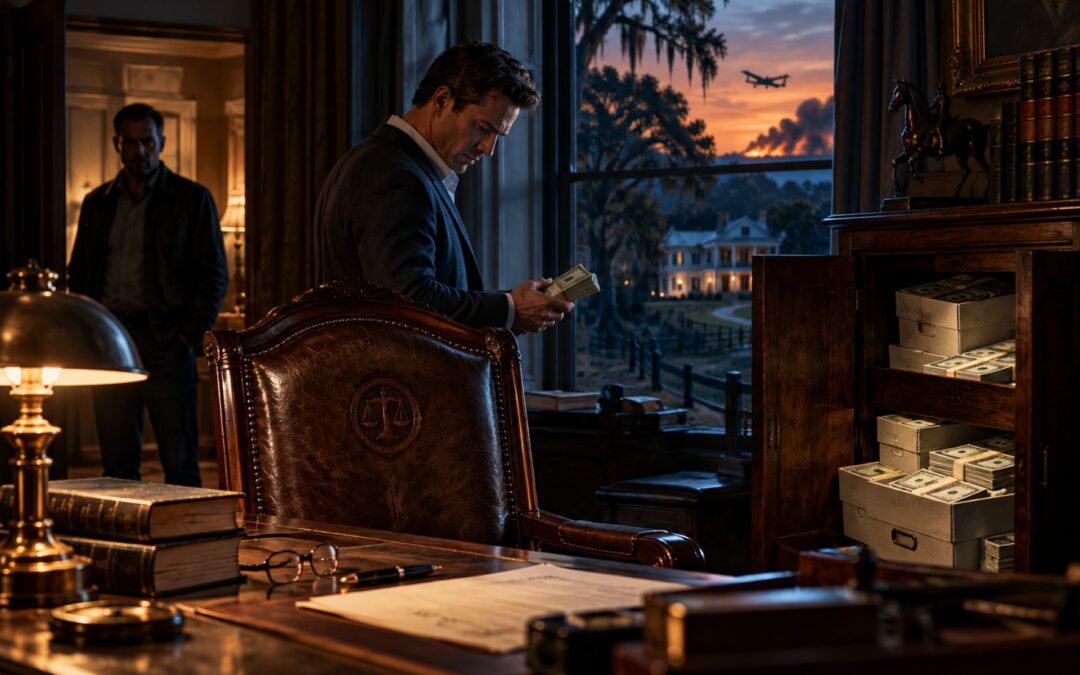
John Grisham’s The Summons begins with a familiar legal-thriller ingredient—a commanding old Mississippi judge—but quickly turns away from the courtroom. The central problem is private rather than public. Ray Atlee, a law professor who has spent much of his adult life distancing himself from his father and hometown, discovers more than three million dollars in cash hidden inside the family home immediately after his father’s death. He does not know where the money came from, whether it is legal, whether anyone else knows about it, or whether he has any right to keep it.
That discovery transforms a family summons into an inheritance mystery, then into a surveillance thriller, and finally into a confrontation between two brothers who have spent years accepting very different roles within the Atlee family. Ray has always been the responsible son. Forrest, his younger brother, has spent much of his adulthood moving through addiction, relapse, rehabilitation, and family disappointment. The novel’s deepest reversal comes when the supposedly responsible brother discovers that money can make him just as capable of secrecy, rationalization, and self-serving moral judgment as the brother he believes needs to be protected from it.
According to Penguin Random House’s publication information, The Summons was originally published in hardcover in 2002. Grisham’s official page for the novel emphasizes its return to Clanton, Mississippi, the fictional legal landscape associated with some of his other work. Yet The Summons is not primarily a courtroom drama. It is a quieter novel about inheritance, secrecy, family hierarchy, legal ethics, addiction, and the difference between knowing what the law requires and finding a moral justification for doing what one wants.
Spoiler warning: This article explains the entire novel, including the source of the money, Forrest’s deception, the fate of Maple Run, and the complete ending.

The Complete Plot of The Summons
The novel unfolds almost entirely through Ray Atlee’s experience, which means the reader learns the truth at the same uneven pace he does. What begins as a trip home to see a dying father becomes a mystery about hidden money, then a question of who is watching Ray, and finally a re-evaluation of the Atlee family itself. The progression matters because Grisham repeatedly allows Ray—and therefore the reader—to settle on explanations that later prove incomplete.
A Summons Home and Judge Atlee’s Death
Ray Atlee is forty-three years old and teaches law at the University of Virginia. His life is orderly but emotionally diminished. His marriage to Vicki has ended, she has left him for a much wealthier man, and Ray has retreated into work and flying. Aviation gives him something much of his personal life does not: clear procedures, solitude, control, and the possibility of leaving the ground behind.
His relationship with his father is more complicated. Chancellor Reuben V. Atlee, usually called Judge Atlee, is a revered former Mississippi judge living at Maple Run, the family home near Clanton. Ray respects his father’s public reputation but has spent years resisting the gravitational force of the Judge’s personality. Judge Atlee is imperious, old-fashioned, intensely attached to the law, and accustomed to being obeyed.
The Judge sends Ray a formal written summons requiring him to appear at Maple Run on May 7. The formality is characteristic enough to be almost comic, but Ray takes it seriously. His younger brother Forrest has received a similar command, or so Ray believes. Forrest’s life has been dominated by addiction, rehabilitation, relapses, disappearances, and repeated family attempts to rescue him.
Both brothers assume the summons concerns their father’s imminent death and estate. There is little reason to expect a significant inheritance. Judge Atlee has spent years giving money away, and Maple Run itself is old, expensive to maintain, and burdened more by family history than by obvious market value.
Ray drives south from Virginia toward Mississippi, returning physically and psychologically to the world he has tried to leave behind. Memories of his father’s courthouse years reinforce the contradiction at the center of Judge Atlee’s personality. He could be harsh, distant, stubborn, and difficult within his family, yet he was also a judge willing to enforce the law even when local opinion demanded something different.
When Ray arrives at Maple Run, the planned family meeting has already become impossible. Judge Atlee is dead on a sofa in his study. The setting is saturated with the Judge’s personality, including relics of Southern and Civil War history, but the most important object in the room is initially invisible.
While examining the study, Ray discovers a concealed cabinet behind the sofa. Inside are twenty-seven boxes from a stationery company. They are packed with hundred-dollar bills.
Ray’s first decisive act is not to call Forrest, Harry Rex Vonner, the police, or an estate lawyer. He hides the boxes before anyone else arrives.
That choice determines much of what follows. At first, Ray can tell himself that he is simply securing unexplained property until he understands what it is. Yet secrecy immediately gives him a private relationship with the money. The cash is no longer simply something his father left behind. It becomes something Ray alone knows about.
He also finds a recently executed one-page will. On its face, the document is simple: what remains of Judge Atlee’s estate is to be divided equally between Ray and Forrest. The contrast is immediate. The official estate appears modest and orderly; the unofficial one consists of millions of dollars hidden beside a dead judge.
The Hidden Cash and Ray’s First Deception
The machinery surrounding Judge Atlee’s death begins quickly. The coroner arrives, funeral arrangements are made, and Clanton prepares to mourn a man who had become one of the town’s civic institutions. Forrest appears, and his behavior immediately reinforces the family roles both brothers know well. He begins drinking and complains about the fortune their father has given away over the years.
Harry Rex Vonner, a local lawyer and longtime family friend, steps into the confusion. Harry Rex is vulgar, funny, practical, observant, and deeply familiar with the Atlees. He knows the family’s strengths and weaknesses without revering them as much as the rest of Clanton tends to revere Judge Atlee.
Ray meanwhile begins physically moving the hidden cash. He removes it from the stationery boxes, stuffs it into garbage bags, and eventually places it in the trunk of his car. While the courthouse fills with people paying tribute to Judge Atlee, Ray is carrying a secret fortune away from the family home.
He eventually counts the money. The total is $3,118,000.
The precision of that number makes the mystery more disturbing. It does not look like a lifetime of casually accumulated savings. It looks like a payment. Ray knows enough about his father’s finances to understand that Judge Atlee could not have earned or saved such an amount through ordinary judicial income.
Ray begins by testing the money rather than reporting it. He takes some bills to a casino, partly to see whether they appear counterfeit or trigger any attention. Casinos seem useful because enormous quantities of cash move through them, but they also introduce one of the novel’s recurring concerns: money that appears anonymous is often observed more carefully than the person carrying it realizes.
Back in Clanton, Ray encounters evidence that someone may have been inside Maple Run. He begins wondering whether the hidden cash was known to someone besides Judge Atlee. Claudia, the Judge’s longtime court reporter, becomes one possible source of answers. Local gossip has long speculated about the exact nature of her relationship with the Judge, but her visit gives Ray little reason to believe she knows about the fortune.
Judge Atlee’s funeral complicates Ray’s developing suspicions. The Judge’s public reputation was not merely an illusion manufactured by office and nostalgia. People have genuine stories of his generosity. One of them, involving Nakita Poole, reveals that Judge Atlee quietly gave money to people who needed help without turning that generosity into public performance.
Harry Rex also reveals another side of the Judge: he sometimes accompanied him to casinos. For Ray, gambling briefly becomes a possible explanation. Perhaps his father, despite the austere image, had won enormous amounts and concealed the winnings.
The financial records do not support that theory. Ray and Harry Rex examine tax returns, accounts, debts, donations, and estate papers. The visible finances of Judge Atlee are consistent with the man everyone thought they knew. There is no ordinary path from his income to $3.118 million in cash.
At this point Ray does something particularly important. He approaches Harry Rex with a hypothetical legal problem. Suppose an executor were to discover a large amount of previously unknown cash. What would happen?
Harry Rex’s answer destroys Ray’s ability to pretend that his uncertainty is purely legal. The money would belong to the estate, with tax and reporting consequences. Ray may not yet know where the cash came from, but he now understands that simply treating it as his private property is not a neutral option.
He keeps it secret anyway.
This is the point at which his moral position changes. Before the conversation, Ray can plausibly tell himself that he is protecting unexplained property until he knows what it is. Afterward, he is knowingly concealing an estate asset while serving as the responsible son and eventual executor.
Surveillance, Storage, and the Search for the Money’s Source
Ray transports the fortune to Charlottesville, handling it with increasing caution. Bringing more than three million dollars in cash into his apartment forces him to confront the physical absurdity of wealth in this form. It is heavy, difficult to hide, impossible to spend normally, and potentially dangerous to explain.
He rents a unit at Chaney’s Self-Storage and disguises the money inside boxes among ordinary possessions. The procedure resembles the conduct of someone hiding criminal proceeds, a fact Ray is intelligent enough to recognize even while continuing it.
At the same time, his ordinary life continues. He teaches law. He thinks about flying and about buying into a Beechcraft Bonanza. Forrest remains a problem on the edge of his attention. Yet the money begins to dominate Ray psychologically even when it is not physically near him.
Then the threat becomes explicit. Ray receives a sympathy card warning him that spending the money would be a mistake and suggesting that the IRS is only a phone call away. The card is postmarked in Clanton.
Now Ray knows—or believes he knows—that another person is aware of the fortune. His list of possible suspects expands and contracts repeatedly. Claudia knew Judge Atlee intimately. Harry Rex knows the estate. Forrest has motive and a long history of instability. Someone else may have known about the Judge’s secret life.
Ray travels to Atlantic City with Fog Newton, a friend and fellow pilot. He uses casinos again to circulate some of the hundred-dollar bills, hoping to learn whether the currency is counterfeit, recorded, or otherwise suspicious. The trip produces no simple answer, but it reinforces how extensively casinos observe people and money.
When Ray returns, he learns that an unfamiliar man calling himself Dolph has been asking questions about him and inspecting his car. What had been a financial mystery is becoming a surveillance problem.
Ray consults an expert from the Bureau of Engraving and Printing under the pretext of academic curiosity. He learns more about counterfeit notes and the limits of tracing ordinary currency. He also repeatedly moves the cash among storage locations because every hiding place eventually begins to feel compromised.
The logistics of the money become a form of imprisonment. Ray cannot deposit it without questions. He cannot spend large amounts without attracting attention. He cannot safely leave it in his apartment, yet every storage unit creates another trail. The fortune promises freedom in the abstract while reducing his freedom in practice.
He hires private investigator Corey Crawford to inspect his apartment and car and help determine whether he is being followed. The fact that a law professor must secretly hire a private investigator to protect money he has not reported shows how completely his identity has shifted.
Meanwhile, Forrest becomes involved in work screening potential plaintiffs for litigation involving a diet drug called Skinny Ben. At first, the subplot seems like another example of Forrest drifting through dubious employment. Later it will connect indirectly to the legal economy that produced Judge Atlee’s fortune.
Ray also goes looking for his brother through Ellie Crum. The search reminds him of the long history that makes his distrust seem reasonable. Forrest has disappeared before. He has relapsed before. Ray and others have repeatedly spent money, time, and energy trying to save him.
This history matters because Ray’s later justification for hiding the cash is not fabricated out of nothing. Giving an addict access to millions of dollars could genuinely be catastrophic. The moral problem is that Ray converts a legitimate fear into the belief that he has unilateral authority to decide what Forrest should know about property belonging to the estate.
Probate proceeds. Ray assumes the role of executor while still concealing the most important asset. He also tests Claudia by inventing a story about finding a smaller amount of money and giving some to her. Her reaction persuades him that she probably did not know about the hidden millions.
The casino explanation also weakens. Ray meets casino-security professionals and discovers how closely serious players and significant winnings are tracked. Their records offer no convincing evidence that Judge Atlee won a fortune through gambling.
Forrest then asks Ray for help entering Alcorn Village, a rehabilitation facility where counselor Oscar Meave has worked with him before. Ray agrees to pay. The request places the brothers in their familiar positions again: Forrest as the troubled dependent and Ray as the capable caretaker.
Shortly afterward, Ray finds the first major documentary clue to the money. While examining Judge Atlee’s records of post-retirement judicial work, he notices a missing file. The Judge had been paid to hear a case on the Mississippi Gulf Coast in January 1999, but the corresponding case materials are absent.
At roughly the same time, Ray’s apartment is broken into. Nothing obvious connects the break-in to the cash, but the timing deepens his fear.
Harry Rex remembers that Judge Atlee did work on the Gulf Coast despite already being in poor health. The missing case begins to seem more important than the gambling theory, Claudia, or ordinary estate irregularities.
Then Ray receives something far more alarming: a photograph of one of his storage units.
Whoever is watching him has followed the money.
Ray immediately removes the cash. He drives, watches mirrors, changes plans, and repeatedly considers where he can hide millions of dollars that apparently cannot be hidden. The unknown observer has taken away the illusion that secrecy gives him control.
Patton French and the Ryax Fortune
On the Gulf Coast, Ray reconstructs the missing case through courthouse records. The dispute involved a pharmaceutical company, Ryax, and the death of a plaintiff represented by an aggressive lawyer named Patton French. Judge Atlee had been brought in to preside over the matter.
The case becomes the key to understanding the fortune. Judge Atlee entered a substantial verdict, and the litigation later became enormously valuable. French and his operation profited spectacularly from subsequent pharmaceutical settlements.
The more Ray investigates French, the more the world of the hidden money begins to make sense. French is not simply a successful lawyer. He operates on a scale entirely unlike the austere legal culture represented by Judge Atlee. His practice turns mass injury litigation into a highly organized business capable of generating extraordinary wealth.
Ray contacts French and identifies himself as Judge Atlee’s son. French agrees to meet him.
The meeting finally solves the first major mystery. French explains that Judge Atlee’s handling of the Gibson/Ryax case helped create the conditions for a vast financial success. Out of gratitude, French decided to give the Judge approximately one percent of what he had made.
The gift was paid in cash.
When Ray reveals that he found $3,118,000, the amount fits French’s explanation.
The discovery is both a relief and a new moral complication. The money is not casino winnings, counterfeiting proceeds, or obviously stolen cash. It came from a real lawyer who deliberately gave it to Judge Atlee. Yet a multimillion-dollar personal payment to a judge connected to litigation that enriched the donor remains ethically disturbing, even if the gift came after the decisive work was done.
French also supplies a suspect for the surveillance. A former associate named Gordie Priest delivered the cash to Judge Atlee. Later, Gordie stole another large amount from French, disappeared, and became connected with criminal associates who tried to extort him.
Gordie therefore seems to answer the second mystery. He knew the Judge had received millions in cash. If he later fell into crime and needed money, he might logically return for it after the Judge’s death.
Ray seizes on the explanation because it fits what he already knows. Someone has followed him. Someone has photographed storage units. Someone knows the cash exists. Gordie had knowledge, motive, criminal connections, and apparent access.
For a while, the mystery feels solved.
It is not.
Fire, False Suspects, and the Collapse of Ray’s Theory
The threat soon becomes physical. Ray learns that an incendiary device has destroyed the Bonanza. Flying has been one of the few areas of his life in which he feels fully competent and independent, so the attack has psychological force beyond the loss of an aircraft.
He also receives another photograph connected to the storage units, accompanied by a warning not to spend the money. In Ray’s mind, Gordie Priest and his criminal associates move from plausible suspects to near certainty.
Then the pursuer issues a direct command.
At Maple Run, a brick crashes through a window carrying a message: put the money back where Ray found it and leave.
By this point the fortune no longer represents opportunity. Ray is frightened enough to surrender it. He returns the cash to the hidden cabinet in Judge Atlee’s study and flees Maple Run.
His escape creates a new problem almost immediately. Ray is stopped for speeding, leaving a record of his movements. Shortly afterward, Maple Run burns.
Because people saw Ray leaving the area, the timing makes him look suspicious. His secretive behavior, which he has always told himself is necessary for protection, now makes him vulnerable. He cannot easily explain why he returned to Maple Run, why he fled, or what he was carrying without revealing the hidden inheritance.
Harry Rex understands how dangerous Ray’s position has become. Eventually Ray tells him the truth.
The confession is psychologically important because Ray finally admits more than the facts of the mystery. He acknowledges that greed has become part of his behavior. Whatever protective arguments he made about Forrest, Ray had begun to think of the money as his. He wanted to keep it.
With the truth finally shared, Ray and Harry Rex continue operating under the assumption that Gordie Priest explains the threats. That theory collapses when Patton French provides new information. Gordie and the criminal associates linked to him were already permanently out of the picture before the latest acts of intimidation occurred.
They could not have burned Maple Run.
They could not have been following Ray in the period he assumed they were.
The external-criminal explanation falls apart, forcing Ray and Harry Rex to reconsider the family.
At the same time, another crucial fact emerges. Lawyer Jacob Spain reports having seen Forrest with Judge Atlee at a clinic shortly before the Judge died. Ray had believed Forrest was elsewhere.
Records connected to the Judge’s morphine treatment make the final days at Maple Run increasingly suspicious. The recently executed will also begins to look questionable. Forrest, supposedly absent and uninformed, may have been much closer to his father than anyone knew.
Ray eventually learns that Forrest has left Alcorn Village and resurfaced at Morningstar Ranch, an expensive rehabilitation facility in Montana. Ray goes west to confront him.
Forrest’s Confession and the Ending
The final confrontation overturns Ray’s understanding of almost every major mystery.
Forrest tells Ray that Judge Atlee contacted him before his death and asked him to come home. Forrest secretly stayed at Maple Run for roughly eight days, caring for his father as cancer and pain reduced the once-commanding judge to physical helplessness.
During that stay, Forrest discovered the twenty-seven boxes of cash.
He found the money before Ray ever saw it.
Instead of stealing it immediately, Forrest decided to leave it in place. He wanted to see what Ray would do. This decision is partly a test, partly revenge, and partly an attempt to challenge the family hierarchy that has always defined Ray as trustworthy and Forrest as irresponsible.
Forrest admits that he typed Ray’s summons while Judge Atlee was heavily medicated. He lied about receiving his own summons. He interfered with the telephone line. He also replaced the Judge’s will with a version dividing the estate equally between the brothers.
These admissions reveal that the legal documents Ray regarded as evidence of his father’s final intentions were themselves part of Forrest’s manipulation.
The most serious issue concerns Judge Atlee’s death. Forrest acknowledges helping his dying father with morphine. As the Judge became weaker, Forrest pressed the medication control when the Judge could no longer manage it himself.
Ray immediately recognizes the darker implication. Did Forrest cause their father’s death?
Forrest denies murder. He insists that cancer killed Judge Atlee.
The novel does not give Ray—or the reader—enough evidence to replace that denial with certainty. Forrest’s conduct occurred during extreme terminal suffering, and his description can be understood as assistance with pain relief. It also creates an unresolved question about agency, dosage, intent, and the precise moment of death.
Forrest admits more clearly to the surveillance operation. He hired two men he knew from prison to follow Ray. They used a GPS device to track him and observed the movement of the cash. This explains why Ray’s storage units seemed mysteriously compromised and why his unknown pursuers could follow him with such precision.
The fires remain less explicit. When Ray asks who burned the Bonanza and Maple Run, Forrest refuses to provide a clean confession. His comments strongly implicate him or the men working for him, but Grisham does not convert implication into an admitted fact.
Forrest now controls the money. He is using some of it to pay for a long stay at Morningstar Ranch, where he claims to be seriously attempting recovery.
The moral reversal is deliberate. Ray spent much of the novel believing that he had to protect Forrest from wealth. Now Forrest presents himself as the person who must protect Ray from it. Both brothers have claimed the authority to decide what the other should be allowed to possess.
They do not reconcile in any conventional way. Too much has happened, and neither brother emerges morally clean. Yet the ending is not complete estrangement either. Forrest makes a small gesture of contact, touching Ray lightly on the shoulder, and suggests that they meet again after a year.
The money has exposed what the family was hiding, but the final scene leaves open the possibility that the brothers might eventually construct a relationship less dependent on the roles imposed by their father.
Clanton, Charlottesville, and the World of the Novel
Place matters in The Summons because Ray’s movements are also movements between identities. Clanton represents the world he inherited: Judge Atlee, Maple Run, courthouse culture, family reputation, local memory, and the expectations attached to the Atlee name. Charlottesville represents the life Ray deliberately built elsewhere, where he can be Professor Atlee rather than primarily Judge Atlee’s son.
Clanton is familiar territory in Grisham’s fictional Mississippi, including his earlier Clanton novel A Time to Kill. In The Summons, however, the setting functions less as a stage for a public trial than as the repository of a family’s past. Everyone knows something about Judge Atlee, but public familiarity does not produce genuine knowledge of the private family.
Maple Run is the most important physical setting. It is large enough to embody inheritance and decayed enough to show that inheritance becoming unsustainable. The house contains the Judge’s authority, his historical obsessions, the sons’ memories, the hidden cash, and the final secrets surrounding his death.
Its destruction therefore matters beyond plot mechanics. When Maple Run burns, the brothers lose the physical structure through which Judge Atlee’s legacy has been organized. What remains afterward is not the dignified family inheritance Ray expected to administer but money, suspicion, forged documents, unresolved grievances, and memory.
Charlottesville initially appears safer because it belongs to Ray rather than to his father. Yet the money contaminates that independence. His apartment is searched, his routines are studied, and storage units around his chosen city become part of the surveillance network.
The Gulf Coast introduces a different kind of legal world. Judge Atlee’s authority came from office, reputation, and austere personal habits. Patton French represents law as enterprise: mobile, wealthy, aggressive, technologically organized, and capable of turning mass injury into enormous financial gain.
Aviation spaces provide another contrast. Ray feels comfortable at airports and in aircraft because they reward procedure, attention, and skill. Flying gives him control over direction and distance, which makes the destruction of the Bonanza particularly effective. The threat reaches into the one domain he believes belongs completely to him.
Finally, the rehabilitation facilities frame Forrest’s story. Alcorn Village represents the familiar cycle of treatment and relapse that has exhausted Ray’s sympathy. Morningstar Ranch, by contrast, is where the final power relationship changes. Ray arrives expecting to confront his failed younger brother and instead discovers that Forrest has been directing the mystery from the background.
Ray Atlee: Greed, Fear, and Self-Deception
Ray is effective as a protagonist because he is neither a criminal mastermind nor a conventionally innocent man trapped by circumstances. He is intelligent, educated, legally knowledgeable, and capable of recognizing ethical problems. His deterioration therefore occurs through rationalization rather than ignorance.
Before finding the money, Ray already has reasons to feel dissatisfied. His marriage has collapsed. His former wife has chosen a wealthier man. His father dominates his family identity even from a distance, and his relationship with Forrest requires periodic responsibility without producing intimacy. Ray’s life is respectable but emotionally narrow.
The cash enters that life as pure possibility. More than three million dollars represents security, revenge against financial humiliation, independence, and the ability to own things he has treated as distant ambitions. Ray does not immediately articulate all of these desires, but the money changes the scale of what he imagines possible.
His first rationalization is temporary custody. He must hide the money until he knows what it is.
His second is protection. Forrest cannot be trusted with millions.
His third becomes practical difficulty. Reporting the money would create questions that Ray cannot answer.
These arguments contain fragments of truth, which is what makes them dangerous. Forrest really is an addict. The cash really is mysterious. Tax and probate issues really would be complicated. Yet each valid concern becomes a reason for Ray to keep control rather than a reason to seek legitimate assistance.
His conversation with Harry Rex is the clearest turning point. Ray specifically asks what an executor should do with undisclosed cash and receives an answer. He cannot later claim he was unaware of his responsibility.
The subsequent secrecy therefore reveals something about Ray’s moral imagination. He begins to believe that understanding the law gives him enough sophistication to manage his way around the problem. Instead, his legal knowledge makes him more aware of what he is doing.
His behavior becomes increasingly contradictory. He is frightened that the money may be criminal, but he does not surrender it. He is afraid someone is watching him, but he continues moving it. He believes Forrest cannot handle wealth responsibly, but Ray himself becomes obsessed with hiding, protecting, and eventually claiming it.
His paranoia is not imaginary. Someone really is following him. Storage units really are compromised. His aircraft really is burned, and Maple Run really is destroyed. The novel therefore refuses to make his fear merely a symptom of guilt.
What matters is how fear and greed reinforce one another. Because someone wants the money, Ray becomes more convinced that it is valuable. Because it is valuable, he becomes more determined to understand and control it. Because he is controlling it secretly, every unexplained event feels potentially connected.
His eventual confession to Harry Rex is important because Ray finally recognizes what has happened internally. He did not simply keep the fortune safe while conducting an investigation. He had started thinking of it as his.
That admission prepares the ending. Forrest’s scheme is cruel and criminal in several respects, but his central accusation against Ray is not fabricated. The responsible son found an estate asset, hid it from his brother, ignored legal advice, and intended to keep it.
Ray’s moral failure is therefore inseparable from the quality that has always distinguished him from Forrest: he believes himself capable of making the responsible decision. The novel exposes how easily responsibility can become entitlement when the responsible person is allowed to define the rules.
Forrest Atlee: Addiction, Resentment, and the Final Reversal
For most of the novel, Forrest exists through Ray’s memories and assumptions. He is the younger brother who has repeatedly wasted opportunities, abused substances, entered treatment, relapsed, vanished, and required rescue. That history is real, not merely Ray’s prejudice.
The mistake is assuming that addiction exhausts Forrest’s character.
By the final chapter, it becomes clear that Forrest is observant, resentful, intelligent, manipulative, and capable of long-term planning. His decision to leave the cash untouched after discovering it is particularly revealing. An uncomplicated portrait of addiction would have him steal the money immediately. Instead, Forrest sees the fortune as an opportunity to test Ray.
That test is morally grotesque in several ways. He forges or replaces legal documents. He interferes with communication. He hires criminals to follow his brother. He subjects Ray to sustained fear and apparently allows the intimidation to escalate toward potentially lethal property destruction.
Forrest therefore has no credible claim to ethical superiority simply because Ray fails the test. His resentment toward Ray helps explain the scheme but does not excuse it.
Yet Grisham complicates Forrest by placing his secret reunion with Judge Atlee before the game with the money. The supposedly unreliable son is the one who comes home to care for his dying father. He sees the Judge physically diminished, helps him through pain, and performs intimate tasks that Ray never knows about.
This hidden period matters because Forrest’s relationship with his father was defined publicly by estrangement. The final days reveal that their bond had not completely disappeared.
His discovery of the cash then activates years of sibling resentment. Forrest believes Ray has always occupied the privileged moral position in the family: older, educated, stable, professionally respectable, trusted. Forrest is the warning story against which Ray’s virtue is measured.
Leaving the cash for Ray to discover allows Forrest to challenge that hierarchy. He wants to know whether Ray will behave as nobly as everyone expects when confronted with temptation.
Ray does not.
Forrest’s manipulation of the will intensifies the same grievance. He believes equality is fair enough to justify manufacturing the legal document that produces it. Like Ray, he transforms a moral argument into permission for deception.
The ending also avoids making Forrest’s recovery simple. Morningstar Ranch may represent genuine commitment, but Forrest has a long history of treatment and relapse. Money allows him access to an expensive, long-term program, yet nothing in the final chapter guarantees that wealth has solved addiction.
That uncertainty is important. Forrest’s final position is not triumph. He has the cash, but he remains an addict trying to survive. He has exposed Ray’s hypocrisy, but only through behavior that confirms many of Ray’s fears about trusting him.
The brothers mirror one another without becoming equivalent. Ray is more stable, more law-abiding in ordinary life, and less overtly destructive. Forrest is more deceptive, dangerous, and willing to use criminals. The point is narrower and more convincing: the moral distance Ray assumes between them is not as absolute as he believed.
Judge Reuben Atlee: Public Virtue and Private Ambiguity
Judge Atlee is dead almost as soon as Ray reaches Maple Run, yet he dominates the entire novel. His authority survives through documents, stories, property, memory, and the behavior his sons learned around him.
Publicly, he was a formidable judge. Clanton remembers integrity, independence, generosity, and commitment to law. The funeral and courthouse mourning show that this reputation rests on real relationships rather than mythology alone.
Privately, the picture is harsher. Ray respects his father but has built a life elsewhere. Forrest’s addiction and estrangement have produced years of disappointment and anger. The Judge appears more comfortable exercising authority than expressing affection.
The hidden cash complicates his image without providing a simple reversal. If the money had been bribe proceeds or stolen funds, the discovery would expose the respected judge as a fraud. Instead, Patton French explains that the cash was given after litigation that made him enormously wealthy.
The circumstances remain ethically troubling. A judge receiving millions of dollars from a lawyer whose case he handled raises obvious concerns about judicial independence and the appearance of impropriety. Yet the novel gives no evidence that Judge Atlee altered the case in exchange for payment.
His generosity also remains genuine. He gave away money throughout his life and quietly helped individuals without using charity to enhance his reputation.
The deeper ambiguity is what he intended for the $3.118 million. He hid it rather than depositing or openly distributing it. He apparently did not incorporate it clearly into his estate planning. By the time of his final illness, his intentions are difficult to reconstruct because medication, weakness, Forrest’s interventions, and disputed documents blur the record.
His final days with Forrest are therefore especially important. The estranged son becomes caregiver to the once-commanding father. The change is almost a reversal of their entire relationship: the person long treated as incapable of responsibility becomes responsible for the Judge’s most basic needs.
Judge Atlee’s death leaves both sons trying to interpret him. Ray wants financial documents to explain him. Forrest has private memories Ray cannot verify. Clanton has a civic legend. None provides the whole person.
That fragmentation makes the Judge more interesting than a simple symbol of old-fashioned integrity. He was capable of public courage and private failure, generosity and domination, legal seriousness and ethically questionable secrecy. The sons inherit those contradictions along with the house and money.
Harry Rex, Patton French, and the Supporting Cast
The secondary characters in The Summons are not developed equally, but several perform essential functions beyond supplying information. Harry Rex connects Ray to Clanton and the practical legal world, Patton French explains the economic machinery behind the hidden fortune, and figures such as Claudia, Fog Newton, Corey Crawford, and Oscar Meave expose different parts of Ray and Forrest that the brothers cannot reveal themselves.
Harry Rex Vonner
Harry Rex is the novel’s most vivid supporting character because he combines usefulness with personality. He is crude, funny, locally connected, and unsentimental about the Atlees. Where Clanton tends to treat Judge Atlee as an institution, Harry Rex knows the family as people.
His practical role is considerable. He helps manage the aftermath of the Judge’s death, interprets estate issues, understands local rumors, assists Ray during the arson crisis, and eventually helps uncover Forrest’s secret presence near the end of Judge Atlee’s life.
He also functions as an ethical reference point. When Ray disguises the cash problem as a hypothetical, Harry Rex supplies a straightforward legal answer. The scene matters because it removes Ray’s ability to treat the situation as completely unprecedented or legally unknowable.
Harry Rex is not presented as morally refined, but he is often more honest about motives than Ray. His vulgarity prevents him from becoming a solemn mentor figure, while his loyalty allows him to occupy some of the space Judge Atlee left empty.
Patton French and Gordie Priest
Patton French represents a radically different version of the legal profession from Judge Atlee. The Judge’s authority comes from office, restraint, local reputation, and institutional legitimacy. French’s comes from organization, risk, settlement leverage, and enormous financial success.
His role is not simply to explain where the money came from. He shows how a case involving genuine injury can become part of an industrial legal enterprise capable of producing fortunes.
French’s gift to Judge Atlee is sincere within his own explanation. He believes the Judge’s work on the Gibson/Ryax litigation was enormously important and wants to reward him. The ethical problem is that French’s generosity operates on a scale that makes ordinary professional boundaries seem fragile.
Gordie Priest functions differently. His biography is almost perfectly designed to become Ray’s preferred suspect. He knows about the cash because he delivered it. He later steals from French. He becomes entangled with criminals.
As a result, Gordie allows Ray to stop investigating the possibility closest to home. The false solution works not because it is absurd but because it is so plausible.
When the timeline later eliminates Gordie, the novel forces Ray to abandon the comfortable idea that an outside criminal has invaded the Atlee family. The threat was already inside it.
Claudia, Fog Newton, Corey Crawford, Oscar Meave, and the Minor Cast
Claudia initially matters because Ray suspects that her closeness to Judge Atlee may conceal knowledge about his private life. Her actual function becomes more interesting when she does not solve the mystery. She helps demonstrate how much of Clanton’s apparent knowledge of the Judge is gossip rather than fact.
Fog Newton belongs to Ray’s aviation world, giving Ray companionship outside the family and legal profession. His presence also makes the Bonanza more than a mechanical object; it is part of a community and identity in which Ray feels at ease.
Corey Crawford externalizes Ray’s paranoia. Hiring a private investigator marks the point at which Ray recognizes that ordinary caution is no longer enough. Oscar Meave, meanwhile, provides a more serious frame for Forrest’s addiction, reminding Ray and the reader that rehabilitation is not merely another family inconvenience but a recurring struggle with high stakes.
Ellie Crum, Jacob Spain, casino personnel, courthouse employees, and other minor characters mostly provide evidence, context, or movement. They rarely demand independent psychological attention, but together they create the network through which private secrets become difficult to keep.
The Atlee Family: Favoritism, Inheritance, and Sibling Rivalry
The central relationship in The Summons is not between Ray and an unknown pursuer. It is between Ray and Forrest, with Judge Atlee’s judgment continuing to mediate their relationship even after his death.
Ray is the older son who succeeded according to conventional measures. He became a law professor, remained professionally stable, and avoided the addictions that repeatedly destabilized Forrest. Those differences are substantial.
Yet family roles often become more rigid than the people inside them. Ray is not merely more responsible; he has come to think of himself as the responsible one. Forrest is not merely an addict; he becomes the problem.
This distinction affects how Ray interprets the inheritance. If the money belongs equally to the estate, Forrest may have a legitimate claim. Ray nevertheless believes Forrest’s addiction gives him a superior moral claim to decide whether Forrest should know about it.
That paternalism contains genuine concern. Millions of dollars could finance catastrophic self-destruction. But concern does not automatically create ownership.
Forrest’s response is equally distorted by family history. He believes Ray’s privileged position has never been adequately tested. When he discovers the hidden cash, he could simply reveal it. Instead, he turns the fortune into an experiment designed to expose his brother.
The result is a struggle over who has the right to define responsibility. Ray believes responsibility means protecting Forrest by controlling information and property. Forrest believes responsibility means revealing Ray’s hypocrisy through manipulation.
Both brothers therefore reproduce something of their father. Judge Atlee exercised authority as though judgment naturally belonged to him. His sons inherit not only property but the habit of making unilateral decisions for other people.
The final irony is that neither brother actually behaves according to the simple role assigned to him. Ray becomes secretive and greedy. Forrest becomes caretaker to their dying father and eventually seeks sustained rehabilitation, while also committing forgery, surveillance, and intimidation.
The family hierarchy does not vanish because its categories were entirely false. It breaks down because they were incomplete.
The Major Themes of The Summons
Grisham’s suspense plot remains readable even if approached simply as a mystery about hidden money, but the novel becomes more coherent when its recurring moral questions are traced across the whole story. The cash matters because it places existing relationships under pressure, forcing characters to reveal what they believe they deserve and what they think they are entitled to decide for others.
Greed and Moral Rationalization
Greed in The Summons rarely appears as open avarice. Ray does not discover the money and immediately announce that he intends to steal it. His possession develops through justifications.
At first, he is protecting the cash. Then he is investigating it. Then he is protecting Forrest. Eventually, he simply wants it.
This progression is psychologically convincing because self-interest usually enters through a language a person can live with. Ray sees himself as intelligent and responsible, so his greed must initially disguise itself as prudence.
Forrest constructs a different moral narrative. He wants to test Ray, correct the unfairness of their family hierarchy, and secure an equal share of the estate. Those motives allow him to describe forgery and manipulation as forms of justice.
Patton French provides another variation. He believes Judge Atlee deserves a share of the fortune that emerged from the Ryax litigation. A personal gift of more than three million dollars therefore feels to French like gratitude rather than corruption.
The novel’s point is not that every character is secretly motivated only by money. It is that money gives existing motives new power. Love, resentment, gratitude, fear, responsibility, and pride all become easier to distort when millions of dollars are available to reward the distortion.
Law, Legality, and Justice
The most effective irony in the novel is that Ray teaches law. He possesses exactly the kind of education that should help him recognize the difference between an estate asset and personal property.
His knowledge does not prevent wrongdoing. It gives him a more sophisticated vocabulary for delaying the moment when he must acknowledge what he is doing.
Forrest’s forged documents develop the same theme from the opposite direction. A will and a summons appear authoritative because legal culture depends on signatures, formal language, and recognizable procedures. Forrest demonstrates how vulnerable that authority becomes when a person understands the form well enough to imitate it.
Judge Atlee and Patton French complicate the relationship between legality and justice further. French’s pharmaceutical litigation can represent compensation for injured people while also generating extraordinary private wealth. Judge Atlee can render an important legal judgment and still create ethical ambiguity by accepting a huge later gift.
The novel therefore avoids equating legality with morality. Laws and procedures matter enormously, but they do not eliminate the need for character. A perfectly formatted document may be forged, a legally knowledgeable executor may conceal an asset, and a successful lawsuit may produce both justice and uncomfortable concentrations of wealth.
Secrecy, Suspicion, and Surveillance
Ray believes secrecy will give him control. Instead, every attempt to conceal the money increases his vulnerability.
The hidden cabinet becomes garbage bags. The garbage bags become boxes. The boxes move into storage units. Storage units produce keys, records, routes, cameras, and opportunities to be followed.
At the same time, Ray begins observing everyone around him. Claudia may know something. Forrest may be lying. Harry Rex might have discovered the secret. An unknown stranger inspects his car.
The surveillance eventually becomes literal. Casinos monitor customers. Corey Crawford conducts counter-surveillance. Ray receives photographs of his own hiding places. Forrest’s associates use GPS tracking.
This accumulation matters because money transforms Ray from a person with a private secret into a person who feels permanently observed. The more he hides, the more evidence his hiding creates.
Forrest’s final revelation completes the pattern. Ray thought he was studying the people around him to determine who could be trusted. In reality, Forrest was studying Ray.
Addiction, Care, and Paternalism
Forrest’s addiction makes The Summons morally more complicated than a simple story about siblings fighting over money. Ray’s fear is grounded in experience. Forrest has repeatedly lost control of his life and required assistance.
If Ray believed that handing millions of dollars to Forrest might kill him, the fear would not be unreasonable.
The problem lies in the leap from fear to authority. Ray assumes that because he understands Forrest’s risk, he may decide unilaterally what Forrest should know and possess.
That is paternalism: concern for another person becoming permission to control the other person’s choices.
Forrest mirrors the same pattern at the end. He effectively suggests that Ray also cannot be trusted with the money and that Forrest must therefore keep it from him.
Neither brother recognizes how closely his justification resembles the other’s.
The treatment settings reinforce this tension. Alcorn Village represents the frustrating cycle through which Ray has watched Forrest repeatedly attempt recovery. Morningstar Ranch creates a new possibility, but the novel wisely does not treat expensive treatment as proof of transformation.
Forrest may genuinely be trying to recover. Ray may genuinely want him alive. Genuine concern and controlling behavior can exist at the same time.
Reputation, Legacy, and the Stories Families Tell
Judge Atlee has several identities. Clanton remembers a great judge. Ray remembers a demanding father. Forrest remembers a father who rejected and judged him. Claudia knows another private version. Patton French remembers the judge who helped produce a transformative legal result.
None of these memories is entirely false.
The hidden cash initially threatens to simplify the story by exposing the Judge as corrupt. Instead, the source of the money produces further ambiguity. His public generosity remains real. His judicial reputation remains meaningful. His acceptance of French’s gift remains uncomfortable.
Families also build stories about themselves. Ray is the success. Forrest is the failure. Judge Atlee is the moral center.
The novel destabilizes all three narratives without replacing them with exact opposites. Ray remains more stable than Forrest. Forrest remains an addict who has caused enormous damage. Judge Atlee remains a respected jurist.
The change is that none of those truths is sufficient by itself.
Inheritance in this sense is not merely money or property. Ray and Forrest inherit narratives about who they are. The hidden fortune becomes powerful partly because it gives both men an opportunity to challenge the story they have been forced to live inside.
The Symbols and Motifs That Hold the Novel Together
The Summons is not heavily symbolic in the manner of a literary novel built around dense recurring imagery, but several physical objects acquire greater significance through repetition. They work because Grisham keeps them closely tied to action: cash must be moved, Maple Run must be entered and eventually destroyed, airplanes allow Ray to escape until one is attacked, and legal documents appear authoritative until their authenticity becomes uncertain.
The Cash
The $3.118 million changes meaning repeatedly.
At discovery, it represents mystery and possibility. Once Ray moves it, it becomes a secret. Once he tries to hide it, it becomes a burden. Once someone begins following him, it becomes a threat.
Its physical form matters. This is not wealth represented by numbers on a statement. Ray must carry it in boxes and garbage bags, store it, count it, transport it, and worry about fire, theft, cameras, fingerprints, deposits, taxes, and suspicion.
The money therefore becomes increasingly incompatible with the freedom wealth is supposed to provide.
It also functions as a moral test, though Forrest’s description of his scheme should not be accepted as neutral. Forrest creates artificial pressure around the money and then judges Ray’s behavior under conditions Forrest himself manipulated.
Even so, Ray’s choices remain his own.
Maple Run
Maple Run represents the Atlee family as an inherited structure. It is old, prestigious, difficult to maintain, and full of memories that neither son can comfortably inhabit.
Judge Atlee’s hidden cash is literally concealed inside the house, making family wealth inseparable from family secrecy.
When Ray returns the money to Maple Run, he attempts to put the problem back where it originated. The gesture fails because inheritance cannot be reversed simply by restoring objects to their former location.
The fire then destroys the house.
What disappears is more than property. The physical setting that organized the family’s history is gone. Ray and Forrest are left with memory, money, accusations, and the question of whether they can relate to one another without the Judge’s house standing between them.
Flying and the Airplanes
Flying is Ray’s clearest form of escape. In the air, he follows systems he understands. Skill produces predictable consequences, and geographical distance can be created quickly.
His desire for the Bonanza is therefore connected to more than consumer ambition. The aircraft symbolizes control and mobility at a moment when Ray feels trapped by divorce, family obligation, and inherited identity.
The destruction of the Bonanza is threatening precisely because it reaches into that sanctuary. Whoever is pursuing Ray can touch not only the cash but the part of his life he believes is separate from it.
Flying remains important at the end when Ray travels west to confront Forrest. What previously functioned as escape becomes a means of moving directly toward the family problem.
Wills, Summonses, and Signatures
The novel repeatedly relies on documents that seem to carry authority.
Judge Atlee’s summons brings Ray home because Ray recognizes his father’s formal voice and authority in it. The will appears to express the Judge’s final wishes. Probate gives those wishes legal consequences.
Forrest’s confession destabilizes all of this. He typed the summons. He replaced the will.
The motif works because legal systems depend on trust in authenticated forms. A signature, document, or procedure matters because people believe it reliably connects text to intention.
Forrest separates form from intention. The documents look legitimate while their authorship and purpose are false.
Ray’s experience therefore becomes a warning against confusing documentary certainty with human certainty. A piece of paper can be perfectly clear while the truth behind it remains obscure.
Morphine, Pain, and Uncertain Agency
Morphine enters the novel through Judge Atlee’s terminal illness and becomes crucial to the ending.
Forrest describes a father in severe pain whose physical independence has collapsed. Helping administer medication can therefore be understood as an act of care.
At the same time, Judge Atlee’s weakness makes questions of consent and agency difficult. If Forrest pressed the medication control for him, exactly how much did the Judge understand? What was medically intended? What did Forrest intend?
The novel refuses to answer those questions completely.
That restraint is important because the ending would become much simpler if Forrest were revealed as an unambiguous murderer. Instead, Grisham leaves the final days of Judge Atlee in the morally uncertain space between caregiving, pain management, desperation, and suspicion.
The Mass-Tort Money and the Novel’s View of the Legal Profession
The source of Judge Atlee’s fortune is essential because it connects the family mystery to Grisham’s larger interest in the legal profession.
Patton French operates in a world of mass claims, pharmaceutical litigation, huge settlements, aggressive recruitment, and contingency fees capable of creating immense personal wealth. Forrest’s Skinny Ben work quietly introduces this world before Ray understands its relevance.
The Gibson/Ryax case provides the bridge. Judge Atlee is brought in to handle litigation involving serious allegations against a pharmaceutical company. His judgment helps create the conditions from which French later profits enormously.
French then gives Judge Atlee roughly one percent of his fortune.
From French’s perspective, the payment expresses gratitude. From an ethical perspective, the arrangement is troubling because judges are expected not only to avoid direct corruption but to protect confidence in their independence.
Grisham does not turn the episode into a legal treatise, and the novel should not be read as documentary proof about mass-tort litigation generally. Patton French is a fictional character built to embody a particular form of legal entrepreneurship.
What the subplot does effectively is juxtapose three ways of understanding law.
For Judge Atlee, law is an institution of authority and judgment. For Ray, it is a profession and intellectual discipline. For French, it is also an industry capable of generating wealth at extraordinary scale.
None of these versions is presented as entirely illegitimate. The tension arises when they overlap.
A genuine injured plaintiff can deserve compensation. A lawyer can legitimately earn a fee. A judge can issue a principled ruling. Yet the system can still generate amounts of money large enough to distort relationships around it.
That distortion eventually reaches the Atlee family. French regards $3 million as a fractional reward. Judge Atlee hides it. Ray steals control of it. Forrest builds a test around it.
The legal case ends, but the money keeps producing consequences.
How Grisham Builds Suspense: Point of View, Pacing, and False Leads
Grisham tells the novel through a close third-person perspective centered overwhelmingly on Ray. The choice is crucial because readers do not receive an objective map of the mystery. They receive Ray’s guesses, fears, and assumptions.
This allows false solutions to feel convincing without requiring narrative dishonesty. Claudia is suspicious because Ray finds her suspicious. Gambling seems plausible because Harry Rex reveals the Judge’s casino trips. Gordie Priest becomes persuasive because French provides facts that genuinely point toward him.
The novel’s short numbered chapters help maintain movement even during procedural passages. Ray counts money, drives, rents storage units, speaks with lawyers, consults currency experts, visits casinos, checks records, and changes hiding places.
These activities create a specific kind of suspense. Much of The Summons does not depend on immediate physical danger. It depends on incomplete information.
Who knows about the cash? Where did it come from? Is it illegal? Has someone entered the house? Who inspected the car? How did anyone find the storage unit?
Grisham repeatedly creates a question, supplies a partial explanation, and then introduces a fact that makes the explanation insufficient.
The structure is especially effective around Gordie Priest. Ray needs a suspect who explains everything, and Gordie appears to provide one. Because the explanation emerges from Patton French’s credible account, the reader has little reason to reject it immediately.
Once Gordie is eliminated by chronology, the novel produces its most important structural turn. The mystery stops expanding outward and folds inward toward Forrest.
The final twist works because earlier details can be reclassified. Forrest’s supposed summons, his absence before the funeral, his addiction history, the phone, the will, the surveillance, and his unexplained movements all acquire different meaning.
The technique is efficient, though not without cost. Ray spends a large portion of the middle of the novel moving money, checking hiding places, testing theories, and worrying about surveillance. The repetition successfully creates obsession, but readers who prefer denser action may feel that the narrative circles the same anxiety too often.
This division appeared in contemporary reception. A Washington Post review by Patrick Anderson praised Grisham’s ability to build an effective commercial story around a simple, compelling premise. By contrast, Publishers Weekly admired the setting, characters, storytelling, and final twist while arguing that the novel is unusually quiet and allows some tension to dissipate too early.
Both responses identify the same underlying feature. The Summons is controlled rather than explosive. Whether that control feels economical or subdued depends largely on what a reader expects from a legal thriller.
The Ending Explained: What Forrest Did and What Remains Unproven
The final chapter resolves the largest mystery while intentionally leaving several important facts unsettled.
Forrest explicitly admits that he returned to Maple Run before Judge Atlee died. The Judge had contacted him, and Forrest spent the final days caring for his father during advanced cancer.
Forrest also admits discovering the twenty-seven boxes of cash before Ray arrived. He did not tell Ray because he wanted to observe what his older brother would do with the money.
He acknowledges typing the summons that brought Ray home. He lied about receiving a similar summons himself and interfered with the telephone line.
He admits replacing Judge Atlee’s will with a document dividing the estate equally between the brothers. Whatever Forrest’s belief about fairness, this is not merely interpretation of his father’s wishes; it is deliberate manipulation of the estate.
He also admits arranging the surveillance. Two men he knew through prison connections followed Ray and used GPS tracking. This accounts for the seemingly impossible precision with which Ray’s movements and storage locations were discovered.
The money ultimately comes under Forrest’s control, and he uses part of it to fund his extended treatment at Morningstar Ranch.
Those facts are clear.
The circumstances of Judge Atlee’s death are not.
Forrest says the Judge was dying painfully from cancer and that he helped with morphine administration when his father had become too weak to operate the medication himself. Ray understands why this creates suspicion, but Forrest denies killing him.
Nothing in the ending gives the reader reliable evidence strong enough to convert suspicion into certainty. Saying that Forrest murdered Judge Atlee goes beyond what the novel establishes.
The arsons are similarly unresolved.
The Bonanza was deliberately destroyed, and Maple Run later burned after Ray returned the money. Forrest’s surveillance operation makes him or his associates the obvious candidates.
Yet when Ray pushes for answers, Forrest does not explicitly confess to setting either fire. His evasiveness and later comments strongly implicate him, but implication is not the same as direct admission.
The distinction matters because Grisham wants Forrest to remain dangerous without turning the ending into a tidy catalogue of solved crimes.
More important than the mechanics of the crimes is the meaning of Forrest’s test.
Forrest has spent much of his life being defined as the Atlee brother who cannot be trusted. Ray has accepted the opposite role. He is educated, stable, professionally respectable, and responsible.
Forrest creates a situation in which Ray can act without immediate supervision and then watches what happens.
Ray hides the money.
He lies by omission.
He moves the fortune out of the estate.
He seeks ways to determine whether it can safely be used.
He continues concealing it after learning from Harry Rex that hidden cash belongs to the estate.
Eventually, he admits that he wanted to keep it.
Forrest therefore exposes a real weakness in Ray’s moral self-image.
That does not make Forrest morally superior. He forges documents, manipulates his brother, employs criminals, and apparently permits a campaign of intimidation severe enough to include destructive violence.
The brothers’ similarity lies not in equal wrongdoing but in a shared pattern of justification. Each decides that the other is less capable of handling the money. Each therefore concludes that he has a special right to control it.
Ray says, in effect, that Forrest must be protected from millions because he is an addict.
Forrest ends by suggesting that Ray must be protected from millions because he became greedy.
The final touch on Ray’s shoulder matters because it keeps the ending from becoming pure condemnation. Forrest does not ask Ray to forgive him, and Ray has no reason to do so immediately.
Their agreement to see each other again after a year creates only a possibility. The family hierarchy has been broken, the house is gone, the father is dead, and the money has revealed both brothers at their worst.
A future relationship would have to begin without the convenient fiction that one brother is simply responsible and the other simply a failure.
A Critical Review of The Summons
The Summons works best when understood as a family suspense novel with legal machinery rather than as a conventional courtroom thriller. Its great strength is the clarity of its premise. A law professor finds $3.118 million beside his dead father and must decide what to do before he knows where it came from or who else knows it exists.
Grisham extracts considerable narrative mileage from that simple problem because the money changes function as the story proceeds. It begins as treasure, becomes evidence, then burden, then bait, then threat.
Ray is well chosen as the character through whom to experience the problem. He is knowledgeable enough to understand the risks, respectable enough to believe he is above ordinary criminal behavior, and dissatisfied enough to be tempted.
His gradual moral deterioration is more convincing than a sudden transformation would have been. Grisham rarely needs to make Ray declare himself corrupt. The practical decisions reveal it.
Harry Rex is another major strength. His humor prevents the novel’s procedural passages from becoming entirely dry, while his loyalty and legal competence make him more than comic relief.
The Mississippi setting also gives the story weight. Clanton feels like a place where public reputation accumulates over decades, which is important because Judge Atlee’s reputation becomes part of the mystery. Ray is not merely discovering something unexpected about a dead father; he is discovering something that seems incompatible with an entire town’s understanding of the man.
The Patton French material is effective for similar reasons. It solves the origin of the money without reducing the answer to straightforward crime. The reader receives an explanation that is plausible, ethically uncomfortable, and deeply connected to Grisham’s established interest in legal systems and the money around them.
The final reversal is the novel’s strongest structural achievement. Forrest’s confession changes earlier events without requiring Grisham to introduce a completely new conspiracy in the closing pages.
The twist also serves character rather than existing only for surprise. Forrest is the most important possible answer because the story has always been about the Atlee family, even when Ray believes he is dealing with unknown criminals.
At the same time, the novel’s middle can feel repetitive. Ray hides the money, moves it, worries about it, checks whether he is being followed, considers another suspect, and moves the money again.
That repetition has thematic value because it demonstrates how possession becomes imprisonment. It does not always produce equal narrative momentum.
The book is also unusually restrained in physical action compared with some legal thrillers. Threats accumulate, but Ray spends more time investigating and worrying than fighting or fleeing immediate attackers.
Readers who enjoy procedural suspense may appreciate this. Readers expecting a faster conspiracy thriller may feel that the premise promises more overt danger than the book eventually delivers.
Several supporting characters are thin. Claudia is intriguing but primarily functional. Ray’s ex-wife shapes his emotional starting point without becoming a substantial presence. Corey Crawford, Fog Newton, and Oscar Meave each contribute useful dimensions but remain clearly secondary.
Forrest himself creates a plausibility challenge in retrospect. His history has conditioned both Ray and the reader to see him as unstable and unreliable. The ending asks us to accept that he was also capable of organizing a sustained surveillance operation, manipulating documents, coordinating criminal associates, and maintaining control of a complicated scheme.
The contradiction is not impossible; addiction does not erase intelligence. Still, the scheme requires a level of organization that the earlier portrait of Forrest only partially prepares.
The ethical implications of Patton French’s payment to Judge Atlee could also sustain deeper examination than the novel gives them. A multimillion-dollar gift from a lawyer to a judge connected to enormously profitable litigation raises serious questions even if no quid pro quo existed.
Grisham uses the gift primarily as the answer to the money mystery and as a contrast between legal cultures. The potential institutional scandal remains secondary.
The unresolved arsons are another interesting limitation. Ambiguity gives the ending unease, but readers who want the mystery mechanically solved may reasonably feel that Forrest should either confess or provide a clearer account.
The ambiguity surrounding Judge Atlee’s death works better because it is attached to a genuine moral problem. Forrest helping a terminally ill father with morphine cannot be reduced easily to either murder or uncomplicated caregiving.
Stylistically, Grisham remains highly accessible. The prose is direct, chapters move cleanly, legal concepts are introduced without overwhelming the story, and scenes rarely become difficult to follow.
That accessibility can be undervalued because it does not call attention to itself. The Summons is not trying to produce ornate language. Its craft lies in making a reader continually ask the next practical question.
Where did the money come from? Who saw Ray move it? Why is someone photographing the storage units? Is Gordie alive? Why was Forrest near Judge Atlee before the death?
The strongest version of the novel exists in those questions and in the eventual realization that the most important question was different: what will each Atlee brother allow himself to do when he believes he is the person entitled to make the decision?
That is enough to make The Summons more interesting than its thriller mechanics alone.
Is The Summons Still Worth Reading?
The Summons remains worthwhile for readers who enjoy Grisham’s legal settings but do not require a courtroom battle at the center of the story. Its pleasures come from an inheritance mystery, procedural investigation, gradual paranoia, and the moral deterioration of a protagonist who understands the law well enough to know when he is rationalizing his way around it.
The novel is especially effective for readers interested in family conflict. Ray and Forrest are more important than the external suspects because the hidden money exposes an old hierarchy between the successful son and the addicted failure. The final revelation works not because it proves that they were secretly identical, but because it destroys Ray’s comfortable belief that responsibility automatically makes his judgment morally superior.
Readers looking for constant action may find the middle sections slow, and those who want every mystery closed cleanly may be frustrated by the remaining uncertainty around the fires and Judge Atlee’s final hours. The novel also leaves some potentially rich ethical questions, particularly the Judge’s acceptance of French’s gift, less fully explored than they might have been.
Even with those limitations, the central construction is strong. Grisham takes a box-of-money premise that could have remained a simple thriller device and uses it to expose the private logic of a family in which everyone believes someone else needs to be judged, protected, or controlled.
By the end, the most consequential inheritance is not the $3.118 million. It is the Atlee habit of claiming authority over other people while believing that authority is justified by superior judgment. Ray and Forrest both inherit that tendency from a father whose entire life was built around being the person who decided.
The fire destroys Maple Run, and the old family arrangement disappears with it. What remains is two brothers who finally know enough about each other—and themselves—to make their old roles impossible. Whether they can build anything better after a year apart is left unanswered, but that small possibility gives the ending its final note of humanity.
Last Updated on September 28, 2026 by Aseem Gupta