
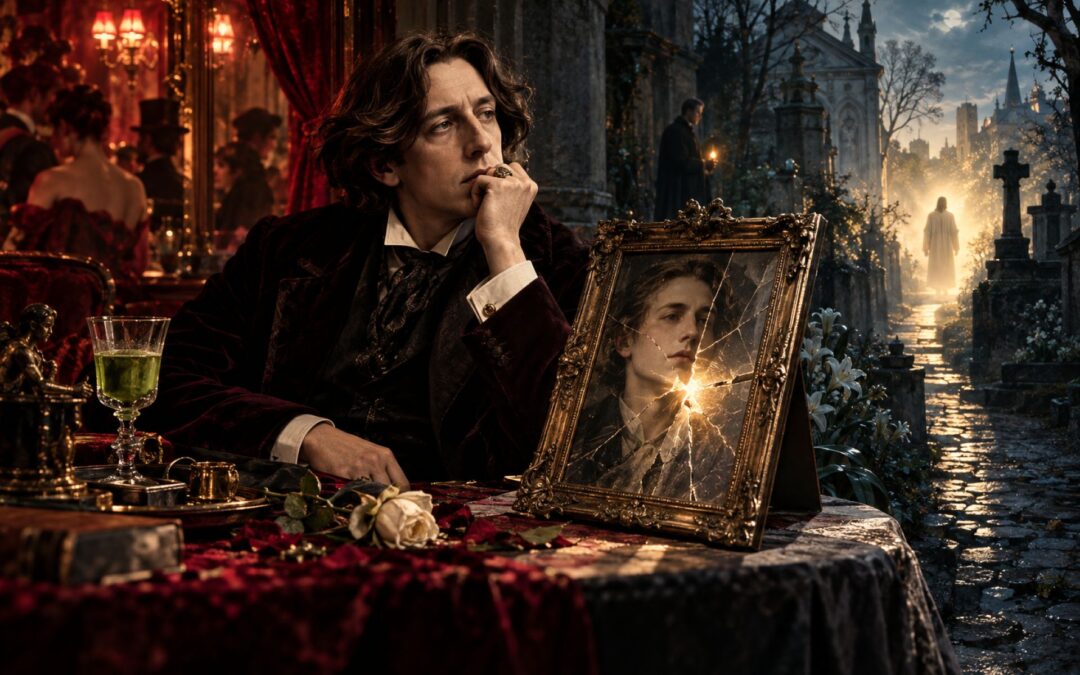
Ravi Zacharias’s Sense and Sensuality begins with an unusual literary experiment: Oscar Wilde is dying in a cheap Paris hotel when his failing consciousness carries him into an imagined final conversation with Jesus Christ and, eventually, Blaise Pascal. Wilde’s wit, aestheticism, sexual history, imprisonment, writings, grief, and fascination with Christianity become the raw material for a Christian argument about pleasure. Zacharias’s central claim is not that pleasure is inherently corrupt. It is that pleasure becomes destructive when detached from the purpose, moral order, and personhood that supposedly give it meaning.
That premise makes Sense and Sensuality more complicated than a conventional work of apologetics. It is partly fiction, partly philosophical dialogue, partly literary criticism, partly biography, and partly sermon. It uses Wilde’s own writings—above all The Picture of Dorian Gray—to suggest that he understood artistically what he failed to live morally. It then moves from pleasure and freedom to law, imagination, sexuality, suffering, the Cross, and grace.
The method also creates the book’s greatest difficulty. Zacharias is free to make his fictional Wilde concede precisely what the argument needs him to concede, while historical claims about Wilde are mixed with imaginative reconstruction and theological interpretation. Later scholarship has also complicated important parts of the portrait Zacharias inherited, especially claims that blur Wilde’s relationships with adult men, prostitution, exploitation, and harm to minors. The result is a book that can be rhetorically powerful without always being historically reliable.
Full spoilers follow. The complete imagined conversation, Wilde’s final vision, his request for a priest, and the meaning Zacharias assigns to his death are all discussed below.

What Kind of Book Is Sense and Sensuality?
Sense and Sensuality was originally published by Multnomah in 2002 as part of Zacharias’s Great Conversations series. The original 2002 bibliographic record gives the subtitle Jesus Talks with Oscar Wilde on the Pursuit of Pleasure, while the 2010 Crown/Multnomah ebook edition sometimes renders it as Jesus Talks to Oscar Wilde on the Pursuit of Pleasure. The substance is the same: this is an imaginary encounter in which a historical personality is placed before Jesus so that his worldview can be tested.
Zacharias makes the fiction explicit. His Wilde is assembled from biography, Wilde’s writings, memorable sayings, biblical material, and authorial invention. Pascal enters for a similar reason. Zacharias sees Wilde and Pascal as intellectual opposites: both brilliant, both capable of penetrating self-examination, but one associated with aesthetic autonomy and sensuality, the other with intellectual discipline and religious surrender. Wilde’s imprisonment and reading of Pascal’s Pensées give the pairing an additional connection.
The book is therefore not a biography of Wilde and should not be read as one. Nor is it a neutral Socratic dialogue in which all positions receive equal opportunities to develop. Jesus is the controlling intelligence of the conversation, Pascal largely reinforces him, and Wilde is progressively moved from resistance to recognition, sorrow, and an implied turn toward faith. The dramatic uncertainty concerns how Wilde will respond, not whether Zacharias considers Christianity true.
What gives the book its distinctive shape is that Zacharias does not simply argue that sensual pleasure is sinful. He argues that pleasure itself needs a framework. Human beings are made to enjoy beauty, sexuality, friendship, art, bodily life, and the material world, but these goods become destructive when treated as ultimate. The question running through the dialogue is therefore not merely, “What pleasures are permitted?” It is, “What kind of account of human life can make pleasure meaningful without allowing desire to consume the person who desires?”
That question is carried by Wilde because Zacharias sees him as an especially revealing test case. Wilde pursued beauty, wit, artistic freedom, emotional intensity, and sexual experience while also producing works saturated with guilt, duplicity, damaged innocence, punishment, confession, and spiritual longing. Zacharias treats that contradiction as evidence that Wilde’s imagination perceived truths his lifestyle resisted. Whether that interpretation is fair to the historical Wilde is a separate question, but it gives the book a coherent dramatic premise.
Complete Summary: Oscar Wilde’s Imagined Final Conversation
The central text is not divided into ordinary numbered chapters. After an introduction and prologue, it unfolds as one continuous dramatic conversation. The progression below follows the stages of that conversation rather than inventing chapter divisions the book itself does not have.
Wilde’s Deathbed and the Gardener at Père Lachaise
Zacharias opens the frame in Paris shortly after the September 11 attacks of 2001. Visiting Père Lachaise Cemetery, he finds Oscar Wilde’s monumental tomb and reads lines from The Ballad of Reading Gaol. Two young visitors approach, one of them blind, and ask about another inscription on the monument. Their language barrier prevents a proper explanation, leaving Zacharias reflecting on a larger problem: despite the enormous literature surrounding Wilde, the final condition of his inner life remains uncertain.
He then visits Saint-Germain-des-Prés, where a memorial service for Wilde had been held. Paris is still shaken by the terrorist attacks in the United States, and the church is filled with people seeking consolation. Zacharias connects that collective return to sacred space with his interpretation of Wilde’s own last days. He imagines himself moving backward a century to Wilde’s room at the Hôtel d’Alsace, and the dramatic dialogue begins.
Wilde is physically collapsing. Robbie Ross has come to him, and the dying writer still retains flashes of the wit that made him famous. He jokes about the hotel, his debts, and the wallpaper, but beneath the performance is terror. Morphine provides little relief. He drinks despite medical warnings, spits blood, suffers intensely, and talks about a diagnosis of tertiary syphilis while also doubting it and suspecting that his severe ear problems are more relevant to his meningitis.
His consciousness begins slipping. He sees Père Lachaise, thinks about death, and addresses a gardener. The apparently ordinary figure knows too much about him and reminds Wilde that he spent much of his life avoiding the very encounter he now seeks. Wilde gradually realizes that the Gardener is Christ.
The identification is deliberately symbolic. In the Gospel of John, the risen Jesus is initially mistaken for a gardener; Zacharias uses that association to make the cemetery encounter simultaneously about death and resurrection. Wilde also speaks of his own life as a garden in which he chose the sunlit side while avoiding shadow, discipline, and suffering. His language becomes confessional. The witty aesthete now describes failure, poverty, disgrace, remorse, conscience, and anguish.
Jesus does not begin by comforting him. Instead, he turns Wilde’s intellectual habits against him. Wilde had questioned how a perfect divine being could understand human life, yet he also celebrated the freedom of imagination. Why, Jesus asks, should Wilde’s imagination become suddenly restrictive when considering incarnation? The argument is characteristically Zacharian: the man who defended artistic possibility is accused of using narrow rationalism when the possibility concerns God.
Wilde feels stripped of performance. The verbal masks that once enabled him to dominate rooms no longer protect him. Death has made intellectual games urgent because he no longer has time to treat religious questions as elegant provocations. Jesus offers to walk with him through places connected with his life and thought, and the imagined journey through Paris becomes a journey through the moral architecture Zacharias wants Wilde to confront.
Freedom, Moral Law, and the Prison Wilde Built
The first major dispute concerns freedom. Wilde had resisted moral restriction because he associated authenticity with self-expression and regarded himself as someone for whom conventional rules did not necessarily apply. Jesus argues that Wilde misunderstood the location of freedom. The pleasures Wilde treated as liberation eventually narrowed his choices, damaged relationships, and contributed to conditions he himself experienced as imprisonment.
Prison becomes the book’s governing analogy. Wilde fiercely condemns the brutal treatment he received in prison, including hunger, humiliation, illness, insomnia, and degradation. Jesus does not deny that systems of law can be cruel or that prisoners can be abused. Instead, he asks why Wilde, who demanded rules protecting prisoners from mistreatment, resisted moral rules intended to protect people from one another’s appetites.
For Zacharias, this is a supposed contradiction in Wilde’s idea of freedom. Wilde wants law when he is vulnerable to someone else’s power but rejects law when it restrains his own desires. Jesus compares laws to fences: they may be abused, wrongly positioned, or enforced without mercy, but their proper purpose is to protect goods that can be destroyed. A society that recognizes human capacity for selfishness cannot simply treat every desire as self-validating.
The conversation then enters more controversial territory. Jesus speaks of the effect Wilde’s sexual choices had on younger men and frames sexual law in terms of protection from victimization. Wilde predicts that society will eventually stop legislating sexual choices; Jesus replies that legal change does not automatically make conduct morally good. A culture can revise a law without proving that every action newly permitted is beneficial.
That exchange establishes an important distinction within the book’s own argument, even though Zacharias does not always maintain it carefully. Civil law is limited: it can forbid some actions, punish others, and protect certain boundaries, but it cannot make people virtuous. Moral law reaches further because it concerns the quality of desire and intention. Even perfect legislation could not solve Wilde’s problem if the problem is ultimately what he loves and what he is willing to sacrifice for pleasure.
Wilde’s imprisonment therefore acquires two meanings. The first is historical and physical: he was imprisoned and suffered severely. The second is metaphorical: Zacharias suggests that Wilde built another prison through repeated choices. The more he defined freedom as release from moral limitation, the more his appetites gained power over him. External freedom and internal freedom become two different things.
The dialogue does not present self-control as sufficient, however. Jesus says that law exposes the problem more effectively than it heals it. Someone can understand a rule and still want what the rule forbids. This prepares the later shift from law to grace, but at this stage Wilde is still being led through accusation. He must first recognize that his conception of freedom cannot explain why apparently liberating choices produced guilt, dependency, relational damage, and a sense of being trapped.
The conversation moves toward Saint-Germain-des-Prés, a place with associations for both Wilde and Pascal. Wilde admires the church’s beauty and quiet, and Jesus reminds him that it will soon be connected with his own memorial. The thought of death unsettles him. He had cultivated detachment and irony, but mortality refuses to remain an aesthetic object. What he wants now is not a clever description of death but some reason to believe that it does not have the final word.
Pascal, Art, Beauty, and The Picture of Dorian Gray
At Saint-Germain-des-Prés, Wilde encounters another figure whose old-fashioned coat initially attracts his mockery. A piece of paper is sewn into its lining, containing the record of an overwhelming religious experience centered on “fire,” the God of Abraham, Isaac, and Jacob, and certainty in Jesus Christ. Wilde recognizes the text as Pascal’s Mémorial and realizes that the stranger is Blaise Pascal.
Pascal’s dramatic function becomes clear almost immediately. Wilde and Pascal are both men of exceptional intellect, but Zacharias assigns them opposite trajectories. Wilde distrusted restrictions and treated imaginative freedom as a fundamental good. Pascal valued reason but insisted that reason itself has limits and that human knowledge includes dimensions that cannot be reduced to formal demonstration. He rejects the caricature that faith is simply irrationality.
The contrast allows Zacharias to challenge another form of autonomy. Just as desire cannot create its own moral standards merely because it is intense, reason cannot declare itself the measure of everything merely because it is powerful. Every intellectual discipline works through assumptions, methods, and governing principles. Pascal argues that refusing to acknowledge the boundaries of reason is not rational sophistication but another form of overreach.
The conversation moves to the Louvre, where art becomes the next test. Wilde’s aestheticism treated artistic beauty as possessing a kind of independence from conventional morality. Zacharias responds by asking whether beauty can really be detached from goodness. If art shapes imagination, and imagination shapes desire, then art is not morally inert simply because it is beautiful.
Wilde resists reduction of art to preaching. He understands that art can become lifeless if evaluated only by whether it conveys an approved moral lesson. The book does not entirely deny this. Its argument is subtler: the imagination is a genuine human faculty and beauty is a genuine good, but both exist within a moral universe. The artist may refuse responsibility for what people do with an image, yet images still form possibilities in the mind.
That leads naturally to The Picture of Dorian Gray, which becomes the central literary case study. Wilde’s novel tells of a beautiful young man whose portrait bears the marks of corruption while his visible body remains youthful. Dorian can therefore pursue experience without displaying its consequences to the world. His outward beauty and inward degradation move in opposite directions.
Jesus treats the novel almost as a confession written in advance. Wilde, in this reading, created a story about the fantasy that consequences can be transferred away from the self. Dorian wants the pleasure of corruption without its visible cost, but the portrait records what his face conceals. Zacharias asks why Wilde could imagine that mechanism with such moral clarity in fiction while behaving as though life itself permitted a similar separation.
The novel therefore becomes more than an example. It gives Zacharias the psychological structure of his whole book. The social self can remain witty, beautiful, admired, and sophisticated while another self is being deformed. A person can manipulate appearances, rationalize desires, and use language to escape judgment, yet the inner portrait continues changing. Conscience is the place where the hidden image remains visible.
Wilde concedes that he was better at art than at living. Zacharias pushes the point further: his art sometimes saw beyond his philosophy. In moments of creative honesty, he understood that unchecked appetite could become self-destruction, that beauty could conceal corruption, and that choices could leave marks not immediately visible. His imagination was not merely an accomplice of sensuality; it could also function as a witness against it.
This argument is one of the book’s strongest dramatic ideas because it does not require dismissing Wilde’s genius. Zacharias needs Wilde to be perceptive. The tragedy works only if Wilde genuinely saw something true and then failed to integrate that insight into life. His artistic greatness becomes part of the accusation: the person capable of creating Dorian’s portrait cannot claim complete ignorance of the moral possibilities hidden beneath beautiful surfaces.
From here, the discussion returns to sexuality and harm. Jesus asks whether Wilde’s relationships consistently treated others as complete persons or whether desire sometimes reduced them to instruments of experience. The book moves too easily between different categories—consensual adult relationships, prostitution, unequal relationships, young men, and abuse—but the internal philosophical question is clear. If another person has intrinsic worth, desire cannot be judged only by the intensity or sincerity of the desirer.
The prison metaphor consequently turns inward again. Wilde can condemn a legal system for treating prisoners as less than fully human while also being asked whether he ever treated lovers or sexual partners instrumentally. Zacharias’s answer is that autonomy becomes self-defeating when the freedom of one person depends on reducing the moral reality of another.
Pleasure “Under the Sun”: Desire, Temptation, and the Body
The dialogue next broadens beyond Wilde by introducing Solomon and Ecclesiastes. Jesus describes Solomon as another man who explored pleasure, achievement, wealth, property, sensuality, status, and worldly accomplishment on a vast scale. After testing those possibilities, the biblical speaker describes the result as vaporous and ultimately incapable of satisfying the deepest human need.
The phrase that matters most is “under the sun.” Wilde asks why it keeps returning, and Pascal explains it as a closed horizon: life interpreted only through temporal values, bodily appetites, and what can be accumulated or experienced within the limits of earthly existence. If human beings are nothing more than temporary organisms, then pleasure is necessarily episodic. It occurs, intensifies, and ends.
Zacharias does not conclude that momentary pleasure is therefore worthless. His argument is that its transience becomes a problem when it is asked to carry permanent meaning. Food satisfies hunger temporarily, sex produces a bounded experience, success creates satisfaction that must continually be renewed, and aesthetic delight passes. A finite pleasure cannot become an infinite foundation merely through repetition.
The question is then whether a momentary pleasure leaves the person more integrated or less integrated after it ends. Jesus asks whether the pleasure accords with the way the person has been made and whether it can be remembered without self-betrayal. Pleasure consistent with moral purpose can deepen gratitude, relationship, and desire for the good. Pleasure detached from purpose can produce the opposite pattern: greater appetite with diminishing fulfillment.
This leads to one of the book’s most useful conceptual distinctions. Zacharias argues that durable pleasure depends on moral commitment rather than the other way around. A person who says, “I will remain committed only while this gives me pleasure,” makes commitment subordinate to fluctuating sensation. A person who first commits to what is believed to be good can experience pleasure within a stable structure.
Marriage becomes one of the primary examples. Zacharias does not treat sexual desire as intrinsically shameful; indeed, he insists that sexuality is created and good. His claim is that bodily union acquires its fullest meaning when it expresses a prior covenantal union between persons. Pleasure then becomes the experience of a relationship rather than the sole reason for preserving the relationship.
The discussion turns from social structure to the mechanics of temptation. Wilde wants to know why bodily appetite can be so strong if God created the body. Jesus distinguishes desire itself from desire that has become disordered. The body signals real goods—food, sex, comfort, beauty, companionship—but appetite can detach the good from its proper context and insist that satisfying the immediate urge is the highest available imperative.
Temptation therefore develops through a sequence. Something desirable is perceived; the imagination enlarges it; the mind supplies justification; the will consents; repetition creates habit; habit begins to resemble necessity. The problem is not that human beings possess appetite but that appetite can recruit imagination and reason into its service. Intelligence does not automatically free someone from temptation. It can become a remarkably efficient lawyer for whatever the person already wants.
That point matters especially for Wilde. His wit and verbal intelligence, qualities that gave him enormous artistic power, also make him capable of exquisite self-justification. A crude person may indulge an appetite without philosophy. Wilde can convert the appetite into an aesthetic theory, celebrate transgression as authenticity, and then use the theory to defend the behavior the desire already selected.
Pride consequently becomes deeper than sensuality. The final issue is not simply excessive sex, alcohol, beauty, or sensation. It is the insistence that the self possesses the authority to define the proper place of those goods independently of any transcendent order. Sensuality is one manifestation of autonomy; the more fundamental theological rebellion is the refusal to receive a purpose rather than invent one.
This is also where body and soul become central. Zacharias resists both hatred of the body and reduction of the person to the body. The body matters because Christianity affirms creation, incarnation, and resurrection. But a human being cannot, in the book’s anthropology, be adequately described by bodily sensation alone. Personhood includes moral agency, relationship, memory, conscience, intention, and spiritual destiny.
Sexual ethics therefore become an argument about what a body means. If the body is merely material available for negotiated pleasure, consent becomes the principal boundary. If the body participates in a larger account of created personhood, Zacharias believes sexual meaning also depends on fidelity to that account. The book’s specifically Christian conclusion is that sex belongs within marriage and that desire should be trained by covenant rather than allowed to determine covenant.
Wilde is increasingly receptive because the dialogue connects these abstract claims with his own history. The pleasures he defended did not remain isolated experiences. They affected Constance, his children, his reputation, his financial condition, his relationships, and his own conscience. Whatever one thinks of Zacharias’s sexual theology, the narrative insists on a relational principle: no major appetite is purely private once other persons and enduring commitments become involved.
Constance, Sorrow, the Cross, and Grace
As the conversation narrows toward Wilde’s family, its tone changes. The earlier arguments were often combative, with Wilde challenging restrictions and Jesus exposing contradictions. When Constance enters the discussion, the issue becomes harder to aestheticize. Wilde must consider not merely whether society treated him unfairly but what his choices meant for those attached to him.
He remembers the collapse of his family life and the sorrow that followed his public disgrace. The book uses these losses to shift from abstract guilt to grief. Wilde can argue about freedom when discussing principles, but memories of people he loved resist easy theoretical defense. The moral question becomes less “Was I entitled to desire this?” and more “What did the pursuit make me willing to lose?”
Yet sorrow is not presented simply as punishment. Zacharias draws on Wilde’s own prison-era reflections to suggest that suffering changed his perception. In prosperity and social success, he could protect himself through wit, performance, and admiration. Prison removed those protections. Humiliation, illness, loneliness, and loss created an unwanted form of attention: he was forced to confront himself without the audience that had once rewarded his persona.
Wilde describes sorrow as holy ground. Zacharias seizes on that phrase because it allows him to distinguish pain from meaninglessness. Pain is not automatically good, and much of Wilde’s imprisonment was cruel, but suffering can destroy illusions that pleasure preserves. The man who once treated sorrow as an enemy begins to recognize that it made certain forms of self-deception harder to sustain.
The conversation then moves toward another garden: Gethsemane. Jesus contrasts Wilde’s garden of chosen pleasure with the biblical garden in which Jesus confronts suffering he does not desire. Zacharias emphasizes the meaning of Gethsemane as an oil press and uses the image of olives being crushed to symbolize the approaching crucifixion. The contrast is between a will trained to escape unwanted pain and a will prepared to endure pain for a higher purpose.
The Cross is presented as the answer to a problem that law cannot solve. Law can name a wrong and protect a boundary. It can condemn, restrain, and expose. But if the guilty person has already crossed the boundary, moral instruction alone cannot undo the past. Wilde does not merely need better rules at the end of his life; within the Christian framework of the book, he needs forgiveness.
This is where Zacharias deliberately modifies the discussion of law. Earlier, Jesus defended moral boundaries against Wilde’s hostility. Now he admits the insufficiency of law as a complete spiritual solution. Law can elicit compliance, but it cannot manufacture love. The Cross supposedly does what law cannot: uphold the reality of wrongdoing while making reconciliation possible through grace.
Substitution becomes the governing idea. Human worth is affirmed, Zacharias argues, not by declaring wrongdoing unreal but by claiming that Christ willingly bears its cost. Jesus’s suffering becomes the opposite of exploitative desire. Sensuality takes another person into the service of the self; sacrificial love gives the self for another person’s good.
Pascal’s image of fire returns within this framework. His conversion is not described merely as agreement with a proposition but as a reordered center of desire. Zacharias wants Christian faith to offer more than repression. The person does not conquer sensuality by becoming incapable of pleasure; lesser desires are reorganized by a greater love.
That is the answer the book has been moving toward from the beginning. It started with the claim that God is not against pleasure, then spent much of its middle exposing pleasures that become destructive, and now returns to the original promise. The Christian alternative is not permanent denial for its own sake. It is the idea that created pleasures are most fully enjoyed when they are not forced to become ultimate, because ultimate satisfaction belongs to relationship with God.
The Final Café Scene, the Priest, and Wilde’s Death
The dialogue reaches its dramatic climax in a Paris café associated with Wilde. By this point, he has admitted much of the case Zacharias has constructed against him. The remaining movement must therefore turn intellectual recognition into something like repentance.
A photograph becomes the crucial object. It represents youth, beauty, innocence, and the human vulnerability that the conversation has repeatedly placed against Wilde’s pursuit of experience. Jesus asks Wilde to look not at an abstraction such as “sexual freedom” but at a face. The point is to force moral imagination away from the desiring self and toward the person who may be affected by desire.
Wilde reacts violently. A knife appears in the scene, and he strikes at the image. Then the photograph changes. The face he has wounded becomes the face of Christ.
The symbolism gathers together almost every strand of the book. It reverses The Picture of Dorian Gray: instead of another image secretly receiving the marks of Wilde’s corruption while Wilde remains outwardly untouched, the image now becomes Christ and openly receives the wound. It also turns the abstract doctrine of substitution into a visual event. Wilde’s sin wounds; Christ becomes the one wounded.
The scene is deliberately theatrical rather than philosophically subtle. By this point Zacharias is no longer developing a new argument. He is converting argument into image. The Cross, previously explained through law and grace, is now dramatized as a face taking the blow Wilde directs elsewhere.
Wilde awakens in the hotel room with Robbie Ross beside him. The boundary between dream, hallucination, spiritual vision, and authorial fiction is left intentionally porous inside the drama, though the reader knows Zacharias has invented the conversation. Ross assumes Wilde’s altered consciousness may be part of his illness. Wilde, however, wants to hear The Ballad of Reading Gaol.
The selected material from the poem reinforces themes that the imaginary Jesus has spent the book developing: law, imprisonment, brokenness, guilt, pardon, Christ, the possibility of a contrite heart, and the relationship between blood, judgment, and cleansing. Zacharias treats Wilde’s own poem as another instance of his art moving closer to Christian moral language than his public persona might suggest.
Then Wilde asks Ross to call a priest. He is tired, frightened, and determined to be certain of at least one thing before dying. Zacharias ends the imagined dialogue at precisely the point where fiction can be joined to historical fact: Wilde did receive Catholic rites near the end of his life.
The epilogue recounts Father Cuthbert Dunne’s attendance, Wilde’s death on November 30, 1900, his funeral, his initial burial at Bagneux, and the later transfer of his remains to Père Lachaise. Zacharias does not claim that he can prove the exact condition of Wilde’s soul. He acknowledges the theological uncertainty surrounding a possible deathbed conversion and ultimately leaves judgment to God.
Nevertheless, he gives Wilde’s life a definite moral interpretation. The great waste, in Zacharias’s view, is not simply that Wilde sinned and might have repented late. It is that brilliance, creativity, family, relationships, and years of life were damaged before the possibility of repentance. Grace may forgive the guilty person, but forgiveness does not retroactively transform every earthly consequence into something good.
The epilogue therefore returns explicitly to sexuality. Zacharias argues that sexual pleasure is divine in origin rather than an embarrassing concession to human weakness. What makes sexuality sacred is precisely what makes its misuse serious: something beautiful can be damaged because it has value. The book ends with the claim that fulfillment does not require abandoning pleasure but receiving it within God’s order, and that eternal pleasure is found ultimately in knowing and loving God.
How the Book’s Argument About Pleasure Works
The summary can make Sense and Sensuality seem like a long accusation directed at Oscar Wilde, but its underlying argument is more systematic than that. Zacharias is trying to construct a theory of pleasure by asking what must be true about human beings if pleasure is to be more than an alternating cycle of appetite, sensation, memory, and renewed appetite.
His answer depends on several linked claims. Pleasure needs purpose; freedom needs moral boundaries; imagination affects conduct; the body belongs to a person rather than existing as an isolated instrument; law can identify good and evil but cannot repair guilt; and lasting satisfaction requires a good that is not itself temporary. Christianity supplies the metaphysical framework holding those claims together.
Pleasure, Purpose, and Moral Commitment
The first important point is that Zacharias does not equate holiness with the absence of pleasure. The book repeatedly insists that pleasure is created by God. That matters because otherwise the argument would collapse into a simple opposition between Christian restraint and Wildean enjoyment, with Christianity offering only less life.
Instead, Zacharias distinguishes a good from an ultimate good. Beauty can be good without being God. Sexuality can be good without becoming the governing principle of identity and choice. Art, success, wit, friendship, food, status, physical comfort, and intellectual achievement can enrich life while remaining incapable of bearing the weight of ultimate meaning.
The “under the sun” argument gives this distinction its temporal form. Every bodily pleasure passes. That does not make it false, just finite. The mistake occurs when repetition is expected to turn finitude into permanence. A larger meal cannot abolish future hunger; another sexual encounter cannot make sensation everlasting; greater fame creates no final quantity after which admiration is permanently secured.
For Zacharias, this is why moral commitment has to precede pleasure. If commitment lasts only while it produces sufficient gratification, then sensation governs the relationship. Fidelity becomes conditional on emotional weather. By contrast, commitment creates a stable context in which changing experiences can be interpreted without every decline in intensity becoming evidence that one should leave.
There is a genuine insight here even outside the book’s theology. Many valuable human activities require commitments whose worth is not measured by uninterrupted pleasure: parenting, friendship, craftsmanship, education, physical training, and care for another person all include frustration and sacrifice. Zacharias extends that insight into a specifically Christian claim: human beings flourish when desire is ordered toward objective goods rather than allowing whatever currently feels strongest to determine what counts as good.
His more controversial step is identifying those objective goods with the moral order he believes God has revealed. Once that theological premise is accepted, the rest of the system becomes much tighter. Without it, the argument still raises a serious question—how should desires be ranked?—but does not by itself prove Zacharias’s complete answer.
Law, Freedom, Love, and the Limits of Desire
Wilde’s hostility to restriction allows Zacharias to challenge a familiar definition of freedom: the idea that freedom primarily means absence of external constraint. The book argues that this account is incomplete because a person can be externally free while internally governed by addiction, obsession, fear, vanity, anger, or appetite.
A desire can therefore become a limitation even when nobody forbids it. If satisfying it repeatedly makes the desire stronger while making refusal harder, increasing opportunity may actually reduce practical freedom. Zacharias uses Wilde’s life to dramatize that possibility: the pursuit of freedom from moral boundaries ends, in the book’s interpretation, in forms of dependency, scandal, financial ruin, imprisonment, and remorse.
Law enters as an attempt to preserve goods threatened by individual appetite. The fence analogy is deliberately simple. A fence limits movement, but a fence around a dangerous drop or a vulnerable garden may make meaningful activity possible. The moral question is therefore not whether a boundary restricts freedom—every boundary does—but whether the thing being protected justifies the restriction.
The prison discussion complicates this argument productively. Wilde has good reasons to condemn cruelty within a legal system. Zacharias uses that fact to show that rejecting oppressive law does not require rejecting law as such. One can argue that some laws are unjust, punishments disproportionate, or enforcement cruel while still believing other laws are necessary.
The stronger principle beneath the dialogue is love. Desire asks, “What do I want?” Love must also ask, “What is good for the other person?” Those questions can overlap, but they are not identical. If another person exists only as the object through which the self seeks gratification, then consent alone does not exhaust every possible moral question about the relationship, though consent remains indispensable.
This is where Sense and Sensuality is philosophically strongest and historically weakest. The abstract distinction between appetite and love is important. Yet Zacharias sometimes supports it by moving too quickly among Wilde’s consensual relationships with adults, unequal or commercial relationships, the category of “youth,” and the moral horror of exploiting children. Because those cases differ significantly, an argument about love and responsibility should distinguish them rather than relying on their emotional proximity.
Art, Imagination, Beauty, and Holiness
Wilde is not merely a convenient example of hedonism; he is an artist. That allows Zacharias to connect pleasure with imagination rather than treating temptation as raw bodily impulse. Human beings rarely desire only what is physically present. They imagine, anticipate, embellish, remember, narrate, and justify.
Art can participate in that process because it teaches the imagination what kinds of lives, bodies, relationships, triumphs, and transgressions are possible. Zacharias therefore rejects the idea that art exists in a morally sealed chamber. A novel need not contain a sermon to influence moral perception. Indeed, works that refuse explicit moral instruction may shape sensibility more subtly than didactic works.
Dorian Gray makes this argument unusually effective. Dorian wants beauty without consequence, experience without visible cost, and a permanent separation between appearance and moral history. His portrait becomes the record the social world cannot see. Zacharias reads that mechanism as an imaginative disclosure of conscience.
The interpretation is powerful partly because Wilde’s novel does not need to become a simple Christian tract for the symbolism to work. One can disagree with Zacharias about Wilde’s own intentions while still recognizing that Dorian Gray explores corruption, influence, self-division, secrecy, aestheticization of conduct, and the impossibility of indefinitely escaping consequence.
Zacharias goes further by joining beauty to holiness. Beauty detached from the good can become seductive rather than redemptive; the beautiful surface can hide destruction. This is again an explicitly theological move. It assumes that beauty has an objective relation to a moral order grounded in God rather than being exhausted by aesthetic response.
The book’s own form tests its claim. Zacharias does not simply state doctrines; he relies on dramatic imagery, Parisian settings, Wilde’s wit, the portrait, the cemetery, Pascal’s fire, and the final transformed photograph. In other words, he argues that imagination shapes moral understanding by attempting to shape the reader’s imagination.
Body, Soul, Personhood, and Sexual Ethics
One of the book’s recurring concerns is that Christianity should not be mistaken for hostility toward embodiment. Zacharias does not want the soul to become good because it escapes a bad body. The body belongs within creation and therefore has positive meaning.
The dispute concerns whether bodily appetite is self-interpreting. Hunger tells us that food matters, but hunger alone cannot tell us whether stealing another person’s food is justified. Sexual desire tells us that sexual union is powerful, but desire by itself does not settle every question about fidelity, exploitation, responsibility, commitment, or the meaning of the relationship.
Zacharias uses personhood to resist reduction of sex to sensation. A sexual partner is not merely a body producing pleasure. The person arrives with memory, vulnerability, attachment, hopes, social connections, future consequences, and moral agency. Sexual choices can therefore have meanings that exceed the minutes in which pleasure is experienced.
His constructive answer is covenantal marriage. Within the book’s evangelical Christian framework, sexual union expresses an exclusive commitment between husband and wife. Desire is not denied but placed within a promise that protects the persons involved from becoming disposable when attraction changes.
Readers who do not share that theology may accept some of the diagnosis without accepting the prescription. The fact that sex can involve attachment, power, vulnerability, or long-term consequences does not by itself demonstrate that every morally legitimate sexual relationship must fit Zacharias’s definition of marriage. That conclusion depends on additional theological claims about creation, Scripture, and divine intention.
The temptation framework is more broadly applicable. Desire first presents an object as attractive. Imagination can magnify it, reason can justify it, and the will can repeatedly choose it until habit narrows alternatives. This is a psychologically recognizable model even though Zacharias expresses it in biblical terms.
Wilde’s intelligence makes him the ideal dramatic example because intelligence can serve either self-knowledge or self-deception. The book refuses the reassuring assumption that sophisticated people are less vulnerable to irrational appetite. Sometimes sophistication merely produces more elaborate rationalizations.
Suffering, the Cross, and Grace
If Sense and Sensuality ended with self-control, it would be a moralistic book rather than a specifically Christian one. Its final argument is that moral knowledge is necessary but insufficient because people can understand what is right after they have already done what is wrong.
Suffering first breaks the illusion of autonomy. Wilde loses social status, freedom, health, wealth, family life, and the confidence that wit can control every room. Zacharias does not claim that every painful event is deserved punishment; the book condemns the cruelty Wilde experienced in prison. But it argues that pain sometimes reveals dependencies that pleasure conceals.
Gethsemane then reverses Wilde’s relationship to pain. Wilde pursued pleasure even when it required sacrificing other goods. Jesus is portrayed as accepting suffering in order to preserve a higher good: obedience to the Father and love for others. One model takes; the other gives.
The Cross completes the contrast. Law says that wrong matters. Grace says that the wrongdoer need not be reducible forever to the wrong. Zacharias wants both propositions simultaneously. If grace merely declared wrongdoing irrelevant, it would trivialize the people harmed by it. If justice consisted only in condemnation, forgiveness would be impossible.
Christian substitution resolves the tension within the book’s theology by placing the cost on Christ. That is why the final visual image matters so much: Wilde’s knife lands on Christ’s face. The book condenses atonement into a dramatic proposition that the guilty person’s wound is borne by someone who voluntarily receives it.
Grace also answers the original question about pleasure. Christianity is not presented as the triumph of grim duty over joy. Pascal’s fire represents transformed affection. The person who knows God supposedly gains a good that can order every lesser good because it does not disappear when individual pleasures end.
Whether that theological conclusion is persuasive depends on prior beliefs about God, Christ, revelation, sin, and atonement. But as a piece of internal architecture, the argument is coherent. Pleasure leads to the problem of purpose; purpose leads to moral order; violated moral order leads to guilt; guilt reveals the limitation of law; and grace becomes the proposed answer that law cannot supply.
Oscar Wilde, Jesus, Pascal, and the Other Voices
Because the book is written as dialogue rather than conventional exposition, its arguments are inseparable from its characters. Yet none of the three central speakers should be confused straightforwardly with the historical figure whose name he bears. Zacharias selects, rearranges, paraphrases, and invents in order to create dramatic roles.
Wilde receives the most psychological development because he must travel the greatest distance. Jesus provides authority and direction. Pascal provides intellectual reinforcement. Robbie Ross, Constance Wilde, and Solomon occupy smaller but structurally important positions by anchoring the deathbed, representing relational consequence, and universalizing the problem of pleasure.
The Constructed Oscar Wilde
Zacharias needs Wilde to be several people at once. He is the flamboyant aesthete who despises restrictions, the brilliant writer who perceives moral truth in fiction, the prisoner who learns through suffering, the husband and father who regrets loss, the skeptic attracted to Christ, and the dying man running out of opportunities for evasion.
This makes him dramatically rich but historically unstable. Some of the words Zacharias gives him derive from Wilde’s writings or documented sayings; others are invented to make a theological argument move efficiently. The danger is that a reader unfamiliar with Wilde may remember the fictional synthesis as biography.
The constructed Wilde is also unusually cooperative. He resists, jokes, and argues, but the structure of the dialogue repeatedly requires him to supply evidence against his own worldview. His novels, prison writings, aphorisms, regrets, and family history all become witnesses for the prosecution. Even his greatest literary insights are interpreted as truths he already knew but refused to obey.
That device is rhetorically effective because it prevents Zacharias from appearing merely to lecture Wilde from outside. The argument seems to emerge from tensions already present within Wilde. Yet the same device can become circular: Zacharias chooses the tensions, writes Wilde’s concessions, and then treats those concessions as confirmation that the Christian diagnosis has prevailed.
Still, the book is more compelling because it does not portray Wilde as stupid. His problem is not lack of intelligence. It is fragmentation between what his imagination perceives, what his conscience suspects, what his appetites seek, and what his public philosophy permits him to admit.
Jesus as the Book’s Authoritative Voice
Jesus is not constructed as one debater among equals. He knows Wilde’s past, anticipates his objections, interprets his motives, controls the itinerary through Paris, introduces Pascal, and ultimately explains the theological meaning of Wilde’s suffering. The dialogue is asymmetrical by design.
That asymmetry is not automatically a flaw. Zacharias is writing Christian apologetics, and a Christian author is hardly obligated to suspend belief in Christ’s authority to create artificial neutrality. The relevant critical question is whether the literary form creates the impression that contested arguments have been proved simply because Jesus is made to speak them.
At times, it does. A proposition placed in Jesus’s mouth arrives with theological authority before its reasoning has been independently established. Wilde may object briefly, but Zacharias controls both the objection and the answer. The dialogue therefore works better as a dramatized presentation of a Christian worldview than as a genuinely open philosophical inquiry.
Jesus’s characterization is nevertheless warmer than a mere prosecuting voice. He jokes with Wilde, acknowledges abuses of law, takes suffering seriously, and eventually shifts from accusation toward self-sacrifice. That movement is essential. If Jesus only condemned sensuality, the book’s opening insistence that God is the giver of pleasure would never become convincing on its own terms.
Pascal as Intellectual Counterpoint
Pascal gives Zacharias something Jesus cannot supply in quite the same way: a human example of formidable intellect joined to Christian faith. Wilde cannot dismiss him as someone who believes because he lacks sophistication. The historical Pascal’s achievements in mathematics, probability, physics, and mechanical calculation make anti-intellectual caricatures of faith harder to sustain.
His role in the dialogue is therefore less to introduce a completely different argument than to validate the intellectual respectability of the argument Jesus is already making. Pascal insists on reason while denying that reason can exhaust reality. His famous emphasis on the “heart” is used to name forms of understanding that cannot be reduced to formal demonstration.
Zacharias also makes Pascal a counter-biography. Wilde and Pascal are both intense, brilliant, imaginative men, but one allegedly organizes his life around sensual freedom while the other eventually organizes his around God. Pascal’s “fire” becomes the positive counterpart to Wilde’s appetite: both men are passionate, but the object of passion determines its destination.
This is an important feature of the book’s theology of pleasure. The Christian ideal is not emotional flatness. Pascal is not admirable because he ceases to desire. He is admirable because desire itself has been redirected.
Robbie Ross, Constance Wilde, and Solomon
Robbie Ross grounds the drama in Wilde’s actual final illness. While Jesus and Pascal belong to the visionary conversation, Ross remains beside the bed, caring for Wilde and interpreting his strange behavior from within ordinary reality. His presence lets Zacharias move between the historical death chamber and the invented spiritual encounter.
Constance Wilde is largely present through absence. She represents the human cost that cannot be reduced to Wilde’s own suffering. Zacharias uses memory of her and the children to challenge any account of freedom concerned only with the chooser. Whatever judgments one makes about Wilde’s sexuality or marriage, the collapse of family relationships gives the dialogue a realm of consequence beyond reputation.
Solomon performs another function. If Wilde were the only example, the book could imply that pleasure becomes dangerous because Wilde happened to pursue the wrong pleasures. Ecclesiastes universalizes the issue. Wealth, building, achievement, possession, status, and socially accepted sensuality can also fail to provide ultimate satisfaction.
Together, these secondary figures prevent the story from becoming entirely private. Ross represents loyal friendship, Constance relational obligation, and Solomon the recurring human attempt to make finite goods solve an infinite problem. They expand Wilde’s crisis into Zacharias’s larger claim about human nature.
History Versus Dramatic Invention
The imaginative form gives Zacharias considerable freedom, but Sense and Sensuality repeatedly relies on historical details to make its moral case. Those details therefore matter. A fictional conversation need not be documentary history, but factual claims about Wilde’s death, sexual relationships, criminal conviction, and final religious rites can affect how persuasive the argument appears.
This is also an area where scholarship has advanced since the book first appeared in 2002. A responsible modern reading should neither dismiss Zacharias because every detail is not current nor repeat contested claims simply because they serve the dialogue. The strongest approach is to separate the theological argument from the historical evidence used to dramatize it.
Wilde’s Death, Final Rites, and the Syphilis Question
The book’s opening gives Wilde a doctor who diagnoses tertiary syphilis while allowing Wilde himself to doubt the diagnosis and attribute his illness more plausibly to severe ear trouble. That internal hesitation is important because Zacharias’s introduction nevertheless connects Wilde’s early death rhetorically with bodily destruction caused by indulgence.
Modern medical-historical work makes the syphilis explanation particularly weak. A 2025 review in the British Journal of Dermatology describes the evidence that Wilde had syphilis as extremely limited and reviews the much stronger role of serious ear disease in accounts of his final illness. The UK National Archives account of Wilde’s life and trials records cerebral meningitis as the cause of death and notes the prison injury often associated with his later ear problems.
That means Wilde’s death should not be presented as medically demonstrated punishment for sexual excess. Zacharias’s own dialogue contains enough uncertainty to avoid the crudest version of that conclusion, but the introduction encourages a moralized reading in which physical ruin becomes part of the evidence against sensuality. The later medical record requires greater caution.
The final rites are better supported, though their interpretation is more complicated than the book’s dramatic sequence suggests. Father Cuthbert Dunne did attend Wilde near death and administered Catholic rites. What cannot be established historically is that Wilde underwent anything resembling Zacharias’s elaborate preceding conversation with Jesus or possessed the exact theology the drama places in his mind.
Research into Wilde’s final hours also warns against relying too confidently on later recollections. A UCLA discussion of Joseph Bristow’s archival work on Wilde’s death examines documentary evidence surrounding Dunne, Ross, and later narratives about Wilde’s conversion. The Catholic rites are real; the precise psychological and spiritual process leading to them is much harder to recover.
This distinction strengthens rather than destroys the literary interpretation. Zacharias’s ending works precisely because it takes a historical fact—the dying Wilde received Catholic rites—and imagines a theological interior capable of explaining it. The problem arises only if imaginative plausibility is treated as recovered history.
The 1895 Trials, Same-Sex Desire, and Claims About Young Men
The most consequential historical problem concerns the book’s movement from Wilde’s sexual relationships to claims about young people, victimization, and the need for law to protect the vulnerable. Zacharias is entitled to make an ethical argument about exploitation. The difficulty is that he often places morally different categories close enough together that readers may come away believing the historical Wilde was convicted for predatory conduct involving underage boys.
Modern scholarship requires much more precision. Joseph Bristow’s Oscar Wilde on Trial, built from trial records, correspondence, newspaper reporting, and other documentary evidence, reconstructs the legal cases in detail and situates them within Victorian laws governing sex between men. Wilde’s eventual criminal convictions concerned gross indecency, a legal category used against male same-sex sexual conduct.
A scholarly review of Bristow’s reconstruction in Modern Philology specifically highlights the problem with claims that Wilde preyed on underage boys. Figures sometimes retrospectively described as boys were in fact young adult men; Lord Alfred Douglas, for example, was in his twenties during his relationship with Wilde. That does not mean every relationship Wilde had was ethically uncomplicated. Differences in age, class, money, social power, and commercial sex can raise legitimate questions without being transformed into allegations involving children.
That distinction matters because the emotional force of Zacharias’s argument changes depending on which conduct is under discussion. Consensual sex between adult men, sex involving payment, exploitative behavior toward an economically vulnerable adult, and abuse of a child are not interchangeable moral or legal categories. An argument may condemn more than one of them, but it must still distinguish what actually occurred.
The legal history adds another layer. Wilde was among the men posthumously pardoned under the scheme associated with the Turing Law. The point of the pardon was not to declare that every action of every pardoned person was morally admirable. It was to address historical convictions for same-sex sexual conduct that would not constitute an offence under modern law when the relevant conditions were met.
Current Home Office guidance on disregards and pardons makes those distinctions explicit. The scheme requires, among other conditions, that another person involved was at least sixteen and that the conduct would not remain criminal in the same circumstances today. The legal framework therefore does exactly what a careful discussion of Wilde should do: distinguish obsolete criminalization of same-sex intimacy from conduct that modern law still treats as abusive or unlawful.
This does not require idealizing Wilde. His relationships could be reckless, unequal, commercial, unfaithful, or damaging without turning him into a predator of children. Nor does the correction settle Zacharias’s wider Christian sexual ethic. A person may oppose consensual same-sex relationships on theological grounds while still being obligated to describe the historical evidence accurately.
The distinction ultimately improves the philosophical debate. Zacharias’s strongest moral question is whether freedom and desire should be governed by concern for another person’s good. That question does not need an inflated historical accusation to matter. If anything, conflating homosexuality with victimization weakens an argument that could otherwise be examined directly on its own theological and ethical premises.
Pascal, the Mémorial, and Saint-Germain-des-Prés
Pascal’s role involves a smaller historical problem. Zacharias links Pascal and Wilde through Saint-Germain-des-Prés and describes Pascal’s famous record of his “night of fire” as having been sewn into his clothing. The Mémorial itself is genuine and central to Pascal’s religious biography.
However, the book’s archival presentation should not simply be repeated. The Bibliothèque nationale de France’s documentation of Pascal and the Mémorial provides the appropriate institutional context for the surviving manuscript material. The historical connection among Pascal, his Mémorial, and Paris remains useful, but Zacharias’s church-specific preservation claim should be treated cautiously.
This is a relatively minor issue compared with Wilde’s trials because it does not bear much argumentative weight. Pascal’s real importance to the book is conceptual: he represents reason acknowledging its limits and passion redirected toward God. Correcting the archival detail does not alter that function.
Symbols, Sources, and Dramatic Technique
Sense and Sensuality is most effective when it stops sounding like a debate transcript and allows images to carry the argument. The recurring garden is a good example. Wilde first meets Christ as a gardener in a cemetery, joining death with the Gospel image of resurrection. Later, Gethsemane becomes the second garden, where Christ’s willingness to suffer for the Father’s will reverses Wilde’s pursuit of desire on his own terms.
Prison functions similarly on two levels. Reading Gaol is a historical site of cruelty, shame, isolation, and transformation. Zacharias then turns it into an inward metaphor: Wilde escaped some social restraints only to become imprisoned by desires and habits. The metaphor works because the book does not completely romanticize literal prison; Jesus acknowledges that law and punishment can themselves become abusive.
Fences are the corresponding image for law. Their meaning changes depending on perspective. To someone determined to cross them, they look like arbitrary restrictions. To someone protecting something fragile, they can represent care. Zacharias repeatedly uses that change in perspective to reframe moral law from hostile limitation into the protection of value.
Pascal’s fire symbolizes a different conception of passion. Wilde is not criticized because he feels too intensely while Pascal is praised for emotional detachment. Both are passionate. The question is what their passion is oriented toward. Fire becomes the image of desire that has found an object capable, within the book’s theology, of ordering all lesser desires.
The most important visual pair is Dorian Gray’s portrait and Wilde’s final photograph. In Dorian Gray, the image receives corruption while the beautiful man appears untouched. In Sense and Sensuality, another image again receives a wound—but this time the face becomes Christ’s. Zacharias takes Wilde’s own device and rewrites its theology. Hidden consequence becomes substitutionary grace.
That intertextual method appears throughout the book. Zacharias borrows from Wilde’s fiction, poetry, prison writings, biography, Pascal’s Pensées and Mémorial, Ecclesiastes, the Gospels, and Christian atonement theology. The result often feels denser than the book’s short length suggests because historical and literary material is continuously being repurposed into theological symbolism.
The technique has a corresponding risk. Authentic quotations, close paraphrases, documented sayings, biblical language, biographical reconstruction, and completely invented speech occupy the same dramatic surface. Zacharias tells readers that the conversation is imaginary, but the seamlessness can make it difficult to remember where evidence ends and ventriloquism begins.
Structurally, the book resembles a sermon disguised as a walk through Paris. It begins with death, moves backward through life, establishes guilt, exposes the insufficiency of autonomy, then shifts from law to grace. The geographical movement is less important than the spiritual movement. Paris provides atmosphere; the real itinerary is from self-justification to confession.
The asymmetry is deliberate. Wilde cannot finally defeat Jesus because Zacharias has built the drama around Christian revelation. What preserves some tension is not uncertainty about the winner but uncertainty about whether Wilde will stop performing long enough to accept the diagnosis. The dramatic question is conversion rather than adjudication.
What the Ending Means
The final photograph scene is the book’s compressed theological statement. Wilde has spent the dialogue confronting the possibility that his pursuit of pleasure harmed both himself and other people. When the vulnerable human image becomes the face of Christ after Wilde strikes it, Zacharias joins guilt, victimhood, and atonement in one visual transformation.
Literally, nothing like this is being presented as an independently documented event. Wilde is gravely ill, drifting in and out of consciousness, while Ross remains at his bedside. The visionary encounter belongs to Zacharias’s fiction. When Wilde awakens, the historically grounded deathbed frame resumes.
Symbolically, however, the scene answers Dorian Gray. Dorian’s portrait receives the marks he avoids. Christ receives the wound Wilde inflicts. The difference is voluntary sacrifice. Dorian transfers consequence in order to protect himself; the Christian Christ accepts consequence in order to rescue someone else.
The subsequent reading from The Ballad of Reading Gaol binds Wilde’s own literary language to Zacharias’s interpretation. Prison, brokenness, judgment, sin, pardon, and Christ have already appeared in Wilde’s writing, which allows Zacharias to suggest that the grammar of repentance was available to him before his final illness.
The request for a priest then links fiction to history. Wilde did receive Catholic rites, but the book cannot establish exactly what he believed, understood, or intended internally in those final hours. The archival research on Wilde’s last days supports caution about overly neat conversion narratives.
Zacharias himself ultimately leaves Wilde’s eternal fate unresolved. That restraint matters. The book strongly implies that Wilde is being offered a final opportunity for repentance, but it stops short of announcing a definitive verdict about his salvation.
The deeper ending is therefore not “Oscar Wilde was certainly converted.” It is that the Christian answer to sensuality is meant to culminate not in condemnation but in grace. The man who has spent the book confronting what his desires cost is shown a Christ who, in Zacharias’s theology, absorbs the final cost himself.
Critical Review: What the Book Achieves and Where It Falls Short
Sense and Sensuality should be judged according to what it actually attempts. It is not a scholarly Wilde biography, a neutral history of Victorian sexuality, or a formal philosophical treatise. It is a compact work of imaginative Christian apologetics that uses a famous life and body of literature to ask whether pleasure can provide its own moral and existential framework.
On those terms, it has real strengths. It also has serious limitations, and some have become more visible as Wilde scholarship has improved and as later revelations about Zacharias changed the context in which his arguments about sexuality, hidden conduct, and moral integrity are read.
Strengths: Clarity, Thematic Integration, and Dramatic Memorability
The book’s strongest achievement is integration. Pleasure is not discussed as one isolated vice among many. Zacharias connects it to freedom, law, art, imagination, personhood, sexuality, suffering, conscience, and grace. Each subject grows out of the previous one, giving a short book a surprisingly complete internal architecture.
Wilde is an inspired dramatic choice because his life and writing genuinely contain tensions the book can explore. A crude caricature of hedonism would have produced a far weaker conversation. Wilde gives Zacharias beauty, wit, aesthetic theory, sexual scandal, imprisonment, Christian imagery, remorse, suffering, and Dorian Gray—a novel whose central symbol already concerns the separation between appearance and moral consequence.
The use of Dorian Gray is particularly effective. Even readers who reject Zacharias’s theology can understand why the portrait matters. It creates a concrete image for self-deception, hidden damage, and the wish to enjoy consequences without displaying them. The final photograph then transforms Wilde’s own imaginative machinery rather than introducing an unrelated Christian symbol.
Zacharias also succeeds in distinguishing Christianity from simple anti-pleasure moralism. The book repeatedly returns to the claim that God created pleasure. Its concern is hierarchy rather than eradication: a lesser good becomes dangerous when treated as ultimate. That is a more intellectually serious thesis than “pleasure is bad.”
The law-and-grace progression is likewise clear. Boundaries may identify and protect goods, but rules cannot repair a person who has already violated them. This gives the Christian ending structural necessity rather than allowing the Cross to appear as a devotional attachment after an essentially secular moral argument.
The dialogue format makes these ideas accessible. Abstract discussions about teleology, moral psychology, embodiment, and atonement are translated into gardens, prisons, portraits, photographs, wounds, fences, and fire. The imagery gives the reader something to remember after individual propositions fade.
Finally, Zacharias understands that intelligence does not automatically cure self-deception. Wilde’s brilliance is central to the tragedy because intelligence can rationalize appetite as easily as it can expose it. That observation gives the book continuing psychological interest beyond its explicitly Christian claims.
Limitations: Historical Reduction, Rhetorical Asymmetry, and Sexual Ethics
The largest literary limitation is built into the form: Zacharias controls everyone. He writes Jesus’s questions, Wilde’s resistance, Wilde’s concessions, Pascal’s reinforcement, and the symbolic resolution. That makes the conversation efficient, but it also makes victory too easy.
A genuinely independent Wilde could press harder on several assumptions. Why should temporal pleasure require eternal pleasure to be meaningful? Why must objective moral order take Zacharias’s specifically Christian form? Why should personhood imply his doctrine of marriage? Can art shape moral imagination without being subordinated to holiness? Can a committed same-sex relationship satisfy some of the very relational criteria Zacharias invokes?
Because Zacharias’s Wilde rarely develops the strongest versions of those challenges, readers can mistake dramatic submission for philosophical demonstration. The book often shows how Christian claims fit together more successfully than it proves that no rival framework can fit together.
The historical reduction of Wilde creates a related problem. Zacharias selects genuine elements—recklessness, affairs, family damage, imprisonment, remorse, religious fascination—but organizes them into a near-parable about sensuality. Other parts of Wilde’s world become less visible because they would complicate the moral line.
That is most serious in the sexual argument. Modern historical work does not justify treating Wilde’s relationships with men as though his conviction demonstrated predation on underage boys. The distinction between consensual adult homosexuality, commercial sex, unequal relationships, betrayal within marriage, exploitation, and abuse is morally indispensable.
Zacharias’s general principle—that another human being should not be reduced to an instrument of appetite—does not depend on blurring those categories. Indeed, the principle becomes stronger when applied precisely. Exploitation is wrong because of what exploitation is, not because it can be rhetorically placed next to every form of sexual conduct an author rejects.
The book also occasionally moralizes biography too aggressively. Wilde’s physical decline is easily folded into a story in which bodily indulgence culminates in bodily destruction, yet later medical history gives little confidence to the syphilis narrative. The correction matters because illness should not become a convenient visible symbol of moral guilt without evidence.
There is also a theological circularity in places. Jesus is presented as the supreme interpretive authority, then propositions attributed to Jesus help establish the worldview that makes his authority supreme. For believing Christian readers, that is not necessarily problematic because revelation is part of the starting framework. For readers being persuaded from outside that framework, more independent argument would be needed.
None of these weaknesses makes the book empty. They change what kind of authority it can reasonably claim. Sense and Sensuality works much better as a dramatization of an evangelical Christian understanding of desire than as a definitive explanation of the historical Oscar Wilde.
The Zacharias Context and the Problem of Authorial Credibility
Any contemporary review of a book in which Ravi Zacharias condemns concealed sexual misconduct, exploitation, uncontrolled desire, and moral self-deception must address what became known after his death. Avoiding that context would create a strange silence precisely where the book places the greatest emphasis on integrity between public argument and private conduct.
A 2021 independent investigation commissioned by Ravi Zacharias International Ministries reported significant evidence of sexual misconduct involving massage therapists and confirmed important elements of allegations made against him. The investigators drew on interviews, electronic records, phones and other documentary material, while also noting an unavoidable limitation: Zacharias had died and could not respond to the findings.
Those findings have unusual relevance to Sense and Sensuality because the book repeatedly argues that brilliance can coexist with hidden corruption, that public language can mask private desire, that self-justification does not remove moral consequence, and that another person must not be reduced to an instrument of appetite. Ideas presented through Wilde became painfully applicable to the author’s own reputation.
That does not create a valid logical argument that “Zacharias behaved hypocritically, therefore Christianity is false” or even “therefore every proposition in this book is false.” The truth of a claim is not determined simply by the character of the person making it. A hypocrite can correctly identify a moral principle while failing to live by it.
But authorial credibility still matters in a different sense. Zacharias repeatedly interprets another man’s secret life, describes the mechanisms by which desire rationalizes itself, and presents himself as a trustworthy moral interpreter of sexuality. Later evidence changes how confidently readers can accept that posture. The book now contains an unintended layer of irony that cannot responsibly be removed from its reception.
It may even sharpen one of the book’s strongest insights: intellectual brilliance and moral coherence are not the same achievement. If Sense and Sensuality is right that people can understand truths they fail to embody, that principle has to apply to its author as readily as to Oscar Wilde.
Who the Book Is Still For
The book remains most useful for readers who want to understand a particular evangelical Christian account of pleasure. It provides a concise and memorable explanation of why Zacharias believed Christianity is not anti-desire, why moral commitment must precede lasting pleasure, how imagination can assist self-deception, and why Christian grace is supposed to accomplish what moral law cannot.
It is also valuable as an example of apologetic technique. Rather than presenting a sequence of abstract proofs, Zacharias enters the writings and biography of a cultural figure and tries to locate contradictions within that figure’s own imagination. Students of Christian apologetics can learn from both the strengths and weaknesses of that method.
Readers interested in The Picture of Dorian Gray may also find the reinterpretation stimulating even when they reject it. Zacharias’s use of the portrait as an analogy for conscience and concealed moral consequence is one of the book’s most memorable ideas, and the final photograph offers a deliberate Christian rewriting of Wilde’s image.
However, readers seeking a reliable introduction to Oscar Wilde’s life, the 1895 trials, Victorian homosexuality, or the history of sexual law should not rely on Sense and Sensuality alone. Later documentary scholarship provides a more careful historical foundation, particularly where the book’s moral argument depends on the ages, vulnerability, or legal status of Wilde’s partners.
Readers who want a genuinely balanced philosophical dialogue should also recognize the limits of the form. Jesus and Pascal are not placed at serious risk of losing the argument. The book is better understood as Christianity speaking imaginatively to Wilde than as Wilde and Christianity meeting on philosophically neutral ground.
For Christian readers already sympathetic to Zacharias’s premises, the book can still function as a meditation on desire, commitment, conscience, repentance, and grace. For skeptical readers, its best use may be different: it offers a clear representation of a Christian worldview that can then be tested independently rather than assumed to have been established by the fictional dialogue itself.
Sense and Sensuality ultimately succeeds more as a compact Christian moral drama than as a historical interpretation of Oscar Wilde. Its deepest question remains worth asking: if pleasure is good but temporary, what should govern the way we pursue it, rank it, and sacrifice for it? Zacharias answers that pleasure must be ordered by moral commitment and finally by love of God, because only an eternal good can prevent finite pleasures from being asked to become ultimate.
The book is strongest when it dramatizes that claim rather than when it tries to make Wilde’s biography prove it. The garden, Dorian’s portrait, prison, Pascal’s fire, Gethsemane, and the wounded photograph create an imaginative structure that explains the Christian movement from appetite to conscience, from conscience to law, and from law to grace with unusual economy.
Its weaknesses matter just as much. Wilde is sometimes simplified until the historical person resembles the theological role prepared for him; categories of sexual conduct are not distinguished carefully enough; and later scholarship makes several biographical assumptions difficult to sustain. The subsequent evidence concerning Zacharias himself adds an unavoidable crisis of credibility, even though it does not logically determine the truth of his arguments.
For readers approaching it with those qualifications in view, Sense and Sensuality remains worth reading—not as the final word on Wilde, sexuality, or pleasure, but as a sharply constructed example of how Christian apologetics tries to answer the problem Wilde represents for Zacharias. Its enduring value lies in the tension at its center: pleasure is too real to dismiss, too temporary to worship, and too powerful to pursue without first deciding what a human life is for.
Last Updated on September 29, 2026 by Aseem Gupta