
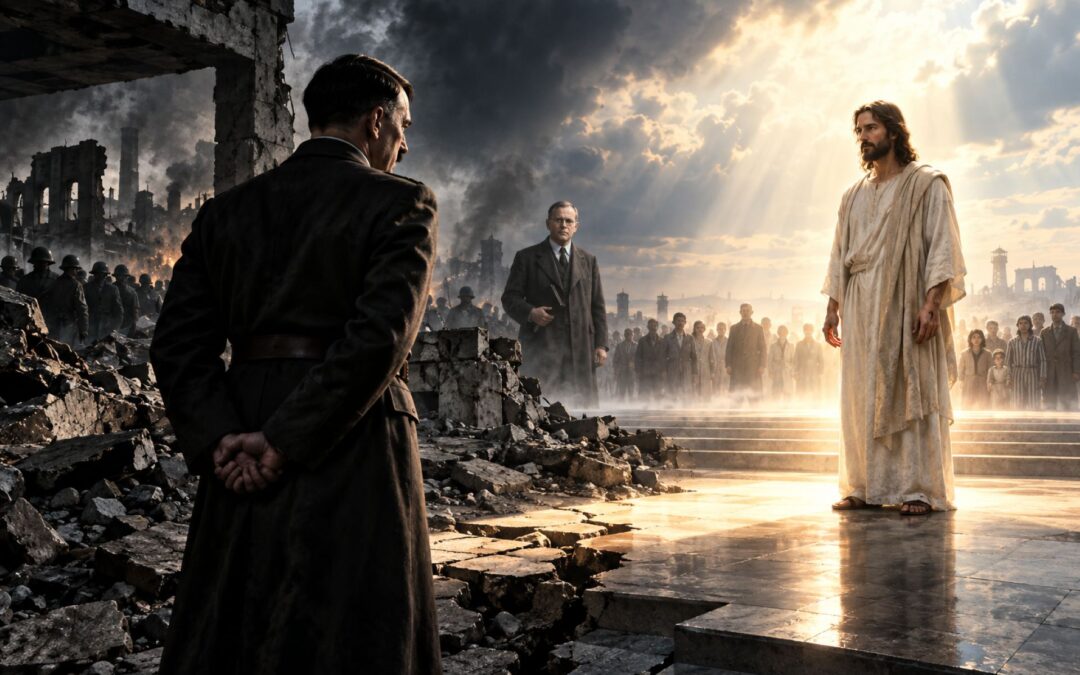
Ravi Zacharias’s The Lamb and the Führer: Jesus Talks with Hitler begins with an extraordinary premise: Adolf Hitler dies in his Berlin bunker and immediately finds himself face-to-face with Jesus Christ. Hitler is allowed to defend himself, victims and former associates testify against him, Dietrich Bonhoeffer enters the discussion as both Christian pastor and would-be resister, and the conversation gradually moves from Nazi Germany into questions about power, human worth, moral law, violence, political authority, repentance, forgiveness, and judgment.
The book is short, but its structure makes a simple synopsis misleading. Almost the entire substantive work appears inside one numbered chapter, yet that chapter moves through several distinct settings and intellectual stages: modern Berlin and Nuremberg, Hitler’s final days in 1945, an imagined afterlife, a courtroom of divine judgment, historical testimony, Christian theology, moral philosophy, and finally the question Zacharias has been preparing from the beginning—whether even Hitler could have been forgiven.
Spoiler warning: this article explains the complete book, including Hitler’s death, the witnesses who confront him, Bonhoeffer’s role, the full theological argument, the appearance of Stalin near the end, Hitler’s final response to the possibility of forgiveness, and the Epilogue.
The book works best when its three central figures are understood as competing visions of power. Hitler represents domination: the right of the strong to determine the value and destiny of others. Bonhoeffer represents responsible resistance: the moral problem of what a person should do when lawful institutions themselves become instruments of oppression and murder. Zacharias’s Jesus represents sacrificial authority: power expressed through service, self-surrender, reconciliation, and a view of human beings as possessing intrinsic worth because they bear the image of God. The book’s most important achievement is turning those differences into a dramatic confrontation; its most important limitation is that the apologetic form sometimes allows disputed historical and philosophical claims to appear more conclusively established than they really are.

What Kind of Book Is The Lamb and the Führer?
First published in 2005 as part of Zacharias’s Great Conversations series, The Lamb and the Führer is neither a conventional novel nor a conventional work of nonfiction. It is an imaginary conversation built around historical people and events, with Zacharias combining documented statements, memoir material, biblical theology, philosophical argument, and dialogue he invents for the purposes of Christian apologetics.
That hybrid form is essential to reading the book fairly. Hitler, Dietrich Bonhoeffer, Albert Speer, Rudolf Höss, Sara Tuvel Bernstein, Helmut Altner, Joseph Goebbels, Eva Braun, and the other historical figures belong to real history. Hitler’s final political testament, Bonhoeffer’s prison writings, concentration-camp testimony, the collapse of Berlin, and the machinery of Nazi persecution provide factual material from which Zacharias builds his drama. Jesus confronting Hitler after death, however, is entirely an imaginative theological construction.
The book openly acknowledges that distinction. Zacharias explains in the Introduction that Hitler’s self-justifying words and Bonhoeffer’s moral struggle could be drawn from historical records, whereas deciding what Jesus would say required a different kind of work. That means the Jesus of the dialogue should not be confused with a transcript of the historical Jesus. He is Zacharias’s interpretation of what Christian Scripture and theology imply that Jesus would say about Hitler, violence, moral responsibility, human dignity, and salvation.
Formally, the book is unusually simple: an Introduction, one long Chapter 1, an Epilogue, and Notes. The chapter nevertheless contains a complete dramatic progression, beginning with two modern visitors discussing Hitler and Nuremberg, reconstructing Hitler’s final hours, moving into his death and judgment, introducing witnesses one by one, bringing Bonhoeffer into the argument, and eventually shifting from history toward theology and philosophy. The summary below therefore follows those genuine movements within the chapter without pretending that Zacharias divided them into separate chapters.
The Complete Story: From Nuremberg to the Court of Eternal Justice
The central narrative begins not with Hitler but with Daniel and Erik, two men moving through the remains of Germany’s Nazi past. Their conversation provides a bridge between historical memory and the imaginary trial that occupies most of the book, allowing Zacharias to begin with the ruins left by political power before asking what judgment of that power would ultimately require.
Nuremberg, Moral Law, and the Question of Forgiveness
Daniel and Erik first stand near the site of Hitler’s bunker in Berlin, where little of the physical structure survives. The disappearance of the bunker already suggests one of Zacharias’s recurring ideas: a political order that proclaimed permanence and dreamed of a thousand-year Reich has almost vanished materially, while the moral questions created by it remain.
They move from Berlin to Nuremberg. Their banter during the journey keeps the opening lighter than the subject matter might suggest, but the tone changes once they enter the Palace of Justice and contemplate the courtroom associated with the postwar trials. The building becomes important not only because Nazis were judged there but because its architecture and symbolism prompt a discussion about law itself.
Daniel and Erik notice religious imagery associated with human disobedience and the Ten Commandments. From those images they begin asking whether there is a law above the laws enacted by states. That question becomes fundamental to the entire book. If the state can legally classify people as inferior, strip them of rights, imprison them, and ultimately participate in their destruction, legality cannot by itself establish morality.
Bonhoeffer naturally enters their conversation because he represents someone who eventually concluded that loyalty to a higher moral duty could place him in conflict with the authorities governing his country. Daniel and Erik also remember the Nuremberg defendants and the recurring defense that people were obeying orders or acting within the system under which they lived.
The discussion then turns from justice to forgiveness. Erik recalls the central moral dilemma in Simon Wiesenthal’s The Sunflower, in which a dying Nazi seeks forgiveness from a Jewish prisoner who cannot bring himself to grant it. That leads to the more extreme hypothetical: what if Hitler himself asked Jesus for forgiveness?
Daniel answers that God could forgive him. Erik is less certain what that would mean, and the tension between them produces the imaginative experiment on which the rest of the book is based. They begin constructing a scene in which Hitler leaves the secrecy of his bunker, dies, and finds himself exposed in a courtroom where the reality he spent his life manipulating can no longer be controlled.
The movement is important because the eventual trial does not begin from the question “Was Hitler guilty?” Zacharias treats that as obvious. The deeper questions are what makes his acts wrong, what authority exists above political authority, why every individual life matters, and whether grace can remain grace if there are people whom it is categorically impossible to forgive.
Hitler’s Final Hours in the Führerbunker
Before Hitler can appear before Jesus, the book reconstructs his final days. Germany is collapsing, Soviet forces are closing on Berlin, and Hitler is receiving increasingly hopeless military reports while remaining psychologically committed to struggle, destruction, and his own historical destiny.
Albert Speer becomes important even before he appears later as a witness. A secretary reads Hitler a memorandum from Speer warning that the war is lost and that the continued destruction of infrastructure will devastate the German people without changing the military outcome. Hitler rejects the logic. He interprets destruction through the same doctrine of strength that has governed his politics: if Germany cannot prevail, he does not want its resources inherited by those who defeat it.
The scene exposes a central contradiction in Hitler’s professed nationalism. He continually claims to embody Germany, yet his identification of the nation with his own success becomes so complete that a Germany capable of surviving him loses its value. Zacharias uses this to show how political devotion can become ownership: the ruler who says he exists for his people eventually behaves as though the people exist for him.
Meanwhile, Hitler remains preoccupied with unrealized architectural dreams, particularly plans concerning Linz, even as the physical world around him disappears. The juxtaposition is deliberately surreal. He continues imagining monuments, cities, national rebirth, and historical greatness while enemy troops are approaching the Reich Chancellery.
He then dictates his final political testament. Rather than reconsidering the antisemitism that helped shape his rule, Hitler carries it into his final political statement, blaming Jews and their supposed international allies for the war and demanding continued adherence to Nazi racial principles. The existence and circumstances of Hitler’s final political testament are documented by the US National Archives, including the attempt to carry copies out of besieged Berlin on April 29, 1945.
The book then follows Hitler into his marriage to Eva Braun and his preparations for suicide. Poison is tested before he commits himself to death, farewells are made, and the remaining members of the bunker wait outside. Hitler shoots himself while Braun uses poison, and their bodies are taken outside and burned as Soviet artillery falls around Berlin.
Zacharias does not treat the suicide as the conclusion Hitler expects. Hitler thinks the gunshot will end his experience and deny his enemies the satisfaction of capturing him. Instead, death strips him of control. He awakens not in silence but in the presence of the one figure he cannot intimidate, manipulate, remove, or redefine.
Readers needing the larger military and political context surrounding Berlin’s collapse can place this final episode within the wider history of World War II, but Zacharias keeps his own focus narrow. The historical catastrophe matters primarily because it delivers Hitler from a world in which he could command others into one in which he must answer for himself.
Hitler Meets Jesus: Power, Race, and Human Worth
Hitler’s first reaction to Jesus is entirely consistent with the character Zacharias has constructed. He demands to know where he is, who is in authority, what rules apply, why people are looking at him, and why he does not have his uniform. Even after death, he tries to organize reality through hierarchy, command, appearance, and status.
Jesus answers that Hitler has entered a different kind of kingdom. His wounds become the visual contradiction of Hitler’s political theology: where Hitler understands authority through the capacity to compel, Jesus presents authority through self-sacrifice. The Führer rose above others by demanding submission; the Lamb accepted humiliation and death.
Hitler attempts to recruit God into his own history. He points to providence, to religious language used by Germans, and to his extraordinary rise from obscurity to national power. If rulers exist only because divine providence permits them, he implies, then perhaps his success itself validates him.
Jesus separates permission from approval. Political power may exist within providence without thereby becoming morally righteous. Hitler’s rise cannot function as proof that his program was good any more than his eventual destruction proves that every action of his enemies was good. Success is not self-authenticating.
Their disagreement over power quickly becomes a disagreement over strength. Hitler regards compassion for the weak as a reversal of nature. Jesus insists that strength is not simply the ability to exert force but the possession of power disciplined by right purpose. The person who can destroy and chooses not to is exercising a form of power that Hitler’s framework barely recognizes.
That contrast gives Zacharias a way to revisit Hitler’s cult of personality. Hitler boasts about the crowds that responded to him, the obedience he commanded, and the fear he could inspire. Jesus treats those accomplishments as evidence not of greatness but of Hitler’s misunderstanding of human beings. Crowds can be manipulated, spectacle can overwhelm judgment, and fear can produce obedience without producing genuine loyalty or moral legitimacy.
The conversation then moves into race. Hitler attempts to defend Aryan superiority, antisemitism, racial struggle, and his authority to remove those whom his ideology classified as dangerous or inferior. Jesus challenges the premise beneath all of them: no ruler, race, state, or historical project possesses the authority to assign ultimate human worth.
For Zacharias, Hitler’s racial ideology is therefore not merely one bad political policy among many. It is the consequence of a false anthropology. Once some human beings can be classified as fundamentally less valuable than others, their rights become conditional, and once their rights are conditional, removing them can be reframed as an administrative or historical necessity.
Jesus confronts Hitler with the graves created by his vision. German soldiers lie dead in Normandy; young men promised a glorious future instead received abbreviated lives and crosses over their graves. Hitler’s own people therefore become evidence against the claim that his politics were simply a ruthless form of patriotism.
The imagined journey also reaches Mauthausen, where victims were reduced to bodies to be worked, degraded, and destroyed. Zacharias keeps returning Hitler from his preferred abstractions—race, destiny, Germany, history, strength—to individual human beings. The whole method of the trial depends on that movement. Ideology speaks in collectives; judgment forces Hitler to see persons.
The Witnesses: Speer, Höss, Bernstein, and Altner
The discussion now becomes an explicit trial. Jesus announces that Hitler has entered the Court of Eternal Justice, where he will receive what his own victims often did not: the opportunity to speak freely and to answer accusations. The irony is central. Hitler is not silenced, tortured, or forced into confession; Zacharias gives him the procedural dignity that his regime repeatedly denied others.
Hitler tries to defend himself through national grievance. Germany had been humiliated after World War I, Versailles had imposed severe burdens, unemployment and instability had devastated society, and he believed his movement restored purpose and confidence. Jesus does not deny that injustice or suffering can occur within history. Instead, he asks why suffering inflicted upon Germans could justify inflicting far greater suffering on people who had not caused it.
Albert Speer is the first major witness. His testimony focuses on the seduction of political spectacle. Speer remembers how Hitler’s rallies combined architecture, light, banners, music, crowd psychology, and carefully staged entrances until politics acquired the atmosphere of a religious experience.
This matters because Zacharias does not portray Nazi power as depending only on fear. Speer represents voluntary fascination. He is an ambitious architect who first receives Hitler’s admiration and then gradually begins admiring Hitler himself, eventually using his own aesthetic talents to enlarge the leader’s image.
The famous Nuremberg spectacle becomes the clearest example. Searchlights turn the night sky into what resembles an enormous cathedral, banners and mass choreography dissolve individuals into a collective body, and architecture makes political power appear transcendent. Speer’s retrospective recognition is that he helped manufacture an illusion and then became susceptible to the illusion he created.
The next witness, Rudolf Höss, represents a colder form of complicity. As commandant of Auschwitz, he appears in the book as a man who can describe mass killing in bureaucratic language and then return to domestic life. The extraordinary moral horror lies precisely in the ordinariness of the administrative mindset: murder becomes a logistical problem involving methods, capacity, efficiency, and orders.
Höss also allows the argument about obedience to become concrete. A person cannot avoid moral responsibility merely by turning atrocity into a professional function. Zacharias’s Court of Eternal Justice is structured around the opposite principle: each individual ultimately answers for what he or she has chosen, even when those choices were authorized by a state or commanded by superiors.
Sara Tuvel Bernstein then shifts the courtroom from perpetrators to a victim. She describes deprivation in Dachau so severe that hunger drives her to search the ground for worms. At one point she sees a horrifying face through a window, approaches it, and realizes that she is looking at her own reflection.
The scene gives Zacharias one of the book’s most effective images of dehumanization. The Nazi system has not merely endangered Bernstein’s body; it has stripped away so much of her ordinary human existence that she initially cannot recognize herself. Hitler responds without compassion, which confirms rather than challenges the case being constructed against him.
Helmut Altner introduces another perspective. He is a young German soldier, not one of the racial enemies around whom Hitler attempts to build his defense. Altner remembers seeing a German civilian hanging publicly with a sign accusing him of cowardice for refusing to fight.
His testimony exposes the cost of Nazi absolutism to Germans themselves. Once the regime equates the Führer, the state, the nation, and moral duty, refusal becomes treason even when continued resistance is pointless. Shame and terror can then be used to make young people participate in destruction long after rational military hope has disappeared.
The witnesses collectively dismantle Hitler’s abstractions from several directions. Speer shows seduction, Höss bureaucratic obedience, Bernstein victimization, and Altner coercion against Hitler’s own population. Zacharias thereby turns a philosophical argument about power into a sequence of human consequences.
Bonhoeffer’s Challenge: Resistance, Conscience, and Responsibility
Dietrich Bonhoeffer is the final and most important human witness. Hitler initially associates him with the July 20, 1944 attempt to kill him and mocks the conspirators for failing. Jesus immediately corrects the chronology within the dialogue: Bonhoeffer was already imprisoned when that assassination attempt occurred.
The historical distinction matters. Bonhoeffer was arrested in April 1943, initially in connection with resistance activities that included efforts to assist Jews and his use of intelligence connections, while evidence tying him more clearly to the wider resistance network emerged after the failed July 20 coup. The US Holocaust Memorial Museum’s account of Bonhoeffer’s resistance and imprisonment records that broader chronology and his eventual execution at Flossenbürg on April 9, 1945.
Zacharias is less interested in conspiracy mechanics than in Bonhoeffer’s moral problem. Bonhoeffer begins from a Christian commitment to peace and from the belief that killing cannot be treated casually as a legitimate instrument. Hitler then creates the case that tests whether such commitments can survive unchanged when a state begins destroying people systematically.
Before addressing violence directly, Bonhoeffer challenges Hitler’s interpretation of providence. Hitler thinks his survival of assassination attempts and his astonishing political rise prove that history itself authorized him. Bonhoeffer counters with Winston Churchill’s survival of a serious accident years before the war. If survival demonstrates providential favor, the same reasoning could be used to argue that Hitler’s eventual opponent was providentially preserved to stop him.
The argument undermines Hitler’s selective theology. Events cannot be called acts of providence only when they advance one’s own ambition. Political success and personal survival are facts requiring interpretation, not divine endorsements conveniently stamped on whichever outcome the ruler prefers.
Bonhoeffer then turns inward. He explains that imprisonment sharpened his question about identity: who is a person beneath reputation, role, fear, social opinion, and public image? Zacharias draws on Bonhoeffer’s prison poem “Who Am I?”, in which the confident man others see conflicts with the fearful and exhausted person Bonhoeffer experiences internally, before identity is finally located in belonging to God.
That becomes the opposite of Hitler’s identity. Hitler defines himself through the office of Führer, the crowds, command, will, conquest, historical destiny, and the power to make others obey. Bonhoeffer defines himself through relationship to God, which means that neither political defeat nor imprisonment can completely determine who he is.
The confrontation then reaches the difficult question Hitler has been waiting to ask. If human life is sacred, how can Bonhoeffer justify involvement in resistance that contemplated Hitler’s death? Does the Christian opponent of killing become morally indistinguishable from the dictator once he decides that one man must be removed?
Bonhoeffer refuses the equivalence. He argues that Hitler first seized control of law, then used law and government as instruments of persecution, then destroyed meaningful mechanisms through which citizens could challenge him. Courts, political speech, institutional resistance, and ordinary appeals to conscience had been corrupted or suppressed.
The result is not a comfortable doctrine of assassination. Zacharias’s Bonhoeffer describes an agonizing conflict in which every available path risks guilt. If he does nothing, innocent people continue dying; if he participates in removing Hitler, he becomes involved in an act he would ordinarily regard as forbidden.
This is where the distinction between moral purity and responsible action becomes central. Bonhoeffer argues that a person can become so committed to preserving personal innocence that he refuses to act while others suffer. Remaining unstained can itself become morally compromised when it is purchased by abandoning people who need protection.
His standard is therefore not simply “my conscience told me to do it.” Reason, conscience, duty, principle, and virtue can all be inadequate when isolated from responsibility to other people. Zacharias presents Bonhoeffer as accepting the possibility of personal guilt while acting to protect life, rather than granting himself sovereign moral authority.
Hitler nevertheless presses the obvious objection: Bonhoeffer wanted him dead. Bonhoeffer replies that he would have preferred courts, lawful removal, persuasion, or public opposition, but Hitler had systematically closed those paths. The assassination problem therefore emerges only after political institutions have ceased functioning as restraints on murderous power.
The exchange gives the book its most serious treatment of political ethics. It prevents Zacharias’s opposition to violence from becoming absolute pacifism and forces the reader to confront a darker reality: sometimes a society’s institutions become so corrupted that obedience to them perpetuates the injustice law is supposed to restrain.
Bonhoeffer does not claim certainty about his own moral purity. That qualification matters. He presents himself as someone acting under responsibility, prepared to bear the consequences and to seek forgiveness if his judgment proves wrong.
Hitler cannot make the same appeal because his use of violence proceeds from a different moral structure. He does not reluctantly violate a principle in order to preserve the lives of others; he denies the equality of those lives in the first place. Zacharias therefore distinguishes tragic resistance from ideological extermination by their premises, aims, scale, targets, and relationship to the moral value of the people affected.
Life, Truth, Relationship, and the Roots of Violence
The dialogue now moves beneath particular political decisions to Zacharias’s theological anthropology. Jesus tells Hitler that before asking how right and wrong should be defined, he should have asked what a human life is. Ethics depends upon anthropology because moral rules about how people may be treated depend upon what people are understood to be worth.
Zacharias’s answer is explicitly Christian. Human beings are created in the image of God and therefore possess a worth that does not originate in intelligence, physical strength, racial membership, social usefulness, citizenship, economic productivity, or political approval. Human value is received rather than assigned.
From there the book moves into Christian claims about Jesus and the Trinity. Zacharias presents God not as solitary power but as eternal relationship between Father, Son, and Holy Spirit. His larger argument is that relationship is not an accidental feature of human existence; it reflects the relational character of the God in whose image humanity is created.
This becomes connected to what Zacharias calls the search for “unity in diversity.” Human beings want social harmony and also experience conflict within themselves. The book claims that political systems cannot finally create unity among people who remain internally divided, because the violence of societies grows from disordered human desires rather than from institutions alone.
The argument is deliberately inward. Hatred begins before murder, lust before adultery, and domination before political oppression. External acts reveal desires already operating within the person.
Hitler admits that relationships were never central to his life. Zacharias turns that admission into another conceptual contrast: Hitler seeks ownership rather than relationship. He wants ownership of himself, his destiny, territory, institutions, other people’s loyalty, and eventually the power to decide who may live within the community he imagines.
Jesus answers with surrender. Within the book’s theology, a person does not become fully human by achieving total autonomy but by surrendering the illusion of self-ownership and accepting relationship with God. Hitler’s refusal to surrender militarily thus becomes symbolic of a deeper refusal: he cannot accept dependence, limits, or authority above himself.
The conversation then turns to naturalism, Darwin, and Nietzsche. Hitler claims that modern thought has undermined Christian definitions of humanity. If human beings are products only of material causes and natural struggle, he argues, why assume that all lives possess equal value?
Zacharias places a sweeping answer in Jesus’s mouth. A purely material account of humanity, the book argues, cannot provide the same foundation for intrinsic human equality that creation in God’s image provides. Hitler’s racial hierarchy is consequently presented as one political expression of a worldview in which human worth is no longer sacred.
Nietzsche becomes particularly important because Hitler invokes claims associated with perspectivism, attacks on equality, and skepticism about objective truth. Zacharias responds by portraying Nietzsche as unable to live consistently without truth and as contributing to an intellectual atmosphere in which stronger human types can assign themselves greater worth.
The book then connects these arguments to the deaths of Joseph and Magda Goebbels’s children. Their killing becomes another example of political ideology consuming individual life. Children who should possess value in themselves instead become subordinate to a political world whose collapse makes continued existence appear meaningless to their parents.
At this stage the book’s line of argument is unmistakable: violence is not primarily explained by weapons or political organization. It begins with what people believe a human being is. If another person is an image-bearer of God, power is morally constrained by that dignity; if the person becomes only material available for historical projects, Zacharias fears that the barriers against domination become weaker.
Politics, Law, Grace, and the Limits of Coercion
Hitler now raises a question that follows naturally from Bonhoeffer’s presence. If Jesus claimed that his kingdom was not of this world, why should Christian clergy have interfered with Hitler’s political rule? Why not leave politics to political leaders?
Zacharias rejects both extremes suggested by the question. Christianity should not be imposed by political force, but religious conviction cannot be made irrelevant to public morality. The book therefore distinguishes politicizing religion from allowing moral beliefs to shape political conscience.
Jesus tells Hitler that rulers possess limited, temporary authority. Political government regulates society, but it does not create the ultimate standard by which justice is defined. That is the principle already foreshadowed in Nuremberg: laws can be formally enacted and still be profoundly unjust.
The historical reality behind this argument is important because Nazi Germany did not simply operate outside law. The regime transformed law. It changed institutions, enacted racial legislation, weakened judicial independence, and encouraged legal professionals to interpret their duties through Nazi ideology and the Führer’s authority.
Zacharias then turns to the biblical pattern of redemption, law, and worship. His Jesus argues that law can expose wrongdoing and restrain conduct but cannot produce inward goodness. A legal system may forbid murder, but no statute can make a person love a neighbor.
That is why Hitler’s love of law and order is insufficient. Order can coexist with evil if the law itself has been corrupted, and obedience can become complicity when the authority commanding obedience has abandoned justice.
The metaphors of salt and light describe the book’s preferred relationship between Christianity and society. Christians should not establish faith by coercion; they should influence their societies through transformed lives, moral witness, persuasion, and participation. The method is slow precisely because it respects human freedom.
Zacharias also allows Jesus to acknowledge the church’s failures. Religious institutions have compromised themselves, sought political advantage, and sometimes acted contrary to the character they claimed to represent. Hitler is not permitted to use those failures as a defense, but neither are they denied.
The conversation finally reconnects politics with redemption. The deeper problem with the human heart, Zacharias argues, is that law encounters people who already desire power, self-protection, and autonomy. Grace must therefore accomplish something law cannot: transformation of the person who stands under the law.
That moves the dialogue toward the cross. Jesus’s suffering becomes the opposite of Hitler’s use of suffering. Hitler sacrifices others for his vision; Jesus sacrifices himself for others. Hitler seeks a kingdom by compelling submission; Jesus offers reconciliation without removing the possibility of refusal.
The Narrow Door and Hitler’s Final Refusal
Hitler eventually asks the question on which the whole book has been converging. If, in the final instant before his death, he had truly repented, would Jesus have forgiven him?
The startling feature of Zacharias’s answer is that Hitler’s crimes are not treated as exceeding the theoretical reach of Christian grace. Jesus does not answer that genocide places a person beyond all possibility of forgiveness. Instead, he invites Hitler to follow him toward the Father.
Bonhoeffer comes with them. As they move, the environment grows darker for Hitler, and Jesus repeatedly tells him to stay close. The imagery of a narrow door becomes increasingly important until Hitler realizes that Jesus himself is somehow the door through which reconciliation must occur.
Jesus continues asking whether Hitler understands forgiveness. Forgiveness is not simply escaping punishment. It involves repentance, transformation, acceptance of grace, and a new relationship to the moral order Hitler has spent his life resisting.
Then Hitler sees someone familiar. It is Joseph Stalin.
The sight instantly reveals what the preceding argument could not establish merely through explanation. Hitler may want mercy for himself, but he cannot tolerate the possibility that grace might also be offered to an enemy he despises. Before he can finish objecting to Stalin being forgiven, the floor gives way and Hitler disappears.
Bonhoeffer asks what happened. Jesus explains that the dead are not receiving a second opportunity to reverse their earthly choices; the encounter has exposed what they already are. Hitler’s reaction confirms that he does not understand or desire forgiveness in the sense the book has defined it.
This distinction resolves the question raised in Nuremberg. Hitler wants exemption from judgment but not reconciliation. He wants the benefits of grace without relinquishing his right to decide who deserves grace.
The moment also answers the objection that forgiveness trivializes evil. Within Zacharias’s framework, forgiveness is not a declaration that atrocity does not matter. It requires the guilty person to surrender the identity, hierarchy, hatred, self-justification, and desire for domination that produced the wrongdoing.
Hitler cannot do it. Stalin’s appearance reveals that even with his own fate at stake he continues dividing humanity into those for whom mercy is conceivable and those for whom it is intolerable. The same structure of judgment that governed his politics therefore remains alive within him.
Bonhoeffer’s ending provides the contrast. Jesus welcomes him into joy, where death, suffering, and grief no longer have power. Bonhoeffer says he is at a loss for words, and Jesus replies with the book’s final touch of humor: that is now his only loss.
The Epilogue extends the imagined trial beyond Hitler. Zacharias invokes Vinoba Bhave’s warning that modern violence can become “absolute,” meaning not merely an occasional instrument but a governing ethic of people and systems competing for supremacy.
Hitler is therefore presented as an extreme manifestation of something Zacharias believes remains present in ordinary human beings. Political labels change, technologies change, and legal language changes, but the desire to dominate, devalue, rationalize, and destroy persists.
The Epilogue returns to Jesus’s instruction to render to Caesar what belongs to Caesar and to God what belongs to God. Zacharias interprets the image on the coin as the key: Caesar’s image marks the currency, but God’s image marks the human person. Political authority may therefore make legitimate claims upon citizens, but it never acquires ultimate ownership of them.
That claim gives the book its final synthesis. Hitler represents ends so absolute that almost any means can be justified. Bonhoeffer represents responsibility constrained by the conviction that human life remains sacred even in conditions where preserving life may demand morally dangerous action. Jesus represents Zacharias’s solution to both: the ends and the means must finally be reconciled through sacrificial love and the transformation of the human heart.
The Historical and Metaphysical Setting
The Lamb and the Führer operates in three overlapping settings, and each has a different function. Berlin gives the book historical collapse, Nuremberg gives it human judgment, and the imagined Court of Eternal Justice gives Zacharias a setting in which every historical defense can supposedly be measured against an absolute standard.
Berlin is a world of physical enclosure and disintegrating authority. Hitler spends his last days underground while the political system identified with him collapses above. The bunker therefore becomes a powerful setting for a man whose ideology promised expansion, permanence, and domination but ends in confinement.
Nuremberg reverses that imagery. Instead of secrecy, there is a courtroom. Instead of unilateral commands, there are accusations, evidence, testimony, defense, and judgment. The city also carries an additional historical irony because it had been central to Nazi spectacle and racial legislation before becoming associated with postwar trials.
The book’s concern with law is strengthened by the actual transformation of German institutions under Nazism. The US Holocaust Memorial Museum’s history of law and justice under the Nazi regime documents how decrees, legislation, courts, and legal professionals helped move Germany from democracy to dictatorship and enabled racial persecution. That background gives Bonhoeffer’s dilemma more force than a simple conflict between private conscience and legitimate law.
The Court of Eternal Justice then universalizes the problem. Zacharias imagines a place where no state controls the standard, no propaganda can alter facts, no official position grants immunity, and no collective category eliminates personal responsibility. Hitler receives the procedural fairness his own regime often refused others, which allows the book to distinguish justice from revenge.
The three settings therefore form a progression. The bunker is the space where Hitler still tries to command reality; Nuremberg is the space where history judges political actors; the eternal court is the space where Zacharias imagines reality judging history itself. Moving through those spaces transforms the story from historical reconstruction into a theological inquiry about what makes judgment legitimate in the first place.
Character Analysis
Because the book uses real historical people inside invented dialogue, characterization operates differently from ordinary historical fiction. Zacharias is less interested in creating psychologically complete portraits than in making each figure embody a distinct moral or intellectual position, though the three central characters receive very different degrees of complexity.
Jesus: Judge, Savior, and Zacharias’s Theological Voice
Jesus performs several roles simultaneously. He is Hitler’s judge, his interrogator, the source of the book’s account of human dignity, and eventually the person still offering reconciliation to the defendant he condemns. That combination allows Zacharias to hold judgment and grace together rather than treating them as opposites.
His power is presented through restraint. Hitler continually associates authority with command, spectacle, physical force, obedience, and fear, whereas Jesus repeatedly refuses those terms. The wounds of crucifixion become evidence that he possessed a conception of power Hitler never understood: strength capable of sacrifice rather than strength proved by domination.
Jesus also controls the structure of the trial. He decides when Hitler may speak, introduces witnesses, redirects evasions, interprets testimony, explains theological principles, and eventually leads Hitler toward the narrow door. There is never serious uncertainty over which worldview the drama will validate.
That certainty is both effective and limiting. Within Christian apologetics, placing the argument in Jesus’s mouth gives theological claims dramatic immediacy. As literature or philosophy, however, it means Zacharias effectively gives his own position an omniscient advocate who cannot be defeated because the fictional world has been designed around his authority.
The resulting Jesus is therefore best understood as Zacharias’s theological voice rather than an attempt at historically neutral characterization. Some statements draw clearly on biblical teachings, but long discussions of naturalism, political theory, philosophical history, and modern culture are Zacharias’s synthesis placed within an imagined conversation.
His final treatment of Hitler is nevertheless the book’s most interesting use of the character. Jesus does not merely sentence Hitler after exposing his crimes. He continues asking whether Hitler understands forgiveness, making grace itself the final test of the worldview Hitler has chosen.
Hitler: Tyrant, Defendant, and Argumentative Foil
Zacharias’s Hitler is recognizable through historically grounded elements: racial ideology, antisemitism, obsession with will and struggle, political spectacle, hatred of surrender, resentment over Germany’s humiliation, contempt for perceived weakness, and determination to subordinate individual lives to an ideological project. Yet he is not written primarily as a psychologically realistic reconstruction of Hitler.
Instead, he functions as a philosophical defendant. Each major belief attributed to him allows Zacharias to introduce another question: What is power? What gives life value? Is truth objective? Can morality survive without God? When does law cease to deserve obedience? Does political authority supersede conscience? Can a person guilty of enormous evil be forgiven?
That design makes the dialogue efficient but reduces ambiguity. Hitler rarely offers the strongest historically informed defense of his political beliefs; he presents positions that Jesus or Bonhoeffer can expose. His inability to learn is built into the drama because the ending requires his character to remain morally unchanged.
His deepest characteristic is ownership. He speaks as though Germany, history, his followers, enemies, military strategy, and even providence exist within a hierarchy centered upon his will. When other people obstruct the vision, their independent value becomes difficult for him to recognize.
This makes his relationship to surrender especially important. He refuses military surrender even after the war is effectively lost, chooses suicide rather than capture, and after death continues refusing the deeper surrender Zacharias associates with repentance. The bunker and the final judgment therefore reveal the same character under different conditions.
The Stalin scene confirms that Hitler’s central problem is not ignorance of Christian doctrine. By then he has heard the argument repeatedly. His failure is that he still insists on retaining the authority to classify some people as beyond mercy.
As characterization, this is morally and rhetorically clear rather than psychologically rich. Readers looking for a historically complex portrait of Hitler’s personality, political development, or decision-making will not find one. Zacharias needs Hitler less as a human mystery than as the extreme embodiment of domination.
Bonhoeffer: Conscience, Resistance, and Moral Risk
Bonhoeffer is the most complicated character because he prevents the book from settling for a simple opposition between violence and nonviolence. If the moral rule were merely that good people never participate in force, Zacharias would have difficulty explaining why he chose a Christian resister connected to anti-Hitler conspirators as his third major voice.
Bonhoeffer instead embodies responsibility under corrupted institutions. He begins with commitments that make killing morally troubling, yet Hitler’s regime creates conditions in which refusing to act may allow continued mass murder. The result is not moral clarity in the ordinary sense but a hierarchy of terrible choices.
That tension distinguishes Bonhoeffer from Hitler even when both contemplate lethal action. Hitler treats other lives instrumentally in service of ideology. Bonhoeffer treats life as sacred and experiences the possibility of killing precisely as a crisis because the intended action conflicts with the value he is trying to preserve.
His willingness to accept guilt is therefore crucial. He does not claim that emergency automatically sanctifies his conduct. He acts while recognizing that responsible action in a broken world may leave the actor morally burdened.
His prison reflections on identity reinforce that humility. Bonhoeffer is not defined by being a heroic conspirator, famous theologian, German patriot, or victim of the Nazis. He ultimately locates identity in belonging to God, which frees him from the political categories through which Hitler judges people.
That gives Zacharias a human middle point between the book’s two symbolic extremes. Jesus can speak from perfect moral authority because he is divine within the narrative. Hitler claims autonomous authority over others. Bonhoeffer must make decisions from inside history, without omniscience, where consequences are uncertain and every available option may be costly.
His presence is therefore indispensable to the book’s seriousness. Without Bonhoeffer, the dialogue would remain a relatively easy confrontation between Christ and a universally condemned dictator. With him, the question becomes what ordinary moral agents should actually do when they recognize the rise of destructive power.
Speer, Höss, Bernstein, Altner, Daniel, and Erik
The supporting characters are less developed psychologically because each carries a particular part of the argument. Speer represents seduction and self-deception. He is useful precisely because he is not initially depicted as a sadistic fanatic; ambition, aesthetics, proximity to power, and fascination with Hitler gradually entangle him in the regime.
Höss represents bureaucratic normalization. The moral shock comes from the coexistence of mass killing with administrative routine and domestic normality. By separating function from moral judgment, he illustrates how institutions can distribute responsibility without eliminating it.
Bernstein restores individual experience to what political language turns into categories and numbers. Her inability to recognize her own starved reflection dramatizes the destruction of personhood from the victim’s perspective, making abstract language about racial policy physically immediate.
Altner performs a related function from inside the German population. His account shows that coercive power eventually consumes those it supposedly protects. The regime’s demand for loyalty becomes so absolute that Germans who refuse futile sacrifice can be publicly killed and shamed.
Daniel and Erik remain framing devices rather than fully developed characters. They ask the questions that allow the imaginative experiment to begin, connect the twentieth-century history to later visitors, and prepare the movement from a human courtroom to a divine one. Their relative ordinariness gives readers an entry into material that soon becomes much more theatrical and theological.
The Book’s Major Themes and Ideas
The narrative stages its argument through scenes, but the book’s deepest concerns are conceptual. Zacharias is not primarily trying to explain how the Nazi regime functioned; he is asking what assumptions about power, humanity, truth, law, and forgiveness make radically different moral worlds possible.
Power Versus Love: The Führer’s Reich and the Lamb’s Kingdom
The title establishes the book’s governing contrast before the dialogue begins. “Führer” signifies leadership understood through command and political supremacy, while “Lamb” evokes a Christian symbol of voluntary sacrifice. The book therefore asks what genuine power looks like by placing two radically different models beside each other.
Hitler’s conception of power is external. He succeeds when others obey, when territory expands, when enemies are eliminated, when crowds respond, and when institutions carry out his will. Power is demonstrated by the ability to make reality conform to the leader’s purpose.
Jesus’s power works in the opposite direction. Zacharias emphasizes crucifixion because Christian theology presents apparent defeat as the decisive act of divine victory. Jesus does not prove authority by preventing suffering but by accepting suffering rather than reproducing the violence directed toward him.
The difference can also be described as coercion versus persuasion. Hitler needs obedience whether or not the obedient person inwardly agrees. The kingdom Zacharias attributes to Jesus seeks voluntary surrender, which necessarily permits refusal.
That explains why the book repeatedly emphasizes hearts rather than institutions. Governments can control behavior to some extent, but the kingdom of God cannot be created simply by passing Christian laws or compelling religious observance. If submission is coerced, it ceases to be the relationship the book is trying to describe.
The strength of this contrast is its clarity. Hitler sacrifices people to maintain the Reich; Jesus sacrifices himself for people. Hitler protects authority by silencing opposition; Jesus allows rejection. Hitler attempts to conquer from the outside; Jesus seeks transformation from within.
The danger is that the contrast can become too clean when generalized into political theory. Real governments must sometimes exercise coercive authority, enforce law, punish wrongdoing, or defend citizens. Zacharias recognizes this partly through Bonhoeffer, but the book remains much stronger at exposing domination than at explaining the full range of legitimate state power.
Human Dignity, Race, and the Image of God
Human dignity is the intellectual center of the book. Zacharias believes Hitler’s crimes ultimately depend on a prior act of definition: some people are treated as though their lives inherently matter less.
Historical Nazism did indeed make racial hierarchy fundamental to political life. The US Holocaust Memorial Museum’s account of Nazi racism explains how the regime treated humanity as divided into supposedly biological races, placed “Aryans” at the top of that invented hierarchy, defined Jews as a dangerous racial enemy, and translated those ideas into persecution and murder.
Zacharias responds with the Christian doctrine of the imago Dei, the image of God. Every person possesses intrinsic value because human worth is grounded in creation rather than granted by society. If that premise is true, the state can recognize dignity or violate it, but it cannot create or abolish it.
That principle explains the witness sequence. Bernstein matters not because she represents a category called “victims” but because one individual person possesses a value no racial bureaucracy can erase. Altner matters because German nationality does not make him expendable property of Germany. Even Hitler’s own life retains value, which is why Bonhoeffer experiences the question of killing him as morally serious rather than obvious.
The book is especially effective when it shows what follows from the principle within its own Christian framework. Human dignity is not based on achievement, purity, usefulness, health, intelligence, agreement, or innocence. That prevents Zacharias from condemning Nazi hierarchy by quietly constructing a different hierarchy of worthy people.
The more controversial step comes when the Epilogue argues that condemnation of Hitler effectively requires the Judeo-Christian view of humanity. That claim goes beyond demonstrating that Christianity can ground intrinsic human worth. It implies that alternative foundations cannot adequately do so.
The book does not seriously examine those alternatives. Kantian accounts of persons as ends in themselves, secular moral realism, natural-law systems not dependent on Zacharias’s evangelical theology, Jewish moral traditions, other religious philosophies, contractualism, human-rights theories, and several other approaches all attempt to defend universal human dignity.
The fairest formulation is therefore narrower than Zacharias’s. The image-of-God doctrine provides a powerful and internally coherent Christian reason for rejecting racial hierarchy and political ownership of persons. The book is much less successful at proving that it is the only possible reason.
Moral Law, Political Authority, and the Ends-Means Problem
The discussion of law begins in Nuremberg and reaches its most difficult form through Bonhoeffer. Zacharias distinguishes law from justice because written rules can be manipulated by the very powers they are supposed to restrain.
That distinction is historically crucial. Nazi persecution did not depend only on secret criminality operating beneath a functioning legal order. The regime enacted laws, altered institutions, removed protections, changed professional norms, and increasingly made the Führer’s ideological will decisive.
This creates the dilemma at the center of Bonhoeffer’s resistance. If obeying the law means facilitating injustice, obedience cannot be regarded as the highest moral duty. A person must possess some criterion by which the law itself can be judged.
Zacharias calls that criterion higher moral law grounded in God. Hitler’s rejection of objective morality then becomes self-defeating when he tries to condemn Bonhoeffer for plotting against him. If morality is nothing more than the will or interests of the actor, Hitler cannot consistently appeal to an independent moral rule making resistance wrong.
Bonhoeffer’s position is more demanding because he accepts a moral law that also judges him. He cannot simply say that removing Hitler is right because he wants Hitler removed. The sacredness of life that condemns Hitler’s murders also makes killing Hitler morally dangerous.
The ends-means distinction emerges from that tension. Hitler allows desired ends to authorize whatever means seem useful: war, imprisonment, racial persecution, terror, and murder. Bonhoeffer insists that means remain morally accountable even in resistance to evil.
Yet Zacharias avoids making this into a rigid rule that any morally compromised means automatically invalidates the end. Bonhoeffer’s predicament is precisely that responsible action may occur in circumstances where every available option carries moral cost.
The resulting ethical view is tragic rather than triumphalist. A responsible person acts without pretending that necessity magically turns violence into purity. That is one of the strongest ideas in the book because it acknowledges that opposition to injustice can require choices no decent person should find easy.
Sin, Repentance, Forgiveness, and Judgment
The question of forgiveness gives the book its dramatic suspense because Christian theology seems to create a paradox. If grace is genuinely available to sinners, then saying “everyone except Hitler” introduces a boundary that must be justified. If Hitler could be forgiven, however, forgiveness can appear morally obscene unless the concept is carefully explained.
Zacharias resolves the problem by distinguishing pardon from transformation. Hitler repeatedly imagines forgiveness as a legal escape: he asks whether, at the last instant, repentance could prevent punishment. Jesus insists that forgiveness includes a changed relationship to God, truth, other people, and oneself.
Repentance therefore cannot mean noticing that punishment is imminent and requesting immunity. It requires recognizing what was wrong, abandoning self-justification, and accepting the same grace as governing one’s attitude toward others.
That is why Stalin appears at the decisive moment. The question “Can Hitler be forgiven?” is suddenly replaced by “Can Hitler accept a moral universe in which Stalin might also be forgiven?” The second question exposes something the first leaves hidden.
Hitler’s reaction shows that he continues to think hierarchically. Mercy is attractive when he needs it but intolerable when imagined for someone he hates. He still wants to be the authority who decides whose guilt is forgivable.
Within Zacharias’s theology, judgment therefore reveals rather than arbitrarily creates Hitler’s final condition. Hitler is not shown begging for transformed relationship and being rejected because his crimes are too great. He refuses the structure of grace itself.
This also explains why Jesus tells Bonhoeffer there is no second chance after death. The postmortem dialogue is a literary device, not Zacharias’s claim that Hitler actually receives a new opportunity to convert. The imagined encounter uncovers the orientation Hitler has already chosen.
The ending is consequently more sophisticated than a simple heavenly verdict. The floor gives way only after Hitler exposes the continuity between his earthly ideology and his final spiritual refusal. Even when his own salvation is supposedly at stake, he remains unwilling to relinquish the privilege of ranking other human beings.
Unity in Diversity, Relationship, Ownership, and Surrender
One of the book’s more ambitious philosophical movements concerns “unity in diversity.” Zacharias argues that human beings search simultaneously for individuality and harmony, both socially and internally. We want to remain distinct persons while belonging meaningfully to something larger.
He grounds his answer in the Trinity. Christian theology describes one God existing as Father, Son, and Holy Spirit, so unity and distinction are presented as belonging together at the foundation of reality. Human relationality then reflects the relational nature of God.
The book extends that claim psychologically. People are divided within themselves by competing desires and impulses, and societies composed of internally disordered people reproduce conflict externally. Peace cannot therefore be manufactured solely through political arrangements.
That argument connects relationship to surrender. Zacharias portrays healthy existence as receptive rather than possessive: life is received from God, identity is received through relationship, and other people are encountered as persons rather than objects available for ownership.
Hitler is the negative image of this model. He wants to own history, nation, land, loyalty, destiny, and finally the right to classify lives. His refusal to surrender becomes a spiritual form of the same political impulse.
The idea is coherent within the book, but some transitions happen rapidly. The existence of relationality within Christian Trinitarian doctrine does not by itself demonstrate all of Zacharias’s conclusions about political society, psychological integration, or social harmony. The dialogue often moves from theological assertion to philosophical application before rival explanations have been considered.
Still, relationship versus ownership is one of the book’s most illuminating interpretive lenses. It explains why Zacharias regards Hitler’s evil as more than unusually intense aggression. He represents the extreme consequence of seeing other lives primarily according to the use they can serve in someone else’s project.
Symbols, Motifs, and Structural Design
The book is argumentative, but Zacharias repeatedly turns its ideas into visual contrasts. The most important symbols are not decorative additions; they reinforce the opposition between two kinds of kingdoms and two ways of understanding human beings.
The Lamb, the Führer, and Competing Images of Power
The title supplies the governing symbolism. “The Führer” identifies Hitler through the office around which he built his public identity, while “the Lamb” identifies Jesus through sacrificial imagery rather than political rank.
The contrast initially appears unequal. Hitler is the ruler commanding armies and crowds; Jesus is associated with crucifixion, wounds, humiliation, and apparent weakness. Zacharias’s argument reverses the terms by asking which form of power actually endures.
Hitler’s Reich collapses within his lifetime. His bunker is destroyed, his armies are defeated, the cities he claimed to serve lie devastated, and the political theater constructed around him cannot survive the disappearance of coercive authority.
The Lamb’s kingdom, in Zacharias’s presentation, operates without the same machinery. Its power lies in love, sacrifice, truth, and voluntary allegiance, so it does not require the physical presence of a ruler enforcing compliance.
The title therefore prepares the final verdict before the first scene begins. The real conflict is not between two unusually powerful individuals but between competing definitions of power itself.
The Courtroom, the Law, and the Floor That Gives Way
The courtroom motif begins in Nuremberg, where legal institutions confront crimes committed by a state that had manipulated law for its own ends. Zacharias then expands that historical setting into the Court of Eternal Justice, where he imagines a standard that cannot be captured by any political regime.
The symbolism depends upon inversion. Hitler’s government controlled courts and silenced opponents; Hitler is now required to answer questions. His victims often had no meaningful defense; he is allowed to speak freely.
The courtroom also turns abstract morality into accountability. Discussions about truth, race, law, providence, and human value always return to the question of what Hitler actually did with those beliefs.
The floor giving way beneath him at the end echoes the imagery of execution discussed earlier in Nuremberg. It also symbolizes the collapse of every foundation on which Hitler has tried to stand: political authority, historical destiny, racial hierarchy, personal will, and selective appeals to providence.
Zacharias does not need a conventional sentencing speech because Hitler’s own response to Stalin has become the verdict. His position collapses under the weight of what he still refuses to surrender.
Light and Darkness, the Cross, Blood, Screams, and the Narrow Door
Light repeatedly distinguishes genuine revelation from manufactured spectacle. Speer describes enormous artificial illumination used to make Nazi rallies appear transcendent. Jesus later identifies himself with a different form of light, one that exposes rather than manipulates reality.
The cross similarly reverses Hitler’s categories. Hitler despises weakness but eventually confronts crosses marking the graves of German soldiers sacrificed to his ambitions. A symbol of apparent defeat becomes an accusation against the ruler whose pursuit of victory produced mass death.
Blood also acquires opposing meanings. Hitler spills the blood of others in pursuit of political ends; Christian theology centers on Christ voluntarily shedding his own blood. The Introduction establishes this contrast, and the entire dialogue develops its implications.
The victims’ screams function as a recurring reminder that abstraction suppresses experience. Hitler prefers words such as race, destiny, nation, traitor, strength, and historical necessity. The imagined court forces him to hear the human consequences hidden inside those categories.
Finally, the narrow door converts theology into spatial imagery. Hitler is invited to follow Jesus, but entry requires more than intellectual curiosity. He must accept a transformed relationship to grace, and when Stalin appears, the door reveals how narrow that requirement really is—not because mercy is scarce, but because Hitler refuses to relinquish judgment over others.
How Zacharias Blends History, Fiction, and Christian Apologetics
The unusual strength of The Lamb and the Führer comes from its use of historical material inside a deliberately fictional framework. That same technique creates the book’s greatest risk, because readers can easily forget where documentation ends and Zacharias’s imaginative reconstruction begins.
Some portions rest on strong historical foundations. Hitler’s final bunker days, marriage to Eva Braun, political testament, suicide, the collapse of Berlin, Nazi racial ideology, concentration camps, and Bonhoeffer’s imprisonment and execution belong to documented history. Zacharias also identifies source material in the Notes, including Hitler’s political testament, Sara Tuvel Bernstein’s memoir The Seamstress, Helmut Altner’s Berlin Dance of Death, and Bonhoeffer’s Letters and Papers from Prison.
Other material comes through historically complicated witnesses. Albert Speer is the clearest example. Speer did oppose Hitler’s late-war destruction orders and later testified that he considered an attempt to introduce poison gas through an air intake in order to kill Hitler and other Nazi leaders.
The Harvard Law School Nuremberg project’s analysis of Speer’s evidence notes both his testimony and supporting documentary material while carefully identifying the plan as something reported through Speer and associated witnesses. That distinction matters because Speer spent much of his postwar life shaping an image of himself as a technically gifted insider who belatedly recognized the regime’s catastrophe.
Zacharias largely uses the version of Speer most useful to his drama: the seduced architect who finally sees the illusion and attempts resistance. The broad moral function is legitimate within fiction, but the historical Speer requires more skepticism than the dialogue provides.
Bonhoeffer is handled more carefully in one important respect. The book explicitly notes that he was already imprisoned by the time of the July 20, 1944 assassination attempt, avoiding the common simplification that he personally participated in Stauffenberg’s bombing. His connections to resistance networks were real, but the exact relationship between his theology, intelligence work, knowledge of conspiracies, and direct participation in tyrannicide is more complicated than a simple label such as “assassin” suggests.
The most obvious invention is the central conversation. Zacharias does not disguise this. Jesus’s statements about Hitler, Nietzsche, Darwin, political theory, American government, the church, and modern society are not historical sayings of Jesus. They are apologetic arguments constructed from Zacharias’s understanding of Christianity.
That device gives the book great rhetorical efficiency. Instead of writing, “A Christian apologist might respond to Hitler by arguing…,” Zacharias allows Jesus to answer directly. The argument becomes personal, confrontational, and memorable.
Yet there is an unavoidable philosophical asymmetry. Jesus is not merely another participant. Within the world Zacharias has created, he is divine, omniscient, morally perfect, and ultimately the judge before whom every other speaker stands.
That means the dialogue cannot function as a genuinely open debate in which Christianity and its alternatives enter under equal evidentiary conditions. When Hitler disagrees with Jesus, the fictional premises already guarantee that Hitler is wrong. When Jesus explains history or philosophy, the literary form makes the author’s interpretation sound like revelation.
This matters most when Zacharias moves away from claims directly rooted in Christian doctrine and toward contested intellectual history. Jesus can plausibly function inside the book as the authoritative expositor of Zacharias’s theology. It is much harder to treat him as an automatically authoritative historian of Darwinism, Nietzsche, secular ethics, modern politics, or the causal origins of Nazism.
The book is therefore best read with two layers of attention. Readers can ask what the fictional Jesus says and what that reveals about Zacharias’s Christian worldview, while separately asking whether the historical and philosophical claims used to support that worldview withstand independent scrutiny.
Seen in that way, the mixture of history and imagination becomes a feature rather than a confusion. Zacharias is not attempting to produce a documentary transcript. He is using history as the stage for a Christian moral thought experiment.
The historical material supplies weight because these questions are not abstract. Governments really did turn racial prejudice into law; people really did comply, resist, suffer, and die. The fiction allows Zacharias to push those events toward questions history alone cannot settle, such as divine judgment, the metaphysical source of human worth, and what Hitler might have experienced after death.
The apologetic method succeeds when it illuminates those questions. It becomes weaker when the dramatic authority of Jesus is allowed to substitute for evidence on questions that remain historically or philosophically disputed.
Critical Review: What The Lamb and the Führer Achieves—and Where It Overreaches
The Lamb and the Führer should ultimately be judged according to the unusual project it actually attempts. It is not a biography of Hitler, a comprehensive Holocaust history, a scholarly study of Bonhoeffer, or a neutral philosophy seminar. It is a Christian apologetic dialogue designed to make moral and theological questions vivid by placing them in conversation with an extreme historical case.
The Book’s Strongest Achievements
The central conceit is exceptionally efficient. Very few figures allow questions of political power, racial ideology, mass violence, obedience, law, judgment, and forgiveness to become immediately concrete in the way Hitler does. Zacharias does not need pages establishing why the moral stakes matter.
The Nuremberg frame is especially effective because it gives the drama an intelligible progression from historical to metaphysical judgment. Readers first encounter a real courtroom in which Nazi leaders were held accountable, then move into an imagined court in which Zacharias can ask what standard ultimately authorizes any judgment at all.
The witness sequence is another strong structural choice. Speer, Höss, Bernstein, and Altner prevent the dialogue from remaining entirely abstract. Each shows a different part of the political system created by Hitler’s worldview: aesthetic seduction, administrative obedience, victim suffering, and coercion of ordinary Germans.
Bonhoeffer makes the book substantially better than a simpler Jesus-versus-Hitler debate would have been. He brings moral risk into a discussion that might otherwise be too easy. Condemning genocide requires little philosophical courage; deciding how a morally serious person should respond when a government commits it is harder.
His presence also complicates the book’s treatment of violence. Zacharias cannot simply say that force belongs to Hitler’s kingdom while nonviolence belongs to Christ’s, because Bonhoeffer believed resistance to Hitler might require participation in a conspiracy prepared to use lethal means. The dialogue consequently has to distinguish domination from responsible resistance rather than violence from perfect innocence.
The question of forgiveness is handled with similar seriousness. Zacharias avoids two obvious failures. He does not say Hitler is automatically beyond grace, which would compromise the Christian universality of forgiveness, and he does not present grace as cheap erasure of responsibility.
The Stalin reversal gives that theological distinction dramatic form. Hitler is exposed not because he has forgotten to pronounce the correct religious formula but because he still wants a universe organized around selective worth. It is the book’s most memorable scene because plot and theology finally become the same thing.
The book is also accessible. Its dialogue format prevents abstract concepts such as objective morality, imago Dei, law and justice, political responsibility, repentance, and grace from becoming purely academic. Readers unfamiliar with formal philosophy can understand what is at stake because the ideas are attached to people, choices, and consequences.
Its compactness further helps. Zacharias rarely spends long periods developing historical background that readers do not need for the argument. The book moves quickly from scene to question and from question to confrontation.
At its best, The Lamb and the Führer therefore does something valuable that a conventional apologetics book might not. It forces a theological worldview to answer an extreme moral case rather than merely presenting abstract propositions about human nature and salvation.
Historical and Philosophical Oversimplifications
The book becomes much less reliable when it tries to establish a broad genealogy running from naturalism and evolutionary thought through Nietzsche toward Hitler and modern violence. There are historical connections between Nazi ideology, racial pseudoscience, eugenics, racial struggle, and distorted ideas about biological competition, but those connections are considerably more complex than the dialogue suggests.
The US Holocaust Memorial Museum’s overview of the Holocaust and Nazi racial ideology emphasizes racial antisemitism, eugenics, nationalism, dictatorship, conspiracy theories, and a pseudoscientific racial worldview. Nazi ideology drew from multiple historical traditions; it cannot responsibly be reduced to evolutionary biology plus atheism.
This distinction matters because scientific descriptions of biological evolution do not by themselves contain instructions about how human societies ought to be organized. Moving from “selection occurs in nature” to “states should eliminate supposedly weak people” requires additional moral and political premises. Nazi racial policy cannot simply be presented as Darwinism consistently applied.
Zacharias also treats naturalism as though denying divine creation automatically eliminates rational grounds for moral equality. That is a philosophical argument worth discussing, but the book largely declares the conclusion rather than demonstrating it against serious alternatives.
A naturalist may deny that humans possess supernatural souls while still arguing for equality through sentience, rational agency, impartial moral principles, mutual vulnerability, universalizable duties, rights, social cooperation, or moral realism. Whether any of those accounts ultimately succeeds is a substantive philosophical dispute. The dialogue does not engage it at sufficient depth to establish that only the Christian account can condemn Hitler coherently.
Nietzsche presents an even clearer problem. Zacharias uses him as a symbolic precursor to the rejection of equality and objective moral order, and there are aspects of Nietzsche’s work that genuinely challenge egalitarian morality. But the route from Nietzsche to Nazism is historically fraught.
As the Stanford Encyclopedia of Philosophy’s account of Nietzsche explains, Nietzsche’s sister Elisabeth took control of his literary estate during his incapacity and produced editorial presentations influenced by her own strong antisemitism, views that had distressed Nietzsche himself. Later political appropriation cannot simply be treated as transparent evidence of Nietzsche’s own political program.
The book’s reference to Nietzsche’s mental collapse is also rhetorically weak when used as though it confirms the failure of his philosophy. A philosopher’s illness does not logically refute his argument. Even readers who ultimately reject Nietzsche should distinguish biographical catastrophe from philosophical demonstration.
The exclusive claim for the imago Dei requires similar qualification. Zacharias successfully explains why Christian theology can make every human life sacred independent of race, status, or usefulness. That is a substantial positive argument.
He does not, however, establish the stronger negative claim that every condemnation of Hitler secretly depends upon Judeo-Christian theology. Historically and philosophically, people have defended equal dignity through several religious and secular frameworks. To refute those frameworks would require direct engagement rather than assertion.
The difference is important for the book’s lasting value. Its strongest case is constructive: “Here is how Christianity grounds human dignity and why that matters.” Its weakest case is monopolistic: “No other worldview can genuinely ground the same moral judgment.”
The Limits of the Dramatic Dialogue
The dialogue form makes difficult ideas readable, but it also stacks the intellectual contest. Hitler is obviously not an ideal representative of secular philosophy, naturalism, Nietzsche, political realism, or moral skepticism. Making him the person who advances these positions creates a strong emotional association between them and his crimes before the arguments themselves are fully considered.
The problem is intensified because the person answering him is Jesus. Within the dramatic world, Jesus does not merely have better arguments; he knows ultimate reality. Readers who already share Zacharias’s theological commitments may find that appropriate, but readers approaching the text philosophically will notice that the conclusion has been built into the casting.
Hitler’s characterization also becomes increasingly functional as the book progresses. Early bunker scenes allow recognizable historical traits and circumstances to emerge, but the afterlife dialogue turns him into a succession of objections for Jesus and Bonhoeffer to answer. He remains defiant because the theological structure needs defiance.
That does not make the drama ineffective. It means its purpose is apologetic rather than psychologically exploratory. Zacharias is asking what Christian theology would say to Hitler, not genuinely imagining every intellectually plausible way Hitler might respond.
The use of Holocaust testimony creates a further ethical challenge. Bernstein, Höss, and other historical voices give the dialogue emotional and historical gravity, but their experiences are being recruited into a Christian theological argument they did not necessarily formulate for themselves.
Zacharias generally treats the victims with seriousness, yet readers should still distinguish between respecting their historical testimony and treating that testimony as proof of later theological conclusions. Suffering can demonstrate what occurred and expose the human cost of an ideology; it does not by itself settle metaphysical debates about God, moral realism, or salvation.
The latter half of the book can also become repetitive. Once Zacharias establishes that Hitler treats people instrumentally and that Jesus grounds human value in the image of God, later exchanges often restate variations of the same opposition through law, politics, ownership, surrender, and naturalism.
Those repetitions are understandable because the dialogue is designed for accessibility and persuasion rather than scholarly compression. Still, the book occasionally explains a conclusion after the dramatic scene has already made it clear.
The Epilogue broadens the argument most aggressively. Zacharias moves from Hitler to modern terrorism, contemporary legal systems, secular societies, church-state relations, and generalized claims about violence. Some of those connections are suggestive, but the farther the book moves from the historically specific Nazi regime, the more care its analogies require.
Hitler’s government was not simply a generic example of “people imposing their worldview by force.” It combined dictatorship, racial imperialism, antisemitism, genocide, war, propaganda, bureaucracy, legal transformation, and an enormous coercive state. Treating every modern moral disagreement as potentially continuous with that history would erase important distinctions.
The Epilogue is most convincing when its claim remains anthropological rather than analogical: the desire to dominate, dehumanize, rationalize harm, and define inconvenient people as less valuable is not confined to one vanished regime. That insight can survive without equating very different political or social conflicts.
Who the Book Still Helps—and How It Should Be Read
The Lamb and the Führer remains useful for readers interested in Christian apologetics, moral responsibility under dictatorship, Bonhoeffer, the relationship between law and justice, political violence, the theological meaning of human dignity, and the relationship between judgment and forgiveness.
It is particularly effective as an introduction to questions. A reader may finish the book wanting to know more about Bonhoeffer’s resistance, how Nazi law functioned, why people followed Hitler, what philosophers mean by objective morality, whether human dignity requires a transcendent foundation, or how Christian theology understands repentance. Generating those questions is one of the book’s real strengths.
It should not be treated as a substitute for serious Holocaust history, Hitler biography, Bonhoeffer scholarship, Nietzsche studies, or philosophy of morality. The dramatic format necessarily compresses disputes that require much more evidence and qualification.
Christian readers will probably gain the most from the book if they resist reading it merely as confirmation that Christianity defeats an obviously monstrous opponent. The more difficult challenge lies in Zacharias’s insistence that the impulses represented by Hitler—self-justification, domination, selective concern for others, resentment, manipulation, and the desire to own one’s moral universe—exist in less extreme forms within ordinary people.
Non-Christian readers can still find value in the ethical structure even when rejecting the theological conclusions. The distinction between law and justice, the danger of treating people as instruments, the corruption of institutions, the conflict between moral purity and responsible resistance, and the possibility that power disguises itself through spectacle do not depend upon accepting every stage of Zacharias’s apologetic argument.
The fairest way to read The Lamb and the Führer is therefore as a Christian moral thought experiment anchored in historical events. Read that way, its imaginative license is clear, its theology can be evaluated on its own terms, and its historical claims can be checked rather than absorbed simply because Jesus delivers them within the fiction.
Its final question is more interesting than whether Hitler was evil. The horror of the Nazi regime does not require an imaginary courtroom to establish. The deeper problem Zacharias raises is what makes a person inviolable when a government, a majority, a leader, or an ideology says otherwise.
His answer is the Lamb rather than the Führer: human beings possess value before rulers evaluate them, power reaches its highest form in self-giving rather than domination, law must answer to justice, and forgiveness requires a transformation deeper than fear of punishment. The book does not prove that this Christian framework is the only coherent answer to those questions, and its treatment of naturalism, Nietzsche, and the intellectual roots of Nazism sometimes overreaches.
Yet its central dramatic contrast remains powerful. Hitler’s imagined final failure is not that he cannot recognize that he has lost. He has already watched his Reich collapse, his armies disappear, and his own life end in a bunker. His deeper failure is that he still cannot accept a moral order in which his enemies possess the same fundamental claim to mercy and human worth that he wants for himself.
That is why Stalin, not a final catalogue of atrocities, provides the decisive revelation. Hitler wants grace to descend upon him without becoming the kind of person who can live under grace. He wants forgiveness while retaining ownership of judgment.
Bonhoeffer presents the opposite human possibility: not moral perfection, but responsibility shaped by the conviction that no ruler possesses absolute authority over another person. His choices remain difficult and historically complicated, but that difficulty is precisely what gives the book moral depth.
For readers willing to distinguish its documented history from its invented courtroom and its theological convictions from claims that require independent evidence, The Lamb and the Führer remains worth reading. Its sharpest contribution is not a definitive explanation of Hitler, Nazism, Nietzsche, or secular morality. It is the question implied by its title: whether human beings will understand power according to the Führer who makes others expendable for his kingdom, or according to the Lamb who gives himself rather than treating other lives as possessions.
Last Updated on September 29, 2026 by Aseem Gupta