
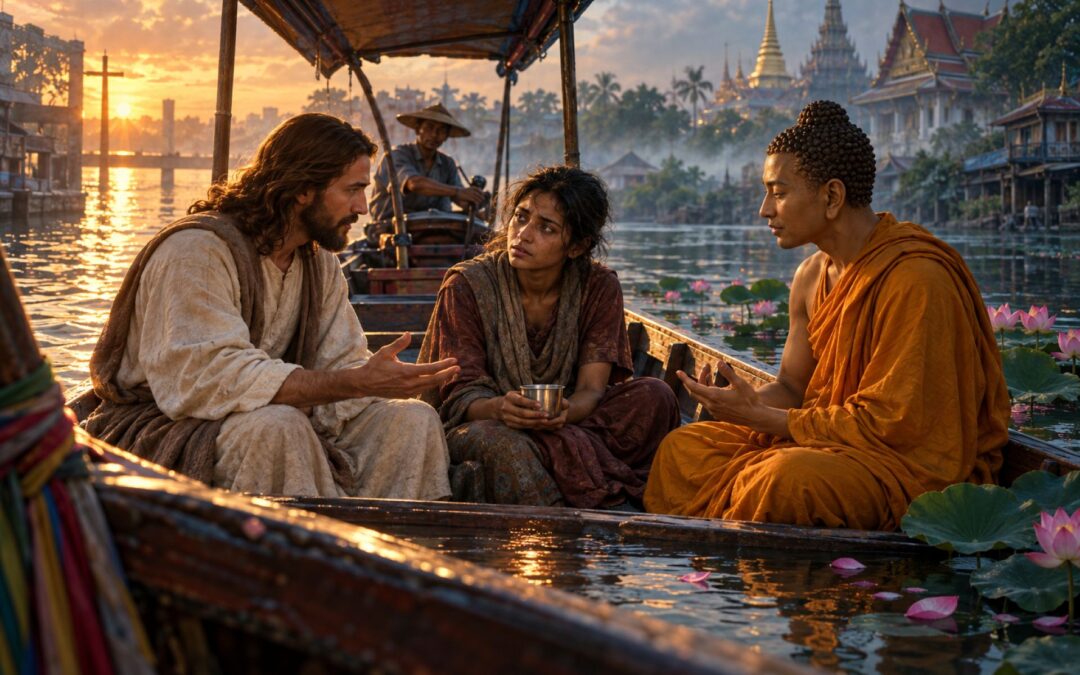
The Lotus and the Cross imagines an encounter that never happened: Jesus and Gautama Buddha sharing a boat in Bangkok while talking with a dying woman named Priya and the boatman carrying them through the city. Ravi Zacharias uses that fictional conversation to ask what Buddhism and Christianity ultimately say about suffering, desire, guilt, identity, death, and the possibility of salvation or liberation. The setting makes the argument concrete. Instead of leaving karma, non-self, grace, or resurrection as abstract doctrines, Zacharias asks what each worldview could offer a woman whose life has been devastated by sexual exploitation, illness, despair, and her own destructive choices.
The book is not a neutral dialogue in which two religions meet on equal terms. It is Christian apologetics, deliberately constructed to argue that the apparent similarities between Jesus and Buddha conceal fundamentally different accounts of human nature and destiny. Its strongest recurring contrasts are karma and grace, non-self and personal identity, detachment and relationship, nirvana and eternal life, and self-directed moral effort and salvation received as a gift. Those contrasts give the book considerable rhetorical force, but they also create its central weakness: the fictional Buddha often presents Buddhist ideas in forms that make Zacharias’s Christian response easier than it would be against a fuller Buddhist account.
This article follows the entire argument through to its ending and therefore contains full spoilers, including the final revelation about the boat journey. It also distinguishes between what Zacharias makes his fictional Buddha say and what Buddhist primary texts and modern scholarship actually support, because understanding that distinction is essential to evaluating the book fairly.

What Kind of Book Is The Lotus and the Cross?
The original 2001 Multnomah edition is a short book of roughly ninety-four pages, but its form is unusual enough that calling it simply a work of comparative religion can be misleading. After a dedication, acknowledgments, introduction, and prologue, nearly all of the substantive book consists of one continuous section titled “The Lotus.” There are no conventional numbered chapters through which Zacharias develops a systematic academic comparison. Instead, doctrinal arguments unfold inside an imagined conversation.
Zacharias explains in his acknowledgments that he had spent time speaking with Buddhist monks, nuns, and teachers in Asian countries, and the introduction acknowledges that representatives of different Buddhist schools did not always answer his questions in the same way. He says he wants to treat the differences respectfully, but he also declares the book’s controlling premise immediately: Jesus and Buddha cannot simply both be right when their central claims conflict. The dialogue is therefore designed not merely to describe two religious paths but to test them and arrive at a verdict.
That makes The Lotus and the Cross a hybrid of dramatic dialogue and evangelical apologetics. It borrows some of the pleasures of fiction—setting, characterization, suspense, symbolism, humor, and an emotionally vulnerable central figure—but its destination is theological argument. The Jesus who appears in the boat is not simply a character inspired by the Gospels, and the Buddha is not offered as an independent historical reconstruction. Both are voices through which Zacharias stages competing worldviews, although Jesus is unmistakably the authoritative voice of the book.
This distinction becomes increasingly important as the dialogue proceeds. Some broad Buddhist ideas presented in the book are recognizable, including the Four Noble Truths, the relationship between craving and suffering, rebirth, the rejection of an eternal self, and nirvana as liberation from the cycle of suffering. Other formulations are more controversial. The article therefore has to read The Lotus and the Cross on two levels at once: first as the Christian apologetic Zacharias intended, and then as a comparative treatment whose description of the opposing tradition can itself be evaluated.
Bangkok, Priya, and the Question That Starts the Debate
The prologue begins at dawn on Bangkok’s waterways. Zacharias’s unnamed first-person narrator boards a long-tailed boat and describes a city in which old temples, modern commerce, poverty, sensuality, reverence, tourism, and sexual exploitation occupy the same landscape. A Buddhist monk walking with a begging bowl appears alongside a man trying to lure tourists toward a brothel. Temples rise over neighborhoods in which the narrator sees both hospitality and suffering. The contrast establishes the question that will govern the book: how can a religious worldview address suffering when religious culture and human degradation coexist so visibly?
What turns that general question into a personal one is a newspaper story the narrator says he has recently read. The woman in the story, whom Zacharias calls Priya, leaves home at seventeen hoping to earn money in the city. The friend who has encouraged her journey rapes her soon after her arrival. She later works as a seamstress but remains surrounded by exploitation, eventually being drawn into prostitution and controlled by men who profit from her.
Priya becomes pregnant and plans to give away the baby so that she can return to earning money. Then she discovers that she is HIV-positive. Her need for money and medical care keeps her trapped in the same life, while despair turns into vengeance: the prologue says she continues seeing customers despite knowing that she may infect them and keeps records of men who include professionals and businessmen. As the illness progresses, her body becomes visibly diseased. She tries folk remedies, repeatedly attempts suicide, and finally poisons herself before setting her house on fire. She dies alone, with people afraid even to approach her remains.
Zacharias does not allow the story to remain journalism or social observation. The narrator asks what Jesus would have said if Priya had come to him, and what Buddha would have said to her in a predominantly Buddhist culture. The thought experiment begins there. Jesus, Buddha, and Priya become imaginary fellow travelers on the boat, with the boat driver completing the group.
The fictional Priya enters the conversation knowing that she is dying. Jesus first draws attention to her name, which he interprets as meaning “beloved,” and contrasts the tenderness of that name with the shame and anonymity that have marked her adult life. She speaks of exhaustion, pain, anger, estrangement from her family, and her wish for death. Her drinking cup already functions as an important detail: because of her disease, she does not want anyone else touching it. What seems incidental at the beginning will eventually become the book’s central symbol.
There is also an important inconsistency that should be kept in view. In the prologue, Priya’s descent into prostitution begins with rape and subsequent exploitation by people around her. Once the imagined dialogue starts, Zacharias’s Jesus adds that her parents had willingly encouraged her to enter the sex trade, and Priya accepts that characterization by describing such behavior as common in poor communities. That additional detail is not established in the prologue’s summary of the newspaper story. Priya therefore becomes increasingly fictionalized as the conversation develops, and the invented version should not be treated as a fully documented biography of a real woman.
Karma, Rebirth, and the Problem of Moral Debt
The disagreement begins when Jesus interprets Priya’s life through Christian categories. He speaks of deception, spiritual death, the corruptibility of the human heart, God’s word, forgiveness, and the possibility that bodily death need not be the end of life. Buddha interrupts because, in Zacharias’s construction, almost every one of those categories is mistaken. Spiritual death, an evil supernatural tempter, divine revelation, and forgiveness all presuppose a theological world that Buddhism does not share.
The fictional Buddha instead explains Priya’s condition through karma. Zacharias gives the concept a financial vocabulary that will dominate the rest of the book: debt, moral capital, payment, deposits, and accounts. Priya, Buddha says, entered her present life carrying the consequences of previous existence and has added new consequences through her own actions. Every action has effects, and the moral structure of reality does not permit those consequences simply to disappear.
Priya initially assumes this means she herself will be reincarnated for another attempt. Buddha corrects her. The book distinguishes Buddhist rebirth from the Hindu conception of reincarnation by saying that the identical individual does not return; rather, another stream of consciousness arises bearing the consequences of the previous causal sequence. Zacharias will later use precisely this distinction against Buddhism, asking why moral responsibility should pass from one life to another if no enduring self connects them.
Priya immediately senses the difficulty. Her suffering cannot be isolated from other people’s choices: the friend who raped her, those who exploited her, customers who bought sex, the child she gave away, and the people she may have infected. She wonders whose karma is actually being worked out when lives are causally entangled. Her metaphor is one of the better images in the dialogue: moral causation feels like putting a hand into glue and then trying to clean it, only to make everything else sticky as well.
Buddha names dependent origination as the framework behind such interconnected causes but does not explain it in detail. Instead, the book has him advise Priya to stop dwelling on past and future, abandon ideas of God and forgiveness, act well in the present, purify her heart, and improve the moral balance she passes onward. This is already a simplification of karma into something like a running moral account, but within Zacharias’s argument it creates the opening Jesus needs.
Jesus asks what it means to speak of debt if there is no creditor capable of receiving payment or forgiving what is owed. Karma in the book is therefore presented as an inexorable mechanism: acts produce consequences, but there is no personal moral lawgiver who can absorb the cost, pardon the debtor, or transform the relationship. Zacharias will spend the remainder of the dialogue constructing Christian grace as the opposite kind of moral economy.
The disagreement also introduces the question of the person. Buddha objects when Jesus promises to return to what Priya “personally” needs, because Zacharias’s Buddha treats personal identity itself as one of the illusions from which liberation is required. To explain why, he begins telling the story of his own spiritual journey. The discussion of karma has therefore opened into a deeper conflict: before deciding what can save Priya, the speakers must decide what a person actually is.
The Buddha’s Journey and the Four Noble Truths
Zacharias places a traditional version of Gautama’s biography in Buddha’s own mouth. He describes a privileged upbringing, the early death of his mother, his marriage to Yasodhara, the birth of his son Rahula, and the deliberate attempt by his family to shelter him from suffering. Encounters with old age, sickness, death, and an ascetic expose him to realities his protected life had concealed. Those sights make the problem of suffering impossible for him to ignore.
Jesus briefly interrupts the chronology because the fictional Buddha notes that he confronted the problem of suffering centuries before Jesus’s earthly life. Zacharias responds by invoking Job and Abraham and, more importantly, Christian claims about Christ’s eternal existence. The point is less historical than theological: chronological priority cannot establish truth if Jesus is understood as existing before his human birth.
Buddha then resumes his story. He leaves his family and privileged life to search for liberation, studies under religious teachers, practices severe asceticism, and finds neither inherited Hindu doctrine nor bodily deprivation sufficient. He describes reducing his body almost to death through fasting before abandoning that path. Eventually he sits in meditation beneath a fig tree at Bodh Gaya, where the book has him recall innumerable former lives, perceive the structure of existence, extinguish craving, and attain the condition that makes him the Buddha, the awakened one.
Zacharias acknowledges the impressive seriousness of this quest. His Jesus even praises the simplicity, compassion, and discipline visible among Buddhist practitioners. Yet he quickly shifts from admiration to criticism by emphasizing the number of monastic rules associated with Buddhist discipline. The dialogue cites large collections governing possessions, behavior, disputes, food, and relations between monks and women, using them to suggest that a path intended to overcome attachment can become another elaborate system of moral performance.
Buddha then explains the framework around which his teaching is organized. Life marked by attachment is characterized by dukkha, a term broader than acute physical pain and encompassing instability, frustration, loss, and dissatisfaction. Craving and ignorance perpetuate this condition. Liberation requires the cessation of craving, and the Noble Eightfold Path supplies the practical discipline through which that cessation is cultivated.
This portion of Zacharias’s summary is broadly recognizable, although his wording remains his own. In the early Buddhist formulation of the Four Noble Truths, suffering or stress is connected with birth, aging, death, loss, frustrated desire, and clinging; craving is identified as its origin; cessation comes through relinquishing that craving; and the Noble Eightfold Path is given as right view, intention, speech, action, livelihood, effort, mindfulness, and concentration. The discourse also presents the Middle Way as avoiding both sensual indulgence and self-mortification.
That canonical framework matters because Zacharias is at his most persuasive when arguing from real differences rather than simplified ones. Christianity as he presents it does not tell Priya merely to extinguish craving or train herself out of attachment. It tells her that something is wrong not only in how she desires but in her relationship with God, and that reconciliation requires an action God performs for her. Buddhism and Christianity genuinely do propose different accounts of both the problem and the solution.
Zacharias next turns enlightenment itself into a target. The fictional Buddha admits that he initially considered remaining silent because he thought others could not understand his discovery. His followers persuaded him to teach. He later accepted his father’s request that young people receive parental permission before joining the monastic order, and the dialogue retells the traditional story in which his foster mother repeatedly seeks admission for women until Ānanda intercedes and women are finally permitted to enter the Sangha.
Jesus argues that these developments create a contradiction. If enlightenment meant complete knowledge, why could unenlightened followers persuade the enlightened Buddha to revise significant judgments? The force of the objection depends heavily on the book’s characterization of enlightenment as exhaustive knowledge rather than awakened knowledge concerning the path to liberation. That assumption will matter again when the discussion turns to prayer and divine omniscience.
Prayer, Knowledge, and the Question of God
Buddha answers the challenge about changing his mind by pointing to biblical stories in which God appears to respond to human intercession. If Moses or Abraham can plead with God and the outcome changes, why should later changes in Buddhist practice undermine enlightenment? Zacharias’s Jesus answers by drawing a sharp distinction between a change in God and a change in the person who prays.
Prayer, in his explanation, is fundamentally relational. Human beings address a personal God precisely because they are not autonomous, and persistent prayer changes the petitioner by aligning the human will with divine wisdom. God does not gain information, discover a fact, or move from ignorance to knowledge. The Christian God already knows the beginning and the end, so responding to prayer is part of an eternal purpose rather than evidence that another mind has corrected God’s understanding.
Priya responds emotionally to this possibility. Her life has contained cries for help, and she wants to know whether any transcendent listener could have heard them. Zacharias uses that longing to make prayer another contrast with Buddhism: karma gives consequences without a creditor, while meditation, in the book’s framing, offers an inward discipline without a personal hearer.
The fictional Buddha largely accepts the distinction. He says prayer does not fit comfortably within his own teaching and contrasts prayer directed beyond oneself with meditation directed inward. He also says that the forty-five years between awakening and death involved continuing clarification. Zacharias seizes on that concession, arguing that a teacher who claims to need no teacher, who supposedly discovered truth independently, and who tells others to be their own refuge cannot also claim exhaustive enlightenment while continuing to revise his understanding.
The argument reveals both the strength and the weakness of the dialogue. Zacharias has isolated a genuine difference between Christianity’s personal God and Buddhism’s non-theistic path, and that difference has important consequences for prayer. Yet the fictional Buddha also accepts premises that make the Christian criticism unusually easy. The claim that the historical Buddha asserted omniscience in precisely the sense required by Zacharias’s argument is not established simply because the invented Buddha says so.
The section nevertheless advances the book’s central logic. If ultimate reality is personal, dependence need not be a weakness; prayer can be relationship rather than failed autonomy. If ultimate liberation instead depends on insight into the nature of experience and the ending of craving, then the spiritual path operates differently. The next question becomes even more fundamental: who is the person praying, suffering, remembering, and seeking liberation?
Non-Self, Personhood, and the Meaning of Nirvana
Buddha answers with the most philosophically important image in the book. He asks the others to look at the boat. Is the boat identical with the wood, motor, glue, paint, or any one of its components? None of the individual parts is the boat by itself, yet people conventionally refer to the arrangement as a single thing. Zacharias has Buddha apply the same reasoning to human beings: no permanent self can be located in the physical and mental components that make up experience.
In the book’s version, Buddha goes further and repeatedly says that the self simply does not exist. Priya’s disastrous desires arose because she believed there was a self whose pleasures, money, security, and success needed to be satisfied. If she had understood the illusion earlier, he argues, she would not have been driven by those cravings. Freedom therefore requires relinquishing attachment not merely to possessions but to the very idea of a permanent “I.”
Jesus attacks this formulation from several directions. First, he points to the language of Buddhist practice itself. If there is no person, who realizes the truth? Who practices? Who inherits karmic consequences? Who must discover that the self does not exist? Zacharias turns ordinary pronouns—“you,” “she,” “we”—into evidence that personal particularity cannot simply be talked away.
He then argues from human dignity. A boat is an object built from parts, but Priya is not merely an arrangement of material and psychological components. Christianity grounds her worth in being created in the image of God. Her suffering matters because a particular person has been violated, and her parents’ grief matters because they do not merely mourn the temporary configuration of an impersonal stream. For Zacharias, uniqueness is not the source of suffering but part of what makes love possible.
The confrontation becomes deliberately physical when Jesus asks Buddha to take Priya’s hand. Buddha refuses. Within the rhetoric of the scene, that refusal dramatizes Zacharias’s contrast between detachment and personal compassion: Jesus stays beside the sick woman and touches what others fear, while Buddha is associated with distance, discipline, and the denial of permanent individuality. The scene is effective drama, although it is also a revealing example of how strongly the author controls the terms of the comparison.
Buddha replies with the image that gives the book half its title. A lotus begins submerged, rises through the water, and eventually blooms above it. Human understanding likewise develops through stages until attachment to self is transcended. Jesus responds that the metaphor again loses the person. Christianity also recognizes development, he says, but God cares for particular individuals as a shepherd cares for individual sheep.
That contrast moves directly into the question of nirvana. Zacharias’s Jesus portrays the Buddhist goal as an extinguished candle in which the individual Priya ultimately disappears. Against that he sets Christian language of rest, paradise, light, bread, shepherding, resurrection, and everlasting life. One path, as the dialogue frames it, dissolves the person in order to end attachment; the other redeems the person and preserves relationship eternally.
This is one of the book’s central arguments and one of the places where later qualification is most necessary. Buddhism genuinely rejects the permanent, independent self presupposed by many Indian and Western theories of personhood. It does not follow straightforwardly, however, that Buddhist teaching can be reduced to the proposition that people are unreal in every meaningful sense or that nirvana simply means personal annihilation. Zacharias’s rhetorical contrast is clearer than the doctrine he is criticizing.
Temple, Ritual, Impermanence, and Final Authority
The group leaves the boat temporarily and enters a Buddhist temple. Buddha himself becomes uncomfortable with what he sees. Images, precious materials, incense, prayer, and devotional behavior appear to contradict the anti-idolatrous teaching Zacharias attributes to him. The fictional Buddha protests that he never wanted to be deified and distinguishes his original teaching from what later followers have made of it.
Jesus acknowledges that Christianity has also been corrupted by its followers, but Zacharias uses the temple to argue that the two forms of corruption have different causes. He distinguishes superstition from legalism. Superstition, in his argument, develops when human beings retain a sense of unseen powers but lack knowledge of a sovereign and merciful God; legalism develops when religious people lose grace and replace relationship with rule keeping.
A practical episode supplies the illustration. Because it is after noon, Priya says a monk will not accept food, and as a woman she cannot simply place it in his hands. The boat driver attempts to offer fruit, and the monk refuses to receive it directly. Nearby spirit houses and offerings then become further evidence in Zacharias’s case that fear, ritual, and attempts to appease unseen forces have filled a spiritual vacuum.
Buddha objects that these practices corrupt rather than express his teaching. Jesus answers that their very form can supposedly be traced to Buddhism’s rejection of a creator God, a permanent self, prayer to a personal deity, an evil supernatural adversary, and permanent revelation. The argument is ambitious: Zacharias is no longer merely criticizing particular customs but claiming that certain later religious practices are logical consequences of the worldview that preceded them.
The discussion then shifts from ritual to metaphysics. Jesus challenges Buddha’s claim to remember an infinite or numberless series of prior births while also having a final birth. Zacharias treats this as a logical problem: an actually infinite quantity should not arrive at a final member. He then connects morality with personhood, arguing that obligations make sense only if persons possess intrinsic worth and that intrinsic worth ultimately requires a creator of absolute worth.
For Zacharias, worship follows from the same structure. Human beings seek something worthy of ultimate devotion because they are created for communion with God. Buddha offers liberation from attachment; Jesus offers relationship. The contrast is summarized as communion rather than union or oblivion, and the Christian claim is that destructive desires are not merely eliminated but replaced by new loves ordered toward God.
Buddha raises the obvious objection that Christians have also distorted their religion. Jesus agrees but claims that Christian corruption occurs by departing from an enduring revelation, whereas Buddhist corruption occurs because there is no equivalent final divine word. This produces the next major argument. The fictional Buddha says he left no permanently binding written authority because everything is impermanent. Jesus responds that the assertion “everything is impermanent” appears to claim permanent truth for itself.
The dialogue treats this as a self-refuting contradiction. If even the doctrine of universal impermanence is impermanent, Jesus asks, how can it function as an absolute description of reality? If it is permanently true, then at least one truth is not impermanent. Zacharias then contrasts this instability with Christianity’s claim that God’s word endures and provides a standard by which later deviations can be judged.
Buddha finally asks why anyone should accept Jesus’s word as true. That question returns the dialogue to Priya. Rather than answer with a detached argument for revelation, Zacharias has Jesus present Gospel encounters in which different kinds of people are personally known, challenged, forgiven, and transformed.
Grace, the Cross, and the Ending of the Dialogue
Jesus begins with the Samaritan woman at the well. Zacharias emphasizes that she has experienced repeated broken relationships and religious confusion but finds herself understood by someone who knows her history without reducing her to it. For Priya, the story demonstrates the book’s Christian claim that personal exposure need not end in shame: God can know the individual completely and still offer relationship.
He next invokes the woman caught in adultery and points to the asymmetry of public condemnation: the woman is presented for punishment while the man involved is absent. Priya recognizes the pattern of people participating in wrongdoing and then abandoning those who bear its consequences. Jesus interprets this not primarily as ignorance but as evidence of a disordered human heart.
A third woman is described by Zacharias as having lived a life of prostitution and entering a room of morally respectable people to anoint Jesus. The Gospel material itself does not explicitly establish prostitution as her occupation, so this should be understood as Zacharias’s characterization rather than a securely stated biblical fact. Within the book, however, the story gives him another contrast: the socially stigmatized woman is allowed to approach Jesus physically and express devotion, while Priya imagines that touching a monk would violate religious discipline.
Zacharias summarizes these encounters with a three-stage pattern: Jesus discloses the person, changes the person, and fills the person. Buddha asks whether the examples work only because these people are obviously needy, so Jesus introduces Nicodemus, a learned religious teacher. Knowledge and outward righteousness, he argues, are no more sufficient than sexual or moral brokenness. Christianity’s answer is not merely better information or greater discipline but new birth through the Spirit.
Priya understands the implication: she cannot save herself. Jesus contrasts Christian new birth with Buddhist rebirth as the book has explained it. The person is not replaced by another consciousness carrying a moral inheritance; the same person is transformed through a divine action “from above.” The moral hunger changes because the relationship to God changes.
The boat driver then voices a concern likely intended to represent the reader’s discomfort: if Buddha deserves respect, how can the book declare him wrong? Jesus answers that respect for a person cannot require treating incompatible claims as equally true. Zacharias uses Buddha’s own rejection of other Indian doctrines as evidence that disagreement need not imply contempt.
Priya finally brings the discussion back to her past. If she cannot undo what she has done, what becomes of the evil attached to it? This gives Zacharias the opening toward which the whole dialogue has been moving. Jesus tells her that he has paid the cost himself. The Cross becomes Christianity’s alternative to karmic repayment: guilt is neither dismissed nor gradually offset but borne by another.
Buddha raises what may be his strongest objection in the final portion of the dialogue. How can it be just for one person to suffer for another’s wrongdoing? Jesus answers through substitution. Justice still requires a cost, but mercy becomes possible when someone who is able and willing pays on behalf of someone who cannot. Whether that theory of atonement is philosophically sufficient is a separate question; within Zacharias’s evangelical framework, it is the decisive difference between karma and grace.
Resurrection enlarges the claim beyond forgiveness. Priya is dying, so a religion that deals only with her moral past would not answer her immediate terror. Jesus therefore promises not simply pardon but bodily death followed by eternal life because, within Christian faith, his own resurrection has defeated death. Zacharias deliberately contrasts this with what his Buddha has said about rebirth and nirvana.
When Jesus asks what Buddha finally offers Priya, the answer is the Triple Gem: Buddha, Dhamma, and Sangha—the awakened teacher, the teaching, and the community. Zacharias immediately reframes each one negatively. The Buddha becomes a teacher who no longer personally exists, the Dhamma a teaching without an eternal divine Word, and the Sangha a community supposedly organized around relinquishing self and attachment. This is rhetorically powerful but substantially stacked, because the Triple Gem is described almost entirely through the Christian objections already developed.
Jesus counters with the biblical image of a pearl of great price. Priya’s choice is presented in increasingly stark terms: self-extinguishing or finding one’s true self, desolation or communion, karmic burden or grace, the Triple Gem or the Pearl. By this stage, the book is no longer pretending to leave the religions balanced.
The dialogue then returns to the medicine Priya carries for her pain. She remarks that it treats the symptoms but cannot cure her disease. Jesus turns the observation into a metaphor for religion: ceremonies, rules, and human efforts may relieve symptoms, but only the Christian gospel, Zacharias argues, treats the underlying disease of sin and alienation from God.
Then the drinking cup introduced near the beginning returns. Priya has kept it separate because she is terrified that someone might come into contact with her infection. Jesus asks her to fill it with water and deliberately drinks from it. She is horrified. The gesture becomes the book’s most vivid symbol because it gives physical form to the doctrine Zacharias has been explaining: where Buddha had described Priya as having filled a moral cup whose consequences she must bear, Jesus says he has willingly taken humanity’s cup upon himself.
The scene expands into Gethsemane. Jesus describes the “cup” of suffering and death he accepted before the crucifixion and connects it with bearing human shame, sin, and estrangement. He then offers Priya a different cup, the “cup of salvation.” The Cross is no longer merely an opposing religious symbol to the lotus; it becomes the mechanism through which Zacharias says the burden represented by Priya’s cup can change hands.
Even the payment for the boat ride is drawn into the same pattern. When Buddha asks who will pay, the boat driver says the conversation has been valuable enough that he wants to make the ride a gift. Jesus points out that a gift is free to its recipient but not costless: somebody bears the expense. This gives Zacharias another miniature analogy for grace. Salvation is received rather than earned, but the Christian claim is that its cost has already been borne.
The driver’s name supplies one last metaphor. Zacharias plays on its resemblance to the Thai word associated with a temple, allowing Jesus to argue that a human being can become a dwelling place for God rather than merely entering a sacred building. The theme of external religious structure thus resolves into personal indwelling.
Priya then asks the question that completes the entire apologetic design: can either teacher accompany her home? Zacharias’s Buddha says he cannot. Jesus says he can. Personal presence becomes the book’s final test of religion.
Only after that answer does the narrator disclose that the three other figures were never physically on the boat. The actual journey consisted only of the narrator and boatman; Jesus, Buddha, and Priya were imagined participants in a meditation on competing answers to suffering. The epilogue then removes nearly all remaining ambiguity. Zacharias explicitly characterizes Buddhism as a disciplined but godless path of autonomy, impermanence, detachment, and eventual oblivion, while Christianity offers entrusting oneself to another, preserving love rather than extinguishing attachment, and receiving permanent relationship with God.
The epilogue is therefore not an optional afterthought. It tells readers exactly how Zacharias wants the dialogue interpreted. Priya needed, in his account, not merely teaching but a Father, Counselor, Savior, and God who could remain with her. The entire book has been constructed to make the last answer—“I can”—feel like the natural completion of everything that came before it.
How Zacharias Constructs the Conversation
The book’s argument cannot be separated from its dramatic form. Zacharias does not present propositions in two parallel columns and then evaluate them. He creates speakers whose personalities, authority, emotional positions, and access to knowledge are deliberately unequal, then makes abstract doctrines prove themselves against Priya’s suffering.
That method is responsible for much of the book’s readability and much of its comparative weakness. Understanding who each voice is allowed to be helps explain why the dialogue feels persuasive even before the individual arguments have been tested.
The Four Voices and Their Rhetorical Roles
Jesus is the dominant figure. Zacharias gives him knowledge of Priya’s heart, the ability to anticipate objections, command of both Buddhist and Christian claims, moral confidence, tenderness toward the suffering, humor, and the last word in almost every substantial exchange. He is simultaneously participant, cross-examiner, interpreter, pastor, and judge. Because the book assumes the theological truth of his divine identity, he also operates from a level of authority no other speaker can match.
Buddha is treated respectfully at the level of tone. Zacharias repeatedly allows Jesus to praise his seriousness, compassion, discipline, renunciation, and intellectual courage. Yet his dramatic function is primarily that of philosophical foil. He explains enough Buddhism to establish the issue, raises occasional objections, and then increasingly acknowledges the force of Jesus’s replies. By the final third, he often sounds less like an independent Buddhist thinker than an opponent being guided toward the author’s conclusion.
Priya performs a very different function. She is not expected to win arguments. She tests whether the arguments matter. Karma must answer her past, non-self must answer her identity, prayer must answer her loneliness, nirvana must answer her approaching death, and grace must answer her guilt. Because she is both victim and wrongdoer in Zacharias’s narrative, neither a purely therapeutic nor purely punitive response seems sufficient. Her suffering turns worldview comparison into an existential question.
The boat driver is the ordinary listener inside the book. He provides humor, practical interruptions, ritual behavior, questions about respect, and reactions that tell the reader when an idea has landed. He is less burdened than Priya and less philosophically committed than Buddha. That makes him a convenient audience surrogate whose gradual receptiveness reinforces the intended direction of the conversation.
Behind all four stands the unnamed narrator, who eventually reveals himself as the true architect of the encounter. He is physically present but dramatically recessive because Zacharias has transferred his questions and answers into the imagined speakers. The final revelation reminds the reader that none of the concessions should be mistaken for historical testimony. Every response attributed to Buddha and every non-biblical sentence attributed to Jesus has been composed for this argument.
A Dialogue Designed to Reach a Verdict
The conversation often resembles a Socratic examination. One speaker makes a claim, Jesus asks what follows from it, and contradictions or uncomfortable implications supposedly emerge. Karma becomes debt without a creditor; non-self becomes a person who must deny that persons exist; enlightenment becomes perfect knowledge that nevertheless needs correction; impermanence becomes a permanent assertion that nothing is permanent.
The method is highly accessible because philosophical differences appear through concrete questions rather than technical exposition. A reader who has never studied comparative religion can understand the tension between earning and receiving, detaching and loving, self-extinguishing and preserving personhood. The recurring return to Priya also prevents the discussion from becoming entirely abstract.
The problem is that Zacharias controls both sides of the exchange. Jesus is allowed to formulate Buddhism’s difficulties, choose the categories in which those difficulties are expressed, and supply the Christian alternative. Buddha rarely reformulates an objection on his own terms after Jesus challenges him. When he does object—asking about justice in substitutionary atonement, Christian religious corruption, or apparent changes in God’s response—the answers come quickly, and he often concedes before the deeper philosophical problem has been exhausted.
The result is not necessarily illegitimate as apologetic literature. A dialogue can illuminate an author’s argument even when the author controls every voice. But it should not be mistaken for evidence that an informed Buddhist interlocutor would accept Zacharias’s descriptions, implications, or concessions. The book is best understood as a Christian thought experiment about Buddhism, not a transcript of Christianity defeating Buddhism in open debate.
The Book’s Central Contrasts
The many topics in the dialogue ultimately organize themselves around a small number of fundamental disagreements. These contrasts overlap because each religion’s account of suffering depends on what it believes a human being is, what causes bondage, what ultimate reality is like, and what liberation must accomplish.
Zacharias is most effective when he exposes genuine differences and least effective when he exaggerates those differences into caricature. The four contrasts below contain both sides of that pattern.
Suffering and Desire
Buddhism enters the book through suffering. Gautama’s traditional encounters with aging, illness, and death drive his renunciation, and the Four Noble Truths begin by diagnosing dukkha and tracing its continuation to craving and ignorance. The practical project is therefore transformative: understand how attachment arises, stop feeding it, and cultivate a path through which the conditions producing suffering cease.
Zacharias’s Christianity offers a different diagnosis. Desire can certainly become disordered, but the deepest problem is not simply that human beings desire; it is that desire has become estranged from God. Some desires are destructive and need to die, while other desires—love, communion, righteousness, relationship with God—are part of the good life. Jesus therefore challenges the idea that freedom requires the extinguishing of desire as such.
Priya allows Zacharias to sharpen the contrast. She wanted money, security, pleasure, acceptance, survival, and later revenge. Buddhism as presented in the dialogue asks what attachment and ignorance did to those desires. Christianity asks what a corrupt heart did with them and what reconciliation to God could make them become. Zacharias’s Christian answer is not desirelessness but reordered love.
That is an important distinction, although the book sometimes makes Buddhism easier to reject by treating it as though it simply condemns every possible desire. The early Buddhist analysis is more precisely concerned with craving, clinging, ignorance, and the processes that generate dukkha. Even within Zacharias’s own summary, the Eightfold Path requires intentional cultivation, which would be difficult to describe as a total absence of motivation.
Karma and Grace
Karma and grace form the book’s clearest organizing opposition. Zacharias presents karma as an impersonal causal order in which consequences must eventually be borne. No personal creditor stands behind the debt, yet no one can cancel it. The individual—or causal continuum that replaces the individual—must continue through moral effort until the conditions for liberation are reached.
Grace reverses the logic. Christianity as Zacharias presents it agrees that wrongdoing has consequences and refuses to treat forgiveness as pretending that evil never occurred. The difference is that God personally bears the cost. The Cross is therefore described through substitution: the debtor cannot pay, so another who can pay assumes the burden.
The strength of this contrast is theological clarity. A reader finishes the book understanding that Zacharias does not mean “Christianity has easier karma.” He means Christianity rejects the entire moral economy of self-payment in favor of reconciliation initiated by God. The boat fare reinforces the point: a gift is free to the receiver because someone else bears its cost.
The weakness is that Buddhist karma is reduced too aggressively to a financial ledger. Karma is fundamentally concerned with intentional action and causal consequences within the cycle of rebirth, not with a cosmic accountant adding good deeds against bad ones until a balance reaches zero. Zacharias’s debt metaphor helps him explain Christian grace, but it should not be allowed to stand as a complete account of Buddhist moral causation.
Non-Self and Personhood
The most philosophically serious divide concerns what a person is. Christianity in the book treats Priya’s individuality as permanent in significance because God deliberately created and knows her. Her name matters. Her particular history matters. Love is meaningful precisely because one person cannot simply be replaced by another.
Buddhism challenges the idea that there is a permanent, independent essence behind the changing physical and mental processes that constitute experience. Zacharias sees this as a threat to personal dignity and moral responsibility. His repeated question is essentially: if the self is not real, who suffers, chooses, loves, acts, inherits karma, seeks enlightenment, or reaches liberation?
That question is not trivial. Buddhist philosophers themselves developed sophisticated accounts of causal continuity, agency, rebirth, and conventional personhood precisely because non-self creates difficult problems for ordinary ways of talking about identity. Zacharias is therefore pressing on a genuine philosophical tension.
Where he overreaches is in moving too quickly from “no permanent independent self” to “Priya is not a real person.” Buddhist thought can deny an enduring metaphysical essence while still making meaningful conventional distinctions between persons, actions, suffering, responsibility, and compassion. The genuine disagreement with Christianity remains substantial without requiring the stronger claim that Buddhism regards human beings as meaningless illusions.
Nirvana and Eternal Life
The final contrast concerns destiny. Christianity offers Priya resurrection, enduring identity, communion with God, and the continuation of personal relationship. Zacharias emphasizes this relentlessly because Priya is close to death. A worldview may explain her past, but the book demands that it also answer what becomes of her.
The Buddhist goal is liberation from the cycle of craving, clinging, rebirth, and suffering. Zacharias interprets the imagery of extinguishing so literally that nirvana becomes personal oblivion. He then makes the choice stark: Buddhism ends suffering by ending the sufferer, whereas Christianity defeats suffering while preserving and redeeming the person.
That is the point at which a real difference becomes an unreliable simplification. Buddhist traditions do not generally describe nirvana as the eternal survival of the same substantial person, so Christianity’s personal resurrection does remain a radically different hope. But early Buddhist texts also resist describing liberation as straightforward annihilation. Zacharias’s contrast is therefore strongest when stated positively—different conceptions of self, liberation, and ultimate destiny—rather than as “Christian eternal life versus Buddhist nothingness.”
Where the Book’s Portrayal of Buddhism Needs Qualification
A fair criticism of The Lotus and the Cross should begin by recognizing what Zacharias does not invent. Buddhism does reject Christianity’s creator God, places craving and ignorance at the center of its account of suffering, teaches the Noble Eightfold Path, denies an eternal independent self in the ordinary substantial sense, accepts karma and rebirth in its classical forms, and seeks liberation from cyclic existence. Christianity and Buddhism really do differ at foundational levels.
The problems arise when Zacharias moves from identifying those differences to defining Buddhism entirely through the implications he wants to attack. Several of the book’s most decisive claims need qualification from Buddhist primary texts and scholarship.
Anattā and the Question of the Self
Zacharias’s fictional Buddha says, in effect, that there is no self anywhere within or beyond the physical and mental components of a human being. The boat analogy then makes the person resemble a convenient name given to a collection of parts. That presentation has a real basis in Buddhist thought, but the dialogue turns a difficult doctrine into an overly simple assertion that there is no meaningful person.
In the Buddha’s discourse on the characteristic of not-self, SN 22.59, form, feeling, perception, mental formations, and consciousness are each examined and identified as not-self. They are impermanent, subject to change, and not under the complete control that one would expect from an enduring self. The practical instruction is not to identify these conditioned aggregates as “mine,” “I,” or an eternal essence.
That is not identical to the sentence “human beings do not exist.” The distinction matters because Buddhist traditions can treat the person as conventionally real while denying that analysis reveals a permanent metaphysical core. The Stanford Encyclopedia of Philosophy’s discussion of the Buddha notes both the longstanding Buddhist rejection of a substantial self and the interpretive complexity surrounding what exactly the earliest teachings commit themselves to. It also explains how later Buddhist thought developed accounts in which a person can function conventionally as a causally continuous series without being an ultimately independent substance.
This does not eliminate Zacharias’s objection. Christianity’s belief that a person is intentionally created by God and possesses an enduring identity is still profoundly different from a Buddhist reduction of the person to conditioned processes without a permanent self. Questions about agency, karmic responsibility, and continuity across rebirth remain philosophically difficult.
What it does eliminate is the easiest version of Zacharias’s argument. Priya does not become irrelevant merely because Buddhism denies an eternal ātman. Buddhist ethics and compassion would make little sense if suffering beings were treated as morally negligible. The real debate concerns what kind of reality and continuity a person possesses, not whether ordinary human suffering can be dismissed because “nobody” is there.
Nirvana, Parinirvana, and “Oblivion”
Zacharias’s epilogue uses “oblivion” as though it were the natural final definition of the Buddhist path. The central dialogue prepares that conclusion by describing nirvana through the image of a candle being extinguished and repeatedly implying that Priya would simply cease to exist. This is one of the book’s most consequential distortions because it makes the Christian alternative almost automatically more humane.
Early Buddhist sources are more cautious. In the Water-Snake Simile, MN 22, the Buddha explicitly rejects the accusation that his teaching proclaims the annihilation or extermination of an existing being. The text presents that accusation as a misrepresentation of what he teaches about suffering and its cessation.
The problem becomes even clearer in MN 72, the discourse to Vacchagotta. Asked whether a liberated Tathāgata exists after death, does not exist, both exists and does not exist, or neither exists nor does not exist, the Buddha refuses all four descriptions. The famous extinguished-fire analogy is used not to say “the person has become nothing” but to show that ordinary categories of location and existence no longer apply in the way the questioner assumes.
Different Buddhist traditions have developed those ideas in different ways, and Buddhism certainly does not teach Christian-style resurrection of an eternal individual soul. Zacharias is right that the destinations differ. What he cannot responsibly infer is that the only alternatives are Christian personal life or Buddhist annihilation.
Even the language of extinguishing is better understood in relation to the ending of craving, ignorance, greed, hatred, and the conditions perpetuating dukkha. That does not turn nirvana into a Christian heaven, nor should it. It simply means that “oblivion” is a polemical interpretation rather than a neutral definition.
God, Devas, Māra, and Buddhist Cosmology
Zacharias is on solid ground when he says Buddhism does not posit the omnipotent creator God of Christianity. The Buddha’s path does not depend on divine creation, revelation by such a creator, or salvation through reconciliation with that being. This is one of the most important genuine differences between the traditions.
The book becomes less accurate when non-theism starts functioning as if it meant an entirely non-supernatural worldview. Early Buddhist literature contains devas, Brahmās, Māra, multiple realms of existence, rebirth, and other forms of cosmology that do not fit modern materialist naturalism. Even the early discourse setting out the Four Noble Truths refers to a cosmos populated by devas, Māras, and Brahmās.
That does not secretly make Buddhism theistic in the Christian sense. A deva is not the eternal creator God, and Māra is not simply the Christian Satan translated into Buddhist vocabulary. The important correction is narrower: rejecting a creator God is different from denying every supra-human being, realm, or religiously significant invisible agency.
The same caution applies to prayer. Zacharias’s contrast between Christian petition to God and Buddhist meditation identifies a genuine difference in spiritual orientation, but lived Buddhist traditions cannot be reduced to solitary inward meditation. Devotion, chanting, ritual, reverence, petitions, merit-making, and relationships with buddhas, bodhisattvas, or other religious figures appear in different Buddhist communities. The traditions remain non-Christian and often non-theistic, but they are more religiously varied than the fictional Buddha’s concessions suggest.
From Thai Religious Practice to “Buddhism”
The temple sequence is rhetorically effective because it shows Zacharias’s Buddha embarrassed by practices carried out in a Buddhist-majority setting. Statues, incense, offerings, spirit houses, food rules, and fears of pollution are gathered into an argument that Buddhism inevitably produces either superstition or legalism.
The first problem is logical. A practice found among people who identify with a religion does not automatically follow from that religion’s foundational philosophical doctrines. Christianity itself provides Zacharias with the obvious parallel: Christians have practiced things he considers contrary to Jesus, yet he distinguishes those practices from Christianity by appealing to what he believes its authoritative sources teach.
The same analytical charity should be extended to Buddhism. One may criticize specific monastic rules, devotional practices, popular beliefs, or cultural customs, but the argument has to show how they arise from the Four Noble Truths, dependent origination, non-self, or another Buddhist teaching. Simply observing them in Thailand does not establish that causal connection.
The second problem is that Zacharias uses the fictional Buddha’s own disapproval as evidence and then refuses to let that disapproval matter. When Buddha says that later followers have corrupted his teaching, Jesus replies that the corruption follows logically from what Buddha taught anyway. Because Zacharias writes both sides, the conclusion cannot function as independent evidence. It remains an apologetic interpretation that must succeed by argument rather than by the fictional opponent’s eventual inability to answer it.
Symbols and Motifs: Lotus, Cross, Cup, Water, Light, and Names
The title identifies the book’s largest symbolic opposition before the dialogue begins. The lotus represents Buddhist awakening: life emerging from muddy water, developing through stages, and blooming above the surface. The Cross represents a radically different path in Zacharias’s theology: not rising through insight and disciplined detachment but receiving salvation through another person’s sacrificial descent into suffering.
The important point is that Zacharias does not merely place the symbols side by side. He gradually makes the Cross absorb and answer the lotus. Jesus tells Priya that it does not matter whether she resembles an immature lotus still beneath the water or someone much further along in spiritual development; the Cross, he argues, is available to both. Christian grace therefore rejects spiritual rank as the basis of acceptance.
Water carries several meanings across the book. The entire conversation takes place while traveling through Bangkok’s waterways, so movement and impermanence are physically present around the speakers. Priya needs water because she is sick. The Samaritan woman’s meeting with Jesus also occurs around water. Finally, the ordinary water placed in Priya’s contaminated cup becomes the medium for the book’s climactic act of identification.
The cup is the most carefully prepared motif. Early in the dialogue, Priya protects everyone from it because she believes it carries danger. Earlier still, Buddha uses cup-like moral imagery to explain how her choices have filled the consequences she must bear. By the end, Jesus deliberately drinks from her cup and connects that act to the cup of suffering he accepts in Gethsemane. The same object therefore moves from contamination to substitution and finally to salvation.
Debt, payment, and gift form another recurring symbolic system. Karma is repeatedly described through what Priya owes. The Cross becomes payment by another. The boat fare then miniaturizes the entire theology: when the driver refuses payment and calls the journey a gift, Jesus points out that the cost has not vanished. The giver has chosen to absorb it.
Light is similarly contested. Buddha is the enlightened one, and the lotus rises into light. Jesus responds by calling himself the light by which Priya can understand her life. Zacharias therefore takes an image naturally associated with Buddhist awakening and places a Christian claim beside it: illumination is not only an insight one attains but a relationship with a person who reveals.
Names matter because the book’s Christian case depends on particularity. Priya’s name means, in Zacharias’s use, someone beloved, and Jesus repeatedly calls her by it precisely when arguing that she is not an interchangeable stream of consciousness. The boat driver’s name becomes another theological pun when Jesus turns it toward the idea of a temple and then argues that God can dwell in a person.
The final motif is home. For most of the dialogue, the argument concerns what each worldview can explain. At the end, Priya asks something simpler: who can accompany her back into the life and death waiting for her? Zacharias makes companionship the ultimate symbol of Christian salvation. The book’s deepest contrast is therefore not merely lotus versus Cross but solitude versus presence.
Style, Tone, and the Ethics of the Imagined Dialogue
Zacharias writes for accessibility rather than scholarly precision. The prose favors concrete analogies, jokes, familiar biblical stories, emotional questions, and recurring images. Dense issues such as personal identity, rebirth, atonement, revelation, and impermanence are introduced through boats, cups, debt, food, parents, illness, and friendship. That makes an unusually large number of philosophical topics readable in a very short book.
The dialogue also moves quickly. Almost every doctrinal claim immediately becomes a challenge, illustration, or consequence. Zacharias rarely allows technical terminology to remain unexplained, and he repeatedly returns to Priya when the conversation risks becoming detached from human suffering. The result is more memorable than a conventional list of similarities and differences would have been.
That speed has a cost. The book offers no sustained documentation for many historical, textual, or philosophical claims. Traditional stories about Gautama’s life, monastic rules, Buddhist cosmology, the admission of women, and the meaning of nirvana are placed into Buddha’s mouth as though the imagined speaker could authenticate them. Readers unfamiliar with Buddhism may therefore have difficulty knowing when they are encountering a broadly accepted teaching, one school or interpretation, a later tradition, or Zacharias’s polemical paraphrase.
The same issue appears on the Christian side, although differently. Jesus speaks not only words drawn from the Gospels but also Zacharias’s synthesized evangelical theology. Biblical episodes are sometimes harmonized or interpreted in traditional ways, as when the woman who anoints Jesus is presented as a prostitute even though the relevant Gospel text does not explicitly identify her occupation that way. The literary Jesus is therefore also constructed, but he is constructed from within the author’s own theological commitments and is not subjected to the same adversarial pressure.
The ethics of Priya’s role are more complicated. Making a sexually exploited, terminally ill woman the test case for abstract theology is effective because it refuses to let religion hide from suffering. Questions about karma, forgiveness, dignity, and death become more urgent when they have to answer a person instead of a textbook problem.
Yet Priya is also heavily instrumentalized. Zacharias controls not only her suffering but the questions she asks, the conclusions she finds compelling, and even details of her history. The unexplained shift from the prologue’s story of rape and exploitation to the dialogue’s claim that her parents encouraged prostitution shows how readily biography can be altered to serve the apologetic structure. Her pain gives the book emotional power, but it also makes the comparison harder to evaluate dispassionately.
The imagined-dialogue form itself is not illegitimate. Philosophers, theologians, dramatists, and apologists have used fictional conversations for centuries because they can make ideas clash vividly. The ethical requirement is simply clarity about what the form can prove. A fictional opponent’s concession demonstrates what the author thinks the opponent should concede; it does not demonstrate that an actual informed representative of that worldview would agree.
Critical Review: What the Book Achieves and Where It Falls Short
The Lotus and the Cross should be judged according to more than one standard because it attempts more than one task. As a short work of evangelical Christian apologetics, it seeks clarity, conviction, accessibility, and a memorable explanation of the gospel. As a comparison with Buddhism, it also implicitly asks readers to trust its representation of the worldview Christianity is rejecting.
Those two standards produce different results. The same compression that makes the apologetic effective often makes the comparative treatment unreliable.
The Book’s Strongest Achievements
The book’s first achievement is that it refuses an easy pluralism in which major religions are treated as different languages saying essentially the same thing. Whatever one thinks of Zacharias’s conclusions, he is right that Christianity and Buddhism make significantly different claims about God, selfhood, salvation, rebirth, desire, and ultimate destiny. Respecting both traditions does not require erasing those differences.
Its second strength is explanatory economy. Karma and grace, non-self and image-of-God personhood, nirvana and resurrection, meditation and prayer, impermanence and revelation all become intelligible to a general reader without pages of technical terminology. The account is not always sufficient, but the book knows how to locate the points where real philosophical pressure exists.
Priya is central to that achievement. Her story makes every system answer practical questions that abstract comparison can evade. What does guilt mean when a person has been both victim and perpetrator? Can a moral past be undone? Does suffering diminish personal worth? Is death extinction, transition, judgment, rebirth, or the doorway to continued relationship? Even when Zacharias answers those questions too quickly, he asks important ones.
The symbolic structure is another strength. The cup is especially effective because it begins as an object of contamination and becomes an image of substitution. The boat fare transforms the abstract idea of grace into a simple distinction between receiving something freely and assuming that it cost nothing. The final question about going home condenses pages of theology into the human desire not to face suffering alone.
The book is also unusually clear about the Christian doctrine it wants to defend. Zacharias does not reduce Christianity to moral improvement, inspirational teaching, or being more compassionate than other religions. His case depends on sin, grace, the Cross, resurrection, divine revelation, personal relationship with God, and salvation that cannot be earned. Readers interested in understanding evangelical Christian apologetics will therefore encounter a concentrated version of its central logic.
The Book’s Main Limitations
The principal weakness is structural: the debate is stacked. Zacharias’s Jesus defines the questions, identifies the contradictions, interprets Buddhist consequences, provides the emotional comfort, and usually receives the final concession. Buddha rarely gets to reconstruct the Christian position in equally demanding terms or present sophisticated Buddhist replies to the objections being made.
That matters because several criticisms depend on simplified versions of Buddhist doctrine. Karma becomes an account book of moral debt. Non-self becomes literal nonexistence of the person. Nirvana becomes oblivion. Non-theism becomes something close to denial of all supernatural reality. Thai devotional and folk practices become consequences of Buddhist philosophy. Once those premises have been accepted, Christianity’s relational and personal alternative predictably appears more humane.
The book also under-documents its case. A reader cannot easily tell which details of Gautama’s biography are early, which are later traditional stories, which monastic regulations belong to which textual contexts, or whether particular interpretations are disputed among Buddhist traditions. Zacharias acknowledges diversity in the introduction but then largely speaks through a single composite Buddha.
Its treatment of Buddhism is therefore best when identifying contrasts and weakest when claiming to have shown that Buddhism internally collapses. The self-reference argument against impermanence, for example, treats a doctrine about conditioned phenomena as though it necessarily means that every truth statement must itself become false. The argument from non-self often shifts between metaphysical selfhood and ordinary personal reference without sufficiently defending the move. The karma argument raises a serious question about continuity and moral responsibility, but the financial metaphor sometimes replaces rather than analyzes the Buddhist theory.
Priya presents a literary limitation as well. Because her suffering is so extreme, any worldview that can be associated with distance, self-effort, or impersonal causation begins at an emotional disadvantage against a figure who touches her, drinks from her cup, forgives her, promises resurrection, and offers companionship. The scene is powerful, but emotional superiority inside a story written by one side cannot by itself establish philosophical superiority.
The fairest overall assessment is therefore that The Lotus and the Cross is considerably stronger as a compact statement of evangelical Christian apologetics than as a dependable standalone introduction to Buddhist thought. Its central Christian claims are articulated clearly and memorably. Its account of the opposing worldview needs independent checking before readers treat the dialogue as a fair representation of Buddhism.
Reading It After the 2021 Zacharias Investigation
No contemporary critical review of the book can entirely ignore what became public after Zacharias’s death. In February 2021, reporting on the independent investigation commissioned by Ravi Zacharias International Ministries described evidence that Zacharias had sexually abused massage therapists over a period of years and had used his position, travel, and spiritual authority in connection with that misconduct. The findings fundamentally altered the public reception of his apologetic ministry.
The publishing consequences were concrete. HarperCollins Christian Publishing subsequently announced that it would remove Zacharias’s publications from print following the investigative findings. That does not determine whether every argument in his books is false, but it permanently changes the context in which those arguments are read.
For The Lotus and the Cross, the relevance is unusually direct. The book places a sexually exploited woman at its emotional center. Jesus is portrayed as the defender of women who have been used, shamed, and treated as bodies rather than persons. Zacharias repeatedly contrasts moral transformation with religious hypocrisy and insists that doctrine must be tested not only by words but by deeds.
The later evidence therefore creates a serious credibility and ethical problem. The person writing those passages was, according to the investigation, engaged in conduct radically at odds with the moral vision he publicly defended. Readers may reasonably experience scenes involving Priya, sexual exploitation, spiritual authority, and the treatment of vulnerable women differently after knowing that history.
At the same time, reducing the review to an argument from hypocrisy would be intellectually insufficient. A false or corrupt messenger can state a true proposition, just as personal virtue cannot make a weak argument logically valid. The Buddhist and Christian claims in the book still have to be evaluated on their own evidence and reasoning. What the investigation changes most decisively is not formal logic but trust, moral authority, reception, and the meaning of reading this particular book by this particular author.
Who Should Read The Lotus and the Cross Today?
The Lotus and the Cross remains useful when read for the purpose it actually serves. Readers interested in evangelical Christian apologetics will find a concise and memorable explanation of why Christians such as Zacharias reject the idea that Buddhism and Christianity are interchangeable spiritual paths. The book’s account of grace, substitution, resurrection, personal identity, and communion with God is far stronger and clearer than its account of the competing Buddhist system.
It can also be useful to readers studying religious rhetoric. Zacharias shows how a philosophical comparison can be transformed into narrative: doctrines become characters, abstractions become objects such as cups and boats, and disagreements about metaphysics become questions about what one can say to a dying woman. Few short apologetic books integrate their imagery and argument as tightly.
Readers wanting to understand Buddhism itself should not rely on it alone. The fictional Buddha is an apologetic construction, not an adequate substitute for Buddhist primary texts or serious scholarship. Reading Zacharias alongside sources such as the Four Noble Truths discourse, the not-self discourse, and scholarly treatments of Buddhist personhood makes the real disagreements more interesting rather than less, because the Christian case then has to confront Buddhism in a stronger form.
The book is therefore worth reading with a clear expectation. It is not a neutral introduction to two religions and does not successfully establish that every Buddhist concept collapses under the objections its fictional Jesus raises. It is one Christian apologist’s attempt to ask which worldview can best account for suffering, guilt, personal worth, death, and hope.
That central question survives the weaknesses of the dialogue and even the collapse of Zacharias’s own moral credibility. Priya’s final request strips the debate of technical language: after all the claims about karma, selfhood, liberation, revelation, and salvation, what does each vision of reality ultimately offer a suffering person who has to go home and face death? The Lotus and the Cross gives an unmistakably Christian answer. Its lasting limitation is that Zacharias gives Buddhism much less freedom to formulate its own.
Last Updated on September 29, 2026 by Aseem Gupta