
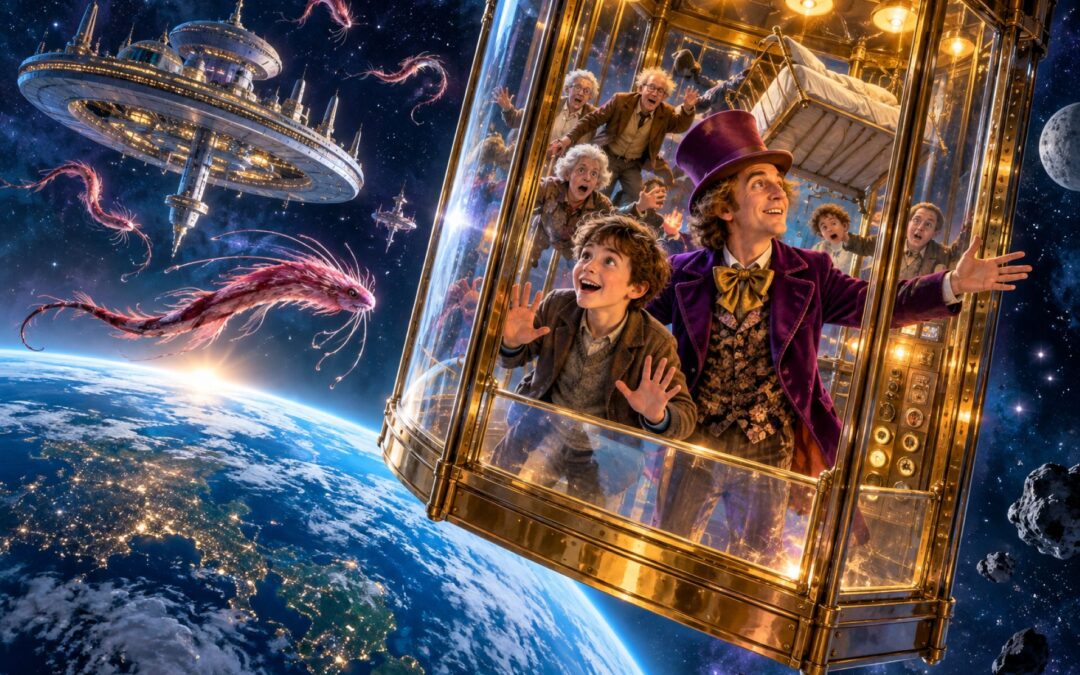
Charlie and the Great Glass Elevator begins exactly where Charlie and the Chocolate Factory ends. Charlie Bucket has inherited Willy Wonka’s extraordinary factory, but before he can settle into his new life, Wonka takes Charlie, his parents and all four grandparents into the Great Glass Elevator. What should be a short return journey becomes a trip into orbit, an accidental confrontation with alien predators, an international incident and, once everyone finally reaches the factory again, an equally chaotic experiment in reversing old age.
Roald Dahl published the novel in 1972 after children asked for another Charlie story, a connection documented in the Roald Dahl Museum’s publication history. This article follows the 2007 Puffin edition, rather than silently combining it with later revisions; the official Roald Dahl shop notes that the text of current editions was updated in 2022.
The sequel is much less neatly constructed than its predecessor. Charlie and the Chocolate Factory moves toward a single destination: children enter a mysterious factory, fail a sequence of moral tests and are eliminated until Charlie remains. Charlie and the Great Glass Elevator instead behaves like two increasingly extravagant adventures joined together. The first sends Charlie and Wonka into space; the second turns the grandparents into children, babies and, in one case, a person of negative age. That looseness is both the book’s great source of imaginative freedom and one of its most significant weaknesses.
Spoiler warning: the discussion below covers the complete novel, including the Vermicious Knids, Wonka-Vite, Minusland and the ending.
Charlie and the Great Glass Elevator: Complete Plot Summary
The novel contains twenty chapters, but its story is easier to understand as three connected movements. The opening chapters send the Bucket family into orbit and introduce the Space Hotel U.S.A.; the middle chapters turn the situation into a genuine survival crisis involving the Vermicious Knids; and the final eight chapters abandon space almost entirely for Wonka’s experiments with age, culminating in the White House invitation that ends the book.
Into Orbit and the Space Hotel
The story begins in mid-motion. Charlie Bucket now owns Willy Wonka’s chocolate factory, and the Great Glass Elevator contains not only Charlie and Wonka but also Mr and Mrs Bucket, Grandpa Joe, Grandma Josephine, Grandpa George and Grandma Georgina. Wonka intends to bring everyone back into the factory by taking the Elevator high into the sky and then crashing downward through the factory roof.
The three elderly grandparents who did not leave bed in the previous book have brought the bed with them, so the Elevator contains an absurd mixture of adventure machinery and domestic furniture. Wonka needs perfect timing to execute his descent, but Grandma Josephine interferes at a crucial moment. Charlie works the controls too late, and instead of dropping toward the factory, the Elevator continues upward until it leaves the Earth’s atmosphere.
The family is suddenly weightless. The bed, the grandparents and everyone else begin floating around the cabin. Wonka treats this with his usual delight, while most of the family reacts with fear and confusion. Even before the main danger arrives, Dahl establishes the sequel’s governing pattern: Wonka turns disaster into play, Charlie is fascinated enough to participate, Grandpa Joe usually joins him, and the remaining adults want everything to stop.
The accidental journey also produces one of the book’s recurring jokes about the three bedbound grandparents. They have spent years insisting that they cannot leave bed, yet weightlessness lifts them out of it effortlessly. Their physical helplessness is therefore exposed as partly psychological. They can move when circumstances force them to; what they consistently refuse to do is choose movement.
While the Great Glass Elevator circles Earth, the family sees a remarkable human construction: Space Hotel U.S.A. The enormous hotel has been launched into orbit but has not yet received its first staff. A transport capsule carrying astronauts and hotel employees is on its way, while technicians and political leaders on Earth are watching the entire operation.
The Americans monitoring the mission notice another object near the hotel. They can see the transparent Elevator, but the sight inside makes no sense. Human figures are floating beside a bed, and nobody on Earth knows what kind of craft could contain such passengers. The Great Glass Elevator becomes an unidentified spacecraft, and uncertainty quickly turns into suspicion.
Wonka, instead of avoiding the new hotel, decides to visit it. He must first manoeuvre the Elevator through weightlessness, and Dahl turns the basic problem of movement into comic improvisation. Wonka teaches everyone that they can propel themselves by blowing air in the opposite direction from where they want to travel. Charlie and Grandpa Joe then help him use the Elevator’s controls and rockets until the craft approaches the hotel.
Their successful docking expands the scale of the Wonka universe. The first novel made the chocolate factory seem impossibly large and secretive, but its wonders were still contained behind factory walls. The sequel immediately removes those walls. Wonka’s glass machine can travel through the air, into orbit and directly into one of humanity’s most ambitious technological projects.
Back on Earth, the unexplained visitors cause political panic. President Lancelot R. Gilligrass is surrounded by generals, advisers, the Chief Spy, Vice-President Miss Tibbs and other officials who offer confident interpretations without possessing reliable information. Various governments are suspected, international calls are made, threats are imagined and everyone behaves as though the inability to identify something must mean that it is dangerous.
Gilligrass himself is not portrayed as a commanding statesman. He is distractible, childish and fascinated by trivial inventions even during an apparent extraterrestrial crisis. His cabinet contains similarly exaggerated figures, including a financial adviser whose relationship with the national budget becomes a literal physical gag. Dahl turns the institutions that are supposed to manage global emergencies into another Wonka-like theatre of absurdity, except that these adults possess official power without Wonka’s actual competence.
Charlie’s group enters the Space Hotel before its intended occupants arrive. The place is a futuristic monument to luxury, but it is eerily empty. Wonka realizes that Earth is almost certainly listening and tells the others to remain quiet. The President attempts to establish communication and even threatens to alter the hotel’s temperature if the unknown visitors do not identify themselves.
Wonka eventually responds in elaborate nonsense. Rather than explain that he is an English chocolate maker travelling with a family from the factory, he produces strange phrases that sound alien to the listeners. The result is exactly what he wants: instead of solving the misunderstanding, he intensifies it. Washington now has even stronger reason to believe that beings from another planet have occupied the hotel.
The joke depends on two different forms of irrationality. Wonka deliberately makes nonsense sound mysterious, while powerful adults desperately assume that every sound must contain hidden strategic meaning. Dahl’s politicians become victims of their own need to interpret what they do not understand.
President Gilligrass attempts diplomacy and invites the apparent extraterrestrials to visit the White House. Charlie and Grandpa Joe are delighted by the possibility, but Wonka knows that accepting would require them to explain themselves. He prefers the masquerade. Before the misunderstanding can develop any further, however, the comedy inside the hotel changes sharply in tone.
Grandma Josephine notices something emerging from one of the lifts. It is alive, strange and unpleasantly fluid in appearance. More creatures begin appearing, and their ability to alter their bodies makes them difficult to identify at first. Gradually they twist themselves into letters.
The message they form is simple: SCRAM.
Wonka immediately understands that they are no longer dealing with a political misunderstanding or an empty hotel. Something dangerous has arrived first.
The Vermicious Knids and the Rescue
Wonka orders everyone back into the Great Glass Elevator and identifies the creatures as Vermicious Knids. They come from the distant planet Vermes and are not merely strange extraterrestrials but predators. Wonka explains that they have destroyed life elsewhere and are capable of reshaping their bodies into different forms.
The Knids introduce actual physical danger into a story that has so far treated almost every crisis as a joke. One pursues the Elevator and attempts to attack it directly. The glass holds, but the creature’s power is unmistakable. The family is trapped in space with organisms that can alter their shapes, swarm and consume living beings.
Dahl never allows the atmosphere to become conventional horror. Wonka continues joking, talking and even singing in the middle of the danger. The Knids are frightening because of what they can do, but they are also ridiculous in shape and behaviour. That combination—real threat filtered through comic exaggeration—is central to Dahl’s treatment of childhood danger.
While Wonka and the Buckets escape temporarily, the official Transport Capsule carrying the Space Hotel staff reaches the station. The occupants do not know what has already happened. They enter what they expect to be a magnificent new workplace and initially react with excitement to its luxury.
The Knids attack.
Earth hears the crisis through communications from the hotel. What had previously looked like an absurd political misunderstanding becomes a genuine emergency. Some people inside the hotel are killed, while survivors retreat toward the capsule. The monsters that Washington had imagined are therefore replaced by monsters nobody had anticipated.
The shift also changes the moral situation for Charlie and Wonka. They could continue toward Earth and save themselves, but the Transport Capsule is now in severe trouble. Its engines have been damaged, and its passengers cannot safely return on their own.
Charlie is the person who refuses to treat them as somebody else’s problem.
When he learns that the damaged capsule cannot manoeuvre normally, Charlie proposes using the Great Glass Elevator to pull it toward Earth. The idea is risky because it requires Wonka’s small craft to approach the Knid-infested area again, attach itself to the much larger capsule and control a descent while under attack. Wonka nevertheless embraces the plan.
This is one of the most important scenes for Charlie in the entire sequel. He does not defeat the danger through magical knowledge or superior technology. Wonka still controls those things. Charlie’s contribution is moral and practical: people need help, the Elevator can potentially help them, and therefore they should try.
Wonka, Charlie and Grandpa Joe manoeuvre close enough to attach a steel cable between the Elevator and the Transport Capsule. Their improvised rescue then becomes a chase. The Knids swarm around them, changing shape and attempting to stop the escape.
One creature wraps itself around the Great Glass Elevator. Others begin forming a long connected chain, creating the possibility that the predators will drag the craft away rather than simply destroy it. Wonka, normally quick to produce an answer, seems temporarily unable to find one.
The breakthrough comes through the idea of going home. The phrase reminds Wonka that the Knids possess a crucial weakness: they cannot tolerate the intense heat produced by entering Earth’s atmosphere at enormous speed. The same descent that is dangerous for the humans can become a weapon against the attackers.
The Great Glass Elevator therefore plunges toward Earth while towing the damaged capsule. The Knids continue following until atmospheric heating becomes unbearable. They burn up during re-entry, while Wonka’s craft survives.
Once the danger has passed, the Transport Capsule is released. Its parachutes can still function, allowing it to descend safely. The rescue that Charlie proposed is successful, and the people on Earth who previously mistook Wonka’s party for hostile extraterrestrials now owe their surviving space travellers to the same mysterious craft.
Wonka then returns to his original problem: getting everyone into the chocolate factory.
The Great Glass Elevator races downward and crashes through the factory roof. The journey is violent and spectacular, but the passengers survive. They eventually reach the familiar Chocolate Room, where the Oompa-Loompas celebrate Wonka’s return.
For a moment, the book appears ready to settle. Charlie is back inside the factory he owns, the family has survived space, the Knids are gone and the American spacecraft has been saved.
Wonka immediately creates another problem.
He expects Grandpa George, Grandma Georgina and Grandma Josephine to leave bed and take an active role in life at the factory. The three refuse. Their journey into orbit, encounter with alien predators and crash back to Earth have changed nothing about their determination to remain under the blankets.
That refusal begins an entirely new story.
Wonka-Vite, Minusland and the White House Invitation
Wonka responds to the grandparents’ refusal with a temptation rather than an argument. He introduces Wonka-Vite, one of his inventions for altering age. Each pill makes the person who swallows it twenty years younger.
As usual, Wonka describes the invention through a mixture of extraordinary claims, absurd ingredients and a story about earlier testing. An elderly Oompa-Loompa had tried the medicine and became dramatically younger. The invention therefore appears to offer exactly what the old grandparents think they want: not simply increased health but restored youth.
Dahl pauses the action for the recipe itself, which is intentionally impossible. Wonka’s ingredient list is filled with bizarre animals, puns and procedures that belong less to science than to linguistic play. The recipe matters because it shows how Dahl writes Wonka’s inventions. Their apparent precision is part of the joke; Wonka gives exact-sounding instructions for processes that make no sense outside the book’s imaginative logic.
The three old people quickly become interested. Wonka has repeatedly told them that the medicine must be taken carefully because every pill subtracts twenty years. They nevertheless begin arguing over who should get how much. The desire for youth overwhelms caution.
Each of the three eventually takes four pills.
The result is mathematically simple and physically absurd. Grandma Josephine and Grandpa George become babies. Grandma Georgina, who was not old enough to lose eighty years and remain alive in ordinary positive age, disappears entirely.
Mrs Bucket is horrified. Wonka explains that Georgina has gone below zero years old and entered what he calls the Minuses. In the strange arithmetic governing Wonka-Vite, age can become negative just as a number can. A human being who has not merely become younger but has been reduced to an age before birth therefore ceases to exist in the visible world.
The disaster resembles the punishments in Charlie and the Chocolate Factory, but with an important difference. Josephine, George and Georgina are not children who ignored Wonka during a factory tour; they are members of Charlie’s family. Charlie cannot simply accept what has happened as comic justice.
He sees his mother’s distress and asks Wonka to bring Georgina back.
Wonka agrees, and Charlie accompanies him deeper into the factory. Their journey reveals that the factory Charlie has inherited is far larger and stranger than either novel has previously shown. They pass through extraordinary industrial spaces and glimpses of hidden production areas, suggesting that the familiar Chocolate Room and invention rooms are only a fraction of Wonka’s territory.
The expansion is important for Charlie’s position as heir. Owning the factory does not mean understanding it. Wonka still knows routes, substances and dimensions of the place that Charlie has never encountered. The sequel therefore turns inheritance into the beginning of an apprenticeship rather than the end of a story.
Wonka explains that he has another invention, Vita-Wonk, designed to do the opposite of Wonka-Vite. Instead of removing years from a person, it adds age. Its development involved searching for extraordinarily old living things and collecting substances associated with their longevity. Like Wonka-Vite, the explanation parodies scientific research by combining methodical language with impossible premises.
Charlie and Wonka descend into Minusland to find Georgina.
Minusland is unlike the factory’s ordinary machinery. It is quiet, misty and conceptually strange, a place governed by subtraction rather than manufacturing. Human beings who have been reduced to negative age exist there in an almost ghostlike condition.
Wonka warns Charlie about invisible beings called Gnoolies that can “subtract” people who remain too long. The threat gives Minusland its own rules and makes Charlie’s decision to accompany Wonka another small act of courage.
They find Georgina in a translucent, barely present state. Wonka applies Vita-Wonk and succeeds in returning her to positive age, but the treatment cannot be controlled with perfect accuracy. She reappears extraordinarily old.
Back in the Chocolate Room, the family must determine just how old she has become. Charlie helps by asking Georgina what events she remembers from her life. Her memories reach centuries into the past until the family calculates that she is 358 years old.
The joke turns age into a strange journey through history. Georgina’s impossible lifespan allows Dahl to move backward through remembered events, while Wonka uses arithmetic to decide how much Wonka-Vite will reduce her to a normal age again.
As Georgina becomes younger, the process effectively reverses her journey through time. She remembers increasingly recent periods until the treatment brings her back to seventy-eight. For once, the combination of Wonka-Vite and Vita-Wonk produces the intended result.
Grandpa George and Grandma Josephine remain babies, so Wonka now uses carefully measured Vita-Wonk to age them forward. Georgina, understandably suspicious after what has happened to her, does not trust Wonka’s medicines. Charlie is more confident. He has seen that Wonka’s inventions can be dangerous when misused, but he has also seen that Wonka understands how to correct the situation when people follow his instructions.
The babies grow rapidly back into the elderly people they were before the experiment. The family is restored.
Wonka assumes that everything they have experienced will finally persuade the three old grandparents to get out of bed. They have been carried into orbit, confronted by monsters, transformed into infants, sent below zero, aged into extreme old age and returned to normal. Surely ordinary life inside the greatest chocolate factory in the world should now seem preferable to remaining under the covers.
They still refuse.
The final solution comes from outside Wonka’s laboratory. An Oompa-Loompa arrives with a message from President Gilligrass. The President has learned that the people in the mysterious glass spacecraft rescued the endangered Transport Capsule, and he invites the entire group to the White House. A helicopter is waiting.
The three stubborn grandparents immediately jump out of bed.
The punchline resolves a joke that has run through the entire novel. Physical necessity could not persuade them to change voluntarily. Wonka’s anger did not work. Becoming younger did not work. Almost disappearing from existence did not work. The prestige and excitement of visiting the President finally do.
Charlie and Grandpa Joe head off with the rest of the family, and Charlie suggests that the extraordinary events they have already survived are merely the beginning of the day.
The Novel’s Worlds: Space, the Chocolate Factory and Minusland
The most obvious difference between Charlie and the Great Glass Elevator and its predecessor is scale. The first book makes Wonka’s factory feel like a complete universe, but the sequel immediately pushes beyond it. Dahl moves from Earth to orbit, from a futuristic hotel back into an even larger factory, and finally into a place where age itself can become negative.
Space is presented through just enough recognizable science to make the nonsense work. There is weightlessness, orbital movement, docking, re-entry and atmospheric heating, but Dahl is not trying to write technically consistent science fiction. Scientific vocabulary creates a platform from which fantasy can leap. The Great Glass Elevator can operate like a spacecraft because the story needs it to, and its transparent walls allow the characters to remain visually exposed even when travelling through an environment no ordinary elevator could survive.
The Space Hotel U.S.A. represents human technological ambition at its most extravagant. It is gigantic, luxurious and politically celebrated, yet before its first guests can properly occupy it, it becomes a hunting ground for creatures humanity did not even know existed. The contrast is comic but pointed: people have built an enormous monument to mastery over space without understanding what else may be living there.
The hotel also creates an interesting contrast with Wonka’s factory. Both are impossible technological spaces, but the factory actually works according to the purposes of its inventor. Wonka’s machines may be dangerous, bizarre and ethically questionable, yet he understands them. The Space Hotel, by comparison, is a triumph of institutional engineering that becomes helpless when reality behaves differently from expectation.
The chocolate factory expands in a different direction. When Charlie and Wonka travel toward Minusland, Charlie discovers that owning the factory has not made its mysteries disappear. There are hidden regions, production areas and landscapes beyond anything shown during the tour in the first novel. The factory continues to function as a place whose boundaries recede whenever somebody thinks they understand it.
That matters for Charlie’s inheritance. The ending of Charlie and the Chocolate Factory could be read as complete fulfilment: the poor child has won the magical kingdom. The sequel quietly revises that idea. Charlie has inherited something he scarcely comprehends. His future therefore involves learning Wonka’s world rather than merely possessing it.
Minusland is the strangest setting because it is not really presented as machinery at all. It is a physical location built from a mathematical joke. If Wonka-Vite can reduce a person from seventy years old to fifty, then the story asks what happens when the arithmetic passes zero. Dahl responds by converting a negative number into geography.
The result is eerie precisely because it is less crowded and comic than most Wonka spaces. Mist, invisibility and the threat of subtraction give Minusland the quality of a border between existence and non-existence. Georgina is not dead in the normal sense, but she is no longer available to the positive world of ordinary age.
Dahl does not build these places with the consistency expected of elaborate modern fantasy worlds. Distances, mechanisms and rules exist primarily to produce the next event. Yet the individual environments possess strong local logic. The Knids cannot survive atmospheric heat; age medicines operate arithmetically; Minusland contains people whose age has fallen below zero. The world-building is therefore imaginative and functional rather than systematic.
Characters and Relationships
Although the sequel constantly introduces machines, aliens, politicians and medicines, its central human dynamic remains the relationship between Charlie and Wonka. Around them, the Bucket family provides several contrasting responses to uncertainty, while President Gilligrass and his officials turn adult authority into another form of comedy.
Charlie Bucket: Moral Center and Emerging Heir
Charlie begins the novel in a very different position from the child readers met in Charlie and the Chocolate Factory. He is no longer starving, powerless or competing for a prize. He owns the factory. The central question is therefore not whether Charlie deserves to win but what kind of person he will be now that he has won.
Dahl preserves Charlie’s defining qualities by placing him in situations where possession offers no advantage. His ownership cannot steer the Elevator, defeat the Knids, recover Georgina or reverse the effects of Wonka-Vite. Charlie remains dependent on Wonka’s knowledge, but he repeatedly influences what Wonka does with that knowledge.
The clearest example is the Transport Capsule. Wonka possesses the extraordinary vehicle and technical imagination required for a rescue, but Charlie supplies the ethical impulse. He does not want to leave the stranded passengers behind. His instinct is not complicated: they are in danger and he believes the Elevator may be able to help.
That response distinguishes Charlie from many adults around him. The grandparents often evaluate situations according to their own comfort. Political leaders evaluate the unknown through suspicion and national interest. Wonka frequently treats danger as an opportunity for experimentation or amusement. Charlie notices the people who may be hurt.
His behaviour toward Grandma Georgina follows the same pattern. Georgina’s disappearance is partly the consequence of greed and refusal to obey instructions, and Wonka could easily treat her fate as another comic punishment. Charlie instead sees his mother’s distress and asks for help. Family loyalty outweighs the logic of deserved consequences.
Charlie is also genuinely curious. Where several relatives react to Wonka’s world by wishing it would become ordinary, Charlie wants to understand what lies beyond the next door or control panel. His curiosity is not identical to Wonka’s, however, because Charlie retains a stronger sense of responsibility toward other people.
That combination explains why he remains a plausible successor to Wonka even though the sequel does not make him its dominant personality. Charlie possesses enough imagination to participate in Wonka’s world without becoming morally indistinguishable from Wonka.
The limitation is dramatic. Wonka still controls almost every major invention and explanation, which can leave Charlie reacting to a story that nominally concerns the future owner of the factory. Charlie proposes important actions, but Wonka generally executes them. As a result, the sequel develops Charlie’s suitability as an heir more clearly than it develops his independence.
Willy Wonka: Inventor, Trickster and Dangerous Mentor
Wonka is the book’s great engine. Nearly every event becomes more unpredictable because he is present. When the Elevator accidentally enters orbit, he does not simply search for the safest path home; he decides to investigate a space hotel. When Earth believes he may be an alien, he reinforces the misunderstanding. When the grandparents refuse to leave bed, he produces medicine capable of changing their ages by decades.
This behaviour makes Wonka exhilarating and dangerous in almost equal measure. His imagination destroys the distinction between a problem and an opportunity. An ordinary adult might respond to danger by minimizing variables. Wonka introduces more.
His humour also depends on emotional asymmetry. Other people are terrified while Wonka is interested. They want explanations while he plays with language. They demand certainty while he treats uncertainty as entertainment. The gap makes him funny, but it can also make him seem callous.
The Knid sequence demonstrates both sides of his character. Wonka is willing to mock the creatures even while they are attacking, yet when Charlie proposes helping the stranded capsule, Wonka does not dismiss the idea as too dangerous. He acts. His recklessness is real, but so is his courage.
The age-medicine sequence complicates him further. Wonka clearly understands that Wonka-Vite can produce disastrous results when misused and warns the grandparents about the dosage. Their transformations are therefore not something he secretly engineers. At the same time, he introduces an extraordinarily powerful experimental substance to vain, impulsive people and then seems almost delighted by the bizarre consequences.
His relationship with Charlie works because Charlie is one of the few characters who neither worships Wonka uncritically nor tries to reduce him to ordinary adult rules. Charlie accepts the reality of impossible inventions quickly, asks practical questions and brings moral concerns into situations Wonka might otherwise treat as experiments.
Wonka is therefore not simply a kindly mentor. He is closer to a trickster-teacher whose lessons often emerge from risks he has helped create. Charlie learns by surviving Wonka’s world, observing its logic and gradually influencing the person who controls it.
That ambiguity is one reason Wonka remains far more compelling than a conventional benevolent magician. His generosity does not eliminate his irresponsibility. His brilliance does not guarantee wisdom. His ability to save everybody from a crisis does not necessarily mean he was wise to bring them into the crisis.
The Bucket Family: Courage, Fear, Greed and Inertia
Grandpa Joe remains Charlie’s closest family ally. He shares the boy’s excitement, participates in the Elevator’s manoeuvres and is much more willing than the other grandparents to accept Wonka’s world. Their relationship preserves some of the warmth of the first novel: Grandpa Joe helps convert Charlie’s curiosity into shared adventure.
Mr and Mrs Bucket are more cautious. Their main function is not to compete with Wonka for control but to represent ordinary parental concern inside a story that constantly refuses ordinary limits. Mrs Bucket becomes particularly important when Georgina disappears. Her distress gives the Wonka-Vite disaster emotional weight that Wonka’s comic manner could otherwise erase.
Grandpa George, Grandma Josephine and Grandma Georgina function almost as a collective character. Their bed is their chosen territory, and their dominant responses to the unknown are complaint, suspicion and refusal. They distrust Wonka but are immediately willing to trust his medicine when it promises youth.
Their greed over Wonka-Vite places them within Dahl’s familiar moral universe. The important problem is not that they want to feel younger; the desire itself is understandable. Their error is refusing restraint. They are told exactly what the pills do and still take excessive amounts because each person wants the maximum benefit.
Yet the three should not be reduced entirely to moral examples. Their fear can be reasonable. They are repeatedly subjected to extraordinary danger by a man who treats impossible machines casually. Their distrust of Wonka is often comic, but the events frequently prove that Wonka’s inventions really can transform, endanger or temporarily erase a person.
The comedy comes from the disproportion between their reactions. Even after surviving events that should permanently change their perspective, they return to bed. Dahl makes inertia stronger than experience until the final invitation provides a motivation powerful enough to overcome it.
President Gilligrass and the Satire of Adult Authority
President Gilligrass exists less as a psychologically developed individual than as the centre of a political farce. He is surrounded by the machinery of government but repeatedly behaves like an overgrown child. In the middle of what appears to be an extraterrestrial emergency, he can become distracted by his own inventions and absurd ideas.
Miss Tibbs and the officials around him extend the joke. Generals, spies and advisers possess impressive titles but little understanding of what is actually happening. The unknown object near the Space Hotel becomes whatever their fears require it to be.
Dahl therefore separates formal authority from competence. The people officially responsible for interpreting the crisis are wrong about its cause, while Wonka—an eccentric chocolate maker travelling with a bed full of grandparents—understands the genuine extraterrestrial danger.
The satire is deliberately broad rather than subtle. Cold War suspicion, bureaucracy, political vanity and military alarm are exaggerated into slapstick. The result can still be funny because institutions are portrayed as desperately serious about nonsense, but some of the jokes are tied closely to the period in which the novel was written.
The most problematic material appears in the selected edition’s caricatured representation of Chinese officials. Stereotyped names and dialogue turn nationality and accent themselves into part of the joke. The issue is not simply that the humour is old-fashioned; it reduces people to racialized comic shorthand. That material has aged much worse than the more general mockery of presidents, generals and bureaucrats.
Themes and Ideas
The novel’s ideas do not form a systematic philosophy, but its repeated situations create several clear patterns. Characters are continually confronted with opportunities to move, change, help others or exercise restraint, and their responses reveal what Dahl values and mocks.
Adventure, Courage and Altruism
Adventure in Dahl’s novel requires willingness to enter uncertainty. Wonka embodies this almost excessively: he treats the unknown as irresistible. Charlie shares the curiosity without sharing Wonka’s indifference to consequences.
The difference matters most during the rescue of the Transport Capsule. Charlie does not act because rescuing the passengers will reward him or prove his bravery. The people inside are strangers. His decision is valuable precisely because there is no selfish reason to return to the Knids.
Grandpa Joe’s role complements Charlie’s. He participates readily, helps operate the Elevator and gives Charlie an adult companion who does not respond to every danger with retreat. His courage is less morally central than Charlie’s, but it makes the adventure collaborative rather than isolating.
The second half develops courage differently. Charlie enters Minusland because Georgina needs help. The threat is not a spectacular monster attack but an unfamiliar realm where the rules of existence itself are strange. Again, Charlie’s courage is tied to another person rather than to thrill-seeking.
Dahl therefore distinguishes adventure from recklessness even though Wonka constantly blurs the two. The novel admires people who are willing to move toward the unknown, but its most admirable acts occur when curiosity is joined to responsibility.
Greed, Moderation and Comic Punishment
The Wonka-Vite episode continues the moral logic of Charlie and the Chocolate Factory. A miraculous object is introduced with clear instructions, somebody wants too much of its benefit, warnings are ignored and the desire becomes grotesquely literal.
Grandpa George, Grandma Josephine and Grandma Georgina know that every pill removes twenty years. They are not tricked. Their problem is that once youth becomes available in measurable units, moderation becomes difficult.
The transformations externalize the consequences of wanting more than one needs. Two grandparents become babies because they take too much youth. Georgina goes even further and becomes younger than zero. Dahl takes a familiar human wish—to recover youth—and pushes it until its literal fulfilment becomes absurd.
Wonka’s inventions frequently work this way. The technology itself is often successful. The disaster comes because somebody refuses to respect its conditions. Wonka-Vite does exactly what Wonka says it will do.
That does not make Wonka morally blameless, but it changes the nature of the cautionary tale. The medicine is not evil. Desire without restraint is the problem.
The Oompa-Loompa songs reinforce this pattern by converting individual disasters into miniature moral performances. They do not offer subtle ethical analysis, but subtlety is not their function. They transform consequences into memorable comic lessons.
Age, Inertia and the Desire to Reverse Time
The novel repeatedly connects old age with immobility, but it does so through caricature rather than a realistic portrayal of ageing. The three grandparents in bed have made inactivity into a way of life. Their physical location becomes a psychological identity.
Wonka-Vite appeals to them because it seems to offer transformation without effort. They do not have to change habits, take risks or decide to participate in life. They can simply swallow youth.
Their experience demonstrates the absurdity of confusing age with vitality. Becoming younger does not automatically make them wiser or more engaged. In fact, excessive youth reduces two of them to helpless infants.
Georgina’s journey pushes the problem in both directions. Too much youth removes her from ordinary existence; too much added age leaves her centuries old. Neither extreme represents fulfilment. The solution is not maximum youth or maximum longevity but restoration to a condition in which she can function as herself.
The bed remains the book’s most effective image for inertia because it survives almost everything. It travels into orbit. It enters the factory. It remains psychologically attractive even after its occupants have experienced impossible transformations.
The ending makes Dahl’s joke especially sharp. The grandparents do not finally leave bed because they have discovered a philosophical appreciation of life. They get up because visiting the White House sounds exciting.
Their inertia was therefore never absolute incapacity. Motivation mattered.
Adult Authority, Political Satire and Technological Hubris
The political chapters mock adults who possess enormous authority but limited imagination. Gilligrass and his advisers encounter something they cannot categorize, and instead of admitting uncertainty, they construct increasingly dramatic explanations.
Their behaviour mirrors a broader pattern in the novel. Adults repeatedly assume that control comes from having the correct title, machine or procedure. The American government has military systems and intelligence agencies. Space Hotel U.S.A. represents advanced engineering. Wonka has factories, medicines and extraordinary vehicles.
None of these things eliminates unpredictability.
The Space Hotel is perhaps the clearest example of technological hubris. Human beings have built a gigantic orbital hotel before understanding what dangers might exist in the environment around it. Its scale suggests confidence, while the Knid attack reveals vulnerability.
Wonka is not exempt from the theme. His inventions are vastly more effective than the government’s bureaucratic machinery, but his technical power also creates new risks. Wonka-Vite works so powerfully that a dosage error can erase a person from positive existence.
The crucial difference is adaptability. Gilligrass and his officials respond to uncertainty through panic and speculation. Wonka responds through improvisation. His solutions may be reckless, but he is capable of changing his model when events change.
Dahl’s satire therefore does not reject technology. The Great Glass Elevator and Vita-Wonk save lives. What the story mocks is the assumption that possessing technology automatically produces wisdom.
Symbols and Motifs: Elevator, Bed, Medicines and Songs
The Great Glass Elevator is the central vehicle of the novel in both a literal and thematic sense. It can move vertically, horizontally, through factory walls and into space. It embodies Wonka’s refusal to accept conventional boundaries.
Its transparency matters as well. The passengers can see the impossible worlds around them, and outsiders can see the bizarre family floating inside. The Elevator exposes rather than conceals, which helps create both wonder and misunderstanding. To Washington, the visible occupants make the craft more mysterious rather than less because what can be seen does not fit any expected category.
Charlie’s future can also be understood through the Elevator. He has inherited a factory, but Wonka immediately carries him beyond it. Ownership therefore becomes motion rather than arrival.
The bed operates in the opposite direction. Where the Elevator represents movement, the bed represents refusal to move. George, Josephine and Georgina transport their inertia everywhere, even when the bed itself is floating through orbit.
That contrast produces one of the book’s strongest recurring jokes. The most mobile vehicle imaginable contains people determined to remain physically stationary. Their bed crosses space while they resist getting out of it.
Wonka-Vite and Vita-Wonk turn time into something that can be consumed and measured. Age becomes almost like an ingredient in Wonka’s factory: it can be added, removed and recalculated.
The two medicines are opposites, but together they dramatize the danger of treating transformation as something that can be maximized without consequence. More youth is not automatically better, just as more age is not automatically wisdom.
The Oompa-Loompa songs function as a recurring chorus. Whenever the story becomes morally chaotic, the songs impose temporary order by converting an event into rhyme and judgment. Their tone can be cheerful even when the subject is frightening, which is typical of Dahl’s ability to make punishment simultaneously comic and disturbing.
Physical transformation runs through the novel more broadly. Adults float helplessly, aliens become letters and chains, grandparents become babies, Georgina becomes negatively aged and then centuries old. Bodies in Dahl’s world refuse stability.
That instability allows abstract qualities to become visible. Greed changes age. Inertia becomes a bed. Predatory hostility becomes monstrous shape-shifting. Dahl’s fantasy repeatedly takes something psychological or conceptual and gives it an exaggerated physical form.
Style and Structure: Dahl’s Comic Machinery
Dahl writes Charlie and the Great Glass Elevator with extraordinary speed. Problems do not merely escalate; they mutate. A failed landing becomes an orbital accident, which becomes an alien misunderstanding, which becomes a real alien attack, which becomes a rescue mission. Once that entire sequence ends, the novel almost immediately begins another chain involving age-changing pills and negative existence.
The narrative voice helps maintain this momentum. Dahl frequently writes as though telling the story directly to a child who is expected to enjoy exaggeration rather than interrogate plausibility. Explanations are confident, jokes arrive quickly and impossible ideas are presented with just enough detail to become temporarily believable.
Wonka’s language intensifies that effect. He uses puns, invented expressions, improbable terminology and verbal reversals. The pleasure of many scenes comes less from what a sentence communicates than from the spectacle of Wonka continuing to speak when any sensible person would stop and explain himself plainly.
Nonsense also becomes a weapon. His fake extraterrestrial language works because the President’s advisers are determined to assume that incomprehensible speech must contain meaning. Dahl repeatedly allows words to defeat people who take themselves too seriously.
The fictional names have a similar function. Vermicious Knids, Vita-Wonk, Wonka-Vite, Gnoolies and Minusland sound almost understandable before their meanings are explained. Dahl creates terms that children can enjoy acoustically while still connecting them to the story’s internal jokes.
Songs interrupt the prose but rarely stop the narrative for long. They operate like compressed performances within the book, exaggerating a moral or ridiculing a character before the plot accelerates again. Their rhymes reinforce the feeling that the narrator and Wonka are always slightly ahead of the characters who are suffering the consequences.
Dahl also uses grotesque comedy much more aggressively than a sentimental view of children’s fiction might suggest. People are eaten by Knids. Old adults become babies. Georgina disappears from ordinary existence. An extremely aged body becomes a source of jokes.
The humour works because the narration refuses solemnity. Violence and bodily transformation are made frightening enough to produce excitement but exaggerated enough to prevent the story from becoming realistic horror. For many readers, that tension is part of Dahl’s appeal: danger feels serious inside the moment but rarely destroys the expectation that the book will somehow restore order.
The structure is less controlled. Charlie and the Chocolate Factory possesses a strong organizing mechanism. Five children enter the factory; four repeatedly fail tests; Charlie remains. Each episode serves the same larger design.
Charlie and the Great Glass Elevator has no equivalent framework. The Space Hotel and Knid story reaches a genuine climax when the creatures burn during re-entry. The characters return to the factory, and the book could plausibly end there.
Instead, Chapter 13 effectively starts another novella.
The Wonka-Vite sequence has its own inciting temptation, disaster, journey, rescue and restoration. It is linked to the first half through the same characters and through the grandparents’ refusal to leave bed, but the main external conflicts are otherwise almost unrelated.
This makes the sequel unpredictable in a way the first novel is not. A reader genuinely cannot know what kind of story will exist several chapters later. That freedom suits Wonka’s personality and Dahl’s comic imagination.
It also weakens cumulative dramatic pressure. The Knids do not matter to Minusland. Minusland does not deepen the conflict with the Knids. Instead of one central problem intensifying toward a final climax, the book repeatedly clears the board and introduces a new one.
The political satire also reveals the difficulty of topical comedy. The broad jokes about bureaucracy, military panic and pompous officials remain understandable because the targets are recognizable across periods. The Cold War atmosphere, however, belongs more specifically to the early 1970s.
The Chinese caricature in the 2007 edition has aged more seriously. The humour relies on stereotyped language and comic naming rather than simply satirizing a government institution. A modern reader can recognize the historical context in which Dahl wrote without pretending that the characterization remains harmless.
That distinction matters when evaluating later revisions. The existence of an officially updated 2022 text means readers may encounter wording different from the edition discussed here. The responsible approach is neither to silently substitute the revised language nor to pretend the earlier material has no bearing on the novel’s present reception.
The book’s strongest stylistic quality is ultimately abundance. Dahl rarely settles for one joke, one danger or one invention when he can add three more. That abundance produces some of his most memorable nonsense, but it also explains why the sequel is less elegant than the book it follows.
The Ending Explained
By the final chapter, every immediate physical crisis has been resolved. The Transport Capsule has reached safety, the family has returned to the factory, Georgina has been retrieved from Minusland, the babies have been restored to their proper ages and all three grandparents are once again themselves.
The unresolved problem is almost comically small compared with everything that preceded it: they still will not get out of bed.
That refusal allows the ending to connect the second half back to the novel’s opening joke. Weightlessness physically removed the grandparents from bed at the beginning, but nothing has persuaded them to abandon it voluntarily. Their transformations have changed their bodies without changing their fundamental attitude.
President Gilligrass’s invitation finally supplies the missing incentive. He has discovered the truth about the rescue and wants the group to visit the White House. A helicopter is ready.
The three grandparents immediately get up.
The joke works because it reverses every assumption Wonka has made. He has treated the problem as though the old people need transformation. He tries adventure, responsibility, youth and medicine. What they actually need is a reason they personally find exciting.
The White House invitation also resolves the space plot. Gilligrass began the novel’s political sequence convinced that the people in the Elevator might be dangerous extraterrestrials. He ends by honouring them for saving American lives. Suspicion becomes gratitude once the events can finally be understood.
Charlie’s final suggestion that the day “hasn’t even begun” prevents the ending from becoming comfortable closure. The novel ends in motion. The family is leaving the factory again, and another improbable encounter appears to be waiting.
That open ending was not merely hypothetical. Dahl later worked on an unpublished third Charlie story, and the Roald Dahl Archive records a 1978 typescript titled Charlie in the White House. It never developed into a completed third novel, but the archival manuscript confirms that the destination at the end of Charlie and the Great Glass Elevator could have become the starting point for another adventure.
The ending therefore resolves the book’s immediate problems while refusing to turn Charlie’s inheritance into a static happy ending. Charlie has won the factory, but Wonka’s world keeps expanding. The story suggests that possessing such a world means being permanently exposed to the next impossible thing.
Critical Review: A Wild, Uneven Sequel
Charlie and the Great Glass Elevator is easiest to appreciate once it is not expected to reproduce the precise achievement of Charlie and the Chocolate Factory. The first book is a tightly constructed modern fairy tale. The sequel is closer to an extended comic explosion.
Its greatest strength is invention. A transparent elevator accidentally enters orbit; a luxury hotel is attacked by shape-changing aliens; a president negotiates with nonsense-speaking strangers; old people swallow youth pills; a grandmother becomes negatively aged; Charlie and Wonka descend into Minusland to retrieve her. Dahl produces ideas at a rate that many children’s novels would spread across several books.
The Vermicious Knids are particularly effective because they give the first half a genuine threat. Their ability to change shape creates visual comedy, but the deaths in the Space Hotel establish that they are not merely harmless cartoons. The atmospheric re-entry solution also gives the chase a satisfying piece of internal logic: a previously established biological weakness becomes the mechanism of escape.
The Wonka-Vite sequence is less suspenseful but more characteristically Dahl-like. It turns vanity and greed into bodily transformation, extends the factory’s pseudo-science and produces the book’s strangest conceptual invention in Minusland. The notion that a person can become younger than zero is ridiculous, but once Dahl accepts the premise literally, the logic is surprisingly coherent.
Wonka remains the book’s greatest comic character. His refusal to respond normally to anything prevents scenes from becoming predictable. He can be infuriating, reckless and emotionally detached, but removing those qualities would also remove much of the force that makes him distinctive.
Charlie provides the necessary counterweight. He is not as colourful, but he repeatedly supplies the story with moral direction. His rescue of the Transport Capsule and concern for Georgina show that the qualities rewarded in the first novel were not merely passive niceness. Given an opportunity to act, Charlie uses imagination in the service of other people.
Yet the sequel never completely solves the problem created by Charlie’s victory in the first book. Poverty, hunger and the Golden Ticket gave Charlie and the Chocolate Factory powerful emotional stakes before the factory tour even began. Here Charlie starts with his greatest dream already fulfilled.
Dahl compensates by increasing spectacle, but spectacle cannot fully replace progression. Charlie does not have another transformation comparable to winning the factory. He demonstrates character rather than undergoing a major character arc.
The two-part construction magnifies that weakness. The Knid adventure reaches an energetic climax, resolves and returns everyone home. The Wonka-Vite story then begins with a different problem, different rules and a different kind of danger.
Both halves contain memorable material, but together they feel more like linked adventures than one inevitable narrative. That is the central structural limitation of the book.
The looseness does provide one advantage: unpredictability. Charlie and the Chocolate Factory quickly establishes the rhythm by which children will be tested and eliminated. Charlie and the Great Glass Elevator refuses to tell the reader what sort of novel it intends to be for very long.
That quality is especially well suited to younger readers who respond to constant escalation. The book moves rapidly, introduces new marvels before old ones become stale and rarely asks for patience. A reader bored by one type of adventure will encounter another within a few chapters.
Dahl’s prose also remains highly accessible. His sentences favour speed, jokes and concrete images over descriptive density. Invented words are usually understandable from context, and technical concepts are converted into visual situations: people float, aliens form words, pills subtract years and negative age becomes a physical realm.
The humour is more divisive. Dahl frequently finds comedy in fear, humiliation and bodily extremity. Readers who enjoy his grotesque imagination will probably find the baby grandparents, ancient Georgina and predatory Knids hilarious. Readers who dislike cruelty embedded in children’s comedy may find the same scenes unpleasant.
Contemporary reviewers were divided enough to anticipate that disagreement. Kirkus’s 1972 review was notably hostile to the sequel’s excesses, treating its silliness as evidence that the imagination of the first book had tipped into strained nonsense. By contrast, a later Penguin Random House edition page preserves a Publishers Weekly assessment emphasizing the appeal of Dahl’s breathless storytelling.
Both reactions identify something real. The book’s unruliness is not a superficial feature that can be separated from its quality. It is simultaneously the reason the novel produces such extraordinary images and the reason its structure feels less disciplined.
Some elements have aged remarkably well. The idea of wealthy technological institutions misunderstanding a crisis remains effective. The tension between official authority and actual competence is still recognizable. Charlie’s instinct to help strangers rather than protect only himself remains morally clear without becoming sentimental.
Other material has aged poorly. The Chinese caricatures in the selected text are the clearest example because their humour depends on racialized speech and naming. The broad political caricature of Gilligrass is deliberately absurd, but the treatment of Chinese characters operates through stereotype rather than merely mocking officeholders.
The novel’s depiction of age is also intentionally crude. The grandparents are funny because they are exaggerated, lazy and obstinate, not because Dahl is attempting a thoughtful portrait of elderly life. Readers looking for realistic psychological treatment will find little of it.
Even the book’s moral world is less tidy than it first appears. Dahl punishes greed, but Wonka constantly behaves with a recklessness that would be unacceptable in anyone without his magical competence. He condemns excess while embodying excess.
That contradiction is productive. Wonka’s world would be less exciting if he were consistently responsible, and Charlie would be less necessary if Wonka were consistently wise. The sequel works best when Charlie’s moral steadiness and Wonka’s imaginative instability are allowed to coexist.
As a sequel, then, Charlie and the Great Glass Elevator is both more ambitious and less complete than Charlie and the Chocolate Factory. It expands the geography, increases the danger and multiplies the inventions, but it loses the elegant narrative engine that made the first book feel inevitable.
Readers who most value plot symmetry, sustained character development and emotional depth will probably consider it the weaker novel. Its episodic second half can feel like a new story attached after the first has already reached its climax, and Charlie sometimes seems secondary inside the sequel that bears his name.
Readers who value Dahl for outrageous imagination may reach the opposite emotional conclusion even while acknowledging those flaws. Few children’s books move from orbital hotels to carnivorous aliens to negative age with such confidence. The novel behaves as though an absurd idea becomes more attractive, not less, when another absurd idea is placed immediately beside it.
That is the fairest way to understand its lasting appeal. Charlie and the Great Glass Elevator is not the perfectly engineered sequel its title might suggest. It is a deliberately unstable machine, full of noisy inventions, frightening creatures, grotesque transformations and jokes that range from inspired to badly dated.
For readers who loved the controlled wonder of the first Charlie novel, it is worth reading with adjusted expectations. The sequel does not deepen Charlie’s story as elegantly as its predecessor begins it, but it does reveal what happens when Dahl stops treating Wonka’s factory as the limit of his imagination.
The answer is that there is no obvious limit at all. Once Charlie enters the Great Glass Elevator, the factory is no longer simply his prize. It becomes the starting point for a world in which orbit, monsters, impossible medicines and even negative existence are only the next doors waiting to be opened.
Last Updated on October 5, 2026 by Aseem Gupta