
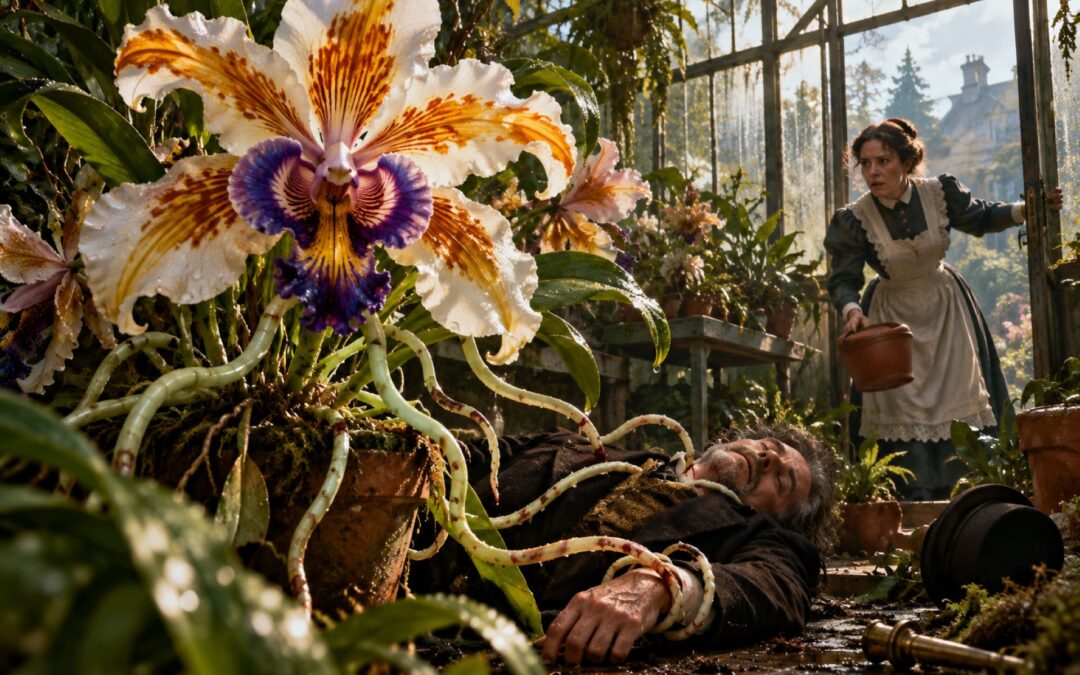
H. G. Wells’s The Flowering of the Strange Orchid begins with an almost comic wish: Winter-Wedderburn, a comfortable but profoundly uneventful middle-aged man, would like something remarkable to happen to him. What he gets is a rare orchid that flowers beautifully, incapacitates him with its perfume, and attempts to drain his blood through its rootlets. The story turns Wedderburn’s vague longing for adventure into a neatly engineered nightmare in which curiosity, scientific fascination, beauty, and danger become impossible to separate.
Some modern versions shorten the title to The Strange Orchid, but Wells published it as The Flowering of the Strange Orchid. It first appeared in 1894 and was later included in Wells’s 1895 collection The Stolen Bacillus and Other Incidents. The story sits comfortably between speculative fiction, Gothic horror, and black comedy, using recognisable Victorian interests in exotic orchids and natural science to make its impossible predator seem temporarily plausible. This article contains full spoilers, including the ending.

What Happens in The Flowering of the Strange Orchid
The story opens by explaining why buying orchids can feel like gambling. A shrivelled, apparently lifeless root may turn out to be worthless, or it may produce some astonishing new flower that brings beauty, profit, scientific distinction, and perhaps even the honour of having a new species named after its discoverer. That possibility attracts Winter-Wedderburn, a shy, slow-moving man with enough private income to avoid ordinary employment and enough leisure to cultivate orchids in a small greenhouse.
Wedderburn’s life is conspicuously uneventful. Over breakfast, he tells his housekeeper, who is also a distant cousin, that he has a feeling something is going to happen to him that day. She immediately interprets the phrase pessimistically, but Wedderburn means something extraordinary rather than necessarily unpleasant. He envies people whose lives contain accidents, travel, illness, romance, danger, or any other disturbance that interrupts routine.
His idea of an interesting life becomes especially clear when he talks about an orchid collector named Batten. Batten, much younger than Wedderburn, had endured malaria, injuries, marriages, divorce, violence, and finally death while collecting specimens abroad. Wedderburn admits that such a life must have been troublesome, but he also finds it fascinating. The contrast establishes his central weakness: he romanticises adventure precisely because he has never had to experience its costs.
Later that day, Wedderburn travels to London for an orchid sale and returns unusually excited. He has bought several plants, but one unidentified shrivelled specimen interests him more than the rest. It may belong to a known species, or it may represent something entirely new. Even before it grows, therefore, the plant already appeals to two of Wedderburn’s desires: the pleasure of scientific curiosity and the possibility of becoming associated with an important discovery.
The plant also has a disturbing history. It belonged to Batten’s final collection and may have been found beneath or beside his body after he died in a tropical swamp. Wedderburn explains that Batten had been suffering from fever and that jungle leeches had apparently drained a great deal of his blood. He treats the story as an unfortunate detail attached to an exciting specimen, whereas his housekeeper reacts with disgust.
Her dislike is immediate and physical. The dried orchid root appears ugly and vaguely spider-like to her, and the thought that a corpse may have lain across it makes the specimen even more repellent. Wedderburn remains amused rather than alarmed, insisting that orchids cannot be judged by their appearance when dormant. Something unattractive in its dry state may eventually produce an extraordinary flower.
Wedderburn soon devotes himself to cultivating the new acquisitions in his greenhouse. Several ordinary orchids fail under his care, but the unidentified specimen begins to grow. Its revival delights him because the possibility that it may be unusual is no longer purely speculative.
The first growths to attract attention are the aerial rootlets. To Wedderburn’s housekeeper, they resemble little white fingers emerging from the brown plant. As they lengthen, she begins comparing them to tentacles reaching outward for something. The description is not merely decorative foreshadowing: the rootlets will eventually function almost exactly as her imagination predicts.
Wedderburn notices that the roots are unusual too, but the same observation produces the opposite response in him. Where his cousin sees something threatening, he sees evidence of novelty. Their disagreement is therefore not between someone who notices the plant and someone who does not. Both notice the same strangeness; they differ in what they believe strangeness means.
The housekeeper eventually becomes so uncomfortable around the orchid that she avoids the greenhouse. Its rootlets enter her dreams, growing rapidly and reaching after her, and she decides that she wants nothing more to do with it. Wedderburn, meanwhile, continues to watch the plant develop with increasing fascination.
His interest is partly scientific. He discusses the fertilisation of orchids and refers to Charles Darwin’s studies of the mechanisms by which insects carry pollen between flowers. Wedderburn wonders whether his specimen may possess some unusual biological feature that has not yet been understood. He even imagines studying it seriously if it proves sufficiently strange.
The orchid’s leaves unfold first. They are broad, glossy, and green, but marked with deep reddish colouring near the base. The detail quietly strengthens the story’s blood imagery without yet revealing the plant’s predatory nature. Wedderburn sees only another intriguing characteristic.
Eventually the orchid flowers. As soon as Wedderburn enters the greenhouse, he notices an overwhelmingly rich, sweet smell stronger than anything else in the enclosed, humid air. He approaches the plant and finds several large blossoms whose white petals are streaked with golden orange, while the centre combines blue-purple and gold in an elaborate shape.
The flower is genuinely beautiful. Wedderburn is delighted because its appearance confirms his suspicion that he possesses something extraordinary, perhaps even an entirely new genus. Yet the intensity of the perfume becomes difficult to tolerate, and the greenhouse grows oppressively hot around him.
As he tries to check the temperature, Wedderburn becomes dizzy. His surroundings seem to move, the floor appears unstable, and the greenhouse begins to tilt before his eyes. He loses consciousness before he understands what is happening.
At the usual time for tea, his housekeeper notices that Wedderburn has not appeared. Since his routine is normally predictable, the delay eventually worries her enough to go looking for him. When she enters the greenhouse, she finds the air saturated with the orchid’s perfume and sees Wedderburn lying motionless on the floor.
The scene reveals what the plant has been doing. Its aerial rootlets are no longer hanging freely but have gathered around Wedderburn, stretched tightly across his body, and attached themselves to exposed areas of his skin. Small traces of blood appear where the roots meet his face, neck, and hands.
The housekeeper finally understands that the roots are functioning like leeches. She rushes forward and tries to pull them away, but they cling with extraordinary strength. When she breaks some of them, their fluid appears red, further blending the distinction between plant and animal.
The perfume then begins affecting her as well. She becomes dizzy and realises that she cannot continue struggling in the same air without collapsing beside Wedderburn. Instead of surrendering to panic, she moves outside, regains herself in the fresh air, and finds a practical solution.
She picks up a flowerpot and smashes the greenhouse windows. The action changes the conditions that have allowed the orchid’s perfume to dominate the enclosed space. She then returns, drags Wedderburn and the plant toward the open air, and causes the orchid to fall from its position.
Even outside, however, its rootlets remain attached to him. She therefore tears them away individually until Wedderburn is finally free. He is pale and unconscious, and his skin is marked by numerous circular wounds from which the orchid has drawn blood.
An odd-job man arrives after hearing the breaking glass and initially encounters a baffling scene: the housekeeper, her hands stained red, is dragging Wedderburn’s apparently lifeless body from the greenhouse. She sends him for water and then for Doctor Haddon. Wedderburn gradually regains consciousness but is weak from blood loss.
When he tries to understand what happened, his cousin tells him that he fainted in the greenhouse and begins explaining what the orchid did. Her immediate concern, however, is saving him rather than satisfying his curiosity. Other members of the household help carry him upstairs.
The damaged orchid rapidly deteriorates. Fresh air enters through the broken greenhouse windows, the intoxicating perfume dissipates, the severed roots wither, and the flowers begin turning limp and brown. Doctor Haddon examines the plant and sees one remaining rootlet still moving feebly, an important detail because it confirms that the extraordinary behaviour was not merely the housekeeper’s frightened interpretation of the scene.
By the following morning, the strange orchid has turned black and is decomposing. The open greenhouse has also exposed Wedderburn’s other carefully cultivated orchids to conditions that ruin them. The great discovery he hoped might bring distinction therefore destroys much of the collection he already possessed.
Wedderburn himself survives. Despite losing a significant quantity of blood, he suffers no permanent physical injury and soon becomes lively and talkative again. Most importantly, the incident has finally given him exactly what he wanted at the beginning of the story: something remarkable has happened to him.
The last irony is that he does not emerge traumatised or cured of his appetite for excitement. Instead, he enthusiastically tells the story of his strange adventure. Wells closes the narrative by converting a near-fatal attack into the fulfilment of Wedderburn’s original wish.
Winter-Wedderburn and the Housekeeper
Winter-Wedderburn is not a conventional heroic scientist or reckless explorer. He is comfortable, harmless, passive, somewhat timid, and almost comically untested by life. His fascination with orchids gives him one area in which uncertainty, discovery, and the possibility of distinction can enter an otherwise sheltered existence.
His longing for adventure is therefore more psychological than practical. He admires Batten’s dangerous life because he encounters it as a collection of stories rather than as fever, pain, loneliness, injury, and death. Adventure has become an abstraction for him, something that gives shape to a life without requiring him to imagine the suffering contained within it.
This explains why the orchid is so perfectly suited to tempting him. It does not ask Wedderburn to abandon his greenhouse or transform himself into an explorer. Instead, the dangerous unknown comes directly into his comfortable domestic world in a form that looks compatible with his existing hobby. He can imagine himself participating in discovery while remaining safely at home.
His scientific curiosity is genuine rather than fraudulent. He notices unusual botanical features, thinks about fertilisation, recognises that the flowers may belong to an unknown genus, and approaches the plant with real intellectual interest. Wells’s criticism is therefore subtler than a simple warning against science: Wedderburn’s weakness lies in allowing excitement about discovery to dominate his interpretation of evidence.
The housekeeper provides the necessary counterweight. She is initially presented as cautious to the point of fussiness, the sort of person who hears that “something” may happen and immediately expects misfortune. Her dislike of the orchid can at first seem merely emotional compared with Wedderburn’s apparently rational curiosity.
Yet her observations repeatedly prove more useful than his. She sees fingers where he sees unusual roots, tentacles where he sees botanical novelty, and danger where he sees the possibility of classification. She cannot explain the plant scientifically, but she responds appropriately to the evidence available.
Her importance becomes clearest during the rescue. Wedderburn has spent the story imagining other people’s adventures, while his housekeeper unexpectedly demonstrates the traits normally associated with an adventure protagonist: courage, rapid judgment, physical action, persistence, and the ability to improvise under pressure. She enters the dangerous greenhouse, struggles directly with the organism, recognises that the perfume is disabling her, smashes the windows, drags Wedderburn outside, and tears away the feeding roots.
That reversal gives the story much of its comic satisfaction. The man who wants adventure becomes helpless at precisely the moment adventure arrives, while the woman who wants ordinary safety proves exceptionally effective in a crisis. Wells does not turn this into a systematic argument about gender, but the contrast is too strong to ignore.
Their relationship also keeps the story grounded in domestic comedy. The housekeeper manages Wedderburn’s practical world, warns him, worries about his clothing and health, and tolerates his orchid enthusiasm without sharing it. Her eventual rescue feels like an extreme extension of the same protective role she has occupied from the beginning.
Batten is much less developed, yet he remains structurally important. He never appears alive in the narrative, but his fate hangs over the orchid from the moment Wedderburn buys it. Batten’s drained body provides the clue that Wedderburn fails to interpret and establishes the pattern that the orchid will later repeat.
Victorian Orchid Culture, Science, and the Colonial Setting
The orchid is an effective Victorian monster partly because Wells did not invent the surrounding enthusiasm for exotic plants. Nineteenth-century Britain experienced an intense fashion for collecting rare orchids, and Kew’s account of Victorian “orchidelirium” describes a culture of wealthy collectors, specialist growers, overseas expeditions, London sales, and competition for unusual specimens. Wedderburn’s visits to orchid auctions and his hope of obtaining an unknown species would therefore have been recognisable rather than fantastical.
The greenhouse matters within that culture. Exotic specimens collected in tropical environments had to be kept under artificial conditions that reproduced the heat and humidity they required. Wedderburn’s small hothouse is therefore both a realistic feature of orchid cultivation and the mechanism that allows Wells’s fictional predator to become dangerous in England.
Scientific interest in orchids was equally real. Wedderburn explicitly refers to Charles Darwin’s research into orchid fertilisation, published in 1862, which examined the highly specialised structures by which orchids interact with insect pollinators. Wells uses this genuine background to prepare the reader for the possibility that an orchid might possess some extraordinary adaptation not yet recognised by science.
The story does not therefore ask readers to choose between rational science and supernatural explanation. Nothing supernatural is required. The orchid is imagined as an organism whose biological behaviour exceeds existing knowledge, and the horror comes from discovering that a familiar scientific category contains something radically unfamiliar.
The global movement of the orchid also reflects the imperial networks within which Victorian natural history operated. Specimens travelled from colonised or commercially penetrated regions into British collections, private greenhouses, museums, gardens, and markets. In Wells’s story, the unknown plant is detached from its original ecosystem, auctioned as property, transported into an English home, and expected to become an object of cultivation and classification.
That context allows a cautious colonial reading. The supposedly passive exotic specimen refuses to remain passive and instead turns against the collector who assumes it can be possessed without being understood. The story does not develop this into an explicit anti-imperial argument, however, and its own language contains period racial prejudices that modern readers are likely to find offensive.
Those remarks are part of what has aged poorly in the story. At the same time, the larger structure remains interesting because the imperial movement of specimens is not merely decorative background: without the culture of extraction, transport, sale, and private possession, the dangerous organism never reaches Wedderburn’s greenhouse in the first place.
The Orchid as Symbol: Beauty, Blood, and the Unknown
The orchid works first of all because it remains an orchid. Wells does not transform it into an obviously monstrous creature at the beginning. It is a botanical specimen whose disturbing features emerge gradually from properties that still resemble plant growth: roots extend, leaves unfold, flowers bloom, and scent fills the greenhouse.
That gradual development allows the object’s symbolic meanings to accumulate. For Wedderburn, the orchid represents discovery, distinction, beauty, and escape from monotony. For his housekeeper, it represents danger almost from the moment she sees it. Both readings prove true, because the plant becomes most beautiful precisely when it becomes most dangerous.
Its rootlets provide the clearest visual bridge between plant and predator. They first resemble fingers, then tentacles, and finally leeches attached to Wedderburn’s body. The imagery gradually removes the comforting boundary between vegetable and animal life without requiring the story to abandon its botanical premise.
Blood links the earlier history of Batten to Wedderburn’s experience. Batten is said to have been drained by jungle leeches, while Wedderburn later becomes the victim of a plant that feeds in an almost identical manner. The earlier explanation therefore functions as both misdirection and prophecy: readers are encouraged to accept leeches as the cause of Batten’s death before learning that another blood-draining organism may have been involved.
The reddish markings on the leaves quietly reinforce this pattern. They do not prove anything by themselves, but retrospectively they become part of the story’s network of blood imagery. Wells repeatedly allows innocent-looking details to acquire a more disturbing significance once the orchid’s behaviour is revealed.
The perfume functions differently. Its sweetness is attractive rather than grotesque, which makes it one of the orchid’s most effective weapons. Wedderburn is not attacked by an obvious smell of decay or poison; he is overwhelmed by the very quality that ordinarily makes a flower pleasurable.
Beauty and predation therefore operate together rather than cancelling each other out. The orchid is not frightening because a beautiful thing secretly becomes ugly. It is frightening because the beauty itself participates in the attack, drawing attention toward a flower whose scent is already disabling the observer.
The greenhouse extends the symbolism of possession and control. Wedderburn places the orchid inside an artificial environment designed to sustain and display it, assuming that he is the cultivator and the plant is the cultivated object. Once the flower opens, the same controlled environment becomes a trap because its heat and enclosed air concentrate the orchid’s perfume.
Naming and classification create another layer. Wedderburn dreams that the plant may belong to a new genus and therefore offer the possibility of scientific distinction. Yet the organism becomes most dangerous at the exact point when he thinks he is closest to understanding and naming it.
The story consequently plays with the difference between categorising something and mastering it. A specimen can be bought, grown, observed, and even eventually named without being harmless. Wells’s unknown orchid remains dangerous not because knowledge is useless, but because human knowledge is incomplete.
Major Themes: Curiosity, Control, and the Desire for Experience
The story’s central theme is established before the orchid appears: Wedderburn wants experience because he mistakes uneventfulness for a deficient life. He listens to stories of Batten’s illnesses, wounds, relationships, and death with a mixture of sympathy and envy because they seem preferable to having nothing worth narrating.
Wells grants that wish with almost mathematical precision. Something does happen to Wedderburn, and it is undeniably remarkable. The comedy lies in the distance between adventure imagined from safety and adventure experienced as genuine danger.
This does not make Wedderburn’s desire ridiculous in every respect. His dissatisfaction reflects a real human longing for novelty, significance, and a life that feels memorable. What Wells exposes is the tendency to romanticise disruption when one has been protected from its consequences.
Curiosity is closely connected to that desire. Wedderburn wants to know what the unidentified specimen will become, whether its rootlets are unusual, how its flowers function, and whether it represents something new. His curiosity is productive because it motivates observation, but dangerous because every warning sign becomes another reason to keep looking.
The housekeeper represents the opposite tendency. She does not need a complete biological theory of the orchid before responding to evidence of danger. Her judgment is imperfect and emotionally coloured, yet survival requires precisely the practical caution that Wedderburn has learned to discount.
Control over nature forms another major theme. Everything about the orchid’s arrival suggests human mastery: collectors remove it from its original environment, commercial dealers sell it, Wedderburn purchases it, the greenhouse reproduces suitable conditions, and scientific language promises eventual classification. The plant appears to have entered a system designed entirely around human purposes.
The attack reverses that relationship. Wedderburn becomes the organism being used, while the orchid becomes the active consumer. Instead of a man feeding and tending a plant, the plant feeds upon the man who tends it.
That reversal gives the story an ecological resonance without requiring it to become a modern environmental manifesto. Nature in Wells’s tale is not necessarily benevolent, harmonious, or morally superior to humanity. It is simply larger, stranger, and less completely understood than collectors and classifiers may assume.
Possession is therefore provisional. Buying the orchid gives Wedderburn legal ownership but no guarantee that he understands the thing he owns. Cultivating it successfully merely enables its hidden capacities to emerge.
Beauty complicates these themes because it prevents danger from looking straightforwardly dangerous. Wedderburn’s admiration of the flower is not foolish; the blossom really is remarkable. Wells makes the threat more unsettling by allowing aesthetic value and lethal behaviour to occupy the same object at the same time.
The contrast between imagined and actual adventure finally unites the story. Wedderburn wants experience because he has encountered adventure primarily as narrative: stories about what happened to other people. After surviving the orchid, he immediately begins converting his own suffering into the same kind of story, becoming lively and talkative about the very event that nearly killed him.
From Domestic Comedy to Botanical Horror
Wells’s tonal control is one of the story’s strongest features. The opening is closer to social comedy than horror, with its gently mocking portrait of a man whose great grievance is that his life has been too safe. Even the conversation about Batten’s disasters is funny because Wedderburn treats them almost as enviable evidence of having truly lived.
That comic tone makes the later horror more effective. Wells does not announce that Wedderburn has brought home a monster. Instead, he lets apparently humorous details accumulate until the reader realises that almost every joke has also been a warning.
The housekeeper’s responses are especially important to this technique. Her comparisons of the roots to fingers and tentacles initially sound like the imaginative anxieties of someone predisposed to dislike the plant. Because Wedderburn himself gently dismisses them, readers are encouraged to occupy a position somewhere between his curiosity and her unease.
Foreshadowing is unusually economical. Batten’s lost blood anticipates Wedderburn’s wounds; the dead-spider appearance anticipates predation; the roots become fingers and then tentacles before finally becoming feeding organs; the reddish leaf markings prepare the blood imagery; and the overpowering perfume is introduced as a botanical sensation before its narcotic effect becomes clear.
Scientific vocabulary strengthens rather than interrupts the suspense. References to orchid structure, aerial roots, fertilisation, classification, and genera make Wedderburn’s behaviour understandable. He is not ignoring something that looks obviously supernatural; he is investigating something that appears biologically extraordinary.
Sensory description becomes more intense as the story approaches the attack. The greenhouse grows hot and close, the scent becomes almost unbearable, the flower’s colours become increasingly vivid, and Wedderburn’s visual perception begins to destabilise. Wells moves from observation into disorientation before revealing the physical mechanism of the attack.
The shift toward the housekeeper during the rescue also changes the story’s energy. Wedderburn’s sections are dominated by speculation, watching, discussing, and waiting for the plant to flower. Once he collapses, the narrative becomes physical and immediate: pulling, breaking, dragging, smashing, breathing, and tearing replace contemplation.
The climax remains compact because Wells has already prepared its logic. There is no need for a lengthy explanation of what the orchid is doing when the roots attach themselves to Wedderburn; the earlier comparisons to leeches and tentacles make the mechanism instantly intelligible.
After the danger passes, Wells returns to comedy rather than maintaining Gothic solemnity. The orchid decomposes, Wedderburn recovers, and the entire terrifying episode becomes material for conversation. That tonal return prevents the story from ending as a conventional warning about forbidden knowledge.
The Ending Explained
The literal ending is straightforward. Wedderburn survives because his housekeeper interrupts the orchid’s feeding, exposes the greenhouse to fresh air, drags him outside, and removes the attached roots. The damaged plant cannot survive the changed conditions and soon collapses into decay.
Doctor Haddon’s observation of a still-moving root is important because it validates the basic event within the story’s reality. Wells does not leave the reader with an ambiguity in which Wedderburn merely fainted and his cousin imagined the rest. The orchid truly possesses some extraordinary predatory capacity.
Wedderburn’s other orchids also suffer because the greenhouse has been opened and damaged during the rescue. The detail gives the adventure an additional cost: the exotic discovery that fascinated him destroys part of the ordinary collection that previously satisfied him. His desire for something exceptional literally disrupts the controlled world he had built around himself.
Yet Wells refuses to give Wedderburn a conventional moral awakening. He does not announce that curiosity is dangerous, abandon orchids, or decide that uneventful life was preferable after all. Instead, he becomes animated by the opportunity to tell people what happened.
That reaction completes the opening joke. Wedderburn wanted an event that would distinguish his life from the monotony he resented, and the orchid provides one. The fact that the experience almost kills him does not erase its narrative value in his mind.
His failure to change is part of what makes the ending satisfying. A more didactic story might have punished him into wisdom, but Wells preserves his essential personality. Wedderburn remains the man who is fascinated by extraordinary experience, except that he finally has one of his own to describe.
The ending also complicates any interpretation that treats the story simply as a warning against curiosity. Wedderburn suffers because of his fascination, yet he also receives exactly the memorable experience he desired and survives to enjoy recounting it. The story’s attitude is therefore amused, sceptical, and ambivalent rather than purely moralistic.
Critical Review: Why the Story Still Works
The Flowering of the Strange Orchid succeeds above all because it wastes almost nothing. The opening complaint about Wedderburn’s dull life establishes character, motive, tone, and ending simultaneously. Batten’s death provides background, atmosphere, and foreshadowing, while the housekeeper’s seemingly exaggerated fears prepare the exact form of the later attack.
The monster concept remains memorable because Wells builds it from ordinary botanical features rather than treating the plant as a disguised animal. Roots, flowers, perfume, colour, growth, and the greenhouse all retain their botanical identities even as their functions become predatory. The result is more disturbing than simply giving a plant teeth or making it behave like a conventional beast.
Wells also understands that speculative horror becomes more convincing when the impossible grows out of something recognisable. Orchid collecting was real, private hothouses were real, strange imported specimens were real, and Darwinian interest in specialised biological adaptation was real. The fictional leap is concentrated in one place: this particular orchid has evolved a blood-feeding mechanism.
The characterisation is deliberately light but effective. Wedderburn is not psychologically complex in the manner of a long novel, yet the story gives him enough personality for every major event to follow naturally from who he is. His boredom explains the purchase, his curiosity explains the cultivation, his excitement explains his failure to retreat, and his temperament explains why the near-death experience becomes a treasured anecdote.
The housekeeper is arguably even more memorable despite remaining unnamed. Her fears initially appear exaggerated, but the climax reveals that she has been reading the plant more accurately than Wedderburn. Her rescue also prevents the story from depending on coincidence or external intervention: the character who has warned against the danger from the beginning is the person who finally defeats it.
There are limitations. Secondary characters receive almost no development, and even the central pair function partly as comic types rather than deeply layered personalities. Readers seeking the emotional complexity of Wells’s longer fiction will not find it here, because the story is designed around one tightly controlled speculative premise.
Some of the period language surrounding Indigenous people and tropical collecting has also aged badly. The story reflects Victorian assumptions in which distant regions can become sources of exotic specimens and racialised caricature, and modern readers should not pretend that this material is neutral simply because it occupies relatively little space.
At the same time, the colonial framework can make the story more interesting to read historically. A plant extracted from a distant environment, sold in London, imported into a private household, and treated as an object of ownership eventually turns the logic of exploitation back upon its owner. That interpretation is suggestive, though the story does not develop it consistently enough to justify presenting Wells as offering a systematic critique of empire.
The fantastic biology is not a major weakness because Wells never asks it to function as literal scientific prediction. Real botanical knowledge provides the scaffolding, while the predatory orchid supplies the speculative leap. The combination creates precisely the sort of uncertainty that effective science fiction often needs: the reader knows the organism cannot be accepted as ordinary botany, but the surrounding discourse makes it imaginable.
The pacing is particularly strong. Wells spends enough time on cultivation and warning signs for the flowering to feel earned, but the story never becomes bogged down in explanation. Once the orchid attacks, events accelerate rapidly and the rescue arrives before the central image loses its force.
The ending is equally economical. Wedderburn’s recovery could easily have produced a moral lesson, yet his delight in having acquired a strange adventure instead returns the story to comedy. That final reversal preserves the tale’s personality and prevents its meaning from collapsing into “curiosity is dangerous.”
What has aged best is therefore the construction. The foreshadowing remains clear without being clumsy, the shift from comedy to horror still works, and the orchid remains an imaginative threat because its beauty is part of its predatory mechanism. Wells understands that the unknown becomes most unsettling when it arrives disguised not as ugliness but as discovery.
What has aged less well is the cultural framing around the tropical world and the thinness with which people outside Wedderburn’s English domestic circle are imagined. Those problems deserve acknowledgment, but they do not destroy the story’s central achievement.
Readers who enjoy classic speculative fiction, Victorian Gothic tales, early science fiction, strange botanical horror, or tightly constructed short stories will probably find The Flowering of the Strange Orchid worth reading. Readers looking primarily for deep character psychology or a rigorously scientific treatment of carnivorous plants may find it slight.
Its greatest achievement is the precision with which one simple desire generates the entire plot. Wedderburn wants something to happen, buys the possibility of novelty, ignores the danger contained within that novelty, almost dies when the unknown finally reveals itself, and then delights in having obtained the story he wanted. The orchid is memorable, but the structure built around it is what gives the tale its lasting bite.
More than a century after its publication, The Flowering of the Strange Orchid remains an effective example of Wells’s ability to make speculative fiction grow from ordinary life. A hobby, an auction purchase, a greenhouse, and a bored man’s wish are enough to produce a complete horror story because each element develops directly from the one before it.
The story’s final pleasure comes from recognising that Wedderburn never truly stops being Wedderburn. He wanted his safe existence interrupted by something extraordinary, and after beauty turns predatory and nearly drains the life from him, he finally possesses the one thing his orchid collection could not previously provide: an adventure worth telling.
Last Updated on October 6, 2026 by Aseem Gupta