
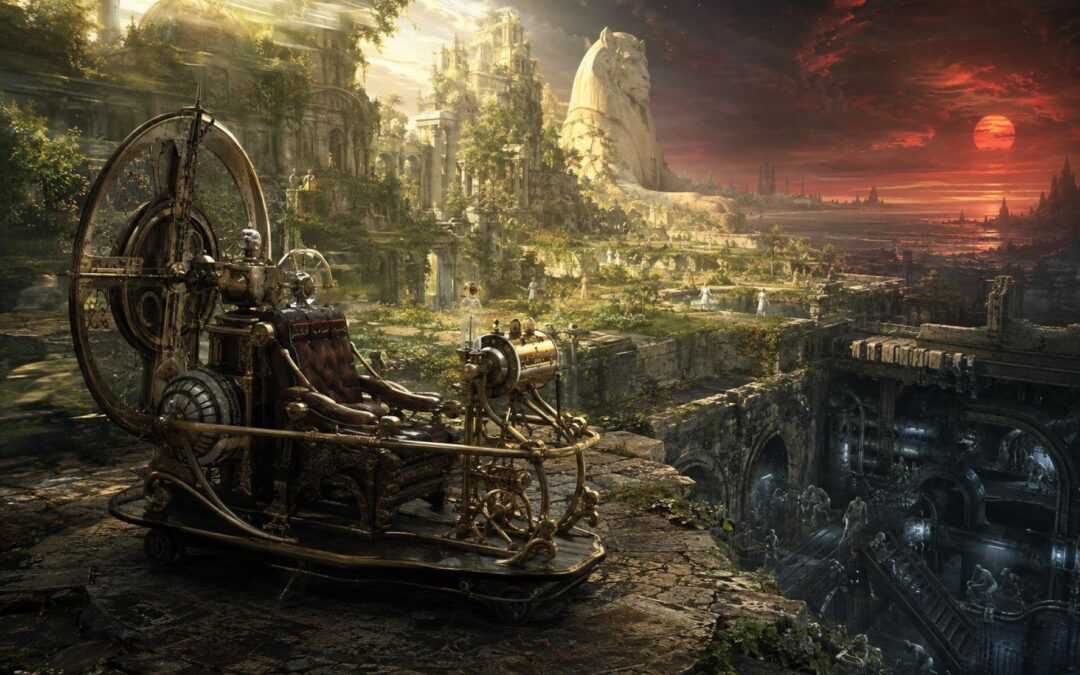
H. G. Wells’s The Time Machine, first published in book form in 1895, is one of the foundational works of modern science fiction. Its most famous invention is obvious from the title: a machine that allows its operator to move deliberately through time. The idea became so culturally familiar that it is easy to overlook how much more Wells builds around it. The journey into the future is not primarily an excuse to display advanced technology. It is a way of asking what happens if the assumptions of Victorian civilization—about progress, class, labour, evolution, knowledge, and human superiority—are projected forward until their consequences become grotesquely visible.
The novella begins as an intellectual experiment and becomes successively an adventure story, a social nightmare, a work of evolutionary speculation, a Gothic survival tale, and finally a vision of a world from which humanity itself has disappeared. In the year 802,701, the Time Traveller encounters the apparently carefree Eloi and the subterranean Morlocks and repeatedly revises his explanation of how humanity produced them. When he travels still farther, even those descendants of humanity vanish. Civilization proves temporary, species prove temporary, and eventually almost all recognizable life seems temporary.
That widening scale is what gives The Time Machine its enduring force. Wells helped establish the mechanical time machine as one of science fiction’s defining devices—the Standard Ebooks edition of the novella rightly emphasizes the importance of that conceptual legacy—but the machine matters because of where it takes the imagination. Wells uses it to attack the comforting belief that technological advancement and historical progress necessarily produce better human beings.
Spoiler warning: This article discusses the complete plot, including the fate of Weena, the Morlocks’ relationship with the Eloi, the dying Earth, the Time Traveller’s return, and his final disappearance.
What Happens in The Time Machine: Complete Plot Summary
Wells does not send his protagonist into the future immediately. He first makes time travel an argument that must survive the scepticism of an educated audience, then gives that audience an apparent demonstration, and only afterward presents the journey itself. Once the Time Traveller reaches the future, the same pattern continues: observation produces a theory, new evidence destroys it, and a more disturbing explanation takes its place.
This structure is essential to the story. The Traveller never receives an authoritative history of the future. He reconstructs it from bodies, buildings, machinery, habits, fears, ruins, and his own encounters. The complete plot is therefore both a physical journey through time and an intellectual journey through increasingly inadequate explanations.
The Fourth Dimension and the Vanishing Model
The novella opens in the comfortable home of a man known only as the Time Traveller. Around him sits a group of acquaintances identified largely by occupation or type: the Medical Man, the Psychologist, the Provincial Mayor, Filby, a Very Young Man, and the unnamed narrator who later records the story. The luxurious dining-room setting makes the conversation initially resemble one of the speculative after-dinner arguments in which educated men test paradoxes for amusement.
The Time Traveller begins by challenging ordinary assumptions about dimensions. A line has length, a plane has length and breadth, and a solid has length, breadth, and thickness. Yet, he argues, no real solid exists only instantaneously. It must also endure. Duration is therefore another dimension of its existence.
From there he proposes that time is comparable to a fourth dimension of space. Human beings experience it differently because consciousness appears to move through time in one direction at a regular rate. That psychological limitation, he suggests, does not prove that deliberate movement through time is impossible any more than the natural pull of gravity proved that humans could never move upward before they developed technologies such as balloons.
His guests immediately begin imagining what controlled time travel might permit. A historian could witness past events directly. Someone might meet Homer or Plato. A financially minded traveller could allow investments to accumulate and collect the results in the future. The narrator half-jokingly imagines discovering a communistic society. Their comments anticipate the book’s larger pattern: everyone projects present interests into the future before anyone has seen what that future actually contains.
The Traveller then claims that he has moved beyond theory to experimental verification. He leaves the room and returns carrying a delicate miniature mechanism of metal, ivory, and transparent material. He explains that it is a model of a machine designed to move through time. At his invitation, the Psychologist presses a lever.
The model becomes indistinct and disappears.
The guests do not immediately accept the stated explanation. They look under the table, consider sleight of hand, and attempt to fit what they saw into ordinary categories. The Traveller then leads them into his laboratory, where a larger version of the device is nearing completion. He announces that he intends to use it himself.
The scene establishes two forms of uncertainty that govern the rest of the novella. The first concerns scientific possibility: can a machine really move through time? The second concerns evidence: what would count as sufficient proof if something extraordinary actually occurred? Wells never allows the second question to disappear simply because the first becomes narratively real.
The Time Traveller Returns
A week later, the narrator returns to the Time Traveller’s house for another dinner. Some guests from the previous gathering are present, joined by others, but their host is missing. He has left instructions that they should begin without him.
During the meal, the Time Traveller suddenly enters. His condition is more striking than any explanation he could immediately offer. He is dirty, exhausted, limping, bruised, cut, and barefoot. His clothes are disordered and his feet and legs bear signs of hardship. Whatever has happened to him, it has not resembled the effortless tourism his guests imagined a week earlier.
He refuses to launch immediately into his story. Instead, he demands food and drink, devouring meat with obvious hunger. Once he has recovered enough to speak, he confirms that he has been travelling through time. He also makes the company promise not to interrupt him with arguments while he tells what happened.
At this point the outer narrative gives way to the Time Traveller’s first-person account. The unnamed narrator later explains that he is attempting to reproduce the Traveller’s story as accurately as possible, but that framing reminder matters: the reader does not receive a direct omniscient account of the future. The story is remembered by the Traveller, told orally to his guests, and then reconstructed by another listener.
The Traveller’s battered condition lends credibility to the coming narrative without proving its central claim. He plainly experienced something extreme. Whether his explanation of that experience should be believed remains open.
Into the Year 802,701
The Time Traveller completed his machine on the morning of his journey. Sitting in its saddle-like seat, he first makes a cautious test. The sensation is strange, and when he stops, the laboratory clock confirms that several hours have passed while he has experienced only a brief interval. This small success gives him the confidence to attempt something far more ambitious.
He pushes the controls farther.
The laboratory changes around him. Mrs. Watchett, his housekeeper, appears to rush through the room at unnatural speed. Darkness and daylight begin succeeding one another so rapidly that ordinary days blur together. As the machine accelerates, the sun’s movement becomes a continuous streak, and the changes of the seasons flash across the landscape.
Buildings appear, transform, and disappear. Vegetation seems to spring from the earth and vanish. Human construction loses its solidity because entire periods of architecture become momentary phases in the Traveller’s accelerated perception. He is no longer watching events in ordinary sequence; he is seeing duration compressed into visible change.
The experience is exhilarating but physically unpleasant. He also recognizes a terrifying mechanical problem. If he stops at a moment when another object occupies the machine’s position, the result might be catastrophic. Because he cannot inspect a future instant before entering it, every arrival contains risk.
Eventually fear overcomes curiosity and he operates the stopping controls. The machine overturns as he arrives amid a hailstorm and is thrown onto the ground. He has reached the year 802,701.
The landscape initially looks almost paradisiacal. The weather is warm, vegetation is abundant, and enormous but somewhat decayed structures rise across the countryside. Most striking is a great white stone figure mounted on a bronze pedestal: a sphinx-like creature whose enigmatic presence immediately suggests that the future contains something the Traveller cannot yet understand.
Then he sees a human figure.
The being who approaches him is small, graceful, beautiful, and physically delicate. Soon more appear. These are the people the Traveller later calls the Eloi. Their clothing is brightly coloured, their manner is gentle and playful, and they show little fear of the stranger or his machine.
The Traveller had expected that hundreds of thousands of years of development might produce intellectually magnificent descendants of humanity. Instead, he quickly notices the Eloi’s limited curiosity and short attention spans. They ask simple questions, become distracted easily, and seem incapable of sustained intellectual effort.
They lead him into one of the huge buildings, where they eat fruit at communal tables. The Traveller sees no meat, no individual households resembling those of his own age, little obvious property, and no visible occupational hierarchy. He notices relatively little differentiation in the Eloi’s clothing and social roles. The landscape also seems to lack ordinary agriculture, shops, factories, or private residences.
At first he interprets these absences optimistically. Perhaps humanity has finally solved scarcity, disease, conflict, dangerous labour, and competition. If the environment provides food effortlessly and collective institutions satisfy everyone’s needs, there may be no reason for the hard work, aggression, or planning that shaped previous societies.
Yet the same theory explains the Eloi’s weakness. If danger has disappeared, physical strength is unnecessary. If material needs are automatically satisfied, ingenuity and sustained intelligence may offer no advantage. The Traveller begins to think that humanity has created a perfect environment and then deteriorated within it.
He regards the Eloi as the descendants of a triumphant civilization that has outlived the conditions responsible for its greatness. Their beauty initially seems like refinement; their weakness gradually looks like degeneration.
Around them stand the remains of a more energetic past. The gigantic buildings are impressive but decaying. The Eloi inhabit them without understanding or maintaining much of what surrounds them. Strange wells punctuate the landscape, and ventilation-like structures suggest the existence of machinery somewhere beyond sight, but the Traveller does not yet understand what they mean.
By the end of this first stage, he believes he has largely solved the future. Humanity has achieved security and abundance but lost vigour, curiosity, and intelligence. It is an elegant explanation—and almost immediately proves insufficient.
The Missing Machine, Weena, and the Morlocks
After spending the day among the Eloi, the Traveller returns toward the lawn where he left his machine. By moonlight he notices something wrong. The machine is gone.
His intellectual detachment collapses into panic. Without the machine, the year 802,701 is no longer an interesting destination from which he can leave at will. It is a prison. He runs frantically through the landscape, injures himself, searches the bushes, rages at the Eloi, and eventually breaks down in despair.
In daylight he regains some self-control and examines the ground more methodically. Marks suggest that the machine was physically dragged away rather than moved through time. The traces point toward the great bronze pedestal beneath the White Sphinx.
The pedestal is hollow. Its decorated sides appear to conceal doors, but he cannot open them. When he gestures toward the structure, the Eloi react with fear or repugnance rather than helping him. Their response confirms that the Sphinx is connected to some part of their world they prefer not to discuss.
The Traveller begins exploring more widely, trying to understand both the missing machine and the society around him. During one of these excursions, an Eloi falls into the water while others look on without helping. The Traveller rescues her.
Her name is Weena.
Weena becomes attached to him with an intensity unlike the casual friendliness of the other Eloi. She follows him, stays near him, brings him flowers, and displays gratitude and affection. Through her, the future becomes personal. The Eloi are no longer merely specimens in an evolutionary puzzle; one of them becomes an individual whose safety matters to him.
Weena also reveals something the Traveller’s daylight observations missed. The Eloi are terrified of darkness. At night they gather inside large buildings and resist being alone. Their fear does not match his theory of a world from which danger has disappeared.
Other clues begin to converge. The strange wells contain moving air. The ventilation structures imply underground systems. Then, in a ruined building, the Traveller sees a pale, apelike figure flee from him toward the darkness.
He realizes that the Eloi are not the only descendants of humanity.
The pale subterranean creatures are the Morlocks. Their bodies are adapted to darkness, especially their large, highly sensitive eyes. They live beneath the surface in a world connected to the wells and ventilation shafts.
The discovery produces the Traveller’s second major theory. Perhaps the division between social classes in his own industrial society continued for so long that it eventually became a physical division of environments. The wealthy, increasingly protected from labour, might have inherited the pleasant surface. Workers, pushed into factories, tunnels, and industrial infrastructure, might gradually have been driven underground.
Over immense evolutionary time, social separation could have become biological separation. The Eloi would then descend from the privileged classes and the Morlocks from the workers who sustained them.
This explanation initially preserves something of the old class hierarchy. The Traveller imagines the Morlocks still maintaining underground machinery and producing goods such as the clothing worn by the Eloi. On that reading, the weak surface people remain the beneficiaries of an ancient labour system even though they have forgotten how it works.
But an immediate problem troubles him. If the Morlocks are still the servants, why were they powerful enough to take the Time Machine? Why do the Eloi fear night?
To discover more, the Traveller must enter the Under-world himself.
He hesitates. The distant green structure he has noticed—the Palace of Green Porcelain—offers a tempting alternative destination, and he recognizes that part of his fascination with it is really an excuse to delay descending into the wells. Eventually curiosity and necessity overcome fear.
He climbs down one of the shafts, descending a great distance before reaching subterranean passages. The environment is oppressive: dark, airless, mechanical, and completely unlike the bright surface world. Enormous machines operate below, although the Traveller cannot fully determine their purpose.
The Morlocks surround him. Their eyes cannot tolerate the light of his matches, and the flame initially gives him a decisive advantage. Yet his supply is limited. As matches go out, Morlocks touch and grab him from the darkness.
He also notices a table containing fresh red meat.
At first he does not know what animal supplied it. The discovery is puzzling because the future surface appears to contain few large animals and the Eloi live on fruit. The unexplained meat remains in his mind after he escapes.
His retreat becomes desperate. The Morlocks attempt to pull him back from the shaft, but repeated bursts of match light drive them away long enough for him to climb upward. Exhausted, he reaches the surface, where Weena greets him.
The descent has confirmed the existence of an entire subterranean society. It has not confirmed the Traveller’s theory about who rules whom.
The Dark Nights and the Palace of Green Porcelain
As the Traveller considers what he has seen, his second explanation begins to collapse. The Eloi may descend from a privileged surface class and the Morlocks from workers, but whatever relationship once existed has changed. The supposed servants possess physical power, operate confidently in darkness, move freely between underground and surface, and inspire terror in the Eloi.
Weena’s fear becomes particularly significant because the moon is waning. The approaching period of darker nights appears to expose the surface people to greater danger.
Then the Traveller remembers the meat.
The obvious implication becomes horrifying. The Morlocks are not merely servicing the Eloi. They are feeding on them.
The Traveller constructs a third version of future history. Long ago, the privileged may have forced labourers into increasingly separate industrial conditions. Over ages, the two populations adapted to different environments. But the old relationship of master and servant did not remain stable. The physically helpless Eloi eventually became dependent on the Morlocks, while the subterranean descendants of workers became their predators.
The class relationship has reversed in grotesque form. People who once lived indirectly from other people’s labour now have descendants who are literally consumed by the descendants of those labourers.
The Traveller is tempted to see a kind of historical revenge in this arrangement. Yet Weena prevents him from embracing that interpretation comfortably. Whatever social class her remote ancestors might represent, she herself is a trusting, vulnerable individual who has never chosen the system into which she was born.
He now has practical priorities. He needs to retrieve the Time Machine, but the Morlocks’ fear of light gives him a possible weapon. He wants a secure shelter, a stronger weapon than his hands, and a reliable means of producing fire. The Palace of Green Porcelain may contain useful remnants of the old civilization.
Weena accompanies him on the journey. The trip strengthens their attachment, and she places flowers in his pockets as an expression of affection. During the later dinner-table narration, the Traveller pauses and produces two of these dried flowers. They become the most intimate piece of evidence supporting a story otherwise almost impossible to prove.
The Palace of Green Porcelain turns out to be a vast ruined museum, recognizable to the Traveller as something like the institutions of South Kensington in his own age. Its galleries preserve traces of a civilization that once accumulated scientific knowledge, natural-history specimens, machines, books, weapons, and cultural objects.
Time has not preserved that knowledge in usable form. Many exhibits are broken, rusted, or decayed. Books crumble when touched. Objects that once embodied organized intellectual achievement have become incomprehensible debris to the Eloi.
The museum thus gives the Traveller practical help while also confirming a larger failure. Human knowledge did not simply increase forever. A civilization once capable of creating great collections and complex technologies disappeared, leaving descendants who cannot read its books or understand its machines.
The Traveller searches for anything he can use. He tears an iron lever from a machine and adopts it as a club. More importantly, he finds usable matches and camphor, giving him control over fire. Fire will compensate for his physical disadvantage against the Morlocks because their eyes are painfully adapted to darkness.
Armed with the lever, matches, and camphor, he leaves the museum with Weena. They must return to the White Sphinx and recover the Time Machine.
Night is approaching.
Fire, Weena’s Loss, and the Trap of the White Sphinx
The Traveller tries to cross a forest before the darkness becomes complete. He knows the Morlocks will be active, but exhaustion and distance work against him. He lights a fire, intending it partly as protection and partly as a marker, then continues with Weena.
The situation quickly becomes unmanageable. The Traveller must carry or protect Weena, hold his iron weapon, preserve his matches and camphor, navigate in darkness, and defend himself from creatures that can see better than he can in the conditions around them. Morlocks begin gathering and attacking.
Weena becomes unconscious or unresponsive amid the struggle. The Traveller, already exhausted, loses awareness for a time as well.
When he becomes fully conscious again, the fire he left behind has spread through the forest. The blaze transforms night into a chaotic red-lit battlefield. Fire is useful because the Morlocks cannot tolerate bright light, but its uncontrolled spread makes the entire environment dangerous.
The Traveller fights with his iron lever and experiences a grim exhilaration in violence. Around him, Morlocks are blinded and confused by the fire. Some stumble toward the flames; others are killed or injured in the chaos.
Then he realizes Weena is missing.
He searches but cannot find her. The novella never gives a directly witnessed moment of death. The Traveller concludes that she was probably left behind when the forest burned, making her death overwhelmingly likely, but her final moments remain unseen.
Her loss destroys his plan to bring her back to the nineteenth century. More importantly, it changes the emotional meaning of his escape. Recovering the Time Machine is no longer a rescue for two people. It becomes the Traveller’s solitary attempt to survive.
When daylight returns, he makes his way back toward the White Sphinx. He reflects again on the evolutionary logic of the world. Intelligence, he thinks, is not an automatic possession that increases simply because time passes. It develops in response to need, danger, uncertainty, and changing conditions. When conditions cease to demand it, it can diminish.
The Eloi achieved security at the price of adaptive strength. The Morlocks retained other capacities because their underground life still required mechanical work and physical action. Yet specialization has changed them too. Neither species represents a triumphant future humanity.
At the White Sphinx, the Traveller finds something unexpected: the bronze doors are open, and his Time Machine is visible inside.
He immediately suspects a trap. Nevertheless, he has no real choice. Without the machine he is permanently stranded, and the open doors offer the only opportunity he has been given.
He enters.
The doors close behind him, plunging the interior into darkness. Morlocks attack from all sides. The Traveller has previously removed the machine’s control levers, preventing others from using it, but that also means he must refit them while being grabbed and assaulted.
He struggles in the dark, manages to restore the controls, climbs onto the machine, and activates it. As the mechanism moves him out of that moment in time, the Morlocks’ hands lose contact with him.
He has escaped AD 802,701.
But in the confusion he has operated the controls in the wrong direction.
Instead of travelling home, he is moving farther into the future.
The Dying Earth, the Return Home, and the Final Disappearance
The Traveller continues forward through time, moving beyond the age of Eloi and Morlocks. The familiar rhythms of the world begin to change at a scale far greater than anything he experienced during his first journey.
The sun’s appearance changes. It becomes larger, redder, and less like the brilliant star of his own day. Familiar astronomical features disappear from the sky. The environment grows increasingly strange and desolate.
He stops on a bleak shore beneath the swollen red sun. The sea is sluggish, the air difficult to breathe, and the landscape almost empty. Huge crablike creatures move across the beach, while other unfamiliar life-forms briefly suggest how completely evolution has moved beyond humanity.
This future is more disturbing than the Morlock world because humans no longer matter to it. The Eloi and Morlocks represented transformations of humanity. Here, their entire evolutionary story has already ended.
Still compelled by curiosity, the Traveller makes further jumps forward. Hundreds, thousands, and eventually millions of years pass. The giant crabs disappear. Vegetation becomes increasingly primitive and sparse.
More than thirty million years beyond his own period, he stops again.
Earth appears to be approaching lifelessness. The sun is enormous and dull red. The air is thin and bitterly cold. The sea scarcely moves. Only minimal forms of life remain visible.
A dark body passes across the sun, reducing the already weak light. The temperature plunges. The Traveller experiences a sense not merely of danger but of cosmic finality. Civilization, humanity, and the Eloi-Morlock world have all become negligible episodes in planetary time.
He can endure no more and reverses the machine.
Travelling backward, he passes the vanished ages of the future and returns toward the nineteenth century. The laboratory gradually forms around him. His journey ends close to the point in space where it began, although the machine’s position has shifted slightly because the future landscape changed around the same location.
This is the moment that leads into his sudden appearance at dinner earlier in the novella. His astonishing story has caught up with the frame.
The guests remain sceptical.
Their disbelief is understandable. The Time Traveller himself admits that, once surrounded again by familiar nineteenth-century objects, his experiences begin to feel strangely dreamlike. The future that seemed overwhelmingly real while he was trapped inside it becomes difficult to reconcile with normal life.
Yet some evidence exists. His battered body matches the dangers he describes. The Time Machine is dirty and damaged. Most intriguingly, he still possesses the two dried flowers Weena placed in his pocket. The Medical Man cannot identify them as a familiar species.
None of this constitutes unquestionable proof. Injuries can have other causes. Machines can be damaged. Strange flowers do not demonstrate travel to the year 802,701. The story therefore ends its first journey with evidence strong enough to trouble disbelief but weak enough to preserve uncertainty.
The other guests eventually leave. The unnamed narrator remains more receptive than most, though not completely certain.
He returns to the Time Traveller’s house the following day. The Traveller is preparing another expedition, this time hoping to bring back stronger evidence. He takes a camera and intends to return with specimens or photographs that will silence scepticism.
The narrator briefly leaves the room.
When he returns, the machine vanishes with the Time Traveller aboard it.
He never comes back.
By the time the narrator tells the story, three years have passed. No one knows whether the Traveller went into the remote past, revisited the Eloi, travelled into a nearer future, or reached some entirely different age. Wells does not supply an answer.
The Epilogue leaves that disappearance unresolved. The narrator imagines possible destinations but acknowledges that speculation cannot become knowledge. What remains is the Traveller’s pessimistic challenge to conventional faith in human progress—and the two flowers.
Those fragile flowers become the final image of the novella. The narrator treats them as evidence that, even in an age when human intelligence, strength, and civilization had declined catastrophically, gratitude and tenderness had not disappeared entirely. The book therefore ends neither with confidence in progress nor with absolute nihilism. Its last surviving consolation is smaller and more personal than civilization itself.
The Future World: Eloi, Morlocks, and the Ruins of Civilization
Wells’s future does not work like the elaborate invented societies found in much later science fiction. The Traveller is not handed a history book explaining the political institutions of AD 802,701, and he never learns enough of the Eloi language to receive a detailed account from them. The world is instead constructed archaeologically. The Traveller sees ruins, bodies, habits, machines, architecture, fear, food, and geography, then tries to infer what historical processes produced them.
The surface initially looks utopian because many structures associated with scarcity have vanished. The Eloi appear to have no jobs, money, private houses, armies, obvious political authorities, or visible economic competition. They eat abundant fruit and inhabit enormous communal structures. The climate is mild, dangerous animals seem absent, and the countryside resembles an immense garden.
Yet the physical beauty of the Over-world hides dependence. The buildings are decaying rather than developing. The Eloi cannot repair the civilization they inhabit. They do not cultivate the intellectual heritage preserved in the Palace of Green Porcelain and seem barely curious about its existence. The landscape that first appears to represent social perfection turns out to be a civilization living on inherited infrastructure it neither understands nor controls.
The Under-world reverses almost every quality of the surface. It is dark rather than bright, industrial rather than pastoral, mechanical rather than leisurely, and physically oppressive rather than beautiful. The Morlocks have adapted to it so completely that their bodies are damaged by strong light. Wells makes the vertical geography socially expressive: one branch of humanity lives above ground in apparent leisure, while another occupies the hidden spaces of machinery and labour.
That geography is central to interpretations of the novella’s class politics. Scholarship on Wells has repeatedly emphasized that the Eloi and Morlocks exaggerate divisions already visible in late-Victorian society. The future turns economic separation into environmental separation and then, through enormous spans of time, into biological divergence. The result is not a stable hierarchy but a grotesque interdependence in which the physically weaker surface population appears to rely on the subterranean one even as it fears being consumed by it.
The Palace of Green Porcelain adds another layer. It demonstrates that the Eloi-Morlock world did not emerge immediately after the nineteenth century. Between the Traveller’s age and theirs stood a civilization capable of advanced science, museums, large-scale engineering, sophisticated weapons, literature, and institutional preservation of knowledge. Almost all of it has become useless.
This is one of the novella’s most important world-building decisions. Wells refuses to equate having once achieved knowledge with retaining it forever. Books decay. Machines become incomprehensible. Museums become tombs of intellectual memory. Human civilization possesses no automatic mechanism that guarantees each generation will preserve what earlier generations discovered.
The White Sphinx performs a similar function on a smaller scale. At first it looks like an enigmatic monument in an unfamiliar future. After the Time Machine disappears, it becomes a sealed obstacle. Later it becomes the site of the Morlocks’ trap. Its meaning changes as the Traveller’s knowledge changes, making it an architectural embodiment of the future itself: visible from the beginning, repeatedly misread, and far more dangerous than it first appears.
Wells then destroys even this world by extending the journey beyond it. The far-future shore proves that the social system of Eloi and Morlocks is only temporary. New organisms arise, humanity vanishes, and eventually nearly all recognizable life disappears. World-building expands into deep-time estrangement, reducing the carefully reconstructed class history of AD 802,701 to a brief interval in planetary existence.
The future is therefore internally coherent less because Wells provides detailed institutions than because every environment develops the same central idea: what looks permanent from within one historical moment becomes temporary when viewed across enough time. Houses, classes, species, technologies, climates, and civilizations all become transient structures.
The Time Traveller, Weena, and the Novel’s Human Relationships
The Time Traveller dominates the novella so completely that nearly every future person is filtered through his perceptions. He is brilliant, inventive, physically capable, intellectually adventurous, impatient, proud, and often reckless. He can build a machine that violates ordinary experience, yet he enters the distant future with almost no supplies, leaves the machine unprotected, repeatedly acts before understanding his environment, and forms sweeping theories on limited evidence.
Those contradictions make him more interesting than a simple mouthpiece for Wells. He embodies the strengths of Victorian scientific confidence—curiosity, experimental courage, analytical thinking—but also its potential arrogance. Again and again, he assumes he has solved the future only to discover that he has mistaken a fragment for the whole.
His first theory interprets the Eloi as the outcome of perfected civilization. His second makes them the descendants of privileged classes still supported by subterranean workers. His third recognizes that the apparent servants have become predators. Each revision shows intellectual flexibility, but the sequence also reveals how readily he transforms observation into social history.
His behaviour under pressure further complicates him. He panics violently when the Time Machine disappears, manhandles Eloi who cannot understand him, delays descending underground because he is afraid, and later becomes intensely aggressive during his battles with Morlocks. He is neither an unflappable scientific hero nor a passive observer. The future strips away some of his cultivated composure and exposes fear, anger, physical courage, tenderness, and brutality.
Weena is the character who changes the emotional register most dramatically. Before rescuing her, the Traveller can regard the Eloi primarily as evidence in an evolutionary problem. Afterward, one Eloi becomes an individual with whom he shares affection.
Weena follows him because he saved her from drowning when the other Eloi did nothing. She expresses gratitude by remaining near him and giving him flowers. Her attachment becomes strong enough that he eventually imagines taking her back to his own age.
Their relationship should not be overstated as conventional romance. The Traveller frequently describes Weena in childlike terms, treats her as dependent on his protection, and never establishes an equal intellectual partnership with her. Their limited ability to communicate makes the imbalance even greater.
That paternalism is part of the novella’s historical limitation, but it does not erase the emotional function of the relationship. Weena gives the Traveller a reason to care about the future beyond solving it. When he realizes the Morlocks probably eat Eloi, his response is not merely theoretical disgust because Weena herself has become potential prey.
Her presumed death therefore matters more than the destruction of an anonymous Eloi would. The forest fire destroys his plan to make the future personally redeemable by rescuing her. He escapes with his life and machine but cannot convert the journey into a triumphant homecoming with someone saved from the world he studied.
The Eloi as a collective are deliberately underdeveloped compared with conventional novelistic characters. Their limited curiosity, passive sociability, physical delicacy, dependence, and weak emotional range all serve the evolutionary premise. Their failure to save Weena from drowning shows how deeply initiative and solidarity have weakened.
Yet Wells does not make them emotionless. Their fear of darkness is intense, and Weena demonstrates affection and gratitude. The Epilogue depends on the distinction. Even after many capacities have diminished, the emotional possibilities represented by Weena are not entirely gone.
The Morlocks are treated more harshly. The Traveller encounters them mostly in darkness, underground, during attacks, or while imagining their consumption of Eloi. Their physical description emphasizes pallor, apelike qualities, grasping hands, and light-sensitive eyes, encouraging Gothic horror.
That framing creates a critical complication. The Morlocks are simultaneously descendants of an exploited class and monsters from whom the Traveller must escape. The story can therefore be read as an indictment of class separation while still relying on dehumanizing imagery toward the descendants of labourers. This tension is one reason the novella resists becoming a simple political allegory with a cleanly virtuous oppressed class and a villainous privileged class.
The unnamed outer narrator provides a different relationship to the Time Traveller. He is neither as dismissive as some guests nor as convinced as the Traveller wants his audience to become. His position allows the story to retain doubt without collapsing into disbelief.
The dinner guests collectively serve a similar function. Filby, the Medical Man, the Psychologist, the Editor, the Journalist, and the others are less important as psychologically developed individuals than as representatives of ordinary intellectual resistance. Their scepticism gives the Traveller something to argue against and ensures that miraculous events are not accepted merely because the narrative announces them.
This framing also matters to the Traveller’s apparent authority. Tim Youngs’s discussion of Wells’s fiction emphasizes the usefulness of reading the Traveller as an observer trying to interpret an alien culture rather than as an infallible ethnographer. The Traveller’s position as an interpreter of an unfamiliar future means that readers should distinguish between what he directly encounters and the histories he reconstructs from those encounters.
Time, the Fourth Dimension, and the Machine
The opening discussion of the fourth dimension does more than provide decoration before the adventure. Wells needs to make the impossible feel conceptually navigable. Instead of presenting time travel as magic, he asks the reader to imagine time spatially and the machine as a technology capable of changing the Traveller’s rate and direction of movement along that dimension.
The reasoning is deliberately intuitive. A physical object exists not only across three spatial dimensions but across duration. A human being at different ages can be imagined as different three-dimensional “sections” of a larger existence extending through time. Once time is treated this way, the machine becomes a device for escaping the ordinary fixed rate at which consciousness encounters temporal moments.
The technical explanation is not sufficient to design an actual machine, nor is it meant to be. Wells provides conceptual scaffolding rather than engineering. The mechanism possesses levers, rails, metal, ivory, and crystalline components because physical concreteness makes speculative impossibility feel experimentally approachable.
The model demonstration performs the same task. The guests see an object disappear before they hear the full travel narrative. They therefore experience a miniature version of the reader’s problem: something observable has happened, but observation alone does not determine the correct explanation.
Once the full machine begins moving, Wells makes time travel visually compelling by transforming chronology into apparent motion. Days become flickers. Buildings grow and vanish. Vegetation rises and falls. The sun becomes a streak. Human history ceases to feel like a sequence of stable worlds and becomes continuous material change.
This is one of the novella’s most original formal achievements. Time travel is not merely a transition between two dates. The Traveller sees the impermanence of everything between them.
The work’s relationship to later physics should nevertheless be described carefully. Scholarly discussion of the fourth dimension and the novella’s intellectual context shows how deeply Wells’s formulation belongs to late-nineteenth-century debates and imaginative speculation. It would be misleading to claim that his fictional machine technically anticipates modern theories of spacetime in a precise scientific sense.
The machine’s real achievement is literary. It turns abstract historical speculation into travel. Wells no longer has to ask readers simply to imagine what society might become after hundreds of thousands of years; he can send a witness there, let him form interpretations, and then expose those interpretations to new evidence.
That device also creates the extraordinary shift of scale near the end. The same machine that lets the Traveller examine the social consequences of class division also lets him move tens of millions of years beyond humanity. A technological invention designed to overcome time ultimately reveals how little any technology can guarantee permanence within it.
Class, Evolution, Degeneration, and the Traveller’s Changing Theories
The most important intellectual movement in The Time Machine is not the journey from 1895 to 802,701. It is the Traveller’s movement through three different explanations of what he finds there.
His first explanation is essentially utopian. The Eloi appear to live without scarcity, harsh labour, war, disease, or competition. Because no visible struggle remains, he concludes that humanity may have perfected its environment.
The problem is that perfection has not produced superior beings. The Eloi are physically weak, intellectually incurious, and incapable of maintaining the civilization around them. Security has removed the pressures that once rewarded intelligence and strength.
This interpretation overturns a simple idea of progress. Evolution does not necessarily mean improvement toward greater complexity, intelligence, or moral excellence. Traits persist when conditions favour them. Change in environment can make previously useful capacities unnecessary.
The second theory begins when the Traveller discovers the Morlocks. If surface and subterranean humans have developed separately, he imagines a historical origin in class segregation. The wealthy increasingly live in pleasant protected environments, while workers are pushed toward industrial spaces. Project this separation across enough time and the social distinction might become biological.
This is where the novella most directly transforms contemporary class anxiety into speculative world-building. A peer-reviewed discussion of Victorian evolution, degeneration, and class in The Time Machine emphasizes how the novella works within a culture in which evolutionary ideas could be used both to challenge comforting notions of progress and to reinforce social hierarchies.
The Traveller initially assumes that the old class system still survives in recognizable form. The Eloi, descendants of the privileged, live in the sunlight and leisure. The Morlocks, descendants of workers, live below ground and maintain machinery. Surface luxury continues to depend on hidden labour.
The third theory is darker because the hierarchy has reversed. The Eloi remain dependent but are no longer masters. The Morlocks emerge at night and apparently use the Eloi as food.
The fresh meat underground is the crucial clue. Once the Traveller connects it with the disappearance of large animals and the Eloi’s terror of darkness, his model changes from labour exploitation to predation.
The reversal has obvious satirical force. A ruling class that once metaphorically “lived off” the labour of others produces descendants who are literally eaten by the descendants of those labourers. Wells takes the language of exploitation and turns it into biological horror.
Yet the novella is more interesting if that reversal is not reduced to a simple moral equation. The Morlocks are not presented as liberated workers who establish justice. They have become predators. The Eloi are not active exploiters but helpless descendants who barely understand their own social position.
The result is a nightmare of inherited structure rather than a fantasy of deserved punishment. The original class system has harmed both branches of humanity. One becomes weak through effortless privilege; the other becomes adapted to darkness, machinery, and predation. Neither preserves the full range of human capacities.
That symmetry explains why “the rich become Eloi and the workers become Morlocks” is insufficient as a complete interpretation. The important process is specialization. Long-term separation allows environments and social functions to shape bodies and behaviour until each population becomes trapped by the conditions its ancestors created.
The Traveller’s own reasoning should also remain under scrutiny. He never receives historical confirmation of this account. It is his reconstruction, supported by powerful clues but not by documentary evidence. The future contains no historian who explains exactly when classes separated, when subterranean labour became hereditary, or when the Morlocks began eating Eloi.
Wells deliberately allows his protagonist’s confidence to outrun his evidence. The pattern resembles scientific theorizing: observations produce a model, anomalies accumulate, and the model must be revised. The Traveller’s fallibility makes the novella epistemically richer because no final social theory arrives from an all-knowing narrator.
The far-future sequence then subjects all three theories to an even larger challenge. Whether Eloi dominated Morlocks, Morlocks dominated Eloi, or both represented different branches of a divided humanity becomes irrelevant once both are extinct. Social evolution itself exists within planetary and biological limits.
This is the book’s deepest rejection of automatic progress. History does not move inevitably upward. Civilizations can decay, species can specialize in self-defeating ways, knowledge can vanish, and environments can become hostile to the life they once supported.
Major Themes in The Time Machine
The novella’s themes are powerful because they develop through changes in the Traveller’s experience rather than remaining abstract propositions. What appears to mean one thing in daylight acquires a different meaning at night; what looks like the culmination of history becomes one temporary stage when the Traveller moves farther forward.
The most important theme is the instability of progress. The Time Traveller comes from a culture deeply impressed by invention, science, industry, and expanding technical control. He himself is the embodiment of that confidence: he has constructed a machine capable of doing what previous generations would have called impossible.
Yet his greatest invention transports him to evidence against the comforting philosophy his achievement might seem to represent. The distant descendants of humanity are not wiser or more capable than he is. They are diminished, divided, and dependent on systems they do not fully control.
The Eloi sharpen this criticism because they initially resemble the reward for successful civilization. They possess abundance, leisure, beauty, and freedom from visible work. Many utopian visions would stop there.
Wells asks what happens next.
If a society eliminates every challenge but fails to preserve curiosity, responsibility, and intellectual activity, comfort can become stagnation. The Traveller’s explanation may be speculative, but the narrative repeatedly associates the Eloi’s perfect safety with diminished initiative.
Labour is therefore another central theme. The future’s bright surface depends on a hidden world of machinery. Whatever the exact history, the Over-world cannot be understood independently of the Under-world.
This makes invisibility important. The Eloi live in a landscape where the mechanisms supporting their existence are literally buried. The arrangement exaggerates the tendency of privileged groups to experience comfort without confronting the labour that makes it possible.
But Wells also refuses to romanticize labour automatically. The Morlocks’ environment has preserved activity and certain forms of practical capability, yet it has also transformed them into creatures associated with darkness and predation. Work under degrading conditions does not ennoble them. It shapes them according to those conditions.
Civilization and knowledge form another major thematic pair. The Palace of Green Porcelain proves that civilization once accumulated extraordinary intellectual resources. Its ruined books and machines show that preservation is not guaranteed by achievement.
A library can be built and later become unreadable. A machine can be invented and later become incomprehensible. A species can acquire immense knowledge and then produce descendants unable to use it.
The novella therefore treats civilization as an active practice rather than a permanent possession. Knowledge survives only if living communities continue to preserve, teach, renew, and apply it.
The same applies to intelligence. The Traveller increasingly comes to view intelligence as adaptive rather than sacred. Human beings are not intelligent because the universe has assigned the species a permanent rank. Intelligence developed under conditions in which it provided advantages.
If those conditions disappear, the trait may weaken. If new environments reward different capacities, evolution may move elsewhere.
This perspective makes The Time Machine deeply anti-teleological. Evolution is not a staircase with humanity at the top. It is change under pressure, and the direction of change depends on conditions.
The far-future scene extends that humility beyond humanity. The Traveller sees a world in which human existence has not merely declined but ended. Other creatures occupy the planet, then they too disappear.
Extinction becomes the ultimate limit on fantasies of permanence. Human beings often experience their civilization as the central drama of history, but deep time makes every empire and ideology look temporary.
Wells intensifies that theme through the red sun and freezing shore. The emotional effect comes partly from scale. The problems that obsessed the Traveller in AD 802,701—recovering his machine, understanding Morlocks, protecting Weena—were enormous while he lived through them. Tens of millions of years later, none of those struggles has left any visible trace.
Violence also runs through the novella more strongly than its reputation as a philosophical classic sometimes suggests. The Traveller begins as a gentleman-scientist explaining geometry over dinner. In the future he becomes a frightened survivor who beats Morlocks with an iron bar and watches fire destroy a forest.
His transformation raises questions about civilization itself. The cultured inventor does not remain untouched by dangerous conditions. When circumstances change, his behaviour changes rapidly.
The relationship between him and the Morlocks complicates any simple contrast between civilized humanity and degenerate descendants. He regards them as monstrous, but he too becomes capable of ferocity when survival requires it. The future tests not just the descendants of humanity but the supposedly superior visitor from the past.
Evidence and belief provide a quieter but equally important theme. The story begins with sceptics asking whether a model really travelled through time. It ends with sceptics asking whether the Traveller’s entire account really happened.
The flowers are compelling because they do not resolve the problem completely. They are evidence of something unfamiliar, not proof of a specific date hundreds of thousands of years in the future. Wells gives the story enough material evidence to prevent easy dismissal while preserving enough uncertainty to keep the frame alive.
Finally, tenderness survives as the novella’s fragile counter-theme to degeneration. Weena is intellectually limited, physically weak, and helpless against the world around her, yet she is capable of gratitude and affection.
The Epilogue makes this significant precisely because Wells has stripped away almost everything else. Human intelligence can diminish. Civilization can collapse. Species can vanish. The narrator nevertheless finds meaning in the possibility that kindness may persist after many qualities traditionally associated with “progress” have failed.
That is not a triumphant answer to the novella’s pessimism. It is a modest one, and its modesty is the point.
Symbols and Motifs: Sphinx, Fire, Darkness, Flowers, and Ruins
The White Sphinx is the novella’s most visible symbol of interpretive uncertainty. It appears immediately after the Traveller reaches the future, before he understands anything about the Eloi or Morlocks. Like the mythic Sphinx, it confronts him with a riddle.
At first, he treats it mostly as monumental scenery. After the Time Machine disappears, its pedestal becomes the suspected hiding place. Later, when its doors finally open, apparent access becomes a trap. The Sphinx therefore changes from mystery to obstacle to danger as the Traveller’s knowledge develops.
Its fixed expression contrasts with the Traveller’s repeated revisions. The monument was visible from the beginning; what changes is his ability to understand its function. That makes it a fitting emblem for the future itself.
Light and darkness are even more structurally important. Daylight creates the illusion of Eloi security. The bright surface seems peaceful, open, and harmless. Darkness reveals that the same landscape belongs partly to the Morlocks.
The Eloi’s fear of night becomes the first strong emotional evidence that the Traveller’s utopian interpretation is wrong. He understands their world differently once he realizes that danger follows a daily cycle he initially ignored.
Fire gives the Traveller temporary mastery over that darkness. His matches become unexpectedly valuable because a simple nineteenth-century technology can exploit the Morlocks’ evolved sensitivity to light. The Traveller’s sophisticated Time Machine cannot by itself solve his immediate survival problem; something as basic as flame becomes more useful.
Yet fire never remains a simple symbol of enlightenment or civilization. In the forest it escapes control and becomes catastrophic. It protects the Traveller while helping destroy Morlocks and probably contributing to Weena’s death.
That duality is important. Technology can illuminate and defend, but control is conditional. The same force that gives power can produce unintended destruction.
The flowers operate differently because they possess almost no practical power. Weena gives them to the Traveller as an expression of affection, and they survive accidentally in his pocket through violence, temporal travel, and return.
They later become physical evidence. Their scientific value is limited—the Medical Man’s inability to identify them does not prove the year 802,701—but their emotional meaning grows.
By the Epilogue, the flowers stand for qualities the Traveller’s evolutionary theories cannot measure easily: gratitude, affection, tenderness, and personal attachment. They survive in the narrative after the civilization that produced Weena has been exposed as degenerate.
Ruins form another persistent motif. The great surface buildings, the Palace of Green Porcelain, broken machines, decaying books, and abandoned infrastructure all represent achievement detached from continuity. Their creators are gone, and their descendants cannot recover the knowledge encoded in them.
Ruins prevent the future from appearing simply primitive. It is post-civilizational. Something greater existed before the Eloi’s world, and the evidence of that greatness now emphasizes loss.
The Palace is especially effective because it resembles a museum, an institution designed to preserve knowledge against time. Time defeats it anyway. The irony is central to the novella’s argument.
Machinery carries a related ambiguity. The Time Machine represents intellectual mastery and unprecedented freedom. Morlock machinery represents hidden systems that continue operating without transparent social meaning. The museum’s ruined machines represent lost knowledge.
Technology therefore has no single moral direction. It can expand possibility, perpetuate dependence, become incomprehensible, or disappear.
The unexplained meat underground is one of the novella’s most efficient horror motifs. When first encountered, it is merely puzzling. Only later does the Traveller connect it to the Eloi.
Its meaning changes retrospectively. A detail that seemed secondary becomes evidence that transforms his model of society.
The red sun performs the same function at a cosmic scale. It takes the familiar source of earthly life and makes it alien. The Traveller’s own world is not merely socially altered but astronomically estranged.
By the time the sun becomes swollen and dull over an almost dead Earth, the symbols of human history have vanished. No Sphinx, machine, museum, class system, or city matters anymore. The red sun becomes the final image of time’s indifference before the Epilogue returns to the tiny flowers.
Narrative Structure, Style, and the Scientific Romance
The Time Machine is compact, but its narrative construction is more sophisticated than a straightforward first-person adventure. Wells surrounds the Traveller’s story with a frame, gives the frame its own narrator, fills the audience with sceptics, and repeatedly introduces evidence that can be interpreted in more than one way.
The first chapter teaches readers how to respond to extraordinary claims. The Time Traveller proposes an argument. Filby objects. The Psychologist tests a model. The guests search for tricks. No one is expected to believe merely because the protagonist speaks confidently.
That sceptical method continues once the future narrative begins. The Traveller sees the Eloi and creates a theory. New evidence contradicts it. He sees Morlocks and creates another theory. More evidence forces another revision.
Form therefore mirrors content. The novella is a sequence of provisional explanations.
The frame also adds distance between event and reader. The future story is not presented directly by an omniscient narrator. The Traveller tells it after returning. The unnamed narrator remembers and transmits that telling.
This layered narration creates room for uncertainty about accuracy without requiring the story to become an elaborate puzzle about whether the journey “really” happened. Wells can treat the future as narratively real while still making credibility part of the experience.
The Traveller’s retrospective narration also allows foreshadowing. He can mention details whose significance he did not understand when first encountering them, guiding readers toward mysteries without immediately resolving them.
Stylistically, Wells mixes scientific exposition with adventure and Gothic horror. The early pages speak the language of dimensions, geometry, experimentation, and mechanisms. The future shifts toward gardens, ruins, monstrous bodies, darkness, underground spaces, and pursuit.
The Under-world could almost belong to Gothic fiction. It contains hidden creatures, suffocating darkness, subterranean machinery, unexplained meat, grasping hands, and a protagonist whose light is constantly about to fail.
The forest fire turns that claustrophobic horror into frantic action. The far-future sequence then abandons both social satire and survival adventure for something approaching cosmic horror.
This range is one reason the novella remains readable. Wells does not make the social argument bear the entire burden of interest. The ideas are attached to suspense: Where is the machine? What are the wells? Why do the Eloi fear darkness? What do the Morlocks eat? Can the Traveller escape? What lies farther ahead?
At the same time, exposition occasionally becomes heavy because the Traveller likes explaining his theories. Long interpretive passages interrupt the immediate action as he reconstructs future history. Readers interested mainly in adventure may feel these pauses.
Yet removing them would fundamentally change the work. The novella is a scientific romance not because it contains an invention but because speculation itself is dramatic. The Traveller’s explanations are events in the story: they mark changes in what he thinks the future means.
Wells’s use of sensory description is especially effective during temporal movement and the dying-Earth sequence. Rapid day and night, changing vegetation, the altered sun, cold air, slow sea, and unfamiliar organisms make immense time spans emotionally perceptible.
The prose becomes most powerful when Wells reduces explanation and allows scale to dominate. The Traveller confronting an almost lifeless Earth does not need a detailed philosophical lecture. The scene itself has already displaced humanity from the center of history.
Irony binds the styles together. The inventor of the most advanced machine in the book is nearly defeated because he lacks matches. The supposedly perfected future is populated by diminished humans. The descendants of a ruling class become prey. A museum built to preserve knowledge becomes evidence that knowledge was lost.
Even the Time Machine itself contains a final irony. It seems to offer mastery over time, but what it reveals is that time remains larger than every civilization the Traveller can visit.
The Ending Explained
The ending of The Time Machine begins before the Traveller reaches home. His escape from the White Sphinx appears to resolve the central survival problem: he has recovered the machine and escaped the Morlocks. Instead of using that moment simply to return to the nineteenth century, Wells sends him farther forward.
That decision changes the meaning of everything that came before it.
Without the dying-Earth sequence, the novella could be read primarily as a social warning about class division. The Eloi and Morlocks would represent one possible endpoint of civilization, and the story’s dominant question would be how humanity produced them.
Travelling millions of years beyond them shows that their conflict is not the endpoint at all. They disappear as completely as nineteenth-century civilization disappears before them.
The far-future shore therefore acts as a second revelation. The first revelation is social: apparent utopia conceals division, dependence, and predation. The second is cosmic: even that dystopian future is temporary.
The imagery becomes steadily emptier. Human beings vanish, then unfamiliar animal forms vanish, then even complex life seems close to disappearing. The Traveller sees a planet becoming inhospitable beneath a red sun.
The science behind this vision belongs to Wells’s period and should not be treated as a precise modern astrophysical forecast. Its literary function matters more. Wells places human history inside deep time and forces the reader to imagine a future in which no human project survives.
When the Traveller returns home after such a vision, ordinary Victorian surroundings feel almost absurdly secure. Dinner, professional conversation, familiar furniture, and sceptical debate resume as though the end of humanity were merely an improbable anecdote.
That contrast explains why the guests’ disbelief matters. Wells could have ended with universal amazement and acceptance, validating the hero completely. Instead, the Traveller comes back to the same epistemic problem with which the novella began: extraordinary evidence remains difficult to interpret.
His physical injuries prove hardship, not time travel. The dirty machine proves use, not destination. The flowers are strange, but their existence cannot independently establish the year in which they grew.
The Traveller therefore decides to go again and return with stronger evidence. This second departure reveals something important about his character. The first expedition almost killed him and caused Weena’s presumed death, yet curiosity remains stronger than fear.
His permanent disappearance prevents that curiosity from receiving closure. He does not return with photographs, specimens, or a final account. The narrator and reader are left with the same incomplete evidence.
The novella never tells us whether he went into the past, returned to Weena’s age, explored a nearer future, suffered mechanical failure, died, or simply chose not to come back. Any definite answer would weaken the ending by converting mystery into information.
The Epilogue instead shifts attention away from the Traveller’s destination and toward the meaning of what he already brought back. The narrator remembers the Traveller’s dark conclusions about progress but refuses to treat them as the only possible response.
The flowers become his counterargument.
They do not prove that civilization improves. They do not reverse extinction. They do not save Weena. They do not guarantee a hopeful human future.
What they show, for the narrator, is that tenderness persisted in a world where intelligence and strength had declined. Weena’s ability to feel gratitude becomes morally significant precisely because the grander achievements of humanity failed.
That makes the ending neither optimistic nor simply pessimistic. Wells leaves technological progress discredited as a guarantee, social progress uncertain, biological survival temporary, and the Traveller himself missing. The only hopeful object is small enough to fit in a pocket.
The scale of that contrast is the ending’s strength. The Traveller has seen the possible extinction of humanity and perhaps almost all life, but the narrator ends with two flowers from a lost friend.
Critical Review: Why The Time Machine Still Works—and Where It Shows Its Age
The greatest achievement of The Time Machine is its density of invention. In a relatively short novella, Wells combines a durable science-fiction device, a survival adventure, speculative evolution, class criticism, Gothic horror, a meditation on knowledge, an attack on inevitable progress, and a vision of deep-time extinction.
The central machine remains brilliantly simple as a storytelling device. Wells avoids overengineering it. The reader understands what the controls do without needing a technical manual, which allows the mechanism to remain concrete while serving larger imaginative purposes.
More importantly, Wells uses the machine rather than merely displaying it. The invention transforms historical extrapolation into witnessed experience. Instead of describing a theory about the remote future from the nineteenth century, the novella gives that theory sensory form.
The Eloi and Morlocks remain powerful partly because they are immediately comprehensible without being exhausted by one interpretation. Their vertical division dramatizes class. Their bodies dramatize adaptation. Their relationship dramatizes dependence and exploitation. Their degeneration challenges narratives of inevitable human improvement.
The best criticism of the novella recognizes that these ideas operate together. Reading the book only as “the rich versus the poor” narrows it. Reading it only as a warning about evolution also narrows it. The class structure matters because it shapes environments, and the environments matter because they shape organisms.
The Traveller’s changing theories strengthen the intellectual architecture. Wells does not reveal the entire future in one explanatory speech. The reader experiences progressive disillusionment with the protagonist.
The Eloi first disappoint his expectation of advanced humanity. The Morlocks destroy his interpretation of peaceful utopia. The evidence of cannibalism destroys his assumption that the surface people remain dominant. The dying Earth destroys the idea that this divided humanity is history’s final destination.
That sequence gives the novella excellent conceptual pacing.
The adventure pacing is somewhat less even. The early dinner-room argument deliberately takes time, and several passages in the future stop the action while the Traveller explains what he thinks has happened across hundreds of thousands of years. Readers accustomed to contemporary plot-driven science fiction may find some stretches discursive.
Yet the book would lose much of its distinctiveness without those pauses. Wells’s protagonist is not merely escaping monsters; he is thinking. Interpretation is part of the action.
The visual writing remains one of the novella’s strongest qualities. The accelerating days and nights during time travel still communicate motion through time with remarkable clarity. The contrast between the bright Eloi world and dark Morlock tunnels is instantly legible. The Palace of Green Porcelain gives intellectual decline physical texture.
The dying-Earth sequence may be the most memorable writing in the book because Wells allows scale and atmosphere to overwhelm human relevance. The swollen sun, silent shore, altered creatures, thin air, and fading life achieve a form of cosmic desolation long before “cosmic horror” became a familiar genre label.
Characterization is more uneven. The Time Traveller is compelling because his intelligence is mixed with impatience, fear, arrogance, adaptability, tenderness, and violence. His mistaken theories humanize him and prevent him from functioning as a flawless scientific prophet.
Weena is emotionally important but comparatively thin. She has limited agency beyond attachment, fear, affection, and dependence. Her characterization is shaped by the Traveller’s paternalistic language, and the story gives her far less interiority than her role in the emotional climax deserves.
The gender imbalance extends beyond Weena. The framing world is overwhelmingly male, professional, and club-like, while the future society is examined through a male Victorian observer whose assumptions often remain visible. Modern readers should notice those limits without pretending that they erase the novella’s achievements.
The Morlocks create a more serious critical tension. They are descendants, under the Traveller’s hypothesis, of historically exploited labourers. Yet the narrative renders them through imagery of animality, darkness, grasping bodies, and cannibalistic threat.
This produces an uncomfortable contradiction. The novella exposes the cruelty of class separation while also making the descendants of the lower class physically repellent monsters.
That contradiction does not make the social criticism meaningless, but it does complicate claims that Wells offers a straightforward political program. The future is not a revolutionary utopia in which oppressed workers triumph. It is a biological catastrophe produced by prolonged separation.
The Traveller’s quasi-anthropological language also reflects nineteenth-century habits of ranking bodies and cultures. Modern readers should remain alert to the way concepts such as degeneration could overlap historically with class prejudice, racial hierarchy, eugenic thought, and anxieties about supposedly “advanced” and “primitive” peoples.
The novella is most defensible when its evolutionary speculation is read as destabilizing hierarchy rather than scientifically validating one. It repeatedly shows that no group possesses permanent superiority. Privilege produces weakness; labouring adaptation produces something frightening; humanity disappears entirely.
The science has obviously aged. The mechanics of the Time Machine are fictional, the Traveller’s evolutionary timescales are speculative, and the far-future astronomical imagery belongs to nineteenth-century scientific imagination rather than contemporary prediction.
But scientific obsolescence damages The Time Machine less than it would damage a book whose primary purpose was forecasting. Wells’s strongest ideas concern uncertainty, adaptation, deep time, and the fragility of progress, all of which remain conceptually effective even when particular scientific assumptions are outdated.
The book’s treatment of the fourth dimension is similarly best appreciated historically and literarily. It gives the story an elegant conceptual entry into time travel, but it should not be retroactively presented as though Wells derived later physics decades in advance.
The social speculation has aged more interestingly. Industrial societies have not literally divided into Eloi and Morlocks, and the book should not be praised as straightforward prophecy. What remains potent is the mechanism Wells imagines: extreme material separation can cause groups to inhabit different social realities while remaining structurally dependent on one another.
The hidden machinery of the Morlock world continues to resonate because modern comfort also frequently depends on labour that consumers rarely see. Wells’s exaggeration works because the underlying question remains recognizable: what happens when beneficiaries of a system become detached from the conditions and people sustaining it?
The critique of effortless security deserves qualification. The Traveller sometimes speaks as though struggle is inherently necessary for intelligence and excellence, an idea that can slide too easily into romanticizing hardship. Suffering does not automatically produce strength, and safety does not automatically produce stupidity.
Within the novella, however, the point is more specific than “hardship is good.” The Eloi have lost not only danger but meaningful activity, responsibility, learning, maintenance, and curiosity. Their degeneration follows from passivity and dependence rather than from kindness or prosperity alone.
The frame narrative remains exceptionally effective. It allows Wells to introduce doubt, create a believable social context for disbelief, and avoid turning the Traveller’s theories into authorial law. The fact that the story comes through several levels of narration reinforces its interest in incomplete knowledge.
The flowers are an elegant solution to that structure. They are evidence without being proof and symbol without becoming abstract. They link Weena, the future, the Traveller, and the narrator in one physical object.
The final disappearance is equally successful. A lesser ending might have had the Traveller return from a second expedition with photographs and specimens, confirming everything. That would resolve the plot but shrink the imaginative space.
Instead, Wells lets the inventor vanish into the dimension he learned to navigate. The man who supposedly mastered time becomes inaccessible within it.
As a work of influence, the novella’s importance is difficult to overstate, but influence alone is not why it remains worth reading. Historically important books can become museum pieces. The Time Machine has not.
It remains readable because its images and questions still generate pressure. Can progress reverse? What happens when classes cease to inhabit the same material world? Does technology guarantee wisdom? Can civilizations lose knowledge? Does intelligence persist without circumstances that reward it? What does human achievement mean when viewed across geological and astronomical time?
Those questions survive the Victorian machinery that originally framed them.
Its strongest contribution is therefore not one prediction or one political message. It is the way Wells makes scale itself argumentative. Move far enough into the future and institutions become ruins. Move farther and human beings become unfamiliar species. Move farther still and humanity disappears.
Its most important limitation is that the same imagination capable of exposing Victorian confidence remains partly trapped within Victorian categories. Weena’s limited characterization, the Traveller’s paternalism, the representation of the Morlocks, and the language of degeneration all require more critical distance today than many early readers would have brought to them.
Those flaws complicate rather than destroy the central project. In some ways they make the novella more revealing as a historical work because the future reflects both Wells’s ability to challenge his culture and the assumptions he could not entirely escape.
For readers approaching early science fiction, The Time Machine remains essential. For readers interested in class, evolution, utopia, dystopia, deep time, or the history of speculative fiction, it offers far more than its short length suggests. Readers seeking psychologically elaborate characters may find it thinner than a conventional realist novel, while those seeking scientifically rigorous time-travel mechanics should remember that Wells is creating a scientific romance, not a technical model.
The fairest overall judgment is that The Time Machine remains a remarkably efficient and intellectually ambitious work whose fundamental imaginative structure has aged better than many of its assumptions. Wells does not merely invent a way to reach the future. He invents a perspective from which the present can look temporary.
That perspective is what ultimately matters. The Traveller begins with an extraordinary expression of confidence: he believes time itself can become territory for human exploration. What he discovers is not a future that confirms humanity’s ascent but a series of worlds that progressively diminish humanity’s claims to permanence.
The Eloi and Morlocks reveal that progress can divide and deform rather than perfect. The Palace of Green Porcelain shows that accumulated knowledge can become inaccessible. The dying Earth demonstrates that even humanity’s longest historical arguments eventually occur within a world that does not promise to preserve them.
Yet Wells does not end by asking readers to admire extinction. He returns from cosmic scale to something almost absurdly small: two flowers given by Weena to the man who saved her.
That final choice is why the novella is more humane than its bleakest interpretations suggest. The flowers do not prove that history improves, and they cannot undo what happens to Weena or to humanity. They suggest instead that value may exist independently of progress—that tenderness can matter even when civilization provides no guarantee of permanence.
For a reader deciding whether The Time Machine is still worth reading, that combination remains its strongest recommendation. It is short enough to be accessible, adventurous enough to remain entertaining, and intellectually unsettled enough to resist becoming merely a historical curiosity. More than a century after Wells sent his Traveller into the year 802,701, the machine still takes readers somewhere disturbing: far enough beyond their own moment to see that what feels permanent may be only temporary, and close enough to humanity to ask what, within that temporary existence, is actually worth preserving.
Last Updated on August 20, 2026 by Aseem Gupta