
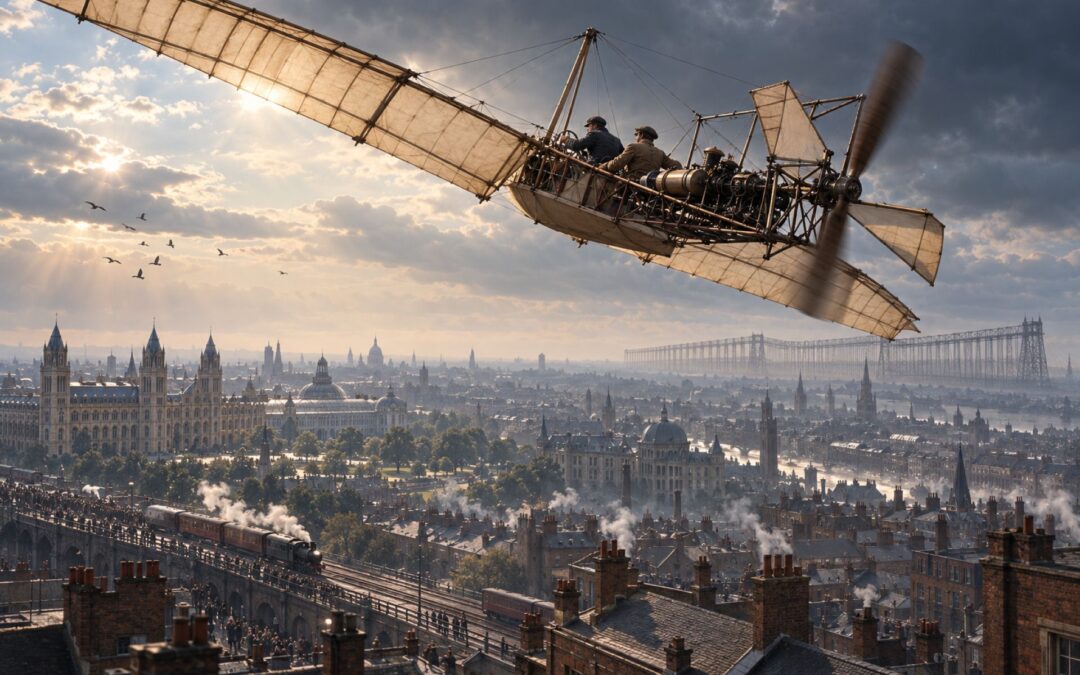
H. G. Wells published The Argonauts of the Air in 1895, at a moment when heavier-than-air flight remained an experimental dream rather than an established technology. Eight years would pass before the Wright brothers’ first successful powered, controlled flight in 1903, yet Wells was already imagining not merely a flying machine but the practical difficulty of controlling one once it left the safety of the ground.
That distinction is the key to the story. Monson, a wealthy inventor who has spent years and much of his fortune developing an aircraft, succeeds in making his machine fly. What he has not mastered is the rapid, instinctive control required to keep it stable in changing air. Public ridicule, dwindling money, wounded pride, and impatience push him into a test that proves his invention works while simultaneously killing both him and his engineer, Woodhouse.
The complete text can be found in Wells’s 1898 collection Thirty Strange Stories. The discussion below contains full spoilers, including the fatal flight and the story’s final reinterpretation of Monson’s failure.

What Happens in The Argonauts of the Air
The story opens not with Monson himself but with the public view of his experiment. Railway passengers passing through the region around Worcester Park can see a gigantic structure rising above the landscape: an immense avenue of iron and timber, crossed by ropes, rails, guides, and supports, extending for nearly two miles. Somewhere inside this artificial corridor, Monson’s flying machine repeatedly rushes forward under controlled conditions.
The scale is enormous, but the results appear unimpressive to outsiders. Travellers sometimes glimpse a white machine hurtling through the framework, straining upward against its restraints and producing enough force to shake the surrounding structure. Yet because the aircraft never escapes its guiding apparatus, spectators do not regard what they see as genuine flight. It looks more like an elaborate mechanical ride operating inside a cage.
Monson has been working on the problem for five years. He began with enough wealth to sustain a vast experimental programme and initially ignored the newspapers and casual mockery surrounding the project. He believed he was pursuing something revolutionary and did not intend to allow ignorant criticism to distract him.
Time changes that confidence. The experiments continue, modifications accumulate, and money disappears. Monson gradually becomes aware that public curiosity has transformed first into ridicule and then into something worse for a man who wants recognition: indifference.
He pretends not to care, but Wells reveals that Monson secretly receives newspaper cuttings about himself. He notices what journalists say and becomes increasingly sensitive to the nickname attached to his project: “Monson’s Folly.” The phrase reduces five years of difficult engineering to a joke.
The technical work itself is not stagnant. Problems are being solved, steering difficulties are gradually reduced, and the machine becomes increasingly capable. But experimental progress does not move at the speed Monson’s pride or finances require.
On the fifth anniversary of the project, Monson is working with Woodhouse, his chief engineer, when he notices the date. The realisation that five years have passed intensifies his frustration. Another set of alterations has become necessary, and Woodhouse calmly tells him that the required work will take several more weeks.
Monson explodes at the seemingly endless cycle of modification. He wonders why mathematics cannot determine everything beforehand instead of forcing inventors to proceed through expensive trial and error. From his point of view, the machine has consumed years because every solution reveals another practical difficulty.
Woodhouse does not offer much comfort. He is technically competent, practical, and emotionally restrained, qualities that make him useful as an engineer but not necessarily reassuring to an increasingly desperate employer.
Monson then asks how long the workers have been calling the project “Monson’s Folly.” Woodhouse answers casually, but the question exposes the depth of Monson’s anxiety. What he presents as contempt for public opinion has become a private wound.
Soon afterward, Monson’s frustration spills over into the workplace. He behaves unusually harshly toward the men employed on the project, and this change is rapidly noticed. Wells expands the effect outward with comic precision: when a millionaire funding a large enterprise begins behaving as though he may abandon it, anxiety spreads among the workers, their families, and the surrounding communities that have come to depend economically on his experiments.
The source of Monson’s sudden emotional deterioration is partly financial, but Wells also gives it a social trigger. A young woman in his social circle has treated the flying machine as an eccentric obsession rather than a serious technological undertaking. She speaks lightly about the project and repeats the phrase “Monson’s Folly,” regarding Monson as a wealthy man who has become consumed by an impossible hobby.
The criticism hurts because it confirms what Monson fears the wider world believes. He is not seen as a pioneer struggling with a difficult problem; he is becoming a joke. Worse, he realises that even intelligent and socially sophisticated people do not grasp the scale of what he is attempting.
The insult alone does not cause his later decision, but it crystallises several pressures that have already been building. Monson has spent five years working toward flight, his financial resources are nearing exhaustion, the public has lost patience, and he increasingly feels that his social identity has become tied to whether the machine succeeds.
He concludes that he must fly soon.
Several weeks later, Monson and Woodhouse stand beside the reconstructed aircraft. The new machine rests on the elevated launching railway that will give it the initial speed necessary for flight. Its structure has been altered again, and preparations are being made for a genuine attempt to leave the testing framework.
Woodhouse remains worried. He tells Monson that taking the aircraft into unrestricted flight is foolhardy. His objection is not that the machine cannot generate lift or move through the air. The unresolved problem is steering.
Monson dismisses the concern. They have repeatedly sent the machine backward and forward through the test structure, and he believes that if it can be controlled there, it can be controlled in open air. Woodhouse sees an essential difference: the framework creates predictable conditions, while unrestricted flight exposes the machine to complex movements of the atmosphere that cannot be rehearsed completely on rails.
Monson refuses to wait another year. The conversation becomes decisive when he admits that money is also running out. Endless testing is no longer financially possible.
Woodhouse had been thinking primarily as an engineer, but the revelation changes his response. He agrees to accompany Monson on the flight. Their brief handshake transforms the relationship between them: Woodhouse still believes the attempt is dangerous, but he will not allow Monson to face it alone.
Before the launch, Wells pauses the narrative to explain how the machine works. Monson’s design has gradually moved toward the form of a bird. It has a small central body containing the men and machinery, broad adjustable wings, petroleum engines, and a large propeller at the rear.
The wings can be tilted to alter the aircraft’s movement through the air. Their surfaces can also be adjusted independently to a limited degree, giving Monson some capacity to turn and correct the machine.
His basic theory depends on maintaining forward speed rather than hovering. The machine will begin with enormous momentum supplied by the launching railway. Once airborne, the rear propeller will help sustain its motion.
Monson expects the aircraft to move through a series of shallow descents and climbs. When it descends, gravity increases its speed. By changing the inclination of the wings, that speed can then be converted into another climb. Wells compares the process to an “aerial switchback.”
Birds already perform versions of this manoeuvre naturally. A bird can glide downward, acquire speed, alter its wings almost instantly, and rise again. The difficulty is that a bird possesses both a body evolved for flight and enormous instinctive experience in controlling it.
Human beings do not. Wells compares aerial control with learning to balance a bicycle, except the consequences of error are far greater. A pilot must react correctly to every shift in speed, angle, balance, and wind while travelling high above the ground.
This distinction becomes the foundation of the entire climax. Monson has developed a machine that can fly, but he has not accumulated the embodied skill necessary to fly it safely.
News of the coming attempt spreads. The same public that mocked the project becomes interested again, and travellers passing the enormous structure begin wondering whether Monson will finally leave his mechanical cage.
One morning, while a train from Basingstoke passes the experimental grounds, the attempt begins. The aircraft and its carrier rush along the elevated railway. Its propellers spin, the machine accelerates through the familiar framework, and spectators expect another violent but constrained test.
Instead, the flying machine reaches the end of its protected run and continues.
It shoots out of the framework and climbs into open air.
The transformation is instantaneous. Passengers rush to the windows, abandoning whatever they were doing to watch the aircraft. The project that had been mocked for years has suddenly achieved the thing everyone claimed it could not do.
From the outside, the moment is triumphant. The machine rises, crosses the railway, curves away, and disappears toward Wimbledon Common. Monson has genuinely flown.
Inside the aircraft, however, the situation is tense almost immediately. Monson has made the initial turn too sharply. Woodhouse notices, but neither man wastes words. Their attention is concentrated entirely on the machine.
The aircraft continues climbing, but as it gains height it loses speed. Woodhouse eventually tells Monson that the moment has come to alter the wings and begin the next phase of the intended aerial switchback.
Monson moves the control.
He moves it too far.
The effect is frighteningly rapid. The aircraft begins diving, and the horizon seems to rise in front of them as the ground moves into view. Monson suddenly understands that he has changed the wing angle too aggressively.
He corrects.
Again, the correction is too strong.
Instead of settling into a controlled glide, the machine begins climbing sharply. The pattern that Wells described theoretically now appears in dangerous practical form: Monson’s aerial switchback is no longer a smooth exchange between speed and height but a sequence of violent oscillations.
The aircraft hurtles across southwest London. It passes extremely low near East Putney, startling people below. Monson changes the wings again and sends the machine upward over Fulham.
The correction once more goes too far. The aircraft loses its stable path, dives, and then climbs again. Each movement requires another response, and each response creates new instability.
The problem is not that Monson has no controls. It is that he lacks the fine judgment required to use them. At the speeds involved, small errors become large movements before he has time to understand exactly what the aircraft is doing.
London rushes beneath them. Familiar buildings and neighbourhoods appear and disappear as the machine alternately climbs and plunges. The ordinary geography of the city turns into a series of potential obstacles.
Eventually Monson sees the greenery of Kensington Gardens and the buildings of South Kensington ahead. The towers of the Imperial Institute and the Natural History Museum rise into his field of vision. His machine is heading rapidly toward one of the densest parts of London.
He has only moments to choose what to do. He can try to climb above the obstacles or turn away from them.
Monson hesitates.
He begins trying to release the control affecting one wing, apparently intending to turn, but fails to complete the action cleanly. At almost the same moment, he grabs the main control wheel.
The aircraft pitches violently upward.
The force of the controls becomes too great for Monson to manage. Woodhouse realises immediately that the correction has gone too far, but there is no time to recover.
Monson is thrown backward. Woodhouse is also unable to remain secure as the machine rears almost vertically.
From the streets and public spaces below, spectators see only fragments of the catastrophe. The flying machine appears above the buildings, changes direction violently, and suddenly points upward. Then two human figures fall from it.
Monson and Woodhouse tumble through the air together before separating as they strike the roof of the Students’ Club and fall into the grounds beyond. Their lives end at the moment when Monson’s greatest technological success becomes undeniable.
The unmanned machine remains airborne briefly. Its nose points upward while the propeller continues spinning, creating a strange pause before the final destruction.
Then one of the engines catches fire.
The burning aircraft plunges downward toward the Royal College of Science. It smashes into the building, breaking apart and sending flame, fuel, metal, masonry, and debris across the area.
The scene immediately becomes the kind of spectacular disaster that attracts crowds, emergency services, and public horror. Yet Wells deliberately refuses to spend much time on those details.
The narrator insists that the important fact is not simply that Monson crashed. The important fact is that the machine flew.
Monson has failed catastrophically in one sense. He and Woodhouse are dead, the aircraft is destroyed, much of his fortune has vanished, and the project has ended in a public disaster.
But the experiment has also crossed a threshold. The question is no longer whether such a machine can leave the ground and travel freely through the air. Within the world of the story, Monson has demonstrated that it can.
His remaining records, experiments, machinery, and mistakes therefore possess value for whoever attempts the problem next. The framework at Worcester Park eventually stands abandoned and rusting, but it becomes a monument to the struggle that preceded successful flight.
Monson’s personal failure becomes part of a larger technological progression. He does not live to master the air, but he changes the problem for those who follow him.
Monson and Woodhouse: Ambition, Loyalty, and Risk
Monson is neither a foolish eccentric nor an uncomplicated visionary hero. Wells gives him enough technical credibility to make the public ridicule unfair, but enough pride and emotional vulnerability to make his final decision genuinely reckless. The tragedy emerges because those qualities coexist rather than because one simply replaces the other.
His commitment to aviation is real. He sacrifices years, money, social standing, and enormous personal energy to a problem that most people regard as absurd. The machine does eventually fly, which confirms that his confidence was not delusional.
At the same time, Monson gradually loses the ability to separate the needs of the experiment from the needs of his ego. At the beginning, he can tolerate ridicule because he believes eventual success will answer it. After years of expenditure and delay, external judgment begins to affect his technical decision-making.
The phrase “Monson’s Folly” becomes particularly destructive because it attacks more than the machine. It turns Monson himself into an object of ridicule. If the aircraft is a folly, then the fortune, time, and identity he has invested in it begin to look foolish as well.
Financial pressure makes the psychological pressure harder to resist. Monson cannot indefinitely continue the rational engineering process of testing, modifying, rebuilding, and testing again. Every additional delay consumes resources he may no longer possess.
His decision to fly is therefore understandable even when it is unsound. Wells does not present him as someone who suddenly abandons reason for no cause. He presents a man trapped between an engineering problem that demands patience and a financial-social reality that tells him patience may destroy him before the machine succeeds.
The unnamed young woman matters because she exposes this vulnerability. Her remarks are trivial compared with the scale of Monson’s work, which is precisely why their effect is so revealing. She does not create his insecurity; she gives it a voice.
It would therefore be misleading to blame her for the disaster. Monson already faces dwindling capital, years of frustration, newspaper mockery, and the knowledge that his reputation depends increasingly on one visible achievement. Her dismissal becomes the emotional spark that ignites material already under pressure.
Woodhouse provides the strongest contrast. Where Monson sees the project partly through ambition and reputation, Woodhouse approaches it as an engineer. He cares about what the machine can actually do rather than what observers think it ought to have done by now.
His reluctance to launch is specific rather than timid. He accepts that the machine itself may be sound enough to fly. What he doubts is their mastery of steering.
That distinction shows his superiority of judgment at the crucial moment. Woodhouse understands that controlled testing inside a prepared structure cannot fully reproduce free flight. The machine may behave differently when every gust, change of speed, and control input interacts without the protection of rails and guides.
He nevertheless agrees to join Monson. His change of mind is not an admission that Monson has won the technical argument. Instead, once he understands that the money is almost gone and Monson intends to fly regardless, professional caution gives way to personal loyalty.
Their handshake is one of the story’s quietest but most important moments. Wells does not sentimentalise the relationship with speeches. Woodhouse simply decides that if Monson is going to risk the machine, he will share the risk.
That choice makes Woodhouse’s death different from Monson’s. Monson is driven partly by pride and ownership of the project; Woodhouse knowingly accepts danger that he has already identified. His courage is therefore inseparable from loyalty, but so is his complicity in a premature experiment.
The public functions almost like a third character surrounding them. Commuters, excursionists, journalists, workers, neighbours, and social acquaintances repeatedly interpret the project according to spectacle. While Monson is solving incremental engineering problems, they ask only whether he has flown yet.
That pressure exposes an enduring difficulty in innovation. Complex technical progress is often invisible until it produces a dramatic result, while the years of partial success required to reach that result can look indistinguishable from failure to outsiders.
Wells does not make the public entirely malicious. When the machine finally launches, the spectators’ excitement is genuine. Their response is simply shallow because they encounter innovation mostly through moments of visible performance rather than through the work that makes those moments possible.
Victorian London and the Race to Fly
The technological setting of The Argonauts of the Air is one reason the story remains striking. Wells was not writing after airplanes had made controlled powered flight seem inevitable. He was writing while inventors were still experimenting with radically different ways of getting heavier-than-air machines off the ground.
Wells explicitly places Monson in relation to Hiram Maxim’s experimental flying machine. Maxim, better known for the machine gun that bears his name, devoted substantial resources in the early 1890s to a large steam-powered aircraft tested on rails. The connection matters because Monson’s enormous testing structure and financially demanding programme belong to a recognisable technological world rather than to pure fantasy.
Wells also invokes Otto Lilienthal’s pioneering glider experiments. Lilienthal had demonstrated through repeated gliding flights that human beings could travel through the air in heavier-than-air craft, and his work made questions of balance and control especially important. For Wells, the leap from gliding to powered flight does not eliminate the piloting problem; it intensifies it.
The date gives the story additional force. The Argonauts of the Air appeared in 1895, while the Wright brothers’ successful powered flight would not occur until December 1903. Wells therefore imagines a credible sequence in which mechanical flight is achieved before safe mastery of the aircraft has been learned.
That distinction is more impressive than claiming simply that Wells “predicted the airplane.” Monson’s machine does not closely resemble the mature aircraft that followed, and Wells was drawing on existing experiments rather than inventing the concept of human flight from nothing. What he does anticipate perceptively is that successful aviation requires solving several different problems at once: propulsion, lift, structure, stability, and human control.
London itself is equally important. Wells does not send Monson over an anonymous desert, coast, or experimental field. The machine breaks free from Worcester Park and enters a densely inhabited modern metropolis.
Railways initially frame the story because they represent a technology already absorbed into everyday life. Passengers moving routinely through the suburbs look out at an experimental machine trying to create the next transformation in transportation. One technology has become ordinary enough to provide spectators for the birth of another.
Once Monson becomes airborne, familiar places turn into markers of speed and danger. Putney, Fulham, Kensington Gardens, the Natural History Museum, the Imperial Institute, and South Kensington flash into view as the aircraft crosses the city far faster than its pilots can comfortably manage.
The choice of the Royal College of Science as the final crash site has an additional resonance because Wells himself studied science in South Kensington. Even without making that biographical fact central to the story, the location suits the ending perfectly: a machine representing the dangerous frontier of experimental science destroys itself against an institution devoted to science.
The city also transforms invention into public spectacle. Monson cannot fail privately once he leaves the testing grounds. His breakthrough, his loss of control, and his death occur above the heads of thousands of potential witnesses.
That public visibility completes the story’s irony. The world that had mocked Monson finally receives undeniable proof that his machine works at the exact moment when his attempt becomes disastrous.
The Machine and the Problem of Control
Monson’s aircraft is historically interesting, but it should not be treated as a blueprint for the modern airplane. Wells combines ideas circulating in nineteenth-century aeronautics with his own speculative design, producing a machine whose literary function matters more than whether every feature would work as described.
The aircraft begins its flight using a launch railway. This apparatus accelerates it to a speed at which the wings can generate sufficient lift, solving the problem of how a relatively heavy machine gets moving fast enough to become airborne.
Once free, petroleum engines drive a large rear propeller that maintains forward movement. The broad wings can change their angle relative to the airflow, allowing Monson to influence whether the aircraft climbs or descends.
His “aerial switchback” principle depends on trading altitude and speed. In a descent, the aircraft accelerates. Monson can then alter the wing angle and use that speed to climb again.
The logic resembles the way gliding birds can gain and expend energy without continuously flapping. Wells uses birds repeatedly because they illustrate both the possibility of flight and the human disadvantage.
A bird does not need to calculate each movement consciously. Its nervous system, body, and experience function together. Tiny changes in balance can be corrected almost immediately.
Monson does not possess that kind of embodied skill. He must consciously interpret what the machine is doing, decide how much correction is required, move the control, wait for the aircraft to respond, and then judge whether the response was sufficient.
At high speed, that delay is dangerous. By the time he recognises that one movement was excessive, the machine has already entered a new state requiring another correction.
This is exactly what happens during the final flight. Monson does not lose control because the aircraft suddenly ceases functioning. The controls continue to work, but his inputs are too large.
He pushes the machine into a descent, then corrects too strongly and sends it upward. The resulting oscillation demands another response, which produces another extreme movement.
The problem compounds itself. Every overcorrection reduces the time available to recover from the previous one.
Woodhouse’s earlier warning therefore turns out to be precise. The machine is capable of flight, but the pilots have not mastered the relationship between the controls and the aircraft’s behaviour in unrestricted air.
Wells’s use of Lilienthal strengthens this idea. Practical gliding had shown that successful flight depended on more than building a surface that could remain airborne. A human being had to learn how to manage balance continuously.
The story thereby separates invention into stages. First comes a machine capable of producing the desired physical effect. Then comes the practical knowledge required to operate that machine reliably.
Modern readers may take that distinction for granted because aviation developed formal pilot training, control systems, aerodynamic theory, instruments, and standardised aircraft behaviour. In Monson’s world, none of that accumulated practice exists.
He is not merely testing the first machine. He is also trying to become the first competent pilot while already in flight.
That is why the test is so dangerous. Every mistake that would later become part of routine pilot training has to be discovered for the first time at full physical cost.
Major Themes: Innovation, Ridicule, and the Cost of Progress
Public ridicule is one of the story’s most obvious themes, but Wells treats it more subtly than a simple opposition between genius and fools. The public is wrong to assume that Monson’s project is worthless, yet Monson is also wrong to let the need to prove them wrong influence the timing of his experiment.
That tension matters because vindication does not automatically justify every decision made in pursuit of it. Monson really does possess a revolutionary machine. He also really does fly before he and Woodhouse are ready.
Wells therefore distinguishes being correct about the future from being correct about the next action. Monson’s belief that powered flight can be achieved is justified; his belief that he must attempt unrestricted flight immediately is not.
The story also contrasts theory with experiment. Monson becomes frustrated that mathematics cannot simply tell him how to build the finished machine without years of expensive alterations. His complaint reflects the emotional burden of engineering through trial and error.
Yet the entire narrative demonstrates why practical testing is unavoidable. The fatal problem does not emerge merely from an incorrect abstract theory of flight. It emerges from the unpredictable interaction between machine, air, speed, controls, and human reaction.
Some knowledge can only be acquired by doing. The tragedy is that early experimenters often have to acquire it before adequate safety systems exist.
That idea leads directly to the story’s treatment of technological progress. Wells does not present progress as a smooth sequence in which every intelligent inventor succeeds. He imagines it as cumulative, wasteful, dangerous, and partly impersonal.
Monson can die while his work succeeds historically. The knowledge generated by his life does not die with him.
This perspective gives the story its grandeur but also its moral discomfort. The narrator can look beyond Monson and Woodhouse toward future aviation because history often evaluates experiments according to what later generations learn from them. The dead individuals themselves do not receive the benefit of that progress.
Money is part of the same equation. Monson’s fortune allows him to attempt something most people could not attempt, but technological experimentation consumes wealth faster than even he expects. Each test requires workers, materials, reconstruction, land, machinery, and time.
His financial decline is not merely background pressure. It places a limit on the supposedly rational option of “keep testing until everything is safe.” At some point, Monson either has to demonstrate success or lose the capacity to continue.
Ambition therefore becomes inseparable from economics. Monson wants to fly because he believes in the invention, because he wants social vindication, and because his resources are running out. Wells refuses to give him a single clean motive.
The same ambiguity applies to courage. Monson unquestionably possesses courage: he enters an aircraft whose safety he cannot guarantee and stakes his own life on his invention.
But courage does not make the decision wise. Woodhouse’s warnings remain correct even though the men’s willingness to fly is brave.
The story repeatedly occupies that uncomfortable border between heroism and recklessness. Pioneers often have to accept risks that later users of a technology never face, but romanticising that risk can encourage people to ignore preventable dangers.
Wells’s treatment of public opinion adds another layer. Before the launch, society judges the machine according to appearances. Five years without spectacular success equals failure.
After the launch, perception changes instantly. The same aircraft that was a folly seconds earlier becomes a wonder because it has crossed an invisible line between testing and public performance.
This makes technological progress partly a problem of narrative. The public wants a moment of invention, while actual engineering consists of thousands of smaller developments that may not look meaningful until they combine.
The brief military references in the story deepen its futurism. Wells imagines that the conquest of flight could eventually lead to machines carrying weapons, recognising that mastery of the air would not remain a purely peaceful achievement.
He does not develop that possibility extensively here, but its presence prevents technological progress from being treated as automatically benevolent. The same capability that fulfils one of humanity’s oldest dreams can become a new instrument of war.
The broadest theme is therefore not simply perseverance. It is the price of entering a new technological domain before anyone fully understands it. Money disappears, reputations suffer, workers depend on uncertain projects, and experimenters may die.
Progress remains possible, but Wells strips away the comforting assumption that progress is therefore painless.
Symbols and Motifs: The Cage, the Switchback, and the Argonauts
The enormous testing framework around Monson’s machine is the story’s most important physical symbol. It exists to make experimentation safer and more controlled, but it also prevents the public from recognising the achievement taking place inside it.
As long as the machine remains within its rails and guides, spectators say it is not really flying. The structure that protects Monson from the full danger of the air simultaneously becomes evidence, in the public mind, that he has failed.
This creates a powerful contradiction. To prove that his experiments have succeeded, Monson must abandon the very system that makes controlled experimentation possible.
The structure can therefore be read as both cage and laboratory. It limits freedom but creates knowledge. Leaving it is necessary for progress, yet leaving it before that knowledge is complete produces disaster.
“Monson’s Folly” operates as a verbal symbol of the same conflict. The phrase allows outsiders to define an unfinished invention before the experiment has reached its conclusion.
Once repeated often enough, the nickname begins influencing Monson himself. Society’s interpretation of his work becomes psychologically real even though it remains technically inaccurate.
The aerial switchback carries both literal and metaphorical significance. Literally, it describes Monson’s intended pattern of descending to gain speed and climbing by converting that speed into height.
During the fatal flight, however, the controlled switchback becomes a violent oscillation. The image begins to resemble technological progress itself: advances and setbacks, confidence and panic, ascent and fall.
Birds function as another recurring measure. They prove that controlled flight is possible, yet simultaneously expose how far humans remain from mastering it.
A bird possesses no elaborate railway, engines, or enormous fortune, but it has something Monson lacks: an integrated instinct for flight. The contrast suggests that technological power cannot instantly replace embodied knowledge.
Money appears almost like a substance flowing out of the project. Monson’s fortune steadily diminishes as physical knowledge accumulates. Wells repeatedly connects experimental progress with expenditure, showing that innovation consumes resources before producing visible returns.
Crowds and windows also recur. People observe Monson from railway carriages, buildings, platforms, streets, and public spaces. Flight is repeatedly framed by spectatorship.
This reinforces the difference between the inventor’s experience and the public’s. Monson lives through years of technical frustration; outsiders encounter selected moments through windows.
The title adds a larger mythic frame. In Greek myth, the Argonauts are voyagers who sail into unknown territory in pursuit of the Golden Fleece. Wells transfers that language of exploration from the sea to the sky.
Monson and Woodhouse become argonauts because they enter a medium that humanity has not yet learned to navigate. Their machine is not simply transportation; it is a vessel entering a new domain.
The comparison also explains Wells’s repeated language of conquest, armies, and right-of-way. Flight is imagined as the opening of another territory to human movement, much as navigation opened the oceans.
Modern readers may reasonably find the conquest language grandiose, especially because technological expansion does not automatically represent moral improvement. Within the story, however, it helps explain why Monson believes his work is larger than his own life.
The final image of the abandoned framework completes this symbolism. Rusting iron remains where the experiment once operated, apparently useless after the catastrophe.
Yet the narrator treats it as a monument. What the public once called folly becomes evidence of an early stage in humanity’s struggle to fly.
From Social Satire to Aerial Catastrophe
One of the story’s strongest formal achievements is its ability to change genres without losing coherence. The opening sections often resemble social satire, while the final pages become a high-speed technological disaster narrative.
Wells begins with commuters and excursionists because they allow him to make the public mildly ridiculous. People discuss the possibility of flight without necessarily knowing much about it, repeat familiar opinions, and judge Monson from brief glimpses through railway windows.
The narrator treats this behaviour with amusement rather than rage. Public skepticism becomes part of the social environment through which every ambitious inventor must move.
The satire extends to Monson himself. Wells sympathises with his frustration but does not idealise him. His irritability, vanity, and desperate need for recognition remain visible alongside his genuine achievement.
Woodhouse provides dry comic resistance. His practical responses to Monson’s emotional complaints repeatedly puncture the inventor’s desire for reassurance.
The technical passages then slow the narrative deliberately. Before Wells can make the flight frightening, readers need to understand enough of the machine to know what each movement means.
The explanation of wings, propulsion, gliding, and the aerial switchback is therefore not detachable scientific decoration. It prepares the mechanics of the climax.
Once the aircraft launches, the pacing changes sharply. Years of experimental history give way to seconds of decision.
Wells initially shows the launch from outside because public spectatorship matters. The reader experiences the astonishment of people who suddenly realise that Monson’s machine has escaped its framework and entered free air.
The narrative then moves closer to Monson and Woodhouse. Their silence and physical concentration replace the chatter of spectators.
This change in viewpoint transforms the meaning of the flight. From outside, the machine is magnificent. From inside, almost every second contains a potential catastrophe.
Wells uses London geography to measure the speed. Locations arrive faster than Monson can comfortably respond to them, making the machine’s forward momentum feel increasingly uncontrollable.
The landmarks also give the danger scale. A vague description of flying “over the city” would be less effective than the sudden appearance of railway stations, roads, museums, parks, and monumental buildings.
The final moments are particularly well constructed because the decisive error is small. Monson does not deliberately perform an absurd manoeuvre. He hesitates, partially changes one control, grabs another, and loses the aircraft.
That is exactly the kind of error the story has prepared. The problem is not the absence of intelligence but the impossibility of learning an entirely new form of rapid physical control without making mistakes.
After Monson and Woodhouse fall, the viewpoint widens again. The catastrophe becomes something witnessed by crowds from below.
This return to exterior perspective removes the men from their own story at the moment of death. They become objects falling through the same public space whose judgment has haunted Monson throughout the narrative.
The burning machine then crashes in spectacular fashion, but Wells refuses to let spectacle provide the final meaning. He effectively tells the reader that fire, crowds, bodies, and emergency response belong to the ordinary language of disaster.
The story’s real conclusion lies elsewhere: what has humanity learned?
That final shift from catastrophe to historical interpretation gives the ending its unusual force. The narrator steps beyond the immediate tragedy and places Monson within an imagined future of aviation.
The Ending Explained: Failure, Success, and the Next Inventor
Literally, the ending is catastrophic. Monson and Woodhouse are thrown from the aircraft during a violent loss of control and die after falling onto and beyond the Students’ Club. The unmanned machine then catches fire and crashes into the Royal College of Science.
Nothing about the test can be called operationally successful. The pilot cannot reliably control the aircraft, the crew does not survive, the machine is destroyed, and the experimental programme loses the man who financed and drove it.
Yet Wells insists that another kind of success has occurred. Monson’s aircraft leaves its launching system and sustains free flight over a significant distance. The basic possibility he has spent five years trying to demonstrate is therefore established.
The catastrophe also identifies the next problem with brutal clarity. It is not enough to create lift and propulsion; an aircraft must be controllable by a human operator under rapidly changing conditions.
Future inventors do not need to begin exactly where Monson began. They can examine his work, understand the behaviour revealed by the final flight, and focus more intelligently on stability and control.
This is why the narrator treats Monson’s records as part of his achievement. Technological knowledge can outlive the person who acquired it.
The ending therefore evaluates success across generations rather than across an individual lifetime. Monson loses everything personally but contributes something historically.
That perspective is both inspiring and disturbing. It explains why failed experiments can matter, but it can also make individual suffering seem secondary to an abstract idea of progress.
Wells does not entirely resolve that tension. The heroic language surrounding Monson invites admiration, while the story’s careful demonstration of his psychological and technical mistakes prevents readers from treating the disaster as pure martyrdom.
His death was not simply an unavoidable price demanded by aviation. He flew because genuine technological courage became entangled with financial desperation, wounded pride, and impatience.
The final monument is therefore ambiguous. The rusting framework represents bravery and visionary persistence, but it also represents the cost of leaving controlled experimentation before the remaining problems were solved.
The title’s Argonaut metaphor reaches completion here. Monson and Woodhouse are explorers who enter a new realm and do not return, but their voyage changes the map for those who come after them.
Critical Review: How Well Does The Argonauts of the Air Hold Up?
The Argonauts of the Air remains compelling because Wells understands that a convincing technological story needs more than a futuristic device. The real drama comes from the interaction between the machine, the people operating it, the society judging it, and the incomplete knowledge surrounding it.
The aviation speculation is historically striking without needing exaggerated claims about prophecy. Wells was writing before powered controlled flight had been achieved, yet he recognised that getting a machine into the air would not by itself solve aviation. Control, stability, pilot experience, and rapid adjustment would be separate problems.
That insight gives the final flight unusual credibility. The machine does not fail because an engine simply explodes at the convenient dramatic moment. It fails because Monson can make it respond but cannot yet make it respond precisely.
The distinction produces excellent suspense. Readers understand that every correction may save the aircraft or worsen the instability, which gives the technical exposition direct narrative value.
Monson is also a stronger character than he initially appears. He could easily have been written as either a heroic genius mocked by fools or a wealthy obsessive destroyed by vanity. Wells allows both readings to coexist.
His project is genuinely important, and the public genuinely misunderstands it. His final decision is also genuinely compromised by pride and impatience.
That complexity prevents the moral from becoming simplistic. The fact that people laughed at Monson does not mean he should ignore every warning. Being ahead of society does not make every risk rational.
Woodhouse adds further depth. His engineering caution gives the reader a credible reason to distrust the launch even before anything goes wrong, while his decision to accompany Monson gives the catastrophe a personal dimension.
Wells does not overdevelop their friendship, but the restraint suits the story. The handshake carries more force because Woodhouse is normally so unemotional.
The public satire remains recognisable as well. Spectators want invention to occur as a dramatic moment, while actual progress takes the form of years of tedious, expensive adjustments. Society grows bored during the work and fascinated during the spectacle.
That observation has aged better than some of the specific engineering. Technologies still pass through long periods in which outsiders alternate between inflated expectation, mockery, indifference, and sudden enthusiasm.
The London setting greatly strengthens the story. Wells makes flight feel revolutionary by sending the aircraft across an environment readers already understand.
The contrast between familiar urban geography and an unprecedented machine overhead creates a kind of technological estrangement. Ordinary places suddenly look different because a new form of movement has entered them.
The pacing of the flight is another major strength. Once Monson leaves the framework, the story accelerates in a way that mirrors his shrinking decision time. Each correction creates the conditions for the next crisis.
The sequence becomes increasingly claustrophobic despite taking place in open sky. Monson has enormous physical space around him but almost no temporal space in which to act.
The ending is perhaps the story’s most intellectually interesting feature. Wells refuses both obvious conclusions: he neither treats Monson as merely a fool who deserved his fate nor converts the disaster into uncomplicated heroic triumph.
Instead, Monson is simultaneously wrong and historically important. He misjudges the readiness of his experiment, but the experiment still generates knowledge.
The most significant limitation is that the narrator’s commitment to technological progress can make the human cost feel abstract. Once the machine crashes, attention quickly turns toward future inventors rather than dwelling on Monson and Woodhouse as dead individuals.
That is partly intentional. Wells wants readers to think historically rather than sentimentally. Yet the effect can make the ending sound as though two deaths are justified simply because later engineers may learn from them.
Modern readers may therefore feel more resistance to the narrator’s language of conquest and sacrifice than contemporary readers did. The idea that humanity possesses a “right-of-way” through the air carries the confidence of an age that often described technological expansion as conquest.
That rhetoric does not destroy the story, but it complicates it. Mastery of a new technology can expand human possibility without automatically making the social uses of that technology admirable.
The brief reference to future flying machines carrying weapons makes Wells himself partly aware of that complication. Aviation will not simply create freedom and wonder; it will extend human conflict into another dimension.
Some technical details have inevitably aged. Monson’s particular aircraft and control system belong to nineteenth-century speculation rather than modern aeronautical engineering.
That limitation matters less than it might because the story’s central technological insight is conceptual rather than mechanical. Wells understands that a machine can be physically capable of an action before human beings have learned to operate it safely.
The secondary characters are also thin. The young woman primarily functions as a trigger for Monson’s wounded pride, Hooper represents workforce anxiety, and the crowds represent public opinion. None requires deep characterisation for the plot to work, but readers looking for the psychological richness of a novel will find the story schematic.
The title may also promise something more mythic than the story delivers emotionally. Monson and Woodhouse become “Argonauts” mainly through the narrator’s larger interpretation of their experiment, not through extensive exploration of their inner lives as heroic adventurers.
Still, the compactness is part of the achievement. Wells needs only a few pages to establish an experimental culture, a social world, a financial crisis, two distinct personalities, a plausible technological principle, a successful breakthrough, and a catastrophic reversal.
The result works both as early science fiction and as a story about innovation more broadly. Its most enduring question is not whether Wells guessed what airplanes would look like. It is what happens when a technology becomes possible before it becomes mastered.
That question gives the story continuing relevance. New capabilities often emerge before institutions, operators, safety practices, and social expectations have adapted to them.
Monson embodies the danger of standing at that threshold. He possesses enough knowledge to cross it but not enough accumulated experience to survive comfortably on the other side.
For readers interested in H. G. Wells, early science fiction, aviation history, invention, technological risk, or the psychology of ambitious projects, The Argonauts of the Air remains well worth reading. Its engineering details belong to another era, but its distinction between invention and mastery still feels remarkably modern.
Monson’s first unrestricted flight destroys him, yet it also changes the question his successors will have to answer. Before he launches, the problem is whether a heavier-than-air machine can truly fly. After the crash, within Wells’s imagined history, that problem has effectively been settled.
The next inventor does not need to prove that the air can be entered. The next inventor must learn how to remain there.
Last Updated on October 6, 2026 by Aseem Gupta