
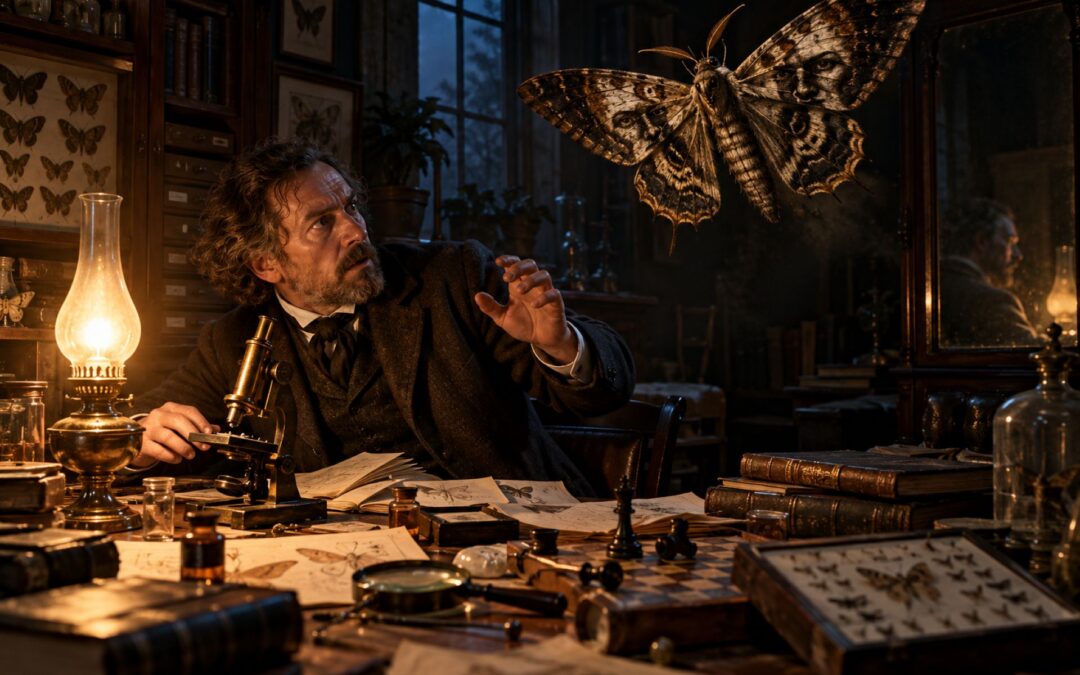
H. G. Wells’s A Moth (Genus Unknown) is a story about what happens when intellectual rivalry stops being a professional relationship and becomes the structure of a person’s identity. Hapley, a brilliant but combative entomologist, spends years defining himself against Professor Pawkins. When Pawkins finally dies, Hapley does not become free. Instead, his mind appears to recreate the rival in a new form: a moth that only he can see.
The story first appeared in 1895 under the earlier title A Moth—Genus Novo and was later included as A Moth (Genus Unknown) in Wells’s 1898 collection Thirty Strange Stories. The change of title preserves the same essential joke: Hapley, even while losing his grip on shared reality, continues to think like a scientist confronted with an unclassified specimen.
The story works because Wells never reduces the moth to a simple symbol. Hapley experiences it visually, hears it, believes he feels it, and pursues it with the urgency of a real creature. Yet nobody else can see it. The resulting uncertainty makes the story less about proving whether the moth is supernatural than about showing how completely Pawkins continues to occupy Hapley’s mind after death.
This article contains full spoilers.

What Happens in A Moth (Genus Unknown)
The story opens by introducing W. T. Hapley as a celebrated entomologist and by treating his feud with Professor Pawkins as if it were an event of enormous public importance. The narrator jokingly assumes that any reasonably informed reader must know about the controversy, even though it belongs to an obscure professional world that most ordinary people would barely notice.
The feud begins with scientific classification. Pawkins publishes a revision of the microlepidoptera and eliminates a species that Hapley had previously identified. What might have remained a technical disagreement quickly becomes personal.
Hapley responds by attacking Pawkins’s broader system of classification. Pawkins retaliates by questioning Hapley’s powers of observation and suggesting that his microscope may be as unreliable as his scientific judgment. Hapley replies with ridicule.
From that point forward, almost every dispute in their field becomes another opportunity for conflict. Their disagreement spreads beyond the original species and turns into a long-running struggle over reputation, authority, and intellectual status.
Wells presents this rivalry with deliberate comic exaggeration. Learned scientific meetings begin to resemble political battles, and supposedly objective men of science behave like people engaged in a personal vendetta. The story’s early humour comes from the contrast between the elevated language of scholarship and the recognisably ordinary emotions driving the scholars themselves.
Hapley and Pawkins become professional opposites. Hapley is energetic, rhetorically skilled, combative, and adept at ridicule. Pawkins is less charismatic and less effective as a public controversialist.
The rivalry lasts for years. Hapley’s reputation grows partly through his attacks on Pawkins, while Pawkins continues resisting him. Their careers become entangled so thoroughly that opposition itself begins to provide structure and momentum.
Eventually Pawkins’s health declines. In 1891 he publishes work on the mesoblast of the death’s-head moth, but the work is substantially weaker than his usual standard.
Hapley immediately recognises the opportunity. He produces a devastating critique and attacks Pawkins with a severity that suggests years of accumulated resentment finally finding release.
Pawkins attempts to answer, but his response is weak. He appears physically ill and intellectually unable to fight at his former level.
Hapley then follows with another paper whose scientific argument is presented as crushing and whose tone is openly contemptuous. The attack is so severe that even an editorial note indicates the original version had apparently been moderated.
At this point, the scientific community expects Pawkins to reply. Their feud has become a familiar spectacle, and another round seems inevitable.
Instead, Pawkins falls ill with influenza. His condition develops into pneumonia, and he dies.
The death changes the moral atmosphere immediately. The same people who had enjoyed the rivalry begin regarding Hapley’s behaviour with discomfort. What had previously been treated as entertaining scientific combat now looks cruel because the weaker combatant is dead.
Hapley’s position becomes even worse when another attack he had already prepared appears around the time of Pawkins’s funeral. Readers who had previously cheered the feud now see only a living man continuing to assault someone who can no longer answer.
Yet Hapley himself does not respond to Pawkins’s death with straightforward guilt or grief. Instead, he experiences something more psychologically revealing: frustration.
Pawkins has escaped him.
For roughly twenty years, Hapley has worked partly in relation to this enemy. He has researched in order to defeat him, argued in order to contradict him, and sharpened his professional identity through opposition. Pawkins has functioned almost as an organising principle.
His death therefore creates a strange emptiness. Hapley has won, but the victory feels less like liberation than the removal of the structure around which his intellectual life had been built.
A doctor advises Hapley to rest, so he leaves London and goes to a quiet village in Kent. The change of location does not solve the problem because Pawkins remains active in Hapley’s thoughts.
He continues remembering arguments, imagining replies, and discovering new points he wishes he could make against a man who is no longer alive. The rivalry continues in one direction.
Hapley tries to distract himself with fiction. The attempt fails because his scientific habits interfere with his enjoyment. He finds himself criticising stories for their logic rather than becoming absorbed in them.
He tries chess next. At first the game works better because it gives his competitive intelligence something structured to do. He learns quickly and becomes capable enough to defeat the local vicar.
But even chess cannot remain separate from Pawkins. The opposing king begins reminding Hapley of his dead rival, turning yet another supposedly neutral activity into a reenactment of the feud.
Finally Hapley decides that perhaps the best escape from one scientific obsession is another scientific occupation. He turns to diatoms, microscopic organisms that allow him to redirect his attention into a different speciality.
This attempt initially seems more promising. He works late at his microscope, returning to the intense habits of observation that defined his previous scientific life.
During one of these sessions, Hapley notices something unusual on the patterned tablecloth beside him. At first it appears as a disturbance in the design.
He shifts his attention away from the microscope and looks directly.
A large moth or butterfly appears to be resting on the table.
The discovery immediately excites him. Hapley is an experienced entomologist, yet the insect does not resemble anything he knows. Its colours blend strangely with the tablecloth, and the possibility occurs to him that he may be looking at an unknown genus.
For a scientist whose identity has been shaped by taxonomy, this should be an extraordinary opportunity. The excitement of classification returns at once.
Then something changes.
The insect begins reminding him of Pawkins.
Hapley tries to catch it. Before he can do so, the moth flies upward and strikes the edge of the lamp shade.
He hears the contact. This matters because his first experience of the moth is not presented as a purely visual illusion.
Hapley removes the lamp shade to illuminate the room more fully and locates the creature again. He attempts to catch it several times, but it repeatedly escapes.
During the pursuit he accidentally knocks over objects, including the microscope and lamp. The light goes out.
In the darkness, Hapley believes the moth strikes his face.
Again, the experience seems tactile as well as visual.
The disturbance attracts Mrs. Colville, his landlady. She cautiously approaches with a candle, but Hapley, still absorbed in the pursuit, behaves in a way that frightens her.
From her perspective, nothing in the room justifies his excitement. She only sees a lodger acting erratically in darkness.
By the next morning, Hapley recognises that his behaviour must have looked alarming. He decides not to explain the moth because he understands that without the specimen his story will sound ridiculous.
This decision marks the beginning of concealment. Hapley is not yet completely detached from social reality; he understands how another person will interpret him.
He tries to behave normally around Mrs. Colville. They talk about ordinary domestic matters, but she remains wary and keeps physical distance between them.
Hapley becomes irritated by her suspicion and eventually goes for a walk.
The moth follows him psychologically even when it does not appear directly. His attention keeps returning to it.
At one point he sees what seems to be the insect flattened against a stone wall. When he approaches, he discovers that the supposed moth is only a pattern of lichen.
The mistake allows Wells another moment of black humour. Hapley reflects on the reversal of mimicry: instead of an insect resembling a surface, the surface has temporarily resembled an insect.
But the incident also reveals how thoroughly his perception has become primed to find the moth.
Later Hapley visits the vicar and becomes involved in an argument about theology. The conversation gives him something else to think about until he suddenly notices the moth again.
It appears to be resting nearby.
Hapley points it out.
The vicar sees nothing.
This is the story’s decisive reality test.
Until this moment, Hapley has been able to imagine that the insect is objectively present even if others have simply missed it. The vicar’s inability to see something Hapley perceives clearly forces him to confront another possibility.
The moth may be a hallucination.
Hapley knows enough about psychology to understand that visual illusions can result from mental strain. He begins analysing himself scientifically.
Yet the explanation does not satisfy him completely because he remembers hearing the moth strike the lamp and feeling it touch his face. Those sensory experiences make the hallucination feel more complicated than a mere mistaken visual impression.
The next night, Hapley sees the moth crawling on his bed.
He tries to reason with himself. He knows his mind may be failing, and he treats sanity almost as another intellectual contest to be won through discipline.
That approach proves ineffective.
Mrs. Colville and a servant hear him moving around his room during the night. Chairs and ornaments are knocked over, and eventually Hapley leaves the room and begins chasing the moth through the house.
To the women listening nearby, he appears to be pursuing nothing.
He goes outside into the road in his nightclothes, moving unpredictably as if following some invisible creature. Sometimes he advances cautiously; at other moments he suddenly strikes at the air.
Eventually he returns indoors and becomes quiet.
The following morning, Hapley realises once again that he must provide an explanation. He tells Mrs. Colville that he is a sleepwalker and that the disturbance occurred because he had failed to take his usual sleeping mixture.
The excuse is revealing. Hapley still understands ordinary social expectations and can invent a rational explanation for irrational behaviour.
His problem is therefore not a total loss of intelligence. His rational mind remains active, but it increasingly functions as a tool for concealing the fact that another part of his experience is becoming uncontrollable.
Hapley decides to obtain medicine and walks across the downs.
Again the moth appears.
He tries to ignore it, but its presence becomes impossible to tolerate.
He strikes at it with his hat.
As he continues, his emotional response changes. The old rage he once directed at Pawkins returns.
The relationship between moth and rival becomes complete. Hapley is no longer merely trying to catch a scientific specimen; he is fighting his enemy again.
During the pursuit he loses his footing and falls near the chalk pits.
When he regains awareness, he discovers that he has badly injured his leg.
Even then the moth remains visible.
At this moment Hapley reaches an important conclusion. Nobody else will ever be able to see it.
He decides he must stop talking about it.
This recognition contains both clarity and terror. Hapley understands that his private perception cannot be socially confirmed and therefore cannot be safely discussed.
His broken leg is treated, and he is confined to bed.
At first Hapley tries to maintain control. But fever weakens him, and the moth appears again near the bed.
He strikes at it.
The nurse reacts with alarm because she sees no insect.
Hapley realises from her expression what she thinks and immediately tries to correct himself, claiming that he had imagined something.
As the fever worsens, however, his self-control deteriorates.
He attempts to get out of bed to pursue the moth despite the broken leg. The movement is dangerous enough that the nurse and attendants restrain him.
When he continues struggling, his arms are tied as well.
The restraint turns the moth from an object of pursuit into an intimate tormentor. Hapley can no longer chase or strike it.
He feels it settle in his hair.
Then he believes it crawls across his face.
Unable to move, he begs the people around him to remove it. They refuse because they see nothing.
The narrator sharply criticises the doctor. Instead of responding to Hapley’s perceived reality, the doctor repeatedly insists that no moth exists.
The story suggests that if the doctor had been willing to accommodate Hapley’s experience temporarily, perhaps by covering his face as Hapley requests, the immediate torment might have been reduced. That judgment belongs to Wells’s narrator and should not be treated as modern psychiatric guidance.
Hapley never recovers psychologically.
He is eventually confined permanently in an asylum, where the moth continues to trouble him.
The doctors call it a hallucination.
Hapley offers another explanation.
He says the moth is the ghost of Pawkins.
Even in madness, however, his scientific habits remain intact. The ghost-moth is not merely terrifying. Hapley also regards it as an extraordinary specimen, unique enough to justify his continued efforts to catch it.
The story closes by fusing his obsession, profession, enemy, and delusion into a single impossible object.
Hapley and Pawkins: A Rivalry That Outlives Death
Hapley is compelling because his psychological collapse grows directly out of qualities that once made him professionally successful. His intelligence, competitiveness, energy, precision, and refusal to yield all contribute to his reputation. The same traits eventually become destructive when they have no boundary outside the rivalry with Pawkins.
He does not simply dislike Pawkins. He needs him.
For years, Pawkins gives Hapley something against which to organise his thinking. A disputed classification becomes the beginning of a professional identity defined by contradiction. Every new scientific issue offers another opportunity to prove Pawkins wrong.
This is why victory becomes destabilising. Hapley assumes that destroying his opponent’s arguments will bring satisfaction, but he has not accounted for how much of his own motivation depends upon the existence of the opponent.
Pawkins’s death therefore removes more than a rival. It removes a system.
Hapley’s later behaviour makes this dependence visible. Fiction cannot replace conflict because it does not engage him in the same way. Chess briefly works because it creates an opponent, but even there the king becomes Pawkins.
When Hapley turns to diatoms, he is not simply changing subjects. He is trying to rebuild the conditions under which he knows how to function.
The possibility that he might begin another scientific quarrel reveals how deeply controversy has become part of his intellectual routine. He does not merely enjoy discovery; he enjoys discovery sharpened by opposition.
Pawkins himself remains comparatively underdeveloped because the story is filtered through the history of the feud. We see him largely as Hapley’s antagonist: slower, less rhetorically gifted, increasingly ill, and eventually unable to defend himself.
Yet his limited characterisation is structurally useful. After death, Pawkins becomes even less a full person and more a psychological form inside Hapley’s mind.
That transformation begins before the moth appears. Hapley imagines conversations with Pawkins, continues formulating rebuttals, and interprets new experiences through the old rivalry.
The moth therefore does not suddenly introduce Pawkins into Hapley’s mind. It gives a sensory shape to someone already there.
Possible guilt may contribute to this process, especially because Hapley’s final attacks are associated with Pawkins’s decline and because the scientific community turns against him after the death. But guilt alone does not explain the story.
Hapley does not seem primarily remorseful. He is angry that Pawkins has deprived him of further combat.
That anger reveals the darker intimacy of hatred. Pawkins is Hapley’s enemy, but he is also the person who has supplied continuity, purpose, emotional stimulation, and professional direction.
The phrase “Pawkins’s final victory” therefore works as an interpretation, not because Pawkins literally returns from the grave and defeats Hapley, but because death makes him unbeatable. Hapley can no longer publish a paper that forces Pawkins to answer.
He can no longer achieve closure through victory because the other participant has left the contest.
The moth solves that problem for Hapley’s mind in the worst possible way. It restores the enemy but removes the possibility of final resolution.
Victorian Science, Entomology, and the Satire of Learned Societies
Wells’s satire depends on a recognisable culture of professional science. Victorian Britain had highly organised specialist societies devoted to fields such as geology, botany, zoology, and entomology, with reputations built through papers, classifications, collections, meetings, and published disputes.
The history of the Royal Entomological Society shows how institutionalised entomology had become during the nineteenth century. Specialist scientific communities collected specimens, maintained publications, and created networks within which taxonomic reputation mattered greatly.
Wells takes that serious world and exaggerates its internal quarrels until they resemble political or theological warfare. His joke is not that classification itself is pointless. Hapley and Pawkins are real scientists doing real intellectual work within the fiction.
The joke is that scientific objectivity does not erase ordinary human vanity. People who devote themselves to evidence can still become jealous, territorial, competitive, vindictive, and obsessed with status.
This distinction is central to the story. Wells does not portray science as inherently irrational. He portrays scientists as human beings who can use rational systems in emotionally irrational ways.
Hapley’s quarrel begins with a legitimate question: whether a species should be recognised within a classification. The problem develops when disagreement over evidence becomes inseparable from the need to defeat the other man.
The narrator intensifies this by treating obscure scholarly disputes as if they were major events in national life. This mock-grand tone turns professional seriousness into comedy without denying that the participants themselves experience the conflict as deeply important.
That same scientific culture later shapes Hapley’s madness. When the moth appears, his first instinct is not fear but classification. He wants to capture and identify it.
Even at the end, when he calls it Pawkins’s ghost, the scientist remains present inside the delusion. The apparition is terrifying, but also taxonomically interesting.
Wells therefore uses professional identity twice: first as the source of the rivalry, then as the language through which Hapley interprets his breakdown.
The Moth: Hallucination, Ghost, and Impossible Specimen
The moth is powerful because it supports several interpretations without requiring the story to settle them absolutely. The strongest reading is psychological hallucination, but Wells carefully makes the experience vivid enough to preserve unease.
From Hapley’s point of view, the first moth behaves like a real insect. It moves across the tablecloth, flies around the room, strikes the lamp shade, and seems to collide with his face.
Those details matter because Hapley does not initially experience a vague vision. He believes he receives visual, auditory, and tactile evidence.
His professional expertise also makes the creature seem more convincing to him. An ordinary observer might simply be startled by an unfamiliar moth, but Hapley has spent his life studying such insects. When he concludes that the specimen appears unknown, his own authority strengthens his certainty.
The story gradually dismantles that certainty through external observation.
Mrs. Colville sees Hapley behaving strangely but never confirms the insect. The servant hears the consequences of his pursuit but does not see what he is pursuing.
The decisive moment comes with the vicar.
Hapley points directly at the moth. The vicar sees nothing.
At that point, the story gives Hapley the same interpretive problem it gives the reader. A sensory experience that feels completely real to him has failed the test of shared observation.
Hapley’s response is scientifically interesting because he does not immediately deny the possibility of hallucination. He knows that prolonged mental strain can distort perception and begins examining the hypothesis rationally.
Yet he cannot reason himself free because rational knowledge is not identical to perceptual control. He may know what hallucinations are and still experience one as real.
This creates the story’s central epistemological tension. Hapley possesses a private experience of extraordinary vividness, while the social world supplies no corroboration.
The supernatural interpretation remains available because Wells never provides an objective narrator who definitively explains the moth’s origin. Hapley ultimately calls it Pawkins’s ghost, and the repeated association between the insect and the dead rival makes that interpretation emotionally coherent.
But the story gives stronger evidence for hallucination. The moth appears after years of obsession, grows increasingly tied to Pawkins, remains invisible to everyone else, and becomes more intrusive as Hapley’s mental and physical condition deteriorates.
The supernatural possibility survives mainly because the early sensory details make the hallucination feel almost too tangible. Wells uses that residue not to prove a ghost story but to preserve the unsettling fact that subjective perception can feel complete even when nobody else shares it.
The moth also functions symbolically as the ideal continuation of Pawkins. Hapley can attack it but never capture it. It remains present enough to provoke him and elusive enough to deny resolution.
As a scientific specimen, it is equally perfect. Hapley wants something unknown enough to classify and possess intellectually. Instead, he encounters an organism that cannot even be verified by another observer.
The title therefore contains a dark joke. A “genus unknown” is normally a challenge to science, something waiting to be identified through evidence. Hapley’s moth cannot enter scientific knowledge because the evidence exists only inside Hapley’s perception.
By the ending, the moth has become an impossible specimen: singular, unrepeatable, and unavailable to anyone except the man whose mind may have created it.
Major Themes: Obsession, Ego, and the Limits of Reason
Obsession is the story’s central psychological theme. Hapley’s rivalry with Pawkins does not remain one important part of his professional life; it gradually becomes the framework through which he experiences professional life itself.
This explains why Pawkins’s death produces disorientation rather than relief. Hapley loses the object around which his hostility has organised itself.
Hatred therefore becomes a form of dependence. The emotional relationship is negative, but its psychological function resembles attachment: Hapley requires Pawkins to sustain a familiar pattern of thought and action.
Wells develops this theme carefully through replacement activities. Fiction fails because it provides no opponent. Chess briefly succeeds because opposition is built into the game, but then the king becomes Pawkins.
Science seems more promising until the moth transforms the new scientific work into another encounter with the rival.
The story also examines scientific ego. Hapley’s conflict begins with classification, but classification quickly becomes tied to reputation.
A species is no longer merely a question of evidence. Accepting or rejecting it becomes a statement about which scientist deserves authority.
That dynamic allows Wells to satirise the belief that expertise automatically produces humility or objectivity. Hapley may understand insects better than ordinary people, but expertise does not save him from vanity.
Reason itself is treated with similar complexity. Hapley is not unintelligent during his breakdown. In some ways, his intelligence makes the situation more disturbing because he can understand exactly how his behaviour will appear to others.
He recognises the possibility of hallucination. He invents explanations for Mrs. Colville. He decides strategically not to mention the moth after the accident.
What he cannot do is make the perception stop.
The story therefore draws a sharp distinction between intellectual knowledge and psychological control. A person can understand a phenomenon conceptually without possessing the ability to regulate it internally.
Perception versus reality is another major theme. Hapley sees the moth clearly, while nobody else can verify it.
The story never asks readers to dismiss his experience as trivial simply because it is private. For Hapley, the moth has consequences as real as any external object.
It causes fear, rage, exhaustion, social embarrassment, physical injury, and eventually confinement. Whether the moth exists outside him becomes less important than the fact that he experiences it as existing.
This leads to the theme of social verification. Shared reality depends partly on the possibility that others can observe what we observe.
Once the vicar fails to see the moth, Hapley understands that his perception has become socially isolated. He is not simply seeing something strange; he is seeing something that cannot enter the common world.
Classification intensifies this contradiction. Science depends upon repeatable observation, communicable evidence, and shared categories.
Hapley’s final “specimen” cannot satisfy any of those requirements.
The story’s final irony is therefore epistemological as well as psychological. The man devoted to classification ends with an object he cannot classify scientifically because no other observer can confirm that the object exists.
From Scientific Comedy to Psychological Horror
The story’s tonal transformation is one of Wells’s strongest achievements. It begins almost as a parody of professional biography, with the narrator treating Hapley and Pawkins’s quarrels as if the fate of civilisation depended upon them.
That comic exaggeration establishes the social world and makes both men slightly ridiculous. Their disputes may concern serious science, but their behaviour resembles ordinary personal conflict dressed in technical language.
After Pawkins dies, the scale narrows.
The story moves away from meetings, publications, controversies, and reputations and into Hapley’s private mental world.
This shift is gradual rather than abrupt. At first, the continued presence of Pawkins appears as repetitive thought. Then it appears symbolically in chess.
Finally it acquires sensory form in the moth.
The microscope is important in this transition because it symbolises disciplined scientific observation. Hapley encounters the moth while engaged in the activity most associated with careful seeing.
Yet the object he sees becomes the very thing that undermines confidence in his perception.
The motif of mimicry deepens the uncertainty. The moth initially blends with the tablecloth, then later a patch of lichen resembles the moth.
The direction of resemblance becomes unstable. Is the environment producing misleading patterns, or has Hapley’s mind learned to turn patterns into the insect it expects to see?
The story increasingly relies on external observers to answer that question indirectly. Mrs. Colville sees strange behaviour. The vicar sees nothing where Hapley sees the moth. The nurse sees him striking at empty space.
These outside viewpoints do not provide access to Hapley’s internal experience, but they establish the widening gap between private perception and public reality.
The night chase is particularly effective because Wells lets readers imagine the scene from both sides. Hapley experiences pursuit of a real creature; the women in the house experience a man fighting empty air.
Neither viewpoint cancels the terror of the other.
The chalk-pit accident then converts the psychological conflict into physical consequence. The moth may be hallucinatory, but the broken leg is real.
That distinction becomes even more disturbing during Hapley’s confinement. Once tied down, he cannot physically respond to the perception.
The moth therefore changes function. Earlier it is something to catch or attack. Later it becomes something he must endure.
The final scene preserves Wells’s black humour. Hapley is institutionalised and tormented, but his scientific instincts survive strongly enough for him to regard Pawkins’s ghost as a remarkable specimen.
The joke is funny because it is perfectly consistent with his character. It is also bleak because the habit that helped destroy him remains intact.
The Ending Explained: Pawkins’s Final Victory
The literal ending leaves little ambiguity about Hapley’s social condition. He is permanently confined, medical authorities regard the moth as a hallucination, and nobody else appears capable of seeing what he continues to experience.
The moth remains.
That persistence is what makes the ending more than a simple account of breakdown. Hapley has spent years trying to defeat Pawkins, yet Pawkins becomes impossible to defeat only after dying.
As long as Pawkins lived, conflict had rules. Hapley could publish a response, attack a classification, expose an error, or win an argument.
The dead Pawkins cannot answer.
Hapley’s mind appears to solve that absence by producing a new opponent, but the replacement cannot be defeated either. The moth escapes capture, survives every attempt to strike it, and finally remains present even when Hapley is restrained.
Calling this “Pawkins’s final victory” is therefore interpretive rather than supernatural. Pawkins does not need literally to return as a ghost for the metaphor to work.
He wins because Hapley can no longer remove him from consciousness.
The final classification joke completes the story’s structure. Hapley identifies the moth as Pawkins’s ghost but also treats it as scientifically extraordinary.
In other words, madness has not erased his professional identity. It has absorbed that identity.
The entomologist still wants to collect the uncollectable and classify the unverifiable.
The ending therefore collapses several oppositions at once: science and obsession, enemy and specimen, hallucination and discovery, rational terminology and irrational experience.
It is difficult to imagine a more fitting punishment for Hapley than an object that satisfies all his deepest intellectual habits while remaining permanently beyond proof.
Critical Review: Why A Moth (Genus Unknown) Still Works
A Moth (Genus Unknown) remains effective because its psychological horror grows directly out of character. The moth is not an arbitrary supernatural threat introduced to frighten Hapley. By the time it appears, Wells has already shown why Hapley’s mind might need some substitute for Pawkins.
That preparation gives the story unusual structural economy. The scientific feud, Pawkins’s death, the failed distractions, the first sighting, the vicar’s disbelief, the night chase, the injury, and the asylum all follow logically from the previous stage.
Hapley is also one of the story’s greatest strengths. He is not merely “a mad scientist,” because his scientific ability remains intact for much of the narrative.
His collapse is frightening precisely because intelligence and self-awareness do not protect him.
He often understands what is happening socially. He knows when others are suspicious, recognises the possibility of hallucination, and invents plausible excuses.
That self-awareness creates a more disturbing portrayal than complete obliviousness would. Hapley can observe his own deterioration without being able to stop it.
Pawkins is less fully developed, but that limitation becomes useful after his death. Because the story is fundamentally about Hapley’s relationship to Pawkins rather than Pawkins as an independent personality, the dead rival can gradually become more symbol than person.
The moth itself is an excellent horror device. It is small, ordinary in form, and closely connected to Hapley’s professional expertise.
Wells does not need a physically grotesque monster because the terror comes from repetition and unverifiability. A harmless-looking insect becomes unbearable because it is always there and belongs only to Hapley.
The ambiguity is also well controlled. Wells gives enough evidence for readers to interpret the moth as hallucination, particularly once no other character can see it.
At the same time, the first appearance includes sensory details that prevent the explanation from feeling completely comfortable.
That small residue of uncertainty improves the story. If Wells definitively revealed a ghost, the psychological dimension would weaken. If he reduced everything to a clinical explanation, the uncanny atmosphere would disappear.
The scientific satire has aged well too. Wells’s broader point remains recognisable: specialised expertise does not make experts immune to status anxiety, ego, rivalry, or personal hostility.
The story is funniest when the narrator treats obscure disciplinary quarrels with mock-epic importance. The exaggeration works because anyone familiar with professional communities can recognise how local disputes can feel enormous to the people inside them.
The transition from comedy to horror is particularly skillful. Wells does not simply stop making jokes once Hapley deteriorates.
Instead, humour and horror begin occupying the same moments. His sleepwalking excuse is clever and absurd. The final specimen joke is both funny and cruel.
That tonal mixture prevents the story from becoming melodramatic.
There are, however, clear limitations. The psychological explanation is literary rather than clinically rigorous, and modern readers should resist turning Hapley into an example of a specific diagnosis.
Wells’s narrator links exhaustion, obsession, rivalry, hallucination, fever, and breakdown in ways that serve the story rather than contemporary psychiatric science.
The treatment of the doctor is similarly dated. The narrator confidently suggests that accommodating Hapley’s delusion might have prevented his fate, but the story does not provide enough basis to treat that as medical truth.
Secondary characters are also mostly functional. Mrs. Colville represents ordinary social judgment, the vicar provides an external reality test, the nurse observes deterioration, and the doctors institutionalise the final condition.
They do their jobs efficiently but possess little independent depth.
The story also risks making madness feel like poetic punishment. Hapley is cruel, obsessive, and self-destructive, and his final torment can appear almost morally tailored to his flaws.
That structure is satisfying as fiction, but it should not be confused with a realistic account of mental illness as deserved consequence.
Even so, the story’s strongest insight remains powerful. A person can organise so much of life around defeating someone else that victory becomes destabilising.
Hapley’s tragedy is not that Pawkins defeats him in ordinary competition. It is that Hapley cannot imagine himself without Pawkins.
The moth externalises that dependence perfectly. It gives him back an opponent while ensuring that the struggle can never end.
Readers interested in Wells, Victorian scientific culture, psychological horror, unreliable perception, obsession, or blackly comic short fiction will find A Moth (Genus Unknown) worth reading. It is smaller in scale than Wells’s famous scientific romances, but its precision is part of its appeal.
The story begins with a quarrel about classification and ends with the most impossible classification problem Hapley could face. He finally possesses access to a specimen that nobody else can see, cannot be independently verified, cannot be captured, and may not exist outside his own mind.
Pawkins dies, but the rivalry survives him. Hapley spends years trying to eliminate his opponent from science and ultimately discovers that the only place he cannot eliminate him is inside himself.
Last Updated on October 6, 2026 by Aseem Gupta