
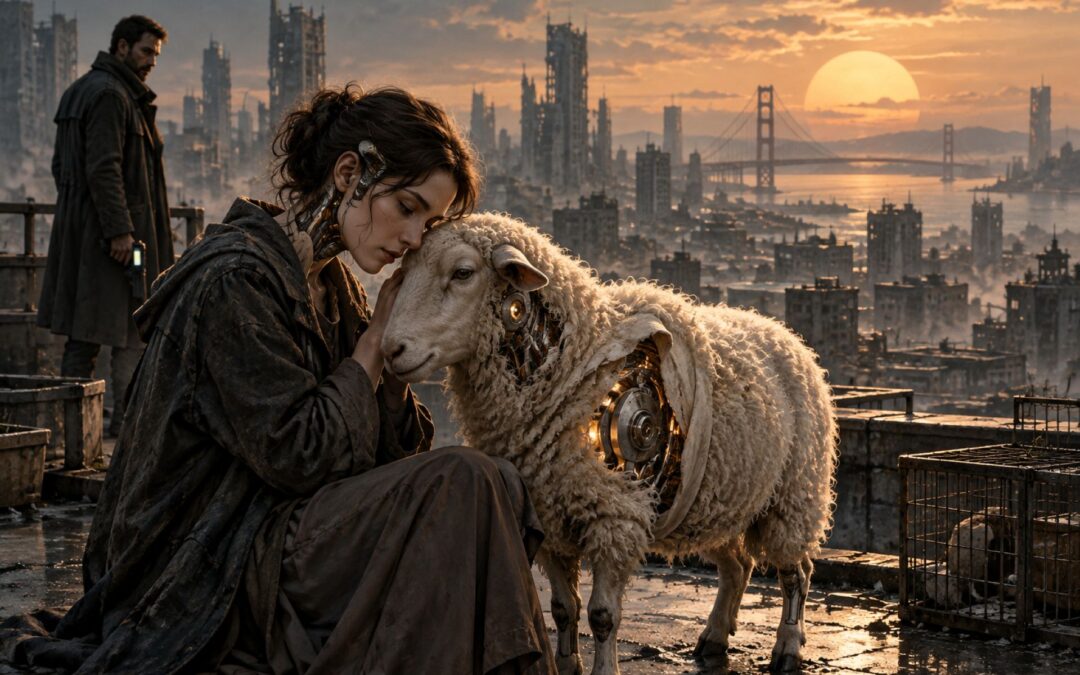
In Philip K. Dick’s Do Androids Dream of Electric Sheep?, a bounty hunter must identify and kill six escaped androids in a world where genuine animals are precious, human emotions can be programmed, and the distinction between living creatures and artificial constructions has become increasingly difficult to maintain. His assignment promises financial security, but each encounter with an android makes him less certain that the categories governing his profession are morally defensible.
First published by Doubleday in 1968, as documented in the Library of Congress catalog, the novel became the literary foundation for Blade Runner. The 2008 Del Rey ebook edition places its events in 2021. Although its detective story provides the narrative momentum, the novel’s larger concerns include ecological destruction, social exclusion, religious experience, loneliness, and the disturbing relationship between empathy and violence.
Spoiler Warning: This article covers the complete novel, including every major plot development, the deaths of important characters, and the ending.

A Marriage of Manufactured Moods and an Electric Sheep
Rick Deckard wakes in his San Francisco apartment when the Penfield mood organ beside his bed delivers a programmed electrical stimulus to his brain. The device allows people to regulate their emotions by selecting particular settings, creating states ranging from alertness and enthusiasm to depression and hostility. His wife, Iran, has set her machine differently and resents Rick’s suggestion that she adjust it to become more agreeable.
Their disagreement reveals a deeper problem in their marriage. Iran has become disgusted with the artificial happiness surrounding her and sometimes wants to experience despair rather than suppress it. She once turned off the television in their apartment and discovered an overwhelming silence, intensified by the emptiness of the neighboring buildings. Instead of immediately eliminating the resulting sadness, she decided that the feeling deserved acknowledgment.
Rick regards this desire for unhappiness as irrational and potentially unhealthy. Iran, however, recognizes something troubling about a society in which people routinely manufacture the emotions that make daily existence bearable. Even a desire to feel genuine despair must be translated into a setting on the mood organ.
The couple’s morning conversation ends without resolving their disagreement. Rick prepares for work, while Iran arranges to spend part of the day experiencing self-accusatory depression before automatically switching to a more hopeful mood. Their routine suggests a marriage sustained partly through technological management rather than spontaneous affection.
On the roof of their apartment building, Rick encounters his neighbor Bill Barbour, who owns a genuine horse named Judy. Barbour’s animal represents an extraordinary luxury because World War Terminus has devastated Earth’s wildlife. The radioactive dust left behind by the war has caused widespread extinctions, making animal ownership both a moral obligation and a form of social prestige.
Rick also appears to own an animal: a sheep that he dutifully tends in its rooftop enclosure. But when Barbour presses him, Rick reveals that the sheep is electric. His original sheep, Groucho, died, and Rick purchased an artificial replacement to conceal his loss.
The deception embarrasses him. Although artificial animals have become sophisticated enough to resemble living creatures, they do not carry the same prestige. Rick resents tending something that cannot recognize his efforts and envies Barbour’s ownership of an authentic animal.
He wants another genuine sheep, a cow, or perhaps even a horse. Unfortunately, the prices are far beyond his normal salary as a police bounty hunter.
His financial prospects depend on finding and retiring escaped androids. Every successful retirement earns him a substantial payment, and a particularly profitable assignment might finally allow him to purchase a real animal.
The desire is neither entirely sentimental nor entirely materialistic. Rick remembers his original sheep and genuinely wants another living creature to care for, but he is also acutely conscious of the shame attached to owning a counterfeit. His work, domestic ambitions, and society’s hierarchy of authentic and artificial life are already entangled before his assignment begins.
John Isidore and the World Left Behind
Elsewhere in the San Francisco region, John R. Isidore lives almost entirely alone in a decaying apartment building that once accommodated thousands of people. Most former residents have died or emigrated to the off-world colonies. The abandoned structure is surrounded by an environment slowly surrendering to radioactive contamination, neglect, and accumulating debris.
World War Terminus has transformed Earth into a dying planet. The surviving governments encourage emigration, particularly to Mars, where colonists receive sophisticated humanoid androids to perform labor and provide assistance. Remaining on Earth means accepting deteriorating living conditions and continuing exposure to dangerous dust.
Isidore has been affected by that exposure. His measured intellectual abilities have declined, placing him among the people officially classified as specials. Society subjects these individuals to degrading labels and excludes them from opportunities available to supposedly normal humans, including emigration.
He works for a company that maintains artificial animals, but he cannot escape his social status. His isolation has made him painfully conscious of his need for companionship, and his speech is frequently marked by hesitation and anxiety about how others perceive him.
Religion provides one source of consolation. Isidore follows Mercerism, a belief system organized around the suffering of a mysterious figure named Wilbur Mercer.
Through an empathy box, believers participate in a collective experience called fusion. They see Mercer climbing a barren hillside while hostile figures throw stones at him. The users identify with his pain and sometimes experience wounds themselves, while also sensing the emotional presence of other participants.
Mercer repeatedly climbs, suffers, falls, and returns. His experience provides a symbolic framework through which followers understand the inevitability of suffering and their responsibility to share it.
The empathy box is simultaneously technological equipment and an instrument of religious communion. Its physical construction does not prevent Isidore from regarding the experience as authentic.
He is also deeply concerned by the destructive emptiness surrounding him. He imagines the abandoned buildings and useless objects as manifestations of an expanding force that threatens to overwhelm whatever living order remains.
One day, he notices signs that someone has moved into an apartment below his own. The possibility astonishes him because people normally leave the building rather than enter it. He immediately begins imagining how he might welcome the newcomer.
His eagerness exposes the emotional cost of social exclusion. In a civilization equipped with advanced machines for communication and psychological stimulation, Isidore struggles to find someone willing simply to speak with him.
Six Escaped Androids and the Price of a Real Animal
Rick arrives at work after stopping to examine the animals displayed in an expensive pet shop. He is particularly interested in an ostrich whose price confirms how remote his dream of genuine animal ownership remains.
At the San Francisco Police Department, he learns that Dave Holden, the department’s senior bounty hunter, has been seriously wounded while investigating a group of escaped androids.
Inspector Harry Bryant summons Rick to discuss the assignment. Eight androids had originally arrived in the region, and Holden had successfully retired two before being incapacitated. Six remain at large.
The fugitives belong to the Nexus-6 generation, manufactured by the Rosen Association. These androids possess extraordinary intellectual abilities and are sophisticated enough to challenge established methods of distinguishing artificial beings from humans.
Under Earth’s legal arrangements, androids are prohibited from living freely among the human population. They are manufactured for service in the colonies, and those who escape to Earth are hunted down.
The official terminology avoids calling their destruction murder. Bounty hunters retire androids, and the euphemism allows their work to be understood as the elimination of dangerous manufactured property rather than the killing of humanlike individuals.
Rick has professional reasons to accept the assignment. Holden’s injury gives him the opportunity to become the department’s leading bounty hunter, and the financial reward could transform his domestic circumstances.
Yet he also understands that the new androids are more dangerous than previous generations. Holden’s failure suggests that ordinary professional confidence may be insufficient.
Before proceeding, Rick must establish whether the department’s principal detection method still works on Nexus-6 models. That question leads him to the corporation responsible for manufacturing the androids.
The Rosen Association and the Limits of the Empathy Test
Rick travels to the Rosen Association’s facilities in Seattle, where he encounters Eldon Rosen and a young woman introduced as his niece, Rachael.
The corporation has a direct financial interest in demonstrating that its new androids are too sophisticated to be distinguished reliably from humans. If police departments cannot establish a dependable method of identification, existing retirement procedures become legally and practically questionable.
Rick relies on the Voigt-Kampff empathy test. Rather than assessing intelligence or the subject’s verbal declarations, it measures involuntary physiological reactions to questions involving emotionally disturbing situations.
Many questions concern the treatment of animals. In a world devastated by extinction, cruelty toward an animal is supposed to provoke immediate emotional responses in an ordinary human. The machinery measures reactions involving the eyes and facial capillaries, seeking differences between authentic spontaneous empathy and calculated or delayed responses.
The Rosens suggest that the test may be unreliable, especially when applied to unusually intelligent androids or humans with atypical experiences. Rachael agrees to serve as the first subject.
Rick is initially impressed by her appearance and demeanor. The Rosen facilities also contain what appears to be an exceptionally rare owl, an animal whose survival would represent a remarkable achievement. Rick’s fascination with the bird makes him especially vulnerable to the corporation’s manipulation.
During the examination, Rachael responds to a series of carefully designed questions. Some responses suggest ordinary human sensitivity, while others produce measurements associated with androids.
The Rosens argue that her unusual upbringing explains her reactions. Their proposed explanation raises the possibility that Rick’s test might condemn a genuine human being whose emotional responses were shaped by exceptional circumstances.
For a time, the encounter threatens to undermine Rick’s confidence in his work. If the instrument mistakes humans for androids, retirement becomes an unacceptable risk.
Rick eventually identifies evidence that Rachael is herself an android. Her biography has been manufactured through implanted memories, creating an identity that she has at least partly accepted as real.
Eldon Rosen acknowledges that the corporation has programmed her. Rick realizes that the examination was designed to discredit his instrument and protect the Rosen Association’s commercial interests.
The owl, too, turns out to be artificial. Its apparent authenticity has been another part of a carefully managed presentation.
Rick leaves with the belief that the Voigt-Kampff procedure remains effective, though the encounter has demonstrated how difficult the task is becoming. Even when a test works, the people being examined may possess memories, personalities, and emotional appearances almost indistinguishable from those of humans.
The Rosen Association’s behavior also reveals that the android problem is larger than escaped individuals. Powerful institutions have incentives to manipulate definitions of personhood, conceal information, and protect products whose complexity increasingly challenges their status as property.
Pris Stratton and the Loneliness of John Isidore
When Isidore visits the newly occupied apartment, he meets a frightened young woman who introduces herself as Pris Stratton. She is suspicious of his friendliness and initially reluctant to allow him inside.
Isidore is eager to help. He notices that she has little furniture and proposes collecting usable items from vacant apartments. The building contains an enormous quantity of abandoned property, most of it gradually becoming worthless.
He explains his theory of kipple, the accumulation of unnecessary objects that fills neglected spaces. In his understanding, kipple continually expands unless living people work to resist it. Even that resistance can only be temporary because everything eventually decays.
Pris is less interested in his philosophical observations than in the practical possibility of obtaining furniture and assistance. Her behavior alternates between fear, irritation, and attempts to enlist his help.
Isidore’s anxiety about being recognized as a special makes him unusually deferential. He desperately wants Pris to regard him as an ordinary person and a possible friend.
Their conversation is awkward because they approach it with radically different needs. For Isidore, the arrival of another resident is an extraordinary opportunity for human contact. For Pris, the apartment is a hiding place, and the stranger at her door may threaten her safety.
Later, after Rick’s investigation has already taken several dangerous turns, Isidore returns to Pris with valuable food. Their acquaintance becomes more intimate as she gradually reveals details about her past.
She has lived on Mars and knows the difficulty of existence in the colonies. Their conversation touches on older science-fiction stories, whose optimistic imaginings of life on other planets bear little resemblance to the miserable realities of colonization.
Isidore finds her experiences fascinating, although he has difficulty understanding her abrupt changes of mood. Pris eventually acknowledges that androids, too, experience loneliness.
She establishes contact with Roy and Irmgard Baty, companions whose arrival she has been awaiting. Her continuing nervousness becomes more understandable once Isidore learns that she belongs to the fugitive group Rick is pursuing.
The relationship has become important to him before he fully understands its danger. His willingness to help Pris begins with an uncomplicated desire for companionship, but it will soon force him to confront the conflict between social law and his attachment to beings the law refuses to recognize as persons.
The Cat That Was Real
Isidore’s employment provides one of the novel’s most painful demonstrations of how completely artificial animals have entered everyday life.
He works for the Van Ness Pet Hospital, a business that presents itself as a veterinary establishment but specializes in repairing sophisticated electric animals. Its employees maintain the deception because customers often wish to conceal that their pets are manufactured.
One day, Isidore collects a cat named Horace that has apparently stopped functioning. Because he assumes the animal is artificial, he interprets its symptoms as evidence of mechanical failure.
When he reaches the workshop, his employer Hannibal Sloat and coworker Milt Borogrove discover that Horace was genuinely alive. The animal has died, and Isidore’s mistaken assumptions prevented him from recognizing the urgency of its condition.
The discovery devastates him. An ordinary veterinary response might have saved the animal, but his expectation that it was a machine led him to treat its suffering as a mechanical problem.
The employees must notify the owners. Isidore eventually speaks with Mrs. Pilsen, who explains the emotional importance of Horace to her husband.
Rather than simply announcing the animal’s death and ending the conversation, Isidore proposes obtaining a precise electric replica. The replacement would be manufactured to reproduce the appearance of the original cat, potentially sparing Mr. Pilsen the shock of losing his beloved pet.
Mrs. Pilsen becomes receptive to the idea, partly because she fears her husband’s reaction to the truth. The artificial replacement would permit him to continue the routines of ownership and affection without knowing that the original animal had died.
The episode has several consequences for understanding Isidore. He is genuinely distressed by Horace’s death and wants to alleviate the owners’ suffering, yet his initial inability to distinguish a living creature from a manufactured object contributes to the tragedy.
The incident also demonstrates that artificial animals are already woven into ordinary relationships. A replacement cat might function as a deception, a source of comfort, or both. Its practical purpose is not limited to imitating biological life.
Max Polokov and the First Retirement
Rick begins his pursuit by investigating Max Polokov, an escaped android who has already demonstrated his willingness to kill. Polokov is believed to be responsible for Holden’s serious injuries.
Using the information available to the police, Rick traces Polokov’s movements and prepares to confront him. He takes precautions appropriate to the danger presented by Nexus-6 androids, whose intelligence and physical capabilities make ordinary arrests extremely risky.
Polokov avoids the expected confrontation. Instead, Rick encounters a man claiming to be Sandor Kadalyi, a representative of Soviet police authorities who has arrived to assist the investigation.
The supposed visitor speaks and behaves in a manner designed to support his professional identity. Rick initially accommodates him, but details of the encounter arouse suspicion.
The man is actually Polokov, using impersonation to approach Rick at close range. His disguise turns the bounty hunter’s own expectations against him.
Rick recognizes the danger and kills Polokov before the android can complete his attack.
The encounter confirms that the fugitives are neither passive victims nor simple machines that can be identified through their mechanical behavior. They can formulate plans, exploit institutions, and act with considerable ingenuity.
Rick’s success also reinforces his confidence as a hunter. Having survived Polokov, he begins to believe that the remaining fugitives may prove more manageable.
His next target, Luba Luft, initially seems especially unlikely to threaten him with the kind of direct violence Polokov attempted. That assumption proves misleading.
Luba Luft and the Police Station That Should Not Exist
Rick visits the War Memorial Opera House, where Luba Luft is rehearsing for a performance.
She is a talented singer with an established professional position, and Rick finds himself impressed by her artistic ability. Her mastery of music makes her difficult to reconcile with his usual image of an android as a manufactured laborer.
Rick attempts to administer the Voigt-Kampff examination. Luba challenges his authority, questions his intentions, and uses ambiguities in their conversation to frustrate the procedure.
She also turns his questions against him. Rather than behaving like a frightened suspect who accepts police authority, she exposes the uncomfortable personal and sexual implications of his scrutiny.
When Rick persists, Luba contacts the police and accuses him of improper conduct. Officer Crams arrives and treats her complaint seriously.
Rick expects the officer to recognize his professional status and understand the investigation. Instead, Crams seems unfamiliar with the police department Rick represents.
The officer arrests Rick and takes him to a Hall of Justice that Rick does not recognize.
The building appears to function as a legitimate police institution. It has personnel, administrative procedures, equipment, and the ordinary routines of law enforcement.
Yet the officers have no knowledge of Rick’s department or his superior, Inspector Bryant. Rick discovers that the institutional identity on which he normally relies can no longer be taken for granted.
His professional authority has been reversed. The person who arrived to identify an android is now the suspect, and the organization examining him may itself be controlled by androids.
This development transforms the pursuit from a sequence of individual confrontations into a problem concerning the authenticity of entire institutions.
The Android Police Station and Inspector Garland
At the unfamiliar Mission Street Hall of Justice, Rick encounters Inspector Garland, a senior official who questions the legitimacy of Rick’s assignment.
Garland behaves like a police administrator confronting a potentially dangerous impostor. He examines Rick’s identification and equipment, scrutinizes his explanation, and challenges the claim that Rick has been legally authorized to kill androids.
The station’s organization makes the situation particularly disturbing. Its credibility rests on the same visible signs of authority that support Rick’s own department.
Rick gradually discovers that Garland’s name appears on Holden’s list of suspected androids.
The revelation changes the meaning of the entire encounter. If Garland is an android, the station may have been constructed or occupied to protect fugitives from human investigation.
Garland attempts to control Rick’s understanding of the situation. He questions the legitimacy of bounty hunting and creates uncertainty about Phil Resch, another bounty hunter working within the building.
The android eventually admits that the station functions as a closed system. Its communications and procedures help maintain a separate institutional reality, concealing its existence from the official authorities.
Garland’s strategy depends on the difficulty of distinguishing a genuine institution from a sufficiently convincing imitation. The police station does not need to persuade everyone in San Francisco that it is real. It only needs to control the experiences of people drawn into it.
When Phil Resch returns with equipment for testing identities, Garland attempts violence. Resch responds by killing him.
Rick is freed from the immediate danger, but the confrontation creates a further problem. Resch has worked inside the false institution and apparently accepted its legitimacy.
If Garland could maintain an artificial police identity, perhaps the people working under him have also been given manufactured memories and professional histories.
The encounter leaves Rick facing a disturbing possibility: intelligence, employment, institutional authority, and personal memory may all be reproduced without guaranteeing an individual’s biological authenticity.
Phil Resch’s Fear of Being Artificial
Phil Resch is a highly capable bounty hunter whose certainty about the legitimacy of his profession contrasts sharply with Rick’s increasing doubts.
Resch has worked under Garland without recognizing the institutional deception. Once Garland’s android identity is exposed, Resch begins questioning his own history.
He considers the possibility that his memories have been implanted. If an android can be programmed to remember an entire childhood and adult career, the apparent continuity of personal identity may prove very little.
Resch’s fear is more than a practical concern about being identified by a test. His entire sense of who he is depends on whether his memories correspond to an actual human past.
His affection for a pet squirrel seems to support his humanity. In the novel’s social and psychological system, concern for animals is treated as important evidence of authentic empathic responses.
Rick eventually administers the Voigt-Kampff test to Resch and confirms that he is human.
The result should provide reassurance, but it unsettles Rick for a different reason. Resch displays little apparent sympathy toward the androids he kills. He approaches retirement as a straightforward professional task and does not understand Rick’s emotional difficulties.
Resch’s humanity therefore creates a contradiction within the assumptions governing the test.
A biological human can possess the physiological responses required for classification while behaving with extraordinary indifference toward beings that appear capable of fear, suffering, and social relationships.
Rick begins to recognize that the test establishes something narrower than the moral superiority of humans. It may identify a difference in the speed and character of certain emotional responses, but it cannot guarantee compassion in every circumstance.
Resch’s anxiety about being artificial also demonstrates the power of socially constructed identity. He fears exclusion from humanity even though his actions have already placed him among its authorized defenders.
Luba Luft’s Death and the Collapse of Rick’s Certainty
Rick and Resch return to the pursuit of Luba Luft. They locate her at a museum, where she is examining paintings by Edvard Munch.
Her interest in art affects Rick. Luba seems capable of recognizing beauty, forming preferences, and responding to the psychological intensity of the works before her.
Rick’s discomfort becomes particularly evident when he purchases a book of Munch’s artwork for her. His gesture briefly transforms their relationship from hunter and target into something resembling an ordinary encounter between people who appreciate the same art.
The situation remains dangerous. Luba has evaded Rick’s earlier examination and belongs to the fugitive group, while Resch is determined to complete the retirement.
In the museum elevator, Resch fires at Luba as she attempts to escape. His shot misses, and Rick himself kills her.
Rick then destroys the art book he had purchased for her. The action expresses a complicated reaction to her death: anger, distress, and an apparent inability to tolerate the survival of the gift after the person for whom it was intended has been destroyed.
Luba’s artistic abilities have made her unusually difficult for him to dismiss as disposable manufactured property.
His feelings become even more confusing when Resch shows little emotional disturbance. Rick is troubled by the realization that the human bounty hunter appears less compassionate than the android he has just helped kill.
The encounter forces Rick to reconsider the relationship between empathy and species identity.
He has been trained to believe that androids lack the defining emotional faculty of humanity. Yet he himself has developed sympathy for Luba while finding Resch’s unquestioning willingness to kill increasingly repellent.
Rick tests Resch and confirms that he is human. He also becomes concerned about his own unusual emotional reactions.
The tests suggest that Rick’s sympathy toward particular androids does not make him artificial. Instead, it reveals that the emotional boundaries assumed by society are considerably less stable than its official categories imply.
Resch offers a cynical explanation for Rick’s distress, suggesting that sexual attraction may be interfering with his professional judgment. His advice exposes the disturbing relationship between desire, violence, and objectification within their occupation.
Rick’s crisis is not simply that he finds Luba attractive. He has encountered an intelligent, artistically gifted individual whose life seems to possess qualities that should matter morally, even though the law assigns her the status of a machine.
By the end of the encounter, he can no longer regard retirement as an emotionally uncomplicated professional procedure.
The Batys Find Shelter With Isidore
Pris’s companions Roy and Irmgard Baty arrive at Isidore’s apartment building after learning that several members of their group have been killed.
Their arrival reveals how precarious the fugitives’ situation has become. What began as an escape from servitude on Mars has turned into a struggle to survive in a hostile human society.
Roy emerges as the group’s principal organizer. He evaluates their options, studies their security arrangements, and attempts to anticipate the bounty hunter’s movements.
Irmgard is more openly expressive about their danger. Her anxiety and attachment to Roy reveal an emotional dimension to android relationships that complicates their supposed incapacity for empathy.
Pris, meanwhile, depends increasingly on the group for protection. Her apparent similarity to Rachael Rosen becomes especially important later when Rick must confront her.
The Batys learn that Isidore understands they are androids.
He nevertheless agrees to help them. He does not regard their manufactured origins as sufficient reason to betray them, and his own experience of exclusion makes him receptive to their predicament.
Roy and Irmgard respond with a mixture of appreciation and condescension. They recognize that Isidore’s social position makes him unusually willing to assist them, but they also perceive his intellectual limitations.
Their discussions reveal the ugly social logic governing both androids and specials. Humans rank individuals according to biological condition, cognitive ability, and presumed worthiness, while the androids themselves sometimes reproduce similar judgments.
The fugitives arrange protection against intrusion and prepare for the possibility that the bounty hunter will find them.
Isidore interprets their presence as the beginning of a meaningful community. For perhaps the first time in his isolated life, other beings need him, and he has a practical role in helping them survive.
His happiness is genuine, but the relationship rests on incompatible understandings of the situation. Isidore wants friendship and mutual care, while the fugitives are primarily concerned with avoiding destruction.
Those differences will become painfully evident when the group encounters a vulnerable living creature.
The Goat, Mercer, and the Burden of Doing Wrong
Rick uses his bounty earnings to purchase a genuine black Nubian goat.
The animal represents an enormous financial commitment, but he regards the acquisition as necessary after the emotional strain of the day’s retirements. He has earned the money by killing androids and now uses it to obtain a living creature whose possession promises moral satisfaction and social respect.
When he brings Iran to the roof, she is astonished and delighted. The goat immediately seems to offer the couple something they have been missing: a shared object of affection and responsibility.
Their neighbor Barbour congratulates them. Rick’s long-standing embarrassment over his electric sheep appears to have ended, and he has acquired the kind of animal ownership he associated with a successful life.
Yet the purchase does not settle his conscience.
The day’s encounters have disturbed him too deeply. He has witnessed Luba’s death, encountered the contradictions of Resch’s humanity, and realized that his own sympathy for androids is becoming difficult to suppress.
Rick turns toward Mercerism while trying to understand his situation.
Through his experience of Mercer, he confronts the idea that moral life may require participation in actions that remain wrong even when they seem necessary. The distinction between unavoidable conduct and innocent conduct becomes increasingly important.
Rick does not conclude that he should simply abandon the assignment. Three dangerous fugitives remain, and he believes they must be found.
However, he no longer expects professional success to restore his earlier confidence.
He contacts Rachael Rosen and requests her assistance. She has previously claimed to understand Nexus-6 psychology and to possess information that could help him survive the final confrontation.
The request marks another compromise. Rick knows that the Rosen Association has already attempted to manipulate him, but he is exhausted and fears that his hesitation will make the remaining androids impossible to retire.
Rachael initially resists his insistence that they act immediately. Eventually, she agrees to meet him.
The genuine goat and Rick’s renewed contact with Rachael develop in opposite directions. One seems to promise the restoration of a meaningful domestic life, while the other threatens to deepen the conflict between his emotions and professional responsibilities.
Rachael Rosen’s Deception and Rick’s Crisis of Conscience
Rick meets Rachael in a luxurious hotel room, hoping that she will help him confront the three remaining fugitives.
She explains aspects of Nexus-6 behavior and discusses Roy Baty’s likely strategy. Rick learns that Pris Stratton is physically identical to Rachael because the two androids belong to the same manufactured model.
The resemblance creates a practical danger. Rick’s growing attachment to Rachael could interfere with his ability to identify and kill Pris.
Their conversation becomes increasingly personal. Rachael discusses the limits of android biology, including the short lifespan produced by difficulties with cellular replacement.
Although her body and mind resemble those of a young human woman, she expects to survive only a few more years. Her consciousness of mortality makes her existence seem less like that of an endlessly replaceable machine.
Rick becomes involved with her sexually. The encounter crosses boundaries established by law, professional ethics, and the ideology that separates humans from manufactured beings.
His attraction does not eliminate his awareness that Rachael is an android. Rather, it forces him to confront the inadequacy of that fact as a complete description of his experience.
After their intimacy, Rachael reveals that she has been manipulating him.
The Rosen Association has employed a strategy in which female androids seduce bounty hunters and undermine their willingness to kill other androids. Rachael explains that she has used this method repeatedly.
Rick realizes that his growing emotional attachment has been anticipated and deliberately exploited.
Rachael also reveals that she knew Luba Luft and had been close to her. The information complicates Rick’s understanding of both android loyalty and Rachael’s motives.
Her relationship with Luba suggests attachments extending beyond an assigned corporate function, yet she has also worked to protect androids through the calculated manipulation of humans.
Rick responds with anger and considers killing her.
Rachael reminds him that she is legally the property of the Rosen Association rather than a fugitive android. Killing her would carry consequences different from the authorized retirement of the fugitives.
But Rick’s hesitation is not solely legal. He cannot bring himself to destroy someone with whom he has just shared an intimate experience.
Rachael believes that she has succeeded in disabling him as a bounty hunter. The remaining androids, particularly Pris, should now be protected by his emotional reluctance.
Rick instead decides to complete the assignment without her assistance.
He leaves Rachael alive and continues alone, though his understanding of himself has changed. He has discovered that desire, sympathy, and professional obligation can coexist without producing a stable moral position.
Rachael’s deception also raises questions the narrative does not fully resolve. She is acting on behalf of a corporation, but her apparent emotions, friendships, fear of death, and subsequent behavior suggest a personality more complicated than a simple programmed seduction device.
Her strategy depends on exploiting the very human capacity for emotional attachment that the androids are supposedly incapable of possessing.
The Spider, Buster Friendly, and the Exposure of Mercer
At Isidore’s apartment building, the fugitives prepare to watch an eagerly anticipated television announcement by Buster Friendly.
Friendly is a ubiquitous entertainer whose broadcasts provide an alternative to the religious experience of Mercerism. His apparently tireless presence has made him a familiar voice in the lives of Earth’s remaining inhabitants.
Roy, Irmgard, and Pris expect the announcement to undermine the religious beliefs through which humans define their distinctive emotional identity.
While the group waits, Isidore discovers a living spider.
The discovery is extraordinary in a world where so much animal life has disappeared. To Isidore, the spider is precious because it is alive, vulnerable, and capable of suffering.
Pris responds differently. She becomes curious about whether the spider can continue moving after losing some of its legs.
She takes scissors and begins cutting them off.
Isidore watches in horror. He tries to stop the experiment, but Pris treats the animal as an object whose reactions can be tested without serious concern for its suffering.
The mutilation demonstrates a form of emotional indifference that the novel’s empathy-based definition of android identity has prepared readers to recognize.
Yet the context matters. The fugitives are themselves threatened with destruction by a society that claims superior moral sensitivity. Their cruelty toward the spider does not erase the violence directed against them, just as their vulnerability does not excuse the cruelty they inflict.
Friendly’s broadcast then presents evidence that Mercerism is based on a fabricated visual narrative.
Investigators have identified an elderly actor named Al Jarry who appeared in films reproducing the supposedly sacred events. The rocky landscape was constructed, and the injuries associated with Mercer’s ascent were simulated.
The broadcast treats these discoveries as proof that Mercerism is a deception.
For the androids, the revelation is a triumph. The belief system through which humans claim emotional superiority appears to have been manufactured using the same techniques of representation and illusion that characterize the wider technological society.
Isidore is devastated. His religion has provided an experience of shared suffering in a world otherwise dominated by loneliness and contempt.
The loss of the spider and the apparent destruction of Mercerism combine into a crisis. He withdraws from the others and experiences the surrounding decay as almost overwhelming.
Then Mercer appears to him.
Mercer acknowledges the factual discoveries concerning the staged imagery but insists that they do not eliminate the significance of the experience.
In the encounter, Mercer restores the mutilated spider, returning it to Isidore with its missing legs intact.
The scene does not offer a conventional explanation of what has happened. It places the apparent falsification of a religious narrative beside an experience that remains meaningful to the believer.
Isidore’s consolation is interrupted by the apartment’s warning system. A bounty hunter has entered the building.
The fugitives extinguish the lights and prepare for the final confrontation.
Rick Deckard’s Final Confrontation With the Androids
Rick reaches the building where Pris and the Batys are hiding.
He encounters Isidore, who attempts to protect the fugitives and resists Rick’s effort to enter the apartment. Isidore recognizes what the bounty hunter intends to do and is distressed by the prospect of losing his companions.
Rick’s approach becomes increasingly ruthless. He threatens Isidore and attempts to obtain information about the androids’ location.
At the same time, Rick experiences another encounter with Mercer. The religious figure appears to him and warns that one of the androids is approaching from behind.
The warning proves crucial.
Pris is moving toward Rick on the stairs, and her resemblance to Rachael initially confuses him. For a moment, he believes that the woman approaching him may be the android with whom he has recently been intimate.
He recognizes the difference in time and kills Pris.
Her death demonstrates that Rachael’s strategy has not completely destroyed Rick’s ability to act. Nevertheless, the encounter forces him to overcome precisely the emotional association Rachael intended to create.
Rick proceeds to the apartment occupied by Roy and Irmgard Baty.
He impersonates Isidore, using details of the special’s identity and speech to persuade the fugitives to open the door.
Once inside, he kills Irmgard.
Roy reacts with anguish at her death, revealing an emotional attachment that directly complicates the notion of androids as beings incapable of concern for others.
Rick kills Roy as well.
The confrontation ends with striking speed. After the elaborate preparations, evasions, and philosophical complications of the preceding chapters, the final retirements occur in a rapid sequence of violence.
Rick has now completed an extraordinary assignment, retiring six Nexus-6 androids in a single day.
There is no extended celebration. He sits among the bodies and damaged objects, exhausted and unable to turn the accomplishment into an unambiguous victory.
Isidore appears and begins crying.
Rick attempts to reassure him, but his response reveals how differently the two characters understand what has happened. For the bounty hunter, the dead androids are the successful completion of an assignment. For Isidore, they are the destruction of the small community that briefly relieved his loneliness.
Rick calls Bryant to report his success.
The professional system has functioned exactly as intended. The fugitive androids have been eliminated, and the bounty hunter will be paid.
Yet the human consequences remain outside the terms by which that institution measures success.
The Death of the Goat and Rick’s Departure
Bryant congratulates Rick and advises him to rest.
Isidore, meanwhile, decides to leave the apartment building. He wants to move somewhere with more people, but he rejects Rick’s suggestion that he consider living near the Deckards.
The rejection matters because Rick has become the direct cause of another person’s devastating loss.
Rick himself reflects on the nature of his work. He increasingly sees his profession as a destructive force that follows him wherever he goes. The religious language of compulsory wrongdoing has become part of his understanding of the day.
He returns home expecting to find Iran and the goat.
Instead, Iran informs him that the animal has been killed.
A young woman matching Rachael’s appearance arrived at the building and deliberately pushed the goat from the roof. Witnesses saw her clearly, and she made little attempt to conceal her identity.
The act is a calculated retaliation.
Rachael could not prevent Rick from completing the assignment, but she has destroyed the living creature that represented its reward.
The goat’s death devastates Rick because the animal was both a financial investment and an emotional symbol. He had imagined that owning it would help restore meaning to his marriage and justify the strain of his work.
Its destruction also gives Rachael’s earlier manipulation a more disturbing conclusion.
Rick spared her life despite discovering her deception. She subsequently targeted a vulnerable creature whose value to him was unmistakable.
Iran wants Rick to remain at home and recover. She also mentions Friendly’s broadcast about Mercerism, asking what he thinks of the apparent exposure of their religion.
Rick cannot provide a coherent answer.
He leaves again in his hovercar, flying away from San Francisco toward the deserted region to the north.
The city, the police department, his financial success, and his domestic life have all become difficult for him to inhabit.
He wants to be alone in a landscape where almost nothing survives.
Rick’s Journey Into the Wasteland
Rick lands in the deserted countryside after a long and exhausting journey.
The surrounding landscape consists of dust, rocks, ruined ground, and traces of a world that once supported vegetation and animal life. He reflects on the extraordinary contrast between Earth’s past abundance and its present emptiness.
He has accomplished something that should establish his professional reputation. Few bounty hunters could hope to retire six Nexus-6 androids within such a short period.
Yet the achievement brings him little satisfaction.
Rick attempts to contact Dave Holden, perhaps seeking recognition from the senior hunter whose injury made the assignment possible. Holden remains too seriously wounded to speak with him.
The attempt reinforces Rick’s isolation. The people who could understand his professional experience cannot explain the moral burden it now carries.
He wanders into the barren landscape and begins climbing a hillside.
The ascent gradually resembles the repeated ordeal of Wilbur Mercer.
Rick experiences physical injury and suffering as stones strike him. Unlike the ordinary experience of using an empathy box, he feels himself undergoing Mercer’s ordeal directly.
His solitude makes the experience especially strange. Mercerism normally involves a technologically mediated union with other believers, but Rick now encounters its central suffering without participating in the shared apparatus.
He considers the possibility that he has become Mercer or has entered an experience inseparable from Mercer’s suffering.
The event does not remove his guilt or restore the goat.
Rick continues to recognize that he has killed the androids and that his actions have consequences he cannot undo.
He communicates with the police and struggles to describe what has happened. His account sounds like a religious vision, psychological breakdown, or exhaustion-induced hallucination.
The narrative does not require readers to choose one explanation conclusively.
Rick’s experience demonstrates that he can no longer keep professional duty, private suffering, and religious identification in separate compartments.
The man who once wanted a real animal partly to establish his social standing now finds himself identifying with a figure defined by vulnerability, endurance, and unavoidable pain.
He returns toward his hovercar, preparing to reconnect with Iran.
Before doing so, he notices movement among the rocks.
Why the Electric Toad Matters
Rick discovers a toad in the barren landscape.
The animal astonishes him because toads are believed to be extinct. They also carry special religious significance within Mercerism, making the discovery appear almost miraculous after his experience on the hillside.
He carefully collects the creature and brings it home.
Iran sees that something has changed in her husband. Despite his exhaustion, he displays an excitement and wonder that she has rarely witnessed.
Rick explains his discovery and shows her the animal.
He believes he has found a genuine survivor of a species that humanity has lost, and the possibility offers him an unexpected source of hope after the destruction of the goat.
Iran examines the toad more closely.
She discovers a mechanism revealing that it is electric.
Rick is disappointed, but his reaction differs from the disgust he originally expressed toward his artificial sheep.
He does not denounce the toad as worthless or reject it because of its manufactured origins.
Instead, he accepts the information and acknowledges his exhaustion. He needs sleep, and Iran recognizes that his condition requires care.
The perspective shifts toward her as Rick rests.
Iran contacts a company that supplies accessories for electric animals. She orders artificial flies to feed the toad and discusses the maintenance required to keep it functioning properly.
She wants the creature to be cared for because it matters to Rick.
Her final actions are practical rather than grandly philosophical. She does not deliver a speech about artificial life or claim that the distinction between real and manufactured animals has disappeared.
She simply arranges what is necessary to maintain the toad.
This quiet ending transforms the meaning of the novel’s opening situation.
Rick initially resented his electric sheep because it could not reciprocate his attention and because its artificiality embarrassed him. By the conclusion, Iran is willing to extend care toward a creature that is definitively artificial.
The toad cannot become biologically alive through their affection.
Nevertheless, the effort to look after it remains real.
Earth After World War Terminus: Dust, Emigration, and Android Labor
Dick’s future Earth is defined by the consequences of a catastrophe whose original political causes have largely faded from collective memory.
World War Terminus has left radioactive dust circulating through the environment, threatening human health and devastating animal populations. The survivors know the consequences more intimately than the reasons the war began.
This historical uncertainty is important. Dick does not build his world around an elaborate explanation of competing nations, military technologies, or a decisive political victory. The war matters primarily because it has transformed the conditions under which people live.
The remaining civilization continues functioning through advanced technology and recognizable institutions. Police departments enforce laws, corporations sell products, advertisers promote consumption, and citizens go to work.
Yet these familiar routines exist within an environment that is becoming increasingly uninhabitable.
Humanity’s response has been emigration.
Governments encourage surviving citizens to move to the colonies, where android servants provide labor and assistance. The arrangement is advertised as a solution to both the dangers of Earth and the inconveniences of frontier life.
The colonies depend on a hierarchy between the humans who migrate and the manufactured workers assigned to serve them.
Androids possess sophisticated intelligence and bodies resembling those of humans, but their legal status remains that of property. Their existence is organized around the needs of their owners.
Escape becomes a criminal violation of the system that created them.
The bounty-hunting profession exists to enforce that arrangement, transforming the recovery of property into the authorized destruction of fugitive beings.
Dick therefore places slavery and colonial exploitation beneath the novel’s science-fiction premise. The androids’ artificial origins distinguish them from historical human slaves, but their legal treatment invites comparison with institutions that deny personhood to exploited populations.
The system also contains a second hierarchy among biological humans.
People such as Isidore, whose abilities have been damaged by radioactive exposure, are excluded from the full rights and opportunities available to healthier citizens.
Their treatment exposes the cruelty of a society supposedly organized around empathy.
The distinction between normal humans and specials is maintained through testing and classification, much as the distinction between humans and androids is maintained through diagnostic procedures.
Both systems translate complicated individual lives into categories that determine social worth.
Isidore’s legal and social position is especially revealing because he is entirely human under the biological criteria used to exclude androids. His exclusion demonstrates that humanity itself is insufficient to guarantee equal treatment.
The novel’s economy further complicates its moral arrangements.
Animal ownership functions as a measure of success, respectability, and compassion. The rarity of surviving species has transformed ordinary animals into extraordinary commodities.
People purchase animals through elaborate financial arrangements, consult catalogs to compare prices, and compete for the prestige of owning rare creatures.
The market supplies increasingly convincing artificial replacements.
These products allow people to imitate the outward rituals of compassion even when genuine animals are unavailable.
The result is a society that claims to value living things while making their possession dependent on wealth.
Rick’s desire for a real sheep or goat is emotionally understandable, but it is inseparable from the economic pressures surrounding him.
He kills androids to obtain the money required to purchase a creature through which he hopes to express compassion.
The contradiction is built into the world rather than added afterward as an abstract ethical observation.
Dick’s technological inventions reinforce this social structure. Hovercars, artificial animals, sophisticated androids, emotion-regulating devices, and empathy boxes coexist with deteriorating buildings and abandoned neighborhoods.
Technological development has not prevented ecological collapse or social inequality.
Instead, many of the inventions help humanity accommodate conditions that might otherwise appear intolerable.
The androids provide labor, the mood organs regulate distress, artificial animals conceal extinction, and mass entertainment fills otherwise unbearable silence.
The novel’s future is thus distinguished by a strange combination of extraordinary technological competence and profound social failure.
Its people can manufacture convincing versions of life and emotion, but they cannot restore the abundance or moral security that their technologies seem designed to replace.
Rick Deckard’s Changing Sense of Humanity
Rick begins the novel as a professionally competent but emotionally dissatisfied man.
His immediate desires are recognizable: he wants financial security, professional advancement, a more satisfying marriage, and a real animal. The extraordinary circumstances of his world give these ordinary aspirations disturbing consequences.
His work requires him to identify androids and destroy them.
Initially, he accepts the moral structure of that occupation. Androids are manufactured beings, they are not supposed to live freely on Earth, and the law authorizes their retirement.
The distinction allows him to regard killing them as a technical and professional matter.
His confidence begins weakening during the Rosen examination.
Rachael’s sophistication demonstrates that an android can possess an apparently coherent personality and memories that feel authentic to the individual concerned.
The possibility of mistaken identification also introduces the terrifying prospect that the law could authorize the killing of an innocent human.
Rick manages to preserve confidence in his instrument, but his understanding of artificial identity has become more complicated.
Polokov’s attack initially supports his professional assumptions. The fugitive is dangerous, deceptive, and willing to kill Rick.
The encounter makes retirement appear necessary for self-defense and public protection.
Luba Luft produces a different reaction.
Her artistic abilities and personality make Rick increasingly reluctant to treat her as disposable property. The museum scene exposes an emotional response that cannot be explained through professional categories alone.
Rick’s destruction of the art book after her death suggests his inability to reconcile the beauty he associated with Luba with his responsibility for killing her.
Phil Resch intensifies the problem.
Resch’s biological humanity is established by testing, yet his comfort with killing androids makes him appear emotionally disturbing to Rick.
Rick begins recognizing that the capacity for compassion is not consistently distributed according to the categories used by society.
His relationship with Rachael complicates matters further.
He experiences sexual attraction, personal attachment, resentment, and guilt toward an android who is simultaneously vulnerable, manipulative, and dangerous.
He cannot regard her as an ordinary machine, but neither can he trust her.
Her revelation that she has deliberately seduced bounty hunters forces him to confront the possibility that his compassion has been exploited.
Yet his refusal to kill her remains significant. He does not simply return to his earlier belief that android life has no moral weight.
His completion of the final assignment therefore should not be interpreted as a restoration of professional certainty.
Rick kills Pris and the Batys despite his growing discomfort.
Mercer’s intervention helps him proceed, but the religious experience does not make the killings innocent.
Rick increasingly regards himself as someone required to commit wrong acts within a system from which he cannot easily withdraw.
This is one of the novel’s strongest and most troubling ideas.
Rick’s moral development does not produce a clean transformation from cruelty to kindness. He becomes more sensitive to suffering while continuing to participate in violence.
The result is a form of moral exhaustion rather than redemption through heroic action.
The death of the goat completes his disillusionment with the rewards he originally sought.
The animal was supposed to justify the day’s work by turning bounty money into genuine life and domestic happiness.
Rachael’s retaliation destroys that expectation.
Rick’s journey into the wasteland places him outside the social institutions that have shaped his identity.
His experience of Mercer’s suffering confronts him with vulnerability that cannot be converted into professional achievement or economic reward.
By the conclusion, Rick has not solved the problem of android personhood.
He has, however, lost the ability to regard authenticity as the sole measure of value.
His acceptance of the electric toad suggests a change in his emotional relationship with manufactured life.
The transformation remains incomplete and fragile, which makes it more convincing than a sudden declaration that he now understands all forms of existence.
John Isidore and the Ethics of Compassion
John Isidore provides the novel’s clearest counterpoint to Rick.
Rick occupies an authorized position within society, exercises coercive power, and receives financial rewards for enforcing the distinction between humans and androids. Isidore has little institutional authority and is himself subjected to degrading classifications.
Yet Isidore consistently demonstrates concern for beings whom other characters dismiss.
His compassion arises partly from his loneliness.
Living in an abandoned building, he is painfully aware of the need for relationships. His excitement at discovering a new resident reflects the emotional deprivation produced by social exclusion.
When Pris arrives, he responds with generosity rather than suspicion.
His willingness to help her is not based on an abstract theory of android rights. He wants to offer hospitality to someone who appears frightened and alone.
After learning that Pris and the Batys are androids, he continues assisting them.
He understands that they are being hunted, and he does not believe their artificial origins justify betrayal.
This response contrasts with the legal system that authorizes Rick to kill them.
Isidore’s moral behavior also challenges the contempt directed toward his intellectual limitations.
He is categorized as less capable than normal humans, yet his treatment of vulnerable beings is often more compassionate than that of the people who classify him.
However, Dick does not portray Isidore as an infallible moral guide.
The incident involving Horace the cat demonstrates that good intentions do not guarantee good consequences.
Isidore’s mistaken assumption that the animal is artificial prevents him from recognizing its actual medical emergency.
His compassion is sincere, but his limited understanding contributes to a preventable death.
His relationship with Pris exposes another weakness.
He is so desperate for companionship that he initially overlooks her selfishness and emotional coldness.
He continues to interpret her behavior through his own desire for friendship, even when the relationship is fundamentally unequal.
The mutilation of the spider finally forces him to confront behavior he cannot accept.
Pris treats the living creature as an object for experimentation, while Isidore experiences its pain as morally significant.
His reaction establishes a limit to his willingness to identify with the fugitives.
He can sympathize with their fear and vulnerability without approving everything they do.
The encounter with Mercer following the spider’s destruction is especially important because it suggests that compassion survives the collapse of external certainty.
Isidore’s religious experience has been challenged by evidence of fabrication, yet his concern for the spider remains real.
The restoration of the creature offers consolation through an experience that cannot easily be reduced to factual proof or mechanical illusion.
Isidore ultimately rejects Rick’s suggestion that he move near the Deckards.
The refusal expresses grief and moral judgment. He does not want to live close to the person who destroyed the companions whose arrival had transformed his life.
His planned move toward a more populated area may represent a modest attempt to recover a less isolated existence.
Isidore’s limitations remain, and the novel provides no guarantee that he will find lasting friendship.
Nevertheless, his story demonstrates that ethical sensitivity may be strongest in individuals whom an ostensibly compassionate society has learned to despise.
Rachael Rosen, Pris Stratton, and Manufactured Identity
Rachael Rosen and Pris Stratton possess nearly identical manufactured bodies, but they occupy very different positions within the novel.
Rachael remains associated with the Rosen Association, the corporation responsible for producing advanced androids. She enjoys protection from the company’s institutional power and participates in a strategy designed to defend its commercial interests.
Pris is a fugitive from Mars, living under threat of retirement.
The contrast demonstrates that manufactured identity does not determine social circumstances.
Two beings with the same physical model can develop different relationships, experiences, and strategies for survival.
Rachael’s memories have been artificially constructed.
The Rosen Association has supplied her with an apparent personal history that helps her behave and understand herself as a human individual.
This raises a difficult question about identity.
If memories contribute to the continuity of personal experience, what happens when those memories were never connected to actual events?
The novel does not simply suggest that implanted memories are meaningless.
Rachael’s behavior is influenced by the identity she has been given, and the discovery of her artificial origins does not erase the psychological reality of her immediate experiences.
Her short lifespan adds another complication.
Rachael knows that her biological construction will not permit the extended life available to most humans.
Her awareness of mortality gives her vulnerability a recognizable human dimension.
At the same time, Rachael is manipulative and capable of cruelty.
She seduces Rick as part of a deliberate strategy, reveals her deception after their intimacy, and later kills his goat.
These actions make it difficult to portray her simply as an innocent victim of human prejudice.
Yet they also demonstrate intentions, attachments, and a capacity for retaliation.
A being that can manipulate another person through a calculated understanding of emotional vulnerability cannot easily be described as devoid of psychological complexity.
Pris displays a different combination of fear, dependency, and indifference.
She is initially suspicious of Isidore because she is trying to escape detection. Her behavior becomes more assertive once her companions arrive and her immediate safety improves.
Her treatment of the spider is the most disturbing expression of her limited concern for other life.
She is capable of fearing destruction when threatened herself but does not extend comparable concern to the vulnerable creature before her.
The contrast suggests that recognizing one’s own suffering does not automatically produce compassion toward others.
The physical resemblance between Rachael and Pris becomes decisive during Rick’s final pursuit.
Rachael has attempted to create an emotional association that will prevent him from killing Pris.
Their shared appearance exposes the instability of individuality within a system of mass manufacture.
The body is reproducible, but the separate histories and circumstances of the two androids remain distinct.
Dick thereby complicates both sides of the identity problem.
The androids are manufactured according to standardized designs, yet their experiences produce differences that matter.
Meanwhile, humans rely on memories, social roles, and emotional habits that are themselves vulnerable to manipulation.
Luba Luft, Phil Resch, and the Failure of Moral Testing
The contrast between Luba Luft and Phil Resch provides one of the novel’s most effective criticisms of its own diagnostic system.
Luba is an android whose abilities extend far beyond the practical tasks associated with mechanical labor.
She performs opera, understands artistic traditions, and responds to paintings with recognizable aesthetic interest.
Her apparent refinement does not necessarily establish a complete capacity for empathy. Artistic talent and moral compassion are not identical.
Nevertheless, her existence challenges the assumption that androids can be understood primarily through their instrumental functions.
Rick recognizes qualities in Luba that he values independently of her biological status.
His decision to purchase a book of Munch’s artwork for her demonstrates an impulse toward kindness that conflicts with his obligation to kill her.
Resch presents the opposite problem.
He is human according to the Voigt-Kampff test, yet he appears unusually comfortable with the destruction of androids.
His affection for his squirrel supports the test’s classification, but that affection coexists with a narrow application of compassion.
Rick’s discomfort arises because the supposed boundary between humans and androids does not correspond neatly to the distinction between morally sensitive and morally indifferent behavior.
Resch can care about an animal while remaining largely unmoved by the death of an intelligent humanoid being.
Luba can demonstrate aesthetic sensitivity while failing the official test of human empathy.
Neither observation proves that the test is mechanically incapable of distinguishing the categories it measures.
The problem concerns the meaning assigned to those categories.
The instrument records involuntary physiological reactions to selected stimuli.
Society treats the resulting classification as evidence supporting a much broader judgment about moral status and the permissibility of killing.
That extension is ethically questionable.
The test may identify a genuine psychological difference while remaining inadequate as a complete theory of personhood.
Rick’s response to Luba also demonstrates that empathy is shaped by familiarity and personal attachment.
He does not feel the same concern for Polokov or Garland, both of whom threaten him directly.
Luba’s artistic ability and apparent vulnerability make her death emotionally difficult.
His compassion is therefore selective, influenced by circumstances rather than distributed impartially across all conscious beings.
This selectivity creates a more complex moral picture than a simple argument that humans possess empathy and androids do not.
The novel portrays empathy as a real and valuable capacity whose operation is unreliable, partial, and deeply influenced by social categories.
The distinction between possessing an emotional faculty and using it ethically remains central.
Roy and Irmgard Baty, Fear, and the Survival Instinct
Roy and Irmgard Baty are fugitives whose existence is organized around the threat of destruction.
Their actions cannot be understood without recognizing that they have escaped from a system in which they were manufactured to serve humans.
They are now being pursued by someone whose legal authority permits their elimination.
Fear shapes their behavior.
Roy approaches their situation strategically, gathering information and organizing defensive measures. His leadership reflects intelligence and determination, but it also produces suspicion and sometimes contempt toward others.
Irmgard appears more openly anxious about the deaths of their companions and the possibility that they will be discovered.
Their relationship is important because it complicates the assumption that androids cannot form meaningful attachments.
Roy’s anguish when Irmgard is killed suggests that her death matters to him as a personal loss.
The reaction is not presented as a mere technical malfunction.
Nevertheless, the Batys do not consistently extend sympathy to Isidore.
They appreciate his assistance because they need protection, but they also recognize his vulnerability and sometimes treat him condescendingly.
Their behavior demonstrates that oppression does not automatically produce ethical insight.
A person—or personlike being—may experience injustice while reproducing harmful distinctions in relationships where they possess greater power.
The group’s reaction to the spider reinforces this complication.
Pris’s cruelty occurs while the others are preoccupied with the attack on Mercerism.
Their response exposes the narrowness of their concern for forms of life outside their immediate interests.
Yet the narrative does not make their lack of compassion a complete justification for their destruction.
The fugitives’ wish to survive remains morally significant even if their behavior is sometimes repellent.
Dick refuses to make the question easy by portraying androids as uniformly virtuous victims.
Roy’s death also differs sharply from the heroic cinematic conclusion associated with Blade Runner.
In the novel, he dies quickly during Rick’s final assault.
The absence of an extended final speech or sacrificial gesture prevents his death from becoming an uncomplicated moment of moral revelation.
His significance instead emerges from the complete pattern of the fugitives’ experiences: their fear, relationships, ingenuity, vulnerability, and failures of compassion.
Mercerism: Can a Manufactured Experience Be True?
Mercerism is the novel’s principal religious system, and its importance extends far beyond providing spiritual background.
The faith centers on Wilbur Mercer, a figure who repeatedly climbs a barren hillside while hostile forces throw stones at him.
Believers participate through empathy boxes, which allow them to identify with his suffering and experience a form of collective emotional union.
The ritual promises an escape from isolation.
People who live in increasingly empty cities can participate in a shared experience that connects them with others.
The system therefore responds to one of the novel’s most pervasive social conditions: the fragmentation of relationships in a dying world.
Mercerism also establishes a moral ideal.
Suffering is not treated as a purely private event. Individuals are encouraged to recognize their connection to others and acknowledge pain that extends beyond their immediate personal circumstances.
The religion’s technological mediation creates an obvious tension.
Its central experience is delivered through a manufactured apparatus, yet believers regard the emotional and spiritual consequences as authentic.
The distinction between the reality of an experience and the means through which it is produced becomes one of Dick’s central philosophical concerns.
Buster Friendly’s exposé attacks the religion’s historical and material foundations.
By identifying an actor and staged footage, the broadcast appears to demonstrate that Mercer’s visible journey was constructed.
For the androids, this discovery undermines the human claim to possess a uniquely authentic religious experience.
If Mercerism is a technological performance, humanity’s proud distinction between genuine emotion and artificial imitation becomes difficult to maintain.
However, the narrative does not end with the exposure.
Mercer appears to Isidore after the spider’s mutilation and acknowledges the evidence presented in the broadcast.
The encounter distinguishes the staged production of religious imagery from the experience’s continuing significance.
Isidore’s grief and need for consolation do not disappear because the original images were fabricated.
The restoration of the spider creates a further ambiguity.
The event might be understood as supernatural intervention, a visionary experience, or an extension of the psychological processes through which Mercerism operates.
The narrative does not conclusively resolve the question.
Rick’s later encounter with Mercer is similarly difficult to classify.
Mercer appears independently of an empathy box and warns him about Pris’s approach.
The warning is practically useful, yet it does not establish a complete metaphysical explanation of Mercer’s existence.
What matters is that Mercerism continues functioning even after its apparent factual foundations have been dismantled.
This does not mean that factual truth is irrelevant.
The deception surrounding the staged footage remains significant, especially because it exposes the susceptibility of religious institutions to manipulation.
But the novel suggests that an experience can be technologically mediated or associated with a constructed image without becoming emotionally meaningless.
Mercerism also introduces the disturbing idea of compulsory wrongdoing.
Rick wants a moral framework that will tell him whether killing the androids is justified.
Mercer’s response offers no simple absolution.
Instead, Rick confronts the possibility that necessary actions may remain ethically troubling.
The religion therefore does not function as a system that removes moral uncertainty.
It deepens Rick’s awareness that responsibility may persist even when circumstances limit one’s available choices.
The difference between Rick and Isidore is especially revealing.
Isidore encounters Mercer while grieving for a mutilated animal and the collapse of his religious certainty.
Rick encounters Mercer while preparing to kill beings toward whom he has developed sympathy.
Both experiences concern suffering, but they arise from different relationships to violence.
Mercerism joins the two protagonists through a shared moral vocabulary without making their positions equivalent.
Its deepest function is to challenge the assumption that authenticity can be determined solely by tracing the material origin of an experience.
The Price of Living Animals and the Value of Electric Ones
Animals occupy an unusually important position in the novel because their scarcity has transformed them into markers of economic status, religious responsibility, and emotional legitimacy.
The extinction of species creates a society in which caring for animals is publicly celebrated.
Yet the resulting economy makes genuine animal ownership available primarily to people with sufficient wealth.
Rick’s original sheep represents a lost connection with biological life.
After its death, he purchases an electric replacement, maintaining the outward appearance of responsible ownership.
He continues feeding and tending the artificial sheep, but resents the fact that it cannot recognize his efforts.
His dissatisfaction partly concerns the absence of reciprocity.
He wants to care for a creature that experiences the world independently of him.
However, his embarrassment before Barbour demonstrates that social prestige is also involved.
A genuine animal would identify Rick as someone capable of fulfilling an admired moral obligation.
The artificial sheep therefore becomes a symbol of both ecological loss and social inadequacy.
The owl at the Rosen Association extends this relationship between rarity and authenticity.
Because owls are believed to be extinct, the apparent survival of one creates an immediate emotional and economic attraction.
The company’s use of an artificial owl demonstrates that manufactured authenticity can become a tool of manipulation.
Rick’s desire for the bird weakens his position during negotiations with the Rosens.
The cat named Horace presents a different problem.
Isidore assumes the animal is artificial, and that assumption contributes to its death.
Here the difficulty of distinguishing genuine life from imitation has direct consequences for a vulnerable creature.
Mrs. Pilsen’s willingness to consider an electric replacement complicates the moral meaning of deception.
The replica would conceal the death from her husband, but it might also protect him from unbearable grief.
The goat represents Rick’s most ambitious attempt to restore authentic life to his domestic world.
Its purchase follows the deaths of several androids, linking the preservation of one living creature to the destruction of other intelligent beings.
Rick imagines that the goat will bring emotional satisfaction and repair something damaged in his marriage.
Iran’s delight suggests that the animal genuinely matters to them.
Rachael’s deliberate killing of the goat destroys this hope.
The act is particularly cruel because it targets a defenseless animal whose value derives from Rick’s emotional attachment.
It also reveals the fragility of a moral economy in which living beings are treated as possessions, rewards, and instruments of retaliation.
The spider provides the novel’s most concentrated image of vulnerability.
It is small, apparently insignificant, and incapable of defending itself against Pris.
Isidore nevertheless regards its suffering as morally important.
Its value does not depend on prestige, rarity as a market commodity, or usefulness to humans.
The spider’s mutilation dramatizes compassion as attention to another creature’s vulnerability.
The electric toad completes the sequence.
Unlike the owl, its artificiality is eventually exposed without producing a lasting sense of betrayal.
Unlike the sheep, it does not become a source of status anxiety.
Unlike the goat, its worth is no longer dependent on functioning as a reward for professional accomplishment.
Iran cares for the toad because Rick is attached to it.
The relationship does not make the toad biologically alive, but it does demonstrate that an act of care can retain meaning even when its object is artificial.
The novel consequently resists a simple opposition between authentic animals and worthless simulations.
Biological life remains precious, and the deaths of genuine creatures are irreversible losses.
Yet the emotional practices associated with artificial animals can also reveal genuine commitments.
The final toad does not replace the extinct species or undo the ecological catastrophe.
It exposes the inadequacy of treating biological authenticity as the only possible foundation of value.
Kipple, Radioactive Dust, and the Work of Entropy
Isidore’s concept of kipple gives the novel’s physical decay a memorable name.
Kipple consists of useless objects that accumulate in abandoned spaces: discarded packaging, obsolete possessions, debris, and the material remains of lives that have disappeared.
Isidore imagines the expansion of kipple as an almost universal law.
People can remove clutter and temporarily restore order, but abandoned objects eventually accumulate again.
His theory gives physical form to the fear that everything meaningful is being absorbed into an expanding landscape of decay.
The empty apartment building illustrates the process.
Furniture and possessions remain after their owners have died or emigrated, but the objects are no longer integrated into functioning relationships.
They become remnants of former activity rather than useful parts of ordinary life.
Radioactive dust operates on a larger scale.
It destroys biological life, alters human bodies, and makes the planet increasingly unsuitable for habitation.
The environment has become hostile to the very organisms that once filled it.
Dick’s recurring descriptions of abandoned buildings, empty neighborhoods, and damaged landscapes place human civilization within a process of material decline.
Technological progress has not reversed that process.
The society can manufacture androids and artificial animals, but it cannot restore the ecological abundance that previously supported ordinary life.
Kipple also carries psychological implications.
Isidore’s isolation resembles the physical emptiness surrounding him. His emotional life is threatened by the absence of relationships, just as his building is overwhelmed by abandoned material.
The arrival of Pris briefly interrupts that condition.
He begins imagining shared activity, companionship, and a renewed purpose for the otherwise useless objects in nearby apartments.
His happiness represents a temporary resistance to the process of abandonment.
The later destruction of the fugitives returns him to loneliness.
The concept should not be treated as a literal scientific theory about the entire universe. It is Isidore’s interpretation of the decay he witnesses.
Its literary force lies in connecting environmental catastrophe, material accumulation, and emotional isolation.
The final act of caring for the electric toad offers a modest contrast.
Iran’s actions do not reverse extinction or halt the accumulation of waste.
She maintains one fragile arrangement of meaning within a world that continues to deteriorate.
Mood Organs, Television, and the Engineering of Feeling
The Penfield mood organ provides the novel’s clearest example of technological control over personal emotion.
People can select moods through numerical settings, arranging happiness, concentration, hostility, or despair according to practical circumstances.
Rick initially treats the device as a useful instrument for maintaining psychological normality.
Iran recognizes that its convenience may come at the cost of emotional authenticity.
Her desire to experience despair arises from the recognition that her environment is genuinely disturbing.
The apartment buildings are empty, animal life is disappearing, and humanity survives through increasingly elaborate substitutions.
She believes that such circumstances deserve an emotional response rather than permanent suppression.
Yet her attempt to preserve genuine feeling remains dependent on the machine.
She must program the experience of despair in order to resist the artificial management of emotion.
The contradiction is characteristic of Dick’s world.
Technology has become so deeply integrated into psychological life that even resistance must operate through technological systems.
Buster Friendly represents a different form of emotional engineering.
His broadcasts fill the silence of abandoned rooms and provide a continuous stream of entertainment, reassurance, and distraction.
His personality appears endlessly energetic, creating the impression of companionship for people who may have little actual human contact.
The revelation concerning Mercerism also demonstrates his influence over collective belief.
By presenting evidence through mass media, Friendly attempts to transform the public understanding of an entire religious system.
The medium’s power lies partly in its ability to make mediated experience feel authoritative.
Mercerism itself depends on a technological apparatus.
Believers experience fusion through empathy boxes, which produce sensations of connection across physical distance.
The arrangement raises questions similar to those surrounding the mood organ.
Does technological production make an emotion less genuine?
Can a shared experience remain meaningful when its visual framework has been manufactured?
The novel refuses a universal answer.
The Penfield device can encourage emotional avoidance, but Iran’s chosen despair may express sincere recognition of the world.
Friendly’s television broadcasts can manipulate audiences, but the exposure of staged religious imagery may contain factual truth.
Mercerism relies on manufactured equipment, yet its participants may experience meaningful compassion.
Dick is therefore more interested in the relationship between technology and human judgment than in declaring all artificial experience false.
The central danger arises when technological systems replace independent moral reflection or allow institutions to determine what people should feel.
The Voigt-Kampff Test, Memory, and Human Exceptionalism
The Voigt-Kampff test is designed to distinguish humans from androids through involuntary emotional responses.
It operates on the assumption that human empathy produces physiological reactions that androids cannot reproduce with equal spontaneity.
The examiner presents hypothetical situations involving morally charged events, particularly cruelty toward animals.
The subject’s verbal explanation is less important than the speed and character of the body’s reaction.
This method reflects an effort to establish an apparently objective boundary between biological humanity and manufactured imitation.
Yet the novel repeatedly demonstrates the instability of the social meaning attached to the results.
The Rosen Association’s challenge initially concerns the possibility of false identification.
An individual with unusual experiences might react differently from a typical human, raising the danger that the test could classify a genuine person as an android.
Rick ultimately identifies Rachael correctly, preserving confidence in the instrument.
But the episode establishes that emotional reactions are influenced by experience and that the boundary depends on the adequacy of the questions used.
The test also assumes that certain cultural responses are reliable signs of universal human empathy.
In a society where surviving animals have become sacred and valuable, questions involving their mistreatment are expected to provoke immediate distress.
That expectation depends partly on shared cultural training.
The instrument may measure physiological differences, but those measurements operate within a social system that decides which responses count as normal.
The case of Phil Resch exposes the problem from another direction.
Resch is human, and his test results confirm the classification.
Nevertheless, he demonstrates a disturbing indifference toward android suffering.
The result shows that identifying a biological human does not establish comprehensive moral goodness.
The distinction between possessing empathic capacity and applying it consistently is essential.
Luba Luft complicates the opposite side of the division.
She is an android, yet her artistic abilities and apparently meaningful emotional responses challenge Rick’s assumptions.
The test may correctly identify her artificial origins without settling every question about her inner experience or moral worth.
Implanted memories make the problem still more difficult.
Rachael’s identity has been constructed through experiences that did not occur in the manner she remembers.
Nevertheless, those memories shape her understanding of herself and her relationships.
If personal identity depends partly on remembered continuity, manufactured memories can produce a psychologically coherent individual even when the remembered history is false.
The novel does not establish that humans and androids are biologically identical.
It also does not demonstrate that every android possesses the same form of consciousness or empathy as a human being.
Its challenge concerns the assumption that technological classification can automatically settle ethical status.
The Voigt-Kampff procedure is a diagnostic method used within a particular legal and social system.
That system treats the result as permission to kill.
The moral difficulty arises in the transition from identifying an artificial organism to declaring its existence devoid of independent value.
The question of human exceptionalism therefore extends beyond whether androids can imitate human emotions.
It concerns whether humans understand their own defining qualities well enough to use them as absolute criteria for excluding other beings from moral concern.
A Noir Detective Story Told Through Unstable Perspectives
Dick constructs the novel around the conventions of detective fiction.
Rick is an investigator pursuing dangerous suspects through a city characterized by deception, corruption, institutional uncertainty, and conflicting loyalties.
He depends on professional tools, informants, records, and investigative procedures.
The pursuit supplies the book’s suspense and gives its philosophical questions concrete consequences.
Each encounter changes what Rick believes he knows.
The Rosen Association challenges the reliability of his instrument. Polokov exploits his expectations of official cooperation. Luba Luft turns an investigation into an arrest, and the alternate police station undermines his confidence in institutional authority.
These reversals resemble the deceptive environments of noir fiction, where the investigator’s understanding of reality becomes less stable as the case develops.
Rick’s moral position also resembles that of a compromised noir protagonist.
He is not an innocent observer uncovering wrongdoing from outside the system.
He participates in institutions whose legitimacy the narrative continually questions.
His financial ambitions, sexual vulnerability, and professional pride influence his decisions.
The alternating perspective of John Isidore prevents the story from remaining a conventional detective thriller.
While Rick pursues the fugitives, Isidore encounters them as frightened individuals seeking refuge.
The reader therefore witnesses the same conflict from positions that carry different emotional and moral meanings.
Rick’s assignment is a professional obligation.
For the androids, it is a threat to survival.
For Isidore, its completion means the destruction of his temporary community.
The structure forces these perspectives into eventual confrontation without providing a single authoritative viewpoint that resolves every contradiction.
Dick’s prose is generally direct and economical.
He describes extraordinary technologies through familiar routines of shopping, employment, advertising, marital disagreement, and bureaucratic procedure.
This ordinary framing makes the futuristic world convincing even when its inventions are extravagant.
Satire frequently emerges from the gap between technological sophistication and emotional inadequacy.
The Penfield mood organ turns marital unhappiness into a programming problem. The animal market transforms ecological catastrophe into an opportunity for luxury consumption. The Rosen Association uses corporate salesmanship to challenge a legal system that depends on its products.
The novel’s humor is often uncomfortable because its absurdities are inseparable from real suffering.
The narrative also contains abrupt shifts of tone.
A comic exchange about artificial animals may be followed by a discussion of extinction or a violent confrontation.
A religious revelation may occur alongside grotesque cruelty.
These transitions contribute to the sense of instability for which Dick’s fiction is known, although their rapidity occasionally limits the emotional development of individual scenes.
The book’s compressed chronology intensifies these effects.
Rick’s moral transformation occurs during an extraordinarily demanding period in which he encounters more violence and uncertainty than he can fully process.
The speed creates momentum but also produces moments when psychological change seems abrupt.
The novel’s relationship with its famous adaptation provides useful context. As the British Film Institute’s examination of Blade Runner makes clear, Ridley Scott’s film develops its own visual and philosophical identity from Dick’s premise.
The original novel gives much greater structural importance to Mercerism, the animal economy, and Isidore’s parallel experiences.
Its distinctive achievement depends less on cinematic mystery and more on the interaction between everyday social arrangements and unstable definitions of personhood.
The Ending: Mercer’s Hill and the Artificial Toad
The ending brings the novel’s central questions together without resolving them into a simple declaration.
Rick completes the assignment, receives professional recognition, and gains the money he wanted.
Yet his achievement has become emotionally intolerable.
He has killed beings whose experiences and relationships he can no longer dismiss as meaningless, and the animal he purchased with his earnings has been destroyed.
The conventional rewards of a successful detective story therefore fail.
Instead of returning home with restored confidence, Rick retreats into the wasteland.
His experience on the hillside resembles Mercer’s repeated suffering.
The similarity is not merely visual. Rick has become conscious of the pain involved in continuing to act within a world where moral responsibility cannot be separated from wrongdoing.
Mercer’s journey offers an image of suffering endured without the promise of complete innocence.
Rick’s identification with him suggests that the bounty hunter has entered a state of profound vulnerability.
He is no longer protected by the confidence that his official duties automatically justify his actions.
Nevertheless, the scene remains ambiguous.
Rick may be experiencing a religious revelation, a psychological breakdown, or some combination that the novel deliberately leaves unresolved.
The fact that Mercerism’s imagery was staged complicates any simple claim that Rick has encountered an objectively supernatural figure.
Yet the emotional significance of the experience is not eliminated by that uncertainty.
Rick’s discovery of the toad then appears to offer an extraordinary consolation.
Because the species is believed extinct, a surviving toad would represent the persistence of biological life against overwhelming destruction.
Its association with Mercerism intensifies the apparent significance of the discovery.
The animal seems to promise a connection between Rick’s suffering and the possibility of renewal.
Iran’s recognition that it is electric removes the miracle’s apparent biological basis.
The creature does not demonstrate that extinction has been reversed.
Its discovery cannot undo the destruction of the goat or the deaths of the androids.
The disappointment is real.
However, Rick does not respond with the same bitterness he displayed toward his electric sheep at the beginning of the novel.
His acceptance suggests that the experiences of the preceding day have changed his relationship with authenticity.
Previously, he regarded artificial animals partly as humiliating substitutes for genuine life.
By the conclusion, an artificial creature can matter to him despite his knowledge of its construction.
Iran’s behavior carries the final interpretive weight.
She does not insist that Rick must abandon the toad because it is artificial.
Instead, she orders the equipment required to maintain it.
Her actions establish a distinction between the authenticity of an object and the authenticity of the care directed toward it.
The toad may be mechanical, but Iran’s concern for Rick and her willingness to preserve something meaningful to him are genuine.
The ending can be read as cautiously hopeful.
In a world organized around declining life and rigid distinctions between natural and manufactured beings, Iran demonstrates the possibility of compassion that is not entirely dependent on those classifications.
This interpretation does not require assuming that electric animals possess consciousness or suffer in the same manner as living creatures.
The meaning lies partly in the relationships formed around them.
Yet the conclusion also permits a bleaker reading.
Humanity has become so dependent on imitation that even an apparent miracle of biological survival turns out to be manufactured.
Rick’s consolation is fragile, and the ecological catastrophe continues.
No larger social transformation has occurred.
The androids remain dead, Isidore remains socially excluded, and the institutions that produced the day’s suffering remain intact.
The novel therefore offers neither complete despair nor secure redemption.
Its ending suggests that care may continue under compromised conditions, even when the objects through which people express it are artificial.
The contrast with the opening is decisive.
Rick begins by despising an electric sheep because it cannot recognize his efforts and because society values its genuine counterpart more highly.
The final scene presents Iran willingly attending to an electric toad because of the meaning it has acquired within her relationship with Rick.
The technological nature of the object has not changed.
What changes is the moral significance of the human response.
What the Novel Achieves—and Where It Falters
Do Androids Dream of Electric Sheep? is distinguished by the concentration of its ideas within a relatively compact narrative.
Its greatest achievement is the way Dick makes philosophical uncertainty emerge from ordinary decisions.
Rick’s desire to buy an animal, Isidore’s attempts to make friends, Rachael’s fear of death, and Iran’s management of artificial emotions are immediately understandable human concerns. Their implications become disturbing because the society surrounding them has transformed familiar experiences into unstable categories.
The world-building is exceptionally effective in this respect. Dick does not need an elaborate technological history to make his dystopia convincing. The cost of an ostrich, the maintenance of an electric cat, and the shame attached to owning a false sheep communicate the consequences of ecological catastrophe more directly than lengthy exposition could.
The novel also benefits from its refusal to assign moral virtue consistently according to biological identity. Rick becomes increasingly compassionate toward androids while continuing to kill them. Isidore demonstrates kindness but lacks the judgment to prevent every harm. The fugitives seek freedom while showing cruelty toward a helpless spider. Resch is biologically human but capable of profound emotional indifference.
These contradictions give the book intellectual force beyond its immediate science-fiction premise.
The strongest characterization belongs to Rick and Isidore, whose experiences develop in parallel before converging. Both are lonely, both seek meaning in a declining world, and both must confront the limitations of their understanding.
Rachael is another compelling figure because her vulnerability and manipulation cannot be separated neatly. Her short lifespan and manufactured memories complicate her identity, while her later cruelty prevents an uncomplicated sympathetic reading.
Some supporting characters receive less development. Pris and the Batys possess important thematic functions, but the narrative often defines them through the immediate requirements of the pursuit. Their limited interior perspectives make it difficult to judge the full extent of their emotional capacities.
The novel’s treatment of gender and sexuality also invites criticism. Female androids are frequently presented through their physical attractiveness and their influence over male characters. Rachael’s seduction strategy is particularly troubling because it places questions of personhood within a relationship shaped by sexual manipulation and corporate power.
These elements serve the story’s concerns, but the treatment does not always give the female characters the same psychological independence granted to Rick.
Pacing is another mixed achievement.
The rapid movement between investigation, satire, and philosophical revelation gives the novel urgency. Yet the final confrontation is so compressed that the deaths of Pris and the Batys receive less narrative development than their importance might warrant.
The abruptness can be interpreted as expressing Rick’s emotional exhaustion and the routine brutality of retirement. Even so, it reduces the dramatic weight of a conflict that the preceding chapters have carefully prepared.
Dick’s prose is functional rather than consistently elegant. Its strengths lie in precision, unsettling imagery, ironic dialogue, and the ability to make extraordinary premises feel like ordinary inconveniences.
Occasionally, the dialogue carries philosophical questions rather directly, and some characters seem constructed to expose a particular contradiction rather than develop as fully independent personalities.
These limitations do not substantially diminish the novel’s central achievement.
Its questions about identity, artificial life, empathy, and moral classification remain compelling because they are embedded in a coherent fictional society. Modern debates about artificial intelligence provide additional reasons to revisit those questions, although Dick’s embodied, biologically manufactured androids should not be equated automatically with contemporary digital systems.
The novel is most rewarding for readers interested in speculative fiction that combines suspense with ethical and metaphysical uncertainty. Readers expecting a conventional action thriller or a straightforward explanation of artificial consciousness may find its unresolved contradictions and bleak atmosphere frustrating.
Its enduring value lies in the precision with which it exposes the gap between claiming to possess empathy and behaving compassionately.
Dick’s novel does not establish a definitive test for humanity. Instead, it depicts the danger of allowing institutions, technologies, and social conventions to convert complicated living relationships into classifications that supposedly settle every moral question.
Rick’s professional success cannot restore the certainty with which he began the day, and Isidore’s compassion cannot protect the beings he befriends. Their experiences reveal the limitations of a society that celebrates empathy while repeatedly failing to practise it.
The final electric toad preserves that uncertainty. It is not alive in the biological sense Rick initially believes, and its existence cannot repair the destruction surrounding him. Nevertheless, Iran’s decision to care for it gives their relationship a modest expression of tenderness.
Do Androids Dream of Electric Sheep? remains worth reading because it refuses to make moral recognition as easy as identifying what is real. Its most persuasive conclusion is quieter: even in a world saturated with imitation, the responsibility to care does not automatically disappear.
Last Updated on October 10, 2026 by Aseem Gupta