
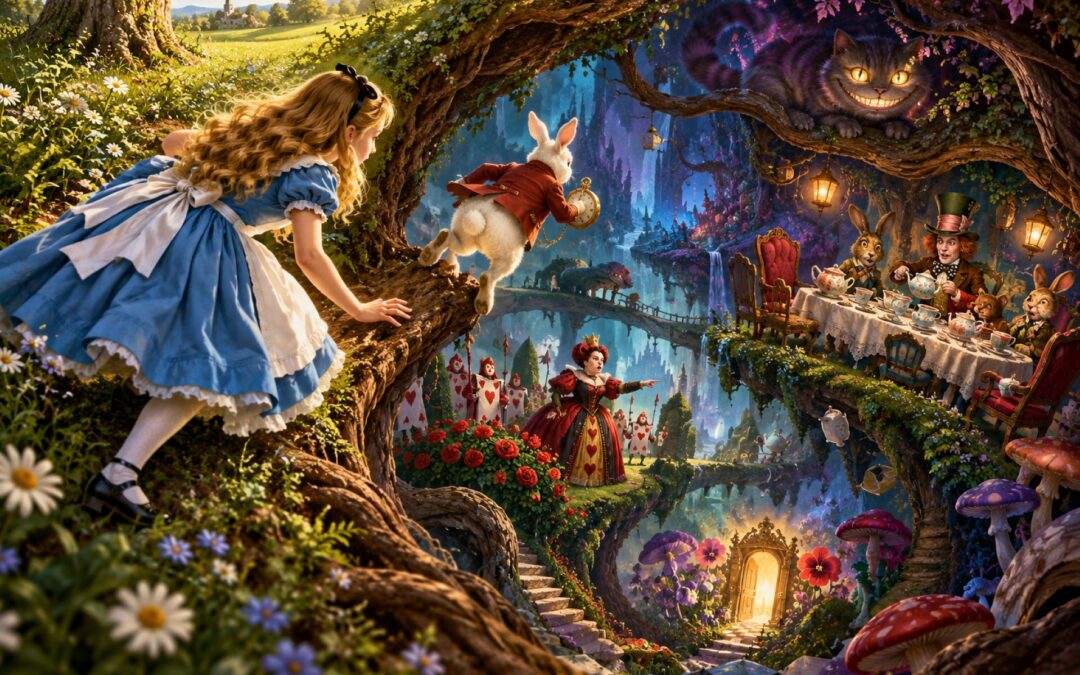
A white rabbit with a pocket watch, a caterpillar who questions a little girl’s identity, a tea party that never ends, and a queen who orders executions whenever she loses her temper: these are among the unforgettable inventions of Alice’s Adventures in Wonderland. Published in 1865, Lewis Carroll’s novel follows a curious young girl into a world where familiar rules of language, behavior, and physical reality repeatedly fail her.
The story begins with an ordinary child’s boredom and develops into a series of increasingly strange encounters. Alice wants to understand her surroundings, behave properly, and find her way into a beautiful garden. Instead, she discovers that adults can be unreasonable, conversations can become impossible, and apparently respectable institutions may operate without any sensible rules. Her growing willingness to question these absurdities gives the adventures a loose but recognizable progression.
Carroll’s novel is also one of the defining works of literary nonsense, combining wordplay, parody, fantasy, and dream logic. Its episodic structure allows almost every encounter to become a distinct comic invention, while recurring concerns about identity, education, manners, and authority connect the episodes.
Spoiler warning: This article covers the complete novel, including its ending, and examines its characters, themes, symbolism, literary techniques, and lasting significance.

Following the White Rabbit Into Wonderland
Alice is sitting on a riverbank beside her older sister, who is reading a book that Alice finds uninteresting because it contains neither pictures nor conversations. The afternoon is warm, and Alice feels sleepy. She is considering whether making a daisy-chain would be worth the effort when a White Rabbit runs past, talking anxiously about being late.
The sight of a talking rabbit does not initially strike Alice as particularly remarkable. What catches her attention is the Rabbit taking a watch out of its waistcoat pocket. Curiosity overcomes her, and she follows it across a field and into a large rabbit hole beneath a hedge.
The hole suddenly drops almost vertically. Alice falls for an extraordinarily long time, passing cupboards, bookshelves, maps, and pictures arranged along the walls. She even removes a jar labelled ORANGE MARMALADE, only to discover that it is empty. Rather than dropping it and risking injuring someone below, she places it in another cupboard.
During her descent, Alice speculates about how far she has fallen, whether she might reach the center of the Earth, and what people on the opposite side of the world are called. Her school knowledge is imperfect, but she enjoys using impressive geographical terms. She also thinks about her cat Dinah, wondering whether cats eat bats and eventually confusing the question with whether bats eat cats.
Alice lands safely on a heap of sticks and dry leaves. She follows the White Rabbit through a passage into a long, low hall illuminated by lamps. There are doors all around, but every door is locked.
A small glass table holds a golden key. Alice discovers that it opens a tiny door hidden behind a curtain, through which she can see an enchanting garden filled with flowers and fountains. Unfortunately, the passage is far too small for her to enter.
Returning to the table, Alice finds a bottle bearing the instruction DRINK ME. She remembers being taught that unfamiliar bottles might contain poison and checks for a warning label before tasting the contents. The drink causes her to shrink until she is only ten inches tall, but she has forgotten to bring the key down from the table.
She then discovers a little cake marked EAT ME. Hoping that another transformation will help, she eats it.
Instead of becoming the right size for the garden, Alice grows to more than nine feet tall. Her head strikes the ceiling, and she can no longer approach the little door. Frustrated and disappointed, she begins crying enormous tears that gather into a pool around her.
Her predicament makes her question whether she remains the same person after changing so dramatically. She considers whether she might somehow have become Mabel, another girl she knows, and attempts to test her identity through arithmetic, geography, and memorized verses. None of these exercises goes as expected. Even familiar poetry emerges in a distorted form, suggesting that her memory has become as unreliable as her body.
The White Rabbit returns, now carrying gloves and a fan, but is frightened away by Alice’s size. She picks up the abandoned objects and discovers that holding the fan makes her shrink again. Before she realizes what is happening, she is slipping into the pool of tears that she created while enormous.
Alice begins swimming and encounters a Mouse. She tries addressing it in English and then uses a French phrase she remembers from her lessons, unfortunately choosing a sentence that asks where her cat is. The Mouse is terrified. Alice apologizes but repeatedly worsens the situation by praising Dinah’s skill at catching mice and describing a neighbor’s dog that kills rats.
Other creatures join them in the water, including birds and small animals. They eventually reach the shore together, thoroughly wet and determined to dry themselves.
The Mouse proposes delivering an exceptionally dry historical account involving William the Conqueror. Its speech fails to improve their condition. The Dodo then suggests a Caucus-race, which it organizes by marking out an irregular course and allowing everyone to begin and stop whenever they please.
After the creatures have run around for a while, the Dodo declares that everybody has won and everybody must receive a prize. Alice is required to distribute sweets from her pocket. When the animals insist that she too deserves a reward, the Dodo solemnly presents her with a thimble that originally belonged to her.
The ceremony imitates the seriousness of an official occasion while emptying competition of its usual rules and consequences. Nobody has truly won anything, yet everyone behaves as though a meaningful judgment has been made.
The Mouse subsequently offers to explain why it dislikes cats and dogs. Its story concerns a creature named Fury proposing to prosecute a mouse despite the absence of any wrongdoing. Carroll arranges the poem on the page in a winding shape resembling a tail, making Alice’s confusion between a tale and a tail visible to the reader.
Alice repeatedly interrupts the Mouse because she misunderstands its words. When she again mentions Dinah, the gathered animals become alarmed and begin finding excuses to leave. Alice is left alone, regretting that she has driven away the creatures with whom she hoped to become friends.
The first three chapters establish the pattern that will govern much of her adventure. Alice enters strange situations with reasonable expectations, but those expectations repeatedly prove inadequate. Her attempts to solve practical difficulties, make conversation, and behave politely often create further complications.
Growth, Identity, and the Creatures of Wonderland
Alice hears approaching footsteps and hopes that the Mouse has returned. Instead, the White Rabbit appears, desperately searching for his missing gloves and fan. Mistaking Alice for his housemaid, Mary Ann, he orders her to fetch replacements from his house.
Alice is astonished that a rabbit should treat her as a servant, but she obeys. Inside the house, she finds the requested gloves and another bottle. Forgetting the difficulties caused by her earlier experiments, she drinks from it.
She immediately begins growing and soon becomes so large that she can barely fit inside the room. One arm extends out of a window, while a foot becomes lodged in the chimney. The house that should have provided shelter has turned into a trap.
The Rabbit returns and becomes furious when he discovers that someone is occupying his home. Unable to get inside, he calls for help. A creature named Pat becomes involved, and Bill the Lizard is sent down the chimney to investigate the obstruction.
Alice, who hears the commotion from inside, kicks Bill violently upward. He shoots out of the chimney and must be attended to by the others. The animals then consider setting fire to the house, but Alice threatens to have Dinah deal with them.
Eventually, the creatures throw stones through the window. When the stones land near Alice, they turn into little cakes. Remembering that eating in Wonderland often changes her size, she consumes one and shrinks sufficiently to escape.
Outside, Alice finds herself surrounded by the animals who had been attempting to remove her. She runs away into a wood, only to encounter an enormous puppy.
The puppy behaves like an ordinary playful dog, but Alice is now so small that its paws and jaws present serious dangers. She distracts it with a stick and escapes while it plays. The encounter demonstrates how physical size determines whether an apparently harmless animal feels comforting or threatening.
Alice knows that she must regain a more manageable height. While searching for something suitable to eat, she discovers a huge mushroom with a Caterpillar sitting on top, smoking a hookah.
The Caterpillar demands to know who she is. Alice explains that she is no longer certain because she has changed sizes so many times since morning. The Caterpillar shows little sympathy and seems unable to understand why these transformations should trouble her.
Their conversation becomes a struggle over questions and answers. The Caterpillar repeatedly asks Alice to explain herself, while Alice becomes frustrated that her explanations are dismissed. When she says that being three inches tall would be uncomfortable, he replies that it is a perfectly good height, since he himself is three inches tall.
He orders Alice to recite You Are Old, Father William, a familiar verse. Her version transforms the original moralizing poem into a series of ridiculous questions and explanations about an elderly man’s unlikely physical accomplishments. The Caterpillar declares that she has recited it incorrectly.
Eventually, he tells Alice that one side of the mushroom will make her grow and the other will make her shrink. Because the mushroom is round, however, she cannot immediately tell which side is which.
Alice breaks off two pieces and experiments with them. One makes her shrink so abruptly that her chin strikes her foot. The other causes her neck to extend upward until her head rises above the treetops.
A Pigeon spots the enormous neck and mistakes Alice for a serpent. Its hostility arises from its belief that serpents are constantly trying to steal birds’ eggs.
Alice insists that she is a little girl, but the Pigeon is unconvinced. When Alice admits that she has eaten eggs, the bird takes the confession as further proof of her serpentine nature. Alice discovers that her identity can be disputed not only by her own uncertainty but also by another creature’s interpretation of her appearance and behavior.
After further experiments with the mushroom, she reduces herself to approximately the right height and approaches a small house.
Outside, a Fish-Footman delivers an invitation from the Queen to the Duchess. A Frog-Footman receives it, and the two perform an elaborate exchange that seems to duplicate the same information without advancing the conversation.
Alice asks how she can enter the house. The Frog-Footman responds with unhelpful remarks about the purpose of knocking and whether anyone inside would hear her. Eventually, she opens the door herself.
The kitchen is filled with smoke, pepper, and chaos. The Duchess sits holding a baby, the cook tends a large cauldron of soup, and a Cheshire Cat grins nearby. The cook throws dishes and cooking implements through the room, while the Duchess seems indifferent to the possibility of injury.
Alice is alarmed by the rough treatment of the child. The Duchess sings a violent lullaby advocating harsh treatment of little boys while shaking the baby and eventually throws it toward Alice.
Fearing that the infant might be killed if she leaves it behind, Alice carries it outside. She gradually realizes that the child is changing shape. Its nose becomes a snout, its cries turn into grunts, and it eventually becomes an unmistakable pig.
Alice sets the animal down and allows it to wander away. Although the transformation is absurd, she regards it as preferable to the child’s remaining human in such an unpleasant household.
Soon afterward, Alice encounters the Cheshire Cat sitting in a tree. She asks which direction she should take. The Cat replies that the answer depends on where she wants to go, and Alice admits that she does not particularly care about her destination.
The Cat tells her that one path leads to the Hatter and the other to the March Hare. Both are mad, he says, as is everyone else in Wonderland. Alice objects that she does not wish to associate with mad people, but the Cat insists that she cannot avoid doing so.
Unlike many of the other characters, the Cheshire Cat seems comfortable with the strange logic of his surroundings. He does not try to explain Wonderland into something ordinary. Instead, he treats its peculiarities as normal and Alice’s expectations as the unusual element.
The Cat appears and disappears during their conversation. On one occasion, he vanishes so gradually that only his grin remains suspended in the air.
Alice is astonished by the sight of a grin without a cat. Nevertheless, she follows the Cat’s directions toward the March Hare’s house, which has chimneys shaped like ears and a roof resembling fur.
Before approaching, she uses the mushroom to increase her height. For the first time, she has begun to exercise some control over the transformations that previously left her helpless.
A Mad Tea-Party and the Queen’s Croquet Game
Alice finds the March Hare, the Hatter, and a Dormouse sitting at a large table beneath a tree. The Dormouse is asleep between the other two, who are using him as a cushion.
Although the table has plenty of empty places, the Hatter and March Hare shout that there is no room. Alice sits down anyway, beginning a conversation that becomes increasingly hostile and bewildering.
The March Hare offers her wine, but there is none on the table. Alice complains that it was uncivil to offer something unavailable. The Hare replies that it was equally uncivil for Alice to sit down without being invited.
The exchange establishes the tea party’s peculiar atmosphere. The hosts employ social rules when those rules are convenient but violate ordinary hospitality themselves. Alice’s attempts to expose the inconsistency accomplish very little because the participants continually change the terms of the conversation.
The Hatter examines Alice’s appearance and remarks that her hair needs cutting. She objects to his rudeness, prompting him to pose a riddle about the resemblance between a raven and a writing desk.
Alice assumes that the riddle must have an answer and begins considering it. The conversation then turns toward the relationship between saying what one means and meaning what one says. The Hatter and March Hare insist on distinctions that expose the ambiguity concealed within familiar expressions.
When Alice eventually gives up on the riddle, the Hatter admits that he has no answer either. Its lack of a solution frustrates Alice because she has been trying to solve it according to ordinary expectations.
The Hatter then explains why the tea party never ends. During a performance before the Queen of Hearts, he was accused of murdering Time. Since then, Time has refused to cooperate with him, and the hour has remained fixed at six o’clock.
Because six is tea time, the participants cannot progress to another part of the day. They simply move around the table when the crockery becomes dirty, creating the appearance of activity without any meaningful advancement.
The Hatter’s explanation turns an ordinary expression about wasting or killing time into a situation with literal consequences. Time behaves almost like an offended acquaintance, while the Hatter and his companions are trapped by the outcome of their quarrel.
The Dormouse is awakened and ordered to tell a story. He describes three little sisters named Elsie, Lacie, and Tillie who live at the bottom of a treacle well. The guests interrupt him continually, and the story becomes a sequence of puzzles about drawing, wells, sweetness, and objects whose names begin with a particular letter.
Alice attempts to make sense of the narrative, but the Hatter and March Hare ridicule or contradict her questions. She eventually becomes so irritated that she leaves the table, declaring it the stupidest tea party she has ever attended.
As she walks through the wood, she notices a door in the trunk of a tree. Passing through it, she unexpectedly finds herself back in the long hall where she first discovered the beautiful garden.
This time, Alice remembers the golden key before shrinking. She unlocks the little door and carefully eats part of the mushroom until she is small enough to enter the passage. She finally reaches the garden, after many unsuccessful attempts.
The achievement proves less satisfying than she expected.
Near the entrance, Alice encounters three gardeners shaped like playing cards. They are painting white roses red because they have planted the wrong color and fear punishment when the Queen discovers their mistake.
The gardeners identify themselves by numbers and belong to a court in which human behavior is performed by living playing cards. Their panic gives Alice an early indication of the Queen’s temperament.
A royal procession arrives, featuring soldiers, courtiers, royal children, the Knave of Hearts, the King, and the Queen. The White Rabbit is also present.
The Queen demands to know who Alice is and becomes enraged when the girl refuses to be intimidated. She frequently responds to displeasure by ordering someone’s head removed.
Alice is initially nervous but realizes that the Queen’s threats do not automatically make her powerful or sensible. She refuses to accept the Queen’s treatment of the gardeners as reasonable.
The Queen then invites Alice to participate in a game of croquet. Alice discovers that the game is almost impossible to play because its equipment consists of living creatures.
Flamingoes serve as mallets, hedgehogs as balls, and soldiers bend over to form arches. The flamingoes twist their necks, the hedgehogs move independently, and the soldiers abandon their positions whenever they wish.
The players quarrel constantly, and the Queen orders executions whenever she becomes frustrated. Alice is unable to learn the rules because the game appears to have no stable rules at all.
She encounters the Cheshire Cat again, which appears above the croquet ground. Alice begins explaining her dissatisfaction with the Queen’s behavior, but the Cat’s presence attracts royal attention.
The King objects to the Cat’s appearance, and the Queen orders its execution. Unfortunately, only the Cat’s head is visible.
The executioner argues that nobody can behead a creature without a body. The King insists that anything possessing a head can be beheaded, while the Queen threatens to execute everyone unless the problem is solved.
Alice suggests that they consult the Duchess, to whom the Cat belongs. By the time the executioner returns with the Duchess, the Cat’s head has vanished completely.
The dispute ends without a solution. The court resumes its activities, leaving the question of how to execute a disembodied head unanswered.
Alice has reached the garden she wanted to enter, but it is governed by the same irrationality that characterizes the rest of Wonderland. Its beauty offers no protection from confusion, intimidation, or arbitrary commands.
The Mock Turtle, the Gryphon, and Their Underwater Lessons
The Duchess greets Alice with unexpected affection. Her behavior has changed dramatically since the chaotic kitchen, and she now seems determined to attach a moral lesson to everything Alice says.
She repeatedly announces that ordinary remarks contain profound meanings. Alice notices that these lessons often have little connection to the subjects being discussed.
The Duchess even suggests that the moral meaning of a statement matters more than the statement itself. Her insistence makes conversation difficult because she seems more interested in producing wisdom than understanding what anyone actually means.
The Queen interrupts their exchange and orders the Duchess away. Alice returns to the croquet ground, where she finds the game continuing in confusion. Many players have been sentenced to death, although the King quietly pardons the condemned when the Queen is not paying attention.
The Queen then asks Alice whether she has seen the Mock Turtle. When Alice admits that she does not know what a Mock Turtle is, the Queen arranges for the Gryphon to take her to meet one.
The Gryphon dismisses the Queen’s execution threats as theatrical bluster and leads Alice toward a rocky place where the Mock Turtle is sitting alone, sighing mournfully.
The creature appears overwhelmed by sorrow but struggles to explain its unhappiness. The Gryphon insists that Alice must listen to its story, though he is considerably less impressed by its emotional displays.
The Mock Turtle describes a childhood spent beneath the sea, where he attended a school taught by an old Turtle whom the pupils called Tortoise. When Alice questions the name, he explains it through a pun involving what the teacher taught.
The curriculum transforms ordinary school subjects into ridiculous underwater equivalents. Reading and Writing become Reeling and Writhing, while other subjects include Ambition, Distraction, Uglification, and Derision.
The Mock Turtle also mentions different forms of arithmetic, languages, and artistic instruction. Each subject twists a familiar school term into something that sounds plausible but does not survive ordinary scrutiny.
Alice is particularly interested in the arrangement of lessons. The Mock Turtle explains that the number of hours decreased each day, beginning with ten on the first day and continuing downward.
The Gryphon explains that this is why they are called lessons: they lessen from day to day. The answer transforms a conventional school term into a literal description of diminishing time.
When Alice attempts to pursue the implications of the timetable, the Gryphon abruptly declares that the discussion has gone far enough. The creatures turn to games and dancing instead.
The Mock Turtle and Gryphon describe the Lobster Quadrille, a complicated seaside dance involving sea animals, including lobsters and whiting. The dancers form lines and throw lobsters into the sea before changing partners.
The explanation becomes increasingly peculiar as the creatures discuss the movements of the dance and the animals participating in it. The Gryphon and Mock Turtle demonstrate portions of the performance while encouraging Alice to join.
Their songs contain further distortions of familiar language and poetic conventions. Alice is also asked to recite verses she has learned, but her attempts produce bizarre alternatives to the originals.
One recitation transforms a familiar moral poem about industrious behavior into the story of a predatory creature. The Mock Turtle and Gryphon react critically to Alice’s performance, despite the absurdity of their own conversation.
The Mock Turtle then sings a melancholy song celebrating turtle soup. The choice is uncomfortable and comic because the creature bears the name of a soup whose preparation traditionally substitutes other meat for turtle.
His mournful singing continues until a distant cry announces that a trial is beginning. The Gryphon immediately takes Alice by the hand and hurries toward the court.
Alice is given no meaningful explanation of the accusation or the proceedings. As with many earlier encounters, she must enter the new situation before she has enough information to understand it.
The Knave’s Trial and Alice’s Awakening
Alice arrives in a courtroom occupied by the King and Queen of Hearts. The Knave of Hearts stands before them in chains, accused of stealing a plate of tarts.
The White Rabbit acts as herald, and a collection of birds and animals serves as the jury. The King wears his crown over a judicial wig, visually combining royal power with the appearance of legal authority.
The proceedings begin with the White Rabbit reading a familiar rhyme about the Queen making tarts and the Knave stealing them. The accusation is treated as though it establishes the facts of the case, even though the trial has barely begun.
Alice looks around the courtroom and notices several recognizable figures, including the Hatter and the March Hare. A dish containing the disputed tarts sits prominently before the court, tempting her because she has become hungry.
The jurors immediately begin writing on their slates. Alice discovers that they are recording their own names so that they will not forget them before the trial concludes.
She finds this foolish and remarks upon it. The White Rabbit demands silence, and the jurors obediently record the word on their slates instead. One juror has a pencil that makes an irritating squeaking noise, so Alice quietly takes it away.
The King orders the witnesses to be called. The first is the Hatter, who arrives carrying tea and bread-and-butter because his tea party has never properly ended.
The Hatter’s testimony is confused and largely irrelevant. He attempts to explain when the tea party began, but his remarks contradict one another. The King and Queen interrupt him repeatedly, and the Queen threatens punishment.
Terrified, the Hatter becomes incapable of offering coherent evidence. His nervousness increases when the King demands that he remove his hat and questions whether it belongs to him.
The Hatter explains that he sells hats rather than owning them, but even this ordinary clarification becomes another source of suspicion. Eventually, the King dismisses him while warning that he must not return to his tea without further interference.
The next witness is the Duchess’s cook. She refuses to cooperate with the court and gives deliberately unhelpful answers when questioned about the ingredients of tarts.
A sleepy remark from the Dormouse causes another uproar, and the Queen orders the creature removed. By the time order is restored, the cook has disappeared.
Throughout these proceedings, Alice has begun growing again. She gradually occupies more space on the jury benches and finds herself disrupting the arrangements around her.
The White Rabbit finally announces the next witness: Alice herself.
Alice jumps up so suddenly that she overturns the jury box, sending its occupants tumbling onto the floor. She hurriedly collects the jurors and replaces them, conscious that the accident might injure them.
When questioned, Alice admits that she knows nothing about the stolen tarts. The King declares that this is important evidence, only to be corrected by the White Rabbit, who suggests that he may have meant unimportant.
The King then notices Alice’s enormous size and orders her to leave, citing Rule Forty-two, which supposedly requires anyone more than a mile high to depart from the court.
Alice points out that she is not a mile high and challenges the King’s assertion that the rule is the oldest in the book. If it is numbered forty-two, she argues, it cannot plausibly be the first rule.
The King has no satisfactory response.
The White Rabbit next produces a document said to have been discovered during the proceedings. It contains a peculiar poem with no clear relationship to the accusation, its characters, or the missing tarts.
The King nevertheless insists that the poem must be important evidence. He proceeds to interpret its lines as references to the trial, inventing explanations whenever the words do not support his conclusions.
Alice objects that the writing does not demonstrate the Knave’s guilt. Her confidence has grown alongside her body, and she no longer feels compelled to accept the court’s assertions merely because they are delivered with ceremony.
The Queen becomes increasingly furious and demands that Alice be punished. The court’s confusion reaches its height when the Queen calls for a sentence before the jury has delivered a verdict.
Alice openly rejects the proceedings. When the Queen demands her head, she declares that the royal assembly is only a pack of cards.
The cards rise into the air and fly toward her. Alice tries to fight them away, but suddenly awakens on the riverbank with her head resting in her sister’s lap.
The objects that appeared to threaten her have become ordinary leaves falling from the trees. Wonderland disappears, and the strange events are revealed as a dream.
Alice excitedly recounts her adventures to her sister before running home for tea.
Her sister remains seated beside the river, reflecting on the dream. Closing her eyes, she imagines hearing the White Rabbit’s footsteps, the Hatter’s cups, the Queen’s cries, and the other sounds of Wonderland.
As she listens, those imaginary sounds gradually become the ordinary noises of the countryside surrounding her. The difference between dream and waking reality returns, but the imaginative experience has not entirely vanished.
The sister pictures Alice growing into adulthood while retaining the affectionate, sympathetic qualities of childhood. She imagines Alice eventually gathering children around her and telling them wonderful stories that awaken their curiosity.
The novel therefore ends with more than Alice’s escape from an absurd courtroom. It concludes with another person’s appreciation of the imaginative world Alice has experienced and the possibility that such experiences can remain meaningful long after childhood has passed.
The Unstable Rules of Wonderland
Wonderland contains recognizable landscapes and institutions, but their behavior rarely conforms to Alice’s expectations. Its halls, houses, gardens, forests, shores, and courtrooms seem ordinary enough to suggest familiar activities, yet almost every location introduces a new difficulty.
The hall of locked doors presents an architectural problem that Alice might solve through observation and planning. The golden key really does fit the small door, and the garden is accessible through the passage. However, Alice cannot reach it without transforming herself, and those transformations repeatedly create new obstacles.
The Rabbit’s house introduces a similar problem from the opposite direction. A room designed for an ordinary occupant becomes dangerous when Alice grows beyond its dimensions. The giant puppy then reverses the relationship, making Alice vulnerable to an animal whose intentions are playful rather than malicious.
Wonderland’s physical rules are therefore unstable without being completely meaningless. Drinking, eating, and touching certain objects produce recognizable consequences, even if Alice cannot initially anticipate their scale or direction.
Its social arrangements are more erratic. Animals organize races and tea parties, servants deliver invitations, a Duchess manages a household, and a Queen presides over ceremonies. These institutions imitate human society while undermining the purposes supposedly served by their rules.
As Martin Dubois explains in the British Library’s examination of anthropomorphism and literary nonsense in Carroll’s novel, the talking animals combine recognizable human behavior with qualities that make them persistently strange. The absurdity emerges partly from seeing familiar customs performed in unsuitable circumstances.
The croquet game is a particularly complete example. It preserves the vocabulary and equipment of a recognizable sport, but its living mallets, balls, and arches refuse to behave as tools. Because the players cannot rely on stable conditions, the game loses the fairness and intelligibility that would make winning meaningful.
The courtroom extends the same problem to justice. It contains a judge, witnesses, a jury, and evidence, but the participants repeatedly violate the purposes of their own procedures.
Carroll does not construct Wonderland as a fantasy world with a comprehensive alternative system of natural laws. Its changing rules are part of its comic method. The reader recognizes enough ordinary life to understand what should happen, then watches the expectation collapse.
Alice’s Curiosity, Fear, and Growing Confidence
Alice is more than a passive visitor observing a collection of eccentric creatures. Her curiosity, pride, impatience, affection, and increasing confidence shape how the narrative develops.
Her decision to follow the White Rabbit establishes her appetite for discovery. She does not enter Wonderland to accomplish an assigned mission or rescue another character. She enters because something unexpected has caught her attention and she wants to know what it means.
Alice also arrives with a child’s confidence in the lessons she has learned. She can recall subjects from school, recognizes familiar social customs, and assumes that knowing the appropriate rules will help her navigate strange situations.
Yet she regularly misapplies her knowledge. Her recitations become confused, and her attempts to use polite conversation sometimes reveal that she has not considered another creature’s perspective.
The Mouse is an early example. Alice genuinely wants to be friendly, but her enthusiasm for Dinah leads her to describe the hunting abilities of a cat to animals who might become its prey. She apologizes when she notices their distress, yet repeatedly returns to the same topic.
The incident prevents the reader from treating Alice as invariably more reasonable than the beings around her. She possesses ordinary human prejudices and assumptions, and Wonderland exposes them.
Her emotional life also matters. Alice cries when she cannot reach the garden, worries that she has become somebody else, misses Dinah, and feels miserable when the animals abandon her. The adventure is frequently delightful to the reader while remaining uncomfortable for its protagonist.
As her encounters accumulate, she becomes more willing to challenge the manners and instructions of others. She resists the Hatter’s rudeness, questions the Queen’s conduct, and refuses to accept explanations that fail to account for what she sees.
These changes do not amount to a simple movement from ignorance to perfect wisdom. Alice continues to misunderstand language, lose her temper, and make questionable assumptions. Her improvement lies more in becoming willing to trust her observations than in mastering Wonderland.
The Caterpillar’s conversation is especially revealing. Alice initially seeks guidance from an apparently knowledgeable creature, but his questions leave her more confused. Nevertheless, she persists long enough to obtain useful information about the mushroom.
The Cheshire Cat offers a different relationship. Alice finds him strange and sometimes irritating, but she is able to ask him practical questions. His explanations do not resolve the contradictions of Wonderland, yet they help her understand that its inhabitants may operate according to assumptions she does not share.
By the time Alice meets the Queen, her tendency to question authority has become more pronounced. She is frightened by the Queen’s temper but does not automatically accept her judgments.
The final courtroom confrontation completes this development. Alice exposes the King’s invented rules and recognizes that the court’s impressive appearance cannot give authority to unsupported claims.
Kimberley Reynolds, in the British Library’s discussion of childhood, logic, and authority in Alice’s Adventures in Wonderland, identifies the novel’s inventive relationship with the conventions governing children’s lives. Alice’s encounters repeatedly place the expectations imposed on children under unusual pressure.
Her personality is essential to this effect. Because she is knowledgeable but fallible, obedient in some situations and rebellious in others, readers can recognize her as a child rather than merely a symbol of resistance.
The White Rabbit, Caterpillar, Cheshire Cat, and Other Wonderland Figures
The supporting cast of Alice’s Adventures in Wonderland is memorable less for conventional psychological development than for distinct habits of speech and behavior. Each major figure confronts Alice with a different version of the difficulties that govern Wonderland.
The White Rabbit is the first example. His waistcoat, watch, house, gloves, and official duties associate him with the respectable routines of organized society. Yet he is perpetually anxious and easily intimidated.
His obsession with punctuality contrasts with his inability to manage events. He fears being late, mistakes Alice for his servant, organizes the effort to remove her from his house, and later serves in the Queen’s court. His position changes, but his nervous dependence on authority remains recognizable.
The Caterpillar displays the opposite temperament. While the Rabbit constantly hurries, the Caterpillar sits almost motionless on his mushroom, smoking and questioning Alice. He offers very little sympathy and expects her to justify explanations that he does not appear interested in understanding.
His repeated demands for self-definition make him frustrating, but he also gives Alice information that becomes practically useful. The mushroom enables her to regulate her size, even though he provides the advice in a form that initially creates further confusion.
The Cheshire Cat is among the book’s most distinctive figures because he appears unusually comfortable with Wonderland’s contradictions. He is capable of discussing them with a certain detachment, although his explanations often seem deliberately provocative.
His conversation about direction reveals a genuine logical relationship: choosing a route depends on having some idea of one’s destination. However, he uses that observation to emphasize the uncertainty of Alice’s purpose rather than to offer her reassuring guidance.
The Cat also demonstrates an extraordinary independence from physical conventions. He can disappear while remaining conversationally present, and his grin can survive the disappearance of the rest of his body.
His encounter with the executioner makes this independence particularly important. The Queen’s command assumes that every prisoner possesses a body that can be punished in an ordinary manner. The Cat’s disembodied head defeats the assumption on which the sentence depends.
The Duchess is more volatile. Alice first encounters her in a violently disorderly household, where she mistreats a baby and seems indifferent to the cook’s dangerous behavior. Later, she appears affectionate and becomes determined to extract moral lessons from everything.
These contrasting appearances suggest a caricature of adult inconsistency. The Duchess does not seem troubled by the incompatibility between her brutal conduct and her eagerness to deliver moral instruction.
The Hatter, March Hare, and Dormouse form a small social world organized around a ritual that can never finish. The Hatter dominates conversation through riddles and assertions, while the March Hare alternates between offering hospitality and attacking Alice for breaches of etiquette.
The Dormouse contributes a different form of disruption. Often asleep, he is nevertheless expected to entertain the others with a story whose apparent logic collapses under questioning.
None of these characters displays much interest in communicating cooperatively. They interrupt, contradict, ridicule, and evade questions. Alice’s frustration partly arises because she expects a conversation to involve shared attention to a recognizable subject.
The Mock Turtle and Gryphon provide another pair of contrasting personalities. The Mock Turtle’s endless sighs and melancholy songs suggest emotional depth, but his sorrow is difficult to separate from the absurdity of his story.
The Gryphon is brisker and more practical. He dismisses the Queen’s threats, urges the Mock Turtle to proceed with his account, and insists on moving from one subject to another whenever he loses patience.
Their underwater lessons expose how thoroughly adult conventions can be absorbed into nonsense. The creatures recall school routines with confidence despite presenting a curriculum composed largely of altered words and impossible explanations.
Among the smaller figures, the Mouse demonstrates Alice’s social awkwardness, the Dodo parodies pompous collective decision-making, and the Pigeon shows how an animal can misunderstand Alice by interpreting her body according to its own fears.
Bill the Lizard, the Fish-Footman, the Frog-Footman, and the Duchess’s Cook similarly contribute to the novel’s accumulation of distorted social roles. They are not developed as independent personalities, but their behavior is sufficiently particular to make each encounter distinct.
Carroll’s achievement lies partly in refusing to turn the creatures into ordinary humans wearing animal costumes. Their recognizable social habits coexist with their animal identities, strange physical properties, and unpredictable assumptions.
The Queen of Hearts and the Abuse of Authority
The Queen of Hearts is Wonderland’s most openly threatening figure. She reacts to minor mistakes, disagreement, and inconvenience by demanding executions, often before establishing what has happened.
Her first appearance follows the gardeners’ attempt to hide their error by painting roses. Their fear makes clear that royal displeasure is treated as a serious danger, even when the original mistake is trivial.
At the croquet ground, the Queen’s behavior becomes still more absurd. She repeatedly orders punishments while participating in a game whose rules cannot be followed consistently. Her authority substitutes anger for judgment rather than providing the order that the game requires.
The King appears less aggressive but is not substantially more rational. He quietly pardons many of the Queen’s condemned subjects, suggesting that her threats do not always produce the outcomes she demands.
However, his conduct during the trial reveals a similar disregard for fair procedure. He invents rules, mistakes irrelevant remarks for evidence, and interprets a nonsensical poem in whatever way appears convenient.
The Queen’s temper and the King’s arbitrary reasoning reveal two related forms of failed authority. One relies on intimidation; the other attempts to make irrational conclusions appear legitimate through formal procedure.
Their behavior becomes especially clear when the Queen demands punishment before a verdict. The sequence reverses the purpose of a trial by treating the desired punishment as more important than determining whether the accused is guilty.
The court’s participants often respond to these absurdities with obedience rather than protest. The Hatter is frightened into incoherence, and the jurors follow instructions without considering whether they make sense.
Alice’s final resistance succeeds because she refuses to grant the court authority simply on the basis of its costumes, titles, and ceremonies.
The novel supports a reading of the court as a satire of arbitrary power, particularly authority exercised without reason or accountability. Yet the Queen need not represent a particular historical monarch or institution for the satire to work. Her behavior is recognizable wherever status is used to silence questions rather than answer them.
Size, Identity, and the Meaning of Growing Up
Alice’s changes in size are among the novel’s most persistent sources of comedy and distress. They also give physical form to her uncertainty about who she is and how she should behave.
In the hall of doors, Alice’s body prevents her from reaching the place she wants to enter. When she is tall enough to possess the key, she cannot fit through the passage. When she shrinks sufficiently, she cannot reach the key.
The problem repeatedly separates intention from capability. Alice knows what she wants, but her physical circumstances prevent her from accomplishing it.
Her enormous size soon becomes emotionally overwhelming. After growing taller than the hall can accommodate, she begins crying and questioning whether she has become another person.
The change in her body appears to threaten the continuity of her identity. Alice assumes that remembering her lessons might prove that she remains herself, but the failures of memory leave her with no secure answer.
This relationship between bodily growth and personal identity makes the story particularly suggestive as a representation of childhood. Children regularly encounter physical and intellectual changes that alter what they can do and what others expect of them.
Alice’s experiences exaggerate such changes into impossible transformations. She can become enormous or miniature within moments, making ordinary expectations about growth irrelevant.
The Rabbit’s house demonstrates the social consequences of being too large. Alice cannot move comfortably, frightens the animals outside, and becomes an apparent intruder because her body no longer fits the environment.
The puppy encounter reverses the problem. Alice’s smallness makes a friendly animal seem monstrous, revealing that vulnerability depends partly on relative scale rather than intention alone.
The Pigeon’s accusation introduces the relationship between appearance and identity. Because Alice’s neck resembles that of a serpent, the Pigeon refuses to accept that she is human.
Alice discovers that knowing who she is does not guarantee that others will recognize her identity. The Pigeon interprets her according to its own experience and fear of egg-eating creatures.
Her conversation with the Caterpillar makes this conflict explicit. Asked to identify herself, Alice cannot provide a stable answer because her circumstances have changed so rapidly.
Yet the Caterpillar’s response complicates the assumption that physical change must be distressing. His own transformation from caterpillar to butterfly is part of his life cycle, and he does not share Alice’s alarm about changes in form.
Alice gradually learns to control her size using the mushroom. Although her early experiments remain clumsy, she eventually manages the process well enough to reach the garden.
The final trial gives enlargement a different significance. As Alice grows, the King’s rules and the Queen’s threats seem increasingly ridiculous. Her physical size coincides with greater confidence in expressing her judgments.
It would be too simple, however, to conclude that getting bigger always means becoming wiser. Alice sometimes behaves sensibly while small and thoughtlessly while large. Her transformations reveal the instability of power and self-perception rather than establishing a reliable measure of maturity.
The novel’s treatment of growing up is therefore suggestive without becoming a conventional developmental allegory. Alice gains confidence through experience, but the story does not present adulthood as a state of complete understanding.
Language, Logic, and the Parody of Education
Much of Wonderland’s comedy depends on characters who use ordinary words in extraordinary ways. Conversations repeatedly fail because Alice assumes that language should convey shared meanings, while other characters treat meanings as opportunities for argument, evasion, or invention.
The Mouse’s story is an early example. Alice confuses its tale with its tail, and Carroll reinforces the misunderstanding by arranging the poem in a winding shape. The joke depends simultaneously on sound, meaning, and typography.
The Hatter’s tea party develops this kind of confusion into an extended verbal contest. The Hatter and March Hare repeatedly challenge expressions that Alice uses without considering their possible ambiguity.
When Alice assumes that meaning what one says is equivalent to saying what one means, the guests expose the difference through examples. The phrases contain the same words but need not express the same logical relationship.
The Hatter’s raven-and-writing-desk riddle creates a different problem. Alice expects a riddle to be a question with an answer, but the Hatter admits that he has none.
Carroll later explained in an added preface that the riddle was originally devised without a solution. Readers had repeatedly asked him for one, which demonstrates how strongly people expect even deliberately nonsensical questions to obey familiar conventions.
The Hatter’s quarrel with Time also depends on language. The ordinary expression of killing time becomes the literal accusation that he has murdered Time, now imagined as a person capable of taking offense.
The result is a peculiar form of imprisonment. The tea party’s participants cannot escape six o’clock because Time refuses to cooperate with the Hatter.
The Dormouse’s treacle-well story continues the manipulation of familiar expressions. Its strange details provoke questions that generate further verbal complications rather than clarifying the narrative.
The Duchess represents another misuse of language. She insists that every statement contains a moral, often producing an interpretation that has little relation to the original remark.
Her approach resembles a parody of instruction that values the appearance of wisdom more than genuine understanding. A moral lesson becomes something an adult attaches to an event rather than something the event necessarily demonstrates.
The novel’s treatment of formal education is similarly irreverent. Alice repeatedly attempts to recite verses she has learned, but the poems emerge in distorted forms.
You Are Old, Father William replaces conventional instruction about behavior with absurd accomplishments and explanations. Another corrupted recitation transforms a moral lesson about industrious conduct into the activities of a predatory creature.
These distortions are particularly effective when readers recognize the original verses. The humor arises from the contrast between familiar educational expectations and Carroll’s surprising replacements.
The Mock Turtle’s school extends the parody to an entire curriculum. Familiar subjects are transformed through sound, resemblance, and double meanings.
The joke about lessons becoming shorter is a simple example of how the book turns figurative or conventional terminology into literal explanation. The Gryphon’s reasoning makes sense at the level of a pun while providing no serious educational principle.
Carroll’s nonsense is therefore different from meaningless language produced at random. It frequently depends on the reader recognizing the original logical or verbal convention that has been disrupted.
Alice often notices the difficulty but cannot explain why her companions’ statements are wrong. Their confidence and verbal aggression make an ordinary disagreement feel impossible to resolve.
The trial raises the stakes of this linguistic manipulation. The King interprets a document as evidence despite having no reliable basis for connecting its words to the theft. His explanations are designed to reach conclusions rather than discover what the words actually support.
The problem is no longer simply an annoying conversation. The misuse of language now threatens to produce an unjust punishment.
Carroll’s relationship with logic is consequently more complicated than a simple rejection of rational thought. The reader is repeatedly encouraged to distinguish sensible reasoning from verbal tricks and unsupported assertions.
The absurdity of Wonderland becomes visible because the reader can detect the contradictions that its inhabitants ignore or exploit. Logic remains useful, even when the characters misuse it.
Gardens, Doors, Food, and Other Recurring Motifs
Wonderland contains a variety of recurring objects and situations whose meanings develop as Alice encounters them in different circumstances. These patterns help connect episodes that otherwise appear loosely related.
The White Rabbit and his watch introduce the adventure through a familiar anxiety about time. The Rabbit’s urgency is remarkable because it is expressed by an animal whose appearance does not ordinarily suggest punctuality or formal obligation.
His concern about lateness anticipates the Hatter’s very different predicament. Both characters are troubled by time, but one is constantly rushing while the other remains trapped at the same hour.
The rabbit hole marks the movement from ordinary reality into a world where familiar expectations cannot be trusted. Its extraordinary depth allows Carroll to begin altering the relationship between everyday observation and impossible experience.
The golden key and small door create one of the novel’s most important recurring practical problems. Alice can see a place she desires but cannot reach it without changing herself.
The garden initially appears to promise beauty, comfort, and escape from the confusing hall. Alice’s repeated efforts to enter it give her wandering a recognizable objective.
Once she arrives, however, she discovers the Queen’s court and its threats. The garden’s appearance proves unreliable as a guide to the experience it contains.
Food and drink repeatedly cause changes in Alice’s body. The labelled bottle, little cake, strange substance in the Rabbit’s house, and mushroom all alter her proportions.
Eating is ordinarily associated with nourishment and growth, but Wonderland makes its consequences unpredictable. Alice often consumes something because she expects it to solve a problem, only to discover that it has created another.
The mushroom gradually changes that relationship. Once she understands how its two sides work, Alice gains some control over her size and becomes less dependent on accidental discoveries.
Tears also acquire an unusual physical significance. Alice’s grief creates a pool that subsequently threatens to overwhelm her when she becomes small. Her earlier emotion literally transforms the environment she must navigate.
The tea party and playing cards turn familiar social objects into the foundations of entire episodes. Tea becomes an endless routine separated from ordinary time, while cards become subjects, courtiers, soldiers, and rulers.
These motifs do not require a single hidden interpretation. Their significance often emerges from their changing practical functions and their relationships with Alice’s experiences. Carroll’s symbolic richness is closely connected to his ability to make ordinary objects behave in surprising ways.
Dream Logic, Narrative Voice, and the Shape of the Story
Alice’s Adventures in Wonderland takes the form of a dream-framed episodic adventure. Its chapters follow Alice through a series of encounters that are individually distinctive but connected by her changing reactions to the world around her.
The narrative begins in an ordinary setting and enters fantasy through Alice’s pursuit of the White Rabbit. Rather than constructing a conventional quest, Carroll allows the story to move through curiosity, accidental discoveries, and changes of direction.
The beautiful garden offers an organizing objective during much of the novel. Alice repeatedly tries to reach it, and her changing size creates practical obstacles along the way.
Once she enters, the narrative shifts from wandering among eccentric individuals to confronting the institutions of Wonderland’s royal court. The trial provides a climax that draws together the book’s treatment of language, authority, and arbitrary rules.
This structure permits a considerable amount of freedom. Episodes do not always produce consequences that determine the next episode, and characters may disappear from the narrative after serving their immediate purpose.
Nevertheless, recurring concerns establish continuity. Alice’s uncertain identity, unsuccessful conversations, interrupted lessons, and conflicts with unreasonable figures become increasingly recognizable.
The dream framework allows Carroll to present events that are causally inconsistent without requiring explanations based on an alternative system of natural laws. Objects change size or form, creatures disappear, and destinations emerge unexpectedly.
The dream is also a plausible setting for the novel’s distorted memories and unstable experiences of time. In a study of Alice’s Adventures in Wonderland and Victorian psychology, Alessandro Cabiati examines how Carroll’s treatment of dreaming intersects with nineteenth-century investigations of perception, memory, identity, and states of mind.
This historical perspective helps explain why the novel’s dream form can support more than whimsical fantasy. It also makes room for experiences of disorientation that are unsettling as well as amusing.
The novel’s narrator contributes to its distinctive tone. Although written in the third person, the story remains closely aligned with Alice’s thoughts and perceptions.
Readers frequently learn what Alice expects before discovering how Wonderland contradicts her. Her private judgments and spontaneous reactions become important sources of humor.
The narrator also sometimes adopts a conversational manner, explaining details or drawing attention to the unusual circumstances. This creates the feeling of a story being told to an attentive listener rather than a fictional world being described from a remote, impersonal distance.
The book’s poetry is inseparable from this storytelling method. Familiar verses become distorted, new songs are introduced, and the Mouse’s tale takes a visual shape that changes how the reader encounters the words.
John Tenniel’s original illustrations further established the novel’s visual identity. His depictions of Alice, the White Rabbit, Caterpillar, Cheshire Cat, Duchess, and royal court contribute to the recognizable forms through which readers have encountered the story.
The Lewis Carroll Society’s account of the book’s origins and publication traces the narrative to a boating excursion on July 4, 1862, when Charles Lutwidge Dodgson told a story to Alice Liddell and her sisters.
Dodgson subsequently developed the tale into the handwritten and illustrated manuscript Alice’s Adventures Under Ground, which he presented to Alice in 1864. Encouragement to publish led him to expand the story into Alice’s Adventures in Wonderland under the name Lewis Carroll.
The original printing appeared in July 1865 through Macmillan, but it was withdrawn after Tenniel objected to the quality of the illustrations. A revised printing appeared in November of the same year, though its title page bore the date 1866.
These details matter because they reveal the relationship between an intimate storytelling occasion and a carefully developed published work. The book retains the spontaneity of an improvised tale while displaying deliberate artistic attention to its language, structure, and illustrations.
The opening poem recalls the summer afternoon associated with the story’s creation. It invites the reader to see Wonderland as an imaginative experience passed from storyteller to listener.
Later editions introduced additional prefatory material, including Carroll’s explanation that the Hatter’s famous riddle originally lacked an intended answer. Such additions offer useful evidence about the book’s history but should remain distinct from the original narrative.
The ending returns the story to the ordinary landscape from which it began. Alice awakens beside her sister, and the strange noises of Wonderland become echoes of familiar countryside sounds.
The sister’s closing imagination completes the relationship between storytelling, dreaming, and childhood. Wonderland begins as something Alice experiences and ends as something another person can imaginatively share.
What the Ending Reveals About Alice and Wonderland
The novel’s climax occurs when Alice challenges the royal court rather than continuing to accept its authority. Her recognition that the judges, soldiers, and monarchs are only playing cards strips away the appearance of power that has made their threats intimidating.
This moment follows a sequence of increasingly absurd proceedings. The King invents procedural rules, the court mistakes meaningless material for evidence, and the Queen demands punishment before the verdict.
Alice’s response is therefore connected to what she has witnessed. She no longer treats ceremonial titles or confident commands as sufficient reasons to believe what she is told.
The cards flying toward her create one last moment of danger. Their attack immediately dissolves when Alice awakens, revealing the apparent violence of the court as part of the dream.
At the literal level, the ending resolves the adventure by returning Alice to safety. She has not defeated the Queen through an extended battle or reformed Wonderland’s institutions. She has awakened from the world in which those institutions possess power.
An interpretation of the ending as growing confidence is persuasive because Alice’s final conduct contrasts with her earlier anxiety and willingness to obey. Yet it would be misleading to describe the conclusion as a complete transformation into adulthood.
Alice remains a child when she wakes. Her development consists principally of becoming more willing to question unreasonable demands.
The sister’s reflection complicates the ending’s meaning. Rather than dismissing the dream as worthless because its events were unreal, she imagines its creatures and sounds for herself.
Her vision of Alice as a grown woman who remembers the pleasures and sorrows of childhood suggests that imaginative experiences can contribute to a person’s emotional life long after the original moment has passed.
The dream may also be read as a form of temporary liberation from ordinary rules. Wonderland makes authority, language, and identity unstable, allowing Alice to encounter possibilities that would be unavailable in everyday life.
These interpretations need not exclude one another. The ending restores ordinary reality, celebrates Alice’s increased confidence, and preserves the imaginative value of what she has experienced.
Its abruptness is a deliberate departure from conventional resolution. The book does not settle the Knave’s case, provide an explanation for every character, or establish a stable political order in Wonderland.
Instead, it ends when Alice recognizes the court’s insubstantial authority. The sister’s final meditation supplies a quieter emotional conclusion to the comic collapse of the dream.
How Well Alice’s Adventures in Wonderland Holds Up
Alice’s Adventures in Wonderland remains distinctive because its imaginative freedom is supported by remarkable precision in language. Carroll repeatedly creates absurd situations whose humor depends on recognizable habits of thought, conversation, and social behavior.
The novel’s originality is especially apparent in the way it treats nonsense as an active literary method. Its riddles, transformations, parodies, and logical reversals allow familiar things to become strange without losing their connection to everyday experience.
The Hatter’s tea party illustrates this achievement. An ordinary social ritual becomes a permanent condition because Time has taken offense, while conventional conversation breaks down into disputes over meaning and hospitality.
The episode works as comedy, but its details also encourage readers to reconsider assumptions about time, speech, and social rules. Carroll achieves this without converting the scene into a conventional moral lesson.
The Queen’s court extends the same artistic method to authority. Her threats and the King’s absurd reasoning exaggerate behaviors that remain recognizable in institutions governed by vanity, intimidation, or incompetence.
The courtroom climax is particularly effective because the narrative has prepared the reader to recognize these patterns. By the time Alice openly challenges the proceedings, the court’s behavior has become ridiculous enough that her resistance feels justified.
Carroll’s characterization is another strength, although it operates differently from psychological realism. Many supporting figures possess only a narrow range of habits and interests, yet those characteristics are expressed with such verbal and visual distinctiveness that the figures remain memorable.
The White Rabbit’s anxiety, Caterpillar’s detached questioning, Cheshire Cat’s amused detachment, Hatter’s conversational aggression, and Queen’s temper are recognizable almost immediately. These characters do not require elaborate biographies to perform their narrative functions.
Alice herself provides enough continuity to prevent the story from becoming an entirely disconnected sequence of jokes. Her reactions reveal a child who is curious and capable but also proud, impatient, frightened, and sometimes inconsiderate.
Her imperfections matter. The novel would be less interesting if she simply entered Wonderland as a perfectly rational observer who recognized everyone else’s foolishness from the beginning.
The book’s episodic structure is both a strength and a potential limitation. Individual encounters have considerable independence, allowing Carroll to develop an extraordinary variety of scenes without forcing them into a rigid plot.
However, readers accustomed to stories driven by clear external objectives, escalating conflicts, and tightly connected consequences may find the progression loose.
The garden provides an intermediate goal, and the final trial creates a climax, but many adventures remain only loosely connected through causation. Characters enter, entertain or frustrate Alice, and disappear without necessarily influencing subsequent events.
This is an important difference between Carroll’s method and that of more conventional fantasy fiction. It may reduce narrative urgency for some readers, but it also permits the book’s playful unpredictability.
The dream ending raises a related question. Because Alice awakens, the dangers of Wonderland disappear without requiring the story to resolve the conflicts that created them.
Such an ending might feel unsatisfactory in a narrative that had promised a sustained struggle against a villain or the achievement of a political objective. Here, its abruptness is more defensible because the story has consistently operated through the logic of a dream.
The sister’s concluding reflection also prevents the awakening from functioning as a simple denial of the preceding experience. The narrative grants the dream emotional significance even after its literal reality has vanished.
The prose remains one of the novel’s greatest pleasures. Carroll’s dialogue moves between apparent simplicity and carefully controlled verbal absurdity, making familiar expressions unstable in surprising ways.
His parodies of instructional verse similarly depend on both precision and mischief. They imitate recognizable poetic forms while replacing the lessons and assumptions that originally gave those forms their purpose.
These qualities can also create difficulties for modern readers. Some of the original poems and educational references are much less familiar today than they would have been to Carroll’s first audience.
A reader who does not recognize the verse being parodied may still enjoy the strange replacement, but part of the joke will be lost. Annotated editions can help recover these references without fundamentally altering the reading experience.
The novel’s treatment of cruelty can also be unsettling. The Duchess mistreats her child, animals threaten one another, and the Queen repeatedly orders executions. Carroll generally presents these events through exaggeration and comedy, but their presence complicates any assumption that Wonderland is simply a harmless fantasy for young children.
Its treatment of adult authority is similarly irreverent. Parents, teachers, officials, and rulers are not automatically reliable merely because they occupy respectable positions.
For some readers, this makes the book liberating. Others may find the relentless instability of its social world tiring, especially when nearly every encounter involves argument, frustration, or misunderstanding.
The novel’s historical achievement is substantial. It helped establish an influential model of children’s fantasy in which imaginative pleasure and verbal invention need not be subordinated to explicit instruction.
The broader field of children’s literature criticism provides a useful context for understanding why such a work should be evaluated according to more than adult expectations of psychological realism or tightly plotted narrative.
Carroll demonstrates that a story can engage children through the pleasures of curiosity, surprise, and absurdity while offering adults additional layers of linguistic and social interpretation.
Its influence can be seen in the extraordinary persistence of its characters and images across illustration, theater, film, and other forms of adaptation. Yet the novel’s continuing significance does not depend solely on these later appearances.
The original work remains entertaining because the situations are still inventive and the dialogue remains capable of surprising readers. A talking rabbit with a watch may be culturally familiar, but the peculiar reasoning that follows him into Wonderland has lost little of its capacity to amuse and frustrate.
The novel’s greatest limitation is inseparable from its artistic method. Its characters and episodes sometimes exist more for imaginative play than for sustained narrative development, and readers seeking emotional intimacy or conventional storytelling may find that unsatisfying.
Nevertheless, the book achieves remarkable coherence through its recurring concerns with identity, language, education, and authority. What appears to be a succession of unrelated absurdities gradually develops into a recognizable confrontation between a child’s expectations and a world unwilling to justify its rules.
Alice’s Adventures in Wonderland is therefore best approached as an inventive work of fantasy and literary nonsense rather than as a conventional adventure or a philosophical allegory with one hidden solution. Its deepest pleasure lies in the precision with which Carroll makes ordinary assumptions behave absurdly.
Its lasting value comes from that combination of imaginative freedom and intellectual play. The story remains worth reading for children who enjoy extraordinary adventures, adults interested in language and literature, and anyone willing to follow a narrative in which curiosity matters more than reaching a predictable destination.
Alice begins by wondering why her sister would read a book without pictures or conversations. She ends with a story crowded with both, having discovered how strange familiar rules can appear when they are examined from an unfamiliar perspective.
The novel’s closing vision gives this experience its final significance. Alice does not need to remain in Wonderland to preserve something of its imaginative freedom. Her adventure can continue through memory, storytelling, and the pleasure of seeing the ordinary world differently.
Last Updated on October 14, 2026 by Aseem Gupta