
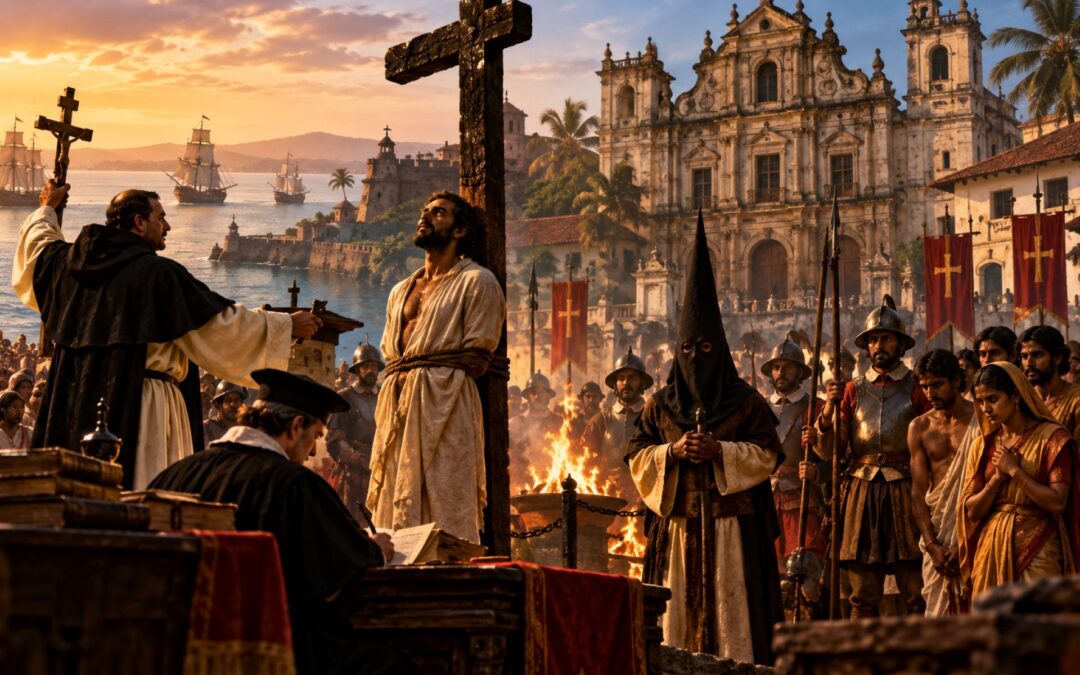
In 1510, Portuguese forces captured Goa on India’s western coast, transforming it into one of the most important centres of their expanding Asian empire. The port connected Portugal to the lucrative trade networks of the Indian Ocean, where Hindu, Muslim, Jewish, and Christian merchants had conducted business for generations. Yet within fifty years, Goa also became the headquarters of a religious tribunal whose purpose was to enforce Catholic orthodoxy and punish practices regarded as heretical.
Established in 1560, the Goa Inquisition operated for more than two centuries, investigating religious beliefs, prosecuting suspected offences, confiscating property, and imposing punishments that could include imprisonment, torture, and execution. Its activities formed part of a wider colonial effort to promote Christianity and restrict other religious traditions. Temples were destroyed, public worship was regulated, and even family relationships and inherited customs could become matters of religious scrutiny.
The history of the Goa Inquisition is therefore more complicated than the story of a single court persecuting religious minorities. It concerns the relationship between missionary ambitions, royal authority, colonial law, and the lives of communities whose religious practices came under increasing pressure. Understanding what happened requires distinguishing the tribunal’s actions from the wider policies of Portuguese rule, while recognizing how closely those systems could reinforce one another.
How Portugal Took Goa and Remade Its Trading World
When Vasco da Gama reached Calicut in 1498, he entered an Indian Ocean commercial system that had flourished long before Europeans arrived. Arab, Persian, Gujarati, Malabari, and other merchants connected the markets of India with East Africa, the Middle East, and Southeast Asia. Portugal wanted access to the profitable trade in spices and other Asian commodities, but its rulers soon developed ambitions that extended beyond peaceful participation in existing markets.
Portuguese expansion relied heavily on naval power, fortified ports, and attempts to control maritime routes. Rather than conquering the entire Indian subcontinent, commanders sought strategically important coastal positions from which ships could operate and commercial activity could be influenced. This development formed an important chapter in the history of European maritime expansion into India, when trading relationships increasingly became entangled with military intervention and imperial competition.
Afonso de Albuquerque captured Goa from the Bijapur Sultanate in 1510. The Portuguese briefly lost control after their initial victory but recaptured the city later that year, establishing a base that would become the capital of Portuguese India. Goa’s harbour, regional connections, and strategic position made it valuable for expeditions farther east and for maintaining Portuguese influence along the western coast.
The population of Goa was religiously and culturally diverse. Hindu communities maintained temples and inherited traditions, while Muslims participated in political and commercial life. The wider region also had longstanding connections with Jewish communities, particularly those established along the Malabar Coast. Portuguese settlers, soldiers, officials, and merchants entered this environment with their own institutions and religious assumptions.
During the early decades, commercial necessity sometimes encouraged accommodation. Portuguese authorities depended on Indian intermediaries, local expertise, established merchants, and relationships with neighbouring rulers. Marriage between Portuguese men and local women was encouraged, missionaries learned regional languages, and some officials prioritized the practical demands of governing a trading settlement.
This relative flexibility should not be mistaken for an absence of coercion. Portuguese conquest had already introduced military domination, unequal political power, and increasing pressure on non-Christian religious institutions. As missionary organizations became more influential and the Crown committed itself more strongly to religious uniformity, the relationship between colonial government and Goa’s inhabitants changed significantly.
The city that had been conquered primarily for strategic and commercial reasons increasingly became a centre for enforcing Catholic religious authority.
From New Christians to a Portuguese Inquisition in Asia
The religious policies eventually imposed on Goa had their origins in developments within the Iberian Peninsula. During the late fifteenth century, the Spanish and Portuguese monarchies adopted increasingly coercive measures against Jewish and Muslim communities, linking religious uniformity with political authority.
In 1492, Spain ordered Jews who refused conversion to leave its territories. Policies affecting Muslims followed a different chronology, but they likewise intensified pressure on religious minorities. Portugal initially became a refuge for some displaced Jews, although this situation changed when King Manuel I introduced measures that culminated in the forced conversion of many Jews in 1497.
Those converted to Christianity became known as New Christians, distinguishing them from established Christian families commonly described as Old Christians. Conversion did not necessarily eliminate religious prejudice. New Christians were frequently suspected of secretly observing Jewish practices, while their ancestry could become a source of discrimination even when they publicly followed Catholicism.
Some continued practicing elements of Judaism privately, while others had little connection to their ancestral religion. Nevertheless, the suspicion that outwardly Christian individuals remained secretly Jewish became a central concern of inquisitorial authorities.
In 1536, the Portuguese Inquisition was formally established with papal authorization. Although it operated as a religious institution, the Portuguese Crown exercised considerable influence over its leadership and administration. Its tribunals investigated offences against Catholic orthodoxy, including alleged Judaism, Islam, Protestantism, and other forms of heresy.
The Inquisition also contributed to a wider system of religious and intellectual regulation. Censorship, the supervision of religious ideas, and the policing of conduct helped define what authorities regarded as acceptable Catholic belief. In this environment, religious conformity became closely connected to political loyalty and social standing.
Portuguese expansion carried these concerns into Asia. New Christian merchants and settlers had travelled to Indian Ocean ports, where commercial networks and contact with established Jewish and Muslim communities sometimes reinforced official suspicions about religious practices. Missionaries also complained about the conduct of Portuguese settlers and the difficulty of enforcing Catholic discipline across distant territories.
One influential advocate for stronger religious intervention was Francis Xavier, the Jesuit missionary who arrived in Goa in 1542. Xavier was troubled by practices he considered contrary to Catholic teaching, including the persistence of Jewish and Muslim religious observances among people expected to follow Christianity.
In a letter dated 16 May 1546, Xavier urged King João III to establish the Holy Inquisition in Portuguese Asia. His concerns specifically included people observing what he described as the Mosaic law and the Muslim faith. The request reflected a conviction that missionary preaching alone was insufficient and that stronger institutions were needed to enforce religious conformity.
Xavier died in 1552, before the Goa tribunal was established. He therefore did not personally administer its later trials or direct the institution throughout its existence, although his advocacy contributed to the religious climate in which it emerged.
The Goa Inquisition was established in 1560, with judicial proceedings beginning around 1561. Its headquarters occupied a former palace in the colonial capital, symbolically placing a powerful religious institution within the administrative centre of Portuguese Asia.
Unlike an ordinary missionary establishment, the tribunal possessed the authority to investigate suspected offences, imprison defendants, conduct trials, and issue sentences. Its jurisdiction extended across Portuguese possessions and communities connected to the Estado da Índia, the administrative system governing Portugal’s Asian territories.
The institution would become one of the most consequential instruments through which Portuguese authorities attempted to regulate religious life in Asia.
Jews, Muslims, and the Persecution of Christian Converts
The Goa Inquisition did not persecute one religious community in an identical manner throughout its history. Its investigations reflected changing political priorities, missionary concerns, and definitions of religious wrongdoing. Understanding its victims therefore requires distinguishing between Jewish New Christians, Muslims, local converts to Catholicism, and non-Christians who became involved in proceedings concerning religious practices.
One of its earliest concerns was Judaizing, the accusation that baptized Christians secretly followed Judaism. New Christians of Jewish ancestry were especially vulnerable because inquisitorial authorities often treated continued adherence to Jewish traditions as evidence of deliberate religious deception.
Contacts between Portuguese New Christians and Jewish communities in the Indian Ocean intensified official suspicion. Jews had established commercial and religious networks in parts of southern India, particularly along the Malabar Coast. Portuguese authorities feared that these connections could encourage baptized Christians to return to their ancestral faith.
In December 1565, restrictions were introduced against Jewish presence and activity in Goa. Such policies threatened merchants whose commercial relationships depended on movement between different ports and communities. However, restrictions on Jews, prosecutions for Judaizing, and the broader treatment of all New Christians were distinct matters and should not be reduced to a single universal rule.
The persecution of the family of Garcia de Orta provides a particularly revealing example. Garcia was a respected physician and scholar who had settled in Goa and published an important medical work in 1563, describing Indian medicinal plants, drugs, and treatments. His achievements did not remove the suspicions attached to his family’s New Christian background.
His sister Catarina de Orta had previously faced inquisitorial proceedings in Lisbon and was prosecuted again in Goa during 1568–1569. Accused of maintaining Jewish beliefs, she was imprisoned, interrogated, and ultimately executed in 1569.
The historical study of Catarina de Orta’s prosecution illustrates how accusations could extend through family relationships and expose relatives to further investigation. The consequences were not limited to the individual initially accused; testimony extracted during proceedings could implicate additional members of a household or social network.
Garcia himself died in 1568, before his posthumous condemnation. In 1580, inquisitorial authorities ordered his remains exhumed and burned after finding him guilty of Judaism. The punishment demonstrated that even death did not necessarily end the tribunal’s pursuit of alleged religious offences.
Muslims and Christians suspected of observing Islamic practices also attracted scrutiny. Accusations could arise from religious observances, associations, statements, or customs interpreted as evidence of adherence to Islam. The precise jurisdiction and punishment depended on the person’s religious status, the alleged offence, and the legal circumstances of the period.
Yet the tribunal’s work cannot be understood exclusively through persecution of Jewish and Muslim converts. Local Christians who had been baptized after the Portuguese conquest became a major category of defendants, particularly when accused of continuing Hindu or other Indian religious practices.
Surviving records summarized in a study published by The Journal of Ecclesiastical History identify approximately 3,800 cases between 1561 and 1623. Around 44 percent concerned locally baptized Christians accused of practices classified as heathenism.
This evidence complicates portrayals of the institution as a tribunal concerned almost entirely with Jewish ancestry. Its prosecutions increasingly reflected the religious and cultural circumstances of Portuguese India, where conversion did not necessarily produce an immediate abandonment of inherited beliefs.
The institution also investigated other suspected deviations from Catholic teaching, including Protestant ideas. Its broad definition of religious wrongdoing made it capable of reaching people from different backgrounds, although the intensity and character of enforcement varied considerably.
How the Holy Office Investigated and Punished the Accused
The Goa Inquisition operated through a formal judicial system, but its procedures differed substantially from modern principles of open trials and transparent criminal justice. An accusation of religious wrongdoing could expose a person to detention, interrogation, financial loss, and lasting damage to reputation.
Proceedings often began with denunciations. Individuals might be reported by neighbours, acquaintances, relatives, or others who claimed to have witnessed suspicious practices or heard statements considered heretical. Religious offences could involve outward actions, private conduct, or beliefs that authorities believed were being concealed.
Denunciations created opportunities for genuine accusations as well as personal hostility and manipulation. People involved in disputes could exploit religious suspicion, while the possibility of confiscation and the fear of being implicated encouraged cooperation with authorities. Nevertheless, claims about a universal system granting informants a fixed share of every confiscated estate cannot be accepted without specific documentary evidence.
Inquisitorial officials assessed accusations and could order further investigation or detention. The identities of witnesses and details of testimony might remain concealed from defendants, making it difficult to understand or challenge the allegations against them.
Imprisonment itself could be severe. Detainees were separated from their families, deprived of ordinary economic activity, and subjected to uncertainty about the progress and outcome of their cases. The secrecy surrounding proceedings increased the power imbalance between the accused and the institution investigating them.
Confession occupied an important place within inquisitorial procedure. Authorities regarded acknowledgment of wrongdoing and expressions of repentance as religiously significant, and defendants could face strong pressure to confess or implicate others.
Torture was permitted under regulated circumstances and was used in some cases to obtain information or admissions. The existence of formal rules did not remove the coercive nature of the process, particularly when an accused person faced confinement, intimidation, and uncertainty about the evidence being used.
However, it would be inaccurate to suggest that every accused individual was automatically convicted, that torture was used in every trial, or that all proceedings followed one unchanging sequence. Procedures and outcomes differed according to the alleged offence, available testimony, judicial decisions, and the period.
Punishments also varied considerably. Some defendants received religious penances, fines, restrictions, penitential garments, or imprisonment. Others faced confiscation of property, corporal punishment, or more severe sentences.
The most solemn public ceremonies were known as autos-da-fé, meaning acts of faith. These events combined religious ritual with the formal announcement of judicial decisions. Public processions, prayers, penitential clothing, and the presence of religious and secular authorities made the proceedings visible demonstrations of institutional power.
An auto-da-fé was not simply another name for burning people alive. Some participants received penances or lesser punishments, while those condemned to death were handed over to secular authorities for execution. In other cases, images or effigies were burned to represent individuals who were absent or had already died.
These distinctions matter when interpreting historical statistics. Records referring to people burned in person, burned in effigy, sentenced to imprisonment, or subjected to public penance describe different outcomes. Combining them into one undifferentiated death toll would misrepresent the surviving evidence.
The system’s coercive effects extended beyond those receiving the most severe sentences. The possibility of denunciation, confiscation, imprisonment, or public humiliation could influence religious behaviour and social relationships even among people who never appeared before the tribunal.
Temple Destruction and the Suppression of Hindu Worship
The Goa Inquisition formed part of a wider Portuguese effort to transform the religious character of its Indian possessions. Although the tribunal was responsible for investigating and punishing specified religious offences, many of the restrictions imposed on Hindu communities originated from colonial legislation, royal commands, missionary activities, or decisions of ecclesiastical authorities.
These institutions frequently reinforced one another, but they were not interchangeable. Understanding the persecution of Hindu religious practices requires examining how colonial government and missionary power operated alongside the tribunal.
Portuguese authorities had begun restricting Hindu religious institutions before the Inquisition was formally established. During the 1540s, royal and colonial policies intensified pressure on temples and public worship in territories under Portuguese control.
A royal directive issued in 1546 called for the destruction of Hindu temples in Portuguese possessions. Over the following decades, temples and shrines were demolished or deprived of official protection in areas where colonial authority was effectively exercised.
The destruction was extensive, particularly in the older territories of Portuguese Goa. However, frequently repeated numerical totals must be treated carefully because they may combine different geographical areas, periods, and methods of counting temples.
Portuguese jurisdiction was also geographically limited. The territory corresponding to modern Goa did not come under Portuguese control all at once, and policies enforced in the original conquered districts cannot automatically be applied to every region that later became part of Portuguese Goa.
Temple destruction affected much more than religious buildings. Temples could serve as centres of community identity, ritual activity, patronage, festivals, and local economic relationships. Their removal disrupted institutions through which communities had maintained traditions and organized aspects of collective life.
Additional regulations restricted the construction of new temples and the repair of existing ones. Hindu priests and religious specialists faced limitations on their activities, while ceremonies, festivals, processions, and other public expressions of Hindu worship could attract official penalties.
Images and objects associated with Hindu religious practices were also targeted. Missionaries and colonial authorities often interpreted such objects through a theological framework that classified non-Christian worship as idolatry, leaving little room for understanding those practices according to the beliefs of the communities observing them.
The effects were especially significant for converts to Catholicism. Baptism was not always treated as sufficient evidence of religious conformity because authorities expected converts to abandon practices identified with their previous faith.
A person could therefore encounter suspicion for retaining household rituals, participating in familiar ceremonies, or maintaining relationships with religious specialists. Conduct understood locally as family custom or community obligation might be interpreted by inquisitorial authorities as a return to forbidden religious practices.
This concern increasingly appeared in the tribunal’s use of the category gentilidade. As examined in the historical research on the movement from idolatry to gentilidade, inquisitorial classifications of Indian religious practices changed over time. The terminology reflected the institution’s attempts to identify, categorize, and prosecute behaviour that did not conform to its understanding of Catholic orthodoxy.
The distinction between an unbaptized Hindu and a baptized Christian accused of continuing Hindu practices was important. The tribunal’s jurisdiction and treatment of alleged offences depended partly on religious status, although non-Christians could also become involved in proceedings under particular circumstances.
Religious coercion additionally operated through policies outside the tribunal. Colonial rules could restrict the employment of Hindus in particular settings, limit participation in administrative institutions, or disadvantage non-Christians in legal and public affairs. Such measures changed over time and were not applied uniformly throughout all Portuguese possessions.
Some measures also offered economic or social incentives for conversion. These could include access to patronage, employment, institutional support, or other advantages associated with Catholic status. When such incentives existed alongside restrictions on non-Christian communities, conversion took place within unequal political circumstances.
Nevertheless, not every conversion can be explained through direct force alone. Some individuals converted for religious reasons, while others responded to marriage, social relationships, professional opportunities, political patronage, or the pressures of colonial rule.
The larger historical pattern is clear even when individual motives differed. Portuguese institutions increasingly attempted to determine which religious practices could be publicly maintained, which customs converts might retain, and which expressions of belief would be punished.
For Hindu communities and many local Christians, religious identity therefore became an issue subject to the authority of a colonial state whose laws and institutions privileged Catholicism.
Orphans, Caste, and the Control of Everyday Life
The religious policies of Portuguese Goa did not stop at temples, ceremonies, and formal prosecutions. They also entered family relationships, questions of guardianship, inheritance, social hierarchy, and the cultural practices people carried into Christian communities.
One particularly controversial area concerned children from non-Christian families whose parents or guardians had died. Portuguese authorities introduced measures under which certain children could be placed in Christian institutions for baptism and religious education.
The legal meaning of orphanhood and the rights of surviving relatives became central questions. Some provisions considered the existence of parents, grandparents, and other relatives, while disputes arose over whether children with surviving family members could nevertheless be removed from their households.
The problem was therefore more complicated than a single rule automatically declaring every child whose father died to be an orphan. The legislation and its interpretation changed, and the treatment of children could depend on the practices of officials responsible for guardianship.
Nevertheless, documentary evidence records controversies concerning the removal and Christian upbringing of children whose relatives objected. Such policies gave religious authorities influence over the future identity of families and communities, extending the consequences of conversion policy beyond adults who made religious decisions for themselves.
Research on Catholics and non-Christians in the Archbishopric of Goa examines how provincial councils and colonial institutions attempted to regulate conversion, family matters, and relations between religious communities. These measures demonstrate that the legal machinery surrounding conversion was broader than the inquisitorial court.
Questions of guardianship could also become connected to property and inheritance. A child’s placement in a Christian institution might change who exercised authority over the child’s upbringing and material interests. Where officials exploited such circumstances, religious intervention could create opportunities for family separation and financial abuse.
The broader goal was often to prevent the continuation of non-Christian religious practices across generations. By influencing the religious upbringing of children, authorities hoped to make conversion a more permanent transformation of society.
Yet Portuguese attempts to remake religious identities did not necessarily eliminate existing social distinctions. The caste system remained influential among many Goan Christians, even when Catholic teaching formally emphasized membership in a common religious community.
Some converts from Brahmin families retained social prestige and developed identities associated with their ancestral status. Among Goan Catholics, the term Bamon came to identify communities claiming Brahmin ancestry, while other converted groups maintained different inherited social positions.
This continuity reflected the complex interaction between religious conversion and local society. Portuguese officials and missionaries sometimes accommodated caste distinctions because they believed such arrangements would encourage influential families to convert or make Christian communities easier to organize.
Accommodation did not imply equality. Differences in occupation, marriage, status, and access to influence could persist within Catholic society, and converts from less privileged communities did not necessarily enjoy the same opportunities as elite converts.
Cultural regulation also affected names, languages, and customary practices. Portuguese baptismal names became widespread among converts, while colonial institutions attempted to discourage customs they associated with non-Christian identities.
Local languages were nevertheless not uniformly eliminated. Missionaries also studied and used Konkani and other regional languages for preaching, religious instruction, and written communication. The history of language policy therefore included suppression of particular texts and traditions alongside efforts to employ local languages for Christian purposes.
These contradictions reveal an important feature of colonial religious power. Portuguese authorities sought to reshape society according to Catholic expectations, but they also depended on local hierarchies, languages, intermediaries, and social relationships to maintain their rule.
The result was neither the complete disappearance of inherited Goan culture nor an uncomplicated continuation of earlier traditions. Communities adapted under pressure, preserving some distinctions while modifying or abandoning others.
Migration, Resistance, and the Limits of Portuguese Power
Religious coercion encouraged some inhabitants of Portuguese Goa to seek greater freedom beyond colonial jurisdiction. Hindu families, religious specialists, merchants, and other groups moved toward neighbouring territories where they could maintain practices restricted under Portuguese rule.
Some religious institutions survived through relocation. Sacred images, community traditions, and ritual practices could be transferred to places outside effective Portuguese control, allowing religious life to continue despite the destruction or restriction of temples in the conquered districts.
Migration was not necessarily permanent or universal. Families sometimes maintained relationships across political boundaries, while individuals and communities developed different ways of negotiating colonial restrictions. Religious persistence could therefore involve departure, accommodation, concealment, or the adaptation of inherited practices to new circumstances.
The neighbouring Deccan states offered alternatives to Portuguese jurisdiction, although their own political and religious policies varied. Movement across these boundaries demonstrated an important limitation of colonial authority: Portugal could impose restrictions within the territories it controlled, but it could not completely determine the religious practices of populations throughout the western Indian subcontinent.
Religious regulation also interacted with commerce. Merchants depended on trust, family connections, credit arrangements, and mobility across regions. Measures that threatened particular communities or discouraged movement into Portuguese ports could damage some of the relationships through which trade operated.
The persecution of New Christians and restrictions affecting other commercial communities therefore had potential economic consequences. Yet it would be misleading to claim that the Inquisition alone destroyed Portuguese commercial power or directly caused the rise of rival European empires.
Portugal’s Asian position faced numerous pressures, including military competition, limitations on manpower and resources, changing trade routes, and resistance from established Asian powers. Dutch and English expansion added further challenges to Portuguese attempts to dominate maritime commerce.
Portugal’s earlier conquest of Malacca illustrated how strategic ports, naval artillery, and commercial coercion could extend the reach of a relatively small European power. But capturing ports did not guarantee permanent control over the trading networks that connected them.
The Dutch eventually displaced Portugal from several important commercial positions, including Malacca in 1641. These changes resulted from wider political, naval, and economic developments rather than a single religious institution.
The consequences of religious persecution must therefore be understood both independently and within that larger history. The Inquisition and related colonial policies altered the lives of particular communities, encouraged migration, and contributed to distrust of Portuguese authority, while the empire’s geopolitical decline had multiple causes.
The Abolition of the Goa Inquisition and Its Surviving Evidence
The Goa Inquisition did not operate continuously without interruption from its establishment until its final abolition. During the eighteenth century, changing political and intellectual circumstances within the Portuguese monarchy contributed to attempts to reform or suppress institutions associated with older forms of religious authority.
The tribunal was first abolished in 1774 during the period of reforms associated with the Marquis of Pombal. It was subsequently restored in 1778, demonstrating that opposition to the institution had not yet produced a permanent settlement.
The Goa Inquisition was finally abolished in 1812. This was the end of the tribunal as an operating institution, although other features of Portuguese colonial rule and religious inequality did not necessarily disappear at the same moment.
A major difficulty in reconstructing its history arises from the destruction of much of its documentary archive. Following abolition, Portuguese authorities authorized the destruction of numerous records, with large-scale burning taking place in 1814.
The loss was significant because inquisitorial documentation could contain information about accusations, testimonies, defendants, sentences, and the institution’s internal administration. Without complete archives, historians cannot reconstruct every prosecution or establish an unquestionable total for all categories of punishment throughout the tribunal’s existence.
Nevertheless, the surviving evidence is far from negligible. Correspondence, registers, summaries of cases, sentencing lists, and records preserved in Portugal and Brazil provide important information about the institution’s activities.
Historical research into the surviving records of the Goa tribunal explains how documents were destroyed, dispersed, and preserved. These materials allow historians to study both the operation of the institution and the limitations of the evidence available today.
One of the most important recent contributions is the database of individuals sentenced by the Goa Inquisition, compiled by researchers Alan Machado, Bruno Feitler, and Carlos Rocha.
The database brings together information from surviving lists associated with proceedings between 1650 and the early nineteenth century, with its principal detailed records extending through 1806. It contains detailed information for 8,250 defendants, providing a substantial basis for examining accusations, religious classifications, sentencing patterns, and other aspects of the tribunal’s activities.
This figure is not a complete count of everyone prosecuted during the Goa Inquisition’s entire history. The surviving lists are incomplete, and individuals could appear in the records more than once. Moreover, the database concerns a particular body of documentary evidence rather than every action undertaken by religious and civil authorities in Portuguese Goa.
The distinction is especially important when evaluating claims about executions. A person sentenced to public penance, imprisonment, confiscation, or burning in effigy cannot simply be counted as someone executed. Likewise, the number of documented defendants cannot automatically be converted into a total for every person who experienced religious coercion.
The Inquisition’s wider influence also exceeded the cases that reached its tribunal. Fear of denunciation, restrictions on inherited practices, and the actions of colonial administrators could affect people who were never formally prosecuted.
Consequently, the historical significance of the Goa Inquisition cannot be measured by one dramatic numerical estimate. Its surviving records reveal a coercive institution operating within a broader system that attempted to enforce religious conformity while exercising colonial authority over a diverse population.
The Goa Inquisition illustrates how religious institutions could become instruments of government within an overseas empire. The tribunal enforced Catholic orthodoxy through investigations and punishments, while related colonial policies restricted religious practices, influenced conversion, and interfered with aspects of community and family life.
Its history also demonstrates the limits of that power. Religious communities resisted, migrated, adapted, and preserved traditions that colonial authorities had sought to suppress. The surviving historical evidence does not permit every accusation or popular numerical claim to be accepted without qualification, but the loss of records does not erase the coercion and persecution that are documented.
What makes the Goa Inquisition historically significant is the way religious authority and imperial government reinforced one another. Its legacy lies not only in the punishments imposed by a tribunal, but also in the profound consequences of allowing colonial institutions to determine which beliefs, practices, and cultural identities could be openly maintained.
Last Updated on October 25, 2026 by Aseem Gupta