
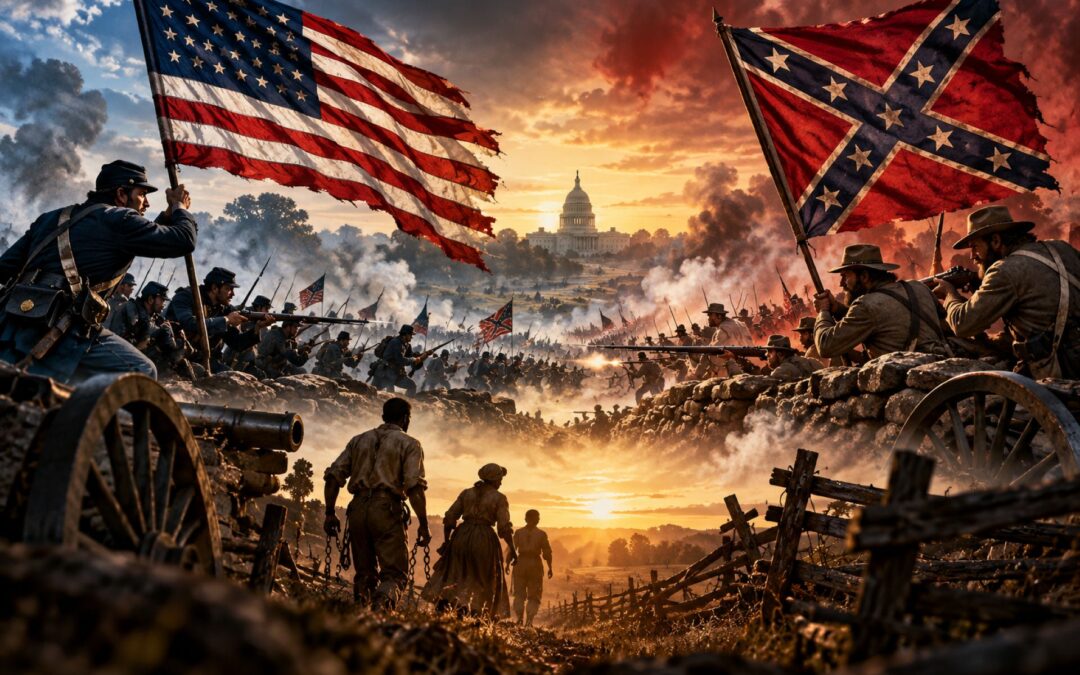
The United States was founded on a promise it could not fully keep. Its Declaration of Independence proclaimed that all men were created equal, yet the country allowed millions of people to be enslaved. For generations, Americans tried to manage this contradiction through political compromises, constitutional arguments, territorial agreements, and an uneasy balance of power between states that permitted slavery and those that did not.
By 1861, those compromises had collapsed. Eleven Southern states would attempt to leave the Union, establish their own Confederacy, and fight a war to preserve a social and economic order built on slavery. What began as a struggle over whether the United States would survive became a devastating conflict over what kind of nation it would be.
The American Civil War lasted from 1861 to 1865, killed hundreds of thousands of people, destroyed much of the Southern economy, and transformed the relationship between the federal government and its citizens. It preserved the Union and brought about the constitutional abolition of slavery, but the struggle to turn emancipation into genuine equality continued long after the armies stopped fighting.
The Republic’s Original Contradiction: Liberty and Slavery
The origins of the American Civil War lay in a contradiction that had existed since the country’s founding. The American Revolution established independence from Britain and advanced powerful ideas about natural rights, representative government, and political liberty. Yet many of the people who promoted those ideals owned enslaved people, and the new republic never resolved the question of how slavery could coexist with its founding principles.
Thomas Jefferson’s original draft of the Declaration of Independence included a passage condemning the slave trade and blaming the British monarchy for its existence. The Continental Congress removed that passage, partly because it threatened agreement among the colonies. The Constitution subsequently accommodated slavery without explicitly using the word. Its Three-Fifths Clause increased the political representation of slaveholding states by counting three-fifths of their enslaved population for representation and taxation, while other provisions protected the international slave trade from federal prohibition until 1808 and required the return of people escaping enslavement.
These compromises allowed the new federal government to function, but they also embedded slavery within the nation’s political institutions. As the United States acquired territory and admitted new states, the question of whether slavery would expand became increasingly difficult to avoid.
The Northern and Southern states gradually developed different economic and social structures. Northern states moved toward a combination of commercial agriculture, manufacturing, shipping, banking, and wage labor. Although slavery had existed in the North, most Northern states adopted gradual or immediate emancipation laws following independence, and slavery became increasingly concentrated in the South.
The Southern economy developed around labor-intensive plantation agriculture, particularly the cultivation of cotton, tobacco, rice, and sugar. Eli Whitney’s cotton gin, developed in the 1790s, made separating seeds from short-staple cotton much easier. Instead of reducing the demand for enslaved labor, the resulting expansion of cotton production increased it dramatically.
Cotton became one of America’s most important exports, and enslaved people became central to the accumulation of Southern wealth. Plantation owners depended on their forced labor, while the financial value assigned to enslaved people underpinned credit, inheritance, and political power. By 1860, nearly four million people were enslaved in the United States.
The distinction between North and South was not absolute. Northern merchants, banks, shipping companies, and textile manufacturers benefited from Southern cotton, while many white Northerners opposed slavery without supporting racial equality. Some abolitionists demanded immediate emancipation because they considered slavery morally indefensible, whereas other opponents primarily wanted to prevent its expansion into territories where free white workers hoped to settle.
Abraham Lincoln belonged to this broader antislavery political world. He believed slavery was wrong but, for much of his political career, argued that the federal government lacked constitutional authority to abolish it in states where it already existed. His preferred strategy was to prevent its expansion, placing the institution on a path toward eventual extinction.
For Southern slaveholders, that position represented an existential political threat. Restricting slavery to its existing territories could weaken slaveholding influence in Congress, limit its economic future, and eventually place the institution at the mercy of an increasingly hostile national majority. As the National Park Service explains in its account of the Civil War’s causes, economic, cultural, and constitutional disagreements contributed to sectional tensions, but slavery occupied the central position in the conflict.
Cotton, Expansion, and the Failure of Compromise
Throughout the early nineteenth century, American politicians tried to preserve a balance between free and slave states. This balance was particularly important in the Senate, where each state received two seats regardless of population. Every new state therefore threatened to alter the political relationship between the two sections.
The Missouri Compromise of 1820 attempted to settle one of the first major disputes over the expansion of slavery. Missouri entered the Union as a slave state, while Maine entered as a free state. Congress also prohibited slavery in most of the Louisiana Purchase territory north of latitude 36°30′, excluding Missouri itself.
The agreement temporarily reduced tensions, but it established a pattern in which every major territorial expansion threatened to reopen the slavery question. Southern politicians wanted guarantees that slaveholders could move into new territories with their enslaved laborers, while growing numbers of Northerners opposed allowing slavery to spread further west.
The annexation of Texas in 1845 and the Mexican-American War of 1846–1848 made the issue even more explosive. American victory brought enormous territories into the United States, including lands that would become California, Nevada, Utah, and parts of several other Western states. Politicians immediately disagreed over whether slavery should be permitted in these acquisitions.
The Compromise of 1850 attempted another settlement. California was admitted as a free state, while the territories of Utah and New Mexico were organized without an immediate congressional prohibition of slavery. The slave trade, though not slavery itself, was abolished in Washington, D.C.
The compromise also introduced a much stronger Fugitive Slave Act. Federal authorities could compel the return of people accused of escaping slavery, and the law imposed penalties on those who assisted them. It denied alleged fugitives important procedural protections, increasing the danger that even free Black Americans could be seized and forced into slavery.
For many Northerners, the law made slavery impossible to ignore. People living in states where slavery had been abolished could now be required to assist in enforcing it, provoking resistance from abolitionists and some state governments. Southern slaveholders, meanwhile, interpreted Northern resistance as evidence that the federal government could not reliably protect their interests.
Each compromise temporarily postponed a confrontation without resolving the underlying disagreement. The political system remained dependent on maintaining sectional consent, but the two sides increasingly disagreed over what that consent required.
Bleeding Kansas, John Brown, and a Political System in Crisis
The Kansas-Nebraska Act of 1854 overturned the fragile territorial settlement. Proposed by Senator Stephen Douglas, the legislation allowed settlers in Kansas and Nebraska to determine whether slavery would be permitted through a principle called popular sovereignty. In effect, it opened territory previously protected by the Missouri Compromise’s restriction to the possibility of slavery.
The result was not peaceful democratic decision-making. Proslavery and antislavery settlers entered Kansas hoping to influence its political future, while rival factions established competing governments and disputed elections. Armed violence followed, turning the territory into what became known as Bleeding Kansas.
One prominent abolitionist involved in the violence was John Brown. Believing slavery was a profound moral evil that could not be defeated through ordinary politics alone, Brown participated in the killing of five proslavery men near Pottawatomie Creek in 1856. His actions made him a deeply divisive figure, celebrated by some radical abolitionists and condemned by others for his use of violence.
The dispute over slavery was also becoming violent within the federal government itself. In May 1856, Senator Charles Sumner delivered a speech attacking proslavery interests and their political defenders. Shortly afterward, Representative Preston Brooks of South Carolina beat Sumner with a cane on the Senate floor, seriously injuring him. The incident was celebrated by some Southern supporters of slavery and regarded by many Northerners as evidence that intimidation had replaced political argument.
Popular literature also helped reshape national attitudes. Harriet Beecher Stowe’s Uncle Tom’s Cabin, published in 1852, exposed a large readership to a sentimental but powerful condemnation of slavery and family separation. The novel intensified antislavery feeling while provoking furious responses from defenders of the Southern system.
In 1857, the Supreme Court deepened the constitutional crisis with its decision in Dred Scott v. Sandford. Dred Scott had sued for freedom after living with his enslaver in areas where slavery was prohibited. Chief Justice Roger B. Taney’s majority opinion declared that people of African descent could not claim United States citizenship under the constitutional understanding advanced by the Court, and that Congress lacked authority to prohibit slavery in federal territories.
The decision undermined the central Republican argument that slavery could be contained through federal territorial policy. If Congress could not exclude slavery from the territories, opponents feared that slaveholding interests might eventually secure its expansion throughout the country.
The Republican Party had emerged in the 1850s from a coalition opposing slavery’s westward expansion. Abraham Lincoln, a largely self-educated lawyer who had served in the Illinois legislature and the House of Representatives, became one of its most effective spokesmen. He had grown up in poverty in Kentucky and Indiana before settling in Illinois, and his ability to explain complex constitutional disputes in accessible language helped establish his political reputation.
During the 1858 Illinois Senate campaign, Lincoln debated Stephen Douglas in a series of confrontations that attracted national attention. Lincoln argued that the United States could not permanently remain divided between slavery and freedom. He did not advocate immediate federal abolition in existing slave states, but he believed the country would eventually have to choose whether slavery would expand or move toward extinction.
Douglas won the Senate contest, but the debates helped make Lincoln a national figure. They also demonstrated how slavery had displaced many other political disagreements as the central question dividing American public life.
The crisis intensified in October 1859, when John Brown and a small group of followers seized the federal armory at Harpers Ferry, Virginia. Brown hoped to obtain weapons and encourage enslaved people to join an uprising against slavery, but the raid failed. Federal Marines under Colonel Robert E. Lee captured him, and Brown was subsequently tried and executed.
Brown’s raid terrified many white Southerners, who interpreted it as evidence that abolitionism threatened violent slave rebellion. Some Northerners condemned Brown’s methods while admiring his commitment to ending slavery. His execution turned him into a martyr for parts of the abolitionist movement and widened the emotional distance between the sections.
By 1860, the country had endured territorial violence, an increasingly divided political system, a Supreme Court decision that inflamed sectional disagreements, and an attempted insurrection against slavery. The mechanisms that had previously contained political conflict were failing.
Lincoln’s Election and the Southern Secession
The presidential election of 1860 exposed the extent of America’s division. The Democratic Party split over slavery, producing two major candidates: Stephen Douglas, who supported popular sovereignty, and John C. Breckinridge, who defended stronger federal protection for slavery in the territories. John Bell represented the Constitutional Union Party, which emphasized preservation of the Union while avoiding a clear resolution of the slavery dispute.
Abraham Lincoln ran as the Republican candidate, promising to oppose slavery’s expansion without immediately abolishing it in states where it already existed. He won the presidency with a plurality of the popular vote and a decisive Electoral College majority, despite carrying no slaveholding state. His victory demonstrated that Northern and Western electoral strength could produce a president without support from the Deep South.
For Southern secessionists, the result confirmed their fear that slaveholding states were losing control over the federal government. South Carolina became the first state to secede, announcing its departure in December 1860. Mississippi, Florida, Alabama, Georgia, Louisiana, and Texas followed before Lincoln took office.
Representatives of these seven states established the Confederate States of America in February 1861, choosing Jefferson Davis as president. Following the outbreak of war at Fort Sumter, Virginia, Arkansas, Tennessee, and North Carolina also seceded, bringing the Confederate total to eleven states.
Confederate leaders commonly defended secession in the language of states’ rights, constitutional liberty, and resistance to federal overreach. Yet the declarations explaining why Southern states seceded reveal how directly those arguments were connected to slavery. Mississippi’s declaration openly identified the state’s interests with slavery, while South Carolina complained about Northern resistance to fugitive slave laws and growing hostility toward the institution.
Alexander Stephens, the Confederacy’s vice president, made the underlying ideology explicit in his March 1861 Cornerstone Speech. He argued that the new Confederate government rested on white supremacy and the supposed natural inequality of Black and white people. Whatever constitutional language accompanied secession, the preservation and protection of slavery remained central to the Confederate project.
Lincoln rejected the legality of secession. He believed the Union was a continuing national political arrangement and that individual states could not unilaterally dissolve it because they disliked an election result. If states could leave whenever they lost political power, the survival of republican government would depend on the willingness of every defeated faction to accept the outcome.
The coming conflict nevertheless divided communities that did not fit neatly into Northern and Southern categories. Kentucky, Missouri, Maryland, and Delaware remained in the Union despite permitting slavery, while the loyalties of families and neighborhoods often differed sharply. Robert E. Lee, a respected United States Army officer, chose to serve Virginia after it seceded, placing loyalty to his home state above continued service in the national army.
The political crisis had created two rival governments claiming authority over parts of the same country. The immediate question was whether that division would be settled through negotiation or military force.
Fort Sumter, Bull Run, and the Illusion of a Short War
The immediate confrontation centered on Fort Sumter, a federal military installation in Charleston Harbor, South Carolina. Although South Carolina had declared independence from the United States, the federal garrison still occupied the fort. Confederate authorities demanded its surrender, while Lincoln faced the difficult choice of maintaining federal authority without appearing to launch an offensive war.
Lincoln decided to attempt a resupply mission. On April 12, 1861, Confederate artillery opened fire on Fort Sumter, and the garrison surrendered after a bombardment lasting more than a day. Although the engagement caused no combat deaths during the bombardment, it marked the beginning of the American Civil War.
Lincoln responded by calling for 75,000 volunteers to suppress the rebellion. The decision contributed to the secession of four additional Upper South states, including Virginia, whose capital, Richmond, became the Confederate capital.
Both governments initially hoped that determination and a few decisive military victories might end the confrontation quickly. The Union possessed major structural advantages: a larger population, greater industrial capacity, more extensive railroad networks, stronger financial institutions, and an established navy. The Confederacy hoped to compensate through defensive warfare, military leadership, geographical familiarity, and the political willingness to endure casualties.
Southern leaders also hoped that Britain’s and France’s dependence on American cotton might encourage diplomatic recognition or intervention. Yet European governments had other sources of supply and strong political reasons to avoid openly supporting a state founded to preserve slavery. Cotton diplomacy would prove much less effective than Confederate leaders hoped.
Union General Winfield Scott proposed a broad strategy that became known as the Anaconda Plan. Rather than relying entirely on capturing Richmond, the Union would blockade Southern ports, gain control of the Mississippi River, isolate Confederate regions, and use sustained military pressure to weaken the rebellion. The strategy recognized that destroying the Confederacy’s capacity to continue fighting would require more than defeating one army.
The first major battlefield test came in July 1861 at First Bull Run, also known as First Manassas, near Washington, D.C. Union troops advanced into Virginia hoping to defeat Confederate forces and open a route toward Richmond. Some civilians traveled from Washington to observe the battle, reflecting widespread expectations that the war might be relatively short.
Confederate forces, reinforced in part through railroad movements, resisted the attack and eventually drove the Union army into retreat. Thomas Jackson earned the nickname Stonewall during the fighting, although accounts differ over the precise circumstances of its origin.
The defeat shocked the North. It revealed weaknesses in the training, organization, and command of the inexperienced Union army, while demonstrating that the Confederacy could sustain serious resistance.
The battle also introduced an unusual personal connection to the war’s eventual conclusion. Wilmer McLean owned a farm near Manassas that was affected by the fighting, and he later moved his family farther south to Appomattox Court House. Four years later, the principal surrender meeting between Grant and Lee would take place inside his home.
Bull Run made clear that patriotic enthusiasm would not be enough to decide the war. Both sides needed trained armies, reliable supply systems, effective commanders, and the ability to survive a prolonged conflict.
McClellan, Grant, and the Two Fronts of 1862
Following the defeat at Bull Run, Lincoln turned to George B. McClellan, a talented organizer who transformed the Union’s principal Eastern force into the Army of the Potomac. McClellan improved training, discipline, logistics, and morale, earning considerable popularity among his soldiers. His organizational strengths, however, were accompanied by a persistent reluctance to risk the army in decisive operations.
McClellan frequently overestimated Confederate strength, sometimes accepting inflated intelligence estimates and assuming that enemy forces were substantially larger than they actually were. Lincoln repeatedly urged him to act more aggressively, but the general believed caution was necessary to avoid disaster.
In the spring of 1862, McClellan launched the Peninsula Campaign, transporting his army by water to the Virginia Peninsula and advancing toward Richmond from the southeast. His forces encountered Confederate resistance at Yorktown and spent valuable time preparing siege operations instead of immediately exploiting their numerical advantage.
The campaign eventually approached Richmond, but its prospects changed when Confederate General Joseph E. Johnston was wounded at Seven Pines and Robert E. Lee assumed command of the Army of Northern Virginia. Lee launched a series of attacks during the Seven Days Battles, forcing McClellan away from Richmond and toward a more secure position on the James River.
Although the engagements were costly for the Confederates and did not produce an outright destruction of the Union army, Lee succeeded in ending the immediate threat to Richmond. His aggressive style contrasted sharply with McClellan’s caution. Later that summer, Confederate victories against another Union army under John Pope at Second Bull Run strengthened Lee’s reputation and restored Confederate confidence.
Lincoln’s challenges extended beyond military leadership. His administration suspended habeas corpus in certain circumstances to deal with suspected disloyalty and threats to military operations, provoking serious constitutional disputes over wartime executive authority. In February 1862, Lincoln also suffered the death of his young son Willie, a personal tragedy amid the mounting pressures of national leadership.
While Union armies struggled in Virginia, more promising developments occurred in the West. Ulysses S. Grant emerged as an effective commander with victories at Fort Henry and Fort Donelson in Tennessee. His demand for unconditional surrender at Donelson helped establish his reputation for determination, and the victories opened important routes into Confederate territory.
Grant’s army then faced a devastating Confederate surprise attack at Shiloh in April 1862. Union forces initially struggled, but they held their position and counterattacked with reinforcements the following day. The battle produced enormous casualties and demonstrated that even Western successes would require sustained sacrifice.
The naval war also became increasingly important. Union vessels enforced the blockade of Confederate ports, while naval forces under David Farragut captured New Orleans in April 1862, depriving the Confederacy of one of its most important commercial cities. The Battle of Hampton Roads between the ironclads USS Monitor and CSS Virginia demonstrated how armored steam-powered warships were transforming naval warfare.
These developments revealed that the Civil War consisted of several interconnected campaigns rather than a single contest between armies near Washington and Richmond. Union control of rivers, ports, railways, and production centers would gradually undermine Confederate resources, even when Eastern battles appeared to favor the South.
Lincoln still needed a battlefield result that could restore Northern confidence and support a major change in national policy. That opportunity would come in Maryland.
Antietam and the Decision to Make Emancipation a War Aim
After his successes in Virginia, Robert E. Lee invaded Maryland in September 1862. He hoped to relieve pressure on war-damaged Virginia, obtain supplies, weaken Northern confidence, and perhaps achieve a victory that would encourage European recognition of the Confederacy.
Union soldiers unexpectedly discovered a copy of Lee’s operational orders, which revealed how Confederate forces were divided during the campaign. McClellan possessed valuable intelligence, but his movements were not swift enough to destroy Lee’s army before it could concentrate.
The opposing forces met near Antietam Creek on September 17, 1862. Fighting around the Cornfield, the Sunken Road, and Burnside Bridge produced terrible casualties as Union attacks repeatedly struck Confederate positions. Approximately 23,000 soldiers were killed, wounded, or missing across both armies, making Antietam the bloodiest single day in American military history.
The battle did not produce the decisive battlefield destruction Lincoln wanted. McClellan failed to use all his available forces in a coordinated assault, while Lee maintained enough of his army to withdraw into Virginia. Nevertheless, Lee’s invasion had been stopped, giving the Union an important strategic result.
For Lincoln, the timing was crucial. He had been considering an emancipation policy but feared that announcing it immediately after a military defeat would make the government appear desperate. Antietam provided an opportunity to present emancipation as a confident wartime decision rather than a last attempt to reverse military failure.
On September 22, 1862, Lincoln announced the preliminary Emancipation Proclamation. It warned that enslaved people in states or designated parts of states still in rebellion on January 1, 1863, would be declared free.
Lincoln’s immediate objective when the war began had been the preservation of the Union. His September decision did not abandon that objective, but it connected Union victory to the destruction of slavery in Confederate territory. The federal government was now moving toward a war that could not end simply by restoring the previous political arrangement.
What Emancipation Changed—and What It Did Not
On January 1, 1863, Lincoln issued the final Emancipation Proclamation, declaring enslaved people free in areas designated as being in rebellion against the United States. The proclamation was issued under his authority as commander in chief and rested on the federal government’s wartime powers.
Its limitations were significant. It did not apply to the slaveholding border states that remained loyal to the Union, and it exempted certain Confederate-controlled or formerly Confederate areas specifically identified in the document. Because much of the territory it covered remained under Confederate military control, its practical enforcement depended on Union military advances.
These limitations have sometimes encouraged the mistaken conclusion that the proclamation accomplished very little. In reality, its legal, military, and political consequences were substantial.
The federal government had formally committed itself to emancipation as a consequence of defeating the rebellion. As Union armies entered Confederate territory, enslaved people could seek protection behind federal lines and establish claims to freedom. The policy also made the restoration of the old slaveholding order increasingly incompatible with a successful Union war effort.
Enslaved people were not passive recipients of freedom. Throughout the conflict, they escaped from plantations, disrupted forced-labor systems, supplied intelligence, worked for Union forces, and helped undermine Confederate economic and military operations. Their actions had already forced federal authorities to confront difficult questions about the legal status of people escaping from slaveholders who supported the rebellion.
The proclamation therefore gave greater legal recognition to a process that enslaved people themselves had helped create. Freedom emerged through the interaction of military victory, political decisions, abolitionist campaigning, and the actions of those who had been enslaved.
Emancipation also changed the war’s international meaning. British and French governments had considered the conflict in relation to economic interests, diplomacy, and the balance of power, but open support for the Confederacy became politically more difficult once Union victory was explicitly tied to ending slavery. Strong antislavery sentiment among parts of the European public further complicated Confederate hopes for intervention.
Another important consequence was Black military enlistment. The proclamation authorized the reception of Black men into Union armed service, while subsequent military organization helped make that policy a reality. The War Department’s General Order No. 143, establishing the Bureau of United States Colored Troops, provided an administrative framework for recruiting and organizing Black soldiers.
Emancipation did not instantly abolish slavery throughout the country. Yet it transformed the nature of the conflict by making the destruction of slavery an increasingly central condition of Union victory.
Fredericksburg, Chancellorsville, and the Crisis of 1863
Lincoln’s difficulties with his Eastern commanders continued despite Antietam. Frustrated by McClellan’s failure to pursue Lee decisively, Lincoln removed him from command and replaced him with Ambrose Burnside. The new general attempted an offensive toward Fredericksburg, Virginia, in December 1862.
Burnside planned to cross the Rappahannock River and advance against Confederate forces, but delays in obtaining the necessary pontoon bridges disrupted his timetable. By the time Union troops crossed, Lee had concentrated his army on strong defensive ground west of Fredericksburg.
Union attacks against Confederate positions around Marye’s Heights became disastrous. Soldiers advanced across exposed terrain toward entrenched defenders, suffering severe casualties without breaking the Confederate line. The defeat further damaged Northern morale and raised questions about whether Union commanders could defeat Lee in Virginia.
Lincoln eventually replaced Burnside with Joseph Hooker, who reorganized and restored confidence in the Army of the Potomac. In the spring of 1863, Hooker attempted to outmaneuver Lee around Chancellorsville. Despite possessing a larger army and an initially promising operational position, Hooker struggled to exploit his advantages.
Lee divided his smaller forces and launched an audacious attack against the Union position. Stonewall Jackson led a devastating assault against Hooker’s exposed flank, contributing to another Confederate victory.
The triumph came at a heavy cost. Jackson was accidentally wounded by Confederate soldiers while returning from reconnaissance, and he died several days later from complications that included pneumonia. His death deprived Lee of one of his most important commanders.
Chancellorsville strengthened Lee’s military reputation, but it also illustrated the limits of Confederate battlefield success. His army could defeat larger Union forces through bold maneuver and effective leadership, yet every campaign consumed soldiers and resources that the South struggled to replace.
For Lincoln, the problem remained unresolved. The Union had superior overall resources, but it needed commanders capable of turning those advantages into lasting strategic results.
Gettysburg and Vicksburg: The Twin Victories
In the summer of 1863, two campaigns changed the direction of the Civil War. One unfolded in Pennsylvania, where Lee attempted another invasion of the North. The other took place along the Mississippi River, where Grant sought to cut the Confederacy in two.
Lee moved his Army of Northern Virginia into Pennsylvania hoping to obtain supplies, relieve pressure on Virginia, and perhaps secure a victory that would undermine Northern willingness to continue fighting. Lincoln appointed George G. Meade to command the Army of the Potomac shortly before the opposing forces encountered one another near Gettysburg.
The Battle of Gettysburg began on July 1, 1863, as Confederate forces attacked Union troops near the town. After heavy fighting, Union forces withdrew to defensive high ground around Cemetery Hill, Cemetery Ridge, and nearby positions.
On July 2, Lee attacked the Union flanks in an attempt to disrupt the defensive line. Fierce fighting took place at Little Round Top, the Wheatfield, the Peach Orchard, and Devil’s Den. Union troops suffered heavy losses but prevented the Confederates from breaking their position decisively.
Lee renewed the offensive on July 3 with a massive attack against the Union center. Following an artillery bombardment, Confederate infantry advanced across exposed fields in what became known as Pickett’s Charge. Union artillery and infantry devastated the assault, forcing the surviving attackers to retreat.
The three-day battle produced more than 50,000 casualties across the two armies. Lee withdrew toward Virginia, and Meade did not destroy the retreating Confederate army. Gettysburg therefore did not end the Eastern war, but it ended Lee’s invasion and severely damaged Confederate hopes of winning a decisive victory on Northern soil.
Almost simultaneously, Grant achieved a major victory in Mississippi. Vicksburg stood on high ground overlooking the Mississippi River and remained one of the most important Confederate strongholds controlling transportation along the waterway.
Grant’s Vicksburg campaign combined naval cooperation, operational maneuver, battles against Confederate forces, and siege warfare. After crossing the Mississippi south of the city, Grant moved inland, defeated Confederate armies, and cut Vicksburg’s connections to potential reinforcements. His forces then surrounded the city, subjecting its defenders and civilian population to a prolonged siege.
Vicksburg surrendered on July 4, 1863, one day after the fighting at Gettysburg ended. The subsequent surrender of Port Hudson completed Union control of the Mississippi River, separating Confederate territories west of the river from the main Confederate states farther east.
The Union’s ability to coordinate military operations across regions was becoming increasingly significant. Capturing the Mississippi disrupted Confederate transportation and supply networks, while victory at Gettysburg prevented Lee from achieving the political and military results he sought through invasion.
June 1863 had also brought West Virginia’s admission to the Union. Its creation from counties that separated from Confederate Virginia illustrated how sectional loyalties could divide individual states, not merely the nation as a whole.
The Confederacy retained powerful armies after the twin victories and would continue fighting for nearly two more years. Nevertheless, its strategic position had deteriorated considerably, while the Union had demonstrated that its material advantages could be converted into decisive territorial gains.
Black Soldiers, Civilians, and the War Behind the Lines
The American Civil War was not fought exclusively by the generals and soldiers whose names dominate battlefield histories. It transformed the lives of enslaved people, free Black Americans, women, industrial workers, farmers, Native American communities, and civilians living under military occupation.
The decision to recruit Black soldiers marked one of the most important developments in the conflict. Frederick Douglass and other Black abolitionists had demanded that African Americans be allowed to fight for the Union, arguing that a war against slavery should include the people whose freedom was at stake.
Following the Emancipation Proclamation and the expansion of federal recruitment, Black enlistment increased rapidly. By the war’s end, approximately 179,000 Black men had served in the Union Army, with roughly 19,000 more serving in the Navy. Their contribution strengthened Union manpower and helped demonstrate the determination of Black Americans to defend and expand their freedom.
Black soldiers frequently faced discrimination, unequal treatment, and dangerous assignments. Confederate forces also subjected captured Black troops to especially severe treatment, reflecting the Confederacy’s refusal to recognize them as legitimate soldiers on the same terms as white Union troops. Their service nevertheless strengthened Black claims to citizenship and political rights.
The 54th Massachusetts Infantry, one of the best-known Black regiments, became nationally recognized for its courage during the assault on Fort Wagner in 1863. Although the attack failed militarily, the regiment’s performance challenged racist assumptions about Black soldiers’ abilities and encouraged further recruitment.
For civilians, the war brought shortages, inflation, displacement, destruction, and uncertainty. Southern communities suffered severely as the blockade restricted trade and Union armies disrupted agricultural and transportation systems. Enslaved people used the shifting military front lines to escape, seek employment, reunite with relatives, and pursue freedom.
Women played important roles in maintaining households, managing farms and businesses, working in hospitals, and supporting armies. Clara Barton became particularly well known for delivering medical supplies and helping care for wounded soldiers near battlefields. Thousands of less famous nurses, volunteers, and relief workers performed equally essential labor amid overwhelmed medical systems.
Disease was another major threat. Inadequate sanitation, contaminated water, overcrowded camps, and limited medical knowledge contributed to widespread illness. Many soldiers died from disease rather than battlefield wounds, while those who survived could face permanent injuries, disability, or psychological trauma.
Military recruitment also created political tension. Both governments introduced forms of conscription, and exemptions or substitution arrangements produced resentment over the unequal burdens of service. In the North, opposition to the draft sometimes overlapped with racial hostility and working-class fears about economic competition.
These tensions erupted during the New York City draft riots of July 1863, documented by the Library of Congress. Rioters attacked government property, wealthy residents, and Black New Yorkers, exposing the limits of Northern unity and the deep racial prejudice that persisted even within the Union.
The war also reached Native American nations, particularly in Indian Territory, where different communities and leaders aligned with the Union or Confederacy for complicated political, economic, and strategic reasons. Some people fought to protect tribal interests, others were influenced by existing slaveholding practices or treaty obligations, and many experienced displacement and suffering regardless of their loyalties.
These experiences reveal why the Civil War cannot be understood through battlefield results alone. The armies fought over political control and military territory, but the conflict also reordered work, family life, social relationships, and the meaning of freedom for millions of people.
Chickamauga and Chattanooga: Winning the Western War
Even after Vicksburg, the struggle for the Western Theater continued. Union forces sought control of Tennessee and Georgia, where railway connections, industrial centers, and agricultural resources remained vital to Confederate resistance.
In September 1863, Confederate General Braxton Bragg defeated Union General William Rosecrans at Chickamauga in northern Georgia. The battle was one of the war’s bloodiest, and Union forces retreated toward Chattanooga, Tennessee. George H. Thomas earned the nickname Rock of Chickamauga for his determined defense during the retreat.
The Confederate army then attempted to isolate Union troops in Chattanooga by controlling the surrounding high ground and disrupting supplies. The city became strategically important because of its railway connections and position near routes into the Deep South.
Grant was appointed to command Union forces in the region and worked to reopen supply routes into Chattanooga. Reinforcements arrived, including forces associated with William Tecumseh Sherman and Joseph Hooker, while Thomas remained an important commander in the city’s defense.
In November 1863, Union armies attacked Confederate positions around Chattanooga. Fighting at Lookout Mountain and Missionary Ridge broke the Confederate hold on the area and forced Bragg’s army to retreat. The victory strengthened Union control of Tennessee and established a starting point for future operations toward Atlanta.
That same month, Lincoln traveled to Gettysburg to dedicate a national cemetery. On November 19, 1863, he delivered the Gettysburg Address, a brief speech that transformed the meaning of the war into a statement about national purpose.
Lincoln described the United States as a nation founded on liberty and equality, now facing a test of whether such a republic could endure. He called for a new birth of freedom, presenting the sacrifices of the dead as an obligation for the living to finish the work of national transformation.
By the end of 1863, Union victories in Mississippi and Tennessee had weakened Confederate control of the West. At the same time, emancipation and Lincoln’s language at Gettysburg were reshaping the political meaning of those victories.
Grant’s Overland Campaign and the Siege of Petersburg
In March 1864, Lincoln promoted Ulysses S. Grant to lieutenant general and placed him in command of all Union armies. Grant’s experience in the Western Theater had convinced Lincoln that he possessed the strategic determination needed to coordinate a national campaign.
Grant recognized that the Confederacy could not be defeated through isolated victories alone. Southern armies had repeatedly survived battlefield losses, withdrawn into defensible positions, and continued resisting. The Union therefore needed sustained pressure across several theaters to prevent Confederate forces from reinforcing one another.
Grant established his headquarters with the Army of the Potomac, commanded directly by George Meade, and directed operations against Lee in Virginia. Sherman would advance through Georgia, while other Union armies attacked Confederate positions elsewhere.
The resulting Overland Campaign began in May 1864 with fighting in the Wilderness, a heavily wooded region of Virginia where limited visibility and difficult terrain contributed to confused and brutal combat. Neither army achieved a decisive victory, but Grant made an important strategic decision by continuing south instead of retreating toward Washington.
At Spotsylvania Court House, repeated attacks produced severe casualties, including intense close-range fighting around the Bloody Angle. Grant continued attempting to turn Lee’s positions and force further engagements, while Lee used defensive terrain and fortifications to resist the advance.
The fighting at Cold Harbor in June brought another costly Union failure. Federal troops attacked strongly defended Confederate positions and suffered heavy losses, adding to criticism that Grant was sacrificing soldiers through excessively aggressive operations.
Grant’s campaign involved serious operational risks and controversial decisions, and his critics called him a butcher. Yet the strategic situation differed from earlier Union campaigns. Grant understood that repeatedly withdrawing after an unsuccessful battle allowed Lee to recover, while continuing pressure limited the Confederacy’s ability to replace losses, reorganize, or shift resources elsewhere.
After Cold Harbor, Grant moved his army across the James River toward Petersburg, a major railway center supplying Richmond. Initial Union attacks failed to capture the city, and the campaign developed into months of trench warfare, siege operations, and attempts to sever Confederate supply lines.
The struggle around Petersburg increasingly resembled later industrial warfare, with extensive fortifications, artillery, supply networks, and battles of attrition. Lee’s army remained dangerous, but its resources were being steadily exhausted.
Confederate General Jubal Early attempted to relieve some of the pressure by launching a campaign through the Shenandoah Valley and threatening Washington in July 1864. His forces approached the capital before withdrawing, reminding Northern civilians that Confederate armies could still mount serious operations.
By late 1864, Grant had not captured Richmond or destroyed Lee’s army. Nevertheless, the Confederacy’s ability to continue fighting was weakening, while Union operations elsewhere were beginning to deliver the victories needed to sustain Northern political support.
Sherman, Atlanta, and Lincoln’s 1864 Reelection
While Grant fought Lee in Virginia, William Tecumseh Sherman advanced south from Chattanooga toward Atlanta. Georgia’s railway connections and industrial resources made Atlanta one of the Confederacy’s most important military and transportation centers.
Sherman faced Confederate forces initially commanded by Joseph E. Johnston, who used defensive positions and withdrawals to slow the Union advance. Frustrated by Johnston’s approach, Confederate President Jefferson Davis replaced him with John Bell Hood, who adopted a more aggressive strategy.
Hood launched attacks against Sherman’s armies but failed to halt their advance. Union forces increasingly threatened Atlanta’s transportation connections, and Confederate defenders were eventually forced to abandon the city.
The capture of Atlanta in September 1864 was a major strategic and political achievement. It demonstrated that Union armies could penetrate the Confederate heartland and seize a critical center of transportation and military production.
The victory came at a crucial moment for Lincoln. By the summer of 1864, many Northerners were exhausted by the war. Casualties remained enormous, the draft was unpopular, and military progress in Virginia appeared slow. Lincoln himself feared that he might lose the upcoming presidential election.
The Democratic Party nominated George B. McClellan, Lincoln’s former commander. Its platform called for efforts to restore peace through negotiations, although McClellan personally favored continuing the struggle to preserve the Union. These differences complicated the party’s message but also raised the possibility that a new administration might pursue a different approach to ending the war.
For the Confederacy, Lincoln’s defeat appeared to offer a possible political route to survival. Southern leaders increasingly hoped that prolonged resistance would exhaust Northern willingness to fight, even if Confederate armies could no longer secure decisive military victories.
Atlanta weakened that calculation. Its capture encouraged Northern confidence, demonstrated that military progress remained possible, and strengthened Lincoln’s position. Additional Union successes, together with support among Union soldiers, helped him win reelection in November 1864.
Lincoln’s victory ensured the continuation of a government committed to defeating the rebellion. It also strengthened the political position of those seeking a constitutional measure that would permanently abolish slavery.
The Confederacy had failed to secure military independence and had now lost much of its hope that Northern electoral politics would end the war on favorable terms.
Hard War, the Thirteenth Amendment, and Confederate Collapse
After capturing Atlanta, Sherman began his March to the Sea in November 1864. His army moved across Georgia toward Savannah, destroying railway infrastructure, military supplies, and resources that supported Confederate operations.
Sherman’s strategy aimed to reduce the South’s capacity and willingness to continue fighting. Rather than limiting military operations to enemy armies, Union forces targeted transportation networks, supply systems, and economic resources essential to Confederate resistance.
The campaign caused extensive destruction and civilian hardship. Union soldiers dismantled railways, seized food and supplies, and destroyed facilities with military value. Unauthorized looting and other abuses also occurred, although the scale and responsibility for particular incidents require careful distinction from official military orders.
The march demonstrated how warfare could undermine an enemy’s entire supporting economy. It also revealed the costs of such a strategy for civilians who lived along the army’s route, including people already struggling with shortages and displacement.
As Sherman moved through Georgia, enslaved people escaped plantations and sought protection with Union forces. The advance of federal armies helped destroy the practical authority of slaveholders, even as the Union military faced serious difficulties providing food, protection, and long-term security to those seeking freedom.
Sherman captured Savannah in December 1864 and then moved north through the Carolinas in early 1865. The campaign further weakened Confederate transportation and infrastructure while adding pressure to the remaining Southern armies.
Military emancipation, however, was not sufficient to guarantee the permanent abolition of slavery throughout the United States. Lincoln recognized that the Emancipation Proclamation rested on wartime powers and applied only to designated rebel territories. A constitutional amendment offered a stronger and more comprehensive foundation for abolishing slavery.
Congress had already debated such an amendment, and the Senate approved it in April 1864. Its passage through the House of Representatives required additional political effort, persuasion, and support from legislators who had previously opposed it.
On January 31, 1865, the House passed the proposed Thirteenth Amendment. The amendment prohibited slavery and involuntary servitude throughout the United States, except as punishment for a crime following conviction. It was ratified by the necessary number of states on December 6, 1865, after Lincoln’s death.
The amendment represented a fundamental constitutional transformation. For the first time, the federal Constitution explicitly prohibited the system of slavery that had been accommodated within the republic since its founding. Yet it did not independently settle questions of citizenship, political participation, economic independence, or equal protection.
By early 1865, the Confederacy’s military and economic position was becoming desperate. The blockade had restricted trade, Union armies controlled major waterways and transportation routes, and repeated campaigns had reduced Southern manpower and industrial capacity.
Inflation, shortages, desertion, and exhaustion weakened Confederate society. Although many soldiers continued resisting, the Confederacy could no longer readily replace its losses or maintain the supply networks needed to support armies across its remaining territory.
As Sherman advanced through the Carolinas and Grant tightened his operations around Petersburg, the Confederacy faced simultaneous pressure that its remaining forces could not effectively relieve.
The war was moving toward its military conclusion, but the most difficult questions about peace and freedom were still unresolved.
Appomattox and Lincoln’s Assassination
In the spring of 1865, Grant’s forces finally broke through the Confederate defenses around Petersburg. The loss of this critical railway and supply center made Richmond increasingly impossible to defend, forcing Lee to abandon both Petersburg and the Confederate capital.
Union forces entered Richmond in early April, while Confederate leaders and remaining troops fled. Lee attempted to move westward, obtain supplies, and join other Confederate forces, but his exhausted army faced constant pursuit and mounting desertion.
With escape increasingly impossible, Lee agreed to meet Grant at Appomattox Court House, Virginia. On April 9, 1865, the two generals met in the home of Wilmer McLean, whose property had also been associated with the war’s opening battle at Manassas.
The surrender terms were comparatively generous. Confederate soldiers were allowed to return home after giving their paroles, officers could retain their sidearms, and men who owned horses could take them for spring planting. Grant recognized that humiliating defeated soldiers would make national reconciliation more difficult.
When Union troops began celebrating, Grant discouraged displays that might humiliate the surrendered Confederates. The war between these particular armies had ended, and he wanted the defeated men to return to civilian life rather than continue resistance.
Appomattox became the symbolic end of the Civil War, but it was not the final Confederate surrender. Other armies remained in the field, including forces under Joseph E. Johnston, who surrendered later in April, and Confederate troops farther west whose resistance ended over subsequent weeks. Jefferson Davis, who had fled Richmond, was captured by Union forces in May 1865.
Lincoln had already begun considering how the nation might reunite. In his Second Inaugural Address on March 4, 1865, he acknowledged the moral responsibility of slavery for the conflict and called for reconciliation without vindictiveness. He did not portray Union victory simply as proof of Northern innocence, but as an opportunity to rebuild the country after immense suffering.
His thinking about Black political rights was also developing. In his final public speech on April 11, Lincoln expressed support for extending voting rights to at least some Black men, particularly educated men and those who had served in the Union military. Although far short of universal Black male suffrage, the position represented an important movement beyond his earlier political views.
Three days later, on April 14, Lincoln attended a performance at Ford’s Theatre in Washington, D.C. John Wilkes Booth, an actor and Confederate sympathizer, entered the presidential box and shot him. Lincoln died the following morning, April 15, becoming the first American president to be assassinated.
Booth fled after the assassination but was tracked down and killed by federal soldiers on April 26. The conspiracy and assassination shocked a country that had only just begun celebrating the Confederacy’s defeat.
Lincoln’s death deprived the United States of its wartime president at the moment when the government faced enormous decisions about the restoration of Southern states and the protection of formerly enslaved people.
His successor, Andrew Johnson, approached many of those decisions differently from congressional Republicans who favored stronger federal protection for Black freedom and more extensive political transformation in the South. The struggle over the meaning of Union victory would continue through the presidency, Congress, the courts, and the former Confederate states.
The armies were surrendering, but military victory had not determined the political terms on which the country would be reunited.
Reconstruction and the Unfinished Meaning of Union Victory
The end of the Civil War created a problem unlike any the United States had previously faced. The federal government needed to restore the former Confederate states, establish new political institutions, rebuild a devastated economy, and determine what freedom meant for approximately four million formerly enslaved people.
This period became known as Reconstruction. It extended beyond the immediate years following Lincoln’s assassination and involved competing attempts to define citizenship, civil rights, federal authority, and the relationship between the national government and the Southern states.
For formerly enslaved people, emancipation created opportunities that had been systematically denied under slavery. Families separated through sale and forced migration searched for one another. Black communities established churches, schools, associations, and businesses, while individuals pursued wages, land, education, and greater control over their lives.
The federal government established the Freedmen’s Bureau to provide assistance with food, education, labor arrangements, and other needs in the former Confederate states. Its achievements were significant but limited by inadequate resources, political resistance, and the enormous scale of the problems it faced.
The constitutional transformation continued after the Thirteenth Amendment. The Fourteenth Amendment, ratified in 1868, established national citizenship for people born or naturalized in the United States, subject to constitutional qualifications, and required states to provide due process and equal protection under the law.
The Fifteenth Amendment, ratified in 1870, prohibited the federal and state governments from denying voting rights on the basis of race, color, or previous condition of servitude. Together, the Reconstruction amendments fundamentally altered the Constitution by placing important protections for freedom and citizenship within federal constitutional law.
For a time, Reconstruction produced remarkable political change. Black men voted and held public office at local, state, and national levels. Black legislators helped establish public schools and participated in writing new state constitutions, while interracial Republican coalitions attempted to reshape Southern political life.
These developments were fiercely resisted. Former Confederates and white supremacist organizations used intimidation, economic coercion, and violence to undermine Black political participation and restore white control. The Ku Klux Klan and other groups attacked Black citizens, political organizers, teachers, and Republican officials.
President Andrew Johnson’s lenient approach toward former Confederate elites contributed to political conflict with Congress. Congressional Republicans adopted stronger Reconstruction policies, including federal oversight and military administration in the former Confederate states, while also passing civil rights legislation intended to defend the rights of freedpeople.
The period became a struggle over the practical meaning of emancipation. Abolishing slavery did not automatically provide land, reliable employment, physical security, political power, or protection from discriminatory state laws. Formerly enslaved people demanded those conditions, while opponents of Reconstruction attempted to restrict Black independence and restore older racial hierarchies through new institutions.
As historian Eric Foner explains in the National Park Service’s account of Reconstruction, the period fundamentally reshaped American citizenship and federal responsibilities, even though many of its achievements were later undermined.
Northern commitment to Reconstruction weakened over time. Economic problems, political disputes, corruption scandals, and fatigue with federal intervention reduced support for continued enforcement. The withdrawal of remaining federal troops from the South in 1877 became a major turning point in the retreat from Reconstruction, although the dismantling of its protections occurred over a longer period.
By the end of the nineteenth century, Southern governments had established segregation and increasingly effective systems of Black voter suppression. Poll taxes, literacy tests, discriminatory administration, political violence, and judicial decisions undermined many of the rights that Reconstruction had attempted to secure.
The defeat of the Confederacy therefore did not produce a straightforward transition from slavery to equality. It destroyed the legal institution of slavery and established constitutional protections, but generations of Black Americans would continue fighting to make those protections effective.
Reconstruction also changed the balance of power between the states and the federal government. The national government had defeated an attempted secession and established constitutional authority to protect important individual rights against state action. Questions about how actively it would enforce that authority remained central to American political life.
The war’s legacy also became a struggle over memory. In the decades that followed, interpretations that minimized slavery’s role in secession and romanticized Confederate leadership influenced education, public monuments, and popular culture. These narratives frequently obscured both the Confederacy’s original political objectives and the experiences of enslaved people.
The Civil War thus became part of the wider history of the United States, shaping later conflicts over civil rights, federal authority, citizenship, and national identity. Its consequences did not end in 1865, and many of the issues addressed during Reconstruction would reappear in twentieth-century movements for racial justice.
The American Civil War began because the United States could no longer reconcile its expanding republic with the continued existence and political protection of slavery. Southern secession transformed that dispute into a military rebellion, while Union victory depended on industrial capacity, military organization, strategic leadership, political endurance, and the contributions of people who fought for their own freedom.
Lincoln’s leadership mattered enormously, but he did not accomplish emancipation alone. Enslaved people’s resistance, abolitionist activism, Black military service, Union soldiers, civilian labor, and evolving national policy all contributed to destroying the slaveholding Confederacy.
The war preserved the Union, abolished slavery through constitutional amendment, and fundamentally changed the meaning of American citizenship. Yet the incomplete promises of Reconstruction demonstrated that legal freedom and political equality were not identical achievements.
The Civil War remains a defining event in American history because it reveals both the power and the limits of national transformation. The United States survived its greatest internal conflict and dismantled an institution deeply embedded in its founding political order. The challenge that followed was whether the country could build a society worthy of the freedom for which so many people had fought and died.
Last Updated on October 22, 2026 by Aseem Gupta