
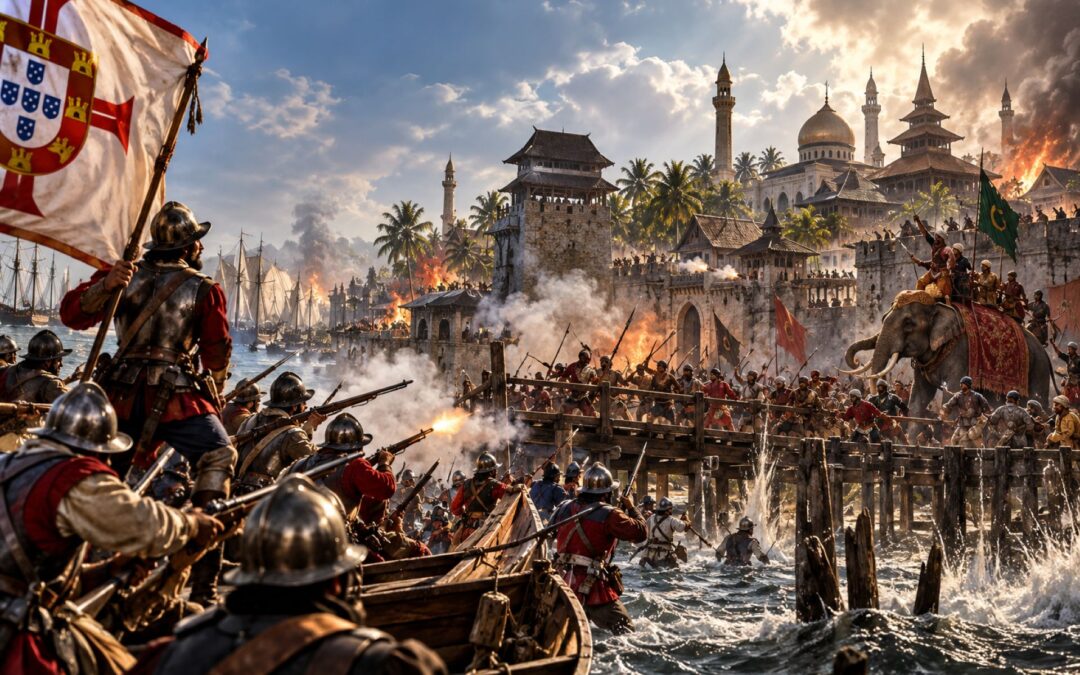
In 1511, a Portuguese expedition commanded by Afonso de Albuquerque captured Malacca, one of the wealthiest and most strategically important trading cities in Southeast Asia. The attacking force numbered roughly a thousand men, although historical estimates vary. Its opponent was a prosperous sultanate with an established military, gunpowder weapons, war elephants, foreign mercenaries, and access to the resources of an extensive maritime trading network.
The conquest presents a remarkable historical puzzle. How could such a small expedition defeat the defenders of a major Asian commercial centre? The answer is not simply that the Portuguese possessed superior weapons or that Malacca was incapable of defending itself. The city had substantial military resources, but its political divisions, commercial dependencies, and geographical layout created vulnerabilities that Albuquerque exploited through intelligence, naval bombardment, and carefully coordinated assaults.
Understanding the fall of Malacca requires examining the trading empire that Portugal wanted to control, the political tensions within the city, and the battle for a bridge that became the centre of the campaign.
Why Malacca Was Worth Conquering
At the beginning of the sixteenth century, Malacca occupied one of the most valuable commercial locations in Asia. Situated on the Malay Peninsula beside the Strait of Malacca, the city stood along the maritime passage connecting the Indian Ocean with the South China Sea. Ships carrying goods between India, Southeast Asia, China, and the wider Indian Ocean world regularly travelled through this region.
Malacca’s importance emerged from its ability to bring these trading networks together. Founded as a political centre around the beginning of the fifteenth century, it grew into an international port where merchants could exchange commodities originating thousands of kilometres apart. Indian textiles, Chinese ceramics and silk, Southeast Asian spices, precious metals, aromatic woods, and numerous other products passed through its markets.
Much of this commerce depended on redistribution rather than direct trade between producers and final consumers. A merchant arriving from India might sell textiles to traders who subsequently carried them farther east, while another ship could transport spices acquired from the Indonesian archipelago toward ports in the western Indian Ocean. Malacca prospered because merchants with different destinations, languages, and commercial relationships could conduct business in the same city.
Its prosperity also depended on institutions that facilitated international trade. The Sultanate appointed officials known as shahbandars, or harbourmasters, to supervise foreign merchants and commercial affairs. Different trading communities maintained their own networks, while the government regulated taxation, maritime activity, and commercial relationships. The Malacca Sultanate’s trading institutions and international connections helped transform the city from a convenient stopping point into a major commercial centre.
Malacca’s political position was equally sophisticated. Its rulers maintained relationships with regional powers and with Ming China, whose maritime expeditions and diplomatic interests had contributed to the wider commercial environment of fifteenth-century Southeast Asia. As historical scholarship on Melaka’s position within competing Asian political and commercial orders demonstrates, the Sultanate operated within a complex regional system rather than existing as an isolated kingdom.
These relationships were part of the broader maritime trading networks connecting India and China. Southeast Asian ports were active participants in those networks, influencing where ships stopped, how merchandise was exchanged, and which rulers benefited from international commerce.
For Portugal, the attraction was obvious. Since Vasco da Gama’s arrival in India in 1498, Portuguese rulers and commanders had sought to establish a powerful position in the Indian Ocean trading system. Their ambitions extended beyond purchasing spices from Asian merchants. They wanted fortified bases, influence over shipping routes, and the ability to compel vessels to operate under Portuguese commercial and military demands.
Malacca offered an eastern gateway into the spice trade and a permanent position near the routes leading toward the Indonesian archipelago and China. Capturing the port would not give Portugal automatic control over every ship passing through Southeast Asia, but it could provide an important strategic base from which to influence the region’s commerce.
That opportunity brought the Portuguese into direct conflict with the Sultanate.
The Portuguese Mission That Failed in 1509
The first major Portuguese encounter with Malacca occurred in 1509, when an expedition commanded by Diogo Lopes de Sequeira arrived at the port. Its immediate objective was to establish commercial relations and obtain a trading foothold. However, Portuguese activity elsewhere in the Indian Ocean had already demonstrated that such missions could lead to demands for fortified positions, preferential treatment, and military intervention.
Sultan Mahmud Shah initially permitted contact with the newcomers. Malacca regularly hosted foreign merchants, and the arrival of another trading group was not inherently extraordinary. The problem was that the Portuguese were not simply another commercial community operating under the city’s established arrangements. Their expanding military presence threatened to alter the balance of power that supported existing trade.
Some merchants and political figures consequently regarded them with suspicion. Traders connected to established Indian Ocean networks had reasons to fear Portuguese interference with their commercial privileges, while members of the Sultan’s administration faced the question of whether admitting the newcomers would strengthen or undermine Malacca’s position.
Relations deteriorated, and an attack was organised against the Portuguese expedition. Sequeira escaped with his ships, but several Portuguese men remained behind and were imprisoned. The details of the episode differ across accounts, including the precise number of prisoners and the circumstances surrounding the attack. What matters for the later conquest is that the failed mission established mutual hostility and left Portuguese captives inside the city.
The prisoners became both a diplomatic issue and a potential source of intelligence. Their presence gave Portugal a reason to demand concessions from Sultan Mahmud, while the information available to them could help a future expedition understand the city and its government.
Meanwhile, Portuguese military expansion continued in India. Afonso de Albuquerque, who became governor of the Portuguese possessions there in 1509, pursued a strategy based on controlling selected ports and establishing fortified positions. His capture of Goa in 1510 provided an important base on India’s western coast and strengthened Portugal’s capacity to conduct operations farther east.
Albuquerque understood that commanding a port could be more valuable than attempting to conquer vast inland territories. Fortresses, naval squadrons, and strategic harbours could support Portuguese shipping while allowing relatively small military forces to exercise influence across considerable distances.
Malacca fitted this approach. It was wealthy, commercially connected, and positioned near one of Asia’s most important maritime passages. The failed expedition of 1509 had also demonstrated that the Sultanate would not necessarily accept Portuguese demands peacefully.
By 1511, Albuquerque was preparing to return with a military expedition capable of doing what Sequeira’s mission had failed to accomplish.
A Prosperous Sultanate with Divided Loyalties
Malacca’s extraordinary commercial diversity was a source of wealth, but it also created a complicated political environment. Malay rulers governed a city containing influential Tamil, Gujarati, Javanese, Chinese, and other merchant communities. Their relationships with the Sultanate depended on commercial privileges, personal alliances, religious institutions, and the protection they received from the government.
These communities were not uniform political organisations. Wealthy merchants could possess substantial influence, while ordinary traders, sailors, labourers, and mercenaries operated under very different circumstances. Their interests sometimes overlapped, but loyalty to the Sultan could not be assumed simply because a person belonged to a particular ethnic or religious group.
One of the most controversial episodes in Malacca’s political history involved Bendahara Tun Muzahir, also known in some accounts as Tun Mutahir. The bendahara occupied a senior administrative position, broadly comparable to a chief minister. Traditional narratives describe accusations against him and other influential figures, followed by their execution on Sultan Mahmud’s orders.
In the familiar version of the story, the executions seriously damaged the Sultan’s authority. Powerful families and merchant groups allegedly became alienated from the government, creating an opportunity for the Portuguese to gain allies inside Malacca. Some accounts connect the affair with rivalries at court and accusations that Tun Muzahir intended to challenge the ruler.
However, this explanation is disputed. Historian Azmi Arifin’s examination of the conflict between Sultan Mahmud Shah and Tun Muzahir challenges the conventional interpretation of the episode and its supposed relationship to the conquest. The surviving traditions cannot safely establish that the executions directly caused Malacca’s defeat.
The political crisis nevertheless illustrates an important feature of the Sultanate. Authority depended on relationships among the ruler, senior officials, aristocratic households, military commanders, and commercial elites. Disputes involving these groups could affect cooperation during a crisis, particularly when a foreign power offered opportunities to individuals dissatisfied with the existing government.
One important figure was Nina Chatu, an influential merchant associated with Malacca’s Tamil trading community. Portuguese accounts describe him as assisting the newcomers, including through communications with Portuguese prisoners. His position within the city’s commercial networks made such assistance especially valuable.
Accounts also attribute his hostility toward Sultan Mahmud to personal grievances connected with the political turmoil. These explanations should be treated cautiously, since individual motives are difficult to reconstruct and Portuguese narratives had reasons to emphasise support for their intervention.
Chinese merchants also occupied an important place in Malacca’s economy, and some accounts describe assistance given to Albuquerque by Chinese trading interests. Javanese soldiers and merchants appear in the narratives on different sides of the conflict. Their conduct demonstrates why describing the battle as a confrontation between two internally united populations is misleading.
The Portuguese could benefit from cooperation with particular merchants without receiving the unanimous support of their communities. Equally, the Sultan could command foreign mercenaries without possessing the permanent political loyalty of everyone serving in his forces.
These tensions did not make conquest inevitable. Malacca remained an established commercial and political centre with substantial resources. They did, however, create opportunities for an invading commander prepared to exploit divisions while applying direct military pressure.
Intelligence, Blockade, and the Approach to Malacca
Among the Portuguese prisoners remaining in Malacca was Rui de Araújo, whose correspondence with Portuguese authorities became important to Albuquerque’s preparations. According to Portuguese historical accounts, Araújo supplied information about the city, its defences, political circumstances, and potential vulnerabilities.
Communicating from captivity required assistance. Nina Chatu is traditionally identified as one of the merchants who helped transmit messages through commercial networks. Such connections demonstrate how the same maritime system that generated Malacca’s wealth could also carry intelligence useful to its enemies.
For Albuquerque, information about the city’s geography was especially valuable. He did not possess enough troops to occupy every district simultaneously or defeat all the Sultan’s forces in an open battle. A successful attack required concentrating his men where their weapons, discipline, and naval support could overcome the defenders’ numerical advantages.
In 1511, Albuquerque sailed from India with a relatively small expedition of Portuguese troops and Indian auxiliaries. Estimates of his strength vary, and the commonly repeated figure of approximately one thousand soldiers should be understood as an approximation rather than an exact count. The force nevertheless represented a significant concentration of professional military experience, supported by ships carrying heavy artillery.
The defenders’ numbers are even more difficult to establish. Some historical accounts refer to forces numbering many thousands, including Malay soldiers and foreign mercenaries. These figures may combine troops immediately available for combat with forces theoretically under the Sultan’s command. A ruler possessing thousands of potential soldiers did not necessarily have them all assembled, equipped, or prepared to fight at the same location.
When Albuquerque reached Malacca in July, his fleet gave him an immediate advantage at sea. Portuguese vessels could threaten shipping entering or leaving the harbour, restrict commercial movements, and bombard positions near the waterfront. Malacca possessed armed vessels, but the local forces available to oppose the expedition could not easily neutralise the Portuguese naval squadron.
The city’s economic geography made such pressure dangerous. Although Malacca was exceptionally wealthy, it relied heavily on food and other supplies brought through maritime trade. Rice, fish, livestock, and additional provisions arrived from surrounding territories and commercial partners. A naval blockade threatened the connections on which the urban population and its defenders depended.
Albuquerque initially negotiated with Sultan Mahmud, demanding the release of Portuguese prisoners and satisfaction for the treatment of the earlier expedition. The prisoners were eventually released, but Albuquerque continued pressing his demands, including permission to construct a Portuguese fortress.
Such a fortress would have fundamentally altered the city’s political independence. It would have given Portugal a permanent military position inside the Sultanate’s principal commercial centre, allowing the newcomers to exert influence far beyond that of an ordinary trading community.
The negotiations therefore occurred under the shadow of military coercion. Albuquerque possessed a fleet capable of attacking the city, and his strategy increasingly pointed toward conquest rather than a commercial settlement acceptable to both sides.
A crucial element of the Portuguese plan was the bridge spanning the river that divided important sections of Malacca. On one side lay Upeh, a commercially significant district containing substantial merchant activity. On the other stood areas associated with the Sultan’s court and royal administration.
Control of the bridge offered several advantages. It could interrupt the movement of defenders between the two sections, concentrate fighting at a narrow crossing, and allow Portuguese soldiers to hold a strategically important position without occupying the entire city at once.
The bridge also lay within reach of naval artillery. Ships positioned to support the attackers could bombard nearby defensive works and threaten soldiers attempting to advance toward the crossing.
Albuquerque’s challenge was to turn these advantages into a successful assault before the defenders could overwhelm his comparatively small expedition.
The First Assault: The Fight for the Bridge
The first major Portuguese assault is conventionally dated to 25 July 1511. Albuquerque organised his troops for an amphibious operation intended to seize positions on both sides of the river and capture the central bridge.
The attack required coordination between ships and landing parties. Portuguese vessels provided artillery support, while soldiers approached the shore and attempted to establish positions from which they could advance into the city. The defenders had prepared obstacles and fortified positions near important landing areas, making disembarkation dangerous.
Malacca’s forces were familiar with gunpowder weapons. Their defences included artillery and firearms, while their available manpower incorporated Malay soldiers and foreign fighters experienced in regional warfare. The city was not being attacked by an enemy possessing a technology its defenders had never encountered.
The challenge lay in the circumstances under which these weapons could be employed. Defensive artillery positioned in stockades or near the waterfront was vulnerable to sustained fire from Portuguese ships. The attackers could use their fleet to suppress particular positions while moving infantry against them, reducing the defenders’ ability to concentrate fire on the landing parties.
Portuguese accounts describe troops landing on both sides of the river. One contingent advanced through Upeh, while another attacked positions associated with the royal quarter. The intended result was to converge upon the bridge from different directions, preventing the Sultan’s forces from concentrating all their strength against a single assault.
The landing forces encountered substantial resistance. In the commercial district, Javanese fighters are reported to have challenged the Portuguese advance. Elsewhere, Malay soldiers attempted to halt the attackers before they could reach the crossing. The fighting involved both close combat and gunfire, with naval artillery supporting Portuguese movements wherever the ships possessed suitable lines of fire.
One of the most memorable episodes in the Portuguese narratives concerns the Sultan’s war elephants. According to these accounts, Sultan Mahmud participated in a counterattack involving elephants intended to disrupt the advancing infantry.
War elephants could be formidable weapons. Their size, momentum, and capacity to frighten opponents made them useful for breaking formations and creating confusion. Their effectiveness, however, depended on control, training, and the conditions under which they encountered enemy soldiers.
Portuguese chroniclers describe their troops using pikes against the elephants, causing panic among the animals and disrupting the defenders. Some versions claim that the Sultan’s own elephant became frightened and that he was thrown or forced from his mount.
The dramatic details cannot be independently established with certainty. Nevertheless, the episode reflects a broader tactical problem: an elephant charge that failed to break disciplined infantry could become dangerous to the soldiers attempting to advance behind the animals. Panic among large animals in a confined urban battlefield could disrupt their own side as easily as the enemy.
Despite substantial resistance, Portuguese troops eventually secured the bridge during the first assault. This was a significant achievement because it threatened communication between major sections of Malacca and gave the attackers a position from which they might extend their control.
Holding the bridge proved more difficult than capturing it. Albuquerque’s men had advanced into hostile territory, where their supplies, ability to obtain reinforcements, and exposure to counterattacks remained serious concerns. The Sultan’s forces still occupied much of the surrounding city, and the Portuguese could not assume that their initial tactical success had settled the campaign.
Albuquerque therefore withdrew rather than commit his entire expedition to defending an exposed position. The decision demonstrated the limitations of his small force. He could seize strategically important ground with coordinated attacks, but maintaining control required a favourable balance between available troops, provisions, and defensive opportunities.
The Portuguese subsequently looked for ways to prevent the defenders from securely restoring their positions near the crossing. In the Portuguese-derived account of Albuquerque’s campaign presented by historian H. Morse Stephens, a large junk was used as an elevated position from which guns could threaten the bridge and surrounding defences.
The vessel was reportedly positioned to command the crossing, providing a form of floating or grounded artillery platform. Its importance lay less in any supposedly revolutionary weapon technology than in its location. Artillery capable of firing into a narrow and strategically important area could make it difficult for defenders to assemble, reinforce their positions, or move openly across the bridge.
This was the essential logic of Albuquerque’s campaign. The Portuguese did not need to defeat every soldier in Malacca simultaneously. They needed to identify positions whose loss would make the Sultan’s remaining forces increasingly difficult to coordinate and sustain.
The first assault had demonstrated that the bridge could be taken. The next challenge was to capture it again and prevent the defenders from recovering.
The August Assault and the Fall of the City
During the interval between the principal attacks, the Portuguese continued applying pressure through their ships and artillery. The fleet remained an important source of mobility, supplies, and firepower, while the defenders faced the difficulty of maintaining positions exposed to attacks from the waterfront.
The Sultan’s forces were also operating in a city dependent on a functioning commercial economy. Military mobilisation required food, weapons, transport, and payment or provisioning for soldiers and mercenaries. Restrictions on maritime movement therefore threatened not only merchants but also the government’s ability to maintain its defence.
This does not establish that every resident was starving or that food shortages alone brought the Sultanate down. Rather, the blockade was one pressure among several, reducing the defenders’ freedom of action while Albuquerque prepared another attack.
The Portuguese also benefited from information and cooperation obtained through relationships with certain local merchants. Such assistance could include access to vessels, supplies, knowledge of particular districts, or communications concerning the defenders. These advantages were valuable precisely because the invading expedition was too small to rely on force alone.
In August, Albuquerque launched a renewed assault. This time, his troops concentrated their efforts on recovering the positions necessary to control the bridge and sustain their advance.
Portuguese accounts describe the attackers moving through fortified positions in Upeh and fighting their way toward the crossing. Ships and armed boats supported the advance, allowing artillery to be brought against defenders occupying positions close to the river.
Once again, the bridge became a central objective. Its capture interfered with the defenders’ ability to reinforce different parts of Malacca and allowed the Portuguese to extend their operations into surrounding streets.
Urban combat presented challenges that a successful landing could not eliminate. Defenders could use houses, rooftops, narrow streets, and other elevated positions to fire upon the invaders. A city composed largely of wooden buildings also faced particular danger from artillery bombardment and the fires that could accompany prolonged fighting.
Portuguese forces responded by clearing contested areas and attacking positions from which defenders threatened the crossing. The operation involved destructive violence rather than a bloodless demonstration of tactical superiority. Historical narratives describe harsh measures against people resisting or obstructing the attackers, although individual incidents and orders must be assessed with care because surviving accounts are uneven and frequently reflect Portuguese perspectives.
The destruction of buildings and the disruption of normal commerce further weakened the defenders’ position. The Sultan could no longer rely on the city functioning as it had before the attack. Soldiers needed provisions, civilians faced danger, and the continued presence of the Portuguese fleet made restoring ordinary commercial traffic increasingly difficult.
Meanwhile, control of the bridge placed the Portuguese in a position from which they could divide and threaten the remaining defensive forces. Their artillery continued to support movements along the waterfront, while infantry could concentrate against particular pockets of resistance.
Sultan Mahmud eventually abandoned Malacca. His retreat did not mean that all his soldiers had been killed or that the Sultanate had ceased to exist. It reflected the loss of the principal city and the judgment that continued resistance from within it could no longer be sustained successfully.
The conquest was completed in August 1511. Although 25 August is frequently given as the date associated with the Portuguese capture of Malacca, accounts do not present every stage of the campaign according to an identical chronology. The secure historical conclusion is that Albuquerque’s expedition took control of the city following the renewed August fighting.
The immediate result was a remarkable military and political victory for Portugal. A relatively small expedition had captured one of Asia’s great trading ports, but its success depended on specific battlefield conditions and the opportunities created by Malacca’s internal and maritime environment.
Why Malacca’s Larger Forces Could Not Prevail
The fall of Malacca is sometimes presented as a straightforward contest between a small, technologically advanced European army and a much larger but ineffective Asian force. That interpretation is misleading because it overlooks the military capabilities of the defenders and the particular circumstances that shaped the battle.
The Portuguese possessed important advantages in artillery, naval organisation, and coordinated amphibious operations. Their ships could bring concentrated fire against selected positions while supporting troops landing near the waterfront. Nevertheless, gunpowder weapons were already established in Malacca and the wider region, and the defenders were capable of mounting serious resistance.
The bridge was especially important because it restricted the space in which the Sultan’s numerical strength could be deployed. A force possessing thousands of soldiers could not necessarily concentrate them all effectively against attackers controlling a narrow crossing. Buildings, riverbanks, defensive works, and limited approaches shaped how many troops could engage at any given moment.
Albuquerque exploited this geography by coordinating land attacks with naval fire. His expedition could concentrate against specific defensive positions, withdraw when an advance became unsustainable, and renew operations under the protection of its fleet. The ability to choose where to apply force helped compensate for its limited manpower.
Intelligence strengthened these advantages. Knowledge of the city’s layout, important defensive positions, and political relationships helped the Portuguese identify opportunities that might otherwise have been difficult to recognise. Assistance from particular merchants and intermediaries further reduced the disadvantages of operating in an unfamiliar city.
Political tensions also mattered, although their precise contribution is difficult to measure. The Sultan governed a commercially diverse population whose interests did not always coincide. Foreign mercenaries and merchant factions could support the defence for different reasons, and their willingness to continue fighting could change as the military situation deteriorated.
It would be wrong, however, to assume that political divisions automatically determined the outcome. States frequently contain competing interests without collapsing under attack. The relevant question is how those divisions interacted with the immediate pressures of invasion, blockade, and repeated assaults.
Malacca’s dependence on maritime commerce created another weakness. The same trading system that made the city prosperous also required continued access to ships carrying food and other essential supplies. A hostile fleet positioned outside the port could threaten that system without occupying the surrounding countryside.
Finally, the Sultan faced the difficulty of responding to an enemy whose military strength was concentrated at sea. Even if he possessed substantial forces elsewhere, bringing them into action against the Portuguese expedition required time, coordination, and suitable vessels. The resources theoretically available to the Sultanate were not necessarily resources that could be used effectively during the decisive fighting.
These factors worked together. Naval artillery helped the Portuguese capture critical positions, while intelligence guided their attacks and the blockade restricted the defenders’ options. Political uncertainty and the changing loyalties of particular individuals added to the pressure.
Malacca therefore fell not because it lacked military power, but because Albuquerque’s expedition found ways to make its own limited strength effective against vulnerabilities in the city’s defence.
What the Conquest Changed—and What Survived
The Portuguese capture of Malacca transformed the political position of one of Southeast Asia’s leading commercial ports. Albuquerque established a fortified Portuguese presence, including the fortress commonly known as A Famosa, and sought to make the city a durable base for Portuguese operations farther east.
The objective was not merely to occupy the former Sultan’s residence or collect the spoils of victory. Portugal wanted a permanent commercial and military position from which its ships could operate between India, the Indonesian archipelago, and the South China Sea.
The conquest therefore formed part of a wider system of fortified ports and naval power rather than a conventional attempt to annex every territory previously associated with the Sultanate. From Malacca, Portuguese authorities could attempt to supervise commerce, establish diplomatic relationships, and influence the movement of valuable goods.
Yet capturing a port did not guarantee complete control over regional trade. Merchants could shift their activity toward alternative harbours, while rival rulers had reasons to resist Portuguese interference. The commercial networks of the Indian Ocean and Southeast Asia were too extensive to be permanently controlled by a single fortress.
The Sultanate’s political history also continued beyond the loss of its capital. Sultan Mahmud Shah retreated from Malacca and attempted to rebuild his position, including through resistance to the Portuguese from other locations. His inability to retake the city should not be confused with the immediate disappearance of the ruling dynasty or all the relationships through which it exercised authority.
The loss of Malacca nevertheless severely weakened his position. The Sultanate had depended on a network of dependent rulers, allied territories, and commercial relationships rather than uniformly administered control over every place associated with its authority. Once the capital fell, those relationships became harder to maintain, and the Sultan could not simply summon unlimited reinforcements from across the region.
Over time, successor states emerged from the old Malaccan political world. Johor became an important continuation of Malay royal authority, while Perak was also established through the wider Malaccan dynastic tradition. These developments demonstrate that political power in the region was reorganised rather than extinguished.
Portuguese Malacca remained important, but the wider commercial environment changed. Some trading activity moved toward ports beyond Portuguese control, and the Portuguese faced continued competition and military opposition. Their occupation created a new power in the region without eliminating established Asian trading networks.
The city remained under Portuguese rule until 1641, when Dutch forces, working with Johor, captured Malacca after a prolonged struggle. This transferred control of the strategic port to another European power while illustrating the continuing importance of Malay political actors in the region’s conflicts.
The conquest also raises a broader historical question about foreign military intervention in Southeast Asia. Albuquerque’s expedition was not the first occasion on which an outside power used naval force against important commercial centres in the region.
Nearly five centuries earlier, Rajendra Chola I had launched a major expedition against centres associated with Srivijaya. That campaign, explored in the history of the earlier Chola expedition against Srivijaya, demonstrated the capacity of a powerful South Indian state to project military force across the Bay of Bengal.
However, these events should not be treated as interchangeable forms of imperialism. The Chola expedition and the Portuguese conquest occurred in different political and commercial environments, and the surviving evidence does not establish that the Cholas created a permanent territorial colonial administration resembling the Portuguese presence in Malacca.
The comparison is useful because it shows that Southeast Asia had long been part of an interconnected world in which commerce, diplomacy, and military power crossed maritime boundaries. What distinguished the Portuguese conquest was its place within an expanding network of European fortified ports and coercive commercial arrangements.
Malacca’s fall was therefore a major turning point, but not the beginning of Southeast Asian history under foreign influence. It marked the arrival of a new form of sustained European military and commercial intervention in a region whose societies had already spent centuries participating in international trade and political competition.
The Portuguese victory in 1511 becomes understandable once the apparent contradiction between the two armies is examined more carefully. Albuquerque did not need to conquer the entire Sultanate or defeat every soldier under Sultan Mahmud’s authority. He needed to capture and hold a critical commercial city, using ships, artillery, intelligence, and concentrated attacks against positions that mattered disproportionately to its defence.
Malacca’s wealth and international connections made it an attractive target, but those same connections also created dependencies and competing interests that an invader could exploit. The conquest demonstrated how a relatively small force could achieve a major victory through a combination of strategic positioning, local circumstances, and military organisation. It did not establish that Portugal controlled all Southeast Asian commerce, nor did it erase the Malay political world that survived the loss of the city.
Last Updated on October 25, 2026 by Aseem Gupta