
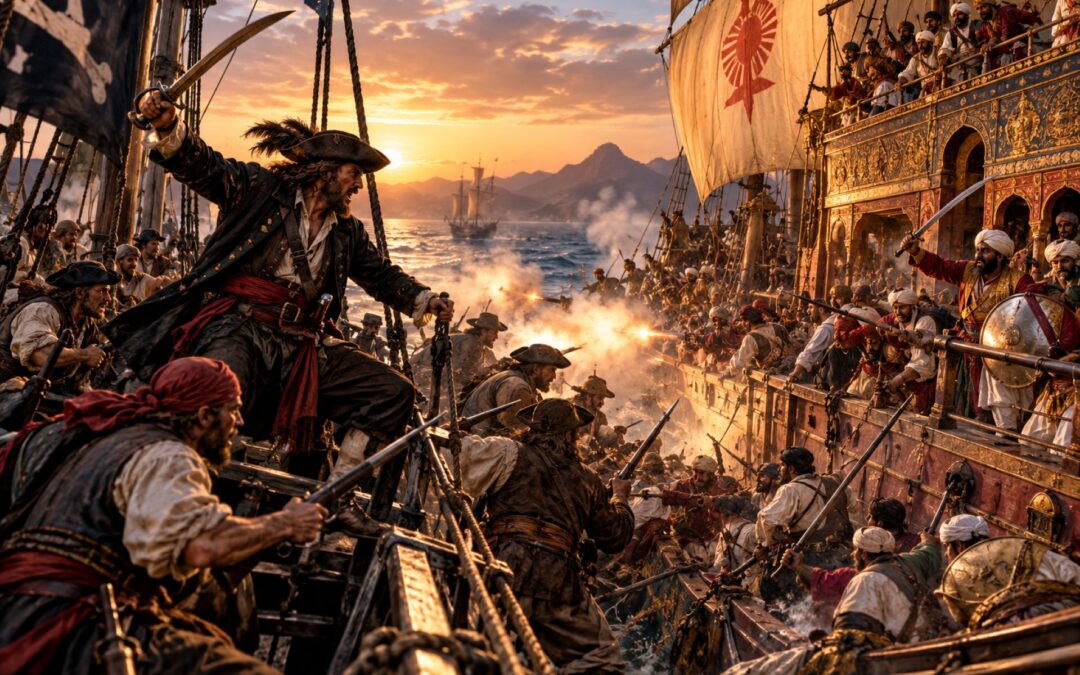
In September 1695, an English pirate named Henry Every attacked a ship belonging to the Mughal Empire as it returned to India from the Red Sea. The vessel, known as the Ganj-i-Sawai, carried valuable cargo and passengers returning from the Hajj pilgrimage to Mecca. It was heavily armed, protected by soldiers, and part of a larger fleet operating under one of the wealthiest and most powerful empires in the world.
Every commanded a much smaller force, but his pirates captured the ship and seized an extraordinary fortune in gold, silver, and other valuables. The robbery became one of the richest recorded exploits in the history of piracy. It was also accompanied by torture, murder, and sexual violence against the passengers and crew.
The consequences reached far beyond the Indian Ocean. Emperor Aurangzeb held the English responsible, threatening the East India Company’s lucrative trading operations in Mughal territory. English authorities launched an international pursuit, offering rewards for the pirates’ capture and eventually executing several of Every’s companions.
Yet Every himself disappeared. His fate remains uncertain, even as the raid that made him famous reveals how piracy, global trade, religious pilgrimage, and imperial power collided at the end of the seventeenth century.
A Mutiny in Spain Creates the Fancy
Henry Every, also known as Henry Avery, was probably born in England around the middle of the seventeenth century. His early life is poorly documented, although he is traditionally associated with Devon and is believed to have acquired considerable experience at sea before becoming a pirate. Some accounts place him in the Royal Navy, where he would have learned navigation, naval discipline, and the operation of armed vessels.
By the early 1690s, Every had also become involved in the Atlantic slave trade. Accounts of his activities during this period describe participation in the trafficking of enslaved Africans, including allegations that he deceived African trading partners and enslaved them. The precise details are difficult to establish, but his association with slave trading is an important part of his career, long before he achieved notoriety in the Indian Ocean.
In 1693, Every joined an expedition organized through cooperation between English investors and the Spanish Crown. Spain and France were at war, and the expedition was intended to attack French shipping in the Caribbean. Its vessels were privateers, meaning that they operated with official authorization to seize enemy ships and cargo during wartime.
Every became first mate aboard the Charles II, a heavily armed vessel belonging to the expedition. Unlike an ordinary pirate ship, it was supposed to operate within a system of legally sanctioned maritime warfare, although the practical distinction between privateering and piracy could become blurred.
The expedition soon encountered serious difficulties. Its ships remained at the Spanish port of Coruña for months while administrative and financial problems prevented their departure. The sailors received little or no pay, and frustration increased as they waited aboard vessels that offered no prospect of immediate employment or profit.
Every recognized an opportunity in this discontent. He persuaded a group of sailors that they could make their fortunes more quickly by abandoning the expedition and taking the ship for themselves. During May 1694, while senior officers were absent, he and his supporters seized control of the Charles II and sailed away.
The mutiny transformed an authorized privateering vessel into a pirate ship. Every assumed command, renamed it the Fancy, and began recruiting sailors willing to pursue wealth through robbery at sea.
The precise stories surrounding his seizure of power have been embellished in later pirate literature, but the essential event is documented. A declaration Every subsequently left at the island of Johanna identified the ship as the former Charles of the Spanish expedition and dated its departure from Coruña to May 1694.
The Fancy was particularly valuable because it carried substantial artillery and could be adapted for speed. Every’s crew removed unnecessary weight and modified the vessel to make it faster, giving the pirates an advantage when chasing merchant ships or escaping stronger opponents.
The mutiny had begun as a response to unpaid wages, but its consequences were much greater. Every now commanded an armed vessel outside the authority of the governments and investors that had originally commissioned it. His next decisions would take the Fancy from the Atlantic into the trading networks of the Indian Ocean.
The Pirate Round and the Road to the Red Sea
After leaving Spain, Every sailed toward Africa, following routes that would eventually bring him around the Cape of Good Hope and into the Indian Ocean. This movement belonged to a wider pattern of seventeenth-century piracy sometimes called the Pirate Round, in which European and American raiders crossed from the Atlantic into eastern waters in search of valuable commercial shipping.
The Indian Ocean was already one of the world’s most important trading regions. Merchant ships linked East Africa, Arabia, Persia, India, and Southeast Asia, carrying textiles, spices, precious metals, ivory, and other commodities. These networks had developed over centuries, long before European trading companies established themselves in Asian ports.
For pirates, the attraction was obvious. Wealthy merchant vessels followed recognizable routes, and some carried enormous quantities of valuable cargo. Yet the ocean was also politically complex, with powerful Asian states, established commercial communities, European trading companies, and armed escorts competing to protect their interests.
Every’s voyage initially involved attacks on smaller vessels along the African coast. His crew seized English merchant ships near the Cape Verde Islands and subsequently encountered Danish and French vessels. Some sailors from captured ships joined the Fancy, while the pirates also acquired supplies, weapons, and valuables through robbery.
The expedition was connected to enslavement as well as maritime theft. Accounts describe people being captured or purchased for forced labour and commercial exchange. Piracy in this period frequently intersected with slave trading, and Every’s activities were no exception.
As the Fancy approached the Indian Ocean, its multinational crew expanded. English sailors were joined by men from other European maritime communities, including French and Danish recruits. By the time the pirates reached Johanna, an island in the Comoros archipelago, Every commanded a substantially larger force than the small group that had participated in the original mutiny.
At Johanna, he left a declaration addressed to English commanders. In it, he claimed that he did not intend to harm English or Dutch ships and explained how other vessels could identify themselves to avoid an encounter. The statement presented him as a selective raider rather than an indiscriminate enemy of European commerce, although his earlier attacks on English shipping complicate that self-description.
The declaration also identified the Fancy as a ship carrying 46 guns and approximately 150 men. These figures provide a useful contemporary description of Every’s strength, although pirate crews changed as sailors joined, deserted, or were left behind.
Every’s greatest opportunity lay farther north, near the entrance to the Red Sea.
Every had learned that a Mughal fleet would be returning to Surat, a major commercial port on India’s western coast. The ships were connected to the annual pilgrimage to Mecca and the commerce that accompanied movement between the Arabian Peninsula and South Asia.
The Hajj was a religious obligation for Muslims who possessed the means to undertake it, and maritime routes were essential for pilgrims travelling from India. Ships returning from ports such as Mocha carried passengers alongside goods, money, and possessions accumulated through pilgrimage and trade.
Some vessels operated under Mughal sponsorship or protection, making their safety a matter of imperial interest. The convoy therefore represented more than a collection of wealthy merchant ships: it was part of an international religious and commercial system in which the Mughal state held a significant stake.
Every knew that attacking such a fleet would require more manpower and firepower than the Fancy alone could reliably provide. Near the island of Perim, at the entrance to the Red Sea, he joined several other pirate captains.
The coalition included Thomas Tew aboard the Amity, Richard Want associated with the Dolphin, Joseph Faro of the Portsmouth Adventure, William Mayes of the Pearl, and Thomas Wake of the Susanna. Accounts differ over some details of the ships and their complements, but the alliance considerably increased the potential strength of the pirates.
Every emerged as the coalition’s leading commander. His vessel combined speed, substantial armament, and a large crew, making it well suited to pursuing heavily laden merchant ships.
The pirates positioned themselves to intercept the returning Mughal fleet, hoping that its wealthiest vessels would prove vulnerable despite their considerable defensive capabilities.
How the Pirates Captured the Ganj-i-Sawai
In late summer 1695, the pirates waited near the Red Sea for the Mughal convoy to emerge. The fleet is commonly described as comprising approximately 25 ships, although its composition and the precise movements of individual vessels are not completely established.
The pirates did not immediately achieve the ambush they wanted. Much of the convoy passed without being intercepted, forcing the raiders to pursue the departing ships across open water.
Speed now became decisive. The Fancy had been modified to sail quickly, but several allied vessels could not maintain the same pace. The Dolphin was reportedly abandoned and burned after proving too slow, with its remaining sailors transferred to other ships. The Susanna also fell behind, reducing the number of pirates capable of participating in the most important encounters.
Although most of the Mughal fleet escaped, two valuable vessels remained within reach: the Fateh Muhammad and the larger Ganj-i-Sawai.
The Fateh Muhammad, sometimes rendered differently in English accounts, was a substantial armed merchant vessel carrying valuable cargo. It was considerably more formidable than the small merchantmen that the pirates had attacked along the African coast.
Thomas Tew and the Amity were among the first to engage it. The encounter went badly for Tew, who was killed during the fighting. His death deprived the pirate coalition of an experienced commander and demonstrated that attacking Mughal shipping could be extremely dangerous.
The Amity withdrew, leaving Every and the remaining pirates to continue the pursuit.
When the Fancy caught the Fateh Muhammad, its defenders offered less effective resistance than might have been expected from the vessel’s armament. Some accounts suggest that the earlier fighting had weakened or demoralized the crew, although the precise reasons for its surrender remain uncertain.
The pirates seized a large quantity of treasure, with estimates in some accounts placing the cargo taken at approximately £50,000 in contemporary money. That alone would have represented a major success for a pirate expedition.
Every, however, continued after the larger prize.
The Ganj-i-Sawai, sometimes called the Gunsway in English accounts, was among the most impressive ships associated with Mughal maritime commerce. Its size, wealth, and connection to imperial authority made it an exceptionally valuable target.
Estimates of its armament vary, but accounts commonly describe several dozen cannons, hundreds of armed defenders, and numerous additional passengers. The vessel was much larger than the Fancy and possessed enough firepower to make an assault extremely hazardous.
Its captain, Muhammad Ibrahim, commanded a ship that should not have been easy for a smaller group of pirates to capture. The Mughal vessel’s numerical and artillery advantages were considerable, even if those strengths did not guarantee success in the particular circumstances of the engagement.
In early September 1695, the pirates caught up with the Ganj-i-Sawai as it approached the final portion of its journey toward Surat.
The ensuing battle became the defining episode of Every’s career.
According to several historical accounts, the Fancy delivered an artillery broadside that damaged or destroyed the Mughal ship’s mainmast. The loss severely restricted the vessel’s ability to manoeuvre, reducing its chances of escaping or choosing a favourable position from which to fight.
Another disaster reportedly followed when one of the Ganj-i-Sawai’s cannons malfunctioned and exploded, killing or injuring members of its own artillery crew. The accident created confusion aboard a ship already struggling to respond to the pirate attack.
These details appear in influential reconstructions of the battle, including historical accounts of Henry Every’s attack on the Mughal convoy. The surviving evidence does not establish every movement of the ships, however, and the exact sequence of the mast damage, artillery explosion, and boarding remains difficult to reconstruct with certainty.
What is clear is that the pirates eventually brought their attack close enough to board the Mughal vessel.
The assault developed into a violent struggle between the boarding parties and the defenders. The pirates had experience fighting from ships and a strong financial incentive to capture the cargo intact, while the Mughal soldiers were confronting attackers who had already disabled their vessel’s ability to escape.
The allied pirate ships did not all contribute equally. Some crews reportedly remained at a distance during crucial phases of the battle, while men from the Pearl joined those of the Fancy in the attack. The varying accounts make it difficult to assign a precise share of the fighting to each vessel.
The Mughal defenders were eventually overwhelmed, although the battle was not a straightforward demonstration of European technological superiority. The Ganj-i-Sawai possessed extensive artillery and armed manpower. Its defeat appears to have resulted from a combination of damage, confusion, tactical circumstances, and the effectiveness of the pirates’ boarding assault.
Later accounts also placed considerable blame on Captain Muhammad Ibrahim.
The Mughal historian Khafi Khan criticized the captain’s conduct, presenting the defeat as a failure of leadership when the ship had enough weapons and men to resist effectively. Some versions of the story go further, alleging that Ibrahim hid below deck and sent enslaved women to face the attackers.
Such accusations must be treated as attributed historical claims rather than independently established facts. They reflect attempts to explain a humiliating defeat, and the surviving evidence does not permit a definitive reconstruction of Ibrahim’s conduct throughout the battle.
By the end of the engagement, Every’s men controlled the Ganj-i-Sawai.
They had captured a vessel far larger than their own and gained access to an extraordinary concentration of wealth. The victory would transform Every into one of the most notorious pirates of his age, but what happened after the fighting was even more consequential.
The Treasure and the Atrocities Aboard the Captured Ship
The capture of the Ganj-i-Sawai gave the pirates access to gold, silver, jewels, and other valuables accumulated through trade, pilgrimage, and private ownership. The combined proceeds of the attacks on the Mughal ships made Every’s expedition exceptionally profitable.
Estimates of the treasure taken from the Ganj-i-Sawai vary substantially. Historical accounts have placed the value somewhere in the broad range of £325,000 to £600,000 in contemporary money, although these figures should not be mistaken for a precise audited inventory.
Converting such sums into modern currency is particularly difficult. A comparison based on consumer prices produces a different result from one based on wages, relative wealth, or the economic importance of precious metals. Claims that Every stole an exact equivalent of $100 million or $120 million therefore give a misleading impression of certainty.
The scale of the plunder was extraordinary by the standards of the period, but the division of the proceeds remains another area of disagreement. The crews involved in the expedition were supposed to share the benefits of their joint venture, yet their participation in the final battle had been unequal.
Some accounts describe disputes between the men of the Fancy and Pearl, including allegations involving clipped coins used in exchanges between the crews. These stories suggest that cooperation among the pirates deteriorated once the treasure was secured, although the precise negotiations and distributions cannot be established with confidence.
For the passengers and defenders aboard the captured Mughal ship, the consequences were far more terrible than the loss of money.
Historical accounts describe the pirates searching the vessel for valuables over several days. Passengers were threatened and tortured in attempts to discover where wealth had been concealed. Some were killed, while women were subjected to sexual violence.
Accounts associated with Khafi Khan also describe passengers taking their own lives, including women who reportedly jumped into the sea or used knives to avoid further assault. These descriptions belong to a traumatic historical record, and their individual details cannot all be independently reconstructed. Nevertheless, the allegations of extensive brutality are central to understanding the raid and cannot be treated as incidental to the treasure hunt.
The victims were not simply members of an armed escort protecting imperial property. The ship carried travellers returning from pilgrimage, including people whose presence formed part of a religious and commercial journey supported by the Mughal maritime system.
Historian Tyler Joseph Kynn’s research emphasizes the value of examining the plunder of the Ganj-i-Sawai through Mughal evidence and the history of the Hajj. His work draws attention to a Mughal captain’s perspective and to the character of the vessel as a ship carrying pilgrims and goods between the Red Sea and Surat.
That perspective matters because the attack was not merely a contest between European pirates and an Indian treasure ship. It disrupted a network through which people travelled to fulfil religious obligations and maintain commercial relationships across the Indian Ocean.
The pirates eventually departed with their plunder, leaving the surviving passengers and crew to confront the destruction and violence they had experienced.
Every’s wealth became legendary, but the suffering aboard the Ganj-i-Sawai explains why the raid produced such a fierce response when news reached Mughal territory.
Why Aurangzeb Held the East India Company Responsible
The attack on the Ganj-i-Sawai reached the Mughal authorities at a time when Emperor Aurangzeb ruled one of the world’s largest and most powerful states. The loss of an important Mughal-associated ship was serious enough, but the reported treatment of passengers returning from pilgrimage made the incident particularly disturbing.
The Mughal government had both political and religious reasons to demand accountability. The security of shipping under imperial protection reflected the emperor’s authority, while attacks on Hajj pilgrims threatened an activity of considerable importance to Muslim communities throughout the empire.
Understanding Aurangzeb’s response requires recognizing the position of European merchants in seventeenth-century India.
The English East India Company had received its charter in 1600, but its early operations depended on permissions obtained from Asian rulers. Its commercial settlements existed within political systems that the Company did not control, and Mughal officials could restrict the privileges on which English trade relied.
As the broader history of India under the Mughal Empire demonstrates, Aurangzeb governed a state with substantial military, financial, and administrative resources. The English Company was an important commercial participant, but it was not an equal territorial power capable of dictating terms to the emperor.
The Company had already experienced the limits of its position during Child’s War in the late 1680s.
That conflict developed when Company leaders attempted to use armed pressure against Mughal authority in pursuit of favourable trading conditions. The Mughal government responded decisively, and the English were forced to seek a settlement, accept financial penalties, and restore relations on terms that reflected their weaker position.
The defeat showed that the Company’s trading establishments remained vulnerable despite its ships, fortifications, and commercial connections. Its position within the emerging British imperial trading system was very different from the territorial dominance it would establish in parts of India during the eighteenth century.
Against this background, Every’s attack became a direct threat to English commercial interests.
The East India Company had not officially authorized the piracy, and its representatives maintained that Every was an independent criminal. From their perspective, they were being punished for acts committed by men operating outside their command.
Mughal authorities had reasons to regard that distinction with suspicion.
European shipping combined trade, armed protection, privateering, and occasional piracy in ways that were not always easy for outside observers to separate. Armed Europeans moved through the same maritime networks, and Mughal officials had long-standing concerns about attacks on Indian Ocean merchants.
The pirates’ use of English vessels, personnel, and maritime connections made it difficult for the Company to persuade Mughal authorities that English institutions bore no responsibility. Kynn’s examination of Mughal Persian material identifies the question of English responsibility as an important part of how the Mughal side understood the attack.
Aurangzeb’s government responded by applying pressure to English trading interests. Company personnel faced confinement or restrictions, and commercial establishments at Surat and elsewhere became vulnerable to reprisals.
The seriousness of the threat appears in the East India Company’s July 1696 petition to the English authorities, preserved in John Franklin Jameson’s collection of historical documents on privateering and piracy.
The petition reported that Mughal officials had placed guards around Company premises at Surat while awaiting the emperor’s instructions. Its authors feared not only direct reprisals but also the interruption of trade between Indian ports and the suspension of commerce with England.
The document reveals the Company’s immediate concern: a pirate’s actions could destroy trading arrangements that had taken years to establish.
English merchants therefore had strong incentives to demonstrate that they were acting against Every. The Company pressed for government intervention, supported efforts to capture the pirates, and sought to reassure Mughal officials through arrangements involving compensation, maritime protection, and cooperation against piracy.
Accounts differ over the precise financial concessions offered or accepted, so an exact compensation figure cannot be treated as established without specifying the underlying evidence. What matters is that the English faced pressure to restore confidence in the safety of Mughal shipping.
The crisis eventually eased sufficiently for commercial relations to continue, but the incident exposed a fundamental weakness in the Company’s position. It depended on Mughal permission and could suffer severe consequences when English maritime violence endangered Mughal interests.
Every had escaped with his treasure, yet his raid had created a diplomatic problem that English officials could not afford to ignore.
The International Manhunt and the Trials of Every’s Crew
After taking the Mughal treasure, Every and his companions faced a problem that successful pirates frequently encountered: possessing a fortune was easier than safely spending it. The larger and more recognizable the plunder, the greater the risk that merchants, officials, and other sailors would identify those attempting to exchange it.
Accounts of the pirates’ subsequent movements describe stops in the western Indian Ocean, where some members of the multinational crew separated from the expedition and others continued toward the Atlantic. Stories about the exact division of treasure and the purchase of enslaved people during this journey vary, but the pirates’ need to conceal their identities and convert their wealth into usable forms was real.
Every eventually sailed toward the Caribbean, where colonial ports offered opportunities for provisioning, exchanging goods, and dispersing beyond the immediate reach of English authorities.
The Fancy reached New Providence in the Bahamas, where the pirates attempted to pass themselves off as traders involved in slave commerce rather than as fugitives from the Mughal raid. They also possessed valuable goods, including ivory, that could be used to obtain favourable treatment from local officials.
Governor Nicholas Trott allowed the men to enter, apparently accepting arrangements involving payments or valuable property. Accounts indicate that he subsequently became aware of their identity, although the details of what he knew at each stage and how he responded are not entirely clear.
As news of the raid spread, remaining in one place became increasingly dangerous. The pirates dispersed, some seeking passage to the British Isles and others moving into colonial communities where their origins might be less readily investigated.
Every also used the alias Benjamin Bridgeman, or Bridgman, a name that appears in the documents issued for his apprehension. The false identity was an obvious advantage for a man whose real name had become associated with an enormous robbery and a diplomatic crisis.
By 1696, English authorities were undertaking a coordinated pursuit of Every and his companions. Their efforts involved the East India Company, government officials, colonial authorities, and naval or commercial networks capable of reporting suspicious movements.
The scale of the pursuit is illustrated by the proclamation issued in Scotland on 18 August 1696 for the apprehension of Henry Every. It identified him under the alias Bridgeman, listed suspected accomplices, and described the seizure of the ship originally known as the Charles.
The proclamation offered £500 for Every’s capture and £50 for each of the named accomplices. These were substantial rewards, reflecting the importance that the authorities attached to bringing the pirates to justice.
The hunt crossed political and maritime boundaries, making it an unusually extensive pursuit for its period. It is sometimes characterized as the first worldwide manhunt, although the surviving evidence does not establish that historical superlative in any rigorous sense.
The authorities did manage to capture several members of Every’s company, even though the captain himself remained beyond their reach.
In England, six accused crewmen faced Admiralty proceedings in 1696. The prosecutions were intended to punish piracy, but they also served a diplomatic purpose by demonstrating that the English state was prepared to act against those responsible for attacks on foreign shipping.
The first trial produced an embarrassing result for the prosecution. On the indictment concerning the Ganj-i-Sawai, the jury did not return the convictions that the authorities expected.
Rather than allowing the defendants to go free, the court proceeded with further charges relating to the seizure of the Charles II and other acts of piracy. The later proceedings resulted in convictions and death sentences.
Five members of Every’s crew were executed at Execution Dock on 25 November 1696. The sixth condemned man was reportedly reprieved, a conclusion supported by the surviving trial record when read alongside contemporary and later accounts.
The trials showed how seriously the English authorities treated the political and commercial consequences of the raid. They also exposed the complications of proving maritime crimes committed thousands of miles away, where evidence depended on testimony gathered after long voyages.
Most importantly, the prosecutions did not deliver the person whose name had become inseparable from the robbery.
Every was not among those brought to trial. Despite the rewards, proclamations, and efforts to locate him, the English authorities never succeeded in capturing the captain of the Fancy.
The Disappearance of Henry Every and the Birth of a Pirate Legend
Henry Every’s disappearance became one of the most enduring mysteries in the history of piracy. After the dispersal of his crew, reliable evidence of his whereabouts becomes scarce, leaving historians unable to establish where he spent his remaining years or when and how he died.
One tradition suggests that he returned to the British Isles under an assumed identity and settled into private life. Another claims that he eventually lost much of his wealth after entrusting it to dishonest merchants, leaving him impoverished despite having participated in one of history’s richest pirate raids.
Other stories take him farther from Europe. Some portray him as retiring to an island refuge, while more extravagant legends imagine him founding a pirate kingdom and living beyond the reach of ordinary governments.
These accounts are not equally reliable, and none provides a firmly established conclusion to his life. The image of Every as a triumphant pirate ruler owes much to later storytelling rather than to contemporary documentary proof.
His escape nevertheless made him an especially attractive figure for popular legend. Many famous pirates ended their careers through capture, execution, or death in battle. Every’s disappearance allowed writers and audiences to imagine that he had defeated not only a powerful merchant ship but also the governments that pursued him.
Songs, pamphlets, biographies, and theatrical works transformed him into a model of the successful pirate. Such portrayals often emphasized daring, cunning, and sudden wealth while giving far less attention to the people who suffered during the raid.
His treasure has also remained a subject of fascination. Although individual coins or objects associated with pirates may survive, there is no securely documented recovery of a complete hidden fortune belonging to Every. The absence of reliable evidence about his final wealth is one reason the story continues to attract speculation.
The most important facts of the Ganj-i-Sawai affair, however, are not mysterious. In 1695, Every’s pirates seized a valuable Mughal vessel, subjected passengers to extreme violence, and provoked a crisis that threatened English commerce in India.
The captain’s disappearance gave the episode its legendary ending, but the raid’s historical significance rests on consequences that are much better documented than the fate of its central figure.
Henry Every’s extraordinary success depended on a particular combination of maritime opportunity, a heavily armed and fast-moving ship, an experienced crew, and moments of good fortune during a dangerous attack. Yet his achievement cannot be separated from the atrocities committed against the people aboard the Ganj-i-Sawai.
The diplomatic aftermath also reveals how different the political balance of the seventeenth-century Indian Ocean was from the imperial order that emerged later. The East India Company was not yet the ruler of India. It remained dependent on the Mughal state and vulnerable to retaliation when English maritime violence threatened imperial interests.
Every vanished before the authorities could bring him to justice, and the destination of his fortune remains uncertain. His raid nevertheless left behind a clear historical record of immense plunder, human suffering, commercial disruption, and the limits of European power in Mughal India.
Last Updated on October 25, 2026 by Aseem Gupta