
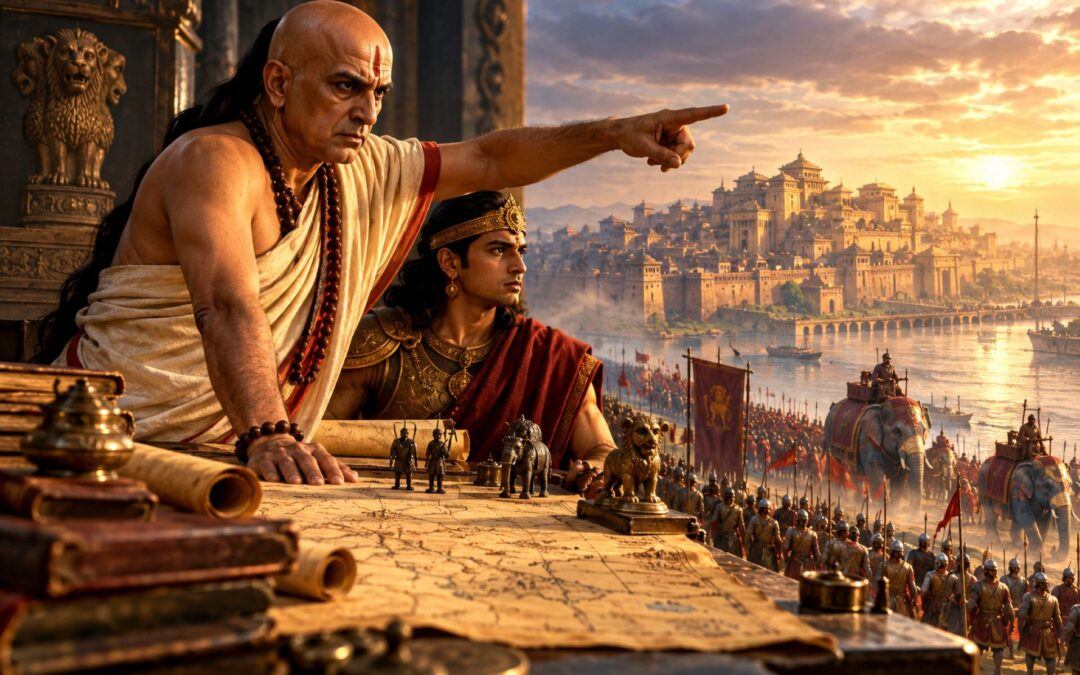
More than two thousand years ago, an Indian scholar and political strategist became associated with one of the most remarkable changes of power in ancient history. Chanakya is remembered as the man who helped Chandragupta Maurya overthrow the Nanda dynasty, establish the Mauryan Empire, and create the foundations of a political system capable of governing enormous territories. Yet his reputation extends far beyond the achievements of the emperor he supposedly guided.
Chanakya is also traditionally identified with Kautilya, the author of the Arthashastra, an extraordinary Sanskrit treatise on government, economics, warfare, diplomacy, and espionage. Its vision of political power combines sophisticated administrative planning with ruthless strategic calculations. A ruler must protect his subjects and cultivate prosperity, but he must also anticipate betrayal, monitor powerful officials, manipulate rivals, and sometimes employ deception or violence to preserve the state.
There is, however, a complication. Much of Chanakya’s famous biography comes from legends written long after the events they describe, while the surviving Arthashastra appears to have developed through multiple stages of composition. The historical strategist, the legendary kingmaker, and the political thinker represented by the text cannot simply be treated as one perfectly documented individual.
Understanding Chanakya therefore requires examining both the political transformation with which his name became associated and the ideas that made him one of India’s most enduring symbols of strategic intelligence.
Who Was Chanakya, and What Can History Tell Us About Him?
Chanakya is traditionally described as a scholar, teacher, political adviser, and minister who lived during the late fourth century BCE. His reputation is inseparable from Chandragupta Maurya, who established a new imperial dynasty after overthrowing the Nandas of Magadha. In popular memory, Chandragupta supplied the military and royal authority, while Chanakya provided the intelligence, planning, and political determination that made the conquest possible.
He is also known by two other names: Kautilya and Vishnugupta. These names are frequently treated as referring to the same historical person, but their relationship is more complicated than the familiar identification suggests. The Arthashastra is attributed to Kautilya, while Vishnugupta appears in its concluding tradition, and Chanakya is prominent in narratives surrounding Chandragupta’s rise. Their identification became deeply established in Indian historical and literary memory, although modern scholarship questions how securely the surviving evidence supports it.
The difficulty is that Chanakya’s life lacks the kind of contemporary documentation that would allow historians to reconstruct a detailed biography. Later Buddhist and Jain traditions, Sanskrit literary works, and regional narratives preserve accounts of his personality and achievements, but they disagree about important particulars. These differences matter because a story told centuries after an event can preserve historical memories while also incorporating political ideals, religious perspectives, and imaginative elaboration.
The different biographical traditions surrounding Chanakya illustrate this problem particularly clearly. Some accounts emphasize his Brahmin identity and learning, while Jain narratives connect his upbringing with their own religious communities. His birthplace is variously associated with different parts of the subcontinent, and his connection to Taxila is more firmly established in tradition than through contemporary evidence about his personal movements.
Even his appearance became part of his legend. Stories describe Chanakya as physically unattractive, sometimes emphasizing his damaged or broken teeth. In one tradition, unusual teeth were interpreted as a sign that he would become a king, leading to their removal and a revised destiny in which he would exercise power through another ruler. The story captures the central theme of his later reputation: Chanakya was destined to control a throne without occupying it.
These accounts are revealing, but not because every event can be independently verified. They show how later generations imagined the ideal political mastermind: intellectually formidable, personally austere, difficult to intimidate, and capable of achieving ambitions that ordinary rulers could scarcely conceive.
The historically important setting behind these stories is more secure. During the late fourth century BCE, northern India experienced a major political transformation as the Nanda dynasty gave way to the Mauryas. The figure remembered as Chanakya became the principal intellectual protagonist in the traditional explanation of how that transformation occurred.
The Nanda Dynasty and Chanakya’s Path to Revenge
The political world into which Chanakya’s story is placed was dominated by Magadha, a powerful kingdom in the eastern Gangetic plain. Its rulers benefited from agricultural wealth, access to important waterways, military resources, and the strategic position of Pataliputra, a capital near present-day Patna. These advantages had helped Magadha become one of northern India’s leading political powers.
The rise of Magadha within the broader history of ancient India was an important stage in the emergence of large territorial states. Earlier kingdoms had already developed methods of taxation, administration, and military organization, and the Nandas inherited a political environment in which control over extensive territories was increasingly possible.
The Nanda dynasty is remembered for its enormous wealth and formidable military resources. Greek accounts associated with Alexander’s campaign describe powerful kingdoms farther east whose armies reportedly possessed large numbers of soldiers and war elephants. The precise figures are uncertain and may have been exaggerated, but they reflect the reputation of the states Alexander’s forces would have encountered had they advanced into the Gangetic plain.
According to several later traditions, the last Nanda ruler, commonly remembered as Dhana Nanda, was deeply unpopular. Stories portray him as greedy, oppressive, and excessively concerned with accumulating wealth. Other narratives attack the dynasty’s legitimacy by describing a low-born ancestor who acquired the throne through intrigue and violence.
Such accounts require caution. Ancient stories about a dynasty’s improper origins often served to justify its overthrow, and descriptions of excessive taxation could reinforce the moral case for replacing a ruler. They cannot automatically establish that Dhana Nanda was universally hated or that every detail of the dynasty’s alleged ancestry was true.
It was against this background that Chanakya supposedly arrived at the Nanda court.
The traditional story describes him seeking recognition, employment, patronage, or an opportunity appropriate to his learning. Instead, the king insulted or dismissed him. The precise circumstances vary, but the outcome is consistent: Chanakya swore that he would destroy the Nanda dynasty.
In literary accounts, the oath becomes a defining moment. Chanakya’s humiliation transforms an ambitious scholar into a determined political conspirator whose personal revenge acquires historical consequences. Yet the narrative also communicates a larger idea about power: a ruler who disregards capable advisers and alienates influential individuals may create enemies more dangerous than those confronting him openly.
Chanakya needed more than resentment to challenge Magadha. He needed a viable claimant, financial resources, military support, and an opportunity to exploit the weaknesses of an established dynasty.
That claimant was Chandragupta Maurya.
Chandragupta’s ancestry is disputed. Some traditions associate him with the Nandas, others give him different origins, and still others emphasize his humble circumstances before his rise to power. One famous account describes Chanakya discovering the boy while he was playing king among other children, recognizing in his behaviour the qualities of a future ruler.
The episode belongs to the legendary biography rather than independently established history. Its importance lies in the relationship it creates between the two protagonists: Chanakya recognizes the potential that others have overlooked, while Chandragupta becomes the instrument through which an experienced strategist can challenge an existing political order.
Their association with Taxila also features prominently in traditional narratives. Located in the northwestern subcontinent, Taxila was an important centre of trade, political activity, and intellectual exchange. It attracted people from different regions and traditions, although describing it as a modern university with a single institutional structure would be anachronistic.
The wider northwestern environment was changing rapidly. Alexander of Macedon invaded parts of the region in 326 BCE, but his troops eventually refused to advance farther east. His retreat and death in 323 BCE left a complex political landscape involving local rulers, Macedonian officials, and competing interests.
Whether Chanakya personally exploited these developments in the detailed manner described by later stories cannot be demonstrated. Nevertheless, the interaction between established Indian powers and the unstable northwestern political world provides an intelligible setting for Chandragupta’s eventual rise.
How Chanakya and Chandragupta Overthrew the Nandas
In the traditional account, Chanakya’s greatest achievement was not simply recognizing Chandragupta’s potential. It was transforming that potential into a successful challenge against one of the strongest dynasties in northern India.
The stories portray their relationship as a partnership between political intelligence and military ambition. Chanakya helped prepare Chandragupta for kingship, cultivated relationships with prospective allies, identified weaknesses in the Nanda establishment, and developed a strategy for seizing power.
Some versions describe Chanakya assembling considerable financial resources before the campaign. Certain traditions explain his sudden wealth through extraordinary or magical means, while modern retellings sometimes suggest that he obtained loans from merchants or commercial organizations. Such financial arrangements would be understandable in the political economy of ancient India, but the specific claim that Chanakya secured merchant loans to fund Chandragupta’s conquest is not securely established.
Similar caution applies to reports of Greek mercenaries participating in his army. The northwestern region contained soldiers and political networks connected to Alexander’s expedition, and Chandragupta’s expansion unfolded amid those circumstances. However, the popular image of Chanakya personally recruiting a substantial Greek mercenary force is more detailed than the reliable evidence permits.
The traditions also introduce a Himalayan ruler commonly called Parvataka or Parvata, who supposedly joined the campaign against the Nandas. In some narratives, the alliance involved promises to share the territory or rewards of the conquest. His eventual fate becomes entangled with poisoning, betrayal, and court intrigue, illustrating the danger of alliances created for a single political objective.
The existence and precise actions of this figure cannot be established with the confidence that a straightforward military history would require. Nevertheless, the story reflects a plausible strategic principle: overthrowing a powerful dynasty often requires cooperation among groups whose interests may diverge once victory becomes possible.
One of the most memorable episodes concerns a failed initial attack.
According to versions of the traditional narrative, Chandragupta and his allies first attempted to challenge the Nandas too directly. Their forces were defeated or forced to retreat because the established kingdom possessed considerable military strength and could defend its political centre.
The failure supposedly revealed that an assault against the heart of a powerful state was premature. Rather than immediately attempting to capture Pataliputra, the attackers needed to weaken the Nandas from the outside, secure territories, establish supply arrangements, and gradually expand their political support.
A related traditional lesson compares the campaign to eating hot food. Someone who attacks the hottest centre first burns his fingers, while a wiser person begins around the cooler edges. Although the parable is not a contemporary military report, it captures the strategic logic attributed to Chanakya.
The revised approach involved gaining control over peripheral territories and strengthening positions before attempting the decisive confrontation. Conquered regions could provide supplies, recruits, access to routes, and opportunities to persuade local rulers that the balance of power was changing.
The traditional story culminates in the fall of the Nanda dynasty and Chandragupta’s accession to the throne at Pataliputra. Accounts disagree about the fate of the defeated ruler, with some describing his death and others allowing his departure into exile.
The broad political outcome is historically significant. Chandragupta established the Mauryan dynasty around 321 BCE, replacing the Nandas and beginning an era of imperial expansion. What remains uncertain is how closely the detailed legendary campaign corresponds to the actual sequence of military and political events.
Chanakya also appears in the Sanskrit political drama Mudrarakshasa, traditionally attributed to Vishakhadatta. The play emphasizes intrigue surrounding the establishment of Mauryan authority, particularly efforts to win over Rakshasa, a capable minister associated with the defeated Nanda regime.
Its portrayal of conspiracies, disguises, divided loyalties, and calculated deception helped reinforce Chanakya’s reputation as an exceptionally resourceful strategist. Yet a political drama is evidence of how these events were remembered and interpreted, not a substitute for a contemporary administrative archive.
The lasting significance of the conquest extends beyond the personalities involved. Chandragupta’s victory created a new political centre capable of competing for control over extensive parts of the subcontinent, while Chanakya became the literary embodiment of the intelligence supposedly needed to accomplish that transformation.
Chandragupta’s Empire After the Fall of the Nandas
Seizing Pataliputra established Chandragupta’s dynasty, but maintaining and expanding its power presented a different challenge. The new ruler inherited a political landscape containing established kingdoms, local elites, military communities, and northwestern territories affected by Alexander’s campaigns.
The Mauryan expansion was therefore part of the larger encounter between ancient India and the Greek-speaking world. Alexander’s successors competed over territories that had formed part of his empire, while Indian political forces sought to establish control over the same strategic regions.
One of the most important developments involved Seleucus I Nicator, a successor of Alexander who established a powerful Hellenistic kingdom. Around 305 BCE, Seleucus and Chandragupta entered into conflict over territories on the northwestern frontier of the Indian subcontinent.
The subsequent settlement is much better established than the precise outcome of their military encounters. It involved territorial concessions to the Mauryas and the transfer of war elephants to Seleucus. Ancient accounts commonly associate the agreement with 500 elephants, an extraordinary diplomatic exchange that demonstrates their importance in Hellenistic warfare.
The agreement is sometimes presented as proof that Chandragupta decisively defeated Seleucus in battle. However, historian Sushma Jansari’s research on Chandragupta Maurya and the construction of his historical reputation highlights the limits of the surviving evidence. The settlement demonstrates a substantial political accommodation, but the available sources do not conclusively establish every military event that preceded it.
A marriage arrangement is also mentioned in some ancient accounts, but the identity and details of the individuals involved remain uncertain. The familiar claim that Seleucus married a daughter named Helena to Chandragupta should not be treated as securely documented history.
The role of elephants deserves particular attention. The Mauryan state operated in a region where access to elephants represented an important military resource, and Indian war elephants could contribute to battlefield operations, transport, political prestige, and diplomacy. Their transfer to a Hellenistic ruler demonstrates that military resources could also become instruments of international negotiation.
Diplomatic contact continued after the settlement. The Greek ambassador Megasthenes visited the Mauryan court, and fragments of his descriptions survive through later authors. Although his observations must be evaluated critically, they provide important evidence concerning the scale, institutions, and political environment of the Mauryan state.
The empire’s expansion required more than successful warfare. Its rulers needed revenue, administrative personnel, military organization, communications, and relationships with provincial authorities. Pataliputra became the centre of an imperial system that projected power over territories with different populations, resources, and political traditions.
The exact degree of central control probably varied across regions. It would be misleading to imagine every settlement administered identically by officials responding directly to the capital. Large ancient empires depended on combinations of direct authority, regional administration, negotiated relationships, and military power.
Tradition credits Chanakya with helping establish this political machinery. Yet it is difficult to identify which specific institutional developments were his personal creations. A description in the Arthashastra cannot automatically be treated as a record of a measure implemented during Chandragupta’s reign.
Chandragupta was succeeded by his son Bindusara, who maintained the dynasty’s position. His grandson Ashoka later inherited an already powerful imperial state and presided over its greatest territorial expansion, eventually bringing much of the subcontinent under Mauryan authority.
Chanakya’s alleged role as an adviser to Chandragupta and Bindusara remains part of his traditional biography. The historical importance of the Mauryan state is clear, but assigning individual administrative achievements to Chanakya requires more evidence than the surviving record can consistently provide.
Did Chanakya Really Write the Arthashastra?
Chanakya’s reputation would be remarkable even if it rested entirely on the story of Chandragupta’s rise. What makes him especially important to the history of political thought, however, is his traditional identification with the author of the Arthashastra.
The Arthashastra is a Sanskrit treatise concerned with the acquisition, organization, and preservation of political power. Its surviving structure consists of fifteen books that examine a remarkably wide range of subjects, including the education and discipline of rulers, appointment of officials, economic administration, legal disputes, criminal investigation, foreign policy, military operations, espionage, and the conduct of war.
Its title is commonly associated with the study of artha, a concept encompassing material well-being, resources, prosperity, and the practical foundations of political life. In the treatise, artha is closely connected to the power of the state and the conditions necessary for sustaining political authority.
The text is often described as ancient India’s equivalent of a manual of political realism. That description captures part of its character, but its breadth is considerably greater than a collection of strategic maxims. It attempts to organize government as a system of interdependent institutions whose effectiveness depends on information, personnel, economic resources, discipline, and calculated political action.
The central historical question is whether the surviving work can genuinely be attributed to a single adviser who served Chandragupta Maurya.
Traditional accounts identify Kautilya with Chanakya and place him in the Mauryan political world of the late fourth century BCE. This identification remained influential for centuries and became fundamental to the popular understanding of the treatise.
Modern textual scholarship has made that picture more complicated.
In his critical study and translation, Patrick Olivelle examines the structure, authorship, dating, and transmission of the Arthashastra. The surviving work cannot simply be assumed to represent one unaltered manuscript produced by a single minister during Chandragupta’s reign.
Mark McClish’s study of the Arthashastra’s composition and editorial history similarly investigates evidence that the text developed through multiple compositional stages. Changes in its structure, political reasoning, and ideological presentation suggest that earlier materials were incorporated into a more elaborate literary and intellectual work.
Scholars disagree about the chronology and character of those stages. The evidence does not justify treating one proposed reconstruction as universally accepted, but it does undermine the familiar certainty that Chanakya personally wrote every surviving chapter after retiring from Mauryan government.
This distinction also affects the relationship between Chanakya, Kautilya, and Vishnugupta. The names are historically connected through tradition and textual attribution, but they do not establish an independently verified biography of a single author responsible for the work in its present form.
The same caution applies to texts commonly associated with Chanakya’s name, including collections of political and ethical sayings known as Chanakya Niti and works circulated under titles such as Chanakya Sutra. Their traditional attribution does not establish that all these materials were personally written by Chandragupta’s adviser.
The precise chronology sometimes assigned to Chanakya’s retirement, literary activity, and death is consequently unreliable. There is no sufficient basis for confidently stating that he retired in 285 BCE, completed three works, and died in 283 BCE.
The Arthashastra also has an important modern history. A manuscript came to scholarly attention in Mysore in the early twentieth century, and R. Shamasastry published the Sanskrit text in 1909 before producing an English translation. Its recovery stimulated considerable interest in ancient Indian political institutions and challenged assumptions about the historical development of political science.
Subsequent scholarship has produced increasingly sophisticated interpretations of its language, organization, legal doctrines, and historical setting. The Arthashastra is therefore best understood as an influential work of political thought associated with the Kautilyan tradition, rather than an unquestionably complete record of one minister’s personal instructions to Chandragupta.
That distinction does not diminish its importance. It changes the question from what one extraordinary individual supposedly invented to what a developed tradition of Indian statecraft considered necessary for the successful exercise of power.
How the Arthashastra Proposed Governing a Powerful State
At the centre of the Arthashastra is a demanding conception of government. Political authority is not sustained merely by royal ancestry, military victories, or the personal charisma of a ruler. It depends on maintaining institutions, controlling resources, collecting information, regulating officials, and responding effectively to dangers within and beyond the state.
The treatise describes seven constituent elements, commonly called the saptanga or seven limbs of the state. These comprise the ruler, ministers and advisers, territory and population, fortifications, treasury, military force, and allies. Each contributes to the state’s capacity to survive and pursue its objectives.
The importance of this framework lies in its recognition that political strength has several foundations. A wealthy ruler with an undisciplined army may be vulnerable, just as a formidable army cannot operate indefinitely without revenue and supplies. Competent advisers are useful only when the ruler can evaluate their advice and ensure that administrative institutions perform their responsibilities.
The ruler’s own conduct receives considerable attention. The Arthashastra prescribes training, disciplined work, consultation, vigilance, and a structured daily routine. Kingship is presented not simply as a privilege but as a demanding occupation in which poor decisions can threaten the entire political system.
The text’s discussion of the king’s duties and responsibilities toward his subjects presents the welfare of the population as closely connected to the ruler’s own interests. A stable and productive society strengthens the state, while neglect, insecurity, and exploitation undermine the foundations of political authority.
This reasoning combines practical calculation with a substantial account of responsible government. Protecting subjects is not treated merely as an act of generosity; it is part of maintaining the economic and political conditions under which the kingdom can function.
A particularly important feature of the treatise is its detailed discussion of administration. Officials are assigned responsibilities involving agriculture, forests, livestock, mines, manufacturing, trade, revenue, and other economic activities. The government is expected to supervise these functions through defined offices rather than relying entirely on the personal attention of the king.
Economic management receives extensive treatment because the treasury supports nearly every other component of the state. Revenue finances soldiers, fortifications, administrators, public works, and diplomatic activity. A government incapable of maintaining its economic resources will eventually struggle to defend itself or enforce its decisions.
The Arthashastra consequently treats taxation as both necessary and potentially dangerous. Revenue must be collected, but excessive extraction can damage productive activity and provoke dissatisfaction. A ruler who destroys the prosperity of his subjects ultimately weakens his own capacity to govern.
The work’s conception of economic life is neither a straightforward endorsement of unrestricted private enterprise nor a modern programme of complete state ownership. It envisages considerable official supervision while also recognizing merchants, cultivators, artisans, and other economic participants whose activities generate wealth.
Mines, forests, trading establishments, manufacturing centres, and agricultural resources appear within a broad system of economic regulation. The text discusses state involvement in strategically important goods and production, alongside rules affecting commercial transactions and the conduct of market participants.
These prescriptions reveal a political economy in which competition, production, taxation, and public authority interact. Their underlying purpose is to preserve the resources required for state security and continued prosperity.
Infrastructure is another important consideration. Roads, settlements, irrigation, fortifications, and communication systems can facilitate trade and cultivation while also enabling officials and armies to move across territory. Such projects serve economic and strategic functions simultaneously.
Ancient cities such as Pataliputra and Taxila provide useful historical settings for understanding these concerns. The Arthashastra discusses urban administration, supervision of residents, maintenance of public spaces, commercial regulation, and measures against hazards such as fire.
Its prescriptions should not, however, be mistaken for proof that every Mauryan city possessed exactly the officials, regulations, or physical facilities described in the surviving text. Archaeological evidence, contemporary accounts, and literary ideals answer different historical questions.
The treatment of social welfare is equally revealing.
The Arthashastra envisages assistance or protection for vulnerable people, including those unable to support themselves and populations affected by serious hardship. It also discusses provisions for families, dependants, and economic support under particular circumstances.
Such rules may appear progressive when compared with familiar assumptions about ancient despotism. Yet describing them as a modern welfare state would be misleading because the text operates within a hierarchical monarchy whose obligations and social distinctions differ considerably from modern constitutional systems.
Its discussion of marriage, separation, divorce, property, and remarriage also requires attention to context. Certain forms of marital separation and remarriage are recognized under specified conditions, and women’s property and financial interests receive legal treatment. These provisions do not establish unrestricted and equal individual rights for every person regardless of status or circumstance.
The text therefore combines forms of practical social protection with extensive regulation of personal and economic life. Its concern for subjects exists alongside a strong belief that the government should supervise activities it considers important to public order.
The same emphasis on institutional control appears in its discussion of corruption and official misconduct.
Officials handling revenue or government property possess opportunities for dishonesty, and the Arthashastra is notably attentive to the difficulty of detecting their abuses. Administrative oversight, inspection, record-keeping, and penalties are important because public resources cannot safely depend on the presumed virtue of every official.
This creates a particularly revealing picture of the state. The ruler must recruit talented people and delegate responsibility, but he must also recognize that those very arrangements create opportunities for private enrichment, concealment, and disloyalty.
The political system envisaged by the Arthashastra is consequently powerful but also intensely demanding. It seeks reliable administration through institutional specialization while assuming that both rulers and officials remain exposed to temptation, ambition, and strategic threats.
The significance of these ideas lies in their systematic treatment of government. Political success is presented as the product of military capability, economic resources, information, competent administration, and the maintenance of public order working together.
Whether any particular Mauryan ruler implemented all these prescriptions is a separate historical question. The surviving treatise demonstrates the sophistication of an Indian tradition of political and administrative thought, not the precise day-to-day operation of Chandragupta’s government.
Spies, Secret Warfare, and the Mandala Theory of Foreign Policy
The Arthashastra’s treatment of espionage is among its most striking features. Having described a state dependent on officials, resources, and political stability, the text also assumes that threats may come from people operating inside those institutions.
A king must therefore possess information that ordinary administrative reports cannot always provide. Powerful officials may conceal misconduct, rivals may cultivate supporters, and foreign rulers may attempt to influence internal political affairs. Intelligence becomes a means of discovering dangers before they develop into open crises.
The Arthashastra’s prescribed organization of secret agents includes individuals operating under different disguises and social identities. Such agents are intended to gather information, observe suspicious activity, and help rulers understand the loyalties and intentions of people who might otherwise conceal them.
The proposed intelligence system extends beyond foreign enemies. It includes surveillance of individuals within the kingdom, investigations involving government officials, and arrangements designed to test or reveal behaviour. This reflects a political outlook in which maintaining order depends partly on discovering what people are unwilling to report openly.
Courtesans and other individuals with access to elite social environments also appear in discussions of intelligence and political influence. Their contact with powerful households, influential visitors, and private gatherings could make them useful sources of information or instruments in efforts to manipulate opponents.
The historical position of courtesans in ancient and medieval India was considerably more varied than their intelligence functions alone suggest. The Arthashastra’s prescriptions should not be taken as proof that all courtesans were government spies or that every Indian court operated the same intelligence apparatus.
The treatise also describes methods of deception, infiltration, secret operations, and covert action against enemies. Its political reasoning often begins from the assumption that an opponent may be dangerous even when outward appearances suggest cooperation.
Counter-espionage is consequently as important as gathering intelligence. Rulers must protect themselves against plots, evaluate suspicious information, and remain alert to deception directed against them.
This atmosphere of danger helps explain the extraordinary poisoning stories associated with Chanakya’s personal legend.
One tradition describes Chanakya gradually administering small quantities of poison to Chandragupta in an attempt to protect him against assassination. The story continues with the emperor unknowingly sharing poisoned food with his pregnant wife. In some versions, Chanakya intervenes to save the unborn child, who becomes Bindusara.
Other stories involve poisoned political allies, including Parvataka, whose death supposedly eliminated a rival claim to the rewards of conquest. These episodes reinforce Chanakya’s literary reputation as someone willing to manipulate even his closest political relationships.
They are not independently verified accounts of historical medical practice or palace events. Their importance is that they dramatize the suspicion, secrecy, and willingness to use extreme measures associated with the legendary strategist.
The text’s approach to warfare similarly refuses to assume that open combat is always the best means of achieving political objectives. A ruler may benefit from negotiation, division among opponents, covert pressure, or the careful management of alliances before resorting to large-scale military operations.
Yet the Arthashastra does not simply recommend deception in every circumstance. Its preferred measures depend on relative strength, anticipated consequences, opportunities, and the changing political environment. Open military power, defensive preparation, and diplomatic accommodation remain essential elements of its strategy.
These considerations lead to one of the most influential features of Kautilyan political thought: the mandala theory, often described as the circle of states.
The theory begins by considering a ruler seeking to expand his power within a surrounding political environment. Other states are evaluated according to their positions, interests, resources, and relationships with the ruler and one another.
A neighbouring ruler may be a natural strategic rival because proximity creates territorial competition. A state situated beyond that rival may possess interests that make cooperation advantageous. However, the model is more complex than the simple claim that every neighbour must be an enemy and every neighbour’s neighbour must be a friend.
Actual relationships depend on strength, circumstances, ambitions, and the wider network of states. A potential ally can become threatening, while a traditional adversary may be useful when conditions change.
The Arthashastra develops these ideas alongside six major measures of foreign policy, explained in its discussion of peace, war, neutrality, preparation, dependence, and dual policy.
Peace or agreement may be advantageous when a ruler needs security or time to strengthen his position. War may become preferable when military superiority creates a favourable opportunity. Remaining inactive or maintaining a position can be rational when neither immediate confrontation nor settlement offers sufficient benefit.
Other measures involve preparation for an expedition, seeking the protection or support of a stronger power, and pursuing differentiated relationships with multiple states. A ruler may therefore cooperate with one power while opposing another, rather than committing to a rigid division between permanent friends and permanent enemies.
What matters is not adherence to a single preferred diplomatic method but the capacity to judge the strategic environment accurately.
This does not mean that the theory offers an infallible formula for international relations. It presents a particular conception of competitive politics in which rulers must respond to uncertainty, shifting alliances, economic resources, and unequal distributions of power.
Its significance lies in treating foreign policy as a system of interacting decisions. Military force, diplomacy, intelligence, and economic capacity are not separate activities; each changes the options available to the others.
Was Chanakya a Ruthless Manipulator or a Practical Political Thinker?
The apparent contradiction at the centre of Chanakya’s reputation is that he is simultaneously associated with good government and extreme political ruthlessness. The tradition represented by the Arthashastra values prosperity, public order, administrative discipline, and protection against exploitation, yet it also permits deception, surveillance, coercion, and covert action.
Understanding this tension requires examining what the text considers the purpose of political authority.
An important concept in ancient Indian political thought is matsyanyaya, often translated as the law of the fish. It describes a condition in which the powerful dominate the weak because no effective authority exists to restrain them. In such circumstances, insecurity can undermine economic production, social relationships, and the ordinary activities of life.
Government is therefore presented as a means of establishing order. The ruler’s coercive authority is justified partly by the protection it can provide against violence and exploitation.
This explains why artha occupies such a central position. Material security and political stability are treated as essential conditions for sustaining social life and making the pursuit of other objectives possible.
Within classical Indian thought, artha is commonly considered alongside dharma, kama, and moksha, referring respectively to moral or religious duty, desire or enjoyment, and liberation. The Arthashastra’s emphasis on material and political foundations does not mean that every passage rejects the significance of these other aims.
Rather, it places particular weight on the conditions under which individuals and communities can pursue them. Economic resources, political authority, and public security are treated as necessary foundations for an organized society.
The difficulty arises when the methods used to protect that society threaten the values supposedly being protected.
A state employing widespread surveillance can identify genuine conspiracies, but it can also subject ordinary people and political opponents to arbitrary suspicion. A ruler using deception against an external enemy may preserve his kingdom, but the same willingness to manipulate others can make political relationships deeply unstable.
The Arthashastra does not resolve all these tensions according to modern ideas of individual rights or democratic accountability. Its primary concern is the effectiveness, security, and durability of monarchical government. The political order it describes is organized around a ruler rather than the sovereignty of citizens.
Nevertheless, the text should not be reduced to the principle that the ends always justify the means. It repeatedly considers the consequences of political behaviour, including the dangers of excessive taxation, administrative incompetence, public discontent, and ineffective use of force.
A policy that produces immediate advantage may be strategically foolish if it destroys the resources or support on which future stability depends. Practical calculation can therefore place limits on coercion even when those limits do not arise from modern moral principles.
The relationship between religion and political authority is also complicated.
The surviving Arthashastra includes religious and Brahmanical elements, but scholarly analysis has raised questions about how its different intellectual layers were composed and combined. McClish’s work, in particular, examines the relationship between pragmatic political thought and subsequent ideological developments.
This makes it hazardous to describe the historical Chanakya categorically as an atheist, an opponent of all religious belief, or a philosopher whose original writings were simply altered by religious conservatives. The text’s compositional history is more complex, and its political use of religious institutions does not by itself establish the personal beliefs of a single historical author.
The treatise certainly recognizes that religion, ritual, and public belief can possess political importance. Its discussions of deception may include the manipulation of religious expectations, while its broader treatment of kingship also operates within established social and normative traditions.
These features complicate any attempt to classify its political thought as entirely amoral or straightforwardly ethical. It is better understood as a sophisticated body of practical reasoning shaped by the concerns and assumptions of ancient monarchy.
For this reason, Chanakya is frequently compared with Niccolò Machiavelli, the Renaissance political thinker associated with The Prince. Both traditions confront rulers with problems involving power, insecurity, deception, political necessity, and the relationship between moral expectations and effective government.
The comparison is illuminating but limited. Machiavelli wrote within the political circumstances of Renaissance Italy, while the Arthashastra emerged from a very different intellectual and institutional environment. Moreover, the Arthashastra’s extensive treatment of law, administration, agriculture, commerce, and public officials makes it a substantially broader work than a manual concerned primarily with princely conduct.
Calling Chanakya an Indian Machiavelli can introduce readers to a shared interest in political realism, but it also risks obscuring the distinctive concerns of the Indian text. Ranking one as more intelligent or advanced than the other adds little to understanding either thinker.
The enduring philosophical question is not whether Chanakya was simply good or ruthless. It is how political authority can maintain order and prosperity without allowing the measures used to secure power to become sources of exploitation themselves.
That tension is what makes the Arthashastra intellectually compelling long after the political world in which its ideas developed has disappeared.
Chanakya’s Legacy: From Imperial Legend to Modern Strategy
Chanakya’s influence survives through several overlapping traditions. He is remembered as a legendary architect of Chandragupta’s rise, represented in Sanskrit political literature as an exceptionally skilful strategist, and associated with a major work of political and administrative thought.
These strands should not be confused with evidence that every ruler in India or Southeast Asia consistently applied his recommendations for centuries. Political ideas circulate through texts, scholarly traditions, adaptations, and reinterpretations, and the surviving evidence does not establish one continuous system of government operating unchanged from the Mauryan period onward.
The later reception of the Arthashastra nevertheless demonstrates the importance of its intellectual tradition. Its detailed discussions of state institutions, economic resources, diplomacy, warfare, and intelligence have attracted attention from historians, political theorists, economists, and scholars of strategic affairs.
Its modern rediscovery contributed to renewed examination of ancient Indian approaches to political authority. It demonstrated that sophisticated discussions of administration, intelligence, diplomacy, and public finance formed part of India’s historical intellectual traditions.
Chanakya’s name has also become prominent in contemporary discussions of leadership and organizational strategy. His association with calculation, long-term planning, disciplined administration, and political intelligence gives him considerable appeal beyond the study of ancient history.
Such applications require care. Advice developed for rulers governing hereditary monarchies cannot simply be transferred into modern business organizations, constitutional states, or international institutions without considering their very different structures and ethical obligations.
His historical reputation also belongs to the wider legacy of the Mauryan Empire. Chandragupta’s establishment of a powerful imperial dynasty created the political foundations inherited by Bindusara and, subsequently, Ashoka.
The extraordinary career of Ashoka and the continuing debate over his greatness illustrates how differently political authority could be represented within the Mauryan tradition. Chandragupta’s remembered achievements emphasize conquest and imperial consolidation, while Ashoka’s inscriptions articulate a distinctive concern with ethical conduct, public welfare, and the consequences of violence.
These differences should not be exaggerated into a simple opposition between ruthless founders and compassionate successors. Both conquest and ethical government operated within political systems that depended on administration, economic resources, law, and coercive authority.
Chanakya’s legacy is therefore more substantial than the image of a clever minister who manipulated a throne. His traditional biography offers an enduring narrative about the strategic use of intelligence and political opportunity, while the Arthashastra preserves a remarkably systematic examination of the institutions that make durable government possible.
The two histories are connected, but their evidentiary foundations are different.
We cannot reconstruct every detail of Chanakya’s life, confidently identify his role in each Mauryan decision, or prove that he personally composed the entire surviving Arthashastra. The legends surrounding him should not be accepted uncritically, just as the complexity of the text’s authorship should not lead us to dismiss the importance of the political tradition associated with his name.
What survives is a powerful account of statecraft built around the relationship between authority, resources, institutions, information, and strategic judgment. Its central insight is that political power cannot be sustained by force or personal ambition alone; it requires an organized system capable of securing the conditions under which a state and its people can survive.
That same system, however, contains an enduring danger. The instruments that enable a ruler to protect society can also enable him to dominate it, and the pursuit of security can become indistinguishable from the pursuit of unchecked power.
Chanakya’s lasting significance lies in this unresolved tension. The legendary kingmaker represents the extraordinary possibilities of political intelligence, while the Arthashastra reveals both the sophistication and the moral difficulties of exercising that intelligence through the institutions of government.
Last Updated on October 26, 2026 by Aseem Gupta