
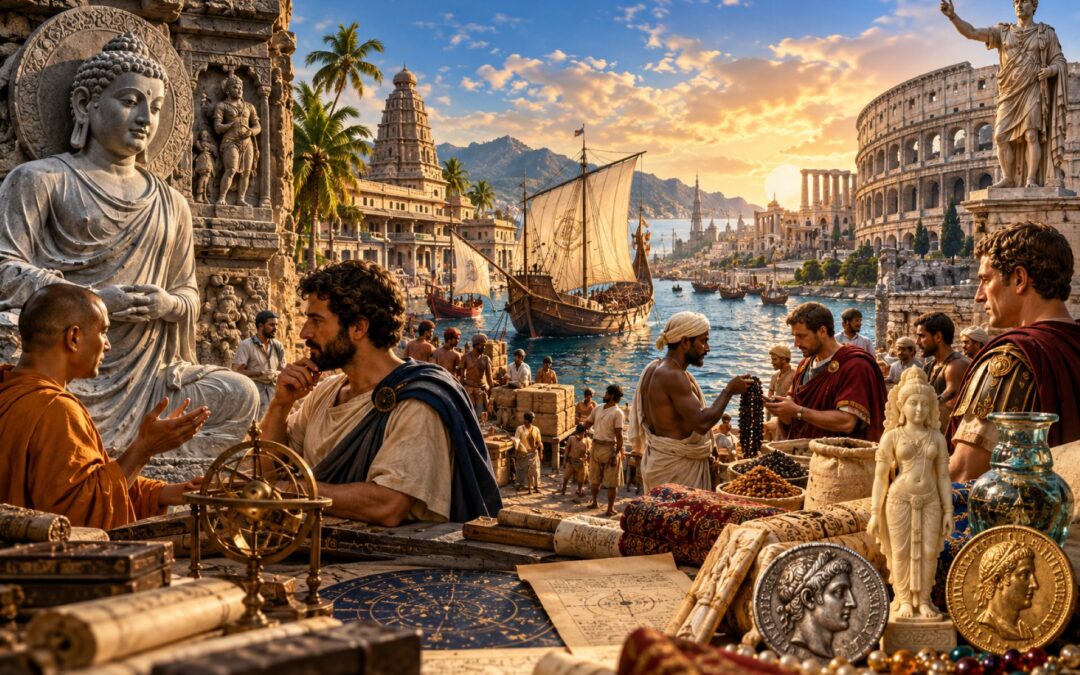
When Alexander the Great marched into northwestern India in 326 BCE, he brought two ancient worlds into one of history’s most famous encounters. His armies fought Indian rulers, crossed unfamiliar rivers, and eventually refused to advance farther east. The campaign has become such a prominent part of ancient history that it can seem like the defining moment of contact between Greece and India. Yet Alexander’s invasion was only one episode in a much longer relationship.
For centuries afterward, Greek-speaking rulers governed territories in northwestern South Asia, Buddhist communities developed connections with Hellenistic culture, and Roman merchants sailed across the Arabian Sea in search of Indian goods. Indian travellers reached the Mediterranean, foreign artisans and merchants became part of Indian commercial life, and scholars encountered astronomical and astrological ideas developed in distant intellectual traditions. These connections involved far more than occasional diplomatic exchanges or the movement of luxury goods.
The surviving evidence also reveals a complicated story. Some encounters produced distinctive works of art and new religious communities, while others involved conquest, enslavement, and competition for wealth. Ancient writers sometimes exaggerated the scale of foreign influence, and later traditions attributed remarkable achievements to individuals whose lives remain difficult to reconstruct. Understanding how India connected with Greece and Rome therefore requires distinguishing what archaeological discoveries and contemporary records establish from what later generations believed or imagined.
The Kingdoms Alexander Left Behind
Contact between the Indian subcontinent and the Greek-speaking world did not begin with Alexander. The Achaemenid Persian Empire had already brought parts of northwestern South Asia into a political system extending toward the Mediterranean. Greeks and Indians participated in overlapping imperial, military, and commercial networks before Macedonian expansion transformed the region’s political landscape.
Alexander conquered the Persian Empire before advancing into territories associated with present-day Afghanistan and Pakistan. In 326 BCE, his forces confronted King Porus near the Hydaspes River, generally identified with the Jhelum. Although Alexander won the battle, Porus remained an important local ruler under the settlement that followed. The encounter demonstrated both the military reach of the Macedonian kingdom and the importance of negotiating with established Indian powers.
Alexander did not conquer the entire Indian subcontinent. His army eventually refused to continue beyond the Beas River, and he turned back without reaching the powerful states of the Gangetic plain. Following his death in 323 BCE, his enormous empire fragmented among competing successors, creating new kingdoms that inherited elements of Macedonian political and military organization.
One of these successors, Seleucus I Nicator, attempted to establish his authority over territories in the east. His conflict with Chandragupta Maurya ended in a settlement involving territorial concessions and the transfer of war elephants. Diplomatic relations followed, and the Greek ambassador Megasthenes visited the Mauryan court at Pataliputra. These developments belonged to the wider transformations of the Mauryan Empire and ancient Indian political history, rather than an uninterrupted continuation of Alexander’s campaign.
The most enduring Greek political presence emerged farther northwest. The Greco-Bactrian kingdoms developed in territories corresponding largely to parts of modern Afghanistan and Central Asia, while Indo-Greek rulers subsequently established authority in regions of present-day Pakistan and northern India. Their boundaries changed through conquest, dynastic rivalry, and shifting alliances, and their populations included communities with different languages and cultural traditions.
The coins issued by Indo-Greek rulers offer particularly revealing evidence of this mixed political environment. Many carried portraits of kings inspired by Hellenistic conventions, with inscriptions in Greek on one side and an Indian language, often written in the Kharosthi script, on the other. Some coins incorporated religious symbols or titles that communicated royal authority to different communities. They were not merely instruments of trade but public expressions of how rulers wanted to be recognized.
These kingdoms gradually became part of a much wider world of interacting political traditions. The Sakas, or Indo-Scythians, established authority in parts of western and northwestern India, while the Kushans later controlled territories linking the subcontinent with Central Asia. The Western Kshatrapas also inherited and adapted aspects of Hellenistic political and artistic culture. None of these powers should simply be described as another Greek dynasty, but their coins, inscriptions, and religious patronage demonstrate how cultural influences could outlast the states that originally carried them.
The political consequences of Alexander’s invasion were therefore considerably more important than the territory he personally occupied. Northwestern India became a region in which Greek, Iranian, Central Asian, and Indian traditions continually encountered one another. Religion and art would provide some of the clearest examples of what emerged from these interactions.
Buddhism in Greek-Speaking India
One of the most remarkable connections between India and the Hellenistic world involved Buddhism. The religion developed in northern India centuries before the Indo-Greek kingdoms reached their greatest extent, but its expansion increasingly brought Buddhist communities into contact with Greek-speaking populations. Royal patronage, monastic institutions, commercial networks, and the movement of religious teachers all contributed to this process.
Emperor Ashoka, who ruled much of the Indian subcontinent during the third century BCE, played an important role in the growth of Buddhist institutions and the communication of ethical ideas across his empire. Following the conquest of Kalinga, he increasingly emphasized dhamma, a framework concerned with compassion, restraint, proper conduct, and respect among religious communities. Although Ashoka personally supported Buddhism, his public proclamations were not simply demands that every subject adopt Buddhist doctrine.
Ashoka’s inscriptions provide unusually direct evidence of communication with Greek-speaking populations. In the region of Kandahar, in present-day Afghanistan, inscriptions associated with his reign were composed in Greek, including material preserved in a bilingual Greek-Aramaic inscription. The scholarly interpretation of Ashoka’s Greek-language edicts demonstrates how Mauryan ethical and political ideas were expressed for audiences familiar with different linguistic and intellectual traditions.
These inscriptions establish more securely than later legends that Ashoka’s government addressed Greek-speaking communities. They do not, however, prove that those communities converted to Buddhism in large numbers. The distinction matters because historical contact, religious sympathy, royal communication, and conversion are different developments that require different kinds of evidence.
Later Buddhist traditions describe missionary activity extending into regions associated with Greek populations. One prominent figure is Dharmaraksita, remembered as a teacher of Greek or Yavana background who helped spread Buddhism. Religious accounts credit such missionaries with extraordinary numbers of conversions, sometimes numbering in the tens of thousands. These figures illustrate how Buddhist communities remembered the success of their teachers, but they cannot be treated as independently verified population statistics.
An even more famous association emerged with the Indo-Greek king Menander I, who ruled during the second century BCE. Menander appears to have exercised considerable authority across parts of northwestern India, and his coinage demonstrates the sophistication of the Indo-Greek political world. Ancient Greek writers also remembered him as a successful military ruler, although the exact territorial extent of his kingdom remains uncertain.
Within Buddhist tradition, Menander is commonly identified with King Milinda, the royal interlocutor in the Milindapañha, or Questions of Milinda. The text presents conversations between the king and the Buddhist monk Nagasena on subjects including personal identity, rebirth, moral responsibility, and the nature of liberation. Through questions and analogies, Nagasena explains Buddhist teachings to a ruler who approaches them with philosophical curiosity.
The Milindapañha is an important work of Buddhist literature, but it was transmitted and developed over time. It cannot be read as a contemporary transcript of conversations between the historical Menander and Nagasena. The identification of its literary king with Menander is influential and plausible, yet the extent to which the dialogues preserve actual historical encounters remains uncertain.
Buddhist tradition remembers Milinda as accepting the teachings, and Menander’s association with Buddhism became an enduring part of Greco-Buddhist history. That does not establish that most Indo-Greek subjects converted alongside him. Communities under Greek-speaking rulers continued to participate in varied religious traditions, and the surviving evidence does not support a simple story of an entire population adopting one faith.
The wider development of Buddhism in the northwest continued under later rulers, particularly the Kushans. Buddhist monasteries received support from political elites and merchants, while religious teachers and travellers moved through the routes connecting India, Afghanistan, and Central Asia. The resulting networks helped transmit Buddhist ideas farther east, eventually contributing to the religion’s expansion toward China.
What makes this relationship significant is not simply the possibility that a Greek king became Buddhist. Greek-speaking and Indian communities participated in religious environments where teachings could be translated, interpreted, supported, and transformed. Ashoka’s relationship with Buddhism and imperial dhamma provides one important starting point, but the later development of Buddhist communities reveals a more extensive history of cultural interaction.
How Classical Art Changed Buddhist Imagery
Religious exchange left a visible legacy in the sculpture, architecture, and coinage of northwestern South Asia. In Gandhara, a region encompassing parts of present-day Pakistan and Afghanistan, artists developed forms of Buddhist art that combined local religious subjects with artistic conventions associated with the Hellenistic and wider Mediterranean worlds. The resulting works have become some of the most recognizable expressions of cultural interaction in antiquity.
Gandharan sculptures frequently portray the Buddha wearing robes arranged in deeply carved folds. The treatment of fabric, bodily proportions, hair, and facial features can resemble traditions of naturalistic sculpture developed in the Greek-speaking world. Architectural ornament sometimes incorporates Corinthian-inspired columns, decorative scrolls, and other motifs with parallels in Mediterranean artistic traditions.
The connections extended beyond decoration. Figures associated with Greek mythology could be adapted into Buddhist settings, acquiring meanings different from those they possessed in their original contexts. A particularly interesting example involves representations of Vajrapani, a figure associated with the Buddha’s protection, who sometimes appears with physical characteristics reminiscent of Heracles. Such works reveal how familiar artistic forms could be reused to express religious ideas within a different tradition.
These sculptures were not simply Greek art transported to India. They were produced for Buddhist patrons and communities, often using regional materials and workshop practices. Their subjects, settings, religious functions, and visual conventions emerged from environments in which South Asian, Iranian, Central Asian, and Hellenistic traditions interacted. Gandharan art is therefore better understood as a distinctive regional achievement than as an extension of Greek sculpture alone.
One influential argument attributes the earliest human representations of the Buddha to Greek artistic influence in Gandhara. Earlier Buddhist art frequently represented the Buddha through symbols such as the Bodhi tree, an empty throne, footprints, or the wheel of the dharma. The development of increasingly recognizable human images marked an important transformation in Buddhist visual culture.
However, Gandhara was not the only centre involved in that transformation. Workshops in Mathura, in northern India, also produced early anthropomorphic representations of the Buddha, drawing on local sculptural traditions. The evidence for early Buddha images from Mathura complicates any attempt to credit the invention of the Buddha image exclusively to Greek artists. Scholars continue to discuss chronology, regional developments, and the relationship between these artistic centres.
The spread of Buddha images reflected changes in religious patronage, devotion, and representation across several regions. Gandhara’s contribution was substantial, but the development did not require Buddhist artists everywhere to adopt one Mediterranean model. Different sculptural traditions eventually developed their own recognizable ways of depicting the Buddha.
Coinage offers another window into the same processes of adaptation. Indo-Greek rulers used Hellenistic portrait conventions alongside Indian scripts, titles, and symbols, while later dynasties inherited and transformed those practices. Kushan coins featured religious figures associated with several traditions, including Greek, Iranian, Buddhist, and Indian belief systems. The visual language of royal authority was therefore unusually flexible in regions where many communities interacted.
Farther south, artistic contact with the Roman world took different forms. Buddhist sites such as Amaravati and Nagarjunakonda developed elaborate sculptural traditions during periods when southern India participated in Indian Ocean commerce. Some artistic features have been compared with Roman forms, prompting questions about whether imported objects, travelling craftsmen, or shared visual conventions influenced local artists.
These comparisons require caution. Roman coins and imported goods found in southern India establish commercial contact, but they do not automatically demonstrate that a particular sculpture copied a Roman monument or that a specific building was constructed by Roman craftsmen. Similarities may reflect broader artistic conventions, independent developments, or selective adaptation, and the evidence varies from one object to another.
The larger significance of Greco-Indian art lies in the way artistic conventions changed as they entered new environments. Mediterranean styles did not simply displace Indian traditions, and Indian subjects did not remain visually unchanged when artists encountered unfamiliar techniques. The resulting works belong to the histories of the communities that created and used them.
How Indian Ocean Trade Linked Rome and India
The most extensive and economically consequential relationship between India and Rome developed through maritime commerce. By the early centuries of the Common Era, merchants were moving substantial quantities of valuable goods between the Mediterranean and ports along the Indian coastline. Their voyages connected Roman Egypt with western and southern India, creating commercial networks that operated far beyond the political boundaries of either civilization.
The expansion of these networks became especially important after Rome established control over Egypt in 30 BCE. Egyptian ports on the Red Sea provided access to shipping routes leading toward Arabia, East Africa, and India, while the Nile linked the eastern desert with Mediterranean markets. Roman authority did not invent commerce across the Indian Ocean, which had developed long before the empire reached Egypt, but it helped integrate established routes with the enormous demand of Mediterranean consumers.
The seasonal monsoon winds were essential to this system. Their changing direction allowed experienced sailors to plan voyages across the Arabian Sea, travelling toward India during favourable winds and returning when seasonal conditions reversed. Knowledge of the monsoon system had developed through generations of navigation, and it would be misleading to credit a single Greek or Roman navigator with discovering winds already familiar to seafaring communities.
Nevertheless, the systematic use of these winds made recurring long-distance voyages possible. Rather than relying entirely on journeys that followed coastlines through numerous intermediate ports, vessels could undertake more direct crossings of the Arabian Sea when conditions permitted. Ships still faced storms, navigational uncertainties, dangerous coastlines, and the risk of losing valuable cargoes, but the routes became sufficiently established to support substantial commercial activity.
Two important Egyptian ports were Myos Hormos and Berenike. Cargoes reaching these ports could be carried across the eastern desert toward the Nile and subsequently transported to Mediterranean markets. The movement of goods required more than ships: roads, pack animals, warehouses, customs arrangements, financiers, and merchants working through trusted networks all contributed to the process.
The Greek geographer Strabo reported that, during the reign of Augustus, as many as 120 vessels sailed from Myos Hormos toward India in a year. His statement suggests the scale that maritime commerce had attained by his time. It should not, however, be treated as a complete annual shipping register or proof that exactly the same number of vessels made the journey every year.
A particularly valuable guide to these networks is the Periplus of the Erythraean Sea, a Greek-language commercial and navigational account generally dated to the first century CE. Its descriptions of sailing routes, ports, markets, and commodities provide insight into how merchants understood the commercial geography of the Red Sea and Indian Ocean. The text is especially useful because it identifies the practical concerns of trade rather than presenting contact between distant societies merely as a series of royal encounters.
On India’s western coast, Barygaza, associated with modern Bharuch in Gujarat, was an important trading centre. Farther south, Muziris became famous as a major port associated with the Malabar coast and the pepper trade. Its precise archaeological location remains debated, although excavations at Pattanam in Kerala have supplied important evidence relevant to discussions of ancient maritime commerce.
Other sites, including Arikamedu near present-day Puducherry, provide evidence of Mediterranean connections with India’s eastern coastline. Archaeologists have recovered imported ceramic vessels, amphora fragments, coins, and other objects from sites connected with maritime exchange. These discoveries help reconstruct the routes through which foreign goods reached local communities, although an imported object does not necessarily prove that its original owner or manufacturer travelled with it.
The commodities exchanged reflected the varied demands and productive capacities of participating regions. Indian merchants supplied pepper, precious stones, pearls, ivory, textiles, and other valuable goods. Mediterranean traders brought products including wine, glassware, metals, manufactured objects, and coinage that could serve as payment or be retained for their precious-metal value.
Pepper was particularly important because it appealed to wealthy consumers throughout the Roman world. Textiles and gemstones also commanded considerable demand, while luxury materials offered opportunities for merchants able to transport relatively high-value cargoes across long distances. Such trade connected Indian producers and regional markets with buyers who might never encounter the people responsible for producing their goods.
Not every commodity shipped from an Indian port had originated in India. Chinese silk, Southeast Asian aromatics, and products from other parts of Asia could pass through successive commercial intermediaries before reaching Mediterranean markets. Indian ports therefore operated not only as centres of local production and export but also as points of redistribution within larger Eurasian trading systems.
The relationship is also visible in ancient Tamil literature. Sangam poetry contains references to foreign ships bringing gold and acquiring pepper at ports associated with the Chera region. The term Yavana, used in different contexts for Greeks and other western foreigners, appears within this broader environment of commercial and cultural contact. Because the surviving literary collections developed through complex processes of composition and transmission, their descriptions should be interpreted alongside archaeological evidence rather than treated as straightforward shipping statistics.
Roman coins recovered in southern India provide another striking indication of these connections. Gold and silver coins associated with Roman emperors have been found in substantial numbers at some sites, including areas linked to early Tamil kingdoms. Yet the coins did not necessarily circulate as everyday currency in the same manner as they did within the Roman Empire. Some may have been valued as bullion, stored as wealth, exchanged through local systems, or retained for purposes that are difficult to reconstruct.
The volume of trade attracted attention in Rome itself. Pliny the Elder complained about the flow of money eastward in exchange for expensive goods, describing enormous sums associated with commerce involving India and other eastern regions. Figures commonly repeated as evidence that Rome lost 100 million sesterces annually to India alone misrepresent his account. The larger figure concerned trade with India, Arabia, and the wider eastern luxury market, while the amount he separately associated with India was approximately 50 million sesterces.
Even these figures require caution. Pliny was criticizing luxury consumption, not presenting an independently audited balance-of-payments statement. His complaints reveal contemporary Roman anxieties about imported luxuries and the movement of wealth, but they cannot establish the precise economic consequences of Indian Ocean commerce.
Modern scholarship has moved beyond treating the relationship simply as an exchange of Roman gold for Indian pepper. Jeremy Simmons’s study of the merchants, institutions, and commercial networks behind Indo-Mediterranean trade emphasizes the people and arrangements that sustained commerce across such enormous distances. Foreign merchants needed access to markets, accommodation, information, intermediaries, and relationships with local authorities.
The Muziris Papyrus, a surviving commercial document associated with trade between India and Roman Egypt, provides unusually detailed evidence of this financial environment. It concerns arrangements involving an expensive cargo, including obligations connected with financing, transportation, and customs. The document demonstrates that merchants could organize sophisticated transactions across multiple stages of a journey, relying on credit and legal arrangements rather than simply exchanging goods for coins when ships reached their destinations.
The papyrus does not allow historians to calculate the entire volume of Roman trade with India. It does, however, reveal the scale of investment that an individual commercial venture could require. Large cargoes depended on access to capital, arrangements for handling goods after arrival, and institutions capable of supporting transactions across different markets.
The movement of luxury goods also produced remarkable archaeological discoveries far from Indian ports. In the ruins of Pompeii, archaeologists recovered an ivory statuette of Indian origin depicting a female figure. Often called the Pompeii Lakshmi, the object has also been interpreted as a yakshi-like figure, and its precise place of manufacture remains uncertain. The Indian ivory statuette discovered at Pompeii nevertheless provides tangible evidence that an object produced within an Indian artistic tradition travelled all the way to a Roman city before the eruption of Mount Vesuvius in 79 CE.
Objects such as this statuette reveal how far commercial networks could extend, but they cannot identify every person who handled a particular object. It may have passed through several merchants and ports before reaching its final owner. Its journey illustrates the opportunities created by interconnected trade, while also reminding us that the surviving archaeological record captures only fragments of the commercial system.
Commercial contact was accompanied by diplomacy. Augustus recorded the arrival of embassies from Indian rulers, reflecting the prestige and political interest associated with relations between distant kingdoms. References sometimes interpreted as evidence for a shrine to Augustus near Muziris have also encouraged speculation about an organized Roman presence there, but the physical existence of such a temple and a permanent official Roman embassy has not been securely established archaeologically.
Indian Ocean trade contributed to the prosperity of several regional powers, including the Cheras, Cholas, and Pandyas of early Tamilakam. Access to overseas markets could enrich merchants, generate revenue for rulers, and support local institutions. Yet these kingdoms were not created by Roman commerce alone; they possessed their own agricultural resources, political histories, cultural traditions, and commercial relationships within South Asia.
The importance of this trade lies in its combination of geography, institutions, and sustained human cooperation. Roman Egypt, Arabian Sea routes, Indian ports, and regional markets formed interconnected parts of a commercial system without being controlled by a single empire. Its participants demonstrated that long-distance economic integration could emerge through overlapping networks of merchants and communities rather than through political conquest.
People Who Crossed the Mediterranean–Indian Ocean World
Long-distance commerce could not function through the movement of objects alone. Ships required crews, merchants needed places to stay and conduct business, and transactions across unfamiliar languages and legal systems depended on interpreters, agents, and trusted intermediaries. The relationship between India and the Mediterranean consequently brought people into repeated contact, sometimes for a single trading season and sometimes through more sustained residence.
Evidence from Indian ports suggests that foreign merchants participated directly in local commercial life. Greek and Roman writers described markets on the Indian coastline, while Mediterranean pottery, coinage, and other imported objects reveal recurring exchange. These finds are consistent with the presence of visiting merchants and, in some locations, longer-term foreign trading communities, although they do not automatically demonstrate permanent Roman settlements at every major port.
A crucial distinction exists between a merchant who belonged politically to the Roman Empire and a person described more generally as a Yavana. Ancient Indian terminology did not always distinguish mainland Greeks, Hellenistic communities, and later Mediterranean foreigners in the ways modern historians might prefer. A Greek-speaking merchant operating under Roman imperial authority could be identified through overlapping linguistic, cultural, and political categories.
The people who facilitated this trade also included Indians travelling westward. Archaeological evidence from Roman Egypt is particularly important because it moves the discussion beyond assumptions derived from imported goods. Egyptian Red Sea ports served as meeting places for people arriving from different regions of the Indian Ocean, including merchants and travellers connected with South Asia.
At Berenike and Myos Hormos, inscriptions and graffiti associated with Indian languages provide evidence of such visitors. Tamil-Brahmi and Prakrit material, among other finds, indicates that people connected with Indian linguistic and commercial traditions reached these ports. Their presence demonstrates that the movement of people was not confined to Mediterranean merchants travelling east.
The archaeological record at Berenike has also produced objects associated with Indian religious and artistic traditions, including Buddhist imagery. Such discoveries illuminate the diverse cultural backgrounds of people participating in Red Sea trade. Nevertheless, an Indian religious object in Roman Egypt does not automatically prove the existence of a large local religious community, just as an Indian inscription does not reveal the complete biography of the person who left it.
The commercial environment of these ports was probably multilingual and socially varied. Merchants from different regions could work alongside sailors, labourers, officials, craft specialists, and people responsible for storing and transporting cargo. Some visitors may have returned home after completing transactions, while others could have remained longer because of commercial partnerships, employment, or relationships with local communities.
These contacts did not end at the ports. Goods moved through Egypt toward the Nile and Mediterranean cities, bringing traders and intermediaries into wider networks. Indian travellers are also known from accounts of diplomatic missions and religious encounters, although the evidence for individual journeys differs considerably in reliability.
An intriguing example comes from accounts of an Indian ascetic who travelled west during the Augustan period and died by self-immolation at Athens. Ancient writers treated the episode as remarkable, connecting it with perceptions of Indian religious practice. The surviving accounts are valuable evidence of Mediterranean interest in Indian ascetics, but they do not justify confidently reconstructing the traveller’s entire background, beliefs, or precise place of origin.
Such stories have sometimes encouraged broader claims that Indian philosophers transformed particular Greek or Roman philosophical schools through identifiable personal encounters. Cultural influence is possible in settings where travellers and ideas moved between regions, but resemblance between philosophical concepts does not by itself establish direct borrowing. Claims about the Indian ancestry of specific Alexandrian philosophers or the Indian origins of Neoplatonism require stronger evidence than the surviving material reliably provides.
What emerges most clearly is a world in which mobility was more ordinary than modern geographical assumptions might suggest. Indian merchants could reach Roman Egypt, Mediterranean traders could participate in Indian markets, and religious specialists or diplomatic representatives could travel far beyond their familiar surroundings. Their journeys created opportunities for cultural contact even when historians cannot reconstruct the lives of every participant.
Slavery, Yavana Women, and Elite Status
The connections between India and the Mediterranean were not limited to voluntary travel, trade, or cultural adaptation. Enslavement and human trafficking formed part of the ancient world’s wider networks of power and exchange. People could be moved across enormous distances through warfare, purchase, coercion, or other circumstances that deprived them of control over their own lives.
Indian literary sources contain references to women identified as Yavani, a term related to the broader designation Yavana. Depending on the period and context, these labels could refer to Greeks or to people associated with a wider Hellenistic and Mediterranean world. The terminology is important because it prevents historians from assuming that every woman described as Yavani necessarily came from the Greek mainland.
Some literary accounts place these women within royal courts and elite households, describing roles such as guards, attendants, musicians, dancers, and concubines. Other descriptions associate foreign women with entertainment, service, or the protection of powerful individuals. Such references provide evidence of the place foreign women could occupy within elite society, although literary portrayals cannot be treated as complete records of their individual circumstances.
Classical Sanskrit literature contains references to Yavana women in courtly environments, while the wider Tamil literary record also preserves evidence of contact with western foreigners. These sources emerged in different historical contexts, and their terminology and social assumptions require careful interpretation. The presence of foreign women in elite settings does not necessarily mean that every such woman was enslaved, but slavery was an important part of the environment in which some of these descriptions developed.
Kathryn A. Hain’s research on Greek slave women and the production of elite prestige in ancient India examines how foreign women could serve as symbols of wealth, political authority, and access to distant commercial networks. Possessing attendants from unfamiliar regions could communicate that a ruler or wealthy household had the resources to acquire people and goods unavailable to most of society.
This helps explain why descriptions sometimes emphasize foreign clothing, appearance, or cultural difference. These features could reinforce the prestige associated with distant origins. Yet such representations also tell us more about elite preferences and the authors who recorded them than about the wishes or experiences of the women themselves.
The surviving evidence should not be used to construct a sweeping picture of Indian demand for Greek women as the primary force behind an organized transcontinental slave trade. Ancient slavery operated through multiple political and commercial mechanisms, and the scale of particular routes is difficult to establish. People from South Asia could also enter situations of servitude or enslavement in western markets, but the surviving records do not permit confident numerical comparisons between the different directions of movement.
The broader significance is that ancient cultural contact could coexist with profound inequality. The same networks that transmitted religious ideas, artistic objects, and luxury commodities also operated within societies where human beings could be treated as property. Recognizing this dimension produces a more complete account of the relationship between India and the Greco-Roman world without romanticizing the experiences of those who lacked freedom.
How Greek Astronomy and Astrology Entered Indian Scholarship
Some of the most enduring connections between the Greek-speaking world and India emerged through intellectual exchange. Astronomy, mathematical calculation, and astrology developed within complex scholarly traditions, and Indian authors encountered ideas associated with Hellenistic scientific learning. These encounters contributed to new systems of calculation and interpretation, although the precise routes through which particular texts and methods travelled are not always clear.
Astronomy and astrology were closely associated in many ancient intellectual environments, but they should not be treated as identical subjects. Astronomy concerns the observation and mathematical description of celestial phenomena, including the motions of planets and other heavenly bodies. Astrology uses celestial positions and patterns to interpret human affairs or predict events. Historical discussion of the development of astrology does not establish the validity of its predictive claims.
Indian astronomical traditions existed before the period of extensive Hellenistic contact. Calendrical practices, observations of celestial cycles, and systems associated with ritual timekeeping had already developed within South Asia. The encounter with Greek-derived knowledge therefore involved the transmission and adaptation of particular methods, terminology, and computational frameworks rather than the introduction of celestial observation to a society that previously possessed none.
One important example comes from the work of Varahamihira, the sixth-century Indian scholar associated with astronomy and astrology. His Pañcasiddhāntikā, or Five Astronomical Canons, discusses five systems of astronomical knowledge. Among them are the Paulīśa and Romaka traditions, whose names and mathematical features have long attracted scholarly attention because of their connections with western astronomical learning.
The Paulīśa system is often associated with material derived from Hellenistic astronomy, while the Romaka system reflects traditions identified with the Roman world. These connections are important, but they should not be simplified into the claim that Varahamihira was merely working with two unchanged Greek books translated directly into Sanskrit. The systems reached the Indian scholarly environment through processes of adaptation, and their surviving forms must be examined within the history of Indian astronomical literature.
Indian authors could acknowledge expertise associated with foreign scholars while also operating within their own intellectual traditions. Certain Sanskrit passages praise the astronomical knowledge of the Yavanas, even while using terminology that marks them as culturally foreign. Such statements reflect an environment in which scholarly ability could be recognized across social and religious boundaries.
The historical significance of these observations lies in the distinction between borrowing and intellectual dependence. Indian scholars were not passive recipients of finished knowledge. They compared methods, incorporated useful techniques, adjusted calculations, and integrated foreign-derived concepts into systems shaped by local astronomical practices and scholarly priorities.
Astrology provides an especially revealing example of this adaptation. Indian traditions of interpreting celestial phenomena developed through multiple historical processes, but the emergence of systematic horoscopic astrology shows substantial connections with Hellenistic models. Zodiacal signs, planetary relationships, and methods for interpreting a person’s horoscope became part of Sanskrit astrological literature in forms that reveal both foreign influence and Indian transformation.
The twelve-sign zodiac offers one of the clearest examples. Its familiar structure and several associated technical concepts entered Indian astrological traditions through contact with Hellenistic systems. Yet the use of imported zodiacal terminology did not mean that all Indian calendrical, astronomical, or predictive practices originated abroad. Earlier indigenous traditions continued to influence how new methods were understood and applied.
One of the most important texts in this history is the Yavanajātaka, often translated as a work concerning the astrological teachings of the Greeks. It is associated with Sphujidhvaja and occupies a significant place in discussions of the transmission of Hellenistic horoscopy into Sanskrit intellectual culture. The text contains material reflecting Greek-derived astrological techniques, but its composition and textual history are more complicated than earlier accounts suggested.
A widely repeated reconstruction described a Greek astrological work translated into Sanskrit by Yavanesvara during the second century CE, followed by a metrical adaptation associated with Sphujidhvaja. This account supplied an apparently precise chronology for the arrival of Greek horoscopic knowledge in India. It also became influential in explanations of how western astrological systems entered Indian scholarship.
However, subsequent research has challenged important elements of that reconstruction. Bill Mak’s reassessment of the date and nature of Sphujidhvaja’s Yavanajātaka examines the manuscript evidence and questions the conventional chronology and the assumed relationship between the surviving Sanskrit work and an earlier Greek original. The result is a more uncertain but also more historically careful picture of the text’s development.
This uncertainty does not eliminate Hellenistic influence on Indian astrology. Rather, it cautions against identifying one specific translation event as the definitive moment at which Greek astrology entered India. Ideas could circulate through multilingual scholarly environments, successive adaptations, and texts whose earliest forms have not survived.
The Western Kshatrapas provide a useful political context for these developments. These rulers governed territories in western India and operated within cultural environments that inherited elements of Hellenistic practice, even though they were not simply a Greek-speaking dynasty. Their coins sometimes retained Greek-derived lettering or visual conventions long after those forms had ceased to function as ordinary Greek inscriptions.
Such objects illustrate how a foreign-derived cultural form could acquire a new local purpose. A coin might preserve recognizable Greek-looking characters without communicating a meaningful Greek text, just as an astronomical technique could be incorporated into Sanskrit scholarship without retaining its original intellectual setting. Adaptation changed both the meaning and the practical use of the inherited material.
The wider history of scientific exchange therefore cannot be reduced to a contest over which civilization invented a particular body of knowledge. Greek-speaking scholars, Indian astronomers, and other intellectual communities operated within a world where methods and ideas could move across political and linguistic boundaries. Their work demonstrates how knowledge developed through repeated interpretation, comparison, and transformation, even when the intermediate stages of transmission remain difficult to recover.
The encounter between India and the Greco-Roman world was never a continuous relationship between two unified civilizations. It involved changing kingdoms, commercial communities, religious institutions, and intellectual traditions across many centuries. Greek and Roman influence was strongest in some regions and fields, while Indian communities adapted that influence according to their own needs, beliefs, and practices.
The evidence also shows why influence should not be confused with cultural ownership. A Buddhist sculpture incorporating Hellenistic conventions remained part of a Buddhist artistic tradition, just as an Indian astronomical text containing Greek-derived material belonged to an evolving Sanskrit scholarly environment. The movement of people and ideas created new forms without erasing the distinct histories of the societies that produced them.
Alexander’s campaign remains an important chapter in this relationship, but it is far from the whole story. Merchants, monks, rulers, artisans, travellers, enslaved people, and scholars established connections that extended beyond the boundaries of individual empires. Ancient India, Greece, and Rome were not isolated worlds occasionally interrupted by extraordinary encounters. They were participants in overlapping networks through which goods, beliefs, artistic practices, and knowledge continually acquired new meanings.
Last Updated on October 26, 2026 by Aseem Gupta