
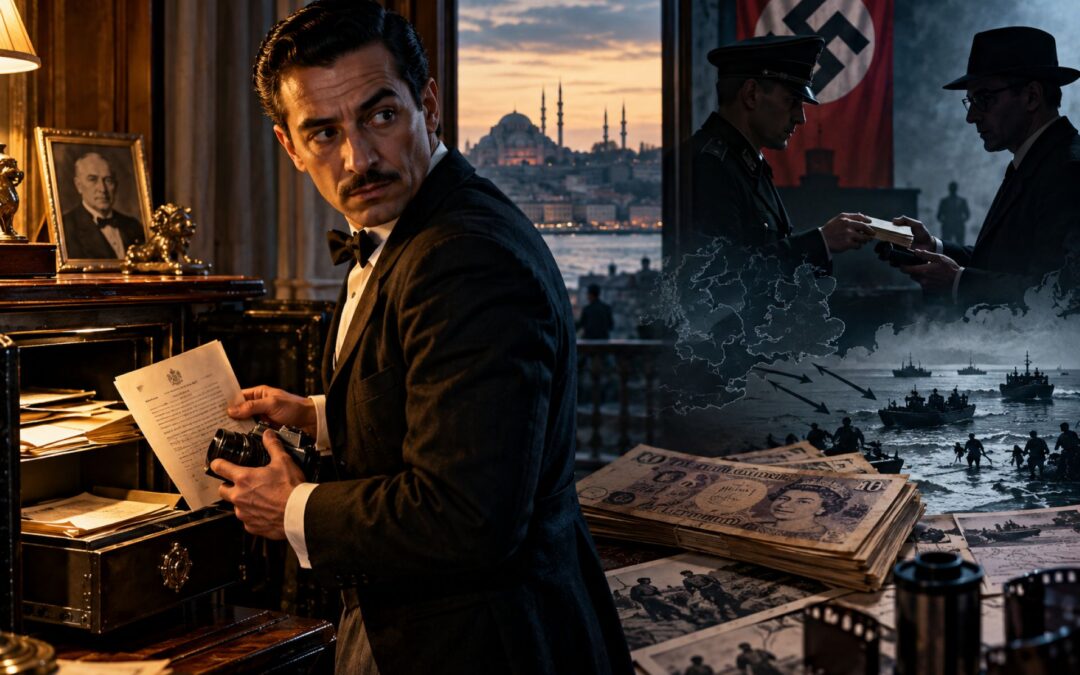
In October 1943, one of Britain’s most serious wartime security breaches began inside the residence of its ambassador to Turkey. The man responsible was not a trained British diplomat, a military officer, or a senior intelligence operative. He was a valet named Elyesa Bazna, whose ordinary household duties gave him access to some of the most sensitive diplomatic documents of the Second World War.
Over the following months, Bazna secretly photographed British documents and sold the images to Nazi Germany. His German handlers gave him the codename Cicero, and the material he supplied included information about Allied conferences, negotiations with Turkey, and preparations for a major invasion of Western Europe. The operation exposed an extraordinary failure of diplomatic security at a time when intelligence could influence military campaigns and international alliances.
Yet the remarkable part of Cicero’s story is not simply that he successfully stole the documents. German officials struggled to decide whether they could trust the information, and the intelligence produced far less demonstrable strategic impact than its sensitivity might suggest. After the war, Bazna discovered that much of the fortune he had earned from espionage was counterfeit.
His story raises three connected questions: how did an embassy servant gain access to Britain’s wartime secrets, why did Germany fail to exploit them decisively, and how did one of the most notorious espionage operations of the war leave its principal agent with so little?
Why Neutral Ankara Was a Prize for Wartime Spies
During the Second World War, Turkey occupied an unusually important position in international diplomacy. Although geographically close to several major areas of conflict, it remained neutral for most of the war, resisting pressure to enter the fighting while maintaining relationships with both the Allied and Axis powers.
Turkey’s geographic position made its allegiance strategically valuable. It controlled the Bosporus and Dardanelles, the waterways connecting the Black Sea to the Mediterranean, and bordered territories important to military operations in southeastern Europe and the Middle East. Its involvement could influence regional security, diplomatic calculations, and the ability of rival powers to operate around these strategically sensitive areas.
Britain wanted Turkey to join the Allied cause, particularly as the prospect of opening additional pressure against Germany became more important. Germany, meanwhile, had strong reasons to keep Turkey neutral and outside the Allied military coalition. German-Turkish economic relations also mattered, particularly the trade in chromite, a mineral used in producing alloy steels for military industry.
Consequently, Ankara became an important center for diplomacy and intelligence gathering. German, British, Soviet, American, and other representatives pursued information about Turkish intentions, military developments, and one another’s negotiations. Embassy conversations and confidential correspondence could offer valuable insights into decisions that had not yet become public.
Within the wider history of World War II, diplomatic intelligence was closely connected to military strategy. Governments needed to understand not only their enemies’ armies but also their political relationships, negotiating positions, and expectations about future operations. A leaked diplomatic document could therefore be valuable even when it contained no battlefield map or immediate military order.
It was in this environment that Elyesa Bazna found an opportunity.
Bazna was an Albanian Turk whose background included a succession of occupations and movement through different European and Turkish environments. Accounts of his early life disagree about his precise birthplace and some biographical details, but they generally portray him as multilingual, resourceful, and experienced in practical work rather than formal diplomacy.
His earlier employment reportedly included military-related work, driving, household service, and positions connected to diplomatic establishments. Some biographical accounts also describe episodes of theft, detention, and experience with locks. These details are difficult to establish independently in every particular, although his later espionage clearly demonstrated an ability to exploit domestic routines and weaknesses in physical security.
By 1943, his varied employment history had brought him close to the diplomatic community in Ankara. What made him dangerous was not any official intelligence position but his ability to gain the trust of people who handled sensitive information.
How Elyesa Bazna Gained Access to the Ambassador’s Secrets
In 1943, Bazna entered the household of Sir Hughe Knatchbull-Hugessen, the British ambassador to Turkey. His position as valet placed him in close contact with the ambassador’s personal routine, including dressing, bathing, and other domestic arrangements. These responsibilities appeared unrelated to diplomatic affairs, but they gave him opportunities that ordinary embassy employees did not necessarily possess.
Before joining the ambassador’s household, Bazna had worked for Douglas Busk, a British diplomat in Ankara. Accounts of this earlier employment include allegations that he had already experimented with photographing documents, sometimes with assistance from a woman named Mara, described in later narratives as a nursemaid connected with the household and a romantic partner of Bazna. The precise details of these early activities are less firmly established than the subsequent Cicero operation, but they suggest that his exploitation of diplomatic access may have developed gradually.
Bazna’s appointment to the ambassador’s household created a much more significant opportunity. Knatchbull-Hugessen was involved in highly sensitive wartime diplomacy, yet he regularly brought confidential documents into his residence. Rather than remaining exclusively within tightly controlled embassy offices, important papers could be accessed in rooms where domestic staff performed their duties.
This was the central weakness that Bazna exploited.
The ambassador reportedly kept secret documents in locked containers or a safe within his private rooms. According to accounts of the operation, Bazna observed that the ambassador sometimes left his keys unattended while bathing. Using an impression of the keys, he arranged for duplicates that allowed him to open the containers without the ambassador’s knowledge.
The method did not depend on breaking into the embassy in the conventional sense. Bazna already had legitimate access to the household, and the ambassador’s routine provided periods during which valuable papers could be examined without immediate supervision.
Once he had access to the documents, Bazna photographed them rather than removing them permanently. He could then return the originals before the ambassador noticed anything unusual. This method allowed him to obtain information repeatedly while reducing the likelihood that a missing document would reveal the theft.
The ambassador’s bathing routine was not the only opportunity. Bazna also exploited occasions when Knatchbull-Hugessen left the residence, including periods when he went into Ankara to play the piano. These absences gave the valet additional time to enter the study and photograph papers.
The seriousness of this security failure became clearer after the war. In 2005, newly released British documents examined in reporting on the Cicero affair and the ambassador’s conduct revealed the extent to which officials understood that sensitive papers had been exposed through the ambassador’s personal habits.
The problem extended beyond Bazna’s ability to copy keys. Diplomatic secrets were being handled in an environment where the boundary between official security and domestic access had become dangerously weak. The ambassador’s confidence in his household arrangements meant that someone trusted to perform personal duties could also reach information intended for senior government officials.
Bazna’s position also helped conceal his activities. As a servant, he was expected to enter rooms, handle clothing, maintain household routines, and remain close to the ambassador without taking part in official conversations. His presence was familiar enough to escape attention even though he lacked any legitimate reason to inspect classified correspondence.
This made Cicero’s operation an unusually effective example of espionage through privileged access. He did not have to penetrate British diplomatic defenses from outside because he had already been admitted into the space where sensitive information was kept.
What he still needed was someone willing to purchase it.
The Deal That Turned a Valet into Cicero
In late October 1943, Bazna approached the German embassy in Ankara with an extraordinary proposition. He claimed to possess access to secret British documents and offered to supply photographs of them in exchange for substantial payments.
His principal contact became Ludwig Moyzisch, an Austrian-born official working at the German embassy. Moyzisch occupied a diplomatic position while conducting intelligence work associated with the Sicherheitsdienst, or SD, the Nazi security service. This distinction matters because the German Abwehr, the military intelligence organization, was a separate institution, and the Cicero operation became entangled in the rivalries and suspicions of Nazi Germany’s intelligence apparatus.
Initially, Moyzisch had reason to be cautious. An unknown man claiming to work for the British ambassador was offering highly sensitive documents for an unusually large sum. The material might have been genuine, but it could also have represented an Allied deception operation designed to feed false information to German officials.
Bazna reportedly introduced himself using the name Pierre rather than immediately revealing his real identity. The two men communicated in French, a language they could both use, and arranged further contact after Moyzisch considered the offer.
The price was remarkable. Widely repeated accounts place Bazna’s initial demand at £20,000 for two rolls of film, with subsequent material priced at approximately £15,000 per roll. These figures illustrate the scale of the transaction, although the exact totals associated with individual deliveries vary across retrospective accounts.
The Germans ultimately decided that the photographs warranted payment. Their quality and the apparent importance of the documents made the source difficult to ignore, even if his true motivations and reliability remained uncertain.
German intelligence assigned him the codename Cicero, invoking the Roman statesman and orator Marcus Tullius Cicero. The name became inseparable from the operation, although the historical record provides little reason to treat the choice of codename as evidence of Bazna’s intellectual sophistication or rhetorical abilities.
The relationship developed into a continuing intelligence arrangement. Bazna photographed documents in the British ambassador’s residence, transferred the film to Moyzisch, and received substantial payments. Meetings were organized discreetly, including exchanges away from the ordinary public activities of the embassy.
The practical division of responsibility was straightforward. Bazna supplied access and photographs, while Moyzisch handled the German intelligence connection and transmitted the material through official channels. This arrangement meant that senior German officials could receive information originating inside the British diplomatic household without having direct contact with the man stealing it.
From Bazna’s perspective, the operation was financially attractive. He was reportedly motivated primarily by money, and the sums available from selling photographs were far beyond anything he could expect from ordinary household employment. Stories about additional grievances against the British appear in later accounts, but his documented willingness to negotiate large payments makes the commercial character of his espionage especially clear.
The very success of the arrangement eventually became one of its weaknesses.
A normal intelligence source might provide occasional fragments of valuable information, often gathered with great difficulty. Cicero repeatedly delivered clear photographs of highly sensitive documents from inside the enemy’s diplomatic establishment. The access appeared so extraordinary that German officers could not agree whether they had discovered a remarkable asset or were being manipulated by an exceptionally sophisticated deception.
What Cicero Revealed—and Why Germany Failed to Use It
The documents sold by Cicero were genuinely important. They contained information about Allied diplomatic exchanges, wartime conferences, negotiations involving Turkey, and preparations for future operations. In principle, such intelligence could help German leaders understand Allied intentions and anticipate political or military developments before they became public.
Among the subjects associated with his deliveries were the Moscow, Tehran, and Cairo conferences of 1943. These meetings formed part of the diplomatic process through which Allied leaders coordinated the war against Germany and Japan, discussed future operations, and negotiated relationships among the major Allied powers.
For German intelligence, even partial knowledge of these discussions could be valuable. It might reveal disagreements between Allied leaders, indicate the timing or direction of future operations, and expose efforts to bring Turkey into the war. Understanding the Allies’ priorities was particularly important as Germany faced mounting pressure in the Soviet Union, the Mediterranean, and Western Europe.
The material also contained references to Operation Overlord, the planned Allied invasion of German-occupied Western Europe. This has become one of the most frequently discussed aspects of the Cicero affair because Overlord culminated in the Normandy landings of June 6, 1944.
However, the distinction between knowing about Overlord and possessing its complete operational plan is essential.
German authorities already understood that an eventual Allied invasion of Western Europe was likely. What remained critically important was determining precisely where, when, and how the invasion would occur. Information confirming a major operation in northern France was valuable, but it was not equivalent to possessing the final landing plans.
Research discussed by the German Spy Museum in its assessment of the Cicero operation indicates that the material revealed the name Overlord and Allied intentions for a large attack in northern France. It did not establish the exact landing site or the precise invasion date.
This limitation significantly changes how the operation should be understood.
If Germany had obtained the complete details of the Normandy invasion months in advance, the implications could have been profound. But Cicero’s possession of documents mentioning Overlord does not mean he compromised every element required to defeat the landings. The most decisive operational details were not necessarily present in the ambassador’s papers.
Nor did possessing genuine intelligence guarantee that German commanders could use it effectively.
From the beginning, senior German officials questioned the authenticity of Cicero’s material. His access was extraordinarily convenient, the photographs were unusually clear, and the volume of information appeared almost too generous. These features created precisely the doubts that successful intelligence collection should normally overcome.
German intelligence officials were familiar with the possibility of deception. A source who supplied genuine-looking documents might actually be delivering carefully prepared false information, especially when the material concerned major military decisions. It was therefore reasonable to investigate whether Cicero had been planted by the Allies.
The wider intelligence environment reinforced those concerns. Britain operated sophisticated deception networks, including double agents who appeared to work for Germany while transmitting information controlled by British intelligence. German officials had to contend with the possibility that seemingly valuable reports were intended to influence their own decisions.
Agents such as Garbo, Zigzag, and Tricycle illustrate the broader world of deception in which Cicero operated. Their circumstances were different from Bazna’s, and they were not evidence that his material was fraudulent. Nevertheless, the existence of Allied double-agent operations helps explain why German authorities were reluctant to accept sensational intelligence without scrutiny.
Institutional rivalries further complicated the assessment. Nazi Germany did not possess a perfectly unified intelligence establishment. The Abwehr, SD, Foreign Office, and other organizations had overlapping responsibilities, competing interests, and complicated relationships with the political leadership.
Information could therefore encounter skepticism at several levels. Officials might question its authenticity, dispute its interpretation, or resist conclusions that conflicted with existing expectations. Even when a document was genuine, turning it into useful policy or military action required agreement among people who did not necessarily trust one another.
One episode helped strengthen Cicero’s credibility. His documents reportedly contained advance information about Allied bombing in the Balkans, including an attack on Sofia. When the anticipated bombing occurred, it provided evidence that at least some of the material represented authentic information rather than an entirely fabricated deception.
That confirmation mattered, but it did not eliminate every uncertainty. A genuine document could be old, incomplete, or misunderstood. It could accurately describe plans that subsequently changed, or reveal intentions that were already known through other channels.
German officials also had to consider the gap between diplomatic discussions and military decisions. Allied leaders might debate several operational alternatives before choosing one, and an embassy document could capture only one stage of that process. Treating preliminary discussions as final orders could produce serious mistakes.
This is why Cicero’s achievements require two different assessments.
As an espionage operation, his work was extraordinary. He repeatedly penetrated a sensitive diplomatic environment and delivered authentic British documents to an enemy government. The security failure itself was substantial, regardless of whether every photograph influenced a military decision.
As an instrument of German strategy, the results were far less clear.
Intelligence historian David Kahn has argued that although Cicero obtained interesting information, it had little meaningful effect on the course of the war. By late 1943, Germany’s strategic position was deteriorating, Allied power was expanding, and the options available to German leaders were increasingly constrained.
This interpretation challenges the popular claim that Germany could have transformed the outcome of World War II simply by believing Cicero. Better intelligence might have improved certain decisions, but it could not automatically overcome shortages of resources, competing military priorities, operational uncertainty, or the Allies’ growing strength.
Some retrospective accounts emphasize German arrogance and bureaucratic resistance as reasons for the failure to exploit the documents. Those factors may have contributed, but the evidence does not justify reducing the entire outcome to officials foolishly ignoring perfect information.
The more useful conclusion is that Cicero’s case demonstrates the difference between obtaining intelligence and benefiting from it. He successfully delivered secrets, but those secrets had to be interpreted in context, judged for reliability, and converted into actions that were both feasible and strategically useful.
For a spy whose reputation rests on the sensitivity of the information he stole, that distinction is fundamental.
How the British and Americans Closed In
While German officials debated the value of Cicero’s reports, British and American intelligence services began receiving indications that information was leaking from the British diplomatic establishment in Ankara.
One important source of suspicion was Fritz Kolbe, a German Foreign Office employee who secretly supplied information to the Americans. Working through contacts associated with Allen Dulles and the Office of Strategic Services, Kolbe provided intelligence about German activities, including information that helped expose the existence of a source inside the British embassy.
The warnings created an uncomfortable problem for British officials. A serious leak appeared to exist, but identifying the person responsible was difficult. The possibility that an apparently trusted member of the ambassador’s household was photographing official papers did not fit easily with conventional assumptions about diplomatic security.
Embassy personnel came under scrutiny, and investigators attempted to determine how confidential information had reached Germany. Bazna was among those questioned or considered during the investigation, but the suspicions did not immediately result in his arrest. Accounts of British attitudes toward him emphasize that his position, manner, and limited command of English encouraged some officials to underestimate his capabilities.
The investigation was not a straightforward example of intelligence agencies efficiently cooperating to identify a spy. British diplomatic officials and security investigators had their own institutional responsibilities, and the inquiry became entangled in questions about who controlled embassy security and who should be permitted to investigate diplomatic personnel.
Historian Christopher Baxter’s study, Forgeries and Spies: The Foreign Office and the ‘Cicero’ Case, uses subsequently released records to examine the Foreign Office’s reaction to the breach. His research highlights earlier security concerns at Ankara, attempts to trap the spy, and the department’s resistance to outside interference, particularly from MI5.
These tensions mattered because a security investigation could threaten the reputation of the ambassador and the Foreign Office itself. Establishing that confidential documents had been photographed was one problem; acknowledging that diplomatic practices had allowed the breach to continue was another.
British authorities also attempted to trap the source by placing false material where the suspected spy might photograph it. In January 1944, a forged Cabinet Office document was prepared as part of the effort, using the apparent authority of senior British officials, including the Foreign Secretary, Anthony Eden.
The objective was to determine whether the planted information would find its way into German hands. If the Germans reacted to a document that had been deliberately introduced into the ambassador’s papers, investigators could establish a clearer connection between the leak and a specific location.
The attempt did not produce the decisive result the investigators hoped for. Cicero continued to evade identification while the broader concerns about embassy security remained unresolved.
Another important part of the story was unfolding inside the German embassy.
Cornelia Kapp, better known as Nele Kapp, worked as a secretary connected with Moyzisch’s intelligence activities. She was also cooperating with Allied intelligence and was able to provide information about German operations from within the diplomatic establishment.
Her position offered a different route into the Cicero affair. Whereas the British were attempting to identify the source of their own leaked documents, Kapp could gather information about the German officials receiving and handling those documents.
She learned about Moyzisch’s contact with the mysterious agent and sought information about the man behind the codename. Her access to conversations and office arrangements allowed her to report details that helped Allied intelligence understand the operation, although the exact sequence by which she established the agent’s identity is not uniformly described in later accounts.
Her activities were dangerous. Discovery could expose her to arrest and potentially fatal consequences, and the Allies eventually had to arrange her escape.
The CIA’s historical account of Jack Caskey and Operation Honeymoon describes how the American Office of Strategic Services became involved in helping Kapp leave Turkey. Caskey, an archaeologist serving with the OSS in Izmir, participated in an extraction operation that used the cover of a newly married couple traveling together.
Kapp’s contribution demonstrates how intelligence operations could become connected through people who were not conventional military agents. Cicero relied on a domestic servant’s access to British diplomatic papers, while the Allied response benefited from a secretary’s access to the German intelligence environment.
At the same time, the British embassy began tightening its security arrangements. New precautions made it more difficult for Bazna to reach sensitive documents without drawing attention. Accounts describe additional alarm measures and growing restrictions that complicated the repeated photographing of papers.
The increasing danger reduced his ability to continue.
Bazna gave notice of his intention to leave the ambassador’s employment in early 1944, and the flow of intelligence to Germany ended around the following February. Accounts differ over the exact date of his final departure from the household, but the important fact is that he managed to disengage without being apprehended during the operation.
The complete scale of the affair became clearer only after Germany’s defeat, when British investigators examined German intelligence records and questioned people associated with the operation. Moyzisch’s testimony and the surviving documentation helped establish what Cicero had done and how the information had been handled.
The British authorities had failed to catch the spy while he was active. Their postwar investigation instead exposed the extent of the breach and raised serious questions about the diplomatic practices that had made it possible.
Knatchbull-Hugessen came under substantial criticism for allowing confidential documents to be photographed through inadequate security precautions. Yet his diplomatic career continued, an outcome that prompted further questions about accountability within the Foreign Office.
The eventual exposure of Cicero therefore revealed failures on both sides. British security had been compromised for months, while the Germans had acquired sensitive material without translating it into a clearly decisive strategic advantage.
A Counterfeit Fortune and Cicero’s Final Years
By the time the operation ended, Bazna had received an extraordinary amount of money, at least in nominal terms. Historical accounts commonly place his total payment at approximately £300,000, a vast sum during the 1940s and far beyond what an ordinary employee in the ambassador’s household could have accumulated through legitimate work.
The payments seemed to have transformed his future. He had taken considerable risks and escaped immediate capture, apparently acquiring enough money to support a comfortable life after the war.
However, the financial reward concealed a devastating problem.
Much of the money paid to Bazna consisted of counterfeit British banknotes. The notes were associated with Operation Bernhard, a Nazi programme designed to reproduce British currency with sufficient accuracy to circulate it as genuine money.
The original objective of the scheme included destabilizing Britain’s economy through currency forgery. The operation also provided the German authorities with a means of financing intelligence activities and acquiring goods without using legitimate financial resources.
The production process was elaborate. German authorities needed to reproduce the paper, printing techniques, watermarks, signatures, and security details of genuine Bank of England notes. Producing convincing currency required more than printing a familiar design, particularly because authentic notes contained features intended to make counterfeiting difficult.
The human cost of the programme was severe.
According to the Bank of England’s history of Operation Bernhard, Nazi officials assembled a group of Jewish concentration-camp prisoners at Sachsenhausen who possessed specialist knowledge of engraving, printing, graphics, and banking. These prisoners were compelled to manufacture counterfeit currency under the control of the SS.
They studied authentic notes, recreated security markings, developed suitable paper, and reproduced the appearance of currency that had circulated through ordinary commercial use. The resulting forgeries were sufficiently convincing to pass through financial transactions before their fraudulent origins were recognized.
Operation Bernhard therefore linked espionage finance to forced labor and Nazi persecution. The currency Bazna received was not merely fraudulent money produced through an ingenious criminal scheme. It was connected to a system in which imprisoned people were exploited for their technical expertise under the threat of violence and death.
Bazna apparently did not realize the full extent of the deception when he accepted the payments. The forged notes looked convincing, and even Moyzisch was reportedly unaware that the money being used to pay Cicero was counterfeit.
After the war, Bazna attempted to put his wealth to practical use. Accounts describe a proposed hotel venture and other efforts to establish financial security. When the authenticity of his banknotes was examined, however, much of the supposed fortune proved worthless.
The revelation transformed the meaning of his wartime earnings. Bazna had successfully sold genuine secret documents, but his employers had compensated him with money that could not reliably be spent or exchanged. The intelligence was real; much of the payment was not.
His financial difficulties continued in the postwar years. He reportedly faced creditors and struggled through several occupations, including teaching singing and performing other work to support himself. He also attempted to obtain compensation from West German authorities for the counterfeit payments, but those efforts were unsuccessful.
By 1960, Bazna had moved to Munich, where accounts describe him working as a night watchman. It was a striking change in circumstances for a man who had once commanded enormous fees for photographs obtained from a British ambassador’s private study.
His experiences had already become the subject of books and popular entertainment. Ludwig Moyzisch published Operation Cicero in 1950, presenting the affair from the perspective of the German intelligence officer who handled the spy.
The story subsequently inspired the 1952 film 5 Fingers, which brought a fictionalized version of the operation to a wider audience. The film contributed to Cicero’s reputation as a remarkably successful espionage figure, although its dramatic treatment should not be confused with a precise reconstruction of the historical events.
Bazna later published his own account, I Was Cicero, in 1962. His memoir offered a personal version of the affair, but like other retrospective autobiographical accounts, it requires careful comparison with documentary evidence, particularly where it describes private conversations, motivations, and events that cannot be independently corroborated.
He died in Munich in December 1970, commonly reported to have been suffering from kidney disease. He was far removed from the prosperity that the wartime payments had appeared to promise.
Cicero’s reputation survived him, but the historical judgment is more complicated than the legend. His operation demonstrated that a person without formal intelligence authority could exploit routine domestic access to compromise exceptionally sensitive state secrets. It also showed that valuable information does not automatically translate into effective strategy, especially when those receiving it cannot determine what to believe or how to act.
The most remarkable irony was that Bazna had risked his future to steal authentic intelligence from the British, only to discover that the German state had rewarded him with counterfeit money. Yet that personal reversal was only one part of a larger story involving diplomatic negligence, institutional distrust, forced labor, and the limits of intelligence in wartime.
Elyesa Bazna succeeded in obtaining secrets that the British government had every reason to protect. He escaped the operation without immediate arrest and became one of the most widely remembered Axis intelligence sources of the Second World War. But the information he supplied did not demonstrably change the war’s outcome, and the fortune he expected to gain largely evaporated.
The Cicero affair illustrates a fundamental distinction in espionage: obtaining secrets, understanding their significance, and using them effectively are three different achievements. Bazna accomplished the first with remarkable success. The failures surrounding the other two—and the deception hidden in his payments—make his story far more revealing than the legend of a brilliant spy who nearly changed history.
Last Updated on October 28, 2026 by Aseem Gupta