
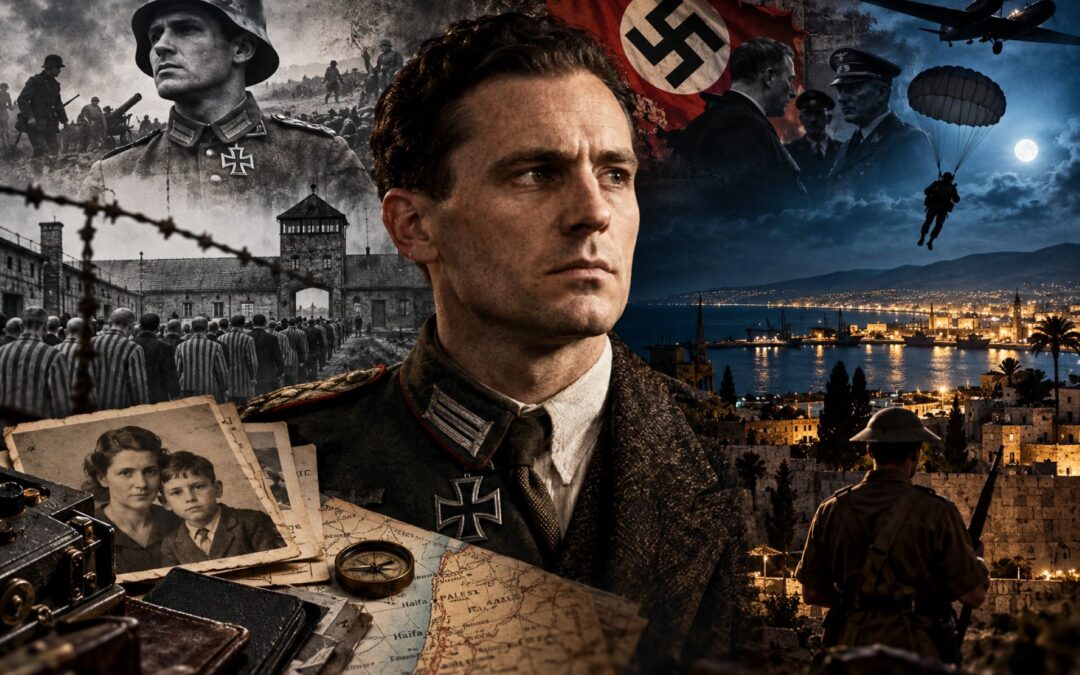
In October 1941, a German military aircraft flew over British-controlled Palestine and dropped a parachutist near the port city of Haifa. The man carried instructions to gather intelligence about British military installations and report his findings to Nazi Germany. His mission was dangerous, his chances of success were uncertain, and his identity was almost impossible to reconcile with the government that had sent him.
His name was Paul Ernst Fackenheim. He was Jewish, a decorated German veteran of World War I, and a former prisoner of Dachau concentration camp. The Nazi regime that had persecuted and imprisoned him had arranged his release so that he could undertake an espionage mission on its behalf.
At first glance, his story seems to defy explanation. Why would German military intelligence entrust such a mission to a Jewish prisoner? Why would a man who had suffered under the Nazis agree to serve them? And when Fackenheim eventually surrendered to the British, was he escaping his captors, protecting his family, or pursuing a more complicated plan?
The answers lie in a life shaped by German patriotism, Nazi persecution, coercion, and a wartime intelligence operation whose true intentions remain disputed.
The German Patriot Who Earned Two Iron Crosses
Paul Ernst Fackenheim was born in Frankfurt am Main on February 8, 1892, into a German-Jewish family. His grandfather had been a rabbi, but his father had moved away from traditional religious observance. Fackenheim grew up identifying strongly with German culture, history, and the national institutions that shaped the country during the final decades of the German Empire.
For many assimilated Jewish families in Imperial Germany, religious ancestry and national belonging were not mutually exclusive. They could participate in German cultural and professional life while retaining varying degrees of connection to Judaism. Fackenheim belonged to a generation that had been encouraged to see military service, education, and loyalty to the state as expressions of citizenship.
He developed a particularly strong admiration for the German Army. The military traditions of Prussia, with their emphasis on discipline, duty, and battlefield achievement, appealed to his sense of national identity. When World War I began in August 1914, he wanted to serve his country.
According to later biographical accounts, the army initially rejected his attempt to enlist because he was a university student and military authorities did not require additional recruits from his circumstances. Fackenheim continued pressing for an opportunity until he was accepted into the 63rd Artillery Regiment. His enthusiasm reflected a conviction that he belonged to Germany and had an obligation to defend it.
He subsequently served on the Western Front, where industrial warfare exposed soldiers to artillery bombardments, machine-gun fire, and enormous casualties. One episode described in accounts of his military career took place during the Battle of the Somme in 1916. When British shellfire severed German telephone lines, Fackenheim reportedly volunteered to move through dangerous terrain and restore communications.
The task mattered because artillery units depended on reliable communication with forward positions to coordinate their fire. Repairing damaged lines under enemy bombardment could expose a soldier to considerable danger, and Fackenheim’s conduct reportedly earned him the Iron Cross, Second Class.
He later received the Iron Cross, First Class, following distinguished service in command of an artillery battery. These decorations were important to his identity because they represented formal recognition of his willingness to risk his life for Germany. Whatever differences existed between Germans of different religious backgrounds, Fackenheim believed his wartime service had demonstrated where his loyalties belonged.
Biographical accounts also describe his acquaintance with Hermann Göring, another German veteran who would later become one of Adolf Hitler’s most powerful associates. The precise closeness of their relationship is less firmly established than Fackenheim’s own military record, but the reported connection illustrates how dramatically the political significance of military comradeship would change after the war.
For Fackenheim, Germany was not merely the country of his birth. It was a nation he had fought for, suffered for, and expected to remain part of throughout his life.
The Reich Turns Against a Decorated Veteran
Germany’s defeat in 1918 profoundly affected Fackenheim. Like many nationalistic veterans, he struggled to reconcile the sacrifices of German soldiers with the collapse of the imperial government and the harsh political consequences of defeat. Later accounts suggest that he sympathized with right-wing criticism of the Weimar Republic and accepted aspects of the claim that internal political forces had undermined the German war effort.
These attitudes reveal an uncomfortable dimension of his patriotism. Fackenheim could oppose the political system created after the war while remaining confident that Germany itself was his homeland. He did not necessarily recognize how thoroughly the nationalist movement that eventually brought Hitler to power would exclude people like him.
During the 1920s, Fackenheim pursued a commercial career, including business activities representing German companies in what was then the Dutch East Indies, now Indonesia. He married and attempted to establish a financially secure family life. His circumstances deteriorated after his father’s death in 1931, when family obligations and financial difficulties brought him back to Germany.
His private life also suffered. Accounts describe the breakdown of his first marriage, a subsequent marriage, the birth of a son, and the death of his second wife during a medical operation. The precise details of these relationships are not equally well documented, but the broader picture is of a man whose earlier professional security had largely disappeared before Nazi persecution intensified.
When Hitler became chancellor in January 1933, Fackenheim initially faced the contradiction between his political sympathies and the regime’s racial ideology. His military decorations and record of service offered no protection against policies defining Jewish ancestry as a basis for exclusion. The Nazis increasingly restricted Jewish participation in economic, professional, and public life, regardless of an individual’s religious beliefs, assimilation, or wartime achievements.
Fackenheim found it increasingly difficult to earn a living. The state whose uniform he had worn now treated his Jewish identity as more important than anything he had done for Germany. His confidence in the country’s institutions could not prevent the systematic destruction of his rights.
In 1939, he was imprisoned in Dachau concentration camp, near Munich, where he was registered as prisoner number 26,336. Established in March 1933, Dachau had become one of the principal institutions of Nazi political terror. As the United States Holocaust Memorial Museum’s history of Dachau explains, the camp subjected prisoners to forced labour, brutal discipline, deprivation, and conditions in which many thousands died.
Fackenheim experienced severe physical hardship. John Broich’s later account, based on British intelligence records, describes him as weakened by mistreatment and desperate enough to take food scraps from the camp kennels. He nevertheless reportedly continued to believe that Hitler’s rule would eventually end and that Germany could return to something resembling the country he had known.
That distinction between Germany and the Nazi government would remain central to his decisions. Fackenheim did not understand loyalty to his homeland as necessarily meaning loyalty to Hitler, even while the government that claimed to represent Germany was destroying his life.
By the time German military intelligence approached him, he was a concentration camp prisoner with little control over his future and a family still vulnerable to Nazi persecution.
Why German Intelligence Needed a Jewish Agent
In 1941, Germany’s military position created an unexpected opportunity for Fackenheim. The Wehrmacht had conquered much of continental Western Europe, but Britain remained undefeated, and the conflict had expanded into the Mediterranean and North Africa. German commanders increasingly recognized the importance of gathering intelligence beyond the European battlefield.
In February 1941, German forces under General Erwin Rommel began arriving in Libya to support Italy’s struggling military campaign. The fighting in North Africa threatened British positions in Egypt, including the Suez Canal, a strategically important connection between the Mediterranean and the wider British Empire. If Axis forces advanced farther east, British-controlled territories in the Middle East could become even more important to the war.
The wider World War II struggle also placed increasing demands on German intelligence. Hitler launched the invasion of the Soviet Union on June 22, 1941, opening a vast eastern campaign while Britain continued fighting. German military planners had strong reasons to seek information about British deployments, ports, defensive preparations, and transport networks in the Middle East.
Palestine, then administered by Britain under a League of Nations mandate, was of particular interest. Haifa possessed a strategically important port, while the territory’s roads, railway connections, and military facilities supported British operations in the region. Intelligence from Palestine could potentially assist German planning or provide advance warning about British military movements.
The organization responsible for foreign military intelligence was the Abwehr, headed by Admiral Wilhelm Canaris. Its officers recruited agents, organized clandestine missions, and sought information from territories controlled by Germany’s enemies. In Palestine, however, recruiting someone capable of moving among civilians without immediately attracting suspicion presented difficulties.
British authorities and Arab communities had experienced serious confrontation during the Arab Revolt of 1936–1939. German intelligence had explored opportunities to exploit anti-British sentiment in the region, but a European-looking agent operating among local Arab communities could be conspicuous. Jewish immigration into Palestine offered another possibility.
German planners believed that a Jewish refugee from Europe might be able to enter established Jewish communities and explain his presence without immediately revealing an intelligence connection. The proposal involved a remarkable contradiction: a regime committed to persecuting Jews wanted to exploit a Jewish man’s identity precisely because British authorities might consider such a person an unlikely Nazi operative.
Fackenheim appeared to offer several advantages. He had military experience, knowledge of Germany’s armed forces, a record of patriotism, and relatives reportedly living in Palestine. His background might help him recognize military equipment while giving him a plausible explanation for seeking refuge in British-controlled territory.
Yet selecting him did not mean the Nazis trusted Jews as equals or had reconsidered their racial ideology. Fackenheim was useful because of the specific circumstances created by his persecution. The Abwehr could offer him something almost impossible to obtain through ordinary channels: release from concentration camp imprisonment.
The conditions surrounding his recruitment were coercive. Intelligence officials promised freedom and assistance for family members while making it clear that his mother and son remained exposed to reprisals if he refused to cooperate.
For someone imprisoned in Dachau, the choice was not between two ordinary employment opportunities. He was being asked to accept a dangerous mission by representatives of the same regime that had deprived him of his freedom, with the welfare of people he loved used as additional leverage.
Later accounts also describe tensions within the German intelligence establishment. The Abwehr competed with the SS intelligence organization, the Sicherheitsdienst, or SD, and Canaris’s relationship with Nazi leadership was increasingly troubled. Some versions of Fackenheim’s story suggest that officials connected to Heinrich Himmler attempted to obstruct the operation, including by alerting British intelligence to an incoming German agent.
Such accounts should be distinguished from the better-established fact of Fackenheim’s recruitment. Rivalries between intelligence organizations were real, but the precise extent of SS interference in this particular mission is less securely established than the existence of the mission itself.
Fackenheim’s recruitment was extraordinary, but it was not evidence that the Nazi system had temporarily become humane. German intelligence had identified a vulnerable prisoner whose identity, military background, and concern for his family could be turned into operational advantages.
Paul Koch: Training for a Mission to Palestine
Fackenheim’s path from Dachau to Palestine was more complicated than the familiar version of his biography suggests. In her study Interrogating Nazism, historian Artemis Photiadou reports that the Abwehr had already recruited him in 1940 for an intended mission to England. That operation was abandoned because of bad weather, after which Fackenheim was returned to Dachau.
This account complicates the simpler narrative in which German intelligence discovered him in the camp in 1941 and immediately arranged his release for the Palestine mission. It does not change the central fact that the Abwehr eventually secured his freedom for espionage purposes, but it shows why the sequence of events must be reconstructed carefully.
When the Palestine operation proceeded, Fackenheim was transferred to Athens, then under German occupation. There he received instructions and elementary intelligence training intended to prepare him for life behind British lines. His assigned cover name was Paul Koch, a German-sounding identity under which he was expected to operate.
His training reportedly included radio communication, codes, invisible ink, and the recognition of British military equipment. He was taught to identify tanks, guns, aircraft, insignia, and other details that could prove useful to German commanders. These were practical reconnaissance skills rather than preparation for conducting elaborate sabotage operations.
The mission required him to observe British installations, establish a means of communicating with German intelligence, and eventually report information of military value. Haifa was particularly important because of its port and military facilities. An agent who could move through the area without attracting suspicion might collect information unavailable to German reconnaissance aircraft or distant intelligence networks.
But the preparation had serious weaknesses. According to Photiadou’s examination of wartime interrogation material, Fackenheim received only rudimentary training and was not given false identification papers or the names of reliable contacts in Palestine. The escape instructions were scarcely more reassuring: he was reportedly advised to find a fisherman willing to take him to the Greek island of Chios.
This differs from older retellings that describe an elaborate set of forged documents and a carefully constructed refugee identity. Fackenheim was expected to present himself as a Jewish refugee from Europe, but that did not necessarily mean he possessed the paperwork needed to make the story convincing.
His apparent readiness to accept the operation also requires context. Fackenheim continued to distinguish the German nation from Hitler’s government, and later biographical accounts describe him justifying the mission as service to his homeland rather than to Nazism. Such statements are consistent with his earlier patriotism, but they cannot establish what he ultimately intended to do once beyond German control.
His situation also contained an unavoidable threat. If he defected or disappeared, the Abwehr could not necessarily reach him, but his family remained in territory controlled by the Nazi regime. A decision made in Palestine could have consequences for people still in Germany.
The planners had therefore selected an agent whose personal circumstances gave them considerable leverage, even though his identity appeared inconsistent with Nazi ideology. Whether that leverage would be sufficient once he landed was another question entirely.
The Drop Near Haifa and the British Manhunt
In October 1941, commonly dated in accounts of the operation to the night of October 10, Fackenheim boarded a German aircraft departing from Greece. His destination was the northern part of British Mandatory Palestine, where he was to parachute into enemy-controlled territory and begin establishing his cover.
A nighttime parachute insertion offered the Germans an opportunity to place an operative beyond the reach of ordinary border controls. It also introduced considerable uncertainty. An agent could land far from the intended position, lose equipment, attract attention, or become stranded before making contact with anyone.
Fackenheim had military experience, but he was not an experienced clandestine operative. His assignment depended on avoiding detection immediately after landing and then creating a convincing civilian identity in unfamiliar surroundings.
Accounts describe him descending near Haifa and landing in an orange grove. Although he survived the jump, the operation did not remain secret. British soldiers and police were soon searching the surrounding area, and the presence of a parachutist had already raised alarms.
One explanation in older versions of the story is that German intelligence rivalries had compromised the mission before it began. According to that narrative, SS officials provided British authorities with information about an incoming agent, possibly exaggerating his rank and portraying him as an operative who intended to encourage an Arab uprising.
The British search can be established without accepting every element of that explanation. Broich’s account describes Fackenheim’s parachute being spotted, which was sufficient to trigger a manhunt. Whether an intelligence warning had also prepared the authorities remains a separate question.
For a short period, Fackenheim managed to avoid the search parties. He moved away from the landing area and attempted to blend into civilian life, but the operation had already begun under unfavourable conditions.
His supposed refugee identity offered a possible explanation for his presence, yet he lacked the secure documentation and local contacts that might have allowed him to establish it. The same Jewish identity that German planners considered useful could not, by itself, explain why he had appeared in an area where a parachutist had just been reported.
Fackenheim eventually approached a British military barracks and surrendered himself to the authorities.
That decision became the defining turning point in the story. In the conventional account, it demonstrated that he had never seriously intended to work for the Nazis and had accepted the mission only to escape Dachau. The evidence from his subsequent interrogation, however, makes that interpretation less certain.
What Fackenheim Told the British—and What They Discovered
When Fackenheim entered British custody, he initially attempted to explain his presence as that of a Jewish refugee fleeing Europe. He did not immediately present himself simply as a German intelligence agent who wished to defect. This created a problem for the British authorities, who were already searching for a parachutist and had reason to suspect that an enemy operative had entered Palestine.
The circumstances surrounding his arrival made an innocent explanation difficult to accept. A German-born man had appeared near the location of a suspected clandestine landing during wartime, without a convincing account of his journey or reliable documentation establishing his identity.
Older biographical versions describe British officers believing that they had captured a dangerous German intelligence figure, possibly an SS general, who had been sent to instigate unrest among local Arabs. That misunderstanding forms part of the traditional story, although it should not be confused with an independently established description of the British investigation.
Once interrogated, Fackenheim disclosed that he was a German Jew who had been imprisoned in Dachau and recruited by the Abwehr. He explained the coercive circumstances under which he had accepted the mission and the danger faced by members of his family. His unusual identity and experiences made the account difficult to evaluate, but the British had every reason to investigate rather than dismiss his story.
The conventional narrative presents Fackenheim as an unwilling spy whose objective had always been to reach British territory and escape Nazi control. It describes legal proceedings in which his background was investigated and testimony from someone who had known him in Germany helped establish his identity. In that telling, he escaped execution because the authorities eventually accepted that he was not a committed Nazi agent.
The British intelligence evidence offers a more complicated interpretation.
Historian John Broich, who examined Fackenheim’s file in Britain’s National Archives, describes circumstances that support the coercive nature of his recruitment but also raise questions about what he intended after surrendering. In Broich’s account of Fackenheim’s case, the former concentration camp prisoner told his interrogators that fear for his family had motivated his acceptance of the mission.
He also proposed cooperating with the British as a double agent. Such an arrangement would have allowed the British to exploit his established connection with German intelligence, potentially sending misleading information through channels the Abwehr believed it controlled.
For British intelligence, this proposal introduced both an opportunity and a risk. A genuinely cooperative agent might provide information about German methods or help deceive enemy handlers. An agent who was only pretending to cooperate could instead acquire British trust and use it to continue his original mission.
Broich reports that Fackenheim subsequently spoke to an undercover operative posing as a German prisoner of war. During that conversation, Fackenheim allegedly indicated that he intended to gain British confidence and then resume his work for Germany.
The significance of this episode lies in the setting. Fackenheim was not necessarily speaking to someone he believed represented British intelligence. If the reported conversation accurately reflected his intentions, it would challenge the idea that his surrender had ended all willingness to carry out the German mission.
Broich describes a further incident in which Fackenheim attempted to smuggle a communication to his German handlers by concealing a message inside cigarettes. The attempt failed, and the message was intercepted by his British captors.
Taken together, these details make it difficult to portray him as someone who had simply accepted the mission, escaped Dachau, and immediately abandoned every intention of helping the Germans. They suggest that the British had legitimate reasons to remain suspicious even after learning about his persecution.
Yet they do not settle the question of his loyalties.
Fackenheim’s mother and son were still vulnerable to Nazi reprisals. He had spent years identifying with the German military and had endured persecution without necessarily abandoning his attachment to Germany. In captivity, he may also have been assessing which statements and actions offered the greatest prospect of survival.
His behaviour could reflect continuing German patriotism, fear for his family, distrust of British authorities, an attempt to keep multiple options available, or some combination of these motives. The available evidence does not permit a confident reconstruction of every calculation he made.
The difficulty of interpreting such cases is central to Artemis Photiadou’s research on the interrogation of German agents. Drawing on records from Britain’s wartime interrogation centre, Camp 020, she demonstrates that the people recruited for Nazi intelligence operations were not uniformly ideological supporters of Hitler.
Some accepted missions because of threats, blackmail, poverty, desperation, or the possibility of escaping imprisonment. Others hoped to improve their circumstances or pursued opportunities without strong political convictions. Their decisions after capture could change as they attempted to judge what their interrogators knew and what their captors might do.
Fackenheim belonged to a particularly vulnerable category. As a Jew living under Nazi domination, his alternatives were radically constrained. Agreeing to work for German intelligence did not mean he enjoyed the freedom to refuse without consequences.
Photiadou uses the concept of a choiceless choice to explain situations in which persecuted people were forced to select between alternatives that were themselves dangerous or morally compromising. It does not mean their decisions were automatic or that their later actions should escape examination. Rather, it requires those actions to be understood within circumstances deliberately created by their persecutors.
There is another important limitation to the British evidence. Interrogation records were produced by security officials trying to assess threats and extract information, not by neutral biographers seeking to reconstruct every aspect of a prisoner’s life. Their observations could be valuable, but their interpretations were also shaped by institutional priorities, suspicion, and the prejudices of individual interrogators.
Fackenheim was eventually retained in British custody rather than executed as an enemy spy. The older biographical account’s emphasis on a trial and his eventual vindication differs from the intelligence-focused reconstruction, which places greater weight on the authorities’ continuing suspicion and his detention as an enemy alien.
It is therefore misleading to describe his experience as an uncomplicated acquittal followed by immediate freedom. Whatever legal or administrative proceedings occurred, he remained detained for the remainder of the war.
His surrender had saved him from the immediate dangers of carrying out the Palestine mission, but it had not restored his liberty. He had exchanged imprisonment under the Nazi regime for confinement by Britain’s wartime authorities, who were unwilling to accept that his remarkable personal history automatically made him harmless.
The War Ends, But the Story Does Not
Fackenheim remained in British custody through the war and was released after Germany’s defeat, around 1945–1946. Broich’s account states that he was transferred to the American occupation zone in Germany, where he confronted the consequences of Nazi persecution for his family.
The Nazis had not fulfilled the promises made when he was recruited. Accounts of his later life describe his discovery that his mother had been deported and murdered, with the traditional narrative placing her death in 1943. The precise fate of every family member is not equally clear in the available accounts, but the destruction of his family’s security was a central tragedy of his experience.
It was an especially bitter outcome because concern for his mother and son had formed an important part of the pressure placed upon him. The Abwehr’s promises had helped persuade a desperate prisoner to accept a dangerous mission, yet those assurances offered no reliable protection against the wider machinery of Nazi persecution.
Fackenheim returned to Germany, the country with which he had identified throughout his life. Accounts place him in Henstedt-Ulzburg, near Hamburg, during his later years. Despite everything that had happened, he did not abandon his German identity or seek to transform his unusual wartime experience into a widely publicized personal career.
Much of what became familiar about his life emerged through the work of Israeli writer Michael Bar-Zohar. After learning about the case, Bar-Zohar investigated Fackenheim’s experiences, drawing on personal recollections, interviews, and surviving materials to reconstruct the story. His account became known through Hitler’s Jewish Spy, also associated with the English-language publication Arrows of the Almighty.
Bar-Zohar’s work helped preserve a remarkable biography that might otherwise have remained obscure. At the same time, it shaped the popular version of Fackenheim as a Jewish prisoner who outwitted the Nazis by accepting their mission and surrendering to the British.
Later examination of British intelligence material complicates that portrayal without erasing its central facts. Fackenheim was a decorated German-Jewish veteran. He was persecuted and imprisoned by the Nazi regime, recruited under coercive circumstances, trained for an Abwehr mission, and parachuted into British-controlled Palestine. He surrendered, underwent interrogation, and survived the war in British custody.
What remains uncertain is how he understood his obligations once he had escaped immediate German control. His reported attempts to maintain contact with German intelligence do not fit neatly into a story of immediate and complete defection. Neither do they establish ideological loyalty to Nazism or eliminate the consequences of the threats made against his family.
The distinction matters because Fackenheim’s story is not simply an unusual example of wartime espionage. It demonstrates how persecution could create the very vulnerabilities an intelligence service sought to exploit. His captors could use his family as leverage, his military record as evidence of usefulness, and his Jewish identity as the basis for a cover that seemed implausible precisely because of Nazi antisemitism.
Fackenheim’s earlier patriotism adds another dimension. He had fought for Germany long before Hitler took power and continued to regard the German nation as something distinct from the regime that persecuted him. That belief may have helped him survive emotionally, but it also made his actions more difficult to separate into straightforward categories of loyalty and betrayal.
He was neither a conventional Nazi spy nor a figure whose every decision can be confidently interpreted as resistance. He was a persecuted man operating under extraordinary pressure, carrying memories of military service, fears for his family, and loyalties that did not disappear simply because the political world around him had changed.
The lasting significance of Paul Ernst Fackenheim’s life lies in that complexity. The most extraordinary part of his story is not merely that Nazi Germany recruited a Jewish prisoner to spy on Britain, but that the experience reveals how thoroughly a regime could exploit the identity, loyalty, and vulnerability of someone it had already stripped of his rights.
Last Updated on October 28, 2026 by Aseem Gupta