
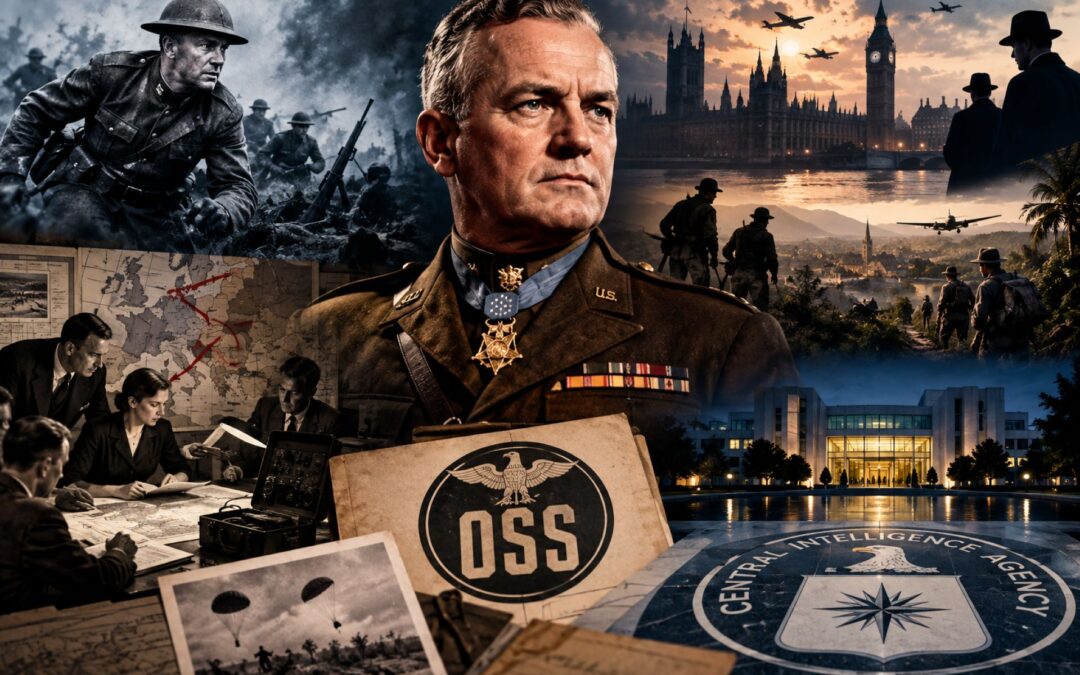
Inside the headquarters of the Central Intelligence Agency in Langley, Virginia, stands a bronze statue of William J. Donovan. It honors a man widely regarded as the father of modern American intelligence, whose ideas helped transform the way the United States gathered information, conducted secret operations, and understood foreign threats. Yet Donovan never served as director of the CIA. The agency that celebrates his legacy did not even exist when he was at the height of his intelligence career.
Donovan’s greatest achievement was creating and leading the Office of Strategic Services (OSS), America’s first centralized wartime intelligence and special-operations organization. Before that, he had been a successful lawyer, a decorated First World War commander, a prominent Republican, and a trusted adviser to Democratic President Franklin D. Roosevelt. His extraordinary career connected battlefield leadership with international diplomacy, espionage, unconventional warfare, and the struggle to establish a permanent American intelligence service.
The organization Donovan built was dismantled almost immediately after World War II, but its influence survived. Understanding his life reveals how American intelligence developed from a collection of competing government operations into an institution that would become one of the central instruments of American power.
From Buffalo to the Fighting 69th
William Joseph Donovan was born on January 1, 1883, in Buffalo, New York, into a working-class Irish Catholic family. His upbringing took place when Irish Americans were gradually gaining greater acceptance in American society but still faced religious and social prejudice. The Donovan household placed importance on education, discipline, hard work, and the possibility of advancing through personal achievement.
Donovan attended St. Joseph’s Collegiate Institute in Buffalo and began his higher education at Niagara University before transferring to Columbia University in New York City in 1904. At Columbia, he distinguished himself academically and athletically, becoming a prominent football player. He graduated from Columbia College in 1905 and continued his education at Columbia Law School, earning his law degree in 1908.
Columbia also brought Donovan into contact with people who would later become influential in American government. Among his fellow law students was Franklin D. Roosevelt, although historians disagree about how close their relationship was during those years. Donovan also knew Harlan Fiske Stone, who would become attorney general and eventually chief justice of the United States. These associations were significant, but Donovan’s later career cannot be explained simply through his university connections.
After completing his education, Donovan returned to Buffalo and established himself as a lawyer. He developed a reputation for professional ability and ambition, but the legal profession was only one expression of his interests. In 1912, he helped organize a New York National Guard cavalry troop, beginning a military career that would fundamentally change his reputation and opportunities.
Donovan’s National Guard service included deployment to the Mexican border in 1916, during the period of American military operations connected with revolutionary leader Pancho Villa. When the United States entered World War I in 1917, Donovan served with the 165th Infantry Regiment, the federal designation of New York’s famous 69th Regiment, traditionally associated with the city’s Irish American community. The regiment became part of the 42nd Infantry Division, commonly known as the Rainbow Division.
France transformed Donovan from a successful civilian officer into one of America’s most distinguished combat commanders. He became known for demanding training standards, personal courage, and a willingness to expose himself to the same dangers faced by his soldiers. Accounts differ about exactly how he acquired the nickname “Wild Bill,” but one longstanding explanation attributes it to troops exhausted by his strenuous training exercises.
Donovan’s leadership became particularly notable during the Meuse-Argonne offensive, the massive Allied campaign launched in September 1918. The fighting involved difficult terrain, heavily defended German positions, artillery bombardment, machine-gun fire, and enormous casualties. On October 14 and 15, Donovan led his men near Landres-et-St. Georges, France, during an attack against fortified German defenses.
Despite being wounded, Donovan continued directing his troops and refused to abandon his responsibilities while the fighting continued. His actions helped maintain the advance under exceptionally dangerous circumstances. The official Medal of Honor citation for William J. Donovan records his extraordinary leadership and refusal to leave the battlefield despite his injuries.
Donovan also received the Distinguished Service Cross and other American and foreign decorations for his military service. He returned from Europe with a national reputation for bravery, determination, and leadership. His experience had given him firsthand knowledge of the importance of information, coordination, morale, and unconventional decisions in warfare.
Those lessons would prove important two decades later. Donovan had commanded soldiers facing an enemy they could see, but the next war would convince him that victory also depended on understanding threats, intentions, and weaknesses hidden from ordinary military observation.
The Lawyer Who Saw the Next War Coming
After World War I, Donovan resumed his legal career but increasingly became involved in public affairs. His military reputation made him an attractive figure in Republican politics, while his professional accomplishments brought him into contact with senior government officials. He also began undertaking assignments abroad, including an intelligence-related mission to Siberia in 1919, where the Russian Revolution and civil war had created a complex international crisis.
In 1922, Donovan became US attorney for the Western District of New York. He subsequently served in the Department of Justice, rising to the position of Assistant Attorney General during the administration of President Calvin Coolidge. These appointments gave him experience in federal administration, legal authority, and the competing interests that shape decisions inside government.
Donovan hoped to become attorney general under President Herbert Hoover, but he was passed over for the appointment in 1929. He returned to private practice and helped establish a prominent New York law firm. His attempt to enter elective politics also ended in disappointment when he ran for governor of New York as a Republican in 1932 and lost to Democrat Herbert H. Lehman.
Political defeat did not reduce Donovan’s interest in national and international affairs. Throughout the interwar period, he continued traveling abroad, observing political developments and developing contacts among military officers, diplomats, and intelligence professionals. His experiences took him into regions affected by revolution, political instability, colonial conflict, and the rise of authoritarian governments.
The international situation was deteriorating rapidly during the 1930s. Benito Mussolini’s Italy pursued imperial expansion, Nazi Germany dismantled the European security order, and Japan extended its military campaigns across East Asia. American public opinion remained deeply reluctant to enter another European war, but Donovan increasingly believed that international developments posed threats the United States could not safely ignore.
His travels and political connections contributed to his reputation as a knowledgeable observer of foreign affairs. However, Donovan was not alone in recognizing the danger of European fascism, nor did his observations provide perfect predictions of future events. What distinguished him was his growing conviction that military preparedness required more than conventional armed forces.
For Donovan, understanding other governments, gathering information through international contacts, and studying unfamiliar forms of warfare were becoming essential national-security responsibilities. He was beginning to see intelligence as a permanent strategic function rather than an occasional activity undertaken during an emergency.
This outlook eventually brought him back into Franklin D. Roosevelt’s orbit. Although the two men belonged to opposing political parties, Roosevelt valued Donovan’s military experience, international contacts, and willingness to undertake sensitive assignments. By 1940, as Nazi Germany conquered much of Western Europe, Donovan was positioned to make his most consequential contribution to American government.
How Donovan Built America’s First Centralized Intelligence Service
In the summer of 1940, Britain stood virtually alone among the major European powers still fighting Nazi Germany. France had fallen, German forces controlled much of continental Europe, and the British government faced the possibility of invasion. For American policymakers, one of the most urgent questions was whether Britain could continue resisting or whether German domination of Europe had become inevitable.
Roosevelt sent Donovan to Britain to investigate its military position, political determination, and capacity to withstand further German attacks. Donovan’s assignment also reflected American interest in the methods of unconventional warfare and intelligence that had become increasingly important during the conflict.
The National Archives’ account of Donovan’s mission and the establishment of the Coordinator of Information documents how his July 1940 visit brought him into contact with senior British political, military, and intelligence officials. He met Prime Minister Winston Churchill, King George VI, and Stewart Menzies, the chief of Britain’s Secret Intelligence Service, commonly known as MI6.
Donovan concluded that Britain possessed both the determination and the resources to continue fighting, provided it received sufficient assistance. He also gained a deeper appreciation of the British approach to intelligence, sabotage, propaganda, and covert activities intended to weaken an enemy without relying exclusively on conventional military operations.
One of Donovan’s important British connections was Sir William Stephenson, a Canadian-born intelligence figure who directed British Security Coordination from New York. Stephenson helped facilitate cooperation between British and American intelligence interests and became an influential contact during Donovan’s efforts to establish an American organization. Their relationship reflected the importance of British experience, although the eventual American intelligence system developed according to its own strategic and political circumstances.
Before World War II, the United States possessed intelligence capabilities distributed across multiple departments. The Army and Navy maintained their own intelligence services, the State Department gathered diplomatic information, and the Federal Bureau of Investigation performed important domestic security and counterintelligence functions. These organizations collected useful information, but their responsibilities, institutional loyalties, and methods did not always align.
The problem was not that America had no intelligence capabilities. It was that there was no permanent, comprehensive organization responsible for integrating information from different sources into a coherent national strategic picture while also possessing the ability to undertake certain specialized activities abroad.
Donovan believed this fragmentation weakened American decision-making. Information about a foreign government might be distributed across military, diplomatic, economic, and clandestine channels without being assessed together. Competing departments could also protect their own authority instead of cooperating effectively.
His proposal went beyond creating another espionage office. Donovan envisioned an organization capable of collecting and interpreting information, examining the economic and political vulnerabilities of foreign powers, and conducting unconventional activities when necessary to support American strategic objectives.
Roosevelt acted on these ideas on July 11, 1941, establishing the Office of the Coordinator of Information, commonly abbreviated COI, and appointing Donovan to lead it. The organization was intended to collect and analyze information relevant to national security and provide the president with an additional source of strategic intelligence.
Its creation was politically delicate. Existing departments were reluctant to surrender authority, and the public description of the new office deliberately avoided many of the more controversial implications of espionage, psychological warfare, and clandestine operations. Donovan had obtained permission to pursue his vision, but he had not received unlimited power over the government’s intelligence activities.
The Japanese attack on Pearl Harbor on December 7, 1941, fundamentally changed the situation. With the United States now directly engaged in a global war, demand for intelligence and unconventional military operations increased dramatically. Wartime conditions made it easier to justify an organization that could operate across conventional institutional boundaries.
On June 13, 1942, Roosevelt established the Office of Strategic Services, transferring the relevant COI functions into the new organization under the authority of the Joint Chiefs of Staff. Donovan remained in charge, and the OSS acquired a broader wartime mission involving intelligence collection, analysis, espionage, sabotage, and other special operations.
The OSS was not the first American organization ever to conduct espionage. Intelligence activities had existed since the American Revolution, and different branches of government had performed them for generations. Its importance lay in bringing several previously fragmented functions together in a centralized organization with an explicitly international wartime mission.
Donovan had moved from advocating centralized intelligence to directing an institution expected to demonstrate its value in combat. The challenge was no longer convincing Roosevelt that unconventional warfare mattered. It was finding capable people, building operational networks, and producing results while competing with established military and civilian authorities.
Inside the OSS: Intelligence, Sabotage and Psychological Warfare
Under Donovan’s leadership, the OSS developed into an organization unlike anything the United States had previously assembled for intelligence and special operations. Its personnel included military officers, university professors, economists, historians, linguists, businesspeople, journalists, technical specialists, and individuals with experience in foreign countries. Donovan believed that useful intelligence skills could come from backgrounds that traditional military recruitment overlooked.
The organization also performed several fundamentally different functions. Some officers analyzed economic reports in Washington, while others recruited informants, operated wireless transmitters behind enemy lines, supported resistance movements, or developed psychological operations against Axis forces. Understanding the OSS requires examining these distinct activities rather than reducing the organization to a collection of daring undercover agents.
Intelligence and Analysis Beyond the Spy Stories
Espionage was one of the OSS’s most recognizable functions, but its intelligence work extended far beyond recruiting people to steal secrets. The organization also developed a substantial Research and Analysis Branch that brought together specialists capable of interpreting information about enemy countries. Academic knowledge, economic research, geography, political history, and industrial analysis became valuable military resources.
Analysts studied the economic capacity of enemy states, transportation infrastructure, industrial production, available resources, and political developments. Their work helped military planners understand the relationships between factories, railways, ports, energy supplies, and the ability of enemy governments to sustain warfare.
A railway junction might appear insignificant when examined in isolation, for example, but become strategically important when connected to factories, supply routes, and military formations dependent on the same transportation network. Similarly, understanding the distribution of industrial production could help identify vulnerabilities that were not immediately apparent from battlefield intelligence.
This approach represented an important distinction between collecting information and producing intelligence. Raw reports might describe enemy movements, political rumors, or economic conditions. Analysts needed to assess their reliability, compare them with other evidence, and determine their significance for military and political decisions.
The OSS therefore combined activities often associated with very different professional worlds. Its field officers sought information that adversaries wanted to conceal, while its researchers examined documents, maps, publications, statistics, and reports that could be gathered through less dramatic means.
The surviving National Archives records of the Office of Strategic Services illustrate the breadth of its wartime responsibilities and the administrative complexity behind its clandestine reputation. The organization was not simply a wartime collection of spies; it was also an experiment in transforming diverse sources of knowledge into strategic intelligence.
Donovan’s recruitment philosophy reflected this broader understanding of expertise. A scholar familiar with European politics, an engineer who understood communications, and a linguist capable of interpreting local conversations could each provide capabilities unavailable through conventional military training alone.
The significance of this model extended beyond the war. It demonstrated the value of maintaining professional intelligence analysis alongside clandestine collection, even though the precise organizational arrangements would change substantially after 1945.
Resistance Networks and the Road to D-Day
The OSS also operated in occupied territory, where gathering information frequently overlapped with supporting resistance movements and conducting sabotage. Across Europe, underground organizations were resisting German occupation through intelligence collection, clandestine communications, transportation disruption, and attacks against military infrastructure.
American intelligence personnel worked with British organizations, particularly the Special Operations Executive, and with resistance groups whose members understood local geography, political conditions, and enemy movements. These partnerships were essential because foreign agents arriving in unfamiliar territory usually lacked the contacts and knowledge needed to operate independently.
Resistance networks could identify troop concentrations, report changes in German deployments, locate vulnerable supply routes, and communicate information to Allied headquarters. Sabotage operations could disrupt bridges, railways, telephone lines, and other facilities used to support German military movements.
By the time Allied forces prepared to invade Normandy in June 1944, such activities had become part of the broader campaign to weaken German control over occupied France. OSS personnel contributed to intelligence and resistance-support operations connected with invasion planning and subsequent liberation efforts.
Some OSS officers worked in teams operating behind enemy lines, coordinating with resistance fighters and helping organize attacks against transportation and communication networks. These efforts were intended to complicate German movements, reduce the efficiency of reinforcements, and provide information useful to advancing Allied formations.
The OSS did not independently plan or determine the success of D-Day. The Normandy invasion depended on a vast combination of conventional military power, naval operations, air superiority, logistics, deception, intelligence from several Allied organizations, and resistance activity. Donovan’s service contributed to that wider effort rather than replacing it.
His relationship with General Dwight D. Eisenhower illustrates the growing importance of incorporating clandestine and unconventional capabilities into conventional military planning. Senior Allied commanders needed reliable information about occupied territory and sought ways to exploit resistance networks as their armies advanced.
The OSS also supported activities in Italy, the Balkans, and other occupied regions. In Yugoslavia, Allied intelligence and special-operations efforts interacted with resistance forces operating in an exceptionally complicated political and military environment. Support for such movements could produce immediate military benefits while also raising questions about the political consequences of strengthening particular groups.
These operations showed both the potential and the limitations of unconventional warfare. A relatively small number of trained personnel could help local movements accomplish tasks beyond the capabilities of an isolated American unit, but their success depended on local relationships, reliable communications, intelligence accuracy, and cooperation with larger military operations.
Operation Sauerkraut and Psychological Warfare
Donovan understood that warfare involved more than controlling territory and destroying military equipment. Governments and armies also depended on morale, obedience, political legitimacy, and confidence in their leaders. If an intelligence organization could influence those factors, it might weaken an enemy without relying entirely on conventional force.
The OSS consequently developed morale operations involving propaganda, deception, rumors, and efforts to encourage dissent within Axis forces. These activities attempted to exploit existing uncertainties and divisions rather than simply communicate Allied military messages.
One revealing example was Operation Sauerkraut, a psychological-warfare effort developed in Italy during 1944. Following the failed assassination attempt against Adolf Hitler in July, the OSS sought to spread stories suggesting that discontent and division were growing within the German military leadership.
The operation involved recruiting selected German prisoners of war who were willing to cooperate. These men received false identities and prepared stories intended to make their propaganda appear more credible when they returned across enemy lines.
Barbara Lauwers, an OSS officer with extensive language skills, played an important role in interviewing prisoners and selecting participants. Her linguistic abilities helped her assess potential recruits and prepare them for the sensitive task of carrying messages into German-controlled territory.
The CIA’s historical account of Barbara Lauwers and Operation Sauerkraut describes how the operation distributed misleading information, fabricated material, and propaganda designed to undermine German confidence. The participating agents also returned with intelligence about enemy positions and conditions.
The OSS regarded the operation as successful and expanded its activities. Nevertheless, claims about psychological warfare must be distinguished from proof that particular rumors directly altered major military decisions. Such operations were intended to exert pressure and exploit uncertainty, but their exact effects were often difficult to measure.
Donovan’s organization also experimented with communications devices, concealed equipment, and specialized weapons intended for covert operations. Some of these innovations were practical adaptations to clandestine requirements, while others reflected the experimental atmosphere of an organization willing to consider unusual proposals.
The importance of these efforts was not that every unconventional idea worked. It was that the OSS treated deception, technology, psychology, and intelligence as potential instruments of military strategy. Donovan encouraged experimentation in areas that traditional commanders might have considered outside the normal boundaries of warfare.
Burma, China and the War Against Japan
Although European operations received considerable attention, the OSS also participated in the war against Japan. Its activities in Asia presented different geographical, political, and logistical challenges, particularly in Burma and China.
In Burma, Japanese occupation threatened vital Allied communications and supply routes connecting India with China. The region’s dense jungles, mountains, difficult climate, and limited transportation infrastructure made conventional military movement extremely challenging. Intelligence collection depended heavily on people familiar with the terrain and local communities.
OSS Detachment 101 became one of the organization’s most significant special-operations formations in this theatre. Operating from bases connected with the Allied campaign in northern Burma, it developed relationships with local populations, including Kachin communities, and trained personnel for intelligence gathering, reconnaissance, communications, and guerrilla operations.
Its activities included reporting Japanese movements, disrupting transportation, supporting Allied advances, and assisting the recovery of personnel stranded behind enemy lines. Indigenous fighters and guides played indispensable roles, providing knowledge and capabilities that American personnel could not have reproduced through brief training alone.
These operations contributed to the Allied campaign in northern Burma, including efforts surrounding the strategically important Myitkyina area. Their effectiveness came from combining local knowledge, wireless communications, intelligence, and specialized military support with the actions of conventional Allied forces.
China presented a more complicated problem. The United States supported Chiang Kai-shek’s Nationalist government against Japan, but the relationship involved competing political priorities and serious disagreement among American and Chinese leaders.
Chiang’s government was fighting Japan while also confronting the Chinese Communist movement led by Mao Zedong. Nationalist officials were understandably concerned about foreign intelligence organizations gathering information independently inside Chinese territory, particularly when that information could reveal internal political or military weaknesses.
One of Donovan’s principal obstacles was General Dai Li, Chiang’s powerful intelligence chief, who maintained extensive security and intelligence networks. Dai Li resisted arrangements that might allow American organizations to establish independent clandestine operations beyond Chinese control.
The OSS consequently became involved in complex negotiations involving Chinese officials, the United States Army, and the Navy. The Sino-American Special Cooperative Organization offered opportunities for cooperation, particularly in training and intelligence activities, but it also imposed political and operational constraints.
The National Park Service’s detailed history of OSS operations in the Pacific and Far East documents how Donovan’s efforts in China were shaped by these rivalries and competing objectives. Agreements could provide access to personnel and facilities without giving the OSS the independence Donovan wanted.
His experiences in Asia demonstrated a recurring limitation of intelligence operations: even a powerful organization could not simply impose its objectives on governments or military commanders whose interests differed from Washington’s.
The successes in Burma and frustrations in China help explain the nature of Donovan’s leadership. He was energetic, ambitious, and willing to experiment, but he operated in a world where military commanders, allied governments, and other intelligence services could constrain or redirect his plans.
Allies, Rivals and the Limits of Donovan’s Power
Donovan’s reputation as an intelligence leader rested partly on his willingness to recruit people who did not fit conventional military expectations. He saw value in specialists with unusual experience, foreign-language ability, academic knowledge, technical skills, or personal connections abroad. This approach helped the OSS assemble capabilities that a traditional military organization might have struggled to develop quickly.
His leadership style also reflected his military background. Donovan respected initiative, determination, and the ability to operate under pressure, especially when communications were limited and circumstances changed rapidly. He often favored energetic individuals capable of improvising rather than officers who waited for detailed instructions from headquarters.
Such independence could be valuable in clandestine operations, but it also created organizational problems. Activities conducted behind enemy lines required secrecy and flexibility, yet the OSS remained part of a larger Allied war effort that depended on planning, accountability, and cooperation among institutions.
Allen Dulles became one of the important figures in Donovan’s wartime organization. Operating from Switzerland, Dulles developed intelligence contacts and gathered information concerning Nazi Germany and wartime European politics. His experience reflected the importance of human relationships, political judgment, and access to people capable of providing sensitive information.
Dulles would later become director of the CIA and remain closely associated with the development of American intelligence during the Cold War. His career represents an important form of continuity between the OSS and its successors, although his later decisions should not be treated as if they were made under Donovan’s command.
Donovan’s relationship with Sir William Stephenson was another important connection. British intelligence officers possessed valuable experience in espionage, counterintelligence, sabotage, and clandestine organization. American cooperation with British services helped accelerate the development of wartime capabilities, even as the two countries retained separate objectives and institutional interests.
Roosevelt’s personal support was particularly important because Donovan faced opposition inside the American government. Senior officials in the War and Navy Departments were reluctant to surrender authority over intelligence activities, while J. Edgar Hoover’s FBI defended its own responsibilities and influence.
These disputes were not merely contests between ambitious personalities. Questions about who controlled intelligence information, authorized operations, distributed reports, and maintained relationships with foreign services had practical military and political consequences. Poor coordination could produce duplicated efforts, conflicting instructions, and disputes over access to sensitive information.
Donovan believed that excessive departmental fragmentation weakened American intelligence. His opponents worried that a powerful independent organization might interfere with established responsibilities, conduct operations without adequate oversight, or accumulate authority beyond what its wartime mission justified.
The tension between innovation and accountability also appeared in the OSS’s operational methods. Sabotage, deception, covert infiltration, and plans involving attacks against enemy personnel raised questions about military necessity, legal authority, effectiveness, and the boundaries of acceptable wartime conduct. The organization’s activities cannot be understood properly by treating unconventional methods as either automatically admirable or inherently illegitimate.
Donovan’s appetite for experimentation occasionally produced episodes that became part of his personal legend. According to a CIA historical account, he once demonstrated a silenced firearm inside the White House by firing into a sandbag. The episode illustrates his enthusiasm for unconventional equipment and his willingness to attract attention through surprising demonstrations, although it should not be mistaken for evidence of the strategic value of every OSS invention.
His broader challenge was to build an organization that could conduct activities traditional institutions were not designed to perform, without becoming impossible to coordinate or supervise. The OSS made substantial contributions to the Allied war effort, but its rapid expansion, experimental methods, and complicated relationships with other agencies ensured that its future remained politically contested.
By the closing stages of World War II, Donovan had become convinced that the United States needed to preserve the capabilities developed under his leadership. Many powerful figures in Washington disagreed about what that future intelligence system should look like, setting the stage for his final institutional battle.
Why Truman Dismantled the OSS
As Allied victory approached, Donovan began pressing for a permanent American intelligence service. He believed that the United States could not return to its earlier pattern of allowing intelligence capabilities to expand during wars and disappear or fragment once peace returned. America’s growing international responsibilities required a standing organization capable of collecting and evaluating foreign information.
His proposals called for centralized intelligence coordination, access to information across departments, and the ability to conduct specialized activities under national authority. Donovan wanted an organization with sufficient independence to avoid becoming simply another department’s subordinate intelligence office.
The underlying argument was strategic. A government could not assess foreign intentions effectively if important information remained scattered across competing agencies. Nor could it respond coherently to developing threats if analytical responsibilities and clandestine capabilities were repeatedly dismantled whenever a military emergency ended.
Donovan’s proposal also raised genuine concerns. Critics feared that an independent intelligence service could become difficult to supervise, duplicate the work of existing departments, or acquire powers inconsistent with American constitutional and political traditions. The possibility of creating a secret organization with extraordinary access to information demanded decisions about civilian control and limits on authority.
Roosevelt had supported Donovan’s wartime work, but the president died on April 12, 1945, before a permanent postwar intelligence arrangement had been settled. His successor, Harry S. Truman, inherited a rapidly changing national-security system while confronting the end of the European war, the continuing conflict against Japan, and the enormous administrative challenge of demobilization.
Truman did not share Donovan’s confidence that the OSS should survive intact. Other officials also questioned whether an organization created for wartime conditions should continue operating with the same structure and responsibilities during peace.
On September 20, 1945, Truman formally announced the termination of the OSS, effective October 1. His decision ended Donovan’s organization as an independent wartime intelligence service, despite the arguments its director had made for a permanent successor.
The president’s action, however, was not simply an instruction to discard everything the OSS had developed. In his September 20, 1945 letter to William Donovan, Truman emphasized the importance of conserving resources and capabilities that remained valuable for peacetime purposes.
The OSS’s functions were divided primarily between the War and State Departments. Research and analytical activities moved toward the State Department, while significant clandestine personnel, records, and operational capabilities were preserved within the War Department.
One important successor was the Strategic Services Unit, or SSU, which maintained elements of the OSS’s clandestine infrastructure. This preservation mattered because skilled personnel, foreign contacts, confidential records, and operational arrangements could not easily be recreated after being dispersed.
Donovan nevertheless lost the institutional battle he had been fighting. The OSS he built was dissolved, and he did not retain command of the principal successor organizations. His experience demonstrated that military effectiveness did not automatically translate into political support for an organization’s permanent existence.
The dispute also revealed the central question facing postwar American intelligence: how could the United States maintain the advantages of centralized collection, analysis, and specialized operations without reproducing all the political and administrative problems associated with wartime intelligence?
The answer would emerge through a sequence of institutional decisions made after Donovan had left his leadership position. Those decisions would preserve important aspects of his vision while producing an organization with a different legal foundation and leadership structure.
The CIA Donovan Inspired but Never Led
The dissolution of the OSS did not resolve America’s need for centralized intelligence. In the months following World War II, relations between the United States and Soviet Union deteriorated, and American officials increasingly confronted questions about Soviet military capabilities, intentions, and political influence.
The emergence of the Cold War made intelligence a permanent strategic necessity rather than merely a wartime concern. American leaders needed information about foreign governments, military developments, political movements, and possible threats across regions where the United States now maintained significant international commitments.
The Strategic Services Unit preserved important elements of OSS clandestine capabilities, while other intelligence functions remained scattered among existing departments. These arrangements protected valuable resources but did not fully solve the problem Donovan had identified before America’s entry into World War II.
In January 1946, Truman established the Central Intelligence Group, commonly known as the CIG. The new organization was intended to coordinate intelligence activities and provide strategic assessments for national decision-makers. Rear Admiral Sidney Souers became its first leader and the first official Director of Central Intelligence.
The CIG represented a substantial step toward the permanent institutional structure Donovan had advocated, although it operated under arrangements that gave existing departments considerable influence. It also inherited a developing intelligence system whose responsibilities and internal relationships were still being defined.
The decisive legal change came with the National Security Act of 1947. The act established the Central Intelligence Agency as an independent civilian intelligence organization within the executive branch, alongside broader reforms of the American national-security system.
The new CIA was charged with coordinating intelligence activities and collecting, evaluating, and disseminating information affecting national security. The position of Director of Central Intelligence provided centralized leadership for the agency and broader intelligence responsibilities.
The CIA’s official institutional history traces this development from Donovan’s Coordinator of Information through the OSS, Strategic Services Unit, Central Intelligence Group, and ultimately the establishment of the CIA on September 18, 1947.
This succession explains why Donovan is remembered as a founding father of the agency, but it also shows why the claim requires qualification. He did not personally establish the CIA through legislation, determine every feature of its eventual structure, or become its first director.
That distinction is historically important. The CIA emerged through decisions made by Truman, Congress, senior military officers, intelligence officials, and civilian policymakers responding to the requirements of the postwar world. Donovan’s ideas contributed to that process, but the institution was the product of broader political developments.
Roscoe H. Hillenkoetter became the first director of the newly established CIA. Allen Dulles, who had served in Donovan’s OSS, subsequently became an influential intelligence leader and eventually directed the CIA from 1953 to 1961. The careers of former OSS personnel helped carry wartime experience into the postwar intelligence establishment.
Personnel continuity was substantial. The CIA’s own historical account notes that roughly one-third of its early employees were OSS veterans. That inheritance included practical knowledge of clandestine networks, field operations, research methods, and intelligence organization.
Yet institutional continuity did not mean that the CIA simply continued every wartime OSS activity without change. Its legal responsibilities, oversight relationships, presidential direction, and operations evolved in response to Cold War conditions. Later activities, including the CIA’s covert interventions in foreign political affairs, must be examined according to their own historical circumstances rather than attributed automatically to Donovan.
Donovan’s personal career also continued after the OSS disappeared. In 1945, he served as deputy to Robert H. Jackson, the chief American prosecutor preparing the Nuremberg trials of leading Nazi officials. His involvement drew partly on the OSS’s work collecting and analyzing evidence of German wartime conduct.
Donovan and Jackson disagreed over aspects of trial strategy. Jackson emphasized the evidentiary strength of contemporary documents, while Donovan believed testimony from perpetrators, witnesses, and victims could help communicate the scale and human significance of Nazi crimes. Their disagreement contributed to Donovan’s departure from the prosecution team before the principal trials began.
He returned to private legal practice and remained involved in international affairs. During the 1950s, he served as United States ambassador to Thailand, extending a public career that had encompassed military service, federal law enforcement, international missions, intelligence leadership, and diplomacy.
Donovan died on February 8, 1959, in Washington, D.C., at the age of 76. He was buried at Arlington National Cemetery, reflecting the importance of his military and government service.
His institutional recognition continued long after his death. On October 26, 1988, a statue honoring Donovan was dedicated at CIA headquarters in Langley, Virginia. The memorial acknowledges his role in developing the principles, personnel, and organizational foundations that influenced American intelligence after World War II.
The statue commemorates a complicated achievement. Donovan built an organization capable of combining specialized intelligence collection, strategic analysis, and unconventional operations during a global conflict. He demonstrated that intelligence could contribute directly to military strategy while arguing that such capabilities should not disappear once the immediate emergency ended.
At the same time, his career exposed tensions that would continue to shape intelligence institutions: secrecy versus accountability, centralized authority versus departmental independence, operational flexibility versus political control, and immediate strategic objectives versus longer-term consequences.
William J. Donovan’s legacy is therefore larger than the popular image of a fearless soldier who became America’s leading spymaster. His most important contribution was helping establish intelligence as a coordinated and enduring responsibility of the American state, rather than a temporary collection of activities assembled when war broke out.
The OSS did not survive him as a permanent organization, and the CIA was not created exactly according to his wishes. But the problems Donovan identified, the capabilities he developed, and the people he recruited helped shape the institution that followed. His career demonstrates how one individual’s vision can influence a government organization even when the final institution emerges through decisions beyond that individual’s control.
Last Updated on October 28, 2026 by Aseem Gupta