
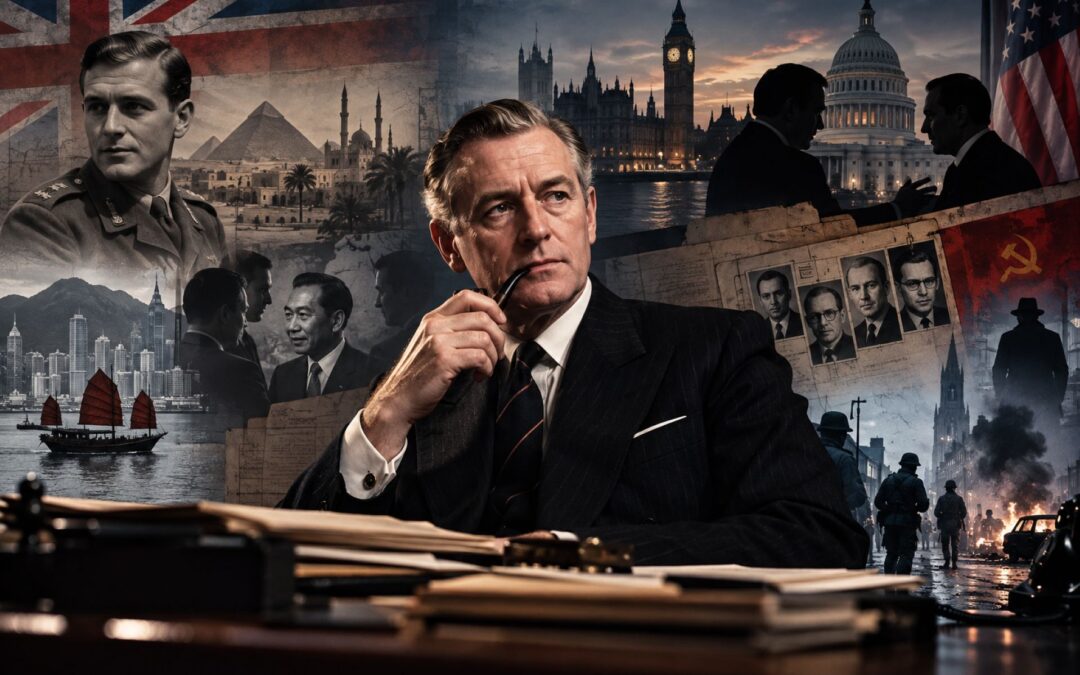
In the early 1960s, British intelligence faced a crisis that threatened its relationship with its most important ally. The exposure of Soviet spies inside Britain’s security establishment had left American intelligence officials questioning whether they could trust the people with whom they shared their most sensitive secrets. At the centre of the effort to repair that relationship was Maurice Oldfield, a British intelligence officer whose background was almost as unusual as the position he had reached.
Born into a farming family in rural Derbyshire, Oldfield had entered a profession traditionally dominated by men from Britain’s most privileged schools and universities. He lacked the conventional appearance of a fictional secret agent, but he possessed qualities that proved considerably more useful: patience, analytical intelligence, an extraordinary capacity for cultivating relationships, and an understanding of how intelligence organisations operated.
By 1973, he had risen to become chief of MI6, Britain’s foreign intelligence service. Yet the man who helped restore confidence in British intelligence would eventually have his own trustworthiness questioned by the security establishment he had served for decades.
Oldfield’s career reveals both the importance of personal judgment in the intelligence world and the institutional prejudices that could undermine even its most experienced officers.
From a Derbyshire Farm to Wartime Cairo
Maurice Oldfield was born on November 16, 1915, at his grandmother’s farm near Youlgreave, a village in Derbyshire, England. He was the eldest of eleven children born to Joseph Oldfield, a tenant farmer, and his wife, Ada. The family lived in a rural environment far removed from the political and social networks that traditionally supplied Britain with its senior diplomats and intelligence officers.
His childhood offered few obvious indications that he would eventually lead one of the world’s most influential intelligence organisations. Britain remained a society in which family background, schooling, and personal connections could strongly influence professional opportunities. For a tenant farmer’s son, advancement into the highest levels of government was far from straightforward.
Oldfield’s academic ability provided his first route beyond those limitations. He attended Lady Manners School in Bakewell and earned a scholarship to the Victoria University of Manchester, where he studied history. He specialised in medieval history, developed a reputation for intellectual distinction, and graduated with a first-class degree.
His university education placed him among talented historians and introduced him to rigorous methods of examining evidence. Historical research demanded the ability to evaluate incomplete records, distinguish reliable testimony from speculation, and understand how individuals and institutions behaved under changing circumstances. These skills would later prove valuable in intelligence work, where the information available to decision-makers was frequently fragmentary, contradictory, or deliberately misleading.
Oldfield might have pursued an academic career under different circumstances. However, the outbreak of the Second World War transformed Britain’s requirements for educated young men, particularly those capable of conducting research, assessing information, and working within complex organisations.
By 1941, he had entered military service and was working in Army Field Security. He subsequently served in the Intelligence Corps, receiving a commission as a second lieutenant in July 1943. His military career eventually took him to Egypt, an important centre of British military and intelligence operations in the Middle East.
Cairo was strategically significant because British forces were fighting to protect imperial communications, military positions, and supply routes while confronting Axis operations across North Africa and the Mediterranean. Intelligence work involved detecting hostile agents, investigating suspected espionage, protecting sensitive information, and assessing threats to Allied operations.
Oldfield served in the wartime security-intelligence apparatus in the Middle East, where military counterintelligence operated alongside Britain’s domestic and foreign intelligence organisations. MI5 was responsible primarily for security and counterespionage, while the Secret Intelligence Service, commonly known as MI6, collected foreign intelligence. Wartime necessities required cooperation between these organisations and the armed forces.
His responsibilities involved identifying hostile intelligence activity and helping prevent Axis agents from undermining Allied military operations. He developed experience in a form of intelligence work that demanded discretion and careful assessment rather than spectacular undercover exploits.
Oldfield rose to the rank of major and received recognition for his wartime service. More importantly for his subsequent career, he had demonstrated an ability to function effectively within Britain’s intelligence establishment despite lacking its customary social credentials.
After the war, he continued working in intelligence, including under Brigadier Douglas Roberts, a senior figure associated with British counterintelligence operations. This relationship connected his wartime experience with the expanding demands of the early Cold War.
The defeat of Nazi Germany had not brought an end to international intelligence competition. As relations between the Western powers and the Soviet Union deteriorated, British intelligence increasingly redirected its attention toward communist organisations, Soviet agents, and political developments across territories where Britain retained strategic interests.
For Oldfield, the transition from wartime counterintelligence to peacetime intelligence operations created an opportunity to develop a distinctive professional approach.
Singapore and the Art of Building Intelligence Networks
Oldfield’s postwar career included an extended assignment in Southeast Asia, culminating in his service as MI6 station chief in Singapore from 1956 to 1958. The region was undergoing profound political changes as European colonial influence weakened, nationalist movements gained momentum, and communist insurgencies challenged established governments.
Singapore occupied a particularly important position within this environment. It was a major commercial and transportation centre, connecting Britain to developments throughout Southeast Asia. Nearby Malaya was experiencing a communist insurgency, while wider regional politics involved competing nationalist, colonial, and Cold War interests.
Effective intelligence collection required more than monitoring known communist organisations or recruiting conventional secret agents. Political loyalties were changing, commercial relationships crossed national boundaries, and influential individuals frequently operated outside formal government positions.
Oldfield became known for recognising the intelligence value of personal relationships that other officials might have dismissed as peripheral. He cultivated acquaintances among people whose work gave them access to conversations, political developments, and international networks unavailable through official diplomatic channels.
Airline personnel, frequent travellers, business contacts, and people associated with international organisations could all possess useful information. Such individuals were not necessarily trained agents, nor did every relationship involve a formal clandestine recruitment. Sometimes an apparently ordinary conversation provided an observation that helped complete a larger intelligence picture.
His method depended upon identifying people who knew something valuable, understanding why they might share it, and maintaining relationships over time. It also required judging whether the information received was credible and whether an individual understood the significance of what they had observed.
One particularly revealing example involved Lee Kuan Yew, whom Oldfield recognised as an important political figure before he became Singapore’s first prime minister in 1959. Cultivating relationships with emerging political leaders helped intelligence officers understand developments that official reports might not yet fully capture.
Oldfield’s approach extended beyond Southeast Asia. He developed relationships with journalists and influential travellers, including the broadcaster Alistair Cooke, whose observations of American life could provide perspectives different from those available through diplomatic reporting.
Accounts of these relationships appear in Martin Pearce’s biography Spymaster, discussed in The Guardian’s assessment of Oldfield’s intelligence career. Although individual anecdotes require appropriate caution, they collectively illustrate an important feature of his professional reputation.
Oldfield understood that intelligence was ultimately concerned with people: their intentions, ambitions, loyalties, fears, and access to information. His ability to develop useful relationships without appearing intimidating or ostentatious became one of his most valuable professional assets.
That ability would soon be tested in a far more sensitive environment, where British intelligence needed not merely information but the restoration of trust.
Washington and the Aftershocks of Kim Philby’s Treachery
Oldfield served as MI6’s senior representative in Washington during the early 1960s, a period when relations between British and American intelligence were recovering from one of the most damaging espionage scandals of the Cold War.
Britain and the United States maintained an unusually close intelligence relationship. Their cooperation extended across military intelligence, diplomatic reporting, signals intelligence, counterespionage, and operations directed against the Soviet Union. The two countries benefited from sharing information that neither could gather as effectively alone.
However, intelligence cooperation depended upon confidence that sensitive material would remain protected. If one country’s security establishment had been penetrated by an enemy intelligence service, information shared with that country could expose agents, compromise operations, and reveal highly classified capabilities.
The Cambridge Five scandal demonstrated precisely that danger.
During the 1930s, Soviet intelligence recruited a group of British intellectuals whose political convictions made them sympathetic to communism. The individuals later identified as the Cambridge Five were Kim Philby, Guy Burgess, Donald Maclean, Anthony Blunt, and John Cairncross.
Their significance came from the positions they eventually occupied within Britain’s government and intelligence establishment. Rather than recruiting only people who already possessed valuable secrets, Soviet intelligence had cultivated individuals who subsequently advanced into important professional roles.
This pattern of Soviet infiltration of British intelligence through ideologically committed recruits demonstrated how an intelligence operation could produce results over many years. A recruit who initially possessed little classified information might later gain access to material of immense strategic importance.
Kim Philby became the most notorious example. He entered Britain’s Secret Intelligence Service and eventually held responsibilities connected with operations against the Soviet Union. His position allowed him to undermine efforts directed against Soviet intelligence while secretly supplying information to Moscow.
Philby’s betrayal was especially damaging because he enjoyed the confidence of senior British and American intelligence officials. In Washington, he worked closely with American agencies and developed a relationship with James Jesus Angleton, who would become one of the CIA’s most influential counterintelligence officials.
The existence of a Soviet agent within such a trusted position meant that some Western intelligence operations were compromised from inside the organisations responsible for conducting them.
The crisis became publicly visible in 1951 when Guy Burgess and Donald Maclean disappeared from Britain. Both had secretly worked for Soviet intelligence, and their flight eventually confirmed the seriousness of Soviet penetration of the British establishment.
Philby came under suspicion because of his associations with the two men and his access to information that could have warned them of investigations. He was recalled from Washington and questioned, although the available evidence initially proved insufficient to establish his guilt conclusively.
He publicly defended himself and continued denying that he had served the Soviet Union. Despite growing suspicions, the uncertainty surrounding his activities persisted for years.
The situation changed when stronger evidence emerged in 1962. In January 1963, Nicholas Elliott, an MI6 officer who had known Philby personally, confronted him in Beirut. Philby made admissions about his Soviet espionage but subsequently escaped to Moscow.
The National Archives’ examination of newly released Cambridge spy files provides important details about these investigations, including interrogation records and material surrounding Philby’s partial confession.
The scandal exposed more than the treachery of individual officers. It raised questions about Britain’s recruitment practices, internal security, counterintelligence procedures, and willingness to investigate people who belonged to influential professional and social circles.
Some officials had defended Philby despite substantial reasons for suspicion. Personal loyalty and institutional reputation could influence judgments in a profession where assessing trustworthiness was supposed to be fundamental.
Oldfield was among those who had questioned Philby’s loyalty before the final exposure. However, he was not the only official to harbour suspicions, and the eventual unmasking of Philby resulted from years of investigation involving several individuals and institutions.
For American intelligence, the larger problem concerned whether Britain could be trusted with sensitive material in the future. The CIA and FBI had legitimate reasons to reconsider information-sharing arrangements when highly placed British officers had passed secrets to Moscow.
Oldfield’s Washington assignment therefore required considerable diplomatic and professional skill. He needed to demonstrate that British intelligence remained a capable partner while acknowledging the seriousness of the failures that had damaged its reputation.
His personal approach was particularly suited to this task. Rather than relying exclusively on formal assurances, he cultivated relationships with American officials, encouraged professional confidence, and helped maintain channels through which sensitive intelligence could continue to be exchanged.
His reputation for integrity and practical judgment mattered because institutional trust is often rebuilt through repeated experience rather than declarations. American officials needed evidence that the British officers handling their information were competent, candid, and capable of protecting shared secrets.
Biographical accounts credit Oldfield with an important role in repairing Anglo-American intelligence relations. That assessment should not be interpreted as meaning he single-handedly restored the entire relationship, but his contribution was significant during a period when trust had become unusually fragile.
One anecdote associated with his Washington years describes his ability to defeat an American polygraph examination by making false statements without triggering detection. The story illustrates the confidence and professional ingenuity attributed to him, although it should be treated as a biographical anecdote rather than independently verified proof of a particular intelligence capability.
His influence also extended into one of the most consequential foreign-policy decisions of the 1960s: Britain’s refusal to send combat troops to Vietnam.
President Lyndon Johnson wanted Britain to make a visible military contribution to the American war effort. A British deployment would have carried considerable political significance by demonstrating that Washington was not acting without the support of its closest allies.
Prime Minister Harold Wilson resisted those requests, even while maintaining Britain’s broader relationship with the United States. Britain continued providing diplomatic support and intelligence cooperation but did not commit combat forces to the war.
Oldfield’s knowledge of Southeast Asia and the intelligence situation in Indochina made his assessment relevant to British policymakers. His understanding of the region helped inform arguments about the risks of military involvement.
In a 1988 parliamentary debate concerning the British Army, Labour MP Tam Dalyell recalled that Oldfield had been instrumental in persuading Wilson to resist American requests. Dalyell attributed that understanding to the former minister Richard Crossman.
This testimony supports the view that Oldfield influenced the decision, but it does not establish that he alone determined British policy. Wilson’s government had political, military, diplomatic, and strategic reasons for avoiding direct participation in the conflict.
Oldfield’s contribution nevertheless illustrates how intelligence could shape policy without becoming publicly visible. His work involved advising decision-makers, helping allies understand Britain’s position, and preserving cooperation despite disagreements over military strategy.
By the time he returned to Britain, he had strengthened his standing as an officer capable of operating effectively at the highest levels of international intelligence.
Becoming “C”: The Outsider Who Led MI6
Oldfield’s return to Britain brought further responsibilities within the Secret Intelligence Service. He held senior counterintelligence positions and became deputy chief, placing him close to the leadership of an organisation confronting both external threats and internal questions about its effectiveness.
The British intelligence establishment was still heavily influenced by social networks formed through elite schools, universities, diplomatic appointments, and longstanding personal relationships. This environment could encourage loyalty and discretion, but it could also create resistance to scrutiny and institutional change.
Oldfield represented a different professional tradition. His career had developed through scholarship, wartime service, overseas intelligence work, and demonstrated competence rather than membership of the customary privileged social circles.
In 1968, when the position of MI6 chief became available, he was passed over in favour of Sir John Rennie. Rennie came from a diplomatic and information-service background, while Oldfield possessed extensive operational and counterintelligence experience.
The appointment illustrated how leadership decisions within the service involved more than professional seniority. Diplomatic relationships, institutional expectations, and judgments about the qualities required of a chief could all influence succession.
Rennie’s tenure ended prematurely in 1973, amid a controversy involving his son’s arrest in connection with drug trafficking in Hong Kong. The affair placed unwelcome attention on the intelligence leadership, although responsibility for the son’s alleged activities should not simply be transferred to Rennie himself.
Oldfield succeeded him that year and became the seventh chief of the Secret Intelligence Service. He held the position until 1978.
The head of MI6 was traditionally known as “C”, a designation associated with the service’s early leadership and subsequently used for its successive chiefs. Although the position carried substantial authority, the chief remained a government official operating within the machinery of British national security.
During Oldfield’s tenure, the service still maintained an unusually secretive public identity. Its institutional activities were not subject to the forms of public explanation and parliamentary scrutiny that later became more familiar.
Leadership involved supervising overseas intelligence collection, assessing the reliability of information, managing relationships with other security organisations, and ensuring that intelligence reached government decision-makers in useful form.
Oldfield’s experience gave him practical knowledge of how operations functioned below the level of senior management. He understood the difficulties faced by station chiefs, the limitations of human sources, the dangers of misplaced trust, and the consequences of intelligence failures.
His appointment also challenged assumptions about who could lead Britain’s intelligence establishment. A grammar-school educated historian from a farming family had reached the top of an institution long associated with more exclusive professional backgrounds.
Oldfield was not simply an outsider appointed to disrupt established conventions. By the time he became chief, he had spent decades inside the intelligence system and understood its culture thoroughly. His distinction lay in having acquired that experience without following the usual social route into the service.
He received high state honours during his career and was knighted while serving as chief, reflecting official recognition of his intelligence work.
However, senior leadership also brought substantial personal danger.
On October 13, 1975, police discovered an explosive device near his apartment at Marsham Court in Westminster. Accounts of the incident describe a substantial bomb that was discovered and defused before it could explode.
The device has been associated with the IRA’s bombing campaign, although the circumstances should not be reduced to an unqualified claim that a particular assassin had personally selected Oldfield as the intended victim.
The incident nevertheless demonstrated the danger surrounding British intelligence leadership during a period of political violence. Oldfield had spent much of his career examining threats to other people, but his position now exposed him to the possibility of becoming a target himself.
When he retired from MI6 in 1978, he appeared to have reached the natural conclusion of an exceptionally distinguished intelligence career. His retirement would prove brief.
A Final Assignment Against the IRA
Following his departure from MI6, Oldfield pursued academic interests as a visiting fellow at Oxford. The arrangement offered a return to the intellectual environment that had shaped his early life, away from the daily demands of running a secret intelligence organisation.
However, the British government continued to regard his experience as valuable. In October 1979, Prime Minister Margaret Thatcher appointed him Security Co-ordinator in Northern Ireland.
The appointment came during one of the most violent periods of the Troubles, the prolonged conflict involving republican and loyalist paramilitary organisations, British security forces, and competing political movements over Northern Ireland’s constitutional future.
The Provisional Irish Republican Army sought to end British rule in Northern Ireland and achieve Irish reunification through an armed campaign. Its operations included bombings, shootings, attacks on security personnel, and violence that killed and injured civilians.
Loyalist paramilitary organisations also conducted violent campaigns, while government responses involving policing, military deployments, intelligence operations, and detention generated their own controversies.
The security environment was especially tense in 1979. On August 27, the IRA killed Lord Mountbatten by placing a bomb aboard his boat off the Irish coast. On the same day, an IRA attack near Warrenpoint killed eighteen British soldiers.
Such incidents demonstrated both the operational capabilities of republican paramilitaries and the difficulties confronting British security organisations.
Oldfield’s assignment was not merely to identify individual terrorists or personally direct intelligence operations. His central responsibility involved improving coordination between organisations that collected information, investigated threats, and conducted security operations.
The relevant institutions included the British Army, the Royal Ulster Constabulary, its Special Branch, and MI5. Each possessed different responsibilities, information sources, command arrangements, and organisational priorities.
Intelligence was particularly difficult to manage because sensitive sources could be endangered if their identities were revealed. An organisation collecting valuable information might restrict its distribution, while another organisation responsible for preventing an attack might need that information urgently.
The resulting tension between source protection and operational action could undermine effective cooperation. Rivalries between security organisations added another layer of difficulty when officials disagreed over jurisdiction, intelligence ownership, or operational responsibility.
Oldfield’s extensive experience in coordinating intelligence relationships made him a logical choice for the assignment. He understood the importance of preserving sources while ensuring that information could be assessed and used by those responsible for national security.
His work belonged to the broader history of British intelligence operations inside the IRA, where human sources could provide exceptionally valuable information while raising difficult questions about secrecy, accountability, and the consequences of intelligence handling.
The later Stakeknife case illustrates these institutional problems, although it would be misleading to suggest that Oldfield personally managed that particular operation. The relationship is one of historical context and recurring security challenges, not direct responsibility.
Oldfield also faced significant personal danger in Northern Ireland. His prominence, association with British intelligence, and involvement in security coordination made protective arrangements necessary. He travelled under close police protection rather than operating anonymously.
Despite his experience, the assignment proved difficult. He was an outsider entering an environment shaped by longstanding local disputes, institutional rivalries, political sensitivities, and the continuing threat of violence.
Yet the controversy that eventually undermined his final government appointment did not emerge from a demonstrated operational failure against the IRA. It arose from questions concerning his private life and the way the British security establishment assessed personal vulnerability.
The Vetting Scandal and the Reputation He Left Behind
Oldfield’s final years became overshadowed by allegations about his sexuality and the security implications that officials attached to his private conduct. The controversy was especially damaging because it concerned a man whose professional reputation rested on discretion, reliability, and the protection of sensitive information.
During his Northern Ireland assignment, reports reached the authorities that prompted a review of his security clearance. One story alleged that Oldfield had approached a man in a public lavatory, an account that subsequently attracted considerable attention.
The reliability of this allegation remains contested. Oldfield was travelling under close protection, making some versions of the incident difficult to reconcile with his circumstances. Later accounts also raised questions about the motives of individuals involved in spreading allegations against him.
The existence of a rumour, however, is not proof that the alleged incident occurred.
The controversy developed in a security environment where homosexuality was treated as a potential source of vulnerability. Officials worried that a person concealing same-sex relationships or sexual activity might be susceptible to blackmail, particularly if disclosure could destroy a career or cause social disgrace.
Such assessments reflected the prevailing attitudes and institutional rules of the period. Although male homosexual activity had been partially decriminalised in England and Wales in 1967, considerable social stigma remained, and security vetting continued to treat sexuality as a sensitive issue.
The reasoning contained an important contradiction. When an institution made disclosure of homosexuality potentially career-ending, its own policies could increase the pressure on individuals to conceal their private lives.
Secrecy about personal relationships could then be interpreted as evidence of vulnerability, even when there was no indication that a foreign intelligence service had obtained compromising information or successfully exerted pressure.
Oldfield’s case exposed the consequences of this approach.
In March 1980, during a review of his positive vetting clearance, Oldfield admitted that he had engaged in homosexual activity on occasions. Positive vetting was the form of detailed security assessment used for individuals entrusted with particularly sensitive information.
The review resulted in the withdrawal of his clearance. For someone who had spent decades protecting national secrets and managing Britain’s intelligence relationships, the decision carried extraordinary professional consequences.
It is important to distinguish the administrative judgment from proof that Oldfield had betrayed his responsibilities. The withdrawal reflected the authorities’ assessment of potential security risk, not a finding that he had passed secrets to an enemy or been controlled by a foreign intelligence service.
Accounts of the affair describe meetings with senior government officials, including Cabinet Secretary Robert Armstrong. In Martin Pearce’s later biography, Armstrong recalled the episode as deeply distressing and described Oldfield as an exceptionally loyal public servant.
Armstrong also acknowledged that Oldfield had not been fully candid in his original security-vetting interviews. This fact provides an important qualification: the case was not solely about the existence of homosexual activity, but also about how personal concealment was interpreted within the contemporary vetting system.
Even so, incomplete disclosure did not establish that his professional loyalty had been compromised.
The controversy became entangled with wider allegations about factions within the British security services. During the 1970s, elements of the intelligence establishment had been accused of extreme political suspicion, including attempts to portray prominent Labour politicians as sympathetic to Soviet interests.
Some later interpretations suggested that hostility toward Oldfield may have been connected to his opposition to such activities. Other accounts raised the possibility that officials genuinely, though mistakenly, feared that he represented a security vulnerability.
These explanations should not be treated as established conclusions. The evidence does not justify presenting a coordinated campaign against Oldfield as proven fact, nor does it establish that everyone who questioned his clearance acted from the same motive.
What can be established is that allegations concerning his private life became a serious official matter, that his security clearance was withdrawn, and that subsequent investigation found no evidence of a breach of national security.
Oldfield was also suffering from serious illness. By the time the security review took place, his health had deteriorated considerably, and he was being treated for stomach cancer.
He ceased serving as Security Co-ordinator in Northern Ireland when his successor assumed the position in June 1980. Less than a year later, on March 11, 1981, he died at the age of sixty-five.
He did not live to see the most authoritative public statement concerning the investigation into his conduct.
On April 23, 1987, Margaret Thatcher responded to a parliamentary question about allegations concerning Oldfield and British national security. Her official statement to the House of Commons confirmed the chronology of his Northern Ireland appointment, the security-vetting review, the withdrawal of his clearance, and his departure from the post.
Thatcher explained that the Security Service had conducted a lengthy investigation, including interviews with Oldfield, to determine whether he or the country’s interests might have been compromised.
The government’s conclusion was unambiguous on the central national-security question: there was no evidence or reason to believe that security had actually been compromised. Thatcher further stated that Oldfield had contributed to intelligence successes that would not have been possible if such a breach had occurred.
This was an important official vindication of his professional loyalty. It did not establish that every rumour about his personal behaviour was false, nor did it mean that all aspects of his private life had been investigated and publicly resolved.
The distinction matters because later retellings have sometimes described the outcome as complete exoneration from every allegation, while others have treated the withdrawal of clearance as though it demonstrated actual espionage or misconduct. Neither interpretation accurately reflects the official findings.
The government acknowledged what it regarded as potential security risks while explicitly rejecting the proposition that those risks had resulted in compromised national security.
Oldfield’s treatment reveals a wider institutional problem. Intelligence organisations must investigate genuine vulnerabilities, but their assessments can be influenced by prevailing social attitudes, incomplete information, and assumptions about what constitutes trustworthy behaviour.
His record as an intelligence officer was extensive, and the investigation did not establish that his private conduct had undermined the country’s security. Nevertheless, suspicion surrounding his sexuality became an enduring part of his public reputation.
The episode remains one of the most striking contradictions of his career: a man who had helped rebuild trust between intelligence agencies ended his public service under suspicion from the security system he had spent much of his life strengthening.
Was Maurice Oldfield Really the Model for “M”?
Oldfield’s reputation has also been shaped by comparisons with fictional intelligence chiefs, particularly M from the James Bond stories and George Smiley from John le Carré’s novels.
These comparisons are understandable. Oldfield possessed many of the characteristics associated with the fictional head of an intelligence service: extensive experience, access to sensitive information, authority over clandestine operations, and the ability to make difficult decisions without public recognition.
His unassuming appearance and analytical temperament also encouraged comparisons with Smiley, the reflective and methodical intelligence officer who became one of le Carré’s best-known characters.
Oldfield’s connection to Smiley was more than a passing resemblance. John le Carré arranged for actor Alec Guinness to meet Oldfield before Guinness portrayed Smiley in the television adaptation of Tinker Tailor Soldier Spy. Such contact could help an actor understand the mannerisms and professional environment of senior intelligence officials.
However, Smiley was already an established fictional character long before that meeting. Oldfield’s influence on a portrayal should therefore not be confused with the creation of the character itself.
The claim concerning James Bond’s M requires even greater caution.
Ian Fleming had created M decades before Oldfield became chief of MI6. The better-established historical model for the original character was Admiral John Godfrey, under whom Fleming served in British naval intelligence during the Second World War.
As explained in Oxford University Press’s account of Ian Fleming’s wartime intelligence chief, Godfrey provided an important basis for the fictional M. Oldfield may subsequently have influenced popular perceptions of what an intelligence chief looked like, but he cannot be presented as the definitive original inspiration.
Such associations are appealing because fiction makes intelligence leadership easier to imagine. A single commanding figure can appear to control entire operations, direct agents across the world, and determine the outcome of international crises.
The reality of Oldfield’s work was considerably more complicated. Intelligence depended upon organisations, bureaucratic processes, government decisions, confidential relationships, and information whose reliability could never be guaranteed.
His importance lay not in possessing the extraordinary personal powers of a fictional spymaster, but in understanding how those complicated systems could be made to work.
Maurice Oldfield reached the leadership of British intelligence through an unusual combination of intellectual ability, professional experience, personal judgment, and adaptability. From a farming family in Derbyshire, he advanced through wartime counterintelligence and overseas service to become a central figure in Anglo-American intelligence cooperation and eventually chief of MI6.
His role in rebuilding confidence after the Cambridge spy scandals was an important contribution, although it was part of a larger institutional effort rather than the achievement of one individual. His later treatment also demonstrated that intelligence organisations capable of detecting foreign threats could struggle to examine their own assumptions and internal prejudices.
Oldfield’s legacy is therefore more substantial than the familiar image of an all-powerful spymaster. His career illustrates how intelligence leadership depends upon trust, relationships, informed judgment, and the ability to recognise human weaknesses, including those within one’s own institution.
He helped strengthen a system that ultimately subjected him to damaging suspicion. Understanding both aspects of his life offers a more accurate appreciation of his place in British intelligence history than either unquestioning admiration or the scandals that followed his death.
Last Updated on October 28, 2026 by Aseem Gupta