
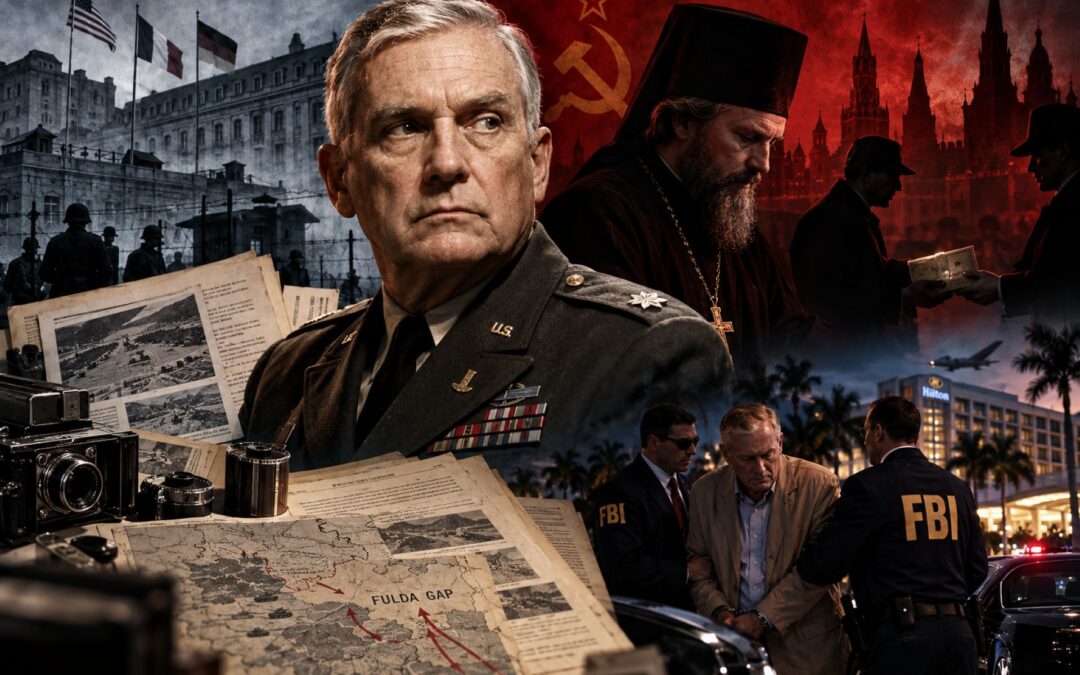
On June 14, 2000, George Trofimoff arrived at a Hilton hotel near Tampa International Airport, expecting to receive money from Russian intelligence. The 73-year-old retired U.S. Army Reserve colonel was facing serious financial difficulties, and the man he was meeting had promised that Moscow would compensate him for services rendered during the Cold War. Trofimoff believed that his years of cooperation with Soviet intelligence might finally provide the money he desperately needed.
The man waiting for him was not a Russian intelligence officer. He was Dmitri Droujinsky, an undercover FBI agent who had spent years cultivating Trofimoff’s confidence. Instead of receiving the $20,000 he expected, the retired colonel was arrested on charges of espionage.
The arrest marked the culmination of an extraordinary counterintelligence investigation. For decades, Trofimoff had worked inside the American military intelligence establishment, eventually gaining access to some of its most sensitive information about the Soviet Union. Prosecutors alleged that he had secretly supplied classified material to the KGB through a Russian Orthodox clergyman who had been part of his family since childhood.
His case would make him the highest-ranking American military officer ever convicted of espionage. Yet the story was more complicated than a straightforward betrayal for money. It involved a Russian émigré who built a career in the country that had given him refuge, a foster brother whose religious position concealed connections to Soviet intelligence, a secret archive that survived the collapse of the Soviet Union, and an elaborate FBI operation that finally brought the allegations into an American courtroom.
From Russian Exile to U.S. Military Intelligence
George Trofimoff was born in Berlin in March 1927, during the Weimar Republic. His parents belonged to the Russian émigré community that had established itself across Europe following the Bolshevik Revolution and the Russian Civil War. His father, Vladimir, had served in the anti-Bolshevik White Army, making the family’s circumstances inseparable from the political upheaval that had driven many Russians into exile.
The family initially enjoyed a measure of stability. His mother, Ekaterina, was a concert pianist, while his father’s military background connected them to a community of Russians who had lost their homeland to the communist government. However, his mother’s death during Trofimoff’s infancy and his father’s subsequent financial difficulties disrupted that stability.
Unable to raise his son comfortably, Vladimir entrusted George to family friends, Vladimir and Antonina Sharav. Antonina had a son from a previous marriage, Igor Susemihl, who became an important figure in George’s childhood. Although the two were not biological brothers, Trofimoff regarded Igor as family throughout his life.
This relationship would eventually become central to the espionage case. Long before either man became involved in the institutions that would define his adult life, they had developed a personal connection rooted in their shared Russian émigré upbringing.
In 1943, Trofimoff returned to live with his father, who had remarried. The reunion was short-lived because Allied bombing raids and the deteriorating military situation in Germany forced further upheaval. By late 1944, when German authorities sought to conscript him into military service, Trofimoff fled to Czechoslovakia rather than join the German armed forces.
As Nazi Germany collapsed, he moved westward, avoiding the advancing Soviet forces and eventually reaching territory controlled by the Americans. His knowledge of Russian, German, and the political circumstances of Eastern Europe made him useful to American military personnel. He worked as an interpreter for U.S. Army units operating near the German-Czechoslovak border.
The experience helped establish a connection with the American military that would shape the remainder of his professional life. After the war, Trofimoff traveled to Paris, where Russian émigrés who had known his father helped him find a place within the expatriate community. In late 1947, he immigrated to the United States with sponsorship from the Society of Friends, commonly known as the Quakers.
On July 19, 1948, Trofimoff enlisted in the U.S. Army. His Russian-language abilities were immediately valuable in an organization preparing for an increasingly hostile relationship with the Soviet Union. Following basic training, he attended the Army Language School in Monterey, California, where he became an assistant instructor.
His intelligence training subsequently expanded into aerial photographic interpretation, prisoner-of-war interrogation, and the study of foreign military organization. By 1949, he was serving with an intelligence unit at Fort Bragg, North Carolina, and undertaking assignments in occupied Germany that involved questioning Soviet military deserters.
Trofimoff became an American citizen in 1951 and received a commission as a second lieutenant in the U.S. Army Reserve in March 1953. His assignments continued to combine military intelligence, interrogation, and regional expertise. He later served in Laos and held additional intelligence-related positions before developing a long civilian career with the U.S. Army in Europe.
An important distinction runs through this career. Trofimoff eventually reached the rank of colonel in the Army Reserve, but his most sensitive intelligence responsibilities came from his employment as a civilian official working within the American military establishment. His reserve rank and civilian authority were separate, even though both contributed to his standing within the intelligence community.
By 1969, Trofimoff had reached a position that provided access to exceptionally valuable classified information. He became chief of the U.S. Army element at the Nuremberg Joint Interrogation Center in West Germany, placing him near the institutional heart of American efforts to understand its principal Cold War adversary.
The Secrets Inside the Nuremberg Interrogation Center
During the Cold War, West Germany was one of the most important locations for American intelligence collection. Its position along the boundary between NATO and the Warsaw Pact made it a natural destination for refugees, defectors, military deserters, and other people arriving from communist-controlled Eastern Europe. Many possessed information that Western governments could not easily obtain through ordinary diplomatic or military channels.
The Nuremberg Joint Interrogation Center, commonly called the JIC, was part of the system established to examine these individuals. American, French, and West German intelligence services participated in its activities, collecting information about Soviet institutions, Eastern European governments, military capabilities, and conditions behind the Iron Curtain.
The center was especially valuable because human intelligence could reveal information that aerial reconnaissance, intercepted communications, and technical surveillance could not always explain. A military defector might describe how a Soviet unit operated, what equipment it possessed, or how its commanders understood a particular strategic problem. A civilian refugee might provide information about industrial facilities, security arrangements, or political conditions.
However, interrogating defectors was only one part of the center’s work. Intelligence officers also needed to compare new accounts against information already collected, evaluate their credibility, identify contradictions, and determine whether the resulting reports could answer particular American intelligence requirements.
This process required access to sensitive files containing both newly acquired information and existing American assessments. In a Cold War intelligence rivalry defined by nuclear deterrence, military planning, and uncertainty about an adversary’s intentions, the knowledge accumulated at such a center could be strategically important.
Trofimoff’s assignment placed him in charge of the U.S. Army element of this operation. He was not the commander of every participating intelligence service, but his position gave him extensive access to classified information received, processed, and produced through the American component of the JIC.
According to the federal espionage indictment, this included American intelligence objectives, information concerning Warsaw Pact military organization, assessments of Soviet capabilities, and material dealing with chemical and biological weapons. It also included reports based on interrogations of people who had recently arrived from communist-controlled territories.
The value of this information to Moscow was not limited to learning what individual defectors had disclosed. By examining American intelligence assessments, Soviet officials could potentially discover which aspects of their military capabilities the United States understood, which weaknesses Washington had identified, and where important gaps in American knowledge remained.
This distinction is crucial to understanding the case. An intelligence service collecting secrets about an adversary gains one kind of advantage when it learns the adversary’s military plans. It gains another when it discovers what that adversary already knows about its own military forces.
If Soviet officials could identify an American misunderstanding, they might exploit it through deception or adjust the information they allowed Western intelligence to collect. If American reports accurately identified sensitive military vulnerabilities, Moscow could take steps to address them.
Trofimoff’s work therefore placed him near information that could potentially help Soviet intelligence evaluate and counter American collection efforts. His legitimate access, accumulated professional knowledge, and familiarity with the center’s procedures made him a particularly attractive source.
Yet access alone does not explain how he became involved with Soviet intelligence. For that, the story returns to the man he had known since childhood.
A Foster Brother, a Bishop, and a KGB Recruitment
Igor Susemihl had followed a dramatically different path from George Trofimoff. While Trofimoff built a career within American military intelligence, Susemihl entered the Russian Orthodox Church and rose through its hierarchy. Known by the religious name Iriney, he eventually served as Archbishop and later Metropolitan of Vienna and Austria.
His position gave him religious authority and opportunities to travel and maintain international relationships. For Trofimoff, however, Susemihl was much more than a prominent clergyman. He remained the foster brother who had shared his childhood during the upheavals of European history.
When Trofimoff returned to Germany for his intelligence assignments, the two renewed their relationship. Their meetings appeared to be ordinary encounters between men whose personal history extended back decades. That familiarity was precisely what made the connection valuable to Soviet intelligence.
According to the American prosecution, Susemihl was cooperating with the KGB and became the intermediary through whom Trofimoff was recruited. The contemporary account of the federal espionage indictment identified Susemihl as the clergyman who helped connect the American intelligence official to Soviet intelligence.
The relationship did not begin with an unfamiliar intelligence officer suddenly demanding classified documents. Accounts of the recruitment describe a gradual progression in which ordinary conversations about politics and international affairs became opportunities to obtain increasingly sensitive information.
Susemihl could ask Trofimoff about current developments, American attitudes toward Soviet policies, or the opinions of people working in his intelligence organization. Questions framed as personal curiosity could encourage discussion without initially appearing to be part of a formal intelligence operation.
Such conversations were potentially valuable because Trofimoff occupied a position where professional knowledge and classified information frequently overlapped. A seemingly casual question about American perceptions of Soviet military strength could lead toward information about intelligence assessments that had never been intended for public discussion.
Financial assistance provided another point of influence. Trofimoff experienced recurring difficulties managing his money, and Susemihl was familiar with those problems. Accounts of their relationship describe the bishop initially extending financial help that could be interpreted as assistance from a trusted family member.
One frequently reported episode involved a loan of 5,000 Deutsche Marks. The financial relationship allegedly developed further as Trofimoff continued requiring money and Susemihl became increasingly aware of the information he could provide.
Instead of demanding immediate repayment, the bishop reportedly forgave debts and offered additional financial assistance. Under the prosecution’s interpretation, this arrangement gradually transformed what appeared to be personal generosity into compensation for intelligence.
The distinction between an informal loan and payment for espionage became progressively less meaningful as Trofimoff supplied information. Accounts of the arrangement describe increasingly substantial rewards, including claims of regular payments amounting to thousands of Deutsche Marks.
The exact payment schedule is not independently established with the precision sometimes suggested in retellings of the case. Much of the detailed reconstruction depends on statements, intelligence records, and testimony rather than a complete surviving accounting of every transaction.
Nevertheless, the relationship illustrates why financial need and personal trust could reinforce each other. Trofimoff did not have to begin by accepting money from someone he regarded as an enemy intelligence officer. Instead, assistance came through a person with whom he already had a deeply established relationship.
Susemihl’s religious identity added another layer to the arrangement. Soviet intelligence services had a documented history of exploiting religious institutions and cultivating contacts among clergy, particularly where international travel and access to expatriate communities created opportunities for intelligence activity.
That does not mean that the Russian Orthodox Church as a whole participated in Trofimoff’s recruitment or that religious office automatically implied KGB cooperation. The relevant allegation concerned Susemihl’s individual relationship with Soviet intelligence and the way his position assisted his activities.
His connection to Trofimoff was especially advantageous because it provided a channel between an American intelligence official and Soviet handlers without requiring every exchange to involve an obvious intelligence contact. Conversations and financial assistance could occur within an established family relationship.
The prosecution’s account ultimately described a progression from personal discussions to deliberate transfers of classified material. What began as supposedly informal exchanges had become a mechanism through which sensitive American intelligence could reach Moscow.
The case also raised a difficult question about Trofimoff’s motivation. Financial problems were repeatedly identified as a major incentive, but the evidence later presented by prosecutors suggested that personal identification with Russia also mattered. The relative importance of money, family loyalty, and national attachment cannot be determined with complete certainty simply from the fact that all three appeared in the case.
What is clear from the eventual conviction is that the jury accepted the prosecution’s account of an espionage relationship extending far beyond harmless conversations between foster brothers.
How Trofimoff Supplied Intelligence to Moscow
The prosecution alleged that Trofimoff transformed his legitimate access to classified material into a long-running channel for Soviet intelligence. Rather than obtaining secrets through dramatic break-ins or unauthorized access to military installations, he exploited information that his ordinary responsibilities allowed him to handle.
According to the indictment and later trial testimony, Trofimoff removed classified documents from the Nuremberg center and photographed them outside the workplace. The original documents could then be returned, reducing the likelihood that their disappearance would attract attention.
This method was particularly dangerous because conventional document controls primarily protect custody and authorized access. If a trusted employee secretly reproduces a document and returns the original, the information may be compromised without the institution immediately realizing that anything is missing.
The prosecution described Trofimoff using photographic equipment supplied through Soviet intelligence channels. One device identified in the indictment was a Minox camera, a compact camera associated with clandestine document photography.
Trofimoff reportedly became concerned that retaining the camera was dangerous and eventually returned it through Susemihl. Other accounts describe photographic equipment that enabled him to reproduce large quantities of material while minimizing the time classified documents remained outside their normal storage arrangements.
The resulting film could be passed through his foster brother or transferred to intelligence contacts during meetings in Austria. The indictment identified locations where Trofimoff allegedly met Soviet representatives and delivered photographed material.
These arrangements separated several stages of the operation. Trofimoff could obtain the documents, photograph them, and return them to his workplace, while intermediaries helped move the intelligence toward Moscow. That separation reduced the need for him to maintain an obvious direct relationship with Soviet intelligence personnel.
Soviet records associated Trofimoff with several codenames, including Markiz, Antey, and Konsul. Such designations allowed intelligence services to refer to sensitive sources without consistently using their real identities.
Former KGB general Oleg Kalugin became one of the central figures in the eventual prosecution. His testimony described Soviet intelligence’s handling of Trofimoff and the importance attached to the material that reached Moscow.
Kalugin portrayed the American as an unusually valuable source because of his sustained access to intelligence that directly concerned the Soviet Union. Prosecutors further argued that Trofimoff’s importance had been recognized at high levels of the KGB, including during the period when Yuri Andropov headed the organization.
The quantity of information attributed to Trofimoff was substantial. Prosecutors described more than 50,000 pages of classified documents being compromised over approximately two decades, while other accounts referred to many volumes of intelligence material obtained through the operation.
Such figures represent the scale alleged or described by investigators rather than a publicly available itemized inventory of every document. They should not be understood to mean that tens of thousands of distinct military plans were individually proven to have been delivered.
The categories of information were nevertheless significant. They reportedly included assessments of Soviet and Warsaw Pact military capabilities, American intelligence collection priorities, interrogation reports, and information concerning Soviet chemical and biological weapons.
This material could reveal the strengths and limitations of American knowledge. For example, an assessment identifying a particular Soviet military weakness would inform Moscow that the United States had recognized the problem. Conversely, an assessment containing an inaccurate assumption could tell Soviet officials where American analysts remained mistaken.
Information about American intelligence objectives could also help Soviet authorities understand which aspects of their military organization were being investigated. Such knowledge might make it easier to protect sensitive capabilities, manipulate future intelligence collection, or identify where additional counterintelligence precautions were necessary.
The dangers resembled those created by Clyde Lee Conrad, another American military insider who compromised NATO secrets. Both cases illustrated how employees with authorized access to classified information could become valuable to Eastern Bloc intelligence services without holding the highest positions in military command.
The two operations should not be confused, however. Conrad’s network obtained sensitive NATO war-planning material through military personnel, while Trofimoff’s position was particularly important because it gave him access to the information and assessments accumulated within an interrogation and intelligence-processing establishment.
The distinction matters when evaluating the damage. Trofimoff’s disclosures could potentially have allowed Soviet intelligence to understand American knowledge of Soviet forces and intelligence operations. That is serious without requiring the unsupported conclusion that every document would have produced an identifiable military disaster.
Contemporary American officials did not entirely agree about the practical consequences. Some viewed the disclosures as potentially devastating, while others suggested that American assessments of Soviet capabilities may themselves have contained significant inaccuracies.
Because the anticipated NATO–Warsaw Pact war never occurred, the full military consequences cannot be measured through battlefield outcomes. The historical significance rests on the compromise of classified information and the potential strategic advantage that such disclosures offered.
Prosecutors also maintained that Trofimoff received substantial financial compensation. A frequently cited figure was approximately $250,000 over the course of his activities, although reported totals and estimates varied. American officials additionally alleged that Soviet authorities honored him with the Order of the Red Banner, reflecting the importance they attached to his work.
The duration of the operation is another point requiring care. Some accounts describe instructions to stop active intelligence collection in 1987, near the beginning of the final transformation of Soviet politics. However, the American indictment described an espionage conspiracy extending from 1969 to 1994.
An instruction to stop collecting information at one particular moment does not necessarily establish when every relationship, payment, or conspiratorial activity ended. Nor is there sufficient evidence to conclude that any reduction in activity was directly caused by Mikhail Gorbachev’s reforms or the approaching end of the Cold War.
For many years, the operation remained undetected by American authorities. Its eventual exposure came not from a routine document audit or an employee discovering Trofimoff photographing files, but from an extraordinary intelligence defection that revealed information about the KGB’s own operations.
The Mitrokhin Archive and the Failed Arrest in Germany
In 1992, Vasili Mitrokhin, a former senior archivist of the Soviet KGB, defected to Britain with a remarkable collection of notes and records concerning Soviet intelligence operations. During his long career, Mitrokhin had secretly copied information from KGB archives, preserving details about agents, intelligence networks, clandestine operations, and foreign sources.
The material offered Western counterintelligence agencies an unusual opportunity to examine the KGB’s activities from the inside. Rather than relying entirely on surveillance or the statements of individual defectors, investigators could study records describing how Soviet intelligence had recruited and handled agents over many years.
Among the revelations was information about an American intelligence official associated with the codename Markiz. The records suggested that a source connected to an interrogation center in Germany had supplied the Soviets with extensive classified information.
The description did not initially provide investigators with a straightforward identification. It referred to a career American intelligence officer and indicated that the material had passed through a Russian Orthodox clergyman.
These details were distinctive enough to generate serious suspicion. Trofimoff’s position at the Nuremberg center matched the professional profile, while his close relationship with Susemihl provided the unusual clerical connection described in the Soviet material.
Christopher Andrew, the Cambridge historian who worked extensively with the Mitrokhin material, later explained the importance of the intelligence disclosed. The records indicated that Soviet authorities had gained access to large amounts of information about American military intelligence activities directed toward the Soviet Union.
Investigators therefore had a compelling lead, but establishing a plausible identification was different from proving an espionage offense in court. The historical records had to be connected to particular people, specific conduct, and the legal requirements of the jurisdiction investigating them.
On December 14, 1994, German authorities detained Trofimoff and Susemihl on suspicion of espionage. The investigation brought their long relationship under direct official scrutiny, decades after the alleged recruitment had begun.
The German case did not result in a conviction. Contemporary accounts describe both problems establishing that the two men were conclusively the individuals referenced in the Soviet material and difficulties created by Germany’s limitation rules for prosecuting espionage offenses.
A judge determined that the available evidence was insufficient to proceed against them, and both men were released. The failure of the German proceedings therefore should not be understood simply as a finding that they had committed no wrongdoing, nor as proof that the allegations were true but technically barred from prosecution.
Trofimoff later acknowledged that the description in the Mitrokhin material closely matched his circumstances. In subsequent interviews, however, he denied having supplied secrets to the KGB and disputed the conclusion that the records proved his guilt.
The German investigation nevertheless had significant consequences for his professional life. His security clearance was withdrawn, his intelligence career came to an end, and he was no longer able to rely on the professional standing he had accumulated during decades of service.
After leaving Germany, Trofimoff and his wife, Jutta, settled in Melbourne, Florida, in a retirement community populated by former military personnel. Their new home appeared to offer a peaceful conclusion to an eventful career.
For Trofimoff, the immediate legal danger seemed to have receded. However, the information obtained through the Mitrokhin investigation had not disappeared, and American authorities still had an important advantage that German investigators had lacked: under the relevant American espionage law, the suspected offenses were not subject to the same limitation period.
The unresolved case remained a potential target for further investigation, even as Trofimoff began constructing his retirement life in Florida.
The Undercover FBI Operation That Brought Him to Tampa
Trofimoff’s retirement was increasingly troubled by financial problems. He and Jutta lived in a gated community in Melbourne, Florida, where their lifestyle included interests and expenses that became difficult to sustain after his intelligence career ended.
Their home, social activities, dining preferences, and other expenditures placed pressure on the household finances. Trofimoff accumulated debts and eventually took out a second mortgage on the property.
Accounts of his retirement describe spending decisions that aggravated the problem, including purchasing a car despite his wife’s concerns about affordability. He also worked part-time bagging groceries at a local Publix supermarket in an effort to supplement his income.
The contrast was striking. A man who had once occupied a sensitive position in American military intelligence was now struggling with debt and performing supermarket work while living among retired military officers.
These financial difficulties created the opportunity that American investigators exploited. The FBI had information linking Trofimoff to Soviet espionage, but the unsuccessful German case demonstrated the difficulty of turning those suspicions into a successful prosecution.
An undercover operation offered another possibility. Investigators could approach Trofimoff while pretending to represent the intelligence service that prosecutors believed he had previously served, then determine whether he would discuss his activities in circumstances that could be recorded.
The operation was conducted by FBI Special Agent Dmitri Droujinsky, who assumed the identity of Igor Galkin, a supposed representative of Russian intelligence. Rather than approaching Trofimoff as an American investigator, he presented himself as someone who might help restore an old intelligence relationship.
On July 10, 1997, Trofimoff received a communication purportedly connected to Russian representatives. Galkin subsequently made repeated attempts to establish contact, offering the prospect of assistance while suggesting that Russia wanted to clarify or reconstruct information about Trofimoff’s earlier services.
The approach provided a reason for discussing the past without immediately demanding new classified information. It also offered a financial incentive to a retired man who urgently needed money.
At first, Trofimoff was hesitant. Recorded conversations indicated that he worried about his health, the possibility of imprisonment, and the consequences of becoming involved with intelligence officials again. He described himself as physically unwell and reluctant to risk whatever years remained to him.
Droujinsky continued cultivating the relationship through telephone calls and offers of help. The operation unfolded gradually, allowing the supposed Russian representative to become a familiar contact rather than appearing as a stranger demanding an immediate confession.
After more than a year of communication, the two arranged a meeting at a hotel in Melbourne. By this point, Trofimoff had become willing to discuss matters that investigators considered relevant to the historical espionage allegations.
The encounter took place on February 24, 1999, and was secretly videotaped by the FBI. Over several hours, Droujinsky questioned Trofimoff about his work in Germany, his contacts with Soviet intelligence, and the methods through which classified information had allegedly been transferred.
As described in contemporary reporting on the undercover FBI investigation, the recordings became central evidence at his subsequent trial. Trofimoff discussed photographing documents, contacts with intelligence operatives, and the role of the Russian Orthodox clergyman he had known since childhood.
He also identified locations associated with alleged intelligence meetings and named individuals whom investigators connected to Soviet espionage operations. These details were especially important because they could be compared with information that American investigators had obtained independently.
The recordings contained revealing statements about motivation. Trofimoff acknowledged that money was attractive, but also presented his actions as service to Russia. In one particularly damaging passage, he declared, “In my soul, I’m Russian. I’m not an American. I was never an American.”
The statement attracted attention because Trofimoff had spent decades serving American institutions and had voluntarily become a United States citizen. To prosecutors, his words suggested an enduring loyalty to Russia that could help explain why he had been willing to compromise American intelligence.
However, these conversations would later become the center of the defense’s case as well. Trofimoff argued that he had invented stories about espionage precisely because he believed his supposed Russian contact would provide money if he could demonstrate a history of service to Moscow.
That explanation meant the recordings had to be understood in context. They unquestionably documented what Trofimoff told a man he believed represented Russian intelligence. Whether every detail he described was truthful was a question the prosecution had to address through additional evidence and testimony.
The operation continued until the authorities were ready to make an arrest. In May 2000, after another period of communication, Galkin contacted Trofimoff with news that the necessary financial arrangements had supposedly been approved.
A meeting was arranged for June 14 at a Hilton hotel near Tampa International Airport. Trofimoff arrived expecting to receive $20,000 and, according to investigators, believed he was dealing with a representative of the Russian intelligence establishment.
Instead, the meeting brought the undercover operation to its conclusion. FBI agents arrested Trofimoff, and federal prosecutors charged him with espionage based on an alleged conspiracy extending across much of his intelligence career.
The arrest was significant because the government now possessed more than a description extracted from Soviet intelligence records. It had Trofimoff’s recorded statements, his identification of alleged intelligence contacts, and additional evidence that could be presented and challenged in an American courtroom.
For investigators, that combination made possible a prosecution that had remained beyond the reach of the German authorities six years earlier.
Conviction, Denial, and a Life Sentence
George Trofimoff’s trial began in federal court in Tampa in 2001. The proceedings brought together testimony from former Soviet intelligence officials, American military personnel, investigators, and the accused himself. The central question was whether Trofimoff had actually conducted a long espionage operation or had fabricated an elaborate account to obtain money from someone he mistakenly believed could help him.
Prosecutors portrayed Trofimoff as a highly valuable Soviet source who had systematically exploited his authorized access to American intelligence. They argued that his long relationship with Susemihl provided the means to pass classified information to Moscow without attracting suspicion.
The government emphasized both the scale of the alleged disclosures and the sensitivity of the intelligence involved. Prosecutors maintained that Trofimoff had compromised tens of thousands of pages of classified material concerning American intelligence objectives and Soviet military capabilities.
Former KGB general Oleg Kalugin became an especially important prosecution witness. He testified about Soviet intelligence’s relationship with Trofimoff and described the American official as a valuable source whose information had attracted high-level attention.
Kalugin also identified intelligence personnel associated with the operation. The prosecution argued that Trofimoff’s ability to recognize or name certain Soviet operatives during his recorded conversations supported the authenticity of his account.
This evidence mattered because the government faced an unusual problem. The espionage allegedly occurred years before Trofimoff’s arrest, and investigators did not possess a complete collection of the original documents he was accused of compromising.
Much of the case consequently depended on the relationship between intelligence records, testimony from former Soviet officials, and Trofimoff’s own statements. The prosecution had to establish that these sources supported a consistent account of actual espionage rather than merely reflecting claims that had become repeated over time.
The defense challenged that interpretation. Trofimoff’s attorney, Daniel Hernandez, argued that his client had been financially desperate and had invented stories about espionage to persuade a supposed Russian official to give him money.
Under this explanation, Trofimoff had not been confessing to a real espionage career. He was an elderly retiree trying to convince someone with apparent Russian government connections that he deserved financial assistance.
The defense also questioned the reliability of former Soviet intelligence officers who testified against him. These witnesses had spent professional careers operating within institutions that relied on secrecy and deception, and their accounts were not necessarily immune from inconsistency or personal interest.
Kalugin’s testimony became an important target. His previous published descriptions of an unnamed American intelligence source did not match every detail of the account he presented in court, including aspects of where and how meetings had occurred.
Trofimoff later highlighted these discrepancies in an interview with CBS correspondent Scott Pelley. In the 60 Minutes II investigation into Trofimoff’s conviction, he insisted that he had never met the Soviet intelligence officers whom prosecutors connected to him.
He also argued that the statements he made to the undercover FBI agent were deliberate inventions rather than genuine admissions. According to Trofimoff, his immediate objective had been to establish a convincing reason for Russian representatives to give him money.
His explanation presented the FBI operation in a different light. Instead of exposing a spy through careful questioning, he claimed investigators had exploited his financial difficulties and encouraged him to exaggerate or fabricate a past that did not exist.
The defense’s argument was not that the recordings had been fabricated. Trofimoff acknowledged making statements that appeared to describe espionage, but maintained that the descriptions themselves were false.
That distinction was central to the case. A recorded confession can be powerful evidence, particularly when it includes specific names, places, and procedures. Yet the defense was entitled to argue that an apparently incriminating statement did not necessarily establish the truth of everything said.
The jury had to consider the recordings alongside the Mitrokhin information, Kalugin’s testimony, the history of Trofimoff’s relationship with Susemihl, and the circumstantial evidence connecting those elements.
The bishop himself could not testify at the American trial. Susemihl had died before the proceedings, leaving his alleged role to be reconstructed through other witnesses and available evidence. Although German authorities had investigated him alongside Trofimoff in 1994, he had not been convicted in the United States.
The prosecution nevertheless argued that the different strands of evidence reinforced one another. Trofimoff’s professional access matched the intelligence source described in Soviet records, his personal connection with Susemihl matched the identified religious intermediary, and his recorded conversations contained details consistent with the alleged espionage operation.
The government further maintained that the explanations Trofimoff offered after his arrest were implausible given the specificity and consistency of his statements to the supposed Russian officer.
The defense countered that specificity did not necessarily prove truthfulness. Trofimoff had worked in intelligence for decades and possessed professional knowledge that could have enabled him to construct an apparently convincing story even if he had never passed classified documents to Moscow.
This competing interpretation made the case more complicated than simply accepting Trofimoff’s apparent admissions at face value. However, after hearing the testimony and examining the evidence, the jury rejected his explanation.
On June 26, 2001, George Trofimoff was convicted of espionage. The verdict established his guilt under American law and made him the highest-ranking U.S. military officer ever convicted of the offense.
His status requires a precise explanation. Trofimoff had retired with the rank of colonel in the U.S. Army Reserve, while the classified information he compromised had been accessible through his civilian intelligence employment. He was therefore not an active-duty colonel commanding troops throughout the period of the alleged spying.
The distinction does not diminish the seriousness of the conviction, but it matters when understanding why his case occupies a particular place in American military history.
Sentencing took place on September 27, 2001. Federal prosecutors sought a severe punishment, arguing that the duration, deliberateness, and national security implications of Trofimoff’s conduct warranted life imprisonment.
The proceedings included an extraordinary intervention from the Department of Defense. Assistant Secretary of Defense John Stenbit submitted a letter supporting a life sentence, reflecting the government’s view that the offense required exceptional punishment and deterrence.
U.S. District Judge Susan Bucklew was not persuaded by Trofimoff’s continued claims of innocence. In the contemporary account of his sentencing, the court rejected his explanation that his admissions had merely been attempts to obtain money.
Bucklew sentenced Trofimoff to life imprisonment. The decision marked the final collapse of the career and reputation he had built over decades of American military and intelligence service.
Trofimoff continued maintaining his innocence after the verdict. He insisted that his statements to the undercover FBI agent had been false and that his service to the United States had been genuine.
His defense also emphasized that the government had not demonstrated that his alleged disclosures caused the deaths of particular American intelligence sources. That qualification matters when evaluating the case because espionage damage cannot always be reduced to an identifiable casualty count.
Information about military capabilities, intelligence objectives, or an adversary’s understanding can be valuable even when its eventual effects cannot be traced to a specific death or military defeat. At the same time, the absence of publicly demonstrated battlefield consequences makes it inappropriate to invent a precise account of the harm his espionage caused.
The historical record therefore supports a narrower but still serious conclusion. Trofimoff was convicted of betraying classified American intelligence to Soviet authorities over many years, while the full strategic consequences of those disclosures remain difficult to measure.
He never secured the vindication he sought. George Trofimoff died in federal prison in California on September 19, 2014, at the age of 87, having spent the final years of his life incarcerated for espionage.
His conviction remained one of the most consequential cases involving an American military intelligence insider during the Cold War. It was especially remarkable because the suspected activities had persisted for decades before investigators obtained evidence that could sustain a criminal prosecution.
The case also exposed the complexity of establishing the truth about historical intelligence operations. Secret documents, defector accounts, former intelligence officers, recorded statements, and courtroom testimony can provide powerful evidence, but their reliability and interpretation must still be examined carefully. In Trofimoff’s case, the jury found the cumulative evidence sufficient for conviction despite his sustained denial.
George Trofimoff’s story illustrates a vulnerability that even sophisticated intelligence organizations struggle to eliminate. He did not have to penetrate an American installation from the outside or defeat its security systems through an elaborate technical operation. His legitimate responsibilities already placed sensitive information within reach, and his personal relationship with Susemihl allegedly provided a channel through which that information could leave the American intelligence system.
The same relationship that helped shape his childhood became central to his prosecution decades later. Financial difficulties, personal trust, and a complicated attachment to his Russian heritage all featured in the evidence, although none alone provides a complete explanation of his conduct.
His eventual arrest required another unusual combination of circumstances: the survival of secret KGB records, Mitrokhin’s defection, years of counterintelligence investigation, and an undercover FBI operation that transformed suspicion into recorded admissions. Even then, the government had to persuade a jury that Trofimoff’s statements described genuine espionage rather than a desperate invention.
The enduring significance of the case lies in that intersection of intelligence access, human relationships, and the difficulty of proving betrayal. Trofimoff’s career demonstrated how much an institution can entrust to a seemingly dependable insider, while his prosecution showed how difficult it can be to reconstruct the misuse of that trust long after the secrets have passed into an adversary’s hands.
Last Updated on October 27, 2026 by Aseem Gupta