
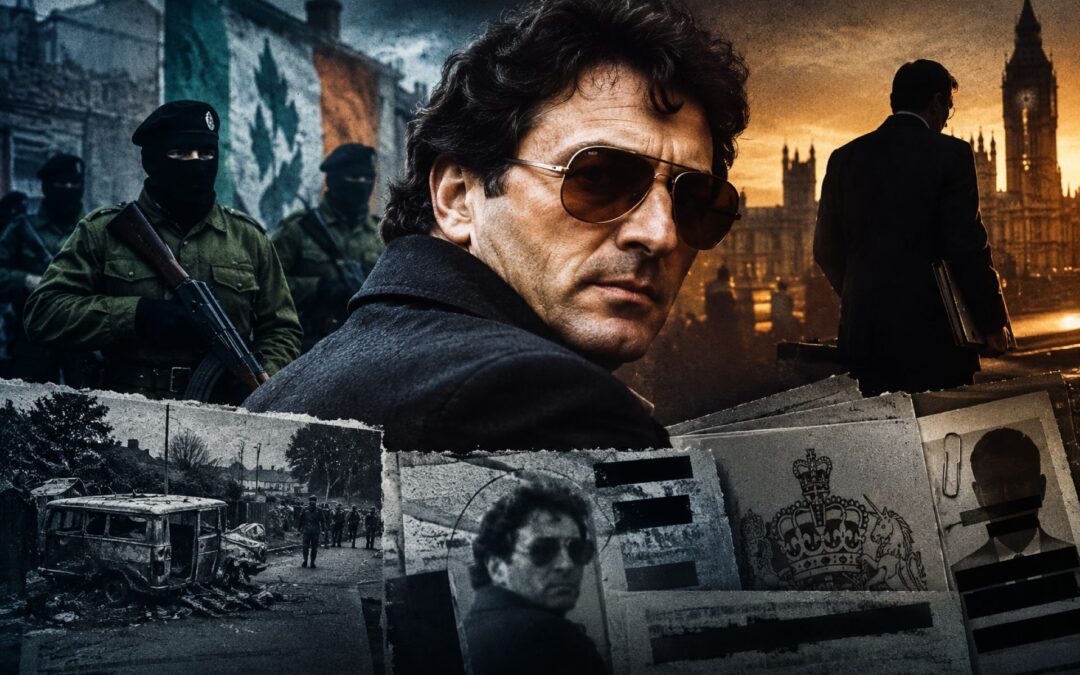
During the Troubles in Northern Ireland, the Provisional Irish Republican Army maintained an internal security unit responsible for identifying informers within its ranks. Suspected traitors could be abducted, interrogated, tortured and executed. The organisation considered this work essential to its survival because information supplied to British security forces could expose its members, weapons and planned operations.
Yet one of the men widely identified as a senior figure in this informer-hunting operation was himself working for British military intelligence. Known to his handlers as Stakeknife, he occupied an extraordinary position: an alleged British agent helping investigate people suspected of betraying the very organisation he had infiltrated.
For decades, Stakeknife was regarded as one of Britain’s most valuable intelligence sources inside the IRA. His access to the republican movement was exceptional, and his handlers received thousands of reports. But the operation concealed a disturbing contradiction. While British intelligence collected information through Stakeknife, people investigated by the IRA’s internal security apparatus were being abducted and murdered, sometimes despite the security forces receiving advance warnings about their danger.
The man publicly identified as Stakeknife was Freddie Scappaticci, a Belfast-born former IRA member who denied working for British intelligence until his death in 2023. Investigations subsequently uncovered extensive evidence of serious criminality, failures to protect threatened individuals and an intelligence operation that may have cost more lives than it saved.
His story is therefore more complicated than that of a successful spy. It raises a question about the limits of intelligence work: when an agent becomes involved in the crimes his handlers are supposed to prevent, how much wrongdoing can be tolerated in the name of protecting his cover?
From Belfast Bricklayer to IRA Insider
Frederick Scappaticci was born in Belfast in 1946 into a family of Italian descent. He grew up in a working-class environment at a time when Northern Ireland’s political and religious divisions were deeply embedded in everyday life. Those divisions would become increasingly violent as the civil rights movement challenged longstanding discrimination and the existing political order.
Northern Ireland had remained within the United Kingdom following the partition of Ireland in the early twentieth century. Unionists, predominantly Protestant, generally supported that constitutional arrangement, while nationalists, predominantly Catholic, generally favoured Irish reunification. These identities were political as well as religious, and disagreements over sovereignty were reinforced by disputes about housing, employment, voting arrangements and policing.
By the late 1960s, civil rights demonstrations, communal violence and confrontations with the police had helped destabilise the region. British troops were deployed in 1969, initially welcomed by some Catholic communities as protection against loyalist attacks. However, relations deteriorated as military operations, internment and continuing violence strengthened support for armed republican organisations.
The conflict became known as the Troubles, a period of violence involving republican and loyalist paramilitaries, the police and British security forces. Its causes and consequences formed a major part of the Troubles within modern British history, eventually influencing constitutional arrangements that would culminate in the 1998 Good Friday Agreement.
The Provisional IRA emerged from a split in the republican movement around 1969–1970. It sought to end British rule in Northern Ireland and achieve a united Ireland, pursuing an armed campaign that included bombings, shootings and attacks on members of the security forces. Its activities also killed and injured civilians, while loyalist organisations conducted their own campaigns of violence, particularly against Catholic communities.
Scappaticci initially worked as a bricklayer. In 1970, he was fined following an incident involving riotous assembly, and the following year he was interned without trial at Long Kesh, the detention facility outside Belfast. Internment, introduced by the Northern Ireland government in August 1971, was intended to weaken republican paramilitary organisations but became a major source of resentment within nationalist communities.
Scappaticci’s precise route into the Provisional IRA is not completely documented. Accounts of his early life connect his political development to the upheaval surrounding internment and the escalating conflict, but it would be misleading to assign him a single proven motivation. Like many people drawn into the republican movement, he operated within a society where political loyalties, personal experiences and armed violence had become closely intertwined.
By the latter part of the 1970s, Scappaticci had developed a position within the republican movement. He would become associated with the IRA’s Internal Security Unit, an organisation concerned not with attacking British forces directly but with identifying suspected informers.
That role was particularly important because intelligence penetration posed a constant threat to the IRA. Its members depended on secrecy, personal trust and strict organisational discipline. An informer capable of identifying senior figures, revealing weapons locations or warning the authorities about planned attacks could compromise operations and endanger entire units.
The IRA’s determination to uncover such individuals created a powerful internal security structure. For Scappaticci, it also created the position that would make the allegations surrounding Stakeknife so consequential.
How Stakeknife Was Recruited by British Intelligence
The circumstances surrounding Stakeknife’s recruitment have been the subject of competing accounts for decades. Some stories suggested that Scappaticci approached British intelligence after being assaulted by fellow republicans and sought revenge against the organisation. Others described a friendship with a British Army intelligence operative who gradually persuaded him to cooperate.
These accounts helped build the mythology surrounding Stakeknife, but they should not be confused with an established recruitment history. The most substantial account comes from Operation Kenova, the independent investigation into the agent’s activities and those of the security forces responsible for handling him.
Kenova established that the British Army began cultivating and recruiting Stakeknife in the late 1970s. Investigators found that his initial willingness to cooperate appeared connected either to the possibility of criminal prosecution or to a desire for financial gain. His military source records also identified other motivations for continuing to provide intelligence.
Those included dissatisfaction with the Provisional IRA leadership, a desire to see the conflict end and concerns about protecting his family. The records therefore point to a more complicated relationship than the familiar story of a republican who suddenly changed sides after a personal dispute.
Once recruited, Stakeknife became what intelligence professionals describe as a human source or agent. He was not a British Army officer pretending to be an IRA member. He was someone already operating inside the organisation who secretly passed information to Army personnel responsible for collecting and assessing intelligence.
This distinction matters because the information he supplied came from his access to genuine republican activities. A conventional undercover officer might struggle to establish the relationships necessary to penetrate a tightly controlled paramilitary organisation. Someone already trusted within that organisation could possess access that would be extremely difficult for an outsider to obtain.
The Army’s recruitment procedures also involved other security organisations. Before recruiting agents, military intelligence was expected to obtain clearance from the Royal Ulster Constabulary’s Special Branch to avoid conflicts with existing police sources. Kenova established that senior Special Branch officers knew Stakeknife’s identity and recruitment circumstances.
MI5, Britain’s domestic security service, was also aware of the agent and his identity from the beginning. Although the British Army remained responsible for directly running him, this was not an operation conducted entirely beyond the knowledge of other security agencies.
Over the years, Stakeknife was assigned several codenames and identifying numbers. These helped protect his identity when intelligence was distributed through official channels, reducing the possibility that someone with access to one report could connect the information to its original source.
His value increased as his access to important IRA personalities and internal discussions developed. Intelligence handlers considered him unusually productive, and the information he supplied included details that might otherwise have remained beyond the reach of the security forces.
Yet the very position that made him valuable also presented a problem. To preserve his credibility within the IRA, Stakeknife had to continue functioning as a member of the organisation. In the Internal Security Unit, that meant involvement in activities that went far beyond attending meetings or passing on information.
The Nutting Squad: Hunting Informers While Being One
The IRA’s Internal Security Unit was commonly known as the Nutting Squad. Its purpose was to identify people suspected of supplying information to the police, military or intelligence services, investigate allegations against them and determine whether they represented a threat to the organisation.
This was not an ordinary disciplinary committee. Suspects could be taken to secret locations, held against their will and interrogated under threats or physical violence. Some were accused of collaborating with the authorities after information became known that the IRA believed should have remained confidential.
The system operated within an organisation that regarded betrayal as potentially fatal. Informers could reveal the identities of volunteers, the location of arms dumps, movements of leading members and plans for attacks. Successful intelligence operations by the authorities therefore intensified the IRA’s suspicion that its organisation had been penetrated.
That suspicion could become self-reinforcing. When an operation failed or security forces demonstrated unexpected knowledge, republican leaders might suspect that someone had betrayed them. Internal investigations could then focus on individuals whose behaviour appeared suspicious, even when the available evidence was weak or misleading.
The Nutting Squad’s methods created particular dangers for those accused. Interrogations conducted without independent oversight could produce statements under coercion, while alleged confessions could be treated as proof of guilt. Suspects had no meaningful opportunity to challenge evidence through a fair judicial process, and the consequences could include execution.
Scappaticci was publicly alleged to have become a senior figure within this unit. Operation Kenova subsequently recovered strong evidence connecting the individual known as Stakeknife to serious criminal activity associated with the IRA’s internal security operations.
The extraordinary feature of the case was not simply that an IRA member had become an informer. It was that a British intelligence source was operating within the organisation responsible for identifying and punishing informers.
This placed Stakeknife in a position of exceptional danger and power. He could learn about suspected informers, investigations, planned abductions, interrogation arrangements and decisions concerning whether someone should live or die. He could pass details of those events to his British handlers while remaining involved in the machinery responsible for carrying them out.
The situation also complicated the distinction between observation and participation. An agent attending an IRA meeting could report information without necessarily committing a crime. But when an agent participated in organising an abduction, interrogating a prisoner or securing a confession under coercive conditions, the intelligence operation became entangled with the underlying criminal conduct.
Kenova found evidence of Stakeknife’s involvement in activities including abduction, interrogation and murder. The investigation did not establish a criminal conviction against Scappaticci for those offences, but the absence of such a conviction does not erase the documentary evidence collected by investigators.
An important feature of that evidence was its contemporary nature. Army handlers had recorded information supplied by Stakeknife while events were developing, rather than relying exclusively on memories reconstructed decades later. Those records helped investigators establish what the agent had reported, when he reported it and what information was available to the security forces.
The Internal Security Unit was responsible for the crimes it committed. The IRA’s decision to abduct, torture or murder suspected informers cannot be transferred automatically to British intelligence merely because an agent was present. But the state’s responsibilities became significant when its officers possessed information about threatened individuals, knew of an agent’s participation or failed to act on opportunities to prevent serious harm.
The Nutting Squad therefore became the setting for two overlapping failures. The IRA subjected people to violent and unlawful forms of internal discipline, while British security agencies continued operating an agent whose intelligence and conduct repeatedly brought him close to those crimes.
For the people accused of informing, the distinction between a genuine republican interrogator and someone secretly reporting to the British Army offered little protection. Their immediate danger came from the organisation holding them captive, regardless of whether one of its members was simultaneously supplying information to the authorities.
Inside the Rat Hole: The Army, RUC and MI5
Stakeknife’s intelligence was considered sufficiently important for the British Army to establish special arrangements for handling him. Rather than treating him as an ordinary source within a large network, the military developed a dedicated operation around his reporting and protection.
His handling initially fell to the 39 Brigade Research Office, an Army intelligence organisation operating in Northern Ireland. As his intelligence output and access increased, a specialist sub-unit was established to manage him separately from other agents. The secure accommodation used by this group became known as the Rat Hole.
According to the December 2025 Operation Kenova Final Report, the purpose of this arrangement was to provide dedicated facilities for Stakeknife’s handlers. His operation received direct oversight from senior military intelligence personnel, including the commanding officer and an operations officer.
The Rat Hole was not continuously staffed, but Stakeknife had access to a dedicated telephone line monitored around the clock within the wider intelligence organisation. This allowed him to contact his handlers whenever he needed to communicate information.
His handlers changed over the years, although several remained assigned to him for extended periods. During the period when he was most active, meetings occurred roughly every seven or eight days on average. These encounters enabled the Army to question him about information he had obtained and issue requests for further intelligence.
Agent debriefings were normally recorded, transcribed and converted into reports. Intelligence could then be passed through military channels to organisations responsible for assessing threats, identifying suspects or conducting operations.
Kenova recovered 3,517 separate intelligence reports attributed to Stakeknife. During one eighteen-month period early in his career as an agent, investigators identified 377 reports, illustrating the frequency with which information was supplied.
Not every report contained strategically important information. Some recorded sightings of particular individuals, conversations or apparently routine observations. Others contained substantial information about IRA members, activities and internal developments.
This mixture is typical of human intelligence collection. A seemingly insignificant detail may help establish someone’s movements or corroborate another report, while information about internal discussions can reveal relationships and intentions that are difficult to discover through surveillance alone.
The volume of reporting explains why the Army regarded Stakeknife as a valuable source. But it also created major questions about how the information was distributed and used.
Some reports were issued as Military Intelligence Source Reports or supplements. Particularly sensitive intelligence could receive more restrictive handling, limiting the number of officials allowed to see it or preventing further distribution without authorisation.
Army personnel also described a specialised database associated with Stakeknife’s reporting, although Kenova could not recover physical evidence establishing that particular system’s existence. More importantly, investigators found that different reporting formats and identifying numbers could make intelligence difficult to trace back to its original source.
The protection of that identity was an understandable intelligence objective. An agent exposed within the IRA could face immediate danger, and disclosure of his identity might compromise information about other people and operations.
Yet the operation’s extraordinary secrecy also made accountability difficult. Officials receiving intelligence did not necessarily know its origin, the circumstances in which it had been obtained or whether the agent was participating in the events described.
The relationship with RUC Special Branch was particularly important. The British Army collected intelligence through Stakeknife, while the police retained responsibility for many aspects of using intelligence to prevent crimes and investigate suspects. In principle, those functions required cooperation.
In practice, the division of responsibility created opportunities for delay, disagreement and inaction. Some intelligence reports carried restrictions such as prohibitions on further distribution or requirements to seek permission before taking action. Special Branch personnel later argued that these limitations constrained their ability to respond.
Army personnel, meanwhile, maintained that responsibility for exploiting intelligence belonged to the police. The result was a system in which vital information could be received by several organisations without any one of them taking effective responsibility for preventing the threatened harm.
MI5’s involvement added another dimension. The service was aware of Stakeknife from the outset and provided administrative and operational assistance connected with his reporting. Later evidence also established that MI5’s knowledge of the operation was greater than had previously been understood.
The financial arrangements surrounding Stakeknife further demonstrate his importance. Kenova identified payments and incentives ranging from sums comparable to ordinary earnings to substantial payments intended to support property purchases or his longer-term security. Investigators could not establish the total amount he received.
By the early 1990s, his operational influence within the IRA appears to have weakened. His reports increasingly concerned political developments and the peace process rather than immediate tactical matters. Nevertheless, the Army continued encouraging him to provide information, and senior personnel repeatedly emphasised his value.
The problem was that protecting such an agent could become an objective in itself. Once the security services had invested years of effort, money and institutional attention in Stakeknife, withdrawing him or allowing his arrest would have meant losing an exceptionally productive source.
Whether that investment remained justified depended on what his intelligence actually achieved and what consequences followed from allowing him to remain in place.
Kidnappings, Interrogations and Preventable Murders
The most serious questions surrounding Stakeknife concern people who were abducted, interrogated and murdered while information about their circumstances was available to British security agencies.
Operation Kenova examined the activities of the IRA’s Internal Security Unit and the intelligence systems through which information about threatened individuals was transmitted. Its findings went beyond the general observation that a valuable agent had sometimes been involved in criminal activity.
Investigators identified cases in which Stakeknife supplied information about suspected informers, impending abductions, secret detention locations, interrogations and decisions to kill. In some instances, the security forces possessed information that created opportunities to warn victims, intervene or investigate those responsible.
One case examined by Kenova involved a suspected informer who was abducted and taken into the Republic of Ireland for interrogation. Stakeknife informed his Army handlers about the captive’s circumstances, his own expected involvement and the possibility that the individual would be executed.
The Army’s records described the interrogation and the developing threat. Information about the victim’s location and the people involved reached RUC Special Branch, yet it was not passed to An Garda Síochána, the police service in the Republic of Ireland, in time to organise a rescue. Investigators found that Special Branch had apparently believed the victim would not be killed.
Another case involved intelligence that an individual would be lured across the border, abducted and interrogated. The authorities received information about the plan but did not warn the intended victim. Later reporting indicated that the captive had allegedly confessed and been sentenced to death.
When information was eventually passed to Gardaí about where the victim was being held, the police attended the wrong address. The IRA members holding the captive escaped, and the victim was subsequently killed.
These examples illustrate why the timing of intelligence matters. A report received after a murder may help establish responsibility, but a warning received while a person is still alive creates an opportunity to prevent the crime. If that warning is delayed, restricted or left unused, its potential protective value disappears.
Other Kenova cases raised comparable concerns. Investigators found instances in which information about planned abductions was not transmitted until after a murder, and cases in which intelligence identifying suspects was withheld from criminal investigators.
The reports also documented situations where security arrangements reduced the presence of security forces in areas associated with a threatened individual’s detention. Such circumstances demanded careful examination of whether the authorities had inadvertently or knowingly made intervention less likely.
The legal and moral responsibilities involved were distinct. IRA members who abducted and murdered people bore responsibility for those crimes. An agent who personally participated in an unlawful detention or violent interrogation could also bear criminal responsibility for his own actions.
The security forces’ responsibility required a separate assessment of what officials knew, what steps were reasonably available and why they did or did not act. That question could not be answered merely by showing that intelligence had been collected.
The 2024 Operation Kenova Interim Report concluded that serious failures in the recruitment, management and oversight of agents allowed unacceptable risks to develop. Investigators found that information which might have protected individuals or assisted criminal investigations was sometimes retained within intelligence systems instead of being used.
This was partly an institutional problem. The Army and police maintained different responsibilities, procedures and assumptions about how intelligence should be handled. There were mechanisms for protecting an agent’s identity while still warning people or conducting investigations, but those mechanisms were not always used effectively.
It was also a problem of priorities. Once preserving a source became more important than responding to information about an imminent murder, the operational objective risked overriding the basic purpose of policing and public protection.
The number of offences associated with the investigation illustrates its seriousness. Files submitted for prosecutorial consideration implicated the individual identified with Stakeknife in connection with 14 murders and the abduction of another 15 people. These figures describe the scope of suspected criminal involvement considered by investigators, not a judicial finding that Scappaticci personally committed every offence.
That distinction matters because some allegations circulated publicly were inaccurate. Kenova identified cases in which Stakeknife had been blamed for crimes that could not properly be attributed to him. Investigators also rejected some sensational accounts about the ways security agencies supposedly protected him.
Responsible examination therefore requires more than assuming every allegation was true. It requires recognising that compelling evidence existed concerning serious criminality while accepting that individual responsibility must be assessed against the evidence available in each case.
For the families, these distinctions did not remove the central problem. Many had spent decades trying to establish what happened to their relatives, who had held them captive and whether authorities possessed information that might have prevented their deaths.
The secrecy surrounding the operation made those questions extraordinarily difficult to answer. Intelligence files were withheld, investigations encountered missing documents and official agencies were reluctant to discuss the identities or activities of sources.
Families consequently faced not only the original loss but years of uncertainty. Some were left wondering whether a loved one had genuinely supplied information to the authorities, whether an accusation had been invented or coerced, and whether an opportunity for rescue had been lost.
The question of whether Stakeknife should have been withdrawn or arrested became unavoidable. Continuing to operate him produced intelligence, but it also allowed the conditions in which further serious crimes could occur.
The responsibility for those crimes cannot be reduced to a single agent or institution. The IRA’s unlawful internal security practices, Stakeknife’s suspected direct involvement and the failures of state agencies all require separate examination. Together, however, they show why the operation’s value cannot be judged simply by the volume of intelligence it generated.
Was Stakeknife an Intelligence Success?
For years, Stakeknife’s reputation within accounts of British intelligence was built around the extraordinary quality of his access. A source who could provide information from inside the IRA’s Internal Security Unit appeared to offer opportunities that ordinary surveillance or interrogation of arrested suspects could rarely match.
British military intelligence regarded him as one of its most productive long-term agents. His reporting covered individuals, internal relationships and organisational developments, including information relevant to the republican movement’s transition towards the peace process.
The issue is not whether Stakeknife produced useful intelligence. Operation Kenova accepted that he did. The harder question is whether the operation achieved results sufficient to justify the risks and consequences associated with keeping him active.
Claims that Stakeknife saved hundreds of lives circulated for years. Such estimates contributed to his reputation as an exceptionally successful source and strengthened the argument that preserving his identity was vital to public safety.
Kenova challenged those claims by examining how intelligence had actually been assessed. The Army’s internal calculations sometimes assigned hypothetical numbers of lives saved to information about recovered weapons or prevented attacks. These estimates could count people who might have been killed if particular weapons had eventually been used.
The method was speculative because it treated possible future consequences as though they were established outcomes. A weapon recovered following intelligence might never have been used, while police or military personnel might have discovered it through other means. Counting all hypothetical casualties as lives saved by one agent could greatly exaggerate his contribution.
Kenova reviewed approximately 90% of the written intelligence reports attributed to Stakeknife. On that basis, Jon Boutcher estimated that identifiable individuals whose lives were saved through information he supplied numbered somewhere between the high single figures and low double figures.
This was not presented as an exact or exhaustive figure. Some successful interventions might not have been fully documented, and not every useful piece of intelligence could be traced to a specific protective outcome. Nevertheless, it was far below the claims of hundreds of lives saved.
More significantly, Boutcher judged that Stakeknife’s continued operation probably resulted in more lives being lost than saved. That assessment reflected the available evidence concerning killings, failures to intervene and the serious criminality associated with the agent’s activities.
A precise calculation of the operation’s overall human consequences is impossible. It would require knowing what the IRA would have done without Stakeknife, whether alternative sources could have supplied similar information, which victims might otherwise have survived and which attacks might have proceeded without his reporting.
The Loughgall ambush illustrates the danger of turning uncertain intelligence history into a simple account of an individual spy’s success.
On May 8, 1987, eight IRA members attacked an RUC station at Loughgall in County Armagh. British Special Air Service soldiers were waiting, and all eight IRA members were killed. A civilian, Anthony Hughes, was also shot dead during the operation.
The ambush was a major blow to the IRA’s East Tyrone Brigade and prompted intense suspicion about how the security forces had learned of the planned attack. Given Stakeknife’s position inside the republican movement, accounts subsequently suggested that he might have supplied the information that enabled the operation.
However, that direct connection has not been conclusively established. Reporting on the BBC’s Spotlight on the Troubles investigation, including evidence about Stakeknife’s involvement in the IRA’s investigation after Loughgall, supports a narrower conclusion.
The security forces possessed advance information about the attack, and Stakeknife was reportedly involved in the IRA’s subsequent attempt to identify the source of the leak. Neither fact establishes that his own warning was responsible for the SAS ambush.
This distinction is essential because intelligence operations often involve multiple sources. Surveillance, intercepted communications, informers and analysis of existing information may all contribute to a successful operation. Assigning the result to one agent without adequate evidence risks creating a misleading account of his importance.
Stakeknife may have supplied intelligence that helped prevent attacks and protect individuals, but he also worked within an IRA organisation responsible for serious violence. His continued presence exposed the security forces to information about crimes that they sometimes failed to prevent.
Even a favourable calculation of lives saved would not automatically settle whether his conduct or the decisions of his handlers were lawful. Preventing one crime does not authorise participation in another, and the state cannot treat serious harm to one person as acceptable merely because it believes an agent may protect others in the future.
The central failure identified by Kenova was therefore not the use of human intelligence itself. Such sources can provide indispensable information about violent organisations. The problem was the absence of effective limits, independent scrutiny and reliable intervention when intelligence operations became entangled with criminal acts.
Stakeknife’s reputation as an intelligence success was based partly on genuine information and partly on estimates that investigators could not substantiate. The eventual evidence presented a much less reassuring picture.
The 1993 Interview, the 2003 Exposure and a Life in Hiding
Although Stakeknife operated under considerable secrecy, suspicions about British penetration of the IRA continued to develop. By the 1990s, his position within the republican movement was weakening, while the emerging peace process was changing the significance of the intelligence he could provide.
An unusual incident in August 1993 later became central to the story of his exposure. Scappaticci approached journalists associated with ITV’s The Cook Report, a programme known for undercover investigations, and gave an interview concerning the republican movement.
During that interview, he made allegations involving Martin McGuinness and the death of Frank Hegarty, an IRA member killed in 1986 after being accused of informing. Those allegations were contested, and Scappaticci’s statements were not themselves proof of McGuinness’s responsibility.
The programme makers learned something unexpected. A senior RUC officer informed them in confidence that Scappaticci was an important Army agent within the IRA whose identity should be protected. The programme’s interview was consequently not broadcast at that time.
The incident demonstrated how close Scappaticci had come to exposing himself through contact with journalists. It also showed that knowledge of his alleged intelligence role extended beyond the small group directly responsible for handling him.
Public discussion of Stakeknife developed further in August 1999, when The Sunday Times published claims about a highly placed British source operating inside the IRA. Those accounts drew upon information associated with former military intelligence operative Ian Hurst, who used the pseudonym Martin Ingram.
The Ministry of Defence pursued legal proceedings concerning disclosures of intelligence information. These proceedings confirmed Hurst’s service within the Force Research Unit, although that did not establish the accuracy of every allegation he later made.
The critical turning point came in May 2003. Media reports publicly identified Freddie Scappaticci as the man behind the Stakeknife codename, bringing the allegations to a much wider audience.
Scappaticci rejected the accusations. He denied working for British intelligence and pursued legal proceedings concerning the government’s refusal to clarify his status.
The previously withheld Cook Report interview also became public after the allegations about his identity emerged. Its significance was no longer confined to what Scappaticci had said about IRA activities; it had become part of the evidence surrounding claims about his own secret relationship with British intelligence.
The publicity placed him at serious risk. An individual believed to have betrayed the IRA from within its own Internal Security Unit could not safely assume that former associates would ignore the allegations simply because he denied them.
Scappaticci eventually lived in England under changed identities and received assistance connected with his resettlement. Kenova later established that the intelligence services had considered various arrangements to support and protect Stakeknife, including substantial financial assistance and accommodation.
His relationship with his handlers was not always straightforward. Records showed that he sometimes resisted their instructions, became dissatisfied with changes in personnel and expressed concerns about his future. At one stage, an attempted relocation failed when he returned to Northern Ireland without informing those responsible for managing his security.
These events complicate any portrayal of him as an obedient operative completely controlled by the Army. Stakeknife possessed his own motives and exercised considerable independence, even while relying on state protection.
In January 2018, Scappaticci was arrested as part of Operation Kenova and questioned about allegations linked to serious offences during the Troubles. The investigation placed renewed attention on crimes that had remained unresolved for decades.
In December 2018, he pleaded guilty to possessing extreme pornographic material and received a suspended sentence. That conviction was unrelated to the Troubles-related murders and abductions investigated by Kenova, but it is important because claims that he never received any criminal conviction are inaccurate.
Scappaticci died on March 20, 2023, aged 77. His death was publicly reported in April, contributing to confusion in some accounts about the precise date.
He died without having been charged with or convicted of the Troubles-related offences at the centre of Operation Kenova. His death also meant that prosecutors could no longer bring criminal proceedings against him, regardless of the strength of evidence that might have supported particular allegations.
Yet the investigation into Stakeknife was about more than whether one man could be prosecuted. It concerned what the security forces knew, how they handled their agent and why serious crimes had not been prevented or properly investigated.
Those questions survived Scappaticci’s death.
Operation Kenova: What the Investigators Established
Operation Kenova began in June 2016 after the Director of Public Prosecutions for Northern Ireland requested an independent investigation into the activities of the alleged British Army agent known as Stakeknife. Its remit also examined the conduct of those responsible for recruiting, handling and overseeing him.
The investigation was initially led by Jon Boutcher, a former chief constable of Bedfordshire Police, and later by Sir Iain Livingstone. It operated independently from the Police Service of Northern Ireland while examining events that had occurred decades earlier.
Kenova faced unusually difficult investigative conditions. Witnesses had died, memories had faded and documents had been lost, destroyed or retained within classified intelligence systems. Some potential suspects and witnesses were reluctant to cooperate, while surviving records were scattered across different organisations.
A central challenge concerned the difference between intelligence and criminal evidence. Intelligence reports can provide valuable leads, but they are not automatically admissible as evidence in court. Investigators must establish their authenticity, provenance and reliability while satisfying the rules governing criminal proceedings.
The problem was particularly serious in the Stakeknife investigation because many original Army documents were no longer available. The Ministry of Defence reported that much of the original material concerning the agent’s intelligence had been destroyed, although copies of some reporting survived in other systems.
Kenova recovered substantial quantities of information from RUC Special Branch and other agencies. Those records enabled investigators to reconstruct much of Stakeknife’s reporting history, but the absence of original debriefing notes, recordings and contact records created difficulties when assessing potential prosecutions.
The inquiry also examined earlier investigations, including the Stevens inquiries into collusion between security forces and paramilitary organisations. These investigations had exposed problems with agent handling and intelligence disclosure, but many questions about Stakeknife remained unanswered.
Kenova adopted a particularly strong emphasis on communication with victims’ families. Investigators sought to explain findings directly to those affected, including cases in which the evidence could not support a prosecution.
This approach recognised that the criminal justice system and the search for historical truth do not always produce identical outcomes. A court requires evidence sufficient to establish criminal guilt to the applicable legal standard. Families may also seek accurate information about the circumstances of a death, the roles of particular organisations and the decisions authorities made.
The prosecution process nevertheless produced disappointing results for those seeking criminal accountability. By February 2024, the Public Prosecution Service had completed decisions concerning the 28 files submitted in the Stakeknife investigation, without initiating the murder-related prosecutions sought by many families.
In its February 2024 explanation of the final Operation Kenova prosecution decisions, the prosecution service identified missing source material and legal difficulties concerning intelligence records as major obstacles.
Prosecutors concluded that the available admissible evidence did not provide a reasonable prospect of conviction in the cases where a prosecution decision could be reached. In ten files involving Scappaticci as the only suspect, his death meant that no prosecution decision could be made.
A decision not to prosecute is not equivalent to a finding that no wrongdoing occurred. It establishes that the legal requirements for bringing a criminal case were not met, or that no prosecution remained possible. Kenova’s broader investigative conclusions must therefore be understood separately from the absence of convictions.
The March 2024 Interim Report challenged several assumptions about Stakeknife, particularly the scale of his supposed intelligence successes. It also criticised weaknesses in the systems used to supervise agents and the tendency of security organisations to protect sensitive information without adequately considering the consequences for victims.
The December 2025 Final Report added significant detail about the organisation and operation of Stakeknife’s handlers. It reconstructed the reporting arrangements, the distribution of intelligence and the relationship between the Army, RUC Special Branch and MI5.
Particularly important were files discovered by MI5 after the main investigative and prosecution processes had concluded. Kenova was first notified in April 2024 that additional relevant material existed, with further records identified afterwards.
The late disclosure was a serious problem because investigators had already completed much of their work and prosecutors had made decisions without possessing all the relevant records. The newly discovered information also revealed that MI5 had greater knowledge of and involvement in Stakeknife’s operation than previously established.
MI5 commissioned an external review led by former senior police officer Helen Ball to examine why the records had not been identified earlier. The review found no evidence that the material had been deliberately withheld, but it identified shortcomings in the disclosure process and made recommendations for improvement.
MI5 apologised for the late discoveries and undertook to implement those recommendations. Kenova nevertheless considered the delay significant because the missing records had affected investigators’ access to a complete historical account.
Further work did not alter the prosecution decisions, but the disclosure problem remained consequential. It demonstrated how an investigation into serious historical offences could be constrained by the way intelligence organisations preserved, searched for and released their records.
Kenova’s findings also raised questions about institutional accountability during the original operation. Responsibility for handling agents, exploiting intelligence and investigating crimes had been divided among organisations that did not always cooperate effectively.
The IRA’s Internal Security Unit had committed serious offences, but the authorities possessed information about some of those activities that was not acted upon appropriately. Intelligence was sometimes restricted or retained without adequate attention to opportunities to protect victims.
The investigation therefore did not produce a simple conclusion that every British official knowingly approved every crime committed by the IRA’s internal security apparatus. Instead, it documented failures in oversight, communication, judgment and the practical use of intelligence.
Those distinctions are important because collusion can describe different forms of conduct, from direct assistance to deliberate non-intervention or improper protection. Establishing the nature of each failure requires examining who knew what, what authority they possessed and what actions were reasonably available.
Kenova’s broader conclusion was that agent handling during the Troubles had not been subject to adequate regulation, supervision and accountability. The Stakeknife operation demonstrated the consequences of those deficiencies in particularly stark terms.
The investigation could not restore the lives lost or provide criminal convictions for every case examined. It did, however, establish a more detailed account of the intelligence operation, challenge longstanding claims about its achievements and document failures that had remained obscured for decades.
Why Stakeknife’s Identity Remains Contested in Official Records
The public identification of Freddie Scappaticci as Stakeknife began in 2003, but the British government has repeatedly declined to provide formal confirmation of the connection.
Its position rests on a longstanding intelligence policy known as Neither Confirm Nor Deny, commonly abbreviated to NCND. Under this approach, the government ordinarily refuses to confirm or reject claims about an individual’s relationship with intelligence agencies.
The reasoning is that identifying agents, even long after particular operations have ended, could expose individuals to danger, reveal sensitive relationships or undermine confidence among people considering cooperation with the security services.
There is a legitimate national-security interest in protecting human sources. Intelligence organisations depend on assurances that individuals supplying information will not automatically be exposed, and revealing one source may sometimes enable others to be identified.
The Stakeknife case, however, presented exceptional circumstances. Scappaticci had been publicly identified for more than two decades, had died in 2023 and was associated with allegations of serious criminality. Families seeking information about the killings of their relatives considered continued official silence an obstacle to establishing what had happened.
Kenova argued that the circumstances justified an exception to the government’s general policy. Its investigators considered that confirmation or denial would serve the public interest and improve confidence in the authorities without creating a meaningful additional security risk.
The continuing refusal also complicated legal proceedings and public discussion. Government agencies could discuss the activities of Stakeknife and acknowledge the seriousness of the investigation while declining to identify the person at its centre.
This produced a difficult situation in which Scappaticci’s identity was widely accepted in public reporting, yet official investigations remained constrained in how explicitly they could connect the two identities.
The matter received renewed parliamentary attention after publication of the Final Report. On February 9, 2026, the House of Commons Northern Ireland Affairs Committee published its report calling for the government to formally name Stakeknife.
The committee concluded that identification would be strongly in the public interest and could help restore trust in state institutions. It placed particular emphasis on the needs of victims’ families and the importance of accountability in addressing the Troubles’ legacy.
Two days later, on February 11, 2026, Taoiseach Micheál Martin publicly identified Freddie Scappaticci as Stakeknife during statements in the Irish parliament. As RTÉ reported on the Dáil proceedings, Martin said that Stakeknife’s identity was widely known and called upon the British government to name him officially.
The Irish parliamentary statement was a significant political development, but it did not constitute formal confirmation by the British government. That distinction explains why descriptions of Scappaticci as Stakeknife can be both widely supported and technically qualified when referring to the UK’s official position.
The dispute is not merely about whether a particular name appears in a government document. Formal acknowledgment affects how evidence is discussed, how responsibility is assessed and how victims’ families pursue information about what happened to their relatives.
It also raises a broader question about the relationship between national security and public accountability. Secrecy can be necessary while an operation is active, especially when disclosure could endanger people or compromise legitimate intelligence work. But secrecy becomes harder to justify when it prevents meaningful examination of alleged crimes decades after an operation has ended.
Stakeknife’s case demonstrates the danger of allowing those objectives to become indistinguishable. Protecting an agent’s identity may initially serve an intelligence purpose, but protecting the institutional reputation of an intelligence operation is not the same thing as protecting national security.
The available evidence establishes that Stakeknife supplied valuable intelligence from inside the IRA, that his operation was associated with grave criminal conduct and that British security agencies repeatedly failed to use available information in ways that might have prevented serious harm. Kenova’s findings also show that the mythology surrounding his achievements overstated what investigators could demonstrate.
Freddie Scappaticci died without facing prosecution for the Troubles-related killings investigated by Kenova. The absence of such a prosecution leaves important questions of individual criminal responsibility unresolved, but it does not prevent a historical assessment of the failures documented by the inquiry.
The most consequential lesson of Stakeknife’s story is not that British intelligence succeeded in placing an agent inside one of the IRA’s most secretive units. It is that exceptional intelligence access can become dangerous when the desire to preserve it overwhelms the obligation to protect lives, investigate crimes and hold institutions accountable.
For the families of those abducted and murdered, the value of the operation cannot be measured in intelligence reports, secret meetings or claims of strategic success. It must also be measured against the warnings that went unheeded, the investigations that failed and the decades spent seeking answers. Understanding Stakeknife requires confronting both sides of that history rather than allowing the achievements of espionage to obscure its human consequences.
Last Updated on October 27, 2026 by Aseem Gupta