
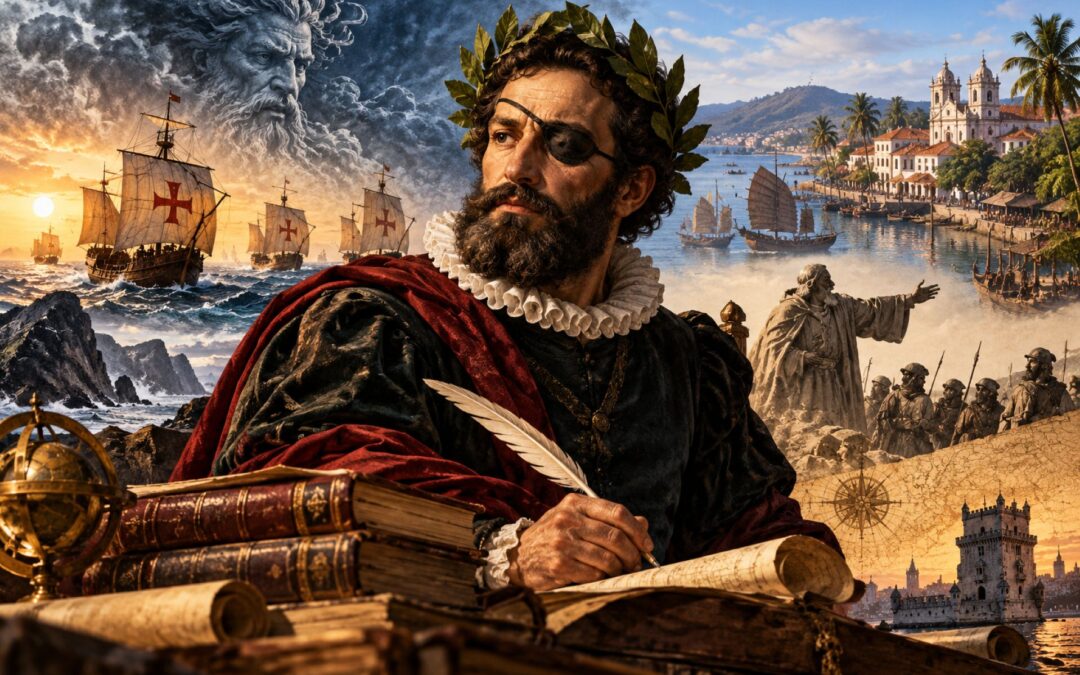
Luís de Camões spent much of his adult life far from Portugal, serving in military expeditions, navigating the politics of colonial administration, enduring imprisonment and financial hardship, and travelling across the Indian Ocean. He lost an eye during military service, became entangled in disputes with royal authorities, and returned home after nearly seventeen years abroad. Yet the same man produced Os Lusíadas, the epic poem that would become one of the defining works of Portuguese literature.
Published in 1572, Os Lusíadas celebrated the voyages, victories, and ambitions that had transformed Portugal into a maritime power. Its central hero was the explorer Vasco da Gama, but its greater subject was the Portuguese nation itself. Camões presented his country as a people capable of extraordinary achievements while also questioning the greed, corruption, and failures of leadership that threatened those achievements.
The timing made his accomplishment particularly significant. Portugal’s overseas empire was extensive, but its political future was increasingly uncertain. In 1578, King Sebastião disappeared during a disastrous campaign in Morocco, and Camões died in 1580, the year Portugal’s succession crisis brought the Spanish Habsburg king to its throne.
Camões became the literary voice of an empire at a moment when its political independence was about to be lost. Understanding how he acquired that position requires looking beyond the heroic legends that accumulated around his name and examining the complicated relationship between his life, his poetry, and the country he celebrated.
The Poet Behind the Legend: What We Actually Know
Luís Vaz de Camões was probably born in 1524 or 1525, although historians cannot establish his exact birthplace with certainty. Lisbon is frequently identified as his birthplace, while other traditions offer different locations. The surviving documentary record reveals surprisingly little about the childhood and education of someone who would become Portugal’s most celebrated poet.
Camões belonged to a family with connections to the lesser nobility. His ancestors had reportedly crossed from Galicia into Portugal, where members of the family acquired positions through royal service. However, noble ancestry did not necessarily provide financial security, and the family’s circumstances appear to have declined over successive generations.
His father is traditionally identified as Simão Vaz de Camões, whose career has been associated with Portuguese overseas activity. Stories about his disappearance or death during an eastern voyage form part of the poet’s conventional biography, but their details are difficult to establish securely. Accounts suggesting that an uncle named Bento supervised Camões’s education must likewise be treated cautiously.
The uncertainty matters because Camões’s later reputation encouraged biographers to construct a childhood appropriate to a great national poet. A brilliant classical education, noble family traditions, early misfortune, and an independent temperament all provided attractive explanations for the extraordinary man who supposedly emerged from them.
What can be established more confidently is the breadth of Camões’s literary knowledge. His poetry reveals familiarity with classical mythology, Roman literature, Renaissance humanism, Christian theology, and the poetic traditions of several European languages. He understood the classical epic deeply enough to adapt its conventions to Portuguese history, and his lyric poetry displays an equally sophisticated command of love, longing, fortune, and human contradiction.
Camões is traditionally associated with the University of Coimbra, although firm evidence of formal university enrolment is lacking. Coimbra was an important intellectual centre, and the possibility that he acquired part of his education there is reasonable. Nevertheless, his knowledge of classical and Renaissance literature provides stronger evidence of his learning than the surviving records provide of any particular educational institution.
This problem extends throughout his biography. As modern biographical research into Camões demonstrates, some influential accounts were written decades after his death and frequently mixed genuine information with contradictory anecdotes. Later writers had powerful reasons to portray him as a romantic adventurer whose suffering prepared him to become Portugal’s national poet.
The historical Camões was undoubtedly educated and experienced considerable hardship. The difficulty lies in distinguishing those established circumstances from the stories subsequently invented or embellished to explain them.
By the 1540s, however, he had entered the literary and social world of the Portuguese court, where his abilities attracted attention and his conduct would eventually bring him into conflict with authority.
Courtly Poetry, a Lost Eye, and a Prison Sentence
The Portuguese court during the reign of João III was an environment in which literary talent could provide access to influential patrons. Poetry formed part of aristocratic culture, and educated courtiers were expected to appreciate classical references, sophisticated language, and fashionable literary forms. Camões possessed precisely the abilities that could make a gifted young writer admired in such circles.
His relationship with the court was nevertheless complicated by his limited financial resources. Connections to noble families might provide opportunities, but they did not guarantee patronage, employment, or a stable position. A man whose social standing exceeded his personal wealth could experience both the attractions and frustrations of aristocratic society.
Camões also acquired a reputation for romantic adventures and unruly behaviour. Later accounts describe relationships with prominent women, rivalries with other courtiers, and periods of exile from Lisbon. These stories contributed to his image as a passionate, rebellious poet, but historians cannot reliably reconstruct every alleged affair or identify the women who inspired particular verses.
His love poetry certainly reveals a fascination with emotional conflict. Desire frequently appears alongside suffering, memory alongside absence, and devotion alongside the unpredictability of fortune. Such themes became central to his literary identity, although poems about romantic longing should not automatically be interpreted as direct records of specific relationships.
Camões eventually entered military service in North Africa, traditionally associated with the Portuguese garrison at Ceuta. Portugal had occupied the city since 1415, and its position on the North African coast remained both strategically important and militarily expensive to defend.
During this period, Camões lost his right eye. The injury became one of the most recognizable features of his later portraits and an enduring symbol of his military experience.
Older biographies commonly describe the injury as the result of combat against Moroccan opponents. More recent biographical research offers a different possibility: Camões may have been injured in a firearms accident, perhaps involving a cannon discharged by another Portuguese soldier. The precise circumstances remain uncertain, but the loss of the eye itself is a well-established part of his life.
Military experience gave Camões a practical familiarity with danger and hardship. It also connected him directly to the Portuguese monarchy’s campaigns against Muslim powers, conflicts that formed part of the wider religious and political assumptions of his age.
When he returned to Lisbon, his reputation for confrontation followed him. In 1552, Camões became involved in an altercation with Gonçalo Borges, a servant connected to the royal household. The incident resulted in imprisonment in Lisbon’s Tronco Prison.
The episode is among the more securely documented events of his early career. It also demonstrates the limits of his aristocratic connections: although noble status could sometimes encourage favourable treatment, it did not protect him from punishment when he offended someone associated with the royal court.
In 1553, João III granted him a pardon connected to his obligation to serve overseas. Camões departed Portugal as part of an expedition bound for India, entering a world that had already transformed the kingdom’s economic and political position.
He was approaching thirty years of age when he left. His future would now depend less on literary circles in Lisbon than on the hazardous military and administrative institutions of Portugal’s Asian empire.
Seventeen Years Beyond Portugal
Camões departed Lisbon in March 1553, travelling along the maritime route established by Portuguese navigators during the previous century. The journey took ships down the Atlantic coast of Africa, around the Cape of Good Hope, and across the Indian Ocean toward Portuguese-controlled territories in India.
These voyages remained dangerous despite decades of accumulated navigational experience. Ships faced storms, disease, shortages of provisions, difficult coastal approaches, and the considerable uncertainty of long-distance sailing. The journey itself placed Camões inside the maritime world that would become the central setting of his greatest poem.
The Cape of Good Hope had particular literary significance. Vasco da Gama’s voyage of 1497–1499 had demonstrated that Portuguese ships could reach Indian ports by sailing around Africa. That achievement helped establish direct commercial connections between Portugal and the Indian Ocean, although the region already possessed extensive trading networks involving African, Arab, Persian, Indian, and Asian merchants.
Camões arrived in Goa in 1554. Goa had become the principal centre of Portuguese administration in Asia after its conquest in 1510, serving as a military headquarters, commercial port, and base for operations across the Indian Ocean.
The Portuguese position in Asia differed substantially from the territorial empires established by some European powers in later centuries. Portugal controlled important ports and fortified settlements, but its authority depended heavily on maritime access, military force, diplomatic relationships, and cooperation with local merchants and rulers.
Camões entered this system as a soldier rather than a celebrated writer. His service reportedly involved military expeditions along the Indian coast and in other parts of the Portuguese sphere of operations. Accounts associate him with campaigns involving the Malabar coast and the approaches to the Red Sea, although the chronology and details of every assignment cannot be established equally securely.
These operations reflected the mixture of commercial and religious ambitions that shaped Portuguese expansion. Ships and soldiers defended trading positions, challenged competitors, pursued enemies, and attempted to influence maritime routes. Conflicts involving Muslim merchants and political powers were especially important to Portuguese imperial ideology, but those encounters were part of complex regional struggles rather than a simple confrontation between two unified religious communities.
Camões’s experiences exposed him to societies whose commercial and political sophistication extended far beyond Portuguese control. Goa connected the Portuguese to Indian markets and established networks of exchange, while operations farther east brought them into contact with Southeast Asian ports and the wider Asian trading world.
The environment also revealed the difficulties of governing distant possessions. Officials operated far from Lisbon, communications were slow, and authority was frequently exercised through personal relationships, military appointments, and competition over commercial opportunities.
Camões’s relationship with this colonial administration was not always harmonious. Biographical traditions describe financial disputes, imprisonment, and satirical criticism of officials whose conduct he considered corrupt or hypocritical. While not every alleged arrest can be independently established, the recurrent difficulties in his career are consistent with the precarious existence of an educated but financially insecure individual dependent on imperial employment.
His poetry also reveals an awareness of the discrepancy between heroic ideals and human behaviour. Service to the crown could be presented as honourable and patriotic, but ambition, greed, favouritism, and personal rivalries often influenced the actions of those claiming to serve the kingdom.
That contradiction would eventually become important to Os Lusíadas. Camões could celebrate the courage of Portuguese navigators without assuming that every Portuguese official acted courageously or honourably.
His overseas years were therefore more than a collection of adventures. They placed him inside the institutions, conflicts, landscapes, and cultural assumptions that his epic would later transform into literature.
Macau, the Shipwreck, and the Stories We Cannot Prove
Among the most intriguing episodes in Camões’s biography is his association with Macau, the Portuguese commercial settlement on China’s southern coast. By the middle of the sixteenth century, Portuguese merchants had established an important presence there, connecting maritime trade between China, Japan, Southeast Asia, and India.
Camões’s journey to Macau has generated considerable disagreement because early biographers supplied conflicting dates and circumstances. Some accounts placed his arrival several years earlier than modern documentary investigations now suggest.
According to research into Camões’s journey to Macau published in 2026, he departed Goa in April 1562 in the company of Diogo Pereira, who had been appointed to lead the Portuguese community in Macau. A contemporary letter concerning Pereira’s voyage supports an arrival in Macau on 24 August 1562. This strengthens the chronology of the expedition, although it does not resolve every question about Camões’s activities there.
Camões received responsibility for administering the estates of deceased and absent individuals. Often described as the Provedor dos Defuntos e Ausentes, the office involved matters concerning property and inheritance when owners had died or could not personally manage their affairs.
The role was significant because Portuguese overseas expansion produced complicated legal and financial situations. Merchants and soldiers died far from their families, property could remain scattered between ports, and communication with heirs might take months or years. Administration of such estates required a degree of official confidence, but it also created opportunities for disputes over money and responsibility.
Camões subsequently lost his position, and accounts of his career describe accusations involving the management of entrusted property. The exact sequence of his dismissal, return journey, and later difficulties remains imperfectly documented.
The most famous story associated with these years concerns a shipwreck in Southeast Asia. According to tradition, Camões was returning from Macau when his vessel was wrecked near the Mekong River region. He supposedly managed to swim ashore while holding the manuscript of Os Lusíadas above the water, preserving his literary masterpiece while losing nearly everything else.
The image is unforgettable: a one-eyed veteran struggling through dangerous water, determined to protect the poem that would make him immortal.
Unfortunately, its dramatic appeal exceeds the strength of the surviving evidence. Camões’s experience of shipwreck forms part of the established biographical tradition, but the precise location, circumstances, and celebrated rescue of the manuscript depend heavily on accounts developed after the event.
The distinction does not make the story irrelevant. Its survival reveals how later generations understood Camões, portraying him as someone who placed poetry above material possessions and endured suffering in the service of a work greater than himself.
Macau developed similar commemorative traditions. A grotto associated with Camões became a landmark connected to the belief that he composed part of his epic there. Although the location is historically important to his cultural memory, the surviving evidence cannot establish exactly which passages he wrote in that particular place.
What matters more securely is that Camões spent years moving through the Portuguese Asian world and experienced the uncertainties of imperial service firsthand. He acquired knowledge of maritime travel, administrative institutions, commercial rivalry, and the human consequences of overseas expansion.
Those experiences did not automatically determine what he would write, but they provided material that an exclusively court-bound poet could not have encountered in the same way.
By the later 1560s, Camões was attempting to leave his troubled Asian career behind. His journey home, however, would prove difficult.
The Long Road Home and the Publication of Os Lusíadas
Camões travelled toward Mozambique in 1567, hoping eventually to return to Portugal. Mozambique was an important stopping point for Portuguese vessels travelling between Lisbon and the Indian Ocean, but reaching the African coast did not mean that he possessed the money or connections required to complete the voyage.
He became stranded there under difficult financial circumstances. Accounts describe debts and disagreements involving the Portuguese governor, while his precarious position made an independent passage home difficult to arrange.
Friends eventually helped him obtain the resources necessary to continue. Among those associated with his return was the historian Diogo do Couto, whose recollections became important to later accounts of Camões’s life.
The poet finally reached Portugal around 1570, nearly seventeen years after leaving Lisbon. He returned with an extraordinary accumulation of experiences but without the financial security that might have been expected after such prolonged royal service.
Portugal had also changed during his absence. João III had died in 1557, and Sebastião, his young grandson, had inherited the throne while still a child. The kingdom remained an important maritime power, but its overseas commitments placed considerable demands on the crown’s resources.
Camões now concentrated on bringing his epic poem to publication. How much of Os Lusíadas had been composed in Portugal, India, Macau, or during his travels cannot be reconstructed with certainty. Its final form, however, reflected both his extensive literary education and his direct experience of the world it celebrated.
In 1572, Os Lusíadas appeared in print in Lisbon. The publication marked the culmination of a project that transformed Portuguese maritime history into a classical-style national epic.
The poem was dedicated to Sebastião, whose youth and authority made him an important audience for its celebration of Portuguese achievement. Camões praised the monarchy while also presenting models of leadership, courage, responsibility, and historical duty.
The connection between the poem and royal patronage must not be exaggerated. Popular retellings sometimes suggest that Sebastião personally commanded its publication after hearing Camões recite it, but such an episode cannot be established securely.
Camões did receive a royal pension in 1572. Modern biographical research indicates that the pension recognized his extensive service to the Portuguese crown and that the dedication of the poem helped accelerate the process. The payments were modest and reportedly irregular, and they did not eliminate his financial difficulties.
The contrast was striking. Camões had given Portugal a literary work celebrating its greatness, yet he continued to live without substantial wealth or dependable material comfort.
His achievement was nevertheless much larger than a successful appeal for patronage. Os Lusíadas offered Portugal something it had not previously possessed on the same scale: a national epic that placed its maritime achievements alongside the legendary histories of classical civilization.
The Epic That Celebrated Portugal—and Questioned It
Os Lusíadas, generally translated as The Lusiads, takes its title from the Lusitanians, an ancient people associated with the territory of modern Portugal. The name connects the Portuguese to an imagined historical lineage extending into antiquity, giving their achievements the dignity and continuity of an epic tradition.
The poem contains ten cantos and more than 8,800 lines, arranged predominantly in eight-line stanzas. Its central narrative follows Vasco da Gama’s expedition around Africa to India, but its ambitions extend considerably beyond the events of that voyage.
Camões wanted to place Portuguese history within the grand literary tradition represented by Homer’s Iliad and Odyssey and Virgil’s Aeneid. These works transformed warfare, journeys, political origins, and divine intervention into stories of exceptional human achievement. Camões adopted their literary methods to demonstrate that Portugal possessed heroes and accomplishments worthy of comparable treatment.
Vasco da Gama provided an ideal narrative centre. His expedition of 1497–1499 connected Portugal directly to the Indian Ocean by sea, transforming the kingdom’s commercial opportunities and international ambitions. For Camões, the voyage represented the culmination of generations of Portuguese courage, exploration, religious commitment, and sacrifice.
Yet the poem does not treat da Gama as its only hero. Its greater subject is the Portuguese people, whose collective accomplishments are presented through accounts of earlier rulers, military victories, voyages, and political struggles.
Camões creates an expansive historical narrative in which individual generations contribute to a larger national destiny. The sailors of da Gama’s fleet inherit the achievements of their predecessors, while their adventures become part of an ongoing story of Portuguese ambition.
The poem begins with the Portuguese expedition already underway, following the classical practice of opening in the middle of events rather than narrating everything from the beginning. The narrative then moves between the voyage itself, episodes from Portuguese history, divine interventions, and predictions of later accomplishments.
Its structure allows Camões to turn a single maritime expedition into a history of the nation.
The classical gods play an essential role in this design. Venus supports the Portuguese because she recognizes qualities associated with the ancient Romans, while Bacchus opposes them, fearing that their achievements will diminish his own reputation. Their interventions create danger, suspense, and supernatural explanations for events encountered during the voyage.
The presence of pagan gods in a poem celebrating a Christian kingdom might initially appear contradictory. Camões, however, was writing within a Renaissance literary tradition that treated classical mythology as a sophisticated poetic language. The gods provide dramatic machinery, symbolic meaning, and a connection between Portuguese achievements and the ancient civilizations whose literature Renaissance scholars admired.
The result is a Christian imperial epic expressed through the conventions of Greco-Roman mythology. Camões does not merely reproduce classical models; he adapts their authority to a different historical and ideological setting.
Several episodes reveal how effectively he combined those traditions.
When da Gama reaches Malindi on the East African coast, he recounts Portuguese history to the local ruler. This provides Camões with an opportunity to move backward through the nation’s past, describing the rise of its monarchy, its military struggles, and the figures who contributed to its development.
The account is not simply a historical chronicle inserted into the poem. It gives the voyage political meaning, suggesting that the sailors’ achievements emerge from a long national experience of warfare, endurance, and ambition.
One of the most memorable historical episodes concerns Inês de Castro, whose relationship with the future Pedro I of Portugal ended in her execution in 1355. Her tragedy introduces a deeply personal story of love, political calculation, and cruelty into the larger narrative of kings and military victories.
Camões’s treatment of Inês demonstrates that his concept of national history included suffering and moral failure as well as triumph. Royal authority could create injustice, and personal loyalty could collide violently with political interests.
Another striking episode occurs as da Gama’s expedition prepares to leave Portugal. An elderly man, commonly known as the Old Man of Restelo, condemns the ambitions motivating dangerous voyages and warns about the consequences of pursuing fame and distant wealth.
His speech presents a serious challenge to the heroic narrative. Exploration might bring glory, but it could also produce unnecessary suffering, encourage destructive ambition, and distract rulers from responsibilities closer to home.
Camões does not simply adopt the old man’s position or reject the voyage that follows. Instead, he allows a powerful critical voice to exist within the same poem that celebrates the undertaking.
The episode is one reason literary interpretations of Os Lusíadas recognize the poem’s concern with the moral and political dangers accompanying imperial expansion. The epic’s patriotic purpose does not prevent it from questioning the conduct of those who claim to act in the nation’s interest.
The most spectacular supernatural encounter occurs near the Cape of Good Hope, where the figure of Adamastor appears as a terrifying giant. He embodies the dangers of the ocean and the resistance of nature to human ambition, threatening the Portuguese with disasters and suffering.
The episode transforms a geographical challenge into a confrontation with a mythological force. The cape is not merely a point on a map but a place where human courage encounters dangers beyond ordinary experience.
Adamastor also possesses his own tragic history, revealing vulnerability beneath his terrifying appearance. Camões gives the apparently monstrous figure an emotional dimension, complicating what might otherwise have been a straightforward celebration of conquest over nature.
Later in the epic, the Portuguese encounter further dangers involving rivalries, deception, and storms before reaching India. Their success depends on endurance and assistance, but the journey also exposes them to political systems and commercial interests that existed long before their arrival.
The historical realities were considerably more complex than the epic’s heroic representation. Indian Ocean commerce involved established African and Asian societies, sophisticated merchant networks, and powerful regional rulers. Portuguese maritime expansion frequently included coercion, armed conflict, and attempts to control commerce, activities that cannot be understood solely through the poem’s language of providential achievement.
Camões wrote from within the values of sixteenth-century Portuguese Christianity and imperial ambition. His portrayal of other societies sometimes relies on religious hostility and assumptions of Portuguese superiority. Those features are central to the poem’s historical character and should not be concealed by its literary prestige.
Nevertheless, the work repeatedly distinguishes worthy achievement from personal greed.
Camões admires courage, loyalty, skill, sacrifice, and service to the kingdom. He is much less generous toward individuals who pursue private wealth, seek undeserved advancement, or undermine public duty through selfish behaviour.
These criticisms are particularly significant when considered alongside his own career. A poet who had served in Portuguese Asia, experienced financial insecurity, and encountered administrative conflict had reasons to recognize the difference between imperial ideals and the behaviour of particular officials.
That connection does not prove that every criticism in the poem refers to a specific personal incident. It does, however, illuminate why the tension between patriotic ambition and corruption receives such persistent attention.
The poem’s conclusion is equally revealing. After the expedition’s successes, Venus rewards the Portuguese sailors with a visit to the Island of Love, a fantastic setting of beauty, pleasure, and supernatural recognition. The episode celebrates their achievements while opening the narrative toward visions of Portugal’s future.
The goddess Tethys reveals a larger vision of the world and later Portuguese exploits. These scenes extend the historical voyage into a cosmic and prophetic framework, presenting Portuguese expansion as part of an extraordinary destiny.
Yet Camões eventually returns to the practical responsibilities of monarchy. His final appeal to Sebastião concerns the future conduct of a ruler whose decisions will affect the kingdom’s fate. The poem’s celebration of past achievements thus becomes an appeal for responsible leadership in the present.
This is what makes Os Lusíadas more complicated than a patriotic monument. It glorifies Portuguese expansion while warning that courage without judgment, ambition without restraint, and power without integrity can undermine the very greatness they are supposed to advance.
The work was neither a modern rejection of colonialism nor an uncomplicated endorsement of every imperial action. It expressed the aspirations and prejudices of its age while exposing tensions within those aspirations.
Camões transformed Portuguese history into literature of exceptional scope, but he did not present national greatness as something that could survive indefinitely without moral and political responsibility.
A Poet at the Edge of a Dynastic Crisis
When Os Lusíadas appeared in 1572, Sebastião was still a young monarch whose political ambitions were developing. The poem’s dedication offered him a vision of Portuguese history shaped by courage, sacrifice, and royal responsibility.
Six years later, the king led a military expedition into Morocco. His campaign reflected religious and dynastic ambitions, together with a desire to achieve military distinction in North Africa.
On 4 August 1578, Portuguese forces suffered a catastrophic defeat at the Battle of Alcácer Quibir, also known as the Battle of the Three Kings. Sebastião disappeared during the fighting and was presumed dead. Many members of the Portuguese nobility were killed or captured, while the kingdom faced the loss of substantial military resources.
The disaster was particularly damaging because the king left no direct heir. His elderly great-uncle, Cardinal Henrique, succeeded him, but the succession remained uncertain.
Camões lived through the immediate aftermath of the defeat. The kingdom whose achievements he had celebrated was confronting a crisis that threatened the continuity of its ruling dynasty.
It is tempting to portray this moment as the fulfilment of warnings embedded in his poem. However, Camões had not predicted the precise events of 1578, and the critical passages of Os Lusíadas should not be treated as prophecies of an inevitable national collapse.
The connection is more meaningful when understood politically and morally. Camões had already emphasized the dangers of misplaced ambition, irresponsible leadership, and pursuing glory without sufficient judgment. Sebastião’s disastrous campaign gave such concerns an unsettling contemporary relevance.
Camões died in Lisbon on 10 June 1580, according to the date traditionally accepted by Portuguese commemorative institutions. His final years had been marked by declining health and continuing financial insecurity, although the precise circumstances of his death remain less certain than the date by which he is remembered.
A famous quotation attributed to his final days claims that he loved Portugal so deeply that he was content to die not merely in his country but with it. The sentiment is consistent with the tragic patriotic image later generations developed around him, but its authenticity as a deathbed statement is not securely established.
The distinction between his death and Portugal’s subsequent political transformation is important. Camões died before Philip II of Spain secured the Portuguese throne through the combination of dynastic claims, political negotiations, and military intervention that followed Henrique’s death.
The resulting Iberian Union placed Portugal and Spain under the same monarch from 1580 until 1640. Portugal retained important institutions and legal distinctions, but its independence in foreign affairs was fundamentally altered.
The consequences for Portugal’s overseas empire unfolded over subsequent decades as Dutch and English competition intensified and Portuguese possessions faced growing military and commercial pressure. The empire did not disappear in 1580, and its decline cannot be explained by the succession crisis alone.
Camões therefore witnessed the disaster that precipitated Portugal’s dynastic crisis, but not the full political and imperial transformation that followed his death.
His literary reputation nevertheless acquired new significance in this environment. A poem celebrating a distinctive Portuguese historical destiny became especially valuable when the kingdom no longer possessed an independent monarch.
Why Camões Became Portugal’s National Poet
Camões’s reputation grew beyond the recognition he received during his lifetime. Os Lusíadas became central to Portuguese literary education and cultural memory, while later generations increasingly treated its author as the figure who had given the nation its most powerful poetic expression.
The importance of the work extended beyond the events it narrated. Camões had demonstrated that Portuguese could sustain an epic of extraordinary ambition, combining classical form, historical narrative, philosophical reflection, and emotional complexity.
His achievement helped establish Portuguese as a language capable of literary expression comparable to the great classical and European traditions. That influence extended beyond Portugal itself, particularly into the wider Portuguese-speaking world.
Camões was also an accomplished lyric poet. His sonnets and other shorter poems explored love, uncertainty, fortune, separation, and the instability of human experience. They reveal a writer whose emotional and philosophical interests extended far beyond imperial achievement.
Some of his most familiar lyric works employ paradox to describe emotions that resist simple explanation. Love can simultaneously provide fulfilment and suffering, while memory can preserve experiences that remain painfully absent.
Much of his lyric poetry appeared posthumously, and determining the authorship of every poem attributed to him has proved difficult. Sixteenth-century poetry circulated through handwritten collections, and later editors sometimes assembled material without reliable authorial documentation.
Camões’s literary reputation therefore developed through both securely attributed works and a broader body of poetry whose boundaries have changed as scholars reassessed the evidence.
His national significance also changed with Portugal’s political circumstances. During periods of foreign rule, political uncertainty, or declining international influence, Camões could represent the memory of an independent and accomplished nation. Later literary and political movements adopted different interpretations of his patriotism, suffering, and relationship with authority.
Romantic writers emphasized his personal misfortunes and independent spirit. Nationalist movements highlighted his celebration of exploration and heroic sacrifice. More recent scholarship has returned attention to the contradictions within his poetry, particularly its treatment of imperial ambition, religious identity, and political responsibility.
His commemoration became institutional as well as literary. In 1880, during commemorations marking three centuries since his death, a tomb honouring him was established in Lisbon’s Jerónimos Monastery. He is also commemorated through the Portuguese National Pantheon, which recognizes his place in the country’s cultural heritage.
The date of his death, 10 June, became Portugal Day, formally associated with Camões and Portuguese communities. The commemoration connects the poet’s memory with national identity in a way that few literary figures have achieved.
His continuing importance, however, cannot be reduced to official celebration. Os Lusíadas remains valuable because it provides access to the ambitions and anxieties of an important historical moment. It allows readers to examine how a maritime empire understood itself, what qualities it admired, and which weaknesses an educated contemporary observer considered dangerous.
The poem is also open to interpretations that its original audience might not have anticipated. Readers today can appreciate its technical and imaginative achievements while recognizing the violence, exploitation, and inequalities associated with Portuguese colonial expansion.
That capacity to sustain admiration and criticism is part of its literary significance.
Luís de Camões did not live the uncomplicated life of a national hero. His career involved dependence on patrons, difficult service abroad, financial insecurity, confrontation with authority, and experiences that later biographers transformed into legend. The surviving evidence cannot explain every decision he made or establish every adventure attributed to him.
His greatest achievement nevertheless remains clear. He brought classical literary ambition together with Portuguese history and his knowledge of a rapidly expanding maritime world, producing an epic that both celebrated national power and questioned the conduct required to sustain it.
Portugal eventually recovered its independent monarchy, while the empire Camões described underwent transformations far beyond anything he could have witnessed. His poetry survived those changes because it offered more than a record of past triumphs: it examined the ambitions, contradictions, and human responsibilities underlying them.
Camões became Portugal’s national poet not simply because he praised his country, but because he gave its historical imagination a literary form powerful enough to endure long after the world that produced it had changed.
Last Updated on October 30, 2026 by Aseem Gupta