
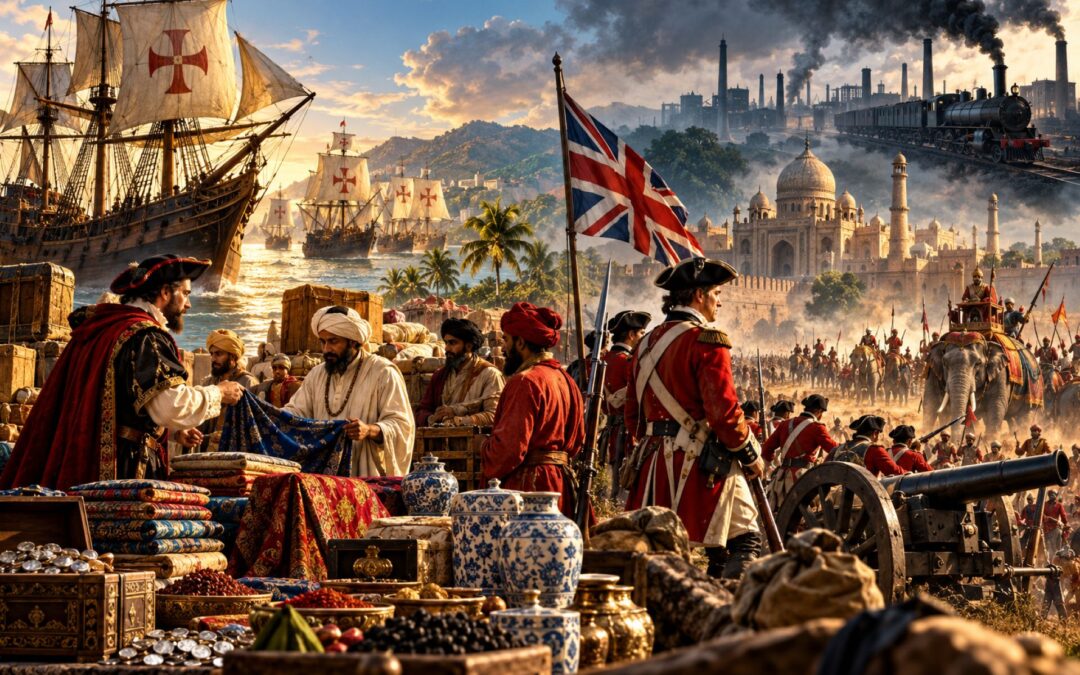
In 1757, the British East India Company defeated the Nawab of Bengal at the Battle of Plassey. The victory was remarkable because the Company was not a sovereign kingdom attempting to conquer a neighbour. It was a commercial corporation that had entered India to purchase textiles, spices, and other valuable goods. Within a few years, it would acquire the right to collect revenue from some of the wealthiest provinces of the Mughal Empire, transforming itself from a trading organization into a territorial power.
This was an extraordinary reversal. When European merchants first arrived in Asia, they encountered prosperous societies with sophisticated economies, powerful armies, extensive trading networks, and established political institutions. The Mughal Empire commanded enormous resources, Chinese manufacturers supplied goods coveted across the world, and Indian textiles dominated important international markets. European powers were initially outsiders seeking access to commercial systems that functioned perfectly well without them.
How, then, did European merchants become colonial rulers? The answer lies in a sequence of changes involving maritime technology, global trade, military organization, political competition, financial institutions, and eventually industrialization. European dominance did not emerge because Asia had always been weaker. It developed over centuries as particular European advantages became increasingly consequential and were combined with opportunities created within Asian societies themselves.
The Rich Asian Trading World Europe Entered
At the beginning of the sixteenth century, Asia contained some of the world’s most productive and commercially sophisticated societies. Indian merchants exported cotton textiles throughout the Indian Ocean, Chinese workshops manufactured silk and porcelain, and Southeast Asian islands supplied spices that could command high prices in distant markets. Persian, Arab, Indian, Malay, Chinese, and other merchants maintained commercial relationships extending across thousands of kilometres.
These networks were not dependent on direct European participation. Goods frequently passed through several intermediaries before reaching their final customers. Indian textiles might be exchanged for Southeast Asian spices, which could then travel through Indian Ocean ports toward the Red Sea or Persian Gulf. Merchants operating along different stretches of these routes supplied transportation, credit, information, and commercial relationships that allowed distant markets to remain connected.
Asian prosperity was also supported by formidable states. The Ming dynasty governed an extensive Chinese empire with substantial manufacturing capacity and a sophisticated bureaucracy. The Mughal Empire, established in northern India in 1526, eventually controlled enormous agricultural revenues and commanded powerful military forces. The Ottoman Empire dominated important territories connecting Europe, North Africa, and western Asia, while other kingdoms and sultanates exercised authority across the Deccan, Southeast Asia, and Japan.
Political fragmentation existed within Asia, but fragmentation did not necessarily mean weakness. Rival kingdoms could maintain substantial armies, invest in fortifications, support manufacturing, and compete for lucrative commercial routes. Indeed, rivalry sometimes encouraged military innovation and allowed merchants to negotiate favourable arrangements with competing rulers.
Europeans were particularly attracted to goods that were difficult or expensive to produce at home. Indian cotton fabrics were valued for their quality, variety, and affordability. Chinese porcelain possessed manufacturing characteristics that European producers struggled to replicate for centuries. Pepper, cloves, nutmeg, and other spices served culinary, medicinal, and commercial purposes, making access to their sources potentially profitable.
Europe’s initial position was therefore largely that of a customer seeking entry into existing markets. As historian J. C. Sharman argues in Empires of the Weak, early modern European expansion should not be mistaken for evidence that Europeans already possessed overwhelming military superiority over the major Asian land empires. Their capacity to project violence across oceans did not mean they could easily defeat powerful states on land.
The distinction matters because the wealth Europeans eventually controlled was not created simply by their arrival. They entered commercial systems that had developed over centuries and sought ways to redirect some of their profits toward themselves.
The Silver and Ships That Opened Asia to Europe
European interest in Asian commerce intensified during the fifteenth century. Merchants could obtain valuable eastern goods through established Mediterranean and overland networks, but these routes involved multiple intermediaries, political authorities, and commercial costs. Portuguese rulers and merchants hoped that reaching Asian markets directly by sea would allow them to participate more profitably in the trade.
The Ottoman conquest of Constantinople in 1453 strengthened Ottoman influence over important connections between Europe and Asia. The Mamluk Sultanate also controlled territories through which Red Sea commerce passed until the Ottoman conquest of Egypt in 1517. However, neither power simply closed all routes to Europeans. Commerce continued through established intermediaries, and the attraction of an alternative sea route lay partly in the possibility of reducing dependence on those networks.
Portugal pursued a route around Africa. During the fifteenth century, Portuguese navigators, merchants, and royal expeditions progressively explored the Atlantic coast of Africa, drawing on accumulated Mediterranean, Atlantic, African, and Islamic navigational knowledge. Improvements in ships, sails, charts, instruments, and maritime experience made longer voyages increasingly practical.
In 1488, Bartolomeu Dias rounded the southern tip of Africa. Ten years later, Vasco da Gama reached the Indian coast, arriving at Calicut in 1498. Portugal had established a direct maritime connection between western Europe and the Indian Ocean, although the ability to reach Asian ports was very different from the ability to dominate their markets.
As the Smithsonian’s account of Portugal’s sixteenth- and seventeenth-century global expansion demonstrates, Portuguese maritime activity connected previously distinct commercial spheres more directly. Ships, merchants, missionaries, soldiers, and commercial agents began moving regularly between Europe, Africa, Asia, and eventually the Americas.
Spain pursued a different route. Christopher Columbus’s Atlantic expedition of 1492 reached the Americas rather than Asia, while later Spanish expeditions crossed the Pacific. These voyages initiated an enormous expansion of European overseas possessions and helped create new connections between American resources and Asian markets.
One of the most consequential developments was the movement of silver.
Spanish colonial mining in the Americas, especially in territories such as Mexico and present-day Bolivia, produced large quantities of silver. American bullion entered European and international markets, while silver from Japanese mines also circulated through East Asian trade. These supplies became particularly significant because silver was highly valued in important Asian monetary systems.
China played a central role. During the Ming dynasty, silver became increasingly important for taxation and commercial transactions, and growing demand helped attract bullion from abroad. Chinese producers supplied silk, porcelain, and other valuable manufactures, while merchants brought silver to purchase them.
As Arturo Giráldez explains in his research on monetary flows in Ming-Qing China, Chinese monetary demand helped shape international bullion movements. The relationship was more complicated than a continent-wide Asian silver shortage: demand, availability, monetary policy, and relative prices varied across regions and periods.
The Spanish Manila galleons illustrate how these networks operated. Beginning in the late sixteenth century, ships regularly crossed the Pacific between the Philippines and Spanish America. American silver reached Manila, where merchants exchanged it for Asian goods, including Chinese silk and porcelain. Those commodities could then travel toward American and European markets.
European merchants consequently acquired something highly useful: access to a monetary commodity that Asian traders were willing to accept in exchange for goods Europeans wanted. They could participate in Asian commerce without first developing manufacturing industries capable of matching every valuable Asian export.
Silver did not make Europeans economically dominant over Asia. Much of the bullion they transported ultimately flowed toward Asian producers and merchants because Europeans continued buying valuable Asian manufactures. Nevertheless, access to American wealth, together with expanding maritime networks, gave European commercial enterprises new opportunities to establish themselves.
Armed ocean-going ships added another advantage. European vessels increasingly combined long-distance carrying capacity with artillery, enabling merchants and governments to protect cargoes, escort fleets, attack competing ships, and threaten ports. Maritime firepower could alter negotiations, particularly where European commanders faced coastal targets rather than the main armies of powerful inland states.
The combination of ships and silver helped Europeans enter Asian trade on a much larger scale. But the ability to purchase goods and threaten shipping still fell far short of the capacity to govern Asia.
Cannon Ships Could Take Ports, Not Empires
The first major European territorial advances in Asia concentrated on maritime locations. Ports, islands, coastal fortresses, and narrow passages offered advantages to powers possessing heavily armed ships. Controlling such positions could provide naval bases, warehouses, customs revenue, and opportunities to influence the movement of valuable goods.
Portugal developed this strategy during the early sixteenth century. Rather than attempting to conquer the Mughal heartland or the great agricultural regions of India, Portuguese commanders concentrated on coastal strongholds and commercial routes. Their expanding network included Goa on India’s western coast and Malacca near the maritime passage connecting the Indian Ocean with the South China Sea.
Goa was captured from the Bijapur Sultanate in 1510 under Afonso de Albuquerque. The port was commercially valuable and strategically connected to the movement of goods between the Arabian Sea and India’s interior. Among those goods were horses imported from western Asia, an important resource for Indian states whose rulers depended on effective cavalry forces.
The political setting made European participation more complicated than an encounter between two unified civilizations. Vijayanagara and the Deccan sultanates competed over territory, commerce, military resources, and access to important ports. Portuguese ambitions could sometimes coincide with the interests of regional Indian powers, even though such cooperation did not imply acceptance of permanent European political domination.
The rise and fall of the Vijayanagara Empire demonstrates how deeply South Indian politics depended on these commercial and military relationships. Rulers sought imported horses, hired foreign specialists, developed artillery, and maintained alliances that could change with circumstances. European merchants and soldiers entered this existing competitive environment rather than introducing military or commercial rivalry into an otherwise peaceful region.
The Portuguese achieved another major victory in 1511 when Albuquerque’s expedition captured Malacca. The city was a prosperous centre of international commerce with access to substantial military resources, but its political divisions and geographical vulnerabilities created opportunities for the attackers.
The Portuguese conquest of Malacca illustrates how naval pressure, intelligence, tactical concentration, and local political circumstances could help a relatively small expedition defeat the defenders of a major trading city. Yet the victory did not give Portugal control over the entire Southeast Asian commercial system. Merchants could alter routes, competing ports remained active, and regional states retained considerable power.
European aggression was therefore significant from the beginning, but its effectiveness depended heavily on geography and circumstances. Cannon-armed vessels were dangerous to ships and exposed coastal settlements. They were much less useful against vast inland territories where armies required cavalry, infantry, artillery, food, transport animals, and sustained logistical support.
Nor were early European activities generally peaceful commercial encounters. Portuguese commanders used blockades, attacks on shipping, forced commercial arrangements, and violence against opponents. Later European enterprises also employed extreme coercion in pursuit of monopolies.
In 1621, the Dutch East India Company carried out a particularly devastating campaign in the Banda Islands, where nutmeg production made the islands commercially valuable. Dutch forces killed, displaced, and enslaved substantial portions of the population while imposing a more tightly controlled production system. As historical research on the genocide in the Spice Islands demonstrates, European colonial violence had already reached extraordinary levels well before the eighteenth century.
The distinction is therefore not between an entirely cooperative early period and a suddenly aggressive later one. European companies and states practiced commerce, negotiation, coercion, and conquest from an early stage. What changed over time was their capacity to turn limited maritime positions into durable control over much larger territories.
Major Asian powers could often restrict European activity, negotiate the terms of trade, or resist unwanted demands. Japanese rulers eventually imposed strict limits on European commercial and religious involvement, while Chinese and Indian authorities generally retained the ability to shape relations with foreign merchants. The presence of European ships did not automatically overturn established Asian political systems.
To dominate large territories, Europeans needed advantages that extended beyond naval artillery. They required armies, money, administrative institutions, and access to political relationships within the societies they hoped to control.
The Military and Financial Systems Behind European Expansion
European warfare underwent important changes between the fifteenth and eighteenth centuries. Artillery became increasingly capable of damaging older fortifications, encouraging rulers to invest in new defensive designs. Fortresses with angled bastions, low walls, and overlapping fields of fire were developed to withstand bombardment and make assaults more difficult.
These fortifications were expensive to construct, maintain, defend, and capture. They could require substantial garrisons and prolonged sieges, while the armies confronting them needed artillery, engineers, ammunition, supplies, and reliable transportation. Military competition increasingly demanded the ability to mobilize resources across extensive territories.
Historians have debated whether these developments constituted a European Military Revolution. One influential interpretation links improvements in artillery and fortifications to larger armies, more systematic drill, centralized administration, and expanding fiscal institutions. Research on military finance and state development between 1450 and 1650 helps explain why the financial and administrative demands of warfare became central to European political development.
The relationship was neither simple nor uniform. Warfare could encourage rulers to expand taxation, strengthen administrative offices, establish public credit mechanisms, and negotiate access to resources controlled by merchants and political elites. At the same time, those institutions could make prolonged warfare possible. The exact chronology and causal direction remain subjects of historical disagreement.
European states did not all become centralized nation-states through the same process. Some relied heavily on representative institutions, commercial creditors, regional authorities, and private contractors. Nevertheless, governments increasingly developed mechanisms that allowed them to support expensive military establishments over long periods.
Naval warfare created similar pressures. Large armed vessels required trained crews, skilled shipbuilders, timber, artillery, ammunition, maintenance facilities, and reliable sources of finance. Establishing a fleet was difficult; maintaining one across distant oceans was a much greater challenge.
European governments and chartered companies could combine commercial profits, taxation, borrowing, shipbuilding infrastructure, and overseas bases to support these operations. Ports and forts provided places to replenish supplies, repair vessels, and concentrate forces. Over time, the resulting networks reduced some of the risks and costs associated with conducting military campaigns far from Europe.
This did not mean Asian societies lacked the technological knowledge to build warships or use artillery. Indian rulers had access to skilled metalworkers, gunfounders, navigators, naval forces, and military specialists. The gunpowder revolution in India had already transformed important aspects of warfare before European companies established territorial empires.
The Mughals employed artillery and firearms, while the Deccan sultanates and Vijayanagara developed their own military establishments. Indian rulers recruited specialists from different regions and adapted foreign techniques to local conditions. Other Asian societies likewise possessed traditions of naval construction, military engineering, and weapons manufacture.
The strategic allocation of resources nevertheless differed. A ruler facing repeated struggles over agricultural provinces, inland fortresses, and frontier territories often had immediate reasons to spend heavily on land armies. Constructing an expensive ocean-going battle fleet capable of confronting European naval squadrons might provide less immediate benefit, especially where maritime commerce continued through private merchants and regional ports.
Such decisions could be rational in their immediate political setting while creating vulnerabilities over the longer term. European naval strength mattered most when it was concentrated at strategically valuable locations and supported by persistent commercial and military infrastructure. It should not be interpreted as proof that Asian rulers were incapable of understanding maritime technology.
Military organization was equally important. European armies increasingly employed coordinated infantry formations, disciplined drilling, artillery support, and systems of command that could make firearms more effective. Regular training helped soldiers reload, move, and maintain formation under battlefield pressure, while centralized supply arrangements improved their ability to conduct sustained campaigns.
But Asian armies were not universally undisciplined collections of feudal retainers. Mughal, Maratha, Mysorean, and other forces possessed diverse organizational arrangements, including professional soldiers, cavalry establishments, artillery units, and troops trained in European methods. Military effectiveness depended on leadership, finance, logistics, tactical choices, and the particular opponents involved.
The East India Company’s armies eventually demonstrated how these systems could be combined. Kaushik Roy’s research on the Company’s hybrid military establishment in South Asia emphasizes the interaction between European organizational practices and Indian soldiers, resources, and military traditions. Colonial success did not result simply from Europeans importing a complete military system into a passive society.
European enterprises also possessed some strategic advantages arising from their overseas position. Defeats in Asia did not necessarily destroy the political institutions or resources supporting them in Europe. Surviving companies could sometimes obtain additional money, ships, officers, and soldiers, allowing them to recover from setbacks.
These advantages had limits. Overseas expeditions were expensive, communication was slow, European companies depended heavily on local cooperation, and military defeats could be disastrous. What ultimately mattered was their capacity to combine outside support with resources obtained inside Asia.
That combination became especially powerful in eighteenth-century India, where commercial corporations discovered that territorial revenue could finance military expansion on an entirely different scale.
How the East India Company Turned Trade Into Conquest
The British East India Company was established in 1600 through a royal charter granting privileges for English trade in specified eastern markets. Its early activities were commercial, and its agents initially depended on Asian rulers for permission to establish trading settlements. They competed with Portuguese, Dutch, French, Indian, and other merchants for access to valuable commodities.
The Mughal Empire was far too powerful for the English Company to confront as an equal during the seventeenth century. Company officials sought commercial privileges, negotiated with local authorities, and established settlements at places including Madras, Bombay, and Calcutta. Their position depended on diplomatic relationships as well as armed ships and fortifications.
Some Asian rulers welcomed foreign merchants because overseas commerce could increase customs revenue, create employment, and expand access to valuable goods. European companies offered connections to distant markets and additional opportunities for commercial competition. Such relationships were never necessarily permanent, however, and disputes over taxation, jurisdiction, fortifications, and political authority could quickly become confrontational.
The political environment changed considerably during the eighteenth century. After the death of Aurangzeb in 1707, Mughal central authority weakened as regional rulers exercised greater independence. Bengal, Awadh, and Hyderabad became increasingly autonomous centres of power, while Maratha expansion transformed the political balance across much of India. Sikh powers, Rajput states, and other political formations also pursued their own interests.
This fragmentation did not mean India lacked powerful states. Several regional rulers commanded substantial revenues and military establishments, and the Marathas became formidable competitors for influence over large parts of the subcontinent. Nevertheless, the weakening of a single imperial centre created opportunities for competing powers, including European companies, to form alliances and intervene in political conflicts.
European rivalry was especially important. Britain and France fought repeated wars in Europe and overseas, while their trading companies competed for commercial and political influence in India. During the Carnatic Wars, European forces became increasingly involved in struggles among Indian rulers and claimants.
Company officials discovered that supporting a claimant to political authority could produce commercial privileges, revenue, territory, and strategic influence. Indian rulers, meanwhile, sometimes sought European military assistance against their regional rivals. These arrangements were neither simple acts of betrayal nor straightforward expressions of colonial loyalty; they reflected efforts by different participants to improve their positions within unstable political circumstances.
Bengal became the decisive turning point because of its enormous productive wealth. Its fertile agricultural lands supported a large population, while merchants and artisans participated in extensive textile manufacturing and commerce. Control over Bengal meant access not only to valuable goods but also to substantial revenues that could finance an army.
The conflict culminating at Plassey in 1757 developed from disputes between the Company and Bengal’s nawab, Siraj ud-Daulah. Company fortifications, commercial privileges, political interference, and the struggle for authority all contributed to the confrontation. British officials under Robert Clive also worked with influential opponents of the nawab, including Mir Jafar, who expected to benefit from a change in government.
The battle itself was relatively brief. Mir Jafar and forces associated with the conspiracy did not provide the support Siraj ud-Daulah needed, contributing significantly to his defeat. The result cannot be explained simply by the superiority of British firearms or the courage of a small European army.
Plassey demonstrated how commercial wealth, military organization, and alliances with Indian political elites could produce a dramatic change in power. The Company gained substantial influence over Bengal’s government, but it did not immediately acquire undisputed authority over all the region’s resources or institutions.
That transformation continued through further conflict. In 1764, Company forces won the Battle of Buxar against a coalition involving Mir Qasim, the displaced nawab of Bengal, Shuja ud-Daulah of Awadh, and the Mughal emperor Shah Alam II. The victory demonstrated that the Company’s military position could survive a confrontation involving several substantial Indian powers.
The settlement that followed was even more consequential. In 1765, Shah Alam II granted the Company the Diwani rights to collect revenue in Bengal, Bihar, and Orissa. The Company now possessed a fiscal foundation that was fundamentally different from the profits of ordinary overseas commerce.
Revenue from conquered territories could help pay soldiers, purchase supplies, support fortifications, and finance additional operations. Military victories produced access to taxable resources, which could strengthen the army and make further victories possible. This created a reinforcing relationship between territorial conquest and military-financial capacity.
Tirthankar Roy’s study of state formation and military-fiscal undertakings in eighteenth-century British India places this transformation within the competitive political economy of the region. The Company’s advantage increasingly depended on its ability to mobilize Indian resources as well as its connections to Britain.
Indian soldiers were essential to this system. Although British officers occupied important positions of command, the Company’s armies included large numbers of Indian sepoys recruited from different regions and communities. These troops supplied the manpower necessary to operate across territories that could never have been subdued using European soldiers alone.
As the National Army Museum explains in its account of the armies of the East India Company, Company military establishments expanded substantially as territorial control increased. Indian soldiers served in infantry, cavalry, and artillery formations, while recruitment, training, pay, and military administration became central concerns.
Regular military employment could appeal to soldiers seeking dependable income and professional opportunities. Company service offered salaries, and in some establishments pensions or other benefits, although conditions and compensation varied considerably. Indian military labour markets were competitive, and soldiers could evaluate service under different rulers according to pay, status, security, and personal obligations.
The Company’s recruitment success did not establish that Indian armies lacked professional soldiers. Many Indian rulers maintained experienced military establishments and employed skilled personnel under different arrangements. The significance of the Company’s system lay in how recruitment, discipline, financial resources, and military administration were combined to support an expanding territorial organization.
Local alliances remained just as important as battlefield tactics. Indian financiers, merchants, landholders, administrators, and political elites could provide credit, intelligence, supplies, or cooperation. Others resisted Company interference or attempted to negotiate terms that protected their own interests.
These relationships made colonial expansion possible, but they also constrained it. Company officials had to understand local institutions, maintain support from important intermediaries, and confront the possibility that alliances would change. The idea that European officials were inherently incorruptible or that Indian nobles were uniquely disloyal offers a misleading explanation of a much more complicated political process.
The Company itself was deeply affected by private enrichment, patronage, corruption, and conflicts between commercial interests and territorial government. Its growing power raised concerns in Britain about accountability and control, eventually prompting greater parliamentary intervention in Indian administration.
Nor was conquest uninterrupted. Mysore under Haidar Ali and Tipu Sultan posed serious military challenges, while Maratha powers continued resisting British expansion into the nineteenth century. The Sikh kingdom of Punjab remained an important independent power until the Anglo-Sikh Wars of the 1840s.
These conflicts reveal that British victory was neither automatic nor guaranteed by a permanent technological gap. Indian states could employ sophisticated armies, develop artillery, recruit foreign specialists, and exploit British vulnerabilities. Outcomes depended on changing coalitions, resources, command decisions, and prolonged struggles for territory.
Over time, however, the Company secured enough military, political, and fiscal advantages to defeat or subordinate its major opponents. Its rise became a defining part of the wider history of the British Empire, demonstrating how a corporation originally established to purchase Asian goods could become the governing authority over millions of people.
The Indian case exposes the central mechanism of eighteenth-century European territorial expansion. The Company did not conquer India using British resources alone. It used Indian money, Indian soldiers, Indian political relationships, and increasingly effective military institutions to extend its control over Indian territory.
Coal, Cotton, and the Industrial Turning Point
The East India Company’s conquests began before industrialization had transformed Britain’s productive capacity. During much of the eighteenth century, Asian states remained commercially and militarily formidable, and European advantages were highly dependent on circumstances. The Industrial Revolution would eventually alter this balance far more dramatically.
Britain’s industrial transformation involved changes in energy production, manufacturing, machinery, transportation, and the organization of labour. Coal became an increasingly important source of energy, while new machinery allowed manufacturers to produce textiles and other goods at volumes that had previously been difficult to achieve.
Coal was particularly significant because it offered an alternative to the energy available from wood, charcoal, animals, wind, and water. Its importance depended not simply on the existence of deposits but also on extraction costs, transportation, markets, and the development of technologies capable of using it efficiently.
The contrast with Japan is revealing, although it should not be oversimplified. Tokugawa Japan developed systems of forest management partly in response to pressures on timber resources. Britain, by comparison, increasingly relied on coal for heating and industrial purposes. These different responses reflected political, geographical, and economic circumstances rather than a simple choice between conservation and technological progress.
The presence of coal alone cannot explain why industrialization began in Britain. Several societies possessed coal reserves, and access to fuel did not automatically produce mechanized factories. Economic incentives, technical experimentation, commercial networks, and institutions capable of supporting investment were also important.
Economic historian Robert Allen argues in Why the Industrial Revolution Was British that Britain’s relatively high wages and inexpensive energy helped make labour-saving technologies economically attractive. Machines that might have offered little advantage in lower-wage economies could generate substantial savings for British producers.
This interpretation directs attention to the relationship between prices and innovation. Inventors and manufacturers did not need to foresee an industrial civilization. They needed practical reasons to improve particular processes, reduce costs, increase output, or solve problems faced by businesses.
British commercial institutions and state policies also shaped these incentives. Overseas trade expanded markets, commercial finance supported investment, and protectionist measures affected competition between British and foreign producers. The Atlantic economy supplied markets and resources, while colonial relationships increasingly influenced the movement of raw materials and manufactured goods.
Textiles became one of the clearest examples of the transformation. Before British mechanization, Indian cotton fabrics occupied an exceptionally strong position in international commerce. Indian manufacturers produced an enormous variety of cloth, ranging from inexpensive fabrics to finely woven luxury textiles, supported by specialized skills and established trading networks.
British consumers had long purchased Indian cotton goods because they were attractive, durable, and often competitive in price. Early British industrialists therefore faced established producers whose expertise and commercial reach had developed over generations.
Mechanization gradually altered the relationship. Innovations in spinning, weaving, and power generation increased British manufacturing capacity, while factories concentrated machinery, workers, and production processes. Improvements in productivity eventually made it possible to manufacture certain cotton textiles at costs that substantially changed international competition.
The consequences for India were profound. British manufactured cotton cloth increasingly entered Indian markets during the nineteenth century, undermining important branches of traditional textile production. At the same time, colonial trade arrangements and the growth of raw cotton exports reshaped India’s place in international commerce.
Prasannan Parthasarathi’s analysis of the transition from cotton to coal places British industrialization within a longer history of competition between European and Asian manufacturing systems. Britain’s eventual industrial advantage emerged from changing economic conditions rather than an enduring European technological superiority.
The term deindustrialization is often used to describe the decline of important Indian manufacturing activities under colonial rule. It captures real changes in textile production, employment, and trade, but requires qualification. The extent and timing of decline varied by region and industry, and some forms of Indian production survived or adapted.
Indian entrepreneurs also developed modern industries during the colonial period, including cotton mills and other manufacturing enterprises. India did not cease to produce goods, nor did every economic transformation result exclusively from British imports. The larger historical reversal was that a society previously central to the export of finished cotton textiles increasingly faced competition from industrial goods produced in Britain.
Industrialization transformed military power as well as commerce. Mechanized manufacturing improved the capacity to produce weapons, ammunition, equipment, and transportation systems. Steamships reduced some of the constraints imposed by winds and seasonal sailing conditions, while railways and telegraphs later strengthened the logistical and administrative reach of colonial states.
The gap between industrializing and non-industrializing economies consequently became increasingly significant during the nineteenth century. States possessing greater manufacturing capacity, commercial finance, and transportation infrastructure could support forms of warfare and economic competition that became progressively harder for their opponents to match.
Historians nevertheless disagree about why Britain industrialized before the leading Asian economies. Kenneth Pomeranz’s The Great Divergence emphasizes the significance of coal and resources derived from the Americas, suggesting that ecological constraints and access to external resources helped distinguish parts of Europe from prosperous Asian regions.
Academic discussion of Pomeranz’s Great Divergence thesis illustrates how contested the comparison remains. Some explanations emphasize energy and geography; others place greater weight on labour costs, institutions, commercial policies, technological incentives, or colonial relationships.
These interpretations need not be mutually exclusive. Britain’s industrialization developed through the interaction of resources, economic incentives, technological knowledge, markets, and political decisions. Colonial expansion could both benefit from industrialization and contribute resources and opportunities that supported further expansion.
By the nineteenth century, European colonial dominance had acquired a foundation much broader than the armed trading ships that first reached Asian ports. Industrial economies could manufacture increasingly large quantities of goods and military equipment, helping sustain overseas power on an unprecedented scale.
Why No Single Explanation Settles the Great Divergence
The history of European expansion becomes misleading when different centuries are treated as though they shared one explanation. The Portuguese arrival in India in 1498, the East India Company’s victory at Plassey in 1757, and Britain’s industrial dominance in the nineteenth century resulted from different combinations of advantages.
The first transformation concerned access. European navigators established direct oceanic connections with Asian markets, while silver from the Americas and Japan helped finance trade. Asian merchants and producers remained central to these exchanges, and European commercial activity depended heavily on existing political and economic systems.
The second transformation concerned coercion and territorial power. Armed vessels allowed European enterprises to establish fortified coastal positions and interfere with maritime commerce. Later, European companies exploited political rivalries, local alliances, financial resources, and military organization to expand inland. Their success was particularly striking when territorial revenues could be used to sustain further conquest.
The third transformation involved production. Industrialization altered the relationship between labour, energy, machinery, transportation, and economic output. European states increasingly possessed industrial and military resources that earlier generations could not have mobilized.
Each transformation depended on circumstances that varied across Asia. The political situation facing the British in eighteenth-century India was different from the one European merchants encountered in China or Japan. Southeast Asian maritime states faced particular vulnerabilities at ports and islands, while powerful inland empires could resist forms of coercion that worked against coastal settlements.
Asian rulers were also active participants in these developments. They negotiated, traded, modernized, recruited specialists, fought wars, formed alliances, and attempted to protect their political interests. Some strategies proved effective for long periods, while others failed under changing conditions.
It is therefore inaccurate to explain European expansion through a timeless contrast between disciplined Europeans and disorganized Asians. European states experienced political fragmentation, fiscal crises, military defeats, and intense commercial rivalry. Asian societies possessed advanced technologies, sophisticated institutions, and substantial resources, but their relative strengths differed according to geography, politics, and historical timing.
Nor can imperial domination be separated from the resources it extracted. Once a European company or state acquired territory, it could use local revenue, labour, commercial networks, and military manpower to reinforce its position. Colonial success could therefore become cumulative, allowing initial advantages to produce much greater power over time.
The Great Divergence was not one event with one cause. It was a prolonged and uneven transformation in economic and political power, during which advantages emerged, reinforced one another, and sometimes disappeared. Understanding that process requires explaining not simply why Europeans succeeded, but why their success became possible in particular places and periods.
The rise of European colonial power was remarkable precisely because it was not inevitable. At the beginning of the sixteenth century, European merchants entered Asian commercial systems whose leading participants often possessed greater wealth, manufacturing capacity, and political authority. Their first advantages were limited, concentrated especially in navigation, maritime warfare, and access to distant trading networks.
Over the following centuries, those advantages interacted with Asian political rivalries, commercial opportunities, military and financial institutions, and eventually industrialization. The East India Company’s transformation in Bengal demonstrates how commercial participation could become territorial domination, while Britain’s industrial growth explains why the balance of economic and military power shifted even further.
Europe did not conquer Asia simply because it was always stronger. Its colonial dominance emerged from historical conditions that developed gradually and unevenly. The deeper lesson is that global power depends not on the permanent superiority of particular civilizations, but on changing relationships between resources, institutions, technology, economic production, and political circumstances.
Last Updated on October 25, 2026 by Aseem Gupta