
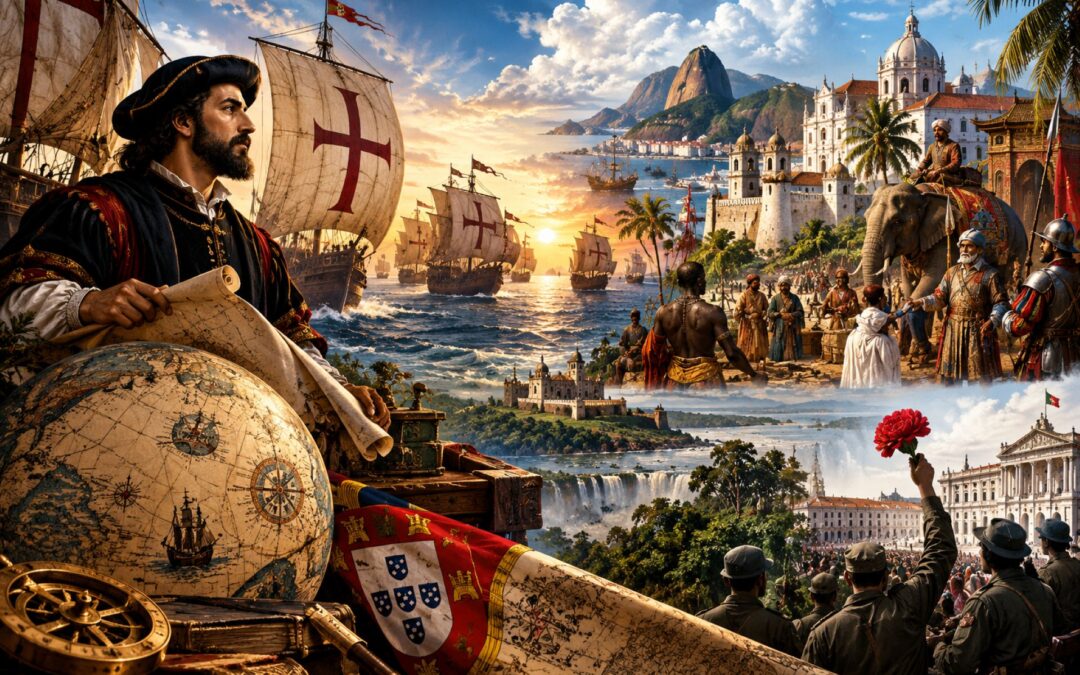
Portugal occupies a narrow strip of land along the western edge of the Iberian Peninsula. Its European territory is small enough to cross by car in a day, and its population has historically been modest compared with those of its larger neighbours. Yet this country once established political, commercial, and colonial connections extending from Brazil across Africa and the Indian Ocean to India, Southeast Asia, China, and Japan. Portuguese became a language spoken on several continents, while Portuguese merchants, missionaries, soldiers, and administrators helped reshape relationships between societies thousands of kilometres apart.
How did a relatively small European kingdom acquire such extraordinary global influence? The usual explanation emphasizes pioneering navigators, powerful ships, and the determination to discover new trade routes. Those factors mattered, but they do not fully explain how Portuguese power operated or why it endured in some places longer than others. Portugal never possessed the military resources to conquer and administer every territory connected to its overseas ambitions.
The Portuguese Empire was better understood as a changing network of fortified ports, settlements, commercial agreements, dynastic relationships, maritime routes, military occupations, and alliances with local rulers. Some territories came under direct colonial government, while others remained independent partners or resisted Portuguese demands. This network relied on Indigenous knowledge, African diplomacy, Asian commerce, enslaved labour, and repeated coercion, often combining cooperation and violence within the same relationship.
The arrangements that allowed Portugal to project power far beyond its European borders also created serious vulnerabilities. Profitable trade routes attracted competitors, distant colonies required military protection, and political upheavals could disrupt connections across oceans. Over time, Portugal became increasingly dependent on overseas territories that were themselves changing politically and economically.
Understanding the rise and fall of the Portuguese Empire therefore requires following a transformation that lasted more than eight centuries. Portugal first had to establish itself as an independent kingdom, then build a maritime empire, survive the loss of its most important possessions, confront resistance to colonial rule, and eventually find a different place in the world.
How Portugal Became a Kingdom, 1128–1297
The history of Portugal begins within the fragmented political world of medieval Iberia. During the early twelfth century, the territory that would become Portugal was not yet an independent kingdom. Much of it belonged to the County of Portugal, a political territory associated with the Kingdom of León, while substantial areas farther south remained under Muslim rule.
Afonso Henriques, the son of Count Henry of Burgundy and Teresa of León, emerged as the central figure in Portugal’s struggle for political independence. His early career was shaped by conflicts within the county’s ruling family, regional aristocratic rivalries, and disagreements over its relationship with León. These disputes were not originally a straightforward contest between two fully formed national identities, because the medieval nobility operated through overlapping family loyalties, territorial interests, and political allegiances.
In 1128, Afonso defeated forces supporting his mother at the Battle of São Mamede, near Guimarães. The victory established his effective control over the county and allowed him to pursue a more independent political position. However, defeating a domestic rival did not automatically make him a universally recognized king.
Afonso subsequently challenged neighbouring rulers and expanded his authority into territories controlled by Muslim powers. He began using the title of king, but his position required recognition from other rulers and the Church. The settlement reached at Zamora in 1143 strengthened his standing, although historians differ over precisely how far it constituted formal recognition of an independent kingdom.
Portugal’s political consolidation was closely connected to its expansion southward. The Christian campaigns in Iberia formed part of a much longer process of warfare, settlement, negotiation, and shifting political boundaries conventionally described as the Reconquista. These campaigns were not simply the recovery of empty territory. The lands being conquered contained established Muslim communities, political institutions, agricultural settlements, and commercial networks.
The capture of Lisbon in 1147 was particularly important. Afonso’s forces, assisted by crusaders travelling from northern Europe, besieged and captured the Muslim-ruled city. The conquest involved violence and displacement, but it also transferred control of one of the peninsula’s most valuable harbours to the emerging Portuguese monarchy.
Lisbon offered advantages that extended far beyond military prestige. Its position near the mouth of the Tagus River connected inland agricultural production and commerce with the Atlantic Ocean. The harbour could support merchant shipping, military expeditions, and the collection of revenues, while the surrounding region provided resources and access to wider trading networks.
The crown’s growing control over such ports helped establish the economic foundations of Portuguese independence. A kingdom with reliable access to maritime commerce possessed opportunities that an isolated inland territory would have struggled to develop. Lisbon eventually became Portugal’s principal political and commercial centre, although the full significance of its Atlantic position would emerge much later.
Afonso’s kingship received explicit papal recognition in 1179 through the bull Manifestis Probatum, issued by Pope Alexander III. This recognition mattered because political legitimacy in medieval Christian Europe depended partly on relationships with the papacy. It strengthened Portugal’s claim to exist as a kingdom separate from neighbouring Christian monarchies.
Territorial expansion continued after Afonso’s death. In 1249, the conquest of the Algarve brought the southernmost part of mainland Portugal under Christian royal control. The resulting kingdom possessed a long Atlantic coastline, important river systems, agricultural regions, and access to maritime routes linking Iberia with northern Europe and the Mediterranean.
The Treaty of Alcañices, signed with Castile in 1297, established most of the frontier that still separates Portugal from Spain. Some territorial disputes and subsequent changes remained, including the later controversy surrounding Olivença, but the agreement helped create an unusually durable European boundary.
This stability did not mean that Portugal was free from dynastic conflict, external threats, or internal political struggles. It did, however, give the monarchy a relatively defined territorial base from which to raise revenue, organize military forces, and pursue commercial ambitions.
Portugal had become an independent kingdom with a defensible frontier and access to the Atlantic. The next question was whether its rulers could preserve that independence while finding new opportunities beyond the peninsula.
The Avis Crisis and the First Atlantic Expansion, 1383–1488
In 1383, King Fernando I died without a surviving male heir, producing a succession crisis that threatened Portugal’s political independence. His daughter Beatrice was married to Juan I of Castile, raising the possibility that both crowns could come under the same dynasty. Different factions within Portugal supported competing solutions, reflecting conflicting interests among nobles, merchants, urban communities, and political institutions.
João, the Master of the Order of Avis and an illegitimate son of King Pedro I, became the leading figure in the resistance to Castilian domination. He attracted support from sections of the urban population, parts of the nobility, and military leaders concerned about Castilian influence. Their coalition was not entirely united by modern patriotic sentiment; its members also sought political security, commercial advantage, and favourable relationships with the future monarchy.
In 1385, the Portuguese Cortes recognized João as king. Later that year, Portuguese forces under João I and the military commander Nuno Álvares Pereira defeated a Castilian invasion at the Battle of Aljubarrota. The victory secured the new Avis dynasty’s position and greatly reduced the immediate threat of incorporation into the Castilian political system.
The dynasty’s survival created new ambitions. Portuguese rulers wanted opportunities to demonstrate military legitimacy, acquire wealth, strengthen their international standing, and reward the powerful groups that had supported them. At the same time, merchants and maritime communities had reasons to seek additional markets and secure profitable routes.
These interests converged in the Portuguese attack on Ceuta in 1415. Located on the North African coast near the entrance to the Mediterranean, Ceuta occupied an important position within regional commercial and political networks. Its capture offered the Portuguese crown a symbolically valuable victory over a Muslim-ruled city and the possibility of influencing trade between North Africa and the Mediterranean.
The reality was less rewarding than the initial conquest suggested. Ceuta proved difficult and expensive to defend, and the occupation did not automatically give Portugal control over the commercial networks that had made the city attractive. Merchants could redirect trade, neighbouring rulers could resist, and maintaining a distant military position consumed resources.
The experience illustrated a problem that would recur throughout Portuguese imperial history. Capturing a strategic location might be possible with a concentrated military expedition, but making that conquest economically useful required dependable supplies, political cooperation, and continuing military expenditure.
Meanwhile, Portuguese activity extended into the Atlantic. During the fifteenth century, Portuguese expeditions established settlements on Madeira and the Azores, islands that offered opportunities for agriculture, colonization, and maritime navigation. These projects brought land into cultivation, encouraged migration, and provided practical experience in organizing settlements at a distance from the mainland.
Madeira became particularly important for sugar production. Sugar required capital, cultivated land, processing equipment, transport, and substantial labour. Enslaved workers were incorporated into the island’s economy, helping develop practices that would later become more extensive and destructive within Atlantic plantation societies.
These Atlantic experiments connected commerce with territorial occupation and coercive labour. They demonstrated that overseas expansion could involve more than exchanging goods at coastal markets. Settlers could establish agricultural estates, transform environments, and create systems designed to extract wealth through control over land and workers.
Portuguese expeditions also travelled progressively farther along the western coast of Africa. Prince Henry, often called Henry the Navigator, encouraged and sponsored maritime activities, but it would be misleading to attribute the entire expansion to one visionary individual. Navigational progress resulted from decades of work by sailors, pilots, shipbuilders, merchants, financiers, and navigators drawing on knowledge developed across different maritime cultures.
One important breakthrough came in 1434, when Gil Eanes successfully sailed beyond Cape Bojador on the Atlantic coast of what is now Western Sahara. The cape had acquired a formidable reputation among Portuguese mariners because of its dangerous coastal waters, shallow areas, strong winds, and difficulties in navigating unfamiliar conditions. Earlier attempts to pass it had failed, encouraging the belief that sailing farther south was extraordinarily hazardous.
Eanes’s voyage did not prove that no one had ever navigated those waters before. Its importance was that it demonstrated to Portuguese expedition planners that the perceived barrier could be overcome. As the Portuguese Navy’s account of the country’s maritime history places the voyage within Portugal’s continuing Atlantic expansion, the achievement helped open the way for increasingly ambitious expeditions farther along the African coast.
The voyages brought Portuguese traders and envoys into contact with African societies that already possessed their own commercial systems and diplomatic relationships. These encounters included negotiated exchanges and political cooperation, but also raiding, violent conflict, and the capture and purchase of enslaved people. The growth of Portuguese participation in African slave trading was therefore part of maritime expansion from an early stage, not simply a later consequence of Brazilian colonization.
Successful navigation required increasingly sophisticated knowledge of Atlantic conditions. Sailors learned how prevailing winds, currents, and seasonal patterns affected voyages, while shipbuilders improved vessels capable of operating over long distances. Routes that initially required experimentation gradually became better understood through repeated journeys and accumulated practical experience.
By the 1480s, Portuguese expeditions had reached the waters of southern Africa. In 1488, Bartolomeu Dias rounded the southern tip of the continent, demonstrating that the Atlantic and Indian Oceans could be connected by sea. His voyage did not establish Portuguese control over either ocean, but it revealed the navigational possibility of reaching Asian markets without travelling through the established overland and eastern Mediterranean commercial routes.
Portugal’s expansion had now moved beyond the immediate defence of its European kingdom. Its rulers possessed experience in Atlantic navigation, overseas settlement, coastal warfare, African diplomacy, and long-distance commerce. These achievements gave the monarchy new possibilities, but its ambitions were about to encounter trading worlds much larger and more sophisticated than anything Portugal could govern directly.
From Ocean Voyages to Strategic Ports, 1494–1511
Portuguese expansion took place alongside growing Castilian ambitions across the Atlantic. Christopher Columbus’s 1492 voyage, sponsored by the Castilian monarchy, intensified disputes over which European rulers could claim authority over overseas territories. Portugal and Castile responded through diplomacy, attempting to establish spheres of expansion before either possessed practical control over most of the lands involved.
The Treaty of Tordesillas, signed in 1494, established a dividing line approximately 370 leagues west of the Cape Verde Islands. The agreement assigned competing spheres of expansion to the two crowns and later became important in explaining Portugal’s claim to Brazil. It was a diplomatic arrangement between European rulers, however, not a settlement accepted by Indigenous peoples or by the other states and societies living within the territories being claimed.
The treaty also reflected the developing competition between two Iberian imperial projects. Portugal increasingly concentrated on Atlantic Africa and the route around the Cape of Good Hope, while Castile pursued transatlantic expansion. These different strategies contributed to the distinct geographical patterns later associated with Spain’s overseas empire, although the two monarchies would continue competing and negotiating over territories and maritime access.
In 1497, Vasco da Gama departed Portugal with a fleet attempting to reach India by sailing around Africa. After crossing the Atlantic and rounding the Cape, his expedition travelled along the eastern African coast, entering an Indian Ocean commercial system that had connected distant societies for centuries.
East African ports were not isolated settlements waiting for Europeans to introduce international trade. Merchants from Africa, Arabia, Persia, India, and elsewhere had established relationships supported by navigation, credit, regional political institutions, and religious and cultural connections. Seasonal monsoon winds shaped shipping schedules, while experienced pilots understood routes that Portuguese sailors were only beginning to explore.
At Malindi, da Gama obtained navigational assistance from a pilot identified in historical research as Gujarati. The expedition reached Calicut, on India’s Malabar Coast, in 1498. The voyage demonstrated the feasibility of direct Portuguese maritime access to Indian markets, but it also exposed the difference between reaching a commercial centre and establishing influence within it.
Calicut was an established trading city ruled by the Zamorin, whose position depended partly on relationships with merchants from numerous regions. Portuguese expectations of favourable commercial treatment did not automatically match local priorities. Their diplomatic gifts made little impression, and established merchant groups had no reason to surrender profitable relationships simply because unfamiliar ships had arrived from Europe.
The Portuguese therefore entered an existing commercial world as ambitious newcomers rather than as rulers of an empty maritime frontier. They possessed armed vessels and an increasingly important connection to European markets, but they lacked comprehensive knowledge of regional politics and could not replace established trading institutions overnight.
In 1500, an expedition commanded by Pedro Álvares Cabral reached the coast of what became Brazil. The territory was already inhabited by numerous Indigenous societies with different languages, political relationships, and ways of life. Portuguese claims to the land did not amount to immediate occupation, and the development of permanent colonial settlement proceeded unevenly over subsequent decades.
The crown now faced two very different challenges. In the Atlantic, it had opportunities to establish settlements and gradually claim large territories, although Indigenous societies would contest colonial expansion. In the Indian Ocean, it encountered powerful states, wealthy ports, and deeply established commercial networks that could not realistically be conquered in their entirety.
The Portuguese response in Asia increasingly emphasized strategic control. Instead of trying to occupy entire inland kingdoms, commanders sought fortified ports, naval bases, commercial privileges, and the ability to influence shipping routes. Armed vessels could protect Portuguese merchants, attack rivals, blockade harbours, and compel some traders to accept Portuguese demands.
This strategy combined military pressure with diplomacy. Alliances with local rulers could provide supplies, intelligence, troops, and commercial opportunities, while conflicts between regional powers sometimes allowed Portuguese forces to secure positions that would otherwise have been difficult to capture. Such cooperation did not eliminate resistance, and agreements could change when the interests of either party shifted.
Afonso de Albuquerque became a central figure in developing this approach. In 1510, Portuguese forces captured Goa, creating a major base for administration and trade on India’s western coast. In 1511, Albuquerque captured Malacca, a commercially important city near the strait linking the Indian Ocean with the South China Sea.
Together, these conquests strengthened Portugal’s position within Asian maritime commerce. Goa provided an administrative and military centre, while Malacca offered access to important routes connecting South and Southeast Asia. Yet neither conquest meant that Portugal controlled every surrounding state, merchant community, or passing ship.
The Portuguese had discovered a way to project influence through carefully selected positions rather than unlimited territorial expansion. Its effectiveness depended on how those positions interacted with the societies around them, and those relationships differed enormously from one region to another.
Why the Empire Worked Differently in Kongo, India, and Brazil
The Portuguese Empire is often represented as a single political entity stretching across continents. Such maps conceal important differences between the relationships that sustained Portuguese influence. An independent African kingdom maintaining diplomatic relations with Portugal was not equivalent to a fortified Asian trading settlement, and neither operated like a plantation colony developing across Indigenous American territory.
These differences mattered because each system offered particular advantages and produced different forms of resistance. Portugal could negotiate with African rulers, use naval power to influence Asian commerce, and establish settlements in Brazil, but it could not apply identical methods everywhere. Understanding the empire requires examining the local political worlds into which Portuguese activity entered.
Kongo: Diplomacy with an Independent Kingdom
When Portuguese expeditions reached the region near the mouth of the Congo River during the late fifteenth century, they encountered the Kingdom of Kongo. This was an established Central African polity with its own rulers, political institutions, commercial relationships, and social hierarchies. It was not a Portuguese colony, and diplomatic contact did not automatically place its people under European sovereignty.
The ruler Nzinga a Nkuwu developed relations with Portuguese representatives and accepted Christianity, being baptized in 1491 and taking the name João. His decision was shaped by political and religious considerations operating within Kongo’s own society. Christianity could provide new diplomatic relationships, access to foreign resources, and additional forms of legitimacy, but accepting it did not mean abandoning independent royal authority.
Portuguese visitors brought priests, goods, military knowledge, and opportunities for exchange. Kongolese rulers could use these connections to strengthen their political positions, particularly where internal rivalries or conflicts with neighbouring groups created demands for additional resources. The relationship was therefore shaped by decisions made on both sides, not simply by Portugal imposing a ready-made colonial system.
Christianity also developed a distinctive place in Kongolese society. The religion’s adoption was neither uniform nor a straightforward replacement of earlier beliefs. Its symbols and practices were interpreted through existing political institutions, cultural traditions, and understandings of spiritual authority.
The Metropolitan Museum’s account of Christianity and Kongo visual culture shows how Kongolese communities adapted Christian forms into locally meaningful artistic and religious traditions. Christian imagery could express ideas about spiritual power and political legitimacy that were intelligible within Kongo’s own cultural world. The resulting practices were neither wholly European nor disconnected from the African societies that developed them.
Nzinga a Nkuwu’s successors pursued different policies toward the new religion and relations with Portugal. His son Mvemba a Nzinga, who ruled as Afonso I, placed greater emphasis on Christian institutions and education, using religious and diplomatic connections to strengthen his authority. Written correspondence and the education of members of the Kongolese elite became significant features of these relationships.
These developments demonstrate that Kongo’s rulers were not passive recipients of Portuguese influence. They selected institutions, practices, and commercial opportunities according to their own priorities, even when the consequences proved difficult to control.
The expanding Atlantic slave trade became one of the most damaging aspects of the relationship. Portuguese merchants participated in networks through which enslaved Africans were transported across the Atlantic, and demand from overseas markets increased the incentives for warfare, raiding, and the sale of captives. African political actors also participated in these systems, but their involvement took place within relationships shaped by changing economic pressures and unequal opportunities for coercion.
Kongolese rulers sometimes attempted to regulate the trade and complained about abuses that threatened their authority. The growing movement of captives could undermine established political relationships, weaken communities, and create conflicts between rulers, merchants, and local elites. Diplomatic cooperation and destructive commercial pressures could therefore exist simultaneously.
Kongo illustrates an important limit of Portuguese imperial power. The crown could establish influential relationships with independent rulers and benefit from African commercial networks without possessing direct sovereignty over the societies involved. Such arrangements depended on continuing negotiation, local political conditions, and the willingness of African actors to cooperate or resist.
India: Force and Bargaining in an Existing Trading World
Portuguese influence in India operated through a different set of arrangements. The Indian Ocean was already a major centre of global commerce, connecting powerful states, specialized producers, merchant communities, and long-established trading routes. Portuguese commanders had to participate in these systems while attempting to redirect part of their wealth toward the crown and its supporters.
The Estado da Índia became the principal administrative framework for Portuguese overseas possessions and operations across much of maritime Asia. Its institutions connected fortified ports, warehouses, administrative officials, shipping activities, and military forces. Goa emerged as an important centre, but its authority did not extend uniformly over the surrounding Indian subcontinent.
Research on the Estado da Índia’s fortified trading settlements and commercial environment emphasizes their coastal concentration and the importance of their interaction with Indian economic life. Many Portuguese positions were essentially fortified commercial centres, while the territories surrounding Goa and some northern possessions involved more extensive claims over land and populations.
Portuguese forces frequently possessed advantages in particular forms of naval warfare. Armed ships could threaten merchant vessels and coastal positions, while artillery supported attacks on fortifications. These capabilities mattered where a fleet could concentrate its strength against a harbour or relatively limited defensive position.
They did not make Portuguese armies superior to every Asian military force or give Portugal the capacity to occupy enormous inland territories. Indian rulers commanded substantial resources, and regional states could resist, negotiate, or ally with Portuguese officials depending on their circumstances.
The Portuguese also tried to regulate maritime commerce through a licensing system commonly associated with the cartaz, a pass that some vessels were required to obtain. Ships operating without Portuguese authorization could face interception, seizure, or attack where Portuguese forces were capable of enforcing their demands.
Such measures were attempts to convert naval strength into commercial revenue and political influence. Their effectiveness varied considerably because the ocean contained alternative routes, competing powers, and merchants capable of adapting to changing circumstances. Portuguese demands could disrupt existing commerce, but they could not permanently eliminate rival trading networks.
The conquest of Malacca in 1511 demonstrated both the strengths and limitations of the strategy. Albuquerque’s forces captured an important Southeast Asian trading centre by exploiting military opportunities, local political divisions, and the city’s geography. Yet the detailed history of the Portuguese conquest of Malacca also shows that capturing a port did not amount to controlling the entire commercial world connected to it.
Portuguese authorities relied heavily on people outside the formal imperial administration. Indian merchants supplied goods and commercial knowledge, artisans maintained equipment and infrastructure, sailors navigated regional waters, and interpreters mediated relationships with local communities. Even a heavily fortified settlement could not function independently of the economic environment surrounding it.
Religious policy added another dimension to Portuguese rule. Missionaries operated across Portuguese possessions, and some colonial authorities attempted to impose Catholic institutions and restrict other forms of worship. These measures were particularly significant in Goa, where Portuguese political and religious authority became closely connected.
The establishment of the Goa Inquisition in 1560 created a tribunal concerned with religious offences and the conduct of people under its jurisdiction. Its history, including the persecution of converts, restrictions on religious practices, and responses from affected communities, belongs within the wider account of the Goa Inquisition and Portuguese religious policy.
Religious coercion should not be confused with every aspect of maritime commercial administration, but neither can it be separated entirely from imperial government. The Portuguese presence in India combined military force, commerce, local alliances, administrative institutions, missionary activity, and religious restrictions in ways that changed according to time and place.
The result was not a uniform Portuguese conquest of India. It was a collection of strategically valuable positions whose survival depended on balancing armed power with relationships involving much stronger and more numerous regional societies.
Brazil: Settlement, Indigenous Alliances, and Enslaved Labor
Brazil developed through a more territorial form of colonization. Portuguese claims following Cabral’s 1500 voyage covered regions already inhabited by diverse Indigenous peoples. These communities possessed their own political relationships, systems of cultivation, trading networks, and understandings of territorial authority.
Portugal did not immediately establish effective control over the enormous territory it claimed. Early commercial activity included the extraction of brazilwood, often through arrangements involving Indigenous labour and exchange. More extensive settlement developed as the crown and private colonists attempted to create permanent agricultural and political institutions along the coast.
The government initially struggled to finance and administer colonization across such a vast coastline. French commercial expeditions also challenged Portuguese claims, giving the crown additional reasons to establish permanent settlements rather than rely principally on occasional trading voyages. King João III consequently turned to a system that delegated much of the responsibility and expense of settlement to private grantees.
Between 1534 and 1536, the crown established fifteen hereditary captaincies, distributed among twelve grantees known as donatários. Each received extensive administrative privileges and responsibility for encouraging settlement, defending the territory, distributing land grants, and developing economic activity. However, these grants did not transfer unrestricted sovereignty or ownership of the entire territory to the recipient. The Portuguese monarchy retained ultimate authority, while the grantees were expected to undertake much of the financial risk.
The hereditary captaincy system in early Brazil illustrates the difference between claiming colonial territory and building institutions capable of governing it. Most captaincies failed to develop successfully because of limited resources, geographical distances, difficulties attracting settlers, disputes among colonial interests, and resistance from Indigenous communities. Pernambuco and São Vicente achieved more durable early development, although their experiences were not representative of the entire system.
Recognizing these limitations, the crown established a governor-general system in 1549, with Tomé de Sousa appointed as the first governor-general and Salvador developed as the central administrative seat. Royal intervention did not immediately eliminate the captaincies, but it introduced a stronger framework for coordinating colonial administration and defence. Portugal was gradually shifting from fragmented private colonization toward a greater degree of direct royal supervision.
Colonization required access to land and labour, making relationships with Indigenous communities central to Portuguese ambitions. Settlers formed alliances with some groups, fought others, and attempted to exploit existing political rivalries. Indigenous leaders negotiated with newcomers according to their own interests, sometimes viewing Portuguese support as useful in conflicts with neighbouring communities.
Tibiriçá, a Tupiniquim leader associated with the São Paulo region, became an important ally of Portuguese settlers and missionaries. Such alliances could provide military assistance, local knowledge, and access to settlements. They did not mean that Indigenous communities collectively accepted Portuguese domination or that allied groups retained control over the consequences of colonial expansion.
Other Indigenous leaders resisted. Cunhambebe, associated with the Tupinambá and remembered in connection with coastal resistance to Portuguese settlement, represented a very different political response. Indigenous resistance could involve coordinated military action, alliances with competing European powers, attacks on colonial settlements, or efforts to preserve territory and political independence.
These contrasting relationships demonstrate why the colonization of Brazil cannot be reduced to Europeans simply conquering an otherwise passive population. Indigenous political decisions influenced where settlements survived, which groups gained temporary advantages, and how colonial authority developed.
The expansion of sugar cultivation transformed the colony’s economic importance. Sugar plantations required extensive labour, agricultural land, investment, processing facilities, and access to Atlantic shipping. Coastal regions became increasingly connected to markets in Europe, while plantation owners and merchants sought to control the resources needed to maintain production.
Colonists enslaved Indigenous people and imposed other forms of coercive labour, often using warfare and captivity to secure workers. Indigenous enslavement continued in different regions and circumstances even as the transatlantic importation of enslaved Africans expanded. The two systems overlapped rather than replacing one another through a simple, uniform transition.
The transportation of enslaved Africans became central to the development of plantation agriculture and other economic activities in Brazil. Portuguese involvement in Atlantic slave trading connected commercial interests on the African coast with labour demand in the Americas. These relationships generated enormous profits for some participants while inflicting violence, displacement, and exploitation on enslaved populations.
Enslaved Africans brought knowledge, languages, religious practices, and cultural traditions that contributed to the formation of Brazilian society. Their labour was indispensable to the colonial economy, but they were not merely instruments of production. Resistance took many forms, including negotiation, flight, organized rebellion, and the establishment of settlements beyond effective colonial control.
Indigenous communities likewise continued adapting to colonial pressures. Some maintained alliances, others relocated, and many fought to protect their land and social institutions. Disease, warfare, dispossession, forced labour, and demographic disruption had devastating consequences, but Indigenous peoples did not disappear from Brazilian history.
Brazil therefore imposed different obligations on the Portuguese monarchy from those associated with Asian fortified ports or diplomatic relations with Kongo. Territorial settlement required continuing efforts to control land, populations, labour systems, and colonial institutions. It created powerful economic interests within the colony itself, including settlers who increasingly possessed resources and priorities that did not always align with those of the crown.
Kongo, India, and Brazil were all connected to Portuguese imperial ambitions, but they were not parts of a single standardized political machine. The empire’s flexibility enabled its expansion, allowing the crown to operate through different combinations of trade, diplomacy, settlement, and force. That same flexibility also meant Portuguese power depended on relationships that could change, weaken, or collapse.
The Iberian Union and the Limits of Maritime Power, 1578–1668
By the late sixteenth century, Portugal possessed an extensive overseas network, but its political independence remained vulnerable to dynastic crisis. The danger became immediate in 1578, when King Sebastião died during a disastrous military campaign against Moroccan forces at the Battle of Alcácer Quibir. The defeat cost Portugal its young monarch and much of the army that accompanied him.
Sebastião left no direct heir, creating a succession problem with consequences far beyond the battlefield. His elderly great-uncle, Cardinal Henrique, succeeded him but died in 1580 without resolving the question of succession. Several claimants competed for the throne, and powerful Portuguese interests differed over whom they should support.
Philip II of Spain possessed a strong dynastic claim and substantial military resources. Following political negotiations and military intervention, he secured the Portuguese crown in 1580, becoming Philip I of Portugal. The resulting arrangement, commonly called the Iberian Union, lasted until 1640.
The union did not simply abolish Portugal and incorporate all its institutions into Spain. The Portuguese crown remained legally distinct, and the kingdom retained important laws, administrative bodies, and governing traditions. However, both monarchies were now ruled by the same sovereign, profoundly changing Portugal’s ability to pursue an independent foreign policy.
This distinction was especially important overseas. Portugal’s maritime empire had developed around commercial interests that did not always coincide with the strategic priorities of the Spanish Habsburg monarchy. Once the two crowns were united, Portuguese possessions became more exposed to conflicts involving Spain’s powerful European enemies.
The union also added Portugal’s overseas possessions to the enormous geographical reach of Philip’s composite monarchy. The wider circumstances of Philip II’s acquisition of the Portuguese crown illustrate both the dynastic advantages of uniting separate kingdoms under one ruler and the difficulties of governing territories whose political institutions and strategic interests remained distinct.
Dutch and English merchants and governments increasingly challenged Iberian maritime dominance. The Dutch Republic, engaged in a prolonged struggle against Habsburg power, had strong incentives to weaken the commercial arrangements that supplied valuable Asian goods to the Portuguese and Spanish systems.
Dutch merchants had long participated in European commerce involving Asian spices and other imported products. As political conflict disrupted established arrangements, they sought more direct access to Asian markets. Maritime expeditions eventually developed into organized commercial competition supported by substantial financial resources and armed ships.
The creation of the Dutch East India Company in 1602 strengthened that competition. The company could mobilize investment, maintain fleets, negotiate with local rulers, construct forts, and wage war. Its subsequent expansion, explored in the history of the Dutch East India Company, demonstrates how commercial institutions and military force could be combined to challenge existing Portuguese positions.
Portuguese settlements and trading routes faced pressure in several regions. Dutch forces attacked or captured important possessions, while English competitors pursued their own commercial and political advantages. Portugal’s ability to reinforce distant locations was limited by the expense of maintaining fleets, the distances involved, and the growing strength of rival powers.
The loss of Malacca in 1641 provided a particularly important example of these pressures. Dutch forces, acting in cooperation with Johor, captured the city after a prolonged campaign, ending Portuguese control of the strategically important port conquered by Albuquerque in 1511. The victory did not simply replace one European flag with another. Johor’s participation reflected continuing Malay political opposition to Portuguese rule and the willingness of regional powers to build alliances that served their own interests.
Malacca’s fall demonstrated the limits of controlling maritime commerce through fortified positions. The Portuguese had held the city for approximately 130 years, yet possession of a strategically valuable harbour had never eliminated competing Asian trading networks or political resistance. When Dutch military and commercial resources converged with local opposition, Portugal lacked the strength to preserve the position indefinitely.
Yet the Iberian Union should not be treated as the single explanation for every Portuguese defeat. Asian states continued pursuing their own interests and resisting external demands, while changes in commerce, local politics, military technology, and colonial administration also influenced outcomes. Even without shared Habsburg rule, Portugal would have faced the difficult task of defending a far-flung maritime system against increasingly powerful competitors.
The crown’s loss of independent foreign-policy control nevertheless made those difficulties more complicated. Portugal’s overseas interests were now connected to conflicts whose origins and priorities extended well beyond the Portuguese monarchy.
In December 1640, Portuguese conspirators overthrew the representatives of Habsburg rule in Lisbon and proclaimed João IV as king. The new Braganza dynasty sought to restore an independent Portuguese monarchy, beginning a struggle that required both military defence and international diplomacy.
Restoration did not immediately produce security. Portugal fought a prolonged war against Spain, relied on foreign alliances, and faced the continuing problem of maintaining overseas possessions under pressure from competing powers. Spain formally recognized Portuguese independence in 1668, ending the long conflict between the two crowns.
Portugal had recovered its separate monarchy, but it had not recovered the international position it enjoyed before 1580. Dutch and English competition had transformed maritime commerce, and Portuguese influence in parts of Asia had contracted. The empire survived, but the balance of its economic importance was shifting increasingly toward the Atlantic and, above all, Brazil.
When the Empire’s Centre Moved to Brazil, 1668–1822
After the restoration of Portuguese independence, Brazil became increasingly important to the monarchy’s finances and overseas ambitions. Sugar production already connected the colony to Atlantic commercial networks, generating revenues for plantation owners, merchants, shipping interests, and the crown. Brazil’s growing importance reflected both its economic development and Portugal’s reduced ability to dominate parts of Asian commerce.
The colony’s wealth was neither evenly distributed nor independent of coercion. Plantation agriculture depended heavily on enslaved labour, while Indigenous communities continued confronting territorial expansion and colonial demands. Revenue flowing toward Portugal concealed the enormous human costs borne by enslaved Africans, their descendants, and dispossessed Indigenous populations.
The discovery and expansion of gold mining in parts of Brazil from the late seventeenth century further transformed the relationship. Mining stimulated migration, commercial activity, urban development, and demands for supplies, while the crown sought revenue through taxation and administrative oversight. Enslaved Africans played a central role in mining as well as plantation production.
Brazil’s economic significance deepened Portugal’s dependence on a territory thousands of kilometres from Lisbon. Colonial revenues supported the monarchy and helped sustain commercial relationships with other European powers, especially Britain. At the same time, wealth generated in Brazil strengthened local interests that were not always willing to accept policies designed primarily for the benefit of the metropolitan government.
Portugal itself experienced major political and economic challenges. On 1 November 1755, an enormous earthquake struck Lisbon, followed by a tsunami and fires that devastated large parts of the city. The catastrophe killed thousands, damaged commercial infrastructure, and confronted the monarchy with an extraordinary reconstruction problem.
Under the leadership of Sebastião José de Carvalho e Melo, later known as the Marquis of Pombal, the government pursued rebuilding and administrative reforms. Lisbon’s reconstruction included a new urban plan with more regular streets and approaches to construction intended to reduce vulnerability to future earthquakes. The disaster became associated with a broader period of centralizing reform and efforts to strengthen the Portuguese state.
However, the earthquake did not single-handedly destroy Portugal’s imperial economy or determine its later political future. The monarchy remained connected to overseas commerce and continued exercising authority over extensive colonial possessions. The more consequential institutional reversal arrived during the Napoleonic Wars.
Napoleon’s attempt to dominate continental Europe placed Portugal in a dangerous position. The Portuguese monarchy maintained close commercial and strategic relationships with Britain, while France sought to restrict British economic access through the Continental System. Portugal’s position exposed it to pressure from both sides.
In 1807, French forces invaded Portugal. Rather than remain in Lisbon and risk capture, the Portuguese royal family and accompanying officials departed for Brazil under British naval protection. The evacuation moved the monarchy across the Atlantic, taking with it members of the court, administrators, servants, and other people associated with royal government.
The decision was remarkable because the principal institutions of a European monarchy were being transferred to one of its overseas possessions. The wider military circumstances formed part of the Napoleonic Wars and France’s struggle against Britain, but the consequences for Portugal and Brazil extended far beyond the immediate campaign.
Rio de Janeiro became the effective seat of royal government. The arrival of the court expanded administrative institutions, increased the city’s political significance, and transformed its relationship with the wider Portuguese monarchy. Brazil was no longer simply governed from an overseas European capital; it now housed the court itself.
The government opened Brazilian ports to trade with friendly nations, weakening the older restrictions that had privileged commerce through Portugal. New institutions developed around the royal presence, and Rio acquired a political importance that made a simple return to the previous colonial arrangement increasingly difficult.
The monarchy’s position was formally redefined in 1815 with the creation of the United Kingdom of Portugal, Brazil and the Algarves. This arrangement elevated Brazil within the structure of the monarchy, although political and social inequalities remained. It reflected the transformation that had taken place since the royal court arrived in 1808.
Meanwhile, Portugal endured invasion, military conflict, economic disruption, and frustration with the continued absence of the monarch. British military influence remained important even after French forces were expelled, while sections of Portuguese society increasingly demanded constitutional reform and a government centred once again in Lisbon.
In 1820, a liberal revolution began in Portugal. Its supporters demanded constitutional government, political reforms, and the return of King João VI. The movement expressed dissatisfaction with existing political arrangements, including the extraordinary position of a European kingdom whose monarch continued governing from an overseas territory.
João returned to Portugal in 1821, leaving his son Pedro as prince regent in Brazil. The Portuguese Cortes sought to reorganize the monarchy and reassert authority over Brazilian institutions. For many political groups in Brazil, these measures threatened to reverse the changes that had elevated the colony’s status during the royal court’s residence.
Brazilian opposition was not uniform. Different provinces, social groups, and political factions held competing views about constitutionalism, royal authority, regional autonomy, and independence. Nevertheless, influential groups increasingly supported maintaining Brazilian political institutions rather than accepting their subordination to Lisbon.
Pedro eventually sided with those resisting the Cortes’ demands. On 7 September 1822, he declared Brazilian independence and subsequently became Emperor Pedro I. The separation was not merely the result of one dramatic decision; it emerged from the interaction of Brazilian political movements, Portuguese constitutional demands, regional tensions, and divisions within the ruling dynasty.
As the history of Portuguese South America and Brazilian independence demonstrates, the extraordinary relocation of royal government helped create the institutional circumstances in which independence became possible. By the time Portuguese authorities attempted to restore a more subordinate colonial relationship, Brazil’s political position had fundamentally changed.
The loss of Brazil removed Portugal’s most important overseas possession and transformed the monarchy’s economic prospects. The empire had reached a point at which its most valuable colony possessed enough political weight to separate from the state that had originally established it.
Portugal remained independent, but the loss exposed the danger of building national power around overseas relationships that could no longer be controlled from Lisbon. The monarchy now had to confront a diminished imperial economy and search for a different foundation for its international ambitions.
Losing Brazil and Building a Territorial Empire in Africa, 1822–1910
Brazilian independence did not immediately bring political stability to Portugal. The country entered a period of serious conflict over the organization of government, the distribution of political authority, and the relationship between monarchy and constitutionalism. Losing Brazil also forced political leaders to reconsider the economic assumptions that had supported the old Atlantic imperial system.
Liberal and absolutist factions disagreed over whether royal authority should be constrained by constitutional institutions. Their conflict eventually produced a civil war during the early 1830s, contributing to financial difficulties, political instability, and repeated struggles over the direction of the state.
The eventual establishment of constitutional monarchy did not eliminate those problems. Portuguese governments faced the challenge of improving administration, supporting economic development, managing public finances, and maintaining overseas possessions with resources that were modest compared with those available to several other European powers.
Portugal still possessed territories and claims along the African coast, including positions associated with Angola and Mozambique. These connections had developed over centuries through commerce, diplomatic relationships, military occupations, missionary activity, and participation in Atlantic slavery. Their effective extent varied enormously, and Portuguese claims on maps frequently exceeded the territory that colonial officials actually governed.
During the nineteenth century, European imperial competition in Africa intensified. Improvements in transport, military technology, and communications, together with commercial interests and geopolitical rivalry, encouraged European governments to pursue more direct territorial control. Portugal participated in this expansion, attempting to transform older coastal positions into larger inland colonies.
The transition altered the practical meaning of empire. A fortified coastal settlement could survive through a combination of maritime supply, local alliances, and limited administration. Governing extensive inland territories required military campaigns, administrative institutions, transport networks, taxation, and continuing efforts to control land and populations.
African rulers and communities did not simply accept these claims. Some negotiated commercial or political arrangements, while others fought Portuguese forces or attempted to preserve their independence through regional alliances. The outcome depended on local political circumstances, military resources, and the ability of colonial authorities to establish lasting control after particular campaigns.
Portuguese expansion also imposed increasingly coercive economic arrangements. Colonial officials introduced or strengthened taxation, compulsory labour, and systems designed to direct African production toward imperial objectives. Racial inequalities became embedded in institutions governing employment, legal status, political rights, and access to resources.
These systems cannot be explained merely as replacements for the older transatlantic slave trade. The abolition of legal slavery did not end coercive labour practices, and colonial authorities continued finding ways to compel African populations to work for state or private economic projects. The forms of coercion changed, but the imbalance of power remained central.
European diplomacy shaped the environment in which these campaigns occurred. The Berlin Conference of 1884–1885 formalized principles associated with competing European claims and the importance of effective occupation. Portugal’s long historical presence on parts of the African coast did not guarantee acceptance of its ambitions to govern the territories farther inland.
Portuguese officials hoped to connect Angola on the Atlantic coast with Mozambique on the Indian Ocean through a continuous zone of influence across southern Africa. This ambition became associated with the Pink Map, which depicted a large area between the two colonies as part of Portugal’s desired imperial sphere.
Britain opposed these claims because they conflicted with its own strategic ambitions in Africa. On 11 January 1890, the British government issued an ultimatum demanding that Portugal withdraw from disputed territories. Faced with the possibility of confrontation with a substantially stronger power, the Portuguese government yielded.
The 1890 British ultimatum and the collapse of the Pink Map project produced a major political crisis. The episode damaged the monarchy’s prestige and encouraged nationalist criticism of a government accused of surrendering Portuguese interests under foreign pressure.
The ultimatum was not simply a diplomatic dispute over African territory. It revealed the gap between Portugal’s imperial ambitions and the military and economic resources available to enforce them. Historical prestige and long-established coastal possessions could not guarantee success against more powerful European rivals.
The crisis also strengthened republican opposition to the monarchy. Political dissatisfaction had multiple causes, including financial problems, institutional instability, and disputes over constitutional government, but the humiliation associated with British demands became an important symbol of royal weakness.
The monarchy’s legitimacy weakened further amid persistent political instability and growing challenges from republican movements. On 1 February 1908, King Carlos I and his eldest son, Crown Prince Luís Filipe, were assassinated in Lisbon. The attack killed both the reigning monarch and his heir, placing the future of the dynasty in the hands of the king’s younger son, Manuel II.
Manuel inherited a monarchy already weakened by constitutional disputes, political polarization, financial difficulties, and the reputational consequences of the British ultimatum. The regicide intensified the crisis but did not create all the conditions responsible for the dynasty’s downfall. As the wider history of political unrest and the growing Portuguese republican movement illustrates, opposition to the monarchy had developed through decades of disputes over national power, political institutions, and Portugal’s international standing.
On 5 October 1910, revolutionaries overthrew the Portuguese monarchy and established a republic. The new political system inherited the same fundamental imperial dilemma: Portugal claimed extensive overseas territories, yet controlling them required resources, coercion, and political legitimacy that would become increasingly difficult to sustain.
Dictatorship, Colonial Resistance, and Three Wars, 1910–1974
The establishment of the Portuguese Republic did not produce a stable democratic system. Its early years were marked by political fragmentation, disputes between civilian and military leaders, economic pressures, and repeated changes of government. Revolutionary expectations coexisted with political violence and considerable disagreement over how the republic should operate.
Portugal’s participation in the First World War added further pressures to a fragile state. Military commitments, financial problems, and domestic conflicts contributed to instability, while supporters of stronger executive government increasingly questioned whether parliamentary institutions could maintain order.
In 1926, a military coup ended the First Republic’s parliamentary system and established an authoritarian regime. António de Oliveira Salazar later emerged as its dominant political figure, becoming prime minister in 1932. The Estado Novo, formally established in 1933, institutionalized an authoritarian political order that would survive for more than four decades.
The regime emphasized political discipline, conservative social values, nationalism, and the preservation of Portuguese overseas possessions. Opposition parties faced restrictions, censorship limited public debate, and political police monitored and repressed opponents. Elections existed within a tightly controlled political environment rather than providing an open mechanism for changing the government.
Colonial rule occupied a central place in the Estado Novo’s understanding of Portuguese identity. The regime presented overseas territories as permanent components of a wider Portuguese nation. During the postwar period, official terminology increasingly described them as overseas provinces rather than colonies.
Changing the constitutional label did not remove the fundamental inequalities of colonial government. African populations remained subject to discriminatory institutions, restrictions on political participation, coercive labour arrangements, and unequal access to social and economic opportunities. The idea of a unified Portuguese political community concealed major differences between metropolitan citizens, colonial settlers, and the people living under colonial rule.
The Second World War created another test for Salazar’s government. Unlike in the First World War, Portugal avoided direct participation in the conflict, pursuing a policy of neutrality while maintaining its longstanding alliance with Britain. This position required careful diplomacy because Portugal faced competing pressures from the belligerent powers, and the regime wanted to protect both metropolitan territory and its overseas possessions.
Portugal’s strategic significance increased because of its Atlantic position and the Azores. In 1943, the government agreed to permit British use of facilities in the Azores, providing the Allies with an important advantage for Atlantic operations. Portugal’s wartime policy therefore involved more than remaining completely detached from the conflict; it combined an official neutral position with diplomatic accommodations shaped by its British alliance and changing military circumstances.
Avoiding direct entry into the war spared Portugal some of the destruction experienced elsewhere in Europe. It also allowed the Estado Novo to survive the conflict with its institutions and colonial claims intact. Yet the international political environment after 1945 was moving increasingly against the legitimacy of European imperial rule, creating pressures that wartime diplomacy could not permanently resolve.
After the Second World War, European empires faced rising nationalist movements, expanding demands for self-determination, and growing pressure from international institutions. Independence movements across Asia and Africa challenged the assumption that European colonial authority could continue indefinitely.
Portugal’s dictatorship resisted these developments. Its leaders believed that abandoning overseas possessions would undermine both the state’s international position and an important ideological foundation of the regime. The government insisted that the territories were integral parts of Portugal rather than colonies entitled to independence.
This position became increasingly difficult to reconcile with political developments overseas. African nationalist movements developed through different histories of resistance, political organization, education, labour conflict, and international contact. Their leaders did not all share identical goals or ideologies, but they challenged the legitimacy of continuing Portuguese colonial domination.
The first major armed front opened in Angola in 1961. Violence in the early months of the conflict included attacks, reprisals, military operations, and serious civilian suffering. Several nationalist movements eventually competed for influence, including the MPLA, FNLA, and UNITA, while Portuguese forces attempted to preserve colonial authority.
The government also suffered a major setback in Asia during December 1961, when Indian forces took control of Goa, Daman, and Diu, ending Portuguese administration there. Salazar’s refusal to accept the loss reflected the regime’s continued commitment to the claim that overseas possessions were inseparable from Portugal.
In Guinea-Bissau, armed struggle intensified in 1963 under the leadership of the African Party for the Independence of Guinea and Cape Verde, commonly known as the PAIGC. The organization developed political and military structures in areas where Portuguese authority was contested. Its strategy combined armed struggle with efforts to mobilize support among local populations and establish alternative institutions.
A third major war began in Mozambique in 1964, where FRELIMO launched armed operations against Portuguese rule. The conflict developed under conditions different from those in Angola or Guinea-Bissau, reflecting the geography, political relationships, and military circumstances of northern Mozambique.
The three fronts of Portugal’s colonial wars therefore emerged at different times and involved distinct movements. Treating them as a single uniform war would obscure important differences in strategy, local support, international relationships, and the balance of military power.
Portugal responded by expanding its military commitments. Conscripts and professional soldiers were deployed overseas, alongside substantial numbers of African personnel recruited into Portuguese forces. Supplying armies across such distances required money, transport, military equipment, administrative resources, and a continuing willingness to sustain casualties.
The wars also imposed severe costs on the people living in the contested territories. Civilians experienced displacement, coercion, destruction of livelihoods, and violence associated with military operations and political conflict. Colonial authorities and armed movements employed different forms of pressure, although their objectives, legal positions, and responsibilities should not be treated as identical.
External support complicated the conflicts further. Liberation movements obtained assistance from sympathetic states and international networks, while Portugal maintained relationships with Western governments whose strategic and economic interests did not always align with their public positions on colonialism. The Cold War influenced these relationships without fully determining the motives or political goals of African nationalist movements.
The Portuguese military could win engagements and retain important positions, but those successes did not necessarily produce a sustainable political settlement. Guerrilla warfare, difficult terrain, cross-border networks, and the continued political mobilization of anti-colonial movements limited the possibility of a simple military victory.
The wars also shaped life within Portugal. Military service affected families, extended overseas deployments became a recurring experience for younger generations, and the financial demands of colonial defence competed with other national priorities. Political repression made open opposition difficult, but dissatisfaction developed within sections of society and the armed forces.
Salazar left office after a serious illness in 1968 and was succeeded by Marcelo Caetano. The change raised expectations of reform, yet the regime did not resolve the central contradiction between maintaining authoritarian colonial rule and responding to demands for political transformation. The wars continued.
Within the armed forces, professional grievances interacted with wider doubts about the government’s strategy. Officers increasingly questioned the possibility of ending the conflicts through military operations while the political leadership refused meaningful concessions. The Armed Forces Movement emerged from this environment, bringing together military figures seeking changes that extended beyond their immediate professional concerns.
By 1974, Portugal’s dictatorship confronted pressures that its political institutions were poorly equipped to manage. Economic frustrations, social change, political repression, and the effects of prolonged warfare reinforced one another. The colonial wars were not the only cause of the regime’s collapse, but they played a decisive role in turning sections of the military against the government they had been expected to defend.
The Carnation Revolution and Portugal After Empire, 1974–1999
On 25 April 1974, officers associated with the Armed Forces Movement launched a coup against the Estado Novo. Military units moved against key government positions, and the authoritarian regime collapsed with relatively limited resistance from its armed defenders. The political upheaval soon expanded beyond the original military operation as civilians entered the streets in support of change.
The revolution became known as the Carnation Revolution because civilians placed carnations into soldiers’ rifle barrels, creating one of the most recognizable images of Portugal’s transition. The flowers symbolized the hope of a peaceful political transformation, although they should not obscure the struggles, uncertainty, and violence that accompanied parts of the subsequent revolutionary period.
The overthrow of the dictatorship immediately raised questions that the previous regime had refused to confront. Portugal needed to restore political freedoms, establish new institutions, address social and economic demands, and determine the future of its overseas territories. The wars in Africa were still ongoing, and military change in Lisbon did not automatically settle political conflicts across the empire.
The new authorities moved toward recognizing the right of colonial peoples to self-determination and negotiating the end of Portuguese rule. Liberation movements, political organizations, and local populations shaped these processes, but circumstances differed substantially from one territory to another. There was no single model through which Portuguese decolonization could proceed.
Guinea-Bissau had already been proclaimed independent by the PAIGC in 1973 in territory under the movement’s control. Portugal formally recognized its independence in 1974, ending a colonial conflict in which the liberation movement had established a substantial political and military position.
In Mozambique, negotiations led to independence on 25 June 1975, with FRELIMO assuming governmental authority. Cape Verde became independent in July 1975, followed by São Tomé and Príncipe later that month. These outcomes involved distinct political processes, even though they occurred within the same broader period of Portuguese withdrawal.
Angola’s transition proved considerably more turbulent. The MPLA, FNLA, and UNITA possessed different political leaderships, military organizations, and international relationships. Attempts to establish a power-sharing arrangement failed as rival movements fought for control, and independence in November 1975 occurred amid escalating conflict.
The subsequent Angolan Civil War cannot be understood simply as a continuation of Portuguese colonial rule under another name. It developed from competing Angolan political projects, regional and international intervention, unresolved conflicts, and the struggle to control the institutions of the newly independent state. Cold War support from outside powers intensified the violence, but Angolan actors remained central to its political development.
East Timor followed a different and particularly tragic path. After Portugal’s 1974 revolution, competing Timorese movements disagreed over the territory’s political future. Conflict intensified during 1975, and Indonesia invaded in December of that year.
Indonesia subsequently claimed East Timor as part of its territory, but the United Nations did not recognize that annexation. Timorese resistance continued under difficult conditions, while the population experienced prolonged conflict and suffering. East Timor’s eventual independence would not arrive until 2002.
The differing outcomes are reflected in the United Nations record of former colonial and non-self-governing territories. Independence in Angola, Mozambique, Guinea-Bissau, Cape Verde, and São Tomé and Príncipe followed separate political trajectories, while East Timor remained an unresolved international question long after Portugal’s main African colonial wars had ended.
For populations living under Portuguese colonial rule, independence represented an opportunity to exercise sovereignty after long struggles for political rights and self-determination. It also brought enormous practical challenges. Newly independent governments inherited unequal economic systems, contested political institutions, infrastructure developed around colonial priorities, and societies affected by decades of coercion or warfare.
Independence did not guarantee immediate peace or prosperity, but those later difficulties do not erase the significance of ending colonial domination. Sovereignty changed the fundamental political relationship between the former territories and Portugal, even where conflict continued after independence.
Decolonization also transformed Portuguese society itself. Hundreds of thousands of people left former African colonies and arrived in Portugal during and after the political transitions. Many were described as retornados, meaning returnees, although the term was imperfect because some had been born overseas and had never previously lived in Portugal.
Their arrival created urgent demands for housing, employment, education, and social support. Families had to reconstruct their lives under unfamiliar economic conditions, while Portuguese society confronted differences in experience, identity, and memory that complicated simple divisions between those who had stayed in Europe and those who had lived overseas.
The consequences were not limited to people who moved physically. Colonial relationships had connected Portuguese and African societies through language, religion, family ties, commerce, and migration. Decolonization changed the political framework of those connections without erasing the historical and personal relationships that had developed over centuries.
Inside Portugal, the revolution opened a period of intense political competition. Socialists, communists, conservatives, military factions, trade unions, and other movements disagreed over the country’s economic future, the ownership of major industries, and the proper relationship between revolutionary institutions and elected government.
There were disputes over land reform, nationalization, military authority, and the structure of political institutions. The revolution therefore involved more than the replacement of one leadership group. Portuguese society was negotiating the meaning of democracy after decades in which public political competition had been severely restricted.
The first elections for a Constituent Assembly took place in April 1975. Political conflict continued, but parliamentary institutions gradually gained authority as Portugal moved away from direct revolutionary military influence. The constitutional settlement represented an attempt to establish democratic legitimacy while responding to the aspirations and divisions produced by the revolution.
The Portuguese Parliament’s history of the construction of democracy between 1974 and 1976 shows how contested that process remained. A succession of provisional governments, competing revolutionary projects, and struggles over military power preceded the establishment of a more durable constitutional system.
The Constitution was approved on 2 April 1976 and entered into force later that month. It established a framework for democratic government, recognized fundamental rights, and provided institutions through which political competition could operate legally. Subsequent revisions would modify important aspects of the system, but the transition created the foundations of modern Portuguese democracy.
The end of dictatorship and decolonization also encouraged Portugal to reconsider its place in Europe. Rather than pursuing international influence primarily through overseas possessions, Portuguese governments increasingly sought stability and economic development through cooperation with other European democracies.
Portugal applied to join the European Communities in 1977. After negotiations and a period of political and economic adjustment, it became a member on 1 January 1986, joining alongside Spain. Membership offered access to institutions, markets, investment opportunities, and forms of political cooperation very different from those associated with Portugal’s earlier imperial relationships.
The accession marked a significant change in national strategy. Portugal was no longer trying to sustain the political fiction of an empire extending across several continents. Its international position increasingly rested on participation in European institutions and diplomatic relationships with countries that had formerly been colonial possessions.
Yet 1986 did not mark the formal end of every Portuguese overseas administration. Macao, a territory with a long history of Portuguese governance on the coast of China, remained under Portuguese administration after the country’s democratic transition.
Portugal and China signed a joint declaration in 1987 establishing the framework for the territory’s transfer. The agreement provided for China to resume the exercise of sovereignty over Macao on 20 December 1999, when it would become a Special Administrative Region of the People’s Republic of China.
The change is documented in the International Labour Organization’s record of Macao’s 1999 sovereignty transfer, which distinguishes Portugal’s responsibilities before the transfer from China’s authority afterward.
Macao’s handover is important because it demonstrates that the collapse of the Portuguese African empire, the establishment of democracy, and the end of the remaining overseas administrative arrangements did not occur on the same date. These developments were connected, but they belonged to different political processes.
East Timor’s history extended beyond even that milestone. Following years of Indonesian occupation, international intervention, and a United Nations-administered transition, Timor-Leste became an independent sovereign state on 20 May 2002. Its independence represented the fulfilment of a separate struggle for self-determination rather than a delayed transfer from an uninterrupted Portuguese colonial administration.
By the beginning of the twenty-first century, Portugal had completed a remarkable political transformation. A monarchy that once pursued maritime dominance had given way to a democratic republic operating within European institutions and maintaining relationships with independent countries across the Portuguese-speaking world.
The legacy of empire nevertheless remained visible in language, migration, religion, architecture, cultural exchange, political institutions, and collective memory. It was also present in the enduring consequences of slavery, colonial inequality, racial hierarchies, land dispossession, and struggles over how the past should be remembered.
Portugal’s modern international relationships continued to cross many of the same oceans that its navigators had crossed centuries earlier. What changed was the political basis on which those relationships could be conducted.
The Portuguese Empire was never simply the achievement of a small kingdom imposing its will across an enormous map. It developed through the combined activities of rulers, sailors, merchants, settlers, soldiers, missionaries, local allies, administrators, and coerced workers, all operating within societies that possessed their own interests and capacities for resistance. Its reach depended on adapting to different political and commercial environments rather than creating one uniform system everywhere.
That flexibility made extraordinary expansion possible, but it also prevented Portugal from exercising complete control over the relationships sustaining its power. Asian merchants could challenge commercial demands, African rulers could renegotiate alliances, Indigenous communities could resist colonial settlement, and overseas populations could develop political interests incompatible with continued rule from Lisbon. European rivals could attack strategic ports, while changes within the Portuguese monarchy could destabilize connections across continents.
The empire’s decline was therefore not one continuous retreat caused by a single failure. Portugal lost and retained different territories at different times, responded to setbacks by redirecting its ambitions, and continued exercising colonial authority long after some of its most valuable possessions had become independent.
What ultimately changed was the relationship between Portugal’s international position and the political institutions supporting it. The country had once sought influence through conquest, colonial administration, commercial coercion, and overseas dependency. After dictatorship and decolonization, democratic government and international cooperation became central to its place in the world.
Portugal remained connected to countries across the Atlantic, Africa, and Asia, but those connections no longer required the survival of the empire that had originally shaped many of them. Its history illustrates both how a relatively small state could acquire influence on a global scale and why power built through unequal, distant, and constantly changing relationships could never remain permanently secure.
Last Updated on October 30, 2026 by Aseem Gupta