
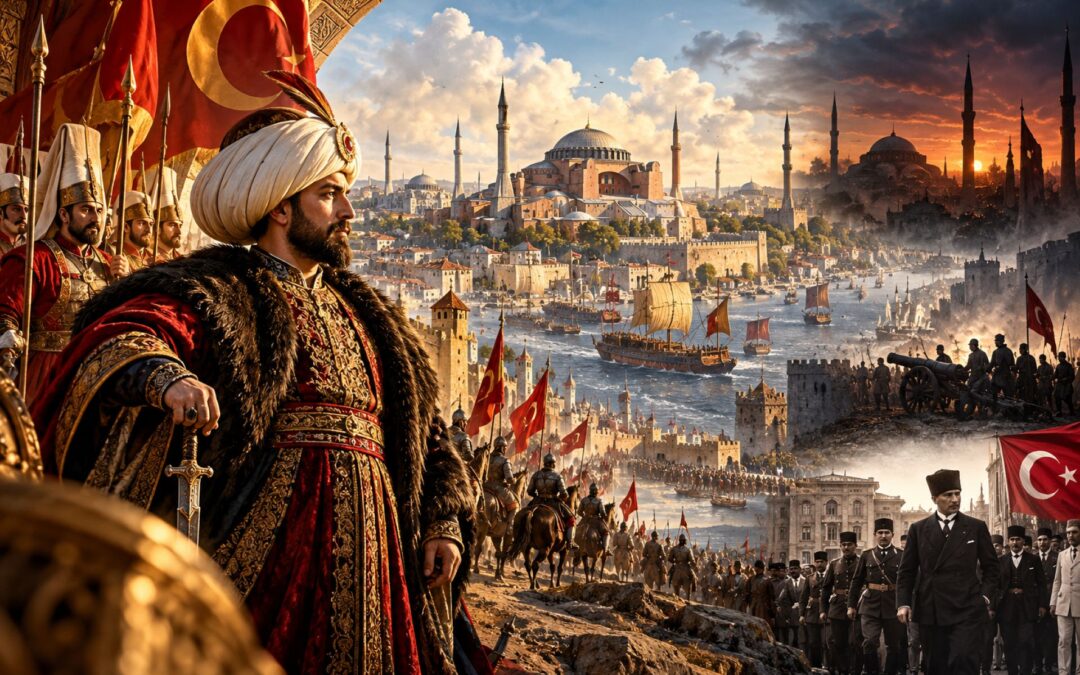
On October 29, 1923, Mustafa Kemal Atatürk and the Turkish Grand National Assembly proclaimed the Republic of Turkey. The new state emerged from the ruins of an empire that had governed large parts of southeastern Europe, the Middle East, and North Africa for more than six centuries. Its capital would be Ankara rather than Istanbul, and its political legitimacy would rest on national sovereignty rather than the hereditary authority of an Ottoman sultan.
The transformation marked the end of one of history’s most remarkable imperial experiments. From a small frontier principality in northwestern Anatolia, the Ottoman dynasty had built an empire that conquered Constantinople, challenged Europe’s most powerful monarchies, controlled strategic Mediterranean territories, and ruled over millions of people belonging to different religions, languages, and cultures.
At its height in the sixteenth century, the Ottoman Empire was among the world’s leading military and political powers. Its armies reached the gates of Vienna, its fleets contested control of the Mediterranean, and its merchants connected commercial networks stretching across Europe, Africa, and Asia. Ottoman rulers also developed administrative, legal, military, and cultural institutions that enabled this enormous and diverse state to survive long after its initial period of expansion.
Yet the empire eventually disappeared, while many of the nations and territories that had once formed part of it developed political identities of their own. Understanding what happened requires more than a story of conquest followed by decline. The history of the Ottoman Empire is also a history of adaptation, institutional innovation, religious coexistence and inequality, political rivalry, and the changing relationship between imperial power and the people it governed.
Before the Ottomans: Turkic Migration, the Seljuks, and Anatolia
The origins of the Ottoman Empire lie in the movements of Turkic-speaking peoples across Eurasia centuries before the Ottoman dynasty appeared. These populations did not constitute a single nation moving together toward a predetermined homeland. They belonged to different tribal confederations and political communities whose languages shared common roots, while their religions, lifestyles, and social organizations varied considerably.
Over many centuries, Turkic-speaking groups established themselves across parts of Central Asia, including the regions surrounding the Altai Mountains, the Aral Sea, and the Caspian Sea. Some maintained predominantly pastoral and nomadic ways of life, while others developed settled communities or participated in the political and commercial systems of neighboring civilizations. Their interactions with Persian, Chinese, Arab, and other societies helped shape the political traditions that later emerged in Anatolia.
Among the most consequential groups were the Oghuz Turks, whose confederations became important in the western Eurasian steppe. During the tenth and eleventh centuries, members of one Oghuz lineage associated with Seljuk established a political dynasty that expanded into Iran and the wider Middle East. The Seljuks adopted Islam and became influential participants in the Persianate cultural world, incorporating Persian administrative practices, court traditions, literature, and political ideas into their government.
The Seljuk Empire grew into a major power during the eleventh century. In 1055, the Seljuk ruler Tughril entered Baghdad, establishing his authority in a city that remained symbolically important to the Abbasid caliphate. Although the Abbasid caliph retained religious prestige, much of the actual military and political power increasingly belonged to the Seljuk rulers and their successors.
This combination of Turkic military traditions, Persian administrative culture, and Islamic political legitimacy became an important foundation for later states. The history of Persia and its changing imperial institutions helps explain why the Seljuks and their successors could adopt sophisticated forms of government without abandoning their own political identities.
The most decisive development for the future of Anatolia occurred in 1071, when the Seljuk ruler Alp Arslan defeated the Byzantine emperor Romanos IV Diogenes at the Battle of Manzikert. The Byzantine defeat weakened imperial authority in eastern Anatolia and contributed to internal political turmoil. Turkic groups subsequently expanded their settlement and military presence across the region, although the battle did not immediately transfer all of Anatolia into Seljuk hands.
One of the most important successor states was the Sultanate of Rum, which developed in Anatolia during the late eleventh century. Its rulers established a political and commercial system that combined Turkic, Persian, Islamic, and existing Anatolian traditions. Cities such as Konya became important centers of administration, trade, architecture, and intellectual activity.
During the thirteenth century, however, Mongol expansion transformed the political environment. The Seljuk defeat at the Battle of Köse Dağ in 1243 weakened the Sultanate of Rum and increased Mongol influence over Anatolia. Central authority gradually fragmented, allowing smaller Turkish principalities, known as beyliks, to develop greater independence.
These principalities competed for territory, resources, legitimacy, and opportunities along the Byzantine frontier. One of them emerged in northwestern Anatolia, where a local ruler named Osman established the foundations of a dynasty that would eventually absorb or dominate many of its rivals.
The future Ottoman Empire therefore did not emerge from an isolated tribal society. It developed within an already interconnected world of Byzantine frontier communities, Turkish principalities, Persianate political institutions, Islamic scholarship, and regional commercial networks. Its founders inherited traditions they would gradually transform into something much larger.
Osman’s Frontier State and the Ottoman Advance into Europe
Osman I is traditionally recognized as the founder of the Ottoman dynasty, although relatively little can be established with certainty about his life. The surviving narratives were often written generations after the events they described, when Ottoman rulers had strong reasons to present their origins as heroic and divinely favored. The conventional founding date of 1299 is therefore better understood as a traditional marker than as an unquestionably documented moment when a formal empire came into existence.
Osman’s principality developed near the northwestern edge of Anatolia, close to territories still governed by the Byzantine Empire. This frontier offered opportunities for military raiding, alliances, settlement, and the gradual absorption of neighboring communities. Byzantine authority had weakened in parts of the region, while political divisions among Turkish principalities created openings for ambitious local rulers.
The early Ottomans benefited from more than military aggression. They attracted warriors seeking wealth and status, established relationships with local elites, and gradually developed mechanisms for controlling conquered territory. Their frontier society also incorporated people from different cultural and religious backgrounds, complicating later accounts that portray Ottoman expansion as a simple struggle between two permanently separated civilizations.
Under Osman’s son Orhan, Ottoman power became increasingly territorial and institutional. The capture of Bursa in 1326 provided the dynasty with an important urban center, while the conquest of Nicaea in 1331 further reduced Byzantine authority in northwestern Anatolia. These victories brought the Ottomans access to established towns, agricultural revenues, commercial networks, and populations whose governance required something more durable than temporary military occupation.
Bursa became an early center of Ottoman government and culture. Its markets, religious buildings, and administrative institutions demonstrated the dynasty’s growing transition from a frontier principality into a territorial state. Control over urban populations also provided revenue that could support more sustained military activity.
The Ottomans crossed into southeastern Europe during the middle of the fourteenth century. Their early involvement in Byzantine political struggles gave them opportunities to establish positions across the Dardanelles, and their acquisition of territory around Gallipoli in 1354 provided a strategically valuable foothold on the European side of the straits.
From there, Ottoman forces expanded into Thrace and the Balkans, where Byzantine weakness and divisions among regional rulers facilitated further advances. Edirne, known historically as Adrianople, came under Ottoman control during the 1360s and eventually became an important political center. Its location enabled the dynasty to direct campaigns into southeastern Europe while maintaining connections with its Anatolian territories.
Under Murad I and Bayezid I, Ottoman influence expanded across parts of Bulgaria, Serbia, Macedonia, and neighboring regions. The Battle of Kosovo in 1389 became especially significant in the political memories of the Balkans, although its immediate outcome and later interpretations were more complicated than national legends often suggest. Ottoman expansion proceeded through conquest, tribute arrangements, dynastic alliances, and agreements with regional rulers whose autonomy varied over time.
The Ottomans increasingly confronted Hungary and other European powers concerned about their growing presence in southeastern Europe. In 1396, Bayezid I defeated a crusading coalition at the Battle of Nicopolis, demonstrating the difficulties European rulers faced when attempting to coordinate resistance against Ottoman armies.
Yet Ottoman success also depended on establishing political authority behind advancing frontiers. Conquered territories had to provide soldiers, agricultural production, taxation, and administrative cooperation. Different regions were governed through different arrangements, allowing the dynasty to extend influence without imposing a completely uniform system everywhere.
By the end of the fourteenth century, the Ottomans had become a major regional power spanning parts of both Anatolia and Europe. Their expansion threatened the surviving Byzantine state and challenged established Balkan political structures. Nevertheless, the dynasty remained vulnerable to internal succession disputes, ambitious rivals, and the emergence of an even more formidable conqueror from Central Asia.
From Civil War to the Fall of Constantinople in 1453
Ottoman expansion suffered a devastating interruption in 1402. Bayezid I confronted the forces of Timur, the Central Asian conqueror who had established an empire extending across parts of Iran, Central Asia, and neighboring regions. At the Battle of Ankara, Timur’s army decisively defeated the Ottomans, and Bayezid was captured.
The defeat created a dynastic crisis that threatened the survival of the Ottoman state. Bayezid’s sons competed for control of different territories, while rival political factions and regional rulers exploited the weakening of central authority. The period between 1402 and 1413, commonly known as the Ottoman Interregnum, demonstrated that the dynasty’s territorial achievements could not yet guarantee political continuity.
Mehmed I eventually emerged victorious from the struggle and restored unified dynastic leadership. His success did not immediately recreate all the power that Bayezid had possessed, but it preserved the Ottoman political project. Under his successor Murad II, the state resumed its expansion and confronted European coalitions attempting to prevent further Ottoman advances.
Murad II defeated a crusading army at Varna in 1444 and another major opposing force at the Second Battle of Kosovo in 1448. These victories reinforced Ottoman influence in the Balkans and weakened the possibility of a successful coordinated offensive against the dynasty. They also prepared the political and military environment inherited by Murad’s son, Mehmed II.
When Mehmed II became sultan in 1451, Constantinople remained the greatest symbolic prize available to the Ottomans. Although the Byzantine Empire had lost most of its former territories, its capital continued to occupy a strategic position between Europe and Asia, connecting the Mediterranean and Black Sea through the Bosporus. The city also represented an enduring claim to Roman imperial legitimacy.
Constantinople had survived numerous sieges over many centuries. Its defensive walls, developed and strengthened under successive Byzantine emperors, were among the most formidable fortifications of the medieval world. Capturing the city required not merely an ambitious army but the ability to overcome a sophisticated defensive system and restrict access by sea.
Mehmed prepared carefully for the campaign. He strengthened Ottoman control over the Bosporus, assembled substantial forces, and employed powerful siege artillery intended to damage the city’s walls. The Ottomans also sought to control the waters surrounding Constantinople and prevent reinforcements from sustaining its defenders.
The siege began in April 1453. Byzantine emperor Constantine XI led the defense with a relatively small force that included foreign volunteers and experienced soldiers. Ottoman artillery subjected sections of the walls to repeated bombardment, while defenders repaired damaged positions and resisted attacks.
Control of the surrounding waterways became another important dimension of the siege. When Ottoman forces transported ships overland into the Golden Horn, they created additional pressure on the city’s defenses and complicated the Byzantines’ ability to concentrate their limited resources. The campaign became an extended contest involving artillery, infantry assaults, naval operations, engineering, and attempts to maintain morale.
On May 29, 1453, Ottoman forces launched their final assault. The defenders were overwhelmed, Constantine XI died during the fighting, and Constantinople fell to Mehmed’s army. The conquest ended the Byzantine Empire as an independent political state and brought a city of extraordinary religious, commercial, and historical importance under Ottoman control.
The consequences extended far beyond a territorial victory. Mehmed could now rule from a city that had served as an imperial capital for more than a thousand years. He increasingly adopted the language and symbols of universal sovereignty, presenting himself as heir to an imperial tradition that predated the Ottoman dynasty itself.
Constantinople became the empire’s principal capital, although the transformation of the city required sustained government intervention. War and population decline had left many districts damaged or underpopulated. Mehmed encouraged resettlement, rebuilt infrastructure, promoted commercial activity, and sought to make the city a functioning center of imperial administration.
The conversion of Hagia Sophia from a cathedral into a mosque symbolized the political and religious change. Originally constructed under the Byzantine emperor Justinian I during the sixth century, the building retained its monumental importance under Ottoman rule. Its minarets and other Islamic architectural additions developed over time rather than appearing simultaneously immediately after the conquest.
The city subsequently became a center where older Byzantine traditions interacted with Ottoman, Islamic, and wider Mediterranean influences. Its markets, religious institutions, palaces, and neighborhoods helped establish the material foundation of a new imperial identity.
The conquest of Constantinople transformed the Ottomans’ standing in the world. It consolidated their position between Europe and Asia, strengthened their dynastic prestige, and gave their rulers access to a capital capable of sustaining imperial ambitions. Yet Mehmed’s achievement was not the conclusion of Ottoman expansion. It was the beginning of a period in which the dynasty would become one of the dominant political powers of the early modern world.
Building an Empire Across Three Continents
Mehmed II used the prestige and resources gained from Constantinople to pursue further expansion across southeastern Europe, Anatolia, and the Black Sea. His campaigns helped establish Ottoman authority over territories that had previously remained outside the dynasty’s control or maintained substantial independence.
During the 1460s, Ottoman forces incorporated the remaining Byzantine successor state of Trebizond and extended their authority over the Morea in southern Greece. Mehmed also conquered much of Bosnia and continued campaigns involving Albania and neighboring Balkan territories. Some regions required repeated military intervention because local rulers and populations continued resisting Ottoman expansion.
The dynasty also extended its influence around the Black Sea. In 1475, an Ottoman expedition established control over important Crimean coastal positions, while the Crimean Khanate became an Ottoman tributary ally. This arrangement expanded Ottoman strategic influence without turning every part of the peninsula into a directly administered province.
The resulting political geography was more complicated than a continuously colored imperial map might suggest. Some territories were governed by appointed Ottoman officials, others retained local dynasties under Ottoman supremacy, and still others existed within shifting military or diplomatic relationships. The empire’s effective authority depended on geography, local institutions, and the resources available to enforce decisions.
Mehmed also worked to strengthen imperial government. His reign witnessed the consolidation of institutions centered on the sultan’s household, professional officials, military forces, and systems of taxation. These developments helped turn territorial conquest into a more durable political order.
When Mehmed died in 1481, his son Bayezid II inherited an empire that was already a major regional power. Bayezid’s reign involved dynastic consolidation, continuing conflict, diplomacy, and maritime rivalry, particularly with Venice. Ottoman advances against Venetian positions between 1499 and 1503 strengthened the dynasty’s position in parts of the Aegean and eastern Mediterranean.
Bayezid’s reign also became associated with the settlement of Jews expelled from parts of western Europe, especially the Iberian Peninsula. The expulsion of Jews from Spain in 1492 contributed to migration into Ottoman territories, where Jewish communities established or expanded commercial, religious, and intellectual networks. Their experiences reflected both the opportunities available within the empire and the continued legal distinctions between Muslim and non-Muslim subjects.
The next major transformation occurred under Selim I, who ruled from 1512 to 1520. Although his reign lasted only eight years, his campaigns fundamentally altered Ottoman power by shifting its center of gravity toward the eastern Mediterranean and the Arab-speaking Middle East.
Selim first confronted the Safavid Empire, which had emerged as an important rival in Iran under Shah Ismail I. The Safavids promoted Twelver Shi’a Islam as a central element of their political and religious identity, while Ottoman rulers increasingly emphasized Sunni legitimacy. Their rivalry involved religious differences but was also driven by territorial ambitions, strategic frontiers, and struggles over political influence among communities in eastern Anatolia.
In 1514, Selim defeated the Safavids at the Battle of Chaldiran. Ottoman firearms, artillery, and military organization contributed to the victory, although the campaign did not permanently resolve the rivalry between the two empires. Ottoman–Safavid competition continued to shape the politics of Anatolia, Iraq, and the Caucasus for generations.
Selim then turned against the Mamluk Sultanate, which controlled Egypt, Syria, and important territories in the eastern Mediterranean. Ottoman forces defeated the Mamluks at Marj Dabiq in 1516 and near Cairo in 1517, bringing Syria and Egypt under Ottoman authority.
The conquest transformed the empire’s economic and political position. Egypt was an exceptionally valuable agricultural and commercial region, while Cairo, Damascus, and other cities connected major trade networks. Ottoman influence also extended toward the holy cities of Mecca and Medina through arrangements with the Sharifs of Mecca, strengthening the sultan’s standing within the wider Muslim world.
Later Ottoman accounts sometimes described a formal transfer of the caliphate from the last Abbasid caliph in Cairo to Selim I. Historians have questioned the evidence for such a straightforward ceremony. What is more securely established is that the conquest greatly increased Ottoman religious prestige and contributed to the dynasty’s subsequent claims to leadership within the Sunni Muslim world.
Selim’s achievements should not be confused with the conquest of all North Africa. Egypt entered Ottoman rule during his reign, while Ottoman influence farther west expanded through later military campaigns, maritime alliances, and relationships with regional authorities. The empire would eventually exercise varying degrees of control over areas including Algeria, Tunisia, and Tripoli, but Morocco remained outside Ottoman sovereignty.
Selim’s successor, Suleiman I, known in European historical writing as Suleiman the Magnificent, inherited this enlarged empire in 1520. His reign, lasting until 1566, became one of the defining periods of Ottoman imperial power.
Suleiman immediately pursued further expansion in Europe. Ottoman forces captured Belgrade in 1521, securing an important position on the approach to Hungary. The following year, they conquered Rhodes from the Knights Hospitaller, removing a significant Christian military stronghold from the eastern Mediterranean.
In 1526, Suleiman defeated the Hungarian army at the Battle of Mohács. King Louis II died during the campaign, and the defeat produced a political crisis over control of the Hungarian kingdom. The consequences eventually divided Hungary among territories under Ottoman rule, Habsburg authority, and the semi-autonomous Principality of Transylvania.
The Ottoman advance reached Vienna in 1529, when Suleiman attempted to capture the Habsburg capital. The siege failed, revealing the logistical difficulties of projecting a large army deep into central Europe. Nevertheless, the campaign demonstrated the scale of Ottoman ambitions and established the Habsburgs as enduring rivals.
Ottoman authority expanded in Hungary over subsequent decades, notably after the capture of Buda in 1541. Suleiman also conducted campaigns against the Safavids, with Ottoman forces occupying Baghdad in 1534. These eastern campaigns reinforced the empire’s presence in Iraq and intensified competition with Iran.
At sea, Ottoman power benefited from experienced commanders and maritime networks. Hayreddin Barbarossa, who had established himself in North Africa, entered Ottoman service and became an important naval commander. His victory at Preveza in 1538 strengthened the Ottoman position in the eastern Mediterranean and complicated efforts by rival European powers to contain Ottoman naval activity.
The empire’s North African interests also grew through campaigns, alliances, and the incorporation of local maritime rulers into the imperial system. Control of ports and coastal strongholds mattered for naval operations, commerce, and competition with Spain and other Mediterranean powers. These arrangements differed considerably from the provincial administration of territories closer to Istanbul.
Suleiman’s reputation rested on more than conquest. Known in Ottoman tradition as Kanuni, or the Lawgiver, he became associated with the development and consolidation of imperial law and administration. His reign also witnessed extraordinary architectural and artistic patronage, contributing to the empire’s cultural standing.
The Metropolitan Museum of Art’s account of Ottoman artistic development before 1600 illustrates how territorial expansion and cultural patronage reinforced one another. Ottoman rulers brought together craftsmen, artists, architects, administrators, and intellectual traditions from across their territories, helping create an imperial culture that drew upon several interconnected civilizations.
By Suleiman’s death in 1566, Ottoman power extended across substantial territories in southeastern Europe, Anatolia, the Arab Middle East, and North Africa. The empire had become an essential participant in European diplomacy, Mediterranean warfare, Islamic political life, and international commerce.
Its achievement, however, cannot be measured solely by the territory it controlled. The more difficult question was how an empire containing such diverse populations, environments, and political traditions could remain governable over many generations. The answer lay in a complex institutional system that combined military coercion with administration, negotiation, law, commerce, and social organization.
How Ottoman Power Worked
The Ottoman Empire survived because its rulers developed institutions capable of collecting resources, organizing military forces, administering provinces, and maintaining political authority across an enormous territory. These institutions changed considerably over six centuries, and practices associated with the empire’s sixteenth-century height cannot automatically be applied to its earliest or latest periods.
Ottoman government combined centralized dynastic authority with substantial variation in local administration. Its military, fiscal, legal, religious, and commercial systems interacted, creating a state that could exercise considerable power while also depending on cooperation from provincial officials, local elites, and different communities.
Armies, Janissaries, and the Sultan’s Household
Ottoman military strength emerged from the combination of different forms of military service. Early frontier warriors and cavalry forces gradually became part of a larger organization incorporating provincial mounted soldiers, professional infantry, artillery, engineers, and naval forces. The empire’s military success depended not on a single technological invention but on its ability to coordinate these elements within increasingly sophisticated campaigns.
An important element was the timar system, under which holders of designated revenue assignments collected specified agricultural revenues in return for military and administrative obligations. Many provincial cavalrymen, commonly known as sipahis, supported themselves through these arrangements. The system connected rural production to military service, although its application and importance varied across regions and centuries.
Among the empire’s most famous soldiers were the Janissaries, an infantry corps closely associated with the central Ottoman state. Their development was connected to the broader use of military slaves and servants whose political allegiance was intended to remain closely tied to the sultan. Unlike many provincial forces, Janissaries were increasingly supported through centralized payment and training arrangements.
A major source of recruitment was the devshirme system, through which Ottoman officials periodically levied boys from Christian communities, particularly in parts of the Balkans. These children were removed from their families, converted to Islam, and trained for military or administrative service. The system was coercive, and the opportunities available to some recruits do not erase the loss of family autonomy and religious freedom involved.
Recruits followed different career paths. Some entered the Janissary infantry, while others received education and training that could lead to appointments within the palace or imperial administration. Exceptionally successful individuals rose to positions of considerable authority, including the office of grand vizier.
The Janissaries became an influential part of Ottoman military organization. Their discipline, training, and access to firearms contributed to battlefield effectiveness, especially during periods when European armies were also undergoing significant military development. Ottoman artillery, siege engineering, and military logistics helped the dynasty conduct campaigns against formidable fortified cities and organized opponents.
Over time, however, Janissary recruitment and service changed. The corps increasingly developed hereditary, commercial, and political connections outside its earlier organizational model. Janissaries could become influential participants in urban economic life and imperial political disputes, sometimes resisting reforms they believed threatened their interests.
Military power was inseparable from the sultan’s household. Ottoman sovereignty centered on a hereditary dynasty whose rulers claimed supreme political authority, but their personal involvement in government varied widely. Succession struggles, court factions, palace officials, military leaders, and members of the imperial family could all influence political outcomes.
The grand vizier became one of the most important offices in the imperial system. Acting as the sultan’s principal minister, the grand vizier could supervise administration, diplomacy, finance, and military campaigns. The imperial council and associated bureaucracy provided the mechanisms through which decisions were recorded, communicated, and implemented.
The Topkapı Palace in Istanbul served as an important center of government and dynastic life. Its household arrangements, court ceremonies, educational systems, and administrative offices connected the ruler’s personal authority to the wider machinery of government.
Women within the imperial household could also exercise substantial influence. Mothers of reigning sultans, royal consorts, and other palace figures sometimes participated in political patronage, succession struggles, charitable foundations, and negotiations among powerful officials. Their influence cannot be reduced to the familiar stereotype of sultans withdrawing from government into luxurious harems.
Provinces, Taxes, and Religious Communities
The Ottoman Empire governed regions with profoundly different histories and institutions. The administrative requirements of a Balkan agricultural district were not identical to those of Egypt, a North African coastal territory, or an Arab city containing established religious and commercial institutions. Imperial authorities therefore relied on multiple arrangements rather than attempting to govern every population through one rigid formula.
Provinces were administered through officials responsible for security, taxation, justice, and the implementation of imperial policy. Governors acted on behalf of the central government, but they depended on cooperation from military officers, local notables, religious authorities, landholders, and merchants. The balance between provincial initiative and central control changed over time.
Ottoman rulers also used tributary relationships and subordinate principalities to extend their influence. Some territories retained their own rulers and substantial internal autonomy while recognizing Ottoman supremacy or providing military and financial support. Such arrangements could be useful where direct administration would have been expensive, politically disruptive, or difficult to sustain.
Taxation was central to the empire’s survival. Agricultural production generated important revenues, while customs duties, commercial activity, and various provincial obligations helped finance government operations. The relationship between taxes and political legitimacy was often contentious because excessive demands or abusive collection could provoke resistance.
The empire’s legal order incorporated Islamic law, imperial regulations, customary practices, and regional arrangements. Religious scholars and judges participated in the administration of justice, while the sultan issued regulations intended to address matters of taxation, administration, and public order. Different legal jurisdictions and practices existed alongside one another, although their relationships could be complicated.
Religious diversity was one of the empire’s defining characteristics. Most Ottoman subjects eventually lived within a Muslim-ruled political order, but Christians, Jews, and other religious communities remained important parts of imperial society. Their institutions, traditions, and economic activities contributed significantly to Ottoman life.
Non-Muslims could retain important forms of communal worship and religious organization. Christian churches, Jewish communities, and their leaders participated in negotiations with imperial authorities concerning taxation, legal matters, and local governance. The arrangements were not identical across all periods, and the later institutional form commonly associated with the millet system should not be projected unchanged onto the empire’s entire history.
Religious coexistence did not mean universal equality. Non-Muslim communities faced legal distinctions, additional obligations, and limitations that Muslim subjects did not experience in the same way. Social position also varied according to wealth, occupation, geography, political connections, and changing government policies.
Conversion to Islam could improve access to certain opportunities, but it was not universally compulsory. Some Ottoman subjects converted for religious convictions, others for social or economic reasons, and some remained within their inherited religious traditions. The empire’s religious history therefore involved accommodation, inequality, negotiation, and occasional persecution rather than a single unchanging policy of tolerance or intolerance.
The arrival of Jewish refugees from Iberia during the late fifteenth century illustrates this complexity. Ottoman cities provided opportunities for communities fleeing persecution elsewhere in Europe, and Jewish merchants, physicians, artisans, and scholars became important participants in urban life. At the same time, their protection existed within a hierarchical imperial order rather than a modern system of equal citizenship.
The institutional organization of Ottoman government and religious communities reveals how military administration, legal distinctions, and provincial arrangements helped sustain imperial authority. These systems created opportunities for cooperation but also generated tensions whenever the expectations of the central government conflicted with local interests.
Trade, Cities, and Culture
The Ottoman Empire occupied a strategic position between several major economic regions. Its territories connected the Mediterranean and Black Sea with Anatolia, the Balkans, the Middle East, and routes extending toward Central Asia, India, and the Red Sea. This geography made commerce an important source of wealth and international influence.
Istanbul became a major commercial center, drawing merchants, sailors, artisans, and travelers from different regions. Other cities, including Cairo, Aleppo, Damascus, Bursa, and Salonica, developed distinct economic specializations and commercial connections. Their importance depended on regional production, transportation routes, administrative functions, and networks that often extended beyond imperial borders.
Agriculture remained the foundation of economic life for much of the population. Farmers cultivated grain, fruits, vegetables, cotton, and other crops under different landholding and taxation arrangements. Markets connected rural production to urban demand, while merchants transported textiles, spices, metals, livestock, and manufactured goods through regional and international trading systems.
The empire also participated in sophisticated financial and commercial practices. Merchants used credit arrangements, partnerships, religious endowments, and other institutions to organize economic activity. Trade was not conducted exclusively by the government, nor were imperial borders impermeable barriers between Ottoman and European commercial worlds.
Cultural life flourished through the interaction of different traditions. Ottoman architecture drew upon earlier Islamic, Byzantine, Persian, and regional forms while developing distinctive approaches to urban design and monumental construction. Palaces, mosques, schools, markets, baths, fountains, and charitable complexes became prominent features of imperial cities.
The architect Mimar Sinan, whose career reached its height during the sixteenth century, became one of the most celebrated figures in Ottoman architectural history. His buildings combined sophisticated structural engineering with carefully organized spaces, domes, courtyards, and decorative features. The Süleymaniye Mosque complex in Istanbul and the Selimiye Mosque in Edirne exemplify the ambition of Ottoman imperial architecture.
Calligraphy, ceramics, textiles, manuscript illustration, metalwork, and other artistic traditions also developed through court patronage and commercial production. İznik ceramics became particularly renowned, while Ottoman textile workshops produced goods valued in domestic and international markets.
Religious and charitable foundations contributed to the economic and social organization of cities. Endowments could support mosques, schools, hospitals, public kitchens, water systems, and other institutions. Such foundations linked wealth, social prestige, religious obligation, and public infrastructure.
The empire’s cultural achievements were not confined to the palace. Provincial communities, religious institutions, local patrons, and commercial networks all participated in creating the built environment and intellectual life of Ottoman society. Their contributions reflected the diversity of the empire itself.
This mixture of centralized authority and local participation helped explain Ottoman endurance. It also meant that the empire’s history was shaped not only by sultans and soldiers but by the everyday activities of farmers, merchants, judges, scholars, craftsmen, religious communities, and provincial leaders.
War in the Mediterranean and the Struggle for Central Europe
Ottoman expansion brought the empire into sustained competition with European powers whose strategic interests extended across the Mediterranean and central Europe. These rivalries involved religion, but they were never exclusively religious conflicts. Trade, territory, dynastic interests, maritime routes, military security, and political prestige all influenced the decisions of Ottoman and European rulers.
One of the empire’s principal rivals during the sixteenth century was Habsburg Spain. Spanish rulers possessed territories in Italy and maintained important interests in North Africa, making Ottoman maritime expansion a direct strategic concern. At the same time, the Republic of Venice depended on commercial networks and island possessions in the eastern Mediterranean.
The Spanish monarchy’s rivalry with Ottoman power became particularly intense under Philip II, who sought to defend his Mediterranean interests while confronting several other military and political challenges. Spain’s resources were considerable, but its commitments across Europe and overseas prevented it from concentrating permanently on the Ottoman frontier.
The Knights Hospitaller also became important opponents of Ottoman maritime expansion. After losing Rhodes to Suleiman in 1522, the knights eventually established themselves on Malta, where they continued military and naval activities against Muslim shipping and Ottoman interests.
In 1565, the Ottomans launched a major expedition to capture Malta. The island’s position made it strategically valuable for operations in the central Mediterranean. Ottoman forces besieged important fortifications, but determined resistance, logistical difficulties, casualties, and the arrival of reinforcements contributed to the failure of the campaign.
The siege demonstrated that Ottoman maritime power could be resisted successfully, particularly when defenders occupied strong fortifications and maintained access to external support. Nevertheless, the failure did not destroy the Ottoman fleet or end the empire’s ability to operate across the Mediterranean.
The next major confrontation came after Ottoman operations against Cyprus, then a Venetian possession. Spain, Venice, and the papacy joined forces in the Holy League, creating a coalition intended to challenge Ottoman naval power.
On October 7, 1571, the Holy League fleet confronted the Ottoman navy near Lepanto, off western Greece. The resulting battle involved hundreds of vessels and became one of the most famous naval engagements of the early modern period. The Christian coalition won a decisive tactical victory, inflicting substantial losses on the Ottoman fleet.
The outcome was celebrated throughout Catholic Europe, where Lepanto became a powerful symbol of resistance against Ottoman expansion. Yet its strategic consequences were more limited than the celebrations suggested. Ottoman authorities rebuilt significant naval capacity, while disagreements among the coalition’s members made it difficult to transform the victory into lasting control of the eastern Mediterranean.
Venice eventually accepted the Ottoman conquest of Cyprus, and fighting continued over other Mediterranean positions. Ottoman forces recovered Tunis in 1574 after a temporary Spanish occupation, demonstrating that Mediterranean power remained contested long after Lepanto.
The relationship between the two empires also included diplomacy, intelligence gathering, commerce, and negotiation. Muslim and Christian merchants continued conducting business across political boundaries, while rulers sometimes adjusted their alliances according to strategic circumstances. The Mediterranean was therefore a region of persistent rivalry but also substantial interdependence.
In central Europe, the principal struggle involved the Ottoman and Habsburg dynasties. Their competition centered on Hungary, the Danube corridor, frontier fortresses, and the political future of territories between the two imperial systems.
Suleiman’s victory at Mohács in 1526 had transformed Hungary into a contested political space. Ottoman control expanded over central Hungarian territories, while the Habsburgs maintained authority elsewhere and competed for influence in neighboring regions. Military campaigns continued intermittently across the frontier, supported by networks of fortifications and garrisons.
The unsuccessful Ottoman siege of Vienna in 1529 demonstrated the difficulties of extending imperial power deep into Habsburg territory. Large armies needed reliable supplies, transportation, artillery, and favorable campaigning conditions. The distance from Ottoman logistical bases complicated efforts to sustain prolonged operations against a heavily defended city.
A second major Ottoman attempt against Vienna occurred in 1683, under the leadership of Grand Vizier Kara Mustafa Pasha. Ottoman forces surrounded the city, threatening a strategic center of Habsburg authority. The siege became a major international confrontation as other European rulers organized support for the defenders.
On September 12, 1683, a relief army led by the Polish king John III Sobieski and allied commanders attacked the Ottoman positions. The Ottoman army was defeated, forcing the withdrawal of its forces and ending the immediate threat to Vienna.
The defeat became a major turning point in the military balance between the Ottomans and their European rivals. It also encouraged the formation of a broader coalition that continued attacking Ottoman territories. The subsequent Great Turkish War inflicted further territorial losses on the empire.
The Treaty of Karlowitz in 1699 confirmed significant changes in southeastern Europe’s political geography. The Habsburg monarchy gained most of Ottoman Hungary and other important territories, while additional concessions benefited Poland and Venice. The treaty marked the loss of major European possessions and established a new diplomatic environment in which the Ottoman Empire increasingly had to negotiate from a less advantageous position.
Yet the consequences should not be exaggerated into an immediate collapse. The Ottoman state retained substantial military and financial resources, continued governing extensive territories, and remained an important participant in European diplomacy. Its relationships with European powers would change over the following centuries, but the empire was far from disappearing.
From Imperial ‘Decline’ to Uneven Transformation
The defeat at Vienna and the territorial losses confirmed at Karlowitz have often been presented as the beginning of a long and uninterrupted Ottoman decline. According to this familiar interpretation, the empire reached its greatest achievements under Suleiman and subsequently weakened because later rulers became complacent, corrupt, or incapable of keeping pace with Europe.
This narrative captures some genuine problems but oversimplifies a much more complicated history. The empire suffered military defeats, territorial contraction, fiscal pressure, and periods of political instability. However, it also experienced institutional adaptation, commercial activity, regional economic growth, and repeated efforts to reorganize government.
The Ottoman state of the eighteenth century was not simply a weaker copy of its sixteenth-century predecessor. Its political institutions had changed, provincial rulers had become more influential in some regions, and new relationships developed between the imperial government and local economic elites. These developments could reduce direct central control while also providing alternative ways of maintaining authority.
The role of the sultan changed across successive reigns, but there was no universal pattern in which every later ruler abandoned government for palace pleasures. Grand viziers, military commanders, provincial officials, palace figures, and members of the bureaucracy had always participated in Ottoman politics. The balance between their responsibilities and the sultan’s personal authority shifted according to institutional circumstances and individual reigns.
The military system also confronted new pressures. European states increasingly developed sophisticated standing armies, improved artillery, and changing methods of finance and recruitment. Ottoman commanders and officials experimented with reforms, although established military organizations sometimes resisted measures that threatened their positions or privileges.
Economic change created another challenge. European overseas expansion helped develop Atlantic and Indian Ocean commercial networks that could transport goods without relying on some traditional eastern Mediterranean and overland routes. This altered the relative importance of different trading centers and intensified international competition.
Nevertheless, older routes did not suddenly become obsolete. Ottoman merchants continued participating in regional and long-distance trade, while cities such as Istanbul, Aleppo, Cairo, and Salonica remained important economic centers. Commercial relationships with European merchants expanded in some sectors even as the overall balance of economic power changed.
The empire also confronted increasingly powerful neighboring states. Russia emerged as a formidable competitor around the Black Sea and in southeastern Europe, while Habsburg Austria remained influential in the Balkans. Their military and diplomatic expansion threatened Ottoman interests and encouraged repeated conflicts.
The Russo-Turkish War of 1768–1774 ended with the Treaty of Küçük Kaynarca, which significantly weakened Ottoman strategic influence around the Black Sea. The treaty recognized the independence of the Crimean Khanate from Ottoman suzerainty, although Crimea subsequently came under Russian control when Catherine II annexed it in 1783.
These developments had consequences beyond the loss of territory. They altered commercial access, strategic security, and the balance of influence among different populations and regional rulers. The Ottoman government increasingly had to manage diplomatic relationships with states capable of exerting sustained military pressure.
Meanwhile, several provincial elites developed substantial autonomy. In parts of North Africa and the eastern Mediterranean, local authorities exercised considerable control over military forces, taxation, and political appointments while maintaining varying degrees of formal connection to Istanbul. Such arrangements were sometimes tolerated because they allowed the empire to retain influence without directly administering every regional decision.
Modern scholarship has therefore challenged the idea that Ottoman history after 1683 can be understood through an uninterrupted decline. Donald Quataert’s analysis of the Ottoman Empire between 1683 and 1798 places changing political arrangements and economic activity within a broader account of imperial transformation.
The crucial distinction is between declining geopolitical strength and the disappearance of institutional vitality. The Ottomans lost advantages they had previously enjoyed over many rivals, but their government and society did not simply stop functioning or developing. The empire remained capable of reform, political negotiation, and military resistance, even as the costs of maintaining its position increased.
Revolts, Reforms, and the Nineteenth-Century Struggle to Survive
By the beginning of the nineteenth century, the Ottoman Empire faced pressures that were increasingly difficult to reconcile. European powers sought to expand their influence, provincial leaders challenged central authority, and nationalist movements questioned whether diverse populations should continue living under the same dynasty. At the same time, Ottoman reformers recognized that the empire’s military and administrative institutions required substantial changes.
In 1804, an uprising began in Serbia against Ottoman authority. The rebellion initially reflected local grievances and opposition to abusive regional powerholders, but it developed into a broader struggle over political autonomy and national identity. Although the Ottomans temporarily reasserted control, subsequent negotiations and resistance gradually expanded Serbian self-government.
The Greek War of Independence began in 1821 and became another defining challenge. Greek revolutionaries confronted Ottoman forces while international sympathy for their cause developed among sections of European society. Britain, France, and Russia eventually intervened militarily and diplomatically, contributing to the emergence of an independent Greek state recognized in 1830.
The Greek struggle revealed the increasing influence of nationalism and international intervention on Ottoman political stability. European rulers sometimes supported independence movements for ideological reasons, but strategic interests also shaped their decisions. The weakening of Ottoman power offered opportunities to expand influence in the eastern Mediterranean and southeastern Europe.
Egypt presented an even more complicated challenge. Muhammad Ali, an ambitious Ottoman governor who consolidated power in Egypt, developed military and administrative institutions that strengthened his regional independence. His forces eventually challenged Ottoman authority directly and advanced into territories that the imperial government considered essential to its security.
Muhammad Ali’s campaigns during the 1830s exposed the central government’s vulnerability. The resulting crisis attracted intervention from major European powers, whose competing interests influenced the eventual settlement. Egypt remained formally connected to the Ottoman Empire, but Muhammad Ali and his descendants established a powerful hereditary ruling position.
The Ottoman government recognized that military reform was essential. Sultan Mahmud II pursued measures intended to strengthen central authority and reorganize the armed forces. His most dramatic decision came in 1826, when he destroyed the Janissary corps after resistance to his reform program.
The event, traditionally known as the Auspicious Incident, ended an institution that had been central to Ottoman military and political life for centuries. The abolition involved considerable violence, including the suppression of Janissary resistance and the dismantling of the corps. It also created opportunities to develop new military organizations modeled partly on contemporary European practices.
Military reform was connected to wider changes in administration, education, taxation, and government communication. Ottoman leaders sought more reliable systems for controlling provincial officials, collecting resources, and coordinating policy. Their efforts reflected an increasingly urgent belief that the empire could not preserve its independence through older arrangements alone.
Mahmud’s successors continued this process through the Tanzimat reforms. The Gülhane Edict of 1839 announced important principles concerning security of life and property, taxation, military service, and the regularization of government. The Reform Edict of 1856 further addressed the legal position of non-Muslim subjects and the idea of equality within the imperial order.
These reforms were ambitious because they attempted to redefine relationships between the government and its population. Officials increasingly sought a more centralized state operating through codified laws, professional administration, improved education, and institutions capable of reaching across different provinces.
Their implementation was uneven, however. Provincial resistance, administrative limitations, economic constraints, and disagreements among reformers complicated the process. Measures designed to strengthen imperial unity could also create resentment when they threatened established local privileges or failed to deliver the equality they promised.
International pressure made reform even more difficult. Russia repeatedly challenged Ottoman influence around the Black Sea and claimed interests involving Orthodox Christian communities within Ottoman territories. Such claims intersected with Russian strategic ambitions, creating diplomatic disputes that could escalate into military conflict.
The Crimean War of 1853–1856 demonstrated the complexity of the empire’s international position. Russia’s confrontation with the Ottoman Empire threatened the European balance of power, prompting Britain and France to intervene on the Ottoman side. Western governments feared that a decisive Russian victory could give St. Petersburg excessive influence over strategically important territories and waterways.
The war ended without the complete defeat of the Ottoman Empire, but it illustrated the state’s growing reliance on international diplomacy and external support. Ottoman sovereignty had become an important issue in European strategic calculations, even though European intervention was motivated by the intervening powers’ own interests.
The war also contributed to growing financial difficulties. The Ottoman government increasingly borrowed from foreign lenders, while military expenditure, reform programs, and administrative demands placed heavy pressure on revenues. In 1875, the government suspended payments on substantial portions of its debt, demonstrating the severity of the fiscal crisis.
The establishment of the Ottoman Public Debt Administration in 1881 gave foreign creditors considerable influence over designated imperial revenues. Although the arrangement helped regulate debt repayments, it also reduced the government’s independent control over important financial resources. Economic dependence became another limitation on political sovereignty.
Meanwhile, nationalism and territorial disputes intensified in the Balkans. The uprisings and wars of the 1870s culminated in major Ottoman defeats and a new diplomatic settlement. The Congress of Berlin in 1878 recognized the independence of Serbia, Romania, and Montenegro while establishing an autonomous Bulgarian principality under formal Ottoman suzerainty.
Austria-Hungary obtained authority to occupy and administer Bosnia-Herzegovina, while Britain gained the right to administer Cyprus under a separate arrangement with the Ottoman government. These decisions revealed how European powers could determine the future of Ottoman territories through diplomacy as well as warfare.
The empire was increasingly described as the “sick man of Europe,” a phrase associated with the widespread expectation that Ottoman weakness would create major international problems. Yet the metaphor concealed an important contradiction. Several European governments feared Ottoman collapse precisely because they disagreed over which power should benefit from its disappearance.
Britain and France might support Ottoman territorial integrity when it restrained Russia, while pursuing their own interests in North Africa, the eastern Mediterranean, or the Middle East. Russia and Austria-Hungary also alternated between confrontation and negotiation according to their strategic priorities. Ottoman rulers had to navigate these rivalries while addressing serious problems within their territories.
By the end of the nineteenth century, the empire remained territorially extensive but politically and economically constrained. Its rulers had introduced major institutional reforms, yet reform did not eliminate nationalist demands, financial dependence, or military vulnerability. The struggle to preserve the empire increasingly raised a fundamental question: could a multinational dynastic state become a modern political community without destroying the relationships that had held it together?
The Young Turks and the Last Crises of the Sultanate
The nineteenth-century reform movement eventually generated demands for a constitutional political order. Some Ottoman intellectuals and officials argued that limiting arbitrary power and establishing representative institutions would strengthen the empire by creating a more legitimate relationship between rulers and subjects.
In 1876, the empire adopted its first constitution under Sultan Abdulhamid II. The constitution established a parliamentary framework while preserving substantial powers for the sultan. However, the experiment proved short-lived. Following war with Russia and mounting political difficulties, Abdulhamid suspended parliamentary government in 1878 and increasingly governed through centralized personal authority.
Abdulhamid’s reign combined authoritarian political control with significant modernization efforts. Railways, schools, communications, and administrative institutions expanded, while the government sought to reinforce Ottoman identity and Islamic legitimacy. The sultan’s political strategy reflected his belief that strong central authority was necessary to prevent further territorial fragmentation.
Opposition nevertheless developed among intellectuals, officers, administrators, and political activists. Groups commonly associated with the Young Turk movement criticized aspects of the existing political system and demanded constitutional government. They did not all share identical ideological commitments, but many believed that restoring representative institutions could help reverse the empire’s weakening position.
The Committee of Union and Progress became an influential organization within this opposition. Its networks included military officers and civilians who supported constitutional restoration, although their views on nationalism, centralization, and political rights varied.
In 1908, a revolution forced the restoration of the Ottoman constitution and parliamentary government. The Young Turk Revolution initially inspired hopes that Muslims, Christians, and other communities could participate in a renewed political order based on common Ottoman citizenship. Supporters believed that constitutional institutions might reduce arbitrary authority and strengthen imperial unity.
Those expectations confronted serious obstacles. Nationalist movements continued seeking autonomy or independence, while different groups disagreed over the extent to which government should be centralized. Political competition also intensified between reformist factions, conservative opponents, the military, and supporters of different visions of Ottoman identity.
The international environment remained hostile. In 1908, Austria-Hungary formally annexed Bosnia-Herzegovina, which it had administered since 1878. Bulgaria also declared full independence, further reducing Ottoman authority in southeastern Europe.
In 1911, Italy attacked Ottoman territories in North Africa, beginning a war that resulted in the loss of Libya. The conflict demonstrated how difficult it had become for the Ottoman government to defend distant possessions against European states possessing stronger naval capabilities.
The Balkan Wars of 1912–1913 brought another devastating series of territorial losses. A coalition of Balkan states attacked Ottoman positions, and the empire lost most of its remaining European territories. Although Ottoman forces recovered Edirne during the second conflict, the overall defeat sharply reduced the empire’s territorial and political position.
These setbacks intensified struggles within the Ottoman government. In 1913, the Committee of Union and Progress consolidated power through a political coup, and its leadership increasingly dominated the state. The constitutional movement that had promised political renewal developed into a more authoritarian system shaped by military pressures, nationalist concerns, and emergency political calculations.
The empire entered the First World War under conditions of substantial internal uncertainty. Its leaders confronted the consequences of recent military defeats, declining territorial influence, nationalist movements, and the persistent ambitions of neighboring powers. They hoped that an international alliance might help restore Ottoman strength, but the decision would instead expose the remaining state to an existential military crisis.
World War I, Imperial Defeat, and the Armenian Genocide
When the First World War began in Europe in the summer of 1914, the Ottoman Empire faced a difficult strategic choice. Its leaders feared Russian expansion, remained resentful of recent territorial losses, and recognized that the empire could not easily withstand another major conflict without powerful allies. At the same time, entering a European war threatened to expose its territories to attacks across several distant fronts.
The Ottoman leadership developed increasingly close military relations with Germany. German officers had participated in Ottoman military modernization, and some leading Ottoman politicians believed that alignment with Berlin offered protection against Russian ambitions. A secret alliance was concluded in August 1914, although Ottoman involvement in active fighting did not begin immediately.
The decisive escalation occurred in late October, when Ottoman warships attacked Russian ports in the Black Sea. Russia and its allies subsequently entered into open war with the Ottoman Empire, bringing the state into the conflict alongside Germany and Austria-Hungary.
Ottoman entry expanded the war geographically. The empire’s territories included strategic waterways, major overland routes, and regions that were economically and politically important to Britain, France, and Russia. Its participation opened campaigns in the Caucasus, Mesopotamia, Palestine, the Arabian Peninsula, and the eastern Mediterranean.
One of the earliest disasters came in the Caucasus. Ottoman forces launched an offensive against Russia during the winter of 1914–1915, culminating in the Battle of Sarikamish. The campaign suffered catastrophic losses caused by a combination of military resistance, extreme weather, logistical failure, and inadequate preparation.
The defeat intensified political suspicion within the Ottoman leadership, particularly toward Armenian communities living in the empire’s eastern territories. Ottoman officials increasingly portrayed Armenians as a collective security threat, using the existence of some Armenian political and military activity as a pretext for policies directed against the wider civilian population.
Beginning in 1915, Ottoman authorities organized systematic deportations and mass killings of Armenians. Communities were forcibly removed from their homes, families were separated, and deportees were sent toward areas where many faced starvation, exposure, disease, and deliberate violence. Ottoman officials, military personnel, and associated forces participated in the destruction of Armenian communities across substantial parts of the empire.
These actions constituted the Armenian genocide. The United States Holocaust Memorial Museum’s historical account of the Armenian genocide estimates that at least 664,000 and possibly as many as 1.2 million Armenians died during 1915–1916. Other historical estimates differ, but the evidence for systematic mass murder and forced deportation is overwhelming.
The genocide remains an essential part of Ottoman history because it reveals how wartime nationalism, authoritarian political power, and claims of military necessity could be used to justify the destruction of civilian populations. It cannot be understood as an ordinary consequence of battlefield combat or explained away by the existence of wartime security concerns.
Elsewhere, the Ottoman military achieved significant defensive successes. The Gallipoli campaign became the most famous example. British and French leaders hoped to force the Dardanelles, threaten Constantinople, open a supply route to Russia, and potentially remove the Ottoman Empire from the war.
An initial naval campaign failed to overcome the Ottoman defenses. Allied forces then landed on the Gallipoli Peninsula in April 1915, including substantial contingents from Australia and New Zealand. The resulting fighting developed into a prolonged and costly campaign marked by trench warfare, difficult terrain, disease, and repeated unsuccessful attacks.
Ottoman defenders ultimately prevented the Allies from achieving their objectives. Mustafa Kemal, then an Ottoman officer, played an important role in organizing resistance during several phases of the fighting. The Allied evacuation by early 1916 represented a major Ottoman defensive victory and contributed substantially to Kemal’s later reputation.
Success at Gallipoli did not mean that the empire was winning the wider war. Ottoman forces confronted growing pressure across several fronts, and the demands of sustaining military operations placed enormous strain on the economy and population.
In Mesopotamia, British imperial forces initially experienced serious setbacks. Ottoman troops surrounded a British-led force at Kut, where the besieged defenders surrendered in April 1916. The victory demonstrated the continued effectiveness of Ottoman armies, although British forces later reorganized and captured Baghdad in 1917.
The Arab Revolt introduced another major challenge. In June 1916, Sharif Hussein bin Ali of Mecca launched a rebellion against Ottoman authority, supported by British financial assistance, military supplies, and advisers. Arab leaders and fighters pursued their own political ambitions, including hopes for an independent Arab state after the war.
T. E. Lawrence, later widely known as Lawrence of Arabia, became famous for his role as a British liaison and adviser. His reputation should not obscure the agency of Hussein, his sons, and the many Arab participants who organized and conducted the revolt. The rebellion disrupted Ottoman communications and contributed to Allied operations in parts of the Arabian Peninsula and Syria.
British and French diplomacy simultaneously complicated the future of the empire’s Arab territories. The secret Sykes–Picot Agreement of 1916 outlined proposed spheres of influence in parts of the Ottoman Middle East. Other wartime commitments, including the Balfour Declaration of 1917 concerning Palestine, introduced additional political expectations that would prove difficult to reconcile.
The war therefore brought together several conflicting visions of the region’s future. Ottoman leaders sought to preserve imperial authority, Arab nationalists pursued varying forms of autonomy or independence, European powers sought strategic advantages, and local communities confronted profound uncertainty about the political order that might replace Ottoman government.
By 1917 and 1918, Allied campaigns increasingly threatened Ottoman positions in the Middle East. British forces captured Jerusalem in 1917, while subsequent offensives and the weakening of Ottoman military resources accelerated the collapse of imperial positions in Syria and Palestine.
The broader course of World War I and its consequences for the major European empires explains why the Ottoman defeat formed part of a much larger transformation. Germany, Austria-Hungary, Russia, and the Ottoman Empire all experienced profound political upheaval as the war destroyed the foundations of several established imperial systems.
On October 30, 1918, the Ottoman government signed the Armistice of Mudros, ending its participation in the war. Allied forces occupied strategically important positions, and Ottoman control over much of its remaining territory became increasingly uncertain.
The defeat left the empire militarily exhausted, financially weakened, and politically divided. Britain and France advanced plans for the administration of former Ottoman Arab territories, while Greece and other powers pursued claims affecting Anatolia itself.
The Ottoman state had survived invasions, dynastic crises, territorial losses, and major reforms for centuries. Yet the First World War brought together military defeat, nationalist conflict, external occupation, and a collapse of confidence in the old imperial political order. The dynasty still existed, but the foundations of the empire it ruled had largely been destroyed.
Atatürk, the Republic, and the Ottoman Legacy
The end of the First World War did not immediately produce the modern Turkish Republic. Instead, it began a new conflict over sovereignty, territory, and the future of Anatolia. The Ottoman government in Constantinople remained formally in existence, but its authority was severely constrained by the Allied occupation and the military collapse of the empire.
The victorious powers considered different arrangements for Ottoman territories. Britain and France sought to consolidate their influence in the former Arab provinces, while Greece pursued territorial ambitions in western Anatolia. The possibility that even the remaining Anatolian territories might be divided among foreign powers generated growing opposition among Turkish nationalists.
In May 1919, Greek forces landed at Smyrna, now Izmir, with Allied approval. The occupation intensified resistance and became a major catalyst for the Turkish national movement. Former Ottoman officers, local organizations, political leaders, and civilians began coordinating efforts against foreign occupation and the government’s perceived inability to defend national interests.
Mustafa Kemal emerged as the movement’s most influential leader. He had established a military reputation during the First World War, particularly at Gallipoli, and now sought to organize resistance around the principle that the future of the country should be determined by its inhabitants rather than imposed by foreign governments.
Kemal arrived at Samsun in May 1919 and subsequently participated in organizing nationalist political activity across Anatolia. Meetings and congresses helped articulate a political program based on territorial integrity and national sovereignty. The movement gradually developed institutions capable of challenging the authority of the Ottoman government in Constantinople.
In April 1920, the Grand National Assembly convened in Ankara. It increasingly acted as an alternative center of government, claiming legitimacy through national representation and organizing military resistance. The conflict that followed was therefore not simply a struggle against foreign occupation; it also involved competing ideas about the source of political authority within the remaining Ottoman territories.
The Treaty of Sèvres, signed in August 1920 by representatives of the Ottoman government, proposed far-reaching territorial and political restrictions. The settlement threatened to leave the remaining Ottoman state severely reduced and subject to extensive foreign influence. Turkish nationalists rejected the treaty, and its central territorial provisions were never fully implemented.
Fighting continued across several fronts. Turkish nationalist forces confronted Greek armies in western Anatolia, while diplomacy and military operations shaped relationships with France, Armenia, and other powers. The struggle required the national movement to transform dispersed resistance into an organized political and military effort.
A major turning point came during the Battle of Sakarya in 1921, when Turkish nationalist forces prevented further Greek advances toward Ankara. The victory strengthened the National Assembly’s position and contributed to changing international perceptions of the conflict.
In August 1922, the nationalist army launched a major offensive against Greek positions. The campaign resulted in a decisive defeat for Greek forces in western Anatolia and the recovery of territory previously occupied during the war. The subsequent Armistice of Mudanya in October 1922 helped establish the conditions for a new diplomatic settlement.
The military victory did not automatically resolve the relationship between the nationalist government and the Ottoman dynasty. The sultan remained a symbol of the old imperial political order, while the Grand National Assembly claimed authority based on the sovereignty of the nation.
On November 1, 1922, the Grand National Assembly abolished the Ottoman sultanate. The decision formally ended the dynasty’s hereditary political sovereignty, bringing the imperial system established by Osman’s descendants to an institutional conclusion. Sultan Mehmed VI subsequently left Constantinople.
The abolition of the sultanate did not immediately eliminate every Ottoman religious institution. The office of caliph was temporarily retained separately from political sovereignty, reflecting the difficulties involved in dismantling an imperial order that had accumulated both political and religious meanings over centuries.
Negotiations with the victorious powers produced the Treaty of Lausanne, signed on July 24, 1923. The treaty established the international framework for recognition of the new Turkish state’s sovereignty and borders, replacing the unimplemented settlement envisaged at Sèvres.
The political settlement was accompanied by profound human consequences. The 1923 Convention Concerning the Exchange of Greek and Turkish Populations provided for the compulsory exchange of specified Greek Orthodox populations in Turkey and Muslim populations in Greece, with important exemptions including Greeks in Constantinople and Muslims in Western Thrace.
The exchange uprooted communities whose histories were deeply connected to places they had inhabited for generations. Religion became a central criterion in determining who would be transferred, illustrating how the transition from multinational empire to national states could produce new forms of exclusion and displacement.
On October 13, 1923, Ankara was designated the capital of the new state. The decision signaled a major political and symbolic departure from Istanbul, which had served as the imperial center since the fifteenth century. Ankara represented the territorial and political foundations of the nationalist movement rather than the traditions of the old Ottoman court.
On October 29, 1923, the Grand National Assembly formally proclaimed the Republic of Turkey, with Mustafa Kemal becoming its first president. The official account of Atatürk’s role in the republic’s foundation places these decisions within the broader movement to establish national sovereignty and reorganize the political institutions inherited from the Ottoman period.
The final major institutional break came on March 3, 1924, when the Turkish government abolished the caliphate. The decision eliminated an office that had become closely associated with Ottoman claims to religious leadership, reinforcing the separation between the institutions of the former empire and the political structure of the republic.
Atatürk’s government subsequently pursued extensive reforms involving law, education, language, administration, and the relationship between religion and the state. These changes aimed to create a modern Turkish national political order, although their implementation involved conflicts over identity, tradition, and the meaning of modernization.
The republic did not emerge from a society without historical continuity. Its population, administrative experience, military institutions, cities, commercial networks, and cultural traditions were deeply shaped by the Ottoman past. The transformation therefore involved both the rejection of imperial sovereignty and the adaptation of institutions inherited from earlier generations.
The consequences of Ottoman dissolution extended far beyond Turkey. Former Arab territories came under British and French mandates or developed different forms of political authority, while communities throughout southeastern Europe and the Middle East confronted new borders and national identities. The political consequences of Ottoman collapse in the modern Middle East remain particularly important for understanding how imperial dissolution influenced later regional disputes.
The empire also left a lasting cultural and architectural heritage. Ottoman mosques, bridges, markets, palaces, legal traditions, culinary practices, artistic forms, and urban landscapes remain visible across territories once governed by the dynasty. These influences developed differently in each region, interacting with local histories rather than producing one uniform Ottoman legacy.
The history of the Ottoman Empire also complicates the assumption that the rise and fall of states follow a predictable pattern. The Ottomans survived the near-destruction of their dynasty in 1402, major European military coalitions, repeated territorial losses, economic difficulties, and reform struggles. Their ultimate dissolution was not simply the inevitable consequence of reaching an imperial peak centuries earlier.
For more than six hundred years, the Ottoman dynasty governed through a changing combination of military power, political negotiation, law, taxation, religious authority, and cultural institutions. Its rulers repeatedly adapted those arrangements to circumstances that differed considerably from the world in which Osman had first established his frontier principality.
The end came when accumulated military defeats, nationalist movements, geopolitical pressures, and internal political struggles made the old imperial system impossible to sustain. World War I accelerated that crisis, while the Turkish War of Independence created the political and military foundations for a different kind of state.
The Ottoman Empire disappeared as a political institution, but its influence did not end with the abolition of the sultanate or the proclamation of the republic. It survived through the societies it had governed, the cities it had shaped, the institutions it had developed, and the conflicts and connections inherited by its successor states. Its history is therefore not merely the story of an empire that rose and fell, but of a political civilization whose transformations continue to shape the modern world.
Last Updated on October 30, 2026 by Aseem Gupta