
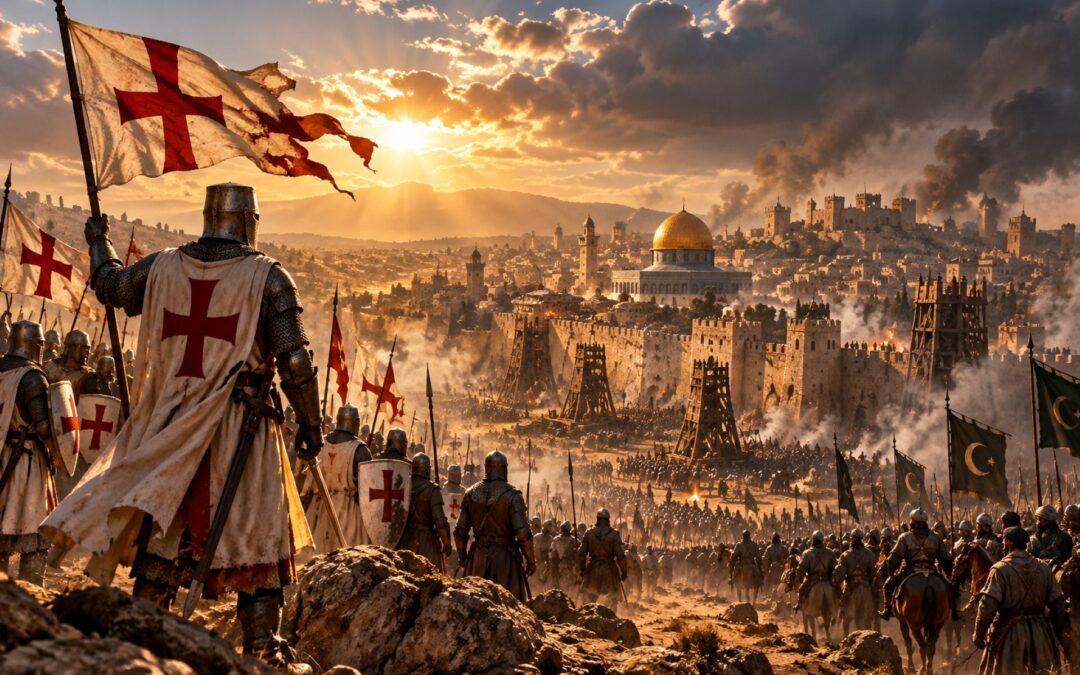
On July 15, 1099, an army of European Christian warriors broke through the walls of Jerusalem. After nearly three years of campaigning across unfamiliar territory, enduring hunger, disease, sieges, and repeated battles, the surviving crusaders had reached the city they believed God had called them to liberate. What followed was a massacre in which many of Jerusalem’s Muslim and Jewish inhabitants were killed.
The conquest was celebrated across Latin Christendom as an extraordinary religious and military victory. Jerusalem, sacred to Christians, Muslims, and Jews, had been under Muslim political control for more than four centuries. Its capture appeared to vindicate a movement that had begun when Pope Urban II called upon Western Christians to take up arms and journey east.
Yet the conquest of Jerusalem did not resolve the problems that had produced the Crusades. Instead, it established a collection of Latin Christian territories in a region inhabited by diverse communities and surrounded by powerful, competing states. Their rulers would struggle to defend these possessions, negotiate with their neighbours, and maintain connections with Europe for almost two centuries.
Between 1095 and 1291, successive Crusades transformed the eastern Mediterranean. Popes mobilized armies in the name of religion, kings and nobles pursued military campaigns, Muslim rulers organized resistance and reconquest, and Christian forces sometimes turned against other Christians. The resulting conflicts reshaped political boundaries, religious institutions, trade networks, and relations among communities whose histories were already deeply interconnected.
Understanding the Crusades requires looking beyond their famous battles. Their history is also one of papal ambition, Byzantine insecurity, political fragmentation, religious conviction, commercial opportunity, and the persistent difficulty of turning military conquest into lasting political control.
Before the Crusades: The Mediterranean World in Crisis
The Crusades emerged from a Mediterranean world divided among several powerful political and religious traditions. By the middle of the eleventh century, Western Europe, the Byzantine Empire, and the Islamic world had developed distinct institutions, rivalries, and understandings of legitimate authority. None of these societies was internally united, and their divisions would prove essential to the history of the Crusades.
In Western Europe, political authority was fragmented among kingdoms, principalities, counties, and smaller lordships. Monarchs depended heavily on regional nobles whose control over land, military resources, and fortified positions often gave them considerable independence. Warfare among Christian rulers was common, even though they shared a broad allegiance to the Latin Church.
The papacy was attempting to strengthen its authority within this political environment. Reforming popes challenged secular interference in Church appointments, sought greater discipline among clergy, and increasingly asserted that religious authority could guide the actions of kings and nobles. These developments created the institutional foundation for a pope to organize military action across political boundaries.
To the east stood the Byzantine Empire, the surviving eastern continuation of the Roman Empire. Governed from Constantinople, it preserved Roman imperial institutions while developing a predominantly Greek-speaking political and religious culture. Its emperor claimed authority within a Christian imperial tradition that differed significantly from the increasingly assertive papacy in Rome.
Constantinople remained one of the Mediterranean world’s greatest cities. Its formidable walls protected a wealthy centre of administration, scholarship, manufacturing, and international commerce. Its location on the Bosphorus connected maritime trade between the Mediterranean and Black Sea while controlling an important passage between Europe and Asia.
The Byzantine Empire, however, was considerably smaller than it had been in earlier centuries. Beginning in the seventh century, Muslim armies had conquered territories formerly governed by Byzantium, including Syria, Palestine, and Egypt. These losses deprived the empire of important cities, agricultural regions, and sources of revenue.
The Islamic world that emerged from these conquests was itself politically diverse. The Abbasid caliphate, centred on Baghdad, retained enormous religious and cultural prestige, but its political authority had weakened as regional dynasties acquired power. In Egypt, the Ismaili Shia Fatimid caliphate challenged Abbasid claims to leadership, while Muslim-ruled Iberia had its own distinct political history.
Religious differences existed within the Islamic world, but political alliances and rivalries did not always follow sectarian boundaries. Muslim rulers competed for territory, trade routes, and legitimacy just as Christian rulers did. These divisions created opportunities for external powers and would later influence the survival of the crusader states.
A major transformation began with the expansion of the Seljuk Turks, a Turkic Muslim ruling dynasty that emerged from Central Asia. During the eleventh century, Seljuk forces established control over much of Iran and entered Baghdad in 1055. They became the dominant military power associated with the Abbasid caliphate without abolishing the caliph’s religious position.
Seljuk expansion brought new pressure upon Byzantium. In 1071, Sultan Alp Arslan defeated a Byzantine army commanded by Emperor Romanos IV Diogenes at the Battle of Manzikert in eastern Anatolia.
The defeat was disastrous, but its consequences were more complicated than an immediate conquest of Anatolia. Romanos was captured and subsequently released, while political struggles within Byzantium undermined the empire’s ability to restore effective control over its eastern territories. Turkic military leaders and settlers expanded into areas where imperial authority had weakened.
These developments transformed Anatolia, which had supplied important agricultural revenues and military manpower to the Byzantine state. Different Turkic powers established themselves across the region, including the Sultanate of Rum. By the late eleventh century, Byzantine rulers faced serious difficulties maintaining the territories and communications necessary for imperial defence.
The relationship between the Eastern and Western Churches further complicated matters. Disagreements over papal authority, theology, liturgical practices, and ecclesiastical jurisdiction had developed over centuries. The mutual excommunications associated with 1054 became an important symbol of the division between Rome and Constantinople, although the separation was a prolonged historical process rather than a single decisive break.
Despite these differences, the two Christian traditions had not ceased interacting. Diplomacy, commerce, military cooperation, and disputes continued across their political and religious boundaries.
By 1095, Byzantine Emperor Alexios I Komnenos had restored some stability after years of military and political crises. Nevertheless, his empire faced serious threats in Anatolia, and recovering lost territory required additional military resources.
Alexios therefore appealed to Western Christians for assistance. He sought soldiers who could support Byzantine operations against the Turks, but the appeal reached a papacy increasingly interested in directing the energies of Latin Christendom toward a religiously sanctioned military undertaking.
The result would be far larger than the emperor had anticipated.
1095: How Urban II Turned an Appeal for Help into Holy War
In March 1095, Byzantine representatives appeared at the Council of Piacenza, where Pope Urban II was meeting with Western clergy and political figures. Their appeal for military assistance provided an opportunity to address both the immediate difficulties of the Byzantine Empire and the broader ambitions of the papacy.
Urban II belonged to the reforming papal movement that sought to extend the Church’s authority over Christian society. He was also operating in a world where religious pilgrimage, aristocratic warfare, and the idea of defending Christian communities were already familiar. His innovation was to combine these traditions into a military expedition that carried an extraordinary spiritual promise.
In November 1095, Urban addressed an assembly at Clermont in southern France. He called upon Western Christians to assist their eastern co-religionists and undertake a journey toward Jerusalem, where sites associated with the life, death, and resurrection of Jesus held immense religious significance.
The precise words of Urban’s speech cannot be recovered with certainty. Several versions were written by chroniclers after the event, and the surviving accounts of Urban II’s speech differ in their wording and emphasis. Nevertheless, they reveal the importance contemporaries attached to defending Christians, recovering sacred territory, and undertaking warfare as a penitential religious obligation.
The promise of spiritual reward was central to the appeal. Participants who undertook the expedition with the appropriate religious intentions were offered remission of the temporal penalties associated with confessed sins. In the religious culture of medieval Western Europe, where concern about salvation and penitence shaped everyday life, this was an exceptionally powerful incentive.
Crusading was therefore presented as more than conventional military service. Participants were expected to make a vow, undertake a demanding journey, and accept hardship as part of an act of devotion. They adopted the sign of the cross, giving rise to the language of taking the cross and the later terminology associated with crusading.
The movement also offered a way to redirect violence within Latin Christendom. Western nobles who ordinarily fought one another could now participate in an enterprise endorsed by the Church. This did not eliminate European political rivalries, but it gave military activity a shared religious objective that transcended individual kingdoms.
The reasons people joined varied considerably. Some were motivated primarily by religious conviction, while others also sought prestige, adventure, opportunities for advancement, or the protection of family interests. These motives were not necessarily contradictory within medieval aristocratic culture.
Participation could be extremely expensive. A knight needed weapons, horses, equipment, provisions, servants, and the resources to maintain himself during an uncertain journey. Many crusaders sold property, borrowed money, or pledged land to finance their expeditions, while families and religious institutions became involved in complicated arrangements for managing property during their absence.
Such financial sacrifices make it difficult to explain the First Crusade simply as an attempt by impoverished Europeans to acquire wealth abroad. Although some participants eventually obtained territories and offices, many spent substantial resources without any guarantee of returning home.
Urban’s appeal succeeded beyond what he could directly control. Enthusiasm spread through preaching networks, aristocratic households, towns, and religious communities. The response included not only professional warriors but also people who lacked the equipment, discipline, and organization necessary for a prolonged campaign.
By 1096, an enormous and loosely coordinated movement was making preparations to travel east. What began as a papal appeal for armed assistance had become a popular religious mobilization on a scale that surprised both Western Europe and the Byzantine Empire.
1096–1099: The First Crusade and the Conquest of Jerusalem
The first people to depart were not the organized noble armies that would eventually capture Jerusalem. During the spring of 1096, groups of ordinary people, minor warriors, and religious enthusiasts began moving east under several leaders. Among the most famous was Peter the Hermit, a charismatic preacher whose followers formed part of what later became known as the People’s Crusade.
Many participants had little understanding of the journey ahead. They lacked adequate supplies, effective command structures, and arrangements for travelling through unfamiliar territories. Their progress exposed the dangers of a large religious movement whose participants did not necessarily obey recognized military or political authorities.
Before the crusaders reached the Byzantine frontier, devastating violence occurred in the Rhineland. Armed crusading groups attacked Jewish communities in towns such as Speyer, Worms, and Mainz, killing inhabitants and pressuring others to accept baptism.
These massacres were not simply the actions of Peter the Hermit’s army. Several different contingents participated in anti-Jewish violence, including forces associated with Count Emicho. Local Christian authorities sometimes attempted to protect Jewish residents, but their efforts frequently proved inadequate.
The attacks reflected existing anti-Jewish hostility intensified by religious enthusiasm and the idea that enemies of Christianity should be confronted. The victims were established members of European communities who had no responsibility for the political situation in the Holy Land.
A surviving Jewish account of the 1096 massacre at Mainz provides an important perspective on the terror experienced by those communities. Like other medieval narratives, it requires careful historical interpretation, but it demonstrates that the First Crusade’s violence began in Europe rather than at Jerusalem.
The People’s Crusade continued through the Balkans toward Constantinople. Conflicts over supplies and discipline created tensions along the route, and Byzantine authorities faced considerable difficulties managing the arriving crowds.
Alexios I eventually arranged for many participants to cross the Bosphorus into Anatolia. There, the poorly organized forces encountered Turkish opponents who understood the terrain and were capable of coordinated military action.
In October 1096, a large part of the People’s Crusade was destroyed near Civetot. Peter the Hermit survived, but the expedition demonstrated that religious enthusiasm could not compensate for inadequate military organization.
The principal armies of the First Crusade began arriving around Constantinople during late 1096 and early 1097. They were led by powerful nobles, including Godfrey of Bouillon, Raymond IV of Toulouse, Bohemond of Taranto, and Robert of Flanders.
These forces were not a unified national army. They consisted of separate contingents with their own leaders, resources, loyalties, and ambitions. Their cooperation depended on personal negotiations and a shared commitment to the campaign.
The Byzantine emperor welcomed the possibility of assistance but viewed the crusading armies with understandable suspicion. Some Western leaders had connections with Norman powers that had previously fought Byzantium, and their objectives were not necessarily identical to those of the emperor.
Alexios sought oaths requiring crusading leaders to recognize Byzantine interests and restore certain territories recovered from the Turks. The agreements varied, and their interpretation became a source of later disputes.
The first major objective was Nicaea, a strategically important city in northwestern Anatolia. Crusader and Byzantine forces besieged it in 1097, eventually compelling its surrender. Byzantine authorities arranged to receive the city, frustrating some crusaders who had expected to seize its wealth.
The army then advanced into Anatolia and defeated Turkish forces at the Battle of Dorylaeum in July 1097. The victory allowed the crusaders to continue toward Syria, but the march imposed terrible hardships.
Food and water were frequently scarce. Horses died, soldiers suffered from exhaustion and disease, and the climate and geography presented challenges unfamiliar to many European participants.
As the expedition approached northern Syria, its leaders began pursuing different political opportunities. Baldwin of Boulogne moved toward Edessa, where he eventually established a Latin-ruled county in 1098.
Meanwhile, the principal crusading army reached Antioch, one of the region’s most important fortified cities. Its extensive defences and strategic position made it a formidable objective.
The siege began in October 1097 and continued through months of hunger, disease, desertion, and fighting. The crusaders had difficulty completely surrounding the city, while its defenders received support from surrounding Muslim powers.
In June 1098, Bohemond secured assistance from an insider connected with Antioch’s defences. Crusaders entered the city during the night and opened the way for their companions.
The capture was accompanied by extensive killing and disorder. However, possession of the city did not immediately secure the crusaders’ position, because an approaching Muslim army soon surrounded them.
The crusaders eventually defeated the relief force outside Antioch. The victory strengthened their belief that divine favour supported their undertaking, although disputes over control of the city exposed the competing ambitions within their leadership.
Bohemond retained Antioch, despite the Byzantine emperor’s claims. The decision became one of the most significant early breaches between the crusaders and the political objectives of Byzantium.
The advance toward Jerusalem resumed after prolonged delays. By this stage, the original expedition had been weakened by casualties, disease, desertion, and the separation of different contingents.
When the crusaders reached Jerusalem in June 1099, they confronted a city held by the Fatimid rulers of Egypt. The Fatimids had recovered it from Turkish control in 1098, an important reminder that Muslim political authority in the region had not been unified.
Jerusalem’s walls presented a serious obstacle. The crusaders lacked sufficient siege equipment at first and struggled with water shortages and the difficulty of maintaining their army.
They eventually constructed siege towers and other equipment, assisted by available timber, skilled labour, and materials from ships that had reached the coast. After several weeks of preparation and repeated assaults, their forces breached the defences on July 15, 1099.
The conquest was followed by extensive killing of Muslim and Jewish inhabitants. Medieval chroniclers differed in their descriptions and often used religious language to celebrate or condemn events, making exact casualty figures impossible to establish reliably.
Nevertheless, the massacre itself is not in serious doubt. It became one of the defining episodes of the First Crusade and a lasting feature of historical memory.
Jerusalem was now controlled by Latin Christian conquerors for the first time since the city’s incorporation into Muslim-ruled territories during the seventh century. Godfrey of Bouillon emerged as its principal ruler, although he did not initially adopt the conventional title of king.
The crusaders then faced a Fatimid army advancing from Egypt. Their victory at the Battle of Ascalon in August 1099 strengthened their immediate position and marked the effective conclusion of the expedition’s principal military objective.
For many surviving participants, the conquest fulfilled their crusading vows. Some returned to Europe, while others remained in the region and participated in the development of new political states.
The First Crusade had achieved something that had appeared improbable when Urban II issued his appeal. Yet capturing Jerusalem was one challenge; defending and governing the territories acquired through the campaign would prove far more difficult.
Outremer: How the Crusader States Survived
The First Crusade produced a new political landscape along the eastern Mediterranean. Latin Christian rulers established territories that became known collectively as Outremer, an Old French term meaning overseas.
Four major states emerged: the County of Edessa, the Principality of Antioch, the Kingdom of Jerusalem, and the County of Tripoli. They did not all arise at the same moment, and their political institutions developed under different circumstances.
Edessa and Antioch were established during the First Crusade in 1098, while Jerusalem came under Latin rule in 1099. Tripoli emerged as a separate county in 1109 after a prolonged struggle for control of the coastal city.
The Kingdom of Jerusalem occupied the most prestigious position because it included Christianity’s principal holy places. Baldwin I, who succeeded Godfrey of Bouillon in 1100, adopted the royal title and worked to consolidate the kingdom’s political institutions.
These states introduced Western aristocratic traditions into the region, including forms of lordship, vassalage, and landholding familiar to their ruling elites. Nevertheless, their governments were not simply replicas of European kingdoms transplanted into Asia.
The Latin rulers governed populations that included Arabic-speaking Christians, Muslims, Jews, Armenians, Greeks, Syriac Christians, and other communities. Religious identities, legal customs, languages, and social relationships differed greatly across the territories.
Political cooperation sometimes crossed religious boundaries. Latin rulers negotiated treaties with Muslim neighbours, employed local specialists, and participated in commercial relations with states that they also fought. Muslim rulers likewise pursued alliances according to regional political circumstances rather than always treating Latin Christians as a single enemy.
These interactions did not eliminate religious discrimination or the inequalities created by conquest. Latin institutions privileged particular Christian communities, and warfare exposed civilians to displacement, captivity, taxation, and violence.
The position of the crusader states remained vulnerable. Their territories were geographically separated or linked by narrow lines of communication, and many inland positions were difficult to reinforce.
Coastal ports were especially valuable because they connected Outremer with Mediterranean shipping networks. Supplies, pilgrims, merchants, and soldiers could arrive by sea more reliably than by attempting the arduous overland journey from Western Europe.
Italian maritime republics became indispensable partners. Venice, Genoa, and Pisa provided transport, ships, commercial connections, and military support in exchange for valuable trading privileges.
Their merchants obtained warehouses, residential districts, and legal concessions in important ports. Commerce in textiles, spices, luxury goods, and other commodities connected the Latin territories with wider Mediterranean markets.
The art and material culture of the crusader states reveal the complexity of this environment. Churches, fortifications, manuscripts, and other surviving objects reflect Latin institutions alongside artistic and cultural influences drawn from surrounding societies.
Trade also brought intellectual contact. European scholars encountered knowledge associated with Arabic-speaking intellectual traditions in medicine, mathematics, astronomy, philosophy, and other fields.
However, the Crusades were not the sole or even necessarily the principal mechanism through which such knowledge reached Latin Europe. Translation movements in Iberia and Sicily, older Mediterranean contacts, Byzantine scholarship, and commercial networks all contributed to the transmission of learning.
Military institutions became another defining feature of Outremer. The most famous were the Knights Templar and the Knights Hospitaller, religious orders whose members combined obligations associated with monastic life with military service.
The Templars developed around 1119 under the leadership of Hugh of Payns and his companions. Their initial purpose included protecting pilgrims travelling between coastal settlements and the holy places around Jerusalem.
The order acquired recognition and patronage from Western rulers and religious authorities. Donations of land, money, and property allowed it to develop an international network that supported military operations in the eastern Mediterranean.
The Hospitallers had different origins. Their institution grew from a hospital in Jerusalem that cared for pilgrims and the sick before the First Crusade. During the twelfth century, it expanded into military responsibilities while retaining charitable and medical functions.
Both orders eventually controlled important fortifications and participated in the defence of the Latin states. The Hospitallers became associated with major strongholds such as Krak des Chevaliers, one of the most formidable castles in the region.
Castles provided secure bases, controlled roads, and helped smaller garrisons defend strategically important territory. Yet fortifications could not remove the underlying imbalance between limited Latin resources and the larger populations and revenues available to surrounding powers.
Outremer survived partly because its opponents were often divided. Rivalries among Muslim rulers created opportunities for treaties, shifting alliances, and military campaigns against individual adversaries.
This arrangement could work while neighbouring powers remained politically fragmented. The greatest danger would emerge when a powerful ruler gained sufficient control over Egypt and Syria to coordinate military action against the Latin states.
Edessa, the Second Crusade, and the Rise of Saladin
The first major warning came in 1144, when Imad al-Din Zengi, ruler of Mosul and Aleppo, captured Edessa. The county had been the earliest Latin state established during the First Crusade, and its position inland made it particularly exposed.
The loss of Edessa shocked Western Europe. It demonstrated that the territories created by the First Crusade could be conquered and that their survival required more than the military achievements of an earlier generation.
Pope Eugenius III called for another expedition, and Bernard of Clairvaux became one of its most influential preachers. Unlike the First Crusade, the Second Crusade attracted two reigning European monarchs: Conrad III of Germany and Louis VII of France.
Their participation gave the expedition considerable prestige, but it did not produce effective military coordination. The German and French armies travelled separately through Byzantine territory and encountered severe logistical problems in Anatolia.
Conrad’s forces suffered a major defeat at the hands of Turkish opponents in 1147. Louis’s army also endured losses and difficult conditions, weakening the expedition before its main objectives could be achieved.
The surviving crusaders eventually reached the eastern Mediterranean. Rather than successfully recovering Edessa, their leaders decided to attack Damascus in 1148.
This decision proved disastrous. Damascus had previously maintained political relationships with the Kingdom of Jerusalem, and attacking it altered the regional diplomatic balance in ways that benefited the crusaders’ enemies.
The siege collapsed after only a few days, amid disagreements, inadequate planning, and mounting opposition. The principal crusading forces withdrew, and the expedition ended without achieving its central purpose.
The Second Crusade’s failure was more than a military embarrassment. It weakened confidence in the effectiveness of large Western expeditions and revealed how unfamiliarity with regional politics could undermine campaigns undertaken with enormous religious enthusiasm.
Meanwhile, Muslim political consolidation continued. Zengi was assassinated in 1146, but his son Nur al-Din inherited and expanded an important part of his political project.
Nur al-Din strengthened his position in Syria and acquired Damascus in 1154. His rule contributed to the development of a more coordinated Muslim power structure capable of confronting the Latin states.
Egypt became increasingly important to this struggle. The Fatimid caliphate was politically weakened, but the country remained exceptionally valuable because of its agricultural wealth, population, and strategic position.
A Kurdish military commander, Shirkuh, intervened in Egyptian affairs on behalf of Nur al-Din. His nephew Saladin participated in these campaigns and eventually rose to prominence.
In 1169, Saladin became vizier in Egypt. Two years later, he ended the Fatimid caliphate and aligned Egypt more closely with the Sunni political and religious order associated with the Abbasids.
After Nur al-Din’s death in 1174, Saladin gradually consolidated his authority in Syria while maintaining control over Egypt. His political position was not established through a single conquest. It depended on military campaigns, negotiations, dynastic arrangements, and the management of rival elites.
Saladin’s eventual control over important parts of Egypt and Syria transformed the strategic position of Outremer. The crusader states could no longer rely to the same extent on rival Muslim powers counterbalancing one another.
His political order, known as the Ayyubid dynasty, possessed extensive resources and a growing ability to coordinate campaigns across the region. Saladin also presented resistance to the crusader states through the religious language of jihad, strengthening the legitimacy of his political and military ambitions.
The emerging confrontation was not simply an unavoidable clash between Christianity and Islam. Both sides continued to make treaties, negotiate over prisoners, and pursue political objectives that sometimes conflicted with broader religious rhetoric.
Nevertheless, the balance of power had changed substantially since 1099. When renewed conflict erupted in the 1180s, the Kingdom of Jerusalem faced a Muslim ruler with far greater resources and political reach than many of its earlier opponents.
1187–1192: Jerusalem Falls and Richard the Lionheart Fights Back
Relations between Saladin and the Kingdom of Jerusalem deteriorated during the 1180s. Political disputes within the Latin kingdom complicated its ability to respond to external threats, while attacks on Muslim caravans by Reynald of Châtillon intensified hostility and undermined existing arrangements.
In 1187, Saladin launched a major campaign against the kingdom. He attacked Tiberias, drawing the Latin leadership into a difficult decision about whether to abandon a defensible position and advance to relieve the town.
King Guy of Lusignan led the main crusader army away from its position near Sepphoris. The march exposed the soldiers to intense summer heat and shortages of water while Saladin’s forces controlled important routes and harassed their advance.
On July 4, 1187, the armies met at the Battle of Hattin, near the Sea of Galilee. Saladin’s forces surrounded and decisively defeated the Latin army, capturing many of its senior leaders and destroying much of the kingdom’s effective field force.
The battle was catastrophic for the crusader states. The loss of experienced soldiers and political leaders left numerous towns and fortresses unable to organize substantial resistance.
Saladin rapidly recovered large areas of territory. Coastal and inland settlements surrendered or were conquered, while the remaining Latin forces struggled to maintain a coherent defensive position.
Jerusalem became the campaign’s most important objective. The city was defended under Balian of Ibelin, who negotiated with Saladin after it became clear that prolonged resistance was unlikely to succeed.
Jerusalem surrendered on October 2, 1187. Unlike the crusader conquest of 1099, the surrender was arranged through negotiations that avoided a general massacre of the population.
However, describing Saladin’s capture of Jerusalem as entirely peaceful would also be misleading. Ransoms determined the freedom of many inhabitants, and those who could not secure release could face enslavement. The outcome reflected a negotiated medieval conquest rather than modern principles of civilian protection.
The recovery of Jerusalem transformed Saladin’s standing throughout the Muslim world. For Latin Christendom, its loss was a profound religious and political shock.
Western rulers responded by organizing the Third Crusade. Three of Europe’s most powerful monarchs committed themselves to the enterprise: Frederick I Barbarossa, Holy Roman Emperor; Philip II of France; and Richard I of England.
Frederick led a substantial army overland through southeastern Europe and Anatolia. His forces overcame serious difficulties and achieved military successes against Turkish opponents, but the campaign ended abruptly when he drowned while crossing a river in Anatolia in June 1190.
His death severely disrupted the German expedition. Many soldiers returned home, although some continued toward the eastern Mediterranean.
Philip II and Richard I travelled by sea, reaching the region in 1191. Their cooperation was complicated by the political rivalry between the French and English crowns, whose territories and interests overlapped extensively in Western Europe.
Richard’s preparations had major consequences for England. Financing his participation required considerable royal resources, and Richard I’s reign and its demands on England reflected the wider pressures of maintaining both continental possessions and an expensive crusading campaign.
During his voyage, Richard captured Cyprus after a conflict with its ruler. Control of the island improved the logistical position of the crusaders and created another important Latin political base in the eastern Mediterranean.
Richard and Philip eventually joined the siege of Acre, which had begun in 1189. The city’s strategic importance lay in its harbour, fortifications, and ability to serve as a principal connection between the remaining Latin territories and Western Europe.
After a long and difficult siege, Acre surrendered to the crusaders in July 1191. The victory restored an important coastal centre, but it did not resolve the problem of Jerusalem.
Philip returned to France shortly afterwards, leaving Richard as the expedition’s principal commander. Richard led his army south along the coast, maintaining contact with the fleet that transported supplies and supported operations.
In September 1191, Richard defeated Saladin’s forces at the Battle of Arsuf. The victory demonstrated his ability to maintain military discipline under pressure and coordinate a successful attack against a formidable opponent.
The crusaders subsequently secured Jaffa and other positions along the coast. These achievements improved the kingdom’s prospects, but the inland advance toward Jerusalem remained difficult.
Richard considered the possibility of taking the city, and his forces advanced toward it more than once. The central problem was not merely whether Jerusalem could be captured. A Latin army would also need sufficient men, provisions, and secure communications to defend it against renewed attack.
Saladin’s position was under pressure, but he had not been decisively defeated. He still controlled Jerusalem and possessed the resources to continue resisting a prolonged occupation.
Both sides were therefore forced to consider a settlement that fell short of complete victory. In September 1192, Richard and Saladin reached an agreement commonly associated with the Treaty of Jaffa.
Jerusalem remained under Muslim control, but Christian pilgrims were allowed access to its holy places. The Latin states retained a coastal territory extending principally between Tyre and Jaffa, providing a more defensible foundation for continued survival.
The Third Crusade achieved important military gains without fulfilling its most celebrated religious objective. It also demonstrated that the future of Outremer depended on diplomacy and limited territorial arrangements as much as on the ambitions of individual commanders.
The struggle for Jerusalem would continue, but the crusader movement was already developing beyond the framework that had produced its original expedition.
Crusading Beyond Jerusalem: Iberia, the Baltic, and Southern France
Although Jerusalem remained central to crusading ideology, the papacy increasingly applied similar religious privileges to military campaigns elsewhere. The resulting movement became a wider institution through which warfare could be authorized, organized, and justified in religious terms.
In the Iberian Peninsula, Christian and Muslim rulers had competed for territory for centuries before the First Crusade. These conflicts involved political rivalries, alliances across religious boundaries, dynastic ambitions, and struggles over resources as well as religious identities.
The movement commonly called the Reconquista developed within this complicated environment. Papal involvement and crusading privileges increasingly connected Iberian warfare with the broader religious ambitions of Latin Christendom.
In 1147, crusaders travelling toward the eastern Mediterranean assisted Portuguese forces in capturing Lisbon from Muslim rule. The campaign coincided with the Second Crusade and demonstrated how crusading military resources could be directed toward objectives outside the Holy Land.
A major turning point occurred in 1212, when an alliance of Christian rulers defeated the Almohad army at the Battle of Las Navas de Tolosa. The victory weakened Almohad power in Iberia and helped create conditions for subsequent Christian territorial expansion.
Yet the history of Christian expansion in medieval Iberia cannot be reduced to a continuous religious campaign lasting from the eighth century to 1492. Political cooperation and conflict regularly crossed religious boundaries, and the meaning of reconquest changed over time.
Crusading also expanded into northeastern Europe. Military religious orders and secular rulers campaigned against populations around the Baltic Sea, many of whom maintained indigenous religious traditions rather than accepting Latin Christianity.
The Teutonic Order became particularly important in these campaigns. Its members combined religious commitments with military activity and gradually established territorial authority in parts of the Baltic region.
The campaigns involved conquest, conversion, settlement, and the creation of new political institutions. Christianization was therefore closely associated with the extension of political power, and the populations subjected to these campaigns experienced profound social and cultural change.
The papacy also authorized crusading against communities within Latin Christendom itself. The most prominent example was the Albigensian Crusade, launched in 1209 against the Cathars and their supporters in southern France.
Cathar religious beliefs were condemned as heretical by the Latin Church. The campaign against them drew northern French nobles and other participants into a conflict that combined religious persecution with political struggles over control of southern French territories.
The massacre at Béziers in 1209 became one of its most notorious episodes. The subsequent campaigns devastated communities and helped extend the political authority of the French crown in the region.
These developments revealed the flexibility and dangers of crusading as an institution. A movement initially associated with armed pilgrimage to Jerusalem could be applied to territorial conquest, forced religious conformity, and conflicts among Christians.
The campaigns were not identical in their causes or outcomes. Nevertheless, they shared an important principle: ecclesiastical authority could offer spiritual privileges to participants in particular wars, transforming military objectives into religious obligations.
Meanwhile, events in the eastern Mediterranean were about to expose an even more extraordinary contradiction. An expedition supposedly intended to recover Jerusalem would instead conquer and devastate one of Christianity’s greatest cities.
1202–1204: The Fourth Crusade Turns Against Constantinople
Pope Innocent III called for a new crusade in 1198, hoping to recover Jerusalem after the incomplete achievements of the Third Crusade. The proposed strategy placed considerable emphasis on Egypt, whose agricultural wealth and political importance made it a crucial foundation of Muslim power in the region.
The expedition’s leaders planned to transport an army by sea rather than repeat the difficult overland journeys of earlier crusades. To accomplish this, they negotiated with Venice, one of the Mediterranean’s most important maritime republics.
In 1201, representatives of the crusading leadership contracted with the Venetians to provide ships, transport horses and soldiers, and supply provisions. The agreement was extraordinarily ambitious and required Venice to devote substantial commercial and manufacturing resources to preparing the fleet.
The plan depended on large numbers of crusaders assembling at Venice and paying the agreed sum. When the army gathered in 1202, however, far fewer participants arrived than anticipated.
The crusaders could not meet their financial obligations. Venice had invested heavily in preparing the expedition and faced a serious problem if the fleet remained unused.
Doge Enrico Dandolo proposed an arrangement that redirected the crusaders’ military strength toward Venetian interests. If they helped Venice recover Zara, a strategically important Adriatic port that had resisted Venetian authority, the republic would defer part of the payment.
Zara was a Christian city under the protection of the Hungarian crown. Attacking it directly contradicted the crusade’s stated religious purpose and provoked opposition among participants and from the papacy.
Nevertheless, the expedition captured Zara in November 1202. Excommunications were imposed in connection with the attack, although subsequent papal decisions distinguished among participants and their responsibility.
The diversion demonstrated how financial commitments and political interests could alter a military expedition even when its formal purpose remained religious. The crusaders had become dependent on Venice while possessing limited practical means of escaping their financial difficulties.
A new opportunity then emerged from the Byzantine Empire. Alexios Angelos, the son of the deposed emperor Isaac II, approached the crusaders with an offer intended to restore his family to power.
He promised financial rewards, military assistance, and concessions concerning relations between the Orthodox Church and Rome. These offers were attractive because they appeared capable of resolving the crusaders’ immediate financial problems while strengthening their eventual campaign against Muslim powers.
The expedition accepted the proposal despite disagreements among its members. In 1203, the crusader fleet reached Constantinople and intervened in the Byzantine succession struggle.
Alexios IV and his father Isaac II were placed on the throne, but the arrangement soon became unstable. The Byzantine government could not fulfil the enormous promises made to the crusaders, while the population of Constantinople increasingly resented the foreign armies and the concessions associated with their intervention.
Relations deteriorated rapidly. Political upheaval within Constantinople overthrew Alexios IV, and the crusaders concluded that their expected payments and support would not materialize.
The situation culminated in an assault on Constantinople in April 1204. After overcoming the city’s formidable defences, the crusading and Venetian forces entered the capital.
The ensuing sack involved widespread looting, violence, destruction, and the seizure of religious and artistic treasures. Churches, palaces, monasteries, and private property were plundered by soldiers who had originally undertaken their expedition under the banner of Christian religious warfare.
The contemporary accounts of the Fourth Crusade preserve different perspectives on the events that led to the conquest and the devastation that followed. These narratives reflect the experiences and biases of their authors, but together they demonstrate the scale of the political and religious catastrophe.
Among the famous objects transported to Venice were the bronze horses associated with Constantinople’s Hippodrome. Their removal became a lasting symbol of the city’s humiliation and the transfer of wealth from Byzantium to its conquerors.
The victors established the Latin Empire of Constantinople and divided claims to Byzantine territories among themselves. Venice obtained valuable commercial and territorial advantages, strengthening its position across the eastern Mediterranean.
These gains were particularly important in Venice’s transformation into a maritime empire. The republic’s commercial ambitions, naval resources, and political relationships were crucial to the expedition, although the Fourth Crusade’s diversion cannot be explained as the product of Venetian intentions alone.
The Byzantine political order fragmented into successor states. Greek-speaking rulers and their supporters maintained alternative centres of authority, including Nicaea, while the Latin Empire struggled to establish lasting control over the former imperial territories.
In 1261, forces associated with the Empire of Nicaea recovered Constantinople and restored Byzantine imperial rule. Yet the restored empire possessed fewer resources and faced serious military, political, and commercial limitations.
The sack of 1204 inflicted damage that could not easily be repaired. It deepened hostility between Latin and Orthodox Christians, undermined Byzantine political power, and altered the commercial balance in the eastern Mediterranean.
The Fourth Crusade exposed a central problem within the crusading movement. Papal authorization and religious purpose did not prevent expeditions from becoming entangled in financial obligations, dynastic conflicts, and political ambitions that could contradict their original objectives.
Jerusalem remained under Muslim control, while one of the Christian world’s greatest capitals had been conquered by an army that had departed Europe claiming to act in defence of Christianity.
1217–1244: Egypt, Diplomacy, and Jerusalem’s Final Loss
The failure of the Fourth Crusade did not end attempts to recover Jerusalem. Instead, Western leaders increasingly considered how to weaken the Muslim powers whose resources sustained control of the Holy Land.
Egypt occupied a central position in these calculations. Its agricultural productivity, commercial networks, population, and political institutions made it an essential source of military and financial strength for the Ayyubid rulers.
The Fifth Crusade began in 1217 and eventually concentrated on the Egyptian port of Damietta. Crusading forces believed that taking a strategically important city in the Nile Delta could provide leverage against the Ayyubid government.
After a prolonged siege, Damietta fell in November 1219. The victory appeared to create an opportunity for further advances, but disagreements among crusading leaders complicated their decisions.
The Ayyubid sultan al-Kamil offered negotiations, including proposals involving Jerusalem. Crusading leaders differed over whether to accept diplomatic concessions or continue pursuing a more decisive military victory in Egypt.
The decision to advance toward Cairo in 1221 proved disastrous. The crusaders encountered difficult terrain, inadequate logistical conditions, and the dangers created by the Nile’s seasonal flooding.
Their position became untenable, and they were forced to negotiate withdrawal. Damietta was returned, leaving the expedition without the territorial gains its supporters had anticipated.
The failure reinforced a familiar pattern. Crusading armies could achieve impressive initial successes yet fail to convert them into lasting political advantages.
The next major expedition approached the problem differently. Holy Roman Emperor Frederick II had pledged to participate in a crusade, but delays and disputes with the papacy complicated his position.
Frederick was eventually excommunicated, creating the unusual situation of an emperor pursuing a crusading objective while in conflict with the highest authority of the Latin Church.
He possessed considerable diplomatic experience and an intellectual interest in the wider Mediterranean world, including Arabic learning and Islamic political culture. Rather than relying primarily on a major military offensive, he sought an agreement with al-Kamil.
The Ayyubid world was divided among competing rulers and relatives whose interests did not always align. These divisions created opportunities for negotiation with Latin Christian powers, particularly when internal rivalries made direct confrontation politically inconvenient.
In 1229, Frederick and al-Kamil concluded an agreement that restored Jerusalem to Latin Christian control under specified conditions. Bethlehem, Nazareth, and associated territories were also included within the arrangements.
The settlement preserved Muslim rights and authority over important Islamic sacred sites in Jerusalem, including the areas associated with the Dome of the Rock and al-Aqsa Mosque. It was therefore not an unconditional transfer of the entire city into unrestricted Christian sovereignty.
The agreement was remarkable because Frederick achieved a central crusading objective through diplomacy rather than a major battlefield victory. His accomplishment also showed how religiously framed conflict could coexist with pragmatic political negotiation.
Nevertheless, the settlement remained fragile. Frederick’s difficulties with the papacy and other Latin leaders complicated its reception, while Ayyubid rivalries continued to influence control over the region.
After the original agreement expired, further expeditions and negotiations altered the territorial balance again. The Barons’ Crusade of 1239–1241, associated with leaders including Theobald of Champagne and Richard of Cornwall, combined military activity with diplomacy involving competing Muslim rulers.
These negotiations produced significant territorial recoveries for the Latin kingdom. The diplomatic recoveries of the Barons’ Crusade illustrate how rivalries within the Ayyubid political world temporarily created advantages for the crusader states.
Yet territorial expansion did not resolve the problem of defending those gains. The Latin states remained dependent on unstable alliances and lacked the resources required to control major inland territories independently.
A new crisis emerged from political upheavals farther east. The Mongol conquests displaced numerous populations and military groups, including Khwarazmian forces whose movements eventually affected the eastern Mediterranean.
In 1244, Khwarazmian troops operating in the service of Ayyubid interests attacked Jerusalem. The city was devastated, and its period of restored Latin Christian control ended.
Later that year, a coalition of Latin forces and Muslim allies opposed the Egyptian-Khwarazmian army at the Battle of La Forbie. The coalition suffered a catastrophic defeat, destroying much of the remaining military strength available to the Latin states.
These events revealed the limitations of the diplomatic recoveries achieved during the preceding decades. Temporary agreements could restore territory, but they could not guarantee security when the regional political balance changed.
Jerusalem would not again become the capital of a Latin crusader kingdom. The remaining struggle increasingly concerned the survival of coastal fortresses, ports, and territories whose strategic importance had become greater than the possibility of permanently holding the holy city.
1248–1291: Louis IX, the Mongols, the Mamluks, and the Fall of Acre
By the middle of the thirteenth century, the crusader states faced a more dangerous political environment than at any previous point in their history. Their territories had contracted, their military resources were limited, and developments in Egypt and the wider Eurasian world were transforming the balance of power.
King Louis IX of France responded by organizing the Seventh Crusade. Deeply committed to the religious purposes of crusading, he assembled a substantial expedition with the objective of striking Egypt.
In 1249, the crusaders captured Damietta. As during the Fifth Crusade, this initial success encouraged hopes that control over an important Egyptian city could weaken the political foundations of Muslim authority in the Holy Land.
The army subsequently advanced inland but encountered determined resistance and increasingly severe logistical problems. Fighting around Mansurah in early 1250 contributed to heavy losses, while disease, shortages, and Egyptian counterattacks weakened the crusading force.
Louis’s position collapsed during the attempted withdrawal. He was captured by Egyptian forces in April 1250 and eventually released after negotiations involving a large ransom and the surrender of Damietta.
The expedition failed to achieve its original objectives. Nevertheless, Louis remained in the eastern Mediterranean for several years, contributing resources to the fortification and defence of the remaining Latin territories before returning to France.
The Egyptian political system had meanwhile undergone a profound transformation. The Ayyubid dynasty, established by Saladin, was displaced by the Mamluks, a military elite that had risen within the institutions of medieval Egyptian government.
Mamluk soldiers were often recruited through systems of military slavery, particularly from regions around the Black Sea and Central Asia. They received military training and developed powerful relationships of service and patronage within ruling households.
Over time, Mamluk commanders acquired sufficient influence to dominate the Egyptian state. Their political system should not be understood simply as an army of enslaved soldiers, because its rulers developed sophisticated institutions, administrative structures, patronage networks, and dynastic relationships.
The transition to Mamluk rule in 1250 created a new centre of military power. The significance of this development became increasingly apparent as another enormous force approached the Middle East.
The Mongol Empire, founded under Genghis Khan in the early thirteenth century, had expanded across vast areas of Eurasia. Its armies conquered territories extending from East Asia into Central Asia, Iran, and parts of eastern Europe.
The Mongol conquests disrupted existing states, displaced populations, and reorganized important trade routes and political relationships. Their advance toward the Middle East threatened established Muslim powers as well as the remaining Latin states.
In 1258, a Mongol army commanded by Hülegü captured Baghdad. The conquest brought an end to the Abbasid caliphate’s rule in the city and devastated one of the Islamic world’s most prestigious political and intellectual centres.
The Mongol advance created unexpected diplomatic possibilities. Some influential Mongols and associated military leaders belonged to the Church of the East, a Christian tradition that had spread across parts of Asia long before the Crusades.
Latin Christian rulers consequently explored the possibility of cooperating with Mongol powers against Muslim opponents. Diplomatic contacts occurred, and some leaders hoped that a coordinated campaign might transform the military situation in the Holy Land.
However, these exchanges did not produce the durable military alliance that Latin rulers desired. Mongol political objectives, regional divisions, religious diversity, and the practical difficulties of coordinating distant powers prevented a reliable common strategy.
The decisive change came in 1260. Mongol forces advancing into Syria and Palestine encountered a Mamluk army at the Battle of Ain Jalut.
The Mamluks, commanded by Sultan Qutuz with Baybars playing an important military role, defeated the Mongol force. The victory prevented the immediate extension of Mongol control into Egypt and dramatically strengthened the Mamluks’ regional position.
Baybars soon emerged as the dominant figure in Egyptian politics and became sultan. His government directed extensive military resources toward consolidating Mamluk authority and weakening the remaining Latin possessions.
The Mamluks were formidable opponents. Their military organization, access to Egyptian revenues, and increasingly effective control over Syria enabled them to undertake sustained campaigns that the crusader states struggled to resist.
Baybars did not depend exclusively on large pitched battles. His strategy included attacks on fortresses, the reduction of isolated strongholds, diplomacy, pressure on local rulers, and the systematic destruction of positions that supported the Latin military presence.
In 1268, Mamluk forces captured Antioch, one of the most important cities established under Latin rule during the First Crusade. Its loss marked the effective end of a major component of the political order created in 1098.
The conquest was accompanied by extensive killing, enslavement, and destruction. It demonstrated that the remaining Latin states could no longer assume that their most important historical centres were defensible.
Baybars continued his offensives against other fortifications. In 1271, the Hospitaller stronghold of Krak des Chevaliers fell to his forces, illustrating the declining effectiveness of even formidable castles when faced with determined and well-resourced opposition.
Western Europe was not entirely indifferent to these developments. However, organizing large expeditions required extensive resources and political cooperation, while European rulers remained occupied with disputes and ambitions closer to home.
Louis IX launched another crusade in 1270, but its destination was Tunis rather than Egypt or the coastal territories of the Holy Land. The decision has generated debate among historians because the expedition’s religious purpose was entangled with the political and commercial interests of Mediterranean powers.
The disputed reasons for the Tunis expedition include considerations involving the ruler of Tunis, French royal strategy, relations with Sicily, and wider Mediterranean politics. It is therefore misleading to present the campaign simply as an effort to interrupt Egyptian supply routes.
The expedition achieved little. Disease spread through the crusading army, and Louis died in August 1270.
His death removed one of the most committed royal supporters of the crusading movement. Subsequent efforts continued, but they lacked the resources and coordination needed to reverse the strategic losses in the eastern Mediterranean.
Baybars died in 1277, yet his death did not end the Mamluk campaign against the Latin states. The institutions and military capabilities developed under his rule survived him.
Under Sultan Qalawun, Mamluk forces continued reducing the remaining coastal territories. In 1289, Tripoli fell, eliminating another major Latin political centre.
Acre now became the principal surviving stronghold. The city had been recovered during the Third Crusade and had subsequently developed into the political, commercial, and religious centre of the reduced Kingdom of Jerusalem.
Its importance was enormous. Acre possessed extensive fortifications, access to shipping, commercial institutions associated with Italian maritime republics, and strong positions held by military religious orders.
Yet the city also suffered from internal divisions among Latin political factions, merchant communities, and military institutions. These rivalries complicated coordinated defence at precisely the moment when unity had become most important.
A confrontation in 1290, involving violence against Muslims in Acre and subsequent demands from the Mamluk ruler, intensified the final crisis. Qalawun prepared for a major campaign but died before carrying it out.
His successor, al-Ashraf Khalil, continued the preparations. In the spring of 1291, a large Mamluk army assembled outside Acre with the objective of ending the city’s resistance.
The siege began in April and continued for several weeks. Mamluk forces used siege engines, infantry attacks, and sustained pressure against the fortifications, while Acre’s defenders attempted to hold their positions and secure assistance by sea.
Despite determined resistance, the defenders could not match the resources available to the besieging army. Sections of the walls were undermined or breached, and the city’s military situation deteriorated rapidly.
On May 18, 1291, Mamluk forces entered Acre. Fighting continued in parts of the city, particularly around positions associated with the military orders, while inhabitants attempted to escape through the harbour.
Many defenders and civilians were killed or captured. Others escaped aboard ships, carrying news of the catastrophe to the remaining Latin territories and Europe.
The fall of Acre was the decisive event in the final decades of the Latin states. The surviving mainland possessions, including Tyre, Sidon, and Beirut, were abandoned or surrendered during the subsequent collapse.
After nearly two centuries, the mainland political order created by the First Crusade had disappeared.
The failure was not simply the consequence of one lost battle or one incompetent ruler. The Latin states had endured despite limited resources because surrounding powers were frequently divided, Mediterranean commerce supported their institutions, and fortifications enabled them to defend strategically important positions.
Those advantages became less effective as Mamluk rulers established sustained political and military pressure across Egypt and Syria. The crusader states could not replace their losses quickly enough, maintain sufficient reinforcements, or overcome the strategic disadvantages of holding scattered territories against a stronger regional power.
The fall of Acre therefore marked the culmination of a long transformation. The initial successes of 1099 had been achieved in a fragmented political environment, but by 1291 the surviving Latin states confronted an adversary capable of concentrating military resources against them over successive generations.
The conquest of Jerusalem had created Outremer. The rise of the Mamluks brought its mainland history to an end.
What the Crusades Changed—and What They Did Not
The fall of Acre in 1291 ended the mainland Latin crusader states, but it did not end the wider crusading movement. Religious institutions, military orders, and papal appeals continued to support campaigns elsewhere, while Latin Christian powers retained possessions in the eastern Mediterranean.
Cyprus remained an important political and military base after the loss of the Holy Land. Members of the Templar and Hospitaller orders relocated there, preserving elements of their organizations even though the territorial system they had defended no longer existed.
The Hospitallers subsequently established themselves on Rhodes, completing their conquest of the island around 1310. Their continued military activities demonstrated that crusading institutions could survive after the disappearance of the original crusader states.
The Templars experienced a very different fate. Their extensive properties, financial relationships, and political independence had made them enormously influential in Western Europe, but these same characteristics left them vulnerable to royal hostility.
King Philip IV of France moved against the order in 1307, arresting members and pursuing accusations of serious religious misconduct. Under intense political pressure and following complicated ecclesiastical proceedings, Pope Clement V dissolved the order in 1312.
The suppression of the Templars was not evidence that their entire history had consisted of secret or criminal activities. The accusations, confessions obtained under coercive conditions, and political circumstances surrounding the prosecution require careful historical interpretation.
Crusading ideology also remained available for campaigns against Muslim powers, non-Christian societies, and religious opponents within Europe. Later expeditions, including campaigns against the expanding Ottomans, drew upon institutions and spiritual privileges associated with the earlier movement.
The Ottoman state emerged in Anatolia toward the end of the thirteenth century and gradually expanded across southeastern Europe and western Asia. Its political rise occurred within a world profoundly affected by Byzantine weakness, Turkic migration, Mongol disruptions, and changing regional powers.
The subsequent rise and expansion of the Ottoman Empire created new confrontations with European states, including crusading coalitions defeated at Nicopolis in 1396 and Varna in 1444. These campaigns belonged to a later political context and should not be treated as a single uninterrupted continuation of the wars fought around Jerusalem.
The most consequential political effect of the Crusades was the transformation of power across the eastern Mediterranean. The Latin states became important participants in regional diplomacy and warfare, while their eventual destruction contributed to the consolidation of Mamluk authority along the Levantine coast.
The Fourth Crusade had particularly severe consequences for Byzantium. The conquest of Constantinople in 1204 fragmented its institutions, diverted resources, and intensified political and religious hostility between Latin and Orthodox Christians.
Although the Byzantine Empire recovered its capital in 1261, it never fully regained its earlier position. Its eventual conquest by the Ottomans in 1453 resulted from a much longer history of military, economic, and political change, but the damage inflicted in 1204 formed an important part of that history.
The Crusades also intensified religious persecution. Jewish communities in Europe suffered massacres during the First Crusade, while Muslim and Jewish inhabitants of conquered cities faced violence, captivity, and displacement. Christian communities regarded as heretical likewise became targets of crusading campaigns.
These consequences cannot be separated from the religious language used to authorize violence. The promise of spiritual reward encouraged participants to understand military campaigns as acts of devotion, giving extraordinary legitimacy to actions that could produce devastating consequences for civilians.
Yet the Mediterranean world was never divided into two completely isolated civilizations. Christian and Muslim rulers made treaties, exchanged prisoners, traded goods, employed specialists from different communities, and sometimes formed military alliances against their co-religionists.
Commercial relationships connected European ports with the eastern Mediterranean throughout the crusading period. Merchants carried textiles, spices, metals, luxury goods, and other commodities between societies whose rulers might simultaneously be engaged in warfare.
Cultural contact also influenced art, architecture, language, and intellectual life. The surviving material culture of the Latin states demonstrates interaction among Byzantine, Islamic, Armenian, and Western European traditions.
Nevertheless, it would be misleading to claim that the Crusades created these connections or introduced all advanced learning to an otherwise isolated Europe. Mediterranean commerce and intellectual exchange existed before 1095 and continued through routes and institutions beyond the crusader states.
The longer historical legacy also depends on distinguishing medieval events from the meanings later generations assigned to them. European historians, religious writers, nationalists, imperial powers, and modern political movements have interpreted the Crusades through different ideological frameworks.
In some traditions, crusading figures were celebrated as models of faith and courage. In others, the movement symbolized religious aggression, foreign domination, or the devastation of established societies.
These interpretations have shaped popular memory, but they do not always explain what medieval participants believed or why particular decisions were made. Understanding the Crusades requires separating the evidence of the eleventh through thirteenth centuries from the political uses of that history in later periods.
The Crusades should therefore not be treated as the original cause of every subsequent conflict between Christian and Muslim societies, nor as evidence of an inevitable and permanent struggle between civilizations. The societies involved were politically diverse, their relationships changed over time, and later conflicts developed under circumstances that cannot be reduced to medieval religious warfare.
What made the Crusades historically distinctive was the combination of armed pilgrimage, papal authorization, spiritual incentives, political conquest, and institutions that could mobilize people across enormous distances.
Their first great success established Latin Christian rule over Jerusalem and neighbouring territories. Their subsequent history demonstrated how difficult it was to defend those conquests against the changing political powers of the eastern Mediterranean.
By 1291, Jerusalem had long since returned to Muslim control, the major Latin states on the mainland had disappeared, and the original objectives of the crusading movement remained unfulfilled. Yet the wars had altered regional politics, weakened Byzantium, expanded religiously sanctioned warfare, and left institutions and memories that survived long after the armies themselves had vanished.
The history of the Crusades is consequently neither a simple account of Christian triumph nor an uninterrupted sequence of religious defeats. It is the history of a movement that achieved extraordinary initial conquest but could not establish a permanent political order in the Holy Land, even as its ideas and consequences continued to influence societies far beyond the territories for which its participants had fought.
Last Updated on October 31, 2026 by Aseem Gupta