
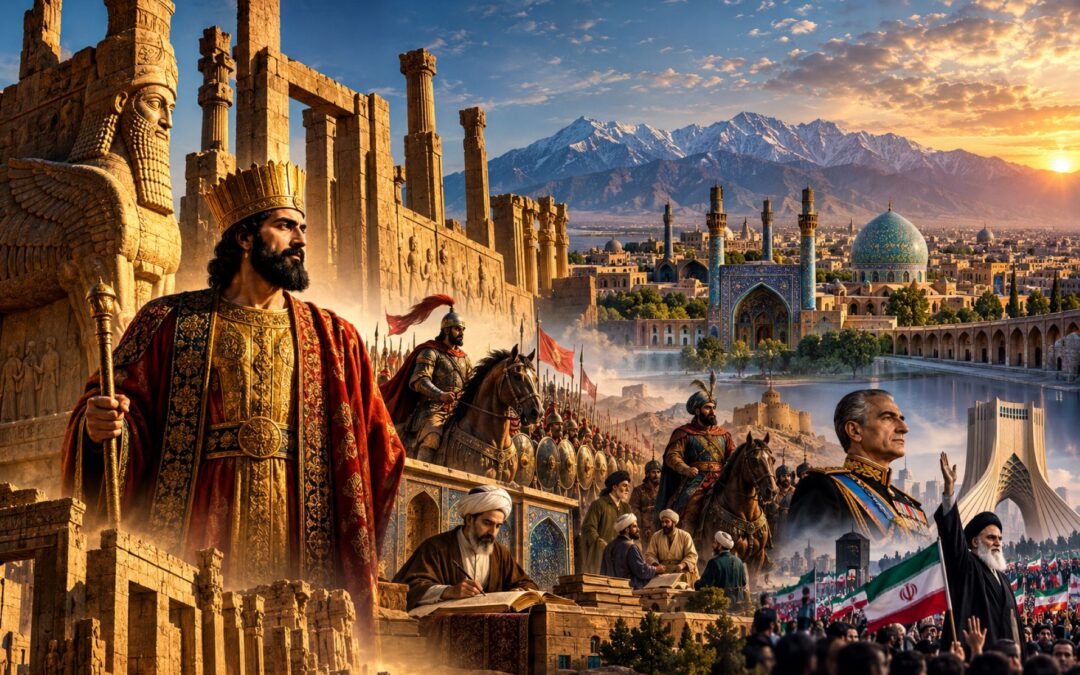
The history of Persia is a history of empires that disappeared and a civilization that repeatedly survived them. From the ancient cities of Elam to the Achaemenid kings, from Alexander’s conquests to the rise of Islam, and from the Safavid shahs to the modern Islamic Republic, the Iranian world has experienced extraordinary changes in government, religion, territory and culture. Its cities have been captured, ruling families overthrown and political institutions dismantled, sometimes with devastating consequences for the people who lived under them.
Yet these upheavals did not erase the cultural and political identity associated with Iran. The Achaemenid, Parthian, Sasanian, Safavid, Qajar and Pahlavi states were not successive governments of one uninterrupted empire. Their territories, languages of administration, religious commitments and systems of rule were often profoundly different. Understanding Persian history therefore requires explaining both what changed and what connected those transformations.
The distinction between Persia and Iran is important. Persia derives from Parsa, the southwestern homeland of the ancient Persians, known to Greek writers as Persis. Iran comes from an indigenous tradition associated with the lands of Iranian peoples. Although both names had long histories, Reza Shah’s government requested in 1935 that foreign governments use Iran more widely in official communication. Persia remains common when discussing the country’s ancient empires and cultural heritage, while Iran is the name of the modern state.
There is also a larger Persianate world that extends beyond Iran’s borders. For centuries, Persian language, literature, political traditions and court culture influenced societies across Central Asia, Anatolia, Afghanistan and the Indian subcontinent. Some of the rulers who promoted these traditions were not ethnically Persian, and many governed territories far removed from the Iranian plateau.
Geography helps explain the region’s extraordinary history. Iran occupies a strategic position between Mesopotamia, the Caucasus, Central Asia, India and the Persian Gulf. These connections made its cities valuable centres of trade and its territories desirable to conquerors. Mountains and deserts complicated invasion, but they never made the region impregnable.
Persian civilization endured not because its people preserved an unchanged political order, but because successive societies adapted inherited institutions, languages, religious practices and cultural memories to new conditions. The result was a history in which conquest repeatedly transformed Persia, while governing Persia often transformed its conquerors.
The Iranian Plateau Before Persia: Elam, Susa, and Migration
Long before Cyrus the Great established the first Persian Empire, the Iranian plateau was home to agricultural communities, trading settlements and organized political societies. Its history began thousands of years before the appearance of Persian-speaking kingdoms, and the institutions inherited from these earlier societies would influence the development of later empires.
The plateau’s geography was both an obstacle and an advantage. The Zagros Mountains rise above the Mesopotamian lowlands in the west, while the interior contains deserts, highlands, fertile valleys and areas of sparse rainfall. The Caucasus and Caspian region lie to the north, Central Asia and Afghanistan to the east, and the Persian Gulf to the south. Communities therefore developed different combinations of farming, herding, irrigation and trade depending upon local conditions.
Unlike the Nile Valley or southern Mesopotamia, much of Iran could not depend upon one enormous river system to support dense settlement. Farmers cultivated land near mountain streams and seasonal water supplies, while pastoral communities moved animals between grazing grounds. Water management became fundamental to settlement and political power, a problem that Iranian societies would confront throughout their history.
Archaeological evidence places farming communities in western Iran during the Neolithic period. Over many centuries, inhabitants cultivated grains and legumes, domesticated animals and established increasingly permanent settlements. By the fifth millennium BCE, Susa had emerged in southwestern Iran as an important urban centre.
Susa’s extraordinary history demonstrates why Persian civilization cannot be understood solely through dynasties. The city remained important under Elamite, Achaemenid, Seleucid, Parthian and Sasanian authority. Its rulers, languages and religious institutions changed, but its location and accumulated infrastructure repeatedly made it valuable to new political systems.
The earliest major civilization associated with southwestern Iran was Elam. This name describes a long succession of kingdoms and political formations rather than one nation that remained unchanged for thousands of years. Elamite power was concentrated in areas including Susa and Anshan, and its rulers maintained complicated relationships with neighbouring Mesopotamian civilizations.
Those relationships involved conflict as well as exchange. Elamite armies sometimes intervened in Babylonian politics, while Sumerian, Akkadian, Babylonian and Assyrian rulers attacked territories associated with Elam. Control of the borderlands shifted repeatedly, and communities on both sides influenced one another through warfare, migration, commerce and administrative cooperation.
Elamite political culture developed writing traditions that reveal both the sophistication and the limits of our knowledge. The earliest Proto-Elamite documents, dating to roughly the late fourth and early third millennia BCE, used a script that scholars have deciphered only partially. Later Elamite cuneiform, however, is substantially readable. As the Encyclopaedia Iranica’s examination of Proto-Elamite writing explains, the two traditions should not be confused or treated as equally mysterious.
The Elamite language was neither Semitic nor Indo-European. Although it eventually disappeared as a living language, it survived in the administration of the early Persian Empire, illustrating how older institutions could remain useful after a new ruling people gained control.
Elam also belonged to extensive trading networks. Stone, metal, timber, agricultural goods and manufactured objects moved through connections joining the Iranian plateau, Mesopotamia, the Persian Gulf and Central Asia. Trade also linked these areas with the societies of the Indus Valley Civilization, whose merchants and producers participated in wider Bronze Age exchange systems.
It would nevertheless be misleading to claim that the Elamites were simply an earlier form of the Persians. Their language and social traditions were distinct, and the precise extent of their influence upon later Persian religion, culture and government remains debated. What can be established is that Persian political power eventually emerged in a landscape already shaped by cities, administrative practices and interconnected populations.
During the second millennium BCE, communities speaking Iranian languages gradually entered and spread across the plateau. These languages belonged to the Indo-Iranian branch of the wider Indo-European language family, connecting the linguistic histories of ancient Iran and parts of South Asia.
The arrival of Iranian-speaking populations was neither one sudden invasion nor a complete replacement of earlier inhabitants. Settlement, migration, intermarriage, competition and cultural exchange unfolded over centuries. Peoples later known as Medes, Persians and Parthians occupied different regions while interacting with established communities.
By the first millennium BCE, Iranian-speaking groups had become important political forces across much of the plateau. But the society from which the Persian Empire emerged was already culturally mixed, with enduring Elamite administrative traditions and extensive connections to older Near Eastern civilizations.
The Persians did not construct their empire upon an empty landscape. They inherited a world in which trade routes, agricultural settlements, urban institutions and traditions of kingship had already developed over thousands of years.
Cyrus the Great Creates an Empire of Many Peoples
The rise of Persian imperial power was made possible by a major transformation in the politics of western Asia. For generations, Assyria had dominated the region through powerful armies, systems of tribute and the intimidation or destruction of rebellious cities. Its rulers extended their influence over Mesopotamia and neighbouring territories, but maintaining such a large political system required continuous military and administrative effort.
During the seventh century BCE, Assyrian power weakened under pressure from several opponents. Among them were the Medes, Iranian-speaking peoples who had established themselves across parts of the western plateau. In 612 BCE, Median and Babylonian forces captured Nineveh, helping destroy the political centre of the Assyrian Empire.
The precise organization of the Median state remains uncertain. Greek accounts describe successive kings ruling a centralized empire, but modern scholars disagree about how firmly Median leaders controlled the territories attributed to them. The Medes were certainly a major political force, although their system may have depended more heavily on alliances and regional authorities than later narratives suggest.
One group within their sphere of influence was the Persians of southwestern Iran. Their ruling dynasty, subsequently known as the Achaemenids, held power in the region of Parsa. During the middle of the sixth century BCE, its most famous ruler, Cyrus II, challenged the Median king Astyages.
Later traditions embellished Cyrus’s origins with prophecies, royal conspiracies and stories of a threatened child destined to rule. Such narratives explain how ancient writers imagined the rise of a great king, but they cannot be treated as reliable accounts of every event. The central historical development is clear: Cyrus defeated Astyages around 550 BCE and took control of a far larger political network.
This victory marked the beginning of an extraordinary expansion. Cyrus incorporated Median elites and institutions into the new monarchy rather than attempting to eliminate every existing arrangement. Persian supremacy therefore emerged through conquest combined with political accommodation, establishing a pattern that helped the empire govern culturally diverse territories.
Cyrus next moved west against Lydia, the wealthy kingdom ruled by Croesus. Lydia controlled important territories in Anatolia, including regions closely connected to Greek settlements along the Aegean coast. Its conquest extended Persian authority toward the Mediterranean and placed several Greek-speaking communities under imperial rule.
Persian forces also campaigned in eastern territories toward Central Asia. The precise sequence and geographical reach of these operations remain uncertain, but they helped establish a political domain stretching far beyond the Persian homeland.
Cyrus’s most consequential conquest came in 539 BCE, when Persian forces entered Babylon. The city was one of the ancient world’s greatest religious, political and commercial centres, and its kingdom controlled Mesopotamia and important territories farther west. Capturing it gave Cyrus access to immense resources, established administrative institutions and a prestigious tradition of monarchy.
Rather than presenting himself solely as a foreign conqueror, Cyrus adopted the language of Babylonian kingship. He portrayed his rule as the restoration of proper religious and political order after the failures attributed to the previous king, Nabonidus. This strategy helped him claim legitimacy within a society whose inhabitants did not share Persian language or religious traditions.
The clearest surviving illustration is the Babylonian inscription known as the Cyrus Cylinder. Written in Akkadian, it represents Cyrus as a king favoured by the Babylonian god Marduk and presents his conquest as a legitimate restoration. It describes actions involving temples, cult images and the return of communities or religious objects displaced under earlier rulers.
In modern discussions, the cylinder is sometimes presented as the world’s first declaration of human rights. That interpretation imposes contemporary political concepts upon an ancient royal inscription. Cyrus did not proclaim equality before the law, freedom of expression or universal rights in the modern constitutional sense.
Nevertheless, the inscription reveals an important feature of Achaemenid politics. Successful conquest did not necessarily require destroying every institution of a defeated society. Religious accommodation, preservation of local elites and continuity in administration could help establish durable imperial authority.
The biblical tradition remembered Cyrus particularly favourably. His policies permitted Judean exiles and their descendants to return toward Jerusalem and rebuild their religious community, making him an exceptional foreign ruler in Jewish religious memory. The association with restoration contributed greatly to his later reputation.
But accommodation should not be confused with an absence of coercion. The Persian Empire remained a monarchy established by military force, demanding obedience, taxation and material contributions from its subjects. Rebellions could be punished severely, and populations remained unequal within an imperial hierarchy.
Cyrus’s achievement lay in creating a political order capable of controlling societies without making all of them culturally Persian. Local religions, laws and administrative traditions could continue when they were compatible with imperial authority. This flexibility helped stabilize an empire that eventually extended from Egypt and Anatolia through Mesopotamia and Iran toward Central Asia and the Indus region.
The Metropolitan Museum of Art’s history of the Achaemenid Empire places its formation around 550 BCE and identifies it as the largest territorial empire the ancient world had yet experienced. Such dimensions created challenges that no king could solve through military campaigning alone.
Cyrus died around 530 BCE while campaigning in Central Asia, although the details of his final expedition remain uncertain. His tomb at Pasargadae survives as one of the most recognizable monuments of early Persian kingship.
His lasting importance was institutional as much as territorial. He created an empire through conquest, but he also demonstrated how preserving useful local political and religious arrangements could help hold that empire together. His successors would transform this foundation into a more elaborate system of imperial government.
Darius Builds the Machinery of Persian Rule
The Achaemenid Empire expanded further under Cyrus’s son Cambyses II, who invaded Egypt in 525 BCE. Egypt possessed enormous agricultural resources, strategic access to the Mediterranean and Red Sea, and a long-established monarchy supported by powerful temples. Its conquest brought the Nile Valley within the Persian imperial system, although the region would periodically rebel against foreign rule.
Cambyses’s death in 522 BCE triggered a succession crisis. Darius I emerged as king after defeating rival claimants and suppressing rebellions in several parts of the empire. His own royal account, preserved in the Behistun inscription, presented his accession as the defeat of illegitimate opponents, but the circumstances remain contested.
Darius needed to achieve something more complicated than defeating his enemies. He had to make the authority of one monarch function across enormous distances, multiple languages and populations with different traditions of law, religion and government.
The empire operated through provincial jurisdictions conventionally called satrapies. Satraps exercised authority over taxation, administration and political order, although their powers differed from region to region. Some territories preserved local kings and temple authorities, while others were governed more directly by imperial officials.
The satrapy system was not simply invented in one moment by Darius. It developed from older Near Eastern administrative practices and earlier Achaemenid arrangements. Darius’s significance lay in consolidating these systems and establishing more regular structures through which the king could supervise provincial government.
Because powerful governors might become threats to the monarchy, imperial administration involved forms of oversight. Military authority, financial responsibilities and provincial inspection could be distributed among different officials. Royal messengers and trusted representatives connected provincial centres with the court, while Persian and Median aristocratic families provided important personnel for the governing network.
Taxation also became increasingly systematic. Provinces contributed different combinations of silver, agricultural products, animals, labour and other resources, reflecting their local economies. Darius promoted imperial coinage, particularly the gold daric and silver siglos, although many regions continued using existing currencies and commercial practices.
A striking feature of Persian administration was its multilingual character. Old Persian served an important purpose in royal inscriptions, but Imperial Aramaic became widely useful for written communication across the empire. Elamite remained important within the central administrative economy, while Babylonian, Egyptian, Greek and other languages continued in their own settings.
The Persepolis Fortification Tablets studied and published by the University of Chicago reveal how the system worked in ordinary administrative life. Thousands of records document movements of food commodities, rations, travellers, workers and official authorizations. They show the practical organization underlying the grandeur displayed in royal architecture.
These tablets are especially important because much of the surviving narrative history of Persia was written by outsiders. Administrative records reveal economic activities and social relationships that literary accounts concerned with battles and kings frequently overlook.
Women appear within this evidence as recipients of rations, workers, supervisors and people responsible for economic resources. Certain elite women controlled estates and maintained substantial administrative influence. These findings challenge the assumption that women were entirely absent from Achaemenid public economic life, but they do not establish universal equality across gender, class or legal status.
Communication was another essential component of imperial government. Roads linked major political centres, and the famous route between Susa and Sardis connected the Iranian heartland with western Anatolia. Official couriers travelled through relay stations where fresh horses and provisions helped transmit messages more rapidly than ordinary travellers could manage.
These networks drew upon and expanded older routes rather than appearing entirely through a single royal invention. Their importance was the combination of transportation, administrative coordination and reliable movement of information. An empire that could communicate quickly across great distances could respond more effectively to rebellions, collect resources and coordinate armies.
Water management was equally important in the dry environments of the Iranian plateau. Among the most influential technologies were qanats, underground channels that tapped groundwater and carried it by gravity toward agricultural fields and settlements. Their design reduced evaporation and allowed communities to cultivate lands far from permanent surface rivers.
UNESCO’s account of the Persian qanat system illustrates the sophisticated engineering and communal management involved. These systems depended upon technical knowledge, maintenance labour and rules governing water distribution, making them social institutions as much as engineering works.
It would be inaccurate to credit Darius or another Persian ruler with inventing every technology associated with Iranian irrigation. Some systems developed through processes spanning different cultures and historical periods. The Shushtar Historical Hydraulic System, for example, preserves a complex engineering landscape with ancient foundations and important later contributions, including influences associated with Roman engineering.
Achaemenid kings maintained several centres of political authority. Susa served as an important administrative capital, Babylon retained its economic and ceremonial significance, and Ecbatana continued as a major royal residence. Darius also began building Persepolis, which became a monumental expression of Persian kingship.
The terraces, palaces and reliefs of Persepolis represented the empire as an ordered association of different peoples under royal authority. Delegations appear wearing distinctive clothing and carrying regional gifts or tribute. The imagery emphasized both cultural diversity and political hierarchy, presenting the king as the centre through which the empire’s many territories were connected.
Religion also reflected the complexity of imperial life. Achaemenid inscriptions invoke Ahura Mazda, the great deity associated with Zoroastrian tradition, but the date of Zoroaster and the exact development of early Zoroastrianism remain uncertain. It is therefore misleading to treat the entire Achaemenid state as a fully developed religious system identical to later Zoroastrian institutions.
The monarchy generally permitted different religious traditions to continue, particularly when their institutions cooperated with imperial rule. Egyptian temples, Babylonian cults, Iranian religious practices and the beliefs of numerous other communities existed within the same political structure.
Darius’s great achievement was making imperial diversity governable. Military power remained indispensable, but the empire also depended upon taxes, documents, roads, communication, administrative supervision and arrangements with regional elites. His reforms helped transform the conquests of Cyrus into a political system capable of lasting for nearly two centuries.
Persia and Greece: A Frontier, Not the Whole Empire
The Persian Empire occupies an enormous place in Western historical memory because of its wars with the Greek city-states. Battles such as Marathon, Thermopylae and Salamis became symbols of Greek resistance against imperial power. Yet these conflicts represented only one frontier of a much larger empire, and their significance looks different when viewed from the Persian political centre.
The Greek world was not a unified country. It consisted of independent cities, kingdoms and communities frequently divided by military rivalry and competing political interests. Some Greek cities were already under Persian rule in western Anatolia, while others maintained independence across the Aegean.
Tensions increased when Greek communities in Ionia rebelled against Persian authority in the early fifth century BCE. Athens supported the revolt, bringing the conflict more directly into mainland Greek politics. Darius subsequently launched an expedition that ended in the Persian defeat at Marathon in 490 BCE.
Marathon was important to Athenian identity and demonstrated the effectiveness of Greek infantry under particular battlefield conditions. But Persia’s defeat did not destroy its army, undermine the monarchy or threaten the survival of the imperial state. Its major political and economic centres remained secure far from the Greek mainland.
Darius died before another major expedition could take place. His son Xerxes I assembled a far larger campaign in 480 BCE, crossing into Greece with substantial land and naval forces. At Thermopylae, Persian troops overcame Greek defenders led by the Spartan king Leonidas after resistance along the narrow pass.
The famous account of 300 Spartans is only part of the battle’s history. Other Greek contingents participated in the defence, and the conflict occurred within a broader campaign involving allied fleets and military operations across several regions.
Persian forces advanced and occupied an evacuated Athens, but the campaign encountered growing logistical and military difficulties. A coalition of Greek naval forces defeated the Persian fleet at Salamis, after which Xerxes withdrew with much of his army. The remaining Persian forces were defeated at Plataea in 479 BCE.
These victories prevented Persian domination of mainland Greece and became central to later Greek political culture. They also influenced the narratives preserved by ancient historians, particularly Herodotus, whose writings explored the rise of Persia and the origins of the conflict.
The value of Herodotus’s account of the Persian Wars is immense, but his work must be read as a literary and historical investigation shaped by the perspectives and sources available to him. Stories about Persian royal behaviour, military numbers and the motives of individual kings do not automatically provide neutral evidence.
Greek victory did not end Persian influence in the Aegean. The Achaemenid monarchy remained the dominant power across western Asia, while Greek states continued struggling among themselves. Persian rulers periodically used diplomacy, financial support and shifting alliances to influence those rivalries without needing permanent occupation of mainland Greece.
The wars also demonstrate why imperial power should not be measured solely by spectacular battles. The Persian state controlled vast agricultural territories, important trade routes, major cities and enormous administrative resources. Greece was significant, but it was not the centre of the imperial economy.
At the same time, Achaemenid rule was not a peaceful federation of equals. Imperial dominance relied upon taxation, hierarchy, aristocratic privilege and military force, and rebellions elsewhere could face harsh punishment. The Persian monarchy remained vulnerable to succession crises, court rivalries and problems of controlling distant provinces.
For generations after Xerxes, however, the empire continued to function. Its eventual collapse would come not directly from the victories of the Greek city-states, but from the emergence of a new military power in Macedonia and a campaign that reached the empire’s political heartland.
Alexander’s Conquest and the Survival of Persian Institutions
The conquest of Persia by Alexander the Great is sometimes presented as the inevitable defeat of a declining empire by a brilliant young commander. That interpretation understates the strength of the Achaemenid state and oversimplifies the causes of its collapse. Alexander’s success depended upon exceptional military organization, political circumstances, Persian defeats and the ability to exploit a crisis of royal authority.
Much of the groundwork had been established by Alexander’s father, Philip II of Macedonia. Philip transformed his kingdom into a dominant military force through organizational reforms, disciplined infantry armed with long pikes, effective cavalry and increasingly sophisticated siege warfare. His victory over a coalition of Greek cities gave him substantial influence over the Greek mainland.
Philip intended to invade the Persian Empire but was assassinated in 336 BCE before the expedition began. His young son inherited both the military system and the political risks created by Macedonian dominance. Alexander moved quickly to secure the throne, suppress opposition and demonstrate that rebellion would be punished.
When Thebes attempted to regain independence, Alexander destroyed the city in 335 BCE. The action demonstrated his ruthlessness and warned other Greek communities against challenging Macedonian authority.
In 334 BCE, Alexander crossed into Anatolia with an experienced army. His victory at the Granicus River gave him access to important territories in western Asia Minor, where Persian power depended upon provincial authorities and local alliances.
The next major confrontation came at Issus in 333 BCE, where Alexander defeated forces commanded by Darius III. The constrained battlefield reduced some advantages associated with the Persian army’s size, while Alexander’s disciplined infantry and cavalry manoeuvres placed the royal position under severe pressure.
Darius withdrew from the battle when his position became dangerous. Greek and Roman accounts subsequently treated his retreat as evidence of cowardice, but such descriptions reflect traditions that celebrated Alexander and often portrayed Persian kings negatively.
A ruler’s decision to leave a battlefield could have enormous consequences for an imperial army, particularly when royal presence helped maintain political cohesion. That does not make a single character judgment an adequate explanation for the defeat of a major state.
Alexander then moved south through the Levant. Tyre resisted his siege for months before falling in 332 BCE, after which many inhabitants suffered killing or enslavement. Gaza also resisted and faced severe punishment, demonstrating that Macedonian conquest could be extraordinarily violent.
Egypt came under Alexander’s authority with much less resistance. He adopted the position of pharaoh and founded Alexandria, which would become one of the Mediterranean world’s greatest centres of commerce and scholarship. By presenting himself through existing Egyptian political and religious traditions, he demonstrated an approach to legitimacy that the Persian kings themselves had often used.
Darius attempted to negotiate and offered territory and a dynastic marriage alliance. Alexander refused, increasingly pursuing control of the entire empire rather than a limited campaign against Persia’s western possessions.
The decisive confrontation occurred at Gaugamela in 331 BCE. Darius selected open terrain intended to favour his army’s numerical strength and manoeuvrability, but Alexander’s forces exploited openings in the Persian formation. Macedonian cavalry drove toward the royal position, causing Darius to withdraw as the battle turned against him.
The defeat destroyed the Persian army’s immediate ability to protect the imperial centres. Alexander entered Babylon and Susa, gaining access to enormous royal treasuries, before advancing into the Persian homeland.
Persepolis was captured and looted, and part of its palace complex was burned. Ancient writers disagreed over the immediate cause, variously presenting the destruction as deliberate revenge for the Persian invasion of Greece or as the consequence of reckless celebration.
Whatever motivated the fire, its symbolic significance was unmistakable. A monument representing the wealth and authority of Achaemenid kingship had been destroyed by a Macedonian conqueror who now claimed the same imperial inheritance.
Darius fled east, attempting to regroup and mobilize resistance. He was eventually seized and killed by members of his entourage. Alexander pursued those responsible and represented himself as the avenger of the fallen king, an important step in claiming legitimacy among Persian elites.
The collapse of the Achaemenid state should not be understood as proof that it had already ceased functioning before Alexander arrived. Its resources remained substantial, and the empire was capable of fielding powerful armies. Resistance continued in several territories, while provincial loyalty shifted under the pressure of military defeat.
Alexander’s victory was therefore political as well as military. Defeating Darius removed the figure around whom imperial authority had been organized, while the capture of major cities and treasuries made Alexander an increasingly plausible alternative sovereign.
Nor did Alexander attempt to abolish every Persian institution. He retained elements of the satrapy system, appointed Iranian officials, adopted aspects of royal ceremony and increasingly presented himself as a legitimate successor to the Achaemenids.
He married Roxana, a noblewoman from Central Asia, and later married Stateira, a daughter of Darius III. At Susa, he also arranged marriages between Macedonian officers and women from Persian aristocratic families. Iranian troops entered his service, and some were trained in Macedonian military methods.
These policies created considerable tension. Macedonian veterans had followed Alexander as conquerors of Persia, and some resented the elevation of Iranian nobles or the adoption of ceremonial practices associated with the defeated monarchy. Alexander, meanwhile, needed a way to rule Iranian territories without relying forever on a relatively small foreign military elite.
His programme of integration remained incomplete when he died in Babylon in 323 BCE. He left no mature successor capable of holding the empire together, and his generals began fighting for control.
The eastern territories eventually fell under the Seleucid dynasty, established by Seleucus I. Greek and Macedonian settlers founded or expanded urban centres, while Greek became an important language of administration, military organization and elite culture.
In Central Asia, Greco-Bactrian kingdoms developed societies shaped by Hellenistic, Iranian and Indian influences. Alexander’s own campaign into northwestern India and the subsequent struggles involving Seleucus and Chandragupta Maurya also connected the history of Persia with the wider history of India.
Hellenistic rule did not eliminate local languages, religions or social structures across the Iranian plateau. Its strongest influence often appeared in cities, elite institutions and military settlements, while rural communities preserved many earlier traditions.
Alexander destroyed the Achaemenid political order but could not remove the societies from which that order had drawn its strength. In attempting to govern the conquered territories, he adopted important features of the imperial system he had defeated. The same pattern would reappear under later dynasties.
The Parthians Between Rome and the Silk Roads
After the breakup of Alexander’s empire, the Iranian plateau experienced a prolonged period of Hellenistic rule and competition between regional powers. Greek-speaking cities and Seleucid institutions became important, but control from the western imperial centres weakened as political pressures accumulated across distant territories.
The Parthians emerged from the northeastern frontier, where agricultural communities of the Iranian plateau interacted with nomadic and semi-nomadic groups of Central Asia. During the third century BCE, the Parni, an Iranian-speaking people associated with the Dahae confederation, entered the Seleucid province of Parthia.
Under Arsaces and his successors, they established the Arsacid dynasty. At first, the new kingdom was relatively small, but its rulers gradually extended their authority across northeastern and central Iran. The greatest early expansion occurred under Mithridates I during the second century BCE, when Parthian power advanced into Media and Mesopotamia.
The Parthians revived Iranian political rule without simply restoring the Achaemenid system. Their monarchy was more decentralized, with considerable authority retained by great aristocratic families, local rulers and powerful regional communities. This arrangement helped incorporate established elites, but it also made royal succession and political unity vulnerable to rival factions.
It would be inaccurate to describe Parthian government as a constitutional monarchy where nobles peacefully elected or dismissed kings through a stable voting system. Aristocratic families could influence succession and remove rulers, but contests for power frequently involved armed conflict, conspiracies and competing claims to the throne.
Hellenistic traditions also remained important. Greek appeared on Parthian coins and in administrative and urban life, particularly during the earlier centuries of Arsacid rule. Royal imagery and artistic styles combined Greek, Mesopotamian and Iranian features, showing that the restoration of Iranian political power was not a rejection of everything introduced after Alexander.
Parthian military strength depended heavily upon cavalry. Mounted archers could harass enemy formations while remaining mobile, and heavily armoured cavalry known as cataphracts could deliver powerful attacks once an opponent became disorganized.
One famous tactic was the Parthian shot, in which an archer turned in the saddle to fire backwards while riding away from an enemy. This technique exploited equestrian and archery traditions associated with the wider Eurasian steppe and became one of the most recognizable symbols of Parthian warfare.
The effectiveness of these methods became unmistakable to Rome in 53 BCE. Marcus Licinius Crassus invaded Parthian-controlled territory with a large Roman force, hoping to extend Roman influence and win military glory.
At the Battle of Carrhae, Parthian horse archers repeatedly attacked Roman formations while avoiding prolonged close combat. Supplies of arrows, transported with the army, allowed the attacks to continue, while armoured cavalry threatened Roman troops whenever their formations weakened.
The Roman army suffered a catastrophic defeat, and Crassus died during the failed campaign. Later writers claimed that molten gold was poured into his mouth as punishment for greed, but the story belongs to the moralizing traditions surrounding his death rather than firmly established history.
Carrhae revealed the limitations of Roman military methods under conditions that favoured mobile cavalry and long-distance harassment. It also demonstrated the logistical difficulties involved in invading territories where an opponent could retreat across enormous distances and avoid decisive confrontation.
Rome and Parthia subsequently competed for centuries over Armenia, northern Mesopotamia and the strategic routes connecting the Mediterranean to the Iranian world. Both sides occasionally captured important cities, but neither established lasting control over the other’s principal territories.
Parthian power also depended upon its position within international trade. Goods, diplomatic missions, technologies and artistic influences moved through territories connecting Rome, Central Asia, India and China.
These exchanges formed part of the overlapping routes commonly described as the Silk Roads. No single government controlled every stage of those networks. Parthian rulers benefited from the movement of goods and the revenues associated with trade, while merchants and intermediaries operating across multiple political zones carried much of the commerce.
Religious life was similarly diverse. Iranian deities coexisted with Greek, Mesopotamian, Jewish and other local traditions. Mithra remained important within Iranian religious culture, but the Roman mystery religion of Mithraism cannot be treated as a straightforward reproduction of Persian worship. Its development occurred within a different religious environment.
By the early third century CE, succession disputes, aristocratic rivalry and continued conflict with Rome weakened the monarchy. In the southwestern region of Persis, a ruler named Ardashir challenged the Arsacid king Artabanus IV.
Ardashir defeated him in 224 CE, bringing nearly five centuries of Arsacid dominance to an end. The new dynasty would preserve elements of Parthian aristocratic and administrative life while presenting itself as the restorer of a more centralized Iranian empire.
The Sasanians: Imperial Revival and Exhausting War
The Sasanian dynasty arose from the same southwestern region associated with the ancient Persians. Its founder, Ardashir I, did not describe his victory over the Parthians merely as a change of ruling family. He presented his monarchy as a restoration of Iranian kingship, drawing upon older traditions of royal authority and the prestige of Persia’s imperial past.
Sasanian rulers used the title king of kings and developed an elaborate ceremonial culture. Rock reliefs, inscriptions, royal residences and monumental architecture expressed an image of political authority sanctioned by divine power. Although their precise knowledge of Achaemenid history was limited, they cultivated a vision of Iranian kingship reaching beyond their immediate dynasty.
The new monarchy was generally more centralized than the Arsacid system, although powerful noble families continued to influence political and military affairs. Royal officials, landholding elites, provincial authorities and religious institutions formed a complicated governing structure that evolved throughout Sasanian history.
Zoroastrianism acquired a stronger institutional relationship with the state. Fire temples, priests and religious law became important components of royal legitimacy and public life. Yet the relationship between monarchy and religion changed between rulers, and the population was never uniformly Zoroastrian.
The Sasanian Empire contained Christians, Jews, Buddhists, Manichaeans and communities following other religious traditions. Their treatment depended upon political circumstances, royal policies and the relationship between the monarchy and neighbouring powers.
Christian populations could face suspicion during wars with Christian Rome, particularly when Sasanian rulers feared that religious ties might create political loyalties across the frontier. At other times, local Christian churches enjoyed greater acceptance, especially when they established identities distinct from the imperial church of Rome.
Jewish communities in Mesopotamia became important centres of religious learning. Scholars working within the Sasanian world contributed to the intellectual traditions that produced the Babylonian Talmud, illustrating the region’s importance beyond Zoroastrian political culture.
Another significant religious movement emerged through the teachings of Mani in the third century. Manichaeism presented a universal religious vision drawing upon ideas associated with Zoroaster, Buddha and Jesus, and it spread from the Middle East through Central Asia and eventually into China.
Its teachings challenged established authorities, and Mani was executed under Sasanian rule. His followers subsequently faced persecution under several governments. Even after the religion disappeared as a major organized tradition, its treatment of light and darkness, matter and spirit, and human salvation remained part of broader intellectual history.
The Sasanians also became Rome’s most powerful eastern rival. Their struggle involved control of Armenia, Mesopotamia, the Caucasus and strategic territories connecting the Mediterranean with Iran.
Under Shapur I, Persian armies inflicted extraordinary defeats upon Roman forces. In 260 CE, they captured the Roman emperor Valerian, an event of enormous symbolic importance that demonstrated the Sasanian state’s military capacity.
The conflict was never one uninterrupted war. Periods of invasion, siege and frontier campaigning alternated with treaties, diplomacy, commercial exchange and temporary cooperation. Both empires claimed exceptional political legitimacy and sought influence over neighbouring kingdoms.
The rivalry also encouraged cultural and technological exchange. Military techniques, court ceremonies, luxury goods, architectural forms and political ideas crossed the frontier even when the two governments regarded one another as enemies.
Sasanian trade connections extended toward India, Central Asia and China. Iranian merchants participated in commerce across the Persian Gulf, Indian Ocean and overland Eurasian routes, transporting textiles, precious metals, spices and other valuable goods.
The Metropolitan Museum of Art’s account of the Sasanian Empire demonstrates how its artistic traditions reached far beyond Iran. Silver vessels, textiles, royal hunting imagery, domed architectural spaces and other visual forms influenced later Islamic societies and cultures across Eurasia.
Despite these achievements, the dynasty’s final century brought increasingly destructive warfare. During the early seventh century, Khosrow II launched a major campaign against the Byzantine Empire, whose political centre was Constantinople.
Sasanian armies captured Syria, Palestine and Egypt and advanced deep into Byzantine territories in Anatolia. Their victories appeared to bring the Roman imperial system close to collapse.
But the Byzantine emperor Heraclius reorganized his forces and launched counteroffensives into Sasanian territory. The balance of power changed dramatically, and in 628 Khosrow II was overthrown and killed by members of the Persian political elite.
The war ended without establishing a durable victor. Both sides recovered much of their earlier territory, but decades of campaigning had severely damaged taxation, agriculture, local authority and military resources. Disease, including outbreaks of plague, compounded these pressures.
The Sasanian monarchy then descended into rapid succession crises. Competing claimants occupied the throne, sometimes for only brief periods, while provincial commanders and aristocratic families struggled for influence.
It was during this period of exhaustion that Arab Muslim armies entered Mesopotamia and the Iranian world. The conquests were not inevitable, and Persian forces continued resisting through major campaigns.
Nevertheless, the defeat at al-Qadisiyyah opened Mesopotamia to further advances. Ctesiphon, the great Sasanian imperial capital, fell, and the subsequent defeat at Nahavand in the 640s further undermined organized resistance.
The last Sasanian king, Yazdegerd III, fled east while attempting to rebuild support. He was killed in 651, ending the dynasty that had ruled Iran for more than four centuries.
The fall of the Sasanians ended the last great pre-Islamic Persian empire. But the administrative knowledge, cities, languages and cultural traditions developed under its rule remained available to the societies that followed.
Arab Conquest, Conversion, and the Reinvention of Persian Identity
The Arab conquest of Iran represented one of the deepest transformations in Persian history. The Sasanian monarchy disappeared, the political position of Zoroastrian institutions changed, and Arabic-speaking Muslim rulers established authority across territories that had been governed for centuries by Iranian kings.
Yet the disappearance of the Sasanian state did not mean that Iran immediately became culturally Arab or uniformly Muslim. Military conquest, religious conversion, linguistic development and changes in social identity occurred through different processes and at different speeds.
During the first generations of Muslim rule, Zoroastrian communities remained substantial in many areas. Christians, Jews and other religious groups also continued to live within the territories of the new caliphates.
Non-Muslim subjects generally occupied a recognized but unequal position, often involving payment of the jizya tax. Local conditions varied, and conversion could be influenced by religious conviction, access to political authority, family connections, economic opportunity, social pressure and changing legal obligations.
Some communities experienced coercion, warfare, discrimination or the loss of religious institutions. Others maintained established practices for generations. The historical record does not support either the claim that every Iranian was instantly forced to convert or the opposite claim that religious change occurred without pressure or conflict.
As the Encyclopaedia Iranica’s study of Iranian conversion to Islam explains, the process unfolded across centuries and requires attention to regional differences. Islam gradually became the dominant religion, but Iranian society changed through sustained interaction between older traditions and the new religious order.
The conquerors also encountered a practical administrative problem. Governing Iran required knowledge of taxation, agriculture, record-keeping, urban institutions and provincial politics. Officials experienced in earlier systems remained valuable even when their rulers had been defeated.
Some Iranian elites lost land, wealth or political authority. Others entered Muslim administration and contributed to the development of new institutions. Elements of Sasanian political practice therefore survived within the governments that replaced the monarchy.
Under the Umayyad Caliphate, political power was concentrated heavily among Arab ruling elites. Non-Arab converts sometimes experienced unequal treatment despite sharing the religion of the rulers. Such distinctions became sources of political resentment, although opposition to Umayyad government had several causes.
Eastern Iran, particularly Khurasan and territories extending into Central Asia, played a major role in the movement that overthrew the Umayyads during the eighth century. The Abbasid dynasty emerged with substantial support from these regions.
Abbasid political culture drew upon the administrative experience of several societies. Arab Islamic institutions combined with practices inherited from the Sasanian and other late antique worlds. Baghdad, established near the older centres of Mesopotamian imperial life, became a powerful political and intellectual centre.
Persian administrators influenced court ceremony, financial management and government organization. Yet Abbasid rule was not simply a restored Persian monarchy under a different name. Its political legitimacy remained tied to Islam and the caliphate, and Arabic continued as a major language of religion, scholarship and administration.
The Abbasid period also witnessed extraordinary intellectual exchange. Greek philosophical and scientific works were translated and debated, while Indian mathematical and astronomical traditions entered wider scholarly networks. Christian, Jewish, Persian, Arab and other scholars contributed to medicine, philosophy, mathematics, astronomy and literature.
The intellectual achievements commonly grouped under the Islamic Golden Age therefore cannot be credited exclusively to one ethnicity or civilization. They emerged through exchanges among many traditions supported by urban economies, political patronage and institutions of learning.
Persian contributions were nevertheless central. Iranian scholars participated in scientific and philosophical life, and Persian administrative and literary practices influenced political culture throughout much of the Islamic world.
Perhaps the most consequential development for Iranian identity was the rise of New Persian as a major written language. Middle Persian had survived the conquest, but Arabic acquired great prestige as the sacred language of Islam and a language of high scholarship.
From roughly the ninth century onward, New Persian developed into a flourishing literary language, generally written in a modified Arabic script and containing a substantial Arabic vocabulary. Its grammar and linguistic inheritance remained Iranian, and poets and scholars cultivated it across courts and cities in eastern Iran and Central Asia.
This revival was not simply a rejection of Islamic civilization. Persian literature developed within Muslim societies and incorporated Islamic learning alongside older Iranian narratives, legends and royal traditions.
The Samanid dynasty was particularly important in encouraging Persian literary and cultural development. Its courts helped create conditions in which New Persian could become a prestigious language of poetry, historical memory and administration.
The most famous literary monument of this revival was Ferdowsi’s Shahnameh, completed around the beginning of the eleventh century. Drawing upon older Iranian historical and legendary material, the poem presented a vast narrative of kingship, heroism, conflict and decline, extending from mythic origins to the Arab conquest.
The Shahnameh preserved an imaginative connection with pre-Islamic Iran while existing within a society profoundly shaped by Islam. Its importance was not merely literary: it provided a language through which successive generations could remember Iran’s ancient kingdoms without attempting to restore their exact political or religious institutions.
Persian soon became influential beyond the borders of Iran. Courts in Afghanistan, Central Asia, Anatolia and India adopted it for literature, administration and refined political culture. Many of these governments were ruled by people of Turkic or other origins.
The distinction between Persian ethnicity and Persianate culture became increasingly important. A dynasty did not need to descend from the ancient Persians to employ Persian secretaries, sponsor Persian poets or participate in traditions of Iranian royal legitimacy.
This was a remarkable transformation. Arab conquest had ended Zoroastrian imperial government, yet the new Islamic civilization absorbed significant elements of Iranian administration and culture. Persian identity, meanwhile, acquired new foundations in language, literature, religious life and historical memory.
Iran was no longer dependent upon the survival of one royal family to preserve a recognizable cultural identity. That flexibility would prove decisive when new conquerors arrived from Central Asia.
The Persianate World Under Caliphs, Turks, and Mongols
By the tenth century, the Abbasid caliphate’s direct political control had weakened across many territories. Regional rulers exercised increasingly independent authority, even when they continued recognizing the caliph’s religious or symbolic position.
Some of these rulers were Iranian in origin, while others belonged to Turkic-speaking military groups emerging from Central Asia. Their political histories were different, but many participated in an increasingly influential Persianate cultural world.
The Samanids promoted Persian language and literature across northeastern Iran and Central Asia. The Buyids, an Iranian dynasty, extended their authority into Iraq and entered Baghdad in 945, reducing the Abbasid caliph to a position with limited independent political power.
These developments illustrate the separation between religious legitimacy and actual political government. The caliph could remain an important symbol of the Muslim community even when military and administrative authority belonged to regional dynasties.
During the eleventh century, the Seljuk Turks established a major empire across Iran, Iraq and Anatolia. They entered Baghdad in 1055 and presented themselves as protectors of the Sunni caliphate.
The Seljuk military elite drew heavily upon Turkic traditions, but Persian officials and scholars played important roles in government. Viziers, scribes, judges, tax collectors and administrators employed institutions and forms of political knowledge developed within the Iranian and wider Islamic worlds.
Persian became an important language of court culture and government across many Seljuk territories. Poetry, architecture, scholarship and political literature flourished under rulers whose ancestors had originated among Central Asian military communities.
This combination of Turkic military authority, Persian administration and Islamic political legitimacy became a recurring feature of medieval Eurasia. It should not be understood as evidence that one cultural tradition simply replaced the others. Each contributed to governing systems that were continually adapted to local conditions.
Persian influence therefore extended well beyond periods when Iran possessed one unified sovereign empire. Governments in different territories could participate in related literary and administrative traditions while remaining politically independent or openly hostile to one another.
The Mongol invasions of the thirteenth century threatened these networks on an extraordinary scale. Forces associated with Genghis Khan entered Central Asia and northeastern Iran, confronting established kingdoms and cities.
Communities that resisted could experience massacres, enslavement and extensive destruction. Major urban centres were devastated, while warfare disrupted trade, agriculture and irrigation systems. Some regions suffered long-lasting demographic and economic decline.
The destruction also undermined institutions supporting scholarship and commerce. Although medieval narratives sometimes exaggerated casualty figures, the devastation of important towns and agricultural communities is well established.
In 1258, Hulagu, a grandson of Genghis Khan, captured Baghdad and ended the Abbasid caliphate’s political authority in the city. The conquest became a defining symbol of a major transformation in Middle Eastern political history.
Baghdad’s fall did not mean that intellectual and commercial life everywhere came to an end. Other centres continued operating, and new governments eventually supported the reconstruction of institutions damaged by warfare.
In Iran, the Mongols established the Ilkhanate, one of the major successor states of the wider Mongol Empire. Its earliest rulers belonged to political and religious traditions different from those of many of their subjects.
The Mongol elite nevertheless faced the familiar challenges of governing a settled agricultural society. Revenue depended upon cultivable land, functioning markets and officials capable of administering taxes and estates. Experienced Persian bureaucrats therefore became valuable members of the new government.
Over time, Ilkhanid rulers adopted elements of Islamic and Persian political culture, and several converted to Islam. Persian became increasingly important in official and literary life, while courts supported historians, architects, scientists and artists.
The relationship was not simple assimilation. Mongol rulers retained aspects of their own identity and political practices while creating a new ruling culture that combined Mongol, Iranian and Islamic elements.
Mongol imperial connections also altered long-distance exchange. For periods, the territories under related Mongol governments enabled extensive movement of merchants, diplomatic missions, technologies and artistic influences between Iran, Central Asia and China.
These exchanges could coexist with the consequences of conquest. The later patronage of learning and art did not erase massacres or repair every destroyed community. Some places recovered through new political arrangements, while others never regained their earlier prominence.
The history of Iran under the Seljuks and Mongols demonstrates an important distinction between political sovereignty and cultural influence. Iranian rulers could be displaced, cities could be devastated and foreign military elites could establish new governments, yet Persian literary culture and administrative knowledge remained valuable instruments of rule.
Timur, the Turkomans, and the Reassembly of Iran
The fourteenth century brought renewed instability to Iran and neighbouring regions. The fragmentation of Mongol political authority created competing states, while outbreaks of plague damaged populations, commerce and urban life. Communities already weakened by warfare faced additional economic and demographic pressures.
The Black Death spread through parts of western and central Asia during this period, affecting settlements and trade routes that connected the Iranian plateau with surrounding regions. The precise scale of its impact varied considerably, but it contributed to the difficulties confronting established political systems.
Toward the end of the century, Timur emerged as a formidable conqueror in Central Asia. His campaigns extended across Iran, the Caucasus, Mesopotamia, India and other territories, establishing an empire through warfare of extraordinary violence.
Cities resisting his armies frequently suffered massacres, destruction and the enslavement or displacement of inhabitants. Later accounts sometimes attach enormous and precise death totals to his campaigns, but such figures are difficult to substantiate. Their uncertainty should not obscure the documented brutality of his conquests.
Timur also patronized monumental architecture, scholarship and artistic production. His successors helped create brilliant centres of Persianate culture, particularly in cities such as Samarkand and Herat.
This combination is essential to understanding medieval imperial power. Patronage of beautiful architecture and literature could coexist with the destruction of entire communities. Cultural achievement did not make conquest less violent, nor did the violence prevent surviving institutions from supporting later artistic development.
Timurid courts promoted Persian poetry, manuscript illustration, architecture and historical writing. Turkic languages and identities remained important, creating a multilingual political culture rather than a uniform Persian-speaking state.
After Timurid authority weakened, western Iran and the Caucasus became contested by Turkoman confederations, particularly the Qara Qoyunlu and Aq Qoyunlu. Political power remained divided among competing rulers and regional forces.
Despite the absence of continuous centralized government, networks of Persian administration, literature and historical memory persisted. Religious communities and military groups also retained structures capable of mobilizing political support across regional boundaries.
From this fragmented environment, a religious order centred in northwestern Iran gradually developed into a movement capable of conquering territory and establishing a new dynasty. Its rise would profoundly change the relationship between Iranian state power and religious identity.
The Safavids Make Iran a Shiite State
The Safavid dynasty emerged from a Sufi religious order based at Ardabil in northwestern Iran. Over several generations, the order developed a political and military character, attracting devoted supporters among Turkoman tribal groups known as the Qizilbash.
Its leaders combined religious authority with ambitions for territorial power. The movement’s beliefs evolved through interaction with different forms of Shiite, Sufi and popular religious practice, and its earliest traditions should not be treated as identical to the later official theology of the Safavid state.
In 1501, the young Ismail defeated important rivals, captured Tabriz and proclaimed himself shah. His forces subsequently extended authority across much of Iran, restoring a degree of political unity after generations of fragmentation.
The Safavids did more than establish another monarchy. They transformed the relationship between territorial rule and religious identity by declaring Twelver Shiism the official religion of the state.
Much of Iran’s population had previously belonged to Sunni Muslim traditions, although Shiite communities and various Sufi practices were already present. The eventual dominance of Twelver Shiism therefore resulted from a sustained programme of state-building rather than the simple recognition of an existing universal religious consensus.
Early Safavid authorities used patronage, religious instruction, political pressure and coercion to establish the new confessional order. Sunni institutions could face displacement, and religious differences became increasingly connected to questions of loyalty to the monarchy.
Scholars were brought from other parts of the Islamic world, particularly Arabic-speaking regions, to help develop legal and educational institutions. Shrines, religious offices and public rituals became important instruments through which the state sought to shape social life.
The process unfolded over generations. As the Encyclopaedia Iranica’s history of the Safavid dynasty explains, the transformation of Iran into a predominantly Shiite society was closely connected with the creation of a new political order.
This change also affected Iran’s relations with its neighbours. The Ottoman Empire, which presented itself as a major Sunni Muslim power, became the Safavids’ principal western rival.
The conflict was not simply a religious dispute. Both empires sought influence over eastern Anatolia, Iraq, the Caucasus and important trade and military routes. Confessional differences strengthened political identities and sharpened rivalries already rooted in territorial competition.
In 1514, Ottoman forces defeated Shah Ismail at the Battle of Chaldiran. Ottoman firearms and more disciplined infantry exposed the limitations of the early Safavid dependence upon Qizilbash cavalry. Ismail retained his throne, but the defeat damaged the belief in his military invincibility.
The relationship between the shah and the Qizilbash remained one of the central problems of Safavid government. Tribal commanders had helped establish the monarchy and expected considerable political rewards, but their autonomy could also threaten royal power.
The most influential response came under Shah Abbas I, who became ruler in 1588. Abbas reorganized the military, strengthened forces directly dependent upon the crown and increased the use of firearms.
He also expanded the employment of military and administrative personnel drawn from populations of the Caucasus. Some had been enslaved or forcibly relocated, while others entered royal service through different arrangements. Their growing importance helped balance the influence of powerful Qizilbash families.
These reforms should not be described simply as the importation of a European military system. The Safavid state drew upon regional experience, practical strategic requirements and broader changes in early modern warfare. European soldiers, advisers and diplomats participated in this environment, but they were not its sole architects.
Abbas recovered important territories from the Ottomans and strengthened Iranian authority around the Persian Gulf. In 1622, Safavid forces, assisted by English naval power, expelled the Portuguese from Hormuz, an important commercial and strategic location.
The shah also moved the capital to Isfahan, transforming the city into one of the most impressive urban centres of the early modern world. Monumental mosques, palaces, bridges, bazaars, public squares and gardens expressed the ambition of the dynasty.
Isfahan was not culturally or religiously uniform. Armenian communities forcibly relocated from the Caucasus became particularly important in New Julfa, where merchants established commercial connections extending toward India, Russia and Europe.
Iranian silk, carpets and luxury goods circulated through international markets. English and Dutch trading companies negotiated with the Safavid court, while Iranian merchants participated in networks linking the Indian Ocean with European and Asian commerce.
The state was prosperous and culturally influential, but its society remained hierarchical. Royal favour, family connections, military service and patronage shaped access to office. The presence of talented administrators did not make the monarchy a uniformly meritocratic government.
Safavid stability also depended heavily upon capable rulers and functioning relationships between the court, provincial elites and military institutions. Over time, factional rivalries, fiscal pressure, weakened frontier control and military difficulties contributed to political decline.
Such problems should not be reduced to a sweeping claim that Islamic civilization had ceased to innovate or that religious government automatically caused the dynasty’s collapse. The monarchy encountered specific institutional weaknesses and strategic pressures under changing historical circumstances.
In 1722, Afghan forces captured Isfahan, bringing effective Safavid rule to an end. Russia and the Ottoman Empire took advantage of Iranian weakness, occupying territories and threatening further fragmentation.
Nader, a successful military commander, eventually defeated several of Iran’s enemies and restored much of its territory before establishing his own monarchy. In 1739, he invaded India and sacked Delhi, acquiring enormous wealth through an expedition remembered for its violence.
Nader’s campaigns briefly restored Iran’s position as a formidable military power. Continuous warfare, authoritarian rule and increasing brutality, however, weakened the political foundations of his state. After his assassination in 1747, Iran again entered a period of fragmentation.
The Safavid dynasty’s most enduring legacy was not permanent political stability. It helped establish the connection between an Iranian territorial state, a monarchy centred upon the plateau and Twelver Shiism as a dominant religious identity. That relationship would profoundly shape the country’s subsequent history.
Qajar Iran Confronts Russian and British Power
Following the collapse of Nader Shah’s empire, Iran experienced decades of competition among regional dynasties and military leaders. The Zand rulers established authority over important territories, but their state did not produce a lasting settlement of the succession struggle.
During the late eighteenth century, Agha Mohammad Khan emerged as the dominant ruler from the Qajar dynasty. Through military campaigns and political consolidation, he reunited much of Iran and was crowned shah in 1796.
The Qajars inherited a strategic position similar to that occupied by earlier Iranian empires, but the balance of global power had changed. Russia was expanding southward, Britain was consolidating its control over India, and European governments possessed increasingly sophisticated military and financial institutions.
The Caucasus became one of the principal areas of conflict. Two wars with Russia during the early nineteenth century ended in serious Iranian defeats, forcing the Qajar state to surrender territories corresponding to substantial parts of modern Georgia, Armenia, Azerbaijan and Dagestan.
These losses demonstrated the military and administrative weaknesses of the monarchy. The government struggled to collect sufficient revenue, maintain a modern army and exercise consistent authority over distant provinces. Attempts at reform encountered resistance from established elites and the limits of available resources.
Britain and Russia increasingly viewed Iran through their own imperial interests. Russia sought influence over the Caucasus and routes toward the south, while Britain considered Iran strategically important to the defence of its Indian empire.
Iran was not formally incorporated into either empire, but its sovereignty was repeatedly constrained. Foreign governments exercised influence through commercial privileges, loans, diplomatic pressure, military intervention and relationships with political factions.
Qajar rulers sometimes attempted to preserve independence by balancing the competing powers against each other. Such manoeuvring could create temporary opportunities, but it also made Iran dependent upon arrangements in which stronger states possessed considerable leverage.
Commercial concessions became a major source of domestic resentment. The monarchy granted foreign interests rights over resources, infrastructure and trade in exchange for revenue, often without broad political consultation.
The Tobacco Concession of 1890 provoked a powerful movement of opposition. Merchants, religious authorities and consumers cooperated in a boycott that forced the government to cancel the concession.
The protest demonstrated the political influence of networks linking mosques, bazaars and urban society. These networks would later become important in constitutional politics and, under very different circumstances, in the revolution of 1979.
Oil introduced another dimension to foreign influence. In 1901, the Qajar government granted William Knox D’Arcy a concession to explore for petroleum across much of Iran. Commercial quantities were discovered in 1908, creating the foundation of an industry that would transform the country’s relationship with Britain and the wider world.
The Anglo-Persian Oil Company became increasingly significant, particularly as Britain’s navy moved toward oil-powered vessels. The Iranian state possessed a valuable resource, but foreign control of production and distribution limited its ability to determine the industry’s direction.
Meanwhile, dissatisfaction with arbitrary royal authority encouraged constitutional reform. Merchants, clerics, intellectuals, guild members and political activists demanded limits on the monarchy, stronger legal institutions and representative government.
In 1906, the shah accepted a constitution and the creation of the Majles, Iran’s parliament. The Constitutional Revolution represented an important attempt to reconcile Iranian sovereignty, modern political institutions and established religious and social traditions.
The constitutional movement did not possess one unified programme. Some reformers wanted accountable government and legal equality, while others sought to defend Islamic institutions or reduce foreign interference. Many believed that constitutional limits on royal authority would help strengthen the country’s economy and military.
The struggle soon became violent. Mohammad Ali Shah attempted to suppress the movement and ordered the bombardment of parliament in 1908. Constitutional forces eventually removed him, but internal divisions and foreign intervention continued.
In 1907, Britain and Russia had already agreed to divide Iran into spheres of influence, leaving a zone between them nominally neutral. The agreement illustrated the extent to which outside powers were willing to make arrangements affecting Iranian territory without respecting the country’s political autonomy.
The First World War intensified these pressures. Iran declared neutrality, but Russian, Ottoman and British military forces operated across its territory. Occupation, violence, disruption of agriculture and commerce, and famine caused immense suffering.
After the Russian Revolution, Soviet power introduced a new political challenge, while Britain continued seeking influence over Iran’s military and government. The Qajar state appeared increasingly incapable of providing order or defending independence.
In 1921, Reza Khan, an officer of the Persian Cossack Brigade, participated in a coup that established a new political leadership in Tehran. British authorities saw advantages in the rise of a strong government resistant to Bolshevik influence, but Reza Khan’s ascent also depended upon Iranian military support, political alliances and widespread frustration with instability.
He subsequently became minister of war and prime minister. In 1925, the Majles ended Qajar rule and placed him on the throne as Reza Shah Pahlavi.
The constitutional monarchy survived formally, but the actual distribution of power changed profoundly. Iran was entering an era of centralization in which modern state institutions expanded alongside increasingly authoritarian royal authority.
Pahlavi Centralisation, Mossadegh, and the Struggle for Sovereignty
Reza Shah Pahlavi attempted to transform Iran into a stronger, more centralized state capable of resisting foreign domination. He regarded fragmented regional authority, weak infrastructure and traditional political arrangements as obstacles to modernization.
His government expanded the army, developed transportation networks, strengthened administrative institutions and sought to bring provincial and tribal communities more firmly under central control. Schools, courts and state bureaucracies grew, while policies promoting standardized national identity increased the public importance of Persian language and pre-Islamic historical symbols.
The reforms produced significant institutional changes, but they were frequently imposed through coercion. Tribal groups faced forced settlement, political opponents were suppressed, and the press operated under severe restrictions.
The monarchy’s approach to religion and social customs was particularly controversial. Reza Shah restricted certain forms of clerical influence and promoted European styles of dress. Women’s education expanded, but compulsory unveiling policies infringed upon personal and religious choice.
Modernization therefore advanced alongside authoritarianism. The state acquired greater capacity to govern, yet political participation and meaningful constitutional accountability remained limited.
Reza Shah’s nationalism placed unusual emphasis upon Iran’s ancient history. Archaeological heritage and memories of pre-Islamic monarchy became symbols through which the government presented itself as the inheritor of a powerful national tradition.
In 1935, his government requested that foreign governments use the name Iran more widely in diplomatic relations. This did not create the name or eliminate the legitimacy of Persia as a historical term, but it reflected the monarchy’s effort to shape how the country was represented internationally.
The Second World War exposed the limits of Iranian independence. Although Iran declared neutrality, Britain and the Soviet Union considered the country strategically important because of its oil resources, transportation infrastructure and possible connections with Germany.
In 1941, British and Soviet forces invaded Iran. Reza Shah was forced to abdicate in favour of his son, Mohammad Reza Pahlavi, and Iran became an important supply route through which Allied equipment reached the Soviet Union.
Occupation weakened the central monarchy but also opened political space. Parties, newspapers, parliamentary factions and labour organizations became more active during the 1940s.
The most consequential dispute centred upon oil. The Anglo-Iranian Oil Company, controlled by British interests, exercised extensive influence over production and profits, while many Iranians regarded the distribution of revenue and the treatment of workers as deeply unjust.
Mohammad Mossadegh emerged as one of the most important advocates of national sovereignty and parliamentary authority. He believed that Iran should control its petroleum resources and that elected institutions should exercise meaningful power rather than remain subordinate to the monarchy.
In 1951, the Majles nationalized the oil industry, and Mossadegh became prime minister. The decision challenged British economic interests and triggered an international crisis.
Britain responded with legal pressure, a boycott and efforts to isolate Iran economically. Negotiations became increasingly difficult as the two sides disagreed over compensation, political sovereignty and control of production.
The conflict also intensified divisions within Iranian politics. Mossadegh sought to strengthen the authority of elected government, while the shah and his supporters regarded parts of his programme as threats to the monarchy.
Religious leaders, conservative politicians, nationalists, military officers, bazaar interests and the communist Tudeh Party pursued their own positions within an increasingly polarized environment. These groups cannot be reduced to two perfectly unified camps.
Mossadegh briefly resigned during a political confrontation in 1952 but returned after large demonstrations. The crisis subsequently deepened, and by 1953 British and American authorities were supporting plans to remove his government.
The declassified American documents concerning Operation TPAJAX provide extensive evidence of covert activity involving propaganda, political contacts, financing and attempts to organize opposition to Mossadegh.
An initial effort to remove him failed, and the shah fled Iran. A subsequent combination of pro-shah military action, political mobilization and street violence resulted in Mossadegh’s overthrow in August 1953.
The coup involved important Iranian actors and reflected genuine divisions within society. It was nevertheless shaped decisively by British and American intervention, which helped plan and support the campaign against the prime minister.
Mossadegh was arrested, and the shah subsequently consolidated his authority. Arrangements involving international oil companies restored substantial foreign participation in the industry, even as Iran secured a greater share of revenue than under earlier agreements.
The 1953 coup became a defining event in modern Iranian political memory. It reinforced the belief among many Iranians that foreign powers were willing to intervene against constitutional government to protect strategic and economic interests.
For the monarchy, the coup provided an opportunity to expand centralized rule. For its opponents, it damaged faith in the possibility of achieving genuine political reform through established institutions.
The struggle over oil had therefore become much more than a dispute about resource ownership. It connected economic sovereignty, representative government, foreign influence and the legitimacy of the Pahlavi state.
These unresolved tensions would shape Iran throughout the following decades, even as the monarchy pursued some of the most ambitious modernization programmes in the region.
The Shah’s Modernisation and the Revolution of 1979
During the 1960s and 1970s, Mohammad Reza Shah promoted an extensive programme of economic and social modernization. He sought to transform Iran into a powerful industrialized state supported by expanding oil revenues, modern institutions and a strong military.
The most famous programme was the White Revolution, which included land redistribution, educational expansion, industrial development and political rights such as women’s suffrage. The monarchy presented these reforms as evidence that Iran could modernize rapidly without abandoning strong centralized leadership.
Oil revenue financed roads, factories, urban expansion, education and military procurement. Millions of people moved from rural communities toward growing cities, while new professional and middle-class groups became increasingly influential.
These changes were substantial, but their benefits were distributed unevenly. Land reform weakened established rural elites without always creating viable farms or stable livelihoods for former tenants. Rapid urbanization placed pressure upon housing, infrastructure and employment.
Industrial expansion also increased dependence upon imported technology and state spending. Rising oil income encouraged ambitious development programmes but contributed to inflation, corruption and economic imbalances.
Social expectations changed more rapidly than political institutions. Education and urban life created new groups demanding participation, professional opportunity and public accountability, while the monarchy remained resistant to organized opposition.
The intelligence and security service SAVAK monitored political activity and became notorious for imprisonment, interrogation and torture. Independent parties and dissenting organizations faced severe restrictions, and the monarchy eventually attempted to channel political participation through a single state party.
Opposition therefore grew among groups whose interests were otherwise very different. Liberals wanted constitutional government, nationalists invoked the legacy of Mossadegh, and leftist movements criticized inequality, imperialism and authoritarian rule.
Religious leaders also became increasingly important opponents of the monarchy. Some condemned its secularizing policies and restrictions on clerical influence, while others criticized corruption, foreign dependence and political repression.
Ayatollah Ruhollah Khomeini emerged as one of the most influential religious critics during the 1960s. After confronting the shah, he was forced into exile, but his religious authority and political message continued reaching supporters in Iran.
The movement against the monarchy also included students, intellectuals, workers, merchants and sections of the urban middle class. Many participants did not support the same constitutional or religious vision for the country’s future.
The shah’s close relationship with the United States contributed to the opposition’s political language. Memories of the 1953 coup made foreign support for the monarchy especially controversial, while resentment over domestic repression connected national sovereignty with demands for political change.
By the late 1970s, economic pressures and government violence were interacting with widespread dissatisfaction. Demonstrations attracted increasingly diverse groups, and attempts to suppress them often intensified opposition.
Deaths during protests produced funerals that became opportunities for further mobilization. Religious institutions and existing social networks helped sustain these cycles of mourning and protest, while strikes disrupted important areas of the economy.
The shah attempted concessions, replaced officials and promised reforms, but his authority continued weakening. Large sections of society no longer trusted the government to implement meaningful political change.
In January 1979, Mohammad Reza Shah left Iran. Khomeini returned from exile the following month to immense public demonstrations, and the monarchy’s remaining institutions rapidly collapsed.
The revolution had succeeded in removing the shah, but the coalition responsible for that victory did not possess one universally agreed programme for the future.
Liberals and constitutionalists hoped for representative government and legal protections. Leftist organizations sought different forms of economic and political transformation, while religious revolutionaries advocated institutions based upon Islamic authority.
Khomeini and his allies proved particularly effective at consolidating power. The new political order adopted the principle of velayat-e faqih, or guardianship of the Islamic jurist, placing ultimate authority within institutions associated with the religious leadership.
As the revolutionary coalition fragmented, competing political groups were increasingly marginalized or suppressed. Liberals lost influence, leftist organizations faced persecution, and many former supporters of the revolution experienced imprisonment, exile or execution.
The political outcome was therefore different from the expectations of many participants. A monarchy associated with foreign intervention and authoritarian modernization had been overthrown, but the resulting system was not the unrestricted parliamentary democracy sought by some revolutionaries.
The Islamic Republic combined electoral institutions with religious bodies able to supervise political competition and exercise decisive authority over fundamental questions of state power.
The revolution of 1979 was both a rejection of the Pahlavi monarchy and another major transformation of Iranian political identity. It drew upon religious movements, national sovereignty, modern mass politics and historical grievances, creating a state unlike any empire or dynasty that had governed Iran before it.
The Islamic Republic, Regional Power, and the Crisis of 2026
The Islamic Republic was established through a revolution that rejected royal authority, Western political influence and the Pahlavi model of modernization. Yet it retained and reworked many institutions of the modern Iranian state, including a centralized bureaucracy, regular armed forces, national infrastructure and administrative authority over the country’s territory.
Its constitution created an unusual political system combining elections with religious oversight. The president, parliament and other elected offices possess defined responsibilities, but their authority operates within limits imposed by institutions such as the Guardian Council and the office of Supreme Leader.
The Supreme Leader occupies the most powerful position in the system, exercising broad authority over national security and important state institutions. Elections continue to shape political competition within approved boundaries, but the structure does not permit unrestricted contestation of the republic’s fundamental ideological order.
The new government soon entered a severe confrontation with the United States. In November 1979, Iranian militants seized the American embassy in Tehran, beginning a hostage crisis that lasted more than a year and profoundly damaged relations between the two countries.
The crisis also strengthened revolutionary factions that portrayed opponents as potential collaborators with foreign powers. It became part of a wider process through which the new leadership consolidated authority and excluded competing political movements.
In September 1980, Saddam Hussein’s Iraq invaded Iran. The Iraqi leadership expected the revolution to have weakened Iranian military capabilities and political unity, and it sought strategic advantages in disputes involving territory and regional power.
The invasion instead mobilized substantial sections of Iranian society against an external enemy. The Iran–Iraq War lasted until 1988 and caused enormous destruction, military casualties and civilian suffering on both sides.
Iran’s leaders presented the conflict through Islamic revolutionary language, particularly Shiite ideas of martyrdom and sacrifice. But the war also mobilized a much older sense of Iranian territorial identity: the country was defending its sovereignty against invasion.
The conflict strengthened institutions associated with the revolution, particularly military and security organizations. It also provided the government with opportunities to suppress political dissent and establish an enduring culture of wartime sacrifice and national resistance.
The war’s causes were modern and specific. Iraqi territorial ambitions, regional political calculations, the consequences of Iran’s revolution and fears about the regional balance of power were all important. The conflict cannot be reduced to an inevitable continuation of wars fought between ancient Mesopotamian and Iranian states.
After the war, Iran pursued influence beyond its borders through relationships with governments, parties and armed organizations across the Middle East. These included connections in Iraq, Lebanon, Syria, Yemen and the Palestinian territories.
Iranian policy reflected several overlapping objectives. Revolutionary ideology encouraged support for movements opposed to perceived enemies, while national security concerns motivated attempts to prevent hostile powers from dominating neighbouring regions.
Historical geography remained relevant, although the modern state was not attempting a literal restoration of the Achaemenid or Sasanian empires. Mesopotamia, the Caucasus, the Persian Gulf and the eastern Mediterranean had been strategically important to Iranian states for centuries because of their proximity, trade routes and political connections.
Iran’s regional strategy also produced confrontation with Israel, the United States and several neighbouring governments. Support for armed movements, disputes over nuclear development, sanctions and competing security objectives contributed to recurring crises.
Economic pressure became a defining feature of the republic’s relationship with Western powers. Extensive American sanctions restricted trade, investment and access to international finance, while domestic governance problems and dependence upon energy exports complicated the country’s economic development.
Iran increasingly strengthened relations with Russia, China and Eurasian institutions as it sought alternatives to Western-dominated political and financial networks. It became a full member of the Shanghai Cooperation Organisation in 2023 and joined the expanded BRICS grouping in 2024.
These relationships created diplomatic and commercial opportunities, but they did not eliminate Iran’s economic vulnerabilities. Nor did they return the country to the territorial influence exercised by ancient Persian monarchies.
In the mid-2020s, conflicts involving Iran and its regional adversaries escalated dramatically. The confrontation entered a new phase in February 2026, when the United States and Israel launched extensive attacks against Iranian military and nuclear-related targets.
The strikes began on 28 February 2026. Supreme Leader Ali Khamenei was killed, and his son Mojtaba Khamenei was subsequently selected as his successor. The change represented an extraordinary moment in the history of the Islamic Republic, whose leadership had previously been dominated by the generation associated with the revolution and its immediate successors.
Iran retaliated with attacks against Israel and other targets across the region. The conflict severely disrupted trade through the Strait of Hormuz, one of the world’s most important maritime routes for petroleum and other commercial shipments.
The confrontation also illustrated the importance of geography that has shaped Iranian history for millennia. Control of territory, maritime access and routes connecting the Persian Gulf with global markets continued to determine the strategic possibilities available to the government.
Pakistan-mediated arrangements in June produced a memorandum intended to facilitate negotiations and reduce large-scale fighting. However, the underlying disputes over Iran’s nuclear programme, sanctions relief, maritime access and regional security remained unresolved.
As the UK House of Commons Library’s August 2026 assessment explains, the conflict intensified economic pressure, damaged infrastructure and complicated Iran’s political situation. The government faced continued sanctions, restricted commerce and the consequences of an extraordinary leadership transition.
The effects extended beyond conventional military losses. Disruption of shipping, restrictions on financial transactions, inflation, weakened employment opportunities and interruptions to energy supplies placed further pressure upon a society already experiencing serious economic difficulties.
The conflict also developed alongside domestic political tensions. Protests, restrictions on civil liberties and continued repression remained part of the country’s political environment, while disagreements within ruling institutions complicated the search for a settlement.
By October 2026, a durable peace had not been achieved. The Council on Foreign Relations’ conflict tracker continued to record serious confrontation and reports of attacks affecting shipping and regional security.
Reports dated 22 October described Iranian claims involving strikes against vessels and damage caused by mines near the Strait of Hormuz. Such incidents illustrated how a reduction in large-scale military operations could coexist with continuing danger and the possibility of renewed escalation.
The conflict also demonstrated the limits of any simple claim that Iran’s history can be explained through continuity alone. The Islamic Republic is a modern political system shaped by mass politics, petroleum, international law, national borders, revolutionary ideology and contemporary military technologies.
Its institutions differ fundamentally from those of the Achaemenid monarchy, the Sasanian court or the Safavid shahs. It possesses no unbroken governmental or religious succession from those ancient states.
Nevertheless, important historical connections remain. Persian continues as the country’s principal official language, linking modern public life with a literary tradition developed over many centuries. Iranian historical memory encompasses pre-Islamic kingdoms, Islamic scholarship, Shiite religious traditions, constitutional struggles and the experiences of modern foreign intervention.
Political identities within Iran are diverse and contested. The people living within its borders do not share one uniform interpretation of their past or agreement about how the state should be governed. Yet the idea of Iran as a distinctive geographical, cultural and political community has persisted through dramatic differences in religious commitment and political authority.
The Islamic Republic’s present difficulties therefore belong to a much longer history of changes in the relationship between society, government and external power. How its current political order develops remains uncertain, but its future will be shaped by institutions and identities whose origins extend far beyond the republic itself.
Persia’s history is not the story of one empire repeatedly returning under different names. Its dynasties were replaced, its cities changed rulers, and its religious and political institutions underwent transformations that earlier generations could scarcely have imagined.
What endured was a complex body of language, administration, historical memory, urban life and cultural practice that could survive the destruction of the governments associated with it. Persian institutions influenced foreign conquerors, while foreign ideas and peoples became part of new Iranian societies. That process was often violent and unequal, but it also made cultural continuity possible without political uniformity.
The mountains and deserts of the Iranian plateau helped shape its history without protecting it from conquest. Its location exposed communities to invasion while connecting them with the commercial and intellectual worlds of Eurasia. The same networks that made Iran vulnerable also supplied opportunities for recovery, adaptation and renewed influence.
The Achaemenids and Sasanians vanished, as did the caliphates and the dynasties that followed them. Modern Iran is not identical to any of those political systems. Its historical continuity lies instead in the capacity of successive generations to inherit, reinterpret and transform older traditions while creating new forms of Iranian life. Persia survived its empires not by remaining unchanged, but by becoming something different after each great transformation.
Last Updated on October 23, 2026 by Aseem Gupta