
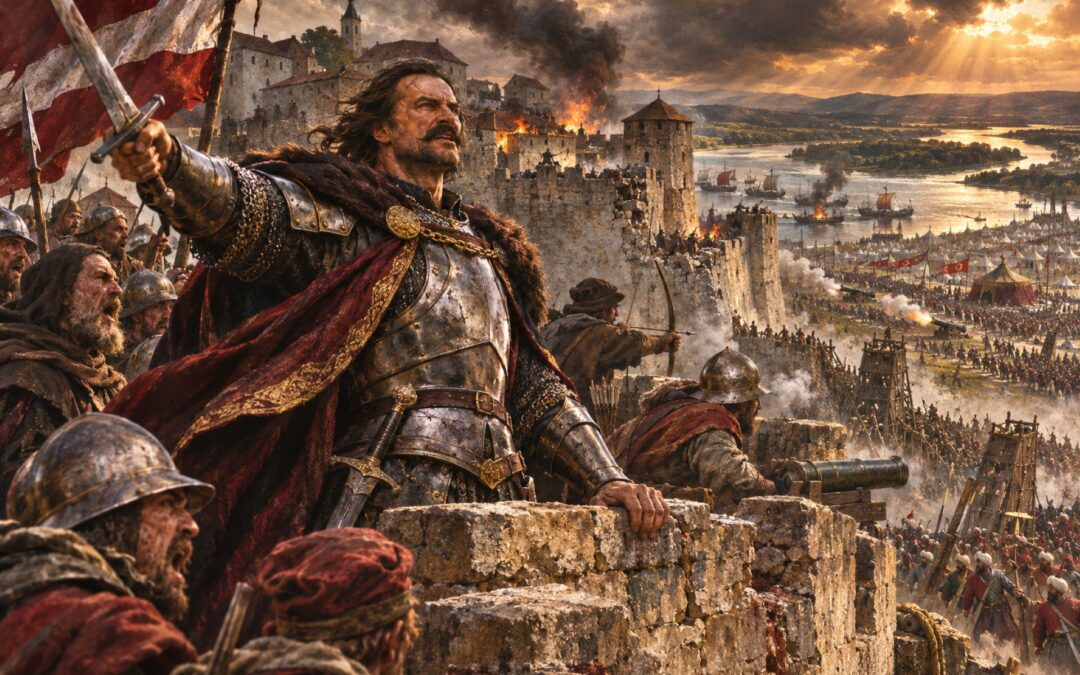
By the night of 21 July 1456, the walls of Belgrade had been battered by Ottoman artillery, and the defenders were struggling to keep Sultan Mehmed II’s army out of the fortress. Three years earlier, Mehmed had conquered Constantinople. Now he stood at one of the principal gateways into Hungary, where the Danube and Sava rivers meet. If Belgrade fell, the kingdom’s already vulnerable southern defences would be in even greater danger.
John Hunyadi, the commander organizing the relief, was no stranger to desperate circumstances. He had won striking victories against Ottoman armies, but he had also survived two disastrous crusading defeats and spent years navigating Hungary’s quarrelsome nobility. His career had made him one of Central Europe’s most influential soldiers without ever making him king.
Belgrade would become his greatest victory, and his last. To understand how he reached that moment, however, means looking beyond the familiar story of a heroic general defeating a larger army. Hunyadi’s real achievement lay in turning military experience, political influence and unreliable alliances into an effective defence of a threatened frontier.
A Noble Family on a Dangerous Frontier
John Hunyadi emerged from the borderlands of the medieval Kingdom of Hungary, in a region now divided among modern states and national histories. He was probably born around the beginning of the fifteenth century, although neither his precise birth date nor every detail of his ancestry is securely established. Later Hungarian and Romanian traditions would both claim him in ways that reveal as much about subsequent national identities as about the society in which he lived.
His father, recorded as Voyk, Voicu or Vajk, belonged to a family with Wallachian connections. In 1409, King Sigismund of Hungary granted land at Hunyad, in Transylvania, to Voyk and his relatives. The grant provided a foundation for the family’s growing status, although it should not be confused with the immediate gift of the great castle and all the possessions associated with it in later centuries. The name Hunyadi would eventually become far more famous than the family had been when the grant was made.
Another tradition alleged that John was Sigismund’s illegitimate son. That story offered a convenient explanation for his extraordinary rise, but it is not established by contemporary evidence and cannot be treated as an alternative genealogy of equal weight. As modern scholarship on Hunyadi’s political and military career emphasizes, the surviving records leave important uncertainties about his origins while documenting the advancement he achieved through service and warfare.
Young noblemen learned their profession through the households and campaigns of more powerful patrons. Hunyadi served in aristocratic and royal military circles and became familiar with warfare beyond Transylvania. His experience in Italy, including associations with the Milanese court of Filippo Maria Visconti, exposed him to professional commanders, hired troops and military methods different from those employed along Hungary’s frontier. The precise details of his education are imperfectly recorded, but the variety of his experience helps explain his later flexibility.
That education mattered because the Ottoman Empire was expanding through southeastern Europe. Bulgaria had fallen under Ottoman control, Serbia’s rulers faced shifting conditions of dependence and resistance, and Wallachian princes struggled to preserve room for manoeuvre. The Ottoman Empire’s expanding influence in the Balkans created a frontier on which castles, rivers, local alliances and the ability to raise troops mattered as much as an impressive title. Hunyadi would build his career in that unstable world.
From Border Commander to Ottoman Adversary
By the early 1440s, Hungary’s southern approaches were exposed to raids, military incursions and the competing interests of neighbouring rulers. Defending them required more than waiting behind fortress walls. A commander needed information about enemy movements, forces ready to march quickly and cooperation from nobles who did not always share the crown’s priorities.
In 1441 Hunyadi gained major frontier responsibilities, including the voivodeship of Transylvania, a position combining military command with substantial regional authority. His growing resources and close connections with the royal government helped him act where more fragmented arrangements could fail. He was not the only defender of the border, but he became unusually effective at bringing together its available military strength.
His reputation grew sharply in 1442. In the spring, an Ottoman force led by Mezid Bey entered Transylvania, and Hunyadi suffered an initial reverse near Sântimbru. Rather than ending the campaign, the setback preceded a successful counterattack in the area associated with Sibiu, in which Mezid Bey was killed and the Ottoman force defeated. Accounts differ over the precise location, troop strengths and sequence of manoeuvres, so the battle is better understood as a successful recovery and counteroffensive than as a perfectly documented ambush planned from the beginning.
A second major Ottoman advance followed later that year. Its commander, Şehabeddin, held a senior position in the Ottoman administration of the European provinces. Hunyadi again prevailed, this time in Wallachia near the Ialomița River. Popular retellings sometimes move the fighting to the Danube’s Iron Gates gorge, but that confuses distinct places and campaigns. Research into Hunyadi’s relations with Wallachia and Moldavia is particularly valuable for reconstructing the actual geography and political relationships of these operations.
The victories had consequences beyond the immediate battlefield. They showed that Ottoman incursions could be resisted and gave Hunyadi greater prestige among rulers and churchmen seeking a wider campaign. Yet the enemy had not been permanently driven out of the Balkans, and regional politics remained difficult. Wallachian rulers, Serbian nobles and Hungarian magnates all had reasons to protect their own territories, sometimes by fighting the Ottomans and sometimes by making accommodations with them.
Hunyadi’s distinctive strength was his willingness to take the initiative, not possession of some miraculous tactic that always cancelled superior numbers. His forces depended on combinations of cavalry, infantry, local knowledge and coordinated movement, while his victories also required logistics, recruitment and favourable circumstances. The more famous he became, the greater the expectation that he could turn successful frontier defence into something much more ambitious.
The Long Campaign and the Promise of Victory
That ambition took shape in 1443, when Hunyadi joined King Władysław III, ruler of Poland and Hungary, in a major offensive against Sultan Murad II. The campaign aimed to push into Ottoman-held territory, strengthen Hungary’s southern position and take advantage of tensions within the empire. It also answered a wider Christian hope that a coordinated army could reverse decades of Ottoman expansion.
The army crossed the Danube and advanced through Serbia toward Niš and the Balkan interior. Hunyadi’s troops won a series of engagements, disrupted Ottoman positions and showed that a determined invading force could penetrate farther than recent defensive campaigning had suggested. Success at Niš was especially consequential for the wider Balkans: the unsettled situation helped open the opportunity for the Albanian commander Skanderbeg to break with Ottoman authority and begin a separate resistance movement.
The invaders nevertheless faced deteriorating conditions as they moved deeper into hostile territory. Winter weather, mountain passes, lengthening supply lines and Ottoman resistance limited what their successes could achieve. The campaign did not end with the conquest of the Ottoman European provinces. Its achievement was to alter the diplomatic balance and encourage the belief that further victories were possible, even though the army had to turn back.
Negotiations in 1444 produced arrangements generally associated with the Peace of Szeged and a projected truce. The documentary sequence is more complicated than the familiar story of one clear treaty signed and immediately discarded: negotiations, promises, oaths and decisions about ratification did not all occur in a single straightforward moment. Serbia’s position, the fate of important fortresses and the rulers’ obligations were central to the bargaining. The result offered a possible pause in the fighting at a time when Hungary had already gained more than recent defeats had led many to expect.
But papal representatives and other supporters of renewed crusading urged the king to continue the offensive. Cardinal Giuliano Cesarini argued for a campaign that would take advantage of Ottoman difficulties, and the prospect of help from Christian fleets appeared to make the risks manageable. Religious arguments about the binding force of commitments to a Muslim ruler became part of the political justification, but the decision also involved strategic calculations and competing promises of support.
Hunyadi’s position cannot be reduced to a neat invented conversation in which he begged for peace and was simply overruled. What is clear is that the Christian leadership chose to gamble on another invasion before the fragile diplomatic settlement could produce lasting stability. The victories of the Long Campaign had raised expectations faster than they had resolved the practical problems of fighting a powerful empire far from home.
Varna: When the Crusade Collapsed
In the autumn of 1444, the crusading army marched toward the Black Sea coast, hoping that allied ships would prevent Ottoman reinforcements from crossing the straits between Asia and Europe. The plan depended on coordination between land forces and fleets operating at considerable distance from one another. It also underestimated how difficult it would be to control the crossings and prevent Sultan Murad II from concentrating his forces.
Murad, who had temporarily withdrawn from active rule, returned to command the Ottoman army. The Christian naval effort failed to stop Ottoman movements across the straits, although it is misleading to imagine that no allied vessels appeared at all. Maritime limitations, the geography of the passages and the uncertain reliability of coalition plans made the promised separation of Ottoman forces impossible to guarantee.
On 10 November 1444, the armies met near Varna, on the western Black Sea coast. The Christians were outnumbered according to most reconstructions, but exact figures vary considerably. Hunyadi helped direct the fighting, and Christian attacks initially achieved success against parts of the Ottoman army. Heavy cavalry could be devastating in a concentrated charge, but its effectiveness depended on timing, cohesion and the ability to protect the rest of the formation.
The turning point came when King Władysław led a force against the Ottoman centre, where Murad was protected by Janissaries, the sultan’s elite infantry. Accounts differ in details, including the numbers involved and the exact course of the attack, but the king was killed. His death transformed a difficult battle into a political and military catastrophe, destroying the authority around which the crusade’s coalition had been assembled.
Hunyadi survived the defeat, but the army could no longer execute its original plan. The death of Władysław left Hungary facing a succession crisis, while the failure of the expedition weakened hopes of removing Ottoman power from southeastern Europe in a single decisive campaign. The disaster was not adequately explained by one reckless cavalry charge alone. It followed a sequence of ambitious decisions, uncertain allies, difficult logistics and an opponent capable of responding quickly.
The retreat brought Hunyadi another humiliation. On his return through Wallachia, he was detained by the prince Vlad Dracul before eventually securing his freedom. This incident is sometimes wrongly attributed to the Serbian ruler Đurađ Branković, who would imprison Hunyadi after a different defeat four years later. The distinction matters because it reveals the changing interests of neighbouring rulers, whose willingness to support Hungary could not be assumed simply because they also feared Ottoman power.
Varna exposed a recurring weakness in Hunyadi’s strategy: winning important engagements did not guarantee the diplomatic cohesion necessary to sustain a broader offensive. It also demonstrated the limit of individual leadership. Even an experienced commander could not control a king’s battlefield decision, make every ally honour its promises or compensate for a campaign founded on overly optimistic expectations.
A Governor Without a Crown
After Władysław’s death, the Hungarian crown was claimed by the young Ladislaus V, whose position was entangled with the ambitions of powerful nobles and the Habsburg ruler Frederick III. The kingdom needed government and defence while rival factions disagreed about who should exercise authority. Hunyadi’s military prestige and growing estates made him one of the few men capable of commanding support across significant parts of the realm.
In 1446, the Hungarian Diet elected him governor during Ladislaus’s minority. This was a remarkable advance for a nobleman without a royal inheritance, but it did not give him unrestricted power. Magnates defended their privileges, royal revenues were contested and rival officeholders controlled forces and strongholds that could not simply be summoned into Hunyadi’s service. His position required bargaining as well as command, and the effort to secure Hungary’s frontier continued alongside domestic conflicts.
Hunyadi nevertheless remained convinced that an offensive against the Ottomans could succeed if Christian forces coordinated effectively. In 1448 he prepared another expedition into the Balkans, expecting support from the Albanian leader Skanderbeg. Their armies did not unite in time. Movement through territory under the influence of the Serbian despot Đurađ Branković was obstructed, reflecting both personal political disputes and the difficult choices facing Serbia between its stronger neighbours.
The failure to join forces mattered, but it does not prove that a combined army would have won. Skanderbeg was fighting his own campaign to maintain Albanian resistance against the Ottomans, while Hunyadi faced the much larger problem of sustaining an expedition on hostile ground. Their interests intersected, but their military resources and immediate political circumstances were not interchangeable.
At the Second Battle of Kosovo in October 1448, Hunyadi again faced Murad II. The fighting continued over several days, with determined resistance and heavy losses on both sides. Ottoman forces eventually prevailed, and Hunyadi escaped the battlefield only to be captured by Branković. He regained his freedom after negotiations that involved concessions and the temporary detention of his son László as a guarantee. This was the Serbian captivity later accounts sometimes misplace after Varna.
Kosovo was another severe defeat, not a secret strategic victory disguised by the result. Hungary’s offensive had failed, and the prospect of a broad Christian reconquest receded. At the same time, Murad had to consider the costs of continued warfare, while Hunyadi still possessed enough influence and resources to remain central to Hungary’s defence. Neither side emerged from the encounter with a simple, permanent settlement of the frontier.
In the years afterward, Hunyadi’s conduct became more pragmatic. Agreements, truces, local diplomacy and the strengthening of frontier positions had to accompany military preparation. Relations with Wallachia, Serbia and the Hungarian nobility remained complex because no state in the region could base its policy entirely on religious solidarity. Hunyadi had become both a symbol of resistance and a political actor forced to reckon with the limits of what an army could achieve.
Constantinople Falls, and Belgrade Becomes the Front Line
On 29 May 1453, Mehmed II captured Constantinople, bringing the Byzantine Empire to an end. The victory gave the Ottoman sultan enormous prestige and a strategically valuable capital linking the Black Sea with the Mediterranean. It also demonstrated how determined artillery-supported siege warfare could overcome even the formidable defences of a city that had resisted many earlier attacks. The conquest of Constantinople and the city’s subsequent transformation changed calculations far beyond the Bosphorus.
Hungary now faced an Ottoman ruler with the ambition and capacity to expand farther into southeastern Europe. Yet the approaches to Central Europe were not an undefended open plain. Fortresses, rivers, contested territories and rival rulers shaped every possible invasion route. Belgrade, known in Hungarian as Nándorfehérvár, was especially important because it stood where the Sava joins the Danube and helped command movement along crucial river and land corridors.
Holding Belgrade required strong walls, supplies and a defensible garrison, but also the ability to prevent an enemy from sealing the city off. Mehmed could bring artillery and troops to the fortress; the defenders needed river access and reinforcements to resist a sustained siege. Hunyadi understood that the city’s location was both its strength and its vulnerability, because whoever controlled the waterways could determine whether its defenders received food, weapons and fresh men.
Pope Callixtus III called for a crusade against the Ottoman advance, and the Franciscan preacher John of Capistrano travelled through the region recruiting volunteers. Many were not experienced professional soldiers. Their enthusiasm added manpower to the defence, but coordinating them with garrisons and Hunyadi’s trained troops created its own difficulties. Support also came from established local military networks, including men responsible for holding Belgrade itself.
The effort was more complicated than one abandoned commander facing Europe alone. Hunyadi drew on his resources, family connections, experienced fighters, river vessels and religiously inspired volunteers, even though the great powers of Europe did not assemble the united army that crusade advocates had hoped for. As Ottoman preparations advanced in 1456, the challenge was to make these different contributions function together before the fortress was overwhelmed.
The Siege of Belgrade, July 1456
Mehmed’s army reached Belgrade in the summer of 1456 and began investing the fortress. Ottoman artillery bombarded the defences, while ships on the Danube sought to prevent reinforcements and supplies from reaching the city. Contemporary and later accounts describe an imposing force, but published estimates of its manpower, guns and vessels differ widely. The scale of the siege mattered more than any exact number repeated for dramatic effect.
Belgrade was not a single wall that could be destroyed in one blow. Its defensive system included different fortified areas, with positions that allowed defenders to resist even after attackers gained ground in outer sections. The garrison, associated with Hunyadi’s brother-in-law Mihály Szilágyi, had to repair damage, conserve supplies and keep soldiers prepared for an assault. Every day the blockade held made the defender’s situation more precarious.
Hunyadi’s first urgent task was not to charge the main Ottoman camp on land but to open the river. He assembled a flotilla of available craft, including small vessels that would not ordinarily have been expected to challenge Ottoman warships. On 14 July, his forces attacked the blockade with help from boats coming out of the fortress. The fighting was violent and confused, with vessels closing at short range as crews struggled for control of the channel.
The river action succeeded in breaking the blockade and allowing supplies and reinforcements into Belgrade. This was not merely a colourful preliminary victory; it altered the siege’s logistics. A fortress cut off from outside help might eventually be reduced even if its walls held for weeks. By reopening communication, Hunyadi gave the garrison a better chance to withstand the bombardment and a final assault.
Mehmed continued pressing the attack. Ottoman artillery had damaged the walls, and on 21 July the sultan’s forces launched a major effort to force their way into the defences. Fighting extended into the night and the early hours of 22 July, with attackers penetrating parts of the fortified position. The danger was immediate: the defenders could not rely simply on the city’s formidable location once Ottoman troops were fighting inside its defensive perimeter.
Hunyadi and the garrison organized resistance around the threatened passages and inner positions. The precise sequence of every local engagement is difficult to reconstruct, and later accounts add dramatic details that cannot always be confirmed. What is clear is that the attackers failed to turn their penetration into control of the fortress. Their assault lost momentum amid fierce resistance, exhaustion and confusion.
The next phase of fighting was just as consequential and even harder to describe as a single perfectly coordinated command decision. Crusading volunteers associated with John of Capistrano moved out against Ottoman positions, and the fighting spread beyond the walls. The movement is often described as spontaneous, although the degree to which it was directed by individual leaders varies among surviving narratives. Ottoman troops who had spent the night assaulting the fortress now faced attacks on their siege lines and artillery positions.
The situation became dangerous for Mehmed’s army. Once soldiers defending guns, camps and approaches lost cohesion, its material superiority could not be applied as intended. Hunyadi’s experienced forces joined the counterattack, and Ottoman positions were abandoned as the sultan’s army withdrew. Some accounts say Mehmed was wounded during the fighting, but the larger outcome does not depend on any single heroic encounter. The siege had been broken, and Belgrade remained in Hungarian hands.
The contemporary testimony captures the uncertainty better than the polished legends that followed. In his account written on 22 July 1456, Capistrano described the danger and the actions of the crusaders through the religious language of an eyewitness participant. Hunyadi’s own correspondence, preserved and discussed by the Hungarian National Archives, offers another perspective on how the fighting was understood immediately afterward. These accounts should be read with attention to what their authors witnessed, what they believed and what they wanted their readers to understand.
The victory rested on several connected achievements. The fortress was sufficiently defended to survive bombardment; the river blockade was broken at the critical moment; troops resisted the general assault; and the subsequent counterattack transformed an Ottoman setback into withdrawal. Neither Hunyadi’s professional forces nor Capistrano’s volunteers could easily have achieved the same result without the others. This was precisely the kind of military coordination that Hunyadi had spent his career trying to create, although no leader could have designed every chaotic moment of the battle.
Belgrade’s survival was a major setback for Mehmed II and a profound relief for Hungary. It protected a strategic fortress and disrupted an immediate Ottoman campaign along the kingdom’s southern approach. It did not destroy Ottoman power or end its ambitions in the Balkans. The significance of the victory was that, against a formidable army and amid uncertain cooperation, a threatened frontier had held when its defenders could not afford another Varna or Kosovo.
Victory, Plague, and the Fate of the Hunyadis
The defence of Belgrade became an event of European religious and political importance. News of the victory was welcomed far beyond Hungary, and Hunyadi’s reputation as a defender of Christendom grew still further. Yet one frequently repeated detail reverses the chronology. Pope Callixtus III had already ordered prayers and bell-ringing in response to the danger, through a directive issued on 29 June 1456, before the outcome of the siege was known. The enduring association of noon bells with Belgrade developed around that campaign and its celebrated result, not simply from an order first issued after the victory.
For Hunyadi, triumph was brief. Disease spread through the crowded camps in the aftermath of the siege, amid conditions made worse by war and the presence of many soldiers and volunteers. On 11 August 1456, less than three weeks after the decisive fighting, he died near Belgrade, commonly described as a victim of plague. Capistrano also fell ill and died later that year, on 23 October. The victory had saved the fortress, but it could not protect the leaders and troops from the epidemics that accompanied medieval campaigning.
Hunyadi left behind a powerful family whose position had been built on military service, landholding and political alliances rather than an undisputed hereditary claim to the crown. His widow, Elizabeth Szilágyi, and his sons László and Matthias inherited both that prominence and the hostility it provoked. Rival magnates feared the family’s influence, while Hunyadi supporters distrusted royal advisers who might try to reduce it.
The political struggle turned violent within months. In November 1456, Ulrich II, Count of Celje, a prominent rival associated with the royal court, was killed during a confrontation at Belgrade involving Hunyadi’s elder son László. Attempts at reconciliation did not resolve the conflict. László was arrested and executed in March 1457 under King Ladislaus V, while the younger Matthias was imprisoned and eventually held in Prague.
At first the Hunyadi family’s prospects seemed ruined. Yet Ladislaus V died unexpectedly in November 1457 without an heir, reopening the contest for Hungary’s crown. The family’s military reputation, wealth and support among powerful nobles remained valuable. On 24 January 1458, the Hungarian estates elected Matthias king, although he was still only fourteen. His election was the product of negotiation and political power, not a simple act of revenge or an automatic inheritance from his father.
Matthias would build a strikingly different career, strengthening royal administration, employing professional troops and challenging rival Central European powers. That later story belongs to the reign of Matthias Corvinus, rather than to the closing chapters of his father’s life. One distinction is essential even here: Matthias became king through election in 1458, but his formal coronation with the Holy Crown did not take place until 1464.
Hunyadi’s legacy also needs to be measured against what happened to the frontier he had defended. Belgrade remained outside Ottoman control for another sixty-five years, until Sultan Suleiman I captured it in 1521. That interval was significant, but it was not sixty-five years of peace or an end to Ottoman pressure. Warfare, diplomacy, raids and struggles for influence continued across southeastern Europe, and the outcome of 1521 belonged to a different political situation from that of 1456.
John Hunyadi’s career was neither an unbroken succession of victories nor the story of one man rescuing a continent without assistance. He lost at Varna and Kosovo, contended with rivals at home and repeatedly depended on alliances whose interests he could not control. Yet he also helped make Hungary’s vulnerable southern defence more formidable, turning the experience of decades of campaigning into effective action at Belgrade.
His most important legacy was therefore practical as well as symbolic. By combining professional soldiers, fortifications, river warfare, local networks and religious volunteers, he helped deny Mehmed II a strategic breakthrough in 1456. Belgrade’s later fall shows that the danger was not permanently removed, while the political upheaval after Hunyadi’s death shows how difficult his authority was to replace. The achievement was not that he made Hungary invulnerable, but that, at a decisive moment, he helped its defences hold.
Last Updated on November 3, 2026 by Aseem Gupta