Reading Time: 12 Minutes
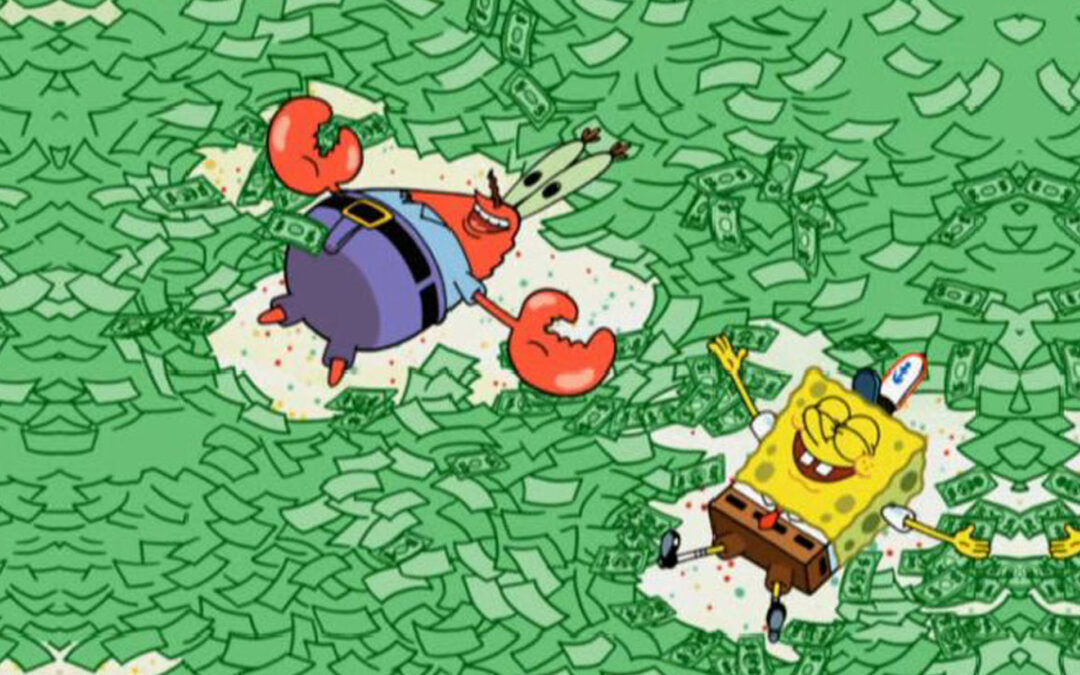
Nobody in Bikini Bottom understands money quite like Eugene H. Krabs. He owns the Krusty Krab, employs SpongeBob and Squidward, and seems capable of detecting a loose coin from across the ocean. He is also so obsessed with protecting his fortune that he regularly makes decisions which threaten the business that created it. SpongeBob, meanwhile, delights in making Krabby Patties without showing much interest in becoming rich. Patrick usually prefers to do as little as possible.
This odd workplace offers a surprisingly good introduction to the choices behind financial independence. Who owns an income-producing asset? Why do customers pay for a product? How does somebody develop skills worth paying for? And what happens to earnings after they arrive? Those questions connect business ownership, customer value, everyday discipline, and investing—although no cartoon can supply a guaranteed formula for getting rich.
The useful lesson is not to become as greedy as Mr. Krabs, as tireless as SpongeBob, or as relaxed as Patrick. It is to understand what each character gets right, where each goes wrong, and how the principles might work in a real economy.
Mr. Krabs and the Difference Between Earning Wages and Owning a Business
SpongeBob arrives at the Krusty Krab, works his shift, and earns whatever Mr. Krabs agrees to pay him. Squidward does much the same, with considerably less enthusiasm. Their income is tied primarily to their employment. Mr. Krabs, by contrast, owns the restaurant: if it makes more from selling Krabby Patties than it costs to operate, the remaining profit belongs to him.
That difference is fundamental. Employees generally exchange their time and skills for wages or salaries, sometimes supplemented by bonuses and benefits. A business owner assembles ingredients, equipment, a location, a brand, and other people’s labour into an operation customers will pay for. The business can sell burgers when its owner is not personally at the grill. His earnings therefore need not rise only when he works another hour.
The Krusty Krab also demonstrates how ownership makes expansion possible. Mr. Krabs tries ventures beyond his original restaurant, including the Krusty Towers hotel and Krabby Land amusement park. These schemes are often ridiculous and badly managed, but they reveal a different economic ambition: to build additional operations, products, or sources of revenue instead of relying on a single wage. A successful restaurant might eventually support more outlets, a recognizable brand, or other services without the owner personally completing every transaction.
Of course, the owner does not automatically pocket every dollar that customers spend. Food ingredients, rent, wages, utilities, maintenance, taxes, and equipment must all be paid for. A restaurant that sells plenty of burgers can still lose money if its costs exceed revenue. Nor is the owner necessarily free to relax: when a delivery fails, a health inspection looms, or customers stop arriving, responsibility for fixing the problem ultimately rests with the business.
That is the distinction obscured by the catchy instruction to “be the employer, not the employee.” Ownership creates the possibility of profit, control, and scale; it also concentrates financial risk. Employees may receive predictable pay, specialist training, benefits, and a more reliable boundary between professional and personal obligations. A highly skilled employee may also earn more than a struggling proprietor, accumulate investments, or own shares in the company where they work.
Freelancers occupy an interesting middle ground. They may control their rates and choose clients, but their earnings can still depend heavily on personally completing each assignment. Hiring help or creating a reusable product could change that relationship, yet it also introduces costs and management responsibilities. A salaried professional who invests regularly may ultimately build greater financial security than a freelancer who earns more but spends everything. The label on the working arrangement matters less than its economics.
Starting small is possible, particularly online. A tutor, designer, programmer, or writer might offer a service from home before renting an office or employing anyone. Yet “small” does not mean free or effortless. Even a home-based enterprise needs customers, time, tools, and attention to regulations. The practical obligations of launching a business include choosing a legal structure, handling registration and tax requirements where applicable, and understanding operating expenses.
The sensible question, then, is not whether employment makes someone a financial failure. It is whether their skills, savings, and circumstances allow them to develop some form of ownership over time—perhaps a small business, intellectual property, investments, or other assets that can generate value beyond the next hour of labour. Mr. Krabs shows the potential of ownership, but his mistakes also show why ownership alone is not enough.
Why Solving Problems Matters More Than Chasing Money
Mr. Krabs loves money so much that he sometimes forgets where it comes from. The Krusty Krab earns revenue because people want Krabby Patties and are willing to pay for the experience of eating there. Its customers are not visiting because they wish to enrich its owner. They want food they enjoy, served at a price and level of convenience they consider worthwhile.
This is the difference between wanting money and creating value. A business must offer something customers regard as worth exchanging their money for. It might save them time, make a difficult task easier, provide entertainment, deliver a more dependable product, or help them develop a skill. Revenue is evidence that customers are willing and able to pay, not necessarily that a business has improved everyone’s life; but without a convincing reason to buy, repeated sales are difficult to sustain.
Mr. Krabs periodically undermines the value his restaurant provides. His instinct is to cut costs aggressively, squeeze employees, invent fees, or launch schemes designed to extract additional money from anyone nearby. Such behaviour may produce a short-term gain while damaging service, employee morale, or customer trust. A bargain that leaves a customer feeling cheated can cost more than it earns if the customer never returns.
The alternative is to ask what customers actually value. At the Krusty Krab, that could mean maintaining consistent burgers, keeping the restaurant clean, reducing delays, or treating people fairly. It might justify investing in better equipment or staff training, even if doing so reduces immediate profit. A restaurant’s reputation is built through many such interactions; one successful sale does not establish a durable business.
The same principle applies outside Bikini Bottom. Amazon’s appeal grew partly from making shopping more convenient and expanding how goods could be ordered and delivered. Electric-vehicle companies such as Tesla sell a combination of transport, technology, and a particular product experience; SpaceX competes in the provision of launch services. These are examples of identifying demand and building ways to serve it, not proof that every firm addressing a large problem will make its founders wealthy.
Businesses still need pricing power, operational discipline, sufficient margins, and an economic model that works. Some valuable activities earn little because customers cannot afford to pay; other businesses capture large profits without delivering an equivalent social benefit. Competition, luck, access to capital, and timing also shape who succeeds. “Solve problems and the money will follow” is an appealing slogan, not a law of economics.
Money itself can fund useful things: security, education, opportunities, and support for people we care about. But Mr. Krabs illustrates the psychological costs of treating wealth as the ultimate goal. When every decision becomes an attempt to protect or acquire another coin, relationships and long-term judgment can deteriorate. The better business question is not merely “How much can I take?” but “What can I offer that people will want to return for?”
SpongeBob’s Work Ethic and Patrick’s Approach to Life
SpongeBob has the work ethic of someone who believes making a burger is an art form. He arrives excited, takes pride in his Employee of the Month awards, pays attention to how Krabby Patties are prepared, and tries to help the restaurant operate well. He treats a repetitive task as an opportunity to become skilled at something. Patrick, by contrast, often prefers naps and entertainment to any undertaking that might require sustained concentration.
The contrast is exaggerated for comedy, but it identifies an important difference between wishing for an outcome and developing the habits needed to produce it. Learning a marketable skill, finding a paying customer, improving a service, or saving regularly all require repeated actions. An attractive business idea does not become a functioning business because someone thought of it once. It develops through experiments, conversations, mistakes, adjustments, and the unglamorous work of following through.
Imagine a person hoping to earn money by teaching a subject they know well. They must organize what they know, test whether learners actually need it, make useful lessons, and respond to questions. Later they may need to improve their explanations, develop a consistent publishing schedule, or learn how to sell. None of those steps is spectacular; taken together, they can create a capability that did not exist before.
The familiar temptation is to leave difficult tasks for another day. Patrick represents that temptation in cartoon form: doing what is pleasant right now while ignoring work that could expand future choices. Repeatedly choosing the easier option can prevent a promising project from getting started. Conversely, regular practice can make useful behaviour less dependent on a daily burst of enthusiasm. Willpower is often described as a muscle, but that metaphor should not be mistaken for a universal scientific rule; habits, working conditions, rest, and realistic goals matter too.
Squidward illustrates another obstacle. He approaches his job with resentment, even when a little attention might make a shift less unpleasant. His cynicism can sap the energy that might otherwise go toward improving his circumstances. Optimism does not guarantee commercial success, but the expectation that effort can teach us something often makes experimentation easier than assuming failure in advance.
There is a danger in taking SpongeBob’s example too literally. His devotion makes him vulnerable to Mr. Krabs’s exploitation, and Patrick’s preference for leisure is not worthless. Rest, friendship, and time away from work are necessary parts of a sustainable life. The financially useful combination is SpongeBob’s care and consistency, Patrick’s capacity to disengage when needed, and a willingness to set boundaries neither character always gets right.
How to Build Income That Does Not Depend Entirely on Your Time
The appeal of owning a business is clearest when income is no longer tied to delivering one more hour of personal labour. That does not require opening a chain of restaurants. It may begin with turning an ability into a repeatable service or product and building systems that allow more customers to benefit without the founder doing every task individually.
Consider a creator with a skill people want to learn—editing videos, learning a language, using software, or managing a household budget. Initially, they publish free educational videos. Creating them requires research, scripting, production, and editing, often for a tiny audience. The free material gives viewers a chance to judge whether the explanations are useful. Over time, consistently good work may attract an audience that returns and recommends the material to others.
If the channel meets a platform’s eligibility conditions, advertising may eventually provide revenue. Brands may offer sponsorships because the creator reaches people interested in particular subjects. Neither stream is automatic: views fluctuate, sponsorships must be negotiated, and promoting unsuitable products can erode the trust on which the audience depends. Free content is therefore not simply a machine for collecting effortless payments. It is also a service and an ongoing relationship with viewers.
Suppose this creator then uses some revenue to hire an editor or researcher. Delegation might increase the number or quality of videos without requiring the creator to do every step. That creates room to develop a deeper offering, such as an on-demand course assembled from structured lessons, demonstrations, exercises, and supporting materials. Once produced, a digital course can be purchased by multiple learners without the creator teaching each class live.
Now several revenue streams may coexist: advertising, sponsorships, course sales, and perhaps a separate service for customers needing individual guidance. The underlying idea is leverage. Work completed once—a lesson, a template, a piece of software, or a production system—can sometimes be used many times. Hiring can expand capacity further, if the extra revenue exceeds the cost of supporting the additional people.
But scalable is not the same as passive. An on-demand course needs updates when its subject changes, customer support when buyers run into difficulties, and promotion so new learners can discover it. Contractors and employees need to be paid; payment processors charge fees; software, equipment, rights, and taxes can introduce further costs. Nor can everyone achieve a large audience, even with excellent material. Demand must be tested rather than imagined.
A sensible experiment might begin with a small, specific offer. Instead of spending months building an elaborate course, a creator could teach a live workshop to a small group and learn which explanations succeed. Repeated questions might reveal what a recorded course needs to cover. Real customers provide more useful evidence than a fantasy of unlimited passive income. The same process applies to products beyond education: discover a need, deliver something valuable, improve it, and only then look for repeatability.
The goal is not necessarily to become a full-time entrepreneur. Someone with stable employment might build a modest side service, license creative work, or simply invest a portion of their salary. Ownership and diversification are opportunities, not obligations. The essential question is whether any part of the person’s financial future can gradually become less dependent on being present for every transaction.
Reinvesting Profits and the Power of Compound Growth
Imagine Mr. Krabs enjoying a particularly profitable month. He could spend every extra coin on luxuries, hide it beneath a mattress, or use some of it to improve the Krusty Krab. Perhaps the grill needs replacing, staff training could speed up service, or a better inventory system could reduce waste. If an investment improves profits, the business may later have more money available for further improvements.
That is business reinvestment: retaining some earnings to expand or strengthen the activity that generated them. For a small creator, it could mean buying better sound equipment, paying for editing assistance, or developing a product that serves an existing audience. The return is not guaranteed. Hiring before there is sufficient demand, building a product nobody wants, or overspending on equipment can destroy capital instead of multiplying it.
Reinvestment also creates a trade-off. Money committed to the business cannot simultaneously pay household expenses or sit safely in an emergency reserve. A promising enterprise may deserve further capital, but its owner should not automatically risk every spare rupee or pound on one venture. Sometimes the better decision is to preserve cash, reduce debt, or invest outside the business to avoid having every source of income depend on its survival.
Financial markets offer another route for money to work over time. Stocks represent ownership interests in businesses; bonds involve lending to issuers under specified terms. Diversified funds, including index funds, can spread investment across many securities rather than relying on the fortunes of one company. As Investor.gov explains in its introduction to investing, the choice depends on goals, time horizon, tolerance for risk, and the need to manage fluctuations.
The most powerful mechanism for patient investors is compound growth. When an investment earns a return and that gain remains invested, future returns can be earned on a larger amount. With deposits, that may involve interest on accumulated interest; with equities, it may involve reinvested dividends and appreciation. Unlike a savings account with a stated interest rate, an investment portfolio does not deliver a fixed percentage each year, and its value may fall significantly along the way.
A popular illustration suggests that investing only £78 per month from age 22 to 65 would result in more than £1 million. That sounds as though becoming a millionaire is simply a matter of choosing a small monthly amount and waiting. The arithmetic requires a crucial assumption that is often omitted: 43 years of uninterrupted contributions would need a nominal annual return of about 11.2%, compounded monthly, to reach roughly £1 million.
For comparison, assume £78 is invested at the end of every month for 43 years, that returns are constant for illustration, and that there are no fees or taxes. Total contributions would be £40,248. At 7% nominal annual return compounded monthly, the final balance would be about £255,538; at 10%, about £668,288. At 11.2%, it would be approximately £1,000,709. These scenarios reveal the power of compounding, but also how dramatically the answer changes when the assumed return changes.
The SEBI compound interest calculator makes the underlying inputs explicit and cautions that illustrations are not predictions. Actual market returns fluctuate, fees and taxes may reduce the amount kept, and inflation reduces what a future pound will buy. A million pounds decades from now would not purchase what a million pounds purchases today. The lesson is to plan with realistic scenarios, not treat an unusually favourable projection as a promise.
Regular investing also demands judgment about what not to invest. Money needed soon for rent, medical expenses, or other obligations cannot necessarily be exposed to volatile markets. Maintaining an appropriate cash buffer, avoiding unaffordable high-interest debt, and deciding how much risk one can bear are as important as choosing a fund. Business profits and investment balances can grow, but they can also shrink; financial resilience matters more than a spectacular spreadsheet result.
This brings us back to Mr. Krabs. He understands the appeal of keeping money, but sometimes hoards it so aggressively that he undermines the source of future earnings. A wiser owner knows when to spend, when to save, and when to reinvest. A wiser employee can make similar choices with a salary. Neither needs to imitate his obsession to benefit from the underlying principle: income becomes more useful when some of it strengthens tomorrow’s opportunities.
Bikini Bottom’s characters reveal three very different ways to relate to money. Mr. Krabs knows how valuable ownership can be but often lets greed overwhelm judgment. SpongeBob shows the value of becoming excellent at useful work, although enthusiasm needs boundaries. Patrick reminds us what unchecked postponement can cost, while also demonstrating that a life devoted entirely to earning would miss the point of having money at all.
A sound financial life draws selectively from each lesson. Create something people value, develop the skills to deliver it reliably, look for opportunities to own productive assets, and decide deliberately what to do with the income. Wealth is never guaranteed, and money is not a substitute for friendship, leisure, or a satisfying day. Its best purpose is to give people more security and freedom to live those parts of life well.
Last Updated on November 19, 2026 by Aseem Gupta