
Reading Time: 40 Minutes
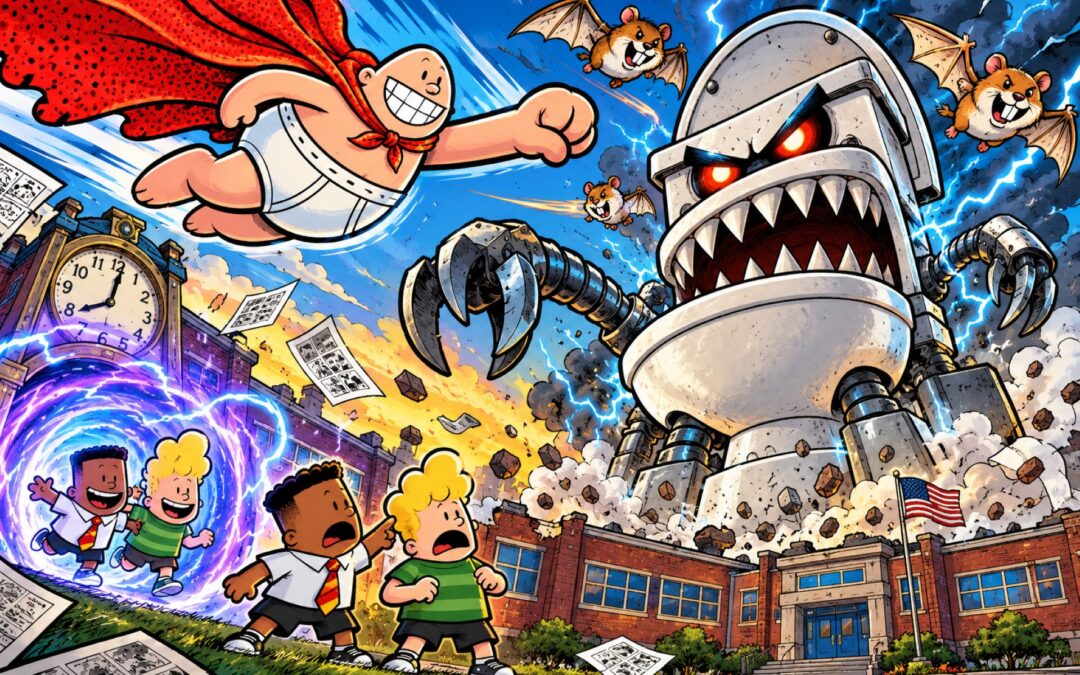
Dav Pilkey’s Captain Underpants and the Tyrannical Retaliation of the Turbo Toilet 2000 is the eleventh novel in the Captain Underpants series, first published in 2014. The story brings back a monstrous enemy determined to destroy George Beard, Harold Hutchins, and their underwear-clad superhero, but the villain’s revenge is only one part of a much larger adventure involving time travel, duplicated children, a reluctant superhero, and a spectacular breakdown of school discipline.
Unlike a straightforward superhero story, this installment spends considerable time exploring the consequences of the characters’ earlier adventures. Melvin Sneedly discovers that possessing extraordinary powers can be a terrible inconvenience, while George and Harold attempt to prevent their separation at school by traveling into the past. Their solution creates two additional versions of themselves, setting off a chain of increasingly ridiculous problems that eventually collide with the return of the Turbo Toilet 2000.
Pilkey combines these overlapping storylines with illustrated action, interactive Flip-E-Rama sequences, and a complete comic created by the protagonists themselves. The result is an unusually intricate entry in a series famous for its simple premise and outrageous humour.
Spoiler warning: This article covers the complete story, including every major revelation, the final confrontation, and the ending.

Time Travel and the Turbo Toilet’s Return
The story begins immediately after the events of the preceding Captain Underpants novel. George Beard, Harold Hutchins, and Captain Underpants have just survived an extraordinary journey involving prehistoric times and a future version of their elementary school. With the help of their scientifically gifted classmate Melvin Sneedly, they are traveling backward through time in his glowing Robo-Squid suit.
The group also carries three mysterious eggs laid by Crackers, the boys’ pet pterodactyl. Crackers and Sulu, their bionic hamster, have played an extraordinary role in earlier adventures, and the eggs are among the few things George and Harold have managed to bring home from their journey.
Melvin returns them to a point approximately forty years and one day before their departure from the future. They arrive near Jerome Horwitz Elementary School and briefly observe events from the previous day, including the disappearance of Tippy Tinkletrousers in his mechanical Robo-Pants. For George and Harold, the experience is another confusing consequence of having traveled through several periods of history.
Their immediate concern, however, is much more ordinary. The police have been searching for them because of a bank robbery they were wrongly suspected of committing. Melvin explains that he has already traveled backward to alter the bank’s surveillance images, effectively removing the evidence that implicated them.
This unexpected assistance surprises the boys. Melvin has ordinarily been their enemy, frequently reporting their misbehaviour and attempting to demonstrate his intellectual superiority. When George asks why he has suddenly become helpful, Melvin refuses to give a straightforward answer. He has a reason for bringing them back, but understanding it requires knowing what happened while they were absent.
Meanwhile, an entirely different event is unfolding elsewhere in the solar system.
A red rubber kickball, which has been traveling through space since an earlier Captain Underpants adventure, approaches the planet Uranus. On its surface lie the remains of the defeated Turbo Toilet 2000, his army of Talking Toilets, and the mechanical Incredible Robo-Plunger.
The kickball strikes the Robo-Plunger and knocks off its head. A stream of absurdly named radioactive-like mechanical fluid leaks into the mouth of the Turbo Toilet 2000, restoring the monstrous machine to life.
The resurrected villain remembers his previous defeat and humiliation. Furious that Captain Underpants and the boys destroyed his ambitions, he decides to return to Earth and take revenge. Using components salvaged from the Robo-Plunger, he constructs a rocket-powered scooter capable of carrying him through space.
The journey back to Earth will take approximately two weeks. That delay becomes crucial because the protagonists will face several other crises before discovering that their old enemy is approaching.
The opening therefore establishes two mysteries: why Melvin rescued George and Harold, and what will happen when the Turbo Toilet reaches Earth. The first is answered through an extended flashback, while the second hangs over the remainder of the novel.
Melvin’s Year as Big Melvin
The explanation begins with an alternative version of the preceding year, one in which George, Harold, and Mr. Krupp never returned from their time-travel adventure.
After the three disappear, the police search for them as suspected bank robbers. Eventually, the investigation loses momentum, and the townspeople assume they have escaped somewhere beyond the authorities’ reach.
Melvin Sneedly, however, is delighted by their disappearance. With George and Harold gone, there are no practical jokes, ridiculous comic books, or interruptions to interfere with his scientific work. He can finally devote himself to experiments and inventions without dealing with classmates he considers intellectually inferior.
His happiness lasts only about two weeks.
The Turbo Toilet 2000 returns to Earth and begins attacking Piqua, Ohio. Buildings collapse, vehicles are thrown through the streets, and the population flees from the giant mechanical toilet. Yet Melvin’s first reaction is not concern for the town. He is irritated because the destruction is interrupting an important experiment.
Melvin opens his bedroom window and angrily demands that the monster be quiet. The Turbo Toilet responds by chasing him through the town and into Jerome Horwitz Elementary School.
Melvin hides beneath Principal Benjamin Krupp’s desk, where he accidentally encounters one of the principal’s discarded toenail clippings. Initially disgusted, Melvin remembers something important: Mr. Krupp and Captain Underpants are the same person.
George and Harold had previously hypnotized their unpleasant principal into becoming the superhero they invented. Because Captain Underpants possesses genuine superhuman abilities, Melvin reasons that some component of Krupp’s DNA must contain the secret of those powers.
The toenail becomes his opportunity to replicate them.
As the Turbo Toilet pursues him, Melvin uses the DNA-extraction function of his miniature scientific wristwatch to isolate genetic material from the clipping. He escapes from the school and runs to his laboratory, where his computer identifies and replicates the substance supposedly responsible for Krupp’s extraordinary abilities.
The Turbo Toilet breaks into Melvin’s bedroom just as the experiment reaches its conclusion. With the monster about to eat him, Melvin grabs a container of the glowing solution and drinks it.
The villain swallows him, but the attempted meal goes disastrously wrong. Melvin’s body has become extraordinarily resilient, making him impossible to chew or digest. The astonished monster pulls him back out, discovering that the boy is completely unharmed.
Melvin has transformed himself into a superhero.
The ensuing battle is presented through one of the novel’s most elaborate visual jokes. The narrator claims that the confrontation is too violent for an ordinary children’s book and introduces a supposedly safer artistic team: four-year-old Timmy Swanson and his elderly grandmother, Gertrude.
Timmy supplies deliberately crude illustrations, while his grandmother is expected to describe the action in gentle language. Instead, she becomes increasingly horrified by the violent nonsense appearing on the pages. Her protests accompany a series of Flip-E-Rama action illustrations, in which readers rapidly turn pages back and forth to create a crude animation.
The battle ends with the Turbo Toilet defeated and Melvin celebrated as the world’s newest superhero.
Melvin becomes known as Big Melvin. The mayor organizes a parade in his honour, Weird Al Yankovic supposedly writes a song about him, and even the vice president sends congratulations.
At first, the attention is exactly what Melvin wants. Having always considered himself exceptionally intelligent and important, he believes the world is finally recognizing his greatness.
He begins saving people from burning buildings, rescuing lost children, and stopping runaway trains. Whenever anyone shouts for Big Melvin, he abandons his current activity and flies to the emergency.
Gradually, however, the demands become intolerable.
People start summoning him for increasingly trivial problems, including misplaced belongings, video-game difficulties, and other inconveniences that hardly require a superhero. Melvin has little opportunity to continue his research, sleep properly, or enjoy any privacy.
The final disaster occurs when he is conducting a complicated particle-accelerator experiment. After eleven months of preparation, Melvin believes he is close to an important scientific breakthrough involving the Higgs boson.
At the critical moment, he hears another desperate call for help. He shuts down his experiment, causing a destructive explosion in his laboratory, and races across the city to assist the supposedly endangered citizen.
When he arrives, he discovers that a woman merely wants his opinion about how she looks in a pair of trousers.
The experience destroys his remaining enthusiasm for superhero work.
Melvin decides to quit, but he realizes that the public will continue demanding help unless someone else assumes his responsibilities. Captain Underpants is the obvious replacement. Unfortunately, the superhero and the boys are still missing somewhere in time.
Melvin remembers that he installed a tracking device inside Sulu’s bionic body. Using the device’s location history, he searches not only different geographical locations but also different periods of time. Eventually, he traces the hamster to the schoolyard thirty-nine years in the future.
Armed with this information, Melvin enters his Robo-Squid and retrieves George, Harold, Captain Underpants, and the three eggs.
He then returns them to the precise period in which they originally disappeared. By doing so, he changes the course of events that made him Big Melvin. The Turbo Toilet will still arrive in approximately two weeks, but Captain Underpants will now be available to fight him.
Melvin is thrilled that he no longer needs to become a superhero at all. His greatest accomplishment, from his perspective, is successfully transferring the burden of saving humanity back to someone else.
This explains his apparently generous intervention at the beginning of the novel. He has rescued George and Harold primarily because he wants them and Captain Underpants to deal with a catastrophe that he knows is coming.
The Missed Tests and the Threat to George and Harold’s Friendship
After Melvin departs, George and Harold take Captain Underpants home and restore him to his ordinary identity as Mr. Krupp.
The transformation is simple: Captain Underpants changes into the principal when water touches his head, while snapping fingers can restore the superhero personality. The boys instruct him to splash water on his face, returning their cheerful superhero to the irritable school administrator.
They then head back to their tree house, where they place Crackers’s three eggs on cushions beneath desk lamps to keep them warm. After their recent adventures, both boys are exhausted.
Harold remains worried about Melvin’s warning. George tries to reassure him that they have already survived much worse and should concentrate on avoiding trouble until the expected arrival of the mysterious threat.
Unfortunately, they cannot even manage to avoid trouble for the next few minutes.
Their parents have learned that they were absent from school. George and Harold attempt to explain that they have been traveling through time and saving the world, but their parents understandably refuse to believe such an extraordinary account.
The boys are punished with hours of household chores, including cleaning, washing dishes, and other exhausting tasks. By the time they finish, they are almost incapable of staying awake.
Just as Harold finally collapses into bed, George telephones with terrible news. They have important tests in every subject the following morning.
Although both boys desperately need sleep, they decide they must study through the night. The following morning finds them struggling to complete their preparation in a state of near-total exhaustion.
While leaving for school, Harold remembers the eggs in their tree house and climbs up to check on them. He immediately falls asleep.
George follows him, intending to wake him after a few minutes. Instead, he sits down, closes his eyes, and also falls asleep.
The next time George checks the clock, the school day is over.
They have slept through every test.
The boys are initially terrified because they expect their parents to discover another unexplained absence. Surprisingly, nobody has been notified, and their parents appear unaware that anything unusual happened.
This temporary relief disappears when they return to school the following morning.
Mr. Krupp welcomes them with an enthusiasm so extraordinary that the boys immediately recognize something is wrong. Teachers congratulate him as he escorts George and Harold to his office, where Miss Calculator has prepared their final grades.
Krupp announces that the previous day was Super-Secret Test Day. Because George and Harold were absent, they received zeroes on every examination. The principal refuses to permit makeup tests and reveals that final examinations have also been cancelled.
As a result, the boys have no remaining opportunity to improve their grades.
George receives a final average of 62.7 percent, which is barely sufficient to pass fourth grade. Harold receives 59.7 percent, placing him just below the passing threshold.
Consequently, George will advance to fifth grade while Harold must repeat fourth grade.
For Krupp, this is an extraordinary victory. He has spent years trying to separate the two troublesome boys, and their academic records have finally provided the opportunity.
Miss Calculator openly enjoys their distress, emphasizing that the boys will have different classrooms, teachers, and classmates in the following school year.
The scheme is particularly cruel because Harold is not presented as incapable of passing the examinations. He studied for them and believes that he could have earned respectable marks. His failure results from the unusual combination of exhaustion, absence, inflexible grading rules, and Krupp’s determination to prevent any second chance.
George and Harold are devastated by the prospect of being separated.
Their friendship is central to their lives. They create comics together, devise pranks together, and have survived countless dangerous adventures by working as a team. The possibility of attending different grades threatens the arrangement around which their school experience revolves.
As they walk home, Harold expresses his despair. George, however, begins searching for a solution.
He remembers Melvin’s time-traveling Robo-Squid.
If the school will not permit them to retake the examinations, George reasons, they can simply return to the previous day and take the original tests.
Harold recognizes the danger immediately. Their earlier experiences have repeatedly demonstrated that traveling through time creates unforeseen complications. Nevertheless, the possibility of being separated from George is sufficiently frightening that he eventually agrees.
Their attempt to protect their friendship will create a problem much stranger than failing fourth grade.
The Robo-Squid, the Four Boys, and Super Diaper Baby 2½
George and Harold visit Melvin’s house and discover the Robo-Squid in his garage.
Harold objects to entering without permission and using someone else’s invention, but George insists they are only borrowing the machine to correct a problem. After preparing its controls, George climbs inside, lifts Harold with one of the robotic tentacles, and activates the time-travel mechanism.
The Robo-Squid transports them thirty-two hours into the past.
They arrive on the morning of the examinations, reach their school, and successfully complete the tests they originally missed. For once, George and Harold are genuinely pleased to be attending classes and completing schoolwork.
Their relief is interrupted by something peculiar.
When they return to Melvin’s garage after their journey, they notice that there are now two Robo-Squids. The second machine appears to be the earlier version that existed before they traveled backward.
George interprets this as a harmless consequence of visiting the past. He even jokes that Melvin should appreciate having an extra time machine.
The boys return to their tree house, intending to check the eggs, but find a backpack blocking the entrance. George recognizes the books and belongings inside it as his own, even though he is already carrying his backpack.
When they enter, they discover two children sleeping in the tree house.
The sleeping children are themselves.
George and Harold gradually understand what has happened. They returned to a time when their earlier selves were still alive and going about their ordinary activities. Traveling into the past has not erased the original boys or replaced their earlier experiences.
Instead, two versions of George and two versions of Harold now exist simultaneously.
When the sleeping pair wake up, the time travelers explain the situation. The original inhabitants of the tree house become known as Yesterday George and Yesterday Harold, distinguishing them from the pair who traveled through time.
At first, everyone is alarmed.
The boys cannot tell their parents what happened without creating enormous confusion. They also have to consider where four children can sleep, how they will obtain sufficient food, and how they can avoid being discovered together.
George soon realizes that the situation might offer an extraordinary opportunity.
Instead of treating duplication as a disaster, the four boys could divide their responsibilities. One pair could attend school and complete homework on even-numbered days, while the other pair handles those obligations on odd-numbered days.
The pair not attending school would be free to spend the day reading comics, watching movies, playing games, and relaxing in the tree house.
Both Georges enthusiastically support the plan, while the Harolds are more doubtful. Nevertheless, everyone eventually agrees.
The arrangement initially appears successful.
Yesterday George and Yesterday Harold prepare for the next day of school, while George and Harold settle into an evening of snacks, comics, and monster movies. They order takeaway food and enjoy the freedom of having no homework or classes to worry about.
The following morning, however, the practical difficulties become obvious.
Both boys need access to bathrooms, but their mothers work from home and would be suspicious if they appeared during school hours. They improvise temporary arrangements using empty bottles, but this cannot serve as a permanent solution.
Food and money are also running low. George has spent much of his allowance, and the tree house is not equipped to support two children living there for half the school week.
George proposes solving the financial problem through the activity he and Harold know best: making comic books.
They create a new adventure titled Super Diaper Baby 2½, intending to photocopy it at school and sell copies to their classmates.
The miniature comic follows Super Diaper Baby and Diaper Dog, two superheroes whose powers and costumes extend the same childish superhero parody represented by Captain Underpants.
Its villain is Petey the Cat, who escapes from prison and plots revenge. Disguised as the famous clown P. T. Duckhat, Petey organizes a parade featuring a giant mechanical Robo-Baby and tricks the heroes into participating.
The apparent celebration becomes a trap. The heroes eventually discover that the clown is Petey in disguise and that the enormous baby-shaped machine is designed to overpower them.
Petey gains temporary control of the situation, trapping the heroes while his mechanical creation threatens the city. The rescue arrives through Dog Man, whose fleas become an unexpected weapon against Robo-Baby.
The fleas attack the machine, and the resulting chaos allows Super Diaper Baby and Diaper Dog to escape. The comic ends with the familiar promise of another adventure.
This embedded story occupies an entire illustrated chapter rather than functioning as an ordinary paragraph within the novel. Its crude drawings, exaggerated expressions, absurd dialogue, and interactive Flip-E-Rama sequences imitate the creative work of George and Harold.
The comic also helps demonstrate why the two boys are inseparable. Their friendship is not based solely on shared misbehaviour; they are collaborators who regularly turn imagination into stories that entertain other children.
Having completed their new work, they decide to visit school and use the office photocopier.
This decision violates the spirit of their agreement with their doubles and leads directly to the next disaster.
Schoolwide Chaos and the Return of Captain Underpants
George and Harold enter the school office during the day and begin making copies of their comic.
Their activity is interrupted when Miss Anthrope, the school secretary, returns from lunch and discovers them. Because Yesterday George and Yesterday Harold are supposed to be attending classes at that moment, George realizes he can exploit the existence of the duplicates.
He informs Miss Anthrope that she must be dreaming.
When she refuses to believe him, George suggests contacting their teacher, Ms. Ribble, to confirm that George and Harold are already present in the classroom.
Ms. Ribble does exactly that.
Still suspicious, Miss Anthrope orders the children in the classroom to report to the office. Yesterday George and Yesterday Harold arrive, confronting her with two apparently identical pairs of boys.
Unable to reconcile what she is seeing, Miss Anthrope concludes that she really must be dreaming.
George encourages her to enjoy the experience rather than waste it on ordinary office duties. She promptly begins behaving in ways she would ordinarily consider unacceptable, throwing off her restrictive clothing and running through the school.
The duplicate boys are furious with George and Harold for risking exposure.
Yesterday George insists that the original arrangement must be respected. He and Yesterday Harold are responsible for attending school that day, and their time-traveling counterparts should remain in the tree house.
George resents being ordered around by another version of himself. The disagreement leads to a ridiculous argument about whether he has the authority to control his own behaviour.
Instead of leaving immediately, George and Harold continue playing pranks.
They convince Mr. Meaner and Miss Labler that they are dreaming by showing them the duplicate boys through a classroom window. The teachers accept the same explanation Miss Anthrope believed and begin indulging their impulses.
Mr. Meaner turns the school hallway into an enormous improvised water slide, while Miss Labler raids the staff refrigerator and eats other teachers’ lunches. Their behaviour attracts attention, and other members of the staff are led to the classroom to witness the apparent impossibility of two Georges and two Harolds.
More teachers become convinced that ordinary rules no longer apply.
The school rapidly descends into chaos. Teachers, staff members, and volunteers abandon their usual responsibilities, behaving as though they are experiencing a dream without real consequences.
When Mr. Krupp encounters the disorder, his reaction differs from that of the other adults.
He recognizes both pairs of children, but the sight overwhelms him. Rather than embracing the situation as an amusing dream, he becomes psychologically incapacitated, unable to produce intelligible speech.
The police eventually arrive and attempt to restore order.
Their intervention produces further confrontations, including the humiliation of an officer whose trousers are pulled down by a teacher. By the end of the disturbance, nearly the entire school staff has been arrested for various offences.
Mr. Krupp has not participated in the disorder, but he remains incapable of communicating normally. The authorities send him to the Piqua Valley Home for the Reality-Challenged, where he continues repeating meaningless sounds.
The consequences of the boys’ prank are much greater than they anticipated.
Instead of merely avoiding schoolwork, they have effectively destroyed the school’s ordinary functioning and removed the one person who can transform into Captain Underpants.
For the next twelve days, the four boys attempt to stay out of further trouble. Yesterday George and Yesterday Harold are especially angry about the disruption caused by their doubles.
During an argument, Harold suddenly remembers Melvin’s warning about something terrible happening in two weeks.
The boys look for signs of approaching danger and initially find nothing. Just as George concludes that the warning might have been meaningless, a fireball appears in the sky.
The Turbo Toilet 2000 has returned.
The four boys understand that Captain Underpants is their best hope of defeating the monster, but their superhero is now confined inside a psychiatric institution in his ordinary principal identity.
They rush to the Piqua Valley Home and demand access to Mr. Krupp.
The nurse refuses to let them see him without permission. When they claim that Krupp is actually Captain Underpants, she dismisses the statement as another delusion, noting that several patients already claim to be famous superheroes or historical figures.
The boys cannot simply enter the institution and rescue him.
George devises another solution.
They gather cardboard boxes, white paint, duct tape, and barbecue grills to construct two large Talking Toilet disguises. George and Harold wear the costumes and approach the Turbo Toilet, pretending to be surviving members of his defeated army.
The villain accepts their appearance as evidence that some of his allies survived.
He tells them that he intends to find the two children responsible for his earlier humiliation. George and Harold attempt to redirect his anger toward Captain Underpants by claiming that the superhero has been insulting him.
Their exaggerated taunts succeed.
Furious, the Turbo Toilet follows the supposed Talking Toilets to the institution, where he begins smashing through the building in search of his enemy.
George uses the public-address system to broadcast the sound of snapping fingers throughout the facility.
The sound reaches Mr. Krupp, who has remained in his confused condition for nearly two weeks. His expression changes, he breaks free of his restraints, and he transforms into Captain Underpants.
The world’s most unlikely superhero is finally ready to fight.
The Turbo Toilet’s Defeat and the Unfinished Ending
Captain Underpants confronts the Turbo Toilet in another exaggerated battle presented through Flip-E-Rama.
The interactive illustrations transform the conflict into a series of rapidly alternating images featuring physical blows, humiliating reversals, and ridiculous puns. Unlike Melvin’s earlier confrontation, this battle takes place in the restored timeline, with George and Harold watching their familiar superhero take on the resurrected enemy.
Captain Underpants eventually gains the upper hand.
The Turbo Toilet is reduced to tears, apparently defeated by the superhero he intended to destroy. George and Harold begin celebrating what seems to be a much easier victory than expected.
Unfortunately, a single tear changes everything.
As the Turbo Toilet cries, a droplet lands on Captain Underpants’s face. Because water reverses his transformation, the superhero immediately changes back into Mr. Krupp.
The triumphant hero is replaced by a terrified school principal who has no understanding of what just happened.
Krupp sees the enormous mechanical monster behind him and runs away screaming. The Turbo Toilet, realizing that his supposedly formidable opponent has suddenly become helpless, chases and captures him.
Mr. Krupp begs not to be harmed.
The villain tells him that he still needs to find two annoying children, describing George’s flat-topped haircut and tie and Harold’s T-shirt and distinctive hair. Krupp recognizes the description immediately.
Rather than protecting his students, the principal explains that he knows where they live.
The Turbo Toilet recruits him as a guide and sets off toward their homes.
George and Harold realize that their doubles are still at the tree house and may be completely unaware of the danger. They try to follow the monster, but his enormous size and speed leave them far behind.
Meanwhile, Yesterday George and Yesterday Harold hear the approaching destruction.
Krupp leads the Turbo Toilet directly to their neighbourhood and identifies the tree house as a likely hiding place. Believing that he has fulfilled his obligation, he asks to be released.
The monster responds by swallowing him.
Mr. Krupp disappears into the giant mechanical toilet’s interior, apparently meeting a dreadful end despite having helped the villain.
The Turbo Toilet then begins attacking the tree house.
Yesterday George locks the door while Yesterday Harold hides beneath the desk. The monster repeatedly throws his tremendous weight against the tree, shaking the structure and scattering its contents.
Books, furniture, and comic books fly around the room. More importantly, Crackers’s three eggs begin wobbling toward the edge of the desk.
After another collision, the eggs fall.
The boys desperately attempt to catch them, but they strike the floor and shatter.
At first, Yesterday George and Yesterday Harold believe that something terrible has happened to the unborn creatures. When they search through the broken shells, however, they discover three small, warm, furry animals with wings.
The creatures resemble strange hybrids of pterodactyls and hamsters.
Before the boys can investigate further, the Turbo Toilet tears open the tree house and grabs them in his enormous mechanical hand.
He declares that he will finally avenge his defeated allies and establish himself as Earth’s supreme ruler.
The newborn creatures initially treat the commotion as a game. They flutter around the room and affectionately approach the children without understanding the danger.
When they notice the terror on Yesterday George’s and Yesterday Harold’s faces, their behaviour changes.
The three animals begin attacking the Turbo Toilet, circling him rapidly and biting pieces from his mechanical body with their powerful bionic jaws.
The villain struggles to defend himself against the tiny flying creatures. Their speed makes them difficult to catch, and their unexpectedly strong bites allow them to remove bolts and other components from his body.
Eventually, the Turbo Toilet releases the boys to defend himself.
The creatures seize their enormous opponent by his lid and shoulders and begin lifting him into the air. Despite their small size, they possess sufficient strength to carry the monster far above the city.
When he demands that they release him, they comply.
The Turbo Toilet falls through the clouds, spinning helplessly toward the ground.
He crashes into an empty parking lot with an enormous explosion. The impact destroys his mechanical body and shatters windows across much of the town.
The villain’s reign of terror is finally over.
The aftermath contains another surprise.
As the smoke clears, Mr. Krupp is discovered sitting amid the shattered metal and porcelain. Although the Turbo Toilet swallowed him and suffered a catastrophic impact, Krupp is completely unharmed.
His superhero abilities protected his body even though he had returned to his ordinary personality.
Police officers arrive and ask whether he is all right. Krupp, confused by everything that has happened, concludes that he must have experienced another strange nightmare.
Unfortunately, this remark creates another misunderstanding.
The officers remember the recent disturbance at Jerome Horwitz Elementary, where teachers who believed they were dreaming behaved outrageously. Seeing an inadequately dressed school administrator talking about nightmares, they assume Krupp belongs with the other troubled members of the staff.
He is arrested again.
George and Harold eventually return to their tree house, where they reunite with Yesterday George and Yesterday Harold.
The four boys inspect the creatures that emerged from Crackers’s eggs. Their combination of furry bodies, wings, and mechanical abilities leads them to conclude that the animals are offspring of Crackers the pterodactyl and Sulu the bionic hamster.
Harold is puzzled by the biological impossibility of a mammal and prehistoric reptile producing offspring. He attempts to explain the result through mutations associated with Sulu’s bionic body, but George is thoroughly disgusted by the entire subject.
George finally dismisses the problem by suggesting that examining the scientific logic of their adventures too closely would cause the stories to collapse.
The boys decide to call their new pets hamsterdactyls.
They prepare small beds from shoeboxes and name the three animals Dawn, Orlando, and Tony.
For a moment, the ending appears genuinely happy.
The Turbo Toilet has been destroyed, the boys have survived, and their new pets have saved the world. However, when Yesterday Harold describes the conclusion as satisfying, George points out that their situation remains disastrous.
Much of the town has been damaged. Their teachers are in jail, Mr. Krupp has been taken away, four versions of the boys still exist, and they now have three extraordinary animals to raise.
None of these problems has been properly resolved.
The boys recognize that the abundance of unfinished business can mean only one thing: another sequel.
The novel ends not with a complete restoration of normal life, but with the characters collectively dreading the next adventure.
Setting and World-Building: Piqua, School, and Superhero Logic
The Captain Underpants universe is centered on Piqua, Ohio, a recognizably ordinary American town where school routines, family obligations, shopping, and local institutions coexist with astonishingly improbable inventions and monsters.
Jerome Horwitz Elementary School is the most important institution in the story. It represents the adult system through which George and Harold experience discipline, examinations, grading, and restrictions on their behaviour.
Its principal, Mr. Krupp, exercises authority with extraordinary personal hostility toward the boys. He actively celebrates the possibility of separating them, making the school’s administrative rules instruments of punishment rather than neutral educational procedures.
This environment helps explain why George and Harold continually rebel against authority. Their pranks are not presented merely as random acts of destruction; they frequently arise from resentment of adults who appear unfair, humourless, or excessively controlling.
Nevertheless, the novel also demonstrates that resistance can produce consequences well beyond the original grievance. The boys’ attempt to escape the school’s examination rules eventually contributes to the collapse of the institution itself.
Outside school, the story operates according to the exaggerated conventions of comic-book science fiction.
Melvin’s inventions can extract superhuman genetic material, track objects across time, and transport people into the past. Captain Underpants has extraordinary physical abilities but switches personalities through commonplace triggers such as finger-snapping and water.
The Turbo Toilet is a sentient mechanical monster capable of traveling through space, destroying buildings, and swallowing human beings. Three newborn animals can fly and support the enormous weight of a gigantic robot.
These elements are not intended to form a scientifically plausible universe. Their consistency lies primarily in the recognizable rules Pilkey establishes for particular inventions, transformations, and running jokes.
The time-travel mechanism is especially important. When George and Harold return to an earlier day, their previous selves continue existing, allowing both pairs to interact. This rule provides the narrative foundation for the school prank and the later conflicts between the doubles.
The transformation rules governing Captain Underpants are similarly consequential. The boys can activate his superhero identity with snapping fingers, but the same character can instantly become vulnerable to confusion when water restores Krupp’s personality.
The fictional world therefore combines deliberately ridiculous science with enough recurring mechanisms to support recognizable cause-and-effect storytelling.
George, Harold, and Their Yesterday Doubles
George Beard and Harold Hutchins are not conventional child heroes. Their most important abilities are imagination, practical ingenuity, and an almost unlimited willingness to challenge the rules governing their everyday lives.
George generally takes the lead in planning. He identifies possible solutions quickly, argues confidently for risky ideas, and treats complications as opportunities for further improvisation.
His proposal to travel backward and retake their school examinations demonstrates both his resourcefulness and his lack of caution. He recognizes a genuine problem but does not adequately consider the consequences of using a time machine to solve it.
Harold is more hesitant.
He repeatedly questions whether the boys should enter Melvin’s garage, borrow the Robo-Squid, or interfere with time after their previous disastrous experiences. His concerns are justified, but he eventually agrees because maintaining their friendship matters more than avoiding another adventure.
The characters complement one another through these differences. George supplies momentum, while Harold provides skepticism, even though his objections rarely prevent them from following George’s plans.
Their shared comic-making is equally important.
They are not simply children who enjoy consuming entertainment. They create their own stories, develop recurring characters, produce illustrated adventures, and find ways to distribute them among classmates.
This makes their friendship a creative partnership as well as a personal relationship. The threat of attending different grades therefore endangers both their everyday companionship and the collaborative activity through which they express themselves.
The appearance of Yesterday George and Yesterday Harold complicates the relationship.
At first, the doubles appear to be identical versions of the protagonists, sharing the same memories and interests up to the point when the time travelers enter the past.
However, their experiences begin diverging almost immediately.
The time-traveling pair attend the examinations and know that the original school crisis has been avoided. The Yesterday pair wake after missing the tests and have to be informed of the extraordinary situation unfolding around them.
When George proposes alternating school attendance, both pairs recognize the appeal. They can apparently enjoy twice the available leisure while completing only half their usual school obligations.
Yet the arrangement produces a conflict over responsibility.
Yesterday George becomes angry when the other pair enters school on a day assigned to him and Yesterday Harold. His complaint is reasonable: the entire arrangement depends on avoiding situations in which the two pairs are seen together.
The time-traveling George resents this criticism, despite having imposed the same agreement on everyone. He objects to being controlled by another version of himself.
This conflict is one of the book’s more inventive comic situations. George is forced to experience his own stubbornness from the receiving end, while Harold discovers that having a double does not eliminate interpersonal disagreement.
The duplicates also reveal an important limitation of George’s problem-solving approach.
He imagines that creating additional versions of themselves will provide greater freedom, but four children require more food, money, organization, and cooperation than two. The multiplication of people creates additional responsibilities rather than removing them.
By the ending, the doubles have become established members of the boys’ strange household arrangement, but their continued existence remains unresolved.
Melvin, Mr. Krupp, and Captain Underpants
Melvin Sneedly is the novel’s most substantially developed supporting character.
Initially, he appears to represent the opposite of George and Harold. He values scientific intelligence, personal achievement, seriousness, and freedom from distractions. Their pranks and comics offend his sense of intellectual superiority.
When the boys disappear, Melvin believes he has finally obtained the peaceful environment necessary for important scientific work.
The Turbo Toilet’s arrival destroys that peace, but Melvin’s response demonstrates his extraordinary technical ability. Under immediate threat, he extracts genetic material from Mr. Krupp’s toenail, identifies the supposed source of Captain Underpants’s powers, and replicates it in his laboratory.
His transformation into Big Melvin gives him the recognition he has always desired.
However, the experience reveals a contradiction in his ambitions.
Melvin wants society to recognize his greatness, but he does not particularly want society to depend on him. Public acclaim is enjoyable when it consists of parades, congratulations, and admiration. It becomes intolerable when it requires sacrifice, interruption, and continuing responsibility.
The citizens who summon him for trivial inconveniences are certainly unreasonable. Nevertheless, Melvin’s ultimate response is not to negotiate boundaries or distinguish genuine emergencies from ordinary requests.
Instead, he uses time travel to remove the circumstances that made him a superhero, effectively transferring the problem to Captain Underpants.
His behaviour is selfish but psychologically coherent. Melvin values the exercise of intelligence more than the social obligations that accompany power, and he prefers to arrange events so that someone else bears the burden.
Mr. Krupp presents a different kind of authority.
As principal, he has institutional power over George and Harold, and he uses that power vindictively. His delight in Harold’s failure demonstrates that his primary concern is not the child’s education but the opportunity to separate the boys.
Krupp’s personality is defined largely by anger, resentment, and a determination to maintain control.
His encounter with the duplicates exposes a vulnerability that his intimidating behaviour ordinarily conceals. Faced with an impossible event, he becomes so overwhelmed that he can no longer function normally.
Later, after returning from his Captain Underpants identity, Krupp has no understanding of the battle and responds to the Turbo Toilet with understandable terror.
His willingness to guide the monster toward the boys’ homes is less admirable. Faced with danger, he cooperates with the villain rather than attempting to protect his students.
Captain Underpants is Krupp’s comic opposite.
Where the principal is hostile, authoritarian, and fearful, the superhero is cheerful, confident, and eager to protect others. He approaches extraordinary danger without hesitation, even when his clothing and manner make him appear ridiculous.
This contrast is fundamental to the series.
The same physical person can represent oppressive adult authority or childlike heroic freedom, depending on which personality controls him.
Yet Captain Underpants is not the most active character in this particular adventure.
Melvin defeats the Turbo Toilet in the original timeline, while the hamsterdactyls deliver the decisive victory in the restored timeline. Captain Underpants’s own confrontation produces a temporary success that collapses when the villain’s tears transform him back into Krupp.
This limited role is an unusual feature of a novel named after the superhero. It shifts attention toward George, Harold, Melvin, and the broader consequences of their decisions.
The Turbo Toilet, the Hamsterdactyls, and Supporting Characters
The Turbo Toilet 2000 is deliberately uncomplicated as a villain.
He remembers being defeated and humiliated, and he wants revenge against the people responsible. His motivation rarely changes, making him a consistent external threat around which the other characters’ more complicated problems can converge.
His enormous strength and ability to destroy buildings make him genuinely dangerous within the fictional world. At the same time, his identity as a mechanical toilet ensures that even his most terrifying actions remain fundamentally ridiculous.
He frequently behaves like an exaggerated comic-book villain, announcing his intentions, boasting about future domination, and responding violently to insults.
These qualities make him vulnerable to manipulation.
George and Harold successfully redirect his anger toward Captain Underpants simply by dressing as Talking Toilets and claiming that the superhero has insulted him. His eagerness for revenge prevents him from questioning the unlikely appearance of two surviving allies.
The three hamsterdactyls provide an unexpected contrast.
Dawn, Orlando, and Tony are introduced as tiny newborn creatures whose first instinct is affectionate play. They initially appear harmless, despite the impossibility of their existence.
Their powerful bionic jaws and extraordinary strength become apparent only when Yesterday George and Yesterday Harold are threatened.
Unlike the Turbo Toilet, the creatures have no interest in domination or revenge. Their actions are motivated by attachment to the children and a response to their distress.
This makes their intervention both comically surprising and emotionally satisfying. The smallest and apparently least threatening participants in the story defeat an enormous villain whom the adult authorities cannot stop.
Crackers and Sulu matter primarily because their earlier adventures and unusual characteristics prepare this development. Their offspring connect the consequences of previous books to the resolution of the current one.
The supporting adults serve different comic purposes.
Miss Calculator reinforces Krupp’s cruelty by celebrating Harold’s failure. Miss Anthrope, Mr. Meaner, and Miss Labler demonstrate how quickly apparently respectable adults abandon responsibility when they believe ordinary consequences have disappeared.
The police represent an institution attempting to restore order, but their responses create further absurdities, especially when they mistake Krupp for another teacher behaving irrationally.
Most of these characters are intentionally broad caricatures. They function less as psychologically detailed individuals than as exaggerated representatives of the restrictions, hypocrisies, and misunderstandings surrounding childhood.
Themes of Friendship, Freedom, Power, and Recognition
Friendship is the emotional foundation of the novel.
George and Harold’s fear of separation motivates their decision to travel backward through time. Without that threat, the duplication accident and much of the subsequent disorder would never occur.
The boys are willing to accept extraordinary risks because they cannot imagine attending school without one another.
Their partnership is expressed through practical cooperation. They create comics, plan disguises, improvise solutions, and repeatedly face danger together.
Yet Pilkey does not present their friendship as a guarantee of good judgment.
The boys frequently make irresponsible decisions, and their loyalty to one another sometimes strengthens their willingness to ignore consequences.
Creativity is similarly double-edged.
George and Harold’s imaginative abilities allow them to solve problems that defeat more conventional adults. They understand the value of comic storytelling, can construct convincing disguises from ordinary household materials, and repeatedly devise unexpected strategies under pressure.
However, the same imaginative confidence leads George to assume that time travel can safely solve an academic problem.
His creativity is powerful precisely because it is not restrained by conventional expectations, but its lack of restraint also creates danger.
The contrast between power and responsibility is most explicit in Melvin’s storyline.
Becoming Big Melvin gives him the ability to help people, but it does not create an enduring desire to serve them. He enjoys admiration while resenting the obligations that public admiration produces.
The citizens’ behaviour complicates this theme.
Their excessive demands suggest that people can abuse the generosity or abilities of someone capable of helping them. Melvin’s frustration is therefore partly justified, even though his eventual decision to escape responsibility entirely remains self-interested.
The novel also repeatedly examines freedom from rules.
George and Harold initially celebrate the possibility of attending school only half the time. They imagine that duplication will allow them to enjoy leisure without sacrificing academic progress.
The adults experience an even more dramatic release from restraint when they believe they are dreaming.
Teachers who ordinarily enforce school rules suddenly behave as though they have no obligation to respect those same rules themselves. Their conduct implies that some of their respectability depends less on moral conviction than on the expectation of consequences.
The comparison is important because the children and adults respond similarly when they believe they have escaped ordinary restrictions.
Both groups enjoy temporary freedom, but their behaviour produces practical harm.
Finally, the novel distinguishes intelligence from judgment.
Melvin possesses remarkable scientific knowledge but repeatedly behaves selfishly. George is exceptionally resourceful but often fails to consider foreseeable dangers.
Neither character lacks the ability to solve difficult problems. Their difficulties arise because they underestimate the consequences of their solutions.
This does not turn the book into a conventional morality tale. Pilkey consistently treats misjudgment as a source of entertainment, allowing the consequences to be serious within the story while preserving its deliberately absurd tone.
Time Travel, Toilets, and Recurring Motifs
Duplication is the novel’s most important recurring narrative device.
The Robo-Squid journey produces two copies of the machine and two versions of each protagonist. The boys initially interpret duplication as an opportunity to multiply their available time, but discover that it also multiplies practical problems.
The repeated appearance of identical characters allows Pilkey to build jokes around apparently impossible situations. Adults cannot explain how George and Harold occupy two locations simultaneously, while the boys struggle to determine which versions of themselves should control their shared lives.
Repetition also structures the Turbo Toilet’s revenge.
The villain is defeated in an earlier adventure, revived on Uranus, defeated by Melvin in an alternative timeline, apparently defeated again by Captain Underpants, and finally destroyed by the hamsterdactyls.
Each apparent ending produces another complication.
This recurring pattern turns the conventional superhero victory into a running joke. Defeating the villain is never sufficient to guarantee that the story has finished.
Toilet and underwear imagery provide the series’ most obvious symbolic language.
Captain Underpants transforms a garment associated with embarrassment into the costume of a superhero. The Turbo Toilet similarly turns an ordinary bathroom fixture into a terrifying mechanical monster.
Both characters parody traditional superhero imagery by giving extraordinary significance to objects normally associated with bodily functions and childish humour.
The resulting comedy depends on the contrast between the grand language of superhero adventure and the ridiculous nature of its participants.
Crackers’s eggs serve a different purpose.
They appear early in the novel and remain in the tree house during the boys’ school problems, duplication experiment, and attempts to avoid discovery. Their importance is not initially obvious.
When they hatch during the Turbo Toilet’s attack, an object that has seemed like a background responsibility suddenly becomes central to the resolution.
The eggs therefore function as a delayed narrative payoff, connecting the opening return from time travel to the climactic battle.
The repeated promise of a satisfactory ending is another significant motif.
Several characters assume that the danger has passed after a victory or apparent solution. Each time, another problem emerges.
The final chapter makes this pattern explicit by allowing the boys themselves to recognize that their adventure has not restored normal life.
Illustrations, Flip-E-Rama, Embedded Comics, and Narrative Voice
Dav Pilkey’s storytelling depends on the combination of prose, illustration, typography, and direct engagement with the reader.
The novel is written in short chapters with frequent visual interruptions. Illustrations do more than decorate the narrative; they supply action, reveal expressions, deliver punchlines, and sometimes replace passages that a conventional novel would describe in words.
Pilkey’s narrator also behaves like a comic performer.
He addresses readers directly, interrupts important developments, comments on the story’s absurdity, and repeatedly postpones one explanation in order to provide another. These interruptions create a conversational rhythm that encourages readers to treat the book as a playful performance rather than a distant fictional account.
The opening narrative illustrates this method.
Instead of immediately explaining the Turbo Toilet’s return, the narrator introduces the complicated aftermath of previous adventures, creates a mystery surrounding Melvin’s behaviour, and then moves to an entirely different location in space.
A similar interruption introduces Melvin’s year as a superhero.
These shifts could make the story confusing, but Pilkey uses explicit reminders, jokes about the complicated plot, and recurring characters to help readers follow the chronology.
The Flip-E-Rama sequences represent the book’s most distinctive interactive feature.
Readers rapidly alternate between two illustrated pages, creating a rough animation of characters punching, kicking, falling, or otherwise participating in exaggerated physical action.
The technique invites readers to become active participants in the storytelling. They control the speed of the animation and can supply their own sound effects.
The deliberately primitive movement also makes the action comic rather than realistic.
The first major Flip-E-Rama battle adds another layer of parody through Timmy Swanson and his grandmother, Gertrude.
The narrator claims that the battle is unsuitable for children because of its violence, so a four-year-old supposedly illustrates it in a less disturbing style. His grandmother’s increasingly shocked commentary undermines the attempt to make the scene respectable.
The joke works because the replacement presentation does not genuinely eliminate the absurd violence. Instead, it makes the exaggeration more visible while mocking adult anxiety about what children’s entertainment should contain.
The embedded Super Diaper Baby 2½ comic offers a different form of participation.
It places George and Harold’s own creative work inside the novel, complete with a separate adventure, crude artwork, exaggerated dialogue, and its own Flip-E-Rama sequences.
Readers temporarily move from Pilkey’s main narrative into a story supposedly produced by the protagonists.
This reinforces the distinction between professional literary polish and children’s creative expression. The comic is intentionally amateurish, but its enthusiasm and inventiveness are presented as strengths.
Pilkey has discussed his broader interest in making books accessible and enjoyable for children who struggle with conventional reading. His use of manageable chapters, illustrations, humour, and rapid visual storytelling is consistent with that approach.
The novel’s accessible form should not be mistaken for a lack of narrative complexity.
Its chronology requires readers to distinguish several versions of events, remember rules established in earlier adventures, and follow the consequences of repeated time-travel interventions.
Pilkey balances this complexity through familiar characters, recurring jokes, straightforward dialogue, and constant visual reinforcement.
The result is a book that offers relatively sophisticated plotting through deliberately unserious presentation.
There are limitations to this technique.
The frequent interruptions, extended comic sequences, and repeated self-referential jokes sometimes delay the forward movement of the central story. Readers who prefer uninterrupted narrative development may find the structure distracting.
For the intended audience, however, these disruptions are also part of the appeal. They transform reading into an energetic experience in which visual comedy, narrative surprise, and interaction continually renew attention.
The Ending Explained: Resolution Without Restoration
The conclusion resolves the novel’s immediate external threat while deliberately leaving its central domestic and institutional problems unfinished.
The Turbo Toilet is destroyed, and the surviving characters are no longer in immediate danger from him. The hamsterdactyls’ victory also provides a satisfying payoff to the eggs carried home at the beginning.
However, defeating the villain does not reverse the consequences of George and Harold’s earlier decisions.
Their duplicate selves still exist. The school staff remains in jail, and Mr. Krupp has once again been detained after being misunderstood by the authorities.
The damage to Piqua has not disappeared, and the four boys now have three unusual animals to care for.
The ending is significant because the conventional superhero resolution would normally restore the world to its original condition.
Here, the world remains altered.
The boys’ attempts to solve one problem have accumulated consequences that cannot simply be erased through a final battle. The novel therefore closes with a strange mixture of victory, relief, responsibility, and continuing disorder.
This also changes the importance of Captain Underpants’s role.
Although the title character participates in the conflict, the decisive victory belongs to the newborn hamsterdactyls. The resolution rewards an apparently insignificant detail carried through the entire adventure rather than relying exclusively on the established superhero.
The closing joke about another sequel acknowledges the artificiality of episodic storytelling.
George and Harold are aware that their lives repeatedly generate new adventures, and they recognize that the unresolved situation provides enough material for another book.
The ending is therefore intentionally incomplete rather than accidentally unsatisfying.
It gives readers the pleasure of seeing the major villain defeated while preserving uncertainty about how the protagonists will manage the aftermath.
Critical Review: Strengths and Limitations
Captain Underpants and the Tyrannical Retaliation of the Turbo Toilet 2000 succeeds most clearly as an inventive, energetic work of children’s comic fiction.
Its greatest achievement is its narrative construction.
The novel begins with apparently disconnected problems: a revived monster traveling toward Earth, Melvin’s mysterious generosity, George and Harold’s academic difficulties, and three eggs that seem largely irrelevant.
Pilkey gradually connects these elements through a chain of increasingly improbable but recognizable causes and consequences.
Melvin’s desire to escape superhero responsibility brings Captain Underpants back into the timeline. George and Harold’s desire to remain classmates leads them to use the time machine. Their duplication causes schoolwide disorder, placing Mr. Krupp beyond their immediate reach when the villain arrives.
The final victory comes from the eggs the boys have protected throughout these developments.
This structure is unusually elaborate for a novel so committed to absurd humour.
The individual events are ridiculous, but their placement creates genuine narrative momentum. Details introduced for comedy frequently become important later, rewarding readers who remember earlier developments.
The book also benefits from the contrast between its different characters.
George’s confidence and Harold’s caution create an accessible friendship dynamic. Melvin offers a more self-interested perspective on superhuman abilities, while Mr. Krupp and Captain Underpants embody sharply contrasting forms of adult power.
Melvin’s experience is particularly effective because it complicates a familiar superhero fantasy.
His transformation initially appears to satisfy his desire for greatness, but he discovers that being powerful enough to help everyone can make ordinary life impossible. The resulting frustration is funny while remaining understandable.
The illustrations are another substantial strength.
Pilkey’s exaggerated expressions, visual jokes, and interactive Flip-E-Rama sequences make the book distinctive as a physical reading experience. The drawings provide action and comic timing that prose alone would struggle to reproduce.
The embedded Super Diaper Baby 2½ adventure also gives the protagonists a creative identity beyond their role as pranksters.
By presenting their comic in full, Pilkey allows readers to experience the kind of imaginative work that makes George and Harold’s friendship meaningful.
The novel’s humour is consistent with the series’ established identity.
Toilet jokes, underwear references, ridiculous names, and exaggerated adult behaviour remain central to its appeal. These elements are intentionally childish, and criticizing them simply for lacking sophistication would misunderstand the book’s purpose.
The more useful question is whether Pilkey develops enough new situations around those familiar jokes.
In several respects, he does.
The duplicated protagonists, Melvin’s unwanted superhero career, and the school staff’s belief that they are dreaming provide fresh variations on the series’ central interest in authority, creativity, and chaos.
The book’s weaknesses emerge primarily from its dependence on earlier installments and its increasingly elaborate continuity.
The opening assumes familiarity with previous time-travel adventures, inventions, pets, and villains. Readers encountering Captain Underpants for the first time may understand the immediate action but struggle to appreciate the significance of returning characters and objects.
Although the foreword supplies a recap, the story still benefits considerably from knowledge of earlier books.
The narrative also takes considerable time to reach the conflict promised by its title.
Much of the first half explains Melvin’s alternate superhero career and the boys’ school problems. These episodes are entertaining and eventually contribute to the larger plot, but readers expecting a continuous confrontation between Captain Underpants and the Turbo Toilet may be surprised by the amount of time spent elsewhere.
Even the superhero himself occupies a comparatively limited role.
Melvin defeats the villain in the earlier timeline, and the hamsterdactyls defeat him in the restored one. Captain Underpants participates in an important confrontation but does not ultimately resolve the conflict.
This is not necessarily a structural failure, since the broader series has always placed George and Harold near its emotional centre. Nevertheless, it creates some distance between the title’s promise and the actual distribution of narrative attention.
The portrayal of adult authority also becomes repetitive.
Most teachers and administrators are cruel, foolish, or excessively rigid, while the children are consistently presented as more inventive and sympathetic. The exaggerated characterisation is effective comedy, but it rarely allows adults much individuality.
Krupp’s hostility is particularly broad. His pleasure in separating George and Harold makes him an unmistakable antagonist, but it leaves relatively little room for psychological complexity.
The ending’s reliance on the hamsterdactyls is another point worth considering.
The eggs have been present throughout the novel, making their hatching a prepared development rather than a completely arbitrary surprise. However, the creatures’ ability to overpower the Turbo Toilet is so extraordinary that the final victory depends more on a sudden revelation of fantastic strength than on a carefully developed strategy.
For readers invested in the adventure’s comic logic, this surprise is satisfying. For readers expecting a more rigorously constructed confrontation, it may feel convenient.
The novel is also unapologetically repetitive in its style.
Familiar transformation mechanisms, toilet puns, exaggerated exclamations, and repeated declarations of impending disaster recur throughout the story. These features create continuity with earlier installments, but established readers may experience diminishing novelty.
The contemporary Kirkus review of the novel recognizes the appeal of its energetic humour and established formula. That positive perspective is understandable, particularly when the book is evaluated for its intended audience rather than for adult expectations of realism or restraint.
The strongest defense of the novel is that its familiar ingredients support several genuinely inventive developments.
Melvin’s reluctant heroism, the time-travel duplication, the adults’ dreamlike rebellion, and the eventual emergence of the hamsterdactyls demonstrate that Pilkey continues finding new possibilities within the series.
Its accessibility is equally important.
The combination of short chapters, lively illustrations, direct narration, and absurd humour makes a comparatively complicated adventure approachable for young readers. Children who find conventional prose-heavy books intimidating may enjoy the sense of movement and participation offered by Pilkey’s format.
Ultimately, the novel is stronger in imagination, comic construction, and reading engagement than in psychological depth or thematic subtlety.
Its flaws are real, particularly its reliance on prior continuity and the limited involvement of Captain Underpants himself. Yet those weaknesses do not seriously undermine its central purpose.
As a work of entertaining, accessible, illustrated fiction, it remains a successful and distinctive installment.
Who Should Read It?
Captain Underpants and the Tyrannical Retaliation of the Turbo Toilet 2000 is particularly well suited to children who already enjoy Dav Pilkey’s mixture of comics, superhero parody, absurdity, and interactive illustrations. Its fast-paced humour and inventive presentation can also appeal to readers who prefer visual storytelling or find traditional chapter books less engaging.
The novel is less suitable as a first introduction to the series. Several important plot developments rely on earlier adventures, and the emotional significance of George and Harold’s friendship becomes clearer when readers already understand their history. Beginning with the earlier books would provide a more natural introduction to the characters and their unusual world.
For parents and educators, its value lies partly in its portrayal of reading as an enjoyable and creative activity. George and Harold are enthusiastic storytellers who use imagination to produce entertainment for themselves and others, while Pilkey’s own presentation encourages readers to engage actively with words and pictures.
The book does not offer profound character psychology or a carefully developed moral philosophy, nor does it need to. Its ambitions are comic, imaginative, and participatory, and it largely succeeds on those terms.
What distinguishes this installment is the surprising amount of narrative machinery beneath its deliberately ridiculous surface. Through time travel, duplicated protagonists, a reluctant superhero, and a villain defeated by newborn hybrid animals, Pilkey constructs an adventure in which every attempt to solve a problem threatens to create another.
The result is an entertaining reminder of what makes the Captain Underpants series work: beneath the toilet jokes and outrageous illustrations is a celebration of friendship, storytelling, and the unpredictable possibilities of an overactive imagination.