
Reading Time: 23 Minutes
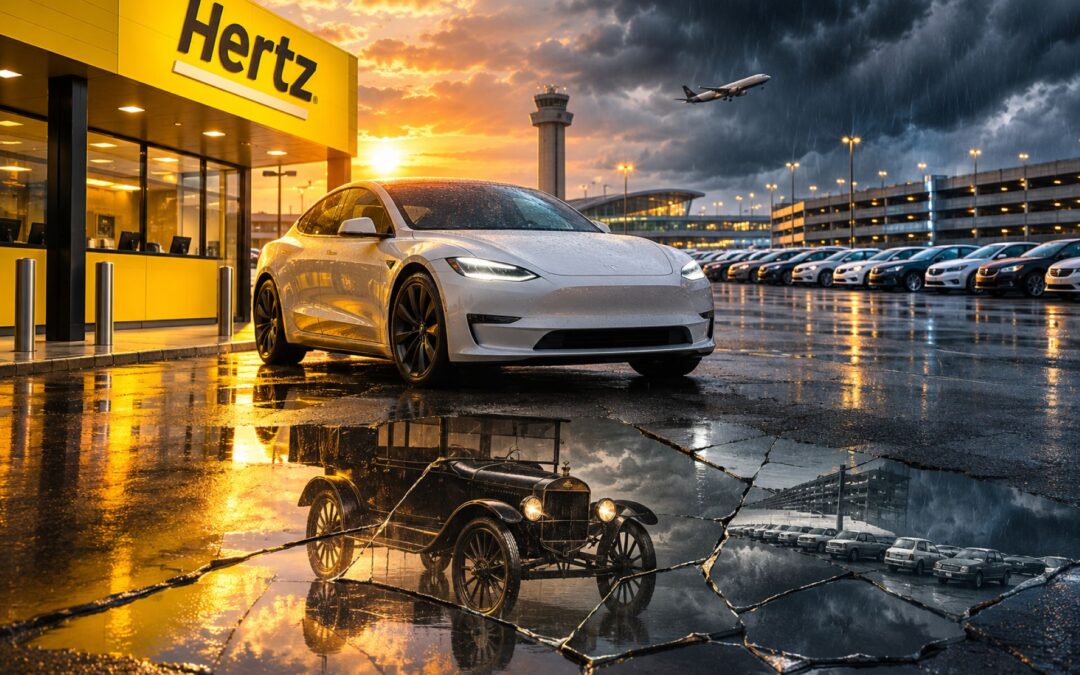
In October 2021, Hertz announced plans to buy 100,000 Teslas. The car rental company had emerged from bankruptcy only four months earlier, but now it was presenting itself as a pioneer of electric mobility. Investors embraced the story: Hertz’s stock surged in the weeks surrounding the announcement, and the ambitious order dominated headlines. The comeback looked spectacular before its results were tested.
By January 2024, Hertz was preparing to sell about one-third of its electric fleet. In June 2026, another painful announcement sent its shares plunging: used-car resale values had weakened, and the company needed to raise more financing. For a business whose central task is to buy vehicles, rent them profitably and eventually sell them, repeatedly misjudging fleet economics was a serious problem.
Yet the rise and fall of Hertz is not simply a story of executives buying the wrong cars. It stretches from an ingenious Chicago start-up to a rivalry transformed by advertising, an expensive acquisition battle, questionable accounting, a pandemic bankruptcy and a scandal involving customers wrongly accused of stealing their rentals. Its recovery also deserves attention. The distinction is between controllable decisions, market forces and who paid for mistakes.
How Hertz Built America’s Car Rental Industry
In 1918, Walter L. Jacobs began renting cars in Chicago with a fleet of twelve Ford Model Ts. At the time, owning an automobile was still beyond many Americans’ means, and even those who could afford one might not need a car every day. Jacobs offered a useful alternative: access to a vehicle for a limited period without the cost and inconvenience of ownership.
The business grew quickly. Within five years, the fleet had expanded to roughly 600 vehicles, and annual revenue was approaching $1 million. In 1923, John D. Hertz, who had built a transportation business around Yellow Cab, acquired Jacobs’s company and gave it the Hertz Drive-Ur-Self name. Importantly, Jacobs did not disappear from the story. He continued running the business for decades, helping build the system that would carry the new owner’s name.
The early company succeeded by making car rental practical on a scale that individual operators struggled to match. A customer needed a dependable vehicle, an understandable contract and reasonable confidence that assistance would be available if something went wrong. Hertz invested in a recognizable network and in procedures that made renting feel like a predictable service rather than a risky arrangement between strangers.
The company also understood that transportation systems could reinforce one another. A national rental network grew as American roads improved. Hertz introduced an early car rental charge card in 1926, allowing approved customers to rent more conveniently. Its airport rental counter at Chicago Midway, opened in 1932, addressed an increasingly obvious need: travelers could arrive by air and still require a car for the final part of their journey.
In 1933, Hertz pioneered one-way rentals, allowing a driver to pick up a vehicle in one city and return it in another. That flexibility connected car travel with trains and aircraft. It was especially valuable for business travelers.
Expansion continued across borders. Hertz entered Canada before World War II and established a presence in Europe after the war. Corporate ownership changed, including a period under General Motors, but the rental network and familiar name endured. By the middle of the twentieth century, the company had turned a modest Chicago idea into one of the country’s defining travel businesses.
Being first brought tangible advantages: airport positions, established customer relationships, purchasing scale and recognition. But these advantages were not the same as permanent loyalty. The larger Hertz became, the easier it was to assume that customers would choose the leader because it was the leader. A smaller rival was about to challenge that assumption without pretending it was bigger or better equipped.
How Avis Challenged Hertz by Trying Harder
In 1962, Avis was confronting a problem familiar to businesses that compete against a dominant brand. Hertz occupied the commanding position in American car rental, with contemporary accounts placing its market share around 61%. Avis was a distant second and had struggled to make a profit for years. Advertising that merely declared Avis excellent would have invited an obvious question: if it was so excellent, why was Hertz winning?
Working with the agency Doyle Dane Bernbach, Avis found a way to make second place itself the selling point. Its campaign declared, “When you’re only No. 2, you try harder.” Rather than hide its disadvantage, the company claimed that losing the customer’s business would hurt a challenger more than an incumbent. Service, therefore, had to be the difference.
The ads made that promise concrete. They talked about cleaner ashtrays, fuller gas tanks and the small courtesies a rushed traveler might remember long after returning the keys. Customers could test those promises, and attentive employees could distinguish Avis from its larger competitor.
The “We Try Harder” campaign became one of advertising’s best-known examples of turning an apparent weakness into a distinctive position. Accounts of its early results describe Avis moving from a loss of roughly $3 million to a profit of about $1 million within a year. Hertz reportedly spent far more on advertising, yet Avis’s market share improved as the message gained recognition.
Over the following years, estimates cited in the campaign’s history show Hertz’s share falling from around 61% toward 49%. Those figures should not be read as proof that a slogan single-handedly shifted an entire industry. Service execution, network expansion, pricing and broader competition also mattered. But the campaign demonstrated that Hertz’s size did not answer the question customers actually cared about: what would their experience be like?
Avis’s advantage was storytelling joined to an operational claim. Hertz remained formidable, but the challenger had given consumers a reason to reconsider an automatic choice. The irony was that Hertz would later respond to competitive pressure in a very different fashion. Instead of merely trying to become more appealing, it would spend billions acquiring another rival—and inherit the financial consequences of doing so.
The Acquisitions, Accounting Problems and Debt That Weakened Hertz
Scale is especially tempting in car rental. A larger operator can negotiate vehicle purchases, spread reservation technology over more transactions and present customers with more airport and neighborhood locations. Buying an existing competitor seems faster than constructing that network location by location. But an acquisition also commits capital immediately, often before the promised savings have materialized.
Hertz’s pursuit of Dollar Thrifty illustrates the attraction and the danger. In April 2010, Hertz made an offer worth around $1.2 billion for the operator of the Dollar and Thrifty brands. Avis Budget entered the contest with competing proposals. Through 2010 and 2011, the companies traded bids as Hertz attempted to secure a larger share of the rental market without allowing Avis to strengthen its own position.
Avis eventually withdrew in September 2011. Hertz continued negotiating and, in August 2012, announced an agreement to acquire Dollar Thrifty at $87.50 a share. The deal was commonly described as worth roughly $2.3 billion, although the final acquisition accounting recorded approximately $2.592 billion in total purchase consideration, including a previously held equity stake. These are different measures of the transaction, not interchangeable figures.
The price reflected a prolonged bidding struggle. Mark Frissora, then Hertz’s chief executive, acknowledged an acquisition multiple substantially above the trading multiples of the major rental companies; the transcript describes a premium of about 40%. Hertz also raised substantial debt, including senior notes, to help fund the purchase. Buying Dollar Thrifty offered brands and market access, but it made future performance depend on earning an adequate return on a costly transaction.
Regulatory approval required concessions, including the divestiture of the Advantage rental business and certain airport-related assets. The enlarged company still needed to integrate its operations, preserve service standards and achieve the hoped-for efficiencies. A high price left little room for disappointing cash flow.
Hertz soon faced a different crisis. Its financial reporting for periods between 2012 and 2014 proved unreliable. The Securities and Exchange Commission found that the company had misstated pretax income and suffered from significant accounting and internal-control failures. Hertz restated earlier financial results and, in 2019, agreed to pay a $16 million civil penalty to settle the SEC’s charges.
This was not merely the ordinary uncertainty of running a vehicle fleet. Investors need credible accounts to distinguish genuinely profitable rentals from results shaped by inaccurate assumptions or flawed records. A company can recover from an unfortunate market forecast while still retaining the confidence of lenders. It is harder to inspire confidence when outsiders cannot rely on previously reported numbers.
Frissora left in September 2014 amid pressure from investors, including activist Carl Icahn. His departure should not be confused with a criminal judgment against him; the SEC’s Hertz action did not charge Frissora personally. Nevertheless, the combination of restatements, disputed performance and leadership changes destabilized the company’s direction.
Over the following six years, Hertz repeatedly changed chief executives. Different leaders inherited essentially the same demanding economics: a large fleet, substantial fixed commitments, fierce price competition and a business vulnerable to changes in travel. Meanwhile, expansion and financing decisions had accumulated obligations that remained payable even when revenue slowed. Hertz had not lost its place in the industry, but its financial room for error was shrinking.
The Pandemic Bankruptcy and Hertz’s Second Chance
When COVID-19 spread in 2020, airline passengers disappeared, business trips were canceled and holiday plans collapsed. Rental companies could not simply switch off the costs attached to vehicles sitting in parking lots. Financing obligations, insurance, maintenance and contractual arrangements persisted even when cars generated little income.
Hertz was particularly vulnerable because it entered the crisis with heavy borrowings and a history of operational strain. The sudden interruption of travel was an extraordinary shock that no ordinary business forecast could have fully absorbed. It was not, however, the original cause of every problem on Hertz’s balance sheet. Years of debt accumulation and inconsistent leadership had weakened its ability to withstand that shock.
In May 2020, Hertz appointed Paul Stone as its fourth chief executive in roughly six years. On 22 May, Hertz Global Holdings, The Hertz Corporation and several American and Canadian subsidiaries filed for Chapter 11 bankruptcy protection. A former leader had captured the immediate predicament in a blunt assessment: “No business is built for zero revenue.” That described the pandemic’s scale, but not the whole history behind Hertz’s vulnerability.
Chapter 11 allowed Hertz to restructure liabilities while operations continued under court supervision. The company had to negotiate with creditors, manage vehicle financing and determine what assets and obligations would remain in a reorganized business. Employees, suppliers, bondholders and shareholders experienced the disruption in very different ways.
One of the most conspicuous casualties was Carl Icahn. The activist investor had held a stake of approximately 39% and sold during the bankruptcy at a loss reported around $2 billion. For ordinary shareholders, the episode underlined that a famous brand and a vast operating network do not guarantee protection when lenders and other creditors have higher claims on a business’s assets.
Yet Hertz’s story did not end in liquidation. As travel began recovering, its fleet and customer network remained valuable. A restructuring backed by Knighthead Capital Management, Certares and Apollo supplied a path out of Chapter 11. The company emerged from bankruptcy on 30 June 2021 with a dramatically reduced corporate debt burden and fresh ownership support.
The recovery in travel offered Hertz a chance to rebuild with less debt. But debt relief cannot eliminate depreciation, repair costs or the need to choose the right mix of vehicles. Those judgments had always been central to rental economics. Hertz would soon make its most highly publicized fleet decision just as the market for electric cars was changing.
The Tesla Gamble That Became a Costly Reversal
The basic economics of car rental are easy to describe and difficult to execute. A company acquires vehicles, earns income for each day they are rented and eventually sells them into the used-car market. Between purchase and sale, it must pay for financing, storage, cleaning, insurance, repairs and periods when no customer wants the car. The difference between what a vehicle costs and what it can ultimately be sold for—depreciation—is one of the central expenses of the business.
A rental company therefore makes several bets at once. It estimates how many customers will rent a model, what daily rate they will pay, how often it will be damaged and how much its resale value will decline. An attractive purchase can become expensive if utilization falls or the used-car price drops unexpectedly. Those risks would take on a new form as Hertz turned to electric vehicles.
The 100,000-Tesla Announcement
In October 2021, just months after its bankruptcy exit, Hertz announced an initial order for 100,000 Tesla Model 3 vehicles. It was an extraordinary number for a single buyer and a powerful publicity opportunity for both brands. Electric cars were becoming symbols of technological progress, while Hertz wanted investors to see more than a conventional rental company emerging from restructuring.
According to Hertz’s own 2021 securities filing, the planned Teslas represented the equivalent of roughly 22% of its global fleet at the time. Hertz envisaged installing thousands of charging stations across its network, including infrastructure across approximately 65 markets. The ambition extended beyond offering tourists an unfamiliar vehicle for a weekend.
Hertz also announced a partnership with Uber that could make as many as 50,000 Teslas available to drivers in the United States. The arrangement gave the company a possible source of frequent, longer-term rental demand while giving rideshare drivers access to electric cars they might not want to purchase themselves. Electrification was presented not only as a product choice but as the foundation of a broader mobility business.
Mark Fields, the former Ford chief executive then serving as Hertz’s interim leader, oversaw the initial announcement. It arrived shortly before Hertz returned to the public stock market. Shares surged, and investors appeared enthusiastic about the possibility that an old rental brand could participate in the excitement surrounding electric vehicles.
There was an important complication. Tesla’s Elon Musk subsequently said the manufacturers had not signed a contract for the entire reported order. Hertz maintained that its purchase plans were proceeding and that deliveries had begun. The distinction matters: an announced intended fleet size was not the same as proof that every car had been contractually secured, delivered or profitably deployed.
Hertz’s filings acknowledged risks such as semiconductor shortages and other constraints outside its control. But even if production and charging infrastructure arrived on schedule, a much harder question remained. Could the electric vehicles earn enough rental revenue, withstand costly use and retain enough resale value to justify the investment?
Betting Even Bigger on Electric Vehicles
The original Tesla announcement was not the end of the strategy. About six months later, in April 2022, Hertz announced a plan to purchase up to 65,000 Polestar electric vehicles over five years. Diversifying suppliers appeared to lessen dependence on any one manufacturer, while extending the company’s identity as an early adopter of a new automotive era.
In September 2022, Hertz and General Motors announced plans for up to 175,000 electric vehicles over five years. The initial deliveries were expected in early 2023. This distinction is important because later retellings sometimes describe the GM initiative as a 2023 announcement; the commitment was publicly made the year before.
Stephen Scherr had become chief executive in early 2022, following a long career in finance. He did not originate the Tesla strategy, but the Polestar and GM plans made electrification a much larger part of Hertz’s public direction during his tenure. The announcements described intended purchases over time, not hundreds of thousands of confirmed vehicle deliveries. At its peak, Hertz said its operating EV fleet numbered around 60,000 vehicles across manufacturers.
The attraction was understandable. Electric cars could reduce fuel-related expenses for drivers and some routine maintenance costs compared with conventional vehicles. A modern fleet might attract customers curious about new technology, environmentally conscious travelers and rideshare drivers seeking lower day-to-day energy costs. Access to enough vehicles could also position Hertz as a significant provider in a rapidly growing market.
But the renter’s experience did not always match the promise. Many travelers had little familiarity with charging speeds, connector types, battery range or the location of reliable chargers. Someone collecting a car after a delayed flight might value a quick and predictable refueling stop more than potential savings on energy. An unfamiliar charging requirement could reduce the convenience on which rental firms depended.
The rideshare market exposed a different pressure. A driver working long hours and accumulating substantial mileage places heavy demands on a vehicle. Hertz later reported that damage incidence and repair expenses were disproportionately high in parts of its EV business, particularly among rideshare rentals. Some electric models required specialized labor or parts, while repairs following collisions could take longer and cost more than expected.
These problems did not prove electric vehicles were inherently unsuitable for rental fleets. Vehicle choice, customer education, insurance arrangements, rental duration, charging availability and pricing could all change the result. But a strategy built around very large purchases needed those operational details to work at scale. Hertz was learning how expensive a mismatch could become while its public commitments still looked ambitious.
Why Hertz Sold Its Electric Cars
The most damaging challenge came from the used-car market. Tesla reduced prices on new vehicles, seeking to stimulate demand in a more competitive electric-car market. That made newly purchased Teslas more affordable, but it also weakened the resale value of older ones. Hertz could not control Tesla’s pricing decisions, yet its ownership of thousands of vehicles meant it directly absorbed the resulting depreciation pressure.
Suppose a rental company expects to recover most of a car’s purchase price after a few years. If the resale market falls sharply, daily rental revenue must cover a much larger loss of vehicle value. The car can be busy and still produce disappointing economics. Collision expenses and downtime compound the damage.
By late 2023, Hertz had decided its EV mix was too large for the actual demand and cost profile. It began disposing of vehicles in December. On 11 January 2024, the company disclosed plans to sell about 20,000 electric cars, approximately one-third of its global EV fleet, and redirect some of the proceeds toward gasoline-powered vehicles that better matched customer preferences.
The accompanying accounting figure was stark: approximately $245 million of incremental net depreciation expense. Although announced in January 2024, the write-down was recognized for the fourth quarter of 2023, reflecting the lower estimated value of EVs held for sale at 31 December. The physical sales continued into 2024. Mixing up those dates obscures when the financial damage entered Hertz’s accounts.
Management argued that reducing EV exposure would remove lower-margin rentals, cut damage expenses and create a better balance between vehicle supply and demand. The company also planned to reconsider which rideshare customers it served and how it priced their rentals. Selling cars was not an admission that every electric rental lost money; it was an acknowledgment that the existing fleet allocation and operating assumptions were not delivering the expected returns.
Scherr left in March 2024. His replacement, Gil West, had previously held senior operational roles at Delta Air Lines and at Cruise, General Motors’ autonomous-vehicle subsidiary. By then, Hertz’s shares had lost much of the value investors attached to its post-bankruptcy comeback. The company’s most celebrated modernization initiative had become a warning about what happens when enthusiasm for a technology outruns the practical economics of using it.
It would be unfair to say Hertz caused Tesla’s price cuts or invented the higher repair expenses that affected parts of the EV industry. Those were external pressures. But deciding how much to buy, how quickly to expand, which customers to target and how much residual-value risk to accept were management decisions. The disaster was not simply that the market changed; it was that Hertz had made itself unusually exposed to the change.
When Hertz Customers Were Accused of Stealing Their Rentals
During the years Hertz promoted its electric future, it was also confronting a crisis in an older, more basic part of its operations: keeping accurate records of who had rented which vehicle. Customers alleged they had been reported to police as car thieves despite having legitimate rental arrangements. For some, what should have been a routine transaction became a confrontation with law enforcement.
Consider the experience described in court records of a woman renting a vehicle in Florida. She extended her rental four times, and text messages with a Hertz employee documented arrangements for returning it. Yet the vehicle was reported stolen before the extension period had ended. According to her lawsuit, she spent 37 days in jail, was separated from her children and missed her nursing-school graduation. The central failure was not a complicated theory about the future of transportation; it was an apparent breakdown between an agreed extension and the company’s records.
Other customers described different but equally serious failures. In one Chicago case, a customer called for assistance with a flat tire and later learned during a traffic stop that a warrant existed in connection with the rental; she said she spent more than a month in jail. A Mississippi man alleged that he had returned and paid for his rental but was incarcerated for months after the company failed to notify prosecutors. These individual accounts remained allegations in litigation.
Some people reported being arrested at gunpoint. Others said pending felony charges cost them employment opportunities. Even when charges were ultimately dropped, an arrest could mean lost income, legal expense, family separation and damaged trust. Those consequences are not captured by a simple calculation of how many complaints a company receives in an average year.
The lawsuits pointed to several mechanisms. Rental extensions might not be entered correctly into internal systems. A vehicle previously reported stolen might later be rented to a new customer without the police report being withdrawn. In other situations, the wrong customer could be connected to a theft report or payment history. The common thread was the gap between a company’s administrative account of a vehicle and what had actually happened.
Hertz defended parts of its procedures and emphasized the rarity of theft reports relative to its huge rental volume. It said it handled about 25 million rentals annually and reported roughly 3,500 vehicles stolen, or around 0.014% of transactions. That proportion is small, but it does not establish that every one of those reports was justified. Nor does the percentage make the consequences of an erroneous report less serious for the person detained.
On 5 December 2022, Hertz announced a settlement of 364 vehicle-theft-reporting claims, agreeing to pay approximately $168 million. The settlement resolved more than 95% of the then-pending claims. It was a negotiated resolution, not a court ruling proving every allegation or establishing that the company had deliberately fabricated every report.
Hertz said it expected meaningful insurance reimbursement, did not anticipate a material effect on its near-term capital allocation plans and had worked to improve its policies. Scherr emphasized putting customers first. Those assurances mattered, but they could not undo the days people said they had spent in jail or the experiences they believed had disrupted their lives.
The scandal reveals a different kind of operational risk from depreciation. A car can be well maintained and profitable on paper while the records attached to it put its lawful renter in danger. Hertz’s ability to manage vehicles at scale was supposed to be a competitive advantage. In these cases, customers alleged that flaws in that same system had become a source of personal harm.
The June 2026 Financing Crisis
The EV reversal was not Hertz’s last encounter with the resale market. By the spring of 2026, used-car values had weakened more broadly, and Hertz disclosed losses on vehicle disposals. The problem affected conventional fleet economics as well as the remnants of its electric investment: when cars sell for less than expected, the company must recognize higher depreciation or losses and find ways to finance replacement vehicles.
Hertz was not alone in facing that pressure. Avis Budget also reported rising fleet costs and weaker resale values in its third quarter. Its monthly fleet cost per vehicle rose about 7% to roughly $330, while adjusted earnings declined, and vehicle recalls added operating complications. Both companies could suffer from an unfavorable car market without having made identical decisions. Investors even bid up the two shares after Avis’s results, apparently viewing part of the pressure as industry-wide.
The distinction matters. A rental company does not decide the price that used-car buyers will offer six months from now. But it can decide what it pays for vehicles, how long it keeps them, the proportion of models exposed to a volatile resale market and how much borrowing supports its operations. Hertz’s previous decisions shaped how much pain a new market decline would cause.
On 24 June 2026, the company announced another financing initiative against that difficult backdrop. Its shares fell sharply—at one point by about a third in the session—as investors absorbed the implications of the used-car weakness and a complex fundraising structure. The fall was particularly unsettling given the hope attached to Hertz’s return to public trading in 2021.
One part of the transaction was described as a $100 million stock offering at approximately $2.70 a share. That description needs care. The shares were borrowed shares loaned to a financial institution for sale as part of arrangements facilitating hedging of the related debt securities. Hertz itself did not receive the approximately $100 million of stock-offering proceeds. Treating that sale as ordinary cash raised by issuing equity would overstate what flowed into the company.
The financing that did raise money for Hertz was an offering of $350 million in exchangeable senior secured notes due in 2030. Under the announced note terms, the securities carried a 6.75% annual coupon, split between 3.375% paid in cash and 3.375% paid in kind. They could be exchanged into Hertz stock at an initial price equivalent to approximately $3.58 per share, subject to the transaction’s terms and adjustments.
Payment-in-kind interest sounds technical but describes a familiar bargain: rather than pay every dollar of interest immediately, a borrower adds part of the interest obligation to the debt. That preserves cash today but increases what will be owed later. It can be useful when liquidity is tight, yet it is not free money. The June notes also had first-lien security over specified assets alongside other secured obligations, giving their holders priority claims over those assets relative to unsecured creditors, not a unique first claim ahead of every existing secured lender.
This was not Hertz’s first use of such instruments. In June 2024, it had issued $250 million in exchangeable notes due in 2029 with payment-in-kind features that could increase outstanding principal over time. Returning to similar financing in 2026 emphasized the tension between keeping enough cash available to operate the business and creating new obligations for future periods.
Litigation followed the market shock. A shareholder action filed in July 2026 alleged that Hertz, its chief executive and its chief financial officer had made misleading statements in May about available liquidity and the supposedly temporary weakness in used-car prices. A similar shareholder complaint followed in September. These were allegations, not findings that executives had committed fraud, and their merits must be determined through the legal process.
A separate shareholder dispute concerned statements about demand for electric vehicles. By October 2026, that litigation had reached a settlement stage, distinct from the newer liquidity-related allegations. They involved separate claims and outcomes.
June 2026 therefore presented more than an embarrassing stock-market headline. It showed how a difficult used-car market could collide with financing choices, investor confidence and the accumulated consequences of earlier decisions. Hertz needed liquidity, but it also needed to demonstrate that keeping its rental business supplied with vehicles would not repeatedly require terms that made its future finances more complicated.
Can Hertz Finally Break the Cycle?
Gil West’s response has focused less on announcing dramatic vehicle purchases and more on ordinary operating discipline. The company has emphasized improving rental prices, putting cars in locations where they earn attractive returns, reducing damage costs and choosing vehicles with more predictable resale values. The vocabulary is less exciting than an order for 100,000 Teslas, but it addresses the mechanics that determine whether a rental company earns money.
The third quarter of 2026 offered real evidence of progress. Hertz reported approximately $2.6 billion in revenue, about 6% higher than a year earlier and its strongest quarterly revenue in three years. Adjusted corporate EBITDA reached $233 million, up roughly 15% year on year. On the standard GAAP measure, the company recorded $116 million in quarterly net income. These are different measures, and improvement in one should not be mistaken for identical improvement in all.
Rental revenue per day improved, particularly in the core American business, while fleet capacity was broadly flat. That suggests the company was collecting more from vehicles already available rather than relying on a massive increase in fleet size. In a capital-intensive business, earning more from an existing asset can be more valuable than owning additional assets merely to grow reported revenue.
Hertz also reported a U.S. core fleet averaging about nine months of age, its youngest in twelve years. A younger fleet can help limit maintenance problems, make rentals more appealing and give managers greater control over vehicle rotation. It does not eliminate depreciation risk: a nearly new car still loses value if the resale market deteriorates. The company reported net depreciation of roughly $285 per vehicle per month, illustrating how closely management continues to watch that cost.
The financial improvements were not unqualified. Adjusted EBITDA fell more than $40 million below the lower end of management’s guidance, and Hertz expected negative adjusted corporate EBITDA in the fourth quarter. It ended September with approximately $946 million of liquidity—cash plus available borrowing capacity, not $946 million sitting entirely in a bank account. Strong seasonal results therefore coexisted with liquidity pressure and concern about what slower months might bring.
Damage recovery remains another priority. Management has said that roughly $200 million a year of vehicle-damage costs go unrecovered and wants to improve collections from customers and insurers where justified. Doing so could reduce losses, but the company must also preserve fairness and accuracy in its claims process. Its history of mistaken theft reports makes the quality of customer records more than a narrow administrative detail.
Another element of the turnaround is a more capital-light franchise strategy. In a directly operated location, Hertz may have to support vehicles, facilities, staffing and associated commitments. Under a franchise arrangement, an independent operator can take on more of the local capital burden while Hertz receives brand-related revenue and retains a commercial relationship. The appeal is obvious for a company that has repeatedly struggled with the cost of owning and financing large fleets.
Franchising carries its own trade-offs. A company may surrender some direct control over customer experience, service consistency and local economics. Fewer owned assets do not guarantee profitability. Successful transitions will depend on choosing capable partners and maintaining standards while freeing cash for the business that remains company-operated.
The more ambitious growth proposal is Oro Mobility, a fleet-management operation supporting rideshare and emerging autonomous-vehicle services. Rather than relying solely on renting a car to an occasional traveler, Hertz wants to provide ownership, vehicle preparation, maintenance, movement and management capabilities to companies whose businesses depend on vehicles operating continuously. This draws on experience Hertz has accumulated for a century, although the technology and customer relationships are changing.
In October 2026, Oro secured an $80 million strategic equity investment to develop as a standalone platform. It reported managing approximately 45,000 vehicles across major American mobility markets, including services for driver-led and autonomous fleets. Hertz retained a majority economic interest and continued to supply fleet and corporate support. The initiative offered a possible route to new earnings without assuming that every opportunity required Hertz itself to buy an enormous new fleet.
West’s prior work at Cruise helps explain the appeal of that direction. Autonomous vehicles still require cleaning, maintenance, charging or refueling, repositioning, repairs and day-to-day management. Removing the human driver does not remove the need to operate the physical vehicle. Hertz hopes capabilities developed for ordinary rentals will become valuable infrastructure for a different kind of transportation market.
That possibility should not be confused with a proven turnaround. The economics of autonomous fleets remain uncertain, and building new services requires execution, partners and discipline. A company that previously used electric vehicles as a compelling vision of its future has reason to be cautious about another ambitious mobility narrative. Oro’s first investments and early operations are evidence of activity, not yet evidence of enduring returns at scale.
There is also a useful distinction between Hertz’s failures and its misfortunes. The pandemic crushed travel for reasons Hertz did not control. Tesla set its own prices; the used-car market moved independently; Avis faced some of the same depreciation pressures. Those events explain part of the company’s difficulties. But Hertz chose its acquisition prices, financial commitments, degree of EV exposure and internal processes for tracking rentals. Those decisions determined how much damage external events could cause.
The legacy is unevenly shared. Investors have seen the value of their holdings swing violently. Employees have lived through bankruptcy, uncertainty and changes of management. Some customers alleged they were arrested for vehicles they had legitimately rented. Executives made decisions under difficult circumstances, but they were rarely the only people left dealing with the consequences.
After more than a century, Hertz still has a recognized brand, a global rental network and a genuine opportunity to become more profitable. Yet companies can remain trapped by the business model that made them dominant when scale and old habits make change expensive. Hertz’s task is not to produce the next extraordinary announcement. It is to prove, quarter after quarter, that ordinary decisions about cars, customers, costs and capital can finally deliver durable results.
Last Updated on November 14, 2026 by Aseem Gupta