
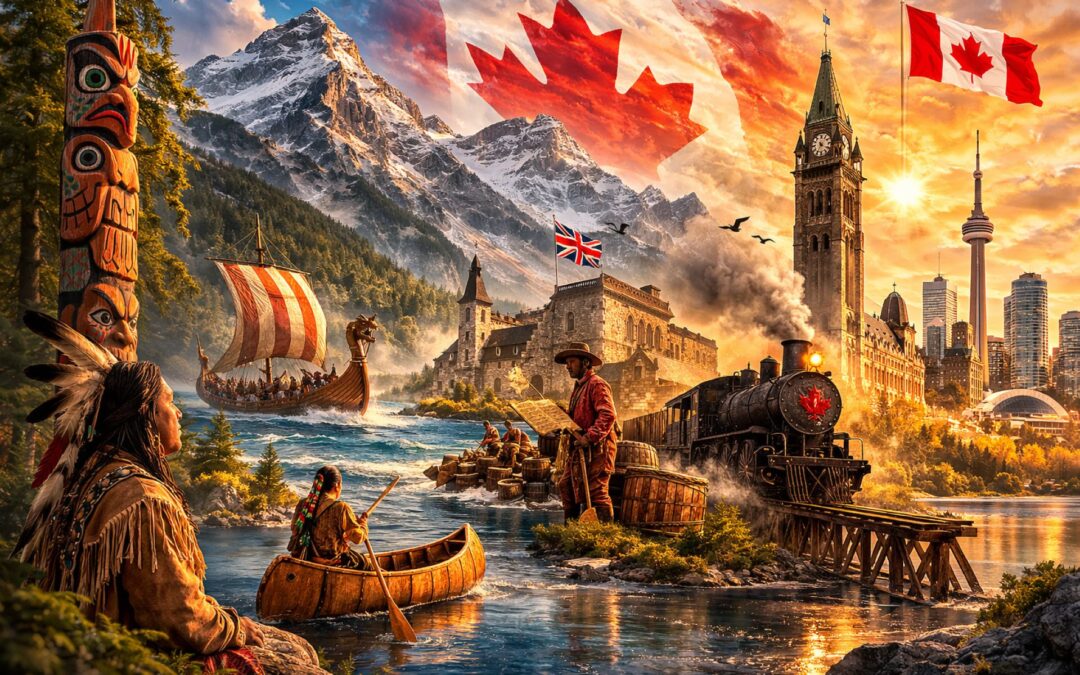
Canada is the second-largest country on Earth, stretching across nearly 3.8 million square miles and spanning six time zones. Its landscapes range from the towering peaks of the Rocky Mountains and the endless prairies of the interior to the dense temperate rainforests of the Pacific coast and the frozen tundra of the Arctic. Yet Canada’s diversity is not defined only by its geography. It is also reflected in the extraordinary variety of peoples, cultures, languages, and traditions that have shaped the nation over thousands of years.
The story of Canada begins long before European explorers first arrived on its shores. For millennia, the land was inhabited by Indigenous peoples who developed complex societies adapted to the vast and varied environments of northern North America. Later, waves of European exploration and colonization introduced new political powers, economic systems, and cultural influences that profoundly reshaped the region.
Over time, rival empires fought for control of the territory, colonial settlements grew into provinces, and political institutions evolved from imperial administration to democratic self-government. The country that emerged from this long historical process was not forged in a single revolution or dramatic break with the past. Instead, Canada developed gradually through negotiation, compromise, and steady political transformation.
From the first migrations across the Bering land bridge to the creation of a modern multicultural democracy, Canada’s history is a story of migration, conflict, cooperation, and nation-building across an immense continent. Understanding how this vast and diverse country came into existence requires tracing the many stages of its development — beginning with the earliest human inhabitants of North America.
Canada Before Europe: The First Peoples of the North
Long before European explorers reached the shores of North America, the land that would later become Canada was already home to diverse Indigenous societies whose histories stretched back thousands of years. These early inhabitants adapted to one of the most varied and demanding environments on Earth, building cultures that were deeply connected to the land, climate, and natural resources of the continent.
Migration Across the Bering Land Bridge
The earliest chapter of human history in Canada begins roughly 16,000 years ago, when small groups of hunter-gatherers migrated from eastern Siberia into North America. During the last Ice Age, global sea levels were much lower, exposing a vast land bridge known as Beringia, which connected Asia to Alaska. This route allowed early human populations to gradually move into the previously uninhabited lands of the Americas.
Over thousands of years, as the massive ice sheets that covered much of northern North America began to retreat, these early migrants spread southward and eastward across the continent. As glaciers melted and sea levels rose around 11,000 years ago, the Bering land bridge disappeared beneath the ocean, permanently separating Asia from North America.
By this time, human communities had already established themselves across the vast territories of what would become Canada. Over generations, these groups adapted to dramatically different environments—from forests and plains to coastal regions and Arctic tundra—developing distinct languages, cultural traditions, and social structures.
Regional Indigenous Cultures Across the Canadian Landscape
Across eastern Canada, large portions of the land were inhabited by Algonquian- and Iroquoian-speaking peoples, whose territories stretched from the Atlantic coast to the Great Lakes and north toward Hudson Bay. These societies often lived in semi-permanent villages and relied on a combination of hunting, fishing, and agriculture.
In the Great Plains and prairie regions, Cree-speaking peoples and other Indigenous groups lived as highly mobile communities, following vast herds of bison that roamed across the grasslands. Their nomadic lifestyle was carefully adapted to the rhythms of the plains ecosystem.
Further west along the Pacific coast, Indigenous societies developed rich maritime cultures supported by abundant natural resources. Salmon runs, dense forests of cedar trees, and productive coastal waters allowed communities to construct large wooden homes, carve totem poles, and build sophisticated ocean-going canoes.
In the far north, the Inuit emerged as a distinct people uniquely adapted to life in the Arctic. Spread across the Arctic archipelago from Alaska to Greenland, Inuit communities developed specialized technologies and survival strategies suited to one of the harshest climates on Earth, relying heavily on hunting marine animals and navigating frozen landscapes.
These societies were far from isolated or primitive. They maintained complex systems of trade, diplomacy, and cultural exchange across vast distances. By the time Europeans eventually arrived in North America centuries later, the land that would become Canada was already home to vibrant and diverse Indigenous civilizations that had flourished for millennia.
The First Europeans: Vikings in North America
Centuries before Christopher Columbus reached the Americas in 1492, the first Europeans had already set foot on the northern shores of North America. These early visitors were the Norse seafarers, better known today as the Vikings, whose remarkable voyages across the North Atlantic brought them briefly to the lands that now form part of Canada.
Norse Exploration and Vinland
By the late 10th and early 11th centuries, Viking explorers from Scandinavia had already established settlements in Iceland and Greenland. These distant colonies served as stepping stones for further exploration into the western Atlantic.
Around the year 1000 CE, the Norse explorer Leif Erikson led an expedition westward from Greenland in search of new lands. According to Norse sagas and archaeological evidence, Erikson and his companions eventually reached the coast of North America. They encountered several distinct regions during their journey, which they named Helluland, Markland, and Vinland.
Helluland is generally believed to correspond to modern Baffin Island, while Markland likely referred to the forested coastline of Labrador. Further south lay Vinland, a region described in the sagas as having milder climates and abundant resources. Historians widely believe this area corresponded to parts of Newfoundland and possibly surrounding regions.
L’Anse aux Meadows and the End of the Viking Presence
The most significant evidence of Norse presence in North America was discovered in the 1960s at L’Anse aux Meadows, located on the northern tip of Newfoundland. Archaeological excavations at the site revealed the remains of a small Norse settlement dating to around the early 11th century, confirming that Vikings had indeed established a foothold in North America.
This settlement likely served as a base for exploration, resource gathering, and further voyages along the surrounding coastlines. During these expeditions, the Norse encountered Indigenous peoples of the region, whom they referred to in their sagas as “Skraelings.” Relations between the two groups appear to have been tense and occasionally hostile.
Despite their impressive navigational achievements, the Norse presence in North America proved to be short-lived. The immense distance between Vinland and the Viking homelands in Greenland and Scandinavia made communication and supply difficult. Combined with resistance from local populations and the challenges of maintaining remote colonies, these settlements were eventually abandoned.
By the 12th century, the Norse had withdrawn entirely from North America. Over time, knowledge of their western voyages faded from European memory. For nearly five centuries, the existence of the continent remained largely unknown to Europeans—until a new age of exploration began at the end of the 15th century.
The French Discovery of Canada
When Europeans returned to the northern coasts of North America at the end of the 15th century, they did so as part of a wider era of exploration that reshaped the global map. While earlier Viking voyages had faded into legend, the expeditions of the late 15th and early 16th centuries began a sustained European presence in the region that would eventually become Canada.
Jacques Cartier and the Naming of Canada
In 1497, just a few years after Christopher Columbus reached the Caribbean, the Italian explorer John Cabot, sailing under the English crown, became the first European since the Norse to reach the coasts of North America. His voyage reintroduced the continent to European awareness and opened the door for further expeditions.
Over the following decades, English, French, Spanish, and Portuguese ships explored the Atlantic coastline in search of new trade routes and valuable resources. However, for many years these voyages resulted primarily in fishing expeditions rather than permanent settlements.
A turning point came in 1534, when the French explorer Jacques Cartier sailed into the Gulf of St. Lawrence. During this voyage, Cartier claimed the territory for France and began exploring deeper into the region. It was during these expeditions that the name “Canada” first entered European usage.
The word originated from the St. Lawrence Iroquoian term “kanata,” meaning “village” or “settlement.” Cartier used the term to describe the region surrounding the Indigenous settlement of Stadacona, near present-day Quebec City. Over time, the name expanded to refer to the broader territory explored by the French.
Cartier made two additional voyages to the region, traveling further along the St. Lawrence River and attempting to establish early French settlements. Although these initial colonies ultimately failed due to harsh conditions and logistical difficulties, his expeditions firmly placed Canada on the European map.
Samuel de Champlain and the Founding of New France
It was not until the early 17th century that France began making serious efforts to establish a permanent colonial presence in Canada. The key figure in this process was the explorer and cartographer Samuel de Champlain, often referred to as the “Father of New France.”
Beginning in 1603, Champlain undertook a series of expeditions to explore and map the St. Lawrence region in greater detail. Recognizing its strategic importance for trade and settlement, he helped establish the first durable French colonies.
In 1605, French settlers founded Port Royal in present-day Nova Scotia, one of the earliest European settlements in Canada. Three years later, in 1608, Champlain established the city of Quebec, which quickly became the political and economic center of the French colony known as New France.
Champlain also ventured deep into the interior of the continent, becoming one of the first Europeans to explore the Great Lakes region. Along the way, he formed alliances with several Indigenous nations, particularly the Huron-Wendat, which played a crucial role in the expanding fur trade.
Despite these efforts, the French population in Canada grew slowly. By the mid-17th century, New France remained a relatively small colonial society with only a few thousand settlers. Yet its influence extended far beyond its modest population through trade networks and exploration that reached deep into the North American interior.
These early foundations laid the groundwork for a vast French colonial presence across North America—one that would soon come into direct conflict with another rising imperial power: Great Britain.
Fur, Empire, and Rivalry: France and Britain in North America
During the 17th and early 18th centuries, Canada became the center of a vast imperial competition between two of Europe’s most powerful kingdoms: France and Britain. What began as scattered settlements and trading outposts gradually evolved into rival colonial systems competing for territory, resources, and alliances with Indigenous peoples across northern North America.
The Fur Trade and Colonial Expansion
The economic engine that drove early European activity in Canada was the fur trade, particularly the trade in beaver pelts, which were highly prized in Europe for making fashionable felt hats. The demand for these furs created a lucrative transatlantic trade network that linked Indigenous hunters, French traders, and European markets.
French settlers in New France established trading posts along the St. Lawrence River and gradually pushed inland toward the Great Lakes and the vast river systems of the interior. Rather than relying on large agricultural colonies, the French colonial model depended heavily on partnerships with Indigenous nations who controlled access to fur-rich territories.
French traders known as coureurs des bois and later voyageurs traveled deep into the wilderness by canoe, exchanging European goods such as metal tools, firearms, and textiles for furs obtained by Indigenous hunters. This network of trade routes stretched across enormous distances, linking the forests of Canada to markets in Europe.
Over time, French explorers and traders expanded their reach far beyond present-day Canada. Their expeditions connected the Great Lakes region to the Mississippi River, creating an immense French sphere of influence that extended from Canada all the way to the Gulf of Mexico.
The Hudson’s Bay Company and Competing Empires
While the French expanded south and west from the St. Lawrence Valley, the British pursued a different strategy centered on the northern waterways of the continent. In 1670, King Charles II granted a royal charter to the Hudson’s Bay Company, giving it exclusive trading rights over a vast territory surrounding Hudson Bay known as Rupert’s Land.
From a series of fortified trading posts along the bay’s coastline, the company encouraged Indigenous hunters to bring furs directly to British traders. This approach allowed the British to compete with the French without sending large numbers of settlers into the interior.
By the early 18th century, two rival colonial systems had emerged across northern North America. The French controlled the St. Lawrence River valley and much of the interior through exploration and alliances, while the British dominated the Atlantic coastline and the Hudson Bay region through trade networks and colonial settlements.
These competing empires increasingly found themselves in conflict. A series of colonial wars between Britain and France throughout the late 17th and early 18th centuries repeatedly shifted the balance of power across the continent.
What had begun as commercial rivalry over furs gradually escalated into a broader struggle for control of North America itself—one that would culminate in a decisive confrontation during the Seven Years’ War.
The Fall of New France and the Rise of British Canada
By the mid-18th century, tensions between the French and British empires in North America had reached a breaking point. After decades of rivalry over territory, trade, and influence among Indigenous nations, a major conflict erupted that would permanently reshape the political map of Canada.
The Seven Years’ War and the Battle of Quebec
In 1754, fighting broke out between British and French forces in North America in what became known locally as the French and Indian War. This regional conflict soon expanded into the global Seven Years’ War, involving major European powers and battles across several continents.
In North America, the struggle centered on control of New France, the vast French colonial territory that stretched along the St. Lawrence River and into the interior of the continent. Although the French initially achieved several military successes, the British gradually gained the advantage due to their larger population in the American colonies and stronger naval support.
One of the earliest major developments occurred in Nova Scotia, where British authorities expelled thousands of French-speaking settlers known as the Acadians in an event remembered as the Great Expulsion. Many Acadians were deported to other British colonies, while others eventually settled in Louisiana, where their descendants became known as Cajuns.
The decisive moment of the war came in 1759 during the Battle of the Plains of Abraham, fought just outside the fortified city of Quebec. In a dramatic and short battle, British forces led by General James Wolfe defeated the French army commanded by General Louis-Joseph de Montcalm. Both commanders were mortally wounded, but the British victory effectively sealed the fate of New France.
Within a year, other French strongholds in Canada fell to British forces. The conflict formally ended in 1763 with the Treaty of Paris, in which France ceded nearly all of its North American possessions to Britain.
British Rule and the Preservation of French Identity
With the Treaty of Paris, Canada passed definitively into British control, marking a major turning point in its history. However, Britain faced a delicate political challenge. The population of Quebec remained overwhelmingly French-speaking and Catholic, with legal traditions and cultural practices that differed from those of Britain.
Rather than attempt to forcibly impose British customs, the British government adopted a more pragmatic approach. Authorities allowed the French-speaking population to retain many of their institutions, including their language, civil law system, and the practice of Catholicism.
This policy was formalized in the Quebec Act of 1774, which guaranteed religious freedom for Catholics and preserved aspects of French civil law. While controversial in the British American colonies to the south, the act helped stabilize British rule in Canada and prevented large-scale unrest among the French population.
These decisions had lasting consequences. By preserving the cultural and legal traditions of French Canadians, Britain inadvertently laid the foundations for Canada’s enduring bilingual and bicultural character, a defining feature of the country to this day.
However, events unfolding just to the south of Canada would soon test British control in North America once again. Within little more than a decade, rebellion would break out in the British colonies—an event that would dramatically reshape the future of Canada.
Revolution to the South: Canada and the American War of Independence
While Britain had secured control over Canada after defeating France, its hold over the rest of its North American empire was becoming increasingly fragile. Rising tensions between Britain and its American colonies soon erupted into revolution, and although Canada remained largely loyal to the British crown, the conflict would profoundly reshape the political and demographic landscape of the region.
Loyalist Migration and the Creation of New Colonies
In 1775, thirteen British colonies along the eastern seaboard of North America began a rebellion against British rule, launching what became the American War of Independence. The revolutionaries sought to establish an independent republic free from British taxation and political control.
The colonies that would later become Canada found themselves caught in the middle of this struggle. While some Canadians sympathized with the revolutionary cause, the majority—particularly among British officials, colonial elites, and many French Canadians—remained loyal to Britain.
Early in the war, American revolutionary forces attempted to bring Canada into the rebellion. In 1775, the Continental Army launched an invasion of Quebec, hoping to persuade the local population to join the revolution. However, the campaign ultimately failed, and Canada remained under British control.
When the war ended in 1783 with the recognition of the United States of America, thousands of American Loyalists—colonists who had supported Britain during the conflict—fled north to avoid persecution in the newly independent republic.
These Loyalists played a major role in shaping early Canadian society. Many settled in Nova Scotia, while others helped establish new communities along the St. Lawrence River and around the Great Lakes. Their arrival significantly increased the English-speaking population of British North America.
To accommodate these new settlers, Britain created the new colony of New Brunswick in 1784 and expanded administrative structures in other parts of the region.
The Dividing of Upper and Lower Canada
The influx of English-speaking Loyalists into the province of Quebec created new political tensions between the existing French-speaking population and the newly arrived settlers. To manage these differences, the British government reorganized the colony in 1791 through the Constitutional Act.
The province of Quebec was divided into two separate colonies:
- Lower Canada, located along the St. Lawrence River and largely populated by French-speaking communities.
- Upper Canada, located further west and dominated by English-speaking settlers.
Lower Canada retained many aspects of French law and culture, while Upper Canada developed institutions modeled more closely on British political traditions. The capital of Upper Canada was established at York, which later became the modern city of Toronto.
This division laid the groundwork for Canada’s long-standing dual linguistic and cultural identity, a feature that would shape the country’s politics for generations.
Meanwhile, even as these political structures were taking shape in eastern Canada, British explorers and traders were pushing westward across the continent. Their journeys would soon extend British influence all the way to the Pacific Ocean, dramatically expanding the geographical reach of what would eventually become Canada.
Expansion to the Pacific and the War of 1812
By the late 18th and early 19th centuries, British influence in North America was no longer limited to the eastern regions of Canada. Explorers, traders, and imperial officials began pushing westward across the continent, opening new territories and extending British claims all the way to the Pacific Ocean. At the same time, relations with the newly independent United States grew increasingly tense, eventually erupting into another major conflict.
Exploration of the Pacific Northwest
The Pacific coast of North America became an area of growing interest for European powers during the late 18th century. Although Spanish explorers were among the first Europeans to survey parts of the Pacific Northwest in the 1770s, Spain failed to establish lasting settlements that could secure its claims to the region.
The British soon stepped in to assert a stronger presence. In 1778, the famous British navigator Captain James Cook reached the coast of what is now Vancouver Island during one of his Pacific voyages. Cook established early relations with Indigenous peoples of the region and began trading for valuable sea otter pelts, which were later sold in China for enormous profit. This trade helped open a lucrative commercial route linking the Pacific Northwest to Asian markets.
Following Cook’s expedition, other British explorers and traders continued mapping the coastline. One of the most notable was George Vancouver, who arrived in 1792 and conducted detailed surveys of the region’s intricate coastal geography.
At the same time, overland expeditions were pushing westward from the interior of the continent. Explorers such as Sir Alexander Mackenzie pioneered new routes across the Rocky Mountains, eventually reaching the Pacific Ocean. These expeditions laid the foundation for British influence in the territories that would later become British Columbia and Vancouver Island.
Despite these advances, the region remained heavily disputed between British and American traders, both of whom sought access to the profitable fur trade of the Pacific Northwest.
The War of 1812 and the Stabilization of the Border
While exploration and trade were expanding across western North America, tensions between Britain and the United States were escalating once again. Several issues contributed to the growing conflict, including trade restrictions imposed by Britain during the Napoleonic Wars and the British practice of impressment, in which American sailors were forcibly taken into the Royal Navy.
In 1812, the United States declared war on Britain and launched a series of invasions into British Canada, hoping to seize territory from the northern colonies.
The War of 1812 lasted nearly three years and involved a series of battles along the border between the United States and Canada. American forces launched multiple invasions into Upper Canada, while British and Canadian troops conducted their own counterattacks across the border.
Despite the intensity of the fighting, the war ultimately ended in 1815 with neither side gaining significant territory. The Treaty of Ghent restored the borders largely to their pre-war positions.
One of the lasting consequences of the conflict was the strengthening of a distinct Canadian identity, particularly among English-speaking settlers who had defended the territory against American invasion.
In the years that followed, both nations agreed to demilitarize the border, creating what would eventually become the longest undefended international boundary in the world.
Although the war ended without major territorial changes, internal political tensions within Canada itself were growing. Calls for greater democracy and political reform were becoming louder—demands that would soon erupt into rebellion.
Rebellions and Reform: Canada’s Path Toward Self-Government
By the early 19th century, the political structures of British Canada were beginning to show serious strain. Although the colonies had representative assemblies, real power remained concentrated in the hands of small groups of colonial elites who were closely tied to the British administration. Growing frustration with this system eventually erupted into open rebellion and forced the British government to reconsider how Canada should be governed.
The Rebellions of 1837–1838
In both Upper Canada and Lower Canada, dissatisfaction with colonial rule had been building for years. Many reformers believed that the political system was dominated by narrow ruling groups who controlled government decisions without meaningful accountability to the public.
In Upper Canada, a powerful elite known as the “Family Compact” exercised considerable influence over politics, the judiciary, and economic life. Similarly, in Lower Canada, political power was concentrated among an English-speaking administrative elite despite the colony’s largely French-speaking population.
Inspired in part by democratic ideas emerging from the United States and Europe, reformers began calling for greater political representation and responsible government. When these demands were ignored, tensions escalated into armed uprisings.
In 1837, rebellions broke out in both colonies. Reformers in Upper Canada, led by William Lyon Mackenzie, attempted to overthrow the colonial administration near Toronto. At the same time, French-Canadian reformers in Lower Canada, under the leadership of Louis-Joseph Papineau, launched their own revolt against British authority.
Both rebellions were quickly suppressed by government forces. Although the uprisings ultimately failed, they exposed the deep political dissatisfaction within the colonies and forced Britain to examine the causes of the unrest.
Responsible Government and Political Reform
In response to the rebellions, the British government sent Lord Durham to investigate the situation in Canada. His findings were published in the influential Durham Report of 1839, which concluded that the rebellions had been caused largely by the lack of democratic accountability in colonial government.
Durham recommended sweeping reforms, including the introduction of responsible government, a system in which the executive leadership of the colony would be accountable to the elected assembly rather than appointed colonial officials.
One of the immediate outcomes of Durham’s recommendations was the Act of Union of 1840, which merged Upper and Lower Canada into a single political entity known as the Province of Canada. The intention was partly administrative and partly political, as British authorities hoped that merging the colonies would reduce tensions between English- and French-speaking populations.
Over the following years, further reforms gradually expanded political participation and strengthened democratic institutions. By the mid-19th century, Canada had begun to develop a more autonomous system of government within the British Empire.
These reforms did not yet make Canada fully independent, but they represented a crucial step toward self-rule. As political cooperation between the colonies grew, discussions began about forming a larger union that could unite the various British North American territories into a single nation.
Confederation: The Birth of the Dominion of Canada
By the mid-19th century, British North America consisted of several separate colonies spread across a vast territory. Although these colonies shared economic ties and political institutions, they were governed independently and often faced challenges that were difficult to address alone. Growing pressures—both internal and external—eventually pushed colonial leaders to consider a bold solution: political union.
The Confederation of 1867
During the 1860s, leaders from several British North American colonies began discussing the possibility of creating a federal union that would combine their governments into a single political entity while still preserving regional autonomy.
Several factors encouraged this movement toward confederation. Economically, closer cooperation would facilitate trade and infrastructure development across the colonies. Politically, union offered a way to overcome legislative deadlock within the Province of Canada, where tensions between English- and French-speaking representatives often stalled government.
Security concerns also played a role. The American Civil War had recently demonstrated the destructive potential of conflict on the continent, and many British North American leaders feared the possibility of American expansion northward.
In response to these concerns, colonial representatives met at a series of conferences—most notably the Charlottetown Conference in 1864 and the Quebec Conference later that same year—to negotiate the structure of a new political union.
Their discussions culminated in the British North America Act of 1867, passed by the British Parliament. On July 1, 1867, the Dominion of Canada was officially created.
The new federation initially consisted of four provinces:
- Ontario
- Quebec
- Nova Scotia
- New Brunswick
The capital of the new nation was established in Ottawa, and Canada became a self-governing dominion within the British Empire.
Building a Nation Across a Continent
Although Confederation created a unified political structure, the new country was still geographically incomplete. Large portions of northern and western North America remained outside the federation.
Over the following decades, Canada expanded dramatically. In 1870, the vast territory of Rupert’s Land, previously controlled by the Hudson’s Bay Company, was transferred to the Canadian government. This acquisition opened enormous areas of the western interior for settlement and development.
Additional provinces gradually joined the confederation:
- Manitoba (1870)
- British Columbia (1871)
- Prince Edward Island (1873)
These expansions extended Canada’s reach from the Atlantic Ocean all the way to the Pacific coast. However, bringing these distant territories into the federation created new challenges. Governing such a vast country required improved transportation, stronger political institutions, and the integration of diverse populations living across widely separated regions.
As Canada expanded westward, it also encountered resistance from communities already living on the prairies—particularly the Métis, a people of mixed Indigenous and European heritage who had long inhabited the region.
Their resistance would soon lead to one of the most dramatic conflicts in early Canadian history.
Resistance and Nation-Building in the West
As the newly formed Dominion of Canada expanded westward in the late 19th century, the government sought to consolidate control over the vast territories it had recently acquired. However, the process of extending Canadian authority across the prairies was not peaceful. For many communities already living in the region—particularly the Métis—this expansion threatened their land, livelihoods, and way of life.
The Métis, Louis Riel, and Prairie Rebellions
The Métis were a distinct cultural group that emerged from the mixing of Indigenous peoples and European settlers, particularly French fur traders. By the mid-19th century, many Métis communities had established themselves across the Red River region and the western prairies, developing their own unique traditions, language, and political identity.
When Canada acquired Rupert’s Land from the Hudson’s Bay Company in 1870, the Métis feared that the incoming Canadian government would ignore their land rights and impose new systems of governance without their consent.
These concerns sparked the Red River Rebellion of 1869–1870, led by the Métis leader Louis Riel. Riel organized a provisional government in the Red River Settlement to negotiate terms with the Canadian authorities. The resulting compromise led to the creation of the province of Manitoba, which included protections for Métis land and cultural rights.
However, tensions did not disappear. As increasing numbers of settlers moved westward and the government attempted to impose greater control over the prairies, Métis communities once again feared displacement.
In 1885, these tensions erupted into the Northwest Rebellion, once again led by Louis Riel. Métis fighters and their allies clashed with Canadian government forces in a series of confrontations across the Saskatchewan region.
The Canadian government eventually crushed the uprising, capturing Riel and putting him on trial for treason. Despite widespread controversy and appeals for clemency, Louis Riel was executed in 1885, an event that deeply divided Canadian society—particularly between English and French Canadians.
The Canadian Pacific Railway and National Integration
The defeat of the rebellion strengthened the Canadian government’s determination to integrate the western territories more firmly into the nation. One of the most important tools for achieving this goal was the construction of the Canadian Pacific Railway (CPR).
Building a railway that stretched across an entire continent was an enormous undertaking. Construction began in the 1870s and involved thousands of workers, including many immigrant laborers who faced extremely difficult and dangerous conditions.
The final spike of the railway was driven on November 7, 1885, completing the first transcontinental rail line across Canada. The railway dramatically reduced travel time across the country and connected distant regions to central markets and government institutions.
The completion of the CPR allowed the Canadian government to move settlers, goods, and military forces more efficiently across the country, consolidating control over its western territories and strengthening the political unity of the young nation.
Yet this period of nation-building also had profound consequences for Indigenous peoples across Canada. As settlement expanded and new policies were introduced, Indigenous communities faced increasing displacement and pressure to assimilate into Canadian society.
Indigenous Displacement and Assimilation Policies
As Canada expanded westward in the late 19th century, the federal government pursued policies designed to open vast territories for settlement and economic development. While these policies helped consolidate the young nation’s control over its land, they came at a devastating cost to Indigenous peoples who had lived on these lands for generations.
Treaties and the Creation of Reserves
Throughout the late 19th century, the Canadian government negotiated a series of agreements with Indigenous nations known as the Numbered Treaties. These treaties were intended to secure access to large areas of land across the prairies and northern regions so that settlers, railways, and agricultural development could expand westward.
In exchange for surrendering vast territories, Indigenous communities were promised certain protections, including designated lands known as reserves, financial payments, and assistance with agriculture and supplies. On paper, these treaties were meant to establish peaceful coexistence between Indigenous peoples and the expanding Canadian state.
In practice, however, many Indigenous communities experienced these agreements very differently. The treaties were often negotiated under conditions of immense pressure as Indigenous societies were already facing devastating challenges from disease, declining bison populations, and economic disruption caused by the expanding colonial economy.
As a result, many Indigenous nations were confined to relatively small reserves that represented only a fraction of their traditional territories. Government policies and administrative controls further limited their autonomy, restricting movement and undermining traditional economic and cultural systems.
The Residential School System
One of the most controversial and harmful policies implemented during this period was the residential school system. Beginning in the late 19th century and continuing well into the 20th century, the Canadian government partnered with Christian churches to establish boarding schools intended to assimilate Indigenous children into Euro-Canadian society.
Children were often taken from their families and communities and placed in distant institutions where they were forbidden from speaking their own languages or practicing their cultural traditions. The stated goal of the system was to eliminate Indigenous cultures and integrate Indigenous peoples into mainstream Canadian society.
In reality, many residential schools became places of severe hardship and abuse. Students frequently endured harsh discipline, neglect, and poor living conditions. Generations of Indigenous families were deeply affected by the loss of language, cultural knowledge, and family connections.
Today, the residential school system is widely recognized as one of the most damaging chapters in Canadian history. The long-term consequences of these policies continue to shape relations between Indigenous communities and the Canadian state.
Even as these profound social and political changes were unfolding at home, Canada itself was beginning to take on a more prominent role on the global stage—particularly as the world moved toward the catastrophic conflict of the First World War.
Canada on the World Stage: The First World War
At the dawn of the 20th century, Canada had developed into a rapidly growing and increasingly prosperous nation. Immigration was rising, cities were expanding, and the country’s natural resources were fueling economic growth. Yet despite these advances, Canada was still part of the British Empire, and its foreign policy remained closely tied to that of Britain. This relationship would soon draw the country into one of the most devastating conflicts in human history.
Canadian Forces in Europe
When the First World War broke out in 1914, Britain declared war on Germany—and as a dominion of the British Empire, Canada was automatically committed to the conflict. The Canadian government quickly mobilized troops and resources to support the Allied war effort.
Over the course of the war, hundreds of thousands of Canadian soldiers were sent overseas, most of them serving on the brutal Western Front in France and Belgium. Canadian forces participated in several of the war’s most important and costly battles, including the Battle of the Somme, Passchendaele, and Vimy Ridge.
The capture of Vimy Ridge in 1917 became one of the most significant moments in Canadian military history. Canadian troops, fighting together as a unified national force, succeeded in capturing the heavily fortified German position after earlier Allied attempts had failed. The victory was widely celebrated at home and contributed to the growing sense that Canada had emerged as a capable and distinct nation on the world stage.
Beyond battlefield contributions, Canada also played a critical role in sustaining the Allied war effort. Canadian factories produced enormous quantities of weapons and supplies, while ships carried food, equipment, and soldiers across the Atlantic to support Britain and its allies.
Conscription and the French-English Divide
Despite these achievements, the war also exposed deep divisions within Canadian society. As the conflict dragged on and casualties mounted, the Canadian government introduced conscription in 1917, requiring eligible men to serve in the military.
The policy proved highly controversial, particularly in French-speaking Quebec, where many people felt little attachment to Britain’s imperial conflicts. Large protests and political tensions erupted as French Canadians resisted what they viewed as an unjust imposition.
The Conscription Crisis of 1917 created a significant divide between English-speaking and French-speaking Canadians, highlighting the fragile balance between the country’s two major cultural communities.
Although Canada emerged from the war on the winning side, the experience left a lasting impact. The sacrifices made by Canadian soldiers helped strengthen a sense of national identity and international recognition. At the same time, the social and political tensions revealed during the war would continue to influence Canadian politics for decades.
In the years that followed, Canada would face new challenges—including economic crisis, political reform, and another global conflict that would once again test the nation’s resilience.
Depression, Reform, and the Second World War
The decades between the two world wars brought both progress and hardship to Canada. While the country continued to evolve socially and politically, it also faced one of the worst economic crises in modern history. These challenges would once again test Canada’s resilience and ultimately draw the nation into another global conflict.
The Great Depression and Economic Hardship
During the 1920s, Canada experienced a period of economic expansion and social change. Urbanization accelerated, new industries developed, and Canadian culture began to flourish. One of the most notable cultural developments of this era was the growing popularity of ice hockey, which became firmly established as the country’s national sport following the formation of the National Hockey League (NHL).
Politically, Canada also continued to move toward greater independence from Britain. A significant milestone came with the Statute of Westminster in 1931, which granted legislative autonomy to the dominions of the British Empire, including Canada. Although Canada still maintained symbolic ties to Britain, this act gave the Canadian government greater authority over its own laws and foreign affairs.
However, this progress was soon overshadowed by the Great Depression, which began after the stock market crash of 1929. The global economic downturn devastated many sectors of the Canadian economy, particularly agriculture and resource industries.
Unemployment soared, businesses collapsed, and thousands of families struggled to survive. The crisis hit the prairie provinces especially hard, where farmers faced not only falling crop prices but also severe drought conditions during the Dust Bowl years.
The hardships of the 1930s forced governments to reconsider economic policy and social support systems, laying the groundwork for future reforms.
Canada’s Contribution to the Allied War Effort
Just as Canada was beginning to recover from the Great Depression, another global conflict erupted. In 1939, following Germany’s invasion of Poland, Britain declared war on Nazi Germany. This time, Canada made the decision independently to enter the war as a sovereign nation within the Commonwealth.
Once again, Canada mobilized its population and industrial capacity for the war effort. Canadian soldiers served in numerous campaigns, including battles in Italy, Northwest Europe, and the Normandy landings of D-Day in 1944.
At sea, the Royal Canadian Navy played a crucial role in protecting Allied shipping across the Atlantic. German submarines, known as U-boats, frequently targeted merchant vessels carrying supplies to Europe, and Canadian naval forces became central to the struggle to keep these supply lines open.
Canada also faced threats closer to home. German submarines operated in Canadian waters, sinking several ships along the Atlantic coast. Despite these dangers, the country remained a vital logistical and industrial hub for the Allied war effort.
Canada even prepared for the possibility that Britain might fall to Nazi Germany. As part of Operation Fish, a massive quantity of British gold reserves and financial assets—worth tens of billions of dollars today—were secretly transferred to Canada for safekeeping. Plans were also drafted to relocate the British royal family to Canada if the British Isles were invaded.
By the end of the Second World War in 1945, Canada had emerged as a significantly stronger and more influential nation. Its economy had expanded rapidly due to wartime production, and its military contributions had earned international recognition.
The postwar years would usher in a new era of prosperity, social reform, and political transformation as Canada continued its journey toward full independence and a modern national identity.
Independence and Modernization After 1945
The end of the Second World War marked the beginning of a new era for Canada. Having emerged from the conflict with a stronger economy and increased international stature, the country entered a period of rapid growth, political reform, and expanding social programs. These developments helped transform Canada into one of the most stable and prosperous nations in the world.
Welfare State and Postwar Prosperity
In the decades following the war, Canada experienced significant economic expansion driven by industrial growth, natural resource development, and rising global trade. Cities grew rapidly, infrastructure improved, and millions of Canadians enjoyed rising living standards.
Alongside this economic prosperity, the government began building a more comprehensive social welfare system. Programs designed to improve public health, provide financial security for the elderly, and support families were gradually introduced.
One of the most important developments was the creation of universal healthcare, which ensured that Canadians could access medical treatment regardless of their financial situation. Combined with programs such as old-age pensions, these policies helped shape Canada’s reputation as a country committed to social stability and public welfare.
Newfoundland Joins the Confederation
During this same period, Canada also completed an important step in its territorial consolidation. One of the last remaining remnants of Britain’s colonial presence in North America was the island of Newfoundland, which had been governed separately from Canada for centuries.
Following a period of economic hardship and political debate, a referendum was held to determine Newfoundland’s future. In 1949, the population voted to join the Canadian Confederation.
Newfoundland officially became Canada’s tenth province, marking the final major expansion of the country’s federation in the eastern part of the continent. Its addition further strengthened Canada’s political unity and expanded its control over the Atlantic region.
As the world entered the tense geopolitical environment of the Cold War, Canada also found itself increasingly aligned with the United States in matters of defense and security. These developments would further shape the country’s role on the global stage in the decades that followed.
Cold War Canada and the Rise of a Modern Identity
As the world entered the Cold War in the mid-20th century, Canada found itself increasingly positioned between two powerful forces: its historical ties to Britain and its growing strategic partnership with the United States. During this period, the country deepened its role in global alliances while also undergoing significant political and cultural changes at home that helped shape a modern Canadian identity.
NATO, NORAD, and Continental Defense
In the aftermath of the Second World War, international tensions between the Western powers and the Soviet Union escalated rapidly. In response, Canada became one of the founding members of the North Atlantic Treaty Organization (NATO) in 1949, committing itself to collective defense alongside the United States and several European nations.
Canada also strengthened its military cooperation with the United States in defending North America itself. In 1958, the two countries established the North American Aerospace Defense Command (NORAD), a joint defense organization responsible for monitoring and protecting the airspace over the continent.
NORAD was particularly important during the Cold War, when the threat of long-range Soviet bombers and later nuclear missiles raised fears of possible attacks across the Arctic. Canada’s northern geography made it a crucial part of the early warning systems designed to detect incoming threats.
Through these alliances and defense arrangements, Canada became deeply integrated into the Western security framework while maintaining its own diplomatic identity and political independence.
Quebec Nationalism and the Question of Unity
While Canada’s international role expanded during the Cold War, internal political tensions also began to reshape the country. One of the most significant developments was the rise of Quebec nationalism, particularly during the Quiet Revolution of the 1960s.
During this period, Quebec underwent rapid social and political transformation. The provincial government began asserting greater control over economic development, education, and cultural institutions. At the same time, many French-speaking Quebecers sought greater recognition of their language, culture, and political rights within Canada.
These developments led to the emergence of a strong Quebec independence movement, with some groups advocating for the province to become a separate country. Political parties dedicated to this goal gained influence, and the question of Quebec’s future became one of the central issues in Canadian politics.
Despite these tensions, Canada remained united. National symbols and political reforms helped reinforce a shared sense of identity. One of the most visible examples came in 1965, when Canada adopted the Maple Leaf flag as its official national emblem, replacing the older flag that prominently featured British symbolism.
These developments reflected Canada’s gradual transformation from a dominion closely tied to Britain into a fully modern nation with its own distinct identity—an evolution that would reach a crucial milestone in the final decades of the 20th century.
Constitutional Independence and the Modern Canadian State
By the late 20th century, Canada had evolved from a collection of British colonies into a mature and confident nation. Although it had already gained substantial autonomy over its domestic affairs, some of the country’s constitutional ties to Britain still remained. The final step in Canada’s journey toward full sovereignty came through a series of political reforms that reshaped its legal and constitutional framework.
The Maple Leaf Flag and National Identity
One of the most visible symbols of Canada’s evolving national identity appeared in 1965 with the adoption of the Maple Leaf flag. Prior to this, Canada’s official flag had incorporated the British Union Jack, reflecting the country’s imperial heritage.
The introduction of the new red-and-white flag marked an important cultural shift. The Maple Leaf, already widely recognized as a national symbol, represented a uniquely Canadian identity that transcended older colonial ties. The change was intended to reflect a country that had grown increasingly independent and diverse.
The adoption of the flag also occurred during a period when Canada was redefining its national character. Immigration policies were being reformed, multiculturalism was gaining recognition as a central feature of Canadian society, and debates about language rights and federalism were reshaping the political landscape.
The Constitution Act of 1982
The most decisive step toward full constitutional independence came with the Constitution Act of 1982. Prior to this reform, Canada’s constitution—the British North America Act of 1867—remained a law of the British Parliament, meaning that certain constitutional changes still required approval from Britain.
In 1982, the Canadian government successfully “patriated” the constitution, transferring full authority over constitutional amendments to Canada itself. The new constitutional framework also included the Canadian Charter of Rights and Freedoms, which guaranteed fundamental rights and liberties for Canadian citizens.
This reform marked the final legal break between Canada and the British Parliament. From that point onward, Canada possessed complete legislative independence while still retaining its constitutional monarchy. The British monarch continued to serve as Canada’s ceremonial head of state, represented domestically by the Governor General.
By the end of the 20th century, Canada had firmly established itself as a stable democracy with a strong commitment to civil liberties, multiculturalism, and federal governance. The country’s modern institutions were the result of centuries of gradual change—shaped by Indigenous heritage, colonial rivalries, political reform, and the steady pursuit of self-determination.
Conclusion
Canada’s history is the story of a vast land gradually transformed into a modern nation through centuries of migration, conflict, negotiation, and political evolution. From the first Indigenous societies that adapted to its diverse landscapes to the arrival of European explorers and the struggles between rival empires, the foundations of the country were shaped long before Canada itself formally existed.
Over time, the region passed from French to British control, and the colonies of British North America slowly developed their own political identity. Rather than emerging through a single revolution, Canada’s path to nationhood unfolded through gradual reform, compromise, and institutional change. Confederation in 1867 created a unified political structure, while westward expansion and the construction of national infrastructure helped bind together a country that stretched across an entire continent.
Yet the development of Canada was not without deep tensions and injustices. Indigenous communities faced displacement, cultural suppression, and policies of forced assimilation whose consequences continue to resonate today. At the same time, divisions between English- and French-speaking populations repeatedly tested the country’s unity, shaping its unique political and cultural balance.
Through two world wars, economic crises, and major political transformations, Canada continued to evolve. The adoption of new national symbols, the expansion of democratic institutions, and the patriation of the constitution in 1982 marked the final steps in the country’s transition from colonial dominion to fully sovereign state.
Today, Canada stands as one of the world’s most stable and diverse democracies. Its identity has been forged by geography, immigration, cultural pluralism, and a long tradition of negotiation between different peoples and regions. The modern Canadian nation reflects the layered legacy of its past—one defined not by a single founding moment, but by a long and complex journey toward unity within diversity.