
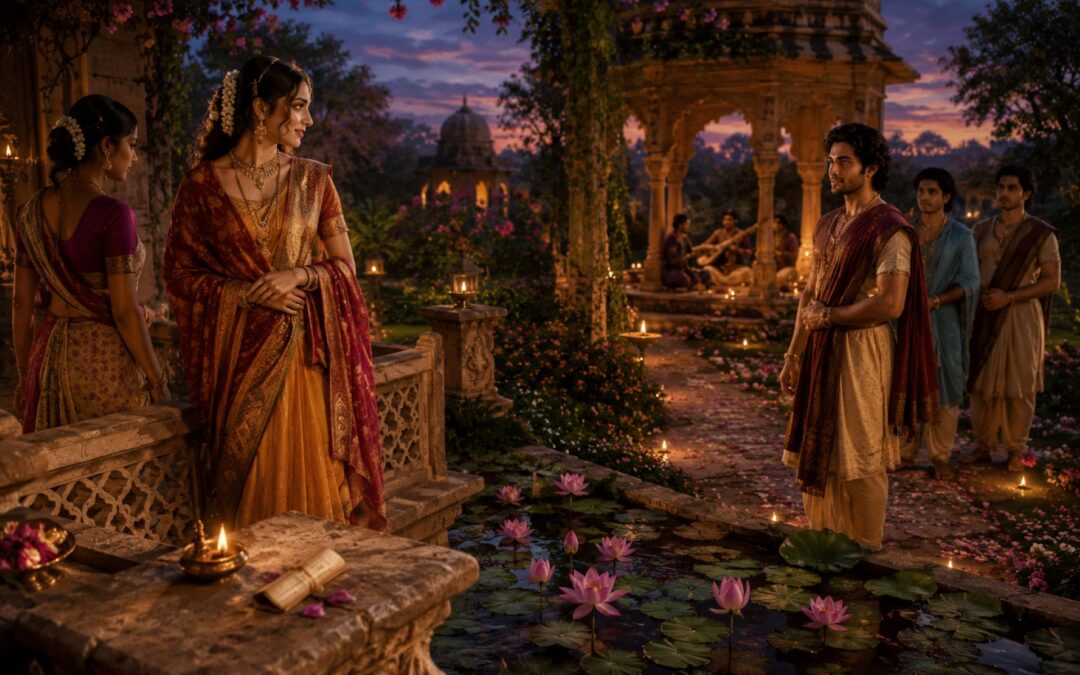
You notice someone across a crowded gathering. You ask mutual friends about them, dress more carefully when you expect to meet, and wonder whether a smile means genuine interest or ordinary politeness. Perhaps you send a gift, arrange another encounter, or rely on a trusted friend to carry a message.
The emotions are familiar. The social world is not.
The popular question of what dating in ancient India looked like begins with a genuine historical surprise. Ancient Indian literature is filled with attraction, flirtation, secret meetings, jealousy, affairs, rejection, separation, and the fear that love may not survive social pressure. The people represented in these works do not appear as uniformly austere ancestors concerned only with duty, religion, and family obedience.
Yet calling their behaviour “dating” can also mislead us. Ancient India did not possess a single institution equivalent to the modern date, nor did everyone enjoy the same freedom to choose partners. What survives is a collection of different worlds: elite Sanskrit manuals, Tamil love poetry, court dramas, legal treatises, religious narratives, and later story collections. These sources reveal what certain communities admired, imagined, permitted, feared, or attempted to regulate.
They do not provide a survey of ordinary life.
Ancient Indian texts nevertheless show that kāma—sensual, emotional, and aesthetic pleasure—was treated as a serious part of human existence. Desire had techniques, conventions, risks, and consequences. People were expected to cultivate attractiveness, interpret signals, use intermediaries, negotiate secrecy, and sometimes choose between personal affection and social recognition.
Ancient lovers can therefore seem startlingly familiar. But understanding them requires resisting the temptation to turn ancient India into either a prudish society without romance or a liberated paradise that invented modern relationships.
Ancient India Did Not Have One Dating Culture
“Ancient India” covers an enormous territory, many languages and communities, and centuries of social change. A courtly Sanskrit drama, an early Tamil poem, an urban erotic manual, and a legal text do not describe the same group of people for the same purpose.
This matters because the most vivid evidence for romance is often literary or prescriptive.
Poetry dramatises emotion. Drama creates compelling characters and conflicts. Legal texts describe conduct that authorities wished to classify, punish, or control. Manuals offer advice to particular readers, sometimes presenting an idealised lifestyle that only a small minority could afford.
As the scholarly collection Love in South Asia: A Cultural History emphasises, much of what historians know about love comes through aesthetic, ethical, and literary traditions. The prominence of secret lovers in poetry does not prove that most people routinely conducted secret affairs. It proves that such relationships were imaginable, meaningful, and culturally legible.
The same caution applies to the Kāmasūtra.
Popular culture usually reduces the work to sexual positions, but Wendy Doniger’s account of the text’s wider scope shows that it is also concerned with social conduct, marriage, adultery, courtesans, urban leisure, grooming, conversation, and the management of pleasure. It was probably composed in northern India in the later third century CE, drawing upon earlier traditions.
Its imagined reader was not an average inhabitant of the subcontinent. He was closer to the nāgaraka: a sophisticated urban man with money, leisure, servants, cultivated friends, and access to performances, gardens, parties, and courtesans. The women in its pages also occupy distinct social positions—wives, prospective brides, courtesans, servants, widows, and other men’s spouses—and their options differ sharply.
The text therefore provides rich evidence for an elite urban understanding of desire. It cannot be treated as a handbook followed by every ancient Indian.
Nor should Sanskrit evidence be allowed to speak for every region. Classical Tamil love poetry developed its own complex vocabulary for attraction, secrecy, union, waiting, jealousy, and separation. Legal traditions might recognise several forms of marriage while still ranking them morally and attaching different consequences to them. A relationship praised in a poem could remain socially dangerous outside it.
There was no single ancient Indian dating culture.
There were overlapping cultures of courtship, arranged marriage, mutual-choice unions, clandestine love, patronage, adultery, and erotic performance. Their rules depended on class, gender, family authority, locality, reputation, and the kind of source through which we encounter them.
Where Lovers Could Meet
The idea that unmarried men and women always lived in complete isolation is difficult to reconcile with the social settings described in ancient literature.
In an early English translation of the Kāmasūtra, urban social life includes festivals, gatherings, drinking parties, picnics, performances, games, and excursions to gardens. Friends could organise meetings, introduce acquaintances, and create situations in which men and women observed one another without an immediate marriage negotiation.
Gardens were especially useful literary and social spaces. They offered beauty, relative informality, and some distance from the household. A visit might include music, flowers, conversation, games, or a religious festival. Parks and pleasure gardens appear repeatedly as places where public sociability could shade into private interest.
Festivals created another opening. Crowds, performances, processions, songs, and games temporarily altered ordinary routines. They allowed people to see and be seen, although visibility did not mean freedom from scrutiny. A meeting in a festive atmosphere could still involve relatives, companions, servants, or watchful neighbours.
Friends were often more important than the location itself.
A potential lover rarely needed to approach someone as a complete stranger. A companion might arrange an introduction, report on the other person’s temperament, carry a message, or create an excuse for a second encounter. In literature, the trusted confidante could become essential, especially when a woman’s movements were restricted or her reputation was vulnerable.
The Kāmasūtra also describes mixed social gatherings in which cultured men, wives, courtesans, entertainers, and friends might be present. But this was not a modern public sphere in which everyone mingled on equal terms. A courtesan’s presence, a wife’s presence, and an unmarried woman’s presence did not carry the same meaning.
Markets, temples, roads, taverns, schools, and religious institutions also appear as meeting places in stories written across different periods. Such scenes show that attraction could arise beyond the household. They should not, however, be combined into a single claim that public flirting was ordinary everywhere.
The important point is narrower and more defensible: ancient Indian writers imagined societies in which men and women could encounter one another through kinship networks, friendships, festivals, performances, gardens, travel, religious occasions, and urban leisure.
Romance did not always begin in isolation. It often began inside a social network.
How People Made Themselves Desirable
Attraction in ancient Indian elite literature was rarely presented as a matter of physical appearance alone.
Beauty mattered, but beauty was something to be cultivated. Bathing, clean clothes, fragrant oils, flowers, jewellery, cosmetics, and carefully arranged hair all signalled refinement. The ideal was not necessarily extravagance. Tasteful presentation suggested that a person understood the codes of their social world.
A desirable man was expected to know how to speak, listen, amuse, and perform. A desirable woman might be praised for beauty, intelligence, wit, artistic accomplishment, grace, and social skill. Compliments worked best when they recognised qualities rather than simply repeating conventional praise.
The Kāmasūtra famously refers to the sixty-four arts. These included a broad range of accomplishments associated with cultured life: music, singing, dancing, poetry, storytelling, games, riddles, decoration, perfumery, arranging flowers, and other forms of skilled performance.
The number should not be understood as a universal school curriculum. The arts represented an ideal of cultivated versatility. They made social encounters more pleasurable and allowed a person to display intelligence, memory, taste, confidence, and discipline.
This is also why poetry and music mattered to courtship. They created a shared emotional language. A song could express longing indirectly. An unfinished verse could invite a response. A riddle or joke could test whether another person wished to continue the exchange.
Humour lowered the stakes. Light teasing, clever misunderstanding, and verbal play allowed attraction to be expressed without immediate confession. They also helped distinguish a responsive partner from an indifferent one.
Yet this cultivated world was deeply tied to privilege. Learning instruments, memorising poetry, maintaining fine clothing, hosting gatherings, and spending afternoons in gardens required resources. The idealised lover of the Kāmasūtra had time and money that agricultural labourers, domestic servants, and many urban workers did not possess.
The relationship between eroticism, art, and status becomes especially clear in Sanjay K. Gautam’s history of courtesans and cultivated erotic life. The courtesan, or gaṇikā, was imagined not merely as a sexual partner but as a trained performer whose value could depend on music, conversation, dance, poetry, wit, and knowledge of elite etiquette.
Her education made desire theatrical. Attraction was produced through costume, voice, gesture, surroundings, and performance.
The same principle shaped the urban male ideal. He was expected to construct an attractive presence rather than simply possess an attractive body. Refinement demonstrated that he understood pleasure as an art.
Ancient texts therefore treated desirability as a social accomplishment. A person became attractive by showing that life in their company would be interesting.
How Courtship, Flirtation, and Secret Messages Worked
Courtship was often indirect because directness carried risks.
A rejected approach could produce embarrassment. A secret relationship could damage reputations, provoke family intervention, or leave a woman especially vulnerable. Lovers therefore relied on ambiguity, intermediaries, and gradual escalation.
A friend might first discover whether the other person was available or receptive. A confidante could praise the suitor, create opportunities for conversation, or report signs of interest. Messages might travel through servants, companions, or people who could move between households without attracting suspicion.
Gifts also carried meaning. Flowers, garlands, ornaments, rings, scented objects, or other small tokens could signal affection without requiring a public declaration. Their value was not always financial. A carefully chosen object showed observation and intention.
Conversation provided another testing ground. Compliments, stories, jokes, riddles, and playful disagreement allowed two people to build a private rhythm inside a public setting. A person who continued the exchange, responded with humour, or found reasons to extend the encounter might be understood as interested.
Ancient manuals also tried to catalogue physical signs of attraction: repeated glances, smiles, changes in dress or ornament, nervous behaviour, teasing, or deliberate proximity.
These passages are tempting because they sound like timeless instructions for reading romantic signals. But they also reveal a danger. A smile may express interest, politeness, discomfort, or social obligation. A literary manual can list supposed signs; it cannot make another person’s intentions certain.
This distinction becomes especially important when the sources describe physical contact. A lover might invent a reason to sit nearby, exchange an object, play a game, or brush against the other person. In literature, these moments create tension. In real life, their meaning depends on willingness.
Women are not always passive in these traditions. Some texts describe women initiating conversations, arranging meetings, sending messages, or using friends to express attraction. Heroines in love poetry may speak with emotional clarity about desire, frustration, waiting, and betrayal.
But female initiative in a text does not erase the constraints surrounding it. A woman might need secrecy precisely because her household did not recognise her freedom to choose. Her emotional agency could coexist with economic dependence and legal vulnerability.
Courtship therefore unfolded through a mixture of performance and caution. Lovers attempted to become legible to one another while remaining partially hidden from everyone else.
Premarital Love and Marriage by Choice
Some of the strongest evidence against the stereotype of total premarital separation comes from classical Tamil love poetry.
The poetic tradition distinguishes between kalavu, clandestine love before marriage, and karpu, love associated with marriage and domestic life. Kalavu does not merely describe a passing flirtation. It can include reciprocal attraction, secret meetings, physical union, promises, waiting, anxiety, elopement, and attempts to transform a private relationship into a socially recognised one.
The surviving poems are not straightforward diaries. They belong to an elaborate literary system in which landscapes, seasons, flowers, animals, times of day, and speakers correspond to different emotional situations.
Mountains might evoke secret union. Seashores could express anxious waiting. Dry landscapes might accompany dangerous separation. The natural environment became a language for feelings that lovers could not always announce publicly.
In the classical Tamil poems of the Aiṅkuṟunūṟu, love is represented through many voices: the heroine, the hero, the heroine’s friend, mothers, observers, and others who interpret or interfere with the relationship. The confidante often helps the lovers meet while also pressuring the man to make the union secure.
This is crucial. Secret love could be emotionally reciprocal while remaining socially unstable.
A man might delay formalising the relationship. Gossip could spread. A family could discover the affair. Separation could turn confidence into fear. The heroine’s friend might remind the lover that private affection was not enough if the woman bore most of the reputational risk.
The poetry therefore gives women emotional presence without presenting a world of unrestricted freedom. A heroine may desire, choose, complain, accuse, or insist. Yet her future can still depend on whether the private relationship receives public recognition.
Sanskrit traditions also recognised a form of union based upon mutual attraction. Gāndharva marriage was understood as a marriage arising from the consent and desire of the couple, with little ritual and without the same degree of parental arrangement required by other forms.
It is sometimes described too casually as ancient India’s equivalent of a love marriage or live-in relationship. The comparison conceals more than it reveals.
Gāndharva marriage belonged to a specific classificatory and legal tradition. It was not simply cohabitation without commitment. Nor did private consent guarantee social security. The story of Śakuntalā and Duṣyanta demonstrates the problem dramatically: their private union possesses emotional and ritual significance, but the absence of secure public acknowledgement leaves Śakuntalā exposed when the king fails to recognise her.
The example helps explain why marriage involved more than the feelings of two people. Public recognition affected legitimacy, inheritance, household status, and a woman’s protection within the social order.
Premarital love and mutual-choice unions therefore existed as recognised possibilities in ancient Indian imagination. That does not prove that couples across the subcontinent commonly enjoyed a trial period in which they lived together and calmly tested long-term compatibility.
The evidence supports something more complex.
Some lovers met privately, formed emotional and physical relationships, used friends to protect their secrecy, and attempted to convert affection into a recognised union. Their relationships could be meaningful before marriage without being safe from family authority, gossip, abandonment, or unequal consequences.
Courtesans, Affairs, and the Economics of Desire
The Kāmasūtra’s world cannot be understood without courtesans.
A gaṇikā was not simply an unmarried romantic partner, nor can she be reduced to the modern category of sex worker. In elite literature, she could be a trained singer, dancer, conversationalist, poet, musician, and performer who built relationships with wealthy patrons.
Her accomplishments gave her unusual access to urban social life. She could appear at gatherings, cultivate influential men, manage money, negotiate gifts, and exercise forms of strategic choice unavailable to many wives.
But this visibility should not be romanticised as complete independence.
The courtesan’s livelihood depended on maintaining desirability, evaluating patrons, managing competition, and converting affection into economic security. Pleasure, performance, and calculation were closely connected. A lover’s generosity, status, reliability, and future usefulness could matter as much as his charm.
The Kāmasūtra devotes substantial attention to these relationships. It discusses how a courtesan might attract a patron, appear emotionally invested, assess his wealth, obtain gifts, recognise declining attachment, and decide whether to dismiss or reconcile with him.
This is the context behind much of what can look like ancient breakup advice.
Instructions about gradually withdrawing affection, reducing access, provoking dissatisfaction, or creating circumstances in which a man leaves are not universal recommendations for ending any unhappy relationship gently. They belong largely to a transactional world in which the courtesan must protect her livelihood while managing a patron whose value has changed.
Affection may still have been genuine. Economic strategy does not make emotion impossible. It does mean that the relationship operated under pressures different from those of a modern couple separating after a private romance.
The text’s treatment of affairs is equally strategic.
It recognises attraction between married people and outsiders, including relationships involving neglected spouses. It considers opportunity, secrecy, intermediaries, risk, and the possibility of discovery. The interested lover is expected to study the household, identify vulnerabilities, and calculate consequences.
This is not simply evidence that adultery was accepted. The amount of attention given to secrecy suggests the opposite: affairs were imaginable because marriage did not eliminate desire, but they could threaten reputation, household stability, property, and legal standing.
The neglected wife appears in this literature as someone who may seek affection elsewhere, especially when her husband is absent, indifferent, incompatible, or involved with other women. Yet the male author’s interest is often less in her emotional liberation than in the opportunity she presents to another man.
Ancient texts thus preserve a recognisable truth: marriage could fail to satisfy emotional or sexual needs.
They also reveal a less romantic reality. Desire could become an arena of strategy in which lovers assessed one another’s loneliness, wealth, status, dependence, and exposure.
Consent, Coercion, and the Law
It would be comforting to collect the most reciprocal passages from ancient Indian texts and present them as evidence of a consistently consent-centred romantic culture.
The evidence does not permit that conclusion.
Some passages take a woman’s willingness seriously. They describe gradual courtship, warn against moving too quickly, and recognise that a woman may initiate contact or communicate desire through a confidante. They assume that successful intimacy depends upon responsiveness rather than indifference.
But the same traditions also contain manipulation, deception, intoxication, abduction, pressure, and force.
This contradiction is not accidental. In Wendy Doniger’s analysis of sexuality and political strategy, the Kāmasūtra is shown to share important features with the Arthaśāstra, a work concerned with governance, espionage, calculation, alliances, and betrayal. Intimate relations can consequently appear as contests of information and power rather than purely mutual exchanges.
The lover studies vulnerability. The courtesan manages attachment. The adulterer searches for an opening. The household guards women’s movement. Servants and friends become sources of information. Desire operates within the same strategic imagination that political texts apply to rulers, rivals, and agents.
Consent-oriented passages must therefore be read beside coercive ones.
Nor can lists of supposed romantic signals be treated as substitutes for consent. Repeated glances, smiles, ornament adjustment, teasing, or nervousness may have been interpreted as interest within the text’s conventions. They do not provide certainty about a real person’s wishes.
Law further complicated intimacy.
The surviving Arthaśāstra is a layered work whose composition and redaction developed over time. Patrick Olivelle’s modern translation and analysis places the text that has reached us broadly around the second or third century CE while recognising older materials within it.
Its rules show that intimate behaviour was tied to property, household authority, caste status, inheritance, and public order. Sexual contact was not merely a private matter between individuals. It could trigger fines and disputes involving husbands, guardians, families, and the state.
The restrictions were not gender-neutral.
Women’s movement, communication, sexual conduct, and access to property could be regulated more closely than men’s. A married woman’s meeting with another man might be treated through a framework of household control, while male access to courtesans and other partners occupied a different social and legal position.
Ancient Indian texts should therefore not be labelled uniformly progressive or uniformly repressive. They preserve competing impulses.
They recognise desire as real, powerful, and worthy of study. They sometimes grant women striking emotional and erotic agency. They also embed intimacy within systems that privileged male authority, family reputation, social hierarchy, and strategic control.
What Happened When Love Ended
Ancient relationships did not always conclude with marriage, lifelong harmony, or tragic death.
Affection could fade. A lover could become inattentive. A patron might stop giving gifts. A spouse could be absent, hostile, sexually incompatible, or involved elsewhere. The texts recognised that relationships could stagnate, collapse, or become intolerable.
But they did not offer one universal procedure for breaking up.
As the Kāmasūtra’s treatment of courtesans demonstrates, ending a relationship could be an economic calculation. A courtesan might distance herself when a patron became poor, ungenerous, dangerous, excessively possessive, or otherwise unprofitable. She might reduce intimacy, create conflict, show indifference, or encourage him to leave.
That is not the same as advising all lovers to part gently and introduce their former partners to someone new. It belongs to a specific professional and economic context.
Marriage brought different problems because it involved households, property, obligations, and social recognition.
Book III of the Arthaśāstra contains rules addressing abandonment, separation, adultery, property, and marital conflict. It allows for separation in certain situations, including cases described through mutual hostility, but the options depend on the form of marriage and the surrounding circumstances.
A woman could sometimes leave a husband who had disappeared, abandoned his obligations, become dangerous, or met other specified conditions. A husband might also seek separation. Property brought into the marriage, gifts, maintenance, and compensation could become part of the dispute.
These provisions show that marital dissolution was legally imaginable.
They do not amount to modern no-fault divorce.
Separation could involve fines, restrictions, waiting periods, family negotiations, and unequal consequences. The law often treated the wife’s sexuality and mobility as matters subject to supervision. A formal remedy might exist while remaining difficult, dangerous, or socially costly to use.
Adultery occupied the same uneasy territory. Its appearance in manuals and law codes suggests that it occurred often enough to demand attention. Yet the penalties and precautions surrounding it show that it was not simply accepted as an ordinary alternative to an unhappy marriage.
The ancient evidence is therefore more convincing when it describes problems than when it is turned into modern advice.
People neglected their partners. Desire became monotonous. Spouses failed to listen. Lovers lost interest. Individuals looked elsewhere for affection. Couples developed mutual hostility. Some relationships ended informally, some through abandonment, and some through recognised legal procedures.
The emotional breakdown may sound familiar. The available exits were shaped by a very different world.
Ancient Indians were not strangers to attraction, awkwardness, longing, jealousy, secret intimacy, incompatible relationships, or heartbreak. Their literature took such experiences seriously enough to classify them, aestheticise them, advise upon them, and regulate their consequences.
That familiarity can be seductive. It encourages us to imagine a modern dating culture hidden beneath ancient clothing.
The truth is more interesting.
A garden excursion was not simply a date. A gāndharva union was not simply cohabitation. A courtesan’s cultivated independence did not erase economic vulnerability. A heroine’s emotional agency did not guarantee legal equality. A recognised route to separation did not create modern divorce.
What crosses the centuries most clearly is not the institution but the uncertainty.
People wanted to be seen favourably. They performed versions of themselves. They depended on friends. They searched for signs, feared rejection, concealed relationships, demanded commitment, endured neglect, and sometimes discovered that affection was not enough to overcome the structures surrounding it.
Ancient Indian romance was neither a restrained silence nor a lost age of freedom. It was a complex field in which pleasure, art, affection, family, money, law, and power continually collided.
Last Updated on July 27, 2026 by Aseem Gupta