
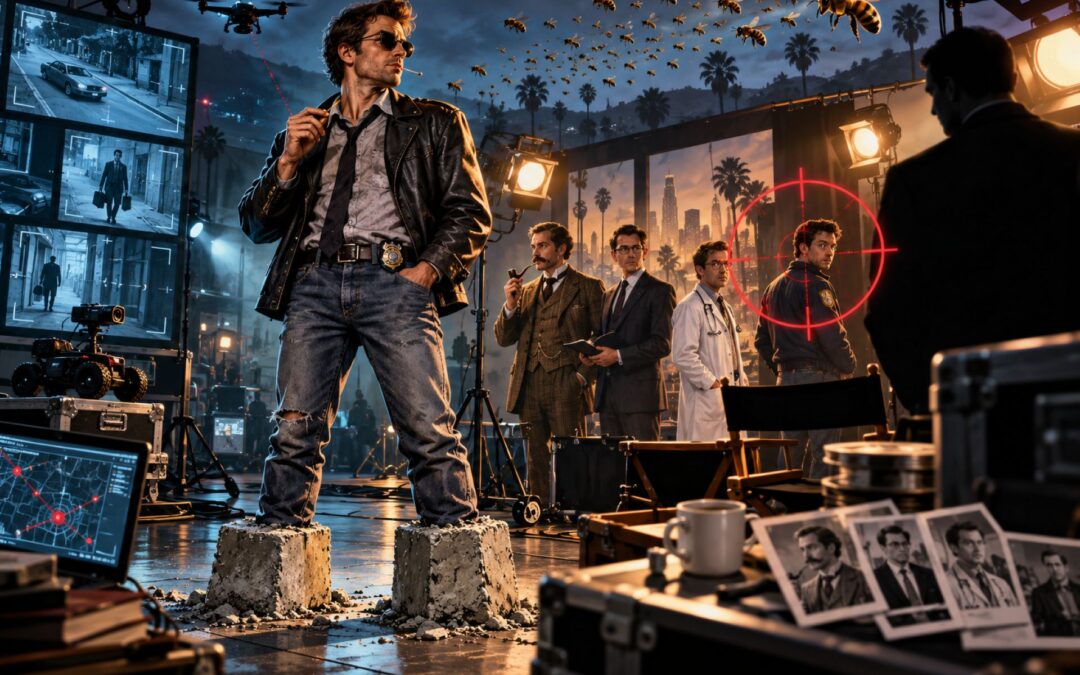
Scott Meyer’s Destructive Reasoning begins with a comic detective team already caught between two kinds of police work. One is the ordinary work of identifying criminals, following evidence, protecting people, interviewing suspects, and making arrests. The other is the version billionaire Vince Capp wants the public to see: dramatic chases, outrageous gadgets, reckless improvisation, memorable personalities, and footage that can turn every successful investigation into publicity for the Authorities.
That contradiction becomes especially uncomfortable for Sinclair Rutherford. He is naturally precise, cautious, clean, methodical, well dressed, and painfully aware of procedure, but Capp employs him to perform a dirty, leather-jacketed, lollipop-sucking television stereotype known as “Cement Shoes” Rutherford. When Capp tells him that merely following instructions is not enough—that he must learn to improvise the right kind of irresponsible-looking behavior himself—Rutherford begins searching for a model of the authentic maverick cop.
He finds one in Los Angeles, where the Authorities have been sent to investigate a bizarre series of attacks against actors playing Dr. Watson. Randy McCormick appears to be everything Rutherford has been told to become: insubordinate, instinctive, vulgar, fearless, dismissive of rules, and proud of getting results his own way. The mistake Rutherford makes is assuming that someone who looks like a rogue hero must actually be one.
That mistake is the key to the entire book. Destructive Reasoning is a comic mystery about hired killers, Watson actors, corporate surveillance, angry bees, Hollywood productions, and a man nearly being drowned while standing in concrete. Underneath the absurdity, however, it keeps returning to the same question: what is the difference between appearing to be the hero and actually doing the work?
Spoiler warning: this article explains the complete plot, the identity and motive of the person behind the Watson killings, and the ending of the novel.
Meyer’s official page for Destructive Reasoning identifies it as the second novel in The Authorities series and describes it as a funny mystery built around a murdered Watson actor, Rutherford’s new role model, and a dangerous figure from Max’s past. Those apparently separate threads ultimately fit together because each involves people struggling with the difference between a role and a real identity.

What Destructive Reasoning Is About
The Authorities are an unconventional crime-fighting team financed by billionaire Vince Capp. Detective Sloan is the actual investigative center of gravity, while the surrounding team supplies unusual expertise: Max combines a disarming personality with almost frightening physical competence; Albert Mok handles technology and surveillance; Professor Sherwood develops eccentric inventions; Terri Wells manages the team’s public behavior; and Rutherford has been deliberately turned into the group’s photogenic “bad cop.”
Capp’s motives are not purely cynical. He wants crimes solved and victims protected, but he also believes that successful policing is wasted if nobody sees it. The Authorities are therefore expected to produce results that look good on television, and Rutherford has become the team member most aggressively shaped around that requirement. His leather jacket, damaged jeans, sucker or match, gigantic weapon, rough manners, and habit of appearing barely under control are essentially costume design.
The main case takes the team from Seattle to Los Angeles after actor Emery Hindman is murdered inside a locked luxury car. Hindman has been playing Dr. Watson in a Sherlock Holmes production, and a message claims that he died because of the character he portrayed. Other performers currently playing Watson are threatened, including Russell Byrne, an actor on the television series No Matter How Improbable.
The apparent problem is straightforward: identify the serial killer before more Watsons die. The real problem becomes progressively stranger. Hindman’s murderer is found, but another Watson dies anyway. Another hired killer is found, but he cannot identify the person paying him. A sniper repeatedly tries to kill Byrne. A different attacker targets another Watson. The Authorities eventually discover that they are not hunting one serial murderer carrying out a personal ritual. They are looking for the person who designed the ritual and outsourced its individual killings.
At the same time, Rutherford is studying Randy McCormick, a former police officer now working as a consultant on Byrne’s television show. Randy seems to embody exactly the independence Capp demands. He steals when permission would slow him down, ignores instructions, insults anyone who expects professionalism, and treats institutional rules as the natural enemy of people capable of getting things done.
Rutherford spends much of the novel trying to learn from him. The central joke gradually turns into the central danger: Randy is not merely a distorted example of the kind of cop Rutherford wants to become. He is the architect of the murders.
Complete Plot Summary
The novel’s 42 short chapters move quickly, but the mystery develops through a carefully escalating series of apparent solutions. Each arrest seems to explain part of the case while simultaneously revealing that the larger structure remains intact, until Rutherford finally understands that the separate killers are all components of someone else’s plan.
The investigation also develops alongside Rutherford’s identity problem. His increasing willingness to imitate Randy repeatedly complicates the case, while the final confrontation works precisely because Rutherford eventually learns what is worth taking from the idea of a maverick and what must be rejected.
The Authorities Turn Crime Into Spectacle
The book opens before the Watson case, during the arrest of Julius Clearman. Rutherford and Sloan confront Clearman while he is riding a tram with his family. Clearman bolts, and Rutherford is forced into the kind of ridiculous chase that Capp’s publicity machine loves: he races along the tram, ends up dealing with hostile raccoons, and becomes part of a visually absurd arrest that would be embarrassing under ordinary circumstances but is ideal for the Authorities’ brand.
Max ultimately subdues Clearman with almost effortless control. He prevents the fleeing suspect from seriously injuring himself, pins him down, and calmly congratulates Rutherford while Rutherford is still struggling above a group of angry raccoons. The contrast establishes a pattern that lasts through the entire novel. Max’s most valuable work often looks undramatic because he is genuinely good at it, while Rutherford’s difficulties create the images that people remember.
Capp wastes no time converting the arrest into entertainment. At the subsequent press conference, footage of the chase is already being edited into an attractive story. The victim, suspect, Rutherford, Max, raccoons, and other memorable visual fragments have become pieces of a media package rather than merely elements of a police investigation.
Afterward Capp gives Rutherford a more troubling message. Terri has been directing his public persona, telling him when to look reckless and what sort of behavior fits the image, but Capp says Rutherford now needs to internalize the role. He cannot always wait for someone to tell him what the fictional version of himself would do. He must independently discover what Capp considers the right kind of wrong.
The demand terrifies Rutherford because almost every instinct he actually possesses points in the opposite direction. Back at his Lake Union home, the contrast becomes obvious. His public persona suggests a careless slob, but his real life is highly controlled: his clothes, possessions, coffee, surroundings, and habits reveal someone who values order and taste.
A conversation with his sister Vanessa does not solve the problem. Rutherford understands that many stereotypical television-cop gestures are irrational when judged as actual police work. Jumping over cars, damaging property, ignoring procedure, and creating unnecessary danger are not automatically signs of courage. Yet he is employed by someone who specifically wants a marketable approximation of those behaviors.
Before Rutherford can resolve the contradiction, the entire team is awakened early and ordered to Los Angeles. Capp explains that actor Emery Hindman has died under extraordinary circumstances, and the killer has linked his death to the fact that he was playing Dr. Watson. Other performers currently portraying Watson may be next.
Capp sees a horrific crime and a publicity opportunity at the same time. A nationally visible Hollywood investigation can give the Authorities a profile they have not previously possessed. He therefore sends the team south with new corporate partnerships, including CartFulls forensic support and the experimental TurkMO system, which allows remote human drivers to control vehicles from somewhere else.
The LA assignment thus begins with two goals that will never quite separate: save the threatened actors and make sure the world notices who saved them.
Emery Hindman’s Murder and the Inventor of Antwerp
Hindman has died inside his own locked luxury car in a studio parking lot. The murder mechanism is both grotesque and elaborate. His wristwatch has been modified into a weapon, while the car itself has been electronically prevented from allowing him to escape. He is trapped by objects associated with wealth and status, bleeding inside a well-insulated vehicle that effectively seals his cries away from anyone who might help.
At the crime scene the Authorities meet LAPD detectives Frederick and Burski as well as Dr. Claire Romero from the CartFulls forensic team. Claire quickly dislikes Rutherford because she has no reason to know that the person she sees is a manufactured character. His disheveled appearance, performative swagger, props, and deliberate affect read to her as genuine evidence about his personality.
Their first interactions nevertheless reveal cracks in that impression. Rutherford unexpectedly recognizes that Hindman’s prestigious-looking watch is counterfeit, displaying knowledge and discernment that do not fit Claire’s assumption about him. This becomes the beginning of a relationship in which almost every new piece of evidence about Rutherford conflicts with the identity he is required to project.
The technological evidence leads in another direction. The custom electronics involved in the murder remind Max of a notorious figure from the clandestine world he inhabited before joining the Authorities: Boris DeBeul, known as the Inventor of Antwerp. DeBeul has supposedly died, but Max is deeply skeptical of deaths involving people from that world, especially when the alleged corpse was difficult to identify.
The team visits DeBeul and discovers that he is indeed alive. He examines the available evidence and rejects the idea that he built Hindman’s murder device. The work resembles his methods but is too crude, too flamboyant, and too poorly concealed. Someone with knowledge of his techniques appears to have imitated him.
DeBeul rapidly realizes that his apprentice, Lea Gladki, is the likely culprit. The device is not evidence of the legendary inventor returning to crime; it is evidence of someone close enough to copy him badly and arrogant enough to believe the imitation would succeed. Lea runs.
The pursuit introduces another major thread. A formidable Australian named Chaz appears and violently stops Lea, casually dislocating her joints in the process. Max recognizes him immediately, and their reaction to one another makes clear that they have a long and complicated personal history.
Chaz is someone Max both fears and desires. The reunion quickly destabilizes a man who is normally one of the most controlled members of the team. DeBeul’s earlier warning that Max’s presence in Los Angeles might attract somebody from his past has come true in the most disruptive possible form.
The immediate murder investigation appears to be progressing well. Lea is captured, the Authorities have a plausible explanation for the Hindman device, and the team can finally interrogate the person who built it.
The apparent solution lasts only until Lea talks.
Randy, Russell Byrne, the Sniper, and the First False Solution
While the Lea investigation develops, Rutherford and Albert are assigned to protect Russell Byrne, one of the surviving Watson actors. Byrne works on No Matter How Improbable, a knowingly ridiculous television variation on Sherlock Holmes filled with the kind of contrived genre material Meyer can parody without leaving the world of the main story.
The show introduces two people who become central to the case. Kyndra Perrin is the exasperated showrunner who wants the production to function despite police disruption. Randy McCormick is the production’s police consultant, an abrasive former officer whose behavior instantly attracts Rutherford’s attention.
Randy seems to be living proof that Rutherford’s problem has a solution. Byrne explains that Randy was forced out of police work after refusing orders, making noise, stepping on the wrong toes, and generally behaving exactly like the rebellious television cop Rutherford has been told to emulate. Byrne considers him the worst possible model. Rutherford, hearing the same description through Capp’s expectations, hears something closer to a résumé.
While Rutherford is beginning to study Randy, the novel reveals something the investigators do not yet know: a professional sniper has been hired to kill Byrne. The sniper’s chapters form a parallel comic thriller in miniature. He sees himself as a highly competent and intimidating professional, but his attempts are repeatedly destroyed by absurdly small mechanical failures.
During one attempt he infiltrates the studio disguised as an unremarkable repair worker. The disguise works because people instinctively avoid looking too closely at someone associated with maintenance problems. He reaches his firing position, assembles his rifle, and nearly gets the shot he wants, only to lose crucial time dealing with a tiny mechanical component. Byrne disappears from view before he can fire.
This repeated collision between enormous criminal seriousness and humiliating practical inconvenience becomes one of the book’s characteristic comic structures. The sniper is genuinely dangerous, but the universe repeatedly refuses to let him experience himself as the elegant professional he imagines.
Rutherford also accompanies Byrne to a performance-art piece centered on the actor’s famous mother, Catalina Byrne. Russell’s work is built around the experience of living beneath the story of her death. Positive reviews and references to his own career become submerged in public narratives about Catalina, leaving him in the paradoxical position of using his mother’s cultural shadow as the material for protesting that very shadow.
The performance initially seems like a comic detour, but it becomes essential to the solution. Randy’s eventual motive depends on the same public memory that Russell is trying to escape.
Back in the Hindman investigation, evidence against Lea strengthens. Albert uses one of his stranger surveillance inventions, a mobile camera disguised as a wad of rubbish, while DeBeul recognizes that Lea has left traceable signs of her work. When confronted, she admits that she constructed the device and murdered Hindman.
Crucially, she did not select him.
Lea was hired anonymously. Her elaborate murder device was work performed for a client, and she attempted to direct suspicion toward DeBeul. That distinction means the Authorities have found a murderer without necessarily finding the person behind the Watson campaign.
For a short time, however, Rutherford is tempted to regard her confession as the answer. Then another Watson actor, Mac Menard, is murdered on the other side of Los Angeles while Lea is securely in custody.
The case changes immediately. The Authorities are no longer looking for one physically identifiable killer with one method. Someone is commissioning different murders.
At the same time, the Chaz subplot turns increasingly disruptive. Max agrees to meet him privately after Lea’s capture, expecting an ugly confrontation over their past. The team covertly watches part of the encounter through Albert’s surveillance device out of concern for Max’s safety.
What appears at first to be a fight becomes sexual. Chaz subsequently attaches himself to Max and the team with almost no respect for ordinary boundaries, and Max—normally capable of reading danger with extraordinary clarity—becomes noticeably less effective whenever Chaz is involved.
The murder investigation and the relationship subplot operate differently, but both show supposedly competent people having their judgment altered by a person who knows exactly how to affect them.
Menard, SKeyeBALL, Morrison, and the Contract-Killer Network
The murder of Mac Menard confirms that Lea is only one part of the structure. The Authorities now have to reconstruct a second killing while accepting that every captured assassin may reveal only another disposable layer.
Claire becomes increasingly important during this phase. Rutherford and she spend more time together, and the initial hostility begins to mix with unmistakable attraction. Their conversations reveal compatibility that Rutherford cannot fully explore because the most basic facts about his personality are professionally restricted.
A private conversation in a recording booth brings the problem into focus. Rutherford cannot simply tell Claire that the crude persona is an assignment. The result is a bizarre emotional bind: he wants her to know him, but part of his job is preventing her from knowing the truth about the qualities she is judging.
The Menard investigation leads the team to SKeyeBALL, a private surveillance company possessing an extraordinary ability to reconstruct a person’s movements after the fact. Its systems aggregate enough visual and digital information to recreate where someone has traveled across the city, effectively turning modern infrastructure into a retrospective tracking network.
The technology is unsettling even by the standards of the Authorities’ world. Employees are surrounded by nondisclosure agreements and proprietary secrecy, and the sheer quantity of available information suggests that privacy has become less a protected condition than a temporary failure of data integration.
Max complicates the obvious moral response. He argues that complete privacy is not necessarily the historical norm people imagine it to be. Having grown up in a small community where everyone knew everyone else’s life, he regards social surveillance as potentially more intrusive than corporate knowledge. His preference for corporations is characteristically cynical: governments can punish you, neighbors can judge you, while companies are more likely to monetize what they know.
The novel does not prove him correct, but the argument prevents the surveillance material from becoming a simple warning about technology. SKeyeBALL is invasive, commercial, secretive, and extraordinarily useful.
Its information helps identify Casper Morrison as the killer of Menard. The team surveils his house, with Albert’s disguised camera supplying remote access. Rutherford then faces exactly the kind of decision Capp wants him to learn to make: whether to remain outside and observe or take an unauthorized risk.
Chaz helps Rutherford gain access. Terri objects, but Rutherford argues that passivity carries its own danger. If they have enough reason to believe the suspect is a professional murderer, waiting for procedural perfection may allow him to escape or kill again.
This is one of Rutherford’s first serious attempts at independently behaving like the person Capp wants. Unlike Randy’s later recklessness, however, Rutherford does not ignore consequences entirely. He argues about them, understands the objections, and reluctantly crosses the line because he thinks the risk is justified.
Inside Morrison’s house he finds the almost unnaturally tidy home of a professional killer, including weapons concealed behind the ordinary domestic surface. The situation becomes dangerous when Morrison unexpectedly returns. Police eventually surround the house, and Morrison is arrested.
Once again, the Authorities have found a killer without finding the killer.
Morrison admits that he works professionally and was hired for Menard’s death. The client used an anonymous system designed to prevent the contractor from learning the customer’s identity. The existence of another paid assassin confirms what Lea’s confession suggested: whoever wants the Watsons dead is deliberately fragmenting the operation.
Rutherford proposes reversing the system by advertising himself as a contract killer and hoping the same client will approach him. The undercover operation outside a convenience store is one of the novel’s broadest comic sequences. Rutherford dresses and behaves in a way he thinks will communicate “professional murderer,” only to discover that costume and stereotype can be interpreted in many unintended ways.
People approach him for the wrong illegal services. His performance succeeds at making him look suspicious without succeeding at making him look specifically like the kind of criminal the mastermind needs.
The real client never arrives.
The episode is funny because Rutherford has spent the book being professionally misread, yet he now tries to exploit that exact process. His employer dresses him to resemble a television archetype, Claire mistakes the archetype for his personality, and Rutherford assumes he can deliberately create another legible criminal identity merely by choosing the appropriate visual cues.
The case refuses to cooperate because appearances are far less precise than everyone keeps pretending.
Rutherford Follows Randy and the Case Fractures Again
Rutherford increasingly turns toward Randy for instruction. On the No Matter How Improbable set, the production itself becomes a parody of detective fiction, while the actual detective beside it tries to learn from a man who treats rules as proof that somebody else lacks courage.
Randy persuades Rutherford to leave Byrne’s immediate protection temporarily. Professor Sherwood can cover, other officers are present, and Byrne himself is willing to accept the inconvenience if Randy will stop disrupting production.
The “errand” turns out to be theft.
Randy needs construction material and simply takes it from a locked studio storage area. He presents the act as practical philosophy. Asking permission, in his worldview, merely gives people the opportunity to say no. Institutions are built from obstruction, and people who accomplish things must learn to proceed without waiting for approval.
Rutherford is disturbed but also fascinated because Randy is articulating a stronger version of the message Capp has been giving him. He reluctantly assists, yet secretly leaves money behind for the materials. The gesture is small but revealing. Rutherford is experimenting with Randy’s behavior without accepting Randy’s moral logic.
The lumber itself later becomes part of Randy’s attempt to murder Rutherford, giving the scene an especially effective retrospective irony. Rutherford literally helps his supposed mentor acquire material that will be used to build his own trap.
Randy continues his instruction as they go to interview personal trainer Amanda Hogan. Amanda has connections to several people relevant to the Watson investigation, making her worth examining even though the evidence against her is weak.
Before they enter, Rutherford explicitly tells Randy that proper questioning matters. Evidence must remain usable, interviews have to be conducted correctly, and Randy cannot simply turn aggression into an investigative method.
Randy agrees and immediately fails to respect the spirit of the instruction. He flirts, sexualizes the encounter, disrupts Rutherford’s questioning, and later claims his behavior was a sophisticated technique designed to put Amanda off balance.
Rutherford reaches a more cautious conclusion. Amanda’s links to the existing victims make her interesting, but her behavior does not establish guilt. Randy reaches essentially the same conclusion while attributing it to his supposedly superior instinct.
The difference matters. Rutherford sees investigation as cumulative work in which suspicion must remain distinguishable from proof. Randy sees his own impressions as self-validating because they are his.
Meanwhile the sniper makes another attempt on Byrne. Once again his professionalism is defeated by a minor mechanical failure. He has carefully planned an assassination, only to lose the opportunity because a component of the rifle creates another frustrating delay.
The repeated failures are not harmless. Byrne remains in real danger, but the assassin’s perspective turns the danger into anti-climactic comedy. A man who thinks of murder as an expression of competence keeps being humiliated by tiny pieces of metal.
Rutherford also becomes more conscious that Randy personally dislikes Byrne. The hostility seems excessive for a mere consultant frustrated by an actor, but Rutherford does not yet possess enough information to understand why.
The case breaks open again when Justine Warner, another performer associated with Watson, is attacked at the theater where she appears on The Wee Smalls with Mia Paul. Unlike Hindman and Menard, Warner survives.
Her attacker is dramatically less competent than Lea, Morrison, or the sniper. He has been hired through the same broader mechanism but is closer to an amateur opportunist than a professional killer. The resulting struggle becomes slapstick, with Rutherford eventually helping capture him amid an undignified physical mess that further damages Claire’s opinion of the persona she thinks she is seeing.
The significance is more important than the comedy. Warner’s attack makes it increasingly difficult to imagine a single killer moving through the victims with one distinctive technique. Someone is choosing targets and then acquiring whatever murderer is available or affordable.
Amanda therefore becomes less convincing as the central answer, while the mystery becomes more abstract. The Authorities can capture hands, but the mind directing those hands remains invisible.
Why Watsons? The Sniper Falls and Randy Gives Himself Away
As the investigation enters its final phase, the team begins concentrating on the question hidden in plain sight: why Watson?
The obvious answer is that the killer hates actors playing a particular fictional character. The more useful answer concerns what Watson represents. Dr. Watson is the companion beside the celebrated genius. He participates in the adventures, records them, supports Holmes, and becomes part of the legend without being the person popularly credited with solving the mystery.
That category—sidekick, assistant, secondary figure—matters enormously to the person behind the killings.
Rutherford is not yet ready to apply the concept to Randy, but Randy keeps revealing how he thinks about work and credit. One small moment becomes unexpectedly revealing when Rutherford asks about the money he secretly left after the lumber theft. Randy cheerfully admits that he found it and kept it, treating another person’s attempt to compensate the owner as free money he happened to discover.
His philosophy of independence consistently turns out to involve benefiting from other people’s effort while denying obligations to them.
The sniper, meanwhile, returns for another attempt on Byrne. He again takes elaborate precautions, including using a different route and carefully assembling his weapon. This time a tiny spring escapes from the rifle and falls through a succession of metal awnings, producing an absurd cascade of noise.
Everyone below looks upward.
The sniper finds himself on a rooftop holding recognizable rifle components while the people protecting Byrne stare directly at him. His entire identity as an invisible professional collapses in one extended accident.
At almost the same moment, Byrne emerges from the soundstage. Kyndra Perrin reacts instantly, physically pulling him back to safety. Her willingness to risk herself undermines any suspicion that she has secretly been arranging attacks on him.
Rutherford joins the pursuit of the exposed sniper. Professor Sherwood’s long-running bee project finally becomes operationally relevant when his drone, followed by the swarm he calls Her Majesty, is deployed into the building.
The system is hardly graceful. The drone flies erratically through an office, disrupting workers and scattering papers, but eventually attaches itself to the fleeing gunman. The bees follow and converge on him, adding thousands of angry insects to a situation already collapsing under its own absurdity.
He falls, injures himself, and is captured.
The arrest is an important victory but not the solution. Like Lea and Morrison, the sniper was hired. The Authorities are still one level away from the person who selected Byrne.
The team is exhausted and increasingly frustrated. Terri also confronts Max about the effect Chaz has had on him. Max’s work has deteriorated because so much of his attention is consumed by a relationship he knows is destructive. Sloan makes the emotional point more directly: they are not merely annoyed that Chaz is interfering with the case; they dislike watching Max be made miserable.
Max himself describes the attraction as something he knows is bad for him but continues consuming when it is available. The metaphor makes his self-awareness obvious without making escape easy.
Randy then takes Rutherford drinking. The scene begins as another lesson from the older supposed maverick, but alcohol loosens something more important than professional advice.
Randy tells Rutherford about his mother. She was a paramedic who died in an ambulance crash while doing her job. The driver also died, but the person whose death dominated public coverage was Catalina Byrne, Russell’s famous mother.
Randy remembers the injustice less as private grief than as a grievance about recognition. His mother died trying to help someone, surrounded by the tools of her profession, yet news coverage reduced her to an unnamed supporting casualty in a celebrity tragedy.
He compares the treatment to being reduced to a secondary character in somebody else’s story.
Rutherford, drunk but still capable of recognizing a pattern, returns to his hotel and researches the crash. He finds the names connected to it. The paramedic was Emilia McCormick, survived by her husband Randolph and their son Randolph Junior.
The irritating former cop who has been teaching Rutherford to ignore rules is Randolph McCormick Jr.
Rutherford suddenly understands exactly what he needs to do.
The Cement-Shoes Trap, Confession, and Final Chase
The next morning Rutherford wakes badly hungover but still convinced that Randy may be the missing center of the case. He does not yet possess enough admissible evidence simply to accuse him. More importantly, he knows that if Randy really is behind multiple murders, a confrontation could become lethal.
Rutherford chooses to go to Randy’s home apparently alone.
On the surface, this looks like the culmination of everything Capp and Randy have been teaching him. He is acting independently, abandoning the safety of procedure, confronting a dangerous suspect without the rest of the team, and placing himself in exactly the kind of photogenic danger his employers reward.
The reality is more complicated.
Randy welcomes him into his shabby mobile home, where Rutherford soon falls through a deliberately weakened floor and lands in a form filled with wet concrete. The materials Rutherford helped Randy steal have become the foundation of the murder plan.
Randy intends to let the concrete harden around Rutherford’s legs, hoist him out with equipment already waiting inside the home, and drown him in an above-ground swimming pool. The man Capp has branded “Cement Shoes” is about to be killed by literal cement shoes.
The joke is grotesquely appropriate because Randy admits that he looked Rutherford up and knows about the nickname. His murders repeatedly turn identities into murder concepts. Hindman dies through an elaborate mechanism connected to the constructed Watson campaign; Rutherford is to die through his constructed public persona.
Rutherford begins laying out what he has understood. Randy’s friendship was never innocent. He had been studying Rutherford as well, trying to manipulate him and eventually eliminate him.
Randy’s reason for wanting Rutherford dead extends the Watson motif beyond actors. In Randy’s worldview, Rutherford is a real-life Watson. Sloan is the detective; Rutherford is the sidekick who attracts attention and receives reflected glory.
Rutherford rejects the label, but Randy considers his resistance proof. Watsons, from his perspective, never realize that they are Watsons.
The argument exposes how deeply Randy’s resentment has distorted his understanding of cooperation. He assumes that if one person receives credit another person must have been robbed. He cannot imagine a team in which different contributions are real without being equal, identical, or individually celebrated.
Randy then explains the larger plot.
His original emotional motive comes from the ambulance crash that killed his mother. Catalina Byrne’s celebrity ensured that public attention centered on her, while Randy’s mother and the driver became background casualties. Randy transfers that resentment to Russell Byrne even though Russell did not create the original media imbalance.
But revenge alone is not enough. Randy also wants money and fame.
Simply killing Russell Byrne would produce one murder. Constructing a pattern around actors playing Watson creates a story. It generates press attention, mystery, fear, and a marketable identity. Randy essentially applies the same logic to murder that Capp applies to police work: events become more valuable when packaged as narrative.
He hires Lea to kill Emery Hindman using an elaborate mechanism. She receives the assignment without knowing the full plan. Byrne is assigned to the sniper, who repeatedly fails. Randy then hires Casper Morrison to murder Mac Menard, extending the Watson pattern and strengthening the impression of a serial killer. Justine Warner is attacked by another hired man when Randy continues trying to maintain the campaign.
The different methods are not evidence of an eclectic mastermind personally improvising each murder. They reflect the different people Randy has contracted.
Russell Byrne has always been the meaningful target. The other Watson victims make his eventual death part of a larger story.
Randy’s crimes therefore reproduce the very moral failure he claims to hate. He resents a culture that made his mother secondary to a celebrity, then murders unrelated people so that his own revenge will receive more attention. He condemns people for gaining reflected status, then constructs a publicity apparatus around himself.
The confrontation also resolves Rutherford’s argument about police work. Randy regards paperwork, rules, evidence handling, coordination, and restraint as tasks for lesser people. To Rutherford, those responsibilities are not signs that someone lacks courage. They are part of the job.
Rutherford’s own decision to confront Randy finally reveals what he has learned. He has not actually abandoned teamwork.
Albert’s wad is present, secretly transmitting Randy’s confession. Max is nearby and ready to intervene. Rutherford has taken initiative and accepted personal risk, but he has not confused independence with isolation.
That distinction is the difference between Rutherford’s developing judgment and Randy’s narcissism.
When Randy discovers the deception, the confrontation becomes violent. Max arrives, and Randy escapes through the damaged home. Rutherford manages to free himself from the wet concrete and joins the pursuit with cement still clinging to him.
Randy flees in his truck, while the Authorities pursue through a sequence of escalating chaos that eventually involves shopping carts. The scene gives Capp exactly the kind of ridiculous action footage he wants, but its meaning has changed. Rutherford is no longer manufacturing danger because he thinks recklessness is inherently heroic. The spectacle is now a by-product of a legitimate attempt to capture a murderer.
Max finally brings Randy down. Rutherford formally arrests Randolph McCormick Jr. for the murders, attempted murders, solicitation and the accumulating crimes surrounding the scheme.
The case is solved because Rutherford eventually stops asking, “What would a maverick look like?” and starts asking what a good investigator actually needs to do.
Who Gets the Credit? Capp’s Version and Claire’s Discovery
The murder case is over, but the novel does not stop with the arrest. Capp immediately turns the solution into a national press event.
Edited footage transforms the messy reality of the case into a clean story about the Authorities. Randy’s name and face are deemphasized because Capp does not want to reward his hunger for notoriety. The victims receive public acknowledgment, CartFulls receives useful exposure, and Rutherford is singled out for his success as Cement Shoes.
The decision sounds ethically attractive until the distribution of credit is examined more closely.
Detectives Frederick and Burski, who contributed throughout the investigation, are excluded from the main presentation because Capp fears that visible LAPD participation will dilute the Authorities’ triumph. Frederick tells Rutherford that he respects what Rutherford accomplished and even wonders whether he could learn from his style.
Rutherford rejects the compliment in one of his clearest moments of self-understanding. He knows that his flashy role attracts credit that often belongs partly to less visible people doing the procedural work he has been taught to make look boring.
The irony is deliberate. Randy becomes a murderer partly because he is consumed by resentment over who receives recognition, yet the organization that defeats him continues carefully controlling recognition for commercial purposes.
The team then returns to Seattle for a celebration at Rutherford’s home. Max arrives injured after finally confronting Chaz and ending their relationship. He has kicked Chaz out of his house and his life, although the injuries make clear that ending the relationship was not simple or painless.
Terri has another plan involving Claire.
Because the Authorities expect to continue working with CartFulls, Claire may remain professionally connected to the team. Rutherford is therefore still forbidden from simply explaining his false public identity. Terri tells him that Claire must discover the truth independently.
Then Terri deliberately places Claire inside Rutherford’s home.
For the first time Claire can see the environment that reflects his actual preferences. The immaculate space, tailored clothes, carefully maintained possessions, coffee habits, and affection for things entirely inconsistent with his leather-jacket image all contradict the man she thinks she knows.
Claire realizes that the dirty clothes and exaggerated behavior are essentially a uniform.
The romantic resolution depends on Rutherford resisting the expectations attached to that uniform. A stereotypical bad boy might respond to the moment by grabbing her and forcing a passionate kiss. Rutherford does not.
He politely asks whether she would like to have dinner with him.
Claire says yes.
The ending does not free Rutherford from Capp’s system. He will still have to perform Cement Shoes in public, and his employers still decide how much of his identity can be shown to outsiders. What changes is that at least one person important to him has finally seen through the costume to the man underneath.
The Authorities and the Book’s Satirical World
The setting of Destructive Reasoning is close enough to contemporary America to be recognizable but exaggerated enough to make its institutional absurdities visible. Meyer does not build a separate science-fiction society; he stretches trends already familiar from corporate consolidation, gig work, surveillance technology, entertainment branding, celebrity media, outsourced services, and private wealth until the world feels one or two turns stranger than our own.
The Authorities themselves embody that approach. They perform a function normally associated with public policing, yet their resources, priorities, and public image are shaped by Vince Capp’s private wealth. That freedom gives them extraordinary capabilities. They can move quickly, recruit unusual specialists, deploy experimental equipment, work with private forensic organizations, and accept risks that a conventional department would struggle to justify.
The same freedom creates obvious accountability problems. Capp is not merely paying for investigators; he is designing characters. Rutherford’s professional identity is controlled partly by marketing concerns. The team’s successes can be edited into promotional material, and decisions about whose contribution appears publicly are made according to brand strategy.
Meyer rarely turns these issues into solemn institutional critique. Capp remains funny, charismatic, practical, and sometimes genuinely generous. That is precisely why the structure is interesting. A purely villainous billionaire manipulating investigators would produce an easier satire. Capp is more unsettling because his system often works.
The Los Angeles setting intensifies the novel’s obsession with performance. No Matter How Improbable is both a television detective story and a workplace the real investigators must enter. Actors perform deductions while actual detectives stand just outside the camera frame trying to prevent murder. Randy is hired to supply authenticity to a fictional production while embodying one of the least useful fantasies about authentic policing.
Russell Byrne’s career also sits inside this overlap between identity and entertainment. He is performing Watson professionally while trying to create art about how another public narrative—his mother’s death—has overwhelmed his own identity. Randy then selects him as the central victim in yet another story designed for public consumption.
Technology functions similarly. TurkMO is ridiculous because a remote human being physically controls a car while passengers experience the eerie illusion of automation, yet it is also a plausible corporate workaround between traditional driving and full autonomy. Albert’s devices often appear to be jokes until they become indispensable. Sherwood’s bees are absurd until an armed killer needs to be stopped inside an office building.
CartFulls is perhaps the clearest example of Meyer’s institutional joke. A big-box retail corporation possesses sophisticated forensic capabilities, and Capp happily uses the partnership while ensuring the company receives publicity. The idea is funny because the brand seems incompatible with serious investigative science, but within the logic of the novel the lab is competent.
This pattern keeps the world from becoming a simple dystopia or a simple farce. Private corporate systems repeatedly do useful things while creating uncomfortable questions about why those capabilities exist in corporate hands at all.
The result is a world in which public service, advertising, policing, entertainment, technology, and commerce have become almost impossible to separate. Randy’s murder campaign initially seems like a monstrous exception to that environment. By the end, it is clearer that his criminality is uniquely evil but his instinct to package an event for maximum attention is not unique at all.
Character Analysis
The mystery works because the characters are not merely arranged around the identity of the culprit. Rutherford’s personal problem begins before Hindman is murdered and continues after Randy is arrested, while several supporting characters embody different answers to the book’s recurring questions about competence, performance, control, teamwork, and authenticity.
The ensemble is also central to Meyer’s comedy. People are funny not because they all deliver the same kind of joke but because their personalities collide: Sloan’s bluntness, Albert’s enthusiasm, Sherwood’s cheerful eccentricity, Max’s unsettling capability, Terri’s management logic, Capp’s branding instincts, and Rutherford’s discomfort all generate different forms of absurdity.
Sinclair Rutherford: Performing the Wrong Kind of Cop
Rutherford’s central contradiction is that he is unusually ill-suited to the identity that makes him publicly valuable. He is not a naturally chaotic man being encouraged to embrace chaos. He is an orderly, aesthetically particular, cautious man paid to simulate disorder.
That difference explains why Capp’s instruction is so difficult. Rutherford can follow directions such as wearing bad clothes or carrying a particular prop because those are external tasks. Capp now wants him to produce spontaneous behavior from a personality he does not possess.
Randy initially appears to solve the problem because his recklessness looks natural. He does not need Terri feeding him instructions. He breaks rules because he genuinely believes rules are beneath him.
Rutherford’s mistake is confusing authenticity with virtue. Randy really is what Rutherford only pretends to be, but that does not mean Randy is therefore a better model.
The novel repeatedly shows Rutherford trying to experiment without becoming comfortable with the moral assumptions behind the experimentation. When he helps Randy steal lumber, he secretly leaves money. When he enters Morrison’s house, he argues through the risk rather than dismissing everyone who objects. When he interviews Amanda Hogan, he insists that evidence and admissibility still matter.
Those moments can look like timidity beside Randy’s swagger, but they become the foundation of Rutherford’s eventual growth. He is learning initiative without learning contempt.
His final confrontation with Randy therefore represents a more sophisticated version of Capp’s instruction than either Capp or Randy articulates. Rutherford acts without waiting to be told what to do. He takes a substantial risk. He creates an opportunity to secure a confession.
But he prepares.
He uses Albert’s technology. He involves Max. He builds a team-supported operation that merely looks like solitary recklessness from Randy’s perspective.
That is Rutherford’s answer to the false choice between obedient bureaucracy and irresponsible individualism. Competence can include improvisation, but improvisation becomes more effective when supported by preparation and cooperation.
His relationship with Claire gives the same development a personal form. Rutherford’s professional costume has become so effective that someone he likes cannot accurately judge him. The final dinner invitation matters because he does not suddenly become more assertively masculine after being understood. He becomes able to behave like himself.
Randy McCormick: The False “Real Cop”
Randy is the novel’s best character concept because he works simultaneously as antagonist, mentor, comic caricature, thematic double, and critique of a familiar detective-fiction fantasy.
When Rutherford meets him, Randy seems free. He ignores orders, behaves offensively, says whatever he wants, takes what he needs, and treats consequences as problems for less capable people. In a genre full of detectives who break rules because they understand the truth better than institutions do, Randy’s behavior initially carries a familiar aura.
The book gradually strips that aura away.
His contempt for permission becomes theft. His confidence in his instincts becomes sloppy interviewing. His disregard for social norms becomes vulgarity rather than insight. His willingness to act alone becomes a worldview in which colleagues are burdens or competitors.
The murder motive reveals the emotional engine underneath that worldview. Randy’s mother died doing ordinary, valuable, unglamorous work. Public attention went elsewhere because Catalina Byrne was famous. Randy has spent much of his life interpreting that injustice through a theory of stolen recognition.
His grief is understandable. His conclusion is monstrous.
Rather than learning that valuable work can go unrecognized, Randy decides that recognition determines value. He becomes obsessed with distinguishing “real” heroes from secondary people who supposedly receive undeserved reflected glory.
Watson becomes the perfect symbol for his resentment.
That worldview also explains his hostility toward Rutherford. From Randy’s perspective, Sloan does the serious detective work while Rutherford receives attention. What Randy cannot understand is that the existence of teamwork does not make Rutherford fraudulent. Rutherford contributes something different, and even the publicity role he dislikes can sometimes help the team.
Randy’s murders reproduce his grievance in an even more perverse form. He kills unrelated people to amplify the story around his preferred victim. He turns Hindman, Menard, Warner, Lea, Morrison, the sniper, and even Rutherford into supporting characters in a narrative designed to make Randy’s revenge important.
The man who hates sidekicks is willing to reduce everyone else to one.
His deepest hypocrisy concerns work. Randy constantly presents himself as a person who “does” while other people obstruct. Yet his major criminal project is outsourced. Other people design the devices, perform the killings, take the physical risks, and absorb the legal danger.
Randy wants the identity of mastermind without doing most of the actual work.
In that sense, the supposedly authentic lone wolf turns out to depend on more invisible labor than anyone else.
Sloan, Terri, Albert, Sherwood, and Max: Why the Team Works
Randy’s theory of greatness depends on imagining that secondary roles are parasitic. The Authorities themselves are the novel’s strongest rebuttal because their successes are distributed across very different kinds of competence.
Sloan is the clearest conventional detective in the team. She is skeptical, observant, impatient with nonsense, and generally less interested in being seen than in moving the investigation forward. Randy’s claim that Rutherford is merely Sloan’s Watson contains enough surface plausibility to sting precisely because Sloan often is the stronger pure investigator.
The mistake is treating that fact as a humiliation for Rutherford rather than an argument for specialization.
Terri’s job is different again. She manages behavior, logistics, publicity concerns, and team discipline. Her restrictions can be infuriating, particularly when Rutherford’s private life becomes entangled with the false persona she is required to preserve. Yet the team would become dramatically less functional without someone coordinating the collision between Capp’s demands and investigative reality.
Albert’s inventions demonstrate another form of useful secondary work. The wad sounds ridiculous and looks ridiculous, but it becomes crucial to surveillance and eventually to capturing Randy’s confession. His drones repeatedly transform the team’s visibility and intelligence.
Professor Sherwood pushes the same principle into farce. His bees appear to be one more eccentric obsession until Her Majesty becomes the instrument that helps stop an armed sniper. The joke works because the thing that seems least appropriate for professional policing becomes operationally effective at exactly the right moment.
Max is perhaps the most extreme example. He frequently looks harmless, friendly, or slightly odd until physical action becomes necessary. He then proves almost absurdly capable. His skill at de-escalation is particularly important because it separates power from swagger: Max does not need to posture as dangerous in order to be dangerous.
The Chaz subplot temporarily destroys that balance. Max becomes distracted, emotionally reactive, unreliable, and more violent than the situation requires. Terri’s criticism is not simply that his romantic life is inconvenient; it is that the relationship prevents him from doing the unique work the team depends on him to do.
That failure gives the ensemble principle a negative form. Teamwork works only when people remain capable of contributing their distinctive strengths.
Claire Romero and the Problem of Seeing Rutherford Clearly
Claire’s importance extends beyond being Rutherford’s romantic interest. Her perception of him becomes a test of whether anyone outside the team can distinguish the constructed character from the actual person.
Her original judgment is reasonable given the evidence available. Rutherford deliberately looks unhygienic, irresponsible, aggressive, and theatrically masculine. The Authorities want strangers to assume those things.
The comedy comes from moments when his real personality leaks through. He knows enough about luxury watches to spot a counterfeit. He is bothered by disorder. His conversational instincts are more considerate than his costume suggests. He has interests that do not fit the caricature.
Claire keeps receiving contradictory signals because Rutherford is required to keep producing them.
Their attraction therefore develops under ethically and emotionally awkward conditions. Rutherford knows that she is judging a false identity, but he is professionally forbidden from correcting the record. Claire can sense that he is more complicated than he appears, yet she lacks the missing explanation.
The recording-booth conversation makes the tension explicit. Rutherford wants to be understood, but honest explanation would violate the rules of the team.
The ending works because Claire does not receive a speech telling her who Rutherford is. She encounters his private world and draws the conclusion herself. His clothes, home, possessions, and tastes amount to accumulated evidence.
Terri’s manipulation of the situation is hardly neutral, but it preserves the rule that Rutherford cannot deliberately reveal the persona.
Claire’s response also validates the central distinction between authenticity and spectacle. The version of Rutherford she finds attractive by the end is not the man acting more like Randy. It is the man who asks her to dinner instead of performing the aggressive romantic gesture his costume might predict.
Max and Chaz: Comedy, History, and a Darker Relationship
Chaz initially arrives as an outrageous expansion of Max’s mysterious past. Both men have histories in intelligence work, both possess abilities far beyond what their present surroundings suggest, and their reunion combines physical threat, sexual tension, old grievances, and immediate familiarity.
The relationship is funny in individual scenes because everyone around them is uncomfortable and because Max, normally unflappable, suddenly loses his balance. Chaz ignores boundaries with cheerful confidence, while Max alternates between resistance, indulgence, desire, and irritation.
As the subplot develops, however, the joke acquires a darker edge.
Chaz interferes with Max’s work, refuses to respect attempts to separate, behaves possessively, abuses Max’s hospitality, and repeatedly pulls him back into a dynamic Max knows is unhealthy. Max eventually describes his own attraction in terms of repeatedly consuming something he knows is bad for him.
The book does recognize the problem. Terri and Sloan explicitly tell Max that they are worried because Chaz is making him miserable, not merely because his job performance has deteriorated. Max ultimately ends the relationship.
Yet the resolution remains deliberately comic and somewhat uneasy. By the press conference Max has visible injuries from forcing Chaz out, and the scene is treated with the team’s usual deadpan humor. That tonal choice can work for readers willing to let the entire world operate at cartoon intensity, but it can also feel too light for a relationship the novel itself has framed as coercive and damaging.
The subplot therefore produces one of the book’s clearest tonal limits: Meyer can incorporate disturbing material into broad comedy, but the comedy does not automatically neutralize what the material implies.
Vince Capp: Justice as Branding
Vince Capp is not the villain of Destructive Reasoning, but the novel repeatedly places his methods uncomfortably close to the logic of the villain.
Capp genuinely wants the Authorities to succeed. He funds the team, gives talented people unusual opportunities, supplies extraordinary resources, and celebrates results. There is no evidence that he would tolerate Randy’s crimes merely for publicity.
At the same time, he treats publicity as inseparable from success.
Rutherford’s identity is partly a product. Gadgets are evaluated for visual usefulness. Dramatic footage has marketing value. A national case matters more than an obscure one because it can enlarge the Authorities’ profile.
The final press conference makes the tension impossible to ignore. Capp refuses to give Randy the notoriety he wanted, which is defensible. He honors victims and promotes CartFulls, which is also defensible.
Then he excludes Frederick and Burski because their visible role might dilute credit for his own team.
Capp therefore fights Randy’s attempt to manipulate recognition by manipulating recognition more effectively.
The moral difference remains enormous—Capp is branding legitimate investigative work rather than murdering people—but the structural parallel gives the ending more bite than a simple victory celebration would have provided.
Why the Victims Are “Watsons”: Credit, Sidekicks, and Resentment
The Watson motif initially functions as an absurd serial-killer hook. Hollywood contains more actors playing variations of Dr. Watson than anyone expects, allowing Meyer to turn a literary sidekick into the organizing principle of a murder spree. The joke becomes more meaningful as the investigation reveals why Randy cares about the role.
For Randy, Watson represents a person who stands near greatness and receives unearned attention. Sherlock Holmes solves the mysteries; Watson accompanies him, observes him, helps him, and becomes inseparable from the story. Randy interprets that secondary status not as collaboration but as parasitism.
His family history makes the idea emotionally attractive. His mother dies doing valuable emergency work, yet the celebrity patient in the same crash dominates coverage. Randy concludes that public life is structured by undeserving people receiving attention that belongs to those who did the real work.
That conclusion contains a recognizable grievance but rests on a false model of credit. Catalina Byrne did not personally decide that newspapers should minimize Randy’s mother. Russell Byrne certainly did not. The injustice of unequal public attention does not create a transferable moral debt that Randy can collect from unrelated people.
Randy’s hatred of Watsons also depends on an oversimplified concept of contribution. Watson is not necessarily useless merely because Holmes is more brilliant. A team does not become illegitimate because one person does more visible intellectual work than another.
The Authorities themselves repeatedly demonstrate this.
Sloan may be the strongest conventional detective. Albert provides technical tools she cannot build. Claire supplies forensic expertise. Sherwood contributes eccentric devices that sometimes become essential. Max supplies physical and interpersonal abilities nobody else possesses. Terri manages the organization. Rutherford handles situations others might not handle in the same way.
No single member can honestly claim the entire result.
Randy’s worldview cannot accommodate that kind of distributed value because he thinks in terms of ownership. If Sloan deserves credit, Rutherford must be stealing it. If Catalina Byrne receives public attention, Randy’s mother must have had attention taken from her. If someone else gets recognition, there must be less available for him.
The novel’s sharpest irony is that Randy himself is dependent on others. He does not personally design every murder or kill every victim. He hires Lea, Morrison, the sniper, and another attacker. He relies on their skills while preserving his own distance.
By his own standard, Randy is living through the work of other people.
His deeper objection is therefore not really to sidekicks. It is to occupying any position in which somebody else might be more important.
That distinction explains his treatment of Rutherford. Randy enjoys being the mentor as long as Rutherford admires him. Once Rutherford becomes capable of exposing him, the younger man becomes another Watson who deserves to die.
The final press conference keeps the theme alive after Randy is captured. Capp carefully redistributes attention toward the Authorities and away from LAPD contributors. Rutherford recognizes the unfairness and tells Frederick that flashy success can conceal the ordinary work that actually builds cases.
Rutherford has therefore learned something Randy never does: receiving credit and deserving all the credit are not the same thing.
Performance, Authenticity, and Manufactured Identity
Almost everyone important in Destructive Reasoning is performing something.
Rutherford performs Cement Shoes. Byrne performs Watson. Wolfberg performs Holmes. Randy performs the “real cop.” Capp performs the generous public benefactor while orchestrating publicity with extreme precision. Russell Byrne creates performance art about being trapped beneath a famous identity. The sniper performs ordinary maintenance work to become invisible. Contract killers hide behind anonymous systems. Corporate employees hide extraordinary surveillance capabilities behind NDAs and bland offices.
The book repeatedly asks readers to distinguish between these performances and the people or motives underneath them.
Rutherford’s case is the most literal. His employers intentionally create a visible identity that conflicts with his personality. The transformation succeeds so well that even intelligent people such as Claire reasonably misread him.
His private home becomes important because it functions almost like evidence at a crime scene. The orderly space, clothing, objects, coffee habits, and aesthetic preferences reveal a coherent personality concealed beneath the public costume.
The novel does not simply argue that public identity is fake and private identity is true. Rutherford’s professional performance produces real consequences. It affects how suspects respond to him, how Claire understands him, how journalists portray him, and even how Randy chooses to kill him.
The Cement Shoes persona becomes so socially real that Randy literalizes it with concrete.
Randy presents the opposite problem. He seems authentic because his public behavior and private values match more closely. He really is contemptuous of authority. He really does enjoy breaking rules. He really does think conventional professionalism is weakness.
Authenticity alone therefore cannot be the standard by which a person is judged. A genuinely terrible person is still genuine.
The distinction matters because Rutherford spends much of the novel assuming that becoming more authentic means finding a way to behave like his costume without Terri’s instructions. Randy exposes the flaw in that goal. Rutherford does not need to become the character. He needs to become confident enough to make decisions from his actual values.
Hollywood supplies a larger environment in which everyone understands that performed identity can still produce real effects. Byrne is professionally someone else while cameras are rolling, yet his career, reputation, and relationships are real. Kyndra Perrin manages fictional stories while facing a genuine murder threat on her set.
Russell’s art about Catalina adds another layer. The public version of his mother’s death has become part of his identity whether he wants it or not. He cannot simply declare himself independent of the story because other people encounter him through it.
Capp operates in the same territory. He understands that raw events do not arrive with an inevitable meaning. Footage can be selected, edited, framed, and narrated. A chaotic arrest can become heroic. A humiliating accident can become a memorable brand image.
Randy’s scheme is horrifying partly because he understands that principle too.
Killing Russell Byrne because of an old family grievance would be a private revenge. Killing a sequence of Watson performers creates a media mythology. Randy is not merely committing violence; he is producing a story designed to make the eventual Byrne murder culturally legible.
His manipulation of narrative is more extreme than Capp’s but disturbingly familiar in structure.
The novel ultimately treats performance as unavoidable. Rutherford cannot simply opt out of having an image. Even if he quit the Authorities, other people would still interpret his clothes, job, speech, home, and behavior.
The meaningful question is whether the performance controls the person.
By the end Rutherford has begun to reverse that relationship. He can still wear the leather jacket without believing it defines courage. He can still create dramatic footage without mistaking spectacle for investigation. He can still occupy a public role without allowing that role to decide how he asks Claire to dinner.
That is a more useful version of authenticity than merely behaving the same way in every context.
Rules, Maverick Policing, and What Professionalism Actually Means
Rutherford begins the novel trapped between two bad definitions of police competence. One says a good officer follows every rule and waits for authorization. The other says a good officer proves courage by ignoring rules and acting alone.
Capp pushes Rutherford away from the first caricature without giving him a complete alternative. Randy appears to supply the missing philosophy.
Randy’s worldview is seductive because bureaucracy really can obstruct useful action. People do sometimes hide behind procedure, avoid responsibility, or say no because refusing something is easier than doing it. A detective who never acts without perfect information could allow danger to continue.
Rutherford experiences exactly that dilemma at Morrison’s house. Entering without ideal authorization is risky, but merely watching a suspected professional killer also carries risk. The novel allows his decision to feel arguable rather than obviously correct or obviously foolish.
Randy converts that difficult judgment problem into a universal principle: permission itself is weakness.
The lumber theft exposes the difference. Randy does not steal because immediate danger requires exceptional action. He steals because asking would be inconvenient. He treats the existence of an obstacle as evidence that the obstacle deserves to be ignored.
The Amanda Hogan interview exposes the same defect in investigative form. Randy believes that if his intuition says someone is innocent, the unconventional manner in which he reached that impression validates itself. Rutherford insists that evidence must survive outside the investigator’s personality.
That insistence is crucial because police authority cannot safely depend on an individual officer announcing that personal instinct is enough.
The final argument in Randy’s home makes the novel’s position clearest. Randy despises routine professional work such as paperwork and procedural compliance because those tasks do not fit his heroic self-image. Rutherford recognizes that the boring parts are still part of doing the job.
A detective does not become more real by refusing to document evidence.
The climax then gives Rutherford a model that combines initiative with responsibility. He goes to Randy independently because nobody else has handed him a finished plan. He knowingly puts himself in danger.
But he also arranges surveillance and backup.
The plan works because he trusts the team rather than because he transcends it.
That makes the final chase more meaningful than its slapstick surface suggests. Fighting across shopping carts and pursuing a murderer while covered in wet concrete certainly satisfies Capp’s demand for memorable action, but Rutherford no longer treats spectacle as the purpose of the action.
The spectacle is incidental to the arrest.
This distinction also explains why Rutherford warns Frederick not to imitate him after the case. Frederick sees the visible results without seeing how much of Rutherford’s image is imposed or how often luck converts foolish-looking situations into favorable footage.
Rutherford now understands enough to know that “be more like the guy on television” is terrible professional advice, even when the guy on television happens to be him.
Technology, Surveillance, and Corporate Power
The technology in Destructive Reasoning operates on two levels. Some inventions exist primarily to generate comic situations: remote drivers argue with family members while operating vehicles hundreds of miles away, drones behave unpredictably, and Sherwood treats a suitcase full of bees as reasonable professional equipment.
Other technology raises more serious questions precisely because it works so well.
SKeyeBALL is the clearest example. Its ability to reconstruct movement across a city represents the convergence of cameras, commercial data, tracking systems, and computational analysis into something approaching retrospective omniscience.
The investigators benefit immediately. A murder suspect who would once have been difficult to trace can be followed through an accumulated digital environment. Information scattered across countless systems becomes useful once a company can combine it.
The ethical problem is obvious: the same infrastructure capable of finding a killer can also find almost anyone else.
Meyer does not dramatize that problem through a long philosophical debate. Instead he gives Max a deliberately provocative response. People idealize privacy partly because they forget how little privacy existed in tight communities where neighbors knew family histories, relationships, purchases, habits, and scandals.
Max’s preference for corporations is comic and cynical. He would rather be marketed to than arrested or morally condemned.
The argument should not be mistaken for the novel proving that corporate surveillance is harmless. SKeyeBALL itself requires secrecy, restrictive agreements, and carefully controlled access. The company possesses extraordinary power while revealing little about how that power is generated.
The joke works because the system is both creepy and useful.
CartFulls creates a related tension. A retail corporation possessing advanced forensic laboratories seems absurd, yet Claire and her colleagues are competent professionals. Their usefulness makes the privatization stranger, not less strange.
TurkMO uses the same satirical method. The system appears automated from inside the car, but another human being is physically operating it remotely. The technology replaces the social awkwardness of a driver sitting next to passengers with the hidden labor of someone elsewhere.
That hidden labor reflects the novel’s larger concern with credit. An apparently intelligent vehicle works because an invisible person is doing the driving. A flashy arrest works because unseen investigators, technicians, police officers, and support staff have built the case.
Albert’s gadgets make hidden labor literal. The wad is visually contemptible but practically valuable. Its disguise works because people ignore rubbish, allowing it to gather evidence precisely by looking unimportant.
Sherwood’s bees are another variation. They remain ridiculous even when effective. The novel repeatedly refuses the assumption that something cannot be silly and useful at the same time.
That principle helps explain the Authorities themselves.
Capp’s system is ethically strange, commercially entangled, and often absurd. It nevertheless solves crimes.
The book is more interested in that uncomfortable coexistence than in offering a clean answer about whether private technology has become too powerful. Its world works because many institutions are capable of extraordinary things for reasons that are only partly aligned with the public good.
Humor, Style, and Narrative Structure
Destructive Reasoning is structured as a fast comic procedural rather than a solemn puzzle mystery. Its 42 short chapters keep scenes moving rapidly, often shifting locations or perspectives before a joke can become too static.
Dialogue carries much of the characterization. Meyer rarely pauses for long psychological explanation when a character can reveal himself through an argument, misunderstanding, inappropriate comment, or oddly specific observation. Sloan, Randy, Max, Sherwood, Terri, Rutherford, and Capp all sound different because their humor emerges from their personalities rather than from one interchangeable comic voice.
Rutherford’s comedy is rooted in discomfort. He wants situations to make sense and repeatedly finds himself required to participate in things that offend his sense of order.
Randy’s comedy is aggressive. He says unacceptable things with complete confidence and treats disapproval as confirmation that everyone else is uptight.
Sherwood’s comedy comes from treating dangerous or bizarre experimentation as ordinary practical work. Albert’s comes from technological enthusiasm. Sloan’s comes from compressed bluntness. Max is funny because extraordinary experiences and abilities are delivered with conversational calm.
The sniper chapters use a different technique: the gap between self-image and material reality. The assassin imagines his profession as a combination of discipline, danger, and masculine elegance. Meyer then lets tiny components, bad luck, awkward timing, and physical objects destroy that fantasy.
The repeated failed attempts on Byrne could have been played as escalating suspense. Instead they repeatedly build suspense toward humiliating anti-climax.
That choice defines the novel’s relationship with genre. It uses the machinery of a thriller in order to puncture the emotional posture normally associated with thrillers.
The same applies to the police-procedural elements. Rutherford debates admissibility, suspects, evidence, access, and surveillance, but every serious process exists beside bees, lollipops, remote drivers, ridiculous television scenes, and petty arguments.
The show-within-the-novel gives Meyer another level of parody. No Matter How Improbable presents an exaggerated fictional Holmes while the actual investigation around it is itself already an exaggerated version of detective fiction.
Randy occupies the point where the layers meet. He is a police consultant helping television writers make fictional cops seem authentic while his own personality resembles the most irresponsible stereotype television helped popularize.
The novel also uses callbacks unusually well. Objects introduced for comic value often acquire plot functions later. Sherwood’s bees stop the sniper. Albert’s wad becomes part of Rutherford’s plan against Randy. The stolen construction material becomes the concrete trap. Cement Shoes shifts from branding joke to attempted murder method.
Those payoffs make the silliness feel structurally integrated rather than randomly decorative.
The strongest example may be Rutherford’s persona itself. What begins as a running joke about clothing and props becomes central to his romantic life, professional insecurity, Randy’s judgment of him, the murder attempt, and the final press conference.
Meyer’s acknowledgements add useful context to the tonal balance. He explains that the first draft was written during the early period of the COVID-19 pandemic and became far darker than he intended for a comedy, prompting significant reworking after early feedback. The finished novel still contains traces of unusually dark material—serial murder, abusive relationship dynamics, corporate surveillance, resentment over a parent’s death—but nearly everything is filtered through broad comic machinery.
That balance will determine whether the book works for an individual reader. Someone comfortable with murder plots functioning beside slapstick will likely find the tonal collisions energetic. Someone who wants the emotional seriousness of the crimes to control the atmosphere may find the same scenes glib.
The mystery structure also differs from a classic fair-play puzzle. Meyer gives the reader information the Authorities lack, especially through the sniper’s perspective, but withholds the decisive Randy connection until relatively late. The pleasure lies less in independently identifying the culprit from a complete set of clues than in watching apparently separate absurdities suddenly line up.
That choice supports the comedy and Rutherford’s character arc, though it weakens the pure deductive satisfaction of the reveal.
Destructive Reasoning Ending Explained
Randy McCormick Jr. is the person who organizes the Watson killings, but describing him simply as “the serial killer” misses the structure of the mystery. He is primarily the client and architect.
His emotionally significant target is Russell Byrne.
Years earlier, Randy’s mother, Emilia McCormick, died in the ambulance crash that also killed Russell’s famous mother, Catalina Byrne. Because Catalina was a celebrity, public coverage centered overwhelmingly on her. Randy remembers his mother—a paramedic who died while doing her job—as being reduced to an unnamed secondary casualty.
That resentment becomes the foundation of his worldview.
He comes to believe that society celebrates the wrong people: stars, sidekicks, beneficiaries of association, and other figures who supposedly receive credit generated by someone else’s work. Dr. Watson becomes the symbol he uses to represent such people.
Russell Byrne is therefore both personal target and symbolic target. Randy projects the injustice surrounding Catalina’s fame onto her son.
But Randy does not merely want revenge. He wants his revenge to matter publicly.
The Watson campaign supplies a hook.
Lea Gladki murders Emery Hindman with the engineered watch-and-car trap. Her distinctive method creates the impression of a sophisticated serial killer while also diverting attention toward Boris DeBeul.
The sniper is hired to kill Russell Byrne but repeatedly fails because of absurd mechanical accidents.
Casper Morrison kills Mac Menard, expanding the pattern after Lea has already been captured and proving that the case involves more than one operative.
Justine Warner is attacked by another hired man, whose relative incompetence reflects the declining quality or changing economics of Randy’s contractor pool rather than a completely different motive.
Randy’s genius, such as it is, lies in understanding that investigators will naturally search for one person connecting the methods. The victims supply the continuity while the killers remain interchangeable.
The plan also protects Randy. Each contractor knows only a portion of the operation. Capturing Lea does not reveal Morrison. Capturing Morrison does not reveal the sniper. Capturing the sniper does not immediately reveal Randy.
The flaw is Randy himself.
He places himself near Byrne through the television production. He openly displays resentment, contempt for collaboration, and hostility toward the actor. He talks too much when drinking. Most importantly, his story about his mother gives Rutherford the historical connection needed to reinterpret everything else.
Rutherford’s discovery of Emilia McCormick’s identity converts Randy from bad influence into plausible mastermind.
Randy tries to kill Rutherford partly because Rutherford has become dangerous, but he also rationalizes the murder through the Watson ideology. To Randy, Rutherford is Sloan’s sidekick: a public-facing secondary figure receiving disproportionate attention.
The concrete trap turns the Authorities’ own branding into a murder method. Rutherford has been called Cement Shoes despite the nickname having little relationship to his actual personality or methods. Randy attempts to make the image literally true.
Rutherford’s hidden preparation is the most important part of the ending.
If he had genuinely followed Randy’s philosophy, he would have confronted him alone to prove personal courage. Instead he uses Albert’s surveillance technology to transmit the confession and ensures Max is close enough to intervene.
He behaves independently without pretending he is independent of everyone else.
That is the lesson the entire novel has been preparing. Rutherford does not need to choose between being obedient and being reckless. He needs judgment.
The final chase then allows the external image and internal reality to coexist. Rutherford does spectacular, ridiculous things that will look excellent in Capp’s edited footage. This time, however, he is not producing spectacle merely because he has been ordered to look interesting.
He is chasing a murderer.
Capp’s press conference complicates the moral victory. Randy wanted fame, so Capp withholds his name and face while emphasizing the victims. Yet Capp simultaneously manipulates the story to maximize credit for the Authorities and CartFulls.
Frederick and Burski are marginalized even though they contributed substantially.
The ending therefore refuses to claim that Rutherford has escaped a world obsessed with credit and presentation. He has merely learned to understand it better.
His final scene with Claire resolves the personal version of the same problem. She discovers his real tastes and temperament by entering his private environment. The persona loses its monopoly over how she sees him.
Rutherford then chooses a gesture entirely consistent with the man the book has shown beneath the costume. He does not seize the romantic moment through aggressive swagger.
He asks her to dinner.
The mystery ends with Randy exposed, but Rutherford’s larger situation remains open. He is still employed by Capp. Cement Shoes still exists. Public identity will continue to conflict with private identity.
What changes is Rutherford’s relationship to the role. He has begun to understand that he can perform it without allowing it to tell him what competence, masculinity, courage, or authenticity actually mean.
Critical Review: How Well Does Destructive Reasoning Work?
Destructive Reasoning is strongest when treated as a character-driven comic mystery rather than as a rigorous deductive puzzle. Its murder case matters, but the mystery achieves its full purpose only when Randy becomes the answer to Rutherford’s personal question as well as the criminal question.
That distinction explains much of the divided response to the novel. Goodreads reader reviews contain both enthusiastic reactions to the humor and ensemble and criticism that the mystery is weaker or the slapstick broader than in the first Authorities novel. An independent review at The Irresponsible Reader makes a similar point, finding the book enjoyable while feeling that Meyer sometimes pushes harder for comedy than for story.
Those reactions identify the real trade-off in the book. Meyer repeatedly sacrifices pure suspense, realism, or emotional gravity in order to maintain comic momentum. Whether that feels like successful genre control or tonal overreach will depend heavily on what a reader wants from the premise.
What Works Best
The strongest element is Rutherford’s arc. His problem begins before the main murder and ends after the arrest, giving the novel a shape larger than the whodunit.
Randy is an especially effective antagonist because he enters through that character problem. He does not initially appear as a mysterious stranger demanding suspicion. He appears as a solution.
Rutherford wants somebody who naturally embodies the maverick style Capp expects. Randy provides exactly that image, which makes Rutherford psychologically motivated to overlook warning signs.
The resulting reversal is more satisfying than a purely mechanical culprit reveal. Rutherford discovers not only that his mentor is a murderer but that the entire philosophy he has been studying is internally rotten.
The Watson concept also works unusually well. It begins as a silly premise—someone murdering actors because they play Watson—and gradually becomes a thematic vocabulary for credit, resentment, collaboration, and status.
Randy’s interpretation is wrong, but it is coherent enough to explain his behavior.
The ensemble remains another major strength. The Authorities feel useful because their differences repeatedly matter to the plot. Albert’s gadgetry, Sherwood’s bees, Max’s physical control, Sloan’s investigative judgment, Terri’s management, and Rutherford’s improvisation are not interchangeable quirks.
That matters particularly in a novel criticizing the obsession with individual heroic credit. The story itself is structurally dependent on distributed competence.
Meyer’s callbacks are also excellent. Comic material rarely exists only once. Cement Shoes, the wad, the bees, the lumber theft, Rutherford’s clothes, Randy’s bad advice, and the sniper’s mechanical troubles all receive later payoffs.
The comedy therefore often feels engineered rather than random.
The dialogue is consistently readable. Even when the plot pauses, characters can keep a scene moving because their conflicts are sharply defined.
Randy and Rutherford arguing about responsibility, Terri trying to manage an impossible team, Sloan puncturing nonsense, or Max discussing outrageous experiences as though they are administrative details can sustain chapters without requiring constant action.
The book also improves whenever it allows its satire to remain morally ambiguous. Capp is funnier and more interesting because his publicity machine is simultaneously manipulative and effective. SKeyeBALL is more interesting because it is genuinely useful. Rutherford’s persona sometimes helps rather than existing only as an indignity.
These ambiguities give the comic world enough resistance to prevent the satire from becoming one-note.
Where the Mystery and Comedy Strain
The central mystery is less satisfying as a fair-play detective puzzle than as a narrative structure for Rutherford’s growth. The decisive connection between Randy and the ambulance crash arrives very late, and it comes largely because Randy reveals the relevant personal history while drinking.
Earlier details make more sense retrospectively—his hostility toward Byrne, obsession with individual credit, contempt for Watson-like roles, access to the production, and general behavior—but readers are not given a dense chain of uniquely incriminating evidence from which Randy can confidently be deduced far in advance.
That does not make the reveal arbitrary. It does make it less intellectually satisfying for readers who primarily enjoy mysteries as solvable puzzles.
The multiple-killer construction has a similar strength and weakness. It gives Meyer a clever way to keep resetting the investigation. Capturing Lea does not solve the case; capturing Morrison does not solve it; stopping Warner’s attacker does not solve it; capturing the sniper still does not solve it.
The structure creates momentum because each success changes the problem.
At the same time, it fragments the antagonism. Several dangerous figures are disposable contractors rather than fully developed adversaries. The mystery becomes less “who could have committed these specific crimes?” and more “who could have commissioned this collection of crimes?”
That abstraction moves the story toward the thematic answer but away from the pleasures of one tightly constructed criminal method.
The sniper sequences illustrate the tonal gamble more strongly. His repeated failures are often very funny. The contrast between his self-image and humiliating bad luck is one of the book’s best recurring jokes.
Repetition, however, reduces threat.
After several failed attempts caused by tiny mechanical problems, the reader begins expecting comic malfunction. That expectation weakens the suspense surrounding Byrne even when the danger remains logically real.
Justine Warner’s attacker pushes the same tendency further. The struggle is deliberately ridiculous, and Rutherford’s attempt to recover his cool afterward is funny, but the sequence makes murder-for-hire feel almost cartoonish.
That tonal choice is not accidental. The entire novel wants to be broad comedy.
The problem is that some material resists easy absorption into that register.
Max and Chaz are the clearest example. The relationship includes possessiveness, disregard for boundaries, manipulation, infidelity, destructive behavior, and physical violence. Meyer allows the team to identify the relationship as harmful, which prevents the book from being completely oblivious to what it depicts.
Yet Max’s final injuries after removing Chaz are still presented as part of the comic aftermath.
For some readers, that will fit the heightened tone. For others, it may feel as though the book recognizes the seriousness of an abusive dynamic but then avoids giving that seriousness enough space.
Claire’s subplot has a milder version of the same artificiality. Her misunderstanding of Rutherford is thematically productive, but it lasts because Terri insists he cannot explain the truth. The rule creates comedy and romantic tension, yet at points it can feel like a mechanism designed to keep two compatible characters from having the conversation that would resolve the misunderstanding.
The eventual payoff is charming enough to justify much of the delay, though the contrivance remains visible.
How the Subplots Affect the Whole
The Claire subplot is the most successful secondary thread because it directly reinforces the main theme. Her changing view of Rutherford dramatizes the cost of manufactured identity in a way no abstract argument could.
Rutherford’s home, clothing, manners, and final dinner invitation turn the professional conflict into something personal. Without Claire, Cement Shoes would remain primarily a workplace problem. With her, the false persona affects whether another person can know him accurately.
The Max and Chaz material contributes to the theme of compromised judgment, though less neatly. Max is normally the character least likely to lose situational awareness. Chaz shows that competence in one domain does not protect a person from destructive emotional patterns.
The subplot also expands Max beyond being the team’s mysteriously overqualified enforcer.
Its weakness is tonal integration rather than conceptual irrelevance.
The Hollywood production material works well because it lets Meyer place fictional detective conventions directly beside his comic version of real investigation. Randy’s employment as a police consultant is particularly effective. A man embodying the destructive fantasy of the rule-breaking cop is literally being paid to help manufacture fictional police authenticity.
Russell Byrne’s performance art initially seems like one of the book’s more elaborate digressions, but it becomes crucial once Randy’s motive is revealed. The piece establishes the public dominance of Catalina Byrne’s death before the story explains why that dominance matters to the murderer.
SKeyeBALL and the corporate technology material broaden the book’s satire beyond entertainment. Those passages do not directly solve Rutherford’s central identity problem, but they reinforce the recurring contrast between visible surface and hidden infrastructure.
The world looks automated, convenient, and sleek because unseen systems are doing enormous amounts of work.
That idea belongs naturally in a novel about who receives credit.
Who the Book Is Most Likely to Work For
Readers who enjoyed the first Authorities novel primarily for its ensemble, dialogue, comic institutions, and Sinclair Rutherford’s bizarre employment situation are likely to find plenty to enjoy here. Destructive Reasoning spends substantial time with the team rather than treating characterization as an interruption between clue discoveries.
It is also well suited to readers who enjoy mysteries that use genre conventions as comic material. Holmes adaptations, maverick-cop clichés, serial-killer branding, forensic technology, undercover performances, assassins, and chase scenes are all present, but Meyer almost always finds a way to undercut their expected dignity.
Readers seeking a tightly realistic police procedural will have a harder time. The Authorities’ institutional structure, corporate technology, action sequences, and investigative liberties are deliberately exaggerated.
Likewise, readers whose main pleasure comes from solving a fair-play whodunit may find the Randy reveal less satisfying than the premise promises. The mystery is coherent in retrospect, but its most decisive clue arrives relatively late.
The book also requires tolerance for broad comedy around dark material. Murder, surveillance, damaged relationships, grief, and violence are repeatedly placed next to slapstick.
For the right reader, that contrast is the point. For someone who wants those subjects treated with sustained seriousness, it will be the main obstacle.
Final Assessment
Destructive Reasoning succeeds most convincingly not as a story about a genius detective identifying a hidden serial killer, but as a story about a man learning that the cultural image of competence can be almost the opposite of competence itself.
Rutherford begins the book believing his problem is that he does not naturally behave enough like the reckless detective Capp wants to market. Randy appears to offer the missing education because he does not merely pretend to disregard rules; he genuinely believes in his own exceptionalism.
The investigation gradually reveals what that philosophy looks like when taken seriously.
Randy considers teamwork evidence of weakness, routine professional duties beneath him, other people’s claims to credit suspicious, and his own impulses inherently meaningful. His resentment over his mother’s forgotten death contains real pain, but he turns that pain into a worldview in which anyone classified as a “Watson” can be dismissed as undeserving.
The murder scheme is the final contradiction. Randy wants to punish people who supposedly benefit from others’ work, so he hires other people to do his killing. He hates publicity distributed unfairly, so he murders strangers to manufacture a more marketable revenge story.
Rutherford defeats him by rejecting the false choice Randy represents.
He does become more independent. He takes risks. He improvises. He makes a decision without waiting for Terri to dictate the correct image.
But he does not become a lone wolf.
Albert’s technology is part of the plan. Max is part of the plan. The team remains part of the result. Rutherford discovers that relying on other competent people is not evidence that he is a Watson stealing somebody else’s glory; it is how difficult work is actually done.
That thematic structure is stronger than the mystery mechanics themselves. The culprit is not impossible to understand once revealed, but the solution depends heavily on late information, and the many contracted killers make the case less elegant as a traditional whodunit.
The comedy produces a similar trade-off. Meyer is very good at recurring jokes, character friction, humiliating reversals, and turning ridiculous objects into legitimate plot devices. The sniper’s mechanical disasters, the bees, the wad, TurkMO, Capp’s publicity machine, and the literal Cement Shoes payoff give the novel an unusually dense network of setups and callbacks.
At times, however, the need to keep everything funny makes dangerous or painful material feel lighter than it deserves. The Max–Chaz relationship is the clearest example, while some of the murder attempts become less suspenseful because the reader learns to expect absurd failure.
Those limitations do not destroy the book’s central project. They define what kind of book it is.
Destructive Reasoning is best approached as a comic ensemble novel that happens to use a murder investigation as its organizing engine, not as a pristine detective puzzle occasionally interrupted by jokes. Its most memorable question is not “Who is killing the Watsons?” but “What does a real hero actually contribute when the performance of heroism becomes more visible than the work?”
By the time Claire finally sees Rutherford’s real home, the answer has moved beyond policing. Rutherford does not need to destroy the Cement Shoes character, because public roles are unavoidable. What he needs is enough confidence in his own values that the role stops defining him from the inside.
That is why the final romantic gesture is so small. After a novel full of killers, drones, staged identities, assassins, corporate surveillance, publicity campaigns, bees, concrete, and shopping-cart action, Rutherford finally gets an opportunity to behave exactly as the man beneath the costume would behave.
He simply asks Claire to dinner.
For readers who enjoy Scott Meyer’s mixture of deadpan dialogue, broad absurdity, eccentric ensemble characters, and genre parody, Destructive Reasoning remains an entertaining sequel with a stronger thematic design than its deliberately chaotic surface suggests. Readers primarily looking for a rigorous, clue-driven mystery may prefer the premise to the eventual solution, but the novel’s real payoff lies elsewhere: in watching Rutherford learn that being the “right kind of wrong” does not mean becoming reckless enough to look like a hero. It means developing enough judgment to know when breaking from the script actually helps everyone else do the work.
Last Updated on September 30, 2026 by Aseem Gupta