
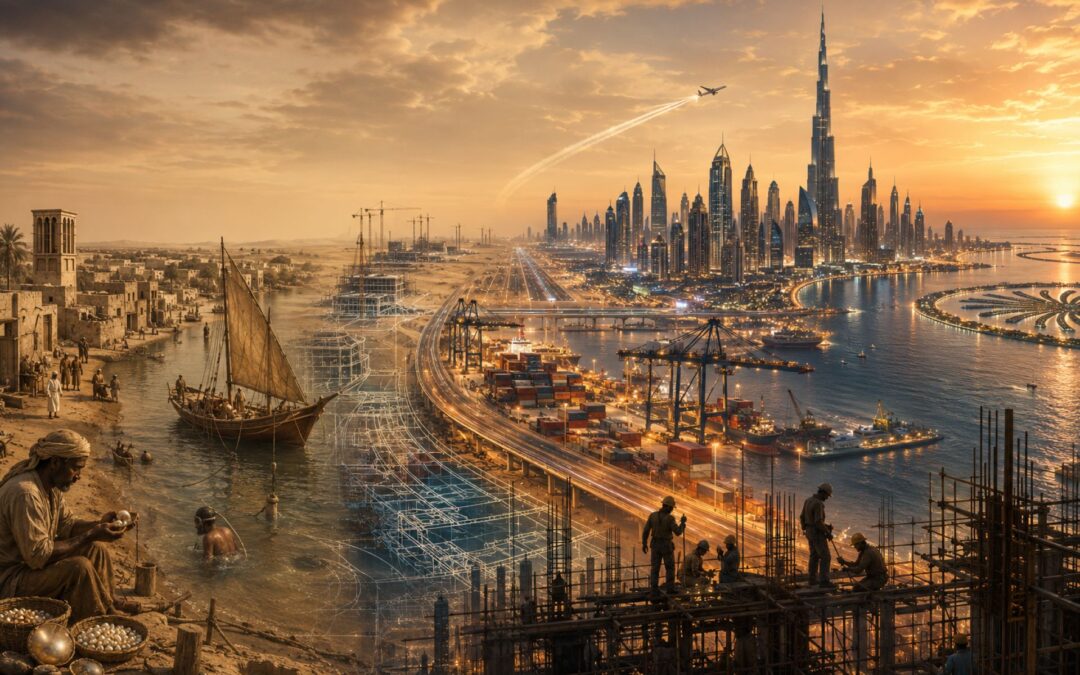
Dubai looks impossible.
A city of glass towers, artificial islands, luxury malls, global banks, five-star hotels, packed airports, and supercars where there was once desert, creek, heat, trade, and hardship. It is one of the few places on earth where the skyline itself feels like a business strategy.
That is why Dubai is so often explained badly.
Some people reduce it to oil. That is too simple.
Others reduce it to slavery, spectacle, and artificial money. That is also too simple.
The more interesting truth is that Dubai became rich because it learned one lesson early: dependence is dangerous. First it depended on pearls, and the pearl economy collapsed. Then it found oil, but not enough to build a permanent petrostate. So Dubai used a temporary oil window to build something else: ports, airports, free zones, tourism, finance, real estate, and a city designed to connect other economies.
Dubai did not escape dependence entirely.
It changed what it depended on.
Dubai Was Never Supposed To Become This Important
Dubai’s rise makes more sense when you remember how unlikely it was.
It did not begin as a natural capital of empire, a huge agricultural basin, a major manufacturing region, or a resource giant like Abu Dhabi. For much of its early modern history, Dubai was a small settlement on the Gulf, built around trade, fishing, pearling, and the creek.
Its geography was harsh. Fresh water was limited. The summer heat was punishing. The local economy was fragile. What Dubai had was not abundance in the traditional sense.
It had position.
Dubai sat along maritime routes connecting India, Persia, East Africa, and the Arabian Peninsula. Long before it became a global aviation hub, it was already a trading point. The creek gave dhows a natural place to anchor. Merchants moved goods through the region. Communities from Persia, India, and the wider Gulf helped shape its commercial culture. Britannica’s overview of Dubai describes how the emirate developed around commerce, the creek, and its role as a regional trade center.
This matters because Dubai’s later success was not invented from nothing. The skyscrapers were new. The instinct was older.
Dubai’s ruling families understood trade before they understood oil. They understood that a small place could become important by making itself useful to larger flows of people, goods, and money.
That became the city’s recurring strategy.
When one economic model failed, Dubai tried to become the place where the next model could pass through.
The Pearling Collapse That Taught Dubai A Brutal Lesson
Before oil, pearls were one of the Gulf’s great economic engines.
For centuries, pearl diving sustained coastal communities across the region. Divers went into dangerous waters with minimal equipment, while merchants sold pearls into luxury markets in India, Europe, and beyond. In Dubai, as in much of the Gulf, pearling was not a side business. It was central to survival.
Then the world changed.
The Great Depression destroyed demand for luxury goods. At roughly the same time, Japan’s cultured pearl industry transformed the market. Natural Gulf pearls could not compete with a cheaper, more scalable alternative that looked similar enough to satisfy buyers. Dubai’s official tourism history notes how pearling was once central to the city’s economy before oil and modern trade reshaped its future.
For Dubai, the collapse was devastating.
A place that had depended heavily on one sector suddenly saw that sector fall apart. This was not just an economic shock. It was a political memory. It taught Dubai’s rulers that a city built on one fragile source of wealth could be broken by forces far beyond its control.
That lesson echoes through the rest of Dubai’s history.
When oil arrived later, Dubai did not treat it the way some resource economies did. It did not have the reserves to assume oil would last forever. And it had already seen what happened when an entire society leaned too heavily on one source of income.
The pearl collapse became the ghost behind the oil boom.
It made diversification feel less like a fashionable policy goal and more like a survival instinct.
Oil Gave Dubai Money, But Not Enough Time To Waste
Oil did change Dubai. But it did not explain Dubai by itself.
That distinction is essential.
Dubai discovered oil in 1966, and commercial exports began in 1969. The timing was transformative. Oil revenue gave the emirate money at the exact moment when it needed capital to build modern infrastructure.
Roads. Ports. Power. Water. Schools. Hospitals. Administrative capacity.
Oil gave Dubai a launchpad.
But Dubai was not Abu Dhabi. Its oil reserves were far smaller. According to the Government of Dubai’s Debt Management Office, more than 95% of Dubai’s GDP now comes from non-oil sectors. That is not an accident. It is the result of a long strategic push to make oil the accelerator, not the destination.
This is where Dubai’s story differs from the lazy version.
Oil did not make Dubai permanently rich.
Oil gave Dubai a limited chance to build the machinery that could make it rich after oil.
That is a very different achievement.
Many resource-rich places struggle because oil creates comfort before capability. It can make governments lazy, distort currencies, weaken private enterprise, and turn political life into a fight over rents. Economists often call this the resource curse: the paradox that natural wealth can sometimes weaken long-term development instead of strengthening it.
Dubai’s advantage was partly that it never had enough oil to relax.
Its oil wealth was meaningful, but not endless. That scarcity forced urgency. Dubai had to think like a trader, not a petrostate.
It had to turn oil money into something that would keep working when the oil money faded.
Sheikh Rashid’s Infrastructure Gamble
The central figure in modern Dubai’s rise was Sheikh Rashid bin Saeed Al Maktoum.
His great insight was simple but risky: build ahead of demand.
That sounds obvious after the fact. It was not obvious at the time.
Dubai in the mid-20th century was still small. Building huge roads, ports, airports, and commercial infrastructure for a modest city looked excessive. It looked like overbuilding. It looked like ambition running ahead of reality.
But Sheikh Rashid understood something many cautious planners miss.
Infrastructure does not merely serve growth. Sometimes it creates growth.
A port can attract trade that did not previously exist. An airport can turn a peripheral city into a stopover hub. A free zone can pull in companies that would never have chosen the country otherwise. A commercial tower can signal that a city wants to be taken seriously before the world has agreed to take it seriously.
That was the gamble.
Dubai would not wait until it became important to build the systems of an important city. It would build those systems first and use them to become important.
This is why Dubai’s modern history often feels like a series of absurd bets that later became inevitable. The Dubai World Trade Centre rose when the city was still nowhere near the global business hub it wanted to be. Jebel Ali Port was built on a scale that seemed wildly ambitious for the region. Emirates airline was launched not simply as an airline, but as a tool of national strategy.
In a different place, this could have become a monument to vanity.
In Dubai, it became a flywheel.
Infrastructure attracted trade. Trade attracted companies. Companies attracted workers. Workers created demand. Demand justified more infrastructure. More infrastructure attracted more trade.
The city began to manufacture its own momentum.
Jebel Ali Turned Dubai Into A Trading Machine
If one project captures Dubai’s post-oil strategy, it is Jebel Ali.
Jebel Ali Port was not just a port. It was a declaration that Dubai wanted to become the logistics heart of the Middle East. Built far beyond the scale of Dubai’s existing economy, it gave the emirate a physical platform for trade between Asia, Europe, Africa, and the Gulf.
Then came the free-zone model.
The Jebel Ali Free Zone grew around the port and became one of Dubai’s most important economic engines. It offered foreign companies something unusually attractive for the region: business-friendly rules, tax advantages, direct access to one of the world’s major ports, and a base from which they could serve wider regional markets.
This is one of the most important parts of Dubai’s story because it shows that the city did not merely build pretty things.
It built systems.
A free zone is not as photogenic as the Burj Khalifa. A container port does not go viral on Instagram. A customs regime does not look glamorous in a tourism ad.
But these are the things that made Dubai useful.
Dubai positioned itself as a low-friction place to do business in a region where business was often slowed by bureaucracy, instability, sanctions, conflict, or political uncertainty. It did not need to manufacture everything itself. It needed to become the place where everything could move, be stored, financed, marketed, repackaged, and redistributed.
That is the real Dubai model.
Not oil.
Flow.
Dubai became rich by becoming a machine for circulation: goods, people, capital, brands, tourists, executives, expatriates, and ambition.
Emirates And DXB Made Dubai A Global Crossroads
Dubai’s airport strategy followed the same logic as its port strategy.
A small place can become globally important if enough people have to pass through it.
Emirates airline, founded in 1985, was never just a transportation company. It was part of Dubai’s economic architecture. The airline connected Dubai to the world, filled hotels, brought in business travelers, supported tourism, strengthened the city’s brand, and made Dubai feel closer to everywhere than geography alone would suggest.
Dubai’s location helped enormously. Sitting between Europe, Asia, and Africa, the city could become a convenient midpoint for long-haul travel. But location alone does not create a hub. Many cities are well located. Few build the airline, airport, visa systems, hotels, and service economy required to convert geography into power.
Dubai did.
Dubai International Airport became one of the clearest symbols of this strategy. Dubai Airports reported that DXB handled 92.3 million guests in 2024, reinforcing its position as one of the world’s busiest international aviation hubs. That kind of passenger volume is not just a transport statistic. It is an economic engine.
Every traveler is also a potential hotel guest, shopper, investor, conference attendee, property buyer, or future resident.
Dubai understood that aviation could feed the rest of the city.
The airport fed tourism. Tourism fed retail. Retail fed real estate. Real estate fed construction. Construction fed migration. Migration fed consumption. Consumption fed more services.
This is why Dubai does not behave like a normal city that happens to have an airport.
It behaves like an airport that grew into a city.
Tourism And Real Estate Sold The Dubai Dream
Dubai’s next act was more psychological.
Once it had trade, infrastructure, ports, and aviation, it needed a global story. It needed people not only to pass through Dubai, but to desire Dubai.
That is where tourism, luxury, and real estate entered the picture.
The Burj Al Arab, the Palm Jumeirah, Dubai Mall, the Burj Khalifa, luxury hotels, artificial islands, desert resorts, branded residences, and high-end shopping were not random acts of extravagance. They were advertising in concrete, steel, glass, and reclaimed land.
Dubai built landmarks that made the world look.
In branding terms, it solved a problem most cities have: invisibility. Before Dubai could become a global destination, people had to know what image to associate with it. The city chose spectacle.
Tallest. Biggest. Most luxurious. Most impossible.
This strategy worked. The Dubai Department of Economy and Tourism reported 18.72 million international overnight visitors in 2024, up from 17.15 million in 2023. Dubai is no longer simply a regional business hub. It is one of the world’s major tourism brands.
But spectacle is double-edged.
It attracts attention, capital, and aspiration. It also creates pressure to keep escalating. Once a city builds its reputation on the impossible, ordinary growth can feel like decline. Every new project has to be bigger, stranger, more luxurious, more Instagrammable, more globally visible.
That is why Dubai’s real estate market is both an economic engine and a source of vulnerability.
Property helped turn Dubai into a magnet for expatriates, investors, developers, and global wealth. But real estate-led growth depends heavily on confidence. If buyers believe Dubai will keep rising, they buy. If they fear oversupply, financial stress, geopolitical risk, or weaker demand, the same market can turn quickly.
Dubai learned this during the 2008 financial crisis, when its debt-fueled property boom came under severe pressure. The emirate recovered, but the episode revealed a permanent truth about the Dubai model: confidence is not decorative. It is load-bearing.
Dubai’s dream is powerful.
But dreams are unstable assets.
They must be constantly maintained.
Why Dubai’s Economy Is No Longer Really About Oil
The most persistent myth about Dubai is that it is rich because of oil.
The better version is this: Dubai became modern because of oil, but it became Dubai because it moved beyond oil.
Today, Dubai’s major economic pillars are trade, logistics, aviation, tourism, finance, real estate, construction, retail, professional services, and free-zone activity. Oil is no longer the center of the model. The Government of Dubai’s own economic overview emphasizes the emirate’s non-oil base, while Britannica’s economy profile of Dubai highlights commerce, finance, transportation, tourism, and free-trade activity as central to the city’s modern economy.
That does not mean Dubai is independent in some pure sense. It is deeply tied to the wider Gulf economy, global capital, energy wealth, regional politics, and international mobility. But its own economic structure is far more diversified than the stereotype suggests.
This is what makes Dubai so fascinating.
It is one of the rare places in the Middle East that can plausibly claim to have built a post-oil urban economy before oil actually disappeared. While other Gulf states now talk about diversification through huge national visions, Dubai began the experiment decades earlier because it had less choice.
Its success came from sequencing.
First, it used trade.
Then oil financed infrastructure.
Then infrastructure attracted commerce.
Then commerce justified aviation.
Then aviation fed tourism.
Then tourism, finance, and real estate turned Dubai into a global lifestyle and business hub.
This was not a clean master plan where every move was guaranteed. It was a series of calculated bets, many of which reinforced one another over time.
Dubai’s genius was not that it predicted the future perfectly.
It was that it built optionality.
Ports gave it options. Airports gave it options. Free zones gave it options. Tourism gave it options. Low taxes and business-friendly regulation gave it options. A large expatriate workforce gave it options.
The city made itself adaptable.
That is why the “oil made Dubai rich” explanation misses the deeper point. Oil was the capital. The model was connectivity.
The Workers Behind The Miracle
Every skyline has a shadow.
Dubai’s shadow is labor.
The city’s growth depended on millions of foreign workers, many from South Asia, Southeast Asia, and Africa. They built the roads, towers, hotels, malls, airports, ports, and homes that made the Dubai brand possible.
Without them, the miracle does not exist.
But the conditions facing many migrant workers have been heavily criticized for years. Human Rights Watch’s 2025 UAE report notes ongoing concerns including wage theft, illegal recruitment fees, passport confiscation, restrictions on unions, and the lack of a non-discriminatory minimum wage. Amnesty International has also criticized the sponsorship system and weak protections that can leave migrant workers vulnerable to exploitation.
This is not a side issue. It is central to the model.
Dubai’s speed was made possible partly because it could import labor at enormous scale without giving most of that labor a path to political membership or citizenship. Workers could build the city, service the city, clean the city, drive the city, guard the city, and maintain the city without becoming full stakeholders in the city.
That arrangement gave Dubai flexibility.
It also created a moral and social contradiction.
The people most responsible for building the physical city are often the least visible in its official image. The tourist sees the hotel lobby. The investor sees the skyline. The conference attendee sees the airport. The luxury buyer sees the waterfront apartment.
Behind all of it are workers whose lives rarely fit the city’s polished self-portrait.
The International Labour Organization has explained how sponsorship systems in the Arab states can restrict workers’ mobility and create conditions that increase vulnerability to exploitation. This wider regional context helps explain why Dubai’s labor model cannot be separated from its development model.
This does not erase Dubai’s achievements. But it changes how they should be understood.
The miracle was not only visionary leadership, oil money, ports, airlines, and free zones.
It was also heat, debt, dormitories, remittances, recruitment fees, long hours, and bodies doing difficult work in a city designed to look effortless.
The Demographic Fragility Beneath The Skyline
Dubai is not just economically unusual. It is demographically unusual.
Most of its population is foreign. The exact share shifts by source and year, but the basic reality is unmistakable: Dubai is a city where citizens are a small minority and expatriates keep the economy functioning. The UAE’s own official portal describes the country’s population as heavily expatriate, a pattern that is especially visible in Dubai’s labor market and urban life.
This gives Dubai enormous advantages.
It can import talent quickly. It can attract professionals, entrepreneurs, investors, service workers, construction workers, and domestic workers from across the world. It can scale faster than a city limited by its native population. It can plug itself into global labor markets with unusual intensity.
But this also creates fragility.
A city built on temporary belonging must keep giving people reasons to stay.
For wealthy expatriates, that means safety, low taxes, lifestyle, schools, property, banking, and business opportunity. For professionals, it means jobs and career mobility. For lower-wage workers, it means wages high enough to justify separation from home and family. For investors, it means confidence that Dubai will remain stable, open, and profitable.
If those conditions weaken, the population can become more mobile than a normal citizen-based society.
Dubai’s model depends on attraction rather than attachment.
That is powerful in good times. It lets the city draw ambitious people from everywhere. But it also means Dubai must constantly compete for people who may not see it as home in a permanent sense.
There is also the climate question.
Dubai has built extraordinary comfort in an extraordinarily difficult environment. Air conditioning, desalination, imported food, engineered landscapes, shaded interiors, and climate-controlled luxury make modern life possible. But as extreme heat becomes a larger global concern, Gulf cities will face harder questions about energy demand, outdoor labor, water security, and livability.
The World Bank’s climate profile for the UAE shows why heat and water stress are not abstract issues for the region. For a city whose model depends on construction, tourism, aviation, and expatriate inflows, livability is not a soft concern. It is part of the economic foundation.
Dubai is not alone in this. But because its model depends so heavily on movement, comfort, and confidence, the challenge matters.
The city has escaped oil dependence.
It has not escaped physical limits.
Is Dubai A Miracle, A Mirage, Or A Warning?
Dubai is all three.
It is a miracle in the practical sense. Very few places have transformed themselves so quickly, so visibly, and so successfully. Dubai turned a narrow oil window into a diversified urban economy. It became a global aviation hub, a logistics center, a tourism magnet, a financial node, and a symbol of ambition in less than a century.
That is not fake.
But Dubai is also a mirage in the sense that its surface can mislead. The luxury image hides the labor structure. The skyline hides the debt cycles. The tourist fantasy hides the environmental strain. The low-tax lifestyle hides dependence on legal and political arrangements that not everyone can access equally.
And Dubai is a warning because it shows what development can become when success is measured mainly by speed, scale, visibility, and global capital.
It is possible to admire Dubai’s strategic brilliance and still question its costs.
It is possible to recognize that Dubai avoided the classic oil trap while also seeing that it replaced one dependency with several others.
Instead of depending mainly on oil, Dubai now depends on trade routes staying open, planes staying full, property buyers staying confident, expatriates staying interested, workers staying available, and the world continuing to believe in Dubai as a place where the future is being built faster than elsewhere.
That belief is one of Dubai’s greatest assets.
It is also one of its greatest risks.
Conclusion: Dubai Escaped Oil, But Not Dependence Itself
Dubai’s rise was not an accident, and it was not just oil.
It was the result of a city learning from collapse, using oil money before it disappeared, building infrastructure ahead of demand, welcoming trade, attracting foreigners, selling spectacle, and turning geography into strategy.
That is why Dubai matters.
It is not simply a rich city in the desert. It is one of the clearest examples of how a place can manufacture relevance in the modern world.
But the deeper lesson is more complicated. Dubai escaped the fate of being only an oil economy, but it did not become independent. No city is. It shifted from dependence on natural resources to dependence on movement, money, labor, climate control, and confidence.
That may be smarter than oil.
It may also be more fragile than it looks.
Last Updated on June 10, 2026 by Aseem Gupta