
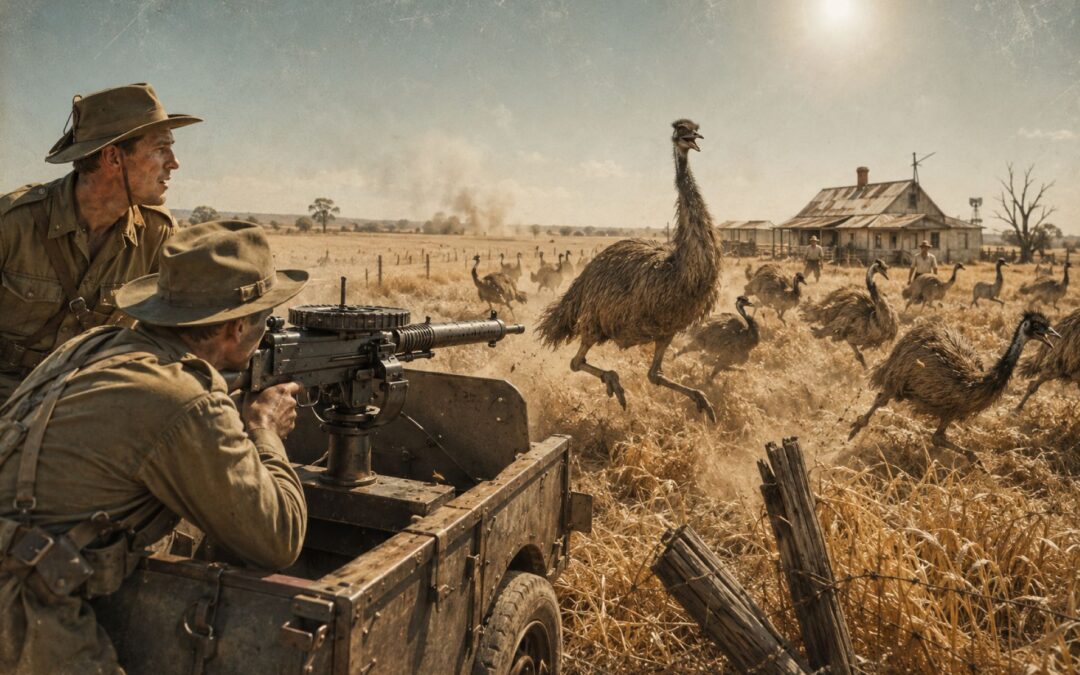
The Great Emu War sounds like something invented by the internet.
Australia, a country already famous for deadly snakes, giant spiders, crocodiles, kangaroos, and animals that seem specifically designed to test human confidence, once sent soldiers with machine guns to fight birds.
Not metaphorically.
In 1932, soldiers from the Australian military were sent into Western Australia with Lewis machine guns and thousands of rounds of ammunition to help farmers deal with emus destroying crops. The result has gone down in history as one of the strangest military operations ever attempted.
The popular version is simple: Australia declared war on emus and lost.
That version is funny because it is not entirely wrong. But the real story is more interesting than the meme. The Great Emu War was not just a random national embarrassment. It was the product of desperate farmers, bad economic timing, postwar settlement policy, animal migration, political pressure, and a government reaching for the most visible solution instead of the most useful one.
It was absurd.
It was also a policy failure.
The Meme Is Funny Because the Real Story Was Absurd
The phrase “Great Emu War” has survived because it sounds impossible.
Wars are supposed to be fought between nations, armies, ideologies, or at least organized human groups. Here, one side had soldiers, machine guns, parliamentary debates, official authorizations, and newspaper coverage. The other side had long legs, feathers, survival instincts, and a talent for running away.
That contrast is why the story works so well online. It has the perfect structure for a historical joke: a serious government treats a ridiculous problem with military seriousness, only to be humiliated by wildlife.
But the joke can also flatten the story.
Australia did not wake up one morning and decide to prove its military strength against birds. The emus were not just wandering around being annoying. The farmers were not simply overreacting. The country was in an economic crisis, and rural communities were under pressure from forces much larger than emus.
The National Museum of Australia’s account of the Great Depression notes that Australia’s economy collapsed after the Wall Street crash, with unemployment reaching a peak of 32 percent in 1932. Wheat and wool prices had already been falling in the late 1920s, and Australia’s heavy borrowing became harder to sustain as global credit tightened.
So when emus arrived in large numbers in the wheat-growing districts of Western Australia, they were not entering a stable farming economy.
They were entering a landscape already close to breaking.
That is what makes the Great Emu War more than a comedy sketch. It was a strange episode, but it happened because real people were trapped between economic collapse, environmental pressure, and political neglect.
The emus just made the crisis impossible to ignore.
Australia’s Farmers Were Already in Trouble
To understand why anyone thought machine guns might be a reasonable answer to emus, start with the farmers.
After the First World War, Australia encouraged many returned soldiers to settle on the land. Soldier settlement schemes promised veterans a path back into civilian life through farming. Land would be opened up, farms would be built, wheat would be grown, and men who had served the country would be rewarded with independence.
On paper, it sounded noble.
In practice, many soldier settlers were sent into a brutal economic and agricultural reality. Some had limited farming experience. Some were working marginal land. Many carried debt. They depended heavily on wheat prices and export markets they could not control.
Then the Great Depression arrived.
Australia was especially vulnerable because it relied heavily on primary exports like wheat and wool. When global demand fell, export prices fell with it. Farmers who had borrowed money during better times suddenly found themselves producing crops that earned too little to cover their costs.
The economy did not simply “slow down.” It squeezed people from every direction.
The Australian government’s historical overview of the Depression explains how falling commodity prices, international borrowing problems, and the collapse of global markets created a severe crisis. For rural farmers, this meant that even a good harvest might not be enough.
Many left the land and looked for work elsewhere.
Those who stayed had to keep producing in conditions that were becoming less forgiving every year. They needed crops to survive. They needed fences to hold. They needed the government to take their distress seriously.
Then the emus came.
Why Emus Became a Wheatbelt Crisis
The emu is not a small bird.
It is the tallest native bird in Australia, and according to the Australian Museum, it is a powerful flightless runner adapted to travelling across large parts of the continent. Emus can move long distances in search of food and water, and they feed on a wide variety of plants, seeds, fruits, insects, and crops.
They are not evil.
They are opportunistic.
In 1932, thousands of emus moved into farming areas of Western Australia’s Wheatbelt after breeding season. The farms offered exactly what hungry animals needed: wheat, water, open land, and broken or vulnerable fencing.
For farmers, this was disastrous.
The emus trampled crops, ate wheat, damaged fences, and opened paths that allowed rabbits to enter as well. Rabbits were already a major agricultural pest in Australia, so a damaged fence did not create one problem. It created several.
The number most often associated with the crisis is about 20,000 emus. Whether every figure from the period should be treated with caution or not, the basic reality is clear: farmers saw the birds as a large-scale threat to their already fragile livelihoods.
And they were not dealing with this from a position of comfort.
If wheat prices had been high, debts manageable, and rural incomes stable, the emu problem might have been treated as a serious nuisance. In Depression-era Western Australia, it became something bigger. It became one more blow against people who already felt abandoned.
That is why the farmers did not only ask for advice.
They asked for force.
How a Farming Problem Became a Military Operation
The most revealing part of the Great Emu War is not that soldiers were sent against birds.
It is that farmers thought the Defence Minister was the right person to ask.
The farmers had military backgrounds, political frustration, and a practical problem they wanted solved quickly. Many were returned soldiers themselves. They knew machine guns. They knew government departments. They knew how to frame their problem in terms officials might understand.
So the request went to Sir George Pearce, Australia’s Minister for Defence.
Pearce agreed to provide military assistance, but not without conditions. The farmers were expected to help cover costs, and the operation was framed as both pest control and useful target practice. Major G. P. W. Meredith of the Royal Australian Artillery was sent with men, two Lewis machine guns, and thousands of rounds of ammunition.
The plan had a certain blunt logic.
If thousands of large birds were destroying crops, and ordinary methods were not enough, then machine guns might seem like a decisive answer. The government could show action. The farmers could feel heard. The soldiers could get field experience.
But this logic depended on one very shaky assumption.
It assumed emus would behave like a target.
They did not.
The moment the military entered the story, the whole problem changed shape. What looked simple from a distance became ridiculous up close. A battlefield weapon had been brought into an ecological problem where the “enemy” had no formation, no command structure, no fixed position, and no interest in standing still.
That mismatch explains almost everything that followed.
Machine Guns Meet a Moving Target
The operation began in November 1932 near Campion in Western Australia.
The soldiers spotted groups of emus and opened fire. But instead of bunching together, the birds scattered. They broke into smaller groups and ran in different directions, making them much harder to shoot in large numbers.
This was not strategy in the human sense.
It was better than strategy.
It was instinct.
A machine gun is terrifying when aimed at a dense human formation. Against fast, dispersed animals crossing open country, it becomes far less efficient. The emus did not need to defeat the soldiers. They only needed to keep moving.
The early attempts were embarrassing. In one encounter, soldiers tried to fire on a group near a dam, but the guns jammed after only a small number of birds were killed. Another plan involved mounting a machine gun on a truck and chasing the birds, which sounded aggressive but worked poorly in rough terrain. The vehicle could not move smoothly enough, the gun could not be aimed properly, and the emus could simply outrun or outmaneuver the attempt.
The newspapers noticed.
A 1932 report preserved in Trove shows that the “emu war” had become a matter of public and parliamentary debate. Pearce defended the use of machine guns, arguing that the damage done by the birds justified the military response.
But ridicule had already taken hold.
The first phase of the operation was called off after poor results and negative press. Then, after farmers renewed their appeals, the military returned for a second attempt. This phase was more effective. Meredith and his men killed more birds than before, and later reports credited the operation with close to a thousand confirmed kills.
Even then, the numbers made the victory look thin.
The commonly cited final tally was 986 confirmed emus killed for 9,860 rounds fired — almost exactly ten rounds per confirmed kill. Against an estimated population of around 20,000 birds, that was not a decisive solution.
It was a noisy dent.
Why the Emus Were So Hard to Defeat
The emus were difficult to defeat because they were never the kind of problem the army was designed to solve.
They were large, fast, mobile animals spread across a wide rural landscape. They did not gather neatly in one place. They did not advance in lines. They did not hold territory in a way that could be captured. They did not panic in a way that made them easier to destroy.
They scattered.
That one fact made the whole campaign inefficient.
Emus can run quickly, travel long distances, and adapt their movement to food and water availability. The Australian Museum’s profile of the emu describes a bird built for movement across varied habitats. Other Australian wildlife sources also emphasize their speed, endurance, and ability to move through open country.
In other words, the emu was almost perfectly designed to make soldiers look foolish.
The military also faced practical problems. Machine guns were not magic. They jammed. They needed positioning. They needed ammunition. They worked best when the target was concentrated and predictable. A flock of birds breaking apart into smaller groups across farmland turned every engagement into a frustrating chase.
Major Meredith reportedly compared the emus’ toughness and mobility to military units. That comparison has become part of the legend, but it also points to the deeper truth: the soldiers were impressed because the birds did not behave like passive pests.
They absorbed the pressure and kept moving.
The emus did not need to win a battle.
They only needed to survive long enough for the humans to run out of patience, ammunition, political cover, or all three.
Did Australia Really Lose the Great Emu War?
So did Australia really lose?
As a military joke, yes.
As a literal war, of course not. The emus did not sign a treaty. They did not capture Canberra. They did not overthrow the government and install a feathered republic.
But as a pest-control campaign, the operation failed to solve the problem.
That is the more useful answer.
If the goal was to kill some emus, the military eventually did that. If the goal was to protect farmers’ crops in a lasting, cost-effective way, the campaign was not enough. Thousands of birds remained, and emus continued damaging farms in later years.
This is why the “emus won” line survives. It captures the gap between official action and practical success.
The government could point to birds killed. The farmers could still point to crops damaged. The newspapers could point to the absurdity of soldiers chasing wildlife with machine guns. The public could see that the operation had generated more embarrassment than relief.
And the emus were still there.
That does not mean the farmers were wrong to be desperate. It means the government chose the wrong tool for the job.
The Great Emu War was not absurd because crop damage was imaginary. It was absurd because a real agricultural problem was treated as if it could be solved by a dramatic display of force.
The lesson is not “farmers were silly.”
The lesson is “visible action is not the same as effective action.”
What Worked Better Than Soldiers
After the military campaign, Australia did not solve the emu problem by escalating the war.
It moved toward more practical tools: fencing, bounties, and local pest-control measures.
Fencing mattered because the real problem was not that emus existed. The problem was that emus could enter vulnerable wheat farms in large numbers. A better fence did not need to defeat the emu as a species. It only needed to reduce access to crops.
That is a very different kind of solution.
Western Australia’s long history of barrier fencing shows how seriously the state treated agricultural protection. The State Barrier Fence, which developed out of earlier vermin fencing efforts, became part of a wider attempt to protect farming land from animals such as rabbits, wild dogs, and emus.
Fences were not perfect. They could be expensive, disruptive, and environmentally complicated. They could redirect animal movement rather than eliminate conflict. But they were at least aimed at the actual mechanism of the problem: animals entering farms and damaging crops.
The same logic applies to bounties. They did not produce a clean heroic story, but they distributed action across local people who were already near the problem. Instead of sending a small military unit to chase thousands of moving birds, local control gave farmers a more continuous way to reduce pressure.
This is why the aftermath of the Great Emu War matters.
The military operation became famous because it was ridiculous. The quieter solutions were less entertaining, but more relevant. They treated the situation as a recurring land-management problem, not as a battle waiting for a commander.
That shift was the real correction.
The Real Lesson of the Great Emu War
The Great Emu War is easy to laugh at, and it should be laughed at.
There is no way to tell the story of soldiers, machine guns, and emus without admitting that history sometimes writes comedy better than fiction.
But the deeper lesson is not that Australia was uniquely foolish. Governments everywhere have a habit of reaching for tools that create the appearance of control. A military response looks decisive. A press release looks reassuring. A dramatic intervention looks better than slow, local, boring management.
But problems do not care how decisive a solution looks.
They respond to whether the solution fits.
The Emu War failed because the government treated an ecological and agricultural crisis as a target-shooting exercise. The emus were not an army. They were animals responding to food, water, habitat, and opportunity. The farmers were not asking for spectacle. They were asking for relief. The land did not need a battle plan. It needed practical management.
That makes the story surprisingly modern.
Around the world, farmers still come into conflict with wildlife when animals damage crops, kill livestock, or move through landscapes reshaped by human activity. The World Bank’s Global Wildlife Program describes human-wildlife conflict as a serious global challenge involving conservation, livelihoods, food security, and local communities.
The details vary. Elephants raid crops. Wolves attack livestock. Monkeys enter cities. Wild boars damage farms. Emus eat wheat.
The pattern is familiar: humans change landscapes, animals adapt, economic pressure rises, and governments are forced to choose between symbolic action and practical solutions.
In 1932, Australia chose symbolism first.
The emus exposed the mistake.
Conclusion: The Wrong Tool for the Wrong Problem
The Great Emu War endures because it sounds like a joke with a historical footnote attached.
But it was really the other way around.
It was a serious historical problem that became funny because the solution was so badly matched to reality. Depression-era farmers were struggling. Wheat prices had collapsed. Returned soldiers were trying to survive on difficult land. Emus moved into farms because farms offered food and water. The damage was real.
The absurdity came from imagining that machine guns could neatly solve it.
In the end, the emus did not win because they were smarter than the Australian government. They won because the government misunderstood the problem. It treated mobile wildlife like a military enemy and expected a battlefield tool to fix an agricultural crisis.
That is why the story still works.
It is funny, but it is also a warning.
When a crisis is complex, the most dramatic response is often the least useful one. The right answer is usually less cinematic: better fences, better incentives, better local management, and a clearer understanding of what the problem actually is.
Australia did not lose to emus because the birds had a master plan.
It lost because the emus were emus — and the humans forgot that.
Last Updated on July 4, 2026 by Aseem Gupta