
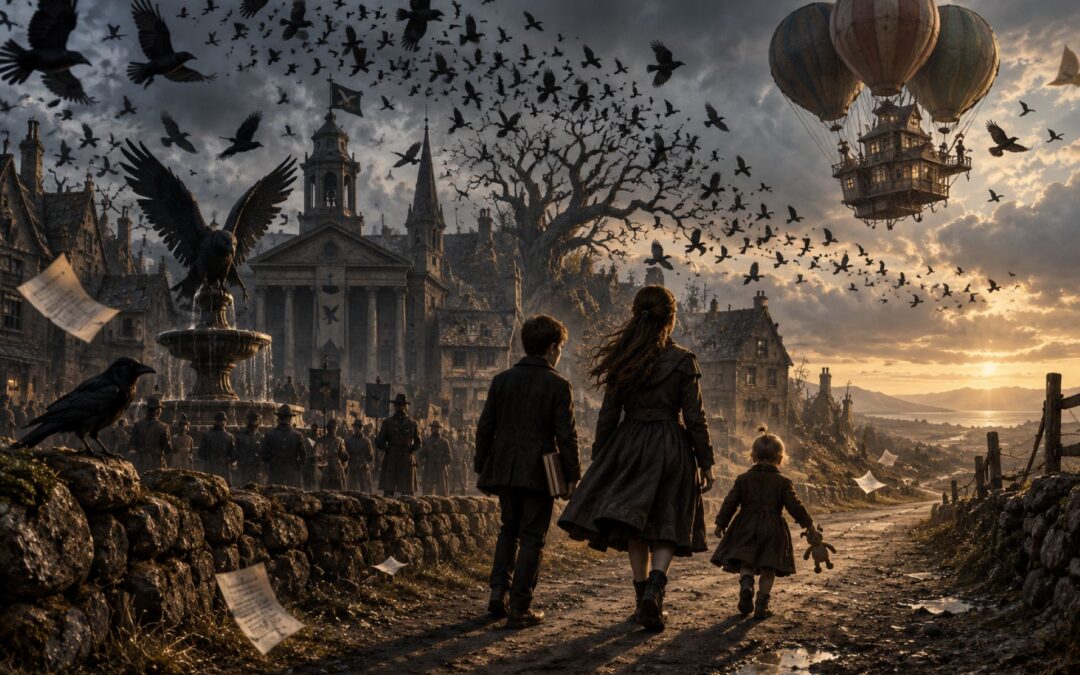
Published in 2001 as the seventh volume of A Series of Unfortunate Events, according to HarperCollins’ official listing for The Vile Village, Lemony Snicket’s The Vile Village initially appears to offer the Baudelaire children yet another variation on a familiar problem. Violet, Klaus, and Sunny need a guardian. Count Olaf is still pursuing their fortune. Adults remain remarkably unwilling to believe the children when they recognize danger, and another strange new setting promises to subject them to a fresh collection of arbitrary rules and unpleasant people.
Yet The Vile Village is more consequential than another stop in the Baudelaires’ disastrous search for a home. Instead of placing them with one guardian, the novel gives them an entire community, turning the proverb “It takes a village to raise a child” into a test of what collective responsibility actually means. The result is disastrous. The Village of Fowl Devotees demands service from the children while refusing to protect them, allows procedure to replace judgment, and finally helps transform three innocent orphans into wanted fugitives. This article contains full spoilers, including Jacques Snicket’s murder, the identities of Detective Dupin and Officer Luciana, the fate of the Quagmires, and the novel’s ending.
Book 7 therefore marks a major change in the larger series. The Baudelaires enter V.F.D. still hoping that some adult structure might keep them safe, help them rescue Duncan and Isadora Quagmire, and perhaps reveal what the mysterious initials V.F.D. mean. They leave having learned that institutions can be worse than useless when the people inside them surrender observation, courage, and moral responsibility. By the final pages, Violet, Klaus, and Sunny are no longer children moving from guardian to guardian. They are fugitives who will have to become, in the novel’s recurring language, self-sustaining.

The Vile Village: Complete Plot Summary
The Vile Village follows a tightly connected sequence of mysteries rather than a collection of unrelated misfortunes. The Baudelaires’ choice of V.F.D., the strange poems found beneath Nevermore Tree, the arrest of a man mistaken for Count Olaf, the murder investigation, the Fowl Fountain, and Hector’s flying home all eventually become parts of the same crisis. Understanding the novel therefore requires following the clues and reversals in order, because each apparent solution produces the conditions for the next disaster.
From The Daily Punctilio to the Village of Fowl Devotees
The story opens with Violet, Klaus, and Sunny Baudelaire in Mr. Poe’s office reading The Daily Punctilio. The newspaper has attempted to report the kidnapping of Duncan and Isadora Quagmire, who disappeared after helping the Baudelaires during the events of The Ersatz Elevator, but almost every important detail has been distorted. It calls Duncan and Isadora twins rather than the surviving members of a set of triplets, names their kidnapper “Count Omar” instead of Count Olaf, and reports Esmé Squalor as another of Olaf’s victims rather than his accomplice.
The inaccuracies are not merely comic. The Baudelaires know that Duncan and Isadora have information about a secret connected to the initials V.F.D., and they know that the Quagmires were abducted precisely because they became involved in the Baudelaires’ struggle against Olaf. A newspaper that cannot get their names, relationships, or captor correct is not helping the authorities find them. Worse, Mr. Poe regards the publication of the story as evidence that matters are being handled properly.
Mr. Poe has another problem. He has tried to find a new relative willing to care for the children, but word of the disasters surrounding the Baudelaires has made potential guardians reluctant. Instead of recognizing that Count Olaf is the source of those disasters, Mr. Poe speaks as though the children themselves have become reputationally inconvenient.
A telephone call gives him what he considers an ideal solution. Several nearby towns have joined a program based on the aphorism “It takes a village to raise a child.” Rather than assigning an orphan to an individual guardian, an entire community will supposedly accept responsibility for raising the child. Mr. Poe imagines that hundreds of guardians ought to provide even greater security than one.
The children are allowed to choose among participating villages. They reject places connected to previous disasters, but one entry immediately catches their attention: V.F.D. The initials are the same ones Duncan and Isadora had been investigating before their kidnapping. The Baudelaires do not know whether the village is genuinely connected to the secret, but the possibility gives them a reason to choose it.
Mr. Poe sends them there alone by bus. Even the journey introduces the village’s peculiar relationship with rules: the bus driver is required to drop passengers a long distance from the town because local regulations prevent him from approaching more closely. Violet, Klaus, and Sunny must cross a hot, flat, dusty landscape on foot before reaching V.F.D.
At Town Hall they encounter the Council of Elders, whose members wear crow-shaped hats and govern village life through an enormous number of rules. The Council is conducting public business from a platform, and procedure matters more than communication. People who are not permitted to speak are silenced regardless of whether they have important information. The newly appointed Chief of Police, Officer Luciana, appears in a motorcycle helmet that hides most of her face, along with black boots, a police uniform, and bright red lipstick.
The Baudelaires soon discover how completely the village has misunderstood its supposed responsibility toward them. Instead of hundreds of adults caring for three children, the children are assigned the chores of hundreds of adults. Because thousands of crows migrate between different parts of V.F.D. throughout the day, the children must arrange their labor around the birds’ movements. In the morning the crows occupy uptown, so the Baudelaires work downtown; in the afternoon the birds move downtown, so the children work uptown; at night they roost in a huge tree on the outskirts.
The villagers do not even want the children living in their houses. Responsibility for feeding and housing them is placed on Hector, the village handyman. Hector is tall, gentle, and friendly, but there is an immediate complication: the Council makes him so nervous that he becomes unable to speak when its members are present.
Hector introduces the children to the most striking feature of V.F.D., the enormous daily migration of crows. In the evening the birds circle overhead before flying toward Nevermore Tree. For Violet, Klaus, and Sunny, the sight is briefly liberating. After the suffocating bureaucracy of Town Hall, thousands of birds moving through the sky suggest freedom from the dangers that have pursued them.
At Hector’s home, the Baudelaires discover that their host is considerably more interesting than the Council would approve. Rule #67 has effectively suppressed mechanical invention, but instead of destroying the town’s inventing materials, Hector secretly stored them in his barn and created a hidden workshop. He is constructing a self-sustaining hot air mobile home consisting of multiple baskets suspended beneath balloons. Once completed, it would contain rooms and supplies sufficient for permanent life in the air. Its most remarkable feature is also its most disturbing: if Hector solves the engine problem, the vehicle will be able to remain aloft for decades but will be impossible to bring back down.
Hector has also disobeyed restrictions on books. The official village library is almost useless because any book depicting behavior forbidden by V.F.D.’s rules is itself prohibited. Hector therefore saved forbidden volumes instead of burning them and created a secret library alongside his workshop. Violet has found an inventor’s paradise, and Klaus has found a hidden collection of useful knowledge.
Sunny’s preferred skill—biting—is also technically forbidden by the village’s rules, reinforcing how little space V.F.D. leaves for individuality. Yet Hector treats the three children with a consideration almost entirely absent from the rest of the community.
Then he reveals something far more important than his secret workshop. Beneath Nevermore Tree, he has found a small rolled scrap of paper. The handwriting is familiar to the Baudelaires, and its two rhyming lines refer to being imprisoned because of sapphires and ask for help. Isadora Quagmire is a poet who writes couplets, while the Quagmire fortune consists of valuable sapphires. Violet, Klaus, and Sunny realize that their kidnapped friends may somehow be communicating with them from nearby.
The Quagmires’ Couplet Trail
The first message gives the Baudelaires hope, but it also creates a mystery. Hector says he simply found the scrap beneath Nevermore Tree, where the crows spend each night. The children initially wonder whether Hector could be involved in the kidnapping, because their experiences have taught them that apparently trustworthy adults cannot automatically be trusted, but his behavior and willingness to help make that increasingly unlikely.
Their first hypothesis is literal: perhaps Duncan and Isadora are imprisoned in or near Nevermore Tree. The Baudelaires therefore arrange to watch the tree throughout the night, making sure that no one approaches it unseen. If Olaf or one of his associates is delivering messages, the children hope to catch the culprit; if the Quagmires are hidden there, prolonged observation might reveal them.
Nothing happens. No person approaches the tree, and the Baudelaires find no prisoners. Yet after the crows depart the next morning, another rolled piece of paper appears among the dark feathers.
The second couplet says that the prisoners cannot speak until dawn and that no words can come from a sad beak. This deepens the puzzle rather than solving it. The Baudelaires know the messages are associated with the crows, but they do not yet understand how. Isadora is clearly communicating indirectly because an explicit location could be discovered by Olaf, yet the mechanism remains invisible.
The children have little time to investigate because V.F.D. expects them to perform the village’s chores. The arrangement makes the supposed guardian program increasingly absurd. The people of V.F.D. have collectively accepted responsibility for three orphans and then translated that responsibility into an entitlement to have their hedges trimmed, windows washed, and errands performed by those same children.
One particularly important chore takes them to the newly installed Fowl Fountain. Like much of V.F.D., the fountain is built around the village’s obsessive reverence for crows. At this stage it looks like an oversized and ridiculous civic monument that requires cleaning. Only later will the Baudelaires realize that it is one of the most important structures in the novel.
Their work is interrupted by startling news from the Council: Count Olaf has been captured.
For the first time in a long while, the Baudelaires might seem to have received good news. If the police truly have Olaf, he can no longer pursue their fortune, and the Quagmires may finally be rescued. Yet the children have seen too much adult incompetence to assume that a confident announcement is the same thing as a verified fact.
Jacques Snicket, the False Olaf, and the Murder
At Town Hall, the Baudelaires discover that the captured man is not Count Olaf. He has one long eyebrow and an eye tattoo on his ankle, features associated with Olaf, but his face is different. The prisoner says his name is Jacques.
V.F.D.’s response demonstrates the danger of reducing judgment to rules. Because villains are prohibited within the village and serious offenders can be burned at the stake, the Council treats physical resemblance as sufficient proof of identity. Jacques insists that the eye tattoo is connected to his work and begins to explain that he works for “the volunteer—,” but the Council silences him under a procedural rule governing who may speak from the platform.
Violet and Klaus object publicly. They know Olaf intimately and insist that the prisoner is not him. Rather than considering the possibility that the children most familiar with Olaf might be valuable witnesses, the adults interpret their testimony as evidence of confusion. Officer Luciana reinforces the mistaken identification instead of investigating it.
Jacques reacts differently. He recognizes the Baudelaires. He also seems to know something about their family and begins referring to their parents before the authorities prevent the conversation from developing. For the children, his appearance suddenly turns the village initials into something more complicated. V.F.D. may be more than the Village of Fowl Devotees, and Jacques’s unfinished reference to “the volunteer—” strongly suggests that he is connected to the same larger mystery Duncan and Isadora were investigating.
The Baudelaires now face two emergencies. Duncan and Isadora are apparently imprisoned somewhere nearby, while Jacques is scheduled to die because the village has mistaken him for Olaf. The children divide the work according to their strengths.
Sunny concentrates on the mysterious appearance of the messages beneath Nevermore Tree. Klaus goes to Hector’s secret library, hoping to find some rule or legal principle that will prevent Jacques’s execution. Violet turns to the self-sustaining hot air mobile home. Her reasoning is strategic: if the village kills Jacques while believing he is Olaf, the real Olaf will effectively be considered dead. That would free him to operate with even less suspicion. Even if the Baudelaires save Jacques and find the Quagmires, they may still need an immediate means of escape.
Hector suggests an even larger possibility. If Violet helps complete the mobile home, the Baudelaires and Quagmires could join him in the sky and never come down. Olaf would be unable to reach them, and Hector would escape a community that terrifies him.
The proposal is genuinely tempting. The Baudelaires have repeatedly been hunted, betrayed, and disbelieved. A permanent refuge above ordinary society sounds safer than another guardian arrangement. Yet there is also something troubling about a solution based on never returning to the world at all.
Each child makes progress. Violet works on the flying home’s mechanical problems. Klaus discovers a rule allowing a condemned person a final speech and combines it with what he has read about crowd behavior. If Jacques is allowed to address the villagers, perhaps he can persuade enough people to question the Council’s conclusion.
Sunny’s investigation produces the most important clue. Another couplet arrives, and the children realize that no human being could have placed it beneath the tree while they were watching. The poem directs them toward the importance of what is read first and suggests an “initial” method of communication. They do not yet solve the code completely, but the possibility that the crows themselves are carrying the notes becomes increasingly strong.
The children hurry back to the jail with their developing plans, hoping they have arrived in time to save Jacques. They have not.
Jacques Snicket is dead in his cell.
The change in tone is significant. Earlier installments contain death, cruelty, and genuine danger, but Jacques’s murder occurs inside a supposedly lawful institution while he is being held by authorities who have already ignored evidence of his innocence. Someone has not simply outsmarted the village. The systems that should have protected a prisoner have provided the conditions for his murder.
Detective Dupin Frames the Baudelaires
Officer Luciana presents Jacques’s death as a mystery and introduces the man who will supposedly solve it: Detective Dupin. His appearance is absurdly conspicuous. He dresses in a manner designed to look fashionable and unconventional, wears sunglasses, uses ridiculous slang, and keeps his feet hidden in plastic shoes.
The Baudelaires nevertheless recognize him instantly as Count Olaf. By this stage of the series, identifying Olaf is rarely the difficult part. The difficulty is persuading adults to believe what Violet, Klaus, and Sunny already know.
Detective Dupin is more dangerous than many of Olaf’s previous disguises because he is not merely infiltrating an institution. He has positioned himself as the authority responsible for deciding what happened. He controls the investigation, meaning he can transform lies into official findings.
He quickly produces apparently incriminating evidence. A ribbon associated with Violet, a lens associated with Klaus, and bite marks attributed to Sunny are presented as proof that the Baudelaires were involved in Jacques’s death. The evidence is designed around recognizable features of the children’s identities, converting their own abilities and habits into tools of accusation.
Sunny is named as the murderer, while Violet and Klaus are accused of assisting her. The absurdity of treating a baby as the principal killer does not matter once the crowd accepts Dupin’s authority. Villagers who had been assigned to raise the Baudelaires rapidly become a mob eager to punish them.
Hector could help. He knows the children well enough to understand that the accusation is false, and his testimony might interrupt the rush toward condemnation. Yet the same fear that prevented him from defending Jacques prevents him from defending the Baudelaires effectively. His kindness remains real, but his inability to act publicly has become morally consequential.
The siblings are locked inside the Deluxe Cell. Count Olaf then visits them without the need to maintain his deception and explains how useful their conviction will be to him. His inheritance scheme still requires one Baudelaire to remain alive, but the others can be disposed of. He tells the children to decide which one should survive.
The demand is psychologically cruel because it attempts to turn the siblings’ loyalty against itself. Olaf wants them to participate in the destruction of their own family by choosing whose life matters most. They refuse. Whatever disagreements arise among the Baudelaires, their basic commitment is that they will face danger together rather than cooperate with Olaf’s logic.
Inside the cell, the children confront a more practical problem: how to escape a room designed to prevent escape. Klaus also realizes that the day is his thirteenth birthday. In another family, becoming a teenager might involve presents, celebration, and parents marking a transition in childhood. Klaus spends the occasion imprisoned for a murder he did not commit, with his parents dead and his surviving siblings beside him.
The birthday does not stop the children from working. Violet studies what little they have available. Their meal consists of bread and water, apparently useless materials, but she realizes that water can weaken the mortar holding the cell’s bricks together. Because their supply is small, the bread can act as a crude sponge, absorbing water after it runs down the wall so it can be squeezed out and applied again.
The improvised technique embodies the Baudelaires’ usual method. They rarely possess ideal tools, but they combine knowledge, observation, and whatever materials remain available. Their competence is not magical; it depends on recognizing possibilities adults around them ignore.
Hector secretly visits the cell. He is ashamed and distressed, yet still has not publicly confronted the Council. He cannot simply free the children without exposing himself and violating more rules, but he tells them he is preparing the mobile home. He also brings another Quagmire couplet.
Klaus examines the four poems together and finally sees the pattern.
Escape, the Fowl Fountain, and the Quagmires
The four couplets contain eight lines. Isadora’s third poem had referred to the first thing the Baudelaires read and to an initial way of communicating, while the fourth tells them to look inside letters and mentions an eye. Klaus realizes that the poems are not merely riddles in the ordinary sense. Their first letters form an acrostic.
Reading the initial letter of each line in sequence produces F-O-U-N-T-A-I-N.
The location is therefore not Nevermore Tree at all. Duncan and Isadora are inside the Fowl Fountain.
The solution explains why Isadora could not simply write their prison’s name. Olaf or his associates might intercept a message. By hiding the location across several poems, she gives the Baudelaires a clue that requires familiarity with her methods and the patience to assemble the entire sequence.
First the children must escape the Deluxe Cell. Their repeated application of water has weakened the mortar, but time is running out. Violet rethinks the cell’s bench, which has already served practical purposes, and converts it into a battering ram. Working together, the siblings strike the weakened section until they create an opening through the wall.
They hurry to the fountain. Knowing that the acrostic identifies the location does not automatically reveal the mechanism of imprisonment. The massive crow-shaped structure provides no obvious doorway.
The fourth poem’s reference to an eye becomes essential. Sunny, small and agile enough to investigate parts of the fountain her siblings cannot easily reach, finds the relevant mechanism in the crow’s eye. Activating it opens the structure, and two soaked figures emerge.
Duncan and Isadora Quagmire are alive.
The reunion is an emotional payoff to a plot that began before The Vile Village. Duncan and Isadora had risked themselves to help the Baudelaires and were kidnapped as a result. Violet, Klaus, and Sunny have been carrying guilt and anxiety about their friends ever since. For a moment, the rescue appears to have succeeded.
Detective Dupin is already approaching, so there is no time to remain in the courtyard. As the five children flee, Duncan and Isadora explain how the messages worked.
After their previous abduction, Olaf and his associates eventually hid them inside the newly installed fountain. From within the structure, the Quagmires studied the routines of V.F.D. Duncan’s research skills and Isadora’s poetry became a combined escape system.
They learned to exploit the crows’ migration. Each morning they attached a dampened scrap containing one of Isadora’s poems to a crow. The bird later traveled to Nevermore Tree. As the scrap dried, it eventually fell away among the feathers, where Hector or the Baudelaires could find it.
The entire mystery therefore depends on the same quality repeatedly displayed by the Baudelaire siblings: different forms of intelligence becoming more powerful when combined. Duncan researches, Isadora writes, the crows transport, Klaus interprets, Violet improvises, and Sunny notices or reaches what the others cannot.
The Quagmires still possess their notebooks, which contain information gathered during their investigation of Count Olaf and V.F.D. Their knowledge is especially important because Jacques’s death eliminated another person who might have explained the mystery. Duncan identifies the murdered man more fully as Jacques Snicket and suggests that Jacques belongs to something larger connected with the initials.
Once again, however, crucial information arrives at the same moment as danger. The villagers are pursuing the escaped children. What began as a guardian community has now become a torch-carrying mob prepared to seize Violet, Klaus, Sunny, Duncan, and Isadora.
The five children run toward Hector’s home because the self-sustaining mobile home has become their only plausible escape.
The Failed Airborne Escape and the Fugitive Ending
As the mob approaches, the situation appears impossible. Then Sunny looks upward and sees something floating toward them: Hector’s completed self-sustaining hot air mobile home.
The arrival resembles exactly the kind of sudden rescue Lemony Snicket has been discussing through the literary term deus ex machina: unexpected help appearing when a story seems to have trapped its characters beyond escape. Yet the novel immediately complicates the device. Hector’s machine can rescue some of the children, but it cannot restore order, expose every lie, or return them safely to ordinary life.
Hector lowers a rope ladder. Duncan and Isadora begin climbing first. Once airborne and physically removed from the immediate intimidation of the Council, Hector finally says what he has repeatedly been unable to say on the ground. He condemns V.F.D.’s treatment of the Baudelaires and challenges the villagers’ behavior.
His courage comes late, but it is not meaningless. Hector has moved from private sympathy to public resistance. The problem is that the change occurs only after the consequences of his silence have become irreversible.
Violet, Klaus, and Sunny attempt to follow the Quagmires up the ladder. Officer Luciana then reveals a mechanical harpoon gun, a weapon whose existence is itself a violation of the village’s rules against such devices. The contradiction exposes the emptiness of V.F.D.’s legalism: the official responsible for enforcing the rules obeys them only when obedience serves her purposes.
Luciana fires at Hector’s invention. The harpoons damage the mobile home and, more dangerously, the rope ladder. At the same time, the evening migration of thousands of crows complicates the air around the vehicle.
Violet has to make the crucial decision. Continuing upward could cause the damaged ladder to fail completely and send the Baudelaires falling. She orders Klaus and Sunny back toward the ground and descends with them.
The separation is devastating because Duncan and Isadora have already reached Hector. The Baudelaires have spent much of the novel trying to rescue the Quagmires, and now their friends are safe but unreachable.
Hector cannot simply bring the mobile home down and try again. The machine’s defining characteristic is that once properly airborne, it is designed not to return. What sounded earlier like perfect safety now reveals its cost. The vehicle can escape the world only by severing contact with it.
Duncan and Isadora make one last effort to help. They throw down their notebooks so the Baudelaires can retain the information they gathered about Olaf, Jacques, and V.F.D. Officer Luciana fires again, and the harpoon tears through the books. Pages scatter into the air among the crows.
The loss is more than an inconvenience. Throughout the series, notebooks represent preserved knowledge. Duncan’s research and Isadora’s observations could have given the Baudelaires a map into the mystery that has been forming around them. Instead, the information is fragmented just as the children come closest to obtaining it.
They hear only part of one final message from above, including the word “volunteer,” echoing Jacques’s unfinished explanation before his death. V.F.D. remains simultaneously nearer and more mysterious than before.
Detective Dupin arrives carrying another edition of The Daily Punctilio. Once again, the newspaper converts lies into public reality. It now reports that the Baudelaire children are wanted fugitives who escaped after murdering “Count Omar,” preserving the earlier errors while adding new ones. Their names are even distorted in the report.
The novel has therefore traveled in a circle. It began with the Baudelaires reading false information about their friends; near the end, other families will be reading false information about the Baudelaires themselves. The children understand the danger of a bad newspaper from both sides: first as readers who know the truth and then as subjects whose identities have been rewritten for strangers.
The confrontation finally exposes the villains. Officer Luciana’s behavior and forbidden weapon help reveal that she is Esmé Squalor, while Detective Dupin is unmistakably Count Olaf. Their disguises fail in front of the village.
Yet truth does not automatically produce justice. Olaf and Esmé escape on a motorcycle, and the Council does not suddenly recognize everything it did wrong. The Baudelaires remain accused rulebreakers and fugitives in the eyes of the community.
The villagers’ attention is eventually distracted by an injured crow. The Baudelaires use the confusion to get away rather than waiting for another round of procedures. They can no longer assume that truth, once demonstrated, will be enough to make the authorities protect them.
Hector and the Quagmires disappear into the distance aboard the mobile home. Count Olaf and Esmé have escaped in another direction. Behind the Baudelaires lies V.F.D., a village that formally accepted the responsibility of raising them and then tried to execute them.
Violet says what the new situation requires: they will have to take care of themselves. Klaus connects the idea to Hector’s self-sustaining invention.
Sunny then stands and takes her first unaided steps.
The moment is both ordinary and enormous. A baby learning to walk is a natural stage of development, but within this particular story the timing transforms it into the clearest possible image of the Baudelaires’ new condition. Sunny can now move under her own power, just as the siblings as a group must move forward without a guardian.
Together, Violet, Klaus, and Sunny leave V.F.D. on foot. They do not know where they will go, the public believes they are criminals, Olaf is still free, the Quagmires are beyond their reach, and the V.F.D. mystery remains unresolved. For the first time, however, they are not being transferred to another adult who has been officially assigned to care for them.
They are on their own.
V.F.D. as a World: Rules, Crows, and Failed Guardianship
The Village of Fowl Devotees is one of the most fully integrated settings in the first half of A Series of Unfortunate Events. Its geography, institutions, laws, architecture, and bird population are not merely eccentric background details. Nearly every feature of the place eventually becomes part of the story’s machinery, while the village itself acts as an experiment in what happens when collective responsibility is reduced to collective authority.
Physically, V.F.D. is isolated before the Baudelaires even arrive. The bus cannot take them directly into town because of a local rule, forcing three children—one of them a baby—to cross an uncomfortable stretch of open land on foot. The absurdity is typical of the village: a regulation exists, everyone obeys it, and nobody asks whether applying it in a particular situation makes sense.
The town is divided into practical zones shaped by the movements of the crows. The birds roost in one section during the morning, another in the afternoon, and Nevermore Tree at night. Human routines are organized around them. The Baudelaires’ chores are scheduled according to the migration, and later Duncan and Isadora exploit that same movement to communicate from captivity.
The crows themselves possess an order that the human community lacks. Their movement follows a reliable pattern. That pattern can be observed, understood, and used. The Council’s rules, by contrast, create the appearance of order without producing justice, safety, or even practical consistency.
Town Hall is the institutional center of the problem. The Council of Elders emphasizes platform rules, speaking privileges, procedural order, and an enormous legal code. The sheer number of regulations creates an atmosphere in which almost any behavior can be classified as an infraction. Yet the presence of rules does not make the Council thoughtful. It often frees members from having to think.
The treatment of the Baudelaires demonstrates the contradiction immediately. V.F.D. joins a program based on communal care, but individual residents refuse to house the children. Hector becomes responsible for their daily welfare, while everyone else receives the benefit of their labor. “The village” is therefore their guardian mostly when authority over them is involved; when care, inconvenience, or sacrifice is required, responsibility narrows rapidly.
The restrictions on knowledge and technology deepen the satire. Mechanical devices are treated with suspicion, which is why Hector hides his inventing studio. Books that depict prohibited activities are banned from the official library, resulting in a collection stripped of much of what Klaus might find useful or interesting. The rules do not merely regulate behavior; they shrink the intellectual resources available to people who might question those rules.
Hector’s barn becomes an unofficial alternative to the village. His hidden library preserves books the Council wanted destroyed, while his workshop preserves tools and invention. Both spaces represent private acts of resistance. Yet they also reveal the weakness of Hector’s resistance: he can preserve forbidden things in secret but initially cannot defend people in public.
The Fowl Fountain presents the village’s hypocrisy in architectural form. It is a celebrated civic monument that the Baudelaires are ordered to keep clean, yet inside it two kidnapped children are being held prisoner. The community maintains the surface of the object while remaining oblivious to the suffering concealed within it.
The jail performs a similar reversal. It exists to contain criminals, yet Jacques is murdered while imprisoned there and the innocent Baudelaires are locked inside afterward. Official spaces supposedly devoted to justice become tools for injustice because the people controlling them have surrendered judgment to appearances.
Even punishment is governed by grotesque literalism. Burning people at the stake is treated as an available civic response to rule violations, while the Council remains preoccupied with procedural niceties. This contrast between excessive formal order and extreme moral disorder is essential to the village’s design.
V.F.D. is therefore not simply a satire of “rules” in the abstract. Rules can be useful, and the novel does not need the claim that every regulation is oppressive. The more precise target is authority without judgment: people treating procedure as a substitute for evidence, consensus as a substitute for morality, and institutional status as a substitute for responsibility.
That distinction explains why the village fails so completely as a guardian. Raising children requires more than possessing authority over them. It requires noticing danger, listening when they speak, changing course when evidence contradicts assumptions, accepting inconvenience, and acting courageously when protection becomes necessary. V.F.D. does almost none of those things.
Its greatest failure is therefore not that it has too many rules. It is that its citizens use rules to avoid the harder work of deciding what is right.
Character Analysis
The Vile Village continues the series’ gradual transfer of competence from adults to children, but Book 7 makes that transfer unusually explicit. Violet, Klaus, and Sunny do not succeed because any one of them becomes capable of solving everything alone; they succeed because their different abilities repeatedly combine into a working system. Around them, Hector, Olaf, Esmé, Jacques, the Quagmires, and the villagers represent different responses to knowledge, fear, authority, and responsibility.
Violet, Klaus, and Sunny: Becoming Self-Sustaining
Violet remains the Baudelaires’ principal engineer, but her importance in The Vile Village goes beyond building devices. Her strongest quality is increasingly strategic judgment. She understands that saving Jacques is not enough if the real Count Olaf remains free and can exploit the village’s belief that he is dead. She therefore works on Hector’s mobile home not because she immediately wants to abandon society forever, but because she recognizes that solving one immediate problem may create another.
Her prison escape demonstrates the practical character of her inventiveness. Violet does not suddenly discover a convenient machine hidden in the Deluxe Cell. She studies the environment and repurposes bread, water, weakened mortar, and a bench. The resulting solution feels ingenious because it grows from limitations rather than ignoring them.
The climax gives Violet an even harder task: knowing when not to persist. She desperately wants to reach Hector and the Quagmires, but once the rope ladder is damaged she realizes that continuing upward could kill her siblings. Leadership here means abandoning the emotionally satisfying objective of reunion in order to preserve their lives. Her decision is painful precisely because she understands what it costs.
Klaus’s intelligence operates differently. He uses books not as repositories of trivia but as tools for connecting situations. His research into village law gives the children the idea of using Jacques’s final speech, while his reading about crowd behavior suggests that collective opinion can sometimes be redirected. Neither solution succeeds completely, but both show that Klaus treats knowledge as something to apply rather than merely possess.
His most important achievement is the acrostic. Isadora’s poems do not yield their meaning all at once. Klaus tests interpretations, accepts when an earlier interpretation was wrong, and returns to the texts after receiving new information. The solution emerges from rereading, comparison, and a willingness to revise.
His thirteenth birthday adds emotional depth to a character often defined by intellect. The fact that Klaus becomes a teenager in a jail cell emphasizes what the siblings have lost beyond physical safety. Ordinary family milestones continue occurring even though the family that would have celebrated them is gone.
Sunny’s development is particularly important because the novel quietly changes how her abilities function. Her biting remains useful, but she is increasingly also an observer and participant in reasoning. She investigates the delivery of the Quagmire messages, contributes to the escape, and reaches the mechanism in the Fowl Fountain that her older siblings cannot access as easily.
Her speech remains comically translated by the narrator, yet she is no longer merely the baby carried through everyone else’s adventures. Her first steps at the end therefore complete a trajectory already visible throughout the book. Physical independence catches up with the intellectual and emotional participation she has been demonstrating.
Together, the siblings function less like three separate prodigies than a small cooperative institution. Violet invents, Klaus researches and interprets, Sunny notices, bites, climbs, and increasingly articulates. They disagree occasionally, become frustrated, and sometimes pursue mistaken hypotheses, but they correct one another without destroying the bond that makes their abilities useful.
That distinction separates them from V.F.D. The village has more people, more authority, more rules, and more formal organization, yet the three Baudelaires cooperate more effectively because they listen to one another and change their minds when evidence requires it.
Their final “self-sustaining” condition therefore does not mean radical individualism. None of the children is self-sufficient alone. Their independence is collective: they can care for one another.
Hector: Kindness, Fear, and the Dream of Escape
Hector is one of the more complicated sympathetic adults in the series because his problem is not stupidity, cruelty, or indifference. He genuinely likes the Baudelaires, believes them, feeds them, gives them access to books and tools, protects forbidden knowledge, helps investigate the Quagmire messages, and ultimately attempts a dangerous rescue.
His failure is courage.
The Council makes Hector so frightened that he becomes unable to speak in its presence. At first the trait is comic. He can have warm, intelligent conversations in private, then become almost mute before a group of ridiculous people in crow hats.
As the stakes rise, however, his silence becomes increasingly serious. He does not defend Jacques strongly enough when an innocent man is threatened. He does not effectively defend the Baudelaires when they are framed. He repeatedly knows that the official story is wrong but allows fear to prevent him from becoming the witness they need.
This does not make Hector secretly malicious. The novel is more interesting because his intentions remain good. It shows that moral failure can occur through passivity as well as cruelty. A person can disagree with injustice privately and still help it continue by refusing to oppose it publicly.
His secret library and inventing studio fit the same pattern. Hector resists the Council, but only where the Council cannot see him. He preserves knowledge without challenging the system that suppresses it.
The self-sustaining hot air mobile home is his grandest response to fear. Rather than changing V.F.D., he plans to leave it forever. The invention is brilliant, generous, and psychologically revealing. Hector imagines safety as complete removal from every person and institution capable of intimidating him.
When he finally returns in the mobile home to rescue the children, he becomes braver. Elevated above the crowd, he speaks openly against the villagers and condemns their behavior. Yet the spatial arrangement matters: Hector finds his voice only when he is already escaping the world that silenced him.
The novel does not dismiss his solution. Duncan and Isadora genuinely need safety, and Hector saves them. But the inability of the mobile home to descend prevents his refuge from becoming an uncomplicated ideal. Permanent escape can protect its inhabitants, but it also makes re-engagement impossible.
Hector is therefore neither failed guardian nor heroic savior in any simple sense. He is a caring man whose fear repeatedly limits his goodness, and whose final act partly redeems his earlier silence without erasing its consequences.
Count Olaf and Esmé: Manipulating Authority
Count Olaf’s Detective Dupin disguise marks a subtle change in how he threatens the Baudelaires. Earlier disguises often depend on convincing a guardian that he is someone else. In V.F.D., Olaf goes further: he takes control of the process by which guilt and innocence are officially determined.
As Detective Dupin, Olaf does not need everyone to fail to recognize him individually. He needs the institution to recognize him as a detective. Once that role is accepted, he can manufacture evidence, interpret it publicly, and convert accusation into fact.
The planted ribbon, lens, and bite marks are effective because they attach lies to truths. Violet really does wear a ribbon. Klaus really does use lenses. Sunny really does bite. Olaf understands that misinformation becomes more persuasive when it incorporates recognizable details.
His scheme also exploits the villagers’ desire for certainty. Dupin offers them a simple story with visible clues and named culprits. The fact that the story is absurd matters less than the confidence with which an authorized figure presents it.
Esmé’s role as Officer Luciana is even more revealing of V.F.D.’s hypocrisy. She occupies the position responsible for enforcing rules while privately cooperating with the greatest rulebreaker threatening the village. Her concealed face and official uniform make authority itself a disguise.
The mechanical harpoon gun exposes the contradiction completely. The village forbids mechanical devices, yet its police chief uses one openly when convenient. The rule system turns out to constrain ordinary residents and useful inventors more effectively than it constrains the person supposedly responsible for enforcement.
Olaf and Esmé succeed because they understand something about V.F.D. that its residents do not: institutions can be manipulated by people who know which appearances everyone else has agreed to trust.
Jacques Snicket and the Quagmires: The Expanding V.F.D. Mystery
Jacques Snicket appears only briefly, but his importance far exceeds his page time. He arrives carrying information the Baudelaires desperately need, recognizes them, knows something about their parents, and possesses the same eye tattoo associated with Olaf. His unfinished explanation that the tattoo relates to his work and his reference to “the volunteer—” complicate everything the children thought they understood.
Before Jacques, an eye tattoo could be treated mainly as one of Olaf’s identifying marks. Jacques proves that the symbol has a wider context. V.F.D. likewise cannot simply mean the Village of Fowl Devotees, because Jacques seems connected to another organization or activity using the same initials.
His murder transforms mystery into loss. The Baudelaires do not merely fail to obtain information; a potential source of truth is permanently removed before he can explain himself. That pattern will matter increasingly as the series expands its mythology.
Duncan and Isadora Quagmire occupy a different position. They are parallels to the Baudelaires: children who have lost their parents and home to fire, inherited a fortune, and become targets of Olaf. Yet they are not passive reflections. They possess their own complementary abilities.
Duncan approaches problems through journalism and research. Isadora communicates through poetry. Their escape strategy combines both. Duncan studies the crows, while Isadora creates coded messages capable of surviving interception.
Their notebooks make them custodians of knowledge as well as victims. The books contain observations about Olaf, Jacques, and V.F.D., which is why their destruction during the climax matters so much. The Quagmires have not merely lost possessions; the children have lost a structured record that might have made the larger mystery intelligible.
Their rescue is also deliberately incomplete. Duncan and Isadora escape immediate danger with Hector, but the Baudelaires lose direct contact with them. Friendship survives, while practical reunion becomes impossible.
The Council and the Villagers: When Authority Becomes a Crowd
Most residents of V.F.D. are intentionally broad rather than psychologically intricate. Mrs. Morrow, Mr. Lesko, the Verhoogens, and the Council members often function as variations on conformity, self-interest, or enthusiasm for punishment. Their lack of depth is partly a limitation of the satire, but it is also connected to the book’s interest in collective behavior.
As individuals, the villagers repeatedly avoid responsibility. They do not want the Baudelaires living in their homes, but they are happy for the children to perform chores. They prefer rules to decisions and official statements to investigation.
As a crowd, those tendencies become dangerous. Once Dupin accuses the children, chants and repeated agreement replace uncertainty. People who have no direct evidence become confident because everyone around them appears confident.
The Council intensifies the problem by giving conformity a legal framework. Instead of asking whether Jacques is actually Olaf, it applies identification rules. Instead of asking whether the Baudelaires could plausibly have committed the murder, it accepts the detective’s evidence. The institution provides a respectable surface for the crowd’s appetite for certainty.
Yet the novel does not portray the villagers as disciplined authoritarian masterminds. They are frequently ridiculous, distracted, selfish, and inconsistent. That is precisely why Olaf can manipulate them so easily. Their danger comes less from coherent ideology than from their willingness to let procedure, fashion, official roles, and group agreement do their thinking.
Major Themes
The novel’s social and moral ideas emerge through the interaction of several themes rather than one overriding message. Misinformation matters because people surrender judgment to authority; rules become dangerous because obedience replaces morality; guardianship fails because adults avoid responsibility; and the children survive because they combine knowledge with courage and cooperation. These themes overlap throughout the book but illuminate different aspects of the Baudelaires’ transformation.
Truth, Misinformation, and Who Gets Believed
The Vile Village begins with bad journalism and ends with worse journalism. That symmetry makes misinformation one of the novel’s organizing themes.
The opening Daily Punctilio article is full of errors that might initially look harmless because readers familiar with the series know the truth. Duncan and Isadora are called twins. Olaf becomes Omar. Esmé is transformed from accomplice into victim. Yet the Baudelaires immediately understand the practical consequences: authorities searching for the wrong person with the wrong story are less likely to rescue anyone.
Mr. Poe’s response is even more revealing than the newspaper itself. He recognizes that the story contains information in a respected public form, so he treats its existence as reassuring. The fact that its contents are wrong seems less important than the fact that a newspaper has published them.
The same structure reappears when Jacques is arrested. Violet, Klaus, and Sunny possess direct knowledge of Count Olaf’s appearance, but the Council trusts the police identification. Their first-hand testimony loses to official certainty.
Detective Dupin then weaponizes the same hierarchy of belief. Olaf understands that people do not merely believe evidence; they believe whoever has authority to define evidence. A ribbon, lens, and bite marks have no inherent meaning. Dupin supplies the narrative that makes them incriminating.
His strategy succeeds because truth in V.F.D. is social before it is factual. Once enough residents accept that the Baudelaires are murderers, agreement itself begins to function as confirmation. The children are not defeated because the lie becomes logically persuasive. They are defeated because it becomes institutionally dominant.
The final newspaper report completes the reversal. The Baudelaires, who opened the novel frustrated by false information about the Quagmires, become the objects of false information themselves. Strangers will now encounter “the Baudelaire case” through a story the children know to be absurd.
Snicket’s point is not merely that newspapers can make mistakes. The deeper problem is that people often assign credibility according to form and status. A printed headline, police uniform, detective title, council procedure, or crowd consensus can feel more authoritative than direct observation.
The novel repeatedly asks what happens when people decide who deserves belief before examining what is being said.
Rules, Morality, and Mob Obedience
V.F.D. has thousands of rules and remarkably little justice. The distinction between the two is central to the book.
Many regulations are comic in isolation. Citizens face restrictions on mechanical devices, books, recreational use of the mouth, speaking from platforms, and countless other activities. The absurd numbering of the rules makes the legal system feel both comprehensive and arbitrary.
The more serious problem is that the villagers treat compliance as a moral category. A person who breaks a rule becomes suspicious because rulebreaking itself is interpreted as evidence of bad character. Conversely, someone acting through official procedures receives credibility even when the result is obviously unjust.
Jacques’s case demonstrates the danger. Physical traits are treated as conclusive proof because they match the village’s expectations about Olaf. His attempt to explain himself is interrupted because the speaking rules matter more than his potentially life-saving information.
The murder investigation repeats the pattern. Dupin’s official status shields absurd conclusions. Officer Luciana’s uniform gives her authority even though she is secretly participating in the crime.
The climax exposes the system’s hypocrisy when Luciana uses a forbidden mechanical weapon. Her behavior demonstrates that rigid rule systems are not necessarily applied rigidly to everyone. People with power can selectively violate the rules while continuing to use those same rules against others.
Hector presents another side of obedience. He knows the Council is wrong and privately violates its restrictions, yet his fear makes him unable to oppose it publicly. The novel therefore distinguishes between internal disagreement and moral resistance.
Mob psychology intensifies all these failures. Once the villagers begin chanting together, participation becomes easier than doubt. Klaus recognizes that collective behavior can potentially be manipulated and hopes to use crowd dynamics to save Jacques. His willingness to try shows that the mechanism itself is not mystical; people respond to social momentum.
The danger is that a crowd can convert uncertainty into emotional certainty faster than individuals can examine evidence. Each person hears agreement from the others and treats that agreement as additional proof.
The book therefore avoids the simplistic claim that rules are always bad or crowds are always irrational. Its sharper argument is that neither legality nor consensus can replace moral judgment. A rule may tell a person what is permitted. It cannot eliminate the responsibility to ask whether obeying it in a particular situation is right.
Guardianship, Courage, and Self-Reliance
The proverb behind the guardian program gives The Vile Village its central structural irony. If it takes a village to raise a child, V.F.D. ought to provide the Baudelaires with more care than any previous guardian could offer. Instead, communal responsibility dissolves into communal avoidance.
The villagers want the authority of guardians without the inconvenience of guardianship. They do not want Violet, Klaus, and Sunny in their homes. They expect the children to perform chores. When the Baudelaires identify danger, the adults refuse to listen. When the children are accused, the community that promised to raise them becomes eager to punish them.
Hector complicates this failure because he actually behaves like a caregiver in private. He provides food, shelter, emotional warmth, books, tools, and eventually an escape plan. His shortcomings therefore show that care requires more than affection.
When Jacques needs defending, Hector is silent. When the Baudelaires need a witness, he is again overwhelmed by fear. His kindness does not disappear, but its protective value collapses at exactly the moments when courage is necessary.
This gives the novel a demanding conception of guardianship. Protecting someone is not simply feeling positively toward them. It can require confrontation, inconvenience, risk, and a willingness to oppose respected authority.
The Baudelaires have already been caring for one another throughout the series, but V.F.D. changes the official structure around that fact. Earlier books repeatedly place them under adults who fail them. At the end of The Vile Village, the children no longer have even the formal promise that another adult will take responsibility.
Their self-reliance should therefore not be romanticized too simply. Violet, Klaus, and Sunny are resourceful, but they should not have been forced into this position. Their independence is simultaneously an achievement and evidence of systemic failure.
That tension gives Sunny’s first steps their force. Growing up is natural; being abandoned by every institution responsible for one’s safety is not. The novel brings those two processes together, making development inseparable from loss.
Hector’s mobile home presents an alternative version of self-reliance. His invention can provide food, shelter, books, movement, and safety without dependence on any earthly community. Yet its permanent flight also means isolation.
The Baudelaires end differently. They become self-sustaining not by escaping all human connection but by depending on one another. Their model of independence remains relational.
Knowledge, Collaboration, and the Work of Interpretation
Intelligence in The Vile Village is practical, collaborative, and frequently interpretive. The novel repeatedly opposes people who examine evidence to people who accept appearances.
Violet’s inventions depend on understanding material possibilities. Klaus’s reading depends on connecting stored knowledge with new situations. Sunny’s contributions depend on noticing details, using her physical abilities, and engaging with problems that adults dismiss because she is a baby.
Duncan and Isadora operate similarly. Journalism and poetry might seem unrelated, yet together they make communication possible. Duncan studies the crows’ routines; Isadora builds a code that can travel through that system.
The acrostic is particularly important because it dramatizes interpretation as a process rather than a sudden revelation. The Baudelaires receive multiple pieces of information, form hypotheses, discover that some are wrong, and reinterpret earlier clues after receiving later ones.
That pattern contrasts directly with the Council. V.F.D.’s authorities rarely revise conclusions. Once Jacques has been labeled Olaf, contrary evidence becomes inconvenient. Once the Baudelaires are labeled murderers, their objections are interpreted through the accusation rather than allowed to challenge it.
The children’s intelligence is therefore inseparable from intellectual humility. Klaus is delighted when he realizes one of his earlier interpretations was mistaken because the correction moves them closer to the truth. Being wrong temporarily is less dangerous than refusing to reconsider.
Books and notebooks reinforce the same idea. Hector’s secret library preserves possibilities the Council has excluded. Duncan and Isadora’s notebooks preserve observations across time. The destruction of those notebooks hurts because knowledge is not automatically permanent; it must be recorded, protected, transmitted, and interpreted.
Even poetry becomes survival technology. Isadora’s couplets are aesthetically structured, but they are also operational. Their form allows hidden information to reach the Baudelaires.
The book’s celebration of intelligence is therefore broader than cleverness. Knowledge matters when people are willing to share it, revise it, combine it with other skills, and act on what they learn.
Symbols and Motifs
Snicket’s symbols rarely operate as solemn one-to-one allegories. Objects and repeated images usually perform several jobs simultaneously: they advance the mystery, support jokes, shape atmosphere, and accumulate thematic significance through recurrence. The crows, fountain, tree, mobile home, poems, and literary terminology are most useful when treated as flexible motifs rather than decoded as if each had one secret meaning.
Crows, the Fowl Fountain, and the Nevermore Tree
The crows dominate V.F.D. visually and structurally. The villagers organize routines around them, wear crow hats, build crow monuments, and treat the birds with a devotion that borders on civic religion. At first the obsession simply appears to be another example of the series’ exaggerated local eccentricity.
Yet the crows prove more useful than the humans who worship them. Their migration follows a predictable pattern that Duncan and Isadora can study. Without knowing it, the birds become a communications network capable of carrying messages between imprisoned children and their friends.
That function produces an important contrast. The human villagers form crowds too, but their collective movement is unstable and easily manipulated. The crows move together without becoming irrational in the human sense. Their order can be observed and relied upon.
The novel does not require the claim that the crows symbolically represent an ideal society. Their meaning remains more open than that. They are beautiful, oppressive, comic, useful, and occasionally dangerous depending on the situation. That flexibility is part of what makes them effective.
Nevermore Tree is equally multifunctional. It is where the crows gather at night, where the Quagmire messages fall, and where the Baudelaires initially search for their friends. Its name obviously evokes the raven imagery associated with Edgar Allan Poe, but the novel does not provide enough evidence to turn that echo into a detailed symbolic program. The allusion works most safely as part of Snicket’s broader fondness for literary naming and Gothic atmosphere.
The Fowl Fountain offers the clearest symbolic irony. V.F.D. displays it proudly as a new civic monument, and the Baudelaires are ordered to clean it. Meanwhile Duncan and Isadora are trapped inside.
Public attention is directed toward maintaining the monument’s surface while the suffering hidden within it remains unseen. The fountain therefore makes the village’s moral blindness physical: civic pride and victimization occupy the same object.
Its eye mechanism deepens the motif of perception. The clue tells the Baudelaires to look through language toward an “eye,” and Sunny must literally find the eye that opens the structure. V.F.D. contains the evidence people need, but seeing it requires the right kind of attention.
The Mobile Home, Couplets, and Deus Ex Machina
Hector’s self-sustaining hot air mobile home is the novel’s most important invented object. At the level of plot, it provides an escape mechanism. At the level of character, it embodies Hector’s response to fear. At the level of theme, it asks whether safety is worth permanent withdrawal.
Its design matters. A conventional aircraft could land, allowing passengers to move between refuge and society. Hector’s invention is intended to remain airborne for an extraordinary length of time and, once functioning properly, cannot come back down. Self-sufficiency is achieved by severing dependence on the world below.
For Hector, that condition is attractive because V.F.D. makes him afraid. For the Baudelaires, it is more ambiguous. They want protection from Olaf but do not easily accept the idea that the answer is to abandon the entire world.
The couplets represent another kind of technology. Isadora transforms poetry into encryption. Rhyme helps identify the messages as hers, while the acrostic conceals location information across several scraps.
The clues also reward a central habit of the series: attention to language. Readers are repeatedly invited to care about definitions, initials, double meanings, idioms, names, and verbal structures because those features can change what characters understand.
The narrator’s discussion of deus ex machina turns literary vocabulary into part of the action. The term traditionally describes an unexpected device or intervention that suddenly resolves an apparently insoluble plot. Snicket introduces the concept humorously, then lets Hector’s spectacular flying machine appear above the trapped children at exactly the moment when miraculous rescue seems necessary.
But the rescue does not solve everything. Duncan and Isadora escape; Violet, Klaus, and Sunny do not. The notebooks are destroyed, Olaf remains free, and the Baudelaires end as fugitives.
The joke therefore has structural intelligence behind it. Snicket gives the story a literal machine from above and then refuses to let that machine erase the consequences already created. The appearance resembles easy salvation, while the outcome preserves difficulty.
Style and Narrative Structure
Lemony Snicket’s narrative voice is so distinctive that plot summary alone cannot explain why The Vile Village feels unlike a conventional children’s adventure novel. The narrator constantly interrupts events to define words, explain idioms, warn readers away from the book, introduce literary concepts, tell apparently irrelevant anecdotes, and remind us that “Lemony Snicket” is supposedly researching and documenting the Baudelaires’ lives after the fact.
The framing begins before Chapter One. The “Dear Reader” note tells the audience that the story has been faithfully researched and records a series of dreadful subjects they would be wiser to avoid. The Beatrice dedication extends the recurring mystery surrounding the narrator’s lost beloved. These elements establish that the series is pretending to be both fiction and recovered history at once.
The definitions are the most recognizable stylistic device. Snicket frequently introduces a phrase and then says that it “here means” something specific to the immediate situation. The joke works because the narrator often gives an explanation far longer, stranger, or more concrete than a dictionary would.
In The Vile Village, definitions are especially appropriate because the plot itself is about disputed meanings. What does V.F.D. mean? What does an “initial” mean in Isadora’s poem? What counts as evidence? What does it mean for a village to be a guardian? What does “self-sustaining” mean when applied first to a machine and then to children?
Snicket also literalizes idioms until they become miniature comic narratives. Expressions involving bolts from the blue, potatoes, barking up the wrong tree, being in one’s element, and other familiar phrases are stretched into elaborate explanations. The technique slows the action, sometimes deliberately, but it also trains the reader to distrust automatic language.
That training matters to the mystery. The Quagmire poems can only be solved when the Baudelaires stop assuming that words have the first meaning that occurs to them. “Initial” must be reconsidered. “First” must be read differently. Language becomes both obstacle and key.
The narrator’s warnings to stop reading create another productive tension. He repeatedly tells the audience that worse events are coming, which removes ordinary suspense about whether the story will become unfortunate. Instead, suspense shifts toward how the disaster will occur and whether the characters can preserve anything within it.
Dark comedy allows the novel to approach severe events without changing genres completely. Jacques is murdered, children are threatened with execution, a mob hunts them, and public misinformation destroys their reputations. Around these events are crow hats, absurd rules, invented slang, bad newspapers, linguistic digressions, and exaggerated civic behavior.
The balance does not always make the violence lighter. Sometimes the comedy makes the surrounding adults seem even more grotesque because their ridiculousness continues while the danger becomes real.
Structurally, Book 7 is especially important. A detailed rereading by Francis Bass similarly identifies The Vile Village as a turning point between the relatively repetitive guardian structure of the earlier books and the more continuous movement of what follows. That interpretation is persuasive because the novel deliberately begins by reconstructing the familiar formula and ends by making its repetition impossible.
The recognizable pattern is still present. The children reach a new home. A peculiar guardian or guardian system imposes a lifestyle. Count Olaf appears in disguise. The Baudelaires recognize him. Adults refuse to believe them. Olaf manipulates the local institution. The children use their abilities to survive.
But the ending removes the mechanism that previously reset the series after each disaster. There is no new guardian waiting to be assigned. Mr. Poe is not arriving to transfer them somewhere else. The authorities believe the children themselves are criminals.
This is why calling Book 7 a structural hinge is more than retrospective enthusiasm. The novel uses repetition to create the conditions for rupture. Readers recognize the formula precisely so they can feel what it means when that formula finally collapses.
The Ending Explained: Why Book 7 Changes the Series
The literal outcome of The Vile Village is unusually divided. Some characters escape, some truths are revealed, and some immediate threats are survived, yet almost none of those victories produces the restoration readers might expect.
Duncan and Isadora reach Hector’s mobile home. They are no longer prisoners of Count Olaf and can live in safety with an adult who genuinely cares for them. In that limited sense, the Baudelaire mission to rescue their friends succeeds.
The Baudelaires fail to join them because the rope ladder is damaged. Violet’s decision to descend is not a failure of courage. It is evidence of judgment. Continuing upward would risk all three siblings for the possibility of reunion.
Hector cannot simply return because his invention was designed for permanent flight. Earlier, that feature sounded like the ultimate guarantee of safety: passengers would never have to descend into a dangerous world. During the climax, it becomes a barrier between friends.
The design gives the ending one of its most important ambiguities. Hector’s refuge works. It saves Duncan and Isadora. Yet because it cannot reconnect with the ground, safety is inseparable from withdrawal.
The Baudelaires are not offered the same withdrawal once the ladder breaks. They remain below, where Olaf, law, public opinion, and uncertainty still exist.
The destruction of the Quagmire notebooks prevents the rescue from becoming an informational victory. Duncan and Isadora have accumulated knowledge that could explain Jacques, Olaf, the tattoo, and V.F.D. The notebooks represent a possible bridge between scattered clues.
Officer Luciana’s harpoon reduces that bridge to fragments. The Baudelaires hear only part of another reference to “volunteer,” leaving them with confirmation that a larger explanation exists but not the explanation itself.
Olaf and Esmé are exposed, which would ordinarily resolve a disguise plot. Yet their exposure changes remarkably little. They escape, and the Council does not suddenly perform a full moral reversal.
This is crucial. The village’s injustice cannot be blamed entirely on Olaf. He exploited V.F.D., but he did not invent its selfishness, procedural obsession, or eagerness to conform. Once his disguise fails, those weaknesses remain.
The final Daily Punctilio report ensures that the consequences extend beyond the village. The Baudelaires are now publicly identified as murderers and fugitives. Their problem is no longer simply that one guardian does not believe them. The official story circulating through the wider world has turned against them.
That development changes the logic of future movement. Earlier, the children could theoretically hope to reach a competent adult who would recognize Olaf and protect them. Now approaching authority carries its own risk because authority may arrest them.
The repeated word “self-sustaining” therefore acquires a new meaning. Hector uses it technically to describe a machine capable of maintaining itself in the sky. By the end, Violet applies the idea to the siblings’ condition.
Sunny’s first steps make the transition visible. She has spent much of the series being carried by Violet and Klaus or transported through circumstances controlled by adults. Now she can walk beside them.
It would be too simple to read this as an uncomplicated triumph of maturation. The Baudelaires should not need to become fugitives in order to grow. Their competence is real, but the conditions forcing them to rely on it are tragic.
The ending therefore combines emancipation with abandonment. The children have greater agency than before, yet less protection. They are more capable, yet more vulnerable to the world’s institutions.
This is why Book 7 changes the series. The first six books repeatedly ask whether the Baudelaires can survive the latest guardian and expose Olaf. The Vile Village ends by making the question larger: how can they survive when the structures that supposedly distinguish innocent people from criminals no longer recognize them?
The Baudelaires walk away together because their most reliable institution is now the relationship among the three of them.
Critical Review: How Well Does The Vile Village Work?
Judged both as an individual children’s novel and as the seventh installment of a long serial narrative, The Vile Village is one of the more structurally ambitious entries in the first half of A Series of Unfortunate Events. It has to repeat enough of the established formula to remain recognizably part of the series while changing enough to justify becoming its midpoint. Its success lies largely in turning familiar devices—failed guardians, Olaf disguises, wordplay, incompetent adults, and elaborate clues—into the machinery that destroys the old status quo.
What the Novel Does Especially Well
The strongest element is the integration of its mysteries. The initials V.F.D., Hector’s discovery of the first couplet, the crows’ migration, Nevermore Tree, Fowl Fountain, Jacques’s tattoo, the word “volunteer,” and the Quagmires’ notebooks initially seem like partially separate puzzles. By the final chapters, most have become causally connected.
The couplet plot is particularly satisfying because its solution depends on information provided fairly to the reader. The poems arrive in sequence, their wording points toward first letters and initials, and the solution requires reinterpreting earlier clues rather than discovering a completely new fact at the last moment.
The message-delivery mechanism is similarly elegant. The crows are introduced as an eccentric environmental feature before becoming indispensable to the rescue plot. Duncan’s research and Isadora’s poetry turn local world-building into communication technology.
That integration extends to the Baudelaires’ talents. Violet’s engineering, Klaus’s reading, and Sunny’s physical abilities are not inserted into isolated set pieces merely because the series expects each sibling to contribute. Their skills overlap. Klaus solves the location, Violet enables the jail escape, and Sunny opens the fountain, with each step depending on the others.
The novel also handles escalation well. The village begins as ridiculous rather than terrifying. Crow hats, chore schedules, strange rules, and public platforms seem like comic nuisances. Jacques’s arrest reveals that the same absurd system can become lethal.
His murder is therefore effective because the book has prepared the mechanism without announcing the tonal shift too loudly. The institutions that seemed foolish are suddenly dangerous.
Detective Dupin’s scheme builds naturally on that shift. Olaf’s disguise may be visually ridiculous, but his position as investigator gives him more power than mere concealment would. He does not simply fool the villagers; he directs their understanding.
The use of The Daily Punctilio as a framing device is another strength. Opening and closing with misinformation gives the novel formal unity while expanding the stakes. At the start, the Baudelaires know a newspaper story about their friends is false. At the end, they understand that strangers will know them through an equally false story.
Hector is also more interesting than many temporary adult figures because the novel gives him a moral flaw that exists alongside genuine decency. His fear is frustrating, but that frustration has purpose. Readers can see exactly what he should do, which makes his repeated failure to do it increasingly painful.
The ending is probably the book’s greatest achievement. It resolves enough immediate action to avoid feeling completely unfinished—Jacques’s murderer is effectively understood, the Quagmires escape, Olaf and Esmé are exposed, the Baudelaires survive—while creating consequences that cannot be reset.
Sunny’s first steps provide an emotionally precise final image because they unite literal development with the book’s recurring idea of being self-sustaining. The symbolism is clear without requiring a speech explaining it.
The transition also gives retrospective value to the repetition of earlier volumes. By Book 7, readers know how a Baudelaire placement usually works. Snicket uses that expectation to make the disappearance of the guardian system feel consequential.
Where the Formula and Satire Have Limits
The same exaggerated style that gives The Vile Village much of its personality can also flatten parts of the book. Most villagers are less like individual characters than pieces of a satirical crowd. Their selfishness, rule worship, and eagerness to chant are funny and thematically useful, but the community rarely develops enough internal variation to make its social dynamics psychologically rich.
That broadness is partly deliberate. A Series of Unfortunate Events operates through caricature, absurdity, Gothic exaggeration, and fairy-tale logic rather than realism. Still, readers looking for a nuanced portrait of how ordinary people become complicit in injustice will find a comic model rather than a subtle sociological one.
The disguise convention remains another potential limitation. Violet, Klaus, and Sunny repeatedly recognize Olaf immediately while adults fail to do so. By Book 7, the absurdity is obviously intentional and almost ritualized, yet repetition can still create frustration.
Detective Dupin works better than some earlier disguises because the important point is not really whether Olaf looks convincing. His institutional position is the source of his power. Even so, the plot still requires almost everyone outside the Baudelaire circle to ignore extremely obvious warning signs.
Hector’s skittishness can likewise feel repetitive. He becomes unable to speak before the Council so consistently that readers may wish the novel allowed him a more gradual progression earlier. His late assertion of courage is satisfying, but because it occurs during escape, it does not fully test whether he could have remained in V.F.D. and resisted.
Snicket’s narrative digressions will also divide readers. Definitions, idioms, warnings, literary terminology, and extended comic comparisons are central to the series’ voice. At their best, they enrich both theme and mystery.
At other moments, especially when the plot has reached urgent danger, the interruptions deliberately delay forward movement. Readers who enjoy the narrator will experience that tension as part of the joke. Readers primarily interested in action may find it exasperating.
The V.F.D. mystery presents a related serial-fiction problem. Book 7 provides substantial new evidence but withholds a coherent explanation. Jacques appears and dies before explaining himself. The Quagmires possess notebooks, but the notebooks are destroyed. The children hear fragments of “volunteer” without receiving the full term.
Within a continuing series, that withholding creates momentum. As a standalone novel, it leaves some major questions deliberately unanswered.
The satire of rules also works best when read at the level the book actually supports. V.F.D. is effective as an absurd fictional society where formal obedience has replaced moral attention. It is less useful if treated as a direct allegory for one particular political system or ideology.
Its social criticism is broad by design. The book attacks complacency, conformity, bureaucracy, cowardice, misinformation, and institutional stupidity more readily than it develops a detailed political argument.
These limitations do not damage the novel’s central project because its project is not realism. The Vile Village wants a grotesque world precise enough to reveal moral patterns while remaining exaggerated enough to support Snicket’s verbal comedy.
The important question is whether the exaggeration continues producing new effects rather than merely repeating old jokes. In Book 7, it mostly does.
Who Should Read It and Why It Still Matters
The Vile Village is difficult to recommend as a completely isolated first encounter with A Series of Unfortunate Events. The novel explains enough for a reader to follow the immediate action, but much of its emotional weight depends on knowing why Duncan and Isadora matter, how often Mr. Poe has failed the children, why another Olaf disguise is a familiar pattern, and how significant it is for the guardian structure to disappear.
Readers who have completed Books 1–6 are therefore the natural audience. For them, Book 7 rewards accumulated familiarity. Repetition becomes part of the narrative design rather than merely background.
Younger readers can enjoy the mystery, ridiculous rules, coded poems, dangerous escape, strange birds, and escalating pursuit. Older readers are more likely to notice how carefully the novel plays with authority, legal procedure, misinformation, social conformity, and the distinction between private goodness and public courage.
The language remains one of the series’ strongest attractions. Snicket assumes that young readers can enjoy unusual vocabulary, literary concepts, irony, elaborate sentence structures, and jokes about interpretation without needing the prose reduced to simple lessons.
The book is also valuable because it refuses to make competence emotionally painless. Violet, Klaus, and Sunny grow stronger, but strength does not erase grief. They rescue friends and lose access to them. They expose villains and remain accused. They solve clues and lose the notebooks containing larger answers.
That pattern gives the series unusual emotional honesty beneath its absurdity. Children may become resourceful in response to neglect, but the novel never needs to pretend that the neglect was therefore beneficial.
As a midpoint, The Vile Village succeeds especially well. It is still recognizably built from the recurring ingredients of the earlier installments, yet by its final pages those ingredients can no longer be rearranged into the same story.
Its strongest contribution is therefore structural as much as thematic. It takes the question that has driven the series—Who will take care of the Baudelaire orphans?—and produces the bleakest possible answer: officially, almost everyone; practically, no one.
That answer could have made the ending merely despairing. Instead, the novel finds a narrower source of hope in the relationship among Violet, Klaus, and Sunny. They do not suddenly become invulnerable, and they do not stop needing other people. They simply recognize that the promise of official guardianship is no longer something they can safely wait for.
The Vile Village is worth reading not because it escapes the patterns of A Series of Unfortunate Events, but because it understands exactly how much those patterns have come to mean by Book 7. Snicket recreates the guardian, disguise, disbelief, and rescue machinery one more time, then lets the machinery break.
The result is a book in which solving the mystery is not enough to restore safety. Jacques is dead, Olaf remains free, the Quagmires are gone into the sky, V.F.D. is still only partly understood, and the wider world believes a false account of the Baudelaires. Their old life cannot be recovered, and even the repetitive instability of moving from guardian to guardian is finished.
Yet the final image does not belong to the Council, Olaf, The Daily Punctilio, or any other institution that has defined the children incorrectly. It belongs to the three siblings walking together. Sunny has learned to move on her own feet, while Violet and Klaus remain close enough to catch her if she falls.
That is the precise kind of independence The Vile Village ultimately values. The Baudelaires become self-sustaining not because they no longer need anyone, but because they have learned whom they can depend on. Their village failed to raise them; their bond with one another will have to carry them into whatever comes next.
Last Updated on September 10, 2026 by Aseem Gupta