
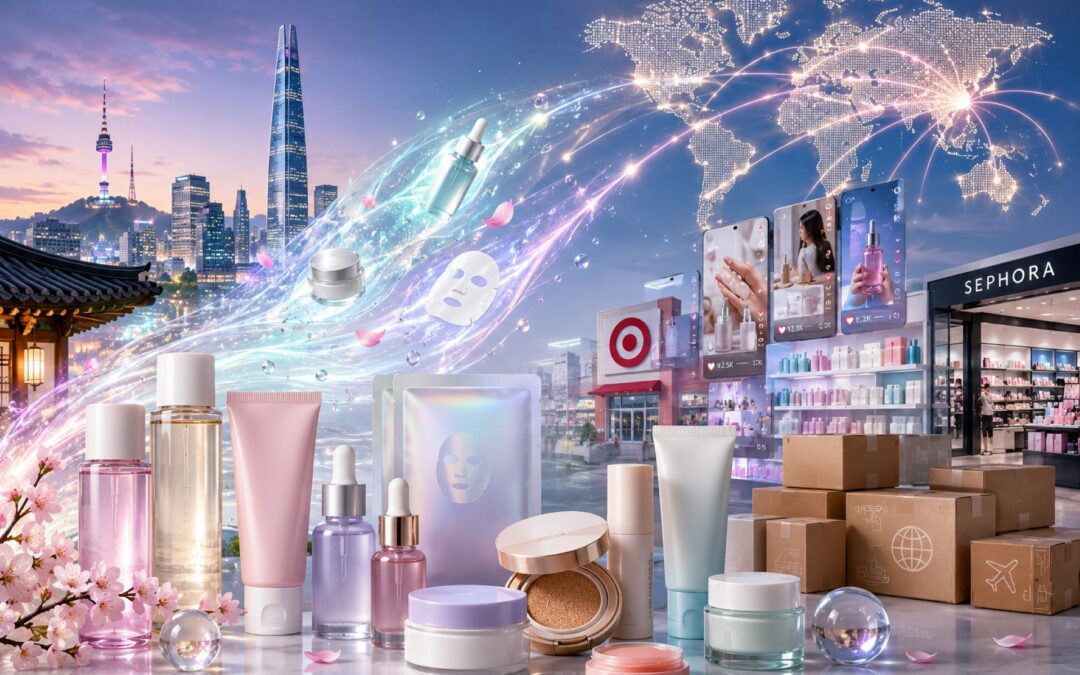
Walk into a Sephora, Target, Costco, or local beauty store today and you will probably see the same thing: Korean skincare is no longer hidden in a niche corner.
It is on the main shelf.
There are cushion compacts, rice toners, snail mucin essences, barrier creams, sunscreens, ampoules, cleansing balms, sheet masks, lip tints, overnight masks, and serums with ingredients most consumers could not pronounce ten years ago but now discuss casually on TikTok.
For a while, K-beauty looked like a trend.
Then it became a category.
Now it is something bigger: one of South Korea’s most successful global export stories.
According to Korea.net, South Korea’s cosmetics exports reached a record USD 10.2 billion in 2024. By 2025, Yonhap reported that exports had risen again to USD 11.43 billion, while Korea Biomedical Review reported that South Korea had become the world’s second-largest cosmetics exporter, behind only France.
That is not a passing fad.
That is an industry.
But the real question is not simply why people like Korean skincare. The answer to that is obvious enough: many of the products are affordable, elegant, effective, and fun to use.
The more interesting question is how South Korea built a beauty ecosystem that Western giants struggled to match.
K-beauty did not take over the world because of one miracle cream or one viral sheet mask. It won because South Korea combined demanding consumers, fast manufacturing, cultural soft power, social media virality, smart retail expansion, and a beauty philosophy that felt perfectly designed for the modern age.
It made skincare feel less like repair and more like daily self-optimization.
And that is both its genius and its double edge.
The Skincare Shelf That Became a Global Industry
K-beauty’s global rise is easy to underestimate because it often arrives in small, beautiful packages.
A sunscreen that disappears without leaving a white cast.
A toner that feels like water but promises hydration.
A serum packaged like a lab product.
A lip tint that looks effortless.
A cleansing balm that melts makeup in seconds.
Individually, these products seem harmless, even ordinary. But together, they changed what millions of consumers expected from beauty.
For decades, Western beauty was dominated by large heritage companies, department-store counters, celebrity campaigns, and expensive anti-aging promises. Skincare often felt either clinical and intimidating or luxurious and overpriced.
K-beauty entered with a different offer.
It was more playful.
More affordable.
More experimental.
More routine-driven.
More accessible.
It gave consumers the feeling that good skin was not only for celebrities, dermatology patients, or people buying expensive French creams. It could be built step by step at home, through daily care.
That idea traveled fast.
Reuters reported that Korean beauty brands have expanded aggressively in the United States, entering retailers such as Ulta, Sephora, Target, and Costco, while brands like Tirtir, d’Alba, Torriden, and Beauty of Joseon pushed deeper into the American market. In 2024, South Korea even surpassed France as the top cosmetics exporter to the U.S. market.
That is a striking reversal.
France has long been the symbolic center of beauty prestige. South Korea, by contrast, did not win by imitating old luxury. It built a different model: fast, digital, affordable, ingredient-literate, and deeply connected to the routines of ordinary consumers.
K-beauty became global because it understood something important about modern beauty.
People no longer wanted only to buy glamour.
They wanted to participate in a system.
K-beauty Was Never Just About Products
The phrase “K-beauty” can be misleading because it sounds like a product label.
But K-beauty is not just Korean cosmetics. It is a philosophy of the face.
At its core, K-beauty is built around prevention rather than correction. Instead of waiting for skin to become damaged and then trying to fix it aggressively, the K-beauty approach emphasizes hydration, sun protection, barrier repair, gentle exfoliation, soothing ingredients, and consistency.
The goal is not only to cover flaws.
The goal is to improve the skin itself.
That distinction matters. Traditional makeup culture often focused on transformation: foundation, contour, concealer, lipstick, drama. K-beauty shifted attention toward preparation, maintenance, and gradual improvement. It made skincare the main event.
This is why so many K-beauty products are built around texture and ritual. Essences, ampoules, sleeping masks, mist sprays, watery sunscreens, gel creams, and cleansing oils are not only functional. They create the feeling of care.
The famous multi-step routine became part of the mythology. Not everyone actually follows ten steps, and the idea has often been exaggerated in Western media. But it gave K-beauty a clear identity: skin as a long-term project.
That was powerful because it matched the mood of the age.
Modern consumers are used to tracking, optimizing, and managing everything: sleep, fitness, productivity, diet, mood, screen time, finances, and health markers. K-beauty applied that same logic to the face.
Your skin was no longer something you simply had.
It was something you worked on.
This is one reason K-beauty could travel across cultures. You did not need to understand Korean society deeply to understand the appeal of smoother skin, better sunscreen, visible hydration, and a routine that made you feel in control.
K-beauty sold products.
But it also sold a method.
South Korea Built the Perfect Beauty Test Market
K-beauty’s global success did not begin overseas. It began in one of the most demanding beauty markets in the world.
South Korean consumers are famously beauty-literate. They know ingredients. They compare textures. They follow trends quickly. They expect products to feel good, look good, perform well, and remain affordable. Weak products do not survive for long.
That makes South Korea a brutal but useful test market.
A brand cannot rely only on vague claims. Consumers are too informed. Competition is too intense. Retail shelves are too crowded. Trends move too quickly. If a product feels sticky, pills under makeup, irritates skin, smells wrong, photographs badly, or fails to deliver, consumers can move on immediately.
This pressure made Korean beauty companies sharper.
Invest Korea describes the country as a “little giant” in the global cosmetics market, noting that Korea developed strong manufacturing technology and became an important testbed for cosmetic innovation. Its domestic market is not the largest in the world, but it is unusually sophisticated, which gives companies a strong environment for rapid feedback and product refinement.
That is one of K-beauty’s hidden advantages.
The world sees the final product: the serum, sunscreen, cushion, or cream. But behind it is a market where consumers behave almost like unpaid product testers at national scale.
They try things quickly.
They judge harshly.
They talk online.
They reward novelty.
They punish mediocrity.
This has an obvious downside. It can intensify appearance pressure and make beauty feel like a competitive obligation. But from an industry perspective, it creates an unusually powerful innovation environment.
South Korea’s beauty culture produced demanding consumers.
Demanding consumers produced better products.
Better products became easier to export.
The Real Engine Is Speed
If K-beauty has one industrial superpower, it is speed.
Western beauty companies often move slowly. Product development can take years. Large corporations have complex approval systems, cautious brand strategies, and legacy product lines to protect.
Korean beauty moves differently.
Brands can spot a trend, work with sophisticated manufacturers, develop formulas quickly, package them attractively, test them with consumers, and push them through online channels at remarkable speed.
This is where South Korea’s cosmetics manufacturing ecosystem matters.
The country has strong original design manufacturers and original equipment manufacturers that can help brands develop products quickly without building every part of the supply chain from scratch. That gives smaller brands a chance to compete. It also allows the industry to respond rapidly when a new ingredient, texture, packaging style, or routine goes viral.
K-beauty is not just creative.
It is operationally fast.
That speed allows Korean brands to turn consumer desire into products while the desire is still hot. If consumers start talking about barrier repair, brands can produce cica creams, ceramide serums, and soothing ampoules. If “glass skin” goes viral, products promising glow, hydration, and smooth texture flood the market. If consumers become tired of complex routines, brands can simplify.
Vogue’s reporting on Korea’s advanced beauty industry describes a market defined by rapid adaptation, preventative care, and clinic-to-consumer innovation. That combination matters because K-beauty does not only borrow from beauty counters. It often draws from dermatology, aesthetic clinics, ingredient research, and consumer trend data.
This is why K-beauty feels both playful and technical.
A product might have cute packaging and a friendly price, but it may also be built around ingredients, textures, and claims that feel more advanced than what consumers expect at that price point.
That is the formula.
High perceived sophistication.
Low barrier to entry.
Fast trend response.
Constant novelty.
For the global consumer, this creates excitement. There is always a new product to discover, a new ingredient to understand, a new routine to try.
For the industry, it creates momentum.
K-beauty does not stand still long enough to be easily copied.
Korean Soft Power Made Skincare Aspirational
Product quality alone does not explain K-beauty’s rise.
Plenty of countries make good cosmetics. Plenty of brands make effective products. But South Korea had something else: cultural momentum.
K-pop, K-dramas, Korean films, Korean food, Korean fashion, and Korean lifestyle content helped make South Korea aspirational to global audiences. Beauty products traveled inside that larger wave.
People did not encounter K-beauty as an isolated category. They encountered it alongside Korean celebrities with luminous skin, drama actors filmed in soft lighting, idols with flawless styling, influencers in Seoul cafés, and online content that made Korean beauty feel like part of a larger lifestyle.
That mattered.
K-beauty was not only selling moisturizer. It was selling proximity to a cultural image: clean, polished, modern, disciplined, youthful, and photogenic.
Reuters has linked K-beauty’s global growth to interest in Korean culture, online popularity, product quality, pricing, and marketing. That blend is important because soft power does not replace product performance. It amplifies it.
If the products were bad, the hype would fade.
But if the products are good and the culture around them is magnetic, the effect multiplies.
This is how a sunscreen becomes more than a sunscreen. It becomes part of a routine someone saw on TikTok. A lip tint becomes part of a K-drama aesthetic. A cushion compact becomes a way to participate in a beauty language that feels international, fresh, and socially validated.
Korean entertainment also helped normalize a particular skin ideal: smooth, hydrated, even-toned, luminous, and seemingly effortless.
That word “effortless” is doing a lot of work.
K-beauty often sells the fantasy that beauty can look natural while being carefully produced. The skin should glow, but not look heavy. The makeup should enhance, not mask. The face should appear fresh, healthy, and controlled.
This is a very modern form of aspiration.
Not old-fashioned glamour.
Optimized naturalness.
TikTok Turned K-beauty Into Peer-Reviewed Beauty
K-beauty was already growing before TikTok became dominant. But short-form video gave it a perfect distribution engine.
Beauty products are highly visual. Texture matters. Application matters. Packaging matters. Before-and-after results matter. A product that looks satisfying on camera has an enormous advantage.
K-beauty products are built for that world.
A cleansing balm melting makeup is satisfying to watch.
A toner soaking into skin looks convincing.
A cushion compact gives instant visual payoff.
A serum dropper creates a sense of precision.
A sunscreen that disappears on darker or lighter skin can be demonstrated in seconds.
TikTok turned these small moments into global advertising.
But it did something even more powerful: it made beauty feel peer-reviewed.
A traditional ad says, “Trust the brand.”
A TikTok review says, “Trust someone like you.”
That difference changed the beauty industry.
Consumers could watch ordinary users test products, complain about them, praise them, compare them, layer them, and return weeks later with updates. Of course, influencer marketing can be manipulated. Sponsored content can blur trust. Viral products can be overhyped. But the feeling of social proof is still powerful.
Vogue’s reporting on Medicube’s global breakout shows how modern K-beauty brands can scale through TikTok virality, Amazon, TikTok Shop, creator affiliate networks, and retail partnerships with stores like Ulta Beauty. This is not the old model of beauty expansion, where a brand slowly builds prestige through magazines and department stores.
It is faster, messier, and more democratic.
A product can go from obscure to unavoidable because thousands of people start filming their faces.
That gives K-beauty a natural advantage because Korean brands are comfortable with fast-moving consumer attention. They do not need to wait for a glossy campaign to define the product. The product can be defined by users, creators, comments, routines, and review videos.
The shelf is no longer only in the store.
The shelf is the feed.
The U.S. Became K-beauty’s New Prize Market
For years, China was central to South Korea’s beauty export story. But the newer story is increasingly about the United States.
That shift matters because it shows K-beauty moving from regional strength to global mainstream power.
Reuters reported that Korean beauty startups are betting heavily on U.S. demand, even with tariff uncertainty, as they expand through major retailers and digital platforms. Sephora has added more Korean brands. Ulta has become an important partner. Target and Costco have brought Korean products into everyday shopping environments. Olive Young, one of South Korea’s most important beauty retailers, has also been moving toward the American market.
This changes the meaning of K-beauty.
When Korean skincare was mostly something enthusiasts ordered online or found through specialty retailers, it still felt niche. Once it appears in mainstream American retail, it becomes part of ordinary consumer life.
That is the crucial transition.
Discovery moves from “I found this obscure Korean product online” to “I saw this at Target.”
The U.S. market is especially valuable because American beauty culture is influential far beyond America. A product that wins on TikTok, Amazon, Sephora, or Ulta can quickly become visible to consumers elsewhere. It can travel through creators, reviews, rankings, and retailer algorithms.
Yonhap reported that Korean beauty exports to the United States rose sharply in 2025, while exports to China declined. That is an important signal. K-beauty’s future is no longer dependent on one Asian growth market. It is becoming more diversified, more Western-facing, and more embedded in global retail systems.
This also makes competition more serious.
K-beauty is no longer just the cool import.
It is now competing directly with legacy beauty brands, celebrity brands, dermatologist-founded brands, luxury skincare, drugstore skincare, and indie startups.
That is a much harder game.
But Korean brands have advantages: price, speed, product variety, digital fluency, and a reputation for skincare innovation.
The question is no longer whether K-beauty can enter the global market.
It already has.
The question is how much of the market it can reshape.
Why Western Beauty Giants Could Not Ignore It
When a trend becomes large enough, incumbents stop dismissing it and start buying it.
That is what has happened with K-beauty.
Reuters reported that L’Oréal acquired Gowoonsesang Cosmetics, the company behind the Korean skincare brand Dr.G, as part of its effort to benefit from global demand for effective and affordable K-beauty products.
That acquisition is not just a business headline. It is a signal.
L’Oréal is one of the most powerful beauty companies in the world. If a company like that wants a Korean skincare brand, it means K-beauty has moved from cultural curiosity to strategic asset.
Western beauty giants cannot ignore what Korean brands have achieved. K-beauty has trained consumers to expect more: better sunscreens, better textures, better hydration, more ingredient transparency, faster innovation, and lower prices for products that still feel sophisticated.
That puts pressure on everyone else.
A luxury moisturizer now has to justify why it costs so much. A sunscreen has to feel elegant. A serum has to explain its ingredients. A drugstore brand has to improve packaging and texture. A prestige brand has to move faster without losing credibility.
K-beauty raised the baseline.
It also changed the emotional tone of skincare. Western anti-aging marketing often sold fear: wrinkles, decline, damage, time running out. K-beauty often sells care: glow, hydration, barrier health, prevention, softness, balance.
That does not mean K-beauty is free from insecurity. Far from it. But its language often feels gentler, which makes it easier to adopt.
It does not always say, “You are aging badly.”
It says, “Your skin barrier needs support.”
That sounds kinder.
It also sells very well.
The Double Edge of Better Skincare
K-beauty deserves much of its success.
It made good skincare more accessible. It pushed sunscreen quality forward. It introduced global consumers to lighter textures, gentler routines, barrier repair, hydrating layers, and ingredient curiosity. It challenged complacent Western brands. It gave smaller Korean companies a path to global consumers.
There is something genuinely democratic about that.
Better skincare should not only belong to people who can afford luxury counters or expensive dermatology clinics. If Korean brands can offer elegant, effective products at reasonable prices, that is a real contribution.
But K-beauty also carries a more complicated legacy.
It globalized a more intensive relationship with the face.
The same routine that feels soothing can become another obligation. The same ingredient literacy that empowers consumers can make them hyper-aware of every pore, wrinkle, dark spot, and patch of texture. The same TikTok review culture that helps people find good products can also create endless comparison.
K-beauty did not create beauty pressure.
But it helped make beauty maintenance feel more refined, more achievable, and more constant.
That is the double edge.
A better sunscreen is good.
A healthier skin barrier is good.
Affordable skincare innovation is good.
But when every face becomes a project, even care can become pressure.
This is why K-beauty’s rise is so interesting. It is not a simple story of cultural takeover or consumer manipulation. It is a story of real product quality meeting a world increasingly hungry for optimization.
South Korea understood that modern beauty is not only about looking glamorous for special occasions. It is about managing the self every day.
Morning routine.
Night routine.
Sunscreen.
Serum.
Barrier cream.
Lip tint.
Glow.
Prevention.
Maintenance.
K-beauty took over the world because it made that system feel accessible, effective, and beautiful.
The question now is what happens after the takeover.
Will better skincare make people more comfortable in their skin?
Or will it simply raise the standard for what acceptable skin is supposed to look like?
That is the tension at the heart of K-beauty’s success.
It gave the world better products.
It also gave the world a more polished mirror.
Last Updated on June 9, 2026 by Aseem Gupta