
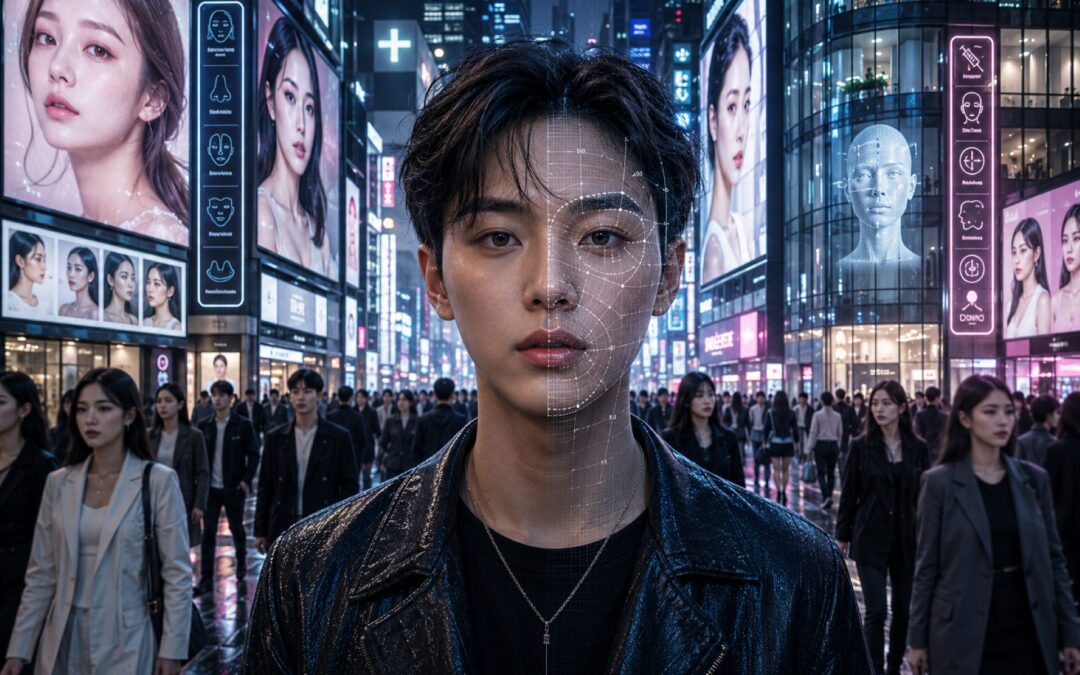
In September 2016, a 24-year-old university student named Kwon Dae-hee walked into a plastic surgery clinic in Gangnam, Seoul.
He wanted a V-line jaw.
Not a medical necessity. Not emergency surgery. A sharper, narrower, more sculpted face — the kind seen on K-pop idols, Korean drama leads, reality stars, subway billboards, beauty ads, and social media filters. He had been editing his photos for months to imagine what the change might look like.
His family worried. He went anyway.
The clinic was prominent. The head surgeon was supposed to oversee the procedure. But CCTV footage later showed something very different. According to Reuters’ reporting on the case, the surgeon began the operation, left partway through, and unqualified staff were involved while Kwon continued bleeding. Nurses mopped blood from the floor repeatedly. He was transferred to a hospital unconscious.
Seven weeks later, he died.
Kwon’s death became one of the cases that pushed South Korea to require cameras in operating rooms for certain surgeries. It exposed a terrifying problem known as “ghost surgery,” where a patient pays for one surgeon but is operated on by someone else.
But the deeper question is not only how one surgery went wrong.
The deeper question is why a healthy 24-year-old felt that reshaping his jaw was worth the risk in the first place.
That is where Kwon’s story stops being only a medical scandal and becomes a social diagnosis.
South Korea did not become the world’s plastic surgery capital because Koreans are uniquely vain. That explanation is too lazy, too shallow, and too comforting for everyone outside Korea.
The more uncomfortable truth is that South Korea built one of the most advanced beauty economies on earth because beauty became infrastructure.
It became part of work.
Part of dating.
Part of entertainment.
Part of family expectations.
Part of self-improvement.
Part of national branding.
And once beauty becomes infrastructure, opting out no longer feels like freedom.
It starts to feel like falling behind.
The Death That Exposed the System
Kwon Dae-hee’s case became a symbol because it revealed the hidden machinery behind an industry built on trust.
Plastic surgery depends on an unusual kind of faith. The patient is unconscious. The body is exposed. The surgeon has control. The clinic sells not only skill, but safety, professionalism, and transformation.
In Kwon’s case, that promise collapsed.
His mother, Lee Na-geum, fought for years after his death. She obtained CCTV footage, studied it obsessively, and campaigned for legal reform. Her efforts became part of a wider public push against ghost surgery and surgical negligence. South Korean lawmakers eventually passed a law requiring surveillance cameras in operating rooms where patients are unconscious, a move that made South Korea one of the first developed countries to mandate such a system.
The reform mattered because ghost surgery was not just a rumor. A medical ethics paper on whether ghost surgery should be legally punished in Korea described it as a serious violation of patient consent and professional duty. The patient agrees to one doctor. Another person may perform the procedure. The patient may never know.
That is horrifying in any medical field.
But in cosmetic surgery, it exposes something even more unsettling. This is a system where people are not always seeking care because they are sick. They are often seeking care because society has convinced them that their ordinary face is a disadvantage.
That does not make them foolish.
It makes them vulnerable.
When a society rewards beauty strongly enough, surgery becomes less like an indulgence and more like a competitive investment. That is why Kwon’s story is so important. He did not walk into that clinic in a vacuum. He walked in from a world that had been telling him, in a thousand subtle and unsubtle ways, that the face he was born with might not be enough.
The tragedy exposed the clinic.
But it also exposed the culture around the clinic.
Korea Did Not Become This Way Overnight
South Korea’s plastic surgery culture is often treated as a modern phenomenon: K-pop, Instagram, Gangnam clinics, idol faces, perfect skin, sharp jaws, double eyelids.
But the roots go deeper.
After the Korean War, South Korea was devastated. Reconstructive surgery had a clear medical purpose: treating wounded soldiers, civilians, and children. One of the most important foreign surgeons in this period was American military surgeon David Ralph Millard, who worked in Korea in the 1950s and later became one of the most influential plastic surgeons of the twentieth century.
His work was not only reconstructive. It also helped normalize cosmetic procedures such as double-eyelid surgery, which was sometimes framed through Westernized beauty ideals. That history is uncomfortable because it shows how medicine, war, race, class, and beauty became tangled together early in South Korea’s modern development.
Historian So-Rim Lee has traced these roots in her work on South Korea’s cosmetic surgery industry. A Stanford feature on her research explains that South Korea’s cosmetic surgery boom cannot be reduced to vanity or Western imitation. It grew through a complicated mix of postwar reconstruction, economic development, gender norms, media, and competitive self-presentation.
There was also an older cultural foundation: the belief that the face can reveal character, fortune, or destiny. In Korean culture, the practice of reading a person’s face — often discussed through ideas like gwansang — gave physical appearance a deeper social meaning. The face was not just appearance. It could be interpreted as a sign of future success, personality, luck, or social value.
Then modern capitalism added a harsher logic.
As South Korea industrialized and became wealthier, cosmetic surgery moved from elite luxury to mass aspiration. Gangnam became the center of the industry, a district where beauty clinics, dermatology centers, luxury retail, entertainment companies, and status culture reinforced one another. Stanford Magazine described parts of Seoul as a “beauty belt,” with hundreds of clinics clustered in neighborhoods where cosmetic transformation became visibly ordinary.
At that point, plastic surgery was no longer hidden at the edge of society.
It was advertised.
Discussed.
Gifted.
Financed.
Normalized.
And once something becomes normal, refusing it can start to look abnormal.
When Beauty Became a Career Strategy
The most important part of South Korea’s plastic surgery story is not beauty itself.
It is competition.
South Korea is one of the most education-obsessed, status-conscious, and labor-market-competitive societies in the world. In that environment, appearance becomes another credential. Not officially, perhaps. But socially, commercially, and professionally, it can function like one.
This is where the word “lookism” becomes useful. Lookism is discrimination based on physical appearance. In South Korea, it has not only existed in dating culture or entertainment. It has also entered the workplace.
For years, South Korean job applicants were commonly expected to submit photos with resumes. According to an IZA World of Labor summary on blind hiring in South Korea, a survey by the Korean job portal Saramin found that 93% of firms required applicants to provide a photo, and nearly half of surveyed HR managers said they had rejected applicants based on appearance.
That kind of statistic changes the moral conversation.
If employers reward appearance, then cosmetic surgery stops being merely personal. It becomes strategic.
If a sharper jaw, larger eyes, clearer skin, or smaller face improves someone’s odds in the job market, then the decision to get surgery is no longer irrational. It becomes rational within an irrational system.
That is the trap.
People are not simply choosing surgery because they hate themselves. Many are making a calculation. They are asking: if everyone else is improving their face, can I afford not to?
South Korea has tried to address part of this problem. The country introduced blind hiring reforms that limited certain personal questions in public-sector applications, and reporting from The World described the law as an attempt to reduce discrimination based on family background, physical appearance, and other irrelevant factors.
But changing a form is easier than changing a culture.
Even if a photo disappears from an application, the interview remains. The social judgment remains. The beauty hierarchy remains. The belief that appearance signals discipline, competence, likability, or social polish remains.
That is why cosmetic surgery can become self-reinforcing. Once enough people participate, the baseline shifts. What used to be enhanced starts to look normal. What used to be normal starts to look neglected.
The individual may choose freely.
But the choice is made inside a pressure chamber.
K-pop Did Not Create the Standard. It Industrialized It.
It would be too simple to blame K-pop for South Korea’s beauty culture.
K-pop did not invent Korean beauty standards. It did something more powerful.
It made them exportable.
The Korean entertainment industry is built on extreme visual discipline. Idols are not marketed only as singers or dancers. They are total aesthetic products: face, body, styling, skin, personality, choreography, lighting, camera angle, fan interaction, and aspirational lifestyle.
That does not mean every idol has had surgery. It also does not mean every fan wants to look like an idol. But K-pop helped turn certain visual ideals into a repeatable template.
The small face.
The V-line jaw.
The high nose bridge.
The pale, clear skin.
The double eyelids.
The delicate but sculpted facial proportions.
Entertainment companies did not create all these ideals from nothing. They selected them, refined them, standardized them, and projected them back into society at massive scale.
The result is not only celebrity worship. It is visual benchmarking.
A person considering surgery no longer has to imagine a vague improvement. They can bring a reference image. They can point to a jawline, an eyelid crease, a nose, a chin, a face shape. Clinics can market transformation through recognizable ideals, while social media circulates before-and-after images that make surgery feel both normal and achievable.
K-pop also matters because it connects beauty to success.
The idol face is not merely attractive. It is rewarded. It gets attention, sponsorships, brand deals, fandom, visibility, and admiration. For young people watching from the outside, the lesson can become brutally simple: beauty is not superficial if beautiful people keep winning.
This is not only a Korean pattern. Hollywood has done it. Bollywood has done it. Instagram has done it. TikTok is doing it every day.
Korea’s difference is not that it invented beauty pressure.
It professionalized it with unusual efficiency.
The Trap Is That Surgery Does Not End With Surgery
Many people imagine plastic surgery as a single before-and-after moment.
You dislike something.
You change it.
You move on.
But modern cosmetic culture often works less like a one-time purchase and more like a subscription.
Some procedures require maintenance. Botox wears off. Fillers dissolve. Skin treatments need repeating. Implants may need monitoring or replacement. Rhinoplasty may require revision. Jaw surgery can involve complications. Even when the procedure succeeds, the face continues to age around it.
The psychological pattern can be just as powerful as the medical one.
Once someone begins seeing the body as a project, the project can expand. A nose correction draws attention to the chin. A jaw reduction changes facial balance. A skin treatment raises expectations for texture. A filtered selfie creates a new target. A successful procedure can reduce insecurity, but it can also teach the person to solve insecurity through further modification.
This does not mean cosmetic surgery is always harmful. Many people report satisfaction after procedures. Some feel more confident, less self-conscious, or more aligned with how they want to present themselves.
The problem is not the existence of surgery.
The problem is the system that turns the body into a never-finished obligation.
Globally, aesthetic procedures are no longer a niche market. The International Society of Aesthetic Plastic Surgery reported that aesthetic procedures approached 38 million worldwide in 2024, with total surgical and non-surgical procedures up 40% from 2020.
That growth matters because non-surgical procedures can become the low-friction entry point. A person who would never consider surgery may try Botox. Then fillers. Then skin tightening. Then a minor procedure. Then something more invasive.
The ladder is easier to climb when each step feels small.
South Korea shows what happens when that ladder becomes socially normalized. Cosmetic work stops being a private exception and becomes part of ordinary self-management, like skincare, fitness, education, or professional grooming.
At that point, the question changes.
It is no longer: why do so many people get surgery?
It becomes: how much modification does a person need before society considers them acceptable?
The Pressure Starts Young
The most disturbing part of South Korea’s beauty economy is not that adults make cosmetic choices.
It is that children grow up inside the logic before they are old enough to question it.
Beauty pressure does not suddenly appear at 21. It begins much earlier: in family comments, school comparisons, idol fandom, uniforms, advertisements, social media, casual jokes, dating expectations, and the silent ranking of faces.
By adolescence, many young people have already learned which features are praised and which are treated as problems.
Research on Korean youth has found a strong relationship between body image distortion, weight concern, and unhealthy eating behaviors. A study published through the National Institutes of Health on body image distortion among Korean adolescents found that distorted body image was common and connected to disturbed eating attitudes and behaviors.
Another study on cosmetic surgery and self-esteem in South Korea examined the relationship between cosmetic surgery experience, self-esteem, and social comparison, highlighting how appearance management is tied to psychological and social pressures rather than simple vanity.
This is where the conversation becomes morally serious.
A society can claim that cosmetic surgery is a personal choice. But how personal is the choice when the pressure begins in childhood?
If a high school student receives eyelid surgery as a graduation gift, is that empowerment or preparation for a biased world?
If parents encourage surgery because they believe it will help their child succeed, are they being cruel or realistic?
If a young woman changes her face to improve her job prospects, is that self-expression or adaptation?
The answer may be all of these at once.
That is what makes the system so difficult to criticize. The people inside it are often not villains. Parents want their children to succeed. Clinics respond to demand. Employers may deny bias while still rewarding appearance. Celebrities operate in industries that punish ordinary bodies. Consumers want confidence, opportunity, and relief from comparison.
Everyone can be acting rationally.
And the system can still be damaging.
Korea’s Beauty Economy Is Now an Export Industry
South Korea’s beauty economy is no longer only domestic.
It is one of the country’s most successful cultural exports.
Korean skincare, cosmetics, dermatology, and aesthetic medicine have become global symbols of innovation. K-beauty products are now visible in major retailers around the world, from Sephora to Target to Costco. Reuters reported that Korean beauty startups have been expanding aggressively in the United States, and that South Korea surpassed France as the top cosmetics exporter to the American market in 2024.
Official Korean reporting has also described the country’s rise as a cosmetics powerhouse. Korea.net reported that Korean cosmetics exports reached a record USD 10.2 billion in 2024, and later noted Korea’s position as the world’s second-largest cosmetics exporter, behind France.
This matters because skincare is not the same as surgery, but the industries sit on the same cultural continuum: appearance improvement, anti-aging, facial optimization, and the promise that the right intervention can move you closer to your best self.
Korea also exports expertise through medical tourism.
Foreign patients travel to Seoul for dermatology, plastic surgery, cosmetic dentistry, and other treatments. Korea Biomedical Review reported that South Korea received 1.17 million foreign medical patients in 2024, nearly double the previous year’s figure, with dermatology and aesthetic services playing a major role.
This is the global appeal of the Korean model.
The products are good.
The clinics are advanced.
The branding is polished.
The results are visible.
The cultural influence is enormous.
It would be dishonest to pretend the entire industry is sinister. Korean skincare has genuinely improved routines for millions of people. Korean dermatology is sophisticated. Korean beauty brands often innovate faster than older Western companies. Many people benefit from these products and treatments without falling into extreme insecurity.
The danger is not excellence.
The danger is what excellence does to expectation.
When a country becomes exceptionally good at beauty, beauty itself becomes harder to escape.
The Rest of the World Is Building Its Own Version
It is tempting to look at South Korea and treat it as an extreme outlier.
That would be a mistake.
The same forces that intensified Korea’s beauty economy are now active almost everywhere: social media, filters, dating apps, video calls, influencer culture, celebrity aesthetics, medical tourism, cheaper procedures, financing options, and algorithmic comparison.
The face has become a public asset.
People now see themselves constantly: in selfies, Zoom windows, tagged photos, Instagram stories, TikTok videos, dating profiles, and front-facing cameras. Earlier generations mostly saw themselves in mirrors and occasional photographs. Today, people watch themselves perform social life in real time.
That changes the relationship with the face.
The rise of filters made the shift even more intense. People no longer compare themselves only to celebrities. They compare themselves to edited versions of themselves.
This phenomenon became so common that doctors began using the phrase “Snapchat dysmorphia.” A medical article on filtered selfies and cosmetic surgery requests described how patients increasingly sought procedures to resemble digitally altered images of their own faces.
That is a profound change.
The old beauty ideal was someone else.
The new beauty ideal is you, but corrected by software.
A study published in JAMA Facial Plastic Surgery found that greater engagement with certain social media and photo-editing platforms was associated with increased acceptance of cosmetic surgery. The research on social media use and cosmetic procedure attitudes gives scientific weight to something many people already feel: the more we see edited faces, the more ordinary faces begin to look unfinished.
The pandemic accelerated this. Video calls forced people to stare at their own faces for hours. Lighting, camera distortion, aging, asymmetry, skin texture, and facial angles became daily irritants. Dermatologists and cosmetic surgeons began reporting that patients were coming in because they disliked how they looked on screens.
South Korea may be ahead of this curve, but it is no longer alone.
Brazil has long had a powerful plastic surgery culture. Turkey has become a global destination for hair transplants, rhinoplasty, and cosmetic dentistry. The United States remains one of the largest markets for aesthetic procedures. China has seen major growth in cosmetic surgery demand. Across countries, the details differ, but the pattern is familiar.
Beauty becomes competitive.
Technology intensifies comparison.
Markets offer solutions.
Solutions become normalized.
Normalization raises the baseline.
Then the cycle repeats.
South Korea matters because it shows what happens when the cycle matures.
The Real Question Is Whether Opting Out Still Feels Free
The easiest way to misunderstand South Korea’s plastic surgery culture is to turn it into a morality play.
On one side: vain people chasing impossible beauty.
On the other: natural people bravely resisting it.
Reality is not that clean.
Many people choose cosmetic procedures thoughtfully and benefit from them. Some correct features that have bothered them for years. Some feel more confident. Some use surgery or dermatology as one part of ordinary self-expression. A liberal society should be careful about telling adults what they can and cannot do with their own faces.
But freedom is not only the ability to choose.
Freedom is also the ability not to choose — without being punished.
That is the real issue.
If a person can refuse surgery and still feel socially accepted, professionally respected, romantically valued, and psychologically safe, then cosmetic choice remains meaningful.
But if refusing surgery carries a cost at work, in dating, in family expectations, in social comparison, and in self-worth, then choice becomes compromised.
This is what South Korea’s beauty economy reveals so clearly. It is not simply that surgery became available. It is that the surrounding culture made surgery feel practical.
Kwon Dae-hee’s story matters because he was not trying to become a celebrity. He was not chasing some absurd fantasy. He was a young man in a society where facial refinement had become a form of social capital. He wanted a face that seemed to promise better odds.
That promise failed him completely.
But the system around him kept going.
The clinics kept operating. The ads kept glowing. The idols kept appearing on screens. The job market kept rewarding polish. Parents kept worrying about their children’s futures. Young people kept comparing their real faces to optimized ones.
This is why Korea is not merely the plastic surgery capital of the world.
It is a warning.
A society does not need to force people into cosmetic procedures for beauty pressure to become coercive. It only needs to make appearance matter enough that changing yourself feels like common sense.
The products may be excellent.
The science may be real.
The doctors may be skilled.
The results may be impressive.
And still, somewhere along the way, the line between self-improvement and self-erasure can become dangerously thin.
South Korea crossed that line earlier than most countries.
The rest of the world is walking toward it.
Last Updated on June 9, 2026 by Aseem Gupta