
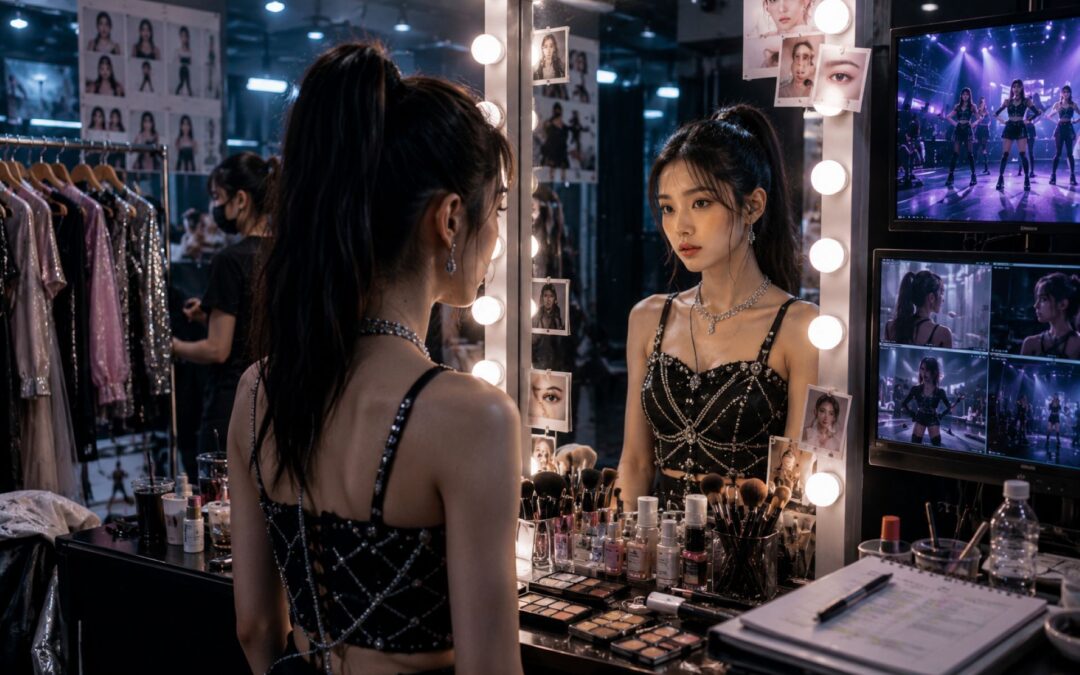
K-pop is not just music.
It is sound, choreography, styling, camera work, fashion, makeup, personality, fandom, branding, and visual design fused into one product. The song matters. The dance matters. The group chemistry matters. But the image matters too.
Sometimes, the image matters first.
That is what makes K-pop beauty standards so powerful. They are not just personal preferences or cultural ideals floating in the background. They are built into the machinery of the industry. Idols are not only expected to sing and dance. They are expected to look camera-ready under stage lights, in airport photos, on livestreams, during fan calls, in music videos, on magazine covers, and in slow-motion fancams that can be replayed millions of times.
Beauty becomes part of the job.
This does not mean K-pop is shallow. Some of the most impressive performers in the world come out of the idol system. K-pop’s best groups are disciplined, inventive, charismatic, and musically ambitious. The industry has also expanded global ideas about fashion, makeup, gender expression, and performance.
But that brilliance has a cost.
K-pop did not invent Korean beauty standards. It industrialized them. It took ideals that already existed — slimness, clear skin, small faces, symmetry, youthfulness, polished styling — and turned them into a global performance language.
The result is a system where beauty is not only admired.
It is trained.
Measured.
Ranked.
Monetized.
Defended.
Attacked.
Exported.
And the people carrying the burden are often very young.
The Idol Is Not Just Heard. The Idol Is Seen.
In many music industries, appearance matters. Pop stars have always been styled, photographed, marketed, and judged. But K-pop takes the visual side of performance to another level.
The idol is not simply a singer.
The idol is a complete audiovisual product.
Every comeback has a concept. Every concept has styling. Every styling choice has visual logic: hair color, skin finish, outfit silhouette, camera angle, choreography formation, facial expression, makeup tone, body line, and stage presence. A three-minute performance is not only heard; it is watched, clipped, replayed, paused, ranked, and dissected.
This is why K-pop is so effective. It understands the internet better than almost any other music system. It creates performances that are built for screens: synchronized choreography, close-up facial expressions, visual contrast between members, striking fashion, and polished music videos designed for repeat viewing.
But when an industry is built for constant viewing, the body becomes part of the performance surface.
An idol’s face is not just their face. It is a brand asset. Their skin is not just skin. It is part of professional presentation. Their body is not just a body. It is part of choreography, styling, and public commentary.
That is the pressure.
K-pop’s visual power is real. It is part of what makes the genre magnetic. But it also means idols are asked to live as permanently visible people in a culture that rarely gives them permission to look ordinary.
K-Pop Did Not Invent Korean Beauty Standards. It Industrialized Them.
South Korea already had intense beauty norms before K-pop became a global force.
Clear skin, slim bodies, small faces, double eyelids, high nose bridges, pale complexions, youthful features, and polished grooming had long been reinforced through media, advertising, employment culture, celebrity culture, and the wider beauty industry.
K-pop did not create those ideals from nothing.
It standardized them.
The idol system takes beauty standards and turns them into repeatable entertainment architecture. Agencies recruit young trainees, evaluate them, style them, train them, place them in groups, assign them roles, create concepts around them, and present them to the public through tightly controlled images.
This is why K-pop beauty standards feel so narrow. It is not only that certain features are preferred. It is that those features are repeatedly selected, enhanced, styled, photographed, and rewarded until they begin to feel like the default idol face.
The small face.
The slim body.
The flawless skin.
The sharp jaw.
The delicate nose.
The bright eyes.
The youthful expression.
A 2019 public debate in South Korea showed how visible this standardization had become. The Ministry of Gender Equality and Family proposed non-binding broadcasting guidelines that raised concerns about “lookism” and the similarity of idol appearances. The proposal sparked backlash and was criticized as overreach, but the controversy itself was revealing. As The Korea Herald reported, the concern that idol images could narrow beauty standards had moved from fan discussion into public policy debate.
That does not mean the government should decide how idols look. It means the “look-alike” concern had become too obvious to ignore.
K-pop’s beauty system is powerful because it does not simply reflect beauty standards. It distributes them globally through music, fandom, fashion, video, and aspiration.
Beauty Becomes a Role Inside the Group
One of the clearest signs that beauty is built into K-pop’s structure is the existence of visual roles.
Many idol groups have members described as the “visual,” the “center,” or the “face of the group.” These terms are not always used in exactly the same way, and fans debate them endlessly, but they reveal something important about how the industry works.
The “visual” is often the member whose appearance most closely matches dominant beauty standards.
The “center” is often placed prominently in choreography, photoshoots, performances, and key visual moments.
The “face of the group” is often the most publicly recognizable member, the one who pulls attention beyond the fandom.
This does not mean those idols are untalented. That would be unfair and inaccurate. Many members known for visuals are also strong performers, singers, dancers, actors, or variety personalities.
But the terminology matters because it formalizes appearance.
In most music industries, beauty may help someone succeed. In K-pop, beauty can become part of the group’s official architecture. A person can be valued not only for how they sing or dance, but for how they visually anchor the group.
That creates a strange professional reality.
A young performer may be praised for being beautiful, but that praise also becomes a cage. If beauty is part of your assigned role, then aging, weight fluctuation, skin problems, exhaustion, bad styling, or one unflattering photo can feel like professional failure.
The “visual” is not just admired.
The visual is expected to remain visual.
And in an industry where fans can freeze every frame, no one gets to be unpolished for long.
The Trainee System Starts the Pressure Early
K-pop beauty pressure does not begin after debut.
It begins in training.
Many idols enter agency systems as teenagers. Some start even younger. They spend years practicing dance, vocals, languages, media skills, facial expressions, and stage presence. But they are not evaluated only on talent. Appearance matters too.
The trainee system is designed to create idols before the public ever sees them. That means the body becomes part of preparation: weight, skin, hair, posture, camera presence, styling potential, facial features, and overall “marketability.”
An Allure essay on the darker side of K-pop stardom discusses how trainees and idols can feel pressure to correct their appearance before debut because looks may affect attention, opportunity, and placement. That is a crucial point. The pressure is not merely emotional. It is strategic.
If an idol’s appearance can influence debut chances, screen time, fan attention, brand deals, and public reception, then beauty becomes part of career survival.
That is what makes the system so difficult to criticize from the inside. Agencies may believe they are preparing trainees for a harsh market. Parents may believe they are helping children compete. Trainees may believe that changing their appearance is a necessary investment. Fans may reward the results without seeing the cost.
Everyone can say they are being realistic.
And the system can still be cruel.
The trainee years are supposed to develop performers. But they can also teach young people that their natural bodies are obstacles to be managed before their dreams can begin.
Thinness Is Treated Like Professional Discipline
Few parts of K-pop beauty culture are as punishing as the body ideal.
Idols are expected to perform demanding choreography, rehearse for long hours, travel constantly, maintain public energy, and look fresh on camera. That requires stamina and strength.
At the same time, they are often expected to remain extremely slim.
This creates a contradiction.
The idol body must be athletic enough to work like an athlete, but thin enough to satisfy a camera culture that punishes visible softness, weight gain, bloating, or natural fluctuation.
That contradiction is not unique to K-pop. Ballet, fashion, gymnastics, Hollywood, and other performance industries have their own versions of it. But K-pop intensifies the pressure through constant public visibility and fan scrutiny. Comeback stages, music videos, airport photos, livestreams, HD fancams, brand shoots, and social media clips turn the idol body into a permanently available object of judgment.
A PubMed-indexed study on Hallyu, body image perception, and eating-disorder risk notes that the global spread of Korean popular culture has contributed to the idealization of Korean beauty standards among fans, and that celebrity diet routines shared through social media may influence negative body-image perception and eating-disorder risk.
That matters because idol thinness is not only a private health issue. It becomes a public template.
When fans see extremely slim idols praised for discipline, professionalism, and beauty, thinness becomes moralized. It is no longer only about appearance. It starts to look like evidence of control.
That is dangerous.
Bodies change. Faces change. Weight changes. Health changes. Hormones, stress, travel, injury, medication, puberty, aging, and exhaustion all affect appearance. But the idol machine often treats visible change as a problem to be explained.
The body is allowed to perform.
It is not always allowed to be human.
Skin, Hair, Makeup, and Styling Become Labor
K-pop beauty standards are not only about facial features or body size.
They are about maintenance.
Idols must appear polished across an impossible number of settings: music videos, award shows, dance practices, variety shows, fan meetings, live broadcasts, behind-the-scenes content, interviews, airport departures, fashion events, brand campaigns, and casual social media posts.
The camera is almost always present.
That means skin, hair, makeup, and styling become labor.
Clear skin is not just nice to have. It becomes a professional expectation. Hair color is not just personal expression. It becomes part of a concept cycle. Makeup is not just decoration. It shapes the idol’s face for close-up cameras. Styling is not just fashion. It communicates group identity, era, mood, and market positioning.
This labor can be creative. K-pop styling at its best is genuinely thrilling. It plays with fantasy, gender, nostalgia, futurism, softness, aggression, school uniforms, luxury fashion, streetwear, cyberpunk, traditional motifs, and theatrical transformation.
But the labor is still labor.
An idol may spend hours in hair and makeup before performing for a few minutes. They may have to maintain skin and body standards while sleep-deprived. They may face public criticism for a hairstyle they did not choose or an outfit assigned by a stylist. They may become responsible for looking effortless after an entire team has worked to construct that effortlessness.
That is one of the paradoxes of idol beauty.
The image looks natural only because so much work has gone into making it look natural.
This is why it is unfair to compare ordinary people to idols. Fans are not seeing a person who simply woke up perfect. They are seeing genetics, training, lighting, cosmetics, styling, editing, camera work, scheduling, and industry discipline merged into one image.
The idol face is not a casual standard.
It is a production.
Fans Both Challenge and Reinforce the Standard
K-pop fandom is not simple.
Fans can be deeply protective. They call out body shaming. They defend idols from cruel comments. They celebrate individuality. They expose harsh industry practices. They organize support. They criticize agencies for overwork, unsafe dieting, bad styling, and mistreatment.
But fandom can also reinforce the very standards it criticizes.
Visual rankings, “glow-up” comparisons, plastic surgery speculation, weight commentary, airport-photo analysis, “bare face” scrutiny, and endless debates about who fits Korean beauty standards all keep the visual machine running.
Sometimes the language sounds caring. Fans may say they are “worried” about an idol’s health. But concern can easily become surveillance. A comment about someone looking tired, thinner, heavier, swollen, aged, different, or “not like themselves” still teaches the same lesson: the idol’s body is public property.
A University of Michigan thesis on weight and health discourse in K-pop fandom examined how discussions about Jeongyeon’s body revealed the way conventional beauty ideals shape what fans consider acceptable, even when framed as health concern. That insight is useful because it shows how fandom can reproduce beauty pressure without intending harm.
Fans inherit the industry’s visual logic.
If companies sell idols as visual products, fans learn to consume them visually. If comeback teasers focus on transformation, fans learn to analyze transformation. If official content highlights faces, bodies, styling, and concept images, fans learn that appearance is part of the performance.
This does not make fans villains.
It makes them participants in a system that rewards attention.
The more a face is watched, the more it is judged.
The more it is judged, the more it must be managed.
The more it is managed, the more artificial the standard becomes.
And then the cycle starts again.
K-Pop Beauty Can Also Be Liberating
A serious critique of K-pop beauty standards should not pretend beauty is only oppressive.
That would be too easy.
K-pop has also expanded global ideas about style, gender, makeup, and self-expression. It has made male makeup more visible. It has helped normalize softer forms of masculinity. It has given fans permission to experiment with fashion, hair, dance, aesthetics, and identity.
Allure’s article on how K-pop changed the meaning of masculinity in South Korea argues that idols helped popularize male beauty practices, softer presentation, and a more flexible image of what male performers can look like. That matters. In many cultures, men are still punished for caring openly about appearance. K-pop made room for a different kind of male beauty: polished, expressive, delicate, dramatic, fashionable, and emotionally stylized.
For fans, this can be freeing.
Teen Vogue has explored how K-pop style can function as liberation, allowing fans to experiment with self-presentation and find confidence through fashion, makeup, and community. That side of K-pop should not be dismissed.
Beauty can be art.
Styling can be identity.
Makeup can be play.
Fashion can be freedom.
Performance can open possibilities that ordinary life closes.
The problem is not that idols wear makeup, dye their hair, dress dramatically, or perform beauty. The problem is when a creative tool becomes a compulsory standard. The problem is when every idol must remain thin, flawless, youthful, symmetrical, and camera-ready to be considered worthy of attention.
K-pop beauty is powerful because it can be both liberating and punishing.
Sometimes at the same time.
The Global Cost of the Idol Face
K-pop is no longer a Korean-only cultural product.
It is global.
That means K-pop beauty standards travel too.
International fans may discover Korean music through choreography, vocals, variety clips, memes, lyrics, or fandom communities. But they also absorb the visuals: slim bodies, flawless skin, carefully styled hair, bright eyes, sculpted jawlines, coordinated outfits, youthful energy, and a polished kind of beauty that looks both human and unreal.
For some fans, this is inspiring. It opens new aesthetic worlds. It challenges Western beauty norms. It introduces different approaches to skincare, makeup, fashion, masculinity, and performance.
For others, it can intensify comparison.
A study in the International Journal of Indian Psychology examined the influence of K-pop beauty standards on adolescent body image, looking at how exposure to idol beauty ideals can shape self-perception among young people. Combined with research connecting Hallyu, celebrity diet messaging, and body-image concerns, this suggests that K-pop’s visual system does not stop at the stage.
It enters bedrooms, schools, group chats, mirror routines, shopping habits, diet thoughts, skincare choices, and social media feeds.
This is especially sensitive for adolescents. Teenagers are already forming identity, navigating insecurity, comparing themselves to peers, and trying to understand their bodies. When they encounter idols who appear impossibly polished at very young ages, the standard can feel personal.
The danger is not that a fan thinks an idol is beautiful.
The danger is that a fan starts to treat their own ordinary body as unfinished because it does not look like a professionally constructed idol image.
And because K-pop is participatory, the pressure can come wrapped in love. Fans collect photos, watch fancams, follow beauty routines, buy products, discuss diets, imitate styling, and learn the visual language of the industry. Admiration becomes imitation. Imitation becomes comparison. Comparison becomes dissatisfaction.
The idol face becomes a global mirror.
And like all mirrors shaped by industry, it does not reflect reality evenly.
The Problem Is Not Beauty. It Is Compulsory Perfection.
The problem with K-pop beauty standards is not beauty itself.
Beauty is part of performance. It always has been. Music is visual. Dance is visual. Fashion, makeup, hair, lighting, and styling can deepen the emotional force of a song. K-pop would not be K-pop without its aesthetic ambition.
The problem is compulsory perfection.
It is the expectation that idols must remain visually flawless no matter how young, tired, hungry, overworked, anxious, sick, or human they are.
It is the trainee who learns that talent may not be enough if their face does not fit.
It is the idol who must perform strength while maintaining extreme thinness.
It is the fan who knows the images are produced but still compares themselves to them.
It is the industry that sells individuality while quietly rewarding sameness.
It is the camera that never lets the idol stop being an idol.
K-pop’s beauty system is not powerful because it shows beautiful people. Entertainment has always done that. It is powerful because it turns beauty into labor, ranking, branding, discipline, and survival.
That is the idol machine.
And the tragedy is that many idols are genuinely beautiful, talented, expressive, and inspiring. They do not need to be reduced to products. They are artists, workers, young people, performers, and human beings navigating a system that asks them to look effortless while carrying impossible effort.
K-pop can keep its beauty.
It can keep its fashion, makeup, fantasy, glamour, and visual imagination.
But it has to stop pretending that every pore, pound, wrinkle, blemish, swelling, haircut, bare face, and awkward angle is a professional failure.
The idol is not just seen.
The idol is watched.
And there is a difference.
To be seen is human.
To be watched without mercy is machinery.
K-pop’s visual brilliance will mean far more when idols are allowed to be more than perfect surfaces inside the machine.
Last Updated on June 9, 2026 by Aseem Gupta