
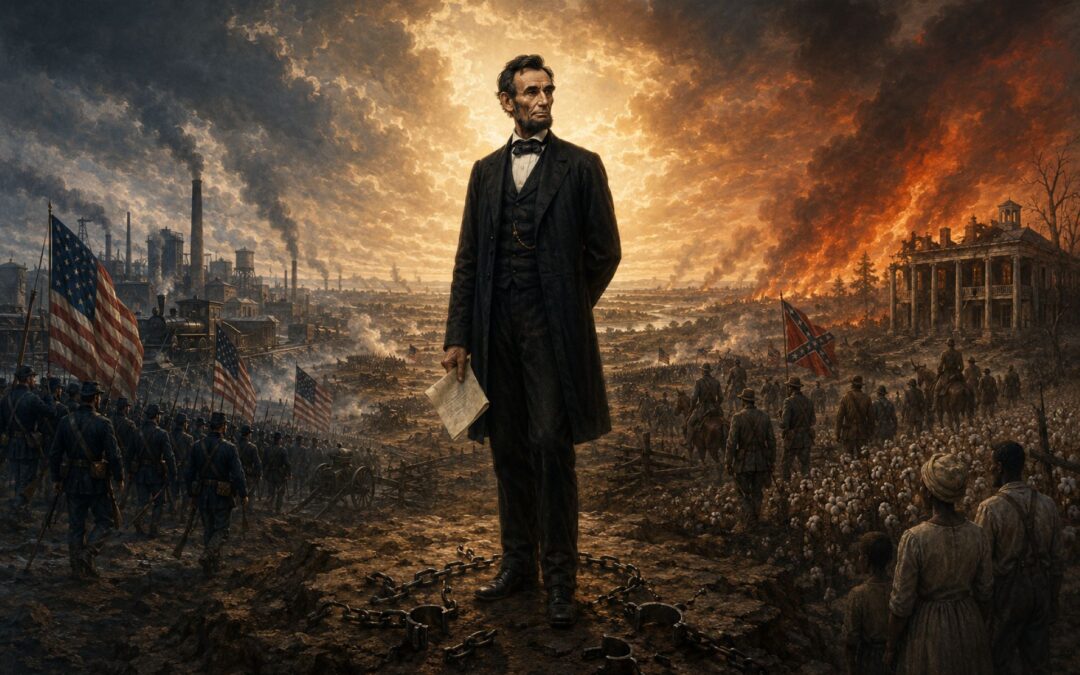
The American Civil War was the moment the United States could no longer avoid the contradiction at the heart of its founding.
A country that had declared that “all men are created equal” had also allowed millions of people to be enslaved. For decades, politicians tried to manage that contradiction with compromises, legal evasions, territorial bargains, and careful language. They argued over state power, federal authority, new territories, elections, and constitutional interpretation.
But underneath nearly every argument was the same question.
Could a nation built on liberty continue to protect slavery?
By 1861, the answer had become impossible to postpone. Eleven Southern states seceded from the Union. The Confederacy was formed. Fort Sumter was fired upon. What many expected to be a short war became the bloodiest conflict in American history.
At first, Abraham Lincoln fought to preserve the Union. But as the war deepened, the conflict changed. It became not only a war to save the United States, but a war to destroy slavery and redefine what the United States was supposed to mean.
The Union survived.
Slavery was abolished.
But the peace that followed was fragile, unfinished, and bitterly contested. The Civil War remade America, but it did not heal all the wounds it exposed.
The Promise America Made and Failed to Keep
The American Revolution created a new nation with a radical political promise. The United States claimed legitimacy from the idea that people had natural rights, that governments required consent, and that liberty was not a privilege granted by kings.
But the American Revolution left slavery unresolved.
That failure mattered from the beginning. Thomas Jefferson’s original draft of the Declaration of Independence included a condemnation of slavery, but the language was removed to preserve unity among the colonies. The new nation was born with a moral contradiction built into its political structure.
The Constitution protected slavery indirectly. It did not use the word “slavery,” but it counted enslaved people for representation through the Three-Fifths Clause, protected the international slave trade until 1808, and required the return of escaped enslaved people.
The founders had postponed the crisis. They had not solved it.
For a time, postponement looked like statesmanship. The country expanded. Political parties formed. Presidents came and went. But the contradiction kept growing because the country kept growing.
Every new state raised the same question.
Would it be free, or would it allow slavery?
How Slavery Divided North and South
The North and South developed into two increasingly different societies.
The North became more urban, commercial, and industrial. Slavery still existed in parts of the North after independence, but it gradually disappeared from Northern state law. Factories, wage labor, shipping, banking, and small farms shaped the region’s economy.
The South moved in a different direction. Its climate and soil supported labor-intensive plantation crops, especially cotton. After Eli Whitney’s cotton gin made cotton processing faster, cotton production expanded dramatically across the South. That expansion increased the demand for enslaved labor rather than reducing it.
Slavery was not a side issue in Southern life. It was the foundation of wealth, power, agriculture, and social hierarchy.
By 1860, nearly four million people were enslaved in the United States. The National Park Service’s Civil War overview describes the conflict as a war that saved one nation and freed four million people, while costing hundreds of thousands of lives.
The North was not free from racism, and Northern opposition to slavery was not always based on equality. Some Northerners opposed slavery because they saw it as morally evil. Others opposed its expansion because they feared plantation power would dominate Western land, labor, and politics.
That distinction matters.
The Civil War was caused by slavery, but not every Northerner who opposed slavery believed in racial equality. Many white Northerners wanted the West reserved for free white labor. Many abolitionists demanded immediate emancipation. Many politicians tried to stop slavery’s expansion without touching it where it already existed.
Abraham Lincoln stood somewhere inside that complicated anti-slavery world. He believed slavery was morally wrong. He also believed, for much of his career, that the federal government had no constitutional authority to abolish it in states where it already existed.
His early position was not immediate abolition.
It was containment.
Stop slavery from spreading, he believed, and it would eventually die.
Southern slaveholders understood the danger of that position. If slavery could not expand, its political power would shrink. If its political power shrank, its future would be uncertain.
That fear drove the country toward crisis.
Why Westward Expansion Made Compromise Impossible
For decades, American politicians tried to preserve balance between free states and slave states.
The Missouri Compromise of 1820 was one of the first major attempts. Missouri entered the Union as a slave state, Maine entered as a free state, and slavery was prohibited in much of the Louisiana Purchase territory north of a specific line.
It was a bargain designed to calm the country.
Instead, it revealed the problem that would keep returning. Every new territory could shift power in Congress. Every new state could strengthen one side or the other. Every map of American expansion became a map of political danger.
The Mexican-American War made the problem far worse. After the United States defeated Mexico, it gained a huge amount of territory in the West. That raised an explosive question: would slavery be allowed in the new lands?
The Compromise of 1850 tried to settle the issue again. California entered as a free state. New Mexico and Utah would decide the slavery question by popular sovereignty. The slave trade was abolished in Washington, D.C., but a much stronger Fugitive Slave Act required the return of escaped enslaved people.
The compromise satisfied almost no one for long.
To many Northerners, the Fugitive Slave Act forced them to participate in slavery. To many Southerners, Northern resistance to the law proved that the North would not honor Southern constitutional rights.
Compromise had become less a solution than a delay mechanism.
And each delay made the eventual rupture worse.
Kansas, Dred Scott, and the Collapse of Trust
The Kansas-Nebraska Act of 1854 shattered what remained of the old settlement.
The act allowed settlers in Kansas and Nebraska to decide for themselves whether slavery would be legal. That principle, known as popular sovereignty, sounded democratic in theory. In practice, it turned Kansas into a battleground.
Pro-slavery and anti-slavery settlers rushed into the territory to influence the vote. Violence followed. The conflict became known as Bleeding Kansas.
One of the most radical abolitionists involved was John Brown. After pro-slavery violence against anti-slavery settlers, Brown and his followers killed several pro-slavery men. Brown believed slavery was a sin that could not be destroyed by speeches and petitions alone. He would later try to ignite a slave uprising by raiding the federal armory at Harpers Ferry.
The country was not only arguing about slavery anymore.
It was bleeding over it.
Then came the Supreme Court’s 1857 decision in Dred Scott v. Sandford. The Court ruled that Black people, whether enslaved or free, could not be citizens of the United States and therefore could not sue in federal court. It also declared that Congress had no authority to ban slavery in the territories.
The decision enraged anti-slavery Northerners. It suggested that slavery could not be contained after all. If Congress could not prohibit slavery in the territories, then slaveholders might be able to carry slavery anywhere.
The legal system had not calmed the country.
It had deepened the crisis.
Abraham Lincoln and the Rise of the Republican Party
The Republican Party formed in the 1850s as a coalition opposed to the expansion of slavery. It was not originally a party of immediate abolition everywhere, but it was firmly against allowing slavery to spread into the Western territories.
Abraham Lincoln became one of its most important voices.
Lincoln had been born into poverty in Kentucky, raised in Indiana and Illinois, and largely self-educated. He worked as a lawyer, served in the Illinois legislature, and spent one term in Congress. He was not born into the national elite, but he had a rare ability to translate constitutional and moral arguments into plain language.
His famous “House Divided” speech in 1858 captured the danger facing the country. The United States, he argued, could not remain permanently half slave and half free. It would eventually become one thing or the other.
That did not mean Lincoln was calling for immediate abolition in the South. His argument was about direction. Either slavery would be placed on the path to extinction, or it would be placed on the path to national expansion.
The Lincoln-Douglas debates of 1858 made him a national figure. Although he lost the Senate race to Stephen Douglas, he emerged as one of the clearest Republican opponents of slavery’s spread.
Southern leaders watched his rise with alarm.
To them, Lincoln’s election would mean that the federal government had fallen into the hands of a party hostile to slavery’s future.
Why the South Seceded After Lincoln’s Election
Lincoln won the presidential election of 1860 without carrying a single Southern state.
That fact terrified the slaveholding South. It showed that a president could be elected by Northern and Western voters without Southern support. In Southern eyes, their power inside the Union was collapsing.
South Carolina seceded first in December 1860. Other Deep South states followed. Eventually, eleven states formed the Confederate States of America.
Confederate leaders later tried to frame secession as a defense of states’ rights. But the states’ own secession documents make clear what right they were most concerned with protecting.
South Carolina’s declaration complained that Northern states had shown hostility to slavery and failed to enforce fugitive slave laws. Mississippi’s declaration was even more direct, stating that its position was “thoroughly identified with the institution of slavery.” These declarations are preserved in collections such as the American Battlefield Trust’s primary sources on secession.
The Confederacy’s vice president, Alexander Stephens, made the point unmistakably in his “Cornerstone Speech.” He argued that the Confederate government rested on the supposed truth that Black people were not equal to white people and that slavery was their natural condition.
Slavery was not incidental to secession.
It was central.
Lincoln, meanwhile, insisted that secession was illegal. He did not believe states could simply leave the Union because they disliked the result of an election. If losing an election justified secession, republican government itself could not survive.
The country had reached the edge.
All it needed was a spark.
Fort Sumter and the War Nobody Thought Would Last
That spark came at Fort Sumter.
Fort Sumter was a federal fort in Charleston Harbor, South Carolina. After secession, Confederate forces demanded its surrender. Lincoln faced a difficult choice. If he abandoned the fort, he would effectively accept Confederate control. If he reinforced it, he risked war.
He chose to resupply it.
On April 12, 1861, Confederate forces fired on Fort Sumter. The National Park Service’s Fort Sumter page identifies the attack as the opening of the Civil War.
After the fort surrendered, Lincoln called for 75,000 volunteers to suppress the rebellion. More Southern states then joined the Confederacy, including Virginia, which became the home of the Confederate capital at Richmond.
Both sides expected a short war.
The North had more people, more industry, more railroads, more money, and a stronger navy. The South believed it had better military leadership, a defensive advantage, and the will to outlast Northern pressure. It also hoped Britain or France might eventually recognize the Confederacy because European textile industries depended on Southern cotton.
Both sides underestimated what the war would demand.
They imagined a quick test of courage.
They got four years of devastation.
Bull Run and the Shock of Modern War
The First Battle of Bull Run in July 1861 destroyed early illusions.
Union forces marched into Virginia expecting a decisive victory. Civilians from Washington even came out to watch the battle, treating it almost like public entertainment. But the Confederates held firm, reinforced their line, and sent the Union army retreating back toward Washington.
The battle shocked the North. It proved the Confederacy would not collapse after one defeat. It also showed that enthusiasm was no substitute for training, leadership, logistics, and discipline.
The war would not be won by patriotic excitement.
It would be won by organization, endurance, strategy, and sacrifice.
Bull Run also introduced figures who would become famous, including Thomas “Stonewall” Jackson, whose defensive stand helped turn the battle. But the larger lesson was bigger than any one general.
The Civil War would be long.
And it would be bloody.
Lincoln’s Problem With His Generals
Lincoln’s greatest early military frustration was not a lack of soldiers. It was a lack of aggressive commanders.
The Union’s basic strategy became known as the Anaconda Plan. It aimed to blockade the Southern coast, control the Mississippi River, divide the Confederacy, and eventually capture Richmond. On paper, it made sense. In practice, it required generals willing to move.
George B. McClellan seemed promising at first. He organized and trained the Army of the Potomac, giving it discipline and confidence. His soldiers loved him.
But McClellan was cautious to the point of paralysis. He repeatedly overestimated Confederate numbers and hesitated when Lincoln wanted action. During the Peninsula Campaign of 1862, McClellan moved toward Richmond by way of the Virginia Peninsula. He came close to the Confederate capital but retreated after Robert E. Lee launched a series of attacks known as the Seven Days Battles.
Lincoln cycled through commanders. Ambrose Burnside led the Union army into disaster at Fredericksburg. Joseph Hooker lost at Chancellorsville despite having a numerical advantage. George Meade won at Gettysburg but did not destroy Lee’s army afterward.
Lincoln learned the hard way that a president in wartime must manage not only policy, but personality. He needed a general who understood that the Union’s advantages mattered only if they were used.
That general was rising in the West.
Grant’s Rise and the Union’s Western Strategy
Ulysses S. Grant was not glamorous. He did not have McClellan’s polish or Lee’s aristocratic aura. But he had something Lincoln desperately needed.
He kept moving.
Grant first made his name with victories at Fort Henry and Fort Donelson in Tennessee. At Fort Donelson, his demand for “unconditional surrender” gave him a reputation for determination. At Shiloh in 1862, his army suffered a brutal surprise attack but held on and counterattacked.
Grant was criticized for heavy casualties, but Lincoln valued what others missed. Grant fought. He did not retreat from the war’s central reality: the Confederacy had to be beaten, not merely maneuvered around.
The Western Theater was crucial because the Mississippi River was crucial. If the Union controlled the river, it would split the Confederacy in two and cut off vital supply lines.
That made Vicksburg, Mississippi, one of the most important Confederate strongholds. Grant’s campaign against Vicksburg was bold, risky, and strategically brilliant. He crossed the Mississippi, cut loose from his supply line, defeated Confederate forces in the field, and besieged the city.
Vicksburg surrendered on July 4, 1863. The American Battlefield Trust’s account of Vicksburg explains why the victory gave the Union control of the Mississippi and divided the Confederacy.
In the West, the Union was learning how to win.
In the East, the war still needed a turning point.
Antietam and the Moment Lincoln Changed the War
In September 1862, Robert E. Lee invaded the North.
Lee hoped a victory on Northern soil might damage Union morale, influence the midterm elections, and encourage European powers to recognize the Confederacy. But Union soldiers found a copy of Lee’s battle plans, and McClellan moved to intercept him.
The armies met near Antietam Creek in Maryland.
Antietam remains the bloodiest single day in American military history. The battle was tactically inconclusive in some ways, but Lee retreated back to Virginia. That gave Lincoln the victory he needed.
Lincoln had been waiting for the right moment to issue a proclamation against slavery in the Confederate states. If he had done it after a Union defeat, it might have looked desperate. Antietam allowed him to act from a position of strength.
On September 22, 1862, Lincoln announced the preliminary Emancipation Proclamation. It would take effect on January 1, 1863.
The war had changed.
It was no longer only about restoring the Union as it had been.
It was now about creating a Union without slavery.
What the Emancipation Proclamation Actually Did
The Emancipation Proclamation did not immediately free every enslaved person in the United States.
Its limits were important. It applied to enslaved people in areas under Confederate control, not to slaveholding border states that remained loyal to the Union. Lincoln issued it as a war measure under his authority as commander in chief.
But its significance was enormous.
The National Archives’ page on the Emancipation Proclamation explains that Lincoln initially framed the war as a struggle to preserve the Union, but the proclamation added emancipation as a central war aim.
It also changed the diplomatic situation. Britain and France were less likely to support the Confederacy once the Union had made the destruction of slavery an official purpose of the war. European governments could no longer treat the conflict as merely a constitutional dispute between two American governments.
The proclamation also gave enslaved people a direct stake in Union victory. As Union armies advanced, enslaved people fled plantations, aided the army, provided intelligence, labored for Union forces, and claimed freedom for themselves.
Lincoln did not single-handedly free enslaved people by signing a document.
But the document transformed the legal and moral meaning of the war.
It turned Union victory into a path toward emancipation.
Black Soldiers and the War’s New Meaning
The Emancipation Proclamation also allowed Black men to serve in the Union armed forces.
This mattered deeply. Black Americans had demanded the right to fight from the beginning of the war, but the Union had hesitated. Once enlistment opened, Black soldiers joined in large numbers.
By the end of the war, nearly 180,000 Black men had served in the United States Colored Troops, along with thousands more in the Navy. Their service challenged racist assumptions about courage, citizenship, and loyalty.
They were not fighting for abstraction.
They were fighting for freedom, family, dignity, and the future of Black citizenship in America.
Their service also made it harder for the United States to return to the old order. If Black men could fight and die for the Union, how could the country deny their claim to freedom? How could it deny their claim to citizenship?
The war was becoming a revolution, even if many white Americans were not ready to admit it.
Gettysburg and Vicksburg: The Turning Point
The summer of 1863 changed the war.
In the East, Lee invaded the North again. His army moved into Pennsylvania, where it collided with Union forces near the town of Gettysburg.
The Battle of Gettysburg lasted three days, from July 1 to July 3, 1863. Lee tried to break the Union line, first on the flanks and then with a massive frontal assault known as Pickett’s Charge. The attack failed disastrously. Lee’s army retreated back to Virginia.
Gettysburg did not end the war, but it ended Lee’s best chance to win a decisive victory on Northern soil.
At nearly the same time, Vicksburg fell to Grant in the West. The Confederacy was now split by the Mississippi River.
Together, Gettysburg and Vicksburg marked a turning point. The Confederacy could still fight, and it would fight for nearly two more years. But its path to victory had narrowed sharply.
That November, Lincoln traveled to Gettysburg for the dedication of a national cemetery. The main speaker spoke for two hours. Lincoln spoke for only a few minutes.
His Gettysburg Address became one of the most famous speeches in American history because it did what the war itself was doing: it redefined the United States.
The nation, Lincoln said, had been conceived in liberty and dedicated to equality. The war was a test of whether such a nation could endure. The dead at Gettysburg had consecrated the ground with their sacrifice. The living had to finish the work.
Lincoln turned a battlefield into a statement of national purpose.
The Union was not simply fighting to restore the past.
It was fighting for “a new birth of freedom.”
Grant, Sherman, and the War of Exhaustion
In 1864, Lincoln finally gave Grant command of all Union armies.
Grant understood the war differently from McClellan. He did not think one dramatic victory would necessarily end it. He believed the Union had to apply pressure everywhere until the Confederacy’s capacity to resist collapsed.
That meant coordinated campaigns.
Grant would confront Lee in Virginia. William Tecumseh Sherman would push into Georgia. Other Union forces would strike elsewhere across the Confederacy.
Grant’s campaign against Lee was brutal. Battles such as the Wilderness, Spotsylvania, and Cold Harbor produced horrifying casualties. Critics called Grant a butcher. But Grant understood the grim arithmetic of the war. The Union could replace losses more easily than the Confederacy could. Lee could win battles tactically and still lose the war strategically.
Grant kept moving south.
When he could not take Richmond directly, he targeted Petersburg, a crucial rail hub supplying the Confederate capital. The campaign turned into a long siege.
Meanwhile, Sherman advanced toward Atlanta. The city was one of the Confederacy’s most important industrial and transportation centers. Its fall in September 1864 gave the Union a major victory at exactly the moment Lincoln needed one politically.
Sherman then began his March to the Sea. His army cut through Georgia, destroying railroads, supplies, crops, and infrastructure. The campaign was harsh and destructive. Sherman believed that breaking the Confederacy’s ability and will to fight would shorten the war.
It was a modern kind of warfare, aimed not only at armies but at the system that sustained them.
The Confederacy was being squeezed from every direction.
The 1864 Election and the Confederacy’s Last Hope
By 1864, many Northerners were exhausted.
The war had dragged on for three years. Casualties were staggering. The draft was unpopular. Emancipation was controversial among many white voters. Lincoln himself believed he might lose reelection.
The Democrats nominated George B. McClellan, Lincoln’s former general. McClellan personally supported continuing the war, but the Democratic platform called for negotiations. To the Confederacy, a Lincoln defeat looked like the last realistic hope for survival.
If Northern voters rejected Lincoln, the Union might stop short of total victory.
Atlanta changed everything.
Sherman’s capture of the city restored Northern morale and made Union victory look likely. Soldiers voted heavily for Lincoln. In November, he won reelection decisively.
The election mattered because it proved that the Union would continue the war to victory. The Confederacy’s political strategy had failed.
Lincoln now had a mandate to finish the war and destroy slavery permanently.
The Thirteenth Amendment and the Legal End of Slavery
The Emancipation Proclamation had been a wartime measure. Lincoln knew that the permanent destruction of slavery required constitutional change.
That change came through the Thirteenth Amendment.
The amendment abolished slavery and involuntary servitude, except as punishment for crime. The National Archives’ page on the Thirteenth Amendment identifies it as one of the great milestone documents in American history because it constitutionally ended slavery in the United States.
Getting it through Congress was not easy. It required political pressure, persuasion, bargaining, and timing. Lincoln involved himself directly in the effort.
In January 1865, the House of Representatives passed the amendment. The moment was historic. The United States was finally doing what it had failed to do at its founding.
It was not merely limiting slavery.
It was abolishing it.
The amendment did not guarantee equality by itself. It did not settle questions of citizenship, voting, land, labor, violence, or political power.
But it destroyed the legal foundation of the slave system.
That was revolutionary.
Appomattox and Lincoln’s Final Vision
By early 1865, the Confederacy was collapsing.
Sherman moved north through the Carolinas. Grant’s siege tightened around Petersburg and Richmond. Lee’s army was starving, shrinking, and losing men to desertion.
In April, Union forces broke through at Petersburg. Richmond was evacuated. Confederate leaders fled. Lee tried to escape and join other Confederate forces, but Grant pursued him.
On April 9, 1865, Lee surrendered to Grant at Appomattox Court House.
Grant’s terms were generous. Confederate soldiers could go home. Officers could keep their sidearms. Men who owned horses could take them for spring planting. When Union soldiers began to celebrate, Grant ordered them to stop. The Confederates, he said, were now countrymen again.
Lincoln had wanted something similar.
In his Second Inaugural Address, delivered just weeks earlier, he did not gloat. He did not speak like a conqueror. He spoke of shared suffering, national guilt, and the need to bind up the nation’s wounds.
His final vision was not revenge.
It was restoration without slavery.
That balance would prove incredibly difficult to maintain.
Lincoln’s Assassination and the Peace That Never Fully Came
Five days after Lee’s surrender, Lincoln went to Ford’s Theatre in Washington, D.C.
John Wilkes Booth, an actor and Confederate sympathizer, entered the presidential box and shot him. Lincoln died the next morning, April 15, 1865.
The assassination stunned the country. No American president had ever been murdered before. At the very moment the Union needed leadership for peace, it lost the one figure most associated with preserving the nation.
Lincoln’s death did not reverse Union victory. The Confederacy was finished. Other Confederate armies surrendered soon after Appomattox.
But his assassination changed the emotional and political landscape of the peace.
The central question was no longer whether the Union would survive.
It was what kind of Union would emerge.
Would the South be restored quickly? Would former Confederates regain power? Would formerly enslaved people receive land, protection, citizenship, and voting rights? Would emancipation become genuine freedom, or would new systems of control replace slavery?
The war was over.
The struggle over its meaning had just begun.
Reconstruction and the Unfinished Fight for Equality
Reconstruction was the difficult era after the Civil War when the United States tried to rebuild the South, define freedom, and decide the political status of formerly enslaved people.
The period brought major constitutional change. The Fourteenth Amendment established birthright citizenship and equal protection under the law. The Fifteenth Amendment prohibited denying the vote based on race, color, or previous condition of servitude.
The National Park Service’s Reconstruction resources frame the era as one of the most important and contested periods in American history because it attempted to answer the questions left behind by slavery and civil war.
For a time, Reconstruction produced real progress. Black men voted. Black leaders held public office. Schools, churches, and communities grew in freedom. Families separated by slavery searched for one another. Formerly enslaved people demanded wages, education, land, and dignity.
But Reconstruction also faced violent resistance. White supremacist groups used terror to undermine Black freedom and Republican government. Many white Southerners sought to restore as much of the old racial order as possible. Northern commitment weakened over time.
By the end of the nineteenth century, segregation, disenfranchisement, and racial terror had stripped away many of Reconstruction’s gains.
The Civil War ended slavery.
It did not end racism.
It preserved the Union.
It did not complete democracy.
Why the American Civil War Still Matters
The American Civil War still matters because it forced the United States to answer a question it had avoided since its birth.
Was the country truly committed to liberty, or only to liberty for some?
The war preserved the Union, but preservation alone was not enough. A Union that protected slavery would have carried the founding contradiction forward. Emancipation gave the war a deeper meaning. The Thirteenth Amendment gave that meaning constitutional force.
But the war’s legacy is not simple triumph.
More Americans died in the Civil War than in any other conflict in the nation’s history. Families were destroyed. Cities burned. A president was assassinated. The South was devastated. Millions of formerly enslaved people entered freedom without the land, security, or protection needed to make equality real.
The Civil War was both an ending and a beginning.
It ended slavery as a legal institution.
It began a new struggle over citizenship, rights, memory, and power.
Lincoln became a symbol of honesty, humility, endurance, and moral growth not because he began with perfect answers, but because he changed with the crisis. He moved from preserving the Union to understanding that the Union itself had to be transformed.
That is why the war remains central to American history.
It shows how long a nation can postpone its deepest contradiction.
And what it costs when that contradiction finally breaks open.
Last Updated on July 9, 2026 by Aseem Gupta