
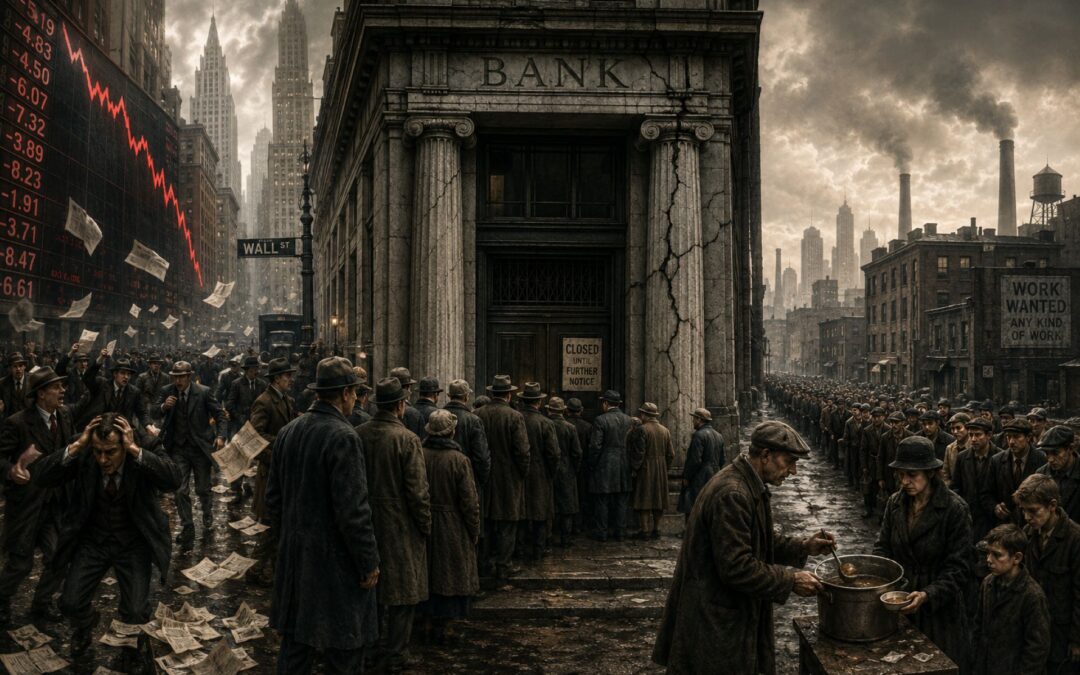
The Great Depression is often remembered through a few familiar images: desperate crowds outside banks, men standing in breadlines, families leaving dust-covered farms, and Franklin D. Roosevelt promising a New Deal.
But those images can make the story look simpler than it was.
The Great Depression was not just a stock market crash. It was not just a banking panic. It was not just a failure of government policy. It was not just a collapse of confidence. It was all of these things feeding one another, again and again, until a downturn became a disaster.
That is what made it different from an ordinary recession.
A normal recession hurts. The Great Depression broke the basic machinery of economic life. People lost jobs. Banks failed. Savings disappeared. Prices fell. Businesses closed. Farmers were crushed by debt. International trade shrank. Governments made mistakes because many of the tools used today to fight economic crises did not yet exist, or were not yet trusted.
According to the Federal Reserve History, the Great Depression was the longest and deepest downturn in the history of the United States and the modern industrial economy. In the U.S., it began in 1929 and did not fully end until the economic mobilization of World War II.
That length matters.
The Depression was not one bad year. It was a long collapse that reshaped how people thought about capitalism, banking, government, central banks, social welfare, and economic security.
To understand why it became so severe, we have to start with the event everyone remembers — and then look beyond it.
The Crash Was Only The Beginning
The stock market crash of October 1929 is the most famous moment in the story of the Great Depression.
It deserves that place. The crash was dramatic, frightening, and psychologically devastating. It destroyed fortunes, shattered confidence, and exposed the recklessness that had built up during the 1920s.
But the crash did not, by itself, cause the Great Depression.
That distinction is crucial.
A stock market crash is a financial event. A depression is an economy-wide collapse. For a crash to become a depression, the damage has to spread from Wall Street into banks, businesses, factories, farms, households, trade, wages, prices, and government policy.
That is exactly what happened.
In the late 1920s, many Americans had come to believe that prosperity was permanent. The market kept rising. New industries were booming. Consumer products like radios, automobiles, and household appliances created the feeling of modern abundance. Credit became easier to access. Speculation became normal.
Then the market broke.
As Britannica’s overview of the Great Depression explains, the crash severely damaged confidence and helped trigger a broader contraction. But confidence was only one part of the problem. The deeper danger was that the economy underneath the market was more fragile than it looked.
That is why the crash was not the full explanation.
It was the opening scene.
The real disaster came from what followed.
The 1920s Economy Was More Fragile Than It Looked
The 1920s are often remembered as the “Roaring Twenties,” a decade of jazz, consumer culture, technological excitement, and stock market euphoria.
But beneath the surface, the American economy had serious weaknesses.
Prosperity was uneven. Industrial productivity had increased, but the gains were not shared equally. Many workers did not earn enough to keep buying everything the economy was producing. Farmers were already struggling before 1929. They had expanded production during World War I, borrowed heavily, and then faced falling prices after the war ended.
So while cities and financial markets looked prosperous, parts of the economy were already under strain.
This matters because the Depression did not strike a healthy system. It hit an economy that depended heavily on confidence, credit, and continued spending.
When confidence collapsed, the weaknesses became impossible to ignore.
Consumers stopped buying. Businesses cut production. Employers laid off workers. Laid-off workers spent even less. Falling demand then forced more businesses to cut back.
A cycle began.
What made the situation more dangerous was the amount of debt and speculation built into the boom. Many people had borrowed to buy goods. Investors had borrowed to buy stocks. Businesses had expanded based on expectations of future demand. Banks had loans tied to farms, businesses, consumers, and financial markets.
The economy was not simply growing.
It was stretching.
When the stretch snapped, the damage spread quickly.
How Speculation Turned Confidence Into A Bubble
Speculation did not create the Depression by itself, but it helped create the conditions for panic.
During the 1920s, the stock market became a symbol of easy wealth. More people began buying stocks not because they understood the underlying value of companies, but because prices kept going up. Rising prices attracted more buyers, and more buyers pushed prices higher.
That is the basic emotional logic of a bubble.
People stop asking, “What is this worth?” and start asking, “How much higher can it go?”
A dangerous practice made this worse: buying on margin. Investors could purchase stocks with borrowed money, putting down only a fraction of the price and borrowing the rest. As long as stock prices rose, this amplified gains. But when prices fell, it amplified losses.
The result was a market built on optimism and leverage.
Once prices began falling, investors rushed to sell. Margin calls forced more selling. Panic fed on itself. The crash wiped out paper wealth and made people question the entire promise of the 1920s boom.
But again, the market crash was not enough to explain the Depression’s depth.
A stock market can collapse without taking down the whole economy for years. What made 1929 so destructive was that the crash hit a banking system that was vulnerable, fragmented, and poorly protected.
That is where the crisis became much more dangerous.
Why Bank Failures Made The Crisis Much Worse
The most destructive part of the Great Depression was not the stock market crash.
It was the collapse of the banking system.
Banks are built on trust. They do not keep every depositor’s money sitting in a vault. They lend much of it out to households, businesses, and farmers. That system works as long as people believe their money is safe.
During the Depression, that belief broke.
When people feared a bank might fail, they rushed to withdraw their money. But if too many depositors demanded cash at once, even a bank that was not originally insolvent could be pushed into failure. These bank runs spread fear from town to town.
The scale was staggering. According to Econlib’s Great Depression entry, between 1929 and 1933, 10,763 of the 24,970 commercial banks in the United States failed.
When banks failed, people lost savings. Businesses lost access to credit. Farmers could not refinance debts. Households became afraid to spend. Surviving banks became more cautious, lending less even when lending was desperately needed.
That meant the financial system stopped doing one of its basic jobs: keeping money moving through the economy.
The Depression deepened because the crisis was no longer only about falling stock prices. It became a crisis of money, credit, and trust.
A worker who lost a job spent less. A shopkeeper with fewer customers laid off employees. A bank with bad loans stopped lending. A farmer with falling crop prices could not repay debt. A family that lost savings became terrified of risk.
Each part of the economy damaged another.
This is why banking collapse made the Depression so severe. It turned fear into a mechanism.
The Deflation Trap That Pulled Everyone Down
One of the hardest parts of the Great Depression to understand today is deflation.
We are used to worrying about inflation, where prices rise and money buys less. Deflation is the opposite: prices fall.
At first, falling prices might sound good. If goods become cheaper, shouldn’t people be better off?
In a depression, no.
Deflation can become a trap.
When prices fall, businesses earn less revenue. To survive, they cut wages, reduce production, or fire workers. Workers with lower wages or no jobs spend less. That reduces demand further. Businesses then cut prices again to attract customers, but lower prices mean lower income.
The cycle keeps tightening.
Deflation is especially brutal for debtors. If you borrowed money before prices and wages fell, your debt does not shrink just because your income does. In real terms, the debt becomes heavier.
Imagine a farmer whose crop prices collapse but whose loan payments stay the same. Or a shopkeeper whose customers disappear but whose debts remain. Or a worker whose wages fall but whose mortgage does not.
This is how falling prices can make an economy poorer, not richer.
The Depression became a downward spiral because falling prices, falling wages, falling demand, and rising real debt all reinforced one another.
The economy did not just slow down.
It contracted inward.
The Federal Reserve, The Gold Standard, And The Policy Mistakes That Tightened The Noose
Today, when a financial crisis hits, central banks usually try to stop panic by cutting interest rates, supporting banks, and expanding the money supply.
During the early Great Depression, the response was much weaker and more constrained.
The Federal Reserve did not act aggressively enough to prevent the banking collapse or the contraction of money and credit. As the Federal Reserve History essay explains, monetary contraction and banking panics played a central role in turning the downturn into a catastrophe.
Ben Bernanke, who later became chair of the Federal Reserve, argued in his speech “Money, Gold, and the Great Depression” that the gold standard was one of the key forces that made the Depression worse internationally.
The gold standard tied currencies to gold. In theory, this created stability. In practice, it limited how freely governments and central banks could respond to crisis. Countries worried about defending their gold reserves often kept monetary policy tighter than their domestic economies needed.
That meant governments were constrained at exactly the moment they needed flexibility.
The United States, like many countries, was operating within a system that prioritized gold convertibility and financial orthodoxy. Expanding the money supply aggressively could threaten gold reserves. Lowering interest rates too much could put pressure on the currency.
So instead of flooding the system with relief, policy often remained too tight.
This was devastating.
The money supply shrank. Banks failed. Credit disappeared. Prices fell. The economic pain intensified.
The Depression teaches a harsh lesson: sometimes the rules designed to create stability can become dangerous when the world changes.
The gold standard was supposed to anchor confidence.
During the Depression, it helped anchor countries to disaster.
Why The Depression Spread Beyond America
The Great Depression did not stay inside the United States.
It became global.
That happened because the world economy was deeply connected through trade, debt, gold, and financial flows. The U.S. was a major lender, producer, and consumer. When the American economy collapsed, demand for imports fell. International lending dried up. Countries that depended on exports suffered. Banks and governments abroad came under pressure.
The gold standard also transmitted the crisis. Countries tied to gold faced pressure to defend their currencies, even when their domestic economies needed expansion. This meant that monetary contraction could spread across borders.
As EH.net’s overview of the Great Depression explains, the Depression was not simply an American event but an international economic disaster shaped by global financial conditions and policy choices.
Trade policy made things worse.
In 1930, the United States passed the Smoot-Hawley Tariff, raising duties on thousands of imported goods. The goal was to protect American farmers and industries. The result was retaliation, reduced trade, and deeper global strain.
Protectionism did not create the Depression, but it worsened the environment in which countries were already struggling.
When economies panic, they often turn inward. But when everyone turns inward at the same time, everyone can become poorer.
That was one of the grim lessons of the 1930s.
The Depression damaged not only markets, but also political faith. In some countries, economic despair weakened democracy and strengthened extremist movements. That larger political story deserves its own article, but it matters here because it shows the Depression’s true scale.
This was not only an economic crisis.
It was a crisis of social order.
Hoover’s Response And The Limits Of Early Intervention
Herbert Hoover did not ignore the Depression, but his response was limited by the political and economic assumptions of his time.
Hoover believed in voluntarism, balanced budgets, local relief, and cooperation between business and government. He feared that direct federal relief could weaken self-reliance and create dependency. He also worried about undermining confidence by expanding government intervention too aggressively.
These ideas were not unusual at the time. Many leaders still believed that downturns had to correct themselves and that too much government intervention could make things worse.
But the Depression was not a normal downturn.
The scale of the collapse overwhelmed older assumptions.
As unemployment rose and banks failed, local charities, cities, and states could not handle the need. Families lost income faster than relief systems could respond. Businesses were not able to restore confidence by voluntary cooperation. The economy kept shrinking.
Hoover did eventually support more intervention than his reputation sometimes suggests, including public works and the Reconstruction Finance Corporation, which lent money to banks, railroads, and other institutions. But these measures were too limited, too cautious, or too indirect to reverse the collapse.
By the time Franklin D. Roosevelt took office in March 1933, the situation had become desperate.
The FDR Library notes that by Roosevelt’s inauguration, nearly 25 percent of the labor force was unemployed, the banking system had collapsed, and prices and productivity had fallen dramatically from their 1929 levels.
The old approach had failed.
The country was ready for something different.
FDR’s Bank Holiday And The New Deal Turning Point
Franklin D. Roosevelt entered office at the darkest moment of the crisis.
Banks were failing. Depositors were panicking. People had lost faith not only in financial institutions, but in the government’s ability to stop the collapse.
Roosevelt’s first major move was the national bank holiday. He temporarily closed banks, pushed emergency banking legislation through Congress, and allowed only stable banks to reopen.
This was not just a technical financial measure. It was a psychological intervention.
The goal was to restore trust.
A banking system cannot function if everyone believes it is safer to hide cash under a mattress. Roosevelt understood that the economy needed confidence before it could breathe again.
The Library of Congress New Deal timeline shows how rapidly the federal government moved in 1933, especially on banking, relief, agriculture, and public works. The early New Deal did not solve everything, but it marked a dramatic shift in what Americans expected the federal government to do during economic crisis.
The New Deal had three broad aims: relief, recovery, and reform.
Relief meant immediate help for people in distress.
Recovery meant getting the economy moving again.
Reform meant changing the system so a collapse like this would be less likely in the future.
Some programs created jobs. Some supported farmers. Some regulated banks and securities markets. Some built infrastructure. Some laid the foundations for the modern welfare state.
The New Deal did not end hardship overnight. But it changed the relationship between citizens, markets, and the federal government.
Before the Depression, many Americans saw economic security as mostly an individual, local, or private matter. After the Depression, it became much harder to argue that the federal government had no responsibility during mass unemployment and financial collapse.
That was one of the Depression’s permanent consequences.
Did The New Deal Actually End The Great Depression?
This is one of the most debated questions in American economic history.
The simplest answer is: the New Deal helped, but it did not fully end the Great Depression.
It stabilized the banking system. It provided relief. It created jobs. It restored some confidence. It introduced reforms that made future banking collapses less likely. It changed the role of government in economic life.
But recovery was uneven and incomplete.
The economy improved significantly after 1933, especially after the U.S. left the gold standard and monetary conditions became more expansionary. As EH.net’s recovery essay explains, recovery from the Depression involved a mix of monetary expansion, policy changes, and institutional shifts, but the process was not smooth.
The sharp recession of 1937–38 showed how fragile recovery remained. When government spending was reduced and monetary conditions tightened, the economy stumbled again.
That episode matters because it shows that the Depression had not simply vanished.
The New Deal did many things, but it did not restore full employment on its own. The final end of the Depression came with the massive industrial mobilization of World War II, when government spending, production, and employment expanded on a scale far beyond the New Deal.
That does not mean the New Deal failed.
It means its role should be understood carefully.
The New Deal helped stop the collapse, reduce suffering, reform institutions, and reshape government responsibility. But the full restoration of economic activity required wartime mobilization.
So the better question is not, “Did the New Deal end the Great Depression?”
The better question is, “What parts of the Depression did the New Deal solve, and what parts remained unresolved until World War II?”
That question deserves its own article.
What The Great Depression Permanently Changed
The Great Depression changed the modern world because it destroyed old certainties.
Before the Depression, many people believed markets would largely correct themselves. They believed banks could be trusted without federal deposit insurance. They believed unemployment was mostly temporary. They believed government intervention should be limited, even during severe downturns.
The Depression made those beliefs harder to sustain.
It led to a new understanding of financial regulation. The United States created stronger banking safeguards, including federal deposit insurance, to reduce the risk of bank runs. Securities markets faced greater oversight. The federal government accepted a larger role in stabilizing the economy.
It also changed expectations around social protection. Programs like Social Security reflected a new idea: that modern economies create risks individuals cannot always manage alone.
The Depression also shaped the future of central banking. Later policymakers studied the 1930s obsessively because they understood how dangerous monetary contraction, bank failures, and delayed intervention could be. The response to later crises, including the 2008 financial crisis, was influenced by lessons drawn from the Depression.
The Great Depression became a warning about cascading failure.
It showed that an economy is not just numbers on a chart. It is a system of trust. When trust breaks in one place, it can spread through banks, households, businesses, governments, and entire societies.
That is why the Depression still matters.
Not because history repeats perfectly.
It does not.
But because financial systems are still vulnerable to panic. Debt can still magnify losses. Policy mistakes can still deepen downturns. Institutions still matter. Confidence still matters. And when ordinary people lose jobs, savings, homes, and hope, an economic crisis becomes something much larger than economics.
Conclusion: The Great Depression Was A System Failure, Not A Single Crash
The Great Depression became the worst economic crisis in modern history because it was not one failure.
It was a chain reaction.
The stock market crash damaged confidence. A fragile economy weakened further. Banks failed. Credit collapsed. Deflation made debts heavier. Consumers stopped spending. Businesses cut jobs. The Federal Reserve did not stop the monetary contraction. The gold standard limited policy flexibility. Trade barriers worsened global pressure. Early government responses were too limited for the scale of the disaster.
Each failure intensified the next.
That is what made the Depression so destructive. It was not just that people lost money in the market. It was that the systems meant to support economic life — banks, credit, prices, jobs, trade, policy, and public confidence — began breaking at the same time.
The Great Depression forced the world to rethink what governments, central banks, and financial institutions are for. It showed that markets can fail not only through bad decisions, but through self-reinforcing panic. It proved that waiting for recovery can be disastrous when the machinery of the economy itself is collapsing.
The crash was only the beginning.
The real story of the Great Depression is how a crisis became a spiral — and how that spiral changed the modern world.
Last Updated on June 8, 2026 by Aseem Gupta