
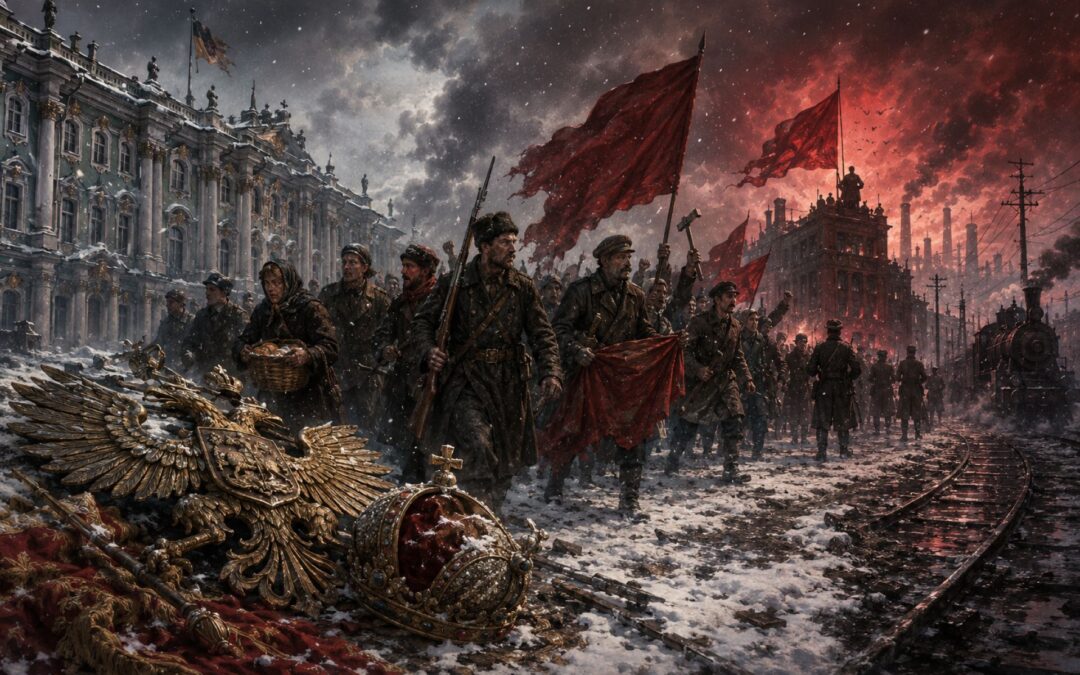
The Russian Revolution was not one event.
It was not just angry workers storming a palace. It was not simply Lenin returning from exile and taking power. It was not caused by Rasputin, or one bad Tsar, or one disastrous war.
It was a long collapse.
For decades, the Russian Empire tried to preserve an autocratic system in a world that was changing around it. Western Europe industrialized, expanded political rights, built parliaments, and created modern economies. Russia remained vast, rural, poor, and ruled by a Tsar who claimed power from God.
That system survived longer than it should have because it was enormous, violent, and stubborn. But it never solved its central problem: Russia needed reform to survive, yet every serious reform threatened the authority of the Tsar.
By 1917, the contradictions became impossible to contain. War exposed the weakness of the state. Hunger brought people into the streets. Soldiers refused to fire on their own people. The monarchy collapsed. A temporary liberal government failed to end the crisis. Lenin and the Bolsheviks promised what others could not deliver: peace, land, and bread.
They won power in the name of workers’ democracy.
Then they built a one-party state.
The story of the Russian Revolution is the story of how an old autocracy destroyed itself, how revolutionaries filled the vacuum, and how the dream of liberation quickly turned into a new form of concentrated power.
Russia Was an Empire Falling Behind
In the 19th century, Russia looked powerful from the outside.
It stretched across continents. It had one of the largest armies in the world. It controlled huge territories, many peoples, and vast natural resources. European rulers had to take it seriously.
But internally, Russia was deeply backward compared to the industrial powers of Western Europe.
Much of the empire was still rural. Millions of peasants lived under conditions that had barely changed for centuries. Until 1861, many were serfs, legally bound to the land and controlled by landlords. They were not enslaved in the exact same way as plantation slaves, but they were not free citizens either. Their labor, movement, and lives were shaped by a social order that belonged to an older world.
Russia’s political system was just as old-fashioned. The Tsar ruled as an autocrat. There was no meaningful parliament that could limit him. There were no broad civil rights that protected ordinary people from state power. The monarchy treated political opposition not as disagreement, but as disloyalty.
This was dangerous because Russia was not isolated from history. The French Revolution had shown what could happen when monarchy, inequality, and popular anger collided. Britain, France, Germany, and other European powers were industrializing and modernizing. Railways, factories, urban workers, newspapers, mass politics, and constitutional demands were reshaping the continent.
Russia tried to remain a sacred autocracy in an age of modern politics.
That tension never went away.
Alexander II Reformed Russia Without Saving the Tsarist System
Tsar Alexander II understood that Russia could not remain frozen forever.
His most famous reform was the emancipation of the serfs in 1861. On paper, this was a historic turning point. Millions of peasants were no longer legally tied to landlords. Russia had finally abolished one of the most obvious symbols of its backwardness.
But the reform was limited and deeply frustrating.
The peasants received freedom, but not enough land or money to build prosperous lives. Many had to make redemption payments for decades to compensate landlords for the land they received. In practice, emancipation often left peasants poor, resentful, and still trapped in village structures that restricted mobility and opportunity.
Alexander II also introduced legal, military, educational, and administrative reforms. He was not a democratic revolutionary, but he did recognize that Russia needed modernization.
The problem was that limited reform satisfied almost no one.
Conservatives thought he was weakening autocracy. Radicals thought he was moving too slowly. Peasants remained frustrated. Intellectuals wanted deeper political change. Revolutionary groups began to believe that the system could not be reformed from within.
In 1881, members of the revolutionary group People’s Will assassinated Alexander II.
It was one of the great tragedies of Russian history. The Tsar who had done more than most to reform the empire was killed by revolutionaries who believed reform was not enough.
His death sent a brutal message to the monarchy: reform could be fatal.
The next Tsar learned the wrong lesson.
Alexander III Chose Repression Over Reform
Alexander III responded to his father’s assassination by turning away from reform and toward repression.
If Alexander II represented cautious modernization, Alexander III represented autocratic reaction. He believed the empire needed discipline, unity, and loyalty to the throne. In practice, that meant censorship, police surveillance, political repression, and pressure on ethnic and religious minorities.
Russia was a multinational empire. It included Poles, Finns, Ukrainians, Jews, Baltic peoples, Caucasian peoples, Central Asians, and many others. Instead of treating diversity as a political reality to manage carefully, the regime often tried to force a more uniform Russian identity onto the empire.
Russification was meant to strengthen loyalty.
It often did the opposite.
Repression also expanded through institutions such as the Okhrana, the Tsarist secret police. Political radicals, socialists, liberals, writers, students, and activists lived under surveillance. Some were imprisoned. Others were exiled to Siberia. The goal was to protect the autocracy from revolutionary ideas.
But repression could not erase the reasons those ideas were spreading.
Russia still had land hunger. It still had poverty. It still had censorship. It still had no meaningful political representation. It still had an autocracy trying to govern a modernizing society by old methods.
Alexander III preserved the system temporarily.
He did not solve its problems.
Nicholas II Inherited a System He Could Not Control
Nicholas II became Tsar in 1894.
He was not prepared for the job.
Even by the standards of monarchy, Nicholas was badly suited to rule a giant empire under pressure. He was personally devoted to his family and sincerely believed in his sacred duty as Tsar. But he lacked imagination, political judgment, and the ability to adapt.
That mattered because Nicholas inherited a state that needed careful reform. Instead, he clung to autocracy as a religious and political principle. He believed that sharing power would betray his duty.
His reign began with a disaster.
During celebrations for his coronation in 1896, a huge crowd gathered at Khodynka Field in Moscow for food, drink, and gifts. Panic spread. A stampede followed. More than a thousand people were killed. Nicholas did not cause the tragedy, but his decision to attend a scheduled diplomatic ball afterward badly damaged his image.
To many Russians, it confirmed what they already suspected: the Tsarist elite could mourn the people in public and party with foreigners in private.
Nicholas would face repeated chances to learn from crisis.
Again and again, he chose denial.
Industrialization Created a New Revolutionary Class
Russia did modernize under Nicholas II, but unevenly and painfully.
One of the key figures behind this transformation was Sergei Witte, a major statesman who pushed industrial development, railway expansion, foreign investment, and economic modernization. Russia built factories, expanded coal and steel production, and developed the Trans-Siberian Railway.
This growth mattered. Russia could not remain a great power without industry.
But industrialization created new social pressures.
Factories brought peasants into cities, where they became workers. These workers often lived in overcrowded dormitories, worked long hours, earned low wages, and endured dangerous conditions. They were no longer isolated village peasants. They were concentrated in urban workplaces where anger could spread quickly.
Industrialization also created a sharper political consciousness. Workers could organize strikes. They could read illegal literature. They could join underground parties. They could begin to see themselves not merely as poor individuals, but as a class with shared grievances.
The Tsarist state had hoped industry would strengthen Russia.
It also created the social force that would help destroy the monarchy.
Lenin and the Bolsheviks Entered a Country Already in Crisis
Vladimir Lenin did not invent Russia’s crisis.
He entered it.
Lenin came from an educated family, not from the industrial working class. His older brother was executed for involvement in a plot against Alexander III, an event that shaped Lenin’s hatred of the Tsarist regime. Lenin himself became a Marxist revolutionary and spent years in exile.
Marxism gave him a framework for understanding Russia’s turmoil. Karl Marx had argued that history was driven by class struggle, that capitalism exploited workers, and that the working class would eventually overthrow the capitalist order. Lenin adapted these ideas to Russian conditions.
This required some intellectual flexibility.
Classical Marxism expected socialist revolution to emerge in advanced industrial societies. Russia was still mostly peasant and underdeveloped. Lenin believed a disciplined revolutionary party could accelerate history by leading the working class and seizing power at the right moment.
That belief caused conflict within Russian socialism.
In 1903, the Russian Social Democratic Labour Party split between Bolsheviks and Mensheviks. The Mensheviks favored a broader, more open socialist movement and believed Russia might need a bourgeois democratic stage before socialism. Lenin’s Bolsheviks favored a tighter, more centralized revolutionary organization.
The split was more than organizational.
It revealed Lenin’s political personality. He was brilliant, disciplined, and ruthless. He did not simply want to participate in a movement. He wanted to control one.
The Russo-Japanese War Humiliated the Tsar
In 1904, Russia went to war with Japan.
The conflict grew from imperial rivalry in East Asia, especially over influence in Manchuria and Korea. Russian leaders underestimated Japan, assuming that a European empire could not be seriously defeated by an Asian power.
That assumption proved disastrous.
Japan launched a surprise attack on the Russian fleet at Port Arthur and went on to defeat Russia on land and sea. The most humiliating moment came at the Battle of Tsushima in 1905, when the Russian Baltic Fleet, having traveled halfway around the world, was destroyed by the Japanese navy.
The defeat shocked the world.
It also shattered Russian confidence in the regime. A monarchy that claimed strength had been humiliated abroad. Soldiers died. Money was wasted. The empire looked incompetent.
War did not create Russia’s internal problems, but it exposed them.
The people were already angry. The defeat gave that anger a focus.
Bloody Sunday Turned Loyal Petitioners Into Revolutionaries
The first Russian Revolution began not with an armed uprising, but with a peaceful petition.
In January 1905, a priest named Father Georgy Gapon led workers and their families toward the Winter Palace in St. Petersburg. They wanted to present Nicholas II with a petition asking for better working conditions, civil liberties, and relief from hardship.
Many marchers still believed in the Tsar.
They imagined him as a father figure who would help them if only he knew their suffering.
Nicholas was not at the palace. Troops blocked the marchers. Then soldiers fired on the crowd.
The massacre became known as Bloody Sunday.
The exact number of dead remains debated, but the political effect was unmistakable. The image of the benevolent Tsar was broken. Workers who had marched with icons and petitions now saw the monarchy as an enemy.
Bloody Sunday did not immediately end Tsarism.
It destroyed the emotional bond that helped Tsarism survive.
The 1905 Revolution Forced Reform, Then Exposed Its Limits
After Bloody Sunday, unrest spread across the empire.
Workers went on strike. Peasants attacked landlords. Students protested. Liberals demanded constitutional reform. Parts of the military mutinied. Workers began forming elected councils called soviets, which coordinated strikes and political action.
The Tsarist state was shaken.
Sergei Witte understood that the regime needed to divide its opponents before they united. Liberals wanted political representation. Workers wanted labor rights. Peasants wanted land. Revolutionaries wanted the end of autocracy altogether. These groups overlapped, but they were not fully united.
In October 1905, Nicholas II issued the October Manifesto, promising civil liberties and an elected assembly, the Duma.
For liberals, this looked like a major victory. Russia seemed to be moving toward constitutional government.
But Nicholas never truly accepted the loss of autocratic power. In 1906, the Fundamental Laws reasserted the Tsar’s authority. The Duma could be limited, dismissed, or manipulated. The regime had conceded enough to survive the crisis, then clawed back as much power as possible.
The 1905 Revolution failed to overthrow the monarchy.
But it mattered enormously.
It revealed the major forces that would return in 1917: workers, soldiers, peasants, liberals, socialists, soviets, and a Tsar who would compromise only when cornered.
Stolypin Tried to Save Tsarism With Reform and Repression
After 1905, Pyotr Stolypin became one of the most important figures in the empire.
He understood that Russia needed reform, especially in agriculture. Peasant poverty and land hunger were constant threats to stability. Stolypin tried to encourage peasants to leave traditional village communes and become independent landowners. The hope was that a class of prosperous peasants would become loyal supporters of the monarchy.
But Stolypin also believed in repression.
Revolutionaries were arrested, tried, and executed. The hangman’s noose became so associated with his crackdown that it was nicknamed “Stolypin’s necktie.”
This combination of reform and violence temporarily stabilized Russia. The economy improved in the years before World War I. Industrial growth continued. Revolutionary movements were weakened. Lenin and the Bolsheviks, still operating in exile and underground networks, struggled to gain influence.
For a brief moment, it looked as if Tsarism might survive.
But the recovery was fragile. It depended on time, stability, and competent political leadership.
Russia would soon have none of those.
Rasputin Became a Symbol of a Rotting Monarchy
Grigori Rasputin did not cause the Russian Revolution.
But he damaged the monarchy’s reputation at the worst possible time.
Rasputin was a Siberian peasant and religious wanderer who became close to the royal family because of the Tsarevich Alexei, Nicholas and Alexandra’s son. Alexei suffered from hemophilia, a dangerous blood disorder. Rasputin appeared able to calm or help him during medical crises, possibly because his advice reduced harmful treatments such as aspirin.
To Nicholas and Alexandra, Rasputin seemed like a holy man sent by God.
To much of Russia, he looked like proof that the monarchy had become absurd.
Rumors spread that Rasputin controlled the royal family, influenced state appointments, seduced aristocratic women, and corrupted the court. Many claims were exaggerated, but the political damage was real. The public already saw the regime as distant and incompetent. Rasputin made it look ridiculous and contaminated.
In 1916, a group of nobles murdered him.
Even that did not save the monarchy. By then, Rasputin had become a symbol of everything people believed was wrong with the Romanovs: secrecy, superstition, weakness, scandal, and decay.
World War I Broke the Russian State
World War I turned Russia’s chronic crisis into a terminal one.
When war broke out in 1914, patriotic feeling initially surged. The capital, St. Petersburg, was renamed Petrograd because the old name sounded too German. Many Russians rallied behind the empire.
But Russia was not prepared for a long industrial war.
The army suffered catastrophic losses. Supply systems failed. Soldiers lacked weapons, boots, food, and ammunition. The transport network struggled. Inflation rose. Food shortages worsened. The state looked increasingly incapable of organizing victory or protecting its own people.
This was not only a military crisis. It was a legitimacy crisis.
As explained in the International Encyclopedia of the First World War, revolutionary tensions had been building in Russia long before 1917, but the war placed unbearable pressure on the empire’s institutions.
Nicholas made the situation worse in 1915 by taking personal command of the army. From that moment, military failure attached directly to him. Meanwhile, Alexandra, his German-born wife, became even more unpopular at home. Her closeness to Rasputin fed rumors that the court was incompetent, corrupt, or even treasonous.
The connection between World War I and the Russian Revolution was direct: the war did not create every grievance, but it made every grievance more explosive.
By 1917, Russia was exhausted.
The monarchy had run out of credibility.
The February Revolution Ended 300 Years of Romanov Rule
The February Revolution began with hunger.
In March 1917 by the Western calendar, women textile workers in Petrograd demonstrated on International Women’s Day. They demanded bread. Other workers joined them. Strikes spread. Crowds grew. Protesters called for food, peace, and eventually the end of autocracy.
The regime ordered troops to restore order.
But this time, the soldiers did not reliably obey.
Many soldiers were peasants in uniform. They were hungry, tired, and angry too. They had no desire to shoot workers and women demanding bread. Some regiments mutinied and joined the protesters. Once the military in the capital turned against the regime, the monarchy was finished.
Politicians in the Duma and military leaders concluded that Nicholas had to abdicate to restore order and continue the war. Nicholas tried to return to Petrograd by train, but he never regained control. On March 15, 1917, he abdicated.
His son Alexei was too ill and young to rule. Nicholas’s brother, Grand Duke Michael, declined the throne unless chosen by a future representative assembly. That effectively ended 300 years of Romanov rule.
The abdication manifesto marked the formal end of Tsarist autocracy.
The strange thing is how quickly it happened.
A dynasty that had ruled for centuries collapsed in days because almost no one with power was willing to defend it anymore.
Russia Then Had Two Governments and No Real Stability
The fall of Nicholas II did not solve Russia’s problems.
It created a power vacuum.
After the February Revolution, liberal politicians formed the Provisional Government. It was meant to govern until elections could create a more legitimate constitutional order. It introduced important reforms: censorship was relaxed, political prisoners were released, the death penalty was abolished for a time, and plans were made for democratic elections.
But the Provisional Government did not control the streets, factories, or soldiers by itself.
The Petrograd Soviet, a council representing workers and soldiers, also claimed authority. Similar soviets appeared elsewhere. This created a situation known as “dual power”: the Provisional Government was the official state authority, while the soviets had enormous influence over workers, soldiers, and revolutionary politics.
Dual power made decisive action difficult.
The Provisional Government wanted order, law, and continued participation in the war. Workers wanted better conditions. Soldiers wanted peace. Peasants wanted land. Socialists wanted deeper revolution. National minorities wanted autonomy or independence.
The Tsar was gone.
The crisis remained.
Lenin Returned With a Simple Revolutionary Offer: Peace, Land, Bread
Lenin returned to Russia in April 1917 with German help.
Germany hoped that sending Lenin back would destabilize Russia and weaken its war effort. It was a cynical wartime calculation, and it worked better than Germany could have imagined.
When Lenin arrived, many socialists expected him to support the revolutionary process already underway. Instead, he attacked both the Provisional Government and moderate socialists who cooperated with it.
His position was laid out in the April Theses. Lenin demanded no support for the Provisional Government, an end to the imperialist war, transfer of power to the soviets, land redistribution, and a move toward socialist revolution.
At first, many people thought he was unrealistic.
But Lenin had a powerful advantage: he understood the emotional simplicity of the crisis.
People wanted peace.
They wanted land.
They wanted bread.
The Bolsheviks turned those demands into a political weapon. “Peace, Land, Bread” was not a detailed governing program. It was something more effective in a collapsing country: a promise that spoke directly to exhaustion.
As the Provisional Government struggled, the Bolsheviks gained support.
The Provisional Government Destroyed Its Own Legitimacy
The Provisional Government’s biggest mistake was continuing the war.
Alexander Kerensky, one of its leading figures and later prime minister, believed Russia needed a successful military offensive to restore morale and strengthen the new government. The Kerensky Offensive of 1917 did the opposite. It failed badly, deepened military collapse, and made the government look as incompetent as the Tsarist regime it had replaced.
Anger spilled into the streets during the July Days, when armed workers and soldiers demonstrated in Petrograd. The Bolsheviks were associated with the unrest, though their leadership was cautious and divided. Kerensky’s government cracked down. Bolshevik leaders were arrested. Lenin fled to Finland.
For a moment, it looked as if the Bolsheviks had been contained.
Then came the Kornilov Affair.
General Lavr Kornilov, appointed commander-in-chief of the army, moved forces toward Petrograd in what Kerensky interpreted as an attempted coup. Kerensky needed help defending the capital, so he turned to the soviets and armed workers, including Bolsheviks.
The coup attempt collapsed largely because railway workers, telegraph operators, soldiers, and socialist organizers disrupted Kornilov’s advance.
Politically, the Bolsheviks benefited enormously.
They could now claim they had defended the revolution against military dictatorship. Their opponents looked weak, divided, and dependent on the very radicals they feared.
By autumn 1917, the Bolsheviks had majorities in the Petrograd and Moscow soviets. Trotsky, who had joined the Bolsheviks, became chairman of the Petrograd Soviet.
Lenin saw the moment.
He pushed for insurrection.
The October Revolution Was Less Dramatic Than Its Myth
The October Revolution has often been portrayed as a grand popular uprising.
The reality was more controlled, strategic, and underwhelming.
In November 1917 by the Western calendar, Bolshevik forces moved through Petrograd and seized key points: bridges, railway stations, telegraph offices, government buildings, and communication centers. Trotsky played a central organizing role through the Military Revolutionary Committee of the Petrograd Soviet.
There was relatively little fighting in the capital.
The Winter Palace, where the Provisional Government was located, was defended weakly. Kerensky had already fled to seek support. Bolshevik forces entered and arrested the remaining ministers.
Soviet later myth turned this into a heroic mass storming. The event mattered enormously, but not because it was militarily dramatic. It mattered because the Provisional Government had become so hollow that a disciplined revolutionary minority could topple it in the capital with limited resistance.
This raises one of the central debates about the Russian Revolution: was October a popular revolution or a coup?
The answer depends on what one means. The Bolsheviks did have real support among radicalized workers, soldiers, and soviets in key cities. But they did not represent all of Russia, and they did not win power through a national democratic mandate. As many historians have argued, the revolution combined mass social breakdown with a highly organized seizure of power.
That combination made it effective.
It also made it dangerous.
Lenin Promised Soviet Democracy but Built One-Party Rule
The Bolsheviks came to power claiming to represent soviet democracy.
But once in power, Lenin had little interest in sharing authority with parties that opposed him.
This became clear after elections to the Constituent Assembly. The vote had been planned before the October Revolution and was meant to create a democratic body representing Russia. When the results came in, the Bolsheviks did not win a majority. The Socialist Revolutionaries, who had strong peasant support, did better.
Lenin dismissed the assembly as outdated and counterrevolutionary because it did not reflect the new soviet power created by the revolution. In January 1918, the Bolsheviks dissolved it by force.
That was a decisive moment.
The Bolsheviks had promised popular power, but they rejected democratic results when those results threatened their rule.
They also created the Cheka, a secret police force, in December 1917. The Cheka was tasked with fighting counterrevolution and sabotage, but in practice it became an instrument of political terror. After an assassination attempt on Lenin in August 1918, repression intensified into what became known as the Red Terror. Thousands were arrested, imprisoned, or executed as enemies of the revolution.
The history of the Red Terror shows how quickly revolutionary emergency measures became a system of state violence.
Lenin believed dictatorship was necessary to defend the revolution.
But dictatorship, once created, does not easily remain temporary.
Brest-Litovsk Gave Russia Peace at a Devastating Price
The Bolsheviks had promised peace.
Keeping that promise was brutal.
Russia was still at war with Germany and the Central Powers. The army was collapsing, and the Bolsheviks had no realistic ability to continue fighting. Trotsky, as Commissar for Foreign Affairs, tried to delay by declaring “neither war nor peace”: Russia would stop fighting but refuse to sign Germany’s harsh terms.
Germany responded by advancing deeper into Russian territory.
The Bolsheviks had to accept an even worse settlement. In March 1918, Russia signed the Treaty of Brest-Litovsk. The terms were devastating. Russia gave up huge territories, populations, agricultural land, and industrial resources.
For many Russians, this looked like national humiliation.
For Lenin, it was the price of survival. He believed the Bolshevik regime needed peace at any cost because without power in Russia, there would be no revolution to defend.
The treaty also deepened opposition to the Bolsheviks.
Their enemies now had another charge: Lenin had betrayed Russia.
Civil War Turned Revolution Into Survival Politics
After October, Russia did not become stable.
It descended into civil war.
The Bolshevik Red Army faced a loose coalition of anti-Bolshevik forces known as the Whites. These included monarchists, liberals, conservatives, moderate socialists, military officers, national separatists, foreign-backed forces, and others. There were also peasant armies, anarchists, Cossacks, regional governments, and foreign interventions by powers including Britain, France, Japan, and the United States.
The Russian Civil War was not a simple two-sided conflict.
It was a brutal struggle over the ruins of an empire.
The Reds had important advantages. They controlled the industrial heartland, major cities, and central transport networks. Trotsky organized the Red Army with surprising effectiveness. The Whites controlled large territories but were divided by ideology, geography, leadership, and political goals. They were often unable to offer peasants an attractive alternative, especially on land.
Both sides committed atrocities.
The Bolsheviks used terror to maintain control. The Whites used terror too, including antisemitic violence and brutal reprisals. Civilians suffered terribly. War, requisitioning, disease, economic collapse, and administrative breakdown produced famine and mass death.
The Romanov family became victims of this environment. Nicholas II, Alexandra, their children, and loyal attendants were held under Bolshevik custody. In July 1918, as White forces approached Yekaterinburg, they were executed in a basement by Bolshevik guards.
It was a grim symbol of the revolution’s final break with the old world.
The Tsar who had once claimed sacred authority died as a prisoner of the new regime.
Lenin Won Power but Not the Utopia He Promised
The Bolsheviks won the civil war.
But victory came over a devastated country.
Industry collapsed. Railways were wrecked. Cities shrank as people fled in search of food. Disease spread. Inflation destroyed money. Famine killed millions, especially in the early 1920s. Political opposition was crushed. The Communist Party tightened control over the state.
The revolution had promised liberation.
Ordinary people experienced hunger, coercion, censorship, requisitioning, and fear.
Lenin was not indifferent to Russia’s collapse. He understood that the country could not survive permanently under pure emergency rule. In 1921, after famine, strikes, peasant uprisings, and the Kronstadt rebellion by sailors who had once supported the revolution, Lenin introduced the New Economic Policy. It restored limited market activity to revive the economy.
But politically, the system remained closed.
The Soviet Union was officially formed in 1922 as a one-party state. Lenin’s health was already failing. He suffered strokes that reduced his ability to lead. The man who had spent his life fighting for revolutionary power had only a short time to exercise it.
He had destroyed the old autocracy.
He had not created the free socialist democracy many revolutionaries imagined.
Stalin Rose Through the Machinery Lenin Left Behind
Most people did not initially expect Joseph Stalin to become Lenin’s successor.
Trotsky seemed more obvious. He was brilliant, famous, charismatic, and had organized the Red Army during the civil war. Stalin was less glamorous. He was not the party’s great theorist or speaker. He worked in the machinery of power.
That machinery mattered more.
In 1922, Stalin became General Secretary of the Communist Party. The title sounded administrative, but it gave him influence over appointments, promotions, party membership, and networks of loyalty. Stalin used the position to place allies throughout the party structure.
Power did not come only from speeches.
It came from controlling who got jobs, who gained access, who was promoted, and who was isolated.
Lenin eventually became alarmed by Stalin’s behavior, especially his rudeness, ambition, and treatment of Lenin’s wife, Nadezhda Krupskaya. In what became known as Lenin’s Testament, he suggested Stalin should be removed from the position of General Secretary.
But Lenin was too ill to enforce his warning.
After Lenin died in 1924, Stalin outmaneuvered his rivals. Trotsky was gradually isolated, expelled, exiled, and eventually assassinated by a Soviet agent in Mexico in 1940. Stalin transformed the Soviet system into something even more centralized, violent, and paranoid.
A New Yorker essay on Stalin’s rise captures the unsettling nature of his ascent: he did not simply inherit power by being the most inspiring revolutionary. He built power from inside the party apparatus.
Lenin left behind a one-party state.
Stalin showed what that state could become.
Conclusion
The Russian Revolution began as a revolt against an autocracy that could not reform.
For generations, the Tsars tried to preserve unlimited power while Russia changed beneath them. Serfdom ended, but peasant misery remained. Industry grew, but workers were exploited. Reform was promised, then restricted. War demanded sacrifice from people who no longer trusted the state asking for it.
By 1917, the monarchy collapsed because it had lost the army, the cities, the political class, and the moral authority to rule.
But the fall of the Tsar did not automatically create freedom.
The Provisional Government failed because it could not end the war, solve the land question, feed the cities, or command real authority. Lenin and the Bolsheviks succeeded because they understood the crisis more clearly than their rivals. They offered simple answers to desperate people and used disciplined organization to seize the moment.
Then they faced the problem that confronts many revolutions: winning power is not the same as building justice.
The Bolsheviks promised rule by workers and soviets. They dissolved elections they lost, built a secret police, crushed opponents, and defended dictatorship as revolutionary necessity. Civil war hardened the regime further. By the time Lenin died, the Soviet state had already become centralized, coercive, and intolerant of opposition.
The Russian Revolution destroyed one autocracy.
It gave birth to another kind of power.
Last Updated on July 10, 2026 by Aseem Gupta