
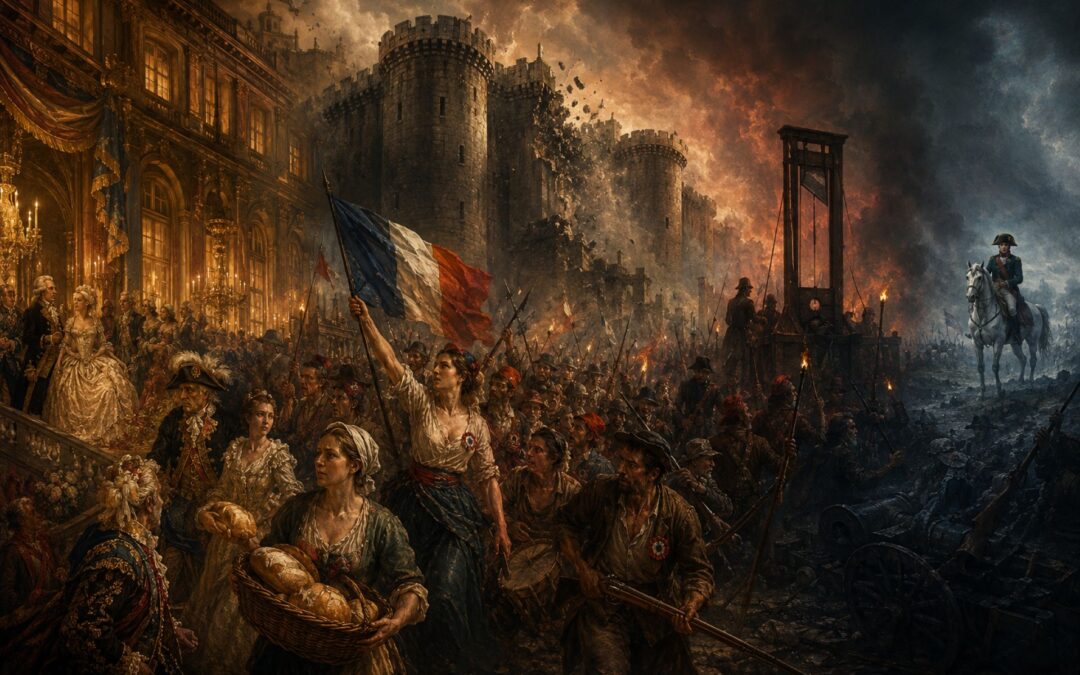
France did not enter the French Revolution as a poor, backward, collapsing country.
It was one of Europe’s great powers: wealthy, cultured, admired, feared, and deeply unequal. Its monarchy projected splendor from Versailles. Its aristocracy lived inside a world of privilege, ceremony, fashion, and inherited status. Its thinkers helped define the Enlightenment. Its armies and diplomats shaped European politics.
But underneath the polish, the system was rotting.
The state was drowning in debt. The tax burden fell hardest on people least able to pay. Food prices were rising. The monarchy looked distant and incompetent. The privileged estates defended exemptions while ordinary people carried the financial weight of the kingdom. New ideas about rights, representation, and sovereignty were spreading through salons, pamphlets, newspapers, and political clubs.
The French Revolution began because that old system could no longer explain itself.
It promised liberty and equality. It destroyed feudal privilege. It produced one of the most influential political documents in modern history, the Declaration of the Rights of Man and of the Citizen. But it also produced mass violence, civil war, political purges, dechristianization, the guillotine, and the Reign of Terror.
By the end, France had removed an absolute king only to fall under the rule of an extraordinary military dictator.
That is the central paradox of the French Revolution: a movement born in the name of liberty ended by creating Napoleon.
France Before the Revolution: A Rich Country With a Broken System
On the surface, eighteenth-century France looked magnificent.
It had a powerful monarchy, a sophisticated court culture, a large population, influential writers, and a central role in European politics. Paris was one of the intellectual capitals of the world. Versailles symbolized royal glory. French language, fashion, diplomacy, and manners carried enormous prestige across Europe.
But France’s social order rested on legal inequality.
French society was traditionally divided into three estates. The First Estate was the clergy. The Second Estate was the nobility. The Third Estate was everyone else: peasants, laborers, merchants, lawyers, professionals, artisans, and the urban poor.
The problem was not simply that some people were richer than others. Every society has inequality. The deeper problem was that privilege was built into law.
The clergy and nobility enjoyed exemptions, honors, offices, and social advantages that ordinary people did not. Many nobles paid little direct taxation compared with the burden carried by commoners. The church collected tithes. Feudal dues still tied peasants to local obligations. State taxes, local dues, church payments, and private tax collection all piled onto the lower orders.
The Third Estate was not a small minority demanding special treatment. It was the overwhelming majority of France.
This made the old order harder to defend. If nearly everyone belonged to the Third Estate, why should two privileged estates retain so much influence? If the common people produced the wealth, why were they treated as politically inferior? If France was supposed to be a great nation, why did greatness look like luxury for a few and exhaustion for everyone else?
These questions did not create a revolution by themselves.
But they prepared the ground.
Why the French Monarchy Ran Out of Money
The French monarchy’s immediate crisis was financial.
France had spent heavily on wars, including the Seven Years’ War, where it lost major colonial possessions to Britain, and later the American War of Independence, where it supported the American colonies partly to weaken Britain. That intervention helped the Americans win independence, but it also made France’s debt problem worse.
The monarchy was not bankrupt because one queen bought dresses. Marie Antoinette’s spending damaged the royal image, but France’s fiscal crisis was much larger than court fashion. The state had structural problems: expensive wars, inefficient revenue collection, deep borrowing, and a tax system that could not easily reach the privileged groups most able to pay.
Attempts at reform ran into resistance.
French finance ministers understood that the state needed more reliable revenue and a fairer tax base. But taxing privilege meant confronting powerful interests. The monarchy wanted reform without surrendering authority. The privileged estates wanted stability without losing exemptions. The result was paralysis.
France had a modern state’s ambitions but an old regime’s fiscal system.
That contradiction became impossible to manage.
The Tax System That Made Inequality Impossible to Ignore
The French tax system was not just heavy. It was confusing, uneven, and widely hated.
Ordinary people could face royal taxes, church tithes, local dues, feudal obligations, and indirect taxes on basic goods. The gabelle, the notorious salt tax, became one of the clearest symbols of arbitrary fiscal oppression. Salt was essential for cooking and preserving food, yet the state taxed and regulated it in ways that varied sharply from region to region.
Tax farming made the resentment worse.
Instead of collecting every tax directly, the monarchy often relied on private tax farmers who paid the state for the right to collect certain revenues. These collectors had an obvious incentive to extract aggressively. To ordinary people, taxation could feel less like public finance and more like licensed predation.
The unfairness was visible everywhere.
The poor paid. The privileged negotiated. The state demanded sacrifice from those already struggling while protecting many of those with the greatest capacity to contribute.
That did not merely create hardship.
It destroyed legitimacy.
A government can survive poverty. It can survive debt. It can even survive inequality for a long time. But it struggles to survive when millions of people conclude that the system is not just harsh, but rigged.
Bread, Bad Harvests, and the Politics of Hunger
Revolutions are not caused by hunger alone.
But hunger changes the speed of politics.
In the late 1780s, France suffered poor harvests and harsh weather. Grain supplies tightened. Bread prices rose. For ordinary families, this was catastrophic. Bread was not a side dish. It was the foundation of the diet. When bread became expensive, survival itself became political.
A hungry population does not experience government failure as an abstract problem.
It feels it in the stomach.
Bread riots became a recurring feature of the crisis. Crowds attacked bakeries. Rumors spread that grain was being hoarded. Bakers suspected of hiding bread could become targets of popular rage. Women, who were often responsible for feeding families, became especially visible in protests over food.
The monarchy looked distant from this suffering. Versailles was not just a palace; it became a symbol of separation. The king and court seemed insulated from the desperation of Paris and the countryside.
This is why the famous phrase “let them eat cake” mattered, even though there is no good evidence that Marie Antoinette actually said it.
The quotation survived because it captured what many people believed about the monarchy: that it was so detached from ordinary life that it could not understand hunger.
Whether or not the words were real, the anger behind them was.
The Enlightenment Question: Why Should France Have a King at All?
Material suffering made the crisis urgent. Enlightenment ideas made it explosive.
Across the eighteenth century, philosophers and political writers had challenged inherited authority. They questioned absolute monarchy, religious intolerance, censorship, legal inequality, and arbitrary power. They argued about natural rights, consent, reason, citizenship, representation, and the social contract.
The Enlightenment did not hand France a single revolutionary program. Its thinkers disagreed with each other. Some wanted reform, not democracy. Some criticized despotism without calling for mass politics. Some ideas were elite, abstract, and limited.
But the intellectual atmosphere changed.
It became possible to ask questions that would once have seemed dangerous or absurd.
Why should birth determine status?
Why should the law treat people differently?
Why should a king rule by divine right?
What is a nation?
Who has the right to speak for it?
Once these questions entered political life, the monarchy could no longer rely only on tradition. It had to justify itself. And in the crisis of the 1780s, it failed.
The Estates-General: When Reform Turned Into a Power Struggle
By 1789, the monarchy needed help.
King Louis XVI summoned the Estates-General, a representative assembly of the three estates. This was extraordinary. The Estates-General had not met since 1614. Calling it back was a sign that the crown could no longer solve the crisis alone.
But the meeting immediately raised a deeper question: who represented France?
The traditional structure gave each estate one collective vote. That meant the clergy had one vote, the nobility had one vote, and the Third Estate had one vote. In practice, the two privileged estates could outvote the Third Estate even though the Third Estate represented the vast majority of the population.
For the Third Estate, this was intolerable.
They were not asking to be a decorative part of royal consultation. They wanted political weight equal to their social reality. If they represented the nation, they wanted voting by head, not by order.
The dispute over procedure became a dispute over sovereignty.
Was France still a kingdom where privilege spoke first? Or was it a nation where the people’s representatives had authority?
That question broke the old order.
The National Assembly and the Tennis Court Oath
When the Third Estate realized it could be blocked inside the old voting system, it took a revolutionary step.
Its representatives declared themselves the National Assembly.
This was more than a change of name. It was a claim that sovereignty did not belong only to the king or the privileged estates. It belonged to the nation, and the Third Estate claimed to speak for that nation.
When the deputies found themselves locked out of their usual meeting place, they gathered in an indoor tennis court. There, on June 20, 1789, they swore the Tennis Court Oath, promising not to separate until France had a constitution.
This moment mattered because it transformed a financial crisis into a constitutional revolution.
The representatives were no longer simply advising the king. They were challenging the structure of power itself.
Some clergy and nobles joined them. Reform was no longer confined to angry pamphlets or hungry crowds. It now had an institutional body, a political language, and a claim to legitimacy.
France had two sources of authority: the king and the nation.
They could not coexist for long without one submitting to the other.
The Storming of the Bastille: Fear Becomes Revolution
In July 1789, fear took over Paris.
Rumors spread that royal troops were gathering to crush the National Assembly. The dismissal of Jacques Necker, a popular finance minister associated with reform, deepened suspicion. Many Parisians believed the king was preparing to use force.
Crowds began searching for weapons.
On July 14, they first seized arms from the Hôtel des Invalides. But they still needed gunpowder. That led them to the Bastille, a medieval fortress-prison that stood as a symbol of royal authority and arbitrary imprisonment.
The storming of the Bastille was not militarily decisive in the way a major battle might be. But symbolically, it was enormous.
The people of Paris had attacked a royal fortress and won.
The governor of the Bastille, Bernard-René de Launay, was killed, and his head was displayed on a pike. This detail is brutal, but important. From the beginning, the Revolution contained both liberation and violence. The crowd was not merely petitioning. It was enforcing political change through force.
The king soon recognized the new reality. Paris was no longer fully under royal control. The National Assembly had popular power behind it.
Fear had become revolution.
The Declaration of Rights: The Revolution’s Great Promise
In August 1789, the National Assembly adopted the Declaration of the Rights of Man and of the Citizen.
It remains one of the defining documents of modern political history.
The Declaration announced that men are born and remain free and equal in rights. It affirmed liberty, property, security, resistance to oppression, freedom of speech, religious toleration, legal equality, and the idea that sovereignty resides essentially in the nation.
It was a direct attack on the principles of the old regime.
No longer was society supposed to be organized around inherited privilege. No longer was sovereignty supposed to descend from God through the king. Political legitimacy now came from the nation. Law was supposed to express the general will. Citizens were to be equal before it.
The Declaration’s limits were also obvious.
Its language centered on men. Women were not granted equal political rights. Slavery in French colonies was not immediately abolished. Property still mattered. The poor did not suddenly become powerful.
But even with these limits, the document changed the world.
It gave the Revolution a moral vocabulary. It made liberty and equality the standard by which political systems could be judged. And it created a dangerous expectation: that France’s new principles should become reality, not just rhetoric.
That expectation would drive the Revolution forward.
It would also help justify its violence.
The Women’s March on Versailles: Bringing the King Back to Paris
The Revolution did not solve the bread crisis overnight.
By October 1789, frustration in Paris had reached another breaking point. Bread remained expensive, and many people believed the king was still too removed from the suffering of ordinary citizens. Versailles, about twenty kilometers from Paris, symbolized that distance.
On October 5, thousands of women marched from Paris to Versailles. Their demand was immediate and practical: bread. But the march quickly became political.
The crowd wanted the king.
At Versailles, the situation turned violent. Some protesters entered the palace. Royal guards were killed. Marie Antoinette narrowly escaped danger. Louis XVI eventually agreed to return to Paris with his family.
This was one of the Revolution’s decisive turning points.
The king was no longer physically separated from the capital. He was brought to the Tuileries Palace, where he lived under the pressure of revolutionary Paris. The monarchy still existed, but its aura had been shattered.
A king who can be marched back by a hungry crowd is no longer absolute.
Versailles had represented distance, ceremony, and royal control.
Paris represented pressure, surveillance, and revolutionary power.
From this point on, Louis XVI was not simply ruling France. He was trapped inside the Revolution.
Why Constitutional Monarchy Failed
Many revolutionaries did not initially want to abolish the monarchy.
They wanted a constitutional monarchy: a system in which the king remained head of state but governed under a constitution and shared power with representative institutions. This was not an absurd idea. Britain had a monarchy with parliamentary limits. Some French reformers hoped France could create its own version.
But constitutional monarchy required trust.
And trust was exactly what France lacked.
The king accepted reforms publicly while privately fearing and resisting them. The revolutionaries demanded proof of loyalty while steadily stripping away royal authority. The nobility fled abroad. The clergy were divided by revolutionary religious policies. The Paris crowd watched the king closely. Radical politicians argued that the monarchy could never sincerely support liberty.
Every compromise looked like betrayal to someone.
The Civil Constitution of the Clergy, which reorganized the Catholic Church in France and required clergy to swear loyalty to the state, made the crisis worse. It turned a political revolution into a religious conflict for many believers. Priests who refused the oath became symbols of resistance. Regions attached to Catholic tradition began to see the Revolution as an attack on their faith.
The monarchy was no longer strong enough to command obedience.
But the Revolution was not yet stable enough to replace it.
The Flight to Varennes and the Collapse of Trust
In June 1791, Louis XVI made the mistake that destroyed what remained of his credibility.
He and his family attempted to flee Paris in disguise, hoping to reach safety near the Austrian Netherlands and possibly regain freedom of action with foreign or loyalist support. They were recognized at Varennes and brought back to Paris.
The damage was fatal.
Before Varennes, the king could still pretend to be a reluctant but constitutional monarch. After Varennes, many concluded that he was a traitor. He had not merely hesitated. He had tried to escape the Revolution.
This radicalized politics.
Moderates still hoped to preserve constitutional monarchy, but radicals increasingly demanded a republic. In July 1791, a republican petition at the Champ de Mars led to confrontation. The National Guard fired on demonstrators, killing dozens.
The Revolution had now split against itself.
On one side were constitutional moderates who believed the Revolution needed order, property, and limits. On the other were radicals who believed monarchy itself was incompatible with liberty.
The old unity against privilege was gone.
The Revolution had entered a new and more dangerous phase: conflict over what the Revolution was supposed to become.
War, Panic, and the Fall of the Monarchy
War pushed the Revolution over the edge.
In April 1792, France declared war on Austria. Many revolutionaries believed war would expose traitors, spread revolutionary principles, and force clarity. Instead, France initially performed badly. Prussia joined Austria. Foreign invasion became a real threat.
Then came the Brunswick Manifesto.
The Duke of Brunswick, commanding enemy forces, warned that Paris would face severe punishment if the royal family were harmed. The threat backfired. To many revolutionaries, it seemed to confirm that the king was aligned with foreign enemies.
On August 10, 1792, revolutionaries stormed the Tuileries Palace. The king’s Swiss Guards fought and were massacred. Louis XVI took refuge with the Legislative Assembly, but the monarchy was effectively finished.
This was sometimes described as a second revolution.
The first revolution had attacked privilege and absolute monarchy.
The second destroyed monarchy itself.
Louis was suspended, imprisoned, and eventually tried as Citizen Louis Capet. France moved toward becoming a republic.
But the republic would be born in wartime, paranoia, and blood.
The Birth of the French Republic
In September 1792, the National Convention abolished the monarchy and declared the French Republic.
This was a staggering transformation.
Only a few years earlier, France had been one of Europe’s great absolutist monarchies. Now it claimed to be a republic founded on citizenship, equality, and popular sovereignty.
The change was not only political. It was cultural.
Revolutionaries wanted to remake society. Titles, symbols, dress, language, religion, calendars, and public rituals all came under pressure. The old world had to be erased, not merely reformed. The republic needed citizens, not subjects.
But the new republic was born under siege.
Foreign armies threatened France. Royalists plotted. Priests resisted. Some regions rebelled. Parisian radicals suspected enemies everywhere. The more danger the republic faced, the easier it became to argue that ordinary legal protections were luxuries.
The Revolution had promised rights.
Now it began asking how many rights could survive an emergency.
From Liberty to Terror: Why the Revolution Radicalized
The French Revolution did not become violent because one man suddenly decided to be cruel.
It radicalized through pressure.
War created fear of invasion. The king’s attempted flight created fear of betrayal. The actions of émigré nobles created fear of aristocratic revenge. Religious conflict created fear of internal enemies. Food shortages created anger in the streets. Political factions accused each other of sabotaging the Revolution.
Fear fed suspicion.
Suspicion fed violence.
Violence then created new fear.
This cycle is essential to understanding the Revolution. Each side believed it was acting defensively. Revolutionaries feared counterrevolution. Royalists feared mob rule. Moderates feared anarchy. Radicals feared betrayal. Provinces feared domination by Paris. Paris feared conspiracy in the provinces.
Jean-Paul Marat, through his newspaper L’Ami du peuple, became one of the loudest voices of revolutionary suspicion. He repeatedly warned that enemies of the people were plotting against liberty and called for extreme measures against them.
This kind of rhetoric mattered.
It made violence feel not only permissible, but necessary.
By 1792 and 1793, the Revolution’s moral language had changed. Liberty was still the goal, but terror was increasingly defended as the method that would save it.
The Reign of Terror: Emergency Government or Revolutionary Paranoia?
The Reign of Terror remains one of the most contested parts of the French Revolution.
To its defenders at the time, terror was emergency government. France faced foreign invasion, civil war, economic crisis, and internal conspiracy. Ordinary politics seemed too slow. The republic had to survive before it could be gentle.
To its critics, terror was revolutionary paranoia turned into state policy.
Both interpretations capture part of the truth.
In 1793, the Committee of Public Safety became the central executive authority of the republic. The Revolutionary Tribunal accelerated the prosecution of suspected enemies. The Law of Suspects widened the category of people who could be arrested. Surveillance committees monitored loyalty. Local authorities, representatives on mission, and revolutionary armies enforced policy across France.
The result was a republic that claimed to defend liberty while suspending many of the protections that make liberty meaningful.
The guillotine became the Revolution’s most terrifying symbol. It had originally been promoted as a more equal and humane form of execution. No more aristocratic privilege in punishment. No more cruel variation by rank. Everyone would face the same blade.
In practice, it became the icon of political death.
Victims included nobles, priests, former revolutionaries, moderates, radicals, ordinary citizens, Louis XVI, and Marie Antoinette. The first execution by guillotine had taken place in 1792, and by the Terror it had become inseparable from revolutionary justice.
The Terror was not only a Parisian phenomenon. Violence spread across France, especially where civil war and counterrevolution erupted. The Vendée suffered brutal repression. In Nantes, Jean-Baptiste Carrier became infamous for mass drownings and atrocities.
The Revolution had crossed a line.
It no longer merely punished actions. It punished suspected loyalties.
Robespierre’s Republic of Virtue
Maximilien Robespierre did not see himself as a villain.
He saw himself as a defender of virtue.
For Robespierre, the republic needed moral citizens. Liberty could not survive if selfishness, corruption, monarchy, aristocracy, and counterrevolution remained alive inside the body politic. He believed terror and virtue belonged together: virtue without terror was helpless; terror without virtue was destructive.
That logic was deadly.
Once politics becomes a test of virtue, disagreement becomes suspicious. Opponents are not merely wrong. They are corrupt. They are enemies. They threaten the moral future of the nation.
Robespierre and his allies moved against rival factions. The Hébertists, who pushed radical dechristianization and extreme popular politics, were executed. Danton and his followers, who wanted to slow the Terror and stabilize the republic, were also executed.
The Revolution began consuming its own architects.
Robespierre also supported the Cult of the Supreme Being, a deistic civic religion intended to replace both Catholic authority and atheistic radicalism. Its public festival in June 1794 made many deputies uneasy. To his enemies, Robespierre seemed not merely powerful, but self-righteous and increasingly dangerous.
The Great Terror intensified executions in the summer of 1794.
By then, fear had reached the Convention itself.
Everyone understood that today’s revolutionary judge could become tomorrow’s traitor.
Thermidor: How the Terror Consumed Its Own Leader
Robespierre’s fall came because the system he helped create turned against him.
On July 26, 1794, he delivered a speech suggesting that new traitors existed within the Convention, but he did not name them. That made many deputies fear they were next.
The next day, 9 Thermidor in the revolutionary calendar, Robespierre and his allies were shouted down, arrested, briefly rescued, and arrested again. On July 28, he was executed by guillotine.
The Terror had devoured its most famous defender.
Robespierre’s death did not instantly create peace, but it marked a decisive reaction against radical rule. The men who overthrew him became known as the Thermidorians. They dismantled parts of the Terror’s machinery, weakened the Jacobin Club, and moved against the sans-culottes and radical activists who had once driven the Revolution from the streets.
But moderation after mass violence is rarely clean.
Former terrorists became targets. Radical militants were attacked. This backlash, sometimes called the White Terror, showed that the end of one kind of political violence did not mean the end of violence itself.
France was tired.
But it was not healed.
The Directory: A Revolution Too Exhausted to Govern
In 1795, France adopted a new constitution and created the Directory.
The goal was to prevent another dictatorship, whether royal or revolutionary. Power would be divided. The executive would consist of five directors. The legislature would have two chambers. The system was designed to avoid concentration of authority.
It did not work well.
The Directory was unstable, corrupt, and unpopular. It faced pressure from royalists who wanted monarchy restored and radicals who believed the Revolution had been betrayed. It struggled with inflation, debt, military dependence, and political legitimacy.
Its greatest strength was the army.
French armies had become increasingly successful abroad. War gave the government victories, resources, and prestige. It also elevated ambitious generals.
One of them was Napoleon Bonaparte.
Napoleon first gained attention during the siege of Toulon in 1793, where royalists had invited British forces into the important naval city. His artillery skill helped the republic retake the city, and he was promoted. In 1795, he helped suppress a royalist insurrection in Paris, further proving his usefulness to the regime.
Then came Italy.
In 1796, Napoleon led the French army in a brilliant campaign against Austria and its allies. He won battle after battle, reshaped northern Italy, negotiated from a position of strength, and became a national hero.
The Directory depended on men like him.
That was its fatal weakness.
A government that survives through military glory may eventually be ruled by the soldier who provides it.
Napoleon’s Coup: How the Revolution Ended in Military Power
By 1799, the Directory had lost much of its credibility.
France was still at war. Politics remained unstable. The economy was strained. The government seemed corrupt and ineffective. Many elites wanted order more than ideological purity.
Napoleon returned from Egypt at the right moment.
He was famous, ambitious, and politically useful. Emmanuel-Joseph Sieyès, one of the Revolution’s veteran political figures, wanted to replace the Directory with a stronger system. Napoleon became the military force behind the plan.
In November 1799, during the coup of 18 Brumaire, the Directory was overthrown. After confusion, pressure, and military intimidation, a new constitution created the Consulate. Napoleon became First Consul.
In theory, the Revolution had produced another republican constitution.
In practice, power now rested in Napoleon’s hands.
He did not restore the old regime. He preserved and institutionalized many revolutionary changes: legal equality for men, careers open to talent, administrative centralization, and the end of feudal privilege. He stabilized relations with the Catholic Church through the Concordat. He later gave France the Napoleonic Code.
But he also ended democratic experimentation.
France had gone from absolute monarchy to constitutional monarchy, from republic to Terror, from Directory to military dictatorship.
The Revolution did not simply fail. It transformed France permanently. But it also proved that destroying an old order is easier than building a stable free one.
What the French Revolution Changed
The French Revolution changed the language of politics.
After 1789, no European monarchy could ignore the force of ideas like citizenship, rights, equality before the law, popular sovereignty, constitutions, and nationalism. Even those who hated the Revolution had to respond to it.
It destroyed feudal privileges in France. It weakened the old aristocratic order. It challenged the political authority of the Catholic Church. It made the nation, not the king, the center of political legitimacy. It inspired reformers, radicals, nationalists, liberals, socialists, and anti-colonial movements far beyond France.
It also issued a warning.
A revolution can begin with legitimate grievances and still become consumed by fear. It can speak the language of liberty while building instruments of coercion. It can abolish privilege while creating new forms of domination. It can overthrow a king and still end with one man ruling above everyone else.
The French Revolution was not one thing.
It was a revolt against inequality. A fiscal crisis. A constitutional experiment. A war for sovereignty. A social explosion. A civil conflict. A moral crusade. A terror state. A military opportunity.
That is why it still matters.
It asks one of history’s hardest political questions:
When people destroy an unjust order, what stops the struggle for freedom from becoming a struggle for power?
Last Updated on July 9, 2026 by Aseem Gupta