
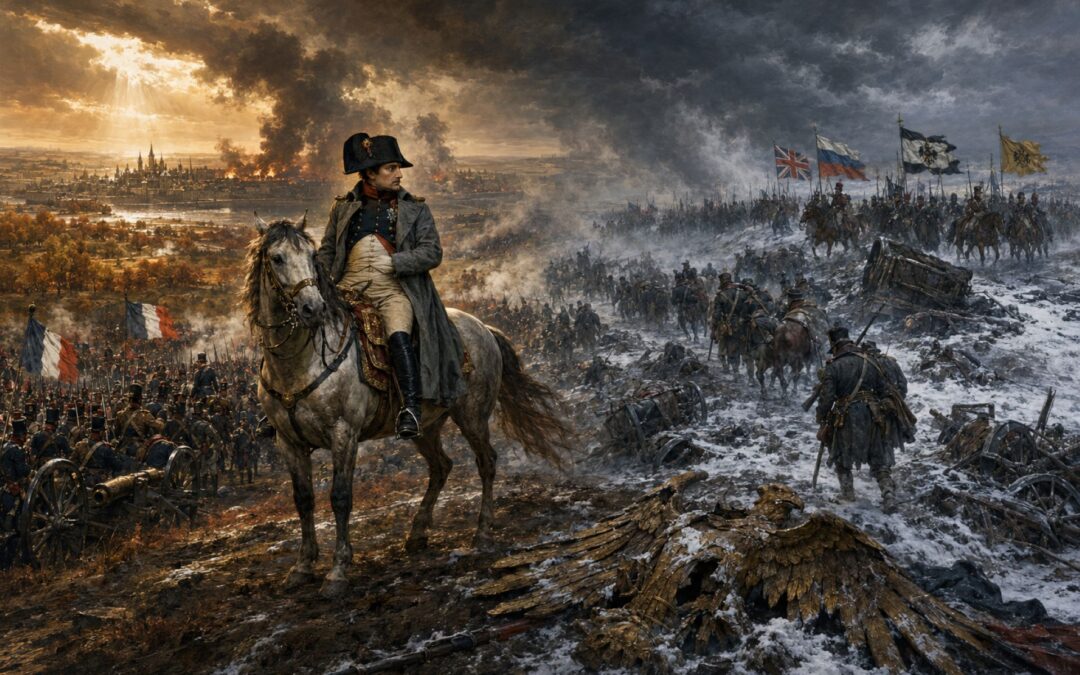
In June 1812, the largest army Europe had ever seen crossed the Niemen River into the Russian Empire.
Napoleon Bonaparte had assembled soldiers from across France and its allies, satellites, and conquered territories. Poles, Italians, Germans, Dutchmen, Swiss, Croats, and others marched alongside French troops. Together, they belonged to the Grande Armée, the military instrument that had humbled Austria, shattered Prussia, defeated Russia, redrawn Germany, occupied Spain, and made Napoleon the dominant ruler on the European continent.
The invasion was supposed to force Russia back into Napoleon’s economic war against Britain. Instead, it destroyed the army on which his empire depended.
Yet Russia alone did not defeat Napoleon. Nor did a single bad decision suddenly erase an otherwise invincible empire. The Napoleonic Wars were a long contest between French military power and coalitions that gradually learned how to resist it. Napoleon’s victories expanded the territory he had to control, strengthened the enemies determined to stop him, and pushed him toward increasingly costly campaigns.
The same system that allowed him to move quickly, concentrate overwhelming force, and destroy divided opponents worked brilliantly when wars were short and decisive. It became far less effective when Napoleon faced guerrillas in Spain, economic resistance across Europe, immense distances in Russia, improved enemy armies, and a coalition finally capable of coordinating its strategy.
The Napoleonic Wars were not simply a succession of French victories followed by one disastrous winter. They were the story of how revolutionary France overturned Europe’s military order, how Napoleon converted that transformation into an empire, and how Europe adapted until it could defeat him.
Corsica, Military School, and the Outsider’s Ambition
Napoleon Bonaparte was born on 15 August 1769 in Ajaccio, Corsica, only a year after France acquired the island from the Republic of Genoa.
His family belonged to the minor Corsican nobility, which made it possible for him to attend military schools in mainland France. He entered the artillery, a branch that rewarded mathematical skill and technical competence more readily than the prestigious cavalry regiments dominated by wealthy aristocrats.
Napoleon was not born into the ruling circles of France. He spoke French with a Corsican accent, came from a relatively modest family, and initially identified strongly with his native island. His outsider status left him ambitious, defensive, and acutely conscious of rank.
Under the old monarchy, his prospects would probably have remained limited. Senior military commands were heavily influenced by birth, wealth, and aristocratic connections.
Then the French Revolution destroyed the hierarchy that had kept men like him away from power.
How the French Revolution Created Napoleon’s Opportunity
The Revolution did more than overthrow a king. It transformed the scale, organization, and political meaning of war.
After revolutionary France declared war on Austria in 1792, other European monarchies joined the conflict. They feared French expansion, revolutionary ideology, and the possibility that rebellion might spread across their own territories. France, meanwhile, portrayed the wars as a struggle for national survival against rulers determined to restore the monarchy.
The revolutionary government introduced mass conscription, mobilized national resources, promoted officers according to ability, and created armies far larger than those fielded by traditional monarchies. Military service was no longer merely the profession of a relatively small royal army. It became a national obligation linked to citizenship and the defence of the Revolution.
The turmoil created extraordinary opportunities for young officers.
Napoleon first attracted major attention during the siege of Toulon in 1793. Royalists had surrendered the important Mediterranean port to British and allied forces. Napoleon developed an artillery plan that helped the republican army retake the city, earning him promotion to brigadier general at the age of 24.
His political position remained precarious. He had connections with the Jacobins and briefly fell under suspicion after the overthrow of Maximilien Robespierre. But in October 1795, the government again needed his military skills when royalists launched an uprising in Paris.
Napoleon helped suppress the revolt with artillery, establishing himself as a defender of the new regime.
These events formed the bridge between the French Revolution and the wars that would bear his name. The Revolution dismantled the old military order, expanded the French army, and created the conditions in which a talented artillery officer could rise with astonishing speed.
Italy and Egypt: How Napoleon Constructed a National Hero
In 1796, Napoleon received command of the French Army of Italy.
The army he inherited was poorly supplied and demoralized. France’s principal offensives were expected to take place farther north, while the Italian front was treated as secondary. Napoleon turned it into the campaign that made him famous.
Austria and the Kingdom of Piedmont-Sardinia fielded separate armies. Napoleon moved rapidly between them, preventing them from combining and defeating them individually. His forces repeatedly concentrated against vulnerable points before the enemy could respond.
Speed became one of his defining advantages.
Napoleon also understood that military success had to be converted into political reputation. He issued dramatic proclamations, cultivated newspaper coverage, commissioned images, and sent carefully written reports to Paris. He did not merely win victories. He shaped how those victories were understood.
The Italian campaign forced Piedmont-Sardinia out of the war, drove Austrian forces from much of northern Italy, and brought French armies close enough to Vienna to compel Austria to negotiate. France acquired territory, money, art, and influence. Napoleon returned as the republic’s most celebrated general.
Britain, however, remained at war.
A direct invasion was difficult because the Royal Navy controlled the seas. Napoleon therefore proposed an expedition to Egypt, hoping to threaten British connections with India while expanding French influence in the eastern Mediterranean.
The French army captured Malta and defeated Mamluk forces near Cairo in 1798. But Admiral Horatio Nelson destroyed the French fleet at the Battle of the Nile, trapping Napoleon’s army in Egypt.
The expedition continued into Ottoman Syria, where French forces failed to capture Acre. Disease, resistance, and British and Ottoman intervention undermined the campaign. Napoleon eventually left the army and returned to France.
Militarily, Egypt had failed to break British power. Intellectually, however, the expedition had enormous consequences. Napoleon brought scholars, engineers, artists, and scientists who studied the region and helped produce the monumental Description de l’Égypte. A French soldier also discovered the Rosetta Stone, which later allowed scholars to decipher Egyptian hieroglyphs.
The campaign revealed a pattern that would recur throughout the Napoleonic Wars. Napoleon could win spectacular land battles, but British naval power limited what those victories could achieve.
The Coup of 18 Brumaire: From General to Ruler
Napoleon returned to a France exhausted by political instability and renewed warfare.
The Directory, which had governed since 1795, suffered from corruption, financial problems, disputed elections, and a weak constitutional structure. It relied increasingly on the military to overturn unfavourable electoral results and suppress opposition.
Emmanuel-Joseph Sieyès, one of the five directors, wanted to replace the government with a stronger executive. Napoleon supplied the reputation, popularity, and military authority the plot required.
On 9 and 10 November 1799—18 and 19 Brumaire under the revolutionary calendar—the conspirators overthrew the Directory. The coup was less orderly than later Napoleonic propaganda suggested. Napoleon struggled when confronted by hostile legislators, while soldiers ultimately dispersed the Council of Five Hundred.
A new constitution established the Consulate, nominally led by three consuls. In practice, power rested with the First Consul, Napoleon.
The wars had created the general who now took control of the state directing them.
Napoleon still had to confront the Second Coalition. In 1800, he crossed the Alps and entered northern Italy, where French forces narrowly defeated Austria at Marengo. Another French victory at Hohenlinden placed further pressure on Vienna.
Austria made peace in 1801. Britain followed with the Treaty of Amiens in 1802.
For the first time in a decade, Europe was briefly at peace.
How Napoleon Rebuilt France—and Built a Dictatorship
Napoleon used the respite to stabilize France and strengthen the machinery that would later sustain his wars.
He reorganized tax collection, encouraged financial stability, established the Bank of France, centralized administration, and appointed prefects to govern departments. He expanded state-supervised secondary education through the lycée system and promoted careers based partly on examination, training, and service.
The Concordat of 1801 restored formal relations with the Catholic Church without returning the Church to its position under the old monarchy. Catholic worship could resume openly, but the state retained significant control over appointments and did not restore confiscated Church property.
Napoleon’s most enduring institutional achievement was the Civil Code of 1804, later known as the Napoleonic Code.
French law before the Revolution varied significantly by region. Napoleon appointed a commission of jurists to create a unified code and personally chaired many of the discussions that brought the project to completion. The Library of Congress’s history of the Civil Code explains how it consolidated revolutionary and pre-revolutionary legal traditions into a common framework.
The Code protected property, established civil equality among men, ended many surviving feudal distinctions, and created clearer rules governing contracts, inheritance, and family life. French conquest later carried versions of this legal system across Europe, and its influence survived Napoleon’s empire.
But legal uniformity did not mean universal liberty.
The Code strengthened the authority of husbands and fathers, restricted married women’s legal independence, and embedded an unequal model of family life. The Library of Congress materials on women in Napoleonic France illustrate the distance between revolutionary declarations of equality and women’s position under the Napoleonic legal order.
Napoleon also restricted newspapers, censored books and theatre, employed an extensive police apparatus, manipulated plebiscites, and gradually reduced meaningful political opposition. His government preserved equality before the law for male citizens while eliminating the competitive republican politics that had brought him to power.
The contradiction extended beyond Europe.
The revolutionary government had abolished slavery in the French colonies in 1794. Napoleon’s government restored or maintained slavery through a series of measures beginning in 1802, although the legal and practical circumstances differed across individual colonies. The attempted restoration of French authority in Saint-Domingue contributed to a brutal war that ended with the creation of independent Haiti in 1804. The Fondation Napoléon’s examination of Napoleon and slavery documents one of the darkest reversals of the revolutionary period.
Napoleon brought order after a decade of upheaval, but the price of that stability was personal rule.
From First Consul to Emperor
In 1802, Napoleon became First Consul for Life. Two years later, the Senate proclaimed him Emperor of the French.
The transformation was legitimized through a plebiscite that reported overwhelming public approval, but voting under Napoleon was carefully managed and could not be treated as a free democratic contest. Popular support was real, particularly after restored order, administrative reform, and military victory. So was state manipulation.
Napoleon’s coronation took place at Notre-Dame Cathedral on 2 December 1804. Pope Pius VII attended, but Napoleon placed the crown on his own head before crowning Joséphine.
The gesture communicated that his legitimacy did not come from the pope or from the hereditary traditions of Europe’s older monarchies. He presented the empire as the product of national approval, revolutionary achievement, and his own authority.
Yet Napoleon was also creating a dynasty. He distributed thrones, titles, and territories among relatives, generals, and loyal officials. France had abolished inherited privilege only to receive a new imperial nobility.
The empire did not simply reverse the Revolution. It institutionalized some revolutionary changes while stripping them of republican government.
This political transformation alarmed Europe’s monarchies, but ideology was only one cause of renewed war. Britain and France had both violated aspects of the Treaty of Amiens, disagreed over colonial and European territories, and remained locked in a broader struggle for power.
Britain declared war again in 1803.
The Napoleonic Wars had begun.
The Grande Armée and Napoleon’s Mastery of Europe
Napoleon assembled an army near Boulogne for a planned invasion of Britain. The invasion depended on gaining temporary control of the English Channel, something the French and allied navies could not reliably achieve.
Britain responded to French expansion by helping organize the Third Coalition with Austria, Russia, Sweden, and Naples.
Napoleon abandoned his immediate invasion plan and turned the army east. What followed demonstrated why the Grande Armée was so dangerous.
Rather than moving as one enormous mass tied to a single supply train, Napoleon divided the army into corps. Each corps combined infantry, cavalry, artillery, and supporting units, allowing it to march independently and survive long enough to receive reinforcements. The corps could move along separate roads, cover more territory, and concentrate rapidly when battle approached.
Napoleon marched approximately 200,000 men from the Channel coast toward the Danube. At Ulm in October 1805, French forces enveloped an Austrian army under General Karl Mack and compelled it to surrender.
Napoleon had destroyed a major enemy formation primarily through movement and encirclement.
The naval war produced the opposite result. At Trafalgar, Nelson’s fleet decisively defeated the combined French and Spanish fleet. Nelson was killed, but the victory confirmed British naval supremacy and made a French invasion of Britain extremely unlikely.
On land, Russian and Austrian armies continued the campaign. Napoleon confronted them at Austerlitz on 2 December 1805.
He encouraged the Allies to believe that his position was weaker than it was, deliberately leaving his right flank looking vulnerable. When allied troops descended from the Pratzen Heights to attack it, French forces struck the weakened centre, seized the heights, and split the allied army.
Austerlitz became Napoleon’s most celebrated victory.
It also became surrounded by propaganda. The story that French artillery shattered the ice beneath thousands of retreating soldiers was greatly exaggerated. Contemporary recovery evidence indicates that the number of human bodies found in the drained ponds was tiny compared with Napoleon’s claims. The victory was real enough without the legend.
Austria withdrew from the war. The subsequent settlement increased French influence in Germany, and Napoleon created the Confederation of the Rhine under his protection. In 1806, Emperor Francis II dissolved the Holy Roman Empire, ending an institution that had existed for roughly a thousand years.
Prussia now feared the destruction of its influence in Germany. It entered the war in October 1806, but its army remained attached to an older military system and suffered from divided command.
Napoleon crushed the Prussians at the twin battles of Jena and Auerstedt. French forces occupied Berlin and pursued the survivors east, where they joined the Russians.
The winter campaign in Poland proved far more difficult. Eylau in February 1807 was a bloody and inconclusive battle fought in appalling conditions. Napoleon’s army was not invincible, and Russian forces could withstand punishment that had rapidly broken other opponents.
At Friedland in June, however, Napoleon trapped the Russian army against the Alle River and inflicted a decisive defeat.
Napoleon and Tsar Alexander I met at Tilsit. Russia became a reluctant partner in Napoleon’s continental system, while Prussia lost substantial territory. New French-aligned states, including the Duchy of Warsaw and the Kingdom of Westphalia, arose from the settlement.
By 1807, Napoleon appeared to be the master of continental Europe.
But Britain remained undefeated.
Trafalgar, Tilsit, and the Continental System
Britain and France possessed different kinds of power.
Napoleon could defeat Britain’s continental allies, occupy their capitals, and impose treaties. Britain controlled the seas, protected its islands, disrupted French colonial ambitions, subsidized European coalitions, and traded through an expanding global network.
After Trafalgar made invasion impractical, Napoleon attempted to defeat Britain economically.
The Berlin Decree of 1806 declared the British Isles under blockade and prohibited European trade with Britain. Later measures expanded what became known as the Continental System. Napoleon hoped that excluding British goods from European markets would create unemployment, financial distress, and political pressure for peace.
Britain retaliated with Orders in Council restricting neutral trade with France and French-controlled Europe. The conflict pulled neutral merchants into an economic war between two powers that each claimed the right to regulate trade.
The system hurt sections of the British economy, but Britain found alternative markets in the Americas and elsewhere. Its navy could enforce maritime restrictions more effectively than Napoleon could patrol every European port, coastline, border, and warehouse.
Smuggling flourished. Merchants, consumers, local officials, and even members of Napoleon’s own family found ways around the restrictions. Some protected continental industries benefited from the exclusion of British competition, but ports and regions dependent on international commerce suffered.
The blockade also created a political trap. Every breach appeared to demand stronger enforcement. Stronger enforcement required greater French interference in allied and neutral states. That interference produced resentment, resistance, annexation, and war.
Portugal, a traditional British ally, refused to close its economy completely to British trade. Napoleon decided to compel it.
To reach Portugal, French armies had to pass through Spain.
The attempt to seal the Continent against Britain was about to open one of the most destructive fronts of the war.
Spain, Portugal, and the First Cracks in the Empire
Spain was formally allied with France, but the relationship had already become strained. Trafalgar had destroyed much of the Spanish fleet, while the Spanish monarchy was divided between King Charles IV, his son Ferdinand, and the influential minister Manuel Godoy.
French forces entered Spain under the pretext of invading Portugal. They occupied strategic positions and fortresses along the way.
Napoleon then summoned the Spanish royal family to Bayonne, pressured both Charles and Ferdinand to surrender their claims, and placed his brother Joseph Bonaparte on the Spanish throne.
Napoleon believed he was removing a corrupt and incompetent dynasty. Many Spaniards saw something simpler: a foreign conqueror had kidnapped their monarchy and imposed his brother as king.
An uprising in Madrid in May 1808 was brutally suppressed, but resistance spread across the country. Provincial juntas raised armies in Ferdinand’s name. Civilians, soldiers, priests, landowners, peasants, smugglers, and irregular fighters participated for different political, religious, and local reasons.
The term “guerrilla,” derived from the Spanish expression for “little war,” became associated with the irregular warfare that harassed French troops, intercepted couriers, attacked supply lines, and made occupation dangerous.
The conflict was savage. French armies conducted reprisals against communities suspected of supporting guerrillas. Irregular fighters tortured and killed isolated French troops and collaborators. Conventional battles unfolded alongside insurgency, occupation, famine, and political revolution.
Britain now had a continental battlefield on which it could deploy an army under Arthur Wellesley, the future Duke of Wellington. British forces operated from Portugal with Portuguese and Spanish allies, protected by the Royal Navy and increasingly supported by secure defensive and logistical systems.
The National Army Museum’s history of the Peninsular War shows how the conflict tied down French forces for years before Wellington’s armies began driving them out of Iberia and into France.
Austria saw its opportunity and launched another war in 1809.
This time, Napoleon faced an Austrian army that had studied earlier defeats and introduced reforms. At Aspern-Essling, the Austrians inflicted Napoleon’s first major battlefield defeat as emperor. He recovered and won a costly victory at Wagram, forcing Austria to make peace once again.
Napoleon subsequently divorced Joséphine, who had not produced an heir, and married Marie Louise, daughter of the Austrian emperor. Their son was born in 1811.
The marriage gave Napoleon a dynastic connection to one of Europe’s oldest ruling houses. It did not resolve the growing structural problems of his empire.
Hundreds of thousands of troops were absorbed by Iberia. The Continental System remained porous. Britain still controlled the seas. France’s allies increasingly experienced Napoleonic rule not as liberation from feudalism but as taxation, conscription, economic restriction, and foreign domination.
The empire looked immense.
It was also becoming expensive to hold together.
Russia 1812: The Campaign That Broke the Grande Armée
The alliance created at Tilsit had never eliminated the rivalry between Napoleon and Alexander.
Russia suffered economically under the Continental System and increasingly allowed trade that undermined the blockade. Alexander disliked Napoleon’s support for the Duchy of Warsaw, fearing it could become the foundation for a restored Polish state. Napoleon’s annexations and marriage into the Austrian dynasty created further suspicions.
By 1812, both empires were preparing for war.
Napoleon assembled a multinational army of roughly half a million men for the initial invasion, with additional troops protecting communications, garrisons, and flanks. The precise totals vary because historians count reinforcements and allied contingents differently. What is clear is that the force was enormous, diverse, and extremely difficult to supply.
It crossed into Russia in June.
Napoleon wanted to isolate and destroy the main Russian armies in a decisive battle near the frontier. Russian commanders repeatedly withdrew, denying him the quick victory his strategy required.
The Grande Armée advanced along poor roads through regions unable to feed such a vast concentration of soldiers and animals. Supply wagons fell behind. Horses died. Food disappeared. Disease spread through crowded camps. Heat, exhaustion, desertion, and hunger reduced the army long before winter arrived.
This matters because the popular image of the campaign beginning successfully and then being destroyed by snow is wrong.
The army was already disintegrating during the summer.
Russian forces continued to retreat, sometimes destroying supplies that might help the invaders. Napoleon captured Smolensk, but the Russian armies escaped.
The Russians finally turned to fight near Borodino in September. The resulting battle became one of the bloodiest single days of the Napoleonic Wars. Napoleon captured the field, but he did not destroy the Russian army.
The Russians withdrew and abandoned Moscow.
When the French entered, much of the city was empty. Fires soon consumed large areas. Russians, French looters, official orders, abandoned buildings, and the city’s wooden construction may all have contributed, but responsibility for the burning remains disputed.
Napoleon expected Alexander to negotiate after losing Moscow.
The tsar refused.
For more than a month, Napoleon waited for a response that never came. Meanwhile, the Russian army recovered south of the city, the French supply position deteriorated, and winter approached.
Napoleon finally ordered a retreat in October.
Russian forces pressured the withdrawing army and pushed it toward routes that had already been stripped of food. Cold intensified the suffering, but hunger, disease, exhaustion, collapsing discipline, and the loss of horses were equally devastating. Cossacks and other Russian units attacked vulnerable stragglers and isolated formations.
At the Berezina River, French engineers built bridges under extraordinary pressure, allowing Napoleon and much of the remaining army to escape encirclement. Thousands were nevertheless killed, captured, or drowned during the crossing and surrounding battles.
Napoleon left the army and hurried back to Paris after learning of an attempted coup.
Only a fraction of the invasion force returned in organized condition. The Grande Armée had not been completely annihilated, and Napoleon still controlled substantial resources, but the veteran army that had enforced his dominance was gone.
Russia revealed the limits of a military system built around rapid movement and decisive concentration. Napoleon had advanced too far to sustain his army, failed to force the political settlement he expected, and discovered that capturing territory was meaningless when the enemy government refused to surrender.
Europe now knew he could be beaten.
Leipzig, the Invasion of France, and the First Abdication
The destruction of the Grande Armée transformed the political balance.
Prussia broke with Napoleon and joined Russia. Popular enthusiasm for a war of liberation helped the Prussian state mobilize troops on a new scale. Britain increased financial support for the continental war. Sweden joined the coalition under Crown Prince Charles John, formerly Napoleon’s Marshal Bernadotte.
Austria initially remained neutral, hoping to mediate and preserve room for negotiation.
Napoleon returned to France and raised another army with remarkable speed. The new troops included large numbers of young conscripts. He could replace infantry more easily than experienced officers, cavalrymen, and horses.
That shortage mattered. Napoleon could still win battles, but he struggled to pursue and destroy defeated armies.
In the spring of 1813, he defeated coalition forces at Lützen and Bautzen. The Allies retreated without suffering the kind of decisive destruction that had ended earlier coalitions.
A temporary armistice gave both sides time to reorganize. Austria offered terms that would have reduced Napoleon’s empire but left him ruling a powerful France. He refused to make concessions sufficient to secure peace.
Austria joined the coalition.
The Allies had learned from repeated failure. Their armies were now larger, better organized, and supported by more effective diplomacy. They also adopted a strategy associated with the Trachenberg discussions: avoid major battle with Napoleon when possible, attack the armies commanded by his marshals, and converge only after weakening his wider position.
Napoleon won at Dresden in August, but his subordinates suffered defeats elsewhere. The coalition armies closed around Leipzig in October.
The Battle of Leipzig, also called the Battle of the Nations, involved hundreds of thousands of soldiers from across Europe. French forces fought Russians, Prussians, Austrians, Swedes, and other coalition troops over several days.
Napoleon could not defeat them individually before they concentrated.
He ordered a retreat, but the only major bridge available to his army was destroyed prematurely, trapping thousands of French troops on the wrong side of the river.
Leipzig ended French dominance in Germany. States of the Confederation of the Rhine abandoned Napoleon, and the coalition advanced toward France.
Meanwhile, Wellington’s army had driven French forces out of Spain and crossed the Pyrenees. The empire was collapsing from multiple directions.
Napoleon conducted a brilliant defensive campaign in France during the opening months of 1814. Moving with a relatively small army, he defeated separated coalition forces in several engagements. But battlefield skill could not compensate for the overwhelming strategic position.
The Allies advanced on Paris.
Napoleon wanted to continue fighting, but his marshals would no longer support an apparently hopeless war. He abdicated in April 1814 and was sent to rule the small island of Elba.
Louis XVIII, brother of the executed Louis XVI, became king of France.
After more than two decades of revolutionary and Napoleonic warfare, Europe appeared to have found peace.
It lasted less than a year.
The Hundred Days and Waterloo
Napoleon retained the title of emperor on Elba, but he had little intention of disappearing quietly.
The restored Bourbon monarchy faced serious problems. Returning émigrés created fears that revolutionary land settlements might be reversed. Army officers resented the loss of positions and status. Veterans remained attached to the emperor under whom they had won promotions and glory.
Napoleon also learned that the financial settlement promised to him was not being honoured and feared that the European powers might move him to a more remote location.
In February 1815, he escaped Elba and landed in France with approximately a thousand men.
Royal forces were sent to arrest him. Instead, soldiers defected to his side. Napoleon advanced toward Paris as support for Louis XVIII collapsed. The king fled, and Napoleon resumed power without fighting a major battle.
The European powers gathered at Vienna did not accept his return. They declared Napoleon an outlaw and formed the Seventh Coalition.
Napoleon knew that Russia, Austria, Prussia, and Britain would eventually assemble overwhelming forces. His best chance was to strike before all their armies could combine.
He invaded the United Kingdom of the Netherlands, where an Anglo-Allied army under Wellington and a Prussian army under Field Marshal Gebhard von Blücher were positioned relatively close together.
Napoleon intended to drive between them and defeat each separately.
On 16 June, he defeated the Prussians at Ligny, his final battlefield victory. On the same day, French forces failed to take decisive control of the crossroads at Quatre Bras.
The Prussian army retreated but did not disintegrate. Crucially, it moved in a direction that allowed it to remain in contact with Wellington.
Two days later, Napoleon attacked Wellington’s position near Waterloo.
Heavy rain had softened the ground, delaying French movements and making it harder to use artillery effectively. French attacks struck the fortified positions at Hougoumont and La Haye Sainte, while infantry and cavalry assaults attempted to break Wellington’s line.
The Anglo-Allied army held.
Napoleon had sent Marshal Grouchy with a separate force to pursue the Prussians, but Grouchy could not prevent Blücher from marching toward Waterloo. Prussian troops began arriving on Napoleon’s flank during the afternoon.
The French captured La Haye Sainte and placed Wellington’s centre under severe pressure, but time was running out. Napoleon committed the Imperial Guard in a final attempt to break the Allied line.
The attack failed.
When parts of the Guard retreated, panic spread through the French army. Wellington ordered a general advance while the Prussians intensified their assault. Napoleon’s army collapsed.
Waterloo was not merely a contest between Napoleon and Wellington. It was a coalition victory made possible by Anglo-Allied resistance, Prussian recovery after Ligny, and the determination of two armies to support one another. The National Army Museum’s Waterloo account details how the Prussians reorganized and reached the battlefield in time to complete Napoleon’s defeat.
Napoleon returned to Paris and abdicated again.
This time, the Allies would not allow him another return.
Saint Helena and the Battle Over Napoleon’s Legacy
Napoleon hoped to receive asylum in Britain or travel to the United States. Instead, he surrendered to the British and was exiled to Saint Helena, a remote island in the South Atlantic.
Unlike Elba, Saint Helena offered virtually no possibility of escape.
Napoleon spent his final years at Longwood House, surrounded by a small group of companions and closely monitored by the island’s British governor, Hudson Lowe. He dictated accounts of his career, defended his decisions, blamed subordinates and enemies, and shaped the version of his life that future generations would inherit.
This was Napoleon’s final campaign: the struggle over memory.
He portrayed himself as the defender of the French Revolution, the builder of modern institutions, and the victim of reactionary monarchies determined to suppress national freedom. His enemies described him as an insatiable conqueror whose ambition had condemned Europe to war.
Both interpretations contained part of the truth.
Napoleon did spread legal equality for men, administrative rationalization, religious toleration, careers based more heavily on talent, and the destruction of feudal privileges. His conquests accelerated political change in Germany, Italy, Poland, Spain, and elsewhere.
But these reforms travelled with armies.
French occupation also meant conscription, taxation, censorship, economic exploitation, the removal of art and wealth, dynastic appointments, and the suppression of resistance. Napoleon liberated territories from older institutions only to subordinate them to his empire.
The same ambiguity surrounds responsibility for the wars. European monarchies had fought revolutionary France before Napoleon took power, and Britain, Austria, Russia, and Prussia pursued their own strategic ambitions. The wars cannot be reduced to one man attacking an otherwise peaceful continent.
Yet Napoleon repeatedly rejected settlements that would have preserved substantial French power. His appetite for control, insistence on enforcing the Continental System, interference in Spain, invasion of Russia, and refusal to accept limits made lasting peace increasingly difficult.
The coalitions defeated him because they adapted.
They reformed their armies, improved coordination, mobilized larger sections of their populations, used British finance and naval power, avoided repeating the same battlefield mistakes, and continued fighting after defeats that would once have ended a campaign.
Napoleon died on Saint Helena on 5 May 1821 at the age of 51. The autopsy identified serious damage to his stomach, and the principal medical explanation remains gastric disease or stomach cancer. Later claims that he was murdered with arsenic have attracted attention, but the Fondation Napoléon’s examination of the evidence finds the cancer diagnosis far more persuasive than deliberate poisoning.
His remains were returned to France in 1840 and eventually placed beneath the dome of Les Invalides in Paris.
By then, the man had become a legend.
Napoleon is remembered as one of history’s greatest commanders, but the Napoleonic Wars cannot be understood through military genius alone. His victories depended on revolutionary institutions, mass armies, capable marshals, disciplined soldiers, and opponents who initially failed to coordinate. His defeat came when those opponents adopted the methods of mass mobilization, administrative reform, and coalition warfare that France had pioneered.
Napoleon transformed Europe, but he could not control everything his wars unleashed.
National resistance grew stronger. Monarchies learned to reform. Coalition armies became harder to destroy. Economic warfare expanded the conflict beyond the battlefield. Every conquest produced new borders to defend, new populations to govern, and new enemies waiting for an opportunity.
The empire did not collapse because Napoleon suddenly stopped being brilliant.
It collapsed because brilliance could no longer compensate for the scale of the system he had built.
Last Updated on July 12, 2026 by Aseem Gupta