
In 241 BCE, a Roman fleet appeared off the western coast of Sicily.
By then, Rome had been fighting Carthage for more than two decades. It had lost entire armies, squandered fortunes and watched hundreds of ships disappear beneath the Mediterranean. Storms had inflicted damage on a scale that no enemy fleet had managed. Thousands of citizens and Italian allies had drowned. The public treasury was nearly empty.
Any reasonable state might have accepted that the war could not be won.
Rome built another fleet.
The ships approaching the Aegates Islands were financed largely by wealthy citizens, who expected repayment if the campaign succeeded. Their crews had been trained relentlessly. Their commanders understood that Rome might never be able to afford another attempt.
Waiting for them was a Carthaginian fleet carrying supplies and reinforcements to the remaining Carthaginian strongholds in Sicily. Carthage had dominated the western Mediterranean before the war. It had been richer than Rome, more experienced at sea and supported by generations of maritime knowledge.
Yet it was Rome that won the battle.
The victory ended the First Punic War, a 23-year conflict that transformed Rome from an Italian land power into the dominant state of the western Mediterranean. It was not a smooth or inevitable rise. Rome repeatedly misunderstood the sea, underestimated the weather and placed enormous forces under reckless commanders. Carthage defeated Roman armies, destroyed Roman fleets and came close to breaking the invasion of its homeland.
Rome survived every failure.
That was the central fact of the First Punic War. Rome did not win because it avoided mistakes. It won because its political system, alliance network, manpower reserves and capacity for adaptation allowed it to keep fighting after mistakes that would have destroyed almost any other ancient state.
Rome and Carthage Before the First Punic War
The war began before Rome became the empire most people imagine when they hear its name.
There was no emperor. Rome did not rule the Mediterranean. It had only recently completed its conquest of most of the Italian peninsula, defeating or absorbing a succession of Latin, Etruscan, Samnite and Greek opponents. Its victory over Pyrrhus of Epirus had demonstrated that Rome could survive defeat, mobilize new armies and slowly exhaust a celebrated Hellenistic commander.
But Rome remained primarily a continental power.
Carthage was different.
Traditionally founded by Phoenician settlers from Tyre in the ninth century BCE, Carthage had grown into one of the wealthiest cities in the Mediterranean. Its location on the North African coast placed it close to major sea routes connecting the eastern and western halves of the Mediterranean.
Carthaginian influence extended through parts of North Africa, western Sicily, Sardinia, Corsica and other islands. Its merchants traded in metals, agricultural products, manufactured goods, ivory, slaves and luxury commodities. Its navy defended those networks and helped maintain Carthage’s position as the leading maritime power in the region.
This did not make Carthage a society of merchants who hired other people to do all their fighting. Its political system, armed forces and relationships with subject communities were considerably more complicated. Carthaginian citizens served prominently at sea, while its armies drew soldiers from Libya, Numidia, Iberia, the Balearic Islands, Gaul and the Greek world.
These forces are often described collectively as mercenaries, but they included allies, subject levies and troops raised through different political arrangements. Their diversity could create difficulties, especially when pay or loyalty became uncertain, but Carthaginian armies were capable of extraordinary discipline and battlefield performance.
Carthage has also been remembered disproportionately through the accusations of its enemies. Greek and Roman writers claimed that the Carthaginians sacrificed children to their gods. Archaeological discoveries in the city’s tophet have led some researchers to argue that sacrifice did occur, although the interpretation of the evidence remains contested. The disagreement between the Oxford researchers who consider the evidence convincing and the continuing scholarly debate over the human remains illustrates a broader problem: much of what survives about Carthage was written by cultures that fought and eventually destroyed it.
Rome and Carthage were not always enemies. They had concluded treaties regulating trade, navigation and their respective spheres of influence. Carthage had even cooperated with Rome during the war against Pyrrhus.
Nevertheless, their expanding interests were moving closer together.
Between them lay Sicily.
The island occupied a commanding position in the central Mediterranean. Its fertile land produced grain, while its ports controlled routes between Italy, North Africa and the wider Mediterranean. The western part of the island fell largely within Carthage’s sphere. The east contained Greek cities, the most powerful of which was Syracuse.
For centuries, Carthage and the Sicilian Greeks had competed over the island without either side establishing complete control.
Rome’s arrival changed that balance.
How the Mamertines Turned Messana Into an International Crisis
The immediate cause of the First Punic War was not a carefully planned invasion.
It was a crisis created by unemployed mercenaries.
The Mamertines had served Agathocles, the ruler of Syracuse. After his death, they seized Messana, the strategically important city now known as Messina. According to the ancient historian Polybius, they killed or expelled many of the male inhabitants, took their families and divided their property.
From Messana, the Mamertines raided the surrounding territory. Their position on the narrow strait between Sicily and Italy gave them control over an important crossing point, but it also made them a threat to Syracuse.
Hiero II, the new ruler of Syracuse, eventually defeated them and placed Messana under pressure. Facing destruction, the Mamertines looked for a powerful protector.
Some appealed to Carthage.
The Carthaginians recognized the strategic opportunity. A Carthaginian garrison inside Messana would prevent Syracuse from controlling the strait and limit Rome’s ability to intervene in Sicily. Carthaginian troops entered the city, and a fleet took up a nearby position.
Other Mamertines then appealed to Rome.
The request created an uncomfortable political problem. Rome had recently punished another group of Campanian mercenaries for seizing the Italian city of Rhegium. Helping the Mamertines would expose Rome to an obvious charge of hypocrisy.
There was also the danger of war with Carthage.
The Roman Senate reportedly hesitated. Supporting the Mamertines meant crossing outside the Italian peninsula, entering Sicily and potentially confronting the greatest naval power in the western Mediterranean.
The Roman popular assembly nevertheless approved the intervention.
The decision may have been driven by several motives. Roman leaders feared that Carthaginian control of Messana would place a hostile power directly across the strait from Italy. Sicily offered military glory, resources and the possibility of further expansion. Rome’s annual magistracies also encouraged consuls to seek visible achievements during their short terms in office.
No single motive explains the decision.
Rome could view intervention as defensive while still recognizing its enormous offensive potential. Ancient states rarely separated security, prestige and expansion as neatly as later historians might prefer.
A Roman force crossed the strait under the consul Appius Claudius Caudex. The Carthaginian garrison withdrew from Messana, reportedly after negotiations with the Mamertines. Carthage then allied with its traditional enemy, Syracuse, to recover the city.
Roman intervention had turned a local dispute into a confrontation among the three major powers surrounding Sicily.
The historical commentary from Dickinson College describes Messana as the point where Rome’s first major military venture beyond Italy began. It was also the moment when neither Rome nor Carthage could retreat without surrendering influence and credibility.
The First Punic War had begun.
Rome’s Intervention Becomes a War for Sicily
Carthaginian and Syracusan forces surrounded Messana, but the alliance did not stop the Romans.
Roman troops broke the siege and defeated their opponents separately. The victory gave Rome a secure foothold on Sicily and encouraged other communities to reconsider their loyalties.
Hiero II soon changed sides.
Rather than continue fighting Rome and risk the destruction of Syracuse, he negotiated an alliance. The agreement was one of Rome’s most important early successes. Syracuse provided food, local intelligence and logistical support for Roman operations on an island where Rome had no established supply system.
The war was already expanding beyond its original justification.
Rome had crossed the strait ostensibly to protect the Mamertines. Once established in Sicily, however, Roman leaders began considering the possibility of driving Carthage from the island.
In 262 BCE, Roman armies besieged Agrigentum, one of Carthage’s most important positions in Sicily. The campaign exposed the difficulties of fighting overseas. Roman forces had to maintain a large army far from Italy, feed it through an uncertain supply network and operate in territory that could be attacked by Carthaginian cavalry.
The defenders of Agrigentum were also being starved, creating a brutal contest in which both sides struggled to outlast the other.
Carthaginian reinforcements eventually arrived, trapping the Romans between the garrison and a relief army. After months of hunger and skirmishing, the armies fought a major battle. Rome won, although the Carthaginian garrison escaped during the confusion.
Agrigentum demonstrated both the strength and the limitations of Roman power.
Rome could defeat Carthaginian armies on land. What it could not do was isolate Carthaginian strongholds or supply its own forces securely while Carthage controlled the surrounding waters.
Sicily was an island.
If Rome wanted to conquer it, Rome needed a navy.
How Rome Built a Navy and Changed Naval Warfare
The traditional version of the story presents Rome as a nation of farmers and soldiers that knew almost nothing about ships.
That goes too far.
Rome possessed some naval experience, and its coastal allies could provide ships and sailors. Roman forces could not have crossed into Sicily without maritime support. But there was an enormous difference between transporting troops across a narrow strait and challenging the Carthaginian battle fleet in open water.
Carthage possessed experienced crews, established naval infrastructure and generations of operational knowledge. Ancient warships required coordinated rowing, disciplined manoeuvring and commanders who understood wind, coastline and currents. Building hulls was only the beginning.
According to Polybius, a Carthaginian quinquereme ran aground and fell into Roman hands. The Romans used it as a model for their ships. His account describes the rapid construction of 100 quinqueremes and 20 smaller triremes.
The captured-ship story may simplify a more complicated process. Rome could draw upon the shipbuilding traditions of Greek and Italian coastal communities. Even so, the scale of the mobilization was remarkable. Rome was attempting to manufacture a battle fleet before it had enough experienced crews to use one effectively.
The weakness became obvious at Lipara in 260 BCE.
The consul Gnaeus Cornelius Scipio entered the harbour believing that the city might defect to Rome. A Carthaginian squadron trapped him inside. The Romans were outmanoeuvred, and Scipio was captured with much of his force.
Rome had ships.
It did not yet have naval superiority.
Its response was not to imitate Carthaginian tactics perfectly. Instead, the Romans changed the kind of battle being fought.
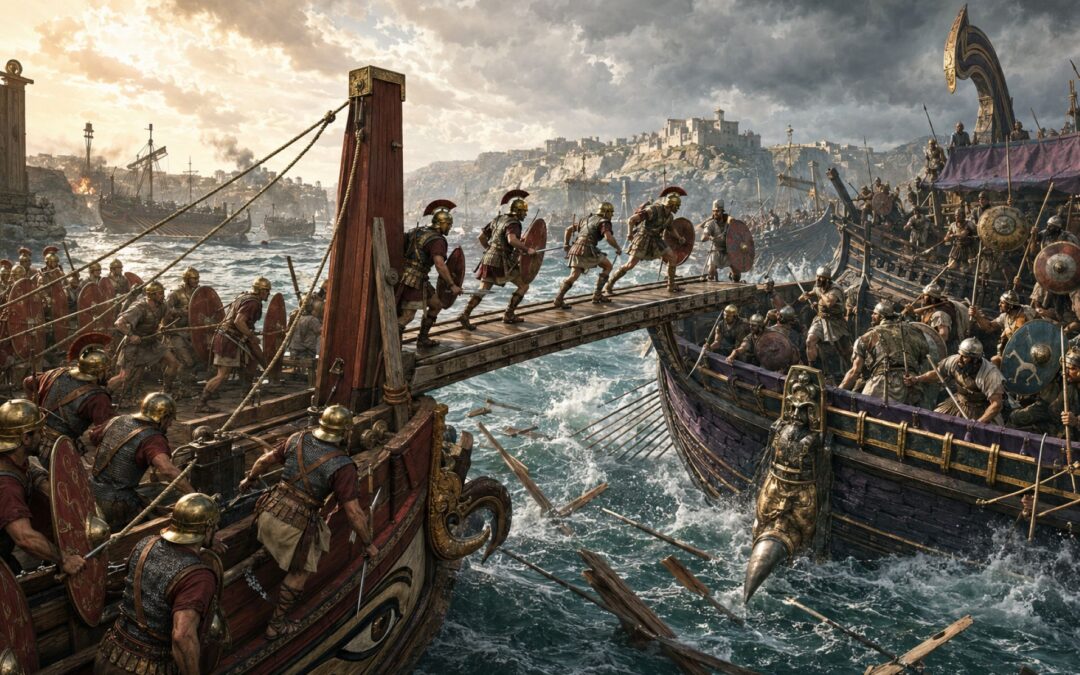
Roman ships were equipped with a boarding device later known as the corvus, or “raven.” It consisted of a narrow bridge with a heavy spike that could be dropped onto an enemy deck. Once the vessels were locked together, Roman infantry could cross the bridge and fight at close range.
Polybius provides a detailed description of the corvus and its use. It allowed Rome to transform a contest of naval manoeuvring into something closer to a land battle.
At Mylae, the Carthaginians initially approached with confidence. Roman crews were inexperienced, and the strange devices mounted on their ships did not appear threatening.
Then the corvi fell.
Carthaginian vessels were pinned in place. Roman soldiers crossed onto their decks with shields and swords. The leading Carthaginian ships were captured, while the remainder attempted to attack from different directions before withdrawing.
Mylae became Rome’s first major naval victory.
The corvus was important, but it was not a magical weapon that instantly made Rome master of the Mediterranean. It worked because Rome combined technology with large numbers of trained infantry. Carthage adapted by avoiding direct contact, attacking from the sides and searching for opportunities where Roman boarding tactics would be less effective.
The device may also have affected the stability of Roman ships, although claims that it caused Rome’s later storm losses remain disputed. Weather, poor navigation, dangerous coastlines and reckless command decisions provide more direct explanations.
Rome had not solved naval warfare.
It had found a way to compete.
Cape Ecnomus and Rome’s Gamble to Invade Africa
The war continued across Sicily and its surrounding waters, but neither side could deliver a decisive blow.
Rome therefore adopted a more ambitious plan.
Instead of continuing to fight for one Sicilian fortress after another, the Romans would invade North Africa and threaten Carthage itself. If Carthage had to defend its homeland, Rome might force it to abandon Sicily or accept peace.
The invasion required an enormous fleet.
In 256 BCE, Roman and Carthaginian forces met off Cape Ecnomus on the southern coast of Sicily. Polybius gives extraordinarily high numbers for the engagement, describing hundreds of warships and well over 200,000 sailors, rowers and soldiers.
If his figures are broadly accurate, Cape Ecnomus was one of the largest naval battles ever fought. Even if they are exaggerated, the battle was an operation on a staggering scale for the ancient world.
The Romans had to protect transports carrying infantry, supplies and horses. They arranged their principal squadrons in a wedge, with the transport ships behind them and another line protecting the rear.
The Carthaginians deployed in a long formation designed to surround the Romans. Their centre pulled back, drawing the Roman front forward while the Carthaginian wings attacked the exposed sides and transport ships.
The plan divided the battle into several separate engagements.
That division ultimately helped Rome. Carthaginian ships lost some of the freedom of movement on which their tactics depended. Roman vessels closed with them, deployed their boarding bridges and turned the encounter into a series of infantry fights.
The Roman centre defeated the Carthaginian force before turning back to assist the squadrons protecting the transports.
Rome had won.
The route to North Africa was open.
Regulus Comes Close to Victory—Then Xanthippus Reverses the War
The Roman army landed near Aspis and began raiding the Carthaginian countryside.
Carthage concentrated on protecting its capital, allowing the Romans to capture settlements, livestock, treasure and thousands of prisoners. The invasion also encouraged Carthage’s Numidian neighbours and African subjects to exploit its weakness.
One Roman consul returned to Italy with much of the fleet and the captured wealth. Marcus Atilius Regulus remained in Africa with a reduced army.
At first, his campaign went exceptionally well.
Carthaginian commanders made poor use of their strongest assets. They possessed excellent Numidian cavalry and war elephants but chose terrain that restricted both. Roman infantry attacked and defeated them, leaving Regulus free to advance towards Tunis.
Carthage appeared close to collapse. Refugees crowded into the capital. Food became scarce. Enemies attacked the surrounding territory.
The Carthaginians sought negotiations.
Regulus demanded severe terms. The precise details are uncertain, but ancient accounts agree that his conditions were harsh enough to convince Carthage that continued resistance was preferable to surrender.
The decision gave Carthage time to reorganize.
A Spartan mercenary commander named Xanthippus arrived and recognized that Carthage’s problem was not the quality of its soldiers but the way they were being used. He trained the army, restored confidence and insisted on fighting on open ground where cavalry and elephants could operate effectively.
The armies met near the Bagradas River in 255 BCE.
Carthaginian elephants attacked the Roman front. Numidian cavalry outflanked and drove away the weaker Roman horsemen. The Roman infantry fought stubbornly, but once it was surrounded, the outcome was unavoidable.
The African expedition was destroyed.
Regulus was captured. A small number of Roman soldiers escaped to Aspis, but Rome’s attempt to end the war by striking at Carthage had failed.
Later Roman tradition transformed Regulus into a moral hero. According to the famous story, Carthage released him so he could negotiate a prisoner exchange or peace. Regulus instead advised the Senate to continue fighting, honoured a promise to return and was tortured to death.
The tale became a symbol of Roman duty, but its historical reliability is doubtful. Polybius does not include it in his account, and the story developed through later literary traditions. Scholarship examining the transformation of Regulus from commander into legend supports separating his documented capture from the moral drama later built around him.
The real reversal was dramatic enough.
Carthage had been close to defeat. One competent commander, intelligent use of terrain and the effective combination of elephants and cavalry had destroyed the Roman invasion.
Rome now had to rescue the survivors.
The Sea Nearly Defeats Rome
Rome assembled another large fleet and sailed to Africa.
The Romans defeated the Carthaginian ships sent to stop them, collected the survivors at Aspis and began the return journey to Sicily.
Then the weather changed.
The fleet encountered a violent storm off the southern Sicilian coast. Polybius claimed that only 80 ships survived out of 364. Vessels were smashed against rocks and headlands. Wreckage and bodies covered the shore.
The precise death toll cannot be known. Ancient warships carried hundreds of rowers, sailors and soldiers, which means even a lower estimate would represent an appalling human catastrophe.
The disaster was not simply bad luck.
Experienced captains had reportedly warned the Roman commanders against taking the dangerous outer route at that time of year. The warnings were ignored. Roman audacity, which had produced extraordinary victories, had become recklessness.
Rome’s answer was extraordinary.
It ordered the construction of another fleet.
Polybius wrote that 220 ships were completed in three months. Whether every detail is accurate or not, Rome clearly possessed access to vast quantities of timber, labour, money and manpower. Italian communities provided ships, sailors, soldiers and resources on a scale Carthage struggled to match.
The new fleet returned to operations.
Soon Rome suffered another maritime disaster. Ships ran aground near North Africa and narrowly escaped, only for another storm to destroy more than 150 vessels during the voyage home.
Rome finally reduced its naval commitments and returned its attention to the land war.
This was not unbreakable confidence. It was exhaustion.
The Republic had reached the limits of what even its alliance system could replace immediately. Yet Rome did not negotiate peace. It continued fighting in Sicily while waiting for another opportunity.
Carthage had won the African campaign and watched the sea destroy multiple Roman fleets.
It still could not make Rome admit defeat.
Sicily Becomes a War of Sieges and Attrition
With large naval operations temporarily reduced, Sicily once again became the centre of the war.
Rome had captured Panormus, modern Palermo, giving it an important base on the northern coast. In 250 BCE, the Carthaginians attempted to recover the city.
The Roman commander Lucius Caecilius Metellus used the fortifications and terrain to neutralize the Carthaginian attack. Missile troops targeted the elephants, which panicked and disrupted the soldiers behind them. Roman forces then counterattacked.
The defeat cost Carthage many elephants and gave Rome renewed confidence.
The Romans moved against Lilybaeum, the great Carthaginian fortress at the western edge of Sicily. Its walls, harbour and location made it extremely difficult to isolate. Carthaginian ships repeatedly ran the Roman blockade, delivering supplies and information.
Rome began the siege in 250 BCE.
It would continue for the rest of the war.
In 249 BCE, the consul Publius Claudius Pulcher attempted to break the deadlock by attacking the Carthaginian fleet at Drepana. He hoped to achieve surprise, but the Roman formation became disordered during its approach. The Carthaginian commander Adherbal moved quickly, led his ships out of the harbour and trapped the Romans against the coast.
Without room to manoeuvre and without the tactical advantages that had helped them at Mylae, the Romans suffered a crushing defeat. More than 90 ships were captured, while Pulcher escaped with only part of the fleet.
The battle became famous for a story about sacred chickens. Roman commanders consulted omens before important operations, and Pulcher was supposedly told that the chickens refused to eat—a bad sign. He allegedly threw them into the sea and declared that if they would not eat, they could drink.
The anecdote comes from later Roman writers and should not replace the military explanation for the defeat. Pulcher lost because his approach failed, his formation collapsed and Adherbal responded faster and more effectively.
Another Roman supply fleet was soon lost in a storm after Carthaginian commanders used their greater knowledge of local conditions to take shelter.
Rome again withdrew from major naval warfare.
Carthage had achieved command of the sea, but it did not use that advantage to remove Rome from Sicily. The Roman army still controlled most of the island. Lilybaeum and Drepana remained in Carthaginian hands, but they were increasingly isolated.
In 247 BCE, Carthage sent Hamilcar Barca to Sicily.
Hamilcar avoided the kind of decisive battle Rome wanted. Operating from strong positions near Panormus and later Mount Eryx, he raided Roman territory, disrupted communications and kept Carthaginian resistance alive.
His campaign was skillful but could not reverse the strategic situation. Rome could not capture the final Carthaginian strongholds. Carthage could not recover the island.
The war became a contest of endurance.
Rome Builds One Final Fleet
By the early 240s BCE, both states were exhausted.
Carthage still had experienced commanders and defensible positions in Sicily, but maintaining the war was expensive. Its political leaders had other commercial and territorial priorities. They may also have concluded that Rome, after so many naval disasters, would never again risk building a major fleet.
For a time, that calculation appeared reasonable.
The Roman treasury could not finance another naval programme. Previous fleets had been captured, wrecked or destroyed by storms. Thousands of trained rowers and sailors had died.
But Rome’s leading citizens agreed to finance new ships.
Individuals or small groups paid for fully equipped quinqueremes on the understanding that they would be repaid if Rome won. The arrangement combined patriotism, elite competition, public obligation and the expectation of future reimbursement.
Approximately 200 ships were constructed. Polybius wrote that they were modelled on a particularly effective Carthaginian blockade-runner that the Romans had captured near Lilybaeum.
This time, Rome did not rush inexperienced crews into battle.
The sailors and rowers trained intensively. Unnecessary weight was removed. The fleet was designed for speed and manoeuvrability rather than dependence on the corvus.
Gaius Lutatius Catulus took command. He occupied the harbours near Drepana and Lilybaeum and prepared for the inevitable Carthaginian relief attempt.
Carthage assembled a fleet carrying grain, supplies and troops. The plan was to reach Hamilcar, unload the cargo, take experienced soldiers aboard and then confront Rome.
Catulus understood that he had to attack before that could happen.
On the morning of the decisive battle, the weather was rough. Sailing against the wind carried risks, but allowing the Carthaginians to reinforce Sicily was more dangerous.
The Romans put to sea.
The Battle of the Aegates Islands Ends the War
The fleets met near the Aegates Islands in March 241 BCE.
The contrast between them was decisive.
The Roman ships were lighter, their crews were trained and their commanders had spent months preparing for this encounter. The Carthaginian vessels were burdened with supplies. Many of their crews had been assembled quickly and lacked comparable training.
The Romans attacked.
The battle was fought using more conventional ramming and boarding tactics than the earlier encounters dominated by the corvus. Roman crews were no longer novices trying to turn every naval engagement into a land battle. After two decades of experience, Rome had become a genuine maritime power.
The Carthaginian fleet was defeated. Dozens of ships were sunk, many more were captured and thousands of men became prisoners. The survivors escaped when the wind shifted.
The victory has acquired unusual significance because modern archaeology has located the battlefield.
Since the early 2000s, investigations around the Egadi Islands have recovered bronze rams, helmets, weapons, coins and amphorae. The RPM Nautical Foundation’s Aegates Islands project describes it as the first ancient naval battlefield identified through archaeology.
The discoveries do more than illustrate the battle. They allow researchers to compare Polybius’s narrative with physical evidence. The amphorae support the claim that the Carthaginian ships were carrying supplies, while inscriptions and differences among the recovered rams reveal information about the construction and ownership of the vessels.
Some discoveries also complicate the literary account. The sizes and types of the ships may not match every assumption derived from ancient texts. A modern reassessment using the underwater material demonstrates how archaeology can confirm the broad shape of an ancient account while challenging individual details.
For Carthage, the strategic consequences were unavoidable.
Its remaining forces in Sicily depended on supplies delivered by sea. The defeat meant they could no longer be sustained. Building and training another fleet would require time and money Carthage did not have.
Hamilcar had not been defeated in battle.
The war around him had become impossible to continue.
Why Rome Won the First Punic War
It is tempting to explain Rome’s victory with one word: determination.
That was certainly part of it. Roman leaders repeatedly refused to accept that lost fleets, failed invasions and mass casualties had decided the war.
But determination alone does not build ships.
Rome possessed a political and military system capable of turning its refusal to surrender into another army or fleet. Its control of Italy gave it access to extensive manpower, timber, ports, craftsmen, sailors and taxation. Its network of allies spread the burden of war far beyond the citizens of Rome itself.
That system could be coercive. Many Italian communities had been defeated by Rome and were obligated to provide troops. Their continued participation was not simply evidence of affection for the Republic. Yet Rome had created a structure in which local elites, allied communities and Roman leaders all had reasons—or obligations—to keep the system functioning.
Rome also adapted.
It did not begin the war with naval superiority. It acquired ships, mobilized maritime communities, adopted unfamiliar technology and changed its tactics. The corvus helped compensate for Roman inexperience, but Rome eventually learned to operate without it.
Roman commanders made disastrous decisions, particularly at sea. The Republic’s annual magistracies encouraged aggression and sometimes placed enormous forces in the hands of leaders seeking rapid glory.
The same political competition also kept producing commanders, resources and new campaigns. No single defeat removed Rome’s capacity to continue the war.
Carthage was not passive or incompetent. It defeated the African invasion, achieved a brilliant victory at Drepana, protected Lilybaeum for years and employed outstanding commanders such as Xanthippus, Adherbal and Hamilcar.
Its problem was strategic conversion.
Carthage repeatedly won without making Rome accept that it had lost. It could destroy a fleet, but Rome built another. It could annihilate an army, but Rome continued the war in Sicily. It could hold its fortresses, but it could not remove the Roman presence from the island.
The differences between the states also affected how they understood the cost of continuing. Carthage’s power depended heavily on commerce, maritime connections and the revenue needed to maintain armies across several territories. Endless war disrupted the activities that made the state wealthy.
Roman expansion, by contrast, had been built through continuous warfare. Its political culture rewarded military service, conquest and the refusal to submit. War imposed immense costs, but it was also one of the principal ways Roman leaders acquired status and the Republic acquired territory.
By 241 BCE, both sides were close to their limits.
Rome found a way to go slightly further.
The Treaty That Made Rome a Mediterranean Power
After the Aegates defeat, Carthage authorized Hamilcar to negotiate.
Catulus also had reasons to accept peace. Rome had won the decisive battle, but it was financially and physically exhausted. Continuing the war risked losing the advantage it had finally secured.
The initial agreement required Carthage to leave Sicily, refrain from attacking Syracuse and its allies, return Roman prisoners without ransom and pay 2,200 talents over 20 years.
When the treaty was submitted to Rome, the popular assembly rejected it. A commission was sent to revise the terms. The payment period was reduced to ten years, another 1,000 talents were added, and Carthage was ordered to evacuate the islands between Sicily and Italy.
The settlement ended the longest continuous war known to Polybius.
Rome acquired its first permanent territory outside the Italian peninsula. Sicily eventually became Rome’s first province, setting precedents for taxation, administration and government overseas.
The change was larger than the transfer of one island.
Rome had learned that it could deploy armies beyond Italy, maintain overseas garrisons, build major fleets and defeat another great power. The Republic now possessed the means and confidence to intervene across the Mediterranean.
Carthage remained wealthy and powerful. It had not lost its North African heartland, and the peace did not eliminate its capacity for recovery. But it had lost Sicily, paid a heavy indemnity and watched Rome establish itself as a maritime rival.
Sardinia and Corsica were not surrendered under the 241 BCE treaty.
Several years later, while Carthage was struggling with a revolt by its unpaid soldiers and African subjects, Rome exploited the crisis. It seized Sardinia, threatened another war and imposed an additional indemnity. Carthage was too weak to resist.
That act caused deeper resentment than the original peace settlement. Even Polybius, generally sympathetic to Rome’s rise, treated Carthaginian anger over Sardinia as a legitimate grievance.
Rome’s victory had begun a pattern that would eventually connect conquest, provincial wealth, taxation and military power across the Mediterranean. Centuries later, the same dependence on conquest and military expenditure would become part of the story of how territorial expansion reshaped Rome’s economy.
In 241 BCE, however, the system still appeared overwhelmingly successful.
How the First Punic War Prepared the Way for Hannibal
The First Punic War ended, but it did not settle the rivalry between Rome and Carthage.
Carthage returned from Sicily with thousands of soldiers who expected to be paid. The government, burdened by the Roman indemnity and weakened by years of warfare, attempted to reduce or delay what it owed them.
The dispute became a revolt.
The Mercenary War spread through Carthaginian North Africa and drew support from communities that resented Carthaginian taxation and political control. The conflict became exceptionally brutal, threatening the survival of Carthage itself.
Hamilcar Barca emerged as one of the commanders who suppressed the rebellion. He had fought Rome in Sicily without suffering a decisive battlefield defeat, only to be ordered to abandon the island after the navy failed.
The loss of Sardinia while Carthage was fighting for survival deepened the humiliation.
After the revolt, Hamilcar led a Carthaginian expansion into Iberia. The region offered soldiers, territory and access to rich silver deposits. Carthage could use those resources to pay its indemnity, rebuild its power and create a new base beyond Rome’s immediate reach.
Hamilcar died before that project was complete, but his successors continued it. His son Hannibal grew up within a family and political culture shaped by the earlier defeat.
The familiar story says Hamilcar made the young Hannibal swear eternal hostility to Rome. Whether the scene occurred exactly as later writers described it, the grievance behind it was real.
Carthage had lost Sicily in war.
It had lost Sardinia when it was too weak to resist.
It had been forced to pay Rome again.
In Iberia, Carthage built the power that would make another confrontation possible. The dispute over Saguntum eventually provided the immediate crisis, but the underlying causes ran back through the First Punic War, the Mercenary War and Rome’s seizure of Sardinia.
In Book III of his Histories, Polybius identified the anger of Hamilcar, the Sardinian grievance and Carthaginian success in Iberia among the causes of the next conflict.
In 218 BCE, Hannibal crossed the Alps and brought war into Italy.
Rome would discover that defeating Carthage once had not made it safe.
It had created an enemy determined to return.
Conclusion: The War That Changed Rome
The First Punic War began with a mercenary crisis in Messana.
It ended with Rome controlling Sicily, operating a major navy and dictating terms to the state that had once dominated the western Mediterranean.
Nothing about that transformation was smooth.
Rome lost battles. Its invasion of Africa ended in catastrophe. Its commanders ignored experienced sailors and drove fleets into lethal storms. Its first attempts at naval warfare exposed how little it understood. By the end of the conflict, the treasury was so depleted that private citizens had to finance the final fleet.
Yet that final fleet existed.
That is what made Rome different.
The Republic possessed an extraordinary ability to mobilize the resources of Italy, distribute losses across its alliance network, borrow from its elites and convert failure into institutional experience. The Romans copied what worked, invented what they needed and discarded methods that had outlived their usefulness.
Carthage fought effectively. Its commanders repeatedly demonstrated that Roman expansion could be stopped. But every Carthaginian victory confronted the same problem: Rome remained willing and able to continue.
At the Aegates Islands, that capacity finally produced a decisive result.
Rome had entered the First Punic War as a formidable Italian republic with limited experience beyond the peninsula. It emerged as a Mediterranean power with an overseas possession, a battle-tested navy and the confidence to challenge states far older and wealthier than itself.
The war did not create the Roman Empire.
It created the Rome that could build one.
Last Updated on July 12, 2026 by Aseem Gupta