
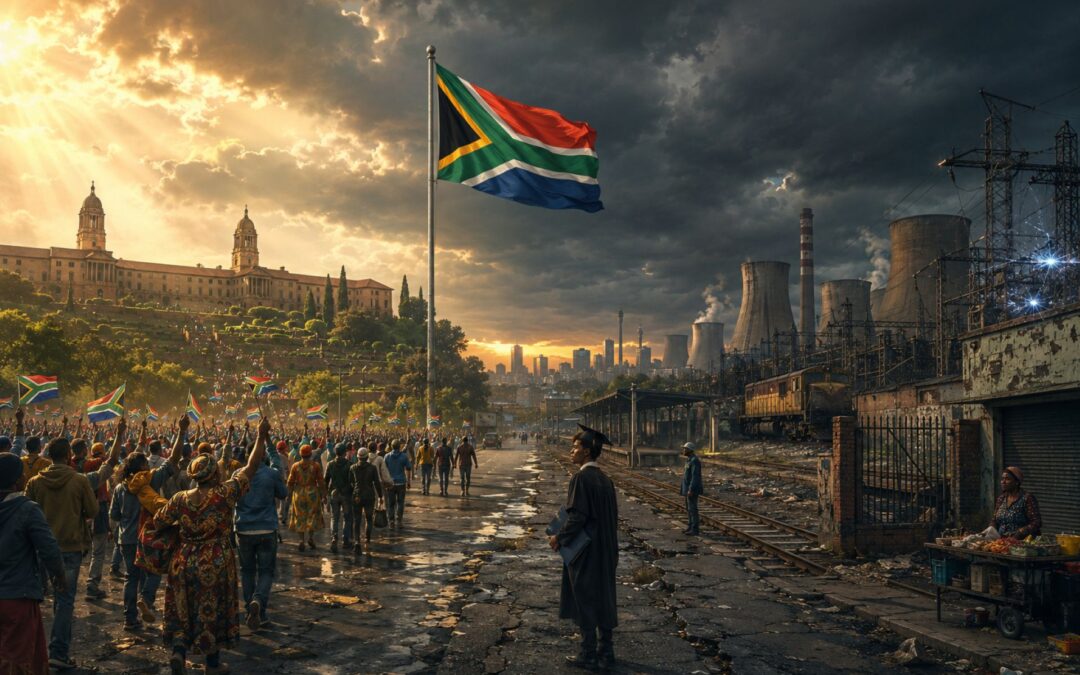
The Promise of 1994
On 27 April 1994, millions of South Africans participated in the country’s first election based on universal adult suffrage. The queues stretched for miles. Some people waited most of the day to cast a vote that apartheid had denied them throughout their lives.
The African National Congress won the election, and on 10 May, Nelson Mandela was inaugurated at Pretoria’s Union Buildings as the first president of democratic South Africa. After 27 years in prison, Mandela stood before the country and promised that freedom would never again be the privilege of one race.
It was more than a transfer of political power. It seemed to be the birth of a new nation.
Apartheid had been dismantled. International sanctions were ending. Political prisoners had been freed. South Africa possessed valuable mineral resources, advanced industries, modern financial institutions and some of the continent’s best infrastructure. The peaceful transition inspired people far beyond its borders.
Three decades later, the picture is far more complicated.
South Africa remains a constitutional democracy with competitive elections, an independent judiciary and a vibrant civil society. It has extended housing, electricity, education, healthcare and social assistance to millions of people once excluded from public life.
Yet it is also one of the most unequal societies on Earth. Economic growth has repeatedly fallen behind population growth. According to the World Bank’s assessment of South Africa, real income per person remains below its 2007 level. In the first quarter of 2026, the official unemployment rate stood at 32.7%, rising to much higher levels among young people.
The democratic revolution gave South Africans equal citizenship.
It did not give them equal economic opportunity.
Understanding why requires more than blaming apartheid, the ANC, corruption, capitalism, socialism or any single policy. South Africa’s present condition emerged from the interaction of an extraordinarily unequal inheritance, incomplete economic transformation, weak growth, institutional decline and years of political corruption.
The promise of 1994 was not meaningless. But it remains unfinished.
The Economy Apartheid Left Behind
Apartheid was formally introduced after the National Party came to power in 1948, but the economic system supporting it was much older.
Colonial conquest had already transferred land, political authority and valuable resources into white hands. The discovery of diamonds and gold created a powerful mining economy dependent on cheap Black labour. Taxes, pass controls and land restrictions pushed African men into mines, farms and urban industries while limiting their ability to settle permanently near their workplaces.
The 1913 Natives Land Act turned this dispossession into national law. Although Black Africans formed the overwhelming majority of the population, they were initially confined to purchasing or occupying land in reserves covering roughly 7% of the country. Later laws enlarged these areas slightly, but also reinforced the principle that land, residence and economic opportunity would be allocated by race.
The Act did not merely divide territory. As South African History Online explains, it helped create a racially and spatially divided country in which Black communities became sources of migrant labour for white-owned agriculture, mining and industry.
After 1948, apartheid extended this logic into almost every part of life.
The government classified people as white, Black, coloured or Indian. It prohibited interracial marriage, segregated schools and neighbourhoods, controlled movement through pass laws and excluded the Black majority from meaningful national political representation.
Through the Group Areas Act and forced removals, communities were expelled from valuable urban land and relocated to townships and distant settlements. Black workers could enter economically important cities, but millions were prevented from living near the businesses, commercial centres and industrial districts that depended on their labour.
Education was designed around the same hierarchy. White children attended better-resourced schools, while Bantu Education prepared Black children for subordinate roles in the economy. Job reservation and discriminatory professional rules restricted access to skilled occupations. Capital, property, pensions, businesses and financial assets accumulated disproportionately within the white population.
By the time apartheid ended, inequality was embedded not only in law but also in ownership, education, geography and infrastructure.
A democratic government could repeal racial legislation immediately. It could not instantly move townships closer to jobs, replace decades of unequal schooling, redistribute professional experience or create household wealth where generations had been prevented from accumulating it.
South Africa did not enter democracy with two communities starting from different positions on the same road.
They had been placed on different roads altogether.
What Democracy Changed
Describing post-apartheid South Africa only as a failure would erase genuine achievements.
The most important change was political freedom itself. Black South Africans became citizens of the state that governed them rather than subjects controlled by it. They could vote, hold office, organise political parties, challenge the government in court and live under a constitution that prohibited racial discrimination.
The new government also inherited an urgent material crisis. Millions of households lacked adequate housing, sanitation, electricity, clean water, healthcare and access to schools.
Over the following decades, access to many basic services expanded substantially. Homes were connected to the electricity grid. Public housing projects were constructed. Water and sanitation networks reached communities previously neglected by the state. Social grants became an essential source of income for poor households, children, pensioners and people with disabilities.
The World Bank’s study of poverty and inequality in South Africa found that the post-apartheid period brought meaningful improvements in access to services and reductions in poverty under several measures, even though progress later slowed and inequality remained deeply entrenched.
A Black professional and middle class also grew. Universities, government departments and private companies became more representative. Black South Africans entered occupations, industries and leadership positions from which apartheid had excluded them.
The early democratic governments maintained relatively conservative fiscal and monetary policies. Public debt declined during parts of the 2000s, inflation was brought under greater control and the country attracted international investment. Growth accelerated during the global commodity boom, allowing the government to expand public services and social protection.
None of these achievements were trivial.
For a family receiving electricity for the first time, a student entering university or a pensioner relying on a social grant, democracy produced visible and important change.
The problem was that these improvements did not become the foundation of a sufficiently productive and inclusive economy.
The state became better at redistributing part of the country’s income than at expanding the number of people able to earn stable incomes through work. Public services reached more people, but their quality was often inconsistent. More students entered the education system, yet too many left without the skills demanded by employers.
South Africa widened access without transforming capability at the same speed.
That distinction would become increasingly important.
Why Political Equality Did Not Produce Economic Equality
Political rights can be granted through laws and institutions. Economic opportunity depends on a much wider system.
It depends on whether children receive a good education, whether workers can reach employment, whether entrepreneurs can obtain finance, whether electricity is reliable, whether contracts are enforced and whether new businesses can compete with established firms.
South Africa struggled in all these areas.
Apartheid’s spatial structure survived democratic rule. Many low-income workers continued to live far from commercial and industrial centres. A job applicant might technically be free to work anywhere but still face several hours of daily travel and transport costs that consumed a large share of the wage.
Housing programmes frequently reinforced this geography by building affordable homes where land was cheapest—often on distant urban peripheries. The government expanded home ownership without always connecting residents to functioning local economies.
Education posed an even deeper problem. South Africa spent a substantial share of public money on schooling, but outcomes remained highly unequal. Former white schools and well-resourced private institutions generally performed far better than schools in poor townships and rural areas.
The result was a divided labour market. At one end, companies complained that they could not find enough engineers, technicians, managers and skilled artisans. At the other, millions of young people searched for work with qualifications that did not open the door to productive employment.
Ownership also remained heavily concentrated. Decades of property appreciation, pension contributions, business ownership and investment income could not be reversed simply by removing legal discrimination. The bottom of the wealth distribution possessed few assets with which to generate further wealth.
Research from the World Inequality Database estimated that the richest 10% owned approximately 86% of aggregate personal wealth, while the bottom 90% shared the remaining 14%.
South Africa’s markets presented another contradiction. The country had sophisticated banks, retailers, mines and telecommunications companies, but many industries were dominated by a relatively small number of large firms.
Market concentration made it harder for new competitors to enter, innovate and lower prices. The World Bank’s inclusive-growth analysis argues that stronger competition and more efficient institutions could produce meaningful gains in productivity and income growth.
These problems reinforced one another.
Poor education reduced employability. Distance from jobs increased the cost of looking for work. Unemployment prevented households from accumulating assets. Concentrated markets limited entrepreneurship. Weak growth reduced the number of new opportunities available.
As explained in A Beginner’s Guide to Economics, prosperity depends on more than the existence of money or natural resources. It requires institutions, infrastructure, human capability, investment and incentives that allow people to participate productively.
South Africa had pieces of this system.
It did not make them work together well enough.
The Long Economic Slowdown
For a time, the depth of the problem was partially hidden by favourable global conditions.
During the early 2000s, demand for minerals helped South Africa benefit from the international commodity boom. Consumer spending increased, tax revenue grew and the country appeared capable of combining redistribution with rising prosperity.
The 2008 global financial crisis ended much of that momentum.
South Africa recovered more slowly than many comparable economies. Private investment weakened. Productivity growth remained low. Manufacturing struggled to expand, and mining faced infrastructure, regulatory and operational constraints.
The country’s population continued to grow while the economy repeatedly expanded by less than 2% a year. Over the decade leading into the mid-2020s, the economy grew by only about 0.7% annually—far below the average for other middle-income countries.
That is why real GDP per person fell back towards levels last seen before the global financial crisis. Economic output grew, but not fast enough to produce substantial improvements in living standards.
The slowdown was not caused by a single decision.
Global conditions mattered. So did falling commodity momentum, weak business confidence, policy uncertainty, poor educational outcomes, crime, limited competition and a declining capacity to deliver major infrastructure.
But two constraints became especially destructive: electricity and freight transport.
Modern economies depend on networks. A factory cannot operate reliably without power. A mine cannot export profitably if trains and ports cannot move its output. A small company cannot plan investment if it expects outages, transport delays and unpredictable administrative decisions.
These failures damaged more than current production. They changed expectations.
Businesses postponed expansion because they could not trust future operating conditions. Investors demanded higher returns to compensate for risk. Skilled workers looked for opportunities abroad. Municipalities lost revenue as local economies weakened.
South Africa gradually became trapped in a cycle in which slow growth weakened the state’s finances, while weak state capacity made faster growth more difficult.
Then governance deteriorated further.
State Capture: When the State Became a Source of Private Wealth
Corruption exists in many political systems. State capture is more dangerous.
Ordinary corruption often involves paying an official to bend an existing rule. State capture involves influencing who writes the rules, who occupies important positions and how entire institutions make decisions.
Under President Jacob Zuma, who governed from 2009 to 2018, political and commercial networks increasingly influenced appointments, procurement and the management of state-owned companies.
The Gupta family became the most notorious symbol of this period.
The brothers had arrived from India in the early 1990s and built businesses spanning computers, media, mining and other industries. Their close relationship with Zuma and members of his family gave rise to allegations that they influenced ministerial appointments and used political connections to secure favourable treatment from public institutions.
The damage went beyond individual contracts.
Boards and senior executives at state-owned enterprises could be replaced with people willing to facilitate particular transactions. Procurement rules could be manipulated. Officials attempting to resist questionable deals could be transferred, marginalised or removed.
The Zondo Commission’s investigation into state capture documented how these networks operated within institutions such as Eskom and Transnet. Its final report extended across more than 5,000 pages and described systemic failures in political accountability, public appointments and procurement.
One of the most controversial cases involved Tegeta Exploration and Resources, a Gupta-linked company that sought to acquire Optimum Coal Mine.
Eskom approved a large coal prepayment to Tegeta at a critical moment in the acquisition. The Zondo Commission concluded that decisions surrounding the arrangement benefited Tegeta while exposing Eskom to unnecessary risk.
The episode illustrates how state capture differed from a simple bribe.
Political influence shaped executive appointments. Executives influenced procurement decisions. Public money then supported private transactions, while the institution carrying the risk had limited protection.
The costs were not limited to the money immediately lost.
Capable officials left. Oversight weakened. Maintenance and long-term planning received less attention than politically connected transactions. Trust declined throughout the public sector.
Once corruption becomes a route to power, honest administration begins to look like disloyalty.
Eskom: The Institution That Could No Longer Keep the Lights On
No institution better represents South Africa’s decline than Eskom.
For decades, the state-owned electricity utility powered mines, factories, businesses and homes across the country. Its large coal stations helped support South Africa’s industrial economy and gave the country some of the world’s cheapest electricity.
But the system was ageing, and investment in new generation came too late.
Construction of the Medupi and Kusile power stations was supposed to solve the capacity shortage. Instead, both projects suffered delays, design defects and enormous cost overruns. Units entered service years behind schedule, while existing plants deteriorated.
Maintenance was repeatedly postponed or poorly executed. Experienced engineers left. Procurement became vulnerable to inflated contracts, unsuitable suppliers and criminal networks.
During the state-capture era, Eskom was drawn into Gupta-linked coal transactions and other questionable arrangements. Yet corruption was only one component of the collapse. Ageing plants, weak project management, insufficient capacity, municipal debt and unstable leadership all contributed.
The result was load shedding: controlled power cuts introduced to prevent the national grid from collapsing.
At first, load shedding appeared intermittently. By 2023, it had become a near-daily feature of life.
Factories lost production. Restaurants discarded spoiled food. Mobile networks and water systems struggled to function. Small companies purchased generators, batteries and solar panels they could barely afford.
Wealthier households could partially escape the problem through private power systems.
Poorer households could not.
Load shedding therefore acted like a regressive tax. It increased costs throughout the economy but imposed the greatest disruption on people with the fewest alternatives.
The crisis also exposed the presence of organised criminal networks inside the energy system. Coal, diesel, cables and spare parts were stolen. Contractors profited from repeated breakdowns. Employees and investigators attempting to disrupt these networks faced intimidation.
André de Ruyter, who became Eskom’s chief executive in 2020, said he survived a suspected cyanide poisoning in December 2022. Police investigated the incident as an alleged attempted murder, although responsibility was never judicially established.
Eskom’s failure spread across the entire economy.
When electricity became unreliable, companies produced less, invested less and employed fewer people. Public institutions diverted money to diesel and emergency systems. Economic activity moved towards businesses and households able to finance their own electricity.
A national utility intended to support development had become one of development’s greatest obstacles.
Transnet and the Infrastructure Crisis Beyond Electricity
Electricity received the most public attention, but South Africa’s logistics system was deteriorating at the same time.
Transnet manages much of the country’s freight rail network, ports and pipelines. These systems are essential for an economy that exports minerals, agricultural products and manufactured goods over long distances.
As with Eskom, years of weak management, corruption, equipment shortages and underinvestment reduced performance.
Rail lines became vulnerable to cable theft and vandalism. Locomotives were unavailable because of maintenance problems and disputes over spare parts. Port congestion caused vessels to wait outside harbours, while exporters faced delays and higher costs.
Mining companies that could not obtain sufficient rail capacity moved more freight by road. That increased congestion, damaged highways and raised transport costs.
Some producers simply exported less.
The decline of Transnet demonstrated that valuable natural resources do not automatically create prosperity. Minerals buried underground are economically useful only when mines can extract them, electricity can process them, trains can transport them and ports can ship them.
A country can possess enormous natural wealth and still be constrained by broken networks.
State capture again formed part of the story. The Zondo Commission investigated major Transnet procurement deals and the influence of politically connected intermediaries. But operational decline also reflected years of neglected maintenance and slow institutional reform.
South Africa’s infrastructure crisis was therefore not one spectacular collapse.
It was the gradual weakening of multiple systems on which every productive sector depended.
Black Economic Empowerment: Necessary Transformation, Uneven Results
The end of apartheid created a difficult economic question.
How could South Africa establish political equality while leaving companies, capital and valuable assets concentrated among the minority that had benefited from racial privilege?
One answer was Black Economic Empowerment.
The policy evolved over time into Broad-Based Black Economic Empowerment, commonly known as B-BBEE. Its stated purpose was to expand Black participation in ownership, management, employment, skills development, procurement and enterprise creation.
Companies could receive scores based on their performance across these areas. Their ratings influenced eligibility for public contracts and affected relationships with customers and suppliers seeking to improve their own compliance.
The objective was legitimate and necessary.
A democratic South Africa could not indefinitely accept an economy in which corporate leadership and ownership continued to reflect apartheid.
BEE helped create opportunities for Black executives, professionals and investors. It encouraged companies to examine hiring, management, training and procurement practices that might otherwise have remained unchanged.
But its results were uneven.
Some early ownership transactions relied on debt structures that benefited a limited group of prominent investors while leaving broad public ownership largely untouched. Companies often preferred well-connected partners who could help them navigate political and regulatory environments.
This contributed to the perception that empowerment was enriching a small elite rather than creating mass economic participation.
Cyril Ramaphosa’s business career illustrates part of the system. After serving as a trade-union leader and ANC negotiator, he entered business through Shanduka Group, which acquired interests across mining, telecommunications, finance, food and property.
Companies sought influential Black partners partly because ownership and relationships had become important in the new economic environment. Ramaphosa built substantial wealth before returning to senior political office.
That does not make every BEE transaction corrupt. It does reveal the limits of trying to transform a national economy through a relatively small number of ownership deals.
Scorecard compliance also created administrative costs and incentives for manipulation. Some businesses engaged in “fronting,” presenting Black partners or employees as meaningful participants without transferring genuine authority or economic benefit.
Procurement rules could encourage companies to select suppliers partly for their empowerment ratings rather than solely for price, quality or capability. Smaller firms sometimes struggled with the expense and complexity of compliance.
Yet the claim that BEE alone destroyed economic growth is not supported by strong evidence.
A 2025 study published in the Journal of Comparative Economics examined listed South African companies and found limited effects: improved empowerment scores were associated with a small positive effect on turnover, no clear penalty to profits and no robust causal improvement in labour productivity.
That is neither a spectacular success nor proof of economic catastrophe.
The deeper problem is that BEE attempted to change participation at the top of the economy without sufficiently transforming the capabilities at its base.
Ownership rules could not repair failing schools. Procurement targets could not create reliable electricity. Corporate scorecards could not move workers closer to employment or make municipalities function.
South Africa needed racial transformation.
But transformation had to mean more than transferring stakes among existing businesses. It had to create new businesses, skilled workers, competitive markets and productive assets owned by a much broader section of society.
Why South Africa Could Not Create Enough Jobs
South Africa’s unemployment crisis is sometimes blamed almost entirely on labour law.
The Labour Relations Act of 1995 strengthened collective bargaining, protected workers from unfair dismissal and established procedures employers had to follow when retrenching staff. These rights responded to a history in which Black labour had been exploited and denied meaningful bargaining power.
But stronger employment protection can also make companies more cautious about hiring, particularly when dismissals are expensive, slow or legally uncertain.
This tension is real.
It is not a complete explanation for unemployment above 30%.
A company hires workers when it expects their output to justify the cost. That calculation depends on far more than wages and dismissal procedures.
It depends on demand, electricity, transport, skills, crime, finance, technology and the overall cost of operating the business.
South African companies faced weak economic growth and repeated infrastructure disruptions. Small businesses encountered licensing requirements, administrative delays and difficulty obtaining capital. Established companies often operated in concentrated markets that were hard for new competitors to enter.
Many job seekers lacked the experience or technical skills available positions required. At the same time, employers offering entry-level work had to consider transport difficulties and the cost of training employees who might arrive with weak basic education.
The geography of apartheid further reduced opportunity. A low-wage job located far from a township may not be viable once commuting time and transport costs are considered.
These barriers help explain why South Africa’s unemployment problem is particularly severe among young people. In the first quarter of 2026, the official unemployment rate among people aged 15 to 34 stood at 45.8%. Millions of young South Africans were neither employed nor actively participating in the labour market.
A country cannot solve a crisis of this scale simply by making dismissal easier.
It needs an economy in which more firms are created, existing firms expand and workers possess skills that increase what those firms can produce.
Labour-market reform may form part of that solution. It cannot substitute for growth.
The Human Cost of Stagnation
Economic statistics can make suffering appear abstract.
A unemployment rate does not capture what it means to spend years moving between temporary work, family support and unsuccessful job applications.
A GDP figure does not show the strain placed on a household in which one wage or social grant supports several adults and children.
South Africa’s racial income gap remains enormous. The 2022–2023 Income and Expenditure Survey reported average annual income of R676,375 for white-headed households and R143,632 for Black African-headed households. The white household average was almost five times higher.
These are group averages, not descriptions of every individual. Millions of white South Africans are not wealthy, and a substantial Black middle and upper class exists.
But the gap reveals how strongly apartheid’s distribution of assets, education and opportunity continues to shape economic outcomes.
Poverty figures require similar care because they vary according to the threshold being used. A narrow food-poverty measure produces a much lower estimate than an upper-middle-income international poverty line.
Using the latter measure, the World Bank estimated that roughly two-thirds of South Africans lived in poverty. The purpose of citing that figure is not to suggest that two-thirds of the population faces identical deprivation. It shows how many people remain unable to reach a standard considered minimally secure for a country at South Africa’s income level.
Weak public infrastructure magnifies this insecurity.
When water systems fail, households purchase water privately or go without it. When electricity fails, businesses close early and students struggle to study. When trains stop running, commuters depend on more expensive alternatives.
Crime adds another layer of cost. Businesses pay for security. Households install gates, alarms and electric fencing where they can afford them. Communities that cannot purchase private protection remain more exposed.
The wealthy withdraw into privately supplied systems of electricity, transport, education, healthcare and security.
The poor remain dependent on institutions most likely to fail.
This is how inequality becomes self-reinforcing. Wealth buys protection from public collapse, while public collapse makes wealth even more valuable.
The Election That Ended the ANC’s Majority
For 30 years, the ANC dominated South African politics.
Its legitimacy came from its role in the liberation struggle and from the historic leadership of figures such as Mandela, Oliver Tambo and Walter Sisulu. For many voters, supporting the ANC was inseparable from rejecting apartheid.
But liberation credentials could not indefinitely protect the party from the consequences of governing.
Corruption scandals, unemployment, failing municipalities, load shedding and weak public services gradually reduced its support. Internal divisions further damaged its ability to present itself as a coherent national movement.
In the May 2024 election, the ANC lost its parliamentary majority for the first time since democracy began. It remained the largest party, but could no longer govern nationally on its own.
The result was not merely a bad election.
It ended the assumption that the ANC possessed a permanent right to rule.
With no party holding a majority, South Africa entered negotiations that produced a Government of National Unity. The arrangement initially brought together ten parties from across the political spectrum, including the ANC, the Democratic Alliance and the Inkatha Freedom Party.
The coalition was unusual and potentially unstable. The ANC and the Democratic Alliance differed on economic policy, race, social programmes, foreign affairs and the proper role of the state.
Yet they agreed on broad priorities: inclusive growth, job creation, poverty reduction and the construction of a more capable and ethical government.
The new arrangement created competing pressures.
The ANC had to share authority and reassure coalition partners concerned about corruption and economic policy. The Democratic Alliance had to demonstrate that participation in government could produce tangible results without abandoning its identity as an opposition party.
This did not automatically create a uniformly pro-market government.
It did, however, make unilateral rule more difficult and reform more politically urgent.
South Africans had delivered a warning: historical loyalty would no longer compensate indefinitely for institutional failure.
The First Signs of a Turnaround
The most visible improvement came in electricity.
The government removed restrictions that had limited private power generation, allowing companies and independent producers to build new capacity. Households and businesses installed large amounts of rooftop solar, reducing demand on Eskom during parts of the day.
Eskom also intensified maintenance and operational reforms under its Generation Recovery Plan. Plant performance improved, unplanned outages declined and previously unavailable generating units returned to service.
By 22 April 2026, Eskom reported that South Africa had completed 341 consecutive days without national load shedding. Its energy availability factor had also improved compared with the previous financial year.
This did not mean that every household enjoyed uninterrupted electricity. Local outages caused by municipal failures, damaged transformers and distribution problems continued.
But the reduction in national load shedding represented a major operational achievement.
Reform also reached logistics.
South Africa began separating management of rail infrastructure from train operations and opening parts of the network to private operators. Transnet allocated capacity expected to introduce an additional 24 million tonnes of freight to the rail system, with the possibility of further expansion.
These changes formed part of Operation Vulindlela, a joint initiative of the Presidency and National Treasury designed to remove structural barriers in electricity, freight logistics, water, telecommunications, visas and local government.
The name means “open the way.”
Its importance lies partly in its method. Instead of announcing one grand ideological programme, it identifies specific institutional blockages, assigns responsibility and tracks implementation across government departments.
Fiscal indicators also improved.
The 2026 National Budget Review projected a primary surplus—meaning revenue exceeded expenditure before interest payments—while the overall budget remained in deficit. Government debt was expected to stabilise rather than continue rising without limit.
In November 2025, S&P Global upgraded South Africa’s foreign-currency sovereign rating from BB− to BB, the first upgrade from a major global agency in more than 16 years. Moody’s changed its outlook from stable to positive in May 2026, while retaining its existing rating.
These developments mattered because they indicated that reforms were beginning to influence expectations.
The lights stayed on. Freight reform advanced. Fiscal management improved. Investors became more willing to consider the possibility that South Africa’s decline was not irreversible.
But a turnaround in expectations is not the same as a transformation in living standards.
Why the Recovery Remains Fragile
South Africa’s recent improvements began from a low base.
Ending load shedding removed one of the economy’s largest immediate constraints. It did not automatically repair weak education, municipal collapse, crime, unemployment or concentrated ownership.
Economic growth remained modest. The 2026 budget expected stronger performance, but even medium-term projections remained below the rates required to absorb millions of unemployed people quickly.
The fiscal position also remained difficult.
A primary surplus sounds reassuring, but interest payments still consume a large share of public revenue. The government continued to run an overall budget deficit, and public debt remained high. Faster growth and continued spending discipline would be required to place the debt burden on a clearly declining path.
Municipal government presented another serious risk.
Many local authorities struggled to collect revenue, maintain infrastructure or deliver reliable water, electricity and sanitation. National reforms can improve generation and rail policy, but daily life is often shaped by local institutions.
Water systems may become the next major infrastructure constraint. Ageing pipes, leaks, maintenance failures and administrative weakness have already created serious shortages in parts of the country.
The political coalition itself remains vulnerable.
Parties within the Government of National Unity disagree on healthcare, empowerment rules, land, education, foreign policy and the size of the state. Electoral competition encourages each partner to claim credit for success and blame others for unpopular decisions.
Reform can survive disagreement.
It cannot survive permanent paralysis.
Corruption prosecutions provide another test. Commissions and reports have revealed how state capture operated, but the public will judge the system by whether powerful participants are held accountable and stolen assets are recovered.
Eskom’s improvement must also be sustained. Much of its fleet remains old, and South Africa needs substantial investment in transmission infrastructure to connect new renewable generation to the grid.
Early progress is real.
So are the forces capable of reversing it.
What South Africa Must Do Next
South Africa does not need to choose between economic transformation and economic growth.
It needs a strategy in which each makes the other possible.
The first priority is institutional competence.
Appointments to state-owned companies, regulators and public departments must be based on expertise and integrity rather than party loyalty. Procurement systems need transparency, professional oversight and consequences for abuse.
The country must continue rebuilding the criminal-justice institutions responsible for investigating corruption, organised crime and illicit financial networks. State capture becomes rational when the rewards are enormous and punishment is uncertain.
Electricity reform must move beyond the end of load shedding. South Africa needs new generation, expanded transmission networks, financially sustainable distribution systems and a stable market in which public and private producers can invest.
Rail and port reform should continue opening infrastructure to additional operators while preserving effective regulation. Mining, manufacturing and agriculture cannot expand if exports remain dependent on unreliable logistics.
The country also needs more competitive markets. Dominant companies should not be punished merely for being successful, but regulations and financing systems should make it easier for new firms to challenge them.
Small businesses require simpler procedures, reliable municipal services and better access to credit. They should be able to grow without crossing regulatory thresholds that suddenly make expansion prohibitively complex.
BEE should be judged by whether it creates broad and durable capability.
That means placing greater emphasis on education, technical training, entrepreneurship, employee ownership and the development of genuinely competitive Black-owned suppliers. Ownership remains important, but a narrow transaction involving a politically connected investor should not be treated as equivalent to thousands of workers acquiring productive assets and skills.
Labour reform should protect basic rights while making entry-level employment and apprenticeship easier to create. Young people need routes into the labour market before long-term unemployment destroys their skills, confidence and professional networks.
Above all, South Africa must improve basic education.
No empowerment policy, social grant or infrastructure programme can compensate indefinitely for schools that fail to provide literacy, numeracy and practical capability.
Education reform will be politically difficult because it involves teacher support, accountability, school leadership, early-childhood development and the allocation of resources.
It is still unavoidable.
Cities must also become more integrated. Housing, transport and economic development should bring people closer to opportunity rather than reproducing apartheid’s distant settlements.
Social grants should remain part of the system. In a society with mass unemployment, removing support would deepen poverty and instability.
But redistribution works best when supported by a growing productive economy.
The goal should not be to choose between supporting people today and creating opportunity tomorrow.
A capable state must do both.
The Dream Did Not Disappear—But It Remains Unfinished
The democratic transition of 1994 was one of the twentieth century’s greatest political achievements.
It ended a system that had denied the majority citizenship, dignity and freedom. It gave South Africans the power to remove their leaders through elections rather than revolution.
That achievement should not be diminished simply because democracy failed to solve every inherited problem.
But political liberation was never meant to be the final destination.
A child born after apartheid may possess rights denied to previous generations and still attend a failing school. A worker may be free to live and work anywhere while remaining trapped far from employment. A voter may be able to change the government yet remain unable to change the economic circumstances of the household.
South Africa’s tragedy is not that nothing changed after 1994.
It is that so much changed politically while economic opportunity remained scarce, unequal and vulnerable to institutional failure.
Apartheid created the structure. Democratic governments struggled to dismantle it. State capture then damaged the institutions needed to complete the work.
The recent improvement in electricity, logistics and fiscal policy demonstrates that decline is not inevitable. Institutions can recover when incentives change, capable people are empowered and political leaders accept practical reform.
But South Africa’s success cannot be measured only by the absence of load shedding, an improved credit rating or a higher growth forecast.
It must be measured by whether businesses invest, schools educate, municipalities function and millions of people find productive work.
Mandela’s generation won political freedom.
The task facing South Africa now is to make that freedom economically meaningful.
Last Updated on July 14, 2026 by Aseem Gupta