
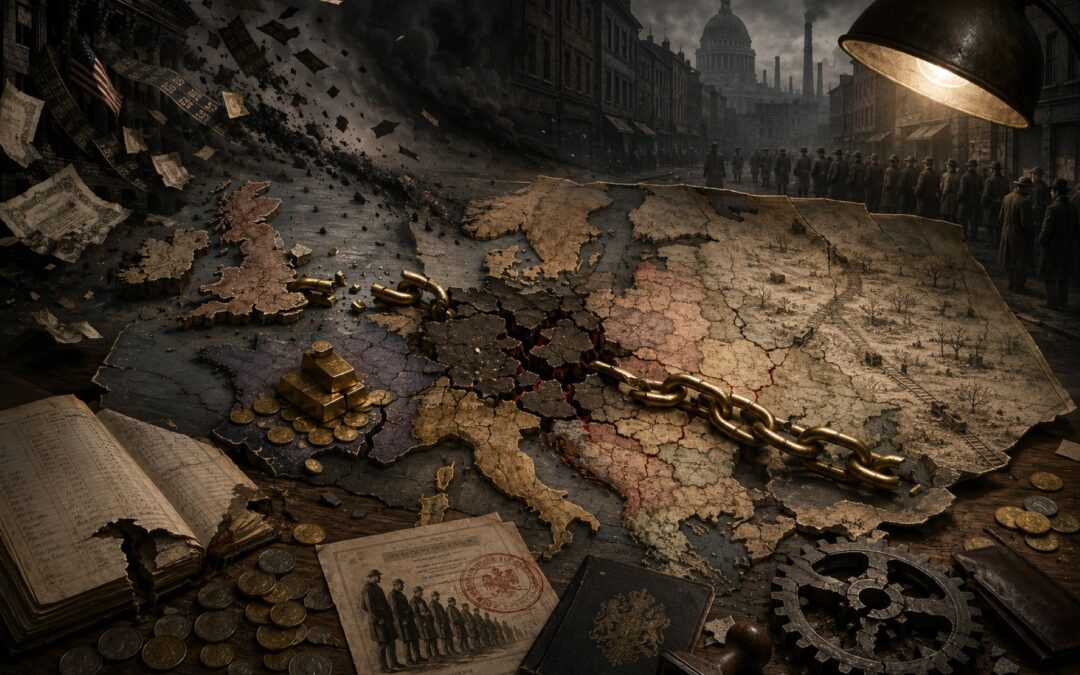
The Great Depression is often remembered as an American disaster: Wall Street crashed, banks failed, breadlines grew, and the United States sank into the worst economic crisis of the modern age.
But the Depression did not stay American.
Across Europe, it became something even more dangerous than an economic downturn. It exposed a continent still weakened by the First World War, trapped by debt, tied to fragile banks, and constrained by a monetary system that made governments defend currencies while people lost jobs. What began as a financial shock became a test of whether Europe’s political order could survive mass unemployment, collapsing trade, and public despair.
In many places, it could not.
The Great Depression broke Europe because it hit a continent that had never fully healed. It did not create every crisis of the 1930s, but it deepened almost all of them. It strained democracies, strengthened extremists, shattered faith in liberal institutions, and helped push Europe toward the darker politics of the decade.
To understand what happened, we have to look beyond the stock market crash and ask a more important question: why was Europe so vulnerable when the global economy fell apart?
Europe Was Already Fragile Before the Crash
The Great Depression did not arrive in Europe like a storm hitting solid ground.
It arrived on a continent that was already cracked.
By 1929, Europe had spent barely a decade trying to recover from the First World War. The war had destroyed lives, factories, railways, farms, empires, currencies, and political systems. It had also rearranged the global economy. Before 1914, Europe had been the center of world finance and trade. After the war, it was wounded, indebted, and increasingly dependent on the United States.
That is why the Great Depression in Europe cannot be understood as a simple aftershock of the Wall Street Crash. The crash mattered enormously, but Europe’s deeper problem was that the continent had rebuilt the postwar economy on fragile foundations.
Germany was burdened by reparations. Britain struggled with older industries like coal, steel, shipbuilding, and textiles. France had rebuilt after enormous wartime damage but remained tied to the financial settlement of the war. Austria and much of Central Europe were left economically dislocated after the collapse of old empires. Eastern Europe depended heavily on agricultural exports at a time when global commodity prices were already unstable.
Europe was not one economy, but many weak economies tied together by debt, trade, banks, currencies, and political fear.
The postwar settlement made this worse. The First World War had left behind a triangle of financial dependence: Germany owed reparations to Britain and France; Britain and France owed war debts to the United States; and Germany increasingly relied on American loans to keep its economy functioning. The U.S. State Department’s history of the Great Depression describes how this fragile international financial structure helped turn a national downturn into a global crisis.
In good times, the system looked like recovery.
In bad times, it was a trap.
The 1920s gave parts of Europe a sense of normalcy, but it was not the same as real stability. Many governments wanted to restore the prewar world: balanced budgets, fixed exchange rates, stable currencies, and the gold standard. They wanted to show that Europe had returned to order.
But the old order could not simply be switched back on.
The war had changed everything. The debts were larger. The currencies were weaker. The electorates were angrier. The banking systems were more exposed. The United States had become the world’s major creditor. And democratic governments, many of them young or fragile, now had to manage economic shocks in societies already traumatized by war.
So when the crash came, Europe did not merely suffer a recession.
It entered a second postwar crisis.
The American Crash Became a European Crisis
The Wall Street Crash of 1929 did not instantly destroy Europe. The more important damage came through what happened after the crash: American credit tightened, international lending slowed, banks became cautious, demand fell, and global trade began to shrink.
Europe had become deeply dependent on the flow of American money.
This mattered most in Germany. During the 1920s, American loans had helped stabilize the Weimar Republic after hyperinflation and political chaos. Those loans supported German industry, government finances, and reparations payments. When American investors pulled back after 1929, Germany lost one of the pillars holding up its recovery.
But Germany was not alone. The wider European economy depended on trade and financial confidence. When the United States fell into depression, it imported less from abroad. When banks became fearful, lending dried up. When businesses expected lower demand, they cut production and jobs. When workers lost jobs, they bought less, making the crisis worse.
A downturn that began in one financial center became a chain reaction.
According to Britannica’s overview of the Great Depression, the crisis was marked by falling industrial production, deflation, mass unemployment, banking panics, and a collapse in confidence. But the timing and severity varied across countries. That variation matters because it shows that the Depression was not just an event that happened to everyone equally. It was shaped by each country’s institutions, policies, debts, industries, and political choices.
In Europe, those choices were often constrained by fear.
Governments feared inflation because many Europeans had lived through wartime price shocks and, in Germany’s case, catastrophic hyperinflation. They feared currency collapse. They feared losing access to foreign credit. They feared looking irresponsible to international markets. They feared breaking from the gold standard because gold was treated as a symbol of national seriousness.
So instead of responding to the Depression by expanding demand and protecting employment, many governments did the opposite.
They cut spending.
They defended their currencies.
They tried to balance budgets.
They accepted deflation.
In theory, this was discipline.
In practice, it deepened the crisis.
The Gold Standard Turned Pain Into Policy
The gold standard sounds technical, but its effect was brutally simple.
If a country tied its currency to gold, it had to defend that link. If gold was leaving the country or investors were losing confidence, the government and central bank had to act in ways that made the currency more attractive. That often meant raising interest rates, cutting credit, reducing wages and prices, and limiting government spending.
In a depression, those policies could be disastrous.
They made borrowing harder when businesses needed relief. They made unemployment worse when workers needed jobs. They pushed prices downward, which made debts heavier in real terms. They forced governments to prioritize currency credibility over human suffering.
This is why the gold standard has become one of the central explanations for why the Great Depression became so deep and international. Barry Eichengreen and Peter Temin’s influential paper, “The Gold Standard and the Great Depression”, argues that the gold standard was not just a background feature of the crisis. It shaped how governments understood the problem and limited the policies they were willing to use.
The tragedy was that many policymakers believed they were preserving stability.
They were actually preserving the mechanism that spread instability.
Ben Bernanke’s work on the Depression also emphasizes the international gold standard as a key transmission mechanism. In his Federal Reserve speech on money, gold, and the Great Depression, Bernanke explained how gold flows and monetary tightening helped spread deflation across countries. When nations tried to protect their gold reserves, they often tightened their own economies, pushing the depression deeper.
This created a cruel pattern.
Countries that stayed on gold longer tended to suffer longer. Countries that left gold earlier gained more freedom to cut interest rates, expand money, and recover.
But in the early years of the crisis, leaving gold felt radical. It looked like failure. It suggested that a country could no longer honor its promises. For governments built on the memory of wartime chaos and inflation, that was terrifying.
So they stayed.
And ordinary people paid the price.
The gold standard turned an economic crisis into an ideological test. Governments were not simply asking, “How do we reduce unemployment?” They were asking, “How do we preserve confidence, discipline, and international respectability?”
That question had a deadly flaw.
A government can preserve the confidence of creditors while losing the confidence of its people.
1931 Was the Year Europe’s Financial System Cracked
If 1929 was the symbolic beginning of the Great Depression, 1931 was the year Europe’s crisis became impossible to contain.
The panic began in Austria. In May 1931, Creditanstalt, the country’s largest bank, revealed huge losses. The bank was not just another financial institution. It was deeply tied to Austrian industry and to the fragile postwar economy of Central Europe. Its failure threatened far more than depositors. It threatened the belief that Europe’s banking system could survive the Depression.
Fear spread quickly.
Investors began to worry about Germany. German banks were exposed, confidence was weak, and the country’s dependence on foreign credit made it vulnerable to capital flight. As money left, the pressure on Germany intensified. The government was trapped between defending the currency, meeting international obligations, and dealing with mass unemployment.
The banking crisis soon became a political crisis.
Germany imposed exchange controls. Banks came under pressure. International rescue efforts were too slow, too limited, or too politically constrained. The financial system was no longer just weak; it was visibly breaking.
Then the pressure reached Britain.
Britain had returned to the gold standard in 1925 at a rate that many critics believed overvalued the pound. This hurt exports and placed pressure on older industries. By 1931, with global confidence collapsing and gold flowing out, Britain faced a choice: defend gold at enormous domestic cost or abandon it.
In September 1931, Britain left the gold standard.
At the time, this looked like a national humiliation. In hindsight, it was the beginning of recovery.
This is what made 1931 so important. It revealed that the interwar economic system was not just suffering from temporary stress. It was structurally broken. Banks, currencies, debts, reparations, and gold were all connected. Once confidence cracked in one place, it could move across borders with frightening speed.
The Depression was no longer a distant American crisis.
It was a European financial emergency.
And once banks failed, something deeper failed with them: trust.
People who lose trust in banks do not only worry about money. They worry about whether the entire system is a lie. They wonder whether governments are competent, whether elites understand reality, whether democracy can protect them, and whether radical alternatives deserve a chance.
That is where economics became politics.
Germany Became the Depression’s Political Warning Sign
No European country shows the political danger of the Great Depression more dramatically than Germany.
The Weimar Republic was already fragile before the Depression. It had survived defeat in World War I, revolution, hyperinflation, assassination, attempted coups, and bitter arguments over the Treaty of Versailles. By the late 1920s, it appeared more stable, but much of that stability depended on foreign loans, economic recovery, and the belief that parliamentary government could deliver order.
The Depression shattered that belief.
As American lending dried up and German industry contracted, unemployment soared. Businesses failed. Wages came under pressure. The government struggled to respond. Instead of bold relief, Germany’s leaders often pursued austerity, partly because they feared inflation, partly because they wanted to maintain international confidence, and partly because the political system was too divided to act decisively.
The result was misery without a convincing democratic answer.
The United States Holocaust Memorial Museum explains that the Depression created dire economic conditions in Weimar Germany and helped make Adolf Hitler and the Nazi Party more politically attractive. This does not mean the Depression alone caused Nazism. That would be too simple. Hitler’s rise also depended on nationalism, antisemitism, resentment over Versailles, elite miscalculation, political violence, propaganda, and the weaknesses of Weimar institutions.
But economic collapse changed what millions of people were willing to believe.
When unemployment becomes mass unemployment, politics changes. Desperation makes extreme promises sound practical. Anger looks like clarity. Complexity feels like evasion. A party that offers enemies, certainty, and national rebirth can gain power not because its answers are true, but because the existing system appears to have no answers at all.
The Nazi Party understood this.
It presented democracy as weak, compromise as betrayal, and economic suffering as proof that Germany had been humiliated by internal and external enemies. The worse the crisis became, the more powerful that message grew.
The Depression did not invent Europe’s extremist movements. Fascism, communism, authoritarian nationalism, and anti-democratic politics already existed.
But the Depression gave them oxygen.
Germany was the warning sign because its collapse showed what could happen when economic despair met a discredited political system. A financial crisis could become a legitimacy crisis. A legitimacy crisis could become a constitutional crisis. A constitutional crisis could open the door to dictatorship.
The lesson was not that poverty automatically produces extremism.
The lesson was that when democratic governments cannot protect people from collapse, people may stop protecting democracy.
Britain Escaped Earlier Because It Left Gold Earlier
Britain’s experience was painful, but it was different from Germany’s.
The country entered the Depression with serious weaknesses. Its older industrial regions had struggled through much of the 1920s. Coal, shipbuilding, steel, and textiles were already under pressure. Returning to gold in 1925 at the old prewar parity had made exports less competitive and placed additional strain on industry.
So Britain did not escape the Depression.
But it did escape some of the worst consequences earlier than countries that clung to gold for longer.
The turning point came in September 1931, when Britain abandoned the gold standard. This was politically embarrassing, but economically liberating. Once Britain no longer had to defend the pound’s gold value, it gained room to lower interest rates and pursue easier monetary conditions.
The effects were not magical or immediate for everyone. Unemployment remained high in many industrial areas, and regional suffering continued. But leaving gold helped shift the direction of the economy. As CEPR’s VoxEU analysis explains, Britain’s departure from gold improved international competitiveness as sterling’s effective exchange rate fell sharply in 1931.
In simpler terms, Britain stopped sacrificing its domestic economy to defend an exchange rate.
That mattered.
Lower interest rates encouraged housing and domestic investment. A cheaper pound helped exports. Policy became less trapped by the need to protect gold reserves. The state did not suddenly become modern Keynesianism in full form, but Britain had more room to breathe.
Britain’s case reveals one of the most important patterns of the Depression: recovery often began when countries stopped treating gold as sacred.
This is not because devaluation solved every problem. It did not. It could not rebuild devastated industries overnight, erase class conflict, or fix regional inequality. But it gave governments something they desperately needed: policy flexibility.
Germany’s crisis showed what happened when economic collapse overwhelmed politics.
Britain’s experience showed something else: a country could begin to recover when it abandoned a symbol of old stability that had become a source of new pain.
France Suffered Differently Because It Held On Longer
France’s Depression did not look exactly like Britain’s or Germany’s.
At first, France seemed more resilient. It was less immediately exposed to some of the same shocks, and its economy did not collapse as quickly as Germany’s. This delay can make France look like a partial exception to Europe’s Depression story.
But France’s problem was not that it avoided the crisis.
It was that it suffered later and longer.
France remained attached to gold after Britain and others had left. That commitment made it harder to adjust. As countries that had abandoned gold devalued their currencies, French exports became less competitive. Deflationary pressure increased. Political conflict deepened. Governments changed frequently. The economy stagnated.
France had also become central to the gold problem in another way. Bernanke’s Federal Reserve speech notes that after France returned to gold in 1928, its accumulation of gold contributed to pressure on other countries by forcing monetary tightening elsewhere. This is one reason the interwar gold system was so unstable: the behavior of major gold-holding countries could transmit pressure across the entire system.
France’s case is important because it complicates the story.
The Depression was not one identical collapse across Europe. Some countries fell early. Some delayed the pain. Some suffered through banks. Some suffered through exports. Some suffered through agriculture. Some suffered through political paralysis.
France’s suffering was tied to delay, rigidity, and the difficulty of adjusting once others had already changed course.
In Britain, leaving gold became a path to recovery.
In France, staying on gold became a source of prolonged stagnation.
That contrast is one of the clearest ways to see the Depression as more than a market crash. It was a test of whether governments could abandon old rules when those rules were destroying the present.
Italy and Eastern Europe Showed the Crisis Was Not One Story
Germany, Britain, and France dominate the story of the Great Depression in Europe, but they were not the whole story.
Italy had already become a fascist dictatorship before the Depression. Mussolini’s regime responded to the crisis with state intervention, corporatist policies, public works, and attempts to control economic life through authoritarian institutions. The Depression did not create Italian fascism, but it strengthened the case for state control and autarkic thinking. Economic crisis made liberal capitalism look weak, and authoritarian regimes used that weakness as propaganda.
Eastern Europe faced a different kind of vulnerability.
Many countries in the region depended heavily on agricultural exports. When global prices collapsed, farmers were devastated. Rural debt became harder to bear. Governments had fewer resources. Political systems became more unstable. In economies where industrial employment was limited and democratic institutions were fragile, the Depression intensified existing pressures.
The crisis also damaged international cooperation. Countries raised tariffs, protected domestic producers, restricted currency movements, and looked inward. The global economy fragmented. The ideal of a liberal international order, already weakened by the First World War, became harder to defend.
This is why Europe’s Depression should not be reduced to one national case.
Germany showed the political danger of mass unemployment and democratic collapse.
Britain showed the importance of leaving gold.
France showed the cost of delayed adjustment.
Italy showed how authoritarian regimes could use the crisis to justify control.
Eastern Europe showed how falling commodity prices and weak states could produce a different kind of instability.
Across the continent, the pattern was not uniform, but the direction was similar: less trust, less openness, less cooperation, more fear.
The Great Depression broke Europe unevenly.
But it broke enough of Europe to change the future.
The Depression Did Not Just Destroy Jobs. It Destroyed Trust.
The most dangerous effect of the Great Depression was not only economic hardship.
It was the destruction of trust.
People lost trust in banks when savings vanished or credit disappeared. They lost trust in employers when jobs disappeared. They lost trust in currencies when money seemed unstable. They lost trust in governments when leaders appeared more committed to budgets and gold than to hungry families. They lost trust in international cooperation when every country seemed to be protecting itself at everyone else’s expense.
That kind of trust is hard to rebuild.
A person who loses a job suffers materially. But a society where millions lose jobs begins to suffer politically. People stop believing that the rules are fair. They stop believing that patience will be rewarded. They stop believing that experts know what they are doing. They stop believing that moderation is strength.
In the 1930s, this loss of trust was everywhere.
Democracy looked slow. Dictatorship looked decisive. Internationalism looked naive. Nationalism looked protective. Compromise looked weak. Anger looked honest.
This is the emotional force behind Europe’s Depression. It was not just a graph of falling output or rising unemployment. It was a lived experience of humiliation, fear, and abandonment.
The crisis also exposed a moral failure in the way many governments understood economics. They treated confidence as something owed to creditors and markets, but not necessarily to citizens. They defended currencies while people lost homes. They protected financial orthodoxy while political legitimacy drained away.
That does not mean policymakers were stupid or cruel in a simple sense. Many were trapped by the ideas of their time. They feared inflation because they had seen what inflation could do. They feared debt because the war had made debt politically explosive. They feared devaluation because it looked like national decline.
But a policy can be understandable and still be disastrous.
The Depression forced Europe to learn that economic systems are not judged only by whether they preserve rules. They are judged by whether they preserve societies.
When the rules become more important than the people living under them, the rules themselves eventually lose legitimacy.
That is what happened across much of Europe in the 1930s.
The Depression did not merely empty factories.
It emptied faith.
Europe’s Lesson: A Financial Crisis Becomes Dangerous When Politics Cannot Absorb It
The Great Depression in Europe was not simply a story of American contagion. It was a story of a fragile continent hit by a global shock and then trapped by its own institutions, debts, fears, and political divisions.
The United States crash mattered. American credit mattered. Trade collapse mattered. Banking panic mattered.
But Europe’s disaster became so deep because the continent had never fully recovered from the First World War. Its financial system depended on unstable flows of money. Its governments were constrained by the gold standard. Its societies were divided. Its democracies were young, wounded, or mistrusted. Its people had already endured too much history in too little time.
That is why the Depression became more than an economic downturn.
It became a test of whether European states could protect their citizens without destroying their currencies, whether democracies could act decisively without becoming authoritarian, whether international cooperation could survive national panic, and whether people would continue to believe in systems that seemed unable to defend them.
In many places, the answer was no.
Some countries adjusted and recovered earlier. Others remained trapped longer. Some democracies survived. Others collapsed. But across Europe, the Depression changed what people thought was possible, what they feared, and what kinds of politics they were willing to accept.
The deepest lesson is uncomfortable because it still matters.
A financial crisis is dangerous when banks fail.
It is more dangerous when governments fail.
But it becomes historic when people stop believing that the existing order deserves to survive.
Last Updated on June 25, 2026 by Aseem Gupta